
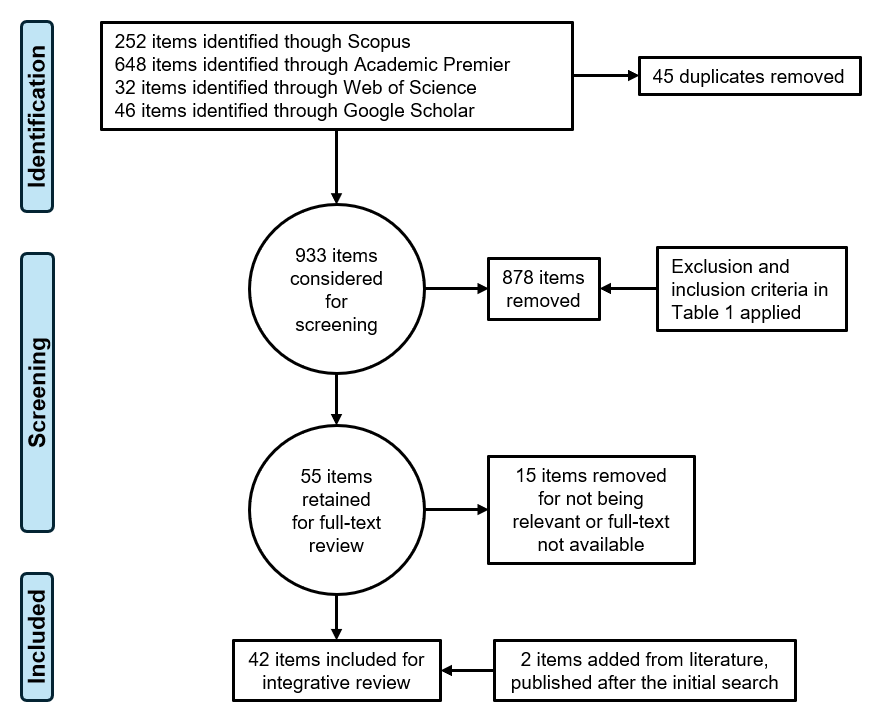
Figure 1
PRISMA diagram for selection of the reviews.
Table 1
Inclusion and Exclusion Criteria.
| INCLUSION CRITERIA | EXCLUSION CRITERIA |
|---|---|
| Reviews of different types Related to OER, OEP, open pedagogy, open education, etc. All contexts (levels of education and training scenarios) Journal and conference papers Secondary research with method section English Language only | Primary research papers Not in English Not related to OER (e.g. open community) Not editorials, book reviews, dissertations, book chapters, and any other grey literature Not having a method section |
Table 2
Metadata Schema.
| METADATA | DESCRIPTION |
|---|---|
| Number of authors | Name and Count |
| Number of countries | Name and Count |
| Number of institutions | Name and Count |
| Publication type | Journal/Conference |
| Name of the publication | Journal name or Conference name |
| Year of publication | Year |
| Keywords | All author assigned keywords on the publication |
| Open Access | Availability with an open license |
| Methods | Type of review methods usad |
| Use of PRISMA | Whether PRISMA method was used? |
| Abstract | Copy of the original abstract |
| Apply quality assessment as per Bond et al (2024) | Answering the ten questions based on Yes: 1; Partly: 0.5; No: 0. |
Table 3
Overview of the Sources.
| PUBLICATION CHARACTERISTICS | FREQUENCY/PERCENTAGE |
|---|---|
| Number of publications | 42 |
| Number of authors | 124 |
| Number of institutions | 68 |
| Number of countries | 23 |
| Sources of publications | |
| Journals | 29 |
| Conferences | 5 |
| Open Access | |
| Yes | 26 (61.9%) |
| No | 16 (38.1%) |
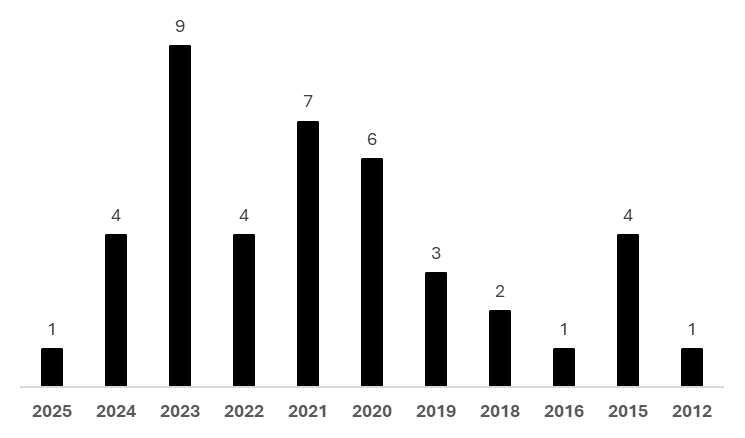
Figure 2
Year-wise distribution of reviews on OER.
Table 4
Country-wise Distribution of Authors.
| COUNTRIES | AUTHORS | LEAD OR CORRESPONDING AUTHOR |
|---|---|---|
| Brazil | 14 | 6 |
| Canada | 11 | 2 |
| China | 9 | 6 |
| Columbia | 3 | 1 |
| Finland | 1 | 1 |
| France | 1 | |
| Germany | 5 | 1 |
| Greece | 1 | |
| Guyana | 1 | |
| India | 13 | 2 |
| Ireland | 1 | |
| Mexico | 4 | 2 |
| Morocco | 4 | 1 |
| Pakistan | 5 | 1 |
| Palestine | 1 | |
| Portugal | 4 | 1 |
| South Africa | 1 | |
| South Korea | 1 | |
| Spain | 10 | 4 |
| Tunisia | 2 | |
| Turkey | 6 | 2 |
| United Kingdom | 6 | 3 |
| USA | 19 | 9 |
| 124 | 42 |
Table 5
Top Sources of Reviews.
| SOURCES | FREQUENCY |
|---|---|
| International Review of Research in Open and Distributed Learning | 6 |
| Sustainability | 3 |
| Distance Education | 2 |
| 26 other Journals | 1 |
| Conferences | 5 |
Table 6
Top Institutional Contributors.
| INSTITUTION | NUMBER OF PAPERS |
|---|---|
| Anadolu University | 4 |
| Arab League Educational, Cultural and Scientific Organization | 2 |
| Beijing Normal University | 6 |
| Brigham Young University | 2 |
| Commonwealth of Learning | 2 |
| Tecnologico de Monterrey | 2 |
| The Open University | 3 |
| Universidad Internacional de La Rioja (UNIR) | 6 |
| University of London | 2 |
| University of North Dakota | 2 |
| University of São Paulo | 2 |
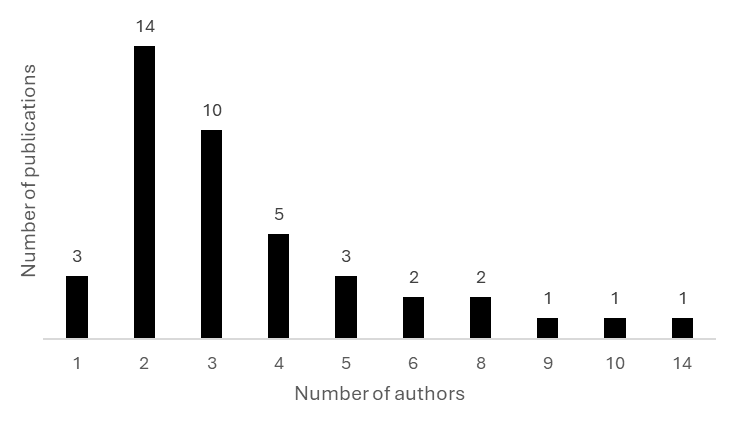
Figure 3
Authorship pattern of reviews on OER.
Table 8
Types of Review Methods.
| REVIEW TYPES | FREQUENCY |
|---|---|
| Bibliometrics analysis | 5 |
| Comprehensive literature review | 1 |
| Integrative review | 1 |
| Literature review | 4 |
| Meta-analysis (Research Synthesis) | 1 |
| Qualitative review | 1 |
| Rapid review | 1 |
| Research synthesis | 1 |
| Scoping review | 1 |
| Systematic mapping | 2 |
| Systematic review | 21 |
| Systematic review (mixed method) | 2 |
| Systematic review (Meta) | 1 |