
Introduction
Open educational resources (OER) emerged as a term and concept through a discussion on knowledge as a collective social product and why it should be made available as social property in the ‘forum on open courseware for higher education in the developing countries’ at UNESCO in 2002. The participants in the forum had a vision of developing “together a universal educational resource available for the whole of humanity, to be referred to henceforth as Open Educational Resources” (UNESCO, 2002, p.28). Since then, the field of OER has advanced as a practical necessity to offer rights-based education for all and is promoted by intergovernmental organizations like the United Nations Educational, Scientific and Cultural Organizations (UNESCO) and the Commonwealth of Learning (COL). The first World OER Congress organized by UNESCO and COL in 2012 released the OER Declaration urging that publicly funded learning materials must be available with open licenses and public policies must be geared towards the same (UNESCO, 2012). A study of the government’s response before the Second World OER Congress indicated support for OER policies in 65 countries (COL, 2017). However, in practice, there is a lack of clarity on having OER policies in these countries (NBA, 2023). Following up on the action plan of the Congress in 2017, UNESCO’s General Conference adopted the Recommendations on OER on 25 November 2019 emphasizing the importance of mainstreaming OER for Sustainable Development Goal 4 (SDG4) and creating inclusive knowledge societies (UNESCO, 2019). The Recommendation identified five action areas:
(i) Building capacity of stakeholders to create, access, re-use, adapt, and redistribute OER
(ii) Developing supportive policy
(iii) Encouraging effective, inclusive, and equitable access to quality OER
(iv) Nurturing the creation of sustainability models for OER
(v) Promoting and reinforcing international cooperation
It may be noted that UNESCO recommendation is a standard setting instrument that describes principles and norms for international regulation in a particular area inviting Member States to take appropriate action (legislative or administrative) to apply them. Recommendations are useful in promoting and influencing best practices in the areas of education, science and culture.
A follow-up report at the UNESCO General Conference in 2023 indicates that only 60 Member States had taken action on OER policy at national or institutional levels. This report also highlighted that 64 Member States used OER to mitigate the challenges of providing education during COVID-19 (UNESCO, 2023). UNESCO recently held the third World OER Congress in Dubai and released the Dubai declaration that emphasized the role of artificial intelligence in the use and promotion of OER (Wang & Mishra, 2025). These developments have improved awareness about OER amongst stakeholders at Ministries of Education and educational institutions worldwide. As such, plenty of research has gone into this field of work. A Google Scholar search using “open educational resources” resulted in 66,300 entries on 23 July 2024. The OER Knowledge Cloud (https://www.oerknowledgecloud.org/), a repository of OER research, has over 2800 entries from over 980 sources. The UNESCO OER Recommendation also puts emphasis on the need for research, especially on the impact of OER, and measures their effectiveness in different contexts.
Research review/synthesis, often called literature review, is an effective way to summarize and assess the impact of research in any discipline (Cooper, 2017). There are different ways of conducting research reviews (Sutton et al., 2019; Xiao & Watson, 2019). Considering that evidence-based practice in education (Pring & Thomas, 2004) has become important, systematic review/ systematic literature review has emerged as a key method to inform policymakers and practitioners to inform policy and practice (Gouch et al., 2012). The paper deploys a meta-systematic review approach to analyze research on OER from the perspective of summarizing and integrating the findings of research in this field and assisting future researchers to ‘see the forest for the trees’ (Jaakkola, 2020). The key research questions are as follows:
What kinds of evidence synthesis are being conducted in the field of OER?
How have these research reviews on OER evolved, and where have they been published?
What is the geographical distribution of authorship of these reviews and the degree of collaboration?
What is the quality of the reviews published?
What are the key thematic areas of the research on OER, and how are these aligned with the Recommendation on OER?
What research gaps have been identified in the reviews?
What are the barriers or challenges identified within the research reviews on OER?
Literature Review
Since the first review paper on OER appeared in 2012, the focus of the reviews has been different, using a variety of lenses and approaches. There are different frameworks used to categorize literature in these reviews. Some of the focus areas of the reviews are specific to the affordability dimension (Mullens & Hoffman, 2023), benefits, enabler, barriers and challenges (Adil et al., 2024; Farrow et al., 2024; Li & Wong, 2021; Luo et al., 2020; Ramirez-Montoya, 2020; Swain & Pathak, 2024), disability (Moon & Park, 2021; Moreno et al., 2018; Zhang et al., 2020), equity and diversity (Iniesto & Bossu, 2023), legal and technical openness (Sousa et al., 2023), open educational practices (Koseoglu & Bozkurt, 2018; Tlili et al., 2021; Tlili et al., 2023b), open pedagogy (Clinton-Lisell, 2021; Tietjen & Asino, 2021), quality of OER (de Oliveira et al., 2021; dos Santos et al., 2023; Yuan & Recker, 2015), OER recommender systems (Rima et al., 2022), OER repositories (Clements et al., 2015; Rodés-Paragarino et al., 2016), student experiences (Axe et al., 2020), sustainability of OER (Aksoy et al., 2025; Tlili et al., 2023a), and reusability of OER (Chiappe & Arias, 2015; Sanabria-Z et al., 2024). Some reviews are discipline-focused, such as in psychology (Clinton, 2019) and nursing education (Connolly & Svoboda, 2023), while there are also reviews that focus on OER from a country context (Tlili et al., 2019) and regional contexts (Tlili et al., 2022). The variations in different analysis methods challenge developing a specific framework for analyzing the thematic issues covered in all the reviews. The use of a specific framework to analyze the discussions in the literature is limited. Aksoy et al. (2025) and Farrow et al. (2024) used the micro-meso-macro approach presented by Zawacki-Richter (2009) to analyze the issues in the literature while presenting the reviews. In terms of thematic issues, Farrow et al. (2024) analyzed the literature in six groups: (i) structural, systematic and contextual factors; (ii) pedagogical practice; (iii) information, awareness and attitudes; (iv) resourcing and sustainability; (v) technology and infrastructure; and (vi) policy and culture. Under all these categories, the literature was discussed in three sub-groups: drivers, enablers, and barriers. Aksoy et al. (2025), on the other hand, used a detailed categorization for analyzing themes that can be broadly grouped into five: (i) institutional contexts, (ii) OER platforms, (iii) content creators, (iv) characteristics of learners and their skills, and (v) open educational materials. Recognizing the variations and the range of topics covered, this review of reviews adopted the OER Recommendation 2019 (UNESCO, 2019) as the conceptual framework to analyze the themes covered in the reviews. This approach presents a way to support and analyze the research trends in the five action areas and could help further identify the research gaps as envisaged in one of the research questions.
Methods
Second-order research systems in the field of education are not common and are mostly used for meta-analysis studies (Borokhovski et al., 2022; Tamim et al., 2011; Tlili et al., 2023b). Considering the limited number of meta-analyses in the field of OER, the tertiary review approach used by Bond et al. (2024) for a study on artificial intelligence was adopted to conduct this research.
Figure 1 shows the steps adopted following the PRISMA guidelines (Page et al., 2021) to select the reviews for the integrative review:
1. Searching different databases such as SCOPUS, Web of Science, Academic Premier, and Google Scholar using iterations of the search string for the title, abstract and keywords fields:
(“Open educational resources” OR “open educational practices”) AND (“systematic review” OR “scoping review” OR “narrative review” OR “meta analysis” OR “evidence synthesis” OR “meta-review” OR “evidence map” OR “rapid review” OR “umbrella review” OR “qualitative synthesis” OR “configurative review” OR “aggregative review” OR “thematic synthesis” OR “framework synthesis” OR “mapping review” OR “meta-synthesis” OR “qualitative evidence synthesis” OR “critical review” OR “integrative review” OR “integrative synthesis” OR “narrative summary” OR “state of the art review” OR “rapid evidence assessment” OR “qualitative research synthesis” OR “qualitative meta-summary” OR “meta-ethnography” OR “meta-narrative review” OR “mixed methods synthesis” OR “scoping study” OR “systematic map”)
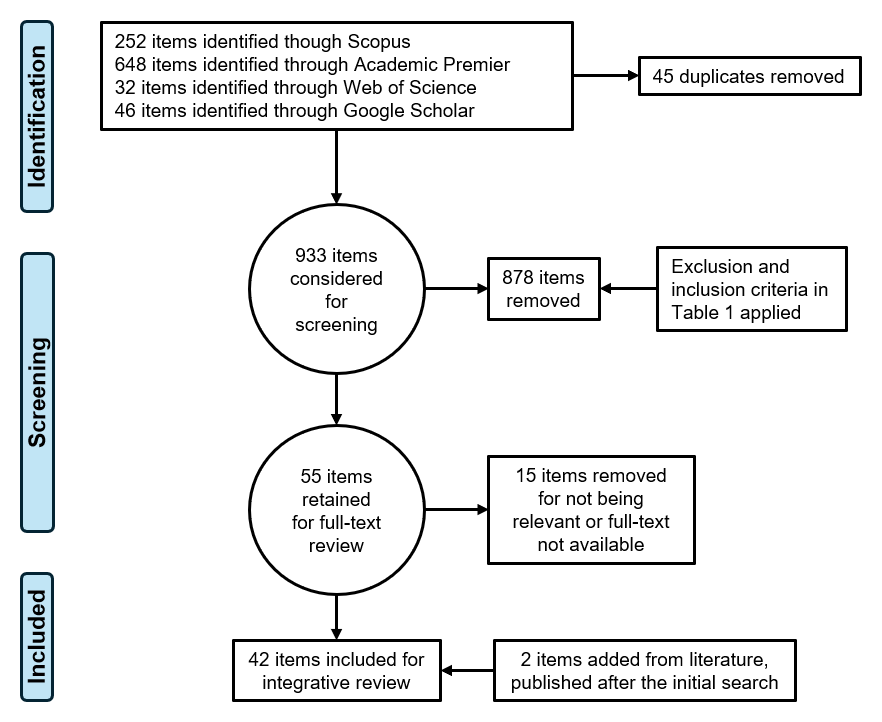
Figure 1
PRISMA diagram for selection of the reviews.
No timeframe was used for searching, and this resulted in 978 items.
2. Duplicate removal: 45 duplicates were removed, leaving the total number of items at 933.
3. Apply inclusion and exclusion criteria: The inclusion and exclusion criteria (Table 1) were applied to remove the items that are not actually reviews. This resulted in exclusion of 878 items leaving only 55 for full-text review.
Table 1
Inclusion and Exclusion Criteria.
| INCLUSION CRITERIA | EXCLUSION CRITERIA |
|---|---|
| Reviews of different types Related to OER, OEP, open pedagogy, open education, etc. All contexts (levels of education and training scenarios) Journal and conference papers Secondary research with method section English Language only | Primary research papers Not in English Not related to OER (e.g. open community) Not editorials, book reviews, dissertations, book chapters, and any other grey literature Not having a method section |
4. Full-text availability: Based on full-text availability and review, 15 more items were removed, leaving only 40 items in the corpus for this study. While the study was in progress, two more reviews were published, and thus we covered 42 reviews on OER for the final analysis.
5. The metadata schema (Table 2) was used to record the data for further analysis for each item.
Table 2
Metadata Schema.
| METADATA | DESCRIPTION |
|---|---|
| Number of authors | Name and Count |
| Number of countries | Name and Count |
| Number of institutions | Name and Count |
| Publication type | Journal/Conference |
| Name of the publication | Journal name or Conference name |
| Year of publication | Year |
| Keywords | All author assigned keywords on the publication |
| Open Access | Availability with an open license |
| Methods | Type of review methods usad |
| Use of PRISMA | Whether PRISMA method was used? |
| Abstract | Copy of the original abstract |
| Apply quality assessment as per Bond et al (2024) | Answering the ten questions based on Yes: 1; Partly: 0.5; No: 0. |
For the thematic analysis, we adopted an integrative review approach (Snyder, 2019; Torraco, 2005), as recently used in a review by Farrow et. al. (2024). All the articles were coded for the thematic areas of the five action areas of the UNESCO OER Recommendation 2019 and then grouped to analyze these critically to develop the narrative. This also assisted in understanding the gaps in the literature and indicate to possible future research areas.
Findings
Table 3 provides an overview of the data about the reviews. The 42 reviews covered in this study were contributed by 124 authors from 68 institutions in 23 countries. The reviews were published in 29 different journals and five conferences, and 38% of the publications were not available in open access. This section provided further detailed analysis of the publications.
Table 3
Overview of the Sources.
| PUBLICATION CHARACTERISTICS | FREQUENCY/PERCENTAGE |
|---|---|
| Number of publications | 42 |
| Number of authors | 124 |
| Number of institutions | 68 |
| Number of countries | 23 |
| Sources of publications | |
| Journals | 29 |
| Conferences | 5 |
| Open Access | |
| Yes | 26 (61.9%) |
| No | 16 (38.1%) |
Publication Year of Reviews
The first review on OER appeared in 2012, a significant year in the OER movement. This year was the 10th year of the coinage of the term OER, and the first World OER Congress was held in 2012. The maximum number of reviews (09) appeared in 2023, while seven and six reviews were published in 2021 and 2020, respectively. It is important to note that reviews on OER have been published regularly since 2018 (Figure 2).
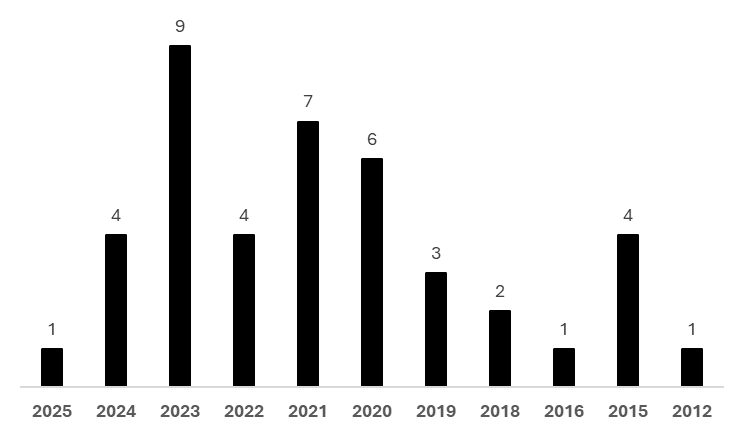
Figure 2
Year-wise distribution of reviews on OER.
Country-Wise Distribution
Reviews on OER have been published by authors from 23 countries, with the highest number of authors from the USA (19), followed by Brazil (14), India (13), and Canada (11). However, the leading authors of the reviews mostly come from the USA (09), followed by Brazil (06) and China (06). The countries represented in Table 4 also indicate increased awareness and work related to OER in these countries. Interestingly, in terms of the OER literature outputs in previous research, the United Kingdom normally tops the list, followed by the USA (Zancanaro et al., 2015). The top country was the United Kingdom, followed by Spain in the study by Tlili et al. (2021) and Bozkurt et al. (2019), whereas the USA topped the country in a study also covering book chapters on OER (Kumar & Deka, 2022).
Table 4
Country-wise Distribution of Authors.
| COUNTRIES | AUTHORS | LEAD OR CORRESPONDING AUTHOR |
|---|---|---|
| Brazil | 14 | 6 |
| Canada | 11 | 2 |
| China | 9 | 6 |
| Columbia | 3 | 1 |
| Finland | 1 | 1 |
| France | 1 | |
| Germany | 5 | 1 |
| Greece | 1 | |
| Guyana | 1 | |
| India | 13 | 2 |
| Ireland | 1 | |
| Mexico | 4 | 2 |
| Morocco | 4 | 1 |
| Pakistan | 5 | 1 |
| Palestine | 1 | |
| Portugal | 4 | 1 |
| South Africa | 1 | |
| South Korea | 1 | |
| Spain | 10 | 4 |
| Tunisia | 2 | |
| Turkey | 6 | 2 |
| United Kingdom | 6 | 3 |
| USA | 19 | 9 |
| 124 | 42 |
Publication Sources
This meta-review covered only journal and conference publications to identify the source items, and only five out of 42 reviews were presented at conferences. The remaining 37 reviews were published in 29 journals (Table 5). The International Review of Research in Open and Distributed Learning (IRRODL) published by the Athabasca University in Canada published six of these reviews. Kumar and Deka (2022) reported that most papers were published in the International Journal of Education Technology in Higher Education, followed by Education and Information Technologies. Whereas Distance Education, followed by IRRODL, topped the list of primary sources of OER literature in the study by Tlili et al. (2021). These two journals are amongst the top publishers of reviews in the OER field (Table 5).
Institutional Affiliation
Table 6 shows that the 42 review papers covered in this study were contributed by authors from 68 institutions, indicating a strong institutional collaboration. Scholars from eleven institutions contributed more than one paper. However, scholars from Beijing Normal University (China) and Universidad Internacional de La Rioja (Spain) contributed six reviews as co-authors. The previous literature review indicated The Open University (United Kingdom) as the top institution contributing research on OER (Bozkurt et al., 2019; Koseoglu & Bozkurt, 2018; Kumar & Deka, 2022; Tlili et al., 2021; Zancanaro et al., 2015).
Table 6
Top Institutional Contributors.
| INSTITUTION | NUMBER OF PAPERS |
|---|---|
| Anadolu University | 4 |
| Arab League Educational, Cultural and Scientific Organization | 2 |
| Beijing Normal University | 6 |
| Brigham Young University | 2 |
| Commonwealth of Learning | 2 |
| Tecnologico de Monterrey | 2 |
| The Open University | 3 |
| Universidad Internacional de La Rioja (UNIR) | 6 |
| University of London | 2 |
| University of North Dakota | 2 |
| University of São Paulo | 2 |
Authorship Distribution
Table 7 shows that most of the authors (109) contributed only one review, indicating there are some authors who are more frequent contributors to reviews on OER. Figure 3 shows that most OER reviews are multi-author, with 14 of them contributed by two authors, while the highest number of authors in a review was 14. Considering that only 3 of the review contributions were by a single author, the degree of collaboration on OER reviews is .928 as per the formula of Subramanyam (1983). Kumar and Deka (2022) reported that between 2011 and 2020, the degree of collaboration in the field of OER was .65. The review of reviews demonstrates a higher degree of collaboration than the literature reviews. It is also important to note that while technology has made it easier to conduct reviews, it may still require the collaboration of more than one person to validate and interpret the data.
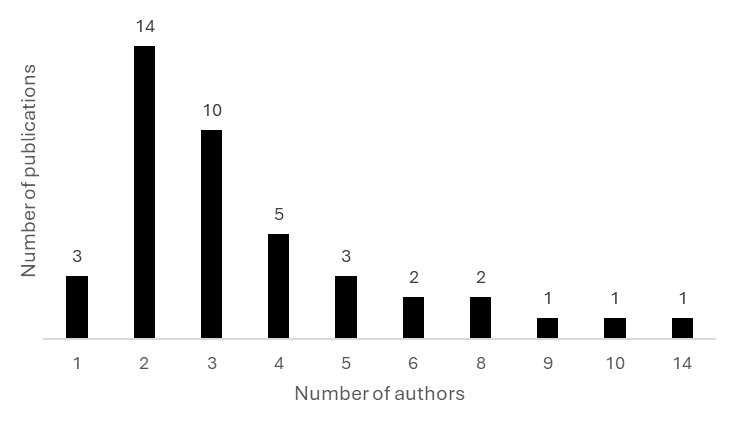
Figure 3
Authorship pattern of reviews on OER.
Methodology Used in Reviews
To understand the method used by scholars in the review of OER literature, we used the description of the method section in the reviews. While there are specific nuances in the use of various terminologies of reviews (Sutton et al., 2019), we preferred to categorize the reviews without critiquing the merits of the classification. Interestingly, the use of systematic review is the predominant method followed by bibliometrics analysis (Table 8). However, only 14 of the reviews used a systematic approach such as PRISMA (Page et al., 2021) to identify the review dataset, which could lead to questions about the quality of the reviews. Only one study used a meta-analysis approach to synthesize research on OER and OEP (Tlili et al., 2023b).
Table 8
Types of Review Methods.
| REVIEW TYPES | FREQUENCY |
|---|---|
| Bibliometrics analysis | 5 |
| Comprehensive literature review | 1 |
| Integrative review | 1 |
| Literature review | 4 |
| Meta-analysis (Research Synthesis) | 1 |
| Qualitative review | 1 |
| Rapid review | 1 |
| Research synthesis | 1 |
| Scoping review | 1 |
| Systematic mapping | 2 |
| Systematic review | 21 |
| Systematic review (mixed method) | 2 |
| Systematic review (Meta) | 1 |
Quality Review
For the quality review of the reviews, the criteria and methods adopted by Bond et al. (2024) were used to analyze the 42 reviews. Once the reviews were scored using the following ten questions, the scores were grouped as depicted in Table 9.
Are there any research questions, aims or objectives?
Were inclusion/exclusion criteria reported in the review and are they appropriate?
Are the publication years included defined?
Was the search adequately conducted and likely to have covered all relevant studies?
Was the search string provided in full?
Do they report inter-rater reliability?
Was the data extraction coding scheme provided?
Was a quality assessment undertaken?
Are sufficient details provided about the individual included studies?
Is there a reflection on review limitations?
Table 9
Quality of Reviews.
| QUALITY RANGE | FREQUENCY | % |
|---|---|---|
| Critically low (0–2.5) | 7 | 16.67 |
| Low (2.51–4.5) | 19 | 45.24 |
| Medium (4.51–7.0) | 15 | 35.71 |
| High (7.1–8.5) | 1 | 2.38 |
| 42 | 100.00 |
Quality analysis of the reviews using the above criteria shows that only one review was in the high score range of 7.1 and above. About 36% of the reviews (n = 15) fall in the medium quality range of 4.51 and 7.0, while 45% (n = 19) were of low quality and seven (17%) were of critically low quality. Overall, the average quality score for the 42 reviewed covered was calculated as 4.5, indicating low quality. Criteria-wise analysis revealed that the average scores were critically low for inter-rater reliability (0.48), and coding scheme (1.9), followed by low scores for quality assessment (3.33), information about individual studies (3.57), and search string (4.4). Only research question/objectives related information scored high (8.1), while other criteria scored in the range of 4.51 to 7.0 indicating medium quality. This also shows that future systematic reviews in the field must include the quality criteria of reviews more systematically.
Thematic Focus Areas Covered
One of the research questions of this review is to explore the key thematic areas of the research on OER, and how are these aligned with the UNESCO Recommendation on OER. The thematic analysis of the reviews used the five action points of the OER recommendation (UNESCO, 2019). Variations in the terminology used are a key concern during analysis. Therefore, the classification was done after repeated reading of the texts to do contextual analysis rather than using the keywords for grouping.
Building capacity of stakeholders to create, access, re-use, adapt, and redistribute OER
This action area broadly covers supporting OER capacity building, awareness raising, promoting digital literacy skills, use, creation, and sharing at the institutional and national levels, targeting all education sectors and levels. Capacity building for the professional development of teachers in the OER field is important and a key meso-level priority (Aksoy et al., 2025; Farrow et al., 2024). There are several resources available (Butcher, 2011; Butcher & Moore, 2015) to de-mystify the concept. A trainer’s guide on OER (Grégoire & Dieng, 2016) provides the essential competencies to be covered in capacity-building programmes. Nascimbeni et al. (2024) present eight key competencies for promoting OER in higher education. Copyright, open licensing, and a basic understanding of the 5R framework of Wiley (2014) are normally the key components of capacity-building activities.
The successful implementation of OER extensively relied on the adequate capacity of teachers, the core group of OER stakeholders. This reliance is why teacher education is frequently mentioned in the literature (Meng et al., 2020). Koseoglu and Bozkurt (2018) also found that several studies emphasized the criticality of capacity building in promoting open educational practices. Training and education programmes related to OER are organized in higher education institutions to inform members about the use of OER in preparing teaching materials (Li & Wong, 2021). However, Sousa et al. (2023) found that most texts in their study did not mention Wiley’s 5R exactly, but referred to some words related to it, such as share, dissemination, adaptation, copy, and combine. Faculty training is also important to help them adopt OER and mainstream OER as regular teaching activities. Mullens and Hoffman (2023) found that several studies discussed that faculty who adopted OER tended to view OER as similar in quality or higher quality than commercial textbooks. Training programmes should also focus on the attitudes of university teachers towards OER, its use, creation, and the use of local repositories to support teachers’ pedagogical work to support mainstreaming of OER (Rodés-Paragarino et al., 2016). In the African context, Tlili et al. (2022) recommended that in-service OER training and teacher professional development should be a priority. The majority of the institutional training falls within this category. In addition, Khalid et al. (2023) found that the Community of Practice approach adopted by different organizations alongside the use of formal training curricula through apprenticeship and mentorship of new faculty members.
Swain and Pathak (2024) emphasize that innovative teaching methods can be enhanced by using OER. Sharing or uploading faculty-developed OER into different open platforms could lead to feedback from different groups and further help modify these resources. Such practice could also strengthen local capacities to create and adapt OER. In this context, Otto et al. (2021) emphasized that the focus should not just be on how OER are created, used, perceived, or evaluated, or the effects of their use, but steps must be taken to improve the institutional structural environment as well to implement OER successfully. One such aspect that must not be overlooked is students’ capacity, digital skills, and awareness about issues related to the re-use of OER in teaching and learning (Axe et al., 2020).
Developing supportive policy
The UNESCO Recommendations on OER urges countries around the globe to create enabling conditions to promote the creation and use of OER through the development of appropriate policy-level interventions at national as well as institutional levels through a participatory process. This is echoed in the discussion by Iniesto and Bossu (2023) when they emphasized that educational institutions should develop policies and activities to promote OER awareness and clarify issues related to intellectual property and quality assurance. Policy is also a meso-level issue in institutional contexts to support students and teachers and foster collaboration, incentives, and funding (Aksoy et al., 2025).
OER policy making is also an issue for advancing social justice (Tlili et al., 2022). However, in Africa, only 6.6% of OER publications covered policy issues, and according to Tlili et al. (2022), “it might not always be clear which type of policy would work best in a given context” (p.14). A policy could create the necessary environment but may not be sufficient to motivate the faculty members to engage in OER activity. A suitable OER policy may also create the necessary motivating factor by incentivizing OER activity (Lesko, 2013; Farrow et al., 2024). Therefore, it is not surprising to see that a lack of institutional policy has been identified as a barrier to OER in many studies (Adil et al., 2024). While recognizing that policy gaps are barriers to OER adoption, institutional policies for OER are drivers of adoption (Farrow et al., 2024).
Otto et al. (2021) recommend that more research should be carried out on how the conditions for OER use can be created or improved on a structural level or how implementation strategies or policies can be developed or implemented. Swain and Pathak (2024) found numerous case studies that emphasized the advantages of institutional OER policies, showing a variety of favorable outcomes, mostly connected to raised OER knowledge. Policies also created an environment for dialogue among the members of the community and supported and guided the members to act on using and adopting OER. The review of OER in China highlighted that various institutional, governmental, and organizational policies and initiatives have been launched to facilitate the adoption of OER in the country (Tlili et al., 2019). The Brazilian review indicated that only five doctoral studies covered discussions on national public policies on the role of OER in the teaching and learning process (Lauermann & Mallmann, 2023). In terms of OER repositories, there is considerably less research on policies (Clements et al., 2015). Studies have also covered the need for policy support from governments and institutions to fund OER activities and cover the costs associated with making educational materials available with an open license (Li & Wong, 2021). Creating structured policies would help develop incentive programmes, such as faculty stipends, funding for OER integration, and course and faculty promotion (Luo et al., 2020).
The literature indicates that while the importance of policies is mentioned in many publications, research on policy and actual policy implementation in practice are limited. This is also possible due to the low uptake of OER policies (Wang & Mishra, 2025).
Encouraging effective, inclusive and equitable access to quality OER
The focus of this area of the action plan is very broad and directly aligned to Sustainable Development Goal 4: ensure inclusive and equitable quality education and promote lifelong learning opportunities for all (United Nations, 2015). The emphasis here is on equity as well as the quality of OER for all, irrespective of age, gender, physical ability, socio-economic status, etc. The question that needs to be addressed is how to make knowledge products more accessible to people in multiple languages and how OER can help in different conflict zones and during natural disasters. The research focus has been more on quality than on equity and accessibility of OER. Equity must address intergenerational barriers and historical legacy affecting communities’ access to educational opportunities. In this context, embracing openness, equal participation, and nurturing ownership would deepen open practices (Iniesto & Bossu, 2023).
While access to persons with disabilities and providing accessible OER are covered less in the literature, adopting accessible guidelines helps everyone access digital learning materials. Several papers have discussed issues around designing accessibility guidelines, specifications, best practices, strategies, and standards (Moreno et al., 2018; Zancanaro et al., 2015). Most authors discuss system design to increase accessibility and usability of students with disabilities. Some others also focus on the use of appropriate and sufficient metadata for easy retrieval of OER (Zhang et al., 2020). Reusability and accessibility are also considered key quality attributes, followed by operability, user interface aesthetics, and appropriateness recognizability (de Oliveira, et al., 2021). The review by Moon and Park (2021) finds that OER implemented according to the principles of Universal Design for Learning may foster learner engagement as OER with accessibility could also address the usability of interaction with the resources. Quality issues related to OER dominate the literature. Over the years, the focus has shifted from OER development to the quality of OER developed (Meng et al., 2020). Many quality indicators and guidelines are already available for assuring OER quality (Kawachi, 2014; Mishra & Kanwar, 2015; Zawacki-Richter et al., 2023). Tlili et al. (2023b) argue that by simply changing the license of a given text from proprietary to open, we can’t expect to improve the quality and improvement in learning achievements. High-quality OER is characterized by accurate and up-to-date content, clear learning objectives, appropriate instructional design, adaptability, licensing, etc. (Aksoy et al., 2025).
Swain and Pathak (2024) found that OER has been discussed widely to support improving instructional quality by inviting faculty to rethink their teaching strategies and adopting novel approaches to promote collaborative learning and knowledge creation. This is also at the heart of the OEP, and open pedagogy practices discussed in the literature to improve quality (Adil et al., 2024). Students using digital learning resources and collaboration to create OER appreciate the value of peer review and feedback in the learning process, which deepens trust with fellow students and teachers (Axe et al., 2020).
A narrative review of OER by Clinton (2019) indicates that OER offers comparable quality and learning opportunities at a much lower financial cost than commercial materials. Despite the student outcomes being equivalent when using OER versus traditional course materials, there are still perceptions of OER as inadequate compared to traditional textbooks (Luo et al., 2020). Faculty trusts the quality of OER produced by celebrity authors and prestigious institutions. Quality assessment of OER is also grounded in the teacher’s beliefs related to what constitutes quality, the relevance of the OER to their teaching, benefits to their students such as reducing the cost of education, and compatibility of the materials to their pedagogical practice (Mullens & Hoffman, 2023). In the African context, Tlili et al. (2022) emphasized that culture might also play a role in OER adoption, as most teachers believe that high-quality educational resources should not be free and must be developed by only expert teachers.
Publications also focus on the quality criteria and instruments used to assess the quality of OER. Some common criteria used are the accuracy of content, the learning goal alignment, relevance, aesthetics, comprehensibility, and content quality (de Oliveira et al., 2021; Otto et al., 2021). Clements et al. (2015) reviewed several papers that identified instruments for quality assurance of learning objects. However, Yuan and Recker (2015) emphasized that many of the rubrics available to evaluate OER quality lack scales, scoring guides, and empirical testing data, raising concerns about the utility of these tools. There is no consensus on a particular criterion in the literature for assessing the quality of OER. The review by dos Santos et al. (2023) identified 24 quality dimensions and considered the content quality dimension as the most relevant and predominant as that increases the possibility of revising and/or remixing OER.
Quality continues to be a major concern in the context of OER. While aligning OER strategies in the context of access, cost, and quality could be challenging for institutions, adopting a quality review process during OER production, using accessible technologies, and using multilingual approaches could improve equitable access to quality OER (Farrow et al., 2024).
Nurturing the creation of sustainability models for OER
Nurturing of sustainability models for OER needs different approaches, including funding support, new business models, government structures and processes related to the procurement of learning materials, partnerships, and collaboration of OER community building and sharing, appropriate policies, etc. The macro-theme of sustainability in the literature covers discussion around different business models and financing OER initiatives (Zancanaro et al., 2015). However, not much research is available in these areas. In reviewing African OER literature, Tlili et al. (2022) found that only 3.68% of papers covered sustainability issues. Tlili et al. (2023a), through a review as well as expert consultation, identified 10 different OER sustainability models, such as public funding, institutional funding, endowment/donations, collaborating in networks, offering services to learners, dependence on author contributions, community-based model, producing on-demand OER, sponsorship/advertisements, and offering learner data to companies.
Reviews covered a range of issues around sustainability models. For the long-term sustainability of OER, Adil et al. (2024) consider that having flexible and extendable technology infrastructure helps in mitigating the challenges associated with the evolving nature of the Web. Arimoto and Barbosa (2012) reported that most of the studies covered learning object metadata and the Sharable Content Object Reference Model for content packaging and associated metadata. The technology used is also associated with the discoverability and accessibility of OERs (Swain & Pathak, 2024). Yet another issue identified for sustainability is the quality of the metadata content (dos Santos et al., 2023). Interoperability, though a major concern, has lost importance since 2006 due to technological developments that help non-experts also to produce and share OER (Chiappe & Arias, 2015). However, despite the benefits associated with OER, the free availability of tools and resources is considered inadequate in many institutions in the developing world (Mishra et al., 2022).
For OER content creation, a wide understanding of reusability should lead to proper and sustainable processes that achieve more use of the OER created (Chiappe & Arias, 2015). Digitization and reuse of OER also increase the sustainability of huge savings for students as well as institutions. (Farrow et al., 2024).
The potential of OER for cost reduction helps in sustainability. Findings indicate that there are cost savings in terms of student finances and in course withdrawal (Clinton, 2019). A review by Hilton (2020) found that “students achieve the same or better learning outcomes when using OER while saving significant amounts of money” (p.853). However, few successful examples have focused on the OER development’s financial model, and OER’s sustainability continues to be a challenge (Sousa et al., 2023). The availability of funding support to set up a platform for publishing course materials and hiring staff for OER work helps in sustainability (Li & Wong, 2021). Farrow et al. (2024) also indicate that new models, such as zero textbook cost and national funding for OER, play a critical role in sustainability.
Taking a broader perspective of sustainability, Aksoy et al. (2025) highlighted the institutional context and role of regulatory mechanisms. Institutional issues of recognition for the development of OER toward academic credit improve OER sustainability in the long run (Khalid et al., 2023). Also, OER sustainability is not just about resources, but also about how they are used and reused (Meng et al., 2020). In this context, learners’ digital skills and their OER awareness also have implications for OER sustainability (Aksoy et al., 2025).
Considering sustainability’s overarching role, it is important to encourage more research on sustainability mechanisms for OER projects (Meng et al., 2020).
Promoting and reinforcing international cooperation
Recognizing that the promotion and use of OER for the global public good would require massive efforts at national and international levels, the UNESCO Recommendation on OER emphasized collaboration at bilateral and multilateral levels. Such collaboration could cover capacity building, technology and repositories, communities of practice, and joint research. Interestingly, despite regular efforts from international organizations like UNESCO and the Commonwealth of Learning, there is limited literature on this action area. While teachers generally prefer to work autonomously rather than collaboratively (Tlili et al., 2022), it is important to focus on nurturing collaboration for OER as this will also lead to increased funding and research. While fostering collaboration, it is necessary to consider cultural practices and multilingual problems in OER practice (Meng et al., 2020). A review by Ramirez-Montoya (2020) also highlighted the need for more work on mobilizing resources and practices through international cooperation.
Farrow et al. (2024) recognize that effective international collaboration can be challenging. Involving various stakeholders, including non-profit organizations, could improve collaboration for OER implementation.
Research gaps identified
The analysis of the reviews based on the UNESCO Recommendation on OER reveals some key insights. Most research focus has been on action area 3 covering issues around effective, inclusive, and equitable access to quality OER followed by research on nurturing sustainability models for OER. Research related to capacity building of stakeholders and developing appropriate policy to promote OER are also covered to some extent but need more work in these areas. However, action area 5 covering collaboration and international cooperation is the least discussed in literature. There are very limited number of studies covering cost of OER and business models in practice, and how international cooperation could be further fostered to promote international collaboration in the field.
Challenges
Farrow et al. (2024), while reviewing the literature on OER, used six areas of barriers: (i) systemic and structural factors, (ii) pedagogical practice, (iii) information and awareness, (iv) Resources and sustainability, (v) technology and infrastructure, and (vi) Policy and culture. This analysis covers policy issues within the structural barriers and discusses the most frequent barriers/challenges to mainstreaming OER.
Systemic and structural challenges
Lack of institutional support in terms of policy and incentives for creating and using OER has been highlighted by several reviews (Adil et al., 2024; Farrow et al., 2024; Koseoglu & Bozkurt, 2018; Li & Wong, 2021; Luo et al, 2020; Mullens & Hoffman, 2023; Otto et al., 2021; Tlili et al., 2022). The lack of policy for using open licenses creates barriers to establishing authoring rights and how the contents could be distributed and used (Arimoto & Barbosa, 2012). Teachers’ workload is also a major problem in many parts of the world, including Africa (Tlili et al., 2022), and the resistance of teachers to use material developed by other institutions (Tlili et al., 2023b). Other barriers include concerns about student privacy, skepticism about the quality of OER, and attitudes of teachers (Clinton-Lisell, 2021; Rodés-Paragarino et al., 2016).
Pedagogical practice
Integration of OER in teaching and learning, including issues related to teacher capacities and skills to create, remix, and reuse OER, are significant challenges discussed in the literature. Teachers find it difficult to judge the quality of OER available in a range of formats and platforms (Adil et al., 2024; Farrow et al., 2024; Swain & Pathak, 2024). Many teachers are also skeptical about the quality of OER and hence do not use them (Clinton-Lisell, 2021). However, in the context of nursing education, Connolly and Svoboda (2023) indicated a lack of adequate OER compared to other disciplines. They also found that studies do not mainly focus on addressing barriers to OER in nursing education.
Lack of skills related to finding relevant OER also stems from a lack of digital skills and understanding of the compatibility of open licenses (Otto et al., 2021; Tlili et al., 2022). Learning design issues are considered a significant barrier to the adoption of OER in higher education institutions (Li & Wong, 2021). “The design of OER may place additional strain on students’ cognitive load by providing ample distractions under the guise of additional resources” (Mullens & Hoffman, 2023). According to Farrow et al. (2024), curricular integration, educator engagement, and localization of OER remain key challenges, too.
Teachers’ limited familiarity with assistive technologies is a critical issue in the context of using OER for teaching and learning (Moon & Park, 2021). Tlili et al. (2019) highlighted that the most pressing issue in developing countries is a lack of skills for developing and publishing OER. Sanabria-Z et al. (2024) emphasized the need for developing holistic competencies covering ICT skills and teaching-learning strategies to help teachers effectively integrate OER into their professional practice.
In addition to a range of pedagogic issues, Swain and Pathak (2024) highlighted that a major barrier is the lack of interest in creating and uploading content to online platforms. In this context, Rodés-Paragarino et al. (2016) emphasize that sharing the benefits of collective collaboration with peers may increase teachers’ engagement with OER.
Information and awareness
UNESCO’s recommendation on OER significantly emphasizes creating awareness and capacity building of all stakeholders, as it is considered the key to mainstreaming OER in teaching and learning. Mishra et al. (2022) found insufficient awareness about OER within the educational institutions. It is a key challenge due to the large number of stakeholders to be reached. The awareness challenge is not just related to OER, it also includes copyright issues, open licensing, and technological limitations (Adil et al., 2024; Luo et al., 2020). Teachers need more orientation about the proper usage of the OER (Swain & Pathak, 2024); however, in nursing education, Connolly and Svoboda (2023) emphasized that workshop alone is not sufficient for implementing OER. For OER adoption, awareness, finding available sources of OER, and insufficient knowledge continue to be a challenge (Farrow et al., 2024; Otto et al., 2021; Tlili et al., 2022). Lack of student awareness about OER also results in low use of the university repositories (Tlili et al., 2019). The lack of OER in the local language is also considered a challenge, according to the findings of Li and Wong (2021).
Resource related
Limited or lack of resources and funding issues affect the sustainability of OER initiatives (Bozkurt et al., 2019; Farrow et al., 2024; Koseoglu & Bozkurt, 2018; Mishra et al., 2022). Considering the potential of OER to reduce the cost of instruction for the student, cost issues are always a major consideration for creating institutional support (Luo et al., 2020). As such, the institutional cost is also a major barrier to the sustainability of OER (Sousa et al., 2023). There is a vicious cycle between lack of funding and availability of resources, including technologies to foster OER (Swain & Pathak, 2024). Limited funding of OER has significant implications for the creation and promotion of OER (Tlili et al., 2022). Faculty also considers lack of time as a resource barrier for finding, adopting, and adapting OER (Mullens & Hoffman, 2023).
Technology and infrastructure
OERs are not necessarily digital. However, they need significant technological infrastructure to create an ecosystem that can promote the use of OER and benefit from the economies of scale by reaching more users. From this perspective, infrastructural support, and lack of access to technology for OER (Farrow et al., 2024; Li & Wong, 2021) is a critical barrier for higher education institutions. In the enthusiasm for the benefits of OER, the issues related to technical aspects necessary to create, reuse, adapt, and share OER are often not discussed (Sousa et al., 2023). However, several reviews highlight the challenges related to technology and infrastructure in the literature. Technological barriers impact access and create difficulty adapting resources (Mullens & Hoffman, 2023). For developing countries, the lack of infrastructure is the toughest of the challenges for OER adoption (Mishra et al., 2022). Broadly, technological barriers are related to a lack of computers, software, internet connections, and bandwidth (Adil et al., 2024; Mullens & Hoffman, 2023; Otto et al., 20021; Swain & Pathak. 2024; Tlili et al., 2022). This could also include accessibility, interoperability, and reusability of OER (Zancanaro et al., 2015).
The limited availability of technological tools in the early 1990s impacted the reusability of OER (Chiappe & Arias, 2015). The issue of accessibility of OER and the use of assistive technologies for persons with disabilities are not often discussed (Zhang et al., 2020).
Lack of institutional repositories, inefficient search facilities, and complex navigation of the resources to find OER are also technological barriers (Connolly & Svoboda, 2023; Mullens & Hoffman, 2023). Research shows that the complicated interfaces of OER failed to consider the difficulties faced by the users (Moon & Park, 2021). Technological barriers are also related to discovery, storage, and poor use of metadata in the repositories (Luo et al., 2020). There is also a gap in technological platforms for OER to work collaboratively in communities (Sanabria-Z et al., 2024).
Discussion
The findings of the review of reviews on OER present some interesting data with useful implications. Scholars use a wide range of evidence synthesis methods. The most used technique is the systematic literature review followed by bibliometrics. Only a small proportion of reviews used the PRISMA method to identify the literature corpus covered. The studies also vary greatly in their coverage. While some included book chapters and conference papers, most focused on peer-reviewed journal literature. The period covered, and the focus of the reviews were also so diverse that effective comparison of the growth and development in the field is relatively challenging. The highest number of reviews published was in 2023. While 2012 was an important year in the evolution of the OER movement due to the 10 years of the emergence of the term, the growth in the publication of reviews in 2023 is difficult to explain with any plausible reason. During 2020 and 2021, which was generally the period of COVID-19, 13 reviews were published. The contribution of reviews by authors from 23 countries indicates that at least some kind of research and awareness about OER is prevalent in these countries. While 124 unique authors contributed to the 42 reviews covered in this study, only three reviews were contributed by a single author, indicating a high degree of research collaboration. This is normal in most bibliometrics and systematic literature surveys, as huge amount of data must be collated and interpreted. Despite the involvement of multiple authors, the quality review of the reviews shows that only 35.71% of the studies fall in the medium quality range, reflecting the need for more rigor in preparing the reviews. This trend is similar to that of the study by Bond et al. (2024) in the field of artificial intelligence. However, the average score of 4.5 shows that the reviews are generally of low quality in the field of OER. Six reviews were published in the International Review of Research in Open and Distributed Learning, a leading open access journal publishing many articles on OER. The reviews were spread in 29 journals, indicating that authors in the field publish their work in a range of journals. This makes it challenging to keep track of the developments in the field unless scholars use technology tools such as Google Scholar alerts to keep track of the latest publications.
The review covered a range of topics within the field of OER. Most reviews covered issues around benefits and barriers to OER. Accessibility, open education practices, quality of OER, and sustainability are some of the other key topics covered in the reviews. From a thematic perspective of the action areas as per the UNESCO OER recommendation, most studies covered issues related to ‘effective, inclusive and equitable access to quality OER’, followed by ‘capacity building’ and ‘policy issues’ for OER. Despite research evidence showing cost savings due to the use of OER, the discussions around quality issues of OER continue to be a predominant topic. A recent study of discourse on OER on Twitter (now X) covering 2017–2021 also indicated the same (Bhagat et al., 2025). The continuing concern about OER quality has positive and negative implications for the OER movement. On the one hand, this allows OER practitioners to focus on quality issues while developing OER. On the other hand, it will require more advocacy and awareness building around OER as the stakeholders’ negative perceptions will impact the adoption of OER. The review of reviews also highlights the gap in research on the ‘international cooperation’ and ‘sustainability’ of OER. While all five action areas need more research and emphasis, scholars in future research may consider focusing on how best international cooperation must be strengthened to create more enabling conditions for promoting OER. Similarly, more focus is needed on sustainability models, as well as research on the costing of OER. This is an area where a very limited number of studies are available (Butcher & Hoosen, 2012). In order to promote research on critical areas, three strategies could be proposed. First, research funders, government agencies supporting OER, and educational institutions may take note of the research areas with less publications and provide necessary funding and incentives to encourage research on these critical areas which are currently receiving little attention from the researchers. Second, OER project and implementation must integrate a research component to collect data from the field, including cost and effectiveness data to support policymaking. Third, research on international collaboration can be fostered when more international projects on OER are funded and supported. This is an important aspect of promoting OER, if the original idea of creating educational resources available to the entire humanity is to become a reality (UNESCO, 2002).
The reviews highlighted a range of barriers to mainstream OER. These broadly fall under five categories: (i) systemic and structural covering policy issues related to copyrights, licensing, workload, incentives, student privacy, etc.; (ii) pedagogic issues covering lack of teacher capacity to integrate OER in teaching and learning and adopting open educational practices, finding and creating OER including digital skills; (iii) awareness and attitudes of teachers towards OER, including misunderstanding about the quality of OER; (iv) resources related, primarily focusing on the funding and sustainability of OER; and (v) technology and infrastructure related to availability of computers, software, repositories, networks and internet bandwidth. It is important to understand the barriers and remove them systematically. While it is important to note that removing the barriers is not sufficient for successful OER implementation, it is necessary to also focus on providing an appropriate enabling environment by creating a suitable policy environment, incentives, and funding to support the technologies and facilitate teachers to develop relevant OER and share through repositories.
Thus, effective implementation of OER requires a holistic approach. There is a need to create an ecosystem for those who will contribute to the creation of OER and those who will use the resources available with an open license. Khalid et al. (2023) provides a comprehensive set of do’s and don’ts for OER in nursing education based on a review of the literature. Based on the review of reviews, the following implementation guidelines can be offered for mainstreaming OER.
Develop policy support for OER development to clarify issues around intellectual property rights and the use of open licenses. The policy must also include issues related to recognition and incentives for OER creators.
Provide necessary funding for creating and maintaining an OER repository and developing learning resources. At the beginning of an OER project, focusing on creating a sustainable model and explaining why OER is important would help ensure continued funding of OER. In addition, partnership and collaborative OER development could support the sustainability of OER initiatives.
All stakeholders must be appropriately trained to support OER. Teachers, especially, must be trained to find, create, and reuse OER. Such training programmes must include understanding copyright, open licensing, compatibility of licenses, finding OER, and technologies for OER development.
OER development must also focus on equity and access, including creating OER using accessibility guidelines, such as Universal Design for Learning. The content developed and released as OER must also be quality-assured from the perspective of good learning design and the subject matter covered at the appropriate level.
Teachers need to engage in innovative thinking, develop new pedagogical strategies for integrating OER in teaching and learning, and adopt open education practices.
The produced OER must be shared through repositories using appropriate metadata to ensure discoverability. The OER must also display the license used to facilitate the legal remixing and revising of the resources.
Do not reinvent the wheel. If some OER is available, revising and adapting the available resources is often better than developing similar material again.
Conclusion
This review of reviews on OER adopted a systematic and integrative review approach to study the publication trends, quality issues and thematic areas covered in the discussion. As a first of its kind, it used the UNESCO recommendation on OER as the thematic framework for analyzing the findings of the reviews. Despite the substantial contributions of this paper, three methodological limitations are important to highlight. First, the study may have missed other reviews on OER that could not be identified through the search process adopted. Second, it only covered English language reviews, and there may be reviews on OER in other languages. Third, this type of study is usually done by a team of researchers, and this study has been completed by one author, which may have led to some bias in categorizing the issues discussed within the themes and the quality rating of the reviews. Nevertheless, these limitations are insignificant as the body of the literature reviewed is sufficient, and a wide range of issues have been analyzed.
The findings indicate research gaps in costing of OER, sustainability, and international cooperation. While quality issues should continue to be an area of attention of scholars in the field, these areas must be addressed by future research as well in the field of OER. A recent publication indicated negative sentiments about OER as a resource (Bhagat et al., 2025), indicating that OER must move towards integrating the resource effectively in the practice of open education, supporting equity and quality learning experiences. As such, moving away from just resource development with open licensing to focus on the integration of OER in teaching and learning and adoption/adaptation of OER would lead to better value for money. Therefore, a purpose-driven approach to institutionalizing OER could help improve the sustainability of OER initiatives. In this context, the paper presents some guidelines derived from the review of reviews, which will be helpful to educational administrators, teachers, instructional designers, and repository managers involved in the OER implementation.
Data Accessibility Statement
The datasets used and/or analysed during the current study are available from the corresponding author on reasonable request.
Sustainable Development Goals (SDGs)
This study is linked to the following SDG(s): Quality Education [SDG4].
Competing Interests
The author has no competing interests to declare.
Author Contributions (CRediT)
Sanjaya Mishra: Conceptualization, Data curation, Formal Analysis, Funding acquisition, Investigation, Methodology, Project administration, Resources, Software, Supervision, Validation, Visualization, Writing – original draft, Writing – review & editing.