
Introduction
The rise of generative artificial intelligence (AI) has the potential to impact many, if not all, aspects of teaching and learning (Dempere et al., 2023). Generative AI’s popularity reflects its ability to engage in natural communication and create seemingly any text product when prompted. Bearman et al.’s (2023) review of the research on AI identified the following two discourses in the literature: (a) imperative change and (b) the belief that AI could disrupt the role of teachers and possibly students. As authors of this article, we, in particular, are interested in how generative AI might expand the creative ways instructors and students communicate and specifically help establish and perceive social presence.
While generative AI will impact learning regardless of its modality, asynchronous online learning is especially susceptible to being disrupted by generative AI. Moore (1989) explained that distance education consists largely of three types of interactions mediated through technology: learner-content, learner-instructor, and learner-learner. All three of these types of interaction will be impacted by generative AI. Generative AI can disrupt how learners and instructors communicate online and how instructors design, develop, and facilitate interactive and collaborative learning activities. Research suggests that generative AI will also likely impact learner-instructor interactions, including how instructors create feedback comments (Baidoo-Anu & Ansah, 2023), course announcements, email responses (Rasul et al., 2023), and discussion and collaborative activities (Fotaris et al., 2023). As AI text generators change what and how instructors and learners communicate online, it will in turn impact their abilities to establish and perceive social presence, especially as the lines blur between what text is created by real people and what is created by AI.
Asynchronous video communication can be an especially important way for students and instructors to establish their social presence (Clark et al., 2015). For over a decade, the four of us have researched the intersection of social presence and asynchronous video communication, highlighting the benefits and limitations of using asynchronous video recordings (Borup et al., 2012; Borup et al., 2014; Lowenthal, 2022; Thomas et al., 2017). We consistently have shown how asynchronous video can help to more efficiently establish social presence than text alone (Borup et al., 2012; Borup et al., 2014; Lowenthal, 2022; Lowenthal & Moore, 2020). However, we have also highlighted the drawbacks to creating and receiving video messages and recommended that instructors strategically combine asynchronous video and text communications (Borup et al., 2012; Lowenthal et al., 2020; West et al., 2017).
Drawing on the literature, in this article, we illustrate how asynchronous video-based communication can be used with AI-generated, text-based communication in online courses. We first provide some background to provide context for how technology has previously impacted interactions and social presence in distance education. We then discuss the potential benefits and challenges of using generative AI in online courses, the established benefits of incorporating asynchronous video in online learning, and the potential ways asynchronous video and AI could be combined.
Background
Media’s impact on social presence
Online learning dates back to the mid-1980s when educators started experimenting with text-based computer-mediated communication (Harasim, 1986, 1987). As computer conferencing technology improved during the 1990s, educators began increasingly using text-based computer conferencing for educational purposes (Harasim, 1993; Khan, 1997). Then, during the late 1990s Garrison et al. (1999) developed the Community of Inquiry (CoI) framework to explain how social presence in conjunction with teaching presence and cognitive presence, can lead to a meaningful educational experience, even in online learning environments relying solely on text-based computer conferencing (see Figure 1).
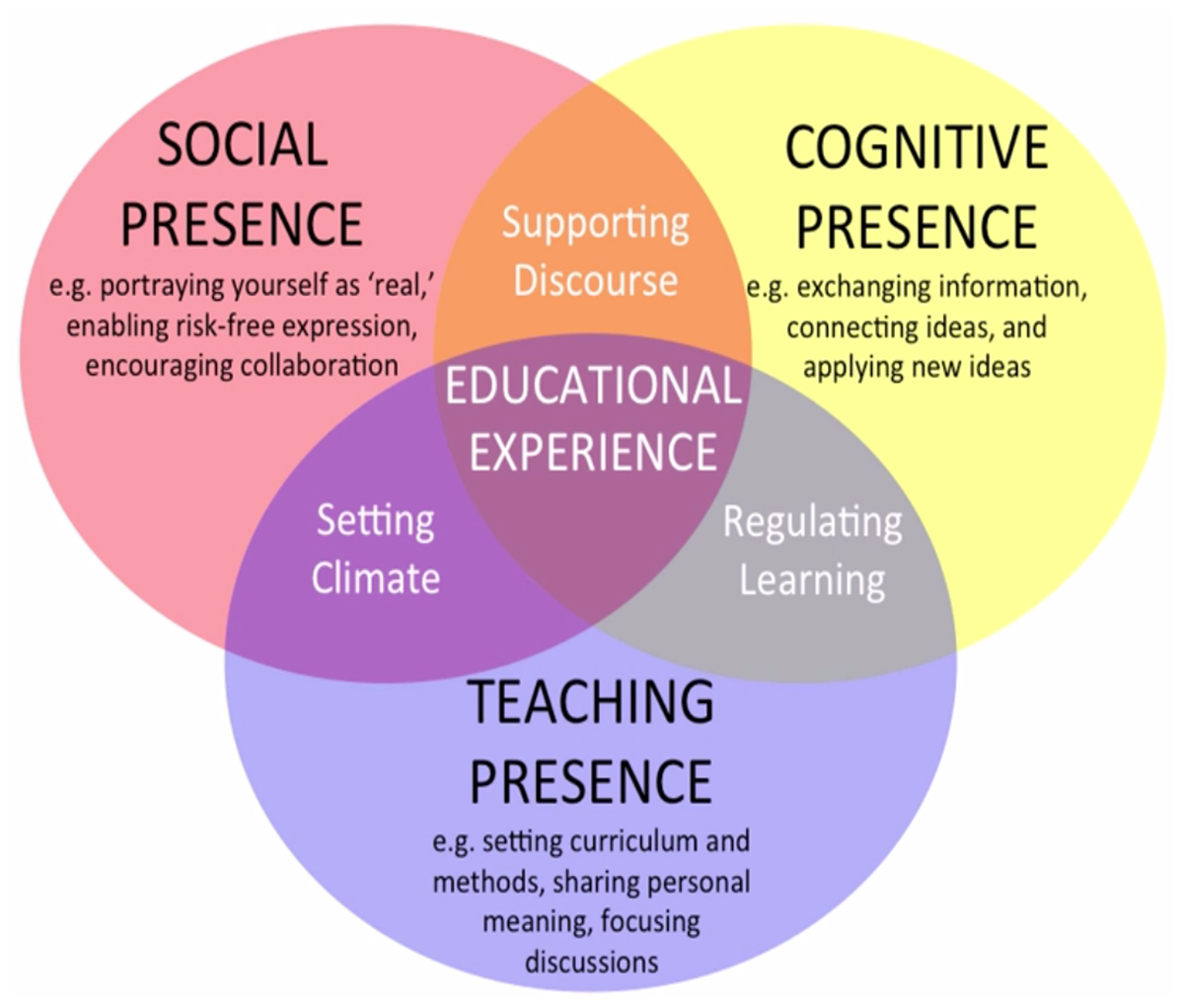
Figure 1
The Community of Inquiry Framework.
Note: Figure adapted from Garrison et al. (1999), CC-BY.
Decades have passed but, in many ways, not much has changed. Despite advances in communication technology, text-based communication continues to be the most prevalent form of communication in online courses (Jansson et al., 2021). There are many reasons for this. Asynchronous text-based communication enables people to learn online at any time and place, even with low bandwidth. Asynchronous text-based discussions, in particular, enable learners to interact with students, course content, and instructors (Aloni & Harrington, 2018; Moore, 2016; Poll et al., 2014). Text communication that can be easily and repeatedly edited and revised also lends to reflection, critical thinking, and higher-order learning (Garrison et al., 1999). Asynchronous discussions also afford reflection time, encourage equitable participation, and foster community development (Arend, 2009; Garrison et al., 1999; Maddix, 2012). Developing a sense of community can, in turn, decrease feelings of isolation and improve retention (Kaufmann & Vallade, 2020; Rourke et al., 1999).
Despite these affordances, many educators continue to experiment with other forms of communication technology. In particular, video communication enables learners to see and hear each other, allowing instructors and students to more efficiently and effectively establish their social presence (Borup et al., 2012). Video also helps to establish social presence because it affords students and instructors the ability to communicate more conversationally and elaborately compared to text (Borup et al., 2014). Video-based communication can occur asynchronously (e.g., VoiceThread, EdConnect) or synchronously (e.g., Facetime, Zoom, Meet, Teams). While synchronous video allows rapid, synergetic communication, asynchronous video communication can allow for more equitable participation and reflection.
Thus we posit that the evolution of online learning over the years has, in many ways, been about a tension between text-based vs. video-based or asynchronous vs. synchronous communication technologies. As choices in communication increase, so do the choices that need to be made when communicating online. This is especially true in the age of generative AI.
Generative AI is a particularly intriguing technology because rather than mediating communication, it can actually create the message. In fact, AI can be so good at mimicking human communication that quasi-social relationships can form between the user and the technology (van Doorn et al., 2017). van Doorn further argued that AI can communicate in ways that establish “automated social presence” or the extent to which those interacting with the AI feel “they are in the company of another social entity” (p. 44). Many students and instructors will also use AI to generate messages they send to others—thus changing their own social presence. For instance, Uhlig et al. (2023) found that ChatGPT could generate excellent responses to their discussion board prompts. However, these responses are unlikely to convey the learners’ true social presence. When reading discussion board comments, a history professor remembered thinking, “This does not read like a student.… I bet it’s ChatGPT.” He recalled that ChatGPT-generated messages were “a combination of polish together with impersonal, kind of like if Wikipedia had a voice” (Barbaro, 2023, June 28).
Generative AI in online courses
Although generative AI tools cannot replace human interaction, they introduce new possibilities for cultivating social presence in ways that can complement more traditional approaches. Large language models (LLMs) such as ChatGPT are designed to engage users in natural, conversational dialogue, creating an interactive experience that mimics human communication (Mishra et al., 2023). After all, these tools are designed to comprehend and produce “human-like responses” (Lo, 2023, para. 2) that show traits of personality and voice that help sustain a back-and-forth conversation over time. This responsiveness can help bridge gaps in social presence, especially in online courses where direct instructor or peer interaction may be limited. Research on human-computer interaction suggests that individuals often anthropomorphize AI and attribute human characteristics to these tools (Choudhury & Shamszare, 2023). As a result, students may perceive AI-driven conversations as dynamic, engaging, and responsive–characteristics that may promote a sense of connection in asynchronous learning environments.
One of the main affordances of generative AI is the ability to assume various roles such as tutor, brainstorming partner, editor, and/or study companion (Wiley, 2023b). Instructors can leverage this by designing structured activities where students are given explicit permission to use AI tools for academic purposes, such as sparking ideas, asking questions, providing feedback, and further engaging with course content. Generative AI can serve as a “more-knowledgeable other,” (MKO) (Vygotsky, 1978) who can provide guidance and scaffolding as learners seek assistance with content. For example, these tools can function as a type of tutor (Lo, 2023) or a study partner with the ability to generate a study guide on any given topic, ask potential test questions and evaluate answers, or create a set of related flashcards (Trust et al., 2023). Additionally, AI tools can act as an editor, assisting with revising sentences, evaluating the strength of a thesis statement, improving broader aspects of writing, including content structure, flow, and organization of a particular piece, as well as focusing on more fine-grained elements such as grammar, punctuation, and word choice (Dai et al., 2023; Imran & Almusharraf, 2023). In this sense, AI in the role of a MKO can be helpful, particularly in a large online classroom where teaching and social presence may be lacking and from the students’ perspective, asking for help may seem daunting.
Given these and the limitless number of additional possibilities, online classrooms will need to adapt to incorporate the ethical use of such tools. As Mishra and colleagues (2023) put it, “GenAI will require educators to develop new pedagogies and recognize that there will be other social agents in the learning space, a space that has been primarily inhabited by humans” (p. 10).
However, when integrating generative AI into teaching and learning, the focus first should be on issues surrounding bias, privacy, and ownership. Generative AI’s outputs can contain potentially harmful political (Motoki et al., 2023; Rozado, 2023), racial (Omiye et al., 2023), and gender biases (Newstead et al., 2023), and online instructors and students should be diligent in recognizing and minimizing these possible biases. Data privacy, security, and ownership are also common concerns with generative AI in higher education (Huallpa et al., 2023). For instance, LLMs are trained using large amounts of online resources--commonly without the permission of those who created those resources. Similarly, anything uploaded to generative AI can also be used to train the model, and careful consideration should be taken to protect students’ intellectual property (Malik et al., 2023). For instance, seeking permission from copyright holders--including students--is important (Lund & Wang, 2023). To address these concerns, universities should vet or even create their own generative AI tools for use by faculty and students that aim to protect student data and ownership (see O’Connell, 2024).
Using asynchronous video to establish social presence
Before presenting strategies for combining the use of generative AI with asynchronous video to enhance social presence in online classrooms, it is helpful to review the nature of social presences along with how video has been used as a medium to foster it. In its simplest terms, social presence is about establishing oneself and perceiving others as being “real” and “there” (Gunawardena, 1995). While research has shown that social presence can be established with text alone (Gunawardena & Zittle, 1997; Rourke et al., 1999), the lack of visual and auditory cues is still regularly perceived as a constraint, especially when trying to establish social presence (Xiu & Thomson, 2020). A line of research suggests that adding audio and video (whether synchronously or asynchronously) when communicating online can naturally make it easier to establish one’s social presence (Clark et al., 2015).
Additionally, there has been an increased interest in synchronous video-based communication for a number of reasons. One is the popularity of video consumption among students from younger generations (e.g., Generation Z). According to a recent study, “Gen Z possess shorter attention span, they are impatient, consume information from all over the world from a variety of sources, preferring digital media to traditional media and have a constant need to receive new, different types of information” (Szymkowiak et al., 2021, p. 8) It is important to note that generalizations of an entire generation should be taken with a grain of salt; however, a general consensus appears to emerge about the increasingly role that video is playing, both in everyday live (Auxier & Anderson, 2021) and among online learners, particularly when videos include interactive components (Haerawan et al., 2024).
Another reason video-based communication has become popular is because of COVID-19 (Zhang et al., 2023). This is in part because nearly everyone overnight gained immediate experience using synchronous video-based communication like Zoom during the pandemic. Many reported how easy and convenient they found it to use tools like Zoom. Among other things, they liked the ability to see and hear each other in real-time, which they believed helped address some of the common shortcomings of asynchronous text-based communication (Parrish et al., 2021; Serembus & Kemery, 2020; Zhang et al., 2023). However, most people quickly learned during the pandemic, if they were not already aware, that there are some inherent problems with using synchronous tools like Zoom, especially in fully-online courses where students might live all over the country or even the world. Commonly, nontraditional students, students with scheduling conflicts, and/or students living too far to attend classes in person make up those who are taking online courses. Requiring students like these to attend synchronous sessions at a specific time and day of the week is not realistic and takes away the freedom and flexibility of learning from anywhere, at any time. Asynchronous video-based communication (e.g., VoiceThread, EdConnect, Padlet), though, has been shown to leverage many of the benefits that go along with asynchronous communication while adding the benefits of video (i.e., being able to see and hear one another) (Lowenthal et al., 2020). These benefits can include increasing in students’ willingness to communicate and improving their level of communication by allowing them a space to rehearse and become more confident (Jaramillo Cherrez & Nadolny, 2023), a better understanding of student knowledge, and potentially strong instructor-student relationships, particularly when the instructor responded via video to those created by students (Griffiths & Graham, 2009). Various approaches for use of asynchronous video in online classes are described below.
Introductions, Check-Ins, & Class Discussions
One of the most common ways to build social presence is through some type of introduction activity (Fiock, 2020). Historically, these types of activities have been conducted in asynchronous discussion boards. However, technological advancements now make it easier than ever to have asynchronous video-based discussions, whether within a learning management system such as Canvas or using a dedicated application like Padlet (Yeh et al., 2022). While social presence building activities often take place in the beginning of a course, there is benefit to having reconnecting activities part-way through a course (Fiock, 2020). These asynchronous video-based discussions can be full class discussions (Guo et al., 2022) or a way for an instructor to check in with individual students (Lowenthal et al., 2021).
Student Presentations
Asynchronous video is also a great tool for students to use for some type of class presentation or demonstration. Students can record a short presentation and then solicit feedback from their peers (Ching & Hsu, 2013; Delmas, 2017; Kleftodimos & Triantafillidou, 2023; Lowenthal et al., 2020). Another option is to have students record a video on their phone or webcam and upload it to YouTube, where they can add comments to the video and/or annotate it (Howard & Myers, 2010). Either option enables students to have an artifact demonstrating their knowledge and skills even after the semester is over.
Video Feedback
Feedback is critical for learning. However, feedback can sometimes be misunderstood when given through text alone. Asynchronous video is not only a great way for instructors to provide feedback but it is also a great way to create instructor social presence and demonstrate their teaching presence. Research has demonstrated the power of video feedback to establish instructor social presence (Bahula & Kay, 2021; Love & Marshall, 2022). Recently Lowenthal et al. (2022) demonstrated the ability of video peer review to establish students’ sense of social presence of each other.
Strategically combining asynchronous video with text generated by AI
Guided by the CoI framework and previous research findings, in this section we share several ideas for how instructors can combine the use of generative AI with asynchronous video for the purpose of establishing or strengthening social presence in their online courses. We present these ideas as part of a new ABCS framework for using Generative AI to increase social presence, including with asynchronous video, which we believe represents many of the ideas we discovered in the literature (see Figure 2).
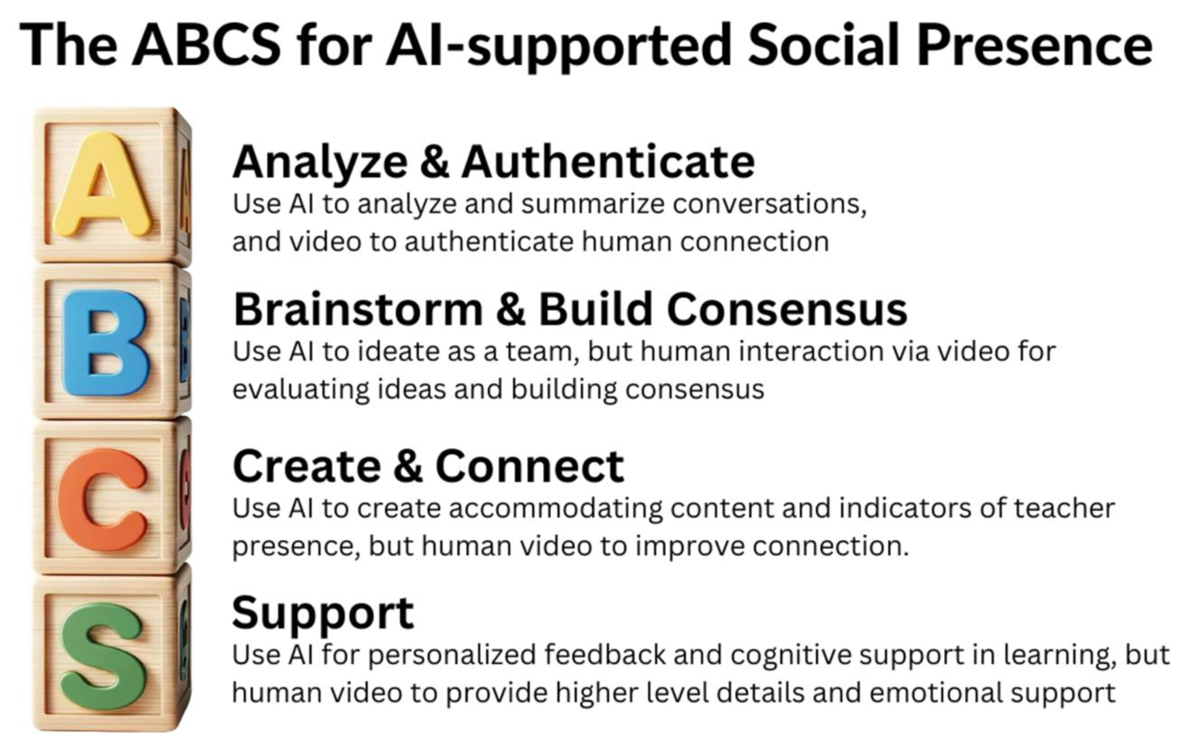
Figure 2
The ABCS for AI-supported Social Presence.
Note: Image of the blocks was created using OpenAI’s Dall-E (CC-BY).
ABCS for using generative AI with asynchronous video to increase social presence
A: Analyze and Authenticate
Instead of replacing the human touch in an online class, AI can be used to accelerate, broaden, and increase human connection by providing analysis to support the human component. For example, the CoI framework explains that social presence is supported when instructors facilitate discourse by providing commentary on class discussions (Anderson et al., 2001), but instructors—especially those with high student loads—must analyze large amounts of information prior to being able to provide this commentary. For instance, Black (2005) recommended that instructors provide a summary or wrap-up of discussion board activities. Similarly, Anderson et al. (2001) found that while facilitating discussions, instructors should provide direct instruction in several ways, including summarizing the discussion and addressing diagnosed misconceptions. As a result, instructors can use generative AI to analyze and describe communication patterns and themes so that instructors can more efficiently and effectively direct, facilitate, and wrap up communication with and between students. AI can also provide sentiment analysis of large discussion activities to help instructors better provide and target emotional support (Rasul et al., 2023; Wang et al., 2023). Furthermore, generative AI can assist with the analysis of one-on-one communications. For instance, Rasul et al. (2023) explained that ChatGPT could be used to analyze, summarize, and clarify student emails or small group class conversations that instructors are monitoring to detect challenges or questions.
However, AI also faces the challenge of presenting a false front to instructor communication, potentially making students feel less connected if the communication from their instructor is through AI. In addition, text responses can be misleading. Punctuation, emojis, and wording can be used to convey desired feelings and thoughts in text format, but often it can be unclear to the recipient if those feelings or thoughts are actually authentic (Derks et al., 2007). The communication cues present in video can help to authenticate the person’s actual thoughts and feelings (Lackmann et al., 2021; Maimaiti et al., 2023). In fact, video is so authentic that it can actually convey emotions that the person does not wish to convey (Borup et al., 2014). As a result, in courses where students’ affective engagement is important, the instructor can better understand students’ authentic thoughts and feelings when they are shared via video. Similarly, students can misinterpret instructors’ sentiments when communicating feedback via text, and providing feedback via video can help avoid these miscommunications.
Suggested Strategies:
Use AI to analyze and summarize conversations so that you can provide a more informed and helpful response. In this way, AI can increase the amount of commentary and conversation instructors can provide in a course.
Use AI to create base responses, but authenticate these responses with video to convey emotions and humanness to the responses.
Use AI to perform sentiment analysis on student comments in a discussion board, alerting instructors to the students most confused, skeptical, or in need of support. Then use video to comment personally on those students’ questions.
Use asynchronous video to authenticate people’s real thoughts and feelings. AI can be used to help generate a text response to questions, but video could show what a student really knows about a topic and what they really feel. By asking students to include a video that explains in their own words, their ideas authenticate, for the instructor, that the student really understands.
B: Brainstorm and Build Consensus
Creativity is an important and often under-taught skill (Wagner, 2019). Group creativity, in particular, is essential to career and societal success and involves two key and alternating processes (see McDonald et al., 2020). The first is divergent thinking or generating many new ideas, and the second is convergent thinking or the critical evaluation of ideas and combination of ideas into one solution—all while building consensus within the group around that solution.
Generative AI and asynchronous video can be combined to address both creative processes. Hörnemalm (2023) explained that generative AI can be “an always-available assistant that you can bounce ideas off of and brainstorm with” (p. 1). This brainstorming capability can assist instructors and students. For example, generative AI can quickly generate example activities that can aid instructors in their brainstorming and planning efforts, extending instructors’ abilities to develop quality group learning activities. Similarly, students, can use generative AI to brainstorm topics and ideas individually and collaboratively, particularly for open-ended learning activities. For instance, Lingard (2023) found that ChatGPT provided a “brainstorming bounty” and modeled how it could be used to quickly generate possible paper outlines and titles. Bozkurt et al. (2024) explained that generative AI can support creative thinking through multimedia content and art.
Fotaris et al. (2023) modeled how ChatGPT can better help brainstorm ideas by including phrases such as “Come up with more unusual ideas that have not been done so often before” or “Think outside the box and come up with something unusual and original” (p. 186) in the prompt.
However, while AI can be very helpful in the divergent thinking phase of group learning, it is less capable, in our opinion, of the convergent thinking phase. While AI can be used to evaluate ideas and provide reasons for the best solution, its decision-making is often flawed. More importantly, human interaction will likely be more helpful in building trust within a group so that members can speak out and come to a consensus around the desired solution.
While in-person and synchronous video may be more effective at capturing the immediacy and “group flow” (Sawyer, 2017) of a collaborative process, asynchronous video can help, over text or AI, at building trust and consensus. For example, video can allow instructors and students to disclose more of their own personal backgrounds and beliefs that can strengthen social presence and sense of community (Garrison et al., 1999). While one’s background and beliefs can be shared in text, Thomas et al.’s (2017) analysis of text and video feedback comments found that instructors were more 2 in their self-disclosure via video. We argue that self-disclosure is an especially important social presence indicator in the age of AI and the least likely to be replicated authentically by generative AI. Thus, while students can have interactive communication with generative AI, ultimately, the tool is not a real person and is unable to self-disclose personal information.
Suggested Strategies:
Use AI for group brainstorming (divergent thinking) and video for reflection, analysis, and commentary (convergent thinking). Create good “handoffs” between the AI part of the discussion and the human part of the discussion to transition effectively.
Use AI to begin a convergent thinking phase by providing analysis of ideas, leading to a discussion via video of how accurate class members believe the AI analysis is. Doing this via video can provide for the emotional bonding needed to build consensus and trust in the results.
Ask students to use video to create summaries of their papers and projects. The video summaries could be shared in group discussions to help peers understand their project quickly before giving feedback, and to authenticate to the instructor that they understood how to do the project. In addition, this can teach students how to present themselves through multimedia on the internet, an increasingly important skill.
C: Create and Connect
Selecting and curating content is an important function of teaching presence within the CoI framework (Rourke et al., 1999). Fotaris et al. (2023) claimed that generative AI “holds the transformative potential to reshape education, particularly in the domain of content creation” (p. 180). Once interactive/collaborative activities are planned, instructors can use generative AI to help create the required supporting content. Islam and Islam (2023) explained that generative AI can help instructors “generate written content on a specific topic, helping content creators save time and effort in writing articles, blog posts, and other written materials” (p. 4) that can be used to prompt discussion and collaboration. Koraishi (2023) added that AI could prove helpful in generating assessments, such as quiz questions, based on the content it helps to create. Fotaris et al. (2023) also argued that generative AI could create complex collaborative escape room activities. Singer et al. (2023) added how generative AI could be used to create authentic scenarios that can be used in scenario-based discussions or inquiry-based group learning, which previous research has found to be especially valuable when establishing a community of inquiry (Darabi et al., 2013).
Rather than generating entirely new content and materials, generative AI can be used to revise and repurpose existing content. For example, Koraishi (2023) explained that ChatGPT could be used by instructors to differentiate existing materials to accommodate their learners’ various backgrounds and proficiency levels. In our own experience, we have found generative AI useful in helping to modify or create course announcements and other communication. When prompted and after being trained on social presence indicators (see Rourke et al., 1999), AI’s modifications could focus on increasing indicators of social presence. In addition, AI may be helpful, particularly in creating and modifying open educational resources (Wiley, 2023a).
Ultimately, the instructors must ensure that what is generated using AI is connected to the course and students. As the facilitator of the course (and often the designer as well), the instructor best understands the history, purpose, and material of the course as well as the ever-changing dynamics within the course. As a result, it is important that the instructor ensures that AI-generated content is meaningful, accurate, and fully integrated into the course.
When facilitating the course, instructors should work to facilitate connections with and between students. Content can be “one-way communications with a subject expert” who created it (Moore, 1989, p. 2). As a result, when creating content with generative AI, instructors’ social presence can be strengthened when they make sure that the content is written in their voice. Instructors can also strengthen their social presence by creating instructional videos using scripts or content created with AI. While there is no shortage of instructional videos online that instructors can curate for their students, Lowenthal (2022) found that students preferred when instructors actually created their own instructional videos—especially those created in response to their needs—because they “sent the message that the instructor is engaged and cares about the class” (p. 379).
When engaging in communication, the verbal and visual cues found in video can be especially important in forming connections because they add a human touch that lets students know they are talking with a real person and not a “computer generated response” (Borup, 2014, p. 241). A few students in Moore and Filling’s (2012) research stated that the connection they felt from asynchronous video felt similar to the connections that they had formed from in-person communication.
Suggested Strategies:
Use AI to help develop scripts that the instructor then uses to create short instructional videos.
Use video to explain complicated topics that AI struggles to do.
Use AI to generate a discussion prompt activity with several scenarios for students to select from and respond to. The instructor can also add a human touch by creating a short video introducing the activity and encouraging students to participate. Students can also post their initial responses using video to form better connections.
Engage students in an asynchronous video discussion as a way of increasing a sense of presence and connection by showing the humanness of people behind the screens. However, it can take longer to view, then read, content. One strategy may be to use AI to generate captions/text from students’ video discussions. The video can still show the authentic self, improving connection, but readers in a hurry can read the text.
Support
Providing support and feedback is an important indicator of social presence within a community of inquiry (Paquette, 2016; Rourke et al., 1999). Generative AI can help alleviate some of the instructors’ responsibility to provide learners with instructional support and feedback (Aksoy & Kursun, 2024; Rutner & Scott, 2022). Baidoo-Anu and Ansah (2023) explained that generative AI such as ChatGPT “can be used to provide personalized tutoring and feedback to students based on their individual learning needs and progress” (p. 55). Atlas (2023) added:
[Generative AI] can be trained to understand the specific style and formatting requirements of an assignment or paper, and can provide suggestions and corrections to improve the clarity and coherence of the writing. This can be especially helpful for non-native speakers or students who struggle with writing. For example, a student can use ChatGPT to generate ideas for their essay and get feedback on their writing. (p. 5)
Mizumoto and Eguchi (2023) used ChatGPT 3.0 to automatically score 12,100 essays and concluded that “GPT has the potential to revolutionize writing instruction and assessment, providing immediate scoring and augmented feedback on writing quality that aligns with specific criteria” (p. 9). While generative AI should not entirely replace instructor-provided feedback, it can provide formative feedback prior to the instructor’s feedback, or provide baseline feedback that the instructor can then personalize and modify—allowing the instructor to provide more detailed feedback.
The support that generative AI provides—while immediate and helpful—often lacks the depth and context needed for students to fully close their performance gap. It should not be used to replace instructor-provided feedback (Imran & Almusharraf, 2023). Rasul et al. (2023) explained that instructors should be “drawing on their subject-matter expertise and focusing on providing higher levels of detail in feedback rather than spending time on structural items like grammar and referencing, which can be easily generated by LLMs” (p. 45). Thomas et al. (2017) analyzed video and text feedback comments and found that feedback was perceived as more supportive when provided using video. West et al. (2017) added that the visuals inherent in screencast recordings can provide helpful context for communication.
Suggested Strategies:
Require students to submit their writing to AI for feedback prior to submitting it to the instructor for grading and instructor. Students can provide the instructor with a description of the AI-generated feedback and the revisions they made as a result. The instructor can then provide their own feedback comments using a combination of text (perhaps created with the aid of generative AI) and video.
Use AI to predict students at risk, and then reach out with video for personal connections and support.
Create different videos answering different questions students commonly have, or areas they often want to learn more about, and then have AI create personalized learning paths for each student. In this way, the AI could analyze the student’s progress, and create a learning path customized to them, but with video commentary from their instructor that can engage and provide teaching presence. This extends the ability of the instructor to “talk” to each student individually via video by allowing videos to be pre-recorded and reused each semester.
Record video feedback giving praise for common learning behaviors, and then have AI add these feedback videos to student feedback as warranted, motivating effective learning behaviors through feedback.
Use AI to grade student work at a surface level, providing a first-level, but very specific, assessment, freeing up the instructor to then spend time recording personalized feedback that provides commentary on their work overall and the big picture strengths and weaknesses.
Conclusion
While artificial intelligence has been a key topic in educational research for over two decades (Chen, et al., 2022), the hype (see Nemorin et al., 2023) has swollen since ChatGPT 3 was released on November 30, 2022. Just one month prior to this event, Bearman et al. (2023, officially, but first published in October, 2022) analyzed the literature and concluded there were two main discourses in the research surrounding AI in education. The first discourse they identified prophetically, was the discourse of imperative change. This imperative has only increased in the last year, and we concur that it has become imperative for all teachers and instructional designers to reflectively consider how to effectively use AI in their teaching in ways that enhance, rather than detract, from learning.
Equally prophetic, the second discourse identified by Bearman et al. (2023) in the literature was of altering authority—or the belief that AI would decenter the teacher, or even the students, as the primary sense-makers in the educational process. This prompts questions of what “humanness” (Graham, 2006) looks like in an AI-fueled educational age, and what role human interaction will play. We argue that community and relationships are core to education and will continue to be so. What AI presents, then, is an opportunity to examine the role of these relationships anew in education. Where technology (generative AI) may present an interesting challenge to decentering these relationships, we also believe technology may present the solution—in part by using video technologies to imbue an AI educational world with humanness.
In this paper, we have explored this issue by discussing the important role that social presence and community play in online learning specifically. We then shared specific strategies for using generative AI to build social presence in online learning, as well as strategies for using asynchronous video to compensate for some of AI’s inherent weaknesses. We have organized these strategies into the ABCS framework that we believe represents a first step into this unknown world. While based on previous empirical research, the ABCS framework has yet to guide new research or practice. Whetten (1989) highlighted that, initially, frameworks commonly make claims that have yet to be empirically examined. In fact, one potential benefit of frameworks is that they can encourage research on new topics and practices, as is the case with generative AI. Wilson (1997) argued that frameworks can help to envision what could be rather than only describing what currently is. Graham et al. (2014) explained that frameworks can provide an important “focus for the activities that take place in a scholarly community” (p. 13). Similarly, Mishra and Koehler (2006) stated that frameworks provide important guidance in the formation of research questions. One way that frameworks provide guidance is by drawing focus on the issues and practices that are most important (Mishra & Koehler, 2006). The goal of the ABCS framework is to provide important insights and guidance for future research and practice. Researchers should examine the scalability and application of the framework to multiple contexts and content areas. These efforts can help to refine and deepen the framework. Future research, reflection, and discussion is also needed to develop additional strategies and evidence for how to effectively integrate AI into online learning without losing the humanness that we believe is essential to human motivation and learning.
Competing Interests
The authors have no competing interests to declare.
Author Contributions (CRediT)
Jered Borup: Conceptulaization, Writing – original draft, review, & editing; Richard E. West: Conceptulaization, Writing – original draft, review, & editing; Patrick Lowenthal: Conceptulaization, Writing – original draft, review, & editing; Leanna Archambault: Conceptulaization, Writing – original draft, review, & editing. All authors have read and agreed to the published version of the manuscript.