
Introduction
Advancements in technology have always gone hand in hand with learning and teaching activities, providing technical possibilities to humankind. The advancements in technology affect information technologies and consequently, information systems. Just as letter correspondence-initiated distance education, some information technologies can open the doors to changing the education paradigm upon which the system is based (Attard et al., 2010, p.10). On the other hand, the accumulation of knowledge in information systems can enable the creation of necessary technologies.
With the proliferation of computer technologies and the increase in individual computers, the time and space constraints in learning and teaching have largely disappeared with the invention of the internet. The rapid changes in information technologies have shifted from teacher-centered education to learner-centered learning paradigms that focus on the freedom and needs of the individual. In this new paradigm, online learning forms, such as Massive Open Online Courses (MOOCs), which adopt an online learning method, require only self-direction, internet access, and a digital device for the learner’s needs (Littlejohn & Hood, 2018, p.3-48). For instance, a learner can enroll in a MOOC, gain the desired knowledge and skills, and obtain a certificate for fee. With the cheapening and widespread use of smart mobile devices and storage devices, access to content, sharing, and intervention in sharing can be achieved simultaneously all over the world.
Online learning methods, which can be the only method that meets all learning needs of learners (synchronous and asynchronous learning), can also be supplemented by in face-to-face learning-teaching processes as a method that supports blended learning (Cheng, 2012, p.362). Regardless of the role of online learning in this process, it can be considered successful if it is adopted and continued to be used by learners (Martins & Kellermanns, 2004).
An example of an online learning platform in Turkey is the Anadolum E-Campus System provided by Anadolu University, a pioneer in open education in Turkey. However, introducing an innovation such as online learning methods to individuals and society is not an easy task. To predict the possible reactions and outcomes of an innovation as an idea or a product in society, the Technology Acceptance Model (TAM) is frequently used especially in studies of usage intention and usage continuance in information systems and information technologies (Cheng, 2022, p. 363).
This study examines the factors that influence the intention of Anadolu University Open Education System learners to use the Anadolum E-Campus platform and subsequently continue to use it via a sustained TAM (STAM).
Literature Review
Anadolu University Open Education System Anadolum E-campus
The e-Campus platform, offered by Anadolu University Open Education Faculty, Economics Faculty, and Business Administration Faculty, is a virtual platform available to learners. The Anadolum e-Campus System, which was started to be used in the spring semester of 2016, was designed to include planning for content, management, evaluation, and communication dimensions to benefit all stakeholders in the best way possible (Sönmez, 2018).
The Anadolum e-Campus System, which is used as a virtual learning environment, enables learners to take an active role in their learning process through its learning management system (Koçdar et al., 2017). It provides learners with the opportunity to connect to online classes from anywhere they want, and it prevents them from falling behind by allowing them to watch the missed classes at any time.
In summary, Anadolum e-Campus System is an original learning environment that aims to maximize interaction and increase learner motivation by focusing on learning and communication technologies. The Anadolum e-Campus is an online learning platform that aims to reduce both physical and transactional distance with its features.
Online Learning
Online learning is the general term for learning that is provided with various digital tools (Farmer, 2019) in order to meet individual learning needs or to achieve the performance needs of an institution for specific purposes (Clark & Mayer, 2008, p.7). Although online learning is generally associated with computers and is based on the teaching machine of behavioral psychiatrist Burrhus Frederic Skinner (Clark & Mayer, 2008, p.11), today’s technology also benefits from various devices such as smartphones, e-book readers, DVDs, podcasts, and USB storage devices. Sometimes, the device used, such as in mobile learning (m-learning), can also be the name of the online learning type. Sometimes, as in accessible learning, the feature of completely freeing learning from time and place rather than the device that enables learning can be the name of the learning type.
Online learning, which holds an important place in our lives, is parallel to the quality of planning, designing, presenting, and the pedagogy used during presentation. Offering learning content to learners with new technological possibilities alone cannot guarantee learning. The characteristics of the learners and the way the learning content is organized and presented are decisive in this process. Therefore, as long as the educational methods remain the same, the result will not change regardless of the tool used (Clark & Mayer, 2008, pp.8–14).
The success of online learning systems depends on learners’ participation and continued use of the system (Zhang et al., 2012). Ensuring learners are involved in the system and using it requires some foresight work and overcoming barriers. Scientific studies have revealed many factors that affect learners’ participation in online learning environments (Chen, 2007; Cheng et al., 2011). Considering these factors will prevent possible exit from the system and increase system success.
Technology acceptance model (TAM)
Saade and Bahli (2005) stated that very few learners who encountered a new technology were able to integrate into the intended system. Therefore, it is necessary to predict, determine, and control learners’ adaptation to new technologies. There are models that predict learners’ adaptation to new technologies by considering the factors that affect their attitudes, thoughts, and adaptability (Venkatesh & Morris, 2000). These are the Diffusion of Innovations Theory, Theory of Reasoned Action, Planned Behavior Theory, and Technology Acceptance Model.
The Technology Acceptance Model was initially seen as a theoretical extension of the Theory of Reasoned Action, but it was later realized that it was a more competent model in explaining user technology acceptance (Lee, 2010). The Technology Acceptance Model states that user acceptance behavior is primarily influenced by perceived usefulness and perceived ease of use (Venkatesh & Morris, 2000). Perceived ease of use indicates an individual’s beliefs about how physically and mentally effortless it is to use a system, while perceived usefulness refers to an individual’s beliefs about how using a system enhances their job performance (Davis, 1989).
Because the validity of the TAM has been established, it has been previously used in online learning studies, and it has been recommended, the TAM is the model upon which the hypotheses in this study are based.
Focus of the Study
By considering this study, online learning and material providers can enhance their products to understand what factors affect learners’ acceptance and ongoing use of their systems. This can lead to the development of more effective, efficient, and appealing learning experiences. Additionally, studies in the literature have shown that the factors affecting online learning can differ slightly in different cultures (Salloum et al., 2018; Baraz et al., 2021; Tawafak et al., 2021). Therefore, identifying the factors that affect the intention to use and usage behavior continuity of learners in online learning in each culture (Chen, 2007; Cheng et al., 2011) can lead to more accurate results.
When the literature is examined, it is seen that there are TAM-based scientific studies on the intention to use and usage continuity of online learning both in Turkey and abroad (Oliver, 1980; Venkatesh & Davis, 2000; Ong & Lai, 2006; Lee et al., 2009; Liu et al., 2010; Lee et al., 2011; Sukendro et al., 2020; Baraz et al., 2021) No study was found that brings together usage intention and usage behavior in a model and examines the effect of usage intention on usage behavior with other factors. Since it is thought that usage intention will determine the fate of usage behavior, it is considered important to establish such a relationship.
In this study, social norms that directly influence the intention of Anadolu University Open Education System learners to use the e-Campus platform, and cognitive participation and content richness that indirectly influence usage behavior continuity were determined through a literature review. For usage behavior continuity, habit, satisfaction, self-efficacy, and endorsement were determined. The following questions are sought to be answered with the help of the determined factors:
What are the factors that affect the intention to use and usage behavior continuity of Anadolu University Open Education System learners for the e-Campus platform?
Is the model developed according to the technology acceptance approach using the determined factors significant?
Are the hypotheses (established regarding the intention to use and usage behavior continuity of Anadolu University Open Education System learners for the e-Campus platform) supported?
What is the predictive power of the theoretical model developed to determine learners’ intention to use online learning and their continuity of usage behavior?
Methods
The correlational research, which aims to explain the relationship between two or more variables and, if any, the direction of the relationship (Creswell, 2012), shapes this study. Correlational (associational) research is a quantitative research design that attempts to statistically determine the direction and degree of the relationship between two or more variables without interfering with the relationship between the variables (Aksu et al., 2017, p.72).
Participants
The development of the measurement tool to be used in the research, the construction of the research model, and the data collection for the main application were conducted with the learners of the Anadolu University Open Education System in the fall semester of 2021–2022. An application was made to the Scientific Research and Publication Ethics Committee of Anadolu University for the administration of the prepared scale. Following the approval of the Committee with protocol number 46176 on March 30, 2021, the research activities began. In this application, which was open to any learner who wished to participate through Google Forms, simple sampling method was used, which is one of the non-probabilistic sampling methods. Simple sampling is a method in which anyone who wishes to participate is included and waited until a certain number is reached, providing time and economic savings (Ural, 2011, p.43). In the first application, the scale created on Google Forms reached 1300 learners. Among the participants, 1001 individuals contributed to the processable data by answering the two control questions placed in the scale as desired. For the confirmatory factor analysis, the scale created on Google Forms reached 1460 learners. Among the participants, 1001 individuals contributed to the processable data by answering the two control questions placed in the scale as desired. In the final application, it was observed that 1314 responses out of 1600 were acceptable after the eliminations made based on the control questions.
Construction of Item Pool and Scope Validation Study
Validity holds particular importance in the preparation stage of a measuring tool (Brains et al., 2011, p.76). Validity refers to the degree to which the scale is aligned with the characteristic being measured. Scope validity refers to the preparation of scale items that cover all aspects of the characteristic being measured. Each scale item in scope validity should be related to the characteristic being measured (Ayre & Scally, 2014, p.81). For a scope validation study, the opinions of an adequate number (5–40) of experts are required, and based on these opinions, modifications and additions/deletions must be made (Lawshe, 1975; Brinkman, 2009).
One technique for attempting to establish scope validity based on expert opinions is Lawshe’s technique (1975). It is a widely used technique due to its ease of use (Wilson et al., 2012). This technique, initially proposed by Lawshe, was subsequently revised by Wilson et al. (2012) and Ayre and Scally (2014). The scope validity criteria determined after revision were used in this study.
An expert group consisting of eight university lecturers specializing in Distance Learning and Open Education was formed. The 66-item scale was presented to them. An online form prepared using Lawshe’s technique, which categorized items as appropriate, in need of development, or in need of deletion, was shared with the experts. The options they selected with their reasons were later visualized. Then, Lawshe’s formula, KGO = Nu/(N/2)-1, was used to calculate the scope validity ratio (KGO), and the KGO means were obtained. The scope validity index (KGI) was then calculated after 22 items with a KGO value of negative, zero, or close to zero were removed, leaving 44 items. Since the scale was multidimensional, KGI was calculated separately for each factor and compared to the 0.750 criterion determined by the eight experts. It was determined that the scale with 44 items had statistically established scope validity, as KGI > KGO was achieved for each factor (Lawshe, 1975). The obtained items were recoded according to their perceived factors and sequence.
Treoretical Model and Developed Hypothesis
A literature review was conducted to identify the factors that affect the acceptance and continuity of online learning, and the model used in this determination (see Figure 1). In the literature review, the study conducted by Panigrahi, Srivastava, and Sharma (2018), which comprehensively compiled certain factors that influence the intention to use and continue using online learning, was determinant in this study. In their study, the intention to use and the continuity of online learning were examined in the context of personal (internal) and environmental (external) factors.
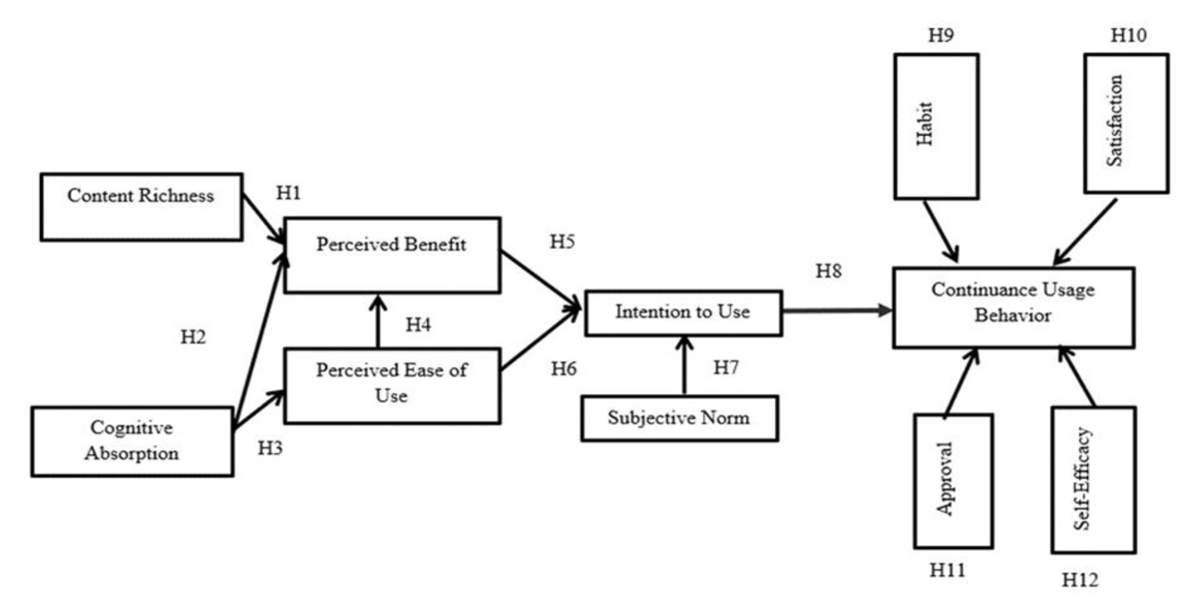
Figure 1
The model of hypotheses that affect the intention to use and the continuity of usage behavior of the Anadolum e-Campus platform.
Exploratory and Confirmation Factor Analyses
Factor analysis, based on Charles Spearman’s study on “mental tests consisting of multiple subtests,” refers to the examination and interpretation of numerous variables under a conceptual framework (Aksu et al., 2017, p. 2). Factor analysis is a type of analysis that groups many items under predetermined headings in the most related way possible and attempts to reduce the relationship between groups (Karagoz, 2016, p. 877). Factor analysis based on the correlation matrix is used both to reveal the structure of a measurement tool (exploratory factor analysis) and to verify the identified factors (confirmatory factor analysis). Confirmatory factor analysis refers to testing and verifying the factors and related items identified by exploratory factor analysis or literature review through data collection again. Confirmatory factor analysis is “a method that estimates and tests the structural relationships between observed variables and latent variables, between Variable-Factor, Factor-Factor, and Parameter-Parameter estimates through a model” (Özdamar, 2017, p. 229). The basic principle of both types of factor analysis is to determine unobservable structures through observable data (Karagoz, 2016, p. 877). Firstly, exploratory factor analysis (EFA) was conducted in this study. Then, the second data obtained was taken for processing in confirmatory factor analysis (See Table 1).
Testing the Normal Distribution of Data
When dealing with variables that cannot be directly measured, such as perception, cognition, or attitudes, and Likert-type scales in social sciences, the normal distribution of the data can be assessed using multiple tests. The SPSS software package allows the normality of data to be tested using various tests simultaneously. Some statisticians prefer to rely on the tests that assess kurtosis and skewness values for normality testing, rather than other tests (Mayers, 2013, p.52). In this study, skewness and kurtosis values were initially assessed to test for normal distribution of the data. Tabachnick and Fidell (2013) state that deviations in kurtosis and skewness values are generally not significant when the sample size exceeds 200. However, George and Mallery indicate that data is normally distributed when the kurtosis and skewness values fall within the ±2 range (2010). Kline suggests that kurtosis and skewness values in Structural Equation Modeling can indicate how far the data deviates from normal distribution. According to Kline, kurtosis values smaller than ±3 and skewness values smaller than ±10 indicate that the data is not deviating from normal distribution (Kline, 2016, pp.76–77).
In the analysis conducted using SPSS AMOS software package, it was observed that the final data did not meet the assumption of multivariate normality. Therefore, it was decided to use partial least squares-based structural equation modeling analysis instead of covariance-based structural equation modeling analysis.
Findings
The findings section is organized according to the research questions.
What are the factors that influence the intention to use and usage behavior continuity of the Anadolu University Open Education System learners’ e-campus platform?
A comprehensive and in-depth literature review was conducted to identify the factors that affect the acceptance and continuity of online learning. The current studies of Panigrahi, Srivastava, and Sharma (2018), who examined the acceptance and usage continuity of online learning in two groups as personal factors and environmental factors, were determinant in identifying the factors. Additionally, usage intention was added to the factors that affect usage behavior continuity to determine the direction and amount of the relationship between usage intention and usage behavior continuity. Therefore, self-efficacy, satisfaction, approval, habit, and usage intention were identified as the factors that affect usage behavior continuity as a result of the literature review. It was concluded that perceived usefulness is influenced by content richness and cognitive absorption, perceived ease of use is affected by cognitive absorption, and usage intention is influenced by subjective norms, perceived usefulness, and perceived ease of use. These factors were used in creating the model.
Is the model developed based on the identified factors significant according to the technology acceptance approach?
Convergent and discriminant validity were tested to evaluate the measurement model. In terms of convergent validity, reliability at the item level, Cronbach’s alpha (α), composite reliability (CR), and average variance extracted (AVE) were examined. It was found that the item loadings ranged from 0.739 to 0.958.
Based on the examination of factor loadings, it has been determined that the item-level reliability has been achieved since the values are above 0.708 (Hair et al., 2010). Additionally, convergent validity has been achieved due to the AVE values being above 0.500 for all factors, and the Cronbach’s alpha and composite reliability (CR) values being above 0.700 (Hair et al., 2017).
Discriminant validity was examined based on the Fornell-Lacker criterion (See Table 2) and the HTMT ratio (See Table 3). It has been concluded that the Fornell-Lacker criterion is met since the square root of the AVE value obtained by dividing the square of the factor loadings for each item by the number of items is higher than the correlation with other factors (Fornell and Lacker, 1981).
Table 2
Discriminant validity (Fornell-Lacker).
| AF | AKK | ALS | BK | KDD | KN | MMT | ONY | OYT | OZN | IZ | |
|---|---|---|---|---|---|---|---|---|---|---|---|
| AF | 0.896 | ||||||||||
| AKK | 0.598 | 0.894 | |||||||||
| ALS | 0.413 | 0.364 | 0.914 | ||||||||
| BK | 0.580 | 0.551 | 0.593 | 0.845 | |||||||
| KDD | 0.531 | 0.449 | 0.515 | 0.522 | 0.893 | ||||||
| KN | 0.443 | 0.523 | 0.560 | 0.588 | 0.615 | 0.933 | |||||
| MMT | 0.576 | 0.575 | 0.569 | 0.673 | 0.643 | 0.671 | 0.929 | ||||
| ONY | 0.538 | 0.514 | 0.473 | 0.604 | 0.612 | 0.537 | 0.729 | 0.937 | |||
| OYT | 0.472 | 0.547 | 0.302 | 0.303 | 0.444 | 0.398 | 0.491 | 0.506 | 0.893 | ||
| OZN | 0.370 | 0.264 | 0.528 | 0.478 | 0.406 | 0.468 | 0.421 | 0.409 | 0.189 | 0.930 | |
| IZ | 0.613 | 0.601 | 0.490 | 0.563 | 0.497 | 0.527 | 0.554 | 0.635 | 0.497 | 0.403 | 0.845 |
Table 3
Discriminant validity (HTMT).
| AF | AKK | ALS | BK | KDD | KN | MMT | ONY | OYT | OZN | IZ | |
|---|---|---|---|---|---|---|---|---|---|---|---|
| AF | |||||||||||
| AKK | 0.651 | ||||||||||
| ALS | 0.446 | 0.394 | |||||||||
| BK | 0.630 | 0.589 | 0.665 | ||||||||
| KDD | 0.576 | 0.487 | 0.562 | 0.577 | |||||||
| KN | 0.480 | 0.567 | 0.602 | 0.648 | 0.667 | ||||||
| MMT | 0.617 | 0.618 | 0.604 | 0.721 | 0.688 | 0.717 | |||||
| ONY | 0.575 | 0.550 | 0.501 | 0.643 | 0.653 | 0.571 | 0.768 | ||||
| OYT | 0.527 | 0.611 | 0.331 | 0.330 | 0.491 | 0.442 | 0.538 | 0.554 | |||
| OZN | 0.396 | 0.284 | 0.561 | 0.523 | 0.437 | 0.498 | 0.442 | 0.428 | 0.205 | ||
| IZ | 0.681 | 0.670 | 0.545 | 0.635 | 0.552 | 0.585 | 0.607 | 0.696 | 0.566 | 0.444 |
In addition, since the HTMT ratio obtained using the Smart-PLS software is lower than the value of 0.90, it has been concluded that discriminant validity is also achieved in terms of the HTMT ratio (Hair et al., 2017).
Are the hypotheses established regarding the intention to use and continuous usage behavior of Anadolu University Open Education System learners on the e-campus platform supported?
The hypotheses regarding the usage intentions and behaviors of Anadolu University Open Education System learners with regards to the e-campus platform were tested using structural equation modeling (See Table 4). The path coefficient between usage intention and perceived benefit was found to be 0.092, and it was found to be statistically significant (β = 0.092; p = 0.038). The path coefficient between usage intention and perceived ease of use was found to be 0.380, and it was found to be statistically significant (β = 0.380; p = 0.000). The path coefficient between usage intention and subjective norm was found to be 0.334, and it was found to be statistically significant (β = 0.334; p = 0.000). It was found that perceived benefit, perceived ease of use, and subjective norm explained 39.4% of usage intention (R2 = 0.395; Adjusted R2 = 0.394).
Table 4
Path analysis.
| COEFFICIENT | STANDARD DEVIATION | t | p | f2 | VIF | R2 | Radj2 | |
|---|---|---|---|---|---|---|---|---|
| Perceived Benefit (AF) -> Intention to Use (KN) | 0.092 | 0.044 | 2.077 | 0.038 | 0.008 | 1.684 | 0.395 | 0.394 |
| Perceived Ease of Use (AKK)-> Intention to Use (KN) | 0.380 | 0.038 | 9.884 | 0.000 | 0.152 | 1.562 | ||
| Subjective Norm (OZN) -> Intention to Use KN) | 0.334 | 0.025 | 13.423 | 0.000 | 0.158 | 1.162 | ||
| Habit (ALS) -> Continuance Usage Behavior (KDD) | 0.130 | 0.026 | 4.963 | 0.000 | 0.022 | 1.628 | 0.526 | 0.524 |
| Intention to Use (KN) -> Continuance Usage Behavior (KDD) | 0.259 | 0.036 | 7.167 | 0.000 | 0.070 | 2.016 | ||
| Satisfaction (MMT) -> Continuance Usage Behavior (KDD) | 0.178 | 0.053 | 3.398 | 0.001 | 0.022 | 2.989 | ||
| Approval (ONY) -> Continuance Usage Behavior (KDD) | 0.232 | 0.044 | 5.280 | 0.000 | 0.049 | 2.302 | ||
| Self-Efficacy (OYT) -> Continuance Usage Behavior (KDD) | 0.097 | 0.034 | 2.831 | 0.005 | 0.014 | 1.415 | ||
| Perceived Ease of Use (AKK) -> Perceived Benefit (AF) | 0.274 | 0.035 | 7.855 | 0.000 | 0.086 | 1.748 | 0.499 | 0.498 |
| Cognitive Absorption (BK)-> Perceived Benefit (AF) | 0.258 | 0.033 | 7.728 | 0.000 | 0.081 | 1.633 | ||
| Content Richness (IZ)-> Perceived Benefit (AF) | 0.303 | 0.036 | 8.523 | 0.000 | 0.103 | 1.781 | ||
| Cognitive Absorption (BK) -> Perceived Ease of Use (AKK) | 0.551 | 0.021 | 26.159 | 0.000 | 0.436 | 1.000 | 0.304 | 0.303 |
The path coefficient between perceived benefit and perceived ease of use was found to be 0.274, and it was found to be statistically significant (β = 0.274; p = 0.000). The path coefficient between perceived benefit and cognitive absorption was found to be 0.258, and it was found to be statistically significant (β = 0.258; p = 0.000). The path coefficient between perceived benefit and content richness was found to be 0.303, and it was found to be statistically significant (β = 0.303; p = 0.000). It was found that perceived ease of use, cognitive absorption, and content richness explained approximately 50% of perceived benefit (R2 = 0.499; Adjusted R2 = 0.498).
The path coefficient between usage behavior continuity and habit was found to be 0.130, and it was found to be statistically significant (β = 0.130; p = 0.000). The path coefficient between usage behavior continuity and usage intention was found to be 0.259, and it was found to be statistically significant (β = 0.259; p = 0.000). The path coefficient between usage behavior continuity and satisfaction was found to be 0.178, and it was found to be statistically significant (β = 0.178; p = 0.001). The path coefficient between usage behavior continuity and confirmation was found to be 0.232, and it was found to be statistically significant (β = 0.232; p = 0.000). The path coefficient between usage behavior continuity and self-efficacy was found to be 0.097, and it was found to be statistically significant (β = 0.097; p = 0.000). It was found that habit, usage intention, satisfaction, confirmation, and self-efficacy explained 52.4% of usage behavior continuity (R2 = 0.526; Adjusted R2 = 0.524).
What is the predictive power of the theoretical model developed to determine learners’ intention and usage behavior of online learning?
The explanatory power of the model and its predictive power, which was tested through K-fold cross-validation, were evaluated (See Table 5). The results indicated that the model had sufficient predictive power (Shmueli et al., 2019). Therefore, it is believed that the model developed in this study has the ability to predict the usage intention and continuance of online learning for Anadolu University Open Education System learners. There is also a possibility that the model may produce similar results when used in other learning cultures.
Discussion
The discussion section is organized according to the research questions.
What are the factors that affect the intention and usage behavior continuity of Anadolu University Open Education System learners in using the e-campus platform?
Based on the literature review, a theoretical model was developed using a TAM framework to determine the factors thought to affect learners’ online learning usage intentions and continuity. Internal and external factors used in the model were selected according to the framework classification identified by Panigrahi, Srivastava, and Sharma (2018). Following the identification of the factors, the scales and models developed in the field were examined. Taking into account the interaction, degree, and direction of the factors in these studies, the factors that are thought to affect Anadolu University Open Education System learners the most were determined.
The identified factors were found to support all twelve hypotheses determined according to the TAM-based theoretical model. Accordingly, content richness, cognitive absorption, and perceived ease of use factors positively influence perceived benefits. Perceived ease of use is positively influenced by cognitive absorption. Perceived benefits, perceived ease of use, and subjective norm factors positively affect usage intention. Usage behavior continuity is positively influenced by usage intention, habit, self-efficacy, approval, and satisfaction factors.
When the data obtained from Anadolu University Open Education System learners were examined, it was determined that cognitive absorption had the highest (0.551) and perceived benefit had the lowest (0.092) impact. Although the subjective norm factor had a relatively high explanatory power (0.334), the low value of the perceived benefit factor is thought to be influenced by factors such as the compulsory nature of the Anadolu E-Campus platform and the need for learners to use it in certain periods of the year, such as midterm and final exams, and online courses.
Is the model developed according to the technology acceptance approach using the determined factors significant?
The convergence and discriminant validities were statistically tested for the evaluation of the measurement model. For convergence validity, reliability at the item level, Cronbach’s alpha (α), composite reliability (CR), and AVE were examined. It was observed that the item loadings ranged from 0.739 to 0.958. When looking at the item loadings, it was determined that the item-level reliability was achieved because the values were above 0.708 (Hair et al., 2010). In addition, convergence validity was determined to be achieved due to AVE values being above 0.500 and Cronbach’s alpha and composite reliability (CR) values being above 0.700 for all factors (Hair et al., 2017).
For discriminant validity, both the Fornell-Lacker criterion and the HTMT ratio were examined. It was concluded that the Fornell-Lacker criterion was satisfied because the square root of the AVE (Average Variance Extracted) value obtained by dividing the square of the item loadings for each factor by the number of items was higher than the correlation with the other factor (Fornell and Lacker, 1981). In addition, discriminant validity was achieved based on the HTMT ratio being less than 0.90 (Hair et al., 2017).
There are different opinions about the threshold values that should be present for the R2 values explaining the internal variables of the external variables in the proposed model. While Moksony (1999) stated that R2 cannot indicate the fit of a model, Falk and Miller (1992) stated that an R2 value of 0.10 or higher would be sufficient to explain the internal variable by the external variable. Chin (1998) stated that in structural equation modeling analysis based on partial least squares, the rates of explanation of the internal variable by the external variable are low for less than 19%, medium for 33%, and high for 67% and above. Hair et al. (2011) and Hair et al. (2013) stated that the R2 value would be low for 25%, medium for 50%, and high for 75% and above in modeling studies in the marketing field. Since this doctoral dissertation examines variability in human characteristics in the field of Social Sciences and uses partial least squares-based structural equation modeling analysis, the value ranges provided by Chin (1998) were taken into account. The perceived ease of use of cognitive lock-in was found to explain at a rate of 30.3%. This value indicates that the cognitive lock-in variable in the presented model has a feature of explaining the perceived ease of use variable in a range close to medium. The rate of explanation of usage intention by perceived usefulness, perceived ease of use, and subjective norms as external variables and usage intention as an internal variable was found to be 39.4%. It was seen that usage intention was explained by external variables in an average range. It was observed that the external structures of perceived usefulness, perceived ease of use, and content richness explained the internal perceived benefit structure with a good value of 49.8%. Finally, it was determined that usage behavior continuity was explained by the external variables of habit, usage intention, satisfaction, approval, and self-efficacy with an internal variable rate of 52.4%. With this value obtained, it can be said that usage behavior continuity is explained in a high level by the latent variable.
It was observed that the identified factors exhibited a significant integrity in the theoretical model based on TAM. Therefore, it was concluded that the factors determined as a result of the literature review can explain the online learning usage intentions and usage behavior continuities of Anadolu University Open Education System learners in the statistical analyses performed and create a significant model.
Are the hypotheses established regarding the usage intentions and usage continuities of Anadolu University Open Education System learners about the e-campus platform supported?
It was observed that all the hypotheses determined during the model creation were supported.
What is the predictive power of the theoretical model created to determine learners’ intention to use and continuous usage behavior of online learning?
The explanatory power of the model and its predictive power through partial small squares-validation were tested. The results indicated that the model had sufficient predictive power (Shmueli et al., 2019). Therefore, it is believed that the model created in this study has the ability to predict the usage intentions and continuance behaviors of Anadolu University Open Education System learners in online learning. There is a possibility that the model may produce similar results when used in other learning cultures.
Conclusion, Implications and Suggestions
After analyzing the data obtained from Anadolu University Distance Education System learners, it was determined that cognitive overload explains 30.3% of perceived ease of use. Perceived usefulness, perceived ease of use, and subjective norm external variables explain 39.4% of usage intention internal variable. It was found that perceived ease of use, cognitive overload, and content richness external variables explain the internal perceived benefit structure with a value of 49.8%, which is considered good. Finally, usage behavior continuity internal variable was found to be explained by external variables such as habit, usage intention, satisfaction, approval, and self-efficacy with a rate of 52.4%. It was determined that usage intention and usage behavior continuity could be explained by the given external variables at a level above average. The fact that these values are at average levels is thought to be due to the variability of human behavior, the high number of participants, and the presence of outliers in the data set. Considering the intensive online learning and exposure to online learning imposed by the COVID-19 pandemic, which is assumed to have affected the participants’ responses, it is a reasonable explanation for the values not being high. In short, considering the given path coefficients, prediction values, percentage of explainability, significance values, and confirmation of hypotheses about the model, it can be said that the created model can successfully determine the factors of intended use of online learning and usage behavior continuity, provide similar results outside the sample, and perform well in prediction. It is believed that the created model can be effective in determining the expectations of learners from online learning, getting learners used to online learning, and ensuring the continuity of usage of online learning.
The findings of this study regarding the Anadolu E-Campus platform indicate that learners find the system content sufficient. However, for the system to be used more, it is thought that it should be compatible with the learners’ needs, there should be no doubt about the content, the information should be suitable for the developments of the time, and it should be complete enough to meet the learners’ needs. In addition, the interface with which the learner constantly interacts should have features such as a related appearance to the real world, user control and freedom, consistency, error prevention, memory load reduction, aesthetics, simple design, and assistance (Nielsen, 2010). It is thought that a system that meets these requirements will pave the way for learners to carry out the necessary activities related to learning without getting bored.
In this study, the results obtained are specific to Anadolu University learners, but they are generally related to online learners with similar cultural and technological characteristics worldwide. Therefore, the results of this statistical study conducted in this research can be easily utilized in global studies.
Data Accessibility Statement
The datasets used and/or analysed during the current study are available from the corresponding author on reasonable request.
Ethics and Consent
The decision of the Anadolu University Social and Human Sciences Research and Publication Ethics Committee was taken with protocol number 46176 on 30.03.2021.
Competing Interests
The authors have no competing interests to declare.
Author Contributions (CRediT)
Abdulvahap Sonmez: Writing—original draft preparation, review and editing; Nilgün Ozdamar: Supervision, writing—review and editing. All authors have read and agreed to the published version of the manuscript.