
Introduction: Welcome to the Age of the Algorithms and Generative AI
The emergence of publicly available and accessible Generative AI applications by the very end of 2022 was undoubtedly an important milestone in the relatively old (Bozkurt, 2023a; Şenocak et al., 2023) and exciting journey of artificial intelligence (AI) (Bozkurt, 2023a). Due to its potential across different disciplines and domains of our lives, following the advent of ChatGPT (OpenAI, 2022), there has been, metaphorically, a new AI gold rush and a race among many other competitors announcing different generative AI technologies (Griffith & Metz, 2023; Rudolph et al., 2023). For instance, following the advent of OpenAI’s ChatGPT; Google’s Bard, Microsoft’s Copilot, Meta’s Llama, and X’s Grok were announced, and platforms and services such as DALL-E, Midjourney, Runway, Synthesia, Jasper, Notion, Perpexlity, Firefly, and many others have become very popular.
Perhaps what excites us is the capability of generative AI technologies to analyze the complex patterns and structures of human language. They are primarily trained to understand and generate human language, emulating one of the most sophisticated technologies, which is language (Bozkurt, 2023b). Furthermore, considering its promises for co-creation and synthetic content generation (Bozkurt, 2023c; Bozkurt & Sharma, 2023), it can be argued that generative AI will become one of the most effective educational technologies in educational praxis. However, in the midst of this rush, it was also highlighted that while generative AI is a powerful technology in education, it still needs to be approached with more caution to ensure safe and responsible use of it (Tlili et al., 2023).
Reflections from the Related Literature: The good, the Bad and the Ugly
The field of education was not indifferent to these exciting developments and carried out different meta studies to reveal the good, bad, and ugly aspects of generative AI technologies. For instance, Bozkurt et al. (2023) imagined a speculative future and argued that it is now “the best of times to define human vs AI contribution to education because AI can accomplish more and more educational activities that used to be the prerogative of human educators. Therefore, it is imperative to rethink the respective roles of technology and human educators in education with a future-oriented mindset.” (p. 53). In another study, İpek et al. (2023) noted that AI integration in education has been already underway, enabling advanced cognitive tasks using technology. This shift creates new opportunities in education, but educators must adapt creatively to mitigate AI’s potential drawbacks, leading to an evolving educational landscape. Through a rapid review study, Lo (2023) identified that while generative AI can assist instructors in creating course materials and offer suggestions and be a virtual tutor for students to answer questions and promote collaboration, challenges exist, such as producing incorrect information and evading plagiarism checks. It’s, therefore, crucial to promptly update assessment methods and policies in educational institutions. By focusing large language models (LLMs), Yan et al. (2023) reported the LLMs in automating education such as profiling/labelling, detection, grading, teaching support, prediction, knowledge representation, feedback, content generation, and recommendation. The researchers also identified a number of practical and ethical challenges, including low technological readiness, lack of replicability and transparency and insufficient privacy and beneficence considerations. In the their study, Bahroun et al. (2023) identified key issues regarding the use of generative AI such as technology adoption, classroom design, assessment practices, language instruction, ethics, subject-specific education, learning outcomes, student engagement, challenges in AI integration, and innovative pedagogical approaches. Likewise, Pradana et al. (2023) stressed out that AI’s capacity to handle tasks demanding knowledge and creative thinking, such as grading assignments and providing student counseling, could transform education. Nevertheless, challenges arise in ensuring AI-generated responses’ accuracy and reliability, along with apprehensions about replacing educators. Ansari et al. (2023), by highlighting the issues such as accuracy, reliability, academic integrity, and other potential negative effects on cognitive and social development, further pointed out that generative AI can be used as a teaching assistant, personalised tutor, assessment partner, and co-researcher in the educational settings.
Through their in-depth analysis, Yu and Guo (2023) highlighted that, to unleash its real potential in terms of personalized education, intelligent teaching, collaborative education, and virtual teaching, generative AI should first address the issues such as opacity and unexplainability, data privacy and security, personalization and fairness, and effectiveness and reliability. Despite its rising popularity and expanded capabilities, Lambert and Stevens (2023) warn stakeholders in the educational landscapes regarding the concerns related to cheating, misinformation, bias, abuse, misuse, privacy, and safety. In their comprehensive study that is investigating the impact of AI-powered chatbots, Dempere et al. (2023) emphasized generative AI’s transformative potential and versatile uses in education. They noted advantages of generative AI such as research assistance, automated grading, and improved human-computer interaction, yet, they also articulated concerns such as online test security, plagiarism, and broader societal and economic impacts like job displacement, the digital literacy gap, and AI-induced anxiety. Additionally, the researchers highlighted potential benefits such as simplified enrollment, enhanced student services, improved teaching, research support, and increased student retention. On the flip side, they also noted risks such as privacy breaches, misuse, bias, misinformation, reduced human interaction, and accessibility issues were also recognized. Additionally, Montenegro-Rueda et al. (2023) critically noted that generative AI technologies will have a profound impact and that requires revisiting teacher/instructor roles in educational settings where most of the practices will be driven by generative AI.
In all, the related literature reported the good, bad and ugly possibilities of generative AI that we can encounter in the educational landscape. At this point, we need studies that examine generative AI technologies from a holistic perspective, and this is where this study comes in. In this context, the main purpose of this paper is to identify and examine research trends and patterns in generative AI studies from the perspective of the educational landscape.
Methodology
Research Design
Because the main purpose of this study is to get a broader understanding and identify emerging research trends and patterns regarding the use of generative AI in education, the study adopted systematic literature review (Gough et al., 2012) and bibliometric analysis approaches (Donthu et al., 2021). Furthermore, it employed data mining and analytical techniques (Fayyad et al., 2002), including t-SNE analysis (van der Maaten & Hinton, 2008), text mining (Feldman & Sanger, 2007) and social network analysis (SNA; Hansen et al., 2010). The rationale for using multiple analytical methods was to triangulate the data, enhancing the reliability and validity of the analytics (Thurmond, 2001), and to investigate various layers of the research corpus in order to provide a more comprehensive perspective when addressing the research questions.
Inclusion criteria and research sampling
The study encompassed publications indexed in Scopus database, which were accessible through library services or open access and had the specified search strings in their titles (see Table 1). The researcher opted for Scopus as our academic database for data retrieval due to its comprehensive coverage of publications, enabling an inclusive approach. To construct our research corpus, we utilized search strings pertaining to generative AI in education (see Table 1). Following the Preferred Reporting Items for Systematic Reviews and Meta-Analyses (PRISMA) protocol (Page et al., 2021), the final research corpus consisted of 513 publications.
Table 1
Search strings and PRISMA protocol.
| DATABASE | SCOPUS (2022–2024). |
|---|---|
| Search Strings | Article Title: “generative AI” OR “generative artificial intelligence” OR “gen AI” OR “GPT” OR “chatbot*” OR “conversational agent*” OR “chatgpt” OR “bard” OR “large language model*” AND Title, abstract, keywords: “education*” OR “school*” OR “colleague*” OR “Tertiary Education” OR “teacher*” OR “student*” |
| Identification | A total of 1427 documents were identified. |
| Screening | Subject area was limited to Social Sciences:
The following document types were excluded
|
| Inclusion | A total of 513 documents were included into the final research corpus. |
Limitations
This paper recognizes certain limitations when interpreting the study’s findings. First and foremost, even though Scopus is the largest database for peer-reviewed publications, this study’s findings are reliant on data obtained from a single source, specifically publications indexed by Scopus. Despite the creation of a substantial research corpus through this search, it’s essential to note that articles related to generative AI in education can also be found in other databases, sources and formats, including the grey literature. Consequently, this study provides only a partial perspective.
Findings and Discussion
The following sections report trends identified through bibliometric analysis and then reports research patterns identified through data mining and analytics approaches.
Research Corpus
The research corpus includes 513 papers published in 255 different sources between 2022–2024. A total of 1624 authors contributed to these studies and 105 of the relevant studies were written as single-author studies. These studies contain a total of 1327 keywords and 20733 references.
Analysis of the Titles through t-SNE Analysis
t-SNE analysis has enabled us to visualize the underlying local structure within high-dimensional data in three dimensions, thus revealing the thematic structure of titles through a straightforward scatter plot. The analysis involved representing the titles in a three-dimensional space, as shown in Figure 1. Subsequently, the researcher identified three prominent themes resulting from t-SNE analysis:
Interaction and communication with generative AI powered chatbots.
Impact of the LLMs and generative AI on teaching and learning.
Conversational educational agents and their opportunities, challenges, and implications.
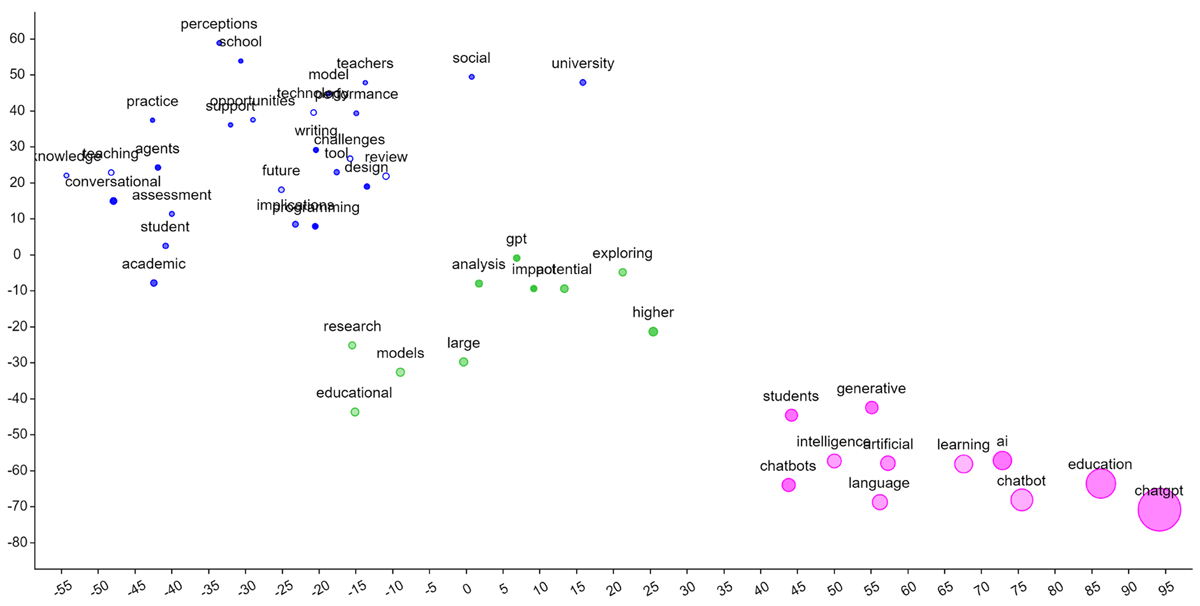
Figure 1
Analysis of the titles through t-SNE.
Accordingly, the first pink dimension, interaction and communication with generative AI powered chatbots, emphasizes the conversational aspects of generative AI technology, particularly interaction and communication with chatbots powered by AI (see Figure 1: generative, artificial, intelligence, chatbots, students, learning). This dimension highlights the relevance of generative artificial intelligence and chatbots in the context of students and learning. It touches upon themes such as generative AI, artificial intelligence, chatbots, students, and learning. The second green dimension, impact of the LLMs and generative AI on teaching and learning, explores how LLMs and generative AI technology can influence higher education, considering elements like the impact, opportunities, and their role in the educational landscape (see Figure 1: GPT, large, language, models, higher, education, impact, opportunties). In the third blue dimension, conversational educational agents and their opportunities, challenges, and implications, the spotlight is on various research areas that warrant attention in the future, including assessment and evaluation, writing skills, and learners’ academic performance (see Figure 1: assesment, writing, practice, academic, performance). Furthermore, this dimension delves into the opportunities and challenges associated with generative artificial intelligence and conversational agents. It also analyzes the potential consequences of using these technologies on students and teachers across K-12 and higher education levels (see Figure 1: future, implications, potential, challenges, students, teachers, school, university).
Analysis of the Abstracts throught Text Mining
The abstracts of the articles within the research corpus underwent analysis to examine the co-occurrence and lexical relationships among the words used (Figure 2), ultimately leading to the identification of emerging themes. These themes were discovered by tracing interconnected lexical paths and are as follows:
Leveraging generative AI for enhancing social and cognitive learning processes.
Promoting AI literacy for unleashing future opportunities.
Harnessing generative AI to expand academic capabilities.
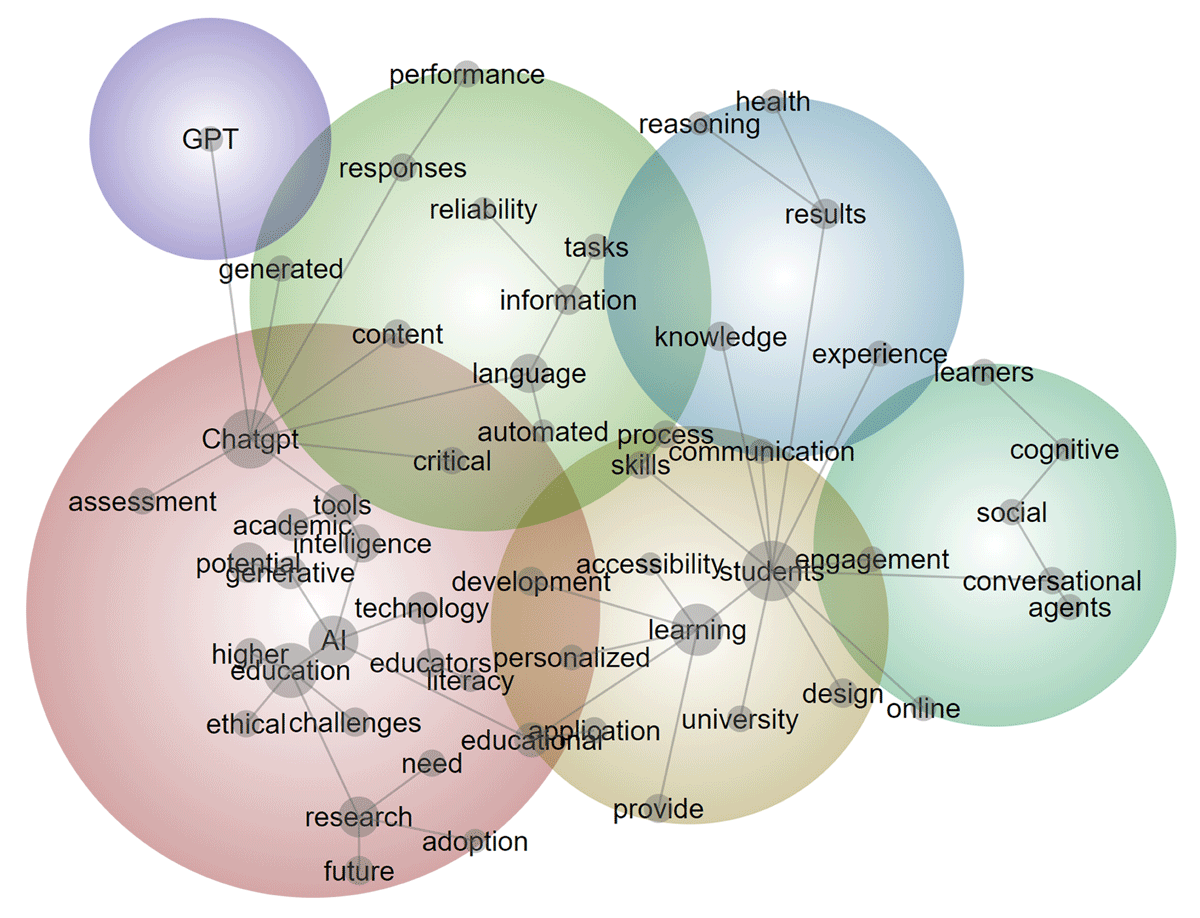
Figure 2
Analysis of the abstracts through text-mining.
The first theme, leveraging generative AI for enhancing social and cognitive learning processes, underscores the potential of generative AI with a focus on its conversational capabilities and its influence on educational processes. This theme emphasizes its impact on students’ experiences, knowledge acquisition, communication, engagement, as well as its role in facilitating social and cognitive development among learners (see the connected paths on Figure 2: students, experience, knowledge, communication, engagement, conversational, agents, social, cognitive, learners). The second theme, promoting AI literacy for unleashing future opportunities, highlights the necessity of improving our understanding of AI and the requirement to develop new literacies to effectively embrace these evolving technologies. It addresses the importance of AI literacy for educators and its significance in the context of higher education, research, and the need to prepare for the future adoption of AI (see the connected paths on Figure 2: literacy, educators, technology, AI, higher, education, research, need, future, adoption). The third theme, harnessing generative AI to expand academic capabilities, underscores the potential of generative AI as a powerful educational tool to enhance and augment academic capabilities. It points to its applications in critical areas such as academic tools, personalized learning, accessibility, and design, benefiting both students and higher education institutions (see the connected paths on Figure 2: GPT, ChatGPT, tools, critical, academic; potential, generative AI, higher education; personalized learning, accessibility; design, students, university).
Social Network Analysis of the Keywords
Through SNA, strategic keywords as nodes within the textual network were identified and summarized, leading to the recognition of one prominent theme:
Augmenting educational experiences through human-AI interaction.
This theme highlights the novel form of interaction emerging within the educational context, particularly focusing on the evolving human-machine interaction, more specifically human-generative AI interaction. The interconnected nodes in the keyword network (see connected nodes in Figure 3: artificial intelligence, chatbots, chatGPT, students, large language model, computational linguistics, language processing, natural language processing) collectively emphasize the significant shift in educational technologies, acknowledging that teaching and learning are inherently social endeavors, and this new type of interaction holds substantial promise for the educational landscape.
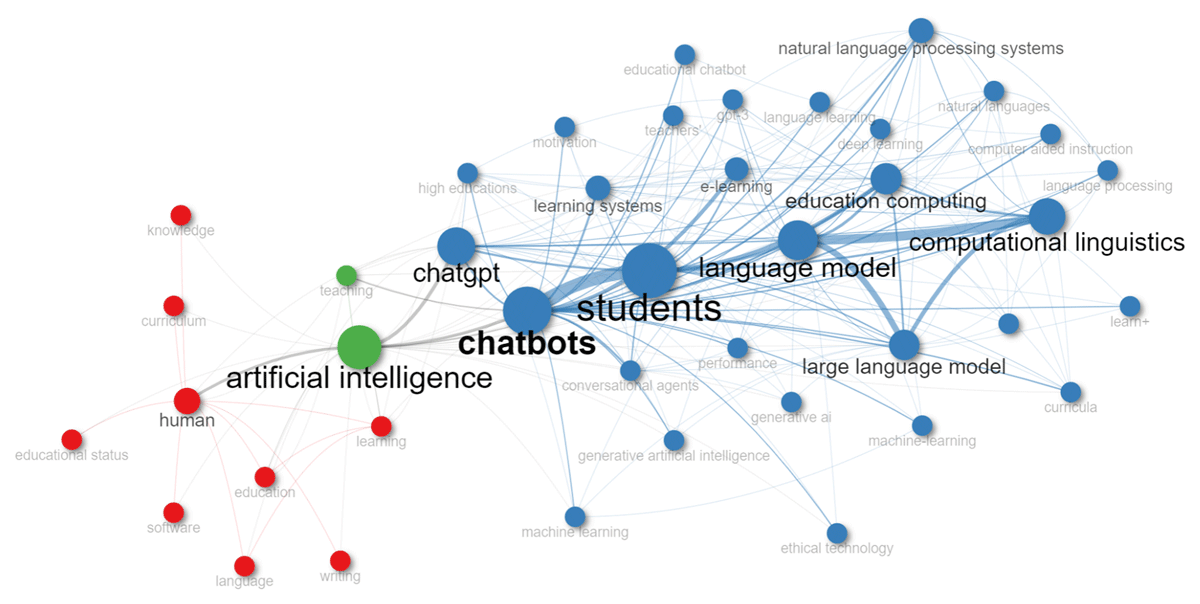
Figure 3
Analysis of the titles through social network analysis.
Conclusion: Revolution, Distraction, Disruption, or Destruction
This paper’s findings through data mining and analytics approaches have revealed seven distinct themes and patterns that hold promise as potential research areas in the context of generative AI in educational praxis. These themes and patterns include:
Interaction and communication with generative AI powered chatbots.
Impact of the LLMs and generative AI on teaching and learning.
Conversational educational agents and their opportunities, challenges, and implications.
Leveraging generative AI for enhancing social and cognitive learning processes.
Promoting AI literacy for unleashing future opportunities.
Harnessing generative AI to expand academic capabilities.
Augmenting educational experiences through human-AI interaction.
In the ever-evolving landscape of education, the exploration of generative AI’s multifaceted impact has uncovered a rich tapestry of themes. From the profound influence of interaction and communication with generative AI-powered chatbots to the transformative effects of Large Language Models (LLMs) and generative AI on teaching and learning, the journey of lifelong learners has been marked by the discovery of conversational educational agents, with their vast array of opportunities, challenges, and implications. Leveraging generative AI to enhance social and cognitive learning processes has emerged as a promising avenue, while the call to promote AI literacy is recognized as a means to unleash future educational opportunities. The harnessing of generative AI to expand academic capabilities showcases the technology’s power to reshape academia. Finally, the compelling prospect of augmenting educational experiences through human-AI interaction has reshaped the educational landscape. As we conclude this exploration, it is evident that generative AI’s role in education extends far beyond the mere adoption of technology; it encompasses a profound and transformative journey that empowers learners, educators, and educational systems to embark on an exciting path towards innovation, inclusivity, and excellence in the educational praxis.
As a final note, while the question of whether generative AI represents a revolutionary force, a potential distraction, a disruptive element, or even a destructive influence, one certainty prevails: no educational technology, particularly in the case of generative AI, can be considered neutral. It will undoubtedly introduce numerous opportunities and challenges that demand our attention and exploration.
Further Remarks
Beyond the findings of this paper, there are three lines of research areas that can be considered for future research directions. These are; emotional intelligence, AI literacy, and prompt engineering.
First of all, one of the notable challenges associated with the integration of generative AI in educational settings is the potential lack of emotional intelligence. While these technologies excel in processing information and generating responses, they often struggle to comprehend and respond to the nuanced emotional cues and needs of learners. The absence of emotional intelligence in AI systems can hinder their ability to provide effective support and personalized guidance, which are crucial elements in the learning process. As we continue to explore the impact of generative AI in education, addressing this emotional intelligence gap becomes imperative to ensure that AI-enhanced educational experiences are not only informative but also empathetic and supportive. Future research and development efforts, therefore, should aim to bridge this gap and make generative AI a more holistic and emotionally intelligent tool in educational landscape.
Secondly, the development of generative AI literacy stands as a pivotal challenge and opportunity. Just as individuals learn to read, write, and interpret language, they must also gain proficiency in understanding, interacting with, and critically evaluating generative AI technologies. Building generative AI literacy is, therefore, essential not only for the current digital age but also for shaping the future of education. By equipping learners with generative AI literacy, educational institutions can empower students to harness the full potential of these technologies. This literacy entails not only knowing how to use AI-driven tools but also understanding the ethical considerations, biases, and limitations inherent in such systems. It encourages students to become discerning consumers and creators of AI-generated content, fostering critical thinking and digital citizenship. Generative AI literacy can be integrated into the curriculum to cultivate a new generation of informed and responsible users. Students can explore the algorithms that power AI, engage in discussions about AI’s societal impact, and develop the skills to collaborate with AI systems effectively. Additionally, educators should adapt their teaching methods to incorporate generative AI literacy, preparing students for a future where AI is an integral part of their personal and professional lives. In all, generative AI literacy in educational praxis ensures that students are not passive consumers but active participants in an AI-augmented world. It enables them to leverage AI’s capabilities while promoting ethical, responsible and thoughtful engagement with these powerful tools.
Lastly, prompt engineering emerges as a critical area of focus in the integration of generative AI into pedagogical practices. Prompt engineering involves the skill of crafting well-structured and effective queries or requests to extract desired responses from AI systems. It’s akin to designing the questions in an educational assessment, and it plays a pivotal role in shaping the quality of interactions between students and AI-powered educational tools. Educational institutions can greatly benefit from emphasizing prompt engineering within their curricula. By teaching students how to formulate clear and contextually relevant prompts, educators can empower learners to effectively leverage AI technologies for personalized learning experiences. Students who are adept at prompt engineering will be able to elicit more tailored and insightful responses from AI systems, enhancing their problem-solving skills and knowledge acquisition. Furthermore, educators themselves can benefit from understanding prompt engineering. They can design prompts that challenge students’ critical thinking and problem-solving abilities, fostering deeper engagement and a more interactive learning environment. This approach facilitates the creation of AI-enhanced educational content that aligns with specific learning objectives and supports educators in providing valuable, individualized feedback. In this context, it can be argued that as AI continues to play a more prominent role in education, fostering expertise in prompt engineering becomes increasingly relevant.
In all, based on the findings of this study, it is possible to say that generative AI will affect all our lives, but considering the rapid development of generative AI technology, it is difficult to predict to what extent it will affect our lives. Nevertheless, AI is here to stay, and we can therefore embrace generative AI technologies and seize the opportunities they present. Last but not least, it should also be noted that the future of education lies not in AI’s dominion but in the symbiotic relationship between human and AI, forging an enriched, diversified, and adaptive educational ecosystem that caters to individual learning needs.
Ethics and Consent
The datasets used and/or analysed during the current study are available from the corresponding author on reasonable request.
Acknowledgements
The author of this paper, Dr. Aras Bozkurt, owes a debt of gratitude to John McCarthy, Marvin L. Minsky, Nathaniel Rochester and Claude E. Shannon, who first introduced the concept of artificial intelligence in their magnum opus work entitled A Proposal for the Dartmouth Summer Research Project on Artificial Intelligence; Isaac Asimov, who inspired the study of artificial intelligence with his arguments in his fictional work Three Laws of Robotics; and Alan Turing, who made significant contributions to the advancement of Artificial Intelligence studies with a single but critical and thought-provoking question “Can machines think?” and his simulation game known as the Turing Test.
Funding Information
This paper is funded by Anadolu University with grant number SBA-2023-1852.
Competing Interests
The author has no competing interests to declare.
Author Contributions (Credit)
Aras Bozkurt: Conceptualization, methodology, formal analysis, investigation, data curation, writing—original draft preparation, writing—review and editing. The author has read and agreed to the published version of the manuscript.
Author Information
This paper was reviewed and proofread with the assistance of OpenAI’s GPT-4, complementing the human editorial process.