
Introduction
The purpose of this article is to discuss the philosophical foundations of Open Education. It suggests to “re-source” (Adler, 2000) educators’ praxis (Freire, 1994) through reflections at the ethos and eidos levels in reference to Sterling (2021)’s Triang model to change paradigm and move away from an overall pattern of unsustainability.
The context and genesis of this article is made up of a series of facts which are flat-listed below, not trying to artificially create a link between them:
Ten years ago, Martin Weller warned, in a warlike language, about Openness being in danger (Weller, 2014). Indeed, today with artificial intelligence (AI), the war between proponents of Openness against commercials and other stakeholders using Openwashing, is even more exacerbated.
After having spent a life working on the concept of sustainability, Sterling (2021) explains how, contrary to the promises of mainstream discourse, it cannot be an “add on” to the current system characterised by an overall pattern of unsustainability.
A collective of scholars from education sciences calls for the necessary considerations and re-integration of philosophy in education (Tesar et al., 2022).
What is the one thing that all these voices have in common? They explicitly point to some shortcomings at the philosophical level in Higher Education institutions (HEIs) in the Global North that have conducted to where we stand today. They all explain that a real solution can only reside in addressing problems at their philosophical roots.
At the same time, a collective of scholars active in Open Education feels the need to recall and reflect on the concept of Openness in education (Bozkurt et al., 2023). Also at the same time, scholarly voices condemn inconsistencies of international instruments like sustainable development goals (SDGs) for being counter-productive and actually fuelling for the opposite of what they are advocating (e.g. Larsen et al., 2022 on the fact that SDGs do not take into account the commons).
Two years ago, the author initiated a project to set up a roadmap for Open Education in the Swiss Higher Education landscape and situate it at the epistemic level.1 The project’s output was published on the EduTechWiki and Zenodo, privileging participation, accessibility and reusability (Class et al., 2022). During the same time span, the author was involved in the writing of an internal institutional policy report to study the risks and opportunities of Open Education for two Swiss HEIs. Contributing to these two projects, she feels the necessity to expand the work conducted on the roadmap, to further explain it and show how relevant it proves. This is accomplished through writing. Writing is seen as an “opening, the possibility of something different”, a way of making other futures possible (St. Pierre, 2019).
First, the concept of sustainability and Sterling’s model are introduced. Then a narrative presents education as a discipline with open questions to the potential role of international organisations in shaping it in its contemporaneous form. Questions with regard to dominant Open Education narratives and their philosophical foundations are then asked, specifically with regard to immanence and post-inquiry. Finally, the roadmap is presented and the article concluded.
Sustainability
As a concept, sustainability in the 1960s and 1970s conveyed ideas related to limiting growth, small-scale production and self-sufficiency. It was clearly meant to oppose neoliberalism. Discourses that emerged after the Second World War, including deep green ecology, argued for the need for a philosophical questioning of the place of the human species, economic growth, ecological and social sustainability. Diverse positions were taken but all agreed on the fact that “economic growth conflicts with ecological sustainability” (Tulloch & Neilson, 2014, p. 31).
Paradigm: the centrepiece
To enable higher institutions and scholars undertake such in-depth cultural and philosophical questioning takes a revolution, in its etymological sense.2 Sterling provides a framework to guide this long-term process: the Triang model, with the paradigm as the centrepiece.
A paradigm with “– its embedded assumptions, beliefs and values – shapes, influences and limits debate and practice” (p. 8). Sterling offers the 4Ps – Paradigm, Purpose, Policy and Practice and explains that questions addressed are most of the time at the level of policy and practice (e.g. pedagogy, curriculum) leaving the question of purpose seldom addressed and the question of paradigm unexamined at all. Indeed, what happens is that usually we take epistemology for granted or take the dominant one as the only existing one (Charmillot, 2023; Robottom & Hart, 1993 cited by Tulloch & Neilson, 2014) and do not question the overall paradigm.
The Triang model consists in articulating 3 domains: seeing domain, knowing domain and doing domain (Table 1 and Figure 1, Sterling, 2021, p. 7). It is a cognitive tool for exploring the different components of a paradigm in order to make them explicit.
Table 1
Triang model: dimensions and interpretations of paradigm. Sterling, 2021, p. 7.
| SEEING DOMAIN | KNOWING DOMAIN | DOING DOMAIN |
|---|---|---|
| Perception | Conception | Practice |
| Affective dimension | Cognitive dimension | Intentional (design) dimension |
| Epistemology (+ axiology) | Ontology | Methodology |
| Ethos | Eidos | Praxis |
| Concern (purpose) | Conception (operation) | Consequence (effect/impact) |
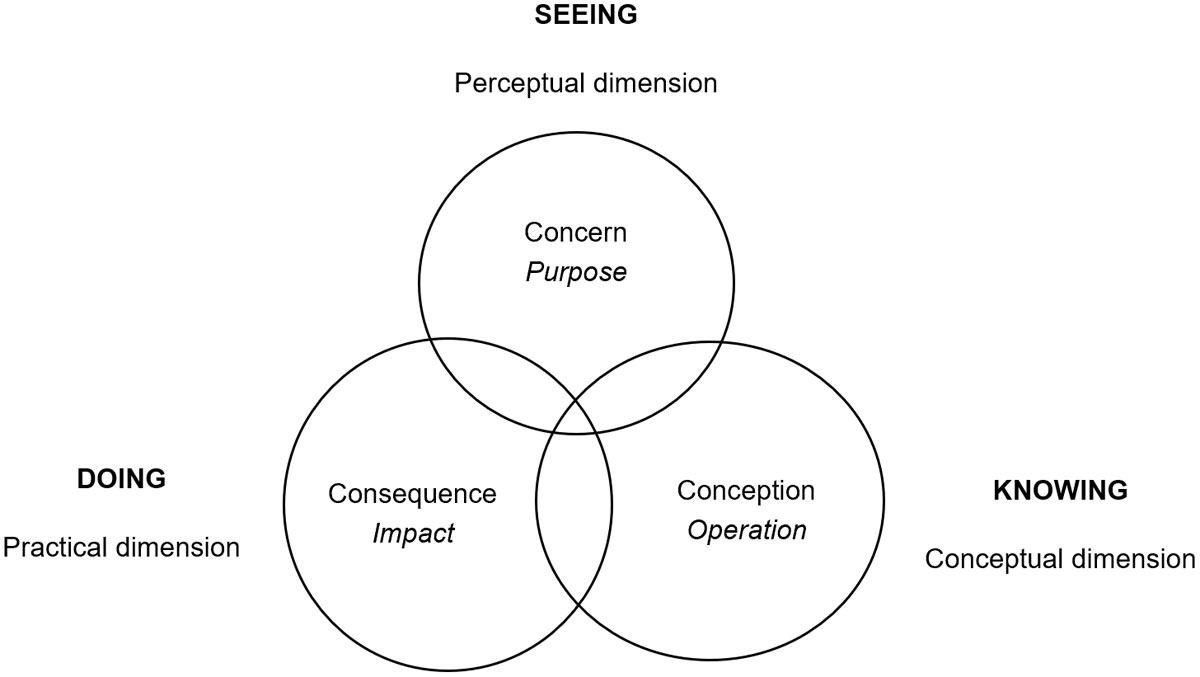
Figure 1
Dimensions of paradigm—key domains in relation to the university. Sterling, 2021, p. 7.
From unsustainability to survival
The “cultural zeitgeist” (Dash, 2019 cited by Sterling, 2021) “entails a shift of emphasis from relationships largely based on separation, linearity, control, manipulation, growth and excessive competition toward those based on context, holism, circularity, participation, appreciation, collaboration, limits, equity, peace and social and ecological justice. It is otherwise referred to as “participative” (Reason and Bradbury, 2001) “co-evolutionary” (Norgaard, 1994), and as the “postmodern ecological worldview” (Zweers, 2000). Alternatively, it is described as a Gaian or “living systems” (Elgin, 1994) view of the world, which accords with many non-Western indigenous perspectives and longheld traditions (Smitsman et al., 2019). Fundamentally, it is challenging us to rediscover our humanity and our place on the planet whilst there is still time” (Sterling, 2021, p. 5).
To escape this endemic destructive pattern, the paradigm shift Sterling suggests is to “travel from mechanism/reductionism toward systemisism/holism” (Sterling, 2021, p. 10).
This is where reaching out to other knowledge systems, like Ubu-ntu (Ramose, 2023) or Buen Vivir (Akkari & Fuentes, 2021, p. 41), can prove to be helpful. To delve into the wealth of the diversity of knowledge systems, it is suggested to make a parallel with Rinaudo’s achievements. An Australian agronomist, based in Niger for more than 40 years and supported by local people’s indigenous knowledge, he has been regreening lands from tree stumps. Despite drylands, leveraging on underground forests of living roots and natural regeneration, they have developed an effective and efficient strategy to regreen lands with local vegetation (Rinaudo et al., 2019). With regard to the diversity of knowledge systems, our assumption is that similar to underground forests, a wealth of indigenous repertoires (Wenger, 1998) have been put in survival mode. Discovering and using them with deep and true respect may be a way towards survival in reference to Sterling’s three-steps process. Indeed, he explains that sustainability is a process starting with survival, going through to security and finally reaching sustainability.
Invitation to question praxis to rediscover ethos, eidos and the paradigm
Scholars are usually familiar with the concept of praxis, but what about those of ethos and eidos, the two remaining major components of a paradigm? Ethos refers to the affective level, values and norms, integrating concepts like epistemology and axiology. Eidos refers to the cognitive or intellectual paradigm, integrating ontology. Finally, praxis refers to the “theory in action”, what is done and how it is done and integrates methodology (Sterling, 2007).
Ethos is said to be the less visibilised of the three (Sterling, 2007), and it is worth to recall how epistemologies are usually repertoriated and their main purpose. “In the very broad lines, positivist epistemologies predict, comprehensive (interpretive) epistemologies understand, critical epistemologies emancipate, and all post-epistemologies deconstruct and prepare for new inquiry (Lather and St. Pierre 2007)” (Class, Accepted). On the other hand, praxis is of course the most visible and the most discussed one. In a backward design process (Wiggins & McTighe, 2011), scholars are encouraged to look beyond praxis. Through an understanding of ethos and eidos, they are invited to gradually discover which paradigm this praxis belongs to. They should then check the onto-epistemological alignment of the whole ensemble. Finally, they are invited to rethink what needs to be rethought in praxis and revise it in the light of the insights offered by their understanding of ethics and eidos.
Education as a discipline is also being looked at through the prism of paradigms. Open Education being first and foremost about education, it is important to begin to look at the discipline itself with a fresh set of eyes.
Education
Education sciences are about 100 years old in the Global North and philosophy and history of education were indeed present in education before the two World Wars (Hofstetter & Schneuwly, 2001; Hofstetter & Schneuwly, 2002; Laot & Rogers, 2015). What about the rest of the world? What about being in a power position of being able to write a history that is disseminated rather for instance of being in a non-hegemonic oral culture where dissemination is well-guarded (e.g. African oral knowledge)?
Narratives make certain elements visible and invisibilise others. This is what de Sousa Santos (2014) explains using the terms “absences” and “emergences”. He uses it in the context of epistemologies of the South to explain how the dominant Global North scientific system excluded the entire range of knowledge systems’ diversity. Let us remind readers that epistemologies of the South do not refer to any geographical South but to an epistemic South, in other words, knowledge systems, worldwide, which have been made invisible, no matter their actual geographical positioning.
The role of international organisations to shape education sciences
Geneva is known to have a fertile past in terms of education with many names known worldwide. Why is this so? To what extent could this historical notoriety be related to the geographical place and the international political role it took? Or vice-versa? Is there a relationship between the fact that the League of Nations, which in 1945 was supplanted by the United Nations, was established in Geneva in 1919 and the effervescence of education in Geneva?3 If there is a relationship, it remains an open and complex question to be disentangled, i.e., which comes first, the chicken or the egg?
Rather, the aim here is to focus on some of those famous educationalists who have become famous and what they have institutionalised. Edouard Claparède founded the Institut Rousseau (ancestor of the Faculty of psychology and educational sciences) in 1912 and then, some years later, in 1925, with Adolphe Ferrière, Pierre Bovet and Béatrice Ensor, they founded the International Bureau of Education (IBE) as a private organisation. IBE had very clear objectives, namely, among others, building up an “international code for public education” or “advocating scientific objectivity for spreading the methods and principles of New Education” (Hofstetter & Schneuwly, 2013). Later, in 1929, the IBE changed its status to become an intergovernmental organisation and then in 1947 it was integrated to UNESCO.
At the League of Nations, Henri Bergson presided from 1920 to 1925 the International Committee on Intellectual Cooperation (ICIC), “which aimed to promote international exchange between scientists, researchers, teachers, artists and intellectuals”1.4 The ICIC was the ancestor of UNESCO, and included Albert Einstein, Sarvepalli Radhakrishnan, Jagadish Chandra Bose and Marie Curie among others.5 UNESCO was founded in 1945, in London, with the pacifist aim of working towards IBE’s goal of building a better world through education. But already by 1957, UNESCO was adding an economic goal to its original endeavour, recommending that countries spend 5% of their GDP on schooling in order to support development (Laot and Rogers, 2015). Moreover, in the 1940s and 1950s, several supranational organisations either began to focus on education or were created to promote education and scientific research in education (e.g., the International Association for the Evaluation of Educational Achievement, OECD, NATO).
A critical look at international organisations
A striking parallel between objectives of the IBE to build a better world through education in 1925 and contemporaneous programmes like the Open Education for Better World program6 exist. What is even more striking is that one cannot possibly be against those principles at first sight. How could one not agree with better education? With building a better world? With sustainable development goals and specifically quality education? Yet, if these ideas have been around and spread by these organisations for 100 years and seeing the state of the world today, how should that be interpreted? What is beneath the surface that hinders achievement of a better world through education? This is a very difficult question to answer but it appears that a growing number of scholars is considering critically international organisations’ instruments and ways to proceed (e.g. Larsen et al., 2022; Matasci, 2023; Akkari & Payet, 2010).
For Sterling (2021, p. 3), if international organisations’ instruments fail to fulfil their promise, it is due to the fact that they focus on “Policy and Practice” “largely bypassing Purpose and Paradigm” in reference to the 4Ps. He explains how sustainability cannot be an “add on” to the current state of the world which is dominated by a pattern of unsustainability and is a process going through survival and security before reaching sustainability. In exactly the same movement as scholars from the South (e.g. de Sousa Santos & Meneses, 2020; Ramose, 2023), he points out at “Western dominant thought” and more specifically “reductionism, objectivism, dualism, individualism, anthropocentrism, rationalism, instrumentalism and technocentrism” as being responsible for the state of education today and for maintaining destructive patterns.
Other scholars point out that these organisations, or even states, rely on evidence-based research/scientism (St. Pierre, 2006) and the concept of development (de Sousa Santos, 2021). Indeed, these two concepts seem to be key players of the mainstream Western worldview.
“Scientism requires that inquiry look “scientific” so it can be considered valid and rigorous, regardless of the onto-epistemology used (St. Pierre, 2019, p. 4). “Habermas (1968/1971) described [scientism] as “science’s belief in itself; that is, the conviction that we can no longer understand science as one form of possible knowledge, but rather must identify knowledge with science” (p. 4)” (St. Pierre, 2019, p. 11).
With regard to development, de Sousa Santos (2021) demonstrates how the discipline of sociology emerged as a way for analysing the issues faced by Western society during the Industrial Age (c. 1760). After the Second World War, the same discipline of sociology was responsible for the spread of the concept of development. The concept of development has been problematised exclusively by Western-centred actors, using carefully chosen indicators. This hampers the countries of the Global South and places the countries of the Global North in a powerful and privileged position. From the spiritual to the political to the economic, the concept of development actually affects multiple aspects of human beings and human societies. Furthermore, it takes an extractivist perspective on the planet (Class, 2022).
The next section discusses how Open Education, with its essential concept of Openness, fits into this picture of education. If Open Education is first and foremost about education, it is Openness that makes it unique and different.
Open Education
Commonly known narrative
Open Education (OE) is an umbrella term and is understood as a diverse and complex compound entangling practices, concepts, scholarships, disciplines, etc., all driven by Openness (e.g. Weller, 2011). In its recent history, it can be tied back to the Middle Ages when, because of contextual socio-politico-economic reasons, students had the power in universities, both in terms of knowledge, i.e. asking for given courses, and in terms of policy and governance, i.e. organised in nations which constituted the congregation of the university, they established rules and regulations for all stakeholders (Cardozier, 1968; De Meulemeester, 2011). Contemporary European universities are derived from the Humboldtian model and highlighting two facts are of utmost importance here. The first is that in German universities in the Middle Ages, power was in the hands of a university council composed of teachers and it is the place in Europe where students enjoyed fewest power. The second is that the recent Bologna reform that started at the end of the XXth century in contemporary European universities may have relied on a deliberate intention to give power back to students but has been diluted in power and policy concerns (Wagenaar, 2022).
Openness is thus tightly related to the creation of European universities and more specifically to the Bologna model, where students enjoyed unequalled power (Peter & Deimann, 2013). It thrived for some years and was caught up by control by the church and editors, in an overall context of colonisation, slavery, extractivism, etc. This is one commonly told story of Open Education. By foregrounding this story which other stories are made less visible?
Openness in Open Education
Examining the understanding of openness in Open Education provides an excellent example of visibilisation/invisibilisation. When much has already been written on how to understand open in Open Education (e.g. Biswas-Diener & Jhangiani, 2017; Bozkurt & Gil-Jaurena, 2023; Bozkurt et al., 2023; Bozkurt & Stracke, 2023), including a synthesis (Pomerantz & Peek, 2016) that has been further developed to focus on Openness as a praxis (Smith & Seward, 2017), it seems that one crucial point was never discussed. This crucial point is the paradigm in which Openness is discussed.
Pomerantz and Peek (2016), when talking about “open society”, most probably non-intentionally and because of invisibility issues, introduce an error saying that Karl Popper coined the term “open society” with his book The Open Society and its Enemies published in 1945. Actually, it is Bergson, who in 1932, introduced the concept of Open society in his book Les Deux sources de la morale et de la religion.
Basically, what are the differences between both models, the one by Bergson and the one by Popper? Bergson’s concept of an open society is elaborated to differentiate it from a closed society. His open society is based on two foundational concepts: love and intuition. The first is a concept that goes beyond all duty; the second is a concept that goes beyond intelligence 4.7 In contrast, Popper developed the concept of the open society to better distinguish between liberal and totalitarian societies. His open society is based on freedom and the latter on rationality. It is presented as a reasonable society, governed by reason and critical thinking (Lee, 2014, 2015).
Each of these two understandings of open society has two very different philosophical underpinnings. To what extent do they each go back to the two major meanings of open Pomerantz and Peek (2016) give a historical account for? Open in the Middle Ages is related to commons, characterised by the shared and the non-enclosed whereas in the 20th and 21st centuries, it is related to free and open, referring fundamentally to legal rights (Pomerantz & Peek, 2016). It seems obvious that two different paradigms are at stake. On one hand, the medieval and the Bergsonian conceptions, which refer to sharing, non-enclosed, love and intuition belong to the same paradigm, and on the other hand, the 20th & 21st centuries and the Popperian conceptions, which refer to freedom, rationality and legal rights belong to another and the same paradigm.
To which paradigm pertains praxis of Openness in Open Education as enacted and described by scholars today? The majority seems to consider Openness from Popper’s paradigm, i.e. freedom, rationality and legal rights, while a minority seems to integrate the Bergsonian paradigm, love and intuition into the dominant Popperian paradigm. It is important to understand the difference between approaching sharing from a paradigm in which it is a constituent part and from a paradigm in which it is not. In the Middle Ages’ understanding of Openness, sharing clearly relates to the common good. In the 20th & 21st centuries’ understanding, sharing is threatened by enclosure because sharing is not based on common good but on legal rights.
This may explain why Sterling (2021) says that a shift from mechanism to holism is needed; that Holmes, cited by van Mourik Broekman et al. (2014), suggests imagining another way of being, which involves “large investments in education, in renewed forms of the humanities, in cooperative processes, in the maintenance of community and ecology, in the development of a philosophy of coexistence” (van Mourik Broekman et al., 2014, p. 12). And that philosophers like Derrida, Deleuze or Foucault, suggest, instead of replacing one system by the other, e.g. replacing educational material under copyright by copyleft Creative Commons8 licenced material, in transforming the system from within.
Finally, why is Popper’s perspective of Open Society the one that history tends to remember? Would it be related to Popper’s influence in promoting the hypothetical-deductive scientific method and his well-known advocacy of neoliberalism? The same “neoliberal economic paradigm that dominated political, social and economic policy since the late 1970s” (Sterling, 2021, p. 5). The same neoliberalism that the concept of sustainability was designed to oppose when it was conceptualised in the 1960s (Tulloch & Neilson, 2014).
What about ethos and eidos in Open Education?
The extent to which ethos and eidos are treated as issues to be discussed and reflected upon in Open Education is still limited. For example, in the recent editorial of Open Praxis (Bozkurt et al., 2023), among the 54 well-known Open Education scholars and their answers to the following question: Why is Openness in Education as a praxis important, and why is it critically needed at this moment?, ethos, labelled as ethos, appears in three contributions. It is present though, either through metaphors like the aerosol (Mark Brown), or concepts like humanness (Tutaleni I. Asino), worldview (Maha Bali), community and authentic connection (Robert Farrow) and sharing knowledge (Martin Weller) to name a few of the most obvious. Eidos does not appear at all under this label but is present at least in Maha Bali’s and Taskeen Adam’s contributions. Praxis, on the other hand, appears not only in the title and in the name of the journal but was embedded in the question scholars were invited to reflect upon.
Elsewhere (Collier & Ross, 2017), efforts have been made to conceptualise Open Education through the lens of not-yetness9 but still remaining at the level of praxis. What about not-yetness at the levels of ethos and eidos? To take this work further, with eidos reaching out to ontology, and following St. Pierre (2019)’s suggestion, the author wonders whether the question to be addressed would be to consider the extent to which an ontology of immanence would be helpful in thinking about Open Education holistically and escaping the mainstream modernist and fragmented ethos. St. Pierre (2019, p. 4) explains the immanent as the ““not yet” (Britzman, 1995, p. 237; Butler, 1995, p. 143; Deleuze, 1969/1990, p. 112; Derrida, 1995/1996, p. 9; Foucault, 1971/1972, p. 119; Lyotard, 1983/1988, p. 13; Manning, 2013, p. 29) that is everywhere but indeterminate, not yet created, not yet individuated and organized into the definite-immanent”.
What about exploring the philosophical foundations of Open Education (e.g. Deimann & Farrow, 2013; Deimann & Peters, 2016; Kalz, 2022; Mai, 1974; Nyberg, 1975; Vetter & McDowell, 2023) from the perspective of immanence, not-yetness, and placing this research in post-inquiry?
Potential invisibilisation of thinkers of immanence?
Could it be possible that thinkers, philosophies and pedagogies in the field of education, even famous ones, have been made invisible because they have, explicitly or implicitly, linked their worldviews in one way or another to an ontology of immanence?
This is where we come back to famous educationalists in Geneva who might have been invisibilised (e.g. Ferrière) to the profit of others (e.g. Piaget). “‘Creative energy develops from within.’ All Ferrière’s ‘educational theory’ is summed up in that phrase” (Hameline, 1993, p. 15). Hameline (1993, p. 17) adds: “One of his sayings is the Pindaric maxim beloved of the Stoics of antiquity: ‘Become what you are.’ In his personal copy of La liberté de l’enfant à l’école active (1927), Ferrière corrected this in his own hand to ‘Become who you are’”.
Does not this resonate with immanence that “Derrida (1995/1996) described as the “future to come” (p. 68) and even “people to come” (Deleuze & Guattari, 1991/1994, p. 176)” (St. Pierre, 2019, p. 4)? Moreover, does not this resonate with the emergence in the 1960s of informal ways to educate children, so-called Open Education (!), with practices of integrated learning, learning by doing, freedom of movement and an overall child-centred approach, supporting children to design their own learning path? Actually, designing learning according to their needs, with creativity and self-direction, was a step towards offering them the opportunity to take their responsibility within a safe and healthy environment, and accompany them to become who they are (Sarmah, 2015).
At the level of praxis then?
The literature is very prolific with regard to praxis, more specifically addressing OER (e.g. Olivier & Rambow, 2023; Otto, 2019; Tlili et al., 2023; Wiley et al., 2014), micro-credentialing (e.g. Bozkurt & Brown, 2022; Chandler & Perryman, 2023; Ward et al., 2023; Weller, 2023) or artificial intelligence (AI) (e.g. Bozkurt, 2023; de la Higuera & Iyer, 2023; Stacey, 2023).
It remains to be seen how far the philosophical underpinnings of implementing these practices have actually been evaluated. Have you ever read anything related to a question such as What are the axiological, ontological and epistemological foundations of OER, micro-credentialing or AI that motivate their adoption in praxis? What about the philosophical underpinnings of the system as a whole, of which all these disparate pieces are a part?
This kind of reflexion requires expertise in worldwide philosophical understanding. Working at the level of ethos and eidos takes time and considerable intellectual effort. It requires time to read, think, write. It requires silence (Caranfa, 2004). Above all, it requires thinking differently: thinking not as we have been trained, i.e. to reproduce, but thinking to Create. Create as a real challenging concept of not-yetness, attempting to think in a different paradigm.
In terms of the philosophical underpinnings of OE, what scholars can learn from the visibility/invisibility perspective when considering it through both the lens of “system failure” (Sterling, 2021, p. 4) and the lens of “productive failure” (Kapur, 2015) is as follows. Learn from what happened, learn from new insights gained and make decisions for action. It is evident that praxis cannot be discussed without ethos and eidos and the overall paradigm to which it relates.
Presenting the roadmap
The group of international scholars deliberately prepared the roadmap at the epistemic level. In light of the discussions that precede, it seems all the more relevant to act as a lever and move towards the first step of the sustainability process, i.e. survival.
The roadmap for Open Education (Figure 2) addresses three major strategic focuses and a set of four actions for each of them. In addition, a supportive ecosystem is desirable for ease of deployment. The three main focuses are: i) broad horizon education; ii) ethical and responsible use of technology; and iii) humans reconnected to the planet’s ecosystem.
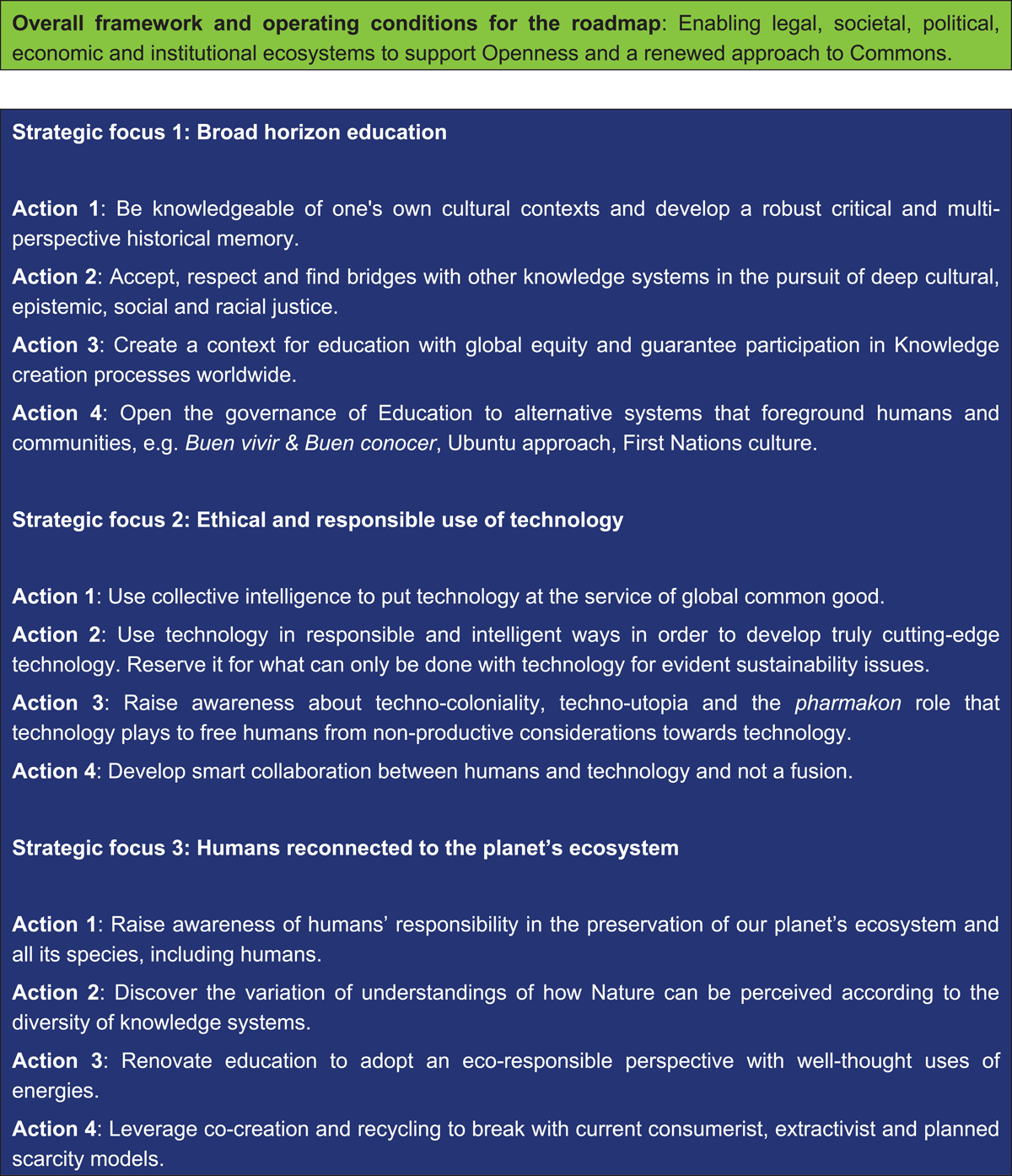
Figure 2
Roadmap for Open Education, situated at the epistemic level.
Conclusion
In this article, the intention was to explain why the roadmap has been prepared at the epistemic level. Using Sterling’s model of sustainability (Sterling, 2007, 2021), the discussion reached out to Bergson’s (1932) and Popper’s (1945) respective perspectives of Open Society (Lee, 2014, 2015); ontology of immanence, not-yetness (St. Pierre, 2019); and post-inquiry to revisit ethos, eidos and praxis in education (St. Pierre, 2019; Sterling, 2021).
The etymology of educate, which is both educare and educere is telling. Educare means nurturing and in this sense, education is geared towards helping human beings, build on what they are to become. The emphasis is on interiority and trusting the potential of human beings. Educere means bringing forth, leading, directing. This second meaning refers to educators as symbolically leading human beings, elsewhere, beyond what they are, emphasising exterior influence (Develay, 2001; Hameline, No date). To what extent are the various debates about education, and therefore about human knowledge, framed within this polysemy and its continuum in Western thought?
Scholars in 2023 are in a process of searching to understand, disentangle messages sent by institutions, research, etc. to make sense of the world and make a difference that matters (Wenger-Trayner & Wenger-Trayner, 2020). This article focused on the importance of making sense with insights, deciphering praxis of Open Education in order to question the ethos and eidos it draws upon. This work is all the more necessary now with the power of EdTech (Courboulay, 2023) and artificial intelligence and the speed they are bringing.
Incidentally, have you ever asked yourself why AI is actually called artificial intelligence and wondered what paradigm it was most likely based on when it was created? Rajaraman (2014, p. 198) reminds us that it was John Mc Carthy in 1956 who used the concept of artificial intelligence “to describe computer programs which seemingly exhibit intelligence, that is, computers perform tasks which when performed by humans require them to be intelligent”. With which underpinning paradigm was it conceived? Has the paradigm been explicitly made visible? From the initial motivation and the “conjecture that every aspect of learning and any other feature of intelligence can in principle be so precisely described that a machine can be made to simulate it” (Rajaraman, 2014, p. 201), it would be closer to Popper’s perspective of Open Society and above all to Newton’s mechanistic perspective (Sterling, 2007). The very mechanistic Western mindset that contains endemic destructive patterns at the root of current generalised unsustainability10 (Sterling, 2021).
The battle of open then is maybe subtler than between proponents and opponents of Openness. It is potentially situated at the levels of paradigm, ethos and eidos that few scholars access to today simply because philosophy of education is seldom taught (Tesar et al., 2022) and because it takes efforts, as an auto-didact, to go through all this wealth of knowledge and understand it. However, in order to work towards survival, security and sustainability (Sterling, 2021), this process is seen as a necessary threshold (Meyer et al., 2010).
Data Accessibility Statement
Data sharing is not applicable to this article as no datasets were generated or analysed during the current study.
Notes
[2] https://www.etymonline.com/word/revolution “late 14c., revolucioun, originally of celestial bodies, “one (apparent) rotation about the earth,” also the time required for this”.
[3] Why Geneva is potentially yet another question of visibility-invisibility and historical narrative, https://www.geneve.ch/fr/faire-geneve/decouvrir-geneve-quartiers/histoire-geneve/role-international-geneve/societe-nations.
[6] https://oe4bw.org/.
[7] Bergson’s perspective clearly reaches out to Eistein’s (Hayes, 2007).
[8] CC licences have been critiqued for reforming authorship from copyright to copyleft but not actually transforming intellectual property, i.e. moving towards “a common stock of non-owned creative works that everyone is free to use at all” (van Mourik Broekman et al., 2014, p. 83).
[9] Authors do not mention the origins of the concept of not-yetness, most probably by lack of awareness of its philosophical roots because, again, of invisibility issues.
[10] It is not impossible that it is the sudden awareness of having unconsciously worked for a particular paradigm that makes some scientists regret their contributions (e.g. Kleinman & Vallance, 2023).
Ethics and Consent
This paper has received a waiver as this paper does not include any living research participants.
Acknowledgements
This article stems from work conducted in the project A Roadmap for Open Education in Switzerland: First Steps, https://data.snf.ch/grants/grant/205792.
Funding Information
This paper is funded by Swiss National Science Foundation with grant number 205792.
Competing Interests
The author has no competing interests to declare.
Author’s Contributions (CRediT)
Conceptualization, B.C.; methodology, B.C.; writing—original draft preparation, B.C.; writing—review and editing, B.C. The author has read and agreed to the published version of the manuscript.
For this paper, the author is sole responsible of the content. For the roadmap this article provides a context for, contributors are all listed in the Class et al. 2022 article and all information, including access to the dataset, is available from the EduTechWiki corresponding page: https://edutechwiki.unige.ch/en/Open_Education_Roadmap.