
Table 1
Code scheme for analysis of project data for RQ1a.
| CODES OF THE ANALYSIS | IMPACT ON INSTITUTION’S ACTIVITIES | ||
|---|---|---|---|
| POSITIVE | NEGATIVE | ||
| Can be traced back directly to a decision in the project | Yes | Project+ | Project- |
| No | Top | Tip | |
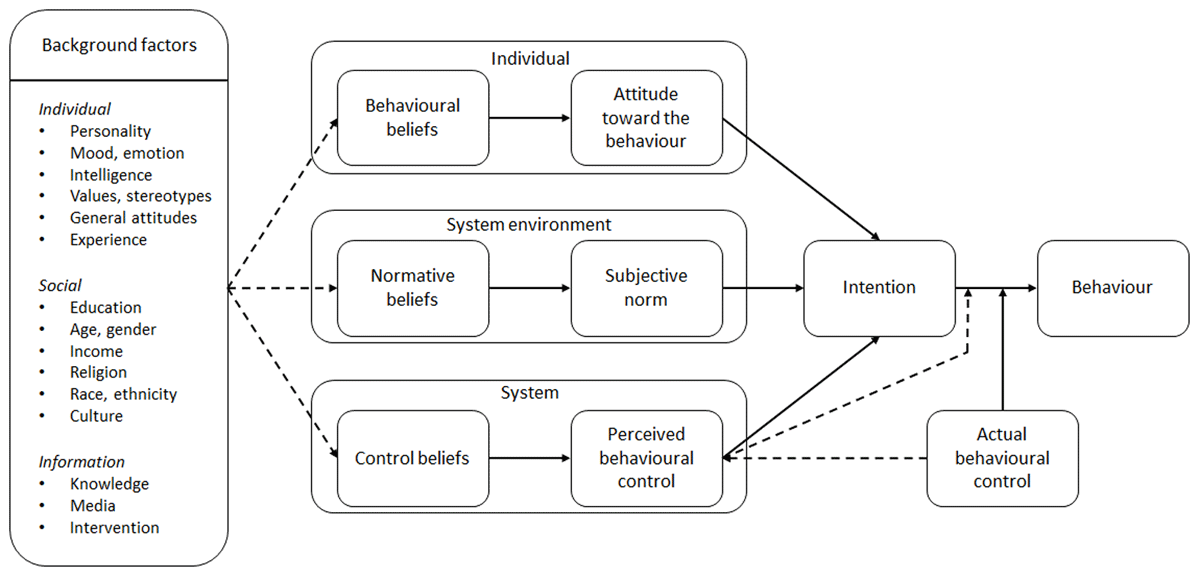
Figure 1
Reasoned Action Approach (Fishbein & Ajzen, 2011).
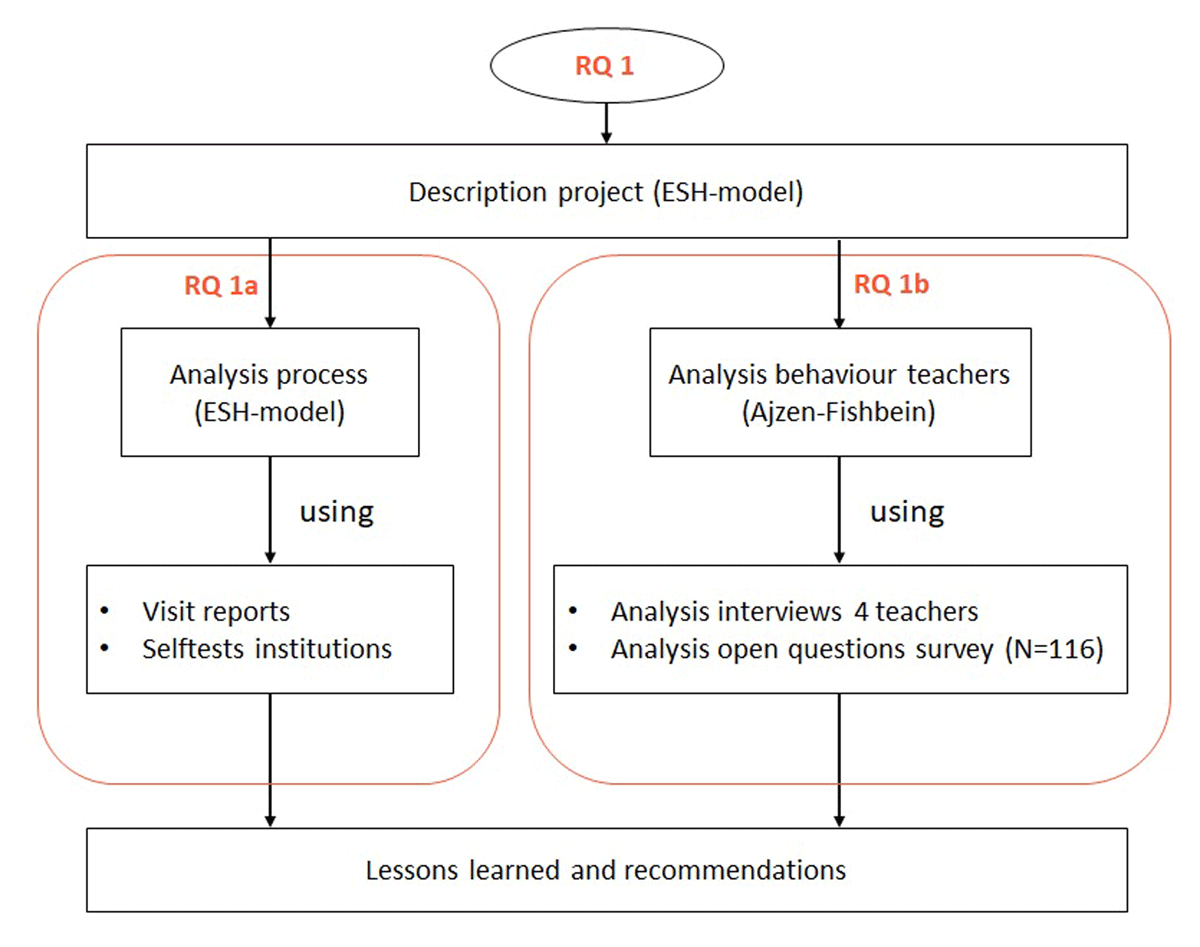
Figure 2
Overview of the study.
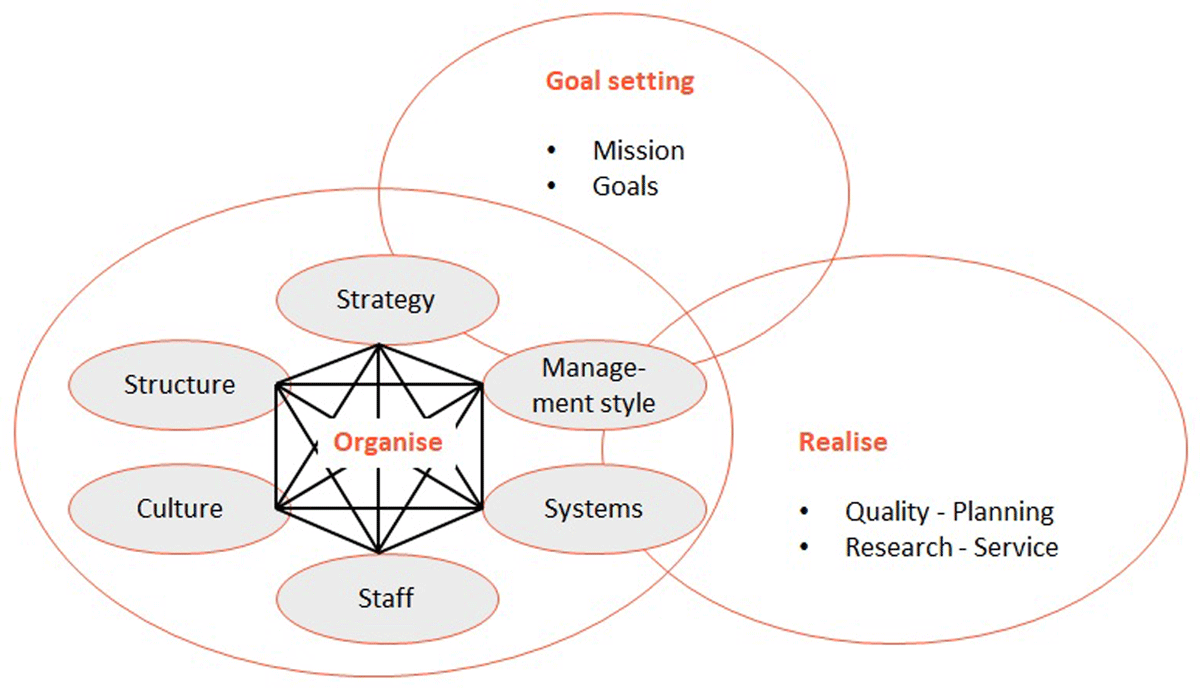
Figure 3
ESH-model from Weggeman (2000).
Table 2
Impact of project decisions on project result.
| RESULT | CONTRIBUTION | EXPLANATION |
|---|---|---|
| Strategy | ||
| Deliver a concrete plan for continuation of platform and community | Project+ | Awareness that the project is an intermediate step in which foundations for the future are laid, thereby contributing to a sustainable situation after the project ends |
| Division of roles. Management pay attention to investing tasks and responsibilities for this project | Project+ | Improved execution of the project activities |
| Work with a quality model * | Project+ | Model has become the standard for working with all open educational resources within institution |
| Management should give the project sufficient priority | Tip | No discrepancy between required and available hours |
| Structure | ||
| Library involvement in support and training (check on copyrights, add metadata) | Top | Unburdening and development of the educator |
| Organise feedback about the quality of OER, given by peers (not just project implementers) | Top | Contributes to higher quality OER, development of the educator and enhancement of # educators involved in sharing OER |
| A clear process for uploading learning materials, which also includes support | Top | Enhances efficiency |
| When formulating project ambitions, take into account that it takes time before sharing can be expected | Tip | Educators need training before they can share OER |
| Systems | ||
| Digital metadata form | Project+ | Enhances efficiency |
| Engage multiple colleagues to act as a broker for an institution | Top | Unburden the broker (Baas et al, 2022a) |
| Community platform supports easy creation of subgroups by members | Top | Contributed to cross-institutional activities |
| Continuous attention for user-friendliness of the IT systems | Tip | Enhances accessibility |
| Give sufficient attention for shared OER that are difficult to reuse due to non-fitting the educational vision | Tip | Enhances usability of OER |
| Staff | ||
| Include knowledge and skills for working with OER in educators’ didactic competence through training | Top | Development of the educator leading to improved sharing and reuse behaviour |
| Culture | ||
| Work with a quality model * | Project+ | The quality of OER is looked at more consciously, with the model being regarded as the reflection of common values |
| Work with community managers and ambassadors | Project+ | Enhances the number of valuable discussions in the community |
| Work with a quality model * | Project– | Leads to additional checks (especially with somewhat older educational resources) and thus takes more time than before |
| Targets on # OER to share | Project– | Feels like an obligation, leading to reduced motivation to actively participate |
| Activities to encourage educators to be active in the community (e.g. monthly presentation of a “open educational resources of the month” and alerting colleagues to interesting topics) (Wenger et al, 2011) | Top | Enhances visibility of the project and the motivation to participate |
| Give attention to a step-by-step realisation of a culture for sharing and reusing open educational resources (Stagg, 2014) | Tip | It takes time before sharing and reusing OER is an element of educator’s activities |
| Communicate clearly the goal for reusing OER | Tip | Mistrust towards management that reuse of open educational resources may lead to reduction of development hours |
| Management style | ||
| (Insufficient data available to draw conclusions) | ||
Table 3
Factors influencing educators share and reuse OER.
| RESULT |
|---|
| Individual positive influence |
| Better findability because of labelling resources according to the framework used by the Bachelor Nursing program |
| Gain trust by comparing his or her behaviour with what is present in the repository and community |
| The quality model for OER provides guidance on confidence in the quality of one’s own OER and that of OER shared by others |
| System environment positive influence |
| Initiatives to increase collaboration |
| Innovations in curriculum and lesson preparation lead to a demand for educational resources |
| Expected behaviour when developing new teaching materials |
| Online teaching during COVID-pandemic |
| Enrichment of own teaching practices |
| System positive influence |
| Sharing and reusing OER is perceived as positive (inspirational, more students may use the OER, professional appearance of OER, time savings) |
| Grant program is perceived as positive |
| Size of the existing collection OER enlarges successful search actions (1) |
| Available support (e.g. by the library) (1) |
| Low threshold to use the platform for sharing and retrieving OER |
| Sharing of positive experiences with other colleagues to encourage them to share and reuse OER |
| The perceived value of the platform during the COVID-pandemic (remote education) |
| Individual negative influence |
| Not being able to retrieve OER shared earlier creates doubt about one’s abilities |
| Doubts about whether or not found OER may be reused |
| Too much institution-specific terminology in found material |
| Lack of time to check found material for applicability |
| System environment negative influence |
| Perceived workload for sharing and reusing OER |
| Advantages for sharing are not clear when content does not change often |
| Perceived insufficient attention from the organisation (lack of commitment and facilitation) |
| Target from project on #OER shared |
| Variety of platforms used by the educators |
| System negative influence |
| The perceived value of the platform (when no open educational resources are available for a topic, look-and-feel lacks confidence) |
| Sharing and reusing OER is perceived as negative |
| Too much specificity of educational resources (e.g. a lot of institution-specific data in them) |
[i] (1): Lack of these factors have a negative influence on behaviour.