
Introduction
Educators and institutions often begin OER adoption as a project funded by a grant, but rarely continue sharing and reusing OER after the project ends (Orr et al, 2015). This causes the value of the OER collection to decrease quickly. A meta study identified ten business models that can sustain OER adoption, including the community-based model where the university relies on a community to bear the cost of producing OER (Tlili et al, 2020). However, growing an initially small community to a broader network of practitioners is difficult (Baas et al, 2022a).
Studies on factors influencing adoption of OER by a community of teachers and learners are manifold (Marín et al, 2022; Baas et al, 2019; Baas et al, 2022b; Wang & Wang, 2017; Stagg & Partridge, 2019). Factors with a positive influence on adoption are presence of an open policy, available support for e.g. copyright clearing and a clear understanding of the added value for the stakeholders, while not having sufficient time, uncertainty about the quality of OER and lack of recognition are among the factors with a negative influence on adoption. However, these studies mainly focus on the initial project phase and do not provide details about sustaining the initiative after project ending.
In the Netherlands, 17 universities of applied sciences (UoAS) collaborated since 2013 under the umbrella of the National Consultation on Nursing Education, (Landelijk Overleg Opleidingen Verpleegkunde, hereafter LOOV) to publish an educational profile: Bachelor Nursing 2020 (BN2020) (Lambregts, Grotendorst & Van Merwijk, 2015). This profile provided a common language for their nursing program, making it easier to share OER. The group received external funding for a one-year project in 2017 to build a community of practice for sharing and reusing OER. This was followed by an externally funded two-year project (ending October 2020) with continued efforts to extend the community and OER collection. At the end of the second project, follow-up agreements were made between the participants to continue the activities without external funding to work towards a sustainable situation in which making, sharing and reusing OER is embedded in the regular activities of the institutions.
This article reports on a study of both projects. It aims to make visible which decisions and activities in this project have contributed to these follow-up agreements. The research question for this study is:
RQ1: What has been the impact of the activities carried out in the OER projects leading to the commitment to work towards sustaining the initiative?
Ultimately, the impact of the project-dependent activities and measures was the extent of adoption of sharing and reusing OER by educators in the Bachelor Nursing program. Therefore, the answer for question RQ1 is the combination of the answers for two sub-questions:
RQ1a: Which project activities contributed positively on adoption of OER, which did not and why?
RQ1b: What factors influence OER share and reuse of nursing program educators?
These insights provide lessons for similar initiatives that may lead to more sustainable OER adoption and align with UNESCO’s SDG 4 for inclusive, equitable education.
Methodology
In essence, moving towards sustainability involves what Rogers (2003), in his theory of diffusion of innovation, refers to as adoption of creating, sharing and reusing OER by the early and late majority of educators. To this aim, he formulates several conditions and recommendations to evolve adoption of an innovation. In the analysis of the results, the innovation theory of Rogers will be used for interpretation of the results.
To answer the research question and the two sub-questions, an a posteriori analysis of project data has been executed. For this aim, the project activities have been described, using the ESH-model from Weggeman (2000). This project description can be found in the chapter on results.
For RQ1a, reports from meetings with key stakeholders and the project leader from April–December 2019 were analysed. The project leader drafted reports after each meeting and institutions checked for completeness and accuracy. One institution had difficulty implementing actions due to management’s lack of understanding of OER, so the project leader gave a talk and discussed the value of being open for their education. Therefore, the study is based on the reports from 14 of the 15 participating institutions.
Due to the COVID pandemic, the project switched to fully online in March 2020 and faced a high demand to assist in hospitals, causing a workload that put project activities on hold. The project was extended until October 2020 and experiences were gathered by self-evaluation of each institution in October 2020. The data from the reports were structured according to the ESH model (Weggeman, 2000) and coded according to the code scheme in Table 1 to link findings to project decisions and activities.
Table 1
Code scheme for analysis of project data for RQ1a.
| CODES OF THE ANALYSIS | IMPACT ON INSTITUTION’S ACTIVITIES | ||
|---|---|---|---|
| POSITIVE | NEGATIVE | ||
| Can be traced back directly to a decision in the project | Yes | Project+ | Project- |
| No | Top | Tip | |
RQ1b aimed to understand how well the project goal of educators sharing and reusing OER was achieved and what factors determined this behaviour. The study used the Theory of Planned Behaviour and its extension, the Reasoned Action Approach (Fishbein & Ajzen, 2011) to analyse this. Figure 1 shows a representation of this model.
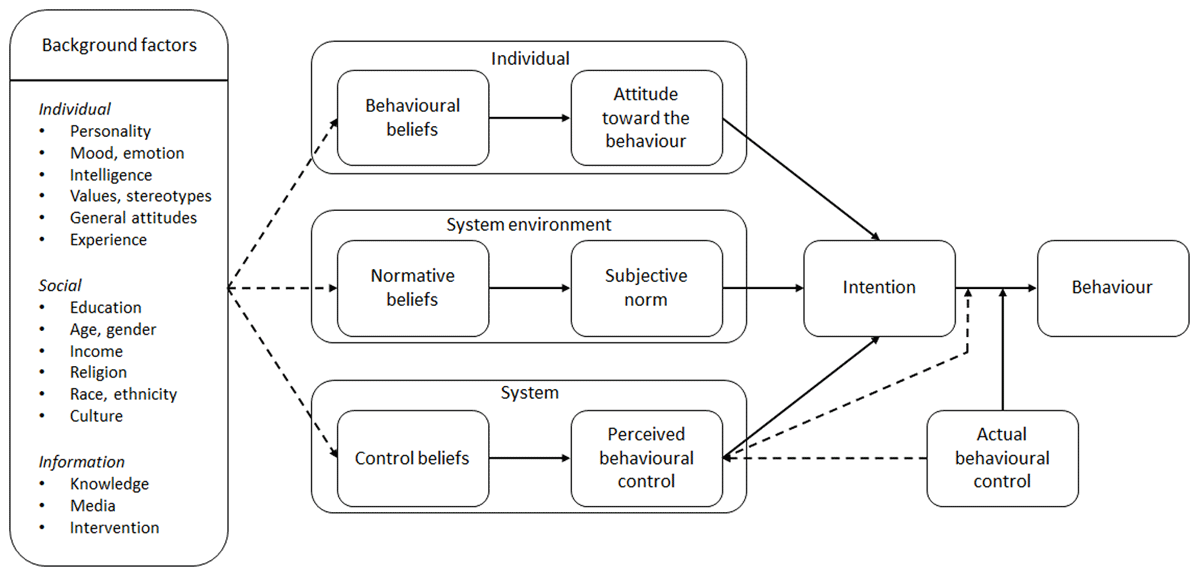
Figure 1
Reasoned Action Approach (Fishbein & Ajzen, 2011).
The model suggests that background factors influence a person’s beliefs which then influence their behaviour. These background factors include predisposition, cultural influences, social environment, one’s own experiences and the information the person has processed throughout his or her life. Factors that influence an individual’s behaviour can be categorised according to three sources: the individual, the system the individual has to deal with and the context in which the system is placed and in which the individual functions. Ultimately this leads to an individual’s intention to perform or not perform the desired behaviour which for this study is sharing and reusing OER.
Individual elements include Behavioural belief and Attitude towards the behaviour, which are the individual’s perception of their confidence in performing the desired behaviour and the value of the behaviour. For this study, these are factors that indicate whether an educator is sufficiently confident that he or she can succeed in sharing or reusing OER and actually started this.
System environment elements include Normative beliefs and Subjective norms, which are the individual’s perception of social pressures and opinions of important third parties in their environment. For this study, this is about the influence from the educator’s environment on his or her intention or actual behaviour to share or reuse OER.
System elements include Control beliefs and Perceived behavioural control, which are the individual’s beliefs about the presence of factors that may facilitate or hinder the performance of the desired behaviour and the perceived ease or difficulty in performing the desired behaviour. For this study, these are system factors that encourage or hinder an instructor from sharing or reusing OER.
Actual behavioural control refers to the individual’s skills, resources and other conditions necessary to perform the desired behaviour. Because it is usually difficult or even impossible to determine a person’s level of actual control, perceived behavioural control can serve as a proxy and can be used for predicting behaviour. Finally, Intention refers to the individual’s willingness to perform the desired behaviour which is sharing and reusing OER.
The analysis was conducted on four transcripts of interviews with four educators and survey responses from a survey conducted in late 2020 responded by 116 educators. The survey consisted of two parts: user behaviour and perception of the value of Wikiwijs (a Dutch national platform used for sharing and finding OER) and of the community.
For each component from Ajzen and Fishbein’s model, two codes were created: one for a positive influence on the desired behaviour and one for a negative influence on it (for example: +Control Beliefs and -Control Beliefs for system factors that respectively encourage or hinder an educator to share or reuse OER). First, the two researchers coded one interview report each. These coding’s were discussed among themselves and mainly aimed to unify interpretation of the codes by the researchers. Next, the remaining two interview reports were coded and discussed. Ultimately, this led to a result that both researchers agreed with.
Both for RQ1a and RQ1b, the tool Atlas TI was used for coding. Figure 2 provides a schematic overview of the study.
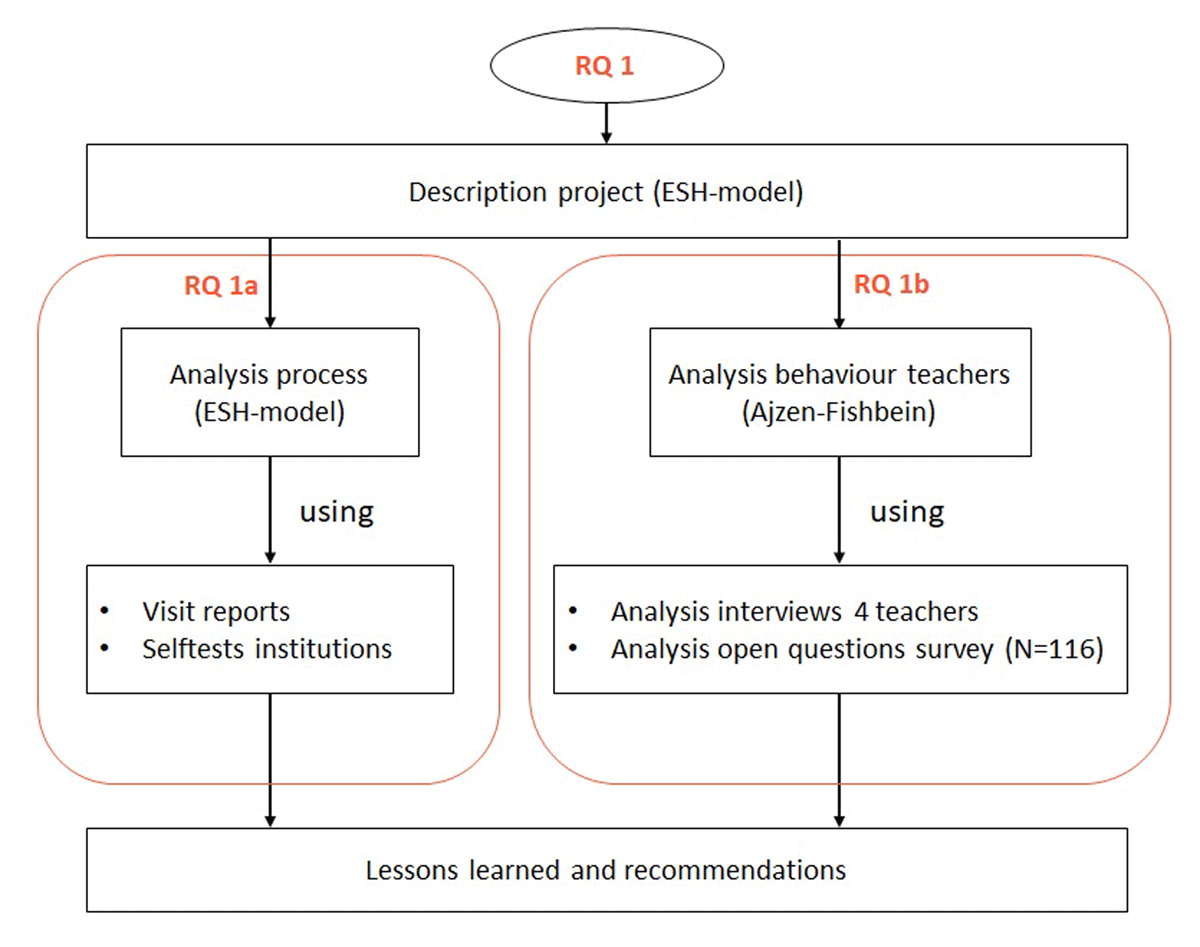
Figure 2
Overview of the study.
Results
In the nationwide project, 15 universities with a Bachelor of Nursing program eventually collaborated to create and share OER in a professional community. The project is described using the ESH model.
The ESH-model distinguishes between three partially overlapping and interacting processes. It assumes a transition from goal setting to organising through the project variable strategy.
Figure 3 provides an overview of this model.
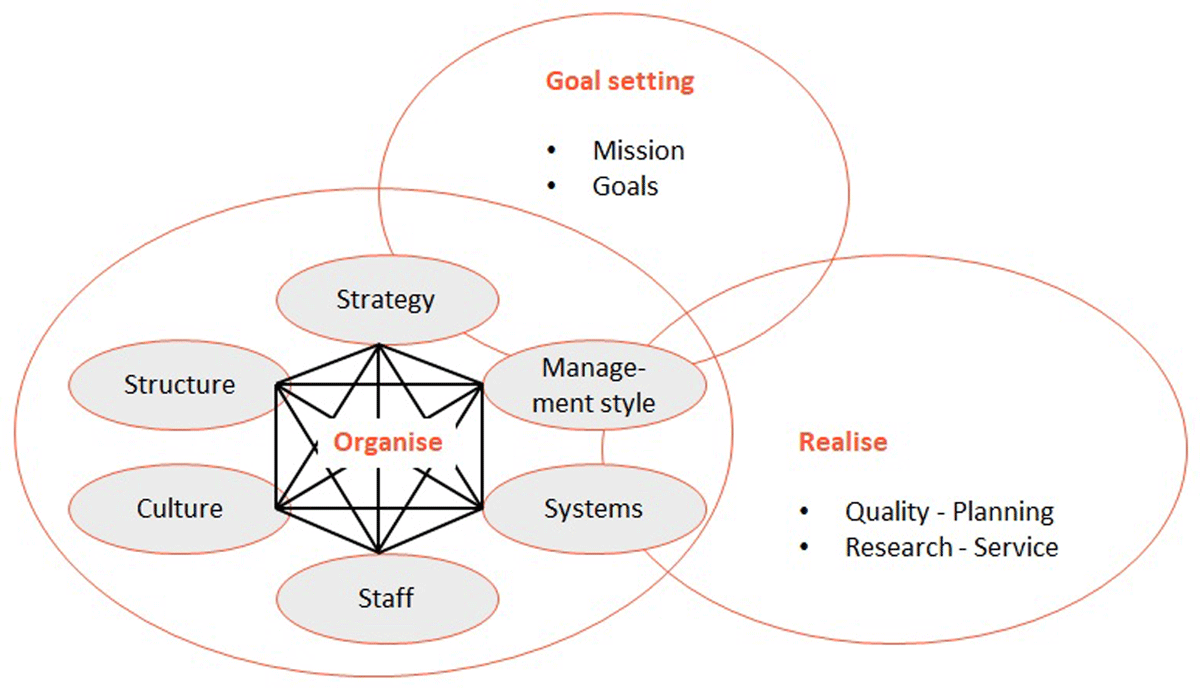
Figure 3
ESH-model from Weggeman (2000).
The Goals were defined by the project management on behalf of the LOOV. The goals were described in a project plan and a practical translation was worked out in an action plan with several work elements. All work elements lead to the main goal: all UoAS with Nursing programs jointly contribute to a platform that will boost the sharing and reuse of digital learning materials by educators and boost collaborating in a community.
The project variables Organise are described as follows, illustrated with an example from the project.
Strategy: the manner and set of means by which predetermined goals are pursued. Activities in the project plan were clustered by objective to keep it manageable.
Systems: rules and procedures by which the daily functioning of the organisation, the planning and control of the activities of the project implementers is regulated or facilitated, and the installed technical (ICT) systems. The quality model for OER was part of the system.
Staff: characteristics, group characteristics, motives, competencies and skills of staff with different personnel and function categories. This diversity of staff was available in the project.
Culture: set of norms, values and behavioural expressions shared by implementers of the project. Codes of conduct for cooperation have been established by community members.
Management style: the characteristic behavioural patterns of management across all levels. Responsibility was placed primarily with the individual participants and an outlined structure was provided by a project manager.
Structure: focuses on three elements: division of labour, division of responsibility and division of power, and the result of the design of coordinating those tasks. Existing structures were used, such as support for copyright check and uploads by an information specialist
Finally, the main process Realise deals with the project activities and the way they are executed, within the settings of the project variables. These activities achieved the following results:
A common language to describe the OER;
A repository has been set up with 1370 OER;
A quality model for the OER, adopted as standard within the project. The quality model consists of several criteria an OER should adhere to1
Quality of OER made visible in the repository by attaching a LOOV seal of approval;
A professional community with 860 members of which at least 10% visits weekly;
57 new OER developed across institutions.
Next, the answers for RQ1a and RQ1b are presented.
RQ1a: Which project activities contributed positively on adoption of OER, which did not and why?
Table 2 shows the results of the analysis, categorised by the ESH model. It shows the impact of project activities and decisions on the project outcome. Some results are relevant to multiple elements in the model, these are indicated with an *.
Table 2
Impact of project decisions on project result.
| RESULT | CONTRIBUTION | EXPLANATION |
|---|---|---|
| Strategy | ||
| Deliver a concrete plan for continuation of platform and community | Project+ | Awareness that the project is an intermediate step in which foundations for the future are laid, thereby contributing to a sustainable situation after the project ends |
| Division of roles. Management pay attention to investing tasks and responsibilities for this project | Project+ | Improved execution of the project activities |
| Work with a quality model * | Project+ | Model has become the standard for working with all open educational resources within institution |
| Management should give the project sufficient priority | Tip | No discrepancy between required and available hours |
| Structure | ||
| Library involvement in support and training (check on copyrights, add metadata) | Top | Unburdening and development of the educator |
| Organise feedback about the quality of OER, given by peers (not just project implementers) | Top | Contributes to higher quality OER, development of the educator and enhancement of # educators involved in sharing OER |
| A clear process for uploading learning materials, which also includes support | Top | Enhances efficiency |
| When formulating project ambitions, take into account that it takes time before sharing can be expected | Tip | Educators need training before they can share OER |
| Systems | ||
| Digital metadata form | Project+ | Enhances efficiency |
| Engage multiple colleagues to act as a broker for an institution | Top | Unburden the broker (Baas et al, 2022a) |
| Community platform supports easy creation of subgroups by members | Top | Contributed to cross-institutional activities |
| Continuous attention for user-friendliness of the IT systems | Tip | Enhances accessibility |
| Give sufficient attention for shared OER that are difficult to reuse due to non-fitting the educational vision | Tip | Enhances usability of OER |
| Staff | ||
| Include knowledge and skills for working with OER in educators’ didactic competence through training | Top | Development of the educator leading to improved sharing and reuse behaviour |
| Culture | ||
| Work with a quality model * | Project+ | The quality of OER is looked at more consciously, with the model being regarded as the reflection of common values |
| Work with community managers and ambassadors | Project+ | Enhances the number of valuable discussions in the community |
| Work with a quality model * | Project– | Leads to additional checks (especially with somewhat older educational resources) and thus takes more time than before |
| Targets on # OER to share | Project– | Feels like an obligation, leading to reduced motivation to actively participate |
| Activities to encourage educators to be active in the community (e.g. monthly presentation of a “open educational resources of the month” and alerting colleagues to interesting topics) (Wenger et al, 2011) | Top | Enhances visibility of the project and the motivation to participate |
| Give attention to a step-by-step realisation of a culture for sharing and reusing open educational resources (Stagg, 2014) | Tip | It takes time before sharing and reusing OER is an element of educator’s activities |
| Communicate clearly the goal for reusing OER | Tip | Mistrust towards management that reuse of open educational resources may lead to reduction of development hours |
| Management style | ||
| (Insufficient data available to draw conclusions) | ||
Overall, delivering a concrete plan for the continuation of the platform and community, dividing roles and responsibilities, and working with a quality model had a positive impact on the project. Library involvement in support and training, organising feedback about the quality of OER, and having a clear process for uploading learning materials also positively impacted the project. Giving sufficient attention to user-friendliness of IT systems, providing training to educators to include knowledge and skills for working with OER, working with community managers and ambassadors and to encourage educators to be active in the community are recommendations for future projects.
RQ1b: What factors influence OER share and reuse of nursing program educators?
As was described earlier, part of the sources for this study were four interviews. In the following, the interviewed educators will be referred to as Penny, Bernadette, Amy and Emily. The analysis revealed the results in Table 3, organised according to Ajzen and Fishbein’s model.
Table 3
Factors influencing educators share and reuse OER.
| RESULT |
|---|
| Individual positive influence |
| Better findability because of labelling resources according to the framework used by the Bachelor Nursing program |
| Gain trust by comparing his or her behaviour with what is present in the repository and community |
| The quality model for OER provides guidance on confidence in the quality of one’s own OER and that of OER shared by others |
| System environment positive influence |
| Initiatives to increase collaboration |
| Innovations in curriculum and lesson preparation lead to a demand for educational resources |
| Expected behaviour when developing new teaching materials |
| Online teaching during COVID-pandemic |
| Enrichment of own teaching practices |
| System positive influence |
| Sharing and reusing OER is perceived as positive (inspirational, more students may use the OER, professional appearance of OER, time savings) |
| Grant program is perceived as positive |
| Size of the existing collection OER enlarges successful search actions (1) |
| Available support (e.g. by the library) (1) |
| Low threshold to use the platform for sharing and retrieving OER |
| Sharing of positive experiences with other colleagues to encourage them to share and reuse OER |
| The perceived value of the platform during the COVID-pandemic (remote education) |
| Individual negative influence |
| Not being able to retrieve OER shared earlier creates doubt about one’s abilities |
| Doubts about whether or not found OER may be reused |
| Too much institution-specific terminology in found material |
| Lack of time to check found material for applicability |
| System environment negative influence |
| Perceived workload for sharing and reusing OER |
| Advantages for sharing are not clear when content does not change often |
| Perceived insufficient attention from the organisation (lack of commitment and facilitation) |
| Target from project on #OER shared |
| Variety of platforms used by the educators |
| System negative influence |
| The perceived value of the platform (when no open educational resources are available for a topic, look-and-feel lacks confidence) |
| Sharing and reusing OER is perceived as negative |
| Too much specificity of educational resources (e.g. a lot of institution-specific data in them) |
[i] (1): Lack of these factors have a negative influence on behaviour.
The table shows that labelling resources according to the framework used by the Bachelor Nursing program and the use of a quality model for OER, the low thresholds for using the platform, as well as initiatives to increase collaboration and innovations in curriculum are perceived positively by educators. The impact of the quality model was illustrated by Amy: “every PowerPoint I made then was perfect because of course I did that on all those conditions”. An anonymous participant of the survey described this as “the perception that I am not doing so badly after all. I still find it “scary” to share something. (…). Nice and instructive to hear how others do it”. Penny formulated the positive influence of the agreement for reuse as “and basically, we also have a kind of procedure for developing new materials at the curriculum committee. It also says to first look for materials to reuse and then start developing, so to speak”. Emily formulated the positive influence of the size of the collection OER as “And I did notice, that yes you could just have a full hit. That you were looking for exactly what you needed. So then it was very effective. For example, once I had to teach something within clinical reasoning, and then I found a PowerPoint and a few videos that I thought made a lot of sense. And I also shared those with colleagues: look there is something there that we can use very well.”
On the other hand, several factors had a negative influence. Bernadette mentioned a perceived lack of confidence in her skills as “I have also shared some OER myself and then I have not been able to find it on (the platform), for example. And (…) then I think: oh, will it end up in the right place?”. Not being able to retrieve OER shared earlier, doubts about whether or not found OER may be reused, too much institution-specific terminology in found material, lack of time to check found material for applicability, perceived workload, advantages not clear when content does not change often, perceived insufficient attention from the organization, target from project on #OER shared, and a variety of platforms are perceived negatively. Emily experienced a negative influence of not being critical when sharing and reusing: “Or it’s just an assignment and then I think it’s actually a bit polluting as well. Then I think if you upload it, do it well, because it also takes quite a lot of time to scroll through it all”.
Discussion
The study aimed at answering the research question: What has been the impact of the activities carried out in the OER projects leading to the commitment to work towards sustaining the initiative?
In this section, the combined results of the sub-studies are formulated and interpreted to provide an answer for the research question. Rogers’ theory for diffusion of innovation (2003) provides a theoretical model for interpreting the results of these sub-studies. According to this model, sustaining the initiative means that adoption of creating, sharing and reusing OER is done by the early and late majority of educators.
Rogers provides some generic recommendations to promote adoption of innovation. These recommendations can be formulated for adoption of OER, providing a framework for interpreting the results of this study.
Make the innovative features of open sharing and reuse clear to educators. Many positive influences regarding this aspect could not be linked directly to planned project activities, but were the result of the creativity and autonomy of individual project members. This can be considered a result of the style of project management, where many responsibilities were placed with the individuals. This is in line with Weggeman (2007), who provides several suggestions for how this can be accomplished, such as formalising the project structure in general terms, steering on output and placing responsibility for results as low as possible.
Organize adequate support for ICT, legal and educational aspects. The results show that the process for the delivery of educational resources, in which support by librarians is given a role has a positive impact. This is in line with previous studies (Marín et al, 2022; Baas et al, 2019; Baas et al, 2022b; Wang & Wang, 2017; Stagg & Partridge, 2019). However, the study has not shown a direct impact of this element on sustaining the activities, but a support structure can be considered a necessary condition to achieve willingness of educators to be involved in sharing and reusing OER (Cox & Trotter, 2017).
Formulate an institutional and faculty policy on open sharing and reuse to enable and secure the activities mentioned under recommendations 1 and 2. Although no comprehensive policy was formulated, the quality model can be considered as a step towards such a policy. The study showed the positive impact, and thereby the importance of this quality model. By involving the community in defining the model, both in its initial formulation and in periodic adjustments, they feel ownership for the model and support its use. Next to this, such involvement contributes to community building. Other results of this study reveal that such a policy should also secure realistic targets (e.g. on the number of shared educational resources). It takes time before educators have the right skills to share educational resources. This is in line with (Schuwer & Baas, 2023), where the skills for successful adoption of OER by educators are described.
At the end of phase 2, the LOOV decided to continue the project with a follow-up “Sharing Together Nursing” to extend involvement and achieve sustainability, without external funding. The main goals to achieve are widening and strengthening the community of practice to take responsibility for maintenance of the collection of OER. The main project activities that convinced these decision makers of the potential value of the initiative were the impact of the quality model and the active role the LOOV got during the project by regular meetings with the project manager. This is in line with (Büchel & Raub, 2002), where involvement of decision makers to recognise the value of the community’s contributions and institutionalising activities is necessary for sustaining the community. This study shows that this involvement should be regular, starting immediately after the start of the project.
Currently (April 2023), during the phase Sharing Together Nursing the number of shared OER on the Wikiwijs platform has grown to 1430. The professional community now consists of 1100 members. The LOOV has created a vision for OER and is carrying it out across the 17 UoAS. Moving towards a sustainable situation for cross-institutional creating, sharing and reusing OER is proceeding according to plan.
Conclusion
The analysis of the project activities revealed that the quality model, the style of management where professionals get responsibility within a minimal framework of rules, and the involvement of decision makers during the project had the largest impact on their decision to commit for extending the collaboration, working towards a sustainable situation for adoption of OER.
Limitations
The analysis is limited by a lack of information on the steering group’s perception of the project, a small sample of educators interviewed, and lack of data on lasting desired behaviour. It is recommended to conduct the study again with a larger sample of educators, including those who have been sharing and reusing resources for a while and to also focus on the influence of activities in the follow-up project.
Notes
[2] The current version of the quality model is available here: https://www.wikiwijs.nl/app/uploads/Kwaliteitsmodel_hbo-vpk.pdf.
Acknowledgements
We thank the anonymous reviewers for their valuable comments on a previous version of this paper.
Funding Information
Both projects were made possible by grants from the Ministry of Education, Culture and Science from the Netherlands.
Competing Interests
The authors have no competing interests to declare.