
Table 1
Affordances of big data and AI to support CBHPE core components.
| CBHPE CORE COMPONENT | DESCRIPTION | IMPACT OF BIG DATA | IMPACT OF AI TOOLS | PROMOTING FAIRNESS |
|---|---|---|---|---|
| 1. Outcome Competencies | Clearly defined competencies expected of all graduates; anchors curriculum to societal and professional needs. | Aggregated learner and patient outcome data can validate or recalibrate competency frameworks across institutions; risk of over-standardization. | AI can map competencies dynamically to clinical tasks and personalize competency attainment pathways. Risk of privileging AI-derived outcomes not aligned with professional judgment. | Ensure competencies reflect diverse populations and approaches. Avoid embedding biased outcome metrics that systematically disadvantage certain groups of learners. |
| 2. Sequenced Progression | Learners advance based on demonstrated competence rather than time; progression is staged and developmental. | Longitudinal data supports fine-grained tracking of progression; may highlight hidden inequities in learner advancement. | AI can predict readiness for advancement, flag struggling learners earlier, and tailor pacing. Risks of over-reliance on opaque algorithms. | Guard against data-driven premature labelling of individuals into developmental tracks, or acceleration favoring learners with more digital trace data (e.g., those benefitting from social capital). |
| 3. Tailored Learning Experiences | Training adapts to learner needs, clinical context, and patient populations; flexible and personalized. | Big data enables benchmarking of exposure opportunities across cohorts and sites; identifies gaps in case mix or learning opportunities. | AI-driven adaptive learning platforms can recommend individualized content and simulate rare clinical scenarios. | Ensure all learners have adequate technology infrastructure to benefit from personalized experiences. Recognize risk that those serving in resourced-constrained settings may not be exposed to clinical AI tools. |
| 4. Competency-Focused Instruction | Teaching is deliberately aligned with competencies; emphasizes coaching and feedback. | Analytics can reveal patterns in feedback quality and instructional practices across faculty; risks of surveillance culture. | AI can support just-in-time feedback (e.g., natural language processing of clinical notes or simulations). Danger of feedback being reduced to automated metrics. | Access to high-quality coaching must be maintained for all learners; AI tools should augment, not replace, interaction with human educators. |
| 5. Programmatic Assessment | Multiple low-stakes data points aggregated for high-stakes decisions by committees. | Big data enables integration of thousands of assessment data points to increase reliability; risks of information overload and data misuse. | AI can synthesize multimodal assessment data into actionable insights; can support CCCs in decision-making. | Risk that AI-supported assessments may have linguistic or cultural errors. Establish processes for algorithmic vigilance. Maintain human oversight of high-stakes decisions to protect learners from potential systemic disadvantage. |
Table 2
Using publicly available large language models (LLMs) to support CBHPE core components.
| TRY THIS AT HOME |
|---|
| Clearly defined outcomes for CBHPE LLMs can be used to generate “competency maps” from authentic learner work to clarify what skills are truly being used in practice. A program can upload de-identified clinical notes, sign-out texts, consult requests, or procedure summaries and have the LLM analyze them for individual or group patterns in skills such as reasoning, communication, data gathering, efficiency, and adaptability. |
| Sequenced Progression Use an LLM to generate individualized “next best learning experiences” for each trainee. The program can input de-identified information about recent clinical tasks, case mix, simulation performance, and areas of struggle. The LLM can then recommend:
|
| Tailored Instruction Empower trainees to generate their own personalized learning modules. Learners can ask the LLM to create:
|
| Competency Focused Instruction Use LLM to extract “instructional snapshots” from daily work so faculty can deliver high-impact micro-teaching. By pasting de-identified notes, sign-outs, or order sets into LLM, a faculty member can ask:
|
| Programmatic Assessment Use an LLM to tag faculty narrative feedback to local EPAs or milestones—instantly expanding narrative data relevance. Faculty or coordinators can input batches of de-identified narrative comments and ask the LLM to:
This dramatically increases the frequency, quality, and usability of narrative assessment, the backbone of programmatic assessment. |
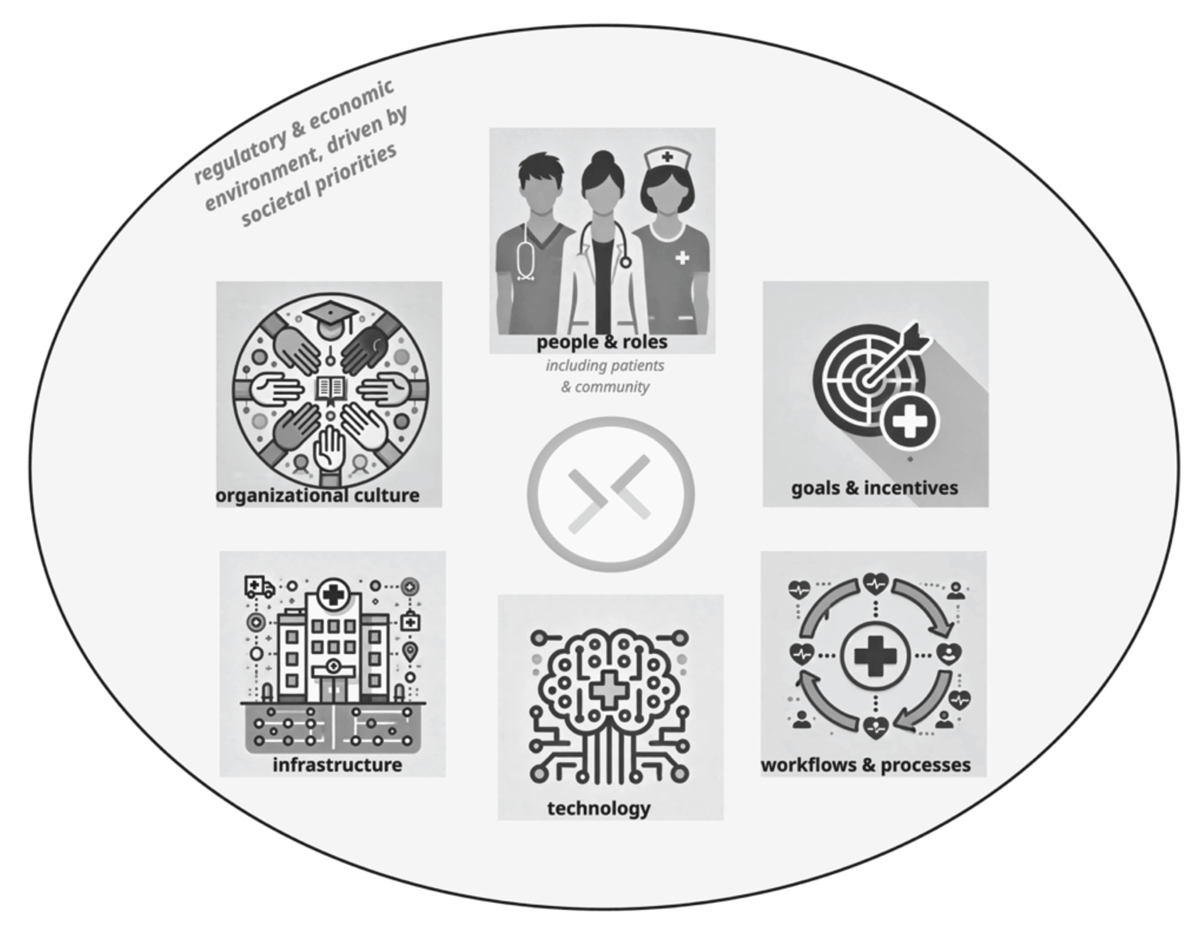
Figure 1
Socio-technical systems theory.
Socio-technical systems theory describes the complex interactions between people & roles; goals & incentives; workflows & processes; technology; infrastructure; and organizational culture, all in the context of the broader environment. Fully optimizing the power of artificial intelligence in care delivery and in health professions education requires consideration of all these elements. (images generated with DALL-E).