Have a personal or library account? Click to login
Assessment Fit for (More Than One) Purpose? Reconciling the Dual Purposes of Assessments in Competency-Based Health Professions Education Cover

Assessment Fit for (More Than One) Purpose? Reconciling the Dual Purposes of Assessments in Competency-Based Health Professions Education

Open Access
|Sep 2026

Figures & Tables

Table 1

Definitions commonly used in describing assessment programs in health professions education.

TERMDEFINITIONILLUSTRATIVE EXAMPLE
Purpose
Assessment for learning [2, 3]An assessment designed to serve primarily as a tool for learning.Students are provided with an optional “self-assessment” in a course. The scores are provided to the student alone to plan for their growth in the program.
Assessment of learning [2, 3]An assessment designed to serve primarily as a tool to determine how well the student has learned the material or achieved a level of skill or competence.Students in a program are given a certification exam to determine whether they have mastered the content in their specialty.
Assessment as learning [4]Assessments are incorporated into the learning process itself; assessments serve to self-regulate learning, reinforcing knowledge and skill acquisition.Students are provided with multiple-choice questions and artificial-intelligence-enhanced feedback highlighting strengths, areas for improvement, and opportunities for self-reflection [6].
Dual purposing [7]Assessments are used for more than one purpose; typically, these purposes include a primary purpose and a secondary purpose, which are categorically different in their orientation toward promoting learning versus judging mastery of content.Workplace-based assessments are used to guide learning during clinical rotations. These same data are then used at the conclusion of all rotations to determine whether students have met the competency threshold.
Stakes
High-stakes [11]The assessment is given significant weight within the education program, and thus, the consequences for high and/or low performance are significant.Students are required to pass an examination to advance to the next stage of their training.
Low-stakes [11]The assessment is given a relatively low weight within the program; thus, its consequences are relatively insignificant.Workplace-based assessments are administered in the authentic clinical settings. The data from each assessment is used as one of many data points in evaluating a student’s performance.
Purpose of assessment and learning
Formative [16, 71]An assessment designed to serve primarily as a tool to contribute to the development or formation of the learner. This is commonly designed to promote learning during an educational experience.Students receive midpoint feedback on their performance during a clinical rotation.
Summative [16, 71]An assessment designed to serve primarily as a tool to determine how well the student has learned the material or achieved a level of skills or competence. This is commonly designed to measure learning acquired at the conclusion of an educational experience or where a progress decision is needed.Students are evaluated on their performance at the conclusion of a rotation.
Assessment systems
Program of assessment [72]The use of multiple assessments within the larger educational program to create a cohesive system of assessment; alignment between assessments and purpose is sought.A medical education program selects a variety of assessment methods; some are designed to assess knowledge, while others are targeted at assessing communication skills.
Programmatic assessment [2, 26]A specific program of assessment in which multiple data points are accumulated from multiple sources and then used to formulate a decision about a learner’s performance in a training program; focus is formative over summative; number of data points needed to make a decision is dependent on the stakes of the decision; a group makes high-stakes decisions of experts.A competency-based program collects data from multiple-choice tests, workplace-based assessments, peer observations, and reflective writing assignments to determine whether a learner is competent for practice.
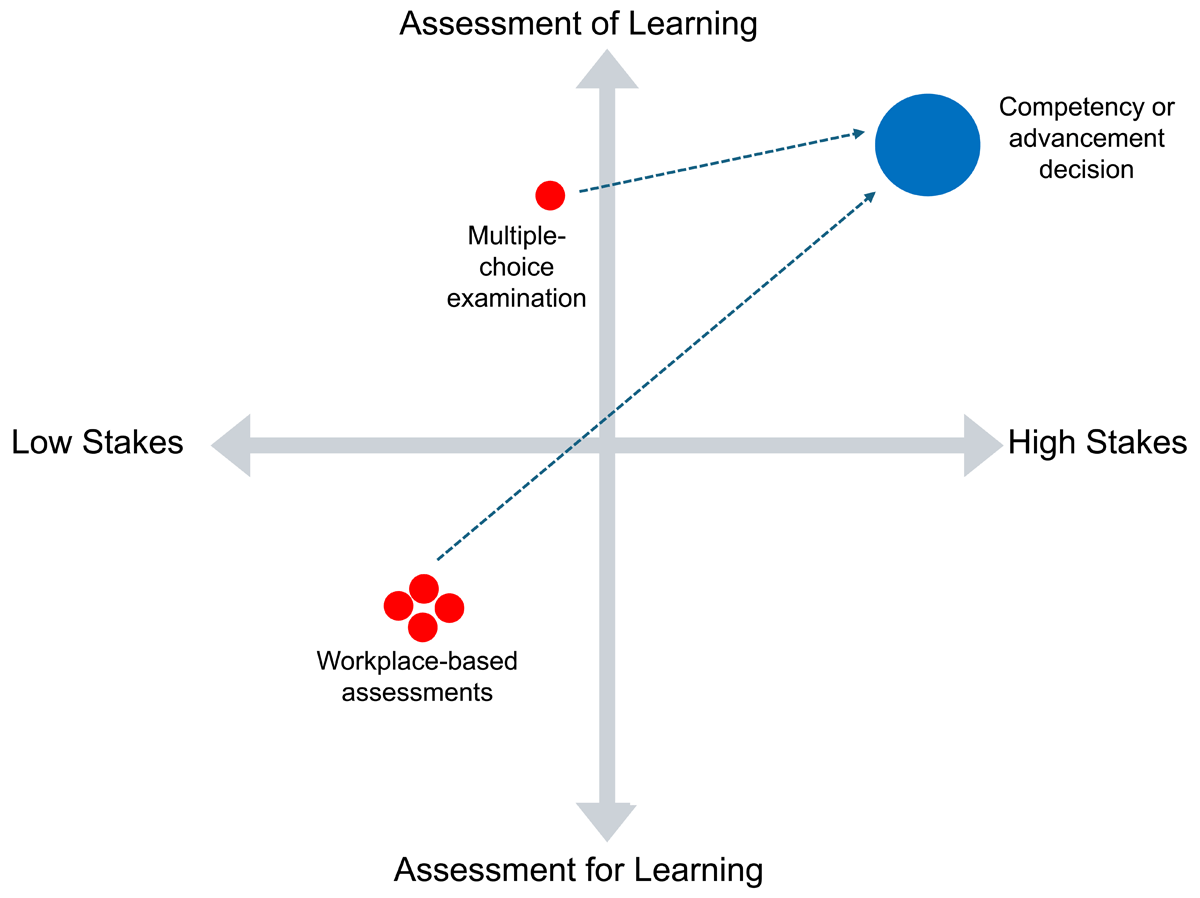
Figure 1

The continuum of purpose and stakes of assessment with an illustration of “dual purposing” in a competency-based education program. Legend: This figure illustrates two prototypical assessments commonly used in competency-based health professions education: end-of-course multiple choice examinations and workplace-based assessments. The red dot indicates the primary use of the assessment while the blue dot indicates a secondary use (i.e., “dual purpose”) of the assessment. This figure illustrates how a lower-stakes assessment can become a higher-stakes assessment (dotted arrow) when that assessment (and others) are used in aggregate to formulate a summative competency decision. Of note, this figure is meant to provide a hypothetical example; the shift in purposes is illustrative of the concept rather than exact.

Table 2

Key considerations for effective “dual purposing” of assessments in a competency-based health professions education program.

KEY CONSIDERATIONHOW TO DEVELOP THE COMPONENTRISKS IF COMPONENT IS ABSENT
Setting the stage
Culture
  • Foster and normalize growth-orientation and likelihood of failures with explicit encouragement and possibly even requirements to include documentation of both in progress and successful workplace-based observations

  • Develop faculty and learners’ orientation to a culture of growth through dedicated and possibly co-delivered sessions

  • Build safe, trusting, collaborative relationships among learners, supervisors and program leaders

  • Ensure processes for how, when, and why assessment data will be used are made transparent to all

  • Continued performance-orientation where learners may perceive all assessments as high-stakes hurdles rather than opportunities for growth, self-reflection, and improvement

  • Avoidance of observation and feedback of clinical encounters during expected developmental phase of learning

  • Increase learner stress regarding fear of being identified/labelled as low performing

  • Reinforces supervisors’ reluctance to document honest corrective feedback

Communication
  • Outline roles and responsibilities for all constituent groups

  • Share policies, procedures, standards, and expectations for assessment data with learners, supervisors, longitudinal advisors, and educational leaders

  • Ensure alignment of growth-oriented practices across learner, supervisor, program, and competence committee/summative decision makers to avoid undermining of trust

  • Result in supervisor feedback that is not aligned with intended goals

  • Result in lack of completion of expected coaching feedback and assessment activities by involved members with lost opportunities for learner development and support

  • Creates hidden curriculum messaging that seeking developmental assessment for learning is not valued or safe in the program

  • Lack of a shared mental model

Obtaining/Interpreting the data
Programmatic assessment
  • Gather multi-modal data from multiple, diverse sources

  • Result in incomplete, non-representative, or biased data informing competence decisions

Lower-stakes assessment
  • Minimize purely summative high-stakes assessments for decision-making

  • Incorporate opportunities for providing feedback even in high-stakes settings

  • Lead to a less comprehensive, authentic picture of learner performance

  • Risk high-stakes assessments being seen as “hoops to jump through” without meaningful learning

  • Promote low volume data collection at risk for selection of cases that are not representative of usual performance (selection bias)

Opportunities for data collection
  • Provide sufficient opportunities for supervisors to observe learners and to collect assessment data and provide actionable suggestions for improvement

  • When observation is not possible, reconsider the feasibility and/or value of obtaining the data or provide alternate means for learners to demonstrate competence in these areas

  • Shared responsibility of the clinical supervisors and learners to trigger an assessment

  • Risk low volume data collection, which can increase the relative stakes and pressure to perform for available observations/cases

  • Increase learner stress as they struggle to find opportunities to demonstrate competence for rarely occurring yet required clinical contexts

Technology
  • Leverage new and emerging technology to facilitate the collection, aggregation, and interpretation of assessment data

  • Critically appraise technology for its potential to promote excessive surveillance and meaningful data interpretation

  • Consider ethical considerations and consent requirements in accessing patient care data

  • Decrease trust and increase learner stress due to continuous assessment

  • Increase administrative burden of programs and competence committees to prioritize, interpret, and integrate large volumes of collected data into assessment of competence

  • Create concern regarding patient privacy and information safety

Learner agency
Learner-initiated assessment
  • Promote balanced opportunities for learners and supervisors to initiate assessment

  • Promote passive learner role with diminished learner motivation and autonomy or place excessive burden on residents to collect data without consequences for supervisors who don’t reciprocate

  • Decrease learners’ ability to seek feedback at times when they need direction to practice lifelong learning skills

  • Lack accountability of learners and supervisors if the expectation to initiate assessments is not shared

Coaching relationships
  • Encourage coaching approaches in any feedback conversations (e.g. following observation in clinical settings or case presentations, mid-point and end-of-rotation discussions, periodic review of learning portfolio)

  • Develop longitudinal coaching programs to support learners in their growth and development and their lifelong learning skills throughout the program

  • Create perceptions of assessment moments as meaningless, low-yield “checkbox” activities

  • Miss opportunity for guided self-reflection and development of lifelong learning skills

  • Result in learners unsure where to focus their efforts to maximize their development and frustration with lack of progression

Ultra-low-stakes assessments
  • Consider learner-identified, developmental-only assessment data that may be used for growth

  • Carefully consider who will see this data and ensure explicit, transparent guidelines for when it may be disclosed to summative decision makers

  • In low trust settings, learners and/or supervisors may hide significant concerns or patient safety issues through this system

  • Learners or supervisors may feel betrayal of trust if critical safety data is disclosed to summative decision makers without transparent communication of the expectations for its release

  • If patterns of significant deficits are not disclosed, programs may not have sufficient data to offer learner supports and to protect the public

DOI: https://doi.org/10.5334/pme.2592 | Journal eISSN: 2212-277X
Language: English
Page range: 946 - 958
Submitted on: Mar 21, 2026
Accepted on: Jul 7, 2026
Published on: Sep 29, 2026
Published by: Ubiquity Press
In partnership with: Paradigm Publishing Services

© 2026 Michael S. Ryan, Aleda M. H. Chen, Heather Nichol, Sören Huwendiek, Denyse Richardson, Benjamin Kinnear, Warren J. Cheung, Claire Touchie, Fremen Chihchen Chou, David A. Turner, Anna Oswald, As members of the International Competency-Based Health Professions Education Collaborative, published by Ubiquity Press
This work is licensed under the Creative Commons Attribution 4.0 License.