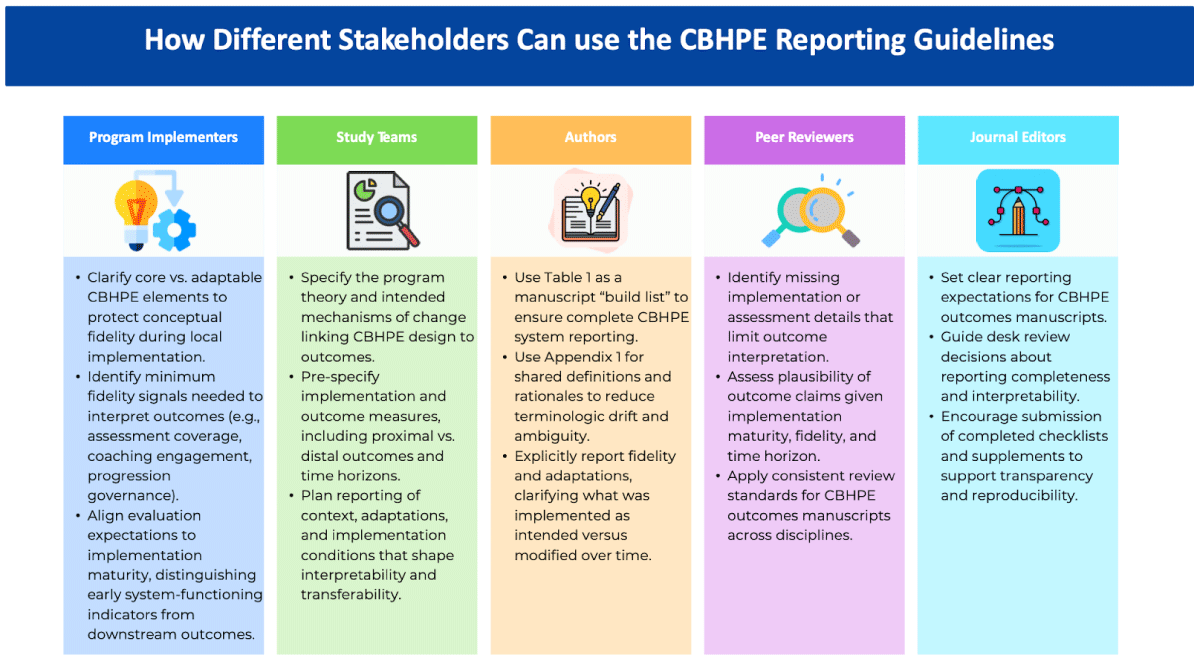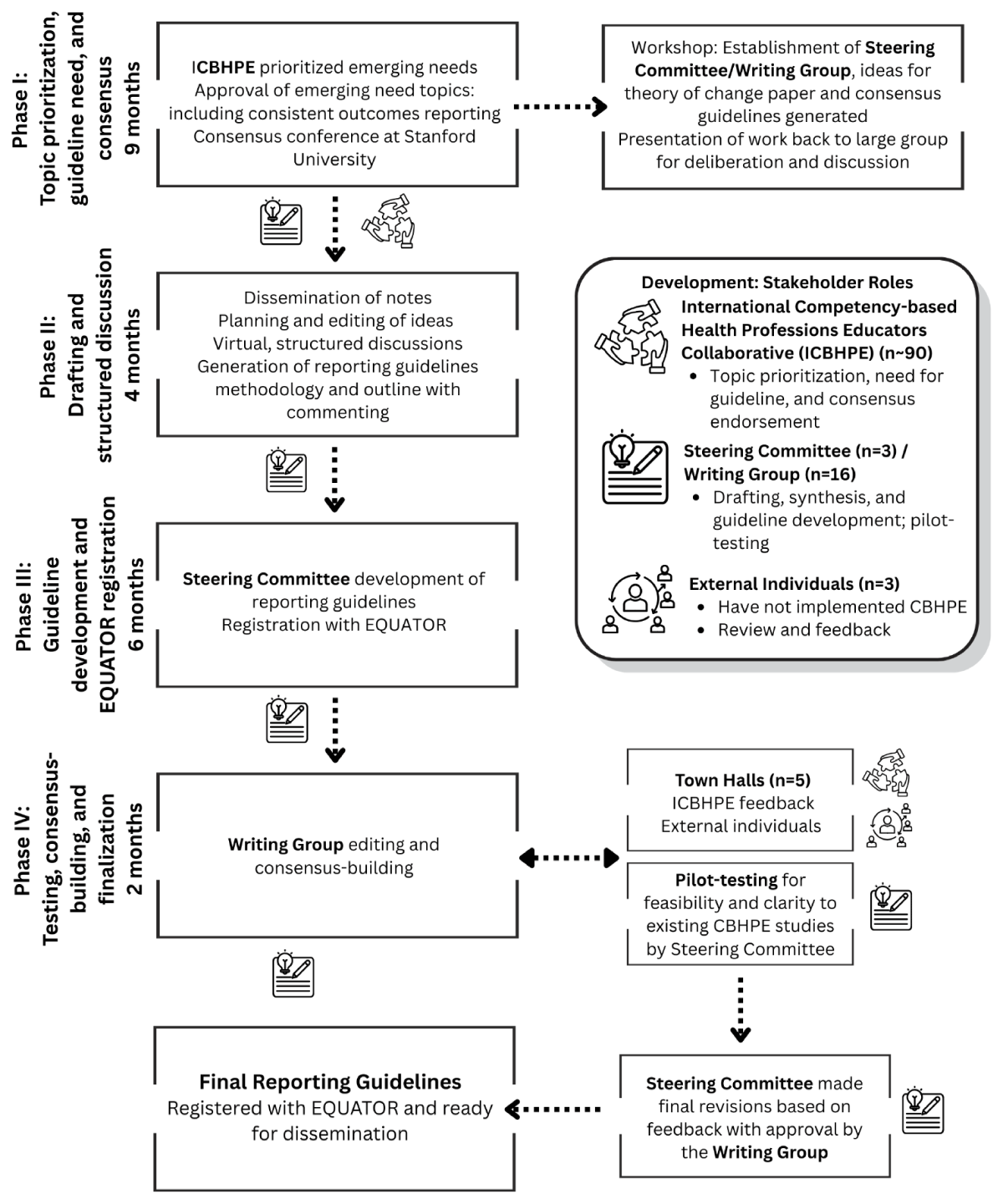
Figure 1
Overview Of Reporting Guidelines Development And Consensus Process.
Table 1
Reporting Guidelines Checklist.
| SECTION | CHECKLIST ITEM | BRIEF DESCRIPTOR | CORE FOR ALL STUDIES | CORE FOR DESCRIPTIVE/EXPLORATORY (INCL. QUALITATIVE)/THEORY-GENERATING STUDIES | CORE FOR IMPLEMENTATION/INTERVENTION STUDIES | REPORTED (YES, NO, PARTIAL, N/A) | PAGE/LINE |
|---|---|---|---|---|---|---|---|
| TITLE AND ABSTRACT | 1. Identification | Identify the work as a competency-based health professions education (CBHPE or the discipline-appropriate acronym, such as CBME, CBPE, CBVE, etc.) or initiative in the title AND abstract, including learner level and setting. | ✓ | ||||
| 2. Study Type | Specify whether the work is an evaluation of a CBHPE study and report the study design (e.g., mixed methods, observational, quasi-experimental, qualitative). | ✓ | |||||
| 3. CBHPE Core Components [2] | Identify which CBHPE core components were addressed and indicate the degree of implementation (planned/partial/full). | ✓ | |||||
| 4. Context and Scope | Describe the CBHPE setting (single vs multi-site), participant groups, scope (pilot vs program-wide), and duration. | ✓ | |||||
| 5. Study Purpose | State the primary outcome(s)/study purpose related to CBHPE and, if applicable, specify whether outcomes are proximal (in-training), intermediate (transition to practice), or distal (in practice). | ✓ | |||||
| 6. Fidelity and Study Outcomes | Report the CBHPE-related study outcomes. | ✓ | |||||
| 6A. Implementation or Other Intervention Outcomes | Report key implementation elements (e.g., feasibility, reach, adoption) and/or other outcomes (e.g., clinical, educational, social/behavioral) associated with CBHPE. | ✓ | |||||
| 6B. Fidelity Evaluation | Provide a brief fidelity evaluation, i.e., implementation delivered as intended, if a CBHPE implementation study. | ✓ | |||||
| 6C. Summary of Key Insights | Summarize the CBHPE-related central themes/constructs/relationships identified. | ✓ | |||||
| 7. Conclusions | Provide CBHPE-related conclusions aligned with the evidence. | ✓ | |||||
| 8. Key Words | Utilize “Competency-Based Health Professions Education” (CBHPE) as a key word. Supplement with any discipline-specific iterations of CBE as appropriate. | ✓ | |||||
| INTRODUCTION | 9. Problem/Rationale | Position the study in the context of the current CBHPE literature. Describe the problem, hook, gap addressed, and explain why a CBHPE approach was selected. | ✓ | ||||
| 10. Conceptual Framing | Anchor the innovation to CBHPE core components and state which components are emphasized. | ✓ | |||||
| 11. Objectives | Clearly state the primary and secondary objectives of the study and indicate whether the focus is CBHPE effectiveness, implementation, or outcomes evaluation (e.g., readiness to implement CBHPE, fidelity of implementation, assessment program validity, educational outcomes, clinical outcomes). | ✓ | |||||
| 12. Definitions | Reference operational definitions for key CBHPE terms. If possible, provide definitions for key and any undefined terms used in the manuscript as a glossary/appendix. | ✓ | |||||
| METHODS | 13. Theoretical Framework & Role in Study | Describe the theoretical framework and its function in the study. Specify whether it is used to: a) justify/design the CBHPE intervention (e.g., theory of change, program theory, implementation framework, assumptions/mechanisms), and/or b) guide the inquiry/analysis/interpretation (e.g., conceptual lens, epistemological stance, analytic framework). | ✓ | ||||
| 14. Context and Setting | Describe the institutional, educational, regulatory, and/or clinical context, including the pre-CBHPE baseline state. | ✓ | |||||
| 15. Learner Level | Specify learner stage and number of learners. | ✓ | |||||
| 16. Scope of Implementation | Describe the scope of CBHPE implementation (pilot vs program-wide; duration/time window). | ✓ | |||||
| 17. Stakeholder Role Changes | Describe intended changes in behaviors and/or roles of stakeholders associated with CBHPE and how these were developed, and how uptake was assessed. | ✓ | |||||
| 17A. Learners | Describe intended changes in behaviors and/or roles of learners associated with CBHPE and how these were developed, and how uptake was assessed. | ✓ | |||||
| 17B. Others | Describe intended changes in behaviors and/or roles of faculty, preceptors, and administrators associated with CBHPE, how these were developed, and how uptake was assessed. | ✓ | |||||
| 18. Resources and Constraints | Report resource context relevant to CBHPE feasibility (e.g. regulatory/accreditation drivers, faculty availability, infrastructure, time, cost). | ✓ | |||||
| 19. CBHPE Core Components Mapping | Map intervention elements to CBHPE core components. | ✓ | |||||
| 19.1. Outcome Competencies | Describe how learner competencies were selected, defined, aligned, and made transparent. | ✓ | |||||
| 19.2. Sequenced Progression | Describe the developmental progression model, EPAs/milestones or levels, decision points, calibration practices, and/or decision-makers (ex: competency committee). | ✓ | |||||
| 19.3. Tailored Learning | Describe mechanisms for individualized learning, coaching, pacing flexibility, and learner agency. | ✓ | |||||
| 19.4. Instructional Methods | Describe teaching and coaching strategies intentionally aligned with competency development. | ✓ | |||||
| 19.5. Programmatic Assessment | Describe the assessment system, including tools, frequency, data aggregation, entrustment decisions, and assessor development. | ✓ | |||||
| 20. Implementation Strategies | Describe implementation strategies, governance, training, stakeholder engagement, and rollout process. | ✓ | |||||
| 21. Fidelity Monitoring | Specify how fidelity was measured/assessed (implemented as intended) of the CBHPE implementation, such as outputs, uptake/adoption, monitoring methods, and planned vs enacted adaptations. | ✓ | |||||
| 22. Evaluation Design | Describe the CBHPE evaluation design (e.g., rapid evaluation, realist evaluation, logic model, quantitative, qualitative, mixed methods), data sources, measures, analytic approach, and stakeholder involvement. | ✓ | |||||
| 23. Evaluation Focus | Specify whether the CBHPE evaluation focuses on implementation, educational outcomes, or other elements (e.g., Readiness to Implement CBHPE, Fidelity of Implementation, Validity of the Program of Assessment, Educational Outcomes, Clinical Outcomes). | ✓ | |||||
| 24. Future Evaluation (Recommended not Required) | For early-phase CBHPE innovations, describe the planned evaluation approach and CQI integration. | ✓ | |||||
| RESULTS | 25. Fidelity Results | Report CBHPE fidelity (implemented as intended), such as adherence, level of integration, quality, engagement, and differentiation from baseline. | ✓ | ||||
| 26. Outcome Timing | Report CBHPE-related outcomes by time, whether proximal (in-training), intermediate (transition to practice), or distal (in practice). | ✓ | |||||
| 27. Outcomes | Report CBHPE-related outcomes appropriately based on study design. If quantitative, denominators and measurement methods should be included. | ✓ | |||||
| 28. Monitoring Indicators | Report CBHPE indicators used to monitor outputs and guide continuous quality improvement. | ✓ | |||||
| 29. Adaptations | Describe CBHPE adaptations, timing, rationale, and impact on core versus adaptable elements. | ✓ | |||||
| 30. Contextual Variation | Report CBHPE implementation elements stratified by site or resource context, where applicable. | ✓ | |||||
| 31. Impact on Stakeholders | Report CBHPE impact on stakeholders and any relevant characteristics. | ✓ | |||||
| 31A. Learners | Report CBHPE impact on learners and any relevant learner characteristics. Examples include entrustment decisions (progression, time variability, and remediation), satisfaction, motivation/engagement. | ✓ | |||||
| 31B. Other Stakeholders | Report CBHPE impact on other stakeholders (e.g., faculty, clinician educators, coaches, administrators) and any relevant stakeholder characteristics. | ✓ | |||||
| 32. Assessment Synthesis | Describe how and by whom CBHPE assessment data were aggregated and interpreted longitudinally. | ✓ | |||||
| 33. Program Outcomes | Report CBHPE program-level outcomes, e.g., related to progression, changes in assessments, and decision outcomes/processes. | ✓ | |||||
| 34. Barriers and Unintended Consequences | Report CBHPE challenges, unintended effects, and mitigation strategies. | ✓ | |||||
| 35. Equity by Design | Describe equity-oriented design features embedded within the CBHPE model. (If not included, use N/A.) | ✓ | |||||
| DISCUSSION | 36. Interpretation | Ensure that the discussion interprets the findings in a manner consistent with the evidence generated, considering the CBHPE core components, theoretical frameworks, and existing CBHPE literature. | ✓ | ||||
| 37. Mechanisms | Explain plausible mechanisms of CBHPE impact using data, such as implementation, fidelity, adaptation, and context. | ✓ | |||||
| 38. Barriers and Facilitators | Identify CBHPE barriers and facilitators. If possible, use an established implementation science framework (e.g., CFIR) or theory. | ✓ | |||||
| 39. Transferability and Scale | Discuss core versus adaptable elements of CBHPE, resource requirements, and implications for transferability. | ✓ | |||||
| 40. Limitations | Discuss CBHPE design, implementation, and external validity limitations. | ✓ | |||||
| OTHER | 41. Reflexivity Statement [Recommended, not required] | Add a statement identifying how the research team’s background, etc., may impact the CBHPE study findings and work. | ✓ | ||||
| CONCLUSION | 42. Summary of Insights | ✓ | |||||
| 42A. Summary of Intervention/Implementation Insights | Summarize CBHPE components implemented, key outcomes, implementation adoption, and lessons learned. | ✓ | |||||
| 42B. Summary of Qualitative Insights | Summarize the CBHPE-related central themes/constructs/relationships identified. If theory-generating, then state the proposed conceptual model/mechanisms (or what is newly clarified) and what remains uncertain. | ✓ | |||||
| 43. Practice Implications | Describe implications for CBHPE and potential actionable elements for adoption, including minimum requirements and conditions. | ✓ | |||||
| 44. Future Research | Recommend next steps for CBHPE, i.e., evaluation and evidence building. Describe how this study advances CBHPE knowledge. | ✓ |
[i] An expansion of the reporting guidelines, with information on how to complete each checklist item, can be found in Table 2. A “not applicable” column with comments has been created, as some study designs may not be able to report all elements. However, these items are comprehensive and worth considering when reporting CBHPE research. Additional reporting guidelines should be utilized that align with your research methodology to ensure reporting. These guidelines are intended to complement existing guidance with specific elements to address surrounding CBHPE.
Scope and Use of this Checklist
This checklist specifies CBHPE-specific reporting elements to address when a study examines, implements, evaluates, or theorizes about competency-based health professions education.
It is intended to be used in addition to, not instead of, established reporting guidelines appropriate to the study’s methodology [42], such as qualitative studies (e.g., SRQR, COREQ), observational quantitative studies (e.g., STROBE), implementation studies (e.g., StaRI), and quality improvement studies (e.g., SQUIRE). Authors should first ensure methodological completeness using the relevant guideline(s) and then apply this checklist to report CBHPE-specific elements.
Instructions for Completing the Checklist
Before scoring, identify the study’s primary CBHPE purpose/study type (e.g., descriptive/theory-generating vs implementation/intervention).
For each checklist item, indicate Yes, Partial, No, or Not Applicable (N/A) based on the criteria below. When selecting Partial, No, or N/A, provide a brief note (1–2 sentences) indicating what was missing or why the item was not applicable. If an item is reported, score it (Yes/Partial) even if it is not core; use N/A only when it is not expected and not reported.
Yes: Select Yes if the item is explicitly addressed and sufficiently described in the manuscript, such that the relevant CBHPE element is clearly identifiable and enough detail is provided for readers to understand what was done, why, and how it informs interpretation of the findings.
Partial: Select Partial if the item is mentioned or implied, but key details are missing, unclear, or underdeveloped, or the item is addressed in one section but not integrated across the manuscript where expected.
No: Select No if the item is core to the study’s CBHPE purpose, but it is not reported anywhere in the manuscript, or the reporting is insufficient to support interpretation, transferability, or reuse.
Not Applicable (N/A): Select N/A only when the item is not core to the study’s CBHPE study type/purpose and is therefore not expected to be reported. Rule of thumb: if a reasonable reader would need this information to interpret the CBHPE claims being made, it is not N/A.
Additional Guidance
Multiple standard reporting guidelines may apply. This checklist assesses CBHPE-specific reporting elements and should be used in addition to appropriate methodological reporting standards.
Items marked Partial or No should be considered opportunities for improving transparency, not judgments of study quality. This checklist is intended to support consistent reporting, not to serve as a risk-of-bias or quality appraisal tool.
For mixed-methods or hybrid papers addressing multiple CBHPE purposes, complete all items that are core to each purpose addressed.
Checklist items can be moved to different paper sections (ex: moving conceptual framework from the Methods to the Introduction), depending on the journal selected and the type of study.
Table 2
Glossary Of Terms.
| TERM | DEFINITION |
|---|---|
| Competency-Based Health Professions Education (CBHPE) | Outcomes-oriented approach in which competencies are explicit, progression is developmental (not primarily time-based), learning experiences are aligned to competencies, and assessment supports longitudinal decisions about readiness for practice in health professions education [2]. |
| CBHPE Core Components | Five foundational building blocks used to describe CBHPE as a coherent system (e.g., outcome competencies, sequenced progression, tailored learning experiences, competency-focused instruction, programmatic assessment) [2]. |
| Theory of change | An explicit explanation of how and why an initiative is expected to work, specifying assumptions and mechanisms and linking activities to outputs and outcomes over time [41]. |
| Program theory | The set of testable assumptions and causal propositions that connect the CBHPE design and implementation to expected outputs and outcomes; often operationalized via a logic model and accompanying narrative [61]. |
| Implementation strategy | The methods or actions used to adopt, operationalize, and sustain an initiative in a real setting (e.g., training, coaching infrastructure, workflow redesign) [65]. |
| Implementation outcomes/outputs | Outcomes or early observable indicators that reflect the success/quality of implementation (distinct from educational, practice, or patient outcomes), such as acceptability, adoption, feasibility, fidelity, and sustainability [65, 66]. |
| Implementation fidelity | Degree to which an initiative is delivered as intended; fidelity reporting supports interpretation of whether findings reflect the model or implementation failure [66]. |
| Implementation Framework | A structured, theory-informed approach used to organize and explain factors and processes that influence implementation (e.g., determinants, strategies, mechanisms, and outcomes), and/or to guide planning, evaluation, and reporting of how an intervention is adopted, delivered with fidelity, and sustained across contexts [67, 68]. |
| Competency committee (e.g., Clinical Competency Committee) | A group that synthesizes longitudinal assessment information to make recommendations about learner progression and readiness and to support defensible, programmatic decisions [69, 70, 71]. |
| Milestones | A criterion-based developmental framework describing progression within competencies; often used to structure expectations and guide longitudinal assessment and feedback [72, 73]. |
| Entrustable professional activities (EPAs) | Units of professional work that can be entrusted once sufficient competence is demonstrated; EPA decisions often imply a supervision level and are supported by aggregated assessment evidence [74]. |
| Entrustment (entrustment decision) | The act of transferring patient care responsibility to a trainee at a specified level of supervision for an EPA. A summative entrustment decision should be supported by multiple observations and contextual considerations [75]. |
| Continuous quality improvement (CQI) | Iterative, data-informed cycles used to monitor and refine processes over time; in CBHPE, CQI often applies to assessment system functioning and implementation performance [76]. |
| Proximal outcomes | Early changes during training that indicate the initiative is functioning as intended (e.g., assessment use, feedback quality, learner development) [2, 36, 47, 49]. |
| Intermediate outcomes | Changes during the transition to practice that reflect the application and consolidation of competencies and movement toward practice readiness [2, 36, 47, 49]. |
| Distal/impact outcomes | Longer-term effects in practice and systems (e.g., sustained performance, workforce effects, patient/population outcomes) [2, 36, 47, 49]. |
| Context | The local conditions (organizational, cultural, resource, policy) that shape implementation feasibility, fidelity, and how mechanisms operate [77]. |
| Barriers/enablers | Factors that impede or facilitate implementation and sustainment (e.g., resources, leadership, culture), often treated as determinants influencing implementation outcomes [77]. |
| Equity | Attention to fairness and inclusion in design, implementation, assessment, and progression so that benefits and opportunities are not systematically distributed unequally [78]. |
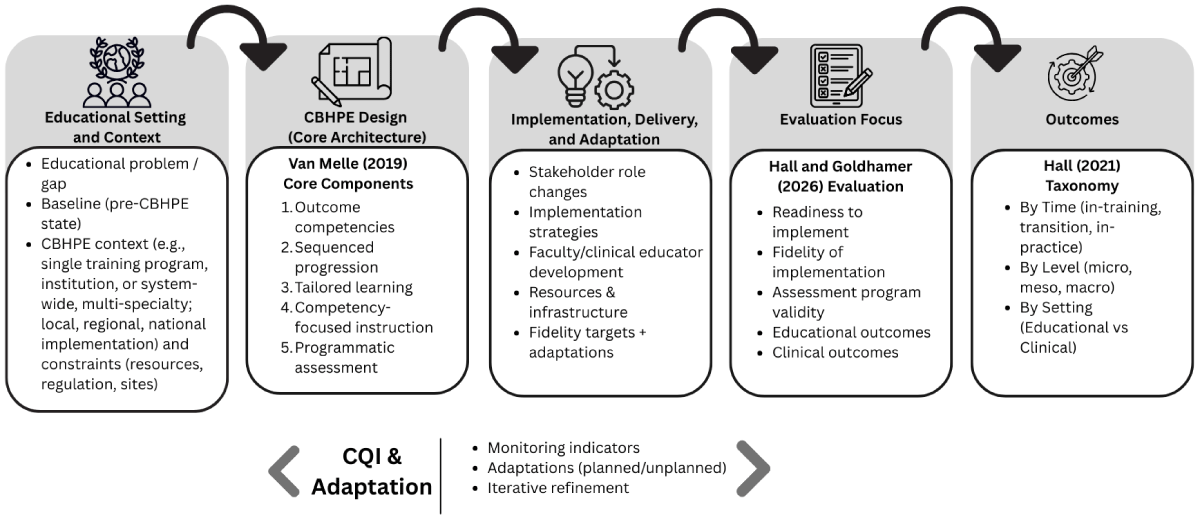
Figure 2
Conceptual Flow Of Cbhpe Design, Implementation, And Evaluation, Illustrating The Theory Of Change And Reporting Domains Addressed In The Cbhpe Reporting Checklist.
Key: CBHPE = Competency-Based Health Professions Education.
This links to the Theory of Change by providing an explicit explanation of how and why an initiative is expected to work, specifying assumptions and mechanisms, and linking activities to outputs and outcomes over time. Elements linked to the reporting domains are located in the white boxes. Further information can be found in Appendix I, which provides an overview of the details of the Reporting Guidelines.