
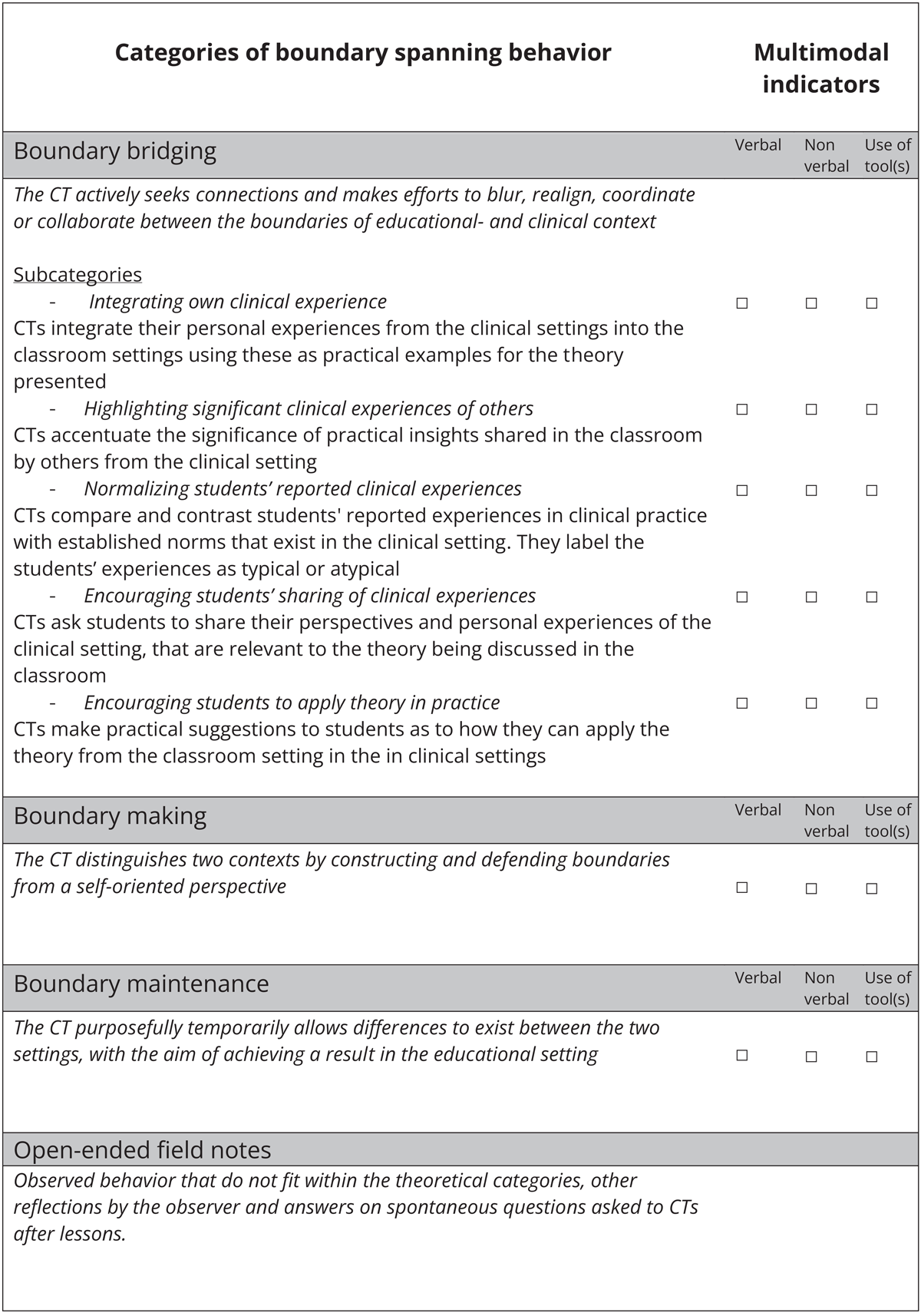
Figure 1
Final observation schedule for documentation and analysis of the boundary spanning behavior of CTs.
CT: clinician-teacher.
Table 1
Types of observed boundary spanning behavior.
| # CTS | # LESSONS | |
|---|---|---|
| Boundary bridging | ||
| Integrating own clinical experience | 6/6 | 22/22 |
| Highlighting significant clinical experiences of others | 6/6 | 21/22 |
| Normalizing or de-normalizing students’ reported clinical experiences | 6/6 | 21/22 |
| Encouraging students’ sharing of clinical experiences | 6/6 | 16/22 |
| Encouraging students to apply theory in practice | 6/6 | 19/22 |
| Boundary making | 6/6 | 14/22 |
| Boundary maintenance | 6/6 | 19/22 |
Table 2
Boundary spanning behavior in the clinical- and classroom settings.
| CTs BOUNDARY SPANNING IN THE CLINICAL SETTING (WITH REFERENCES FROM LITERATURE) | CTs BOUNDARY SPANNING IN THE CLASSROOM SETTING (WITH RESULTS FROM THIS RESEARCH |
|---|---|
| Boundary bridging | |
| CTs incorporating own clinical experiences into their clinical teaching [5] | integrating own clinical experience to illustrate theory |
| questioning students and filling any knowledge gaps [31, 32, 33] | encouraging students’ sharing of clinical experiences in the classroom |
| CTs encouraging students to take actions outside the workplace, such as supplementary readings [32] | encouraging students to apply theory in practice |
| - not found in literature | (de)normalizing students’ experiences or highlighting significant clinical information |
| Boundary making | |
| CTs explaining to their students how certain skills acquired at the institute should be adapted or avoided in certain clinical situations due to unfeasibility or undesirability [34] | accentuating differences in educational institutes and clinical practice |
| Boundary maintenance | |
| - not found in literature | CTs temporarily allowed differences to exist between lesson content and clinical practice, in order to benefit the lesson. |