
Table 1
Participants’ Age Ranges.
| AGE RANGES | n | % |
|---|---|---|
| 18–23 | 22 | 7% |
| 24–35 | 96 | 32% |
| 36–45 | 105 | 35% |
| 46–55 | 48 | 16% |
| 56–65 | 24 | 8% |
| 66+ | 5 | 2% |
| Prefer not to disclose | 3 | 1% |
Table 2
Participants’ Location of Residence.
| LOCATION | n | % |
|---|---|---|
| North America | 241 | 80% |
| Europe | 16 | 5% |
| Caribbean | 15 | 5% |
| Asia | 9 | 3% |
| South America | 9 | 3% |
| Africa | 6 | 2% |
| Oceania | 4 | 1% |
| Middle East | 2 | 1% |
Table 3
Participants’ Type of Institution.
| TYPE OF INSTITUTION | n | % |
|---|---|---|
| Doctoral-Granting University | 188 | 62% |
| Masters-Granting University | 90 | 30% |
| Other(s) | 9 | 3% |
| Community College | 7 | 2% |
| Non-profit Institution | 4 | 1% |
| Undergraduate-Granting University | 3 | 1% |
| Research Lab | 2 | 1% |
Table 4
Motivators for Using Digital Social Networks as an Academic.
| WHAT ARE YOUR MOTIVATORS FOR USING DIGITAL SOCIAL NETWORKS FOR YOUR ACADEMIC CAREER? | n |
|---|---|
| To connect with or meet other professors/academics (networking) | 174 |
| To look for resources for my teaching or research | 149 |
| To be informed/discover information | 149 |
| To ask questions or seek help/advice | 115 |
| To share my research and/or achievements in my academic job | 102 |
| To help others | 94 |
| To share resources (content assignments, syllabus, student work, etc.) | 91 |
| To share my opinions about a topic | 87 |
| To build communities of practice | 86 |
| To thank people or show encouragement | 83 |
| To get away from pressures and stress of the academic job | 59 |
| Other(s) | 5 |
Table 5
Digital Social Network Applications Used by Scholars in their Academic Careers.
| WHAT DIGITAL SOCIAL NETWORK PLATFORMS DO YOU USE FOR YOUR ACADEMIC CAREER? | n |
|---|---|
| 144 | |
| 138 | |
| X | 127 |
| YouTube | 100 |
| 90 | |
| ResearchGate | 73 |
| Academia.edu | 62 |
| Blogs | 51 |
| Podcasts | 49 |
| 44 | |
| TikTok | 19 |
| Wikis | 16 |
| Other(s) | 15 |
| Forums | 14 |
| 13 | |
| 12 | |
| Telegram | 11 |
| Publons | 8 |
| Snapchat | 7 |
| Social bookmarking | 5 |
| 1 |
Table 6
What are the Benefits of Using Digital Social Networks for One’s Academic Career?
| BENEFITS | n | SAMPLE COMMENTS BY PARTICIPANTS |
|---|---|---|
| Networking in general | 70 | ‘Networking and communicating projects or obstacles to peers for targeted feedback.’ |
| Personal branding | 35 | ‘Visibility, transparency, feedback and recognition.’ |
| Information and learning | 29 | ‘Following experts and receiving information directly from them rather than information interpreted by media.’ |
| Networking with others outside their institution | 25 | ‘Connecting with global scholars, access [to] and information about resources.’ |
| Resources | 25 | ‘Able to communicate with people across the world who otherwise it would be very difficult to connect with. With Twitter it’s easy to hear about things that people are doing, find opportunities, etc. that otherwise I would never know about.’ |
| Networking with known peers | 17 | ‘To follow colleagues whose work is relevant to me.’ |
| Other(s) | 12 | ‘Ease of access.’ ‘Staying relevant and maintaining credibility for tenure/promotion.’ |
| Support | 11 | ‘Contents can be scrutinized by various scholars who come across the content. Seeing and reading about what others have done may help encourage one to challenge themselves to keep on thriving and doing better.’ |
| Sharing accomplishments | 8 | ‘Promote awareness of my work.’ |
| Seeking job opportunities | 6 | ‘I can see job posts.’ |
Table 7
What are the Challenges of Using Digital Social Networks for One’s Academic Career?
| CHALLENGES | n | SAMPLE COMMENTS BY PARTICIPANTS |
|---|---|---|
| Other(s) | 34 | ‘Accessibility issues as Internet penetration has not been sufficient enough.’ ‘Self-promotion gets exhausting.’ ‘It’s always changing.’ ‘Many of my colleagues don’t use it and thus won’t see my posts.’ |
| The time needed to actively participate | 32 | ‘Time consuming. In order to leverage networking and connections, we have to dedicate time to invest in our personal brands online.’ |
| Knowing how to properly draw the line between personal and professional sharing | 31 | ‘There is a pressure to be professional and a difficulty to separate personal posts from professional posts.’ |
| Privacy issues | 26 | ‘Privacy is the biggest thing for me. I enjoy keeping my work life and private life separate.’ |
| Experiences with harassment | 26 | ‘Twitter is where academics are forced to be, but it is toxic as hell! Negative, angry, bullying- it’s bad for society and for mental health.’ |
| Access to too much information | 11 | ‘Difficulty of managing multiple streams of communication when I’m already overloaded.’ |
| Dealing with misinformation | 10 | ‘Vetting sources for misinformation is paramount and can be difficult. Failing to vet can get you into trouble.’ |
| False sense of community | 8 | ‘I wish there was more authenticity in networking. I feel that places like LinkedIn are only about showing off your best attributes so it’s become this competition of who can be better in their industry.’ |
| Impostor syndrome | 6 | ‘It creates false expectations of success and/or failure.’ |
Table 8
Imagined Audiences of Scholars.
| IMAGINED AUDIENCES | n | SAMPLE COMMENTS BY PARTICIPANTS |
|---|---|---|
| Other academics | 137 | ‘This is my primary audience; I want to share my research with other academics or have conversations with them to improve my own research.’ ‘My goal is to connect and research with academics that work [on] the same subject as me.’ |
| Students | 85 | ‘They are for me, the most important audience in all my social media platforms. My engagement is based on them.’ ‘I hope students find resources I post to be helpful.’ |
| Family and friends | 59 | ‘I have some friends or closer colleagues that I wish to share resources and achievements with.’ ‘People who love you although they don’t understand all that you do, but they are happy for your achievements’. |
| Journalists and reporters | 36 | ‘I don’t have many associations with the media, but I do hope to get attention for my research.’ ‘Translating research to lay audience.’ |
| Higher education staff | 33 | ‘We can also engage with the staff. You never know who is interested in the type of content you share and can engage with you and your peers.’ |
| Administrators | 19 | ‘I may find some research that my administrators find interesting, and they may share it.’ |
| Fans | 18 | ‘You may have followers that are not enrolled in your institution but can find your content engaging.’ |
| Others | 11 | ‘Practitioners, as a teacher educator my main audience is K-12 teachers and informal educators.’ ‘Industry professionals, hiring managers.’ |
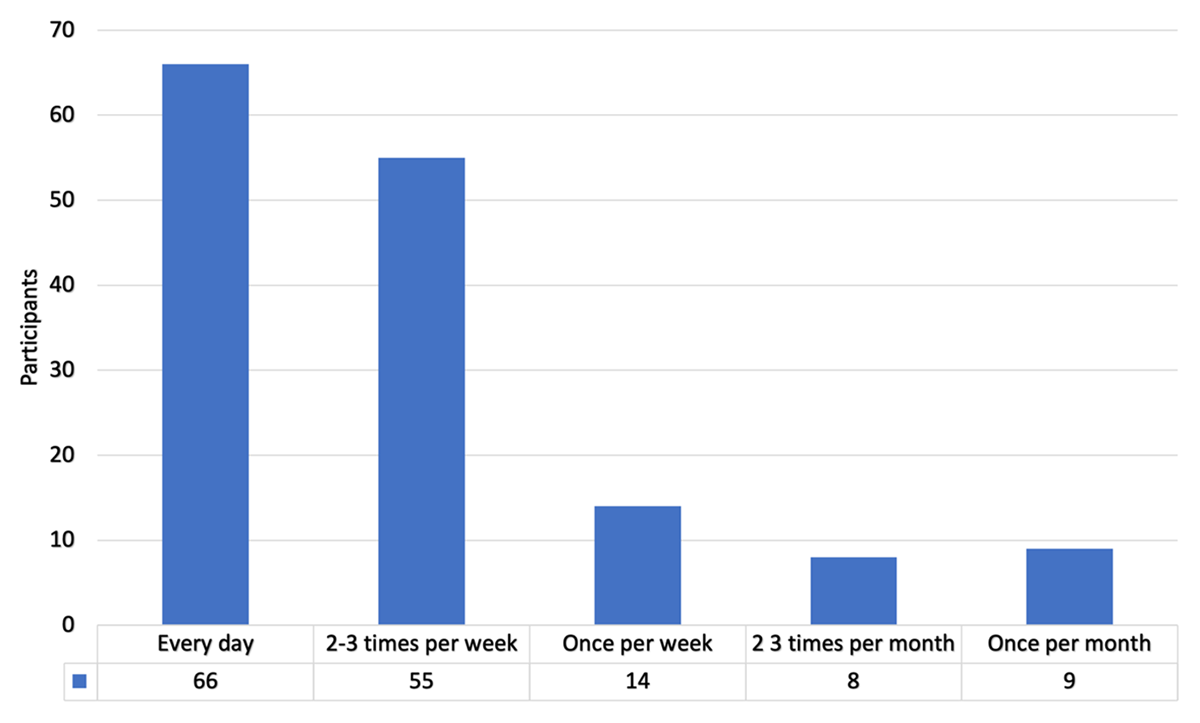
Figure 1
Frequency of Participation in Digital Social Communities.
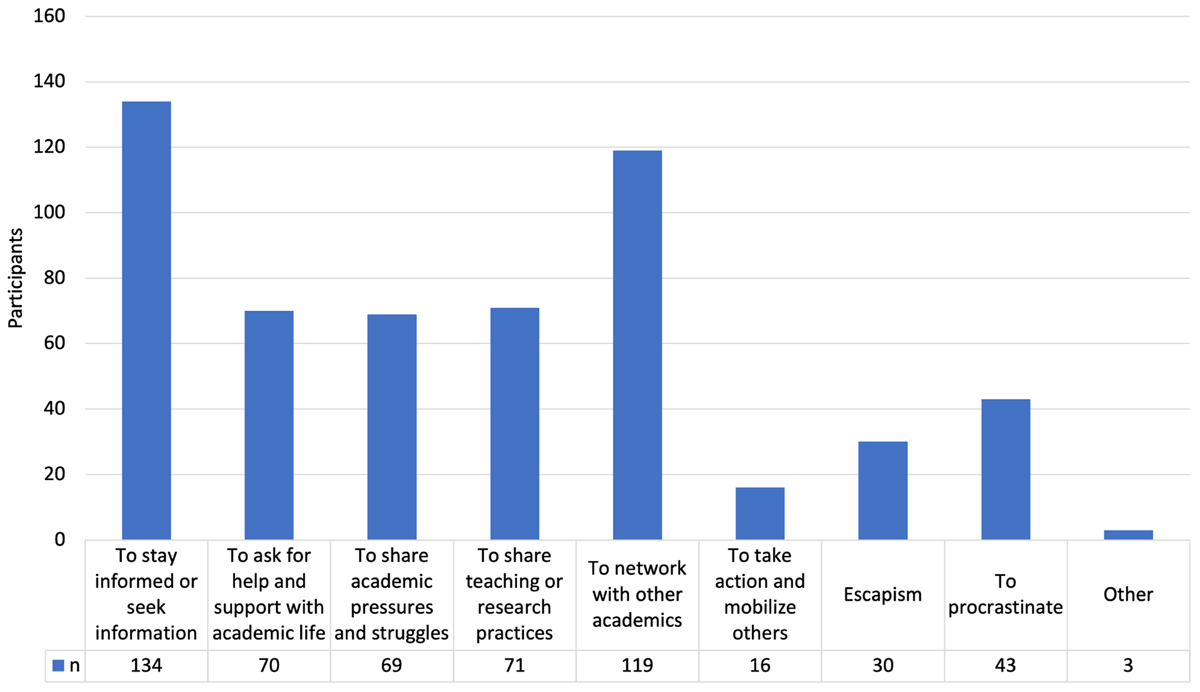
Figure 2
Why do Scholars Turn to Digital Social Communities?
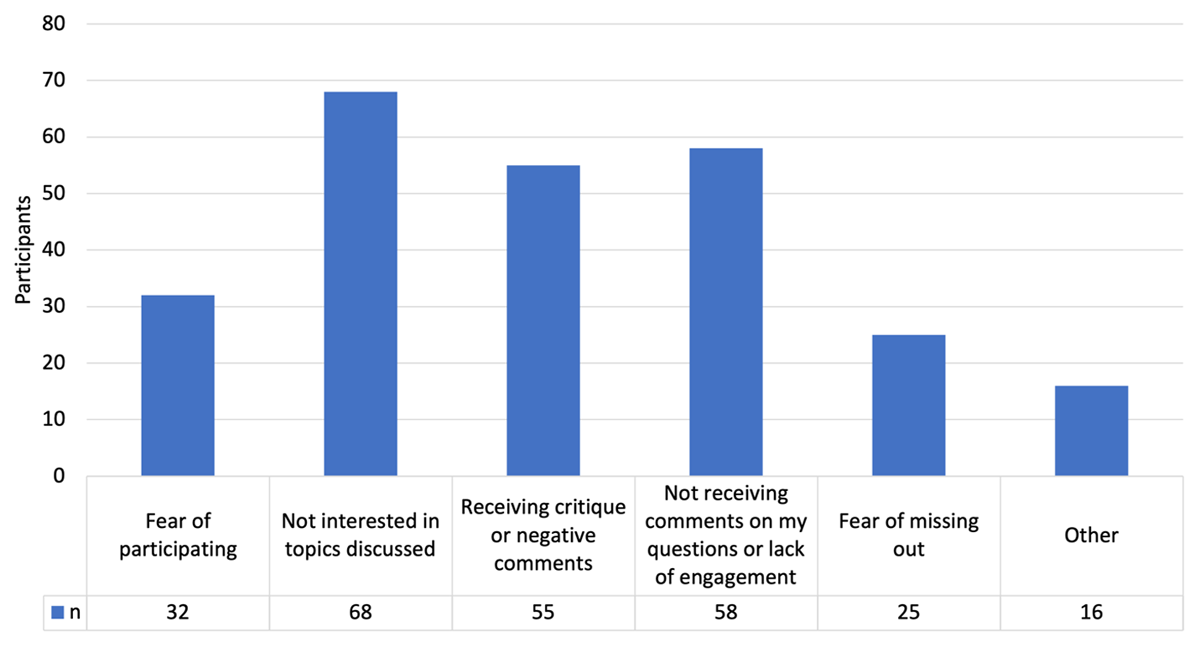
Figure 3
Challenges of Participating in Digital Social Communities.
Table 9
Digital Social Communities as Continuous Professional Development?
| DO YOU CONSIDER YOUR PARTICIPATION IN DIGITAL SOCIAL COMMUNITIES TO BE CONTINUOUS PROFESSIONAL DEVELOPMENT? | n | SAMPLE COMMENTS BY PARTICIPANTS |
|---|---|---|
| Strongly Agree | 39 | ‘Yes: I’m in many photography groups for professors or artists and I both learn new resources and can share my own. This brings visibility to my artwork, and I have been offered professional opportunities from people seeing my work online.’ |
| Agree | 66 | ‘Social media allows professionals and academics to connect across vast distances and engage with an entire community of peers to share ideas, find employment, collaborate on projects/research, and alleviate the stress of work/school life.’ |
| Neutral | 28 | ‘They can give you new ideas, but it requires a lot of work to wade through arguments and random negative comments and so on.’ ‘Sometimes Twitter is the only place you will see a job or conference advertised.’ |
| Disagree | 5 | ‘They usually start strongly engaged but people don’t stay involved.’ |
| Strongly disagree | 1 | ‘I don’t use this for professional development purposes.’ |