
Introduction
Past educational programs and/or instructional lessons have aimed to increase and encourage students’ knowledge of water conservation across preK-12 education, particularly within science and environmental education (Krauss et al. 2022; Thompson et al. 2011; Valenzuela-Morales et al. 2022). To understand the impact of water conservation lessons on students’ understanding, studies have continued to measure the impact of the lessons by exploring the students’ water conservation practices and attitudes. Birch and Schwaab (1983) demonstrated the effectiveness of water conservation instruction in increasing middle school students’ knowledge and fostering positive attitudes toward water conservation practices. Similarly, Thompson and colleagues (2011) found that students became more committed to adopting water conservation behaviors (e.g., turning off the water while brushing their teeth), after learning about the importance of conserving water.
This manuscript details an interdisciplinary collaboration between two middle-school teachers as they developed a project-based learning (PBL) unit based on a middle school earth science content that focused on the interconnectedness of water systems, and water conservation and hydrology. The PBL, which they deemed the “Conserving the 1%” project, was designed with the primary learning goal of raising students’ awareness of efficient water use and fostering water consciousness. The teachers developed this unit during their participation in a STEAM (science, technology, engineering, art, math) teacher training program, GoSTEAM, developed by the Center for Education Integrating Science, Mathematics, and Computing (CEISMC) at Georgia Institute of Technology (Georgia Tech). GoSTEAM works in collaboration with classroom teachers and community partners in the city of Atlanta, to design, develop, pilot, and evaluate STEAM lessons in the schools. The program has two parts, the Summer Institute, where K-12 teachers from different schools across Atlanta engage in professional development for several weeks in the summer, followed by school-year teacher support. Teachers from each school belong to a GoSTEAM STEAM Innovation Team, which consists of support from the Georgia Tech university-based coach and an Innovator-in-Residence (“Innovator”) who is in the classrooms to support teachers’ STEAM lesson implementation. Innovators are university students or local community members that are employed up to 20 hours a week during the school-year to provide GoSTEAM teachers with support for implementation. The Summer Institute engages participating teachers with different activities, such as experiential design/lesson activities, field trips, and access to experts and modeling through various collaboration and guest speakers, all to offer different ideas and perspectives in teaching STEAM. During the last days of the Summer Institute, the STEAM Innovation Team work together to co-create a STEAM action plan to implement in the upcoming school year. During the school year, the teachers receive just-in-time support from the STEAM Innovation Team to implement the lessons.
The “Conserving the 1%” unit is a PBL that focused on student learning through investigating real-world, authentic problems to address the problem of limited fresh water and promote water conservation (Blumenfeld et al., 1991). The PBL integrated STEAM disciplines, particularly computer science and music, by incorporating a free, web-based music coding software, EarSketch, for students to compose songs promoting water conservation as the learning outcome (Figure 1).
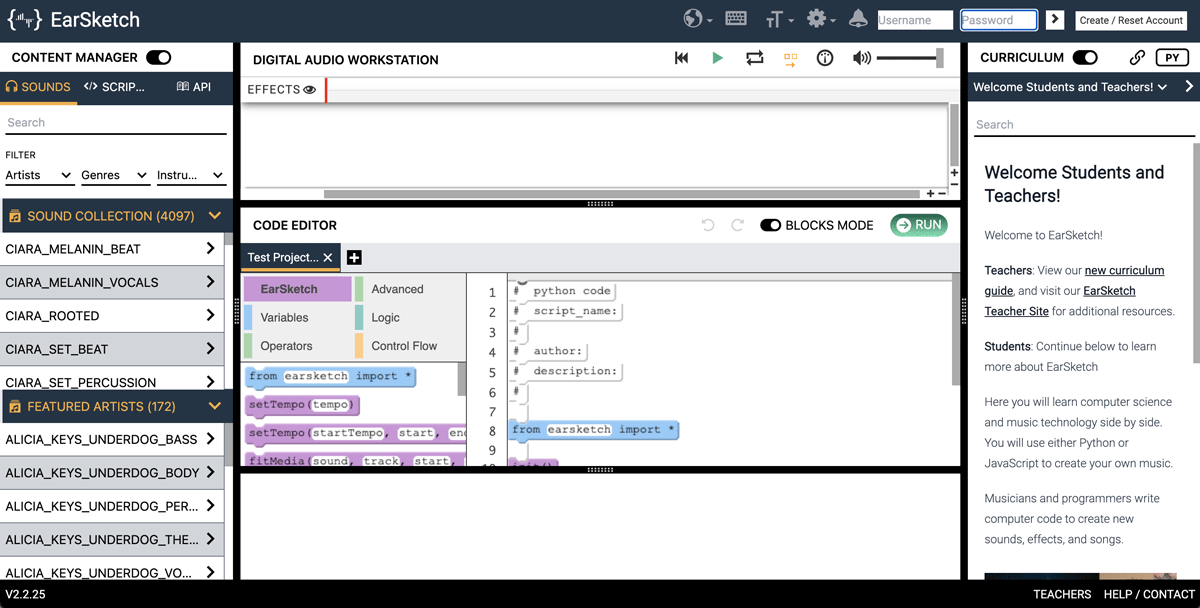
Figure 1
An example of the EarSketch platform using block-programming.
In this paper, we discuss the unit, its varied implementation by different teachers over three years, implementation challenges and recommendations, and teachers’ key takeaways.
“Conserving the 1%” Overview
The “Conserving the 1%” PBL unit integrates middle school earth science, music, and computer science to address a real-world need to conserve Earth’s natural resources and explore the limited proportion of water available for consumption. The PBL was designed to respond to the overarching question: With 97% of the Earth’s water being salt water, 2% frozen, and only 1% available for drinking, what steps can we take to promote water conservation? The goal of the unit was for students to produce 2-minute songs with accompanying lyrics that promote water conservation and encourage listeners to limit their water usage to under two minutes. Student learning was assessed throughout the learning process and focused on the students’ demonstration of understanding the water conservation concepts through written lyrics as well as programming skills. The teachers and Innovators reviewed and provided relevant feedback on water conservation concepts and coding as needed.
The PBL focuses on 6th-grade Georgia science and music state standards, and the Computer Science Teachers Association (CSTA) K-12 computer science standards (Table 1).
Table 1
Sixth Grade Standards.
| STANDARDS | |
|---|---|
| Science Georgia Standards of Excellence | S6E5: Obtain, evaluate, and communicate information to show how Earth’s surface is formed S6E6: Obtain, evaluate, and communicate information about the uses and conservation of various natural resources and how they impact the Earth |
| Music Georgia Standards of Excellence | MSGM6.CR.1: Improvise melodies, variations, and accompaniments MSGM6.CR.2c: Use a variety of traditional and nontraditional sound sources and digital tools when composing and arranging MSGM6.RE.1: Listen to, analyze, and describe music MSGM6.CN.1: Connect music to the other fine arts and disciplines outside the arts |
| Computer Science Teachers Association (CSTA) K-12 computer science standards | 2-DA-07: Represent data using multiple encoding schemes 2-DA-08: Collect data using computational tools and transform the data to make it more useful and reliable 2-AP-11: Create clearly named variables that represent different data types and perform operations on their values |
The science standards focus on understanding and recognizing the significant roles of water in the Earth’s surface, and ways in which they impact the Earth and ways to sustain water resources. The music standards focus on composing and arranging music using digital tools; listening to, analyzing, and describing music; and connecting music to other disciplines. The CSTA standards explore representing data using multiple encoding schemes, collecting data using computational tools, and creating clear variables that represent different data types to perform.
“Conserving the 1%” Implementation
The “Conserving the 1%” PBL was implemented over three years at one middle school participating in the GoSTEAM program. Originally designed as part of the 6th-grade hydrology unit, the lessons were developed by a music teacher and an earth science teacher who shared a goal of integrating their content into an engaging PBL experience. Over the years, the PBL was iterated upon and adapted to incorporate modifications as needed, as well as new collaborators and different grade levels, ensuring its relevance and impact.
The ways in which the PBL was implemented across the three years is highlighted in Table 2.
Table 2
Implementation Across Years 1, 2, and 3.
| IMPLEMENTATION YEAR AND MODE OF INSTRUCTION | GRADE LEVEL | PBL ACTIVITIES |
|---|---|---|
| Year 1 (in-person) | 6th grade |
|
| Year 2 (virtual) | 8th grade |
|
| Year 3 (in-person) | 6th grade |
|
In the sections that follow, we detail how the unit was implemented each year and describe the supporting activities that further enhanced students’ learning experiences through this PBL approach.
Year 1: Implementation and Integration
In its inaugural year (2019–2020), the 6th-grade science teacher and school music teacher collaborated to pilot the “Conserving the 1%” PBL across the entire 6th-grade throughout a semester. The PBL included two lesson components, with the science teacher focusing on the concepts of water conservation and students writing lyrics, and the music teacher and the GoSTEAM Innovator working together to support students create songs using EarSketch. The GoSTEAM coach also met with the teachers biweekly throughout the PBL implementation. During these check-in meetings, teachers discussed recent challenges and successes related to implementation – such as schedule interruptions – and the coach provided targeted feedback and additional support including options for modifying the PBL to accommodate those changes as well as assistance for securing new materials or bus transportation for field trips.
At the beginning of the PBL, students worked in small groups of 2–3 in their music class to create 2-minute songs promoting water conservation using EarSketch. Students incorporated relevant hydrology vocabulary from their science class into the lyrics they wrote and later recorded. Each group’s final song was completed and uploaded to apps that students created using Thunkable to publicly host their music. One student worked with the Innovator to compile all the songs the groups made into a single app, which was later made available for download on the Android app store. Students were able to apply their classroom learning through this real-world context, having the opportunity to share their creations with a larger audience outside their school.
In addition to the grade-wide PBL, teachers also incorporated mini-lessons to supplement “Conserving the 1%” that allowed students to explore different technologies, including Thunkable, micro:bit, and circuitry. Students engaged in design projects to promote water conservation throughout the school, such as creating and printing their own t-shirts for a school-wide t-shirt contest (Figure 2), writing public service announcements for the school’s morning announcements, and creating posters that were displayed throughout the school (Figures 3, 4). These mini-lessons and activities were unified under the slogan “Use It, Don’t Lose It: Conserve the 1%,” highlighting the importance of hydrology and water conservation. Students integrated technology in these lessons in various ways, such as using paper circuits and battery packs to make posters light up or using a micro:bit to play music about conserving water.
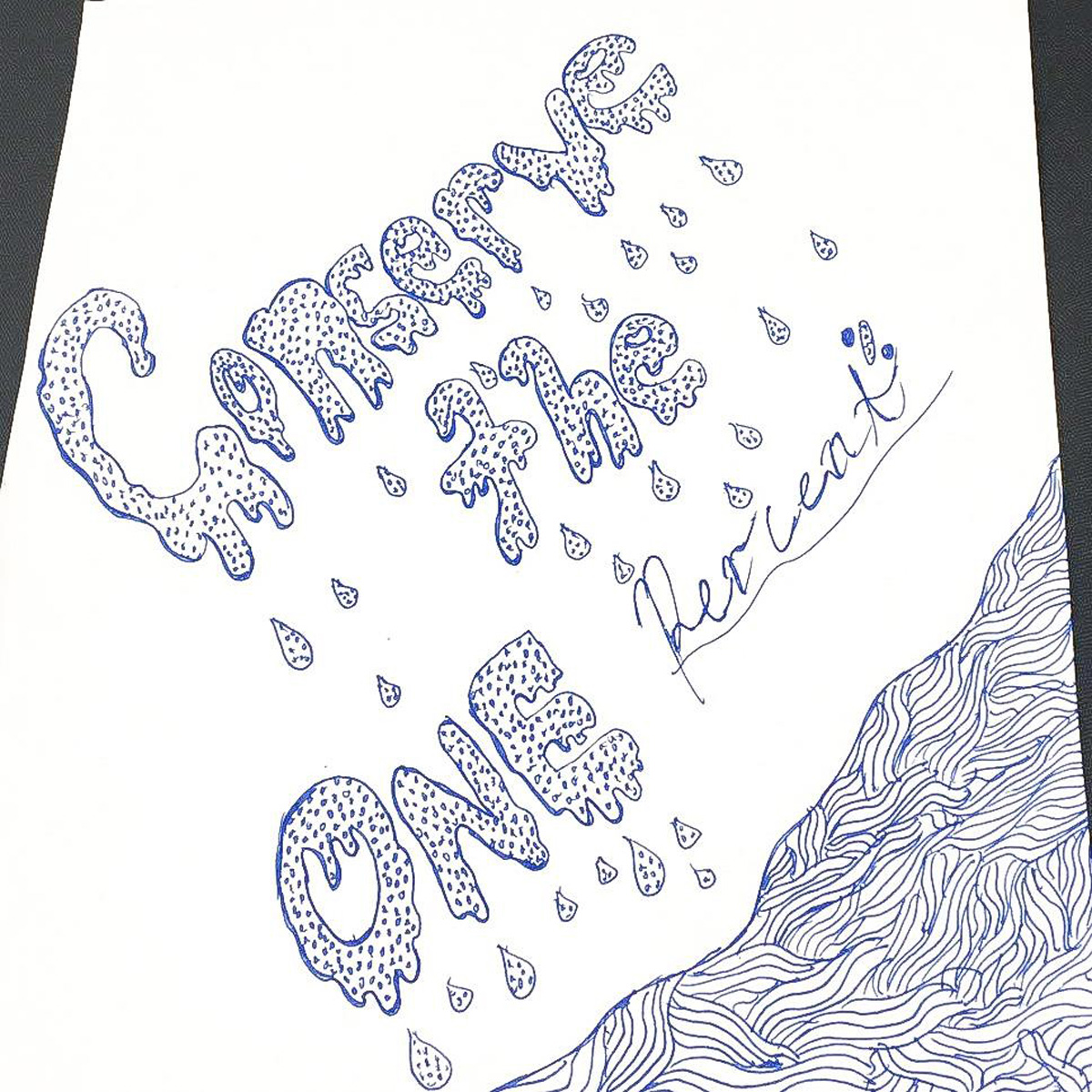
Figure 2
A student-designed t-shirt print that was designed for the schoolwide t-shirt contest.

Figure 3
A student-designed poster promoting water conservation. When the “Press Here” button is covered, water droplets illuminate under the faucet.
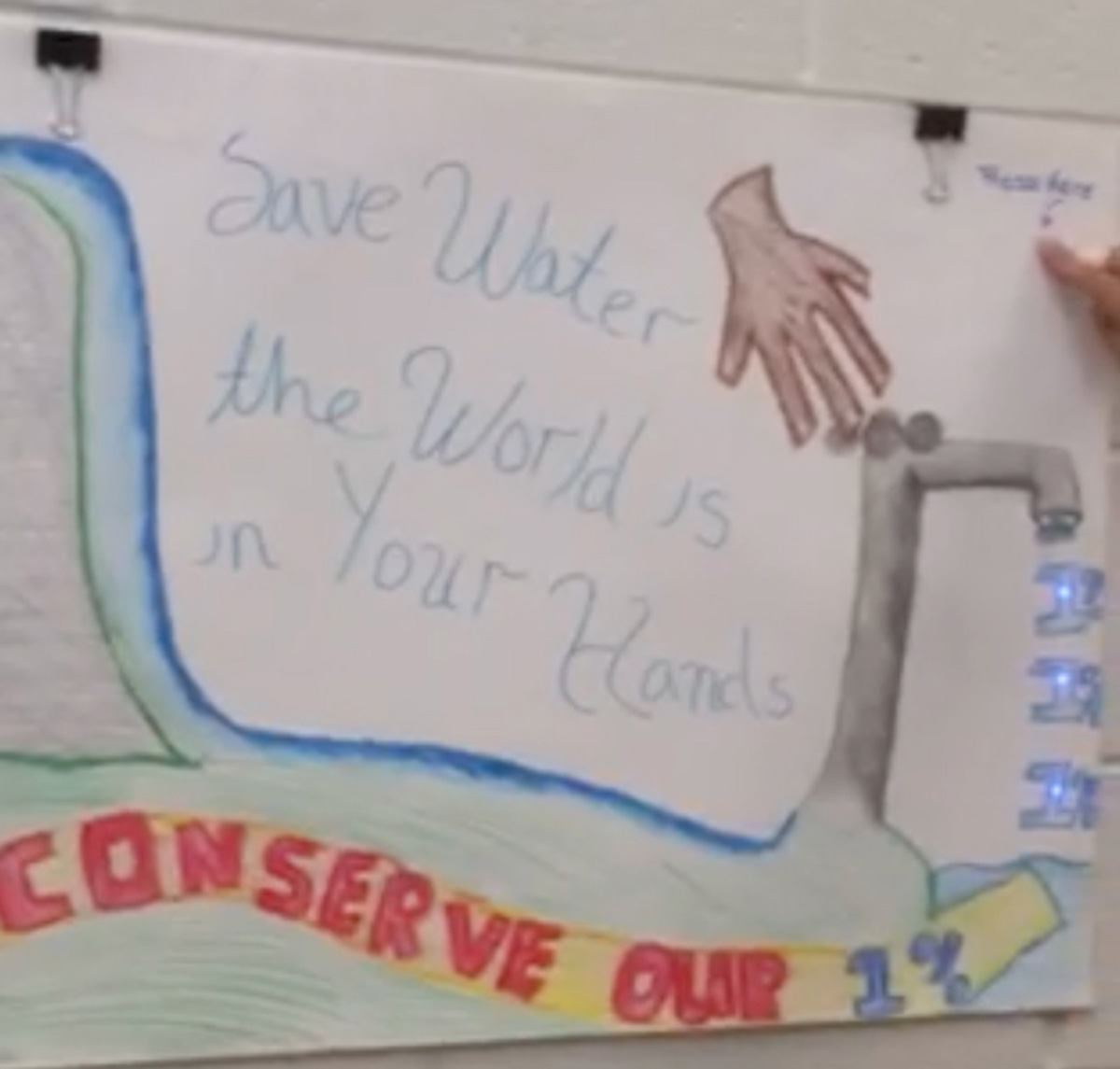
Figure 4
A student-designed poster promoting water conservation. The water droplets are illuminated under the faucet.
To connect students’ learning with their local and global communities, students went on field trips to local areas experiencing water runoff issues and to the Georgia Aquarium, where they learned more about conserving water and energy in a global context. Students then designed pamphlets and flyers for these organizations on how to conserve water to help support their conservation initiatives.
The PBL also emphasized entrepreneurship, as students promoted the app with a playlist of the songs they created, learned about copyright related to their music, and marketed and sold the t-shirts that they designed. At the end of the PBL, the school hosted an award ceremony that showcased the final end-products and presented awards to recognize students’ achievements, with accolades such as “Most Played Song on the App,” “Best App Designer,” and “Best T-shirt Design,” among others. Additionally, the school hosted a music concert featuring the students’ songs as a culminating event. These events were open to members of the school and local community, giving students a platform to share their work with a broad audience.
Year 2: Virtual Adaptation
In its second year of implementation (2020–2021), schools transitioned to virtual instruction due to the COVID-19 pandemic. Due to virtual instruction, the “Conserving the 1%” PBL was scaled down, with an enhanced focus on the arts to help students see the personal relevance of the science content. An 8th-grade physical science teacher and the music teacher collaborated to include 8th-grade students and relevant science and music standards (Table 3).
Table 3
Eighth Grade Standards.
| STANDARDS | |
|---|---|
| Science Georgia Standards of Excellence | S8P1: Obtain, evaluate, and communicate information about the structure and properties of matter |
| Music Georgia Standards of Excellence | MCBC.CN.1: Synthesize and relate knowledge and personal experiences to make music |
The science standards support the understanding of sustainability concepts, including water conservation. The music standards explore the composition of spoken words using symbolism and connections to personal life. The 8th-grade class partnered with a local theatre so students could learn ways to symbolically relate the water cycle to their own lives and the cycle of life through spoken word and poetry. This was in place of writing lyrics and creating songs on water conservation like the previous year. These adjustments were made to the lesson as recording vocals was difficult during virtual instruction. Likewise, lessons on computing concepts were omitted this year due to challenges with learning and using EarSketch, primarily caused by the shift to virtual instruction.
In addition to the implementation of the scaled-down unit in 8th-grade, the 6th-grade science teacher from the previous year continued to use STEAM integration to support student learning during the hydrology unit. A hydrology lesson was designed around the water cycle, and the Innovator led the lesson to work with a small group of students that were able to participate in virtual instruction to create visual animations using block-based programming language on the Scratch platform.
Given the virtual learning environment in the second year, the teachers and the GoSTEAM Innovator facilitated small-group collaboration and offered direct support through the use of online breakout rooms. The GoSTEAM coach met with the teachers during this time to offer pedagogical and financial support, along with emotional support and validation. Given the intense pressure on both teachers and students to maintain academic performance, these check-in meetings served as a safe space for teachers to openly share their experiences and challenges. As the culminating event at the end of the year, the school hosted a poetry slam where the 8th-grade students performed their poems as part of a competition.
Year 3: Literacy Integration
In the third year (2023–2024), a new 6th-grade earth science teacher joined the GoSTEAM program and collaborated with the GoSTEAM Innovator and their co-teacher, who was not part of the program, to implement the “Conserving the 1%” PBL over a three-week period with one class. The GoSTEAM coach continued to meet with the teacher weekly to provide support with lesson implementation, offering additional lesson ideas and necessary resources. As the school operated with in-person instruction, it was possible to implement the original PBL with adaptations as needed. During the first two weeks of the lesson, students focused on creating lyrics for their songs. The teacher introduced guiding questions related to hydrology to scaffold students’ understanding of the topic (e.g., What are some ways 12-year-olds can conserve water every day? Where is all the fresh water found on Earth compared to salt water, and what are the different quantities?). The students’ responses to these questions formed the basis for their song lyrics. The teacher adapted activities to best accommodate students’ literacy development such as including word banks with relevant vocabulary which the students used to enrich their lyrics. Students also practiced developing their rhymes using Rhyme Time, a website that allows users to identify rhyming words. After the lyrics were created, the Innovator worked with the students to use EarSketch to put their lyrics to music, adding beats and melodies. During this time, the students iterated through the process of creating and refining their songs. Once the lyrics and music were finalized, the students used the in-school music studio, equipped with a vocal sound booth, to record their songs (Figure 5).
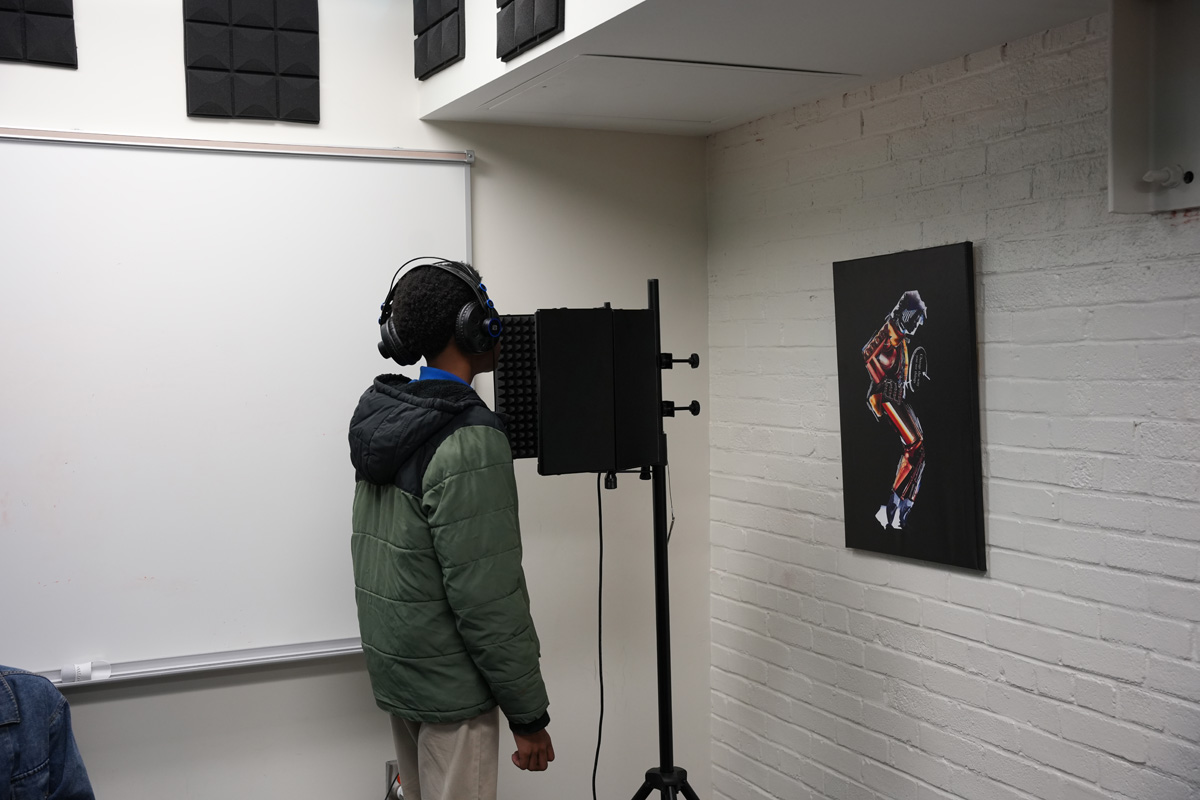
Figure 5
Student recording their song using the vocal sound booth.
“Conserving the 1%” Unit Guide Design
After the implementation of the PBL, the GoSTEAM team used the action plan documents and unit materials to develop a unit guide that can be used across for implementation across 6th–8th grade levels. The unit guide proposes a STEAM-integrated framework and outlines the lesson overview, project description, learning goals, and learning standards, including Next Generation Science Standards (NGSS), CSTA computer science standards, and National Core Arts Standards. The unit can be adapted based on grade level and student experience with coding to help students learn basic to advanced coding skills using EarSketch. The unit activities are structured around the 5E Model of Instruction (“5E Model”), which includes five phases: Engage, Explore, Explain, Elaborate, and Evaluation (Bybee et al. 2006). Each phase of the 5E Model provides a step-by-step guide to incorporate various STEAM integration concepts. Each phase includes a section goal, related activity, and expected artifact, as appropriate. The phases focus on introducing students to water conservation, exploring computing concepts using EarSketch, or integrating musical concepts into computing.
Challenges & Recommendations for Implementation
The implementation of the “Conserving the 1%” PBL unit stemmed from early collaboration between teachers and the GoSTEAM staff before the start of the 2019–2020 school year. With the creation of the unit guide, we hope that this work can be implemented in other contexts. Below, we share some of the challenges and recommendations for related stakeholders, including teachers, administrators, and local partners.
A key feature of this STEAM-integrated PBL was the collaboration among teachers and the GoSTEAM Innovator, who each contributed their own subject matter expertise and offered adequate support for the students to engage in the lesson activity with the technical tools that were needed for learning. For example, in the first year of implementation, the science and music teachers provided foundational knowledge on their respective subjects, while the Innovator offered support for coding to create music and developing the apps. The collaborative model was essential to the success of the PBL, as each member of the STEAM Innovation Team led different aspects of the projects, guiding students through learning about water conservation, writing lyrics, and creating music across different classes and contexts. However, teachers identified limited collaborative planning time during the school year as a significant challenge. Collaboration, which is vital in STEAM lessons to enhance the overall effectiveness and sustainability (Herro et al., 2017), was difficult as the teachers’ planning periods did not coincide during the day, leaving after-school hours as the only opportunity for them to meet and plan. To successfully implement this PBL, it is crucial for teachers to consider their unique expertise and collaborate strategically, and for school administrators to provide the time and support for teachers.
In implementing the unit, teachers also developed partnerships outside the school building to foster student engagement and supplement learning in other content areas. In the first year, students went on field trips to learn about the issues around water runoff in their local area. In the second year, the teachers partnered with a local theatre organization to support the integration of literacy content in the STEAM unit. As these experiences helped students understand how their work connects to a real-world need, it may be beneficial for schools to build and support effective partnerships among teachers and other contributors and local organizations to ensure that students are supported across different content areas in STEAM-integrated learning. Likewise, local organizations can consider ways their work can support students’ STEAM-integrated learning and offer opportunities for students to gain real-world experiences.
There were unforeseen technical challenges that emerged as GoSTEAM teachers implemented the PBL. In the first year of implementation, there were technical issues using the Thunkable app that made it difficult for users to access students’ songs. To address this issue in the future, we recommend that teachers upload students’ songs to either a website or a platform like SoundCloud to ensure easier access. The pivot to virtual learning due to the COVID-19 pandemic in the second year also offered several challenges as many of the activities in the previous year were not originally designed for virtual instruction. This limited student exposure to activities that were previously implemented. Teachers were able to successfully incorporate aspects of STEAM integration into their instruction related to hydrology (6th-grade) and water conservation (8th-grade). This shows the adaptability of the “Conserving the 1%” unit and its utility across multiple grades, teaching modalities, and contexts. In the future, teachers should consider students’ ability access to virtual STEAM resources that can be used in their classrooms (e.g., one-to-one technology access, possible restrictions to certain websites on school computers). Likewise, school administrators should ensure the students have equitable access to technology (e.g., computers, the Internet) to effectively participate in virtual or web-based STEAM activities.
Key Takeaways
The “Conserving the 1%” PBL is a comprehensive STEAM project that integrates science, music, computer science, as well as other artistic disciplines such as poetry/spoken word. Implemented three times over a span of five years, including once during pandemic-related virtual schooling, this project demonstrates the power of collaboration between teachers, GoSTEAM staff, and local organizations to support STEAM instruction. The lesson was successfully sustained over three years of implementation, adapting to different teaching modalities and grade levels. A variety of teachers worked on the project during each implementation, demonstrating their ability to translate this STEAM PBL to unique contexts and classrooms. The school established relationships with the local organizations which added value to the PBL and provided opportunities for students such as field trips in the first year and virtual meetings with theater staff in the second year. The support from the school administrators was pivotal, enabling all students at the school to learn about and build awareness of water conservation on a school-wide level.
The PBL had a positive impact on teachers, helping them understand how to incorporate authentic STEAM lessons into their teaching. The music teacher from the first year of implementation expressed that the PBL changed their approach to teaching, shifting from viewing STEAM as an add-on to integrating it as a core teaching practice, stating, “[the lesson] gave me an idea of how to incorporate STEM and STEAM in my classroom, what type of activities to do, how to include PBL, how to make sure it’s not a lesson where they do a project at the end, but the entire lesson is a project.” This teacher noted that a common misconception is that STEAM is an “extra” or an “add-on.” Their shift from STEAM as a final project to STEAM as a teaching practice was a positive impact of their work on this lesson, helping them transition to designing lessons where the entire experience follows a PBL approach of student-centered, real-world problem-solving activities, rather than just culminating in a project. In addition, the science teacher from the third year highlighted that PBL introduced an alternative way of assessing student learning by evaluating the learning process, skills, and content knowledge the students demonstrate through the project. The teacher noted that they realized that creative outputs such as song creation can be a valid way to assess student learning beyond traditional tests, and shared,
“I never thought of using anything else except a paper and a pencil and a multiple choice to assess kids on the content … the biggest takeaway that I took is there are so many ways to assess knowledge and having students create a song is a very valid way of assessing knowledge of the topic.”
The distinctive feature of the GoSTEAM Program, the support and collaboration between the STEAM Innovation Team and partners throughout planning and implementation, extended beyond simply designing PBLs and promoted a dynamic learning community. The STEAM-integrated PBL unit exemplified an interdisciplinary approach by weaving together STEAM into a unified and meaningful learning experience. Rather than addressing the content in subject-specific silos, the PBL enabled a transdisciplinary, holistic learning experience through a cohesive project and helped students apply their knowledge across multiple subjects. Moreover, the unit positively impacted the teachers’ understanding of STEAM instructional practices and assessments.
Resources
Below are links to resources that can be used in implementing “Conserving the 1%” unit.
Unit Guide for Conserving the 1%: A unit guide including the learning overview, project description, learning goals and standards, and lesson plan to use with 6th–8th grade students.
Pedagogical Approaches for Conserving the 1%: Description of the pedagogical approaches used in GoSTEAM lessons.
EarSketch: Free, web-based platform used to compose songs while learning core topics in computer science, music, and music technology.
Thunkable: Mobile app development platform.
micro:bit: A pocket-sized computer that introduces students to how software and hardware work together. It is equipped with various sensors and LEDs that can be used to learn about coding and electronics.
Acknowledgements
The authors would like to thank all the dedicated teachers who were part of the GoSTEAM Program, especially those who designed and refined these lessons for implementation in their classes.
Competing Interests
The authors have no competing interests to declare.
Author Contributions
The authors contributed to the conception, writing, and reviewing of the manuscript and have approved the submission.