
1. INTRODUCTION
Globally, governments are under increasing pressure to deliver infrastructure more quickly, at lower cost and with lower environmental impact. Modern methods of construction (MMC) – an umbrella term encompassing approaches that shift construction towards greater offsite manufacturing and integration – have long been promoted to help meet these goals. MMC attracted considerable attention and investment from both public and private stakeholders starting in the 1960s, with a new surge of interest in the past decade. Despite this, its uptake remains uneven, constrained by a fragmented industry, misaligned incentives, unstable pipelines and limited institutional coordination. In response, governments have turned to roadmaps as policy instruments to address barriers and transform the construction industry. This paper conducts a comparative analysis of MMC roadmaps to assess their effectiveness in translating strategic ambitions into implementable actions.
Roadmaps originated in private industrial business contexts, where companies employed them as management tools for technology and business development. They later transitioned into industry management contexts as strategic planning tools to coordinate broader technological transitions. Within this role, roadmaps served to establish a common vision and coordinate the research agendas, industry reform and investment required to achieve it (Kerr et al. 2017; Lee et al. 2011). Roadmaps therefore occupy an intermediary position between vision-setting documents – such as strategies and white papers – and binding policy instruments like regulations, programmes and funding mechanisms. Governments increasingly deploy them as policy instruments intended to both communicate a common direction and shape delivery pathways (Ahlqvist et al. 2012; Geum & Park 2012; Miedzinski et al. 2022). Within the public sector, however, they rarely establish enforceable mechanisms or delivery authority, exerting little control over ensuing policies (Miedzinski et al. 2022).
In the context of MMC – where uptake remains fragmented – this raises a fundamental question: do roadmaps function as policy instruments capable of leading change? Within this role, their effectiveness depends on whether they move beyond articulating priorities to specifying concrete implementation measures – such as policies, standards and funding programmes – and whether these measures are subsequently realised. This study therefore evaluates the role of MMC roadmaps as policy instruments through a comparative analysis of how they structure pathways for change and the extent to which those pathways are realised.
2. RESEARCH DESIGN
The assessment framework developed in this study evaluates how roadmaps frame, operationalise and implement changes to advance the adoption of MMC. This role emerged through two parallel developments: the evolution of MMC from a technical approach into a broader challenge requiring coordinated public intervention, and the migration of roadmapping from the private sector to the public sector. Understanding this evolution is important for assessing how roadmaps are expected to function as policy instruments and how their effectiveness should be evaluated. This section therefore first situates MMC roadmaps within this broader historical evolution before introducing the framework used in this study.
2.1 THE CONVERGENCE OF MMC AND ROADMAPS
Industrialised construction approaches – now grouped under the term MMC – emerged in the interwar period in response to housing shortages and construction capacity constraints. Post-Second World War, government-led housing programmes promoted early forms of industrialised housing to quickly meet surging demand. These included standardised designs, factory production and the mass delivery of single-family homes (Buntrock 2017; Carroll 1989; Friedman 1995). As these methods evolved, MMC uptake came to be understood as a system-level challenge encompassing supply chains, regulatory frameworks, procurement, financing structures, labour shifts, market coordination and public acceptance. Operation Breakthrough (1969) in the US was one of the most ambitious attempts to systematically transform housing delivery through industrialised methods. Led by the US Department of Housing and Urban Development (HUD), it included several large-scale pilot projects but was ultimately judged to have failed in accelerating MMC uptake across the industry (The Comptroller General of the United States 1976).
In parallel, roadmaps migrated from private business and technology management contexts into the public sector, heralded as a promising technique for coordinating change (Garcia & Bray 1997; Hart 2019; Kerr et al. 2013; Kerr & Phaal 2020). In public-sector contexts, roadmaps additionally gained features of traditional government strategy documents, which serve to align stakeholders and communicate government vision (Toni Ahlqvist et al. 2012). As a result, public-sector roadmaps combine the communicative and diagnostic functions of traditional strategy documents with the explicit goal of planning and coordinating action. Governments are increasingly embracing this role, creating them as policy instruments capable of both communicating and leading change.
2.2 THE ASSESSMENT FRAMEWORK: TRACING ROADMAPS FROM DESIGN TO IMPLEMENTATION
The assessment framework developed in this study builds on three complementary bodies of literature to evaluate MMC roadmaps as policy instruments. First, previous evaluations of public-sector roadmaps inform how roadmaps have been assessed in other policy domains. Second, policy implementation literature provides the analytical lens through which roadmaps are evaluated as policy instruments, highlighting the characteristics of effective policy design and implementation. Third, the roadmapping literature – publications concerned with informing the development of public-sector roadmaps – identifies the core elements structuring effective roadmaps.
Past evaluations of roadmaps from other public contexts examined how they engaged with stakeholders, how they framed problems and solutions, and the suitability of proposed interventions (Ahlqvist et al. 2012; Featherston & O’Sullivan 2014; Meissner et al. 2016; Miedzinski et al. 2022). The present study builds on this work but shifts the emphasis from evaluating the appropriateness of proposed interventions to examining how roadmaps translate strategic intent into implementation, drawing on the policy implementation literature to assess MMC roadmaps as policy instruments. This literature highlights the importance of establishing defined, realistic goals and translating them into specific, actionable delivery mechanisms (Matland 1995; Peters et al. 2018; Pierre & Peters 2006). Of note, Peters (2018) outlines that effective policy clearly links goals with actionable instruments, clarifies sequencing and explicitly specifies who is responsible for what action. Similarly, Matland (1995) illustrates how ambiguous policy design, especially in how actions are specified, can lead to inconsistent interpretations across actors and result in undesired variation in their behaviour during implementation. From this perspective, translating intent into action requires policymakers to operationalise proposed measures through clearly defined mechanisms, responsible actors and defined timelines.
Policy implementation literature further indicates that the authority and capacity of actors shape both the content of policy instruments and the feasibility of their realisation (Peters et al. 2018; Pierre & Peters 2006). Assessing MMC roadmaps therefore requires considering the authority, mandate and institutional context of the organisations producing them, including how they define MMC and their capacity to realise proposed actions.
The roadmapping literature typically outlines three document components: aligning stakeholders to establish a shared problem definition, anticipating or envisioning future states and planning actions intended to realise it (Garcia & Bray 1997; Kerr et al. 2013). Applying a policy implementation lens, this study focuses on evaluating how roadmaps structure this progression – from problem to intent, to action – and whether these stages are coherently linked. It therefore distinguishes between problem statements, identified solutions (intent) and proposed implementation actions (e.g. policies, programmes or initiatives) accompanied by a responsible actor and defined timeframe.
While most roadmap evaluations focus on the content of the roadmap itself, a smaller body of roadmap research extends analysis beyond publication to examine whether proposed actions are subsequently realised (Jeffrey et al. 2013). This provides an important indication of a roadmap’s practical impact, while recognising that implementation outcomes are shaped by broader institutional and political dynamics and cannot be attributed solely to the roadmap itself.
To evaluate how effectively MMC roadmaps function as policy instruments, the study therefore considers how they articulate change, specify pathways for achieving it, and support implementation in practice. The assessment framework is thus structured around three components: a) the conditions under which each roadmap is produced, including its authorship and definition of MMC; b) the problems, solutions and actions that roadmaps identify; and c) evidence that proposed actions are realised in practice. The framework focuses on the relationships between each stage: how institutional context shapes problem framing, how solutions are operationalised through specific actions and whether they are realised in practice.
3. METHODS
3.1 SEARCH STRATEGY AND INCLUSION/EXCLUSION CRITERIA
Roadmaps were identified and selected for analysis in January 2026 using a sampling strategy appropriate to qualitative document analysis, as MMC roadmaps constitute a form of grey literature not recorded in a comprehensive database (Godin et al. 2015). Document identification therefore relied on iterative searches across institutional websites, policy portals, press releases and other related documents.
Roadmaps were included if they were: self-identified as a ‘roadmap’ and not retrospective in focus; authored or commissioned by government bodies, public agencies or publicly mandated organisations; publicly accessible online; and published between 2000 and 2020. The publication timeframe captured the earliest MMC roadmaps and allowed at least five years since publication for subsequent policy follow-through to be evaluated.
Thirteen roadmaps published since 2000 were identified and nine were excluded as they were published by industry, unavailable online and/or published after 2020. A full list of the roadmaps and their reasons for exclusion are presented in the supplemental data online (Table S1). The four included roadmaps are:
‘Technology Roadmapping for Manufactured Housing’, published by the United State’s Partnership for Advancing Technology in Housing (PATH) and HUD in 2003;
‘Factory Built Housing Roadmap (Including Recommendations for Energy Research)’, also published by PATH, in 2006;
‘Roadmap for Industrialised Building System (IBS) in Malaysia 2011–2015’, published by Malaysia’s Construction Industry Development Board (CIDB) in 2010;
‘Transforming Infrastructure Performance (TIP): Roadmap to 2030’, published by the United Kingdom’s Infrastructure and Projects Authority (IPA) in 2020.
3.2 APPLYING THE ASSESSMENT FRAMEWORK
Each roadmap was first situated within its institutional and political context. This analysis examined who commissioned and authored the roadmap, under what mandate and context, and for what purpose, paying specific attention to how MMC is defined and framed. Results from this stage were synthesised in a comparative table documenting authorship, mandate, context, goals and scope.
Next, the study examined how roadmaps frame problems, identify solutions and propose implementation actions. The analysis classified roadmap statements as ‘problems’ if they describe a condition identified as requiring change, including gaps, constraints and opportunities for further development. Statements were recorded as ‘solutions’ when they describe either a required change or a desired future state, even aspirational. Finally, statements were recorded as ‘implementation actions’ when an intervention mechanism is proposed to achieve a solution, such as a specific policy, initiative or mandate. Actors and timeframes associated with these actions were also recorded. For roadmaps that are still active based on their intended implementation horizon, the analysis focused on short-term actions (up to five years).
Problems, solutions and actions were extracted from each roadmap and systematically assigned to predefined thematic domains (Table 1). These categories were intended to capture the full spectrum of technical, institutional and socio-economic factors shaping MMC uptake (Agapiou 2022; Alhawamdeh & Lee 2025; Rahman 2014). Solutions and implementation actions addressing multiple problems were coded across all applicable domains. This step enables a comparative assessment of how roadmaps frame problems and translate them into solutions and implementation actions.
Table 1
Thematic domains used to structure data extraction from MMC roadmaps
| THEMATIC DOMAIN | OPERATIONAL DEFINITION |
|---|---|
| Research and development (R&D) | Knowledge, technology, tools or evidence supporting MMC |
| Standards and certifications | Formal technical standards, certification systems, product approvals or performance benchmarks |
| Regulation | Statutory or regulatory frameworks governing construction and development processes |
| Funding | Public or publicly supported financial mechanisms |
| Workforce and labour | Skills, training, labour availability and workforce capacity |
| Procurement and project delivery | Organisation of commissioning, contracting, procurement, project management and delivery processes |
| Risk allocation and early adoption | Technical, financial and contractual risk, particularly in early-stage MMC applications |
| Public perception | Social acceptance, trust and market confidence in MMC |
Finally, a targeted document and policy review was undertaken for each proposed implementation action to examine whether proposals were realised following roadmap publication. Official government documents, departmental websites, policy repositories and secondary literature were searched, with particular attention given to organisational self-reporting to find initiatives related to proposed actions. Search terms were informed by the terminology and institutional actors related to actions in the roadmaps.
Where relevant initiatives were found, their title, instrument type (e.g. mandate, regulation, programme), year of introduction and leading actor were documented. All proposed actions in the roadmap were then classified as: unrealised where no discernible follow-up was found; partially realised where related initiatives were found but their scope, delivery mechanism, and/or outcomes diverged from those articulated in the roadmap; and realised where a closely corresponding outcome was observed. This classification identifies correspondence rather than causation, recognising that many actions are embedded within broader policy trajectories.
Together, these steps enable the study to assess how roadmaps articulate and translate intent into concrete actions, and the extent to which they are realised following roadmap publication.
3.3 LIMITATIONS
This approach was designed to evaluate how effectively MMC roadmaps function as policy instruments: how they establish goals and translate them into action. The analysis therefore evaluates the structure, sequencing and specificity of proposed actions but does not assess their quality, suitability or feasibility. In addition, the study relies on document-based analysis to record evidence of implementation, and may not reflect informal, iterative or partially realised processes that occur in practice. The analysis does not isolate causal effects independent of broader institutional and political contexts, including political change, market conditions and parallel policy interventions. In addition, the study does not evaluate the impact of realised actions; it only records if the result was consistent with the original proposal. For example, if a roadmap proposed the publication of a standard and this was subsequently delivered, the action would be classified as realised regardless of whether the standard was later mandated or widely adopted. Conversely, if a roadmap proposed both developing and mandating a standard but the created standard developed was not ultimately mandated, the action would be classified as partially realised.
4. ANALYSIS
This section reports on the findings of the three-part analysis, examining the context in which MMC roadmaps were produced, how they frame problems and operationalise solutions, and the extent to which those proposals were subsequently realised.
4.1 DESCRIPTIVE COMPARISON OF ROADMAPS
Although all four roadmaps seek to advance MMC, they were produced by organisations with different mandates, in response to distinct policy and industry challenges. Examining these contexts reveals important differences in roadmap purpose and how they frame MMC.
4.1.1 Institutional context and roadmap purpose
A first point of divergence among the reviewed roadmaps concerns the institutional roles of their authors (summarised in Table S2 in the supplemental data online), which shape the changes proposed in each roadmap.
The ‘Technology Roadmapping for Manufactured Housing’ (MHRA 2003) and ‘Factory Built Housing Roadmap – Including Recommendations for Energy Research’ (MHRA 2006) roadmaps were commissioned by HUD, the federal agency responsible for national housing policy. The roadmaps were prepared for PATH, a federal initiative managed by HUD that brought together a steering committee of 13 federal bodies – including the US Department of Energy (DOE) – in collaboration with 300 private-sector partners. PATH’s goal was to support development across the housing sector by identifying shared priorities and coordinating collaborative research across government and industry. The roadmaps were authored by the Manufactured Housing Research Alliance (MHRA), a collaborative network of public, industry and research organisations formed to advance research, innovation and policy for manufactured housing in the US. Through this collaboration, the roadmaps were intended to serve as collective action plans, created to mobilise a broad range of organisations, including PATH, HUD, the DOE and affiliated research bodies.
The 2003 roadmap was created in response to a decline in the manufactured housing industry, which was a main source of affordable housing in the US. The roadmap rests on the core belief that ‘research will play an outsized role in shaping the industry in the future’ and that ‘research can be a particularly potent catalyst for positive change’ (MHRA 2003). The PATH roadmaps were intended ‘to serve as guides to help the housing industry make decisions about research and development investments’ and to establish a plan for a ‘research program that will generate the knowledge and innovations necessary’ to advance the manufactured housing industry (MHRA 2003). The 2006 roadmap explicitly expanded on this but maintained the same premise that research is the solution to industry challenges. It aimed to answer ‘Where should factory-built housing be headed and what research is required to reach that destination?’ (MHRA 2006). The MHRA convened a joint industry–government committee, which narrowed over 100 recommendations to 64 research concepts, identifying six high-priority projects for immediate funding.
The ‘Roadmap for Industrialised Building System (IBS) in Malaysia 2011–2015’ (CIDB 2010) was authored and issued by the CIDB, a statutory body operating under the Ministry of Works with a formal mandate to regulate and develop Malaysia’s construction industry. The CIDB’s responsibilities include regulating industry standards, building industry capacity and advising government on sector development. The CIDB is listed as the sole author of the roadmap, with consultation involving industry stakeholders, though none is named in the document. The roadmap is thus an internally authored policy instrument produced by the authority responsible for leading its implementation. The roadmap was intended ‘to industrialize the construction industry with focus on the private sector while sustaining the public sector momentum on the usage of IBS’ (CIDB 2010). The CIDB roadmap states more explicitly than PATH that it desires to impact policy but is structured similarly, establishing priorities followed by action plans. A forward from the secretary general of the Ministry of Works, which oversees the CIDB, describes the document as a ‘blueprint’ intended to ‘steer the right direction for fundamental changes in the construction industry’ (CIDB 2010). The roadmap emerged within a longer-standing national effort to modernise the Malaysian construction sector, in which the government had already begun promoting IBS through public procurement requirements, targets, and earlier policy initiatives, including a previous roadmap in 2003 (no longer available online).
The ‘Transforming Infrastructure Performance (TIP): Roadmap to 2030’ (IPA 2021b) was authored and published by the UK IPA, which was a government body responsible for overseeing, supporting and ensuring the delivery of major public infrastructure and government projects. In 2025, the IPA was incorporated into the newly established National Infrastructure and Service Transformation Authority (NISTA), which assumed responsibility for infrastructure strategy and project delivery (NISTA 2025). The roadmap was produced during a period of increasing concern over the cost and performance of major infrastructure projects, alongside growing pressure to support broader net-zero and economic development objectives. Consultation occurred through the Construction Leadership Council, an established industry–government partnership. As with the CIDB roadmap, the TIP roadmap was authored by the organisation responsible for realising its proposals. Its purpose is to ‘transform how government and industry intervene in the built environment to drive a step change in infrastructure performance’ by ‘bringing together diverse expertise to articulate a vision for 2030 and the changes required to achieve it’ (IPA 2021b). It builds directly on prior government strategies and documents, including the TIP programme (launched in 2017) and the Construction Playbook (published in 2020), which support reform in public infrastructure and construction processes. The TIP roadmap is designed to operationalise existing policy agendas, mainly by coordinating actions for the IPA and other related government departments.
While all four roadmap authors expressed a desire for significant action and impact, they differ in their practical authority to realise their goals owing to their respective political contexts. The PATH roadmaps were produced through a government-sponsored research process in which external actors diagnosed barriers and proposed action but lacked direct responsibility for implementation. They sought to enable change indirectly by supplying research, evidence and technical direction to private industry. In contrast, the CIDB and TIP roadmaps were authored by branches of government with formal authority and mandates to regulate, coordinate and deliver change within the construction sector. The intent of these latter roadmaps was to change the practices of the organisations that authored them, targeting their existing authority over procurement, standards and sector coordination to drive wider industry change. These differing institutional roles shape how roadmaps bound the problem they seek to address and the role of MMC within it.
4.1.2 MMC definition and framing
Each roadmap defines MMC differently, reflecting their underlying assumptions and purpose. These definitions are summarised in Table S3 in the supplemental data online and discussed below.
In the PATH roadmaps, MMC is defined as a technical construction method that reflects HUD’s role in promoting ‘manufactured’ and ‘modular’ housing, defined as homes produced and assembled almost entirely in factories and then transported and installed on site. MMC is framed as a technical solution to broader systemic challenges within the construction sector. The roadmap is based on the premise that manufactured housing represents ‘the most promising solution to the affordability crisis, primarily because of the inherent efficiencies of the factory process’ (MHRA 2003). Existing problems such as labour shortages, low productivity and poor construction performance are framed primarily as deficiencies of on-site construction that manufactured homes can address through continued technological advancement and innovation. Much of both PATH roadmaps is devoted to establishing the benefits of MMC by describing the problems they could solve, rather than examining the factors currently constraining its uptake.
TIP builds on previous R&D to position MMC not primarily as a technological method but as a set of project delivery practices necessary for improving the delivery of major public infrastructure projects. MMC is defined as a ‘platform approach’ in which standardised, prefabricated components, common digital interfaces and coordinated procurement processes enable repeatable project delivery. The original TIP programme (2017) established public infrastructure underperformance as a policy concern and recommended broad reforms related to standardisation, procurement approaches and project delivery. The subsequent Construction Playbook (2020) explicitly embedded the concept of MMC within these reforms and a broader model of industrialised project delivery. The roadmap explicitly builds on these documents, articulating a wider vision for the built environment in which MMC is:
a system for designing, constructing and operating […] that is more resilient, adaptive and sustainable, and that can better withstand the inevitable shifts and changes we will see in the coming decades. (IPA 2021b)
Like the PATH roadmaps, the TIP roadmap positions MMC as a means of achieving larger social and economic objectives. It differs, however, by defining MMC more broadly to encompass a set of project delivery processes, rather than a single technical approach, and assumes that the R&D needed to support MMC adoption has largely been completed.
In contrast, the CIDB roadmap frames MMC more narrowly, treating its adoption as the primary policy objective. The roadmap refers to MMC simply as ‘Industrialised Building System (IBS)’ but provides no formal definition. It devotes only a short first chapter to justifying its benefits, presenting them as a pre-established government priority: ‘to achieve [higher] quality, faster completion time and fewer site workers’ (CIDB 2010). The roadmap briefly describes progress made since an earlier IBS roadmap published in 2003 and highlighting the widespread adoption of IBS in the public sector following the introduction of a 70% IBS mandate for public projects in 2008. This reflects Malaysia’s long-standing history promoting industrialised construction and comparatively strong government authority to shape sectoral transformation. Through this lens, the roadmap focuses primarily on increasing uptake within the private sector, by diagnosing barriers specific to MMC adoption and planning the policy levers and actions required to overcome them.
How MMC is framed – whether as a means to address broader challenges or as an objective in itself – shapes the scope of the problems articulated, types of solutions proposed and capacity for follow-through.
4.2 IDENTIFYING PROBLEMS, SOLUTIONS AND IMPLEMENTATION ACTIONS
This section reports on the structured extraction and thematic coding described in Section 3.2, unpacking how each roadmap defines problems and links them to proposed solutions and implementation actions. Comparisons are based on counts of coded problem, solution and action statements.
4.2.1 Characterising problems and solutions
Although problems and solutions were coded separately during data extraction, they are analysed together in this section owing to their close relationship within the roadmaps. In many cases, solutions are expressed as the inverse of an identified problem or as a desired future state in which a recognised barrier, deficiency or gap has been addressed. Examining them together therefore provides a more coherent account of how each roadmap conceptualises MMC challenges and the changes required to overcome them. The analysis focuses on the types of problems identified and how they shape the solutions proposed.
Figure 1 illustrates the distribution of identified problems in each roadmap across the eight thematic domains, highlighting how barriers are conceptualised across technical, institutional and market-related dimensions.
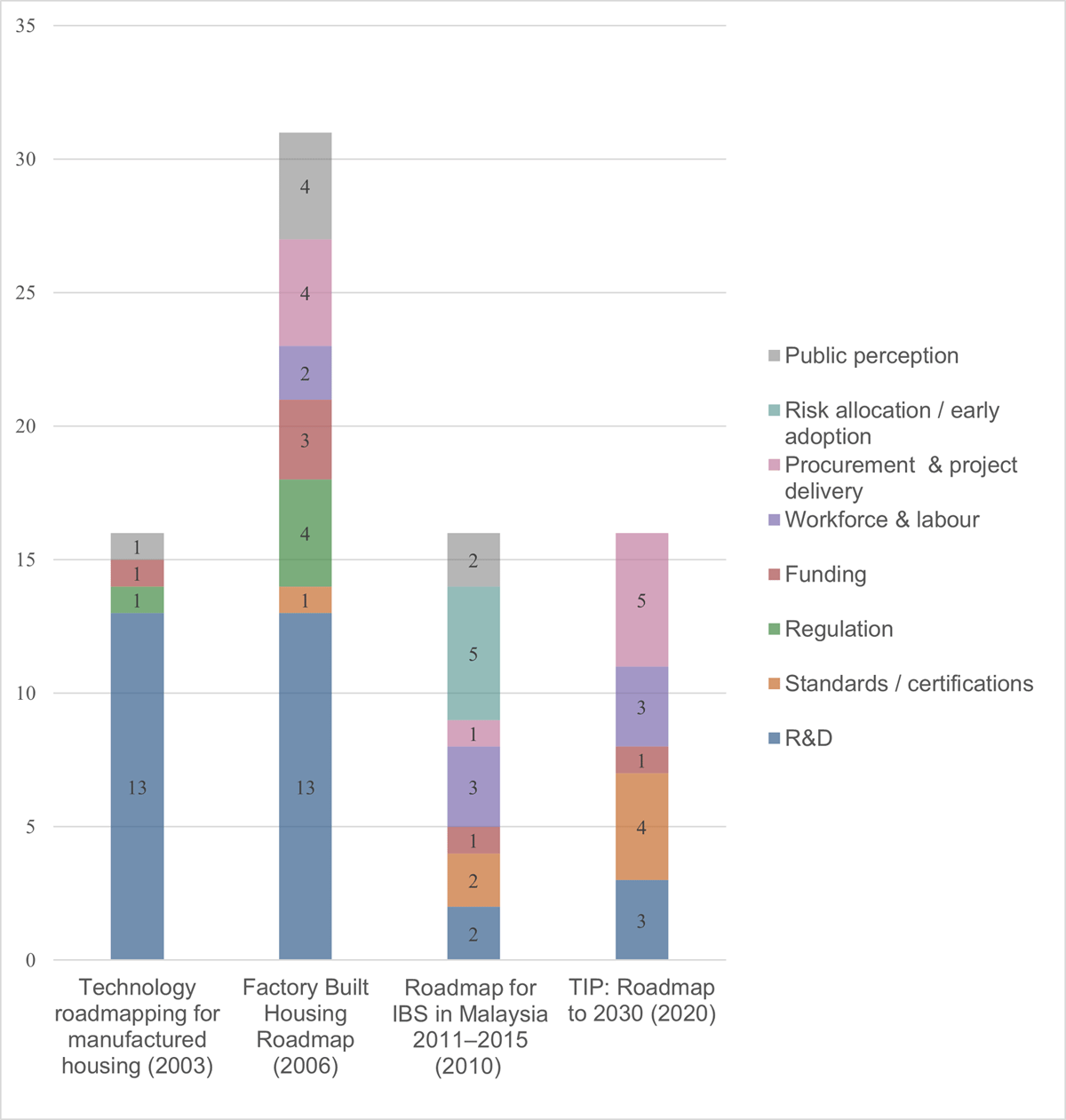
Figure 1
Distribution of coded problems across thematic domains for each roadmap.
The two PATH roadmaps (2003, 2006) are characterised by a strong concentration of problems statements within R&D. This distribution reflects the roadmaps’ assumption that broader construction challenges can be addressed through technological advances in MMC, positioning R&D as the primary need. The PATH roadmaps diagnose a wide range of problems, including both challenges and opportunities. The former includes barriers directly inhibiting MMC uptake, mainly performance issues such as weak systems integration or poor moisture performance, and issues relating to public perception of manufactured homes. In addition to these more common barriers directly inhibiting MMC uptake, the roadmap also frames opportunities or anticipated future demands as ‘challenges’ that MMC could help achieve. For example, the roadmap states that ‘indoor environmental quality – and its impact on health and well being – is a growing topic of interest and concern among homeowners across the country’. To respond to this challenge, the roadmap calls for research in controlling sources of contamination and moisture as well as techniques for improving ventilation (MHRA 2003). Similarly, energy efficiency is treated as a ‘challenge’ that only the manufactured housing industry can meet. The corresponding solutions to both barrier- and aspirational-type problem statements are nearly all based in research, such as generating new knowledge, creating new designs and advancing the technical understanding of a problem.
In the second PATH roadmap (2006), R&D remains the focus but problems are listed across a wider range of other categories, particularly procurement and project delivery, standards and public perception. Persistent issues with MMC itself – such as inefficient delivery processes, a lack of standardised installation guidance and negative perceptions of factory-built housing – are more explicitly acknowledged. R&D remains the primary course of action recommended, but the roadmap recommends research to solve problems beyond technical domains, including market, regulatory and institutional challenges. For example, the roadmap diverges from its 2003 predecessor in section on energy efficiency, by acknowledging that ‘getting to [net] zero is not exclusively or even principally a technological challenge’, instead emphasising that it will require a holistic and coordinated approach including changes to lending processes, incentives, and consumer perception (MHRA 2006).
TIP similarly positions MMC as a means to achieve broader sectoral goals but diverges in its diagnosis of the barriers to uptake. While the PATH roadmaps propose research to support and advance the industry, TIP is built on existing initiatives that call for reforms to the UK government’s way of operating by adopting MMC-related practices. TIP’s main challenge is that ‘the way that we deliver our buildings is inefficient and too often based on delivery of bespoke outputs in sector and project silos’ (IPA 2021b). Solutions to these issues mainly originate in previous government documents, specifically the TIP programme report (2017) and the Construction Playbook (2020). As a result, the boundaries between the roadmap and these preceding documents are often blurred, with many problems and solutions only partially articulated within the roadmap itself. The roadmap thus charts a process of institutional reform, seeking to operationalise and coordinate solutions that already exist but remain insufficiently advanced or mandated.
The CIDB roadmap presents the most even distributed of problems across the thematic domains. This reflects its direct focus on increasing the use of MMC in private projects, rather than on wide-scale construction-sector reform. MMC adoption is framed as a challenge shaped by interacting market, institutional and cultural barriers inhibiting uptake in the private sector. Consequently, the CIDB roadmap is the only one to explicitly foreground risk and early adoption challenges across the MMC value chain, spanning buyer demand, developer risk perceptions, professional scepticism and labour-related stigma. Gaps and solutions are strongly linked: skills shortages are met with training pipelines, quality concerns with standards, risk aversion with demonstration projects, and perception barriers with outreach and marketing. The roadmap is designed specifically to direct government intervention in the construction industry, since ‘the main challenges faced by the [private] industry have remained unchanged throughout the years, indicating that the root cause of the issues have not been resolved’ (CIDB 2010). In this framing, MMC adoption in the private sector requires active state involvement, mainly through interventions and policies that the CIDB and closely affiliated government bodies need to realise.
The differences in problem framing across roadmaps reflect their respective contexts, constraints and understanding of the challenges inhibiting MMC adoption. These framings provide essential context for the subsequent analysis of how identified solutions are translated into proposed implementation mechanisms.
4.2.2 Operationalising proposed solutions
The extent to which identified solutions are translated into implementation actions varies across the four roadmaps, as shown in Figure 2. The total number of implementation proposals identified in each roadmap is tabulated next to stacked bars identifying the number of solutions with and without an associated implementation proposal.
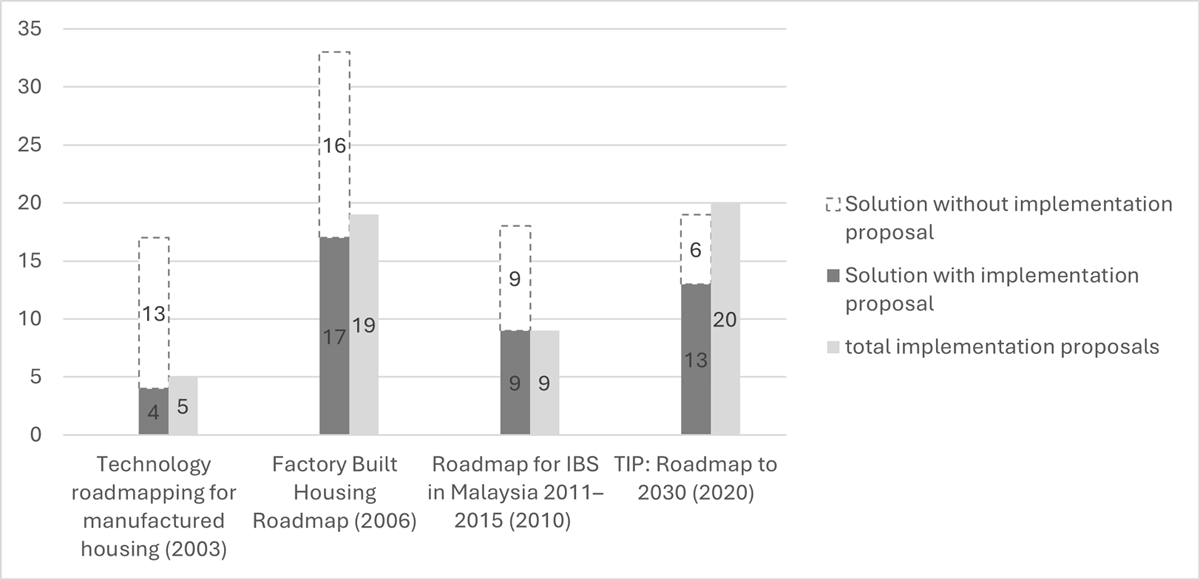
Figure 2
Charted solutions with and without proposed implementation and total proposed actions per roadmap.
In the 2003 PATH roadmap, less than a quarter of identified solutions are accompanied by proposed implementation actions. Most solutions listed express the need to fill a knowledge gap (‘understand’ a problem, ‘develop’ better technical solutions, ‘explore the potential’ for improvement), but few are paired with concrete action. Most proposed actions are research based, such as commissioning studies, developing analytical tools and conducting testing programmes focused on discrete performance questions. However, few specify dissemination pathways beyond report production.
The 2006 PATH roadmap proposes more solutions, reflecting its wider problem scope, but just over half are paired with actions. More research solutions are associated with defined outputs or deliverables than in the 2003 roadmap, including prototypes, demonstration homes, guidebooks, templates, pilot programmes and databases. Across both roadmaps, few actions explicitly link these research outputs to pathways that might make them impactful within industry, such as regulatory adoption, procurement requirements and industry-wide mandates.
In the CIDB roadmap, half of identified solutions are translated into proposed actions, which consist mainly of policy changes and often outline continuous programmes rather than discrete initiatives. These include addressing workforce and skills gaps with apprenticeship and employment development programmes, addressing standardisation and quality concerns through certification systems, common component catalogues and mandating modular coordination, and addressing perception issues through awards, showcases and the promotion of MMC projects.
The TIP roadmap exhibits the highest proportion of solutions linked to proposed implementation actions. Notably, relationships between problems, solutions and actions are not one-to-one: some solutions are addressed through multiple proposed actions, and some actions are designed to respond to several objectives simultaneously. As a result, the number of proposed actions exceeds the number of solution statements. This reflects TIP’s emphasis on coordinating and operationalising existing initiatives rather than on defining problems or proposing new solutions. Many of the intended outcomes – such as improved data availability, standardisation, benchmarking and delivery reform – are already established through ongoing programmes and policy initiatives; the roadmap’s actions focus on completing and formally adopting these efforts. This approach effectively reduces the specificity of many proposed actions, as the roadmap refers to previous documentation where these goals are described in greater detail. As a result, the roadmap offers limited clarity about which elements from these documents will be prioritised or how they are to be operationalised or enforced. For example, the roadmap frequently calls for the government to ‘adopt the Construction Playbook’, without specifying the mechanisms of adoption.
Together, these patterns reveal differences in how far each roadmap operationalises proposed solutions with concrete actions. The specification of responsible actors and implementation timeframes follows this pattern, but with further attrition: the TIP and CIDB roadmaps designate actors and timeframes for most proposed actions, while the PATH roadmaps do so only rarely (Figure 3). The TIP and CIDB roadmaps often assign responsibility for actions to the authoring organisations themselves. They both assign timeframes to broad windows (e.g. 0–2 years, 2–5 years), in addition to some fixed dates.
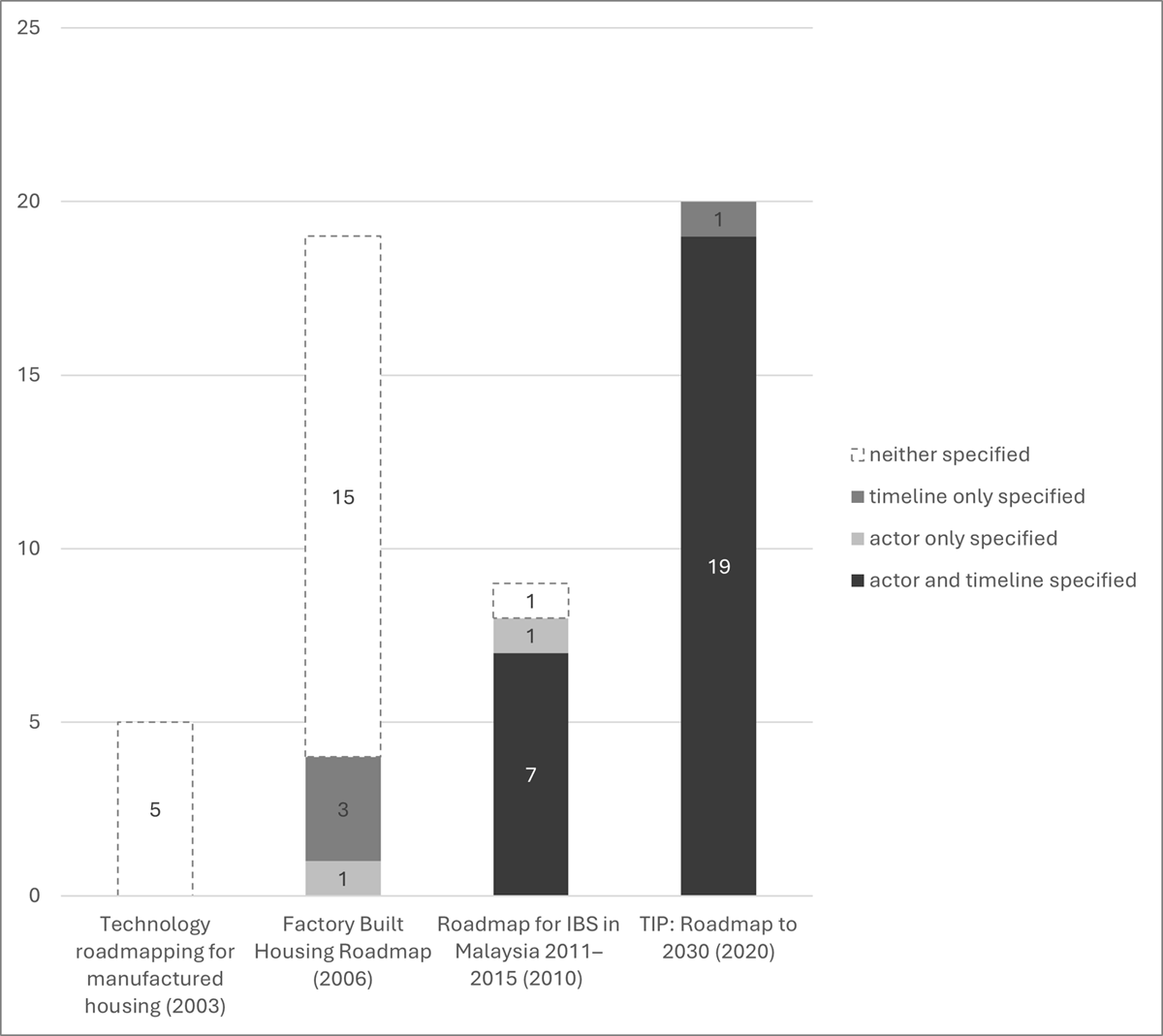
Figure 3
Specification of actor and timeline across proposed actions.
4.2.3 Implementing proposals in practice
This section presents the results of the analysis of roadmap implementation and follow-through, with detailed tables of proposed actions, outcomes and responsible actors provided in the supplemental data online (Tables S4–S7). Figure 4 summarises the status of actions across roadmaps, distinguishing between actions that were realised, partially realised or unrealised at the time of analysis.
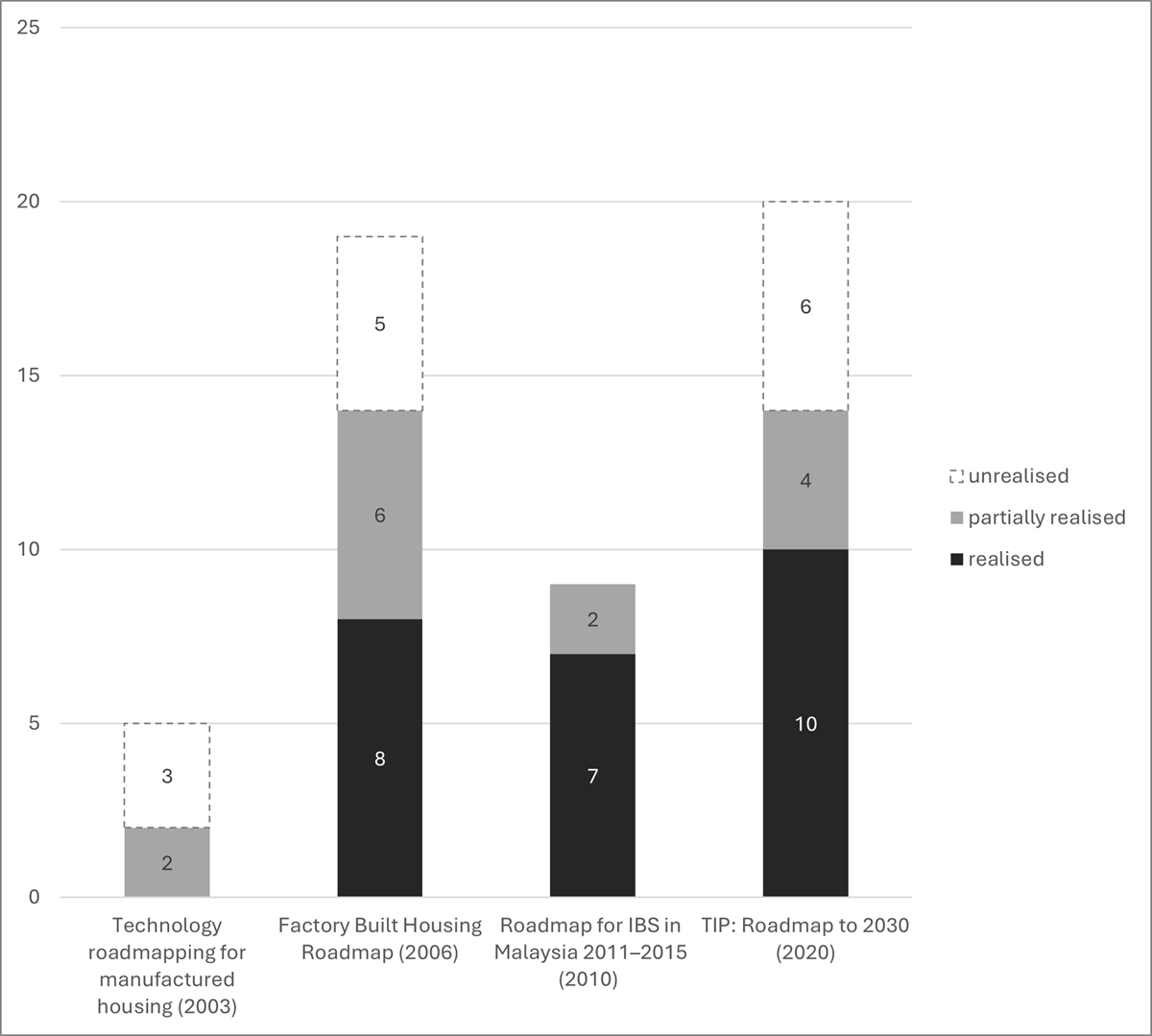
Figure 4
Distribution of proposed action status following the roadmap.
No actions from the 2003 PATH roadmap were fully realised. The 2006 follow-up improved operationalisation, with more partially and fully realised outcomes, primarily in research and prototyping. Actions of a more systemic nature such as training, certification and regulatory reform remain largely unrealised.
In contrast, every identified action was at least partially realised in the CIDB roadmap, with the majority fully realised. Actions related to standards, certification, training programmes, digital platforms and mandates show clear evidence of implementation. The few actions classified as only partially realised involved changing public perception: substantial promotional activity occurred but not always in the form or scale described in the roadmap.
Most actions proposed in the TIP roadmap were realised or partially realised, with many already underway when the roadmap was published. However, partially realised actions typically correspond to cases where a framework, guidance document or digital tool – especially one already under development – has been published but whose mandatory use or widespread adoption has not yet occurred. While this analysis evaluates actions against the roadmap’s planned implementation period for 2021–26, the roadmap itself spans a 10-year horizon; as the TIP roadmap remains within its overall 10-year delivery horizon, some actions may still be realised beyond the timeframes originally proposed.
Taken together, the figures show a strong relationship between the degree of specification in roadmap actions and observed implementation outcomes. Roadmaps with clearly assigned responsibility and timelines – most notably the TIP and CIDB roadmaps – have higher levels of realised actions. Conversely, roadmaps that primarily articulate aspirational plans – particularly PATH’s 2003 roadmap – exhibit weaker and more fragmented follow-through.
5. DISCUSSION
This study examined whether MMC roadmaps function effectively as policy instruments capable of leading change. The analysis of four MMC roadmaps reveals three interrelated patterns that affect this ambition. First, the institutional position and authority of roadmap authors shape how MMC is framed and whether problems are sufficiently bounded to support implementation. Second, while all roadmaps identify expansive sets of solutions, only a subset of these are translated into proposed actions, often lacking the specificity needed to support delivery. Third, roadmaps are more likely to operationalise and realise solutions when the authoring organisation holds direct responsibility for delivery and proposed actions build on existing policies and initiatives. Taken together, these findings indicate that the effectiveness of MMC roadmaps as policy instruments depends on the alignment between problem framing, solution implementation and organisational authority.
5.1 ROADMAP FRAMING: THE IMPORTANCE OF BOUNDING THE ROLE FOR MMC
The chosen roadmaps were written by a relatively narrow group of government, industry and research actors who share a broadly optimistic view of MMC and are committed to its adoption. As a result, the roadmaps largely treat MMC as the presumed solution, with little attention given to its limitations, trade-offs or suitability relative to alternative approaches. Where roadmaps position MMC as the solution to much broader challenges, they blur the distinction between the barriers to MMC uptake and the problems MMC is expected to solve, making both problem identification and solution implementation more difficult.
In the PATH and TIP roadmaps, where MMC is positioned as a means of achieving broader goals, roadmaps often foreground the problems MMC is expected to solve, while giving less attention to the specific barriers constraining MMC uptake itself. For example, in the UK’s TIP roadmap, problem statements identify industry fragmentation, low productivity and skills shortages as problems MMC can address. However, these conditions are also structural barriers to MMC uptake. Similarly, many of the desired benefits are presented as attainable only through MMC, even when they are not unique to offsite construction. This framing reinforces a common narrative in MMC discourse, where MMC is presented as the only solution to a broad set of industry challenges, rather than as one of several possible pathways with its own barriers and limitations (Green 2022).
In contrast, where MMC uptake is framed as the explicit object of policy intervention, as in the CIDB roadmap, problem identification narrows towards constraints specific to MMC adoption. This focus better aligns the scale of the problem with the capacity of organisations and policy instruments tasked with implementation. This aligns with findings from policy implementation literature that narrowly defined problems are easier to operationalise through specific actions, actors and implementation mechanisms (Matland 1995; Peters et al. 2018).
5.2 ROADMAP STRUCTURE: KEY GAPS IN IMPLEMENTATION DESIGN
All four MMC roadmaps fail to operationalise many of their desired solutions, establishing expansive problem statements but not translating many of them into defined actions. Even fewer of these actions are assigned to actors or timeframes. Many proposed actions do not further specify mechanisms to ensure their implementation, such as binding mandates or policies. For example, the PATH roadmaps focus heavily on generating research, tools and technical knowledge but provide few actions to disseminate these outputs or integrate them into the industry. Similarly, the TIP roadmap proposes numerous standards, benchmarks and guidance documents but rarely specifies how they will be enacted or enforced. As a result, responsibility for delivery remains diffuse, and many proposed actions remain aspirational.
Even where implementation actions are proposed, an important enabling condition remains largely unaddressed: financing. Though the roadmaps propose interventions spanning policy, regulation, procurement, research and skills development, few include actions related to funding or financial support, despite all four identifying that financing is a barrier to MMC uptake. This omission is particularly notable because many proposed interventions ultimately depend on financing, which the MMC literature consistently identifies as a critical constraint to adoption (Rahman 2014). In contexts where MMC has successfully scaled, policy and regulatory measures have been accompanied by substantial and coordinated public investment (Steinhardt & Manley 2016).
While all four roadmaps acknowledge the need for adaptation after publication, none outlines plans or mechanisms for assessment or revision. TIP recognises that their approach will ‘need to adapt to a dynamic operating environment and unforeseen events’ and that the roadmap’s plan ‘is not complete or final, it will iterate and sharpen in focus over time’ (IPA 2021b). Similarly, the second PATH roadmap acknowledges that ‘[r]oadmaps are by their nature works in progress and need to be refreshed to keep pace with changes in the building environment’ (MHRA 2006). And yet, while the 2006 PATH roadmap was explicitly presented as an update to the 2003 roadmap, it did not detail any advances or lessons learned since 2003, and no subsequent revisions followed. The CIDB roadmap explicitly sets up a framework for an IBS organisation linking several ministries and industry partners to execute proposed actions and report on progress, but, like the PATH and TIP roadmaps, no future updates were planned or produced. This is a missing dimension as roadmapping literature consistently emphasises the importance of feedback and revision to manage uncertainty, adapt to changing conditions and sustain implementation (Hart 2019; Kerr & Phaal 2020; Miedzinski et al. 2022; Siebelink et al. 2016). As a result, the documents function primarily as static statements of strategic intent rather than adaptive instruments capable of evolving alongside implementation.
5.3 ROADMAP IMPLEMENTATION: THE IMPORTANCE OF ORGANISATIONAL AUTHORITY
The findings suggest that the effectiveness of roadmaps as policy instruments depends on how proposed actions are aligned with the authority and responsibility of those tasked with their delivery. Consequently, roadmaps are most effective when they function as implementation plans for the organisations that author them, focusing on actions that fall within their own responsibilities. Rather than creating new agendas in isolation, they should operationalise and coordinate existing policy commitments and ongoing initiatives. This more closely reflects the original role of roadmapping as a strategic planning tool for organisations to coordinate their own action.
The PATH roadmaps illustrate the consequences of weak alignment between authorship and implementation. Produced by an external advisory body, they proposed responses to industry-wide challenges that depended on action from numerous government and industry organisations, rather than measures PATH could directly implement. Following publication of the second roadmap, federal support for PATH declined and the programme was subsequently discontinued (HUD 2009). By contrast, both the TIP and CIDB roadmaps assign most actions to the authoring organisation itself, or to closely related government bodies, with direct authority over procurement, standards and sector coordination. Many of these actions involve changes to their own organisational practices and existing policy responsibilities. This reinforces that MMC roadmaps are better understood as intermediary policy tools whose effectiveness depends on how they are embedded within institutional structures.
These findings point to several conditions that may support the production of more effective roadmaps. First, the organisations responsible for implementation should play a central role in defining the problem and determining actionable pathways, ensuring alignment between proposals and their own institutional capacity. Rather than seeking to transform entire political, market or institutional systems, organisations should focus on defining specific barriers and interventions that they – or closely aligned organisations – can realistically influence through existing mandates and policy instruments. Second, these proposed actions should be accompanied by a clear implementation plan, assigned to specific actors and time frames and embedded within ongoing initiatives. Finally, roadmaps should include ongoing monitoring and revision mechanisms to sustain momentum and adapt to changing conditions.
5.4 LIMITATIONS
In interpreting these findings, several limitations should be considered, beyond the methodological limitations described in Section 3.3. The analysis is based on a small number of case studies, enabling in-depth comparison but limiting generalisability. The analysis is focused on structural coherence from stated intent to realised actions, not the relevance or industry impact of solutions. The study examined the context surrounding roadmap production, including the mandate of the authoring organisation, the rationale for roadmap development and how MMC is positioned within that context. It does not analyse the broader political, economic and governance dynamics in which these roadmaps are embedded, such as changing market conditions or wider state–industry relationships. The results therefore highlight common structural tendencies and limitations in the design and use of the studied roadmaps, rather than providing a comprehensive evaluation of their impact.
6. CONCLUSIONS
This study has assessed whether MMC roadmaps function as policy instruments capable of leading change. The findings show that roadmaps often struggle to translate vision into action. While all four roadmaps articulate ambitious goals, only a subset of identified problems are linked to specific implementation measures, many of which lack clearly defined actors, mechanisms or time frames for delivery. Roadmaps most effectively function as policy instruments when they focus on bounded challenges and specify concrete solutions aligned with the mandate of the organisations responsible for delivering them. Under these conditions, roadmaps are better understood as organisation-specific planning tools rather than sector-wide policy instruments.
As roadmaps are increasingly produced across a wide range of policy and planning domains, they are becoming a prominent instrument of public governance. These findings, however, raise broader questions about the role of roadmaps in leading change. Future research should therefore examine whether the patterns identified here extend beyond MMC to other policy areas and transition initiatives. It should also investigate how successful national transitions – both in MMC and other domains – have been governed in practice, including the contribution of roadmaps relative to other policy instruments. Such comparisons would help determine whether the growing reliance on roadmaps in public policy is warranted, and under what conditions they can effectively support implementation.
ACKNOWLEDGEMENTS
The authors are deeply grateful to the members and collaborators of the Reconstruct team – including those at McGill University, the University of Toronto, the Université du Québec à Montréal and Carleton University – for their critical feedback to this study, as well as their contributions to the foundational research that formed the basis of this paper.
DATA AVAILABILITY
The data that support the findings of this study are openly available online in the references mentioned and no additional source data are required.
SUPPLEMENTAL DATA
Supplemental data for this article can be accessed at: https://doi.org/10.5334/bc.790.s1. Publications cited in the supplemental data are referenced below.