
1. Introduction
As institutions face turbulent periods,1 they evolve alongside changes, adapting to and managing the consequences of transformation.2 The history of governance in Portugal is marked by events that have significantly impacted outcomes delivered to citizens. The 2008 financial crisis, followed by the Troika intervention, and the COVID-19 pandemic represent critical junctures3 for Portuguese society with implications across various functional areas of policy.
This study focuses on the justice portfolio. Events such as those previously mentioned can significantly affect institutional performance.4 Civil enforcement actions underwent a remarkable transformation following the 2011 Troika intervention, reversing decades of systemic inefficiency that had plagued the justice system.5 Portuguese civil enforcement actions function to enforce judicially determined obligations through various measures: seizing assets to satisfy debts or using the proceeds of such sales to satisfy outstanding obligations.6 By 2020, comprehensive reforms had achieved unprecedented improvements. These achievements demonstrated that even deeply entrenched problems could be effectively addressed through targeted reform intervention.7
However, recent post-COVID data suggest these hard-won gains may now be vulnerable. The post-pandemic period (2022–2024) reveals concerning convergence patterns: the procedural balance is deteriorating, clearance rates are declining toward the critical 100% threshold, and incoming cases are growing faster than resolved cases. Civil enforcement actions provide an ideal lens for examining reform sustainability due to their sensitivity to both economic conditions and institutional capacity. These proceedings implement legally determined obligations through asset seizure and debt collection,8 making them particularly responsive to both societal economic health and judicial system efficiency.9
This study examines whether the performance improvements achieved through Portuguese justice reform remain sustainable in the post-COVID period. Using 33 years of longitudinal data (1991–2024) from Portuguese first instance courts, this research analyzes procedural movement patterns across five distinct historical periods to assess reform durability. The central research question is whether the performance improvements achieved through Portuguese justice reforms are sustainable in the post-COVID period.
This investigation contributes to the literature on reform sustainability in justice administration in three ways. First, it contributes theoretically. This work seeks to make contributions to the scientific field of public administration in general, and particularly to the administration of justice and the study of policies in this sector. The study of justice administration has evolved significantly in recent decades, transitioning from a traditional bureaucratic model to more innovative approaches that recognize the citizen as a central element in the justice system.10 This field has attracted considerable academic attention and generated mutliple theoretical interpretations. Among the most influential approaches, two main theoretical frameworks are particularly prominent: new public management11 and theories of justice administration or judicial governance.12,13,14 The study of reforms in this policy field through multiple theoretical lenses contributes to the cumulative development of knowledge accumulation for justice policy.
Empirically, it provides evidence of long-term reform outcomes beyond immediate implementation periods, addressing critical gaps in justice administration literature regarding institutional change durability. Methodologically, the 33-year longitudinal analysis offers unique insights into how external shocks affect institutional performance over extended periods. Furthermore, it offers court administrators15 evidence-based guidance for preserving reform gains and preventing regression to pre-reform inefficiencies.
The study proceeds as follows. The second section reviews the literature on critical junctures, crisis-induced institutional change, path dependence, and reform sustainability (Section 2). The third sets out the research context and hypotheses (Sections 3). The forth explains the longitudinal methodology (Section 4). The next section uses the longitudinal methodology approach to present the results for five distinct periods, paying particular attention to post-COVID developments (Section 5). The final section concludes and identifies avenues for future research (Section 6).
2. Critical Junctures and Crisis-Induced Institutional Change
Understanding how judicial institutions respond to external shocks draws on critical juncture theory and historical institutionalism. Institutions may be understood as formal and informal rules embedded in political and economic structures.16 In justice systems, this includes procedures, case management, performance metrics, and informal practices.17 Historical institutionalism is characterized by four features: (1) broad views on how institutions shape behavior;18 (2) focus on power asymmetries in processes of institutional change, such as the Troika’s ability to override domestic resistance;19 (3) emphasis on path dependence and unintended consequences20 and (4) attention to the role of ideas and socioeconomic factors in shaping institutional performance.21 Reforms are shaped by legal traditions, organizational cultures, and political pressures.22
Capoccia and Kelemen23 define critical junctures as brief periods when decisions have heightened influence on institutional outcomes. In justice systems, such windows – often months or a few years – can trigger lasting reforms despite typical resistance,24 highlighting the role of temporality.25 Because justice institutions are path-dependent,26 they usually follow entrenched trajectories, but critical junctures can alter them and establish new equilibria.27 Even during such moments, institutional actors may still resist change.28 The 2011 Troika intervention illustrates this dynamic. A severe economic crisis, over 1.1 million pending cases, and external pressure created conditions that overcame institutional inertia. The short intervention period (2011–2014) led to significant, lasting changes.29
New institutional standards emerged: electronic seizures replaced manual processes, performance monitoring improved accountability, and streamlined procedures accelerated case resolution.30 This case illustrates how critical junctures can reshape justice institutions, though their long-term sustainability depends on broader path dependence mechanisms—explored in the next section.
2.1. Path Dependence and Reform Sustainability
While critical junctures explain how institutional change becomes possible, understanding why some crisis-induced reforms endure while others fade away requires an examination of path-dependence mechanisms and sustainability dynamics. The persistence of institutional changes31 in justice systems depends on complex interactions between increasing returns processes, policy feedback effects, and the accumulation of incremental modifications that reinforce or undermine initial reforms.
Pierson32 conceptualizes path dependence as a social process grounded in a dynamic of increasing returns, where initial policy choices create self-reinforcing mechanisms that make reversal increasingly difficult over time. In justice systems,33 this manifests through several mechanisms: institutional investments in new technologies and procedures,34 professional adaptation to reformed processes,35 user expectations based on improved performance,36 and political commitments that create reputational stakes for maintaining reforms. Pierson37 provides a rigorous foundation for historical institutionalism through the concept of increasing returns, highly relevant to justice system analysis. First, timing and sequencing matter – how and when reforms occur shape long-term outcomes. Second, similar crises may yield divergent paths depending on decisions made during critical junctures. Third, small events – such as procedural or technological changes – can trigger major transformations. Fourth, once established, certain institutional paths are hard to reverse. Finally, critical moments can set lasting equilibria. Torfing38 adds that path dependence must be rethought to address reform resilience amid counter-reform pressures.
Kickert and van der Meer39 challenge the idea that only large reforms matter, showing that gradual, cumulative changes can also drive transformation. This insight is central to understanding sustainability in justice systems: reforms made during critical junctures may later be reinforced or weakened by incremental adaptations.40 Gradual change may involve procedural improvements,41 technological upgrades,42 evolving professional practices through training, continuous pressure from performance systems,43 or administrative fine-tuning.44 These mechanisms may either consolidate earlier reforms or erode them through drift or neglect. Understanding path dependence helps identify early warning signs of reform fatigue. Performance indicators nearing critical thresholds45 or gradual metric drift46 may suggest weakening self-reinforcing mechanisms. This framework supports the analysis of how such dynamics have played out in Portuguese civil enforcement reform—where a sharp critical juncture was followed by a period of apparent sustainability.
2.2. Research Context: Portuguese Civil Enforcement Actions Reform
Contemporary societies increasingly face critical events that disrupt institutional functioning.47 In Portugal, the 2011 Troika intervention followed an economic crisis that overwhelmed institutional capacity, exemplifying Capoccia and Kelemen’s48 definition of a critical juncture – when decisions have heightened institutional impact. The transformation of civil enforcement actions offers a strong case to examine how such junctures initiate change and how path dependence shapes reform sustainability, especially post-COVID.
Civil enforcement actions reveal the vulnerability of justice institutions to socioeconomic shocks, as they deal with debt recovery and financial obligations.49 The 2008 crisis led to widespread defaults and a surge in litigation. By 2011, the system was overwhelmed—with over 1.1 million pending cases, delays over six years, and institutional breakdown.50
The intervention created conditions in which major institutional decisions could be taken under uncertainty, easing constraints for structural reform. Two justice priorities emerged: improving system functionality and restructuring courts for efficiency.51 Reform goals included enforcing contracts, restructuring courts, and reducing delays through alternative dispute resolution.52 Measures included removing unenforceable cases, electronic account seizures, procedural simplification, and performance monitoring. These innovations generated increasing returns by improving efficiency and reinforcing the reform trajectory.53 The reforms balanced debtor-creditor interests and laid empirical foundations for long-term assessment.54
COVID-19 tested these reforms, disrupting institutional operations through suspended deadlines and postponed proceedings (Decree-Law No. 10-A/2020;55 Law No. 1-A/202056). A simultaneous GDP drop of –8.2% in 202057 indicated potential increases in enforcement action demand precisely when institutional capacity was constrained. These conditions constituted a stringent test of reform resilience.
Empirical analysis found that Troika-era gains, especially backlog reductions, persisted during the pandemic,58 suggesting path-dependent mechanisms held under stress.59 The post-COVID period saw economic recovery – GDP growth of 5.6 % in 20213 and 7% in 20223 – but a 2.5% contraction in 20233 raises concerns about future sustainability. The Portuguese case illustrates a full theoretical cycle: institutional change,60 path-dependent resilience,61 external stress testing,62 and possible erosion.63
3. Hypotheses
Institutional changes created during crisis periods may face sustainability challenges as conditions normalize.64 The 2011 Troika intervention was a critical juncture that enabled fundamental restructuring of Portuguese enforcement actions. However, the extraordinary factors driving change—crisis urgency, external oversight, and political commitment—may fade, potentially affecting reform durability. The post-COVID period is a key test of sustainability. Kickert and van der Meer65 argue that post-reform adaptations can either reinforce initial changes through incremental improvements or erode them through drift and neglect. Understanding these dynamics requires examining performance indicators that reveal early signs of institutional regression. Critical juncture studies suggest that arrangements formed in crises often face adjustment pressures as conditions stabilize.66
Moreover, the post-COVID context differs markedly from the pandemic period in economic, political, and institutional terms. Path dependence theory predicts such changes can weaken increasing returns mechanisms, potentially affecting performance. Accordingly, the first hypothesis is as follows:
H1 (Post-COVID Performance Change): The post-COVID period (2022–2024) demonstrates statistically significant differences in civil enforcement performance indicators compared to the pre-pandemic reform baseline (2018–2020).
Pierson’s67 analysis of increasing returns suggests that path-dependent processes exhibit characteristic trajectory patterns that reflect the strength of self-reinforcing mechanisms. During the 2014–2020 period, Portuguese enforcement actions demonstrated consistent sustainability. However, Torfing68 warns that multiple feedback mechanisms in public policy may interact in complex ways, with some supporting continued improvement while others may contribute to performance drift. The post-COVID period may exhibit different trajectory patterns if the balance of these feedback mechanisms has shifted, reflecting changes in resource allocation, political attention, or institutional capacity.
The next hypothesis examines whether performance trends indicate continuity or discontinuity in path-dependent processes. The second hypothesis is as follows:
H2 (Performance Trajectory Analysis): Post-COVID civil enforcement performance indicators exhibit distinct directional trends that differ from the established reform trajectory patterns observed during 2014–2020.
Institutional sustainability requires maintenance of performance levels sufficient to preserve reform gains and prevent reversion to pre-reform configurations.69 Critical thresholds exist where performance deterioration may trigger negative feedback effects: declining clearance rates approaching 100% may signal insufficient capacity to manage caseloads, weakening procedural balances may indicate growing backlogs, and increasing disposition times may suggest return to pre-reform inefficiencies. Kickert and van der Meer70 emphasize that early identification of such patterns enables proactive intervention to prevent institutional regression.
The following hypothesis assesses whether recent performance trends approach threshold values that historical experience suggests are associated with institutional instability, providing early warning indicators for policy intervention. The third hypothesis is as follows:
H3 (Sustainability Risk Assessment): Post-COVID performance patterns approach or exceed critical threshold values that warrant policy attention for maintaining institutional reform achievements.
4. Data and Methodology
The objective of this study is to analyze the temporal evolution of civil enforcement actions in first instance courts in Portugal. This longitudinal study encompasses a sample of 408 months, from January 1991 through December 2024. The data used in the analysis are publicly available in the Justice Statistics Information System,71 published by the Directorate-General for Justice Policy of the Portuguese Ministry of Justice. This study examines five distinct periods in the recent history of the Portuguese justice system (Table 1).
Table 1
Study periods.
| PERIOD | TIMEFRAME |
|---|---|
| Pre-Troika | January 1991–April 2011 |
| Troika | May 2011–May 2014 |
| Post-Troika/Pre-COVID | June 2014–March 2020 |
| COVID | April 2020–September 2022 |
| Post-COVID | October 2022–December 2024 |
[i] Source: Prepared by the authors.
For the analysis, three methodological approaches are employed. The first involves descriptive statistical analysis of the number of incoming, resolved, and pending enforcement actions,72 as well as visual inspection of the figures that facilitate exploration of the temporal evolution. To mitigate seasonality effects in the analysis and interpretation of data, seasonal trend decomposition was performed using the LOESS method (STL), a seasonality adjustment technique to identify the robust underlying trend and thereby eliminate irregular components in the time series.73
A second approach employs performance indicators. The performance indicators utilized are calculated using the three main variables previously mentioned74: procedural balance, clearance rate, and disposition time. Similarly, visual examination of these indicators facilitates the identification of patterns. Table 2 presents the description of variables. Finally, statistical tests are conducted to evaluate the previously formulated hypotheses. Given the non-normality of the data,75 the Kruskal-Wallis method is selected to determine whether the five periods under study are statistically similar (that is, whether they present equal medians).
Table 2
Description of variables.
| VARIABLES | DESCRIPTION | SOURCE |
|---|---|---|
| Period | The period is divided into five phases: pre-Troika, Troika intervention, post-Troika and pre-COVID-19, COVID-19 pandemic, and post-COVID-19. | (Correia and Pereira 2022) |
| Incoming cases (IC) | A newly filed action entering the system. | (CEPEJ 2024; Correia and Videira 2015, 2016; Correia et al. 2019; Correia et al. 2018; DGPJ 2016) |
| Resolved cases (RC) | Any action where a final decision has been defined, whether in the form of a judgment, sentence, or order, regardless of whether it has become legally binding. | |
| Pending cases (PC) | Actions that have entered the system but do not yet have a final decision. These cases are waiting for actions by the court, the parties, or others. | |
| Procedural balance | The difference between IC and RC. A positive balance means pending cases are increasing. A negative balance means pending cases are decreasing. Formula: | (CEPEJ 2024; Correia and Videira 2015, 2016; Correia et al. 2019; Correia et al. 2018; DGPJ 2016) |
| Clearance rate | The ratio of total RC to total IC. When equal to 100 percent, the number of IC equals RC, so there is no change in pending cases. When above 100 percent, the system is reducing backlog. The higher this indicator, the more backlog is being cleared. When below 100 percent, more cases are entering than being concluded, creating backlog for the following year. Formula: | |
| Disposition time | Measures, in days, how long it would take to conclude all pending cases at the end of a period, based on the work pace during that same period (the number of cases resolved). Formula: |
5. Results and Discussions
Portuguese civil enforcement reforms achieved transformative improvements following the 2011 Troika intervention, with positive trends sustained through the COVID-19 pandemic. The post-COVID period (2022–2024) represents an understudied phase requiring examination to assess the long-term trajectory of these institutional changes. The 33-year longitudinal analysis reveals the transformation of Portuguese civil enforcement actions across distinct phases. Figures 1 and 2 demonstrate the complete temporal evolution from 1991–2024, with seasonality adjustment revealing underlying trends that transcend cyclical variations. By 2020, the Portuguese justice system had achieved remarkable performance improvements following the 2011 Troika intervention, establishing a robust baseline for assessing subsequent sustainability.
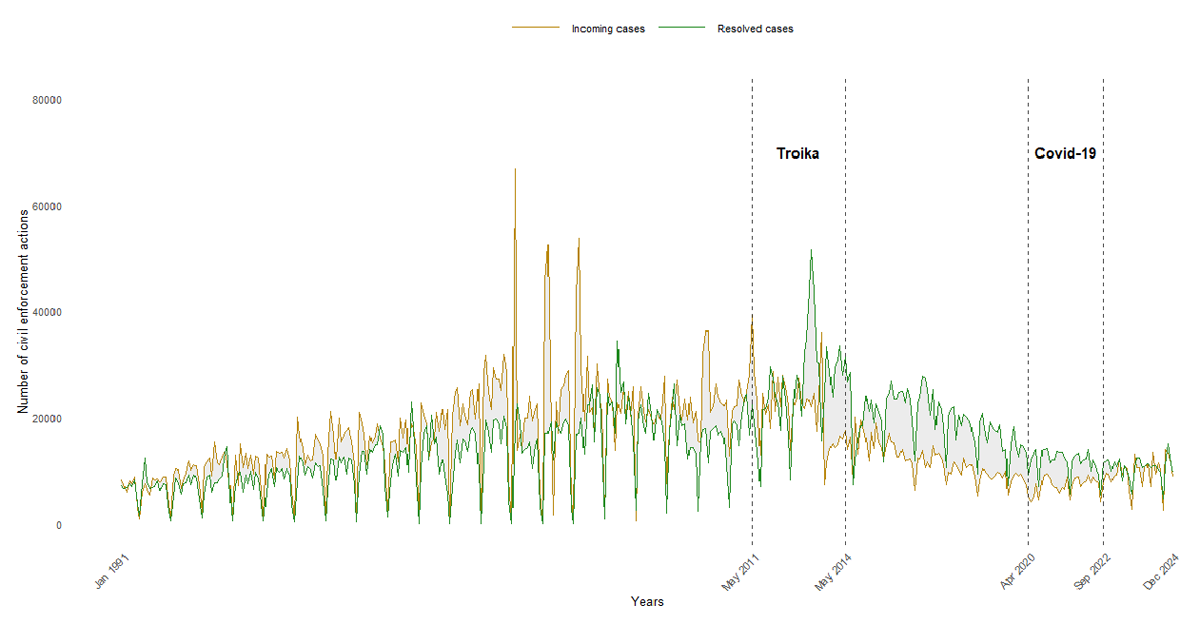
Figure 1
Incoming and resolved civil enforcement actions (1991–2024).
Source: Prepared by the authors.
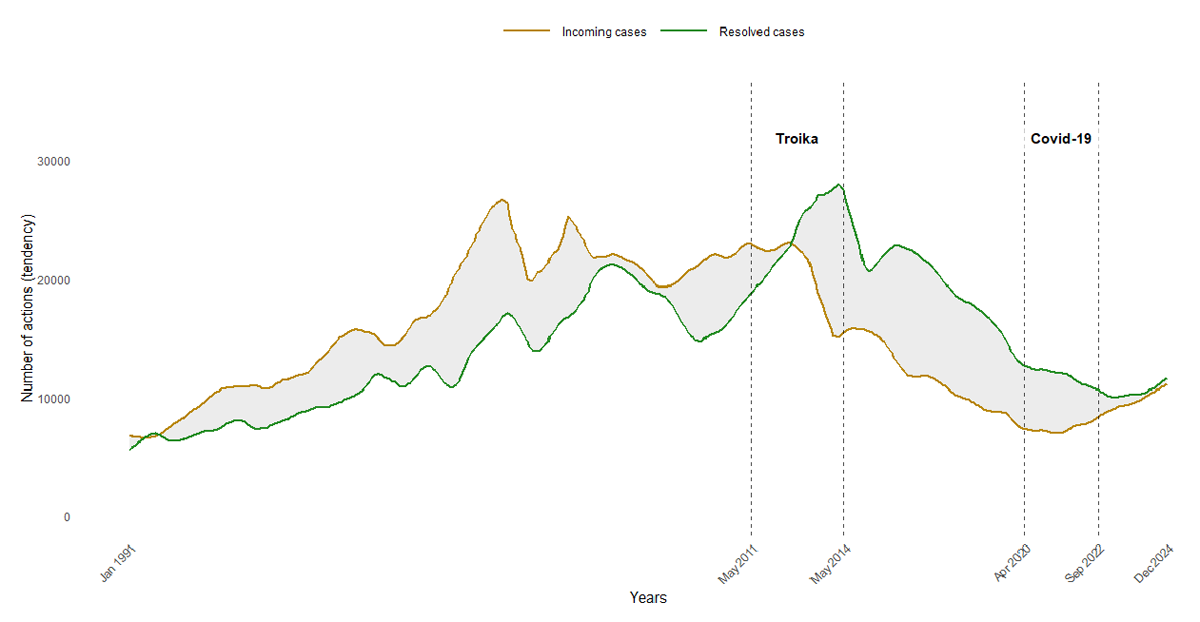
Figure 2
Incoming and resolved civil enforcement actions, adjusted according to seasonality (1991–2024).
Source: Prepared by the authors.
Figure 3 illustrates the dramatic institutional transformation: pending cases declined from over 1.1 million in 2011 to manageable levels by 2020, while Figures 4, 5, 6 confirm sustained performance improvements. The post-Troika/pre-COVID period (2014–2020) established consistent negative procedural balances averaging –8,214 cases, clearance rates exceeding 150% with peaks reaching 191%, and disposition times stabilized below 1,200 days. This baseline represented the culmination of path-dependent improvements achieved through critical juncture reforms76 and sustained through incremental enhancements.77
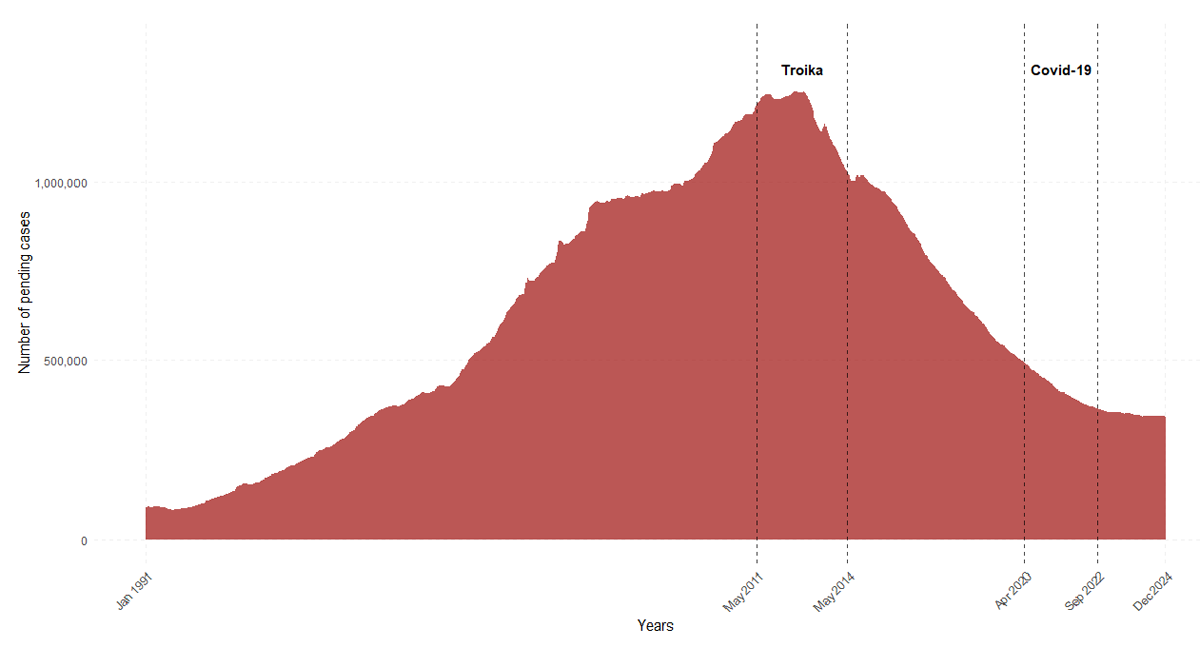
Figure 3
Pending civil enforcement actions (1991–2024).
Source: Prepared by the authors.
Against this established baseline, the post-COVID period demonstrates performance changes that warrant detailed examination. The following subsections address the results of each hypothesis.
Research hypothesis 1: post-COVID performance change analysis
The first hypothesis tests for the existence of performance changes using statistical comparison of distinct time periods. The Kruskal-Wallis test confirms statistically significant differences across all performance indicators between the post-COVID period and established baselines (p-values < 0.05 for all variables, Table 3). Dunn’s post-hoc analysis (Table 4) reveals that the post-COVID period demonstrates distinct performance patterns compared to the pre-pandemic baseline across multiple dimensions. It is essential to determine which specific periods differ from one another and which periods are statistically similar. For this purpose, the five periods and their respective six variables are grouped according to the results of Dunn’s post-hoc test with Bonferroni correction.78 These groupings are formed based on the statistical similarity of the medians (Table 4).
Table 3
Results for the Kruskal-Wallis test.
| VARIABLES | INCOMING | RESOLVED | PENDING | PROCEDURAL BALANCE | CLEARANCE RATE | DISPOSITION TIME |
|---|---|---|---|---|---|---|
| Kruskal-Wallis | 160 | 190 | 138 | 285 | 295 | 52 |
| p-value | 0,000 | 0,000 | 0,000 | 0,000 | 0,000 | 0,000 |
[i] Source: Prepared by the authors.
Table 4
Statistical similarity of medians.
| Periods | Incoming | ||
| Group 1 | Group 2 | Group 3 | |
| Pre-Troika | 17,687 | – | – |
| Troika | – | 22,382 | – |
| Post-Troika/pre-COVID-19 | – | – | 11,551 |
| COVID-19 | – | – | 7,194 |
| Post-COVID-19 | – | – | 9,520 |
| Periods | Resolved | ||
| Group 1 | Group 2 | ||
| Pre-Troika | 11,943.5 | – | |
| Troika | – | 24,386 | |
| Post-Troika/pre-COVID-19 | – | 20,655 | |
| COVID-19 | 12,007 | – | |
| Post-COVID-19 | 10,222 | – | |
| Periods | Pending | ||
| Group 1 | Group 2 | Group 3 | |
| Pre-Troika | – | – | 432,072 |
| Troika | 1,230,961 | – | – |
| Post-Troika/pre-COVID-19 | – | 758,701 | – |
| COVID-19 | – | – | 413,094 |
| Post-COVID-19 | – | – | 349,248 |
| Periods | Procedural balance | ||
| Group 1 | Group 2 | ||
| Pre-Troika | 3831 | – | |
| Troika | – | –1,737 | |
| Post-Troika/pre-COVID-19 | – | –8,214 | |
| COVID-19 | – | –5,063 | |
| Post-COVID-19 | – | –697 | |
| Periods | Clearance rate | ||
| Group 1 | Group 2 | ||
| Pre-Troika | 72 | – | |
| Troika | – | 108 | |
| Post-Troika/pre-COVID-19 | – | 180 | |
| COVID-19 | – | 172 | |
| Post-COVID-19 | – | 107 | |
| Periods | Disposition time | ||
| Group 1 | Group 2 | ||
| Pre-Troika | – | 1,107 | |
| Troika | 1,538 | – | |
| Post-Troika/pre-COVID-19 | – | 1,116 | |
| COVID-19 | – | 1,035 | |
| Post-COVID-19 | – | 1,025 | |
[i] Source: Prepared by the authors.
First, regarding pending cases, we observe that the median reaches its maximum peak during the Troika period (1,230,961 pending cases) and its minimum value in the post-COVID period (349,248 pending cases). The results indicate that the post-COVID, COVID, and pre-Troika periods present statistically similar medians. The post-Troika/pre-COVID period and the Troika period are statistically distinct both from each other and from the other periods.
Second, in the case of incoming actions, we encounter a similar pattern with a notable variation. The COVID, post-COVID, and post-Troika/pre-COVID periods exhibit statistically similar medians, while the pre-Troika and Troika periods differ significantly both from each other and from the other periods. Compared to pending cases, the pattern shows substantially higher values during the pre-Troika (17,687 incoming actions) and Troika (22,382 incoming actions) periods, and considerably lower values in the more recent periods under analysis, with 7,194 incoming actions during the COVID period and 9,520 incoming actions in the post-COVID period.
Third, regarding resolved cases, we identify two homogeneous groups. The first group, with medians ranging between 10,222 and 12,007 resolved cases, comprises the pre-Troika, COVID, and post-COVID periods; the second group, with medians between 20,655 and 24,386 resolved cases, includes the Troika and post-Troika/pre-COVID periods. Notably, the Troika period exhibits the highest number of concluded cases, while we observe a substantial decrease in concluded actions during the COVID and post-COVID periods, returning to levels similar to those of the pre-Troika period.
The procedural balance allows us to examine pendency from an alternative perspective. For this indicator, we identify two distinct groups: the first includes periods with negative procedural balance – the post-Troika/pre-COVID, COVID, Troika, and post-COVID periods—with medians ranging from –8,214 proceedings to –697 proceedings. Although all negative, we observe a notable improvement in the post-COVID period with only –697 proceedings. The second group, consisting solely of the pre-Troika period, with a positive balance of 3,821 proceedings, differs significantly from all other periods.
For the clearance rate, the highest median appears in the post-Troika/pre-COVID period (180%), followed by the COVID period (172%). The Troika and post-COVID periods, although above 100%, present more moderate resolution rates. The pre-Troika period is the only period with a clearance rate bellow 100%. Statistically, two groups were identified, a first composed of medians above 100 percent, corresponding to the post-Troika/pre-COVID, COVID, Troika, and post-COVID periods. It should be noted, however, that these periods are considered to have statistically similar medians, the Troika and post-COVID periods present more moderate medians compared to the COVID and post-Troika/pre-COVID periods. On the other hand, the pre-Troika period presents a negative value of 72% that makes it distinct from all other periods. Lastly, the disposition time encompasses two groups: a first that includes the post-COVID, COVID, pre-Troika, and post-Troika/pre-COVID periods, with medians ranging from 1,025 days to 1,116 days, respectively. These periods are considered statistically similar. On the other hand, the Troika period is considered distinct from the previous ones with a median of 1,538 days.
Figure 4 provides relevant evidence of performance change. While the procedural balance remained strongly negative throughout the reform period, indicating robust system capacity, the post-COVID period shows noticeable weakening. The post-COVID median procedural balance of –697 cases represents a deterioration of 92% from the baseline median of 8,214 cases. Figure 4 demonstrates that incoming and resolved cases are converging in the post-COVID period, with incoming cases displaying a consistent upward trajectory at an average rate of 97 actions per month. Figure 5 reveals concerning clearance rate evolution during the post-COVID period.
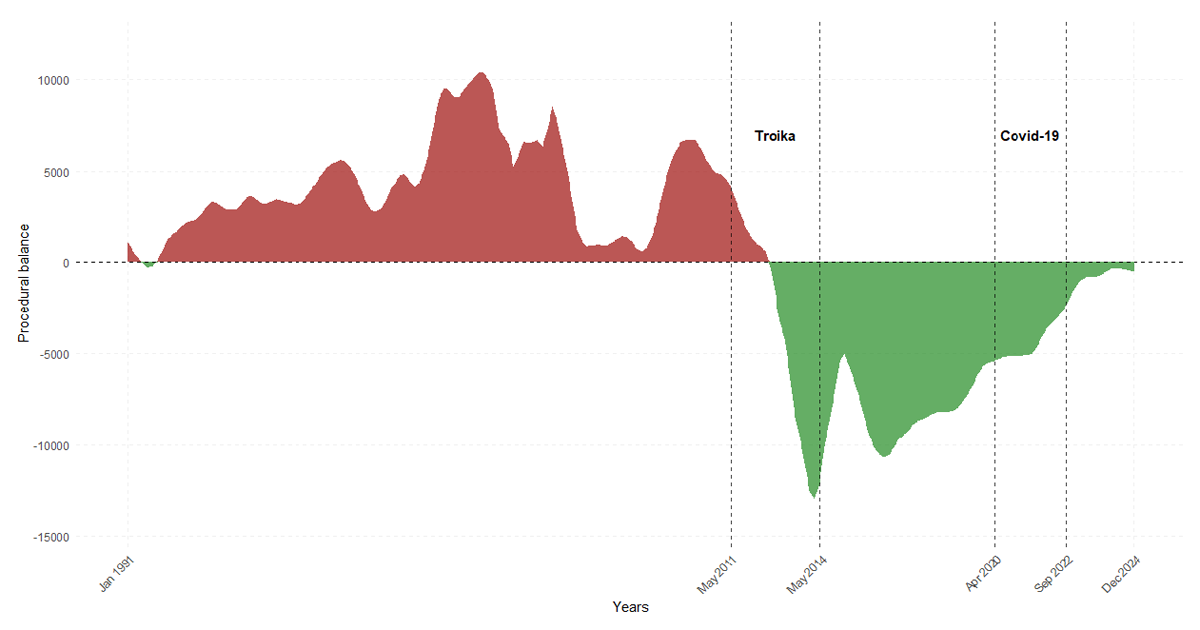
Figure 4
Procedural balance for the civil enforcement actions (1991–2024).
Source: Prepared by the authors. The negative values of procedural balance are represented in green, and the positive values of procedural balance are represented in red.
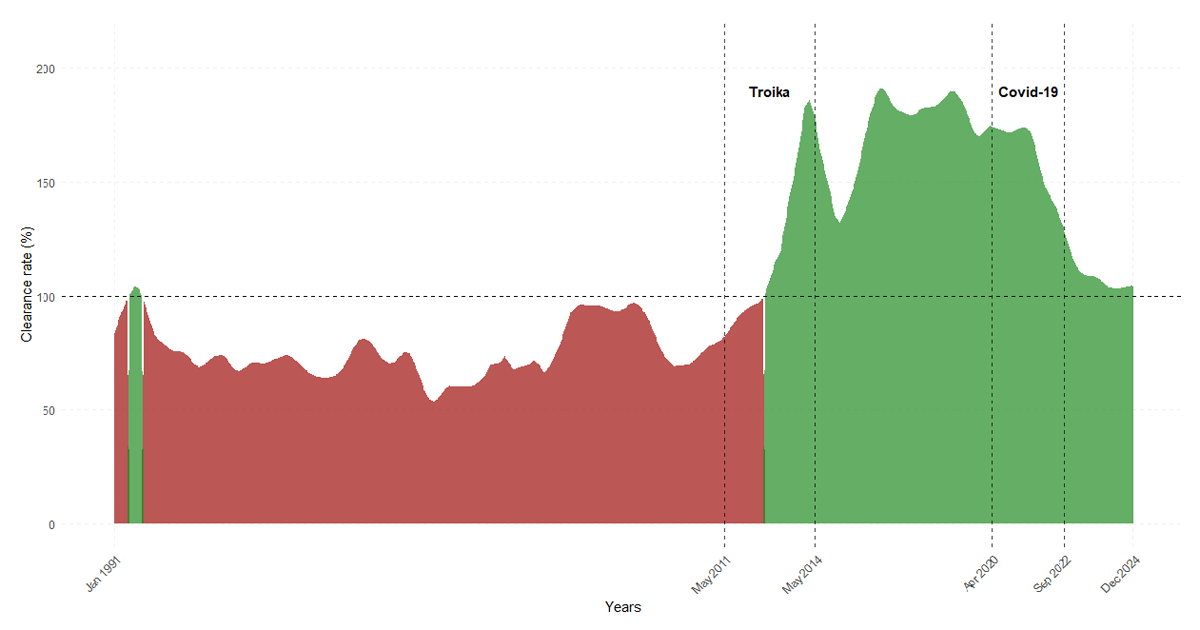
Figure 5
Civil enforcement actions clearance rate (1991–2024).
Source: Prepared by the authors. Green shading indicates a favorable clearance rate above 100%. Red shading indicates an unfavorable clearance rate below 100%.
While the figure demonstrates sustained success of reforms through 2020, with clearance rates consistently above 150%, the post-COVID period exhibits statistically significant deterioration. The median clearance rate during the post-COVID period (107%) represents substantial decline from the baseline median of 180%. Most critically, Figure 5 shows clearance rates converging to 105% by December 2024, approaching the critical institutional stability threshold of 100%.
Figure 6 shows continued disposition time improvements, reaching 888 days by December 2024, suggesting some reform mechanisms remain functional. However, Figure 3 indicates that while pending cases continue declining at 741 cases per month, this positive trend occurs alongside weakening capacity indicators that may affect future sustainability. These performance changes reveal not only statistical differences but also distinct directional patterns that require trajectory analysis.
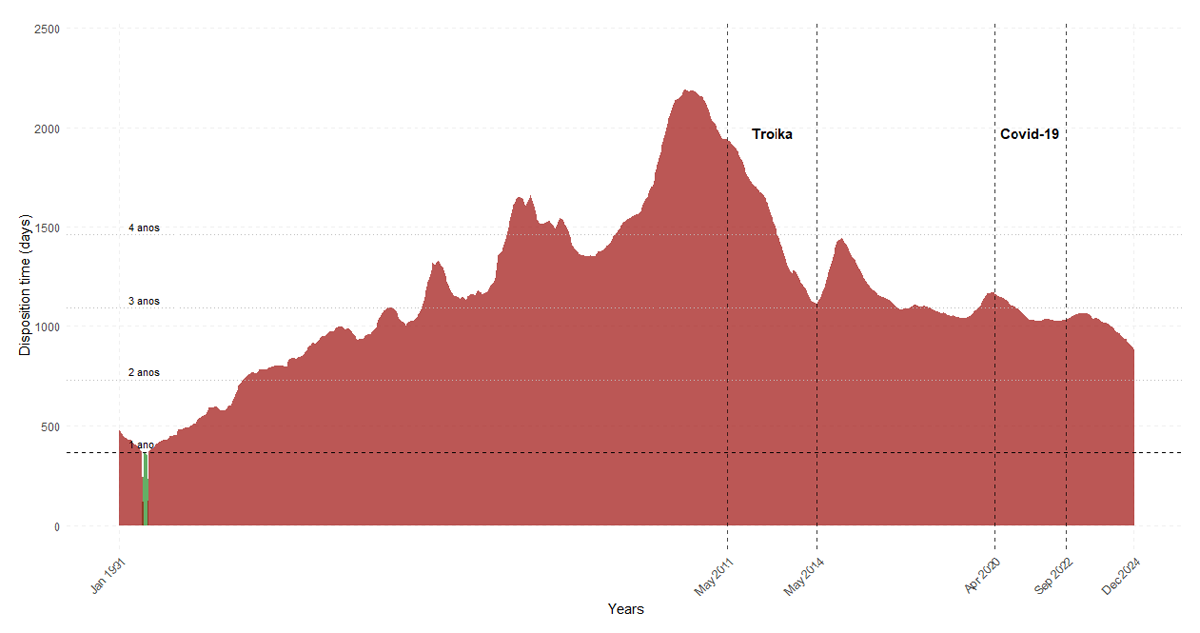
Figure 6
Civil enforcement actions disposition time (1991–2024).
Source: Prepared by the authors. Red shading indicates disposition times exceeding one year.
Research hypothesis 2: Performance trajectory analysis
The second hypothesis examines the nature and direction of any observed changes through trend analysis of trajectory patterns. Figures 2, 4, and 5 enable systematic comparison of performance trajectories between the established reform period (2014–2020) and post-COVID period (2022–2024). The analysis reveals distinct directional changes that differ from established reform trajectory patterns.
Figure 5 illustrates that, whereas the 2014–2020 period was characterized by a stable high-performance trajectory, with clearance rates consistently above 150%, the post-COVID period exhibits a sustained downward trend. The 47-percentage-point decline (26.9%) from 175% to 128% during COVID-19 has continued into the post-COVID period, reaching 105% by 2024. This represents a fundamental shift from the improvement trajectory established during the critical juncture period.
Figure 4 reveals striking trajectory differences. The 2014–2020 period maintained robust negative procedural balances, indicating sustained system capacity. However, the post-COVID period exhibits convergence dynamics where the negative balance decreased by 57.4% during COVID-19 (from –5,466 to –2,328) and has continued weakening to –697 in the post-COVID period. The trajectory analysis shows incoming cases growing faster than resolved cases, creating convergence patterns absent during the high-performance baseline period.
Figure 2’s seasonally adjusted data confirms that post-COVID trajectory patterns differ fundamentally from established reform trends. While the baseline period showed stable high-capacity performance, the post-COVID period exhibits potential erosion of the margins that supported reform sustainability. The trajectory analysis reveals concerning directional changes, but the policy significance of these patterns requires assessment of their proximity to critical performance thresholds.
Research hypothesis 3: Sustainability risk assessment
The third hypothesis evaluates the policy significance of observed patterns by assessing their proximity to critical performance thresholds. The performance indicator analysis reveals that post-COVID patterns approach critical threshold values that warrant immediate policy attention for maintaining institutional reform achievements.
Figure 5 demonstrates that clearance rates have declined to 105% by December 2024, placing the system dangerously close to the critical 100% threshold. The current trajectory suggests a potential breach of this critical threshold within the near term if current trends continue. Figure 4 reveals that procedural balance has weakened from baseline levels of –8,214 to current levels of –697, representing a 92% loss of the system’s capacity margin. This dramatic erosion indicates that the system’s ability to handle demand fluctuations has been compromised. The convergence of incoming and resolved cases shown in Figure 4 suggests the system is approaching equilibrium conditions that historically preceded institutional crisis.
Multiple indicators provide early warning signals of sustainability risks, namely, growing incoming caseloads outpacing resolution capacity (Figure 2), procedural balance weakening toward zero (Figure 4), clearance rates approaching the 100% threshold (Figure 5), and convergence patterns reminiscent of pre-reform periods.
Figure 6 presents a paradox: while disposition times continue improving (888 days in December 2024), this occurs alongside deteriorating capacity indicators. This suggests that current performance may be artificially sustained by processing accumulated backlogs rather than reflecting genuine institutional capacity, raising questions about medium-term sustainability. The threshold analysis indicates that Portuguese civil enforcement reforms face immediate sustainability risks requiring proactive intervention. The convergence patterns observed in Figures 4 and 5 suggest that without corrective action, the system may revert to pre-reform inefficiency levels, potentially reversing over a decade of institutional improvements achieved through the critical juncture intervention. Table 4’s statistical similarity analysis confirms these findings: the post-COVID period demonstrates performance characteristics significantly different from the high-performance baseline, with concerning approximation to threshold values that historically indicated institutional instability. The comprehensive analysis supports all three hypotheses and indicates the need for policy attention to prevent erosion of reform achievements.
6. Conclusion and Avenues for Future Research
This study examined whether the performance improvements achieved through Portuguese justice reforms are being sustained in the post-COVID period (2022–2024). The comprehensive longitudinal analysis of 33 years of civil enforcement data provides clear evidence that reform sustainability is under significant threat. While the transformative achievements of the 2011 Troika intervention persisted through the COVID-19 pandemic, the post-COVID period demonstrates concerning patterns.
The results support key propositions from critical junctures and path dependence studies while extending their application to justice system sustainability analysis. Critical junctures perspectives79 successfully explained how the 2011 Troika intervention created conditions for fundamental change. The extraordinary conditions of economic crisis, external oversight, and political urgency enabled comprehensive reform of enforcement actions. Path dependence perspectives80 proved particularly valuable for understanding both reform sustainability and erosion dynamics. The post-COVID findings confirm Pierson’s warning that path-dependent processes remain vulnerable to erosion if supporting mechanisms weaken or environmental conditions create new institutional pressures.
This research extends reform sustainability literature81 by demonstrating how gradual change during post-reform periods can either reinforce or undermine initial achievements. The post-COVID period illustrates how small, incremental modifications – growing incoming caseloads, declining resolution capacity, weakening procedural balances – can accumulate to threaten institutional sustainability even when no dramatic reversal events occur. Together, the three hypotheses provide a comprehensive framework for understanding whether Portuguese enforcement reforms demonstrate continued path dependence or exhibit signs of sustainability erosion requiring policy attention.
All three research hypotheses were confirmed, providing systematic evidence of sustainability erosion. Post-COVID performance demonstrates statistically significant deterioration across all indicators compared to the established baseline, with clearance rates declining from 180% to 105%, procedural balances weakening by 92%, and concerning convergence patterns between incoming and resolved cases. Post-COVID trends differ fundamentally from the stable high-performance patterns established during 2014–2020, showing systematic erosion rather than continued improvement or stable maintenance of prior gains. Performance indicators approach critical thresholds historically associated with institutional instability, particularly the dangerous proximity of clearance rates to the 100% threshold that characterized pre-reform challenges.
These findings call for policy reflection to prevent reversal of over a decade of improvements. Early warning systems should implement systematic monitoring of critical thresholds with automated alerts when performance approaches dangerous levels. Adequate investment in the technological and human infrastructure supporting reformed procedures is crucial, as path dependence mechanisms require ongoing maintenance to remain effective. Stakeholder engagement must reinforce political and professional commitment to reform maintenance through education about sustainability risks and achievement preservation. Contingency planning should develop intervention protocols for performance deterioration scenarios to prevent institutional regression to pre-reform inefficiency levels. Additionally, given that ten years have passed since the last civil code reform, legislators may want to consider whether further legislative updates are needed.
This study makes three principal contributions: theoretical, empirical and methodological. Theoretically, it advances knowledge in public administration and justice policy by demonstrating how critical junctures and path dependence theory apply to institutional change durability in justice systems. Empirically, it provides evidence of long-term reform outcomes beyond immediate implementation periods, addressing critical gaps in justice administration literature regarding institutional change sustainability over extended periods. Methodologically, the 33-year longitudinal analysis offers unique insights into how external shocks affect institutional performance and reform durability. Additionally, the study offers policy-relevant guidance to court administrators, through evidence-based early warning indicators and actionable insights for maintaining reform achievements and preventing regression to pre-reform inefficiencies.
The study demonstrates that successful justice reforms require ongoing attention to sustainability dynamics rather than assuming that initial achievements will automatically persist. Performance indicators suggest we have reached a decisive period that will determine whether the positive transformations initiated by the Troika intervention become permanent structural improvements or merely represent a temporary enhancement cycle. The research contributes to justice administration literature by providing empirical evidence that reform evaluation must extend beyond immediate implementation periods to assess long-term sustainability.
Civil enforcement actions do not fully represent broader justice system dynamics. It is crucial to understand whether this shift represents a structural issue across Portuguese courts or a challenge specific to civil enforcement actions. To address this question, future research should extend this analysis to other case types, such as insolvency cases, and examine how contextual factors, including judicial officer strikes and the adoption of telework practices in judicial organizations, have affected productivity in Portuguese courts. The study period encompasses only two years of post-COVID data (2022–2024), limiting assessment of longer-term trends.
Future research should closely track the procedural movement of civil enforcement actions, as the current findings indicate that this decisive period warrants systematic monitoring to understand the ultimate trajectory of reform sustainability. Additionally, while this research identifies sustainability risks, it does not examine the specific mechanisms causing performance deterioration. Future investigation should analyze whether erosion stems from resource constraints, political attention shifts, technological obsolescence, professional resistance, or broader socioeconomic pressures affecting institutional capacity.
Notes
[4] Seok-Jin Eom and Jooho Lee, “Editorial. Digital Government Transformation in Turbulent Times; 1–9: Responses, Challenges, and Future Directions,” Government Information Quarterly 39, no. 2 (2022), https://doi.org/10.1016/j.giq.2022.101690.
[5] Conceição Gomes, “The Transformation of the Portuguese Judicial Organization: Between Efficiency and Democracy”. Utrecht Law Review 3, no. 1 (2007): 101–11, https://doi.org/10.18352/ulr.39; Marco Fabri and Philip M. Langbroek. The Challenge of Change for Judicial Systems: Developing a Public Administration Perspective (IOS Press, 2000).
[6] Giovanni Capoccia. “Critical Junctures.” In The Oxford Handbook of Historical Institutionalism, edited by Orfeo Fioretos, Tulia G. Falleti, and Adam Sheingate (Oxford University Press, 2016), 89–106, https://doi.org/10.1093/oxfordhb/9780199662814.013.5.
[7] Eom and Lee, “Editorial. Digital Government Transformation in Turbulent Times,” 1–9; Pedro Miguel Alves Ribeiro Correia and Susana Antas Videira, “Troika’s Portuguese Ministry of Justice Experiment, Part II: Continued Positive Results for Civil Enforcement Actions in Troika’s Aftermath”, International Journal for Court Administration 8, no. 1 (2016): 20–31, https://doi.org/10.18352/ijca.215.
[8] Pedro Miguel Alves Ribeiro Correia and Susana Antas Videira, “Troika’s Portuguese Ministry of Justice Experiment; An Empirical Study on the Success Story of the Civil Enforcement Actions”, International Journal for Court Administration 7, no. 1 (2015): 37–49, https://doi.org/10.18352/ijca.180.
[9] João Basílio, “Noções Básicas de Ação Executiva,” Conferência do Conselho Regional de Lisboa da Ordem dos Advogados (2020), https://crlisboa.org/wp/publicacao/nocoes-basicas-de-acao-executiva/; João Pedroso and Cristina Cruz, “A Acção Executiva: Caracterização, Bloqueios e Propostas de Reforma,” Observatório Permanente da Justiça Portuguesa (Centro de Estudos Sociais, 2001), https://crlisboa.org/docs/publicacoes/on-line/acao-executiva-caracterizacao-bloqueios-propostas-reforma.pdf.
[10] Pedro Miguel Alves Ribeiro Correia and Sandra Patrícia Marques Pereira, “O Impacto da Pandemia COVID-19 no Desempenho das Ações Executivas Cíveis: O que nos Dizem os Dados até ao Momento?”, Solicitadoria e Ação Executiva, no. 8 (2022): 216–34, https://issuu.com/camara_dos_solicitadores/docs/coletanea8/8?ff.
[11] João Basílio, “Noções Básicas de Ação Executiva,” Conferência do Conselho Regional de Lisboa da Ordem dos Advogados (2020), https://crlisboa.org/wp/publicacao/nocoes-basicas-de-acao-executiva/.
[12] Hector Fix-Fierro, Courts, Justice, and Efficiency: A Socio-Legal Study of Economic Rationality in Adjudication (Hart Publishing, 2003).
[13] Sandra Patrícia Marques Pereira and Pedro Miguel Alves Ribeiro Correia, “Sustainability of Portuguese Courts: Citizen Satisfaction and Loyalty as Key Factors,” Sustainability 12, no. 23 (2020): 10163, https://doi.org/10.3390/su122310163.
[14] Jan-Erik Lane, New Public Management: An Introduction (Routledge, 2000); Conceição Gomes, “The Transformation of the Portuguese Judicial Organization: Between Efficiency and Democracy,” Utrecht Law Review 3, no. 1 (2007): 101–11, https://doi.org/10.18352/ulr.39; Petra Pekkanen, Maija Eronen, Pauliina Seppälä, and Timo Pirttilä, “Designing and Implementing Delay Reduction Projects in Courts,” International Journal for Court Administration 4, no. 3 (2012): 94–103, https://doi.org/10.18352/ijca.89; George H. Frederickson, Kevin B. Smith, Christopher W. Larimer, and Michael J. Licari. The Public Administration Theory Primer, 2nd ed. (Westview Press, 2012).
[15] Gar Yein Ng, Marco Velicogna, and Cristina Dallara, “Monitoring and Evaluation of Courts Activities and Performance,” International Journal for Court Administration 1, no. 1 (2008): 58–64, https://doi.org/10.18352/ijca.129.
[16] George H. Frederickson, Kevin B. Smith, Christopher W. Larimer, and Michael J. Licari. The Public Administration Theory Primer.
[17] Tomas de Aquino Guimarães, Pedro Miguel Alves Ribeiro Correia, Luiz Akutsu, and João Abreu de Faria Bilhim, “Governança em Tribunais de Justiça de Portugal: Adaptação e Validação de Escala de Medida,” Ciências e Políticas Públicas 1, no. 1 (2015): 25–46, https://doi.org/10.33167/2184-0644.CPP2015.VIN1/pp.25-46.
[18] Philipp Ambach and Klaus U. Rackwitz, “A Model of International Judicial Administration? The Evolution of Managerial Practices at the International Criminal Court,” Law and Contemporary Problems 76, no. 3–4 (2013): 119–161, https://www.jstor.org/stable/24244675.
[19] Peter A. Hall and Rosemary C. R. Taylor, “Political Science and the Three New Institutionalisms,” Political Studies 44, no. 5 (1996): 936–57, https://doi.org/10.1111/j.1467-9248.1996.tb00343.x.
[20] Nuno Garoupa, O governo da justiça (Lisboa: Fundação Francisco Manuel dos Santos, 2011), https://ffms.pt/pt-pt/livraria/o-governo-da-justica.
[21] Mariana França Gouveia, Nuno Garoupa, and Pedro Magalhães, O Sistema Judiciário: Justiça Económica em Portugal (Fundação Francisco Manuel dos Santos, 2012).
[22] Sandra Patrícia Marques Pereira, Pedro Miguel Alves Ribeiro Correia, and João Abreu de Faria Bilhim, “Research of Innovation and Digital Transformation in Justice: A Systematic Review,” Journal of Digital Technologies and Law 2, no. 1 (2024): 221–50, https://doi.org/10.21202/jdtl.2024.12.
[23] Oona A. Hathaway, “Path Dependence in the Law: The Course and Pattern of Legal Change in a Common Law System,” Law, Economics, and Public Policy Working Papers, Paper 270, 2003.
[24] B. Smith, “Models of Judicial Administration and the Independence of the Judiciary: A Comparison of Romanian Self-Management and the Czech Executive Model,” Public Administration and Development 28, no. 2 (2008): 85–93, https://doi.org/10.1002/pad.483.
[25] Máximo Langer, “Revolution in Latin American Criminal Procedure: Diffusion of Legal Ideas from the Periphery,” The American Journal of Comparative Law 55, no. 4 (2007): 617–76, https://doi.org/10.1093/ajcl/55.4.617.
[26] Giovanni Capoccia and Daniel R. Kelemen, “The Study of Critical Junctures: Theory, Narrative, and Counterfactuals in Historical Institutionalism,” World Politics 59, no. 3 (2007): 341–69, https://doi.org/10.1017/S0043887100020852.
[27] Michael D. Greenberg, and Geoffrey McGovern. An Early Assessment of the Civil Justice System After the Financial Crisis: Something Wicked This Way Comes? (RAND Corporation, 2012), https://www.jstor.org/stable/10.7249/j.ctt3fh0gv.
[28] Jeremy Patrick, “Path dependency, the High Court, and the Constitution,” Journal of Judicial Administration 30, no. 2 (2020): 51–63. https://search.informit.org/doi/10.3316/agispt.20210128042854.
[29] Giovanni Capoccia, “Critical Junctures and Institutional Change,” In Advances in Comparative-Historical Analysis, edited by James Mahoney and Kathleen Thelen, (Cambridge University Press, 2015), 145–79, https://doi.org/10.1017/CBO9781316273104.007.
[30] Correia, Pedro Miguel Alves Ribeiro, “Sobre o SIADAP, a Teoria Institucional e o Ministério da Justiça em Portugal”. Scientia Iuridica 60, no. 325 (2011): 101–30.
[34] Sérgio André Lopes Resende, and Pedro Miguel Alves Ribeiro Correia, “Resistance to Change in the Public Sector: A Modern Concept?,” European Journal of Applied Business and Management 10, no. 3 (2024): 1–17, https://doi.org/10.58869/EJABM10(3)/01.
[35] Paul Pierson, “Increasing Returns, Path Dependence, and the Study of Politics,” American Political Science Review 94, no. 2 (2000): 251–67. https://doi.org/10.2307/2586011.
[36] Patrick McAuslan, “Path dependency, law and development.” Journal of Commonwealth Law and Legal Education 1, no. 1 (2001): 51–68, https://doi.org/10.1080/14760400108522887.
[37] Eom and Lee. “Editorial. Digital Government Transformation in Turbulent Times,” 1–9; Boaventura de Sousa Santos, “Os Tribunais e as Novas Tecnologias de Comunicação e de Informação,” Sociologias 7, no. 13 (2005): 82–109, https://doi.org/10.1590/s1517-45222005000100004.
[39] Sandra Patrícia Marques Pereira and Pedro Miguel Alves Ribeiro Correia, “Sustainability of Portuguese Courts: Citizen Satisfaction and Loyalty as Key Factors,” Sustainability 12, no. 23 (2020): 10163, https://doi.org/10.3390/su122310163; Kevin Burke and Steve Leben, “Procedural Fairness: A Key Ingredient in Public Satisfaction,” Court Review 44, nos. 1–2 (2007): 4–25, https://irlaw.umkc.edu/faculty_works/269.
[41] Jacob Torfing, “Rethinking Path Dependence in Public Policy Research,” Critical Policy Studies 3, no. 1 (2009): 70–83, https://doi.org/10.1080/19460170903158149.
[42] Walter J. M. Kickert and Frans-Bauke van der Meer, “Small, Slow, and Gradual Reform: What Can Historical Institutionalism Teach Us?,” International Journal of Public Administration 34, no. 8 (2011): 475–85, https://doi.org/10.1080/01900692.2011.583768.
[43] Pedro Miguel Alves Ribeiro Correia, Susana Antas Videira, and Ireneu Oliveira Mendes, “Troika’s Portuguese Ministry of Justice Experiment: Dissipation of Doubts about Success, Continuation and Confirmation of Positive Results,” Pensamiento Americano 12, no. 24 (2019): 40–53, https://doi.org/10.21803/pensam.v12i24.309.
[44] Edward S. Cohen, “Hector Fix-Fierro, Courts, Justice & Efficiency: A Socio-Legal Study of Economic Rationality in Adjudication (Hart Publishing, 2003), 268 pages,” Canadian Journal of Law and Society 19, no. 2 (2004): 173–76, https://doi.org/10.1017/S082932010000819X; Attaullah Shah, Hamid Ali Shah, Jason Smith, and Giuseppe Labianca, “Judicial Efficiency and Capital Structure: An International Study,” Journal of Corporate Finance 44 (2017): 255–74, https://doi.org/10.1016/j.jcorpfin.2017.03.012.
[45] Abeline Dorothea Reiling, “Technology for Justice: How Information Technology Can Support Judicial Reform.” PhD diss., Vrije Universiteit Amsterdam, 2009. https://research.vu.nl/ws/portalfiles/portal/42181632/complete percent20dissertation.pdf.
[46] Sandra Patrícia Marques Pereira, Pedro Miguel Alves Ribeiro Correia, and João Abreu de Faria Bilhim, “Research of Innovation and Digital Transformation in Justice: A Systematic Review,” Journal of Digital Technologies and Law 2, no. 1 (2024): 221–50, https://doi.org/10.21202/jdtl.2024.12.
[47] Naomi Creutzfeldt and Richard Kirkham, “Understanding How and When Change Occurs in the Administrative Justice System: The Ombudsman/ Tribunal Partnership as a Catalyst for Reform?,” Journal of Social Welfare and Family Law 42, no. 2 (2020): 253–73, https://doi.org/10.1080/09649069.2020.1751931.
[48] Pedro Miguel Alves Ribeiro Correia, Susana Antas Videira, and Ireneu Oliveira Mendes, “Troika’s Portuguese Ministry of Justice Experiment,” 40–53.
[49] Pedro Miguel Alves Ribeiro Correia and Sandra Patrícia Marques Pereira, “O Impacto da Pandemia COVID-19 no Desempenho das Ações Executivas Cíveis: O que nos Dizem os Dados até ao Momento?,” 216–3.
[50] Seok-Jin Eom and Jooho Lee. “Editorial. Digital Government Transformation in Turbulent Times,” 1–9.
[52] Mariana França Gouveia, Nuno Garoupa, and Pedro Magalhães, O Sistema Judiciário: Justiça Económica em Portugal.
[53] Alves Ribeiro Correia, and Antas Videira. “Troika’s Portuguese Ministry of Justice Experiment, Part II,” 20–31.
[55] Portugal, Memorandum of Understanding on Specific Economic Policy Conditionality, 2011, https://ec.europa.eu/economy_finance/eu_borrower/mou/2011-05-18-mou-portugal_en.pdf.
[56] Alves Ribeiro Correia, Antas Videira, and Oliveira Mendes, “Troika’s Portuguese Ministry of Justice Experiment,” 40–53.
[57] Alves Ribeiro Correia and Antas Videira, “Troika’s Portuguese Ministry of Justice Experiment, Part II,” 20–31.
[58] Available at: https://diariodarepublica.pt/dr/detalhe/decreto-lei/10-a-2020-130243053.
[59] Available at: https://diariodarepublica.pt/dr/detalhe/lei/1-a-2020-130473088.
[60] Available at: https://www.pordata.pt/pt/estatisticas/economia/crescimento-e-produtividade/taxa-de-crescimento-real-do-pib.
[64] Patrick McAuslan, “Path dependency, law and development,” Journal of Commonwealth Law and Legal Education 1, no. 1 (2001): 51–68, https://doi.org/10.1080/14760400108522887.
[65] Pedro Miguel Alves Ribeiro Correia, Ireneu Oliveira Mendes, Sandra Patrícia Marques Pereira, and Inês Subtil, “The Combat Against COVID-19 in Portugal: How State Measures and Data Availability Reinforce Some Organizational Values and Contribute to the Sustainability of the National Health System,” Sustainability 12, no. 18 (2020a): 7513, https://doi.org/10.3390/su12187513; Correia, Pedro Miguel Alves Ribeiro, Ireneu Oliveira Mendes, Sandra Patrícia Marques Pereira, and Inês Subtil. “The Combat Against COVID-19 in Portugal Part II: How State Measures and Data Availability Reinforce Some Organizational Values and Contribute to the Sustainability of the National Health System”. Sustainability 12, no. 20 (2020b): 8715. https://doi.org/10.3390/su12208715.
[68] Walter J. M. Kickert and Frans-Bauke van der Meer, “Small, Slow, and Gradual Reform: What Can Historical Institutionalism Teach Us?,” International Journal of Public Administration 34, no. 8 (2011): 475–485, https://doi.org/10.1080/01900692.2011.583768.
[74] Available at: https://www.siej.dgpj.mj.pt.
[75] Cases transferred, attached, incorporated, or integrated into other proceedings, as well as those referred to another entity, were excluded from the database, as they do not represent new cases in the courts but merely internal transfers within the Portuguese judicial system (Correia and Videira, 2015, 2016).
[76] Marcela Cohen Martelotte, Reinaldo Castro Souza, and Eduardo Antônio Barros da Silva, “Design of Seasonal Adjustment Filter Robust to Variations in the Seasonal Behaviour of Time Series,”Journal of Official Statistics 33, no. 1 (2017): 155–86, https://doi.org/10.1515/jos-2017-0009.
[77] For this calculation, the seasonally adjusted variables of incoming and resolved cases were used.
[78] Pedro Miguel Alves Ribeiro Correia and Sandra Patrícia Marques Pereira, “O Impacto da Pandemia COVID-19,” 216–34.
[79] Alves Ribeiro Correia and Antas Videira, “Troika’s Portuguese Ministry of Justice Experiment,” 37–49; Pedro Miguel Alves Ribeiro Correia and Susana Antas Videira, “Troika’s Portuguese Ministry of Justice Experiment, Part II”, 20–31.
[81] Dahan da Cunha Nascimento, Cristiane Rocha Silva, and Jonato Prestes, “Procedimentos Post Hoc: Orientação para Praticantes de Estatística em Ciências da Saúde,” Arquivos de Ciência do Esporte 6, no. 2 (2018): 45–49, https://doi.org/10.17648/aces.v6n2.2783.
[84] Alves Ribeiro Correia, Oliveira Mendes, Patrícia Marques Pereira, and Subtil, “The Combat Against COVID-19 in Portugal,” 7513; Correia, Alves Ribeiro, Oliveira Mendes, Patrícia Marques Pereira, and Subtil, “The Combat Against COVID-19 in Portugal Part II,” 8715; Creutzfeldt and Kirkham, “Understanding How and When Change Occurs,” 253–73.