
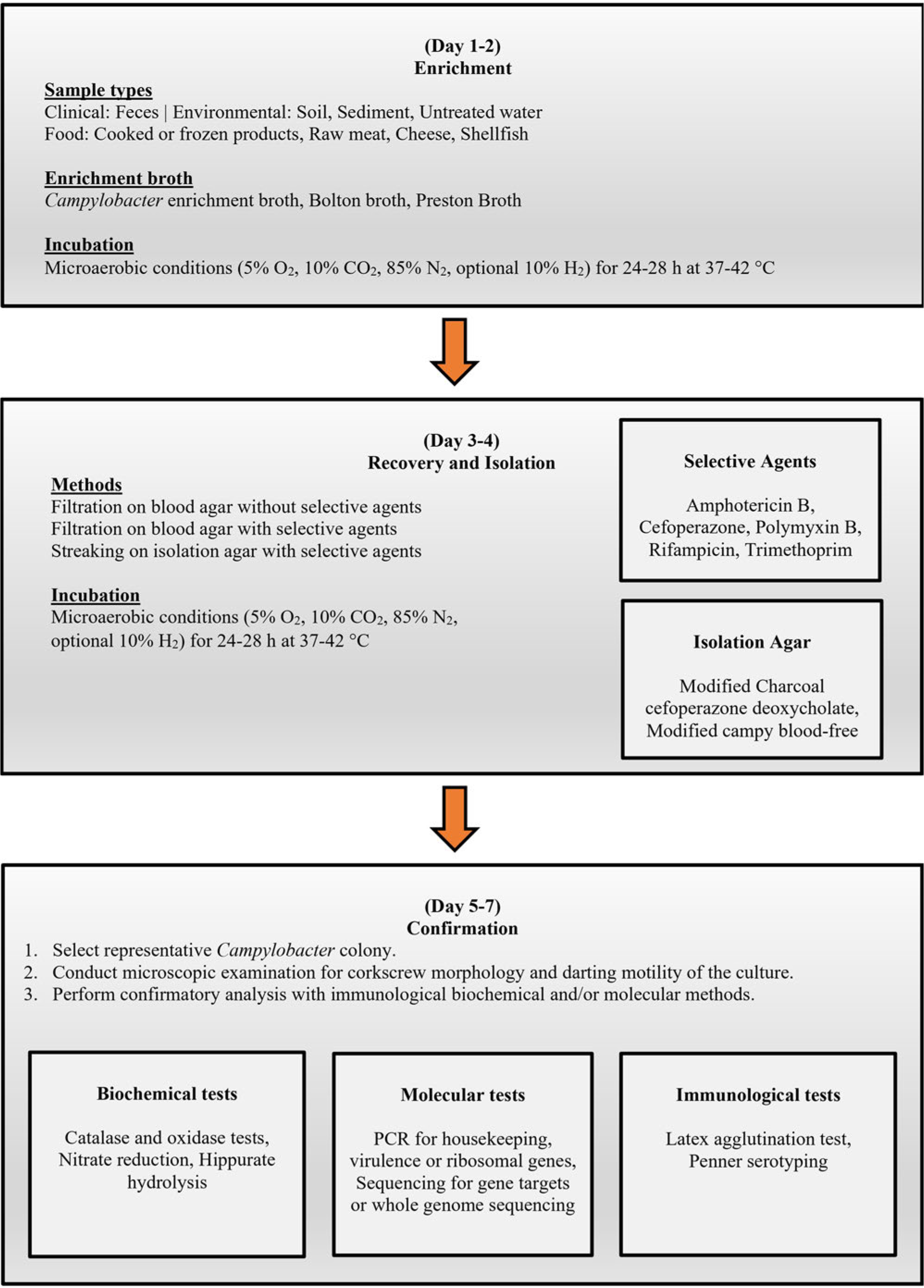
Fig. 1.
General flow chart showing the phases and the time required for the routine detection and identification/confirmation of Campylobacter spp. in food, water, and feces.
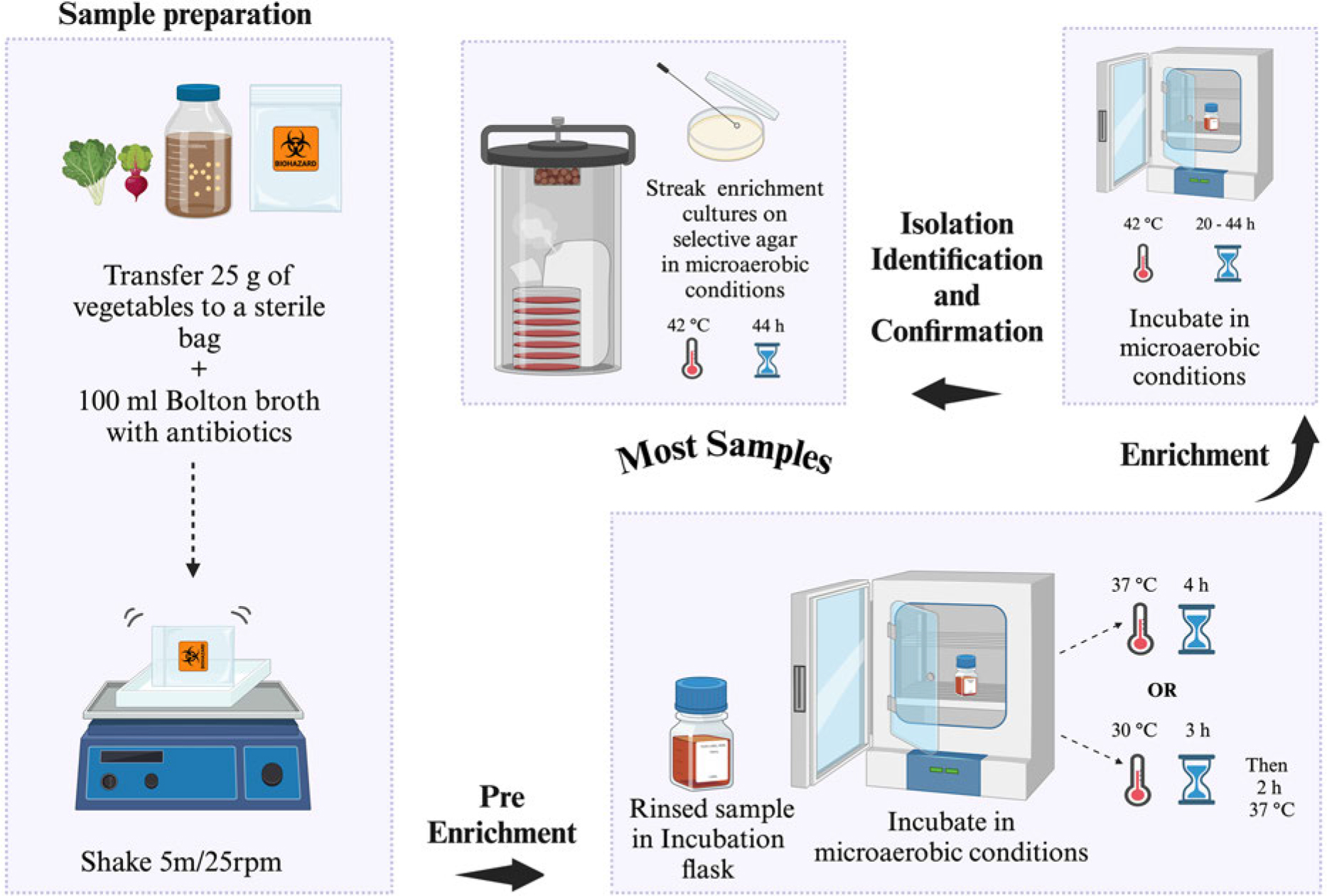
Fig. 2.
US FDA-BAM procedure for the isolation of Campylobacter spp. from most of the food samples (e.g., vegetables/raw meat). Selective agar recommended for isolation: modified charcoal cefoperazone deoxycholate agar (mCCDA) or Abeyta-Hunt-Bark agar, microaerobic conditions (N2: 85%, CO2: 10%, and O2: 5%).
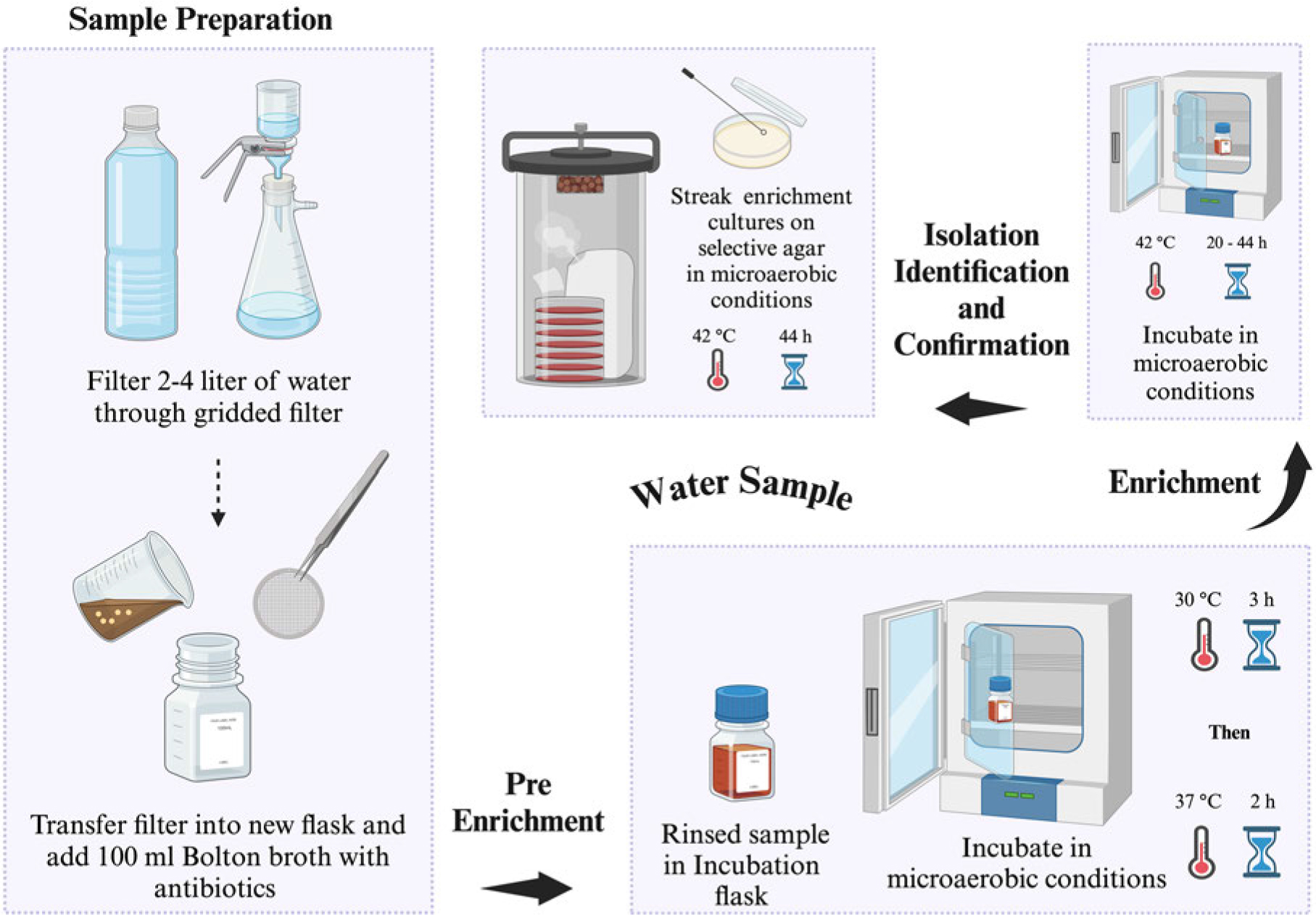
Fig. 3.
US FDA-BAM procedure for the isolation of Campylobacter spp. from drinking water. Selective agar recommended for isolation: modified charcoal cefoperazone deoxycholate agar (mCCDA) or Abeyta-Hunt-Bark agar, microaerobic conditions (N2: 85%, CO2: 10%, and O2: 5%).
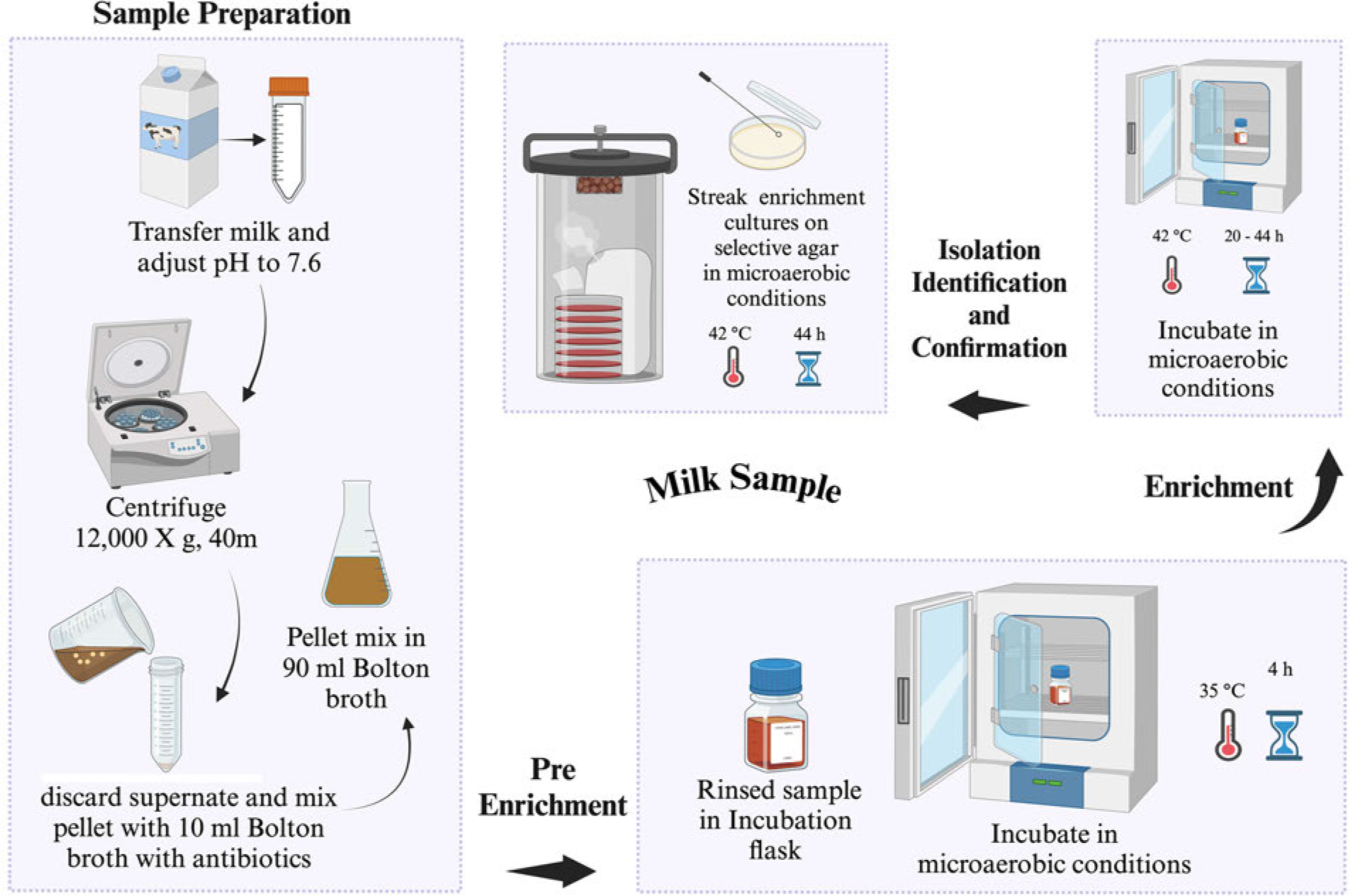
Fig. 4.
US FDA-BAM procedure for the isolation of Campylobacter spp. from milk. Selective agar recommended for isolation: modified charcoal cefoperazone deoxycholate agar (mCCDA) or Abeyta-Hunt-Bark agar, microaerobic conditions (N2: 85%, CO2: 10%, and O2: 5%).
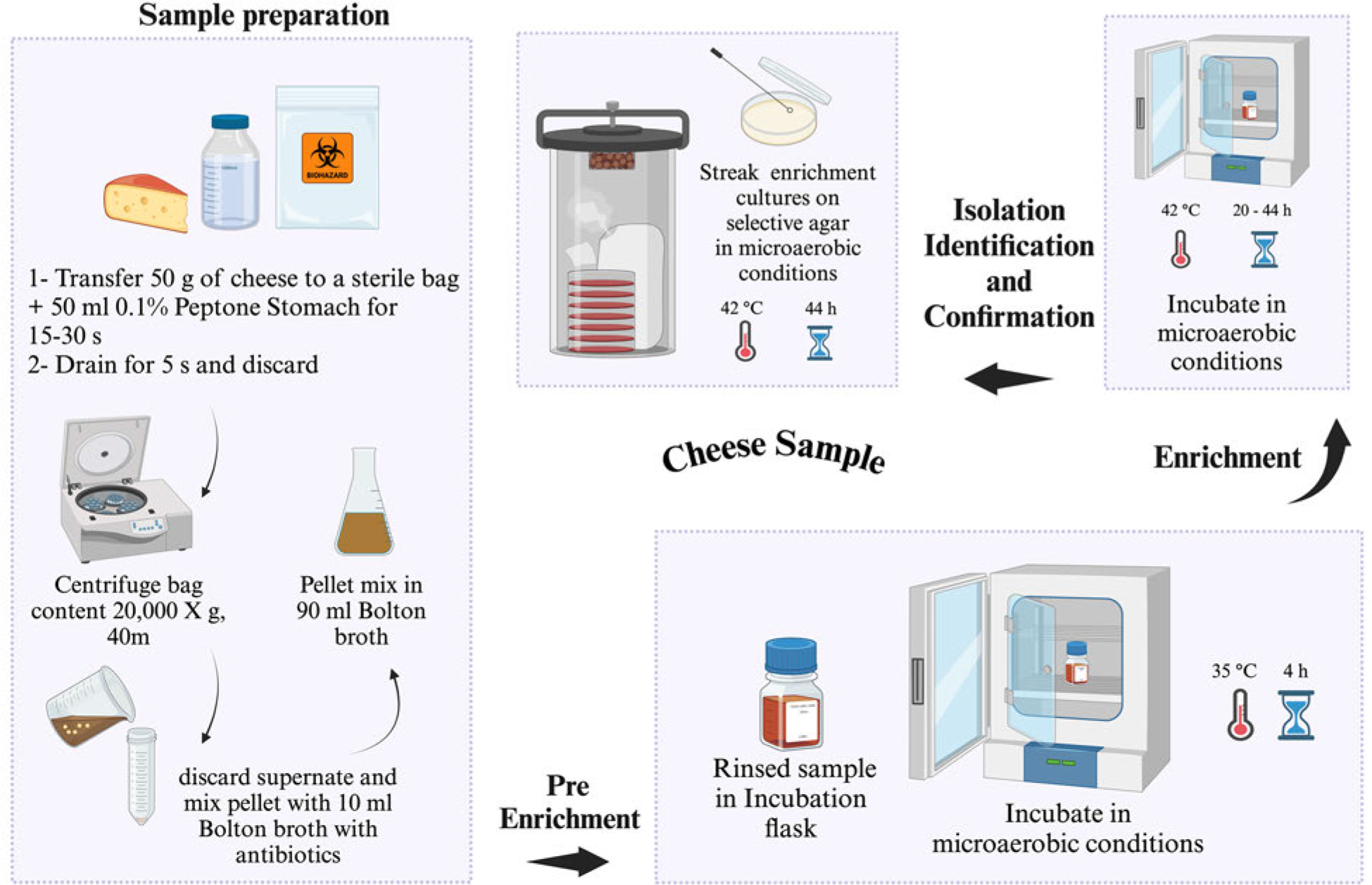
Fig. 5.
US FDA-BAM procedure for the isolation of Campylobacter spp. from cheese. Selective agar recommended for isolation: modified charcoal cefoperazone deoxycholate agar (mCCDA) or Abeyta-Hunt-Bark agar, microaerobic conditions (N2: 85%, CO2: 10%, and O2: 5%).
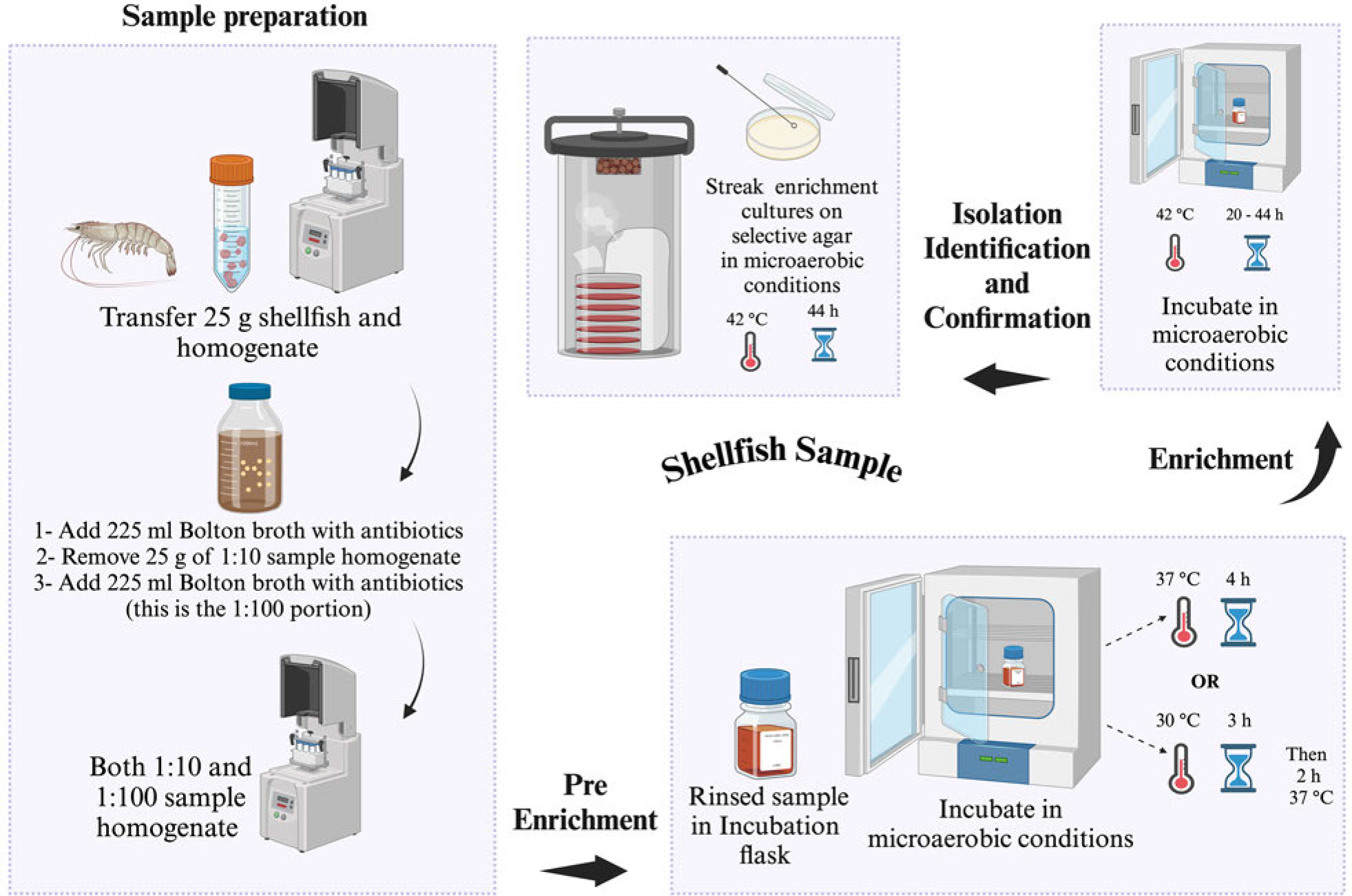
Fig. 6
US FDA-BAM procedure for the isolation of Campylobacter spp. from shellfish. Selective agar recommended for isolation: modified charcoal cefoperazone deoxycholate agar (mCCDA) or Abeyta-Hunt-Bark agar, microaerobic conditions (N2: 85%, CO2: 10%, and O2: 5%).
Table I
Summary of Campylobacter spp. isolation procedure set by FDA, ISO, and PHE.
| Organization | Sample type | Preenrichment | Enrichment | Selective plating | Reference |
|---|---|---|---|---|---|
| FDA | All sample types | Bolton broth | Bolton | mCCDA and/or Abeyta-Hunt-Bark agar | FDA 2001 |
| ISO | Samples with low campylobacters versus low background bacteria | Bolton broth | Bolton broth | mCCDA + other media of choice | ISO 2017 |
| ISO | Samples with low campylobacters versus high background bacteria | Not required | Preston broth | mCCDA + other media of choice | ISO 2017 |
| ISO | Samples with high campylobacters | Not required | Not required | mCCDA | ISO 2017 |
| ISO | All samples (colony count) | Not required | Not required | mCCDA | ISO 2017 |
| PHE | All food samples | Bolton broth | Bolton broth | mCCDA | PHE 2014 |
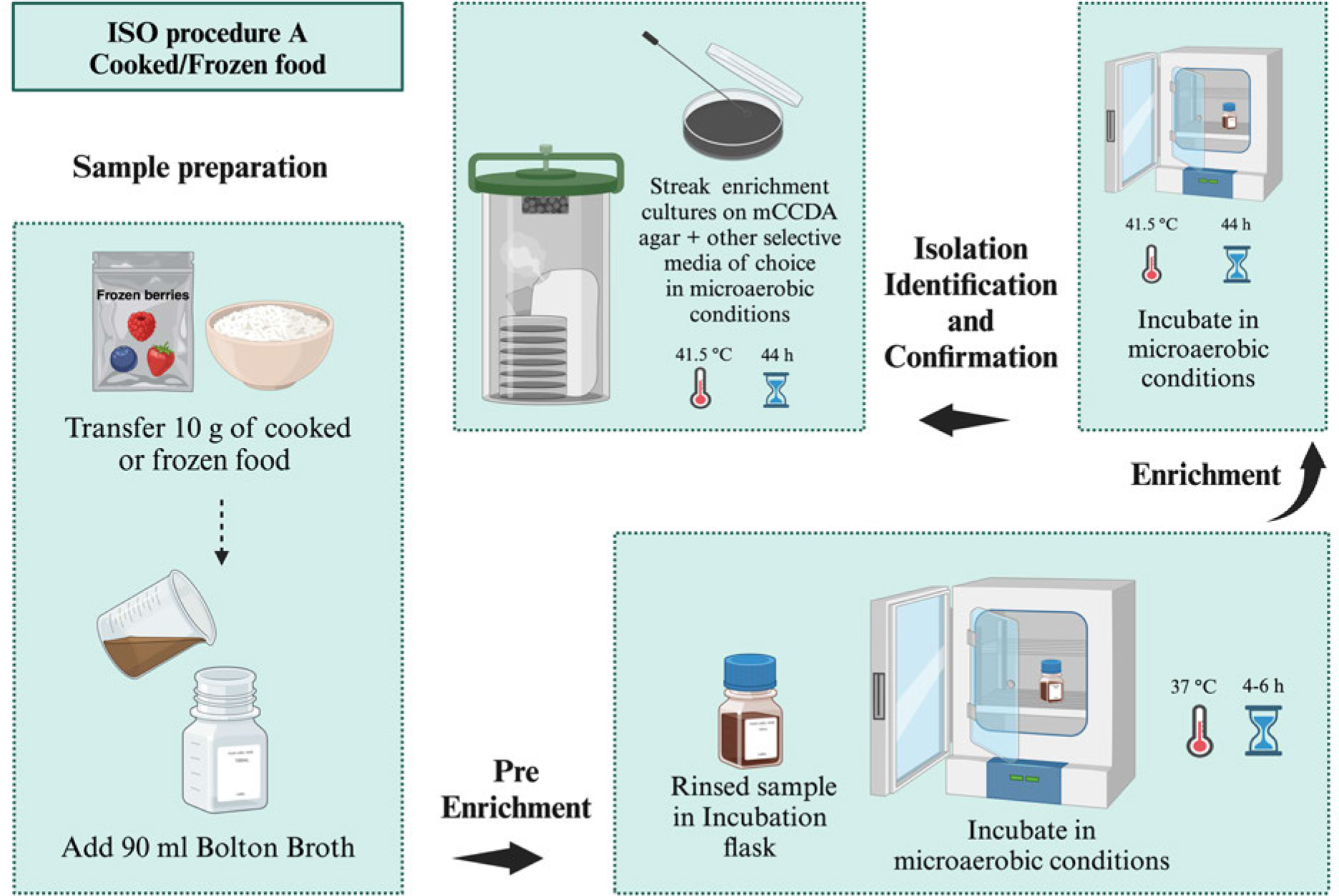
Fig. 7.
ISO procedure A for the isolation of Campylobacter spp. from samples with low number of Campylobacter and low number of background bacteria (e.g., cooked/frozen food), microaerobic conditions (N2: 85%, CO2: 10%, and O2: 5%).ISO procedure B for the isolation of Campylobacter spp. from samples with a low number of Campylobacter versus a high number of background bacteria (e.g., milk/raw meat), microaerobic conditions (N2: 85%, CO2: 10%, and O2: 5%). ISO procedure B for the isolation of Campylobacter spp. from samples with a low number of Campylobacter versus a high number of background bacteria (e.g., milk/raw meat), microaerobic conditions (N2: 85%, CO2: 10%, and O2: 5%).
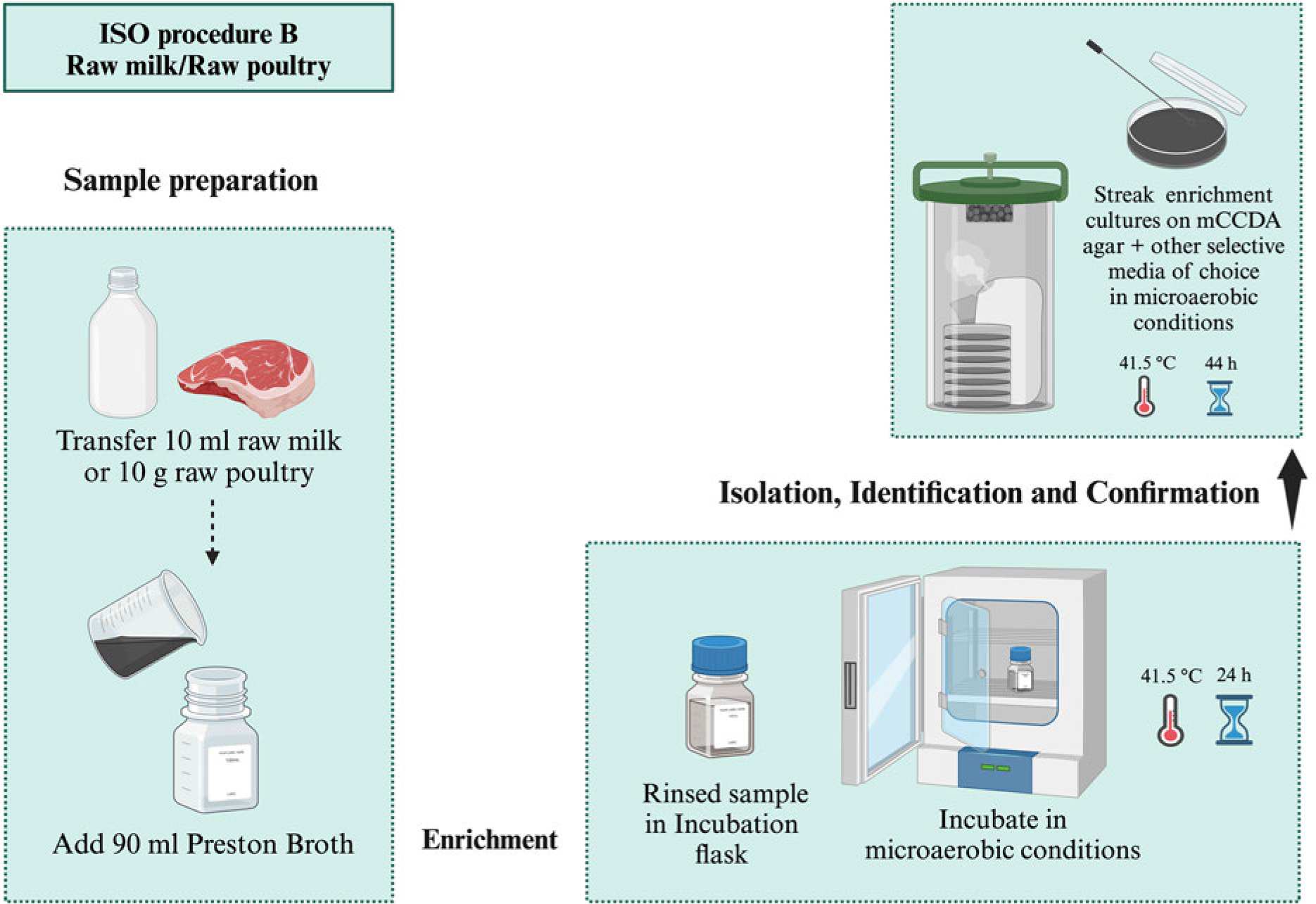
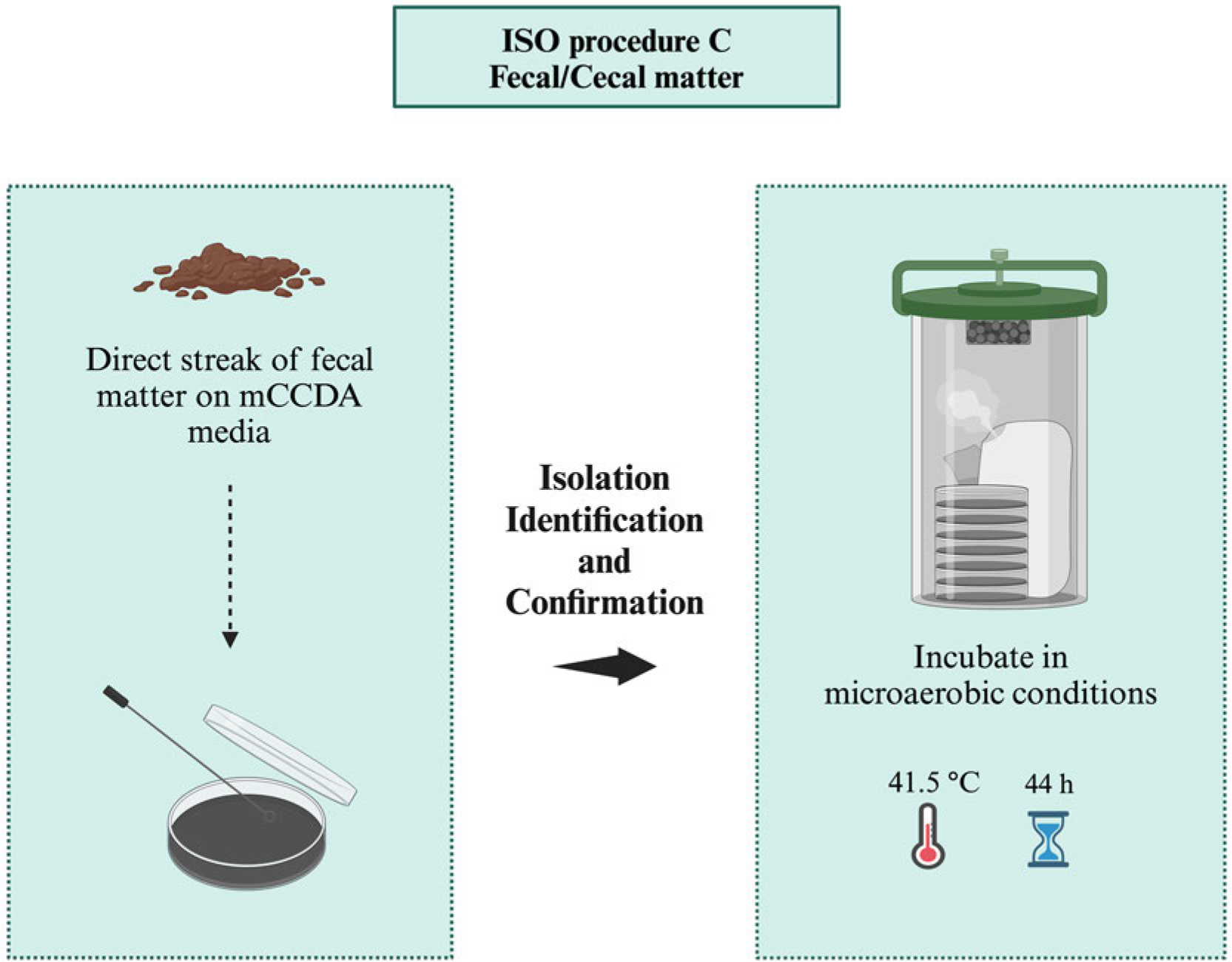
Fig. 9.
ISO procedure C for the isolation of Campylobacter spp. from samples with high number of Campylobacter (e.g., fecal/raw meat), microaerobic conditions (N2: 85%, CO2: 10%, and O2: 5%).
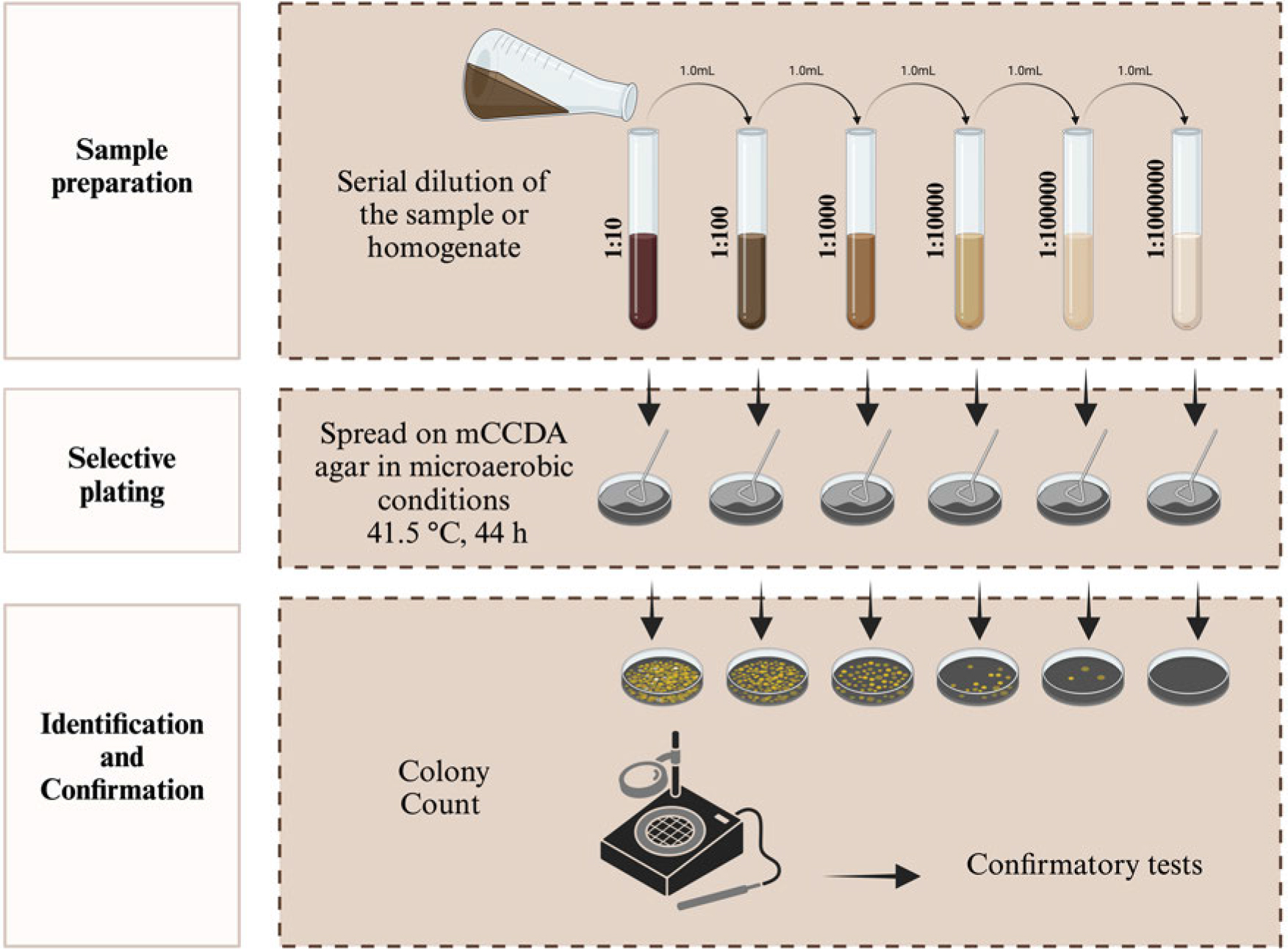
Fig. 10.
ISO procedure for the colony count of Campylobacter spp. in all food samples, microaerobic conditions (N2: 85%, CO2: 10%, and O2: 5%).
Table II
Campylobacter species and features that differentiate them.
| Species | Oxidase | Catalase | Growth at | Hippurate hydrolysis | Aerobic growth | Nitrate reduction | H2S | Sensitive to | TSI | Growth 1% glycine | |||
|---|---|---|---|---|---|---|---|---|---|---|---|---|---|
| 25°C | 37°C | 42°C | Cephalothin | NA | |||||||||
| Campylobacter jejuni | + | + | − | + | + | + | − | + | + | R | S | − | + |
| Campylobacter coli | + | + | − | + | + | − | − | + | + | R | S | − | + |
| Campylobacter fetus | + | + | + | + | (V) | − | − | + | V | S | R | − | + |
| Campylobacter upsaliensis | + | −/W | − | + | V | − | − | + | U | S | S | − | − |
| Campylobacter cinaedi | + | − | − | + | − | − | − | + | + | S | S | − | + |
| Campylobacter lari | + | + | − | + | + | − | − | + | + | R | R | − | + |
| Campylobacter fennellia | + | − | − | + | − | − | − | − | + | S | S | − | + |
| Campylobacter hyointenstinalis | + | + | V | + | V | − | − | + | + | S | S | + | − |
1 NA – Nalidixic acid, TSI – triple sugar iron agar R – resistant, S – sensitive, V – variable, W – weak, U – unknown, (V) – a few strains +
1 Source: modified from Corry et al. (1995); Corry and Atabay (2011)
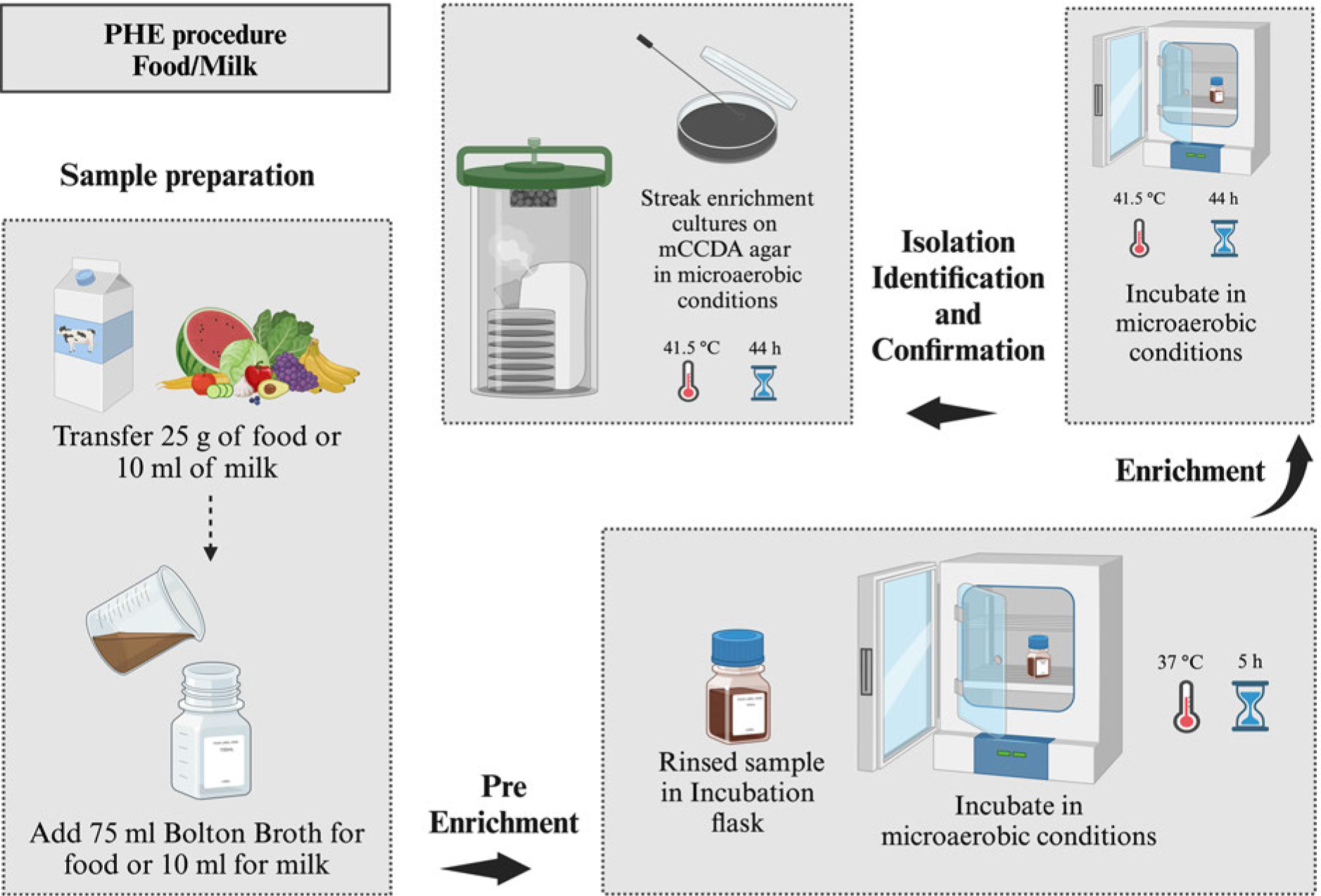
Fig. 11.
Public Health England procedure for the isolation of Campylobacter spp. from all types of food and milk, microaerobic conditions (N2: 85%, CO2: 10%, and O2: 5%).
Table III
Formulation of selective broth and plating media for the isolation of Campylobacter spp. (concentration in mg per liter, unless otherwise stated).
| Media | Basal medium | Antioxygen system | Cephalosporin | Trimethoprime | Polymyxin B/colistin (C) | Rifampicin | Novobiocin | Vancomycin | 5-Fluorouracil or Na-deoxycholate (D) | Bactiracin | Antifungals |
|---|---|---|---|---|---|---|---|---|---|---|---|
| Broth media | |||||||||||
| Bolton | A | 5% LH, 0.1 g HE, 0.5 g P, 0.5 g B | 20 czone | 20 | − | − | − | 20 | − | − | 50 CY |
| Preston | NB | 5% LH/FPB | − | 10 | 5000 | 10 | − | − | − | − | 100 CY |
| Exter | NB | 5% LH, 0.5 F, 0.2 B, 0.2 P | 15 czone | 10 | 4 g (C) | 10 | − | 10 | − | − | − |
| Rosef and Kapperud | NB | − | − | 5 | 2500 | − | − | 10 | − | − | − |
| Doyle and Roman | BB | 7% LH | − | 5 | 20000 | − | − | 15 | − | − | 50 CY |
| Agar media | |||||||||||
| Skirrow | BAB | 7% LH | − | 5 | 2500 | − | − | 10 | − | − | − |
| Campy-BAP | BA | 10% S | 15 cthin | 5 | 2500 | − | − | 10 | − | − | 2 AM |
| Butzler | TB | 10% S | 15 cthin | − | 10000 (C) | 5 | 25000 | 50 CY | |||
| CCD | NB | 4 g C, 0.25 F, 0.25 P | 10 czolin | − | − | − | − | − | 1000 (D) | − | − |
| mCCD | NB | 4 g C, 0.25 F, 0.25 P | 32 czone | − | − | − | − | − | 1000 (D) | − | 10 AM |
| Karmali | CA | 4 g C, 0.32 g HT, 0.1 P | 32 czone | − | − | − | − | 20 | − | − | − |
1 CCD – charcoal cefazolin deoxycholate, mCCD – modified charcoal cefoperazone deoxycholate, Campy–BAP – Campy Brucella agar, NB – nutrient broth, BB – Brucella broth base, BAB – blood agar base, BA – Brucella agar base, TB – thioglycolate broth base, CA – Columbia agar base, LH – lysed horse blood, HE – haemin, B – sodium metabisulfate, P – sodium pyruvate, F – ferrous sulfate, FPB – ferrous sulfate/sodium pyruvate/sodium metabisulfate, S – sheep blood, C – charcoal, HT – hematin, czone – cefoperazone, cthin – cephalothin, czolin – cefazolin, CY – cycloheximide – actidione, AM – amphotericin B, (C) – colistin, (D) – Na deoxycholate, A – 10 g meat peptone, 5 g lactoalbumin hydrolysates, 5 g yeast extract 5 g NaCl, 0.6 g NaCO3
1 Source: modified from Corry et al. (1995); Corry and Atabay (2011)