
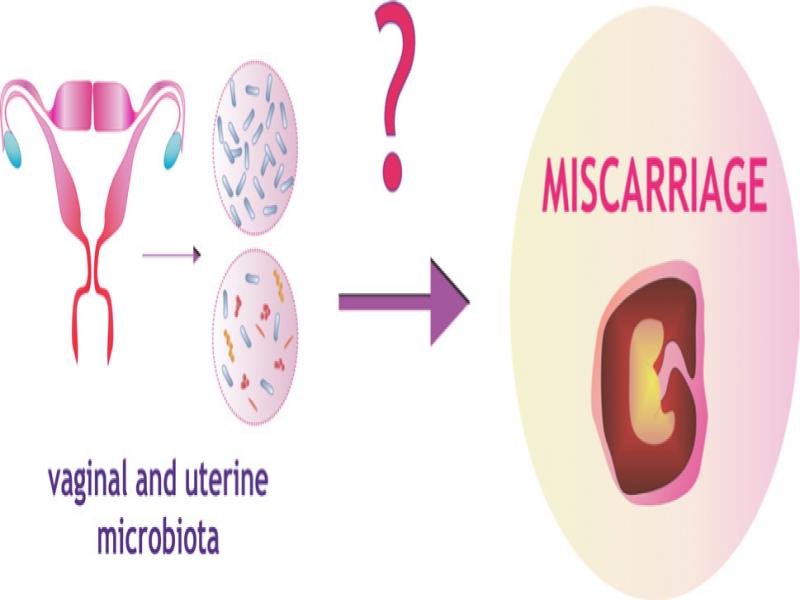
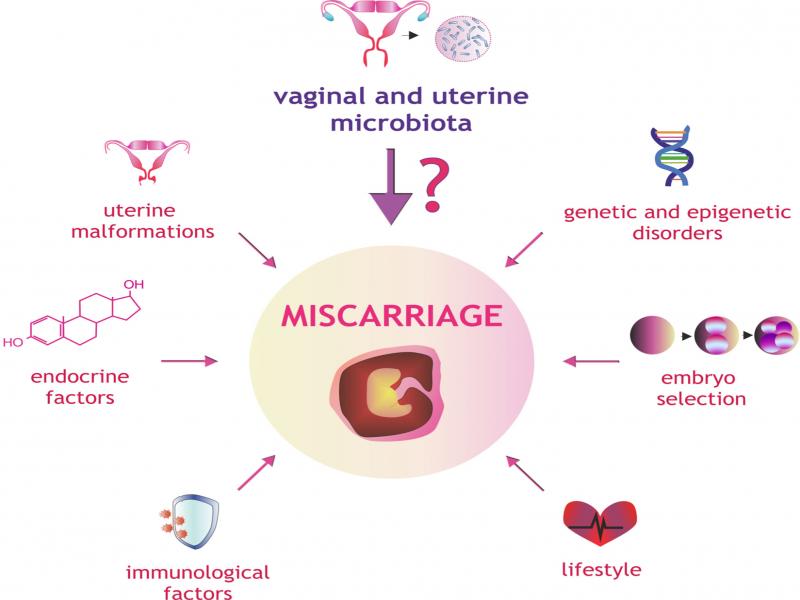
Fig. 1.
Factors affecting the risk of miscarriage.
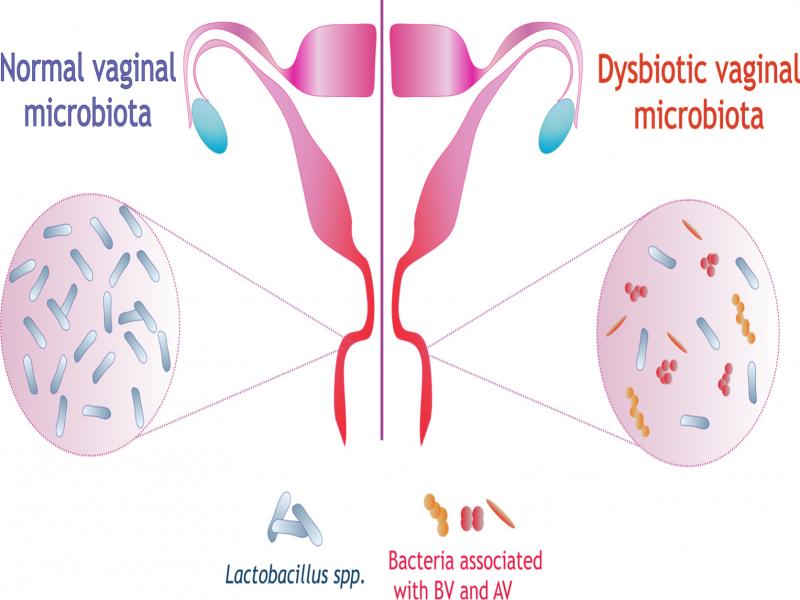
Fig. 2.
Normal vaginal microbiota and vaginal dysbiosis.
Table I
Effect of vaginal microbiota on miscarriage and recurrent miscarriage.
| References | Conclusions | |
|---|---|---|
| MISCARRIAGE | Nelson et al. (2007) | Lack of Lactobacillus spp. in the vagina during the first trimester of pregnancy may be associated with a risk of miscarriage in the second trimester |
| Bretelle et al. (2015) | The presence of pathogenic bacteria such as Chlamydia trachomatis, Atopobium vaginae, and Gardnella vaginalis in the vagina is associated with high-risk pregnancies and may contribute to miscarriage | |
| Nelson et al. (2015) | BV correlates with miscarriageAl-Memar et al. (2020) Decreased vaginal Lactobacillus spp. during the first or second trimester of pregnancy correlates with risk of miscarriage | |
| Chang et al. (2020) | The presence of Lactobacillus iners in the vagina increases the risk of miscarriage | |
| Xu et al. (2020) | The presence of Gardnerella, Prevotella as well as Megastrobila, and Cyclospora and the lack of Lactobacillus spp. in the vagina may contribute to pregnancy loss | |
| RECURRENT MISCARRIAGE (RM) | Llahi-Camp et al. (1996) | The BV is significantly more common among women who have had a second-trimester miscarriage than among women with RM |
| Işik et al. (2016) | The BV is associated with the occurrence of one miscarriage in the past six months. The BV does not affect the occurrence of recurrent miscarriage | |
| Kuon et al. (2017) | Lactobacillus spp. is not present in the vagina of women with RM | |
| Zhang et al. (2019) | Pathogenic bacteria in the vagina include Prevotella, Atopobium, and Streptococcus and reduced Lactobacillus spp. correlate with RM |
Table II
Effect of uterine microbiota on fertility and pregnancy maintenance.
| References | Conclusions |
|---|---|
| Kyono et al. (2018) | Endometrium dominated by Lactobacillus spp. favors embryo implantation |
| Moreno and Simon (2018) | Dysbiotic endometrium characterized by Atopobium, Bifidobacterium, Chryseobacterium, Gardnella, Haemophilus, Klebsiella, Neisseria, Staphylococcus, and Streptococcus correlates with abnormal pregnancy |
| Leoni et al. (2019) | The presence of mixed bacterial microbiota, not always Lactobacillus spp., is associated with a normal pregnancy |
| Moreno et al. (2020) | The endometrium before miscarriage is characterized by a greater diversity of bacteria and fewer Lactobacillus spp. |
| Moreno et al. (2021) | Types of bacteria such as Enterococcus, Enterobacteriaceae, Streptococcus, Staphylococcus, Gardnerella, Mycoplasma, Ureaplasma, Chlamydia, and Neisseria are responsible for chronic endometritis and suspected to have adverse effects on implantation as well as may contribute to miscarriage |