
Table 1.
Identification of keywords.
| Bibliographic Database | Keywords |
|---|---|
| Scopus | ALL ( ( ( "technology" OR "technologies" OR "methodologies" ) AND ( "automation" OR "automated" OR "optimization" OR "digitalization" OR "efficiency" OR "effectiveness" ) AND ( "fault diagnosis" OR "fault testing" OR "fault identification" OR "validating" OR "test" OR "testing" OR "test bench" OR "test equipment" OR "test set" OR "ATE" OR "fault diagnosis equipment" ) AND ( "aviation industry" OR "aviation maintenance" ) ) AND PUBYEAR > 2020 AND PUBYEAR < 2026 |
| Google Scholar | (("technology" OR "technologies" OR "methodologies") AND ("automation" OR "automated" OR "optimization" OR "digitalization" OR "efficiency" OR "effectiveness") AND ("fault diagnosis" OR "fault testing" OR "fault identification" OR "validating" OR "test" OR "testing" OR "test bench" OR "test equipment" OR "test set" OR "ATE" OR "fault diagnosis equipment") AND ("aviation industry" OR "aviation maintenance")) |
Table 2.
Selection criteria.
| Criteria | Inclusion | Exclusion |
|---|---|---|
| Language | English | Non-English |
| Timeline | 2020–2025 | <2020 |
| Type of literature | Journals indexed in Q1, Q2, or Q3; conference papers; reports | Book |
| Publication status | Final | In press |
| Subarea | Technology, management, and engineering | Humanities, medicine, and other areas outside the inclusion criteria |
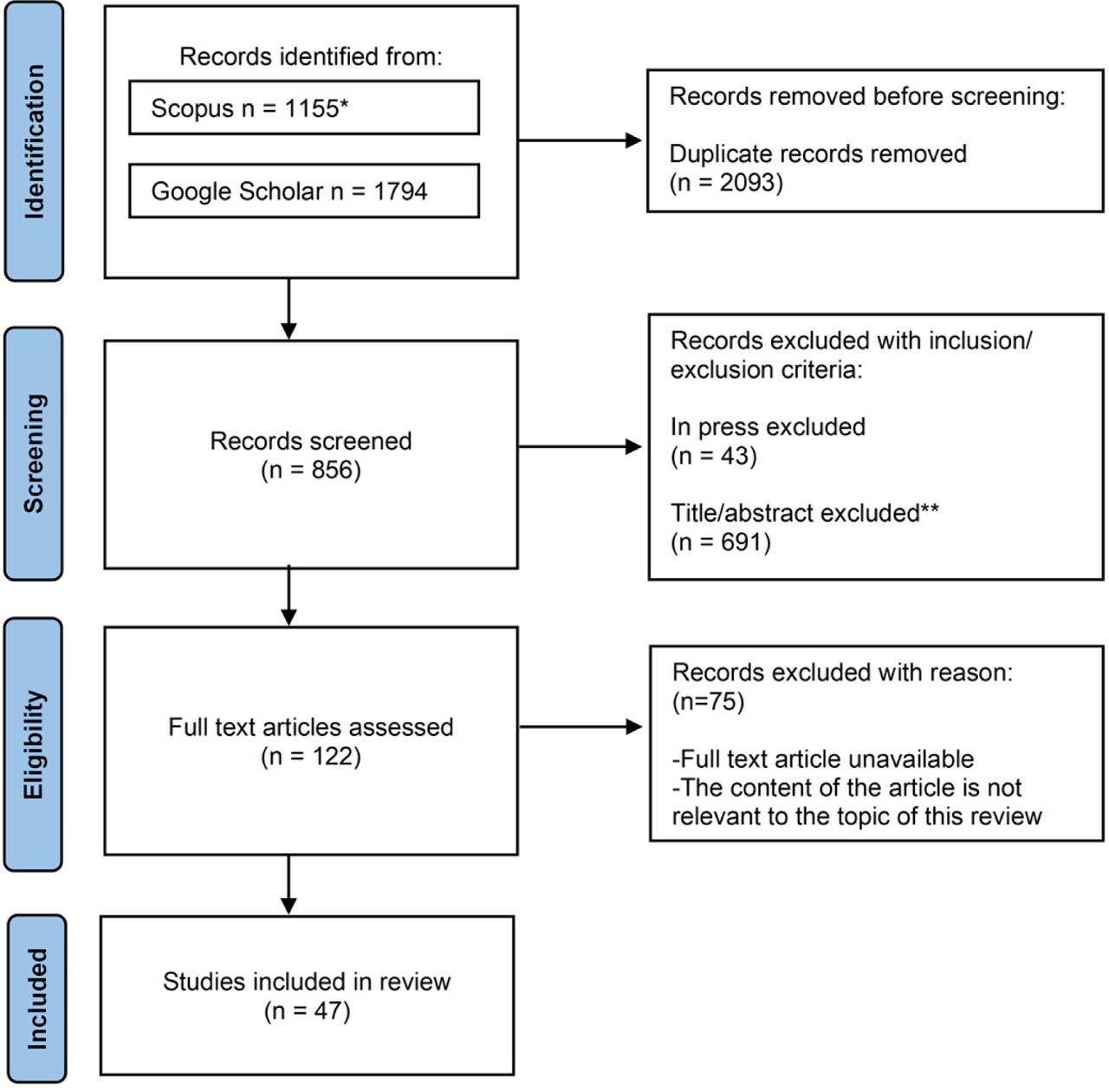
Fig. 1.
PRISMA flow diagram for the systematic review.
* Scopus relevance filter for the technology, management, and engineering fields.
** Not relevant to avionics maintenance, or not concerned with emerging technologies.
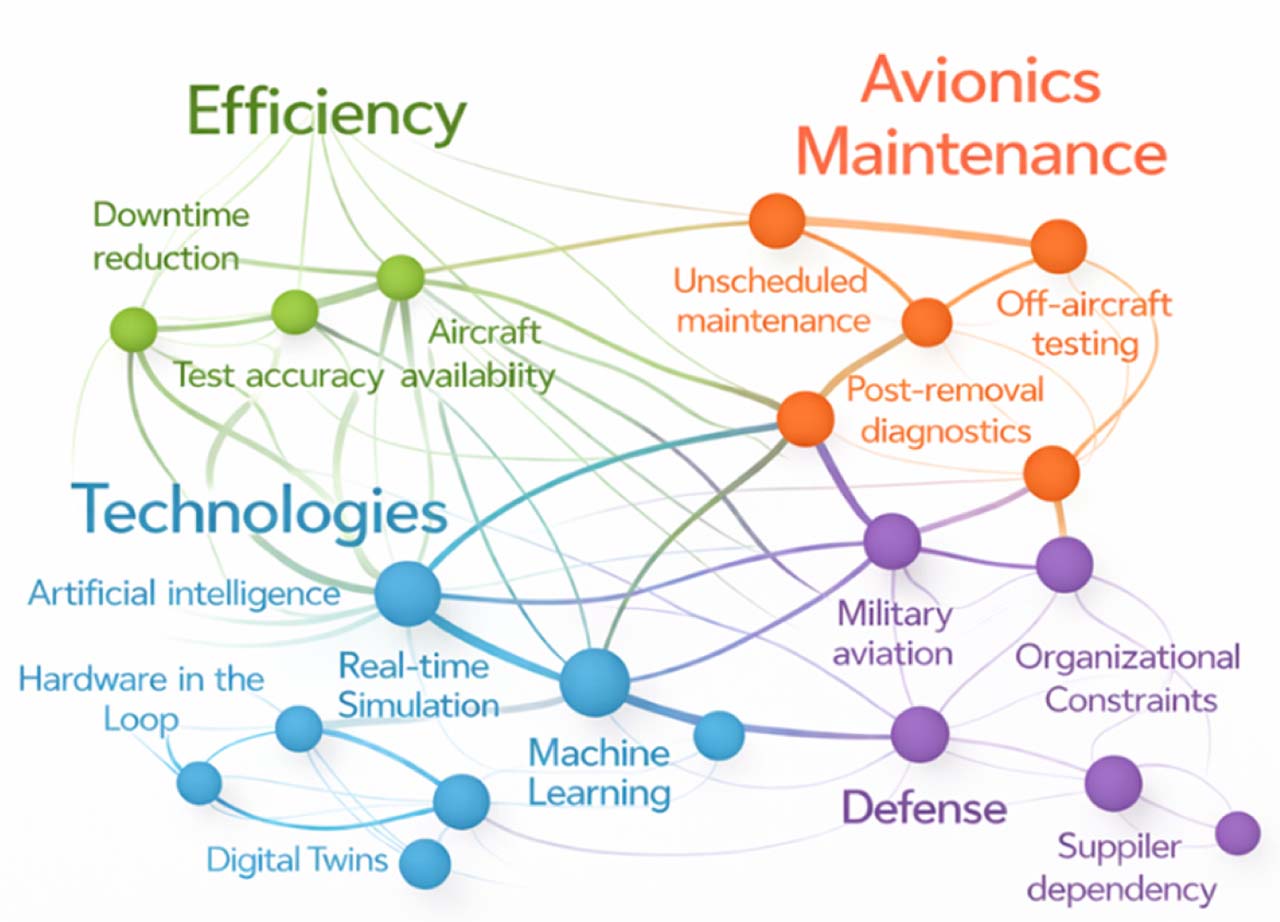
Fig. 2.
Keyword co-occurrence network for avionics component maintenance efficiency in the defense sector, 2020–2025.
The four clusters are: (i) maintenance efficiency (green); (ii) avionics maintenance (orange); (iii) technologies employed (blue); and (iv) defense sector (purple).
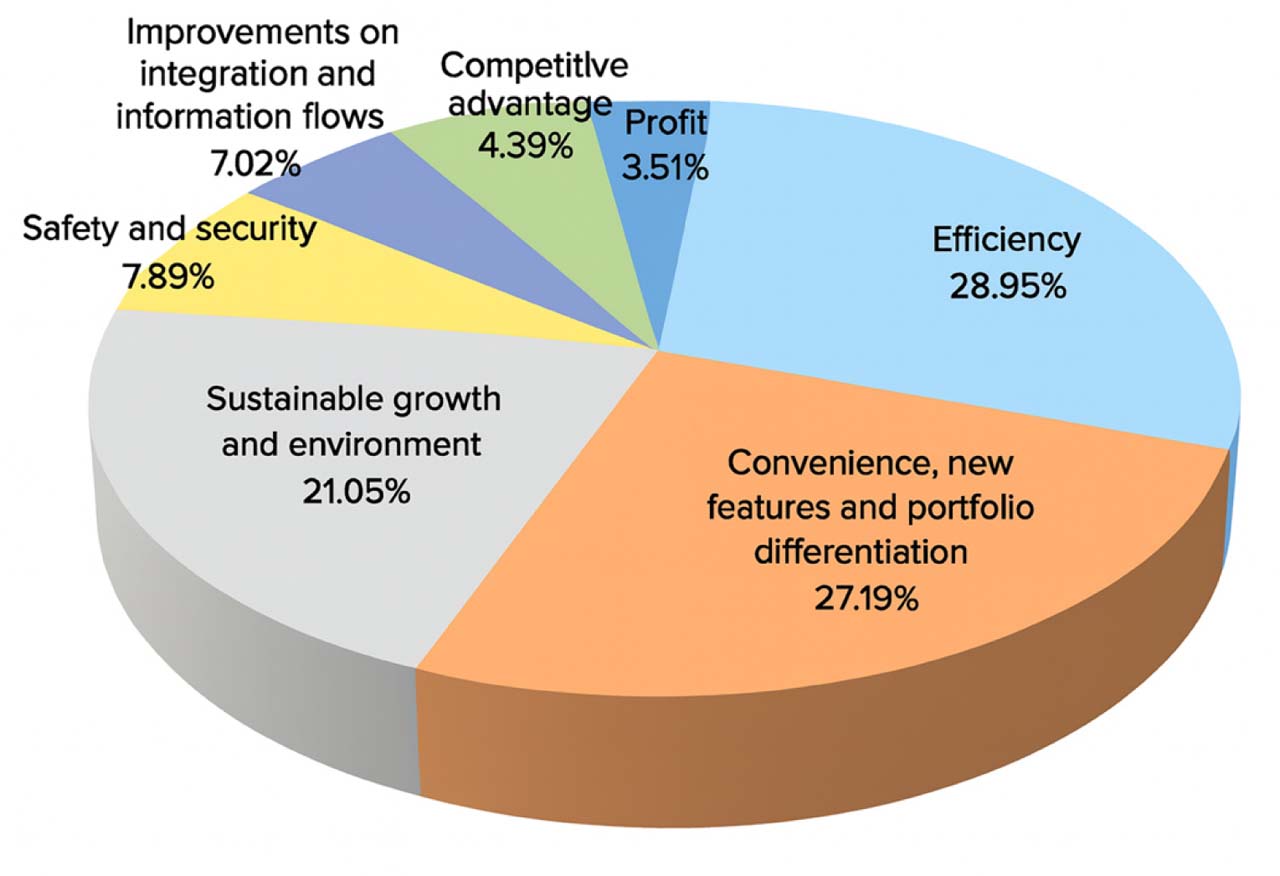
Fig. 3.
Distribution of value creation from technological advances in the aviation industry, 1999–2018 [55].
Table 3.
Advantages and limitations of the technologies and methodologies identified for aeronautical maintenance.
| Category | Number of papers | Technology/methodology | Type of maintenance | Advantages | Limitations | References |
|---|---|---|---|---|---|---|
| Diagnostics and testing of aeronautical components | 21 | Augmented and virtual reality | Scheduled | Accuracy in periodic inspections, reduced human error, and support for remote training | High implementation costs and a steep learning curve | [19,28,29,30,31,32,33,34,35,36,37,38,39,40,41,63,64,65,66,67,68] |
| Model-Based Testing and simulation | Scheduled | Early failure validation; reduced diagnosis and testing times | Complex modeling and dependence on simulated environments | |||
| Machine learning | Unscheduled | Early fault identification and high accuracy | Requires infrastructure for large data volumes; risk of bias | |||
| IoT and digital twins | Scheduled | Remote diagnostics and integration of maintenance data | Risk of cyberattack; requires robust infrastructure | |||
| Diagnostics and testing of avionics components | 09 | Digital Twins | Unscheduled | Real-time monitoring, improved traceability, and fault detection | Dependence on reliable data; cybersecurity risks | [41,42,43,44,45,46,53,69,70] |
| Artificial Intelligence | Unscheduled | Accurate, predictive diagnosis of complex faults | Requires robust computing infrastructure | |||
| Augmented Reality | Scheduled | Reduced human error in confined-space inspections | Requires specialized training and robust computational infrastructure | |||
| Hardware-in-the-Loop | Scheduled/Unscheduled | Virtual validation with reduced testing time and cost | Technical complexity in system modeling and calibration | |||
| FCC diagnosis and testing | 02 | Model-based systems and HIL | Scheduled | In-flight system monitoring in accordance with design requirements | Requires changes or modifications to the aircraft | [48,49] |
| Manual test set | Scheduled/Unscheduled | Measurement of multiple signals | Manual processes and limited automation | |||
| Efficiency in aeronautical maintenance | 15 | Mathematical optimization models | Scheduled | Reduced delays and costs; optimized task planning | Limited applicability to other types of maintenance | [12,19,20,28,55,56,57,58,59,60,61,62,71,72,73] |
| Resource management and planning | Scheduled | Efficient resource allocation and reduced downtime | Constrained by organizational culture and contextual factors | |||
| Digital twins / IoT | Scheduled / Unscheduled | Fault prediction and real-time data integration | Requires data infrastructure, large-volume data management, and cybersecurity measures | |||
| AI & Industry 4.0 | Scheduled / Unscheduled | Classification of technology maturity; reduced time and cost | Lack of standardization | |||
| Integration of sustainable processes | Scheduled | Integration of efficiency and sustainability | Requires structural changes shaped by organizational culture |
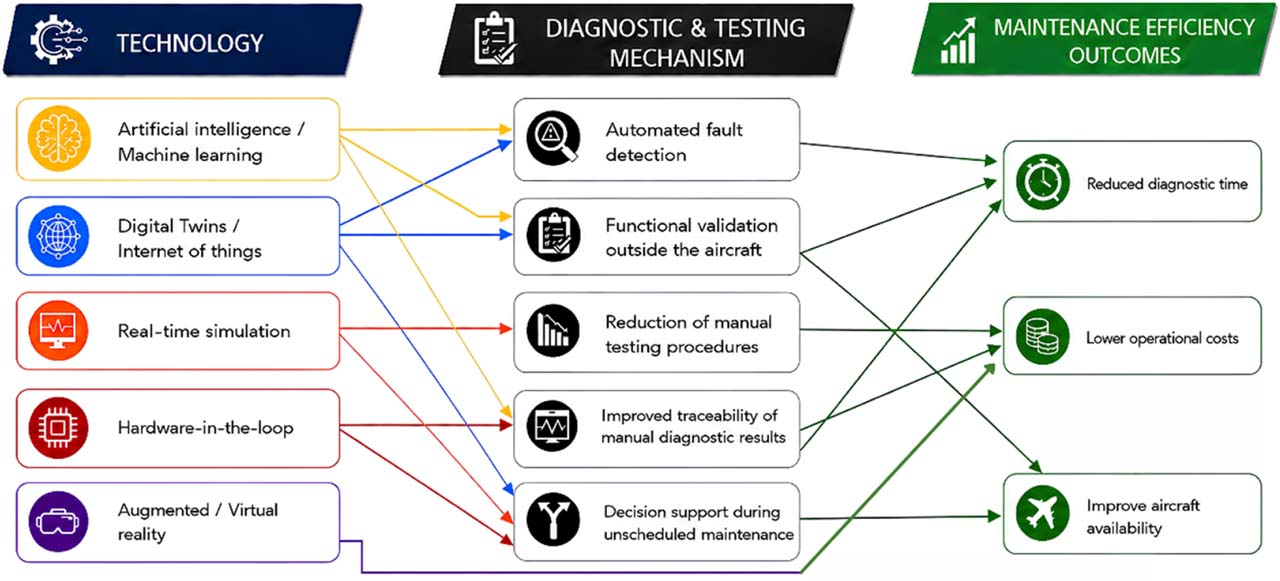
Fig. 4.
Conceptual synthesis linking technologies to efficiency outcomes in avionics maintenance.