
1. INTRODUCTION
Maintenance is essential to aircraft availability and airworthiness, and it is conventionally divided into two types: scheduled and unscheduled [1]. Scheduled maintenance takes place during inspections of aircraft systems and components, triggered by the time elapsed since the previous inspection [2]. Unscheduled maintenance, by contrast, arises from unforeseen events during operation. Military aviation is particularly exposed to the latter: aircraft fly a wide range of missions, often from harsh and unimproved sites, so their components wear more rapidly and reach the end of their service life sooner. This wear frequently makes depot-level or major repair necessary, that is, a complex intervention involving the complete reconstruction of parts, assemblies, and subassemblies [3].
Avionics are among the most demanding components to maintain in this way. They are classified as critical items because their failures are difficult to predict, and maintenance manuals treat them as condition-monitoring items [4]. The system comprises extensive wiring harnesses that connect subsystems and components throughout the airframe [5], and its correct operation is fundamental to helicopter flight. Within the avionics suite, the flight control computer (FCC) deserves particular attention. It processes sensor data and pilot commands in order to adjust the flight control systems automatically, thereby preserving the stability and safety of the aircraft.
Despite growing interest in emerging technologies for aeronautical maintenance, existing research has concentrated on predictive and scheduled maintenance strategies and on systems that monitor aircraft during operation. Few studies critically assess the range of advanced technologies available for diagnosing and testing avionics components during unscheduled maintenance, when those components have been removed from the aircraft.
The gap is most evident for critical subsystems such as the FCC, and it widens in military settings, where operational, organizational, and data availability constraints differ from those of civil aviation. This review addresses that gap by linking emerging technologies to the technical procedures of unscheduled maintenance under the restrictive operating conditions of military defense organizations.
The Colombian Army illustrates what these constraints mean in practice. It is the country's largest operator of military helicopters, and the fleet gives the institution its mobility and maneuver capability, supporting the defense of national sovereignty, aeromedical evacuation, firefighting, and disaster response, as well as military operations. Colombian Army records report approximately 33 FCC failures per year [6], and roughly 35% of the aviation sustainment budget is absorbed by unscheduled maintenance [7].
Because this work is unforeseen and occurs frequently, it is not provided for in the organization’s annual operating budget, and diagnosing, repairing, and testing the affected components consumes human and material resources that must be found elsewhere. The result is a problem with four dimensions: limited local repair capacity, high repair costs, long waiting times, and reduced aircraft availability.
Two questions follow: (i) which technologies are currently applied in aircraft maintenance, including the diagnosis and testing of avionics components and the flight control computer? and (ii) to what extent do these technologies improve the efficiency of aircraft maintenance, particularly within military organizations? Answering them is necessary to guide the development and implementation of technologies capable of improving aviation maintenance efficiency in the defense sector, and to direct future research.
This article pursues three objectives: (i) to review the existing literature on the use of technology in the aeronautical maintenance of avionics components; (ii) to examine the potential benefits of these technologies for military maintenance organizations; and (iii) to derive evidence-based recommendations for technology adoption in the Colombian Army that reflect the specific needs of the institution. The Colombian Army therefore serves as a motivating case rather than as the object of study. The literature reviewed is global in scope, and the findings apply broadly to comparable defense maintenance environments.
The main contribution of this article to the scientific literature is the analysis and consolidation of technological trends in the aeronautical maintenance of avionics components, with the FCC treated as a representative case within a defense institution. The outcomes fall into three groups: (i) an updated synthesis of the state of the art in emerging technologies for aeronautical maintenance; (ii) the identification of knowledge gaps in the application of these technologies within the defense sector; and (iii) dual-use guidance relevant to both the aeronautical industry and defense maintenance organizations.
2. BACKGROUND
Maintenance is one of the largest single costs in aviation operations [8]. That cost is shaped above all by whether the work is planned, which is why maintenance activities are divided into scheduled and unscheduled.
Scheduled maintenance is planned on the basis of flight hours, flight cycles, and calendar intervals, and is carried out according to a schedule that specifies both the procedures to be followed and the method for recording inspection and test results. Unscheduled maintenance is triggered instead by technical failures, reported defects, and faults found during inspection; it may originate in a scheduled task, in a pilot report, or in an unforeseen event such as a hard landing, overweight operation, or ground damage [9].
Total maintenance expenditure typically accounts for between 10% and 25% of an operator’s direct operating costs [10,11,12,13]. Unscheduled work adds to that burden in a distinctive way, because an unexpected component failure keeps the aircraft on the ground for longer, which lengthens turnaround times and raises costs [14].
Avionics form a safety-critical system: once a failure occurs, it can compromise the safe operation of the aircraft [15]. They are also expensive to maintain on modern aircraft, where these systems alone can account for up to 30% of total maintenance cost and therefore for a substantial share of operator expenditure [16]. Reported failure rates for avionics systems vary widely, from 20% to 50% [16], but even at the lower bound their effect on the maintenance budget is significant.
When an avionics failure occurs, the repair is carried out by highly trained personnel following a meticulous process based on visual inspection and on the detailed procedures set out in the manufacturer’s technical manuals. The tools are conventional. Data are collected with standard laboratory instruments such as multimeters, signal generators, and oscilloscopes, so that fault diagnosis remains an entirely manual activity. Where repair is not possible in-house, the operator must turn to external suppliers, whether national or international, and that dependence drives up costs and lengthens repair lead times, reducing component availability and the operational readiness of the fleet.
These pressures are compounded where public finances are tight. In countries such as Colombia, high inflation coincides with an austerity policy in defense spending that reflects a broader commitment to fiscal discipline and to the efficient use of public resources [17]. Funding is not the only politically determined variable. Political decisions also govern when and how the armed forces employ their aircraft, and that employment in turn shapes the demand for maintenance and repair [18]. Military institutions therefore carry a maintenance burden set largely outside their own control, and must look for alternatives that make their operations sustainable.
Against these constraints, technological trends point toward more sophisticated, digitized, and automated approaches to aviation maintenance. The industry describes this shift as Aeronautical Maintenance 4.0, a paradigm that promotes both safety and efficiency across the sector [19,20], and it frames the technologies examined in the remainder of this review.
3. MATERIAL AND METHODS
This study follows the Preferred Reporting Items for Systematic Reviews and Meta-Analyses (PRISMA) guidelines [21]. The review proceeded in three phases. The first identified keywords and located associated and related terms using thesauri and earlier research. Once all relevant terms had been selected, search strings were constructed for the Scopus and Google Scholar databases (Table 1). The cut-off date for the search was 2 January 2026.
Table 1.
Identification of keywords.
| Bibliographic Database | Keywords |
|---|---|
| Scopus | ALL ( ( ( "technology" OR "technologies" OR "methodologies" ) AND ( "automation" OR "automated" OR "optimization" OR "digitalization" OR "efficiency" OR "effectiveness" ) AND ( "fault diagnosis" OR "fault testing" OR "fault identification" OR "validating" OR "test" OR "testing" OR "test bench" OR "test equipment" OR "test set" OR "ATE" OR "fault diagnosis equipment" ) AND ( "aviation industry" OR "aviation maintenance" ) ) AND PUBYEAR > 2020 AND PUBYEAR < 2026 |
| Google Scholar | (("technology" OR "technologies" OR "methodologies") AND ("automation" OR "automated" OR "optimization" OR "digitalization" OR "efficiency" OR "effectiveness") AND ("fault diagnosis" OR "fault testing" OR "fault identification" OR "validating" OR "test" OR "testing" OR "test bench" OR "test equipment" OR "test set" OR "ATE" OR "fault diagnosis equipment") AND ("aviation industry" OR "aviation maintenance")) |
The search string was deliberately broad. It combined general concepts of technology, automation, and fault diagnosis with aircraft maintenance in order to retrieve publications on technologies applied to the diagnosis and testing of avionics components, rather than restricting the query to “flight control computer” and its synonyms. The intention was to map the full spectrum of emerging technologies in aircraft maintenance and to avoid narrowing the results prematurely to a single component.
This choice carries a methodological limitation: studies on the FCC published under alternative names were not searched for explicitly and may have been discarded during title and abstract screening where the terminology did not match “FCC” or “flight control computer” exactly. During full-text review, however, studies were identified that dealt specifically with the architecture, integration, validation, or testing of the flight control computer, which made it possible to assess the current state of the evidence for this critical component.
Articles published in journals indexed in the first, second, and third quartiles (Q1–Q3) were selected to ensure scientific relevance. Gray literature was also considered, given the restricted nature of military and defense data. The search returned 2,949 records; after duplicates were removed, 2,093 documents remained for screening. Table 2 sets out the inclusion and exclusion criteria applied.
Table 2.
Selection criteria.
| Criteria | Inclusion | Exclusion |
|---|---|---|
| Language | English | Non-English |
| Timeline | 2020–2025 | <2020 |
| Type of literature | Journals indexed in Q1, Q2, or Q3; conference papers; reports | Book |
| Publication status | Final | In press |
| Subarea | Technology, management, and engineering | Humanities, medicine, and other areas outside the inclusion criteria |
Applying these criteria left 122 initially eligible articles. Titles and abstracts were then screened, which produced a final sample of 47 articles, as shown in Figure 1.
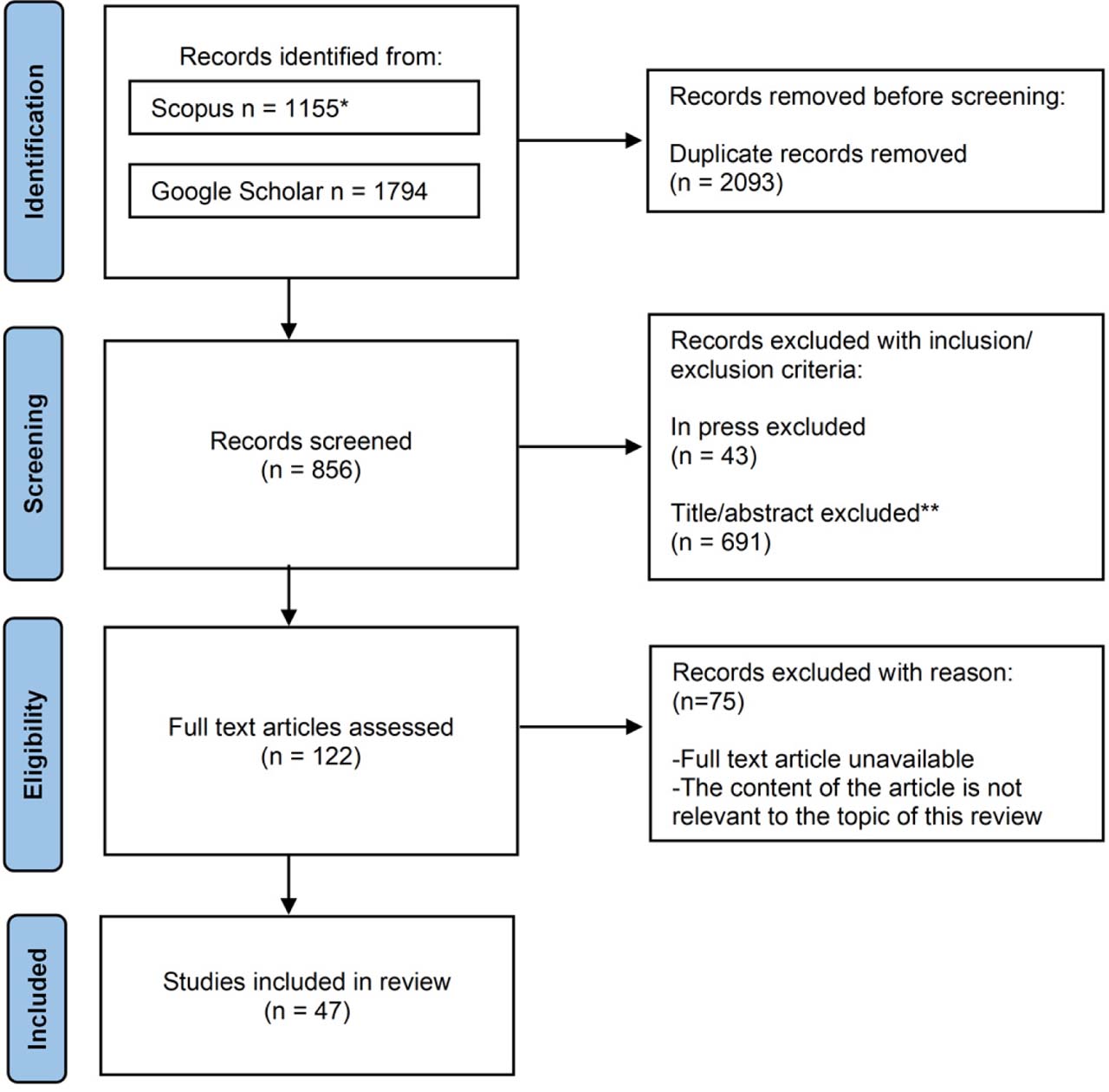
Fig. 1.
PRISMA flow diagram for the systematic review.
* Scopus relevance filter for the technology, management, and engineering fields.
** Not relevant to avionics maintenance, or not concerned with emerging technologies.
A keyword co-occurrence analysis was carried out alongside the systematic search in order to identify thematic clusters and conceptual connections. The resulting network is shown in Figure 2, which displays the frequency of recurring terms and the links between them. Four main clusters emerged.
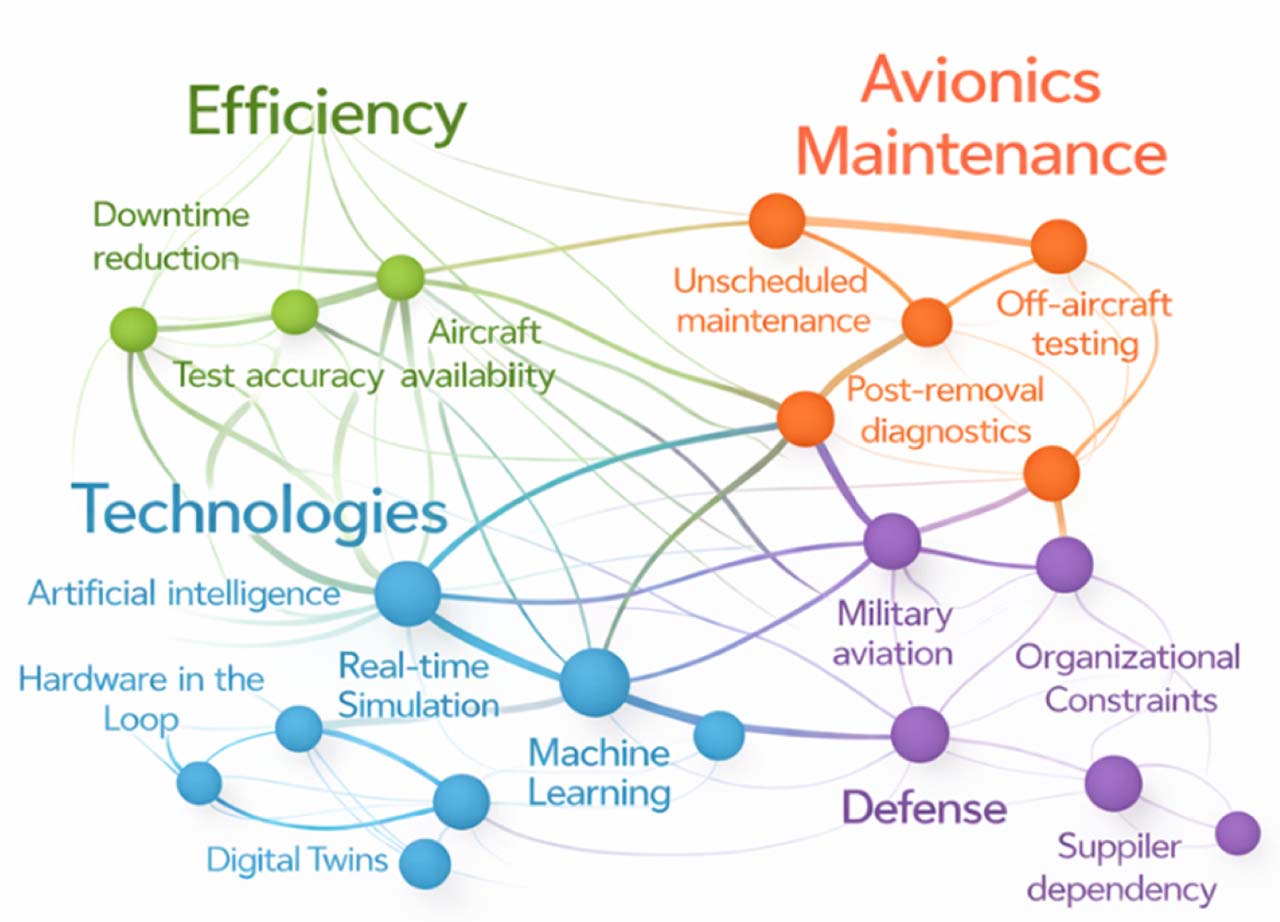
Fig. 2.
Keyword co-occurrence network for avionics component maintenance efficiency in the defense sector, 2020–2025.
The four clusters are: (i) maintenance efficiency (green); (ii) avionics maintenance (orange); (iii) technologies employed (blue); and (iv) defense sector (purple).
3.1. Data Extraction
In line with the objectives set out in the introduction, two research questions guided the collection, analysis, and categorization of data:
RQ1: Which technologies are currently applied in aircraft maintenance, including the diagnosis and testing of avionics components and flight control computers?
RQ2: To what extent do these technologies improve the efficiency of aircraft maintenance, particularly within military organizations?
An inductive narrative synthesis was used to answer these questions. This approach organizes findings through theoretical conceptualization and explores relationships within and between studies, providing a transparent, structured, and rigorous critical appraisal of the evidence rather than a numerical summary [22,23,24].
Data on objectives, methods, technologies studied, and principal results were first extracted into preliminary analysis files. Open thematic coding was then applied in order to record recurrences and convergent patterns inductively [25]. Finally, the findings were compared across studies.
Each article was reviewed independently by each author of the present review; the authors then consolidated their assessments through a consensus process. Conceptual discrepancies arising during study selection and thematic coding were resolved by discussion until agreement was reached on the final classification of every article.
The scientific relevance and methodological quality of the studies were assessed against the eligibility criteria defined above, with priority given to (i) consistency between the stated research objectives, the research questions, and the reported results; (ii) clarity and reproducibility of the methodology described; (iii) publication in journals indexed in the Q1–Q3 quartiles whose methodological soundness was established through peer review; and (iv) a description of the technologies evaluated detailed enough to support the comparative analysis. These criteria ensured that the included studies met an adequate standard of scientific rigor and were relevant to the aims of the review.
Because this is a systematic review with narrative synthesis, intended to identify and categorize established and validated technological trends rather than to pool evidence quantitatively, no formal risk-of-bias assessment was performed. The aim was to integrate and compare the findings reported in the literature conceptually.
Each study was assigned to its final category on the basis of the thematic relevance of its results and of a consensus interpretation derived from the Technology–Organization–Environment (TOE) framework. This procedure ensured consistency in classification and interpretation while remaining aligned with the objectives and methodological scope of the review.
The TOE framework was adopted for classification and interpretation because it integrates the technological factors, organizational capabilities, and environmental conditions that shape technology implementation, all of which are relevant to the aims of this review. Unlike models designed to explain technology adoption by individuals or users, the TOE framework supports the analysis of technologies within complex organizational settings such as defense-sector aircraft maintenance.
Although the framework was developed to explain the adoption and implementation of technology, recent studies have used it as an analytical device for identifying and categorizing literature [26, 27]. Here it served as a complementary tool for organizing and interpreting the findings of the systematic review, clarifying how the results in each category relate to the operational reality of military aviation.
After data extraction, each study was analyzed in terms of the technology evaluated, its principal benefits, its limitations, and its context of application. These elements were then thematically coded and grouped according to the three dimensions of the TOE framework. The technological dimension captured the characteristics, advantages, and disadvantages of each technology. The organizational dimension gathered factors relating to maintenance efficiency, institutional capabilities, and the resources required for implementation. The environmental dimension covered the regulatory, operational, geographic, and security factors of the defense sector that influence adoption.
4. RESULTS
The review identified a range of technologies being implemented in aeronautical maintenance, with particular attention to avionics components. The analysis produced four categories, derived from the search criteria.
The categories are interrelated, and each groups a distinct set of technologies and methods: (i) diagnostics and testing of aeronautical components; (ii) diagnostics and testing of avionics components; (iii) flight control computer diagnostics and testing; and (iv) efficiency in aeronautical maintenance.
4.1. Diagnostics and Testing of Aeronautical Components
The studies in this category fall into three groups: those concerned with augmented reality and robotics at the point of inspection, those concerned with data-driven diagnosis, and those concerned with modeling and simulation.
Within Industry 4.0, technologies such as augmented reality and machine learning are gaining ground in aviation maintenance, although many remain at the pre-production stage [28]. Before they can be deployed, their compliance with current maintenance standards must be evaluated in detail, together with the regulatory changes their adoption might require [29].
Several studies report the use of augmented reality in remote maintenance, and others find that augmented and virtual reality (AR/VR) improve accuracy in both inspection tasks and staff training. They converge on two obstacles: the learning demands placed on operators and the cost of the supporting infrastructure.
Two applications illustrate the range. One combines computer vision with augmented reality to inspect avionics electrical connectors in confined spaces, reducing the physical burden on technicians and improving the accuracy of the task [30]. The other introduces a robotic architecture for avionics integration testing, in which computer vision, robotics, and user interaction subsystems take over work previously performed by hand [31]. Both remain at an early stage of development, and both report risks arising from the complexity of integration and from the reliability of the underlying algorithms.
A second group of studies addresses the data generated by maintenance rather than the physical task itself. Big data, machine learning, and smart systems are held to be central to managing uncertainty in maintenance planning [32], and the concept of the “hangar of the future” describes the convergence of digital twins, the Internet of Things (IoT), and robotics across maintenance and repair processes [33]. Digitizing these processes delivers efficiency and traceability, but it continues to meet organizational resistance and a shortage of technical skills [34].
Prognostics and health management frameworks for maintenance monitoring are presented as a fundamental element of the aeronautical industry, although regulatory and cultural obstacles remain to be overcome in both military and civil organizations [35].
Efficiency in maintenance and diagnostics is likewise said to rest on big data, the IoT, and artificial intelligence algorithms, which support condition-based planning, projections of component life expectancy, and a reduction in unexpected failures. The corresponding challenges are model reliability, resilience in implementation, and cybersecurity [36].
Supervised learning algorithms for classifying damage to aircraft systems achieve acceptable accuracy but depend on the storage of large volumes of data [37]. Predictive modeling to anticipate failures is therefore a promising direction, provided that the risks of data dependency are accounted for.
A third group turns to modeling and simulation. Model-based testing and hardware-in-the-loop (HIL) simulation are reported to be useful for verifying avionics systems ahead of maintenance tasks, allowing faults to be identified early, diagnostic time to be shortened, and test results to be made more reliable. These studies also acknowledge drawbacks: modeling is inherently complex, maintenance planners do not always understand the recommendations that algorithms produce, and test patterns require continuous updating [38,39].
A final study widens the frame, treating simulation as relevant not only to maintenance but also to safe flight operations [40]. On this account, simulation can shorten staff training and education time while improving component diagnostics and testing, although the approach needs to mature further before it can be verified and deployed in operational environments.
4.2. Diagnostics and Testing for Avionics Components
This category focuses on technologies applied not to aeronautical components in general but specifically to avionics, including the FCC. Real-time simulation is the dominant thread. One line of work develops HIL technology, in which real hardware is connected to a simulated environment, allowing assembly and maintenance tasks to be tested and validated virtually [41].
Model-based systems engineering (MBSE) has been used alongside HIL to test and validate components against a representation of the system under test, covering both its physical and its logical elements and simulating system behavior across a range of scenarios. Model-based testing of cockpit displays extends this approach by automating tests through scenario generation and validating the results using computer vision. Applied mainly to the scheduled maintenance of cockpit display systems, where recurring interface faults are readily identified, the method reduces manual effort during testing but requires high-precision simulation environments [42].
A second thread applies deep learning to the diagnosis problem directly. Algorithms for sensor data fusion in the real-time diagnosis of flight control systems report 97.8% accuracy in fault identification and a 25% improvement in fault localization over conventional approaches when applied in unscheduled maintenance to identify unexpected faults. The constraint is the need for robust computing infrastructure and reliable historical databases [43], both of which are scarce in resource-limited, budget-bound sectors such as military defense. A related algorithm for avionics modules, built on deep neural networks with hybrid attention mechanisms, raises accuracy to 99.64% [44]. Its advantage is the ability to detect anomalies across multiple time scales; its drawbacks are dependence on labeled data and the risk of overfitting.
Machine learning and deep learning have also been applied to the prediction of medium- and long-term avionics failures, orienting the technique toward scheduled maintenance by anticipating component degradation before failure occurs [45]. This requires extensive time-series datasets for training and carries the risk that the resulting models will be difficult to interpret.
A final study proposes a localized testing scheme that uses real-time simulation over a wide-area network [46]. It suits both scheduled maintenance, for compatibility testing, and unscheduled maintenance, for identifying unexpected failures in simulated environments. Its main contribution is shorter diagnostic times and the possibility of remote collaboration between maintenance actors; its limitations are communication interruptions and the absence of validation in real operating environments.
4.3. Flight Control Computer Diagnostics and Testing
The literature identifies avionics broadly as a critical system whose correct functioning is essential to aircraft safety and availability. Few publications, however, explicitly apply technologies such as artificial intelligence, big data, machine learning, virtual reality, or real-time simulation to the diagnosis and testing of the FCC specifically.
This scarcity should be read as a finding constrained by the scope and terminology of the search strategy, not as definitive evidence of a gap in the wider scientific literature. Two explanations are plausible. First, the FCC is often studied as part of broader research on flight control system architectures or on avionics as a whole rather than as an independent unit, so relevant studies may be indexed under different terminology. Second, military and defense data on flight control computers are frequently subject to security classification, confidentiality restrictions, and access controls, limiting the availability of open-access peer-reviewed publications.
Although many studies on technologies for the diagnosis of avionics systems were identified, most address predictive maintenance, condition monitoring, systems integration, or validation during the design phase of other avionics components. Very few concern the diagnosis and functional validation of the FCC after repair, particularly within unscheduled maintenance. Research effort is also reported to be biased toward aircraft systems whose data are more readily accessible, which leaves critical systems such as avionics comparatively understudied [47]. Taken together, these observations support, without confirming, the existence of a narrow research gap around post-repair FCC testing.
Contemporary studies do report the use of HIL technology and MBSE methodology for parameterizing FCCs and integrating them into flight control systems, analyzing the interaction between the FCC and other aircraft systems in order to establish design requirements. These approaches use sensors to monitor system performance continuously, predict potential failures, and detect unusual patterns in key parameters such as temperature, pressure, and vibration in real time [48, 49]. Such tools improve predictive maintenance and substantially reduce the risk of catastrophic failure, contributing to both operational safety and maintenance efficiency [12]. No study was found, however, that used these technologies to identify faults in the FCC during maintenance, or to test the component after repair.
On the contrary, the review found that test equipment currently used to diagnose avionics components, including those associated with the FCC, relies on manual data collection and protocols set out in maintenance manuals [50], which underlines the need to move toward intelligent, automated solutions. That need is sharpened by the FCC’s architecture: compared with other avionics components, it concentrates a large number of discrete inputs from aircraft subsystems, receives information from multiple sensors, and interacts directly with critical aircraft systems [51]. These characteristics constrain maintenance, particularly where unscheduled work is approached through conventional means [52].
Real-time simulation, hardware-in-the-loop environments, and test automation address precisely this combination of complexity and constraint. They allow operating conditions to be emulated off the aircraft and support the functional validation of multiple panel inputs and outputs without any modification to the system. Automating the diagnostic test sequence reduces reliance on manual procedures, improves measurement repeatability, and shortens maintenance times [53]. The effect is proportionally greater for the FCC than for other avionics components because these technologies can surface the intermittent faults and integration problems that conventional testing tends to miss [54]. The review therefore points to a clear need to develop and validate technologies designed specifically for this component, given its operational importance in military aircraft maintenance.
4.4. Efficiency in Aeronautical Maintenance
As Figure 3 shows, operational efficiency is the leading category of value creation associated with emerging technologies in aeronautical maintenance, expressed as lower costs, faster response times, higher aircraft availability, and better use of resources [55].
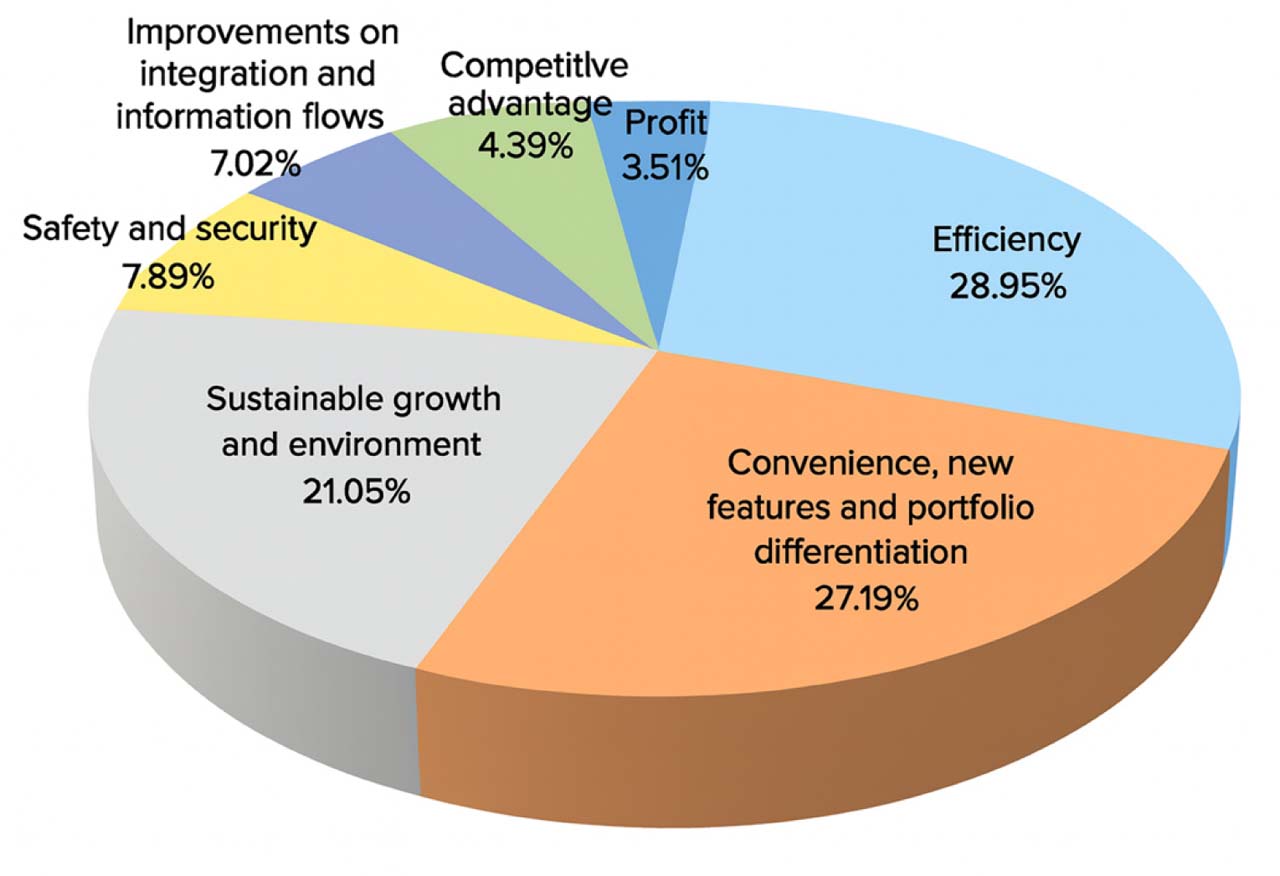
Fig. 3.
Distribution of value creation from technological advances in the aviation industry, 1999–2018 [55].
The literature approaches efficiency through four overlapping mechanisms: optimizing scheduled work, integrating real-time operational data, managing unscheduled events, and embedding sustainability.
On the scheduled side, several authors propose decision-making techniques based on project management and simulation modeling to improve processes within aviation maintenance organizations, with resource planning and task scheduling as the primary levers [12, 56, 57]. Digital twins and cyber-physical systems extend this by reducing downtime and improving planning through the integration of operational data with simulation models [58].
Agile methodologies address the less tractable problem of unscheduled maintenance. Their short, collaborative work cycles are suited to the inherent complexity and unpredictability of that work, and they translate in practice into less downtime, better logistical efficiency, and faster response to operational priorities [59]. Within the same context, techniques based on virtual knowledge graphs have been proposed to enable real-time fault prediction, improving the response to unexpected failures before they cascade [60].
Across both maintenance types, augmented reality and machine learning improve time efficiency and aircraft availability, though the studies concerned stress that organizational standardization protocols must be in place and sustainability considerations integrated if the full benefit is to be realized [28, 61].
Several researchers draw these threads together and argue that automating unscheduled maintenance is the single most significant factor in making aircraft operations more efficient: it raises safety standards, preserves service quality, reduces costs, and improves the operator’s experience [19, 20, 62]. The evidence reviewed here supports that conclusion and frames the rationale for the technology comparisons that follow in the discussion.
Table 3 consolidates the findings of the literature review, setting out each technology and methodology identified together with its contributions and its limitations in aeronautical maintenance.
Table 3.
Advantages and limitations of the technologies and methodologies identified for aeronautical maintenance.
| Category | Number of papers | Technology/methodology | Type of maintenance | Advantages | Limitations | References |
|---|---|---|---|---|---|---|
| Diagnostics and testing of aeronautical components | 21 | Augmented and virtual reality | Scheduled | Accuracy in periodic inspections, reduced human error, and support for remote training | High implementation costs and a steep learning curve | [19,28,29,30,31,32,33,34,35,36,37,38,39,40,41,63,64,65,66,67,68] |
| Model-Based Testing and simulation | Scheduled | Early failure validation; reduced diagnosis and testing times | Complex modeling and dependence on simulated environments | |||
| Machine learning | Unscheduled | Early fault identification and high accuracy | Requires infrastructure for large data volumes; risk of bias | |||
| IoT and digital twins | Scheduled | Remote diagnostics and integration of maintenance data | Risk of cyberattack; requires robust infrastructure | |||
| Diagnostics and testing of avionics components | 09 | Digital Twins | Unscheduled | Real-time monitoring, improved traceability, and fault detection | Dependence on reliable data; cybersecurity risks | [41,42,43,44,45,46,53,69,70] |
| Artificial Intelligence | Unscheduled | Accurate, predictive diagnosis of complex faults | Requires robust computing infrastructure | |||
| Augmented Reality | Scheduled | Reduced human error in confined-space inspections | Requires specialized training and robust computational infrastructure | |||
| Hardware-in-the-Loop | Scheduled/Unscheduled | Virtual validation with reduced testing time and cost | Technical complexity in system modeling and calibration | |||
| FCC diagnosis and testing | 02 | Model-based systems and HIL | Scheduled | In-flight system monitoring in accordance with design requirements | Requires changes or modifications to the aircraft | [48,49] |
| Manual test set | Scheduled/Unscheduled | Measurement of multiple signals | Manual processes and limited automation | |||
| Efficiency in aeronautical maintenance | 15 | Mathematical optimization models | Scheduled | Reduced delays and costs; optimized task planning | Limited applicability to other types of maintenance | [12,19,20,28,55,56,57,58,59,60,61,62,71,72,73] |
| Resource management and planning | Scheduled | Efficient resource allocation and reduced downtime | Constrained by organizational culture and contextual factors | |||
| Digital twins / IoT | Scheduled / Unscheduled | Fault prediction and real-time data integration | Requires data infrastructure, large-volume data management, and cybersecurity measures | |||
| AI & Industry 4.0 | Scheduled / Unscheduled | Classification of technology maturity; reduced time and cost | Lack of standardization | |||
| Integration of sustainable processes | Scheduled | Integration of efficiency and sustainability | Requires structural changes shaped by organizational culture |
5. DISCUSSION
The results are discussed here through the three dimensions of the Technology–Organization–Environment (TOE) framework, which allows technological factors, organizational capabilities, and contextual constraints to be considered together rather than in isolation.
On the technological dimension, the technologies listed in Table 3 improve efficiency by integrating operational data with traceability, automating fault detection, and emulating system behavior with sufficient fidelity to reduce diagnostic uncertainty. Their limitations in defense settings share a common structure: dependence on labeled historical data, demands for complex processing, and the need for large-volume data storage with associated cybersecurity exposure. Each of these limits scalability in environments where data are sparse, classified, or simply not yet collected.
On the organizational dimension, efficiency gains materialize only where the necessary internal capabilities exist: skilled personnel, structured training, data governance, process standardization, and sustained investment in infrastructure. Where those capabilities are absent or underdeveloped, the learning curve and the complexity of integration act as a ceiling on the benefits that technology can deliver.
On the environmental dimension, the constraints specific to the defense sector – regulatory compliance, information security requirements, operational availability demands, logistics chains, and geographic conditions – slow the uptake of technology and tend to push adoption toward incremental rather than transformative solutions.
Table 4 brings these three dimensions together, summarizing how each identified technology performs across the TOE framework and what the interactions between dimensions mean for avionics maintenance efficiency in defense contexts.
5.1. Efficiency Through Technology
The reviewed literature reports a positive effect on both downtime and maintenance operating costs from emerging technologies such as artificial intelligence, digital twins, and augmented reality [35, 37]. HIL testing has become a particularly important means of evaluating components in a controlled environment before they are integrated into the aircraft, because it simulates the interaction between a component and its operational environment [74], improving diagnostic accuracy and reducing the risks associated with unscheduled maintenance [75].
Digitization and automation – the core elements of Aeronautical Maintenance 4.0 – can be combined to improve the repair and diagnosis of aircraft components. The capacity of automated systems to predict failures through machine learning algorithms and real-time condition monitoring [76] is especially relevant for components with high failure rates, such as the FCC.
Figure 4 synthesizes the relationship between the identified technologies and maintenance efficiency outcomes. Simulation-based approaches, namely HIL and digital twins, have the most direct effect on diagnostic time and cost. Artificial intelligence and machine learning deliver greater diagnostic accuracy but depend on data availability. AR/VR contributes indirectly through training and inspection support. Across all four, the impact of a technology depends less on its technical maturity than on how well it can be adapted to defense operational constraints.
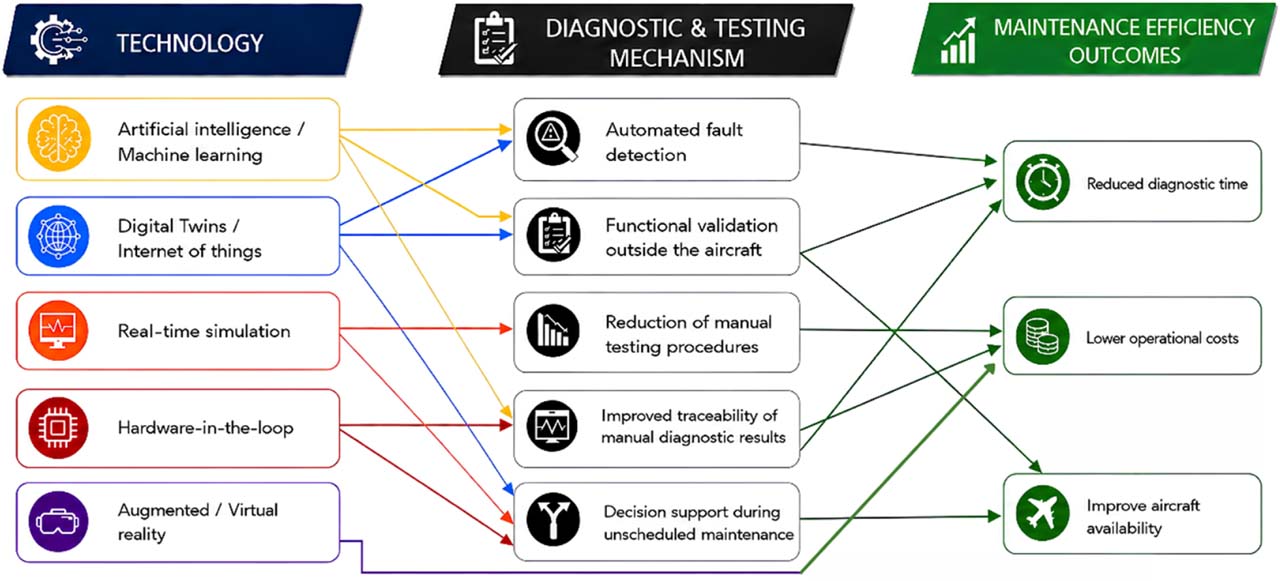
Fig. 4.
Conceptual synthesis linking technologies to efficiency outcomes in avionics maintenance.
These technologies do not offer equal potential for improving maintenance efficiency, because their advantages depend on the operational environment and on the organizational capabilities available. HIL and real-time simulation appear to be the most mature for diagnostic and functional testing applications in defense settings, because they reproduce real operating conditions without requiring large volumes of historical data.
Artificial intelligence and machine learning show greater accuracy in identifying complex faults and in modeling component life cycle and wear, but their performance is contingent on representative databases, robust computational infrastructure, and an appropriate data governance framework. Digital twins and the Internet of Things enable the integration of real-time operational information with maintenance traceability, but require substantial investment in digital infrastructure and raise cybersecurity challenges. Augmented and virtual reality are most effective in inspection, training, and technical support, contributing to maintenance efficiency indirectly by reducing human error.
Taken together, the evidence suggests that simulation technologies are the more immediately feasible option for military organizations, where security restrictions, limited data availability, and budgetary constraints impede the adoption of solutions that depend heavily on artificial intelligence or advanced digital infrastructure.
5.2. Operational and Organizational Limitations
Despite these advances, integrating advanced technologies into military maintenance remains difficult, particularly in developing countries such as Colombia. Limited financial resources [17], combined with a shortage of local skills for repairing avionics components, restrict the adoption of state-of-the-art tools. Political decisions that prioritize fiscal austerity compound this by reducing allocations to the defense sector [18].
Successful technology adoption in military organizations therefore depends on adequate and sustained funding across research, development, prototyping, infrastructure, training, and equipment acquisition [77]. Technologies such as big data analysis and intelligent systems add a further requirement: solid digital infrastructure and qualified personnel to operate it, neither of which is yet fully in place in Colombian military institutions. Dependence on external suppliers for unscheduled repairs adds complexity, increasing costs and extending downtime in ways that internal capability development could reduce.
5.3. Projections for Technology Adoption
Successful adoption of emerging technologies requires a strategic approach matched to the needs of users and of the workforce [78]. For military organizations engaged in the aeronautical maintenance of avionics components, two priorities stand out: developing local capability to implement advanced diagnostic systems, and training the technical personnel who will use them.
The aircraft maintenance industry is not yet ready for full digitization, but its personnel are willing to upgrade their skills, and investment in reliable software, hardware, and training is necessary if maintenance process efficiency is to improve [34]. Defense organizations must therefore begin by identifying their specific needs and their current workforce capabilities, so that technology adoption is aligned with mission objectives [79], strengthens military capability [80], and generates a durable competitive advantage within the sector [81]. The review indicates that HIL real-time simulation is, at present, the technology most consistently applied to avionics components.
Three practical recommendations follow for defense organizations and aircraft operators working in comparable environments.
First, to improve maintainability indicators and reduce dependence on external suppliers, diagnostic and testing systems based on real-time simulation should be introduced progressively for components with high failure rates, such as the FCC [53].
Second, organizational competence should be strengthened through on-the-job training, specialized instruction, and interdisciplinary teams that bring maintenance and engineering personnel together, enabling predictive technologies to be interpreted and applied effectively [82].
Third, adoption roadmaps should be developed in line with current aeronautical regulatory standards [83] and should incorporate cost-benefit and sustainability criteria to ensure that the chosen solutions remain organizationally viable over time.
5.4. Limitations of the Review
Several limitations should be borne in mind when interpreting these results. First, the literature search was restricted to Scopus and Google Scholar, chosen for their broad coverage of peer-reviewed and gray literature in engineering and technology; relevant studies indexed only in other databases may not have been retrieved.
Second, as in any systematic review, the evidence is subject to publication bias: studies reporting positive results from technology implementation are more likely to be published than those reporting inconclusive or negative findings, which may inflate the apparent effectiveness of the technologies analyzed.
Third, only English-language publications were included, which may have excluded relevant work in other languages and in particular studies addressing defense contexts in Latin America.
Finally, the strategic nature of defense-sector aircraft limits the availability of avionics system data, much of which is classified, restricting the depth of empirical evidence and technical detail in the published literature. The findings of this review should therefore be read as a synthesis of currently available published knowledge, not as an exhaustive account of technological capabilities in military aircraft maintenance.
6. CONCLUSIONS
This systematic literature review set out to identify and assess the technological trends applicable to the aeronautical maintenance of avionics components, with particular attention to the defense sector. The evidence analyzed indicates that emerging technologies have real potential to transform the diagnosis and repair of avionics components, but that their effective implementation depends on the technological, organizational, and operational conditions of each context.
The studies reviewed demonstrate the efficiency gains that digitization and automation can deliver from a maintenance management perspective. These gains matter across the aviation industry, because maintenance determines system availability, influences service life, affects customer satisfaction, and shapes the return on investment. The sector continues to search for scalable models that improve efficiency [84].
In the Colombian military context specifically, financial constraints and dependence on external suppliers remain the binding limitations. Both reduce aircraft availability and undermine long-term sustainability, and neither can be resolved by technology alone without the organizational investment described in Section 5.3.
The review also found only limited application of emerging technologies to the diagnosis and functional validation of the FCC during unscheduled maintenance, particularly for military utility aircraft. As discussed in Section 4.3, this gap represents a concrete opportunity to develop and evaluate technological solutions that could meaningfully improve the efficiency of that process.
Although grounded in a specific military context, the findings apply more broadly, to other defense organizations and to civil operators alike, because the problems they address – high avionics failure rates, manual diagnostic processes, dependence on external repair – are not unique to Colombia.
In sum, the evidence supports the adoption of emerging technologies as a promising route to improving efficiency and sustainability in avionics component maintenance. The most immediate opportunity lies in simulation-based approaches, particularly HIL testing, which can be deployed without the large historical datasets that artificial intelligence requires and within the security and budgetary constraints that defense organizations face. This review lays the conceptual groundwork for the future research and practical applications needed to realize that opportunity.