
1. INTRODUCTION
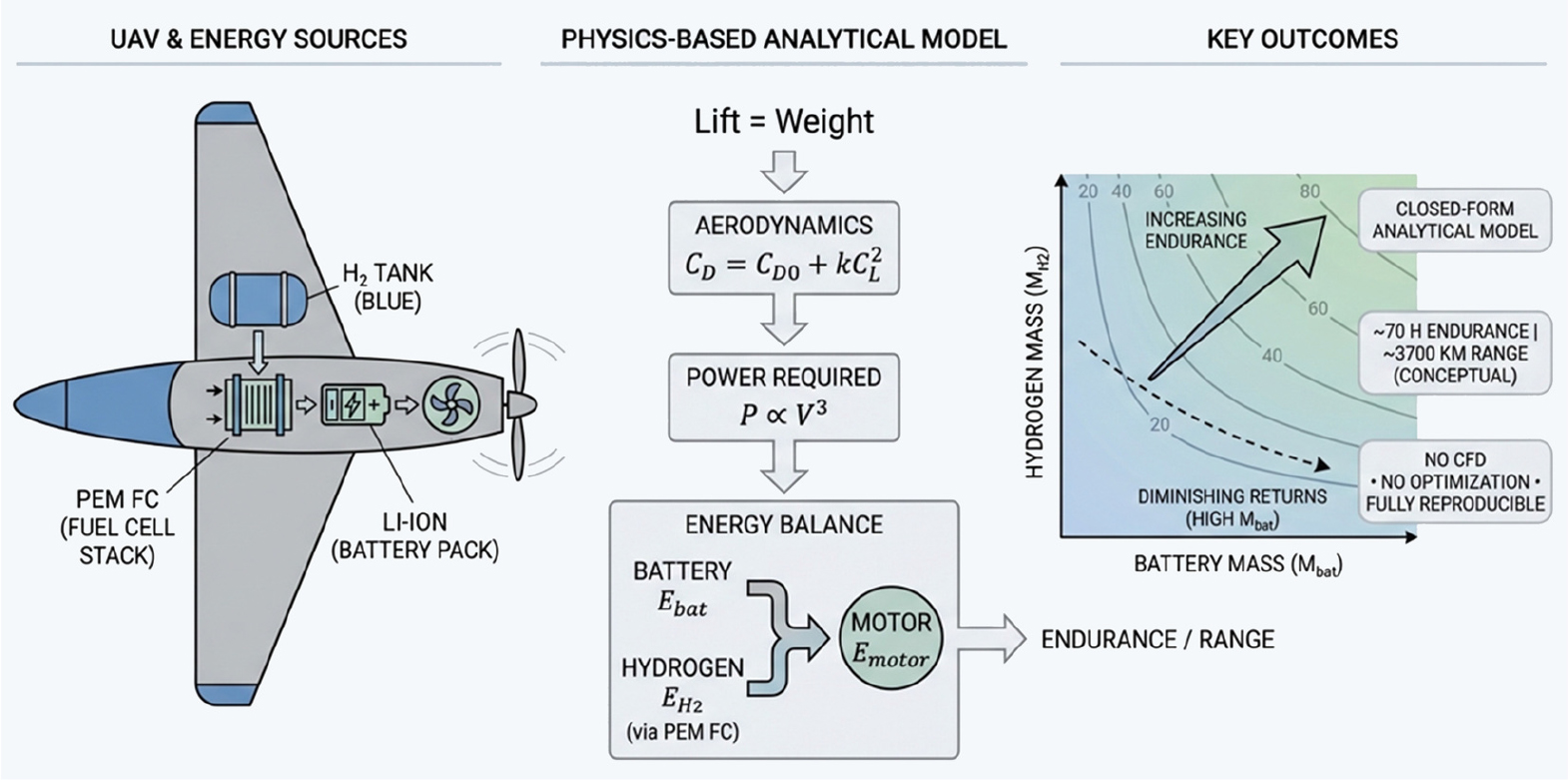
Endurance remains one of the most significant constraints in the development of small unmanned aerial vehicles (UAVs), particularly for missions that require long-duration flight or sustained on-station operation [1–5]. Although lithium-based batteries are widely adopted because of their reliability, maturity, and ease of integration, their specific energy typically remains below 250 Wh kg-1. This fundamental limitation places a strict upper bound on the achievable flight duration of fixed-wing UAVs, even when the airframe is highly aerodynamically efficient [6]. Consequently, endurance-critical applications such as environmental monitoring, border and coastal surveillance, maritime inspection, and precision agriculture are often forced to trade mission persistence against operational frequency [7].
Hybrid hydrogen–electric propulsion has therefore emerged as a promising alternative to conventional battery-only systems. Hydrogen fuel cells offer a substantial increase in gravimetric energy density, quiet and low-vibration operation, and the potential for zero-emission flight – characteristics that are particularly attractive for micro-to-small fixed-wing UAV platforms intended for long-endurance missions [1–3,8–10]. Compared with combustion-engine hybrids, hydrogen–electric architectures can reduce mechanical complexity and simplify drivetrain integration. At the same time, they introduce distinct engineering challenges, including the mass penalty associated with high-pressure hydrogen storage, the integration of efficient power-conditioning electronics, and the management of power sharing between steady fuel-cell output and transient propulsion demands [2,3,9].
This combination of clear advantages and unresolved constraints highlights the need for tools that can identify when and how hydrogen–electric hybridization is genuinely beneficial at the conceptual design stage. Much of the existing research in this area relies on computationally intensive approaches, including high-fidelity CFD, multi-physics simulations, data-driven performance models, and prototype-based experimentation [11–14]. While these methods provide valuable aerodynamic and system-level insight, they often require significant computational resources, depend strongly on specific airframe geometries, and limit rapid exploration of large design spaces during early project phases. For conceptual design, when engineers are still refining mass budgets, propulsion architectures, and mission envelopes, such approaches can slow iteration and place an unnecessary burden on teams working with limited resources.
By contrast, classical aircraft-performance theory has long demonstrated that many of the fundamental relationships governing lift, drag, power, and endurance can be captured analytically using first-principles physics [11,15–23]. These analytical formulations have supported applications ranging from early aircraft sizing to modern performance analysis and even the study of biological flight [20–22]. More recent advances in open aircraft-performance modelling and hybrid-UAV design have further reinforced the value of fast, interpretable analytical tools that complement simulation-heavy frameworks [18,19,24–34].
Motivated by this need, the present study introduces a purely analytical, physics-based framework for evaluating hybrid hydrogen–electric propulsion in small fixed-wing UAVs across the micro-to-small mass range. The approach couples classical lift–drag relationships with a direct energy-balance formulation, yielding simple closed-form expressions for endurance and range that can be evaluated rapidly without CFD, experimental calibration, or mission-specific tuning. This makes the model particularly well suited for conceptual design, where quick iteration and physical interpretability often matter more than high-fidelity detail. By analytically exploring the interaction between hydrogen mass, battery capacity, aerodynamic properties, and cruise velocity, the framework reveals key mass–energy trade-offs that govern hybrid-UAV performance. Rather than replacing detailed simulations or flight testing, the approach is intended to support early-stage decision-making by providing a lightweight, transparent, and scalable analytical baseline before higher-fidelity analysis is undertaken.
1.1. Literature Review
The endurance limitations of small unmanned aerial vehicles (UAVs) have been widely documented, with conventional lithium-based batteries offering specific energies typically below 250 Wh kg-1, insufficient for sustained long-duration missions such as surveillance, mapping, and reconnaissance [1–3]. This inherent constraint has motivated extensive research into hybrid and hydrogen-assisted propulsion systems, which provide substantially higher specific energy while enabling low-emission or zero-emission operation across a wide range of small-UAV scales [4–6]. Experimental demonstrations and conceptual design studies have shown that hydrogen fuel-cell systems can extend UAV flight times well beyond those achievable with battery-only configurations, although challenges remain related to hydrogen storage mass, fuel-cell integration, and onboard energy management [2,4,8–10]. Investigations by Tak et al. [1], Özbek et al. [2], and Farajollahi and Dincer [3], among others, present design methodologies, propulsion-system architectures, and hybrid-electric performance assessments that highlight the potential for multi-hour endurance gains.
Complementary studies have explored advanced hybrid concepts, including solid-oxide fuel-cell (SOFC) architectures, thermoelectric integration, and multi-source energy scheduling using model-predictive control strategies [4,8]. Collectively, these works demonstrate the growing interest in hydrogen-assisted hybrid propulsion as a pathway toward long-endurance and energy-efficient UAV operation.
Parallel advances in UAV aerodynamics, structural optimization, and propulsion-system design have further strengthened the foundation for hybrid-electric development. Research on energy-efficient propulsion technologies [5], UAV propulsion-design strategies [6], and time-varying endurance modelling [7] has provided valuable insight into aerodynamic–propulsive coupling, power-management strategies, and mission-level performance estimation. Recent studies focusing on hybrid-UAV control, aerodynamic optimization, and integrated system analysis further emphasize the importance of modelling frameworks that explicitly link energy availability with aerodynamic requirements [9,10,28–30]. Alongside these developments, a substantial body of classical aircraft-performance literature continues to offer analytical tools that remain highly relevant to UAV endurance analysis. Foundational works by Filippone, Raymer, Mason, Torenbeek, and others [11,15–27] present closed-form formulations for lift, drag, power required, cruise performance, and optimal operating conditions – relationships that have long been used in both manned and unmanned aircraft conceptual design. Because these models are grounded in first-principles aerodynamics rather than empirical curve fitting or numerical simulation, they have proven particularly effective for early-stage sizing and performance prediction. More recent efforts in open aircraft-performance modelling and trajectory-analysis frameworks, such as LEAPS and data-driven mission parameterization approaches, further demonstrate how analytical and semi-analytical methods can support rapid and generalizable performance estimation across diverse aircraft configurations [18,19]. In the UAV context, studies addressing drag estimation, low-speed aerodynamic performance, and airframe-configuration optimization highlight how even modest changes in aerodynamic characteristics can significantly influence endurance-oriented missions [28–34].
Despite this progress, many existing hybrid-UAV studies remain heavily dependent on CFD, numerical optimization, or prototype-level experimentation. While powerful, these approaches are often computationally demanding, geometry-specific, and less suited to broad design-space exploration during early conceptual phases. As a result, there remains a clear need for analytical, first-principles-based frameworks that can rapidly and transparently predict endurance and range without reliance on CFD or experimental calibration. The present work addresses this gap by developing a fully analytical, physics-driven model for predicting endurance and range in hybrid hydrogen–electric UAVs using only fundamental aerodynamic and energetic relationships. By avoiding empirical curve fitting and simulation-heavy techniques, the framework provides a deterministic and reproducible means of exploring mass–energy trade-offs, propulsion-architecture choices, and conceptual design trends. In doing so, it bridges the gap between simplified theoretical approximations and complex numerical models, offering a practical and openly verifiable tool for early-stage, sustainability-oriented UAV propulsion studies grounded in first-principles physics.
2. THEORETICAL MODEL AND METHODOLOGY
2.1. Model Overview
The analytical framework developed in this study is intentionally designed to be lightweight, fully physics-based, and reproducible using only fundamental aerodynamic and energetic relationships. The model relies on a minimal set of input parameters such as lift–drag coefficients, propulsive efficiencies, and the specific energies of onboard storage systems that are typically available from standard UAV specifications or early-stage design estimates. This emphasis on simplicity ensures that the framework remains accessible and transparent, making it well suited for conceptual design studies without requiring CFD, high-fidelity simulations, or proprietary software tools. The central objective of the framework is to express flight endurance and range in closed analytical form by directly coupling aerodynamic performance with the energy available from a hybrid hydrogen–electric propulsion system. All governing relationships are derived from first-principles physics rather than empirical curve fitting or regression-based approximations. As a result, the model exhibits deterministic behaviour and yields results that are physically interpretable, allowing clear insight into how aerodynamic characteristics and energy-storage parameters influence overall UAV performance.
To maintain analytical tractability and conceptual relevance during early design stages, a set of simplifying assumptions is adopted. These assumptions are standard in preliminary aircraft-performance analysis and are chosen to balance physical realism with mathematical clarity:
Steady, level cruise flight: The analysis assumes unaccelerated cruise conditions in which lift equals weight and thrust balances aerodynamic drag.
Constant propeller efficiency (ηprop): Propeller losses are treated as uniform over the cruise operating envelope, consistent with conceptual-level modelling.
Constant air density: For low-altitude micro-UAV operation, variations in air density are neglected and a representative constant value of ρ is assumed.
Constant energy-system mass: Hydrogen consumption and battery discharge are treated as mass-invariant, an approximation commonly used in preliminary sizing studies and appropriate for early-stage analysis.
Single electric propulsion line: Electrical power from both the fuel cell and the battery is assumed to pass through a single motor with constant efficiency (ηem), reflecting a typical hybrid UAV architecture.
These assumptions preserve analytical clarity while enabling rapid exploration of the endurance–range design space. Although they limit the model’s fidelity with respect to transient effects, mass depletion, and off-design operation, they are deliberately chosen to support fast, physically transparent performance estimation during the conceptual design phase. Higher-fidelity effects may be incorporated in future extensions once a specific airframe or propulsion architecture has been selected.
Hydrogen stored in a high-pressure tank is regulated and supplied to a PEM fuel-cell stack, where chemical energy is converted into electrical power. The fuel cell feeds a common DC bus through a DC/DC converter, while a lithium-ion battery connected via a bidirectional DC/DC converter provides transient and peak-power support. A power-management controller governs power sharing and load balancing between the fuel cell, battery, and propulsion motor. Electrical power from the DC bus drives the motor controller, electric motor, and propeller. Auxiliary subsystems such as fuel-cell cooling and power electronics are represented functionally, consistent with the analytical scope of the endurance–range framework.
The schematic illustrates the relative placement of major subsystems used for mass and energy accounting, including the hydrogen tank, PEM fuel-cell stack, lithium-ion battery pack, avionics, and electric propulsion unit. Heavier components such as the hydrogen tank and fuel cell are positioned near the aircraft center of gravity to minimize trim variations, while the battery and avionics are located in the forward fuselage and the motor–propeller unit is nose-mounted. The layout is schematic and intended to represent mass-grouping assumptions rather than a finalized hardware configuration.
2.2. Governing Equations
The analytical framework links the aerodynamic performance of the UAV with the energy available from a hybrid hydrogen–electric propulsion system in order to predict flight endurance and range under steady cruise conditions. The aerodynamic behaviour of the airframe is described using the classical parabolic drag polar,
where CD is the zero-lift drag coefficient and k is the induced-drag factor. For steady, level cruise flight, lift balances the aircraft weight, where ρ is the air density, V is the cruise velocity, and S is the wing reference area.The total aerodynamic drag acting on the UAV is therefore:
The propulsive power required to maintain steady cruise is obtained by accounting for propeller efficiency ηprop,
Energy Availability from the Hybrid System
The hybrid propulsion system supplies usable energy from two onboard sources: a lithium-ion battery and hydrogen processed through a fuel-cell stack.
The electrical energy stored in the battery is expressed as:
where mbatt is the battery mass and ρbatt is the battery specific energy.The usable electrical energy obtained from hydrogen is given by:
where mH2 is the hydrogen mass, LHVH2 is the lower heating value of hydrogen, and ηfc is the fuel-cell efficiency.The total usable onboard energy available for propulsion is therefore:
Accounting for electric motor efficiency ηem, the effective power available over a flight duration t may be written as:
Endurance and Range Formulation
Equating the available electrical power to the propulsive power required for steady cruise yields the analytical expression for endurance:
For constant cruise velocity, the corresponding flight range is then obtained directly as:
These expressions provide closed-form relationships that link aerodynamic coefficients, propulsion efficiencies, and energy-storage parameters to endurance and range without requiring numerical integration or empirical tuning.
Hybridization Ratio
To characterize the power-sharing behavior of the hybrid propulsion system, a hybridization ratio γ is defined as:
where Pfuel-cell is the continuous electrical power supplied by the fuel-cell stack and Ptotal is the total propulsive power required during steady cruise.A balanced hybrid operating regime is identified when
Within this range, the fuel cell supplies the majority of steady-state power demand, while the battery provides transient or peak-load support without excessive cycling or overstress. This operating strategy reflects typical hybrid-electric UAV architectures and is consistent with the conceptual assumptions adopted in the present analysis.
Overall, this set of governing equations forms a closed, deterministic analytical system that predicts endurance and range directly from first-principles aerodynamic and energetic relationships. No empirical constants, surrogate models, or machine-learning regressions are employed, ensuring transparency, reproducibility, and clear physical interpretability consistent with the conceptual scope of the study.
2.3. Input Parameters
The input parameters used in this study are summarized in Tables 1 and 2. They correspond to a lightweight fixed-wing micro-UAV operating at low subsonic speeds and are selected to support conceptual-level analytical performance evaluation rather than detailed hardware realization. Aerodynamic coefficients, propulsion efficiencies, and energy-storage properties are drawn from widely reported values in the UAV and hybrid-propulsion literature, ensuring that all assumptions remain physically reasonable and reproducible.
Table 1.
Reference Model Parameters Used in the Analytical Framework.
| Parameter | Symbol | Value | Unit | Source / Note |
|---|---|---|---|---|
| Air density (sea-level reference) | ρ | 1.225 | kg m-3 | ISA reference (adjusted in simulations) |
| Wing area | S | 1.2 | m2 | Typical micro-UAV configuration |
| Zero-lift drag coefficient | CD0 | 0.025 | — | UAV aerodynamic literature |
| Induced drag factor | k | 0.045 | — | Empirical aerodynamic constant |
| Propeller efficiency | ηprop | 0.85 | — | Assumed constant (conceptual level) |
| Fuel-cell efficiency | ηfc | 0.60 | — | Typical PEM system |
| Motor efficiency | ηem | 0.90 | — | BLDC motor |
| Battery energy density | ρbatt | 230 | Wh kg-1 | Commercial Li-ion cells |
| Hydrogen lower heating value | LHVH2 | 120 × 106 | J kg-1 | ISO standard |
| Structural mass (reference literature scaling value) | mstruct | 10 | kg | Representative UAV sizing |
| Payload mass (reference literature scaling value) | mpayload | 2 | kg | Generic sensor payload |
Table 2.
Baseline UAV Mass Breakdown Used in the Parametric Study.
| Component | Symbol | Value (kg) | Notes |
|---|---|---|---|
| Structural mass | mstruct | 0.85 | Wing, fuselage, empennage |
| Payload | mpayload | 0.10 | Small camera or sensor |
| Fuel-cell stack | ηfc | 0.18 | 150–200 W PEM system |
| Hydrogen tank | mtank | 0.25 | Type-IV,700 bar (≈5:1 tank:H2) |
| Hydrogen mass | mH2 | 0.05 | ≈6 wt% of tank assembly |
| Battery pack | mbatt | 0.20 | Peak-power support |
| Avionics + ESC | melec | 0.07 | Flight control and wiring |
| Electric motor | mmotor | 0.12 | BLDC motor |
| Total mass | mtotal | 1.82 | Used in analytical calculations |
To avoid ambiguity regarding parameter usage and mass accounting, the following clarifications are emphasized.
First, a representative loiter altitude of 300–500 m is assumed for endurance and range estimation. At this altitude range, atmospheric density is computed using the ISA model and treated as constant. Although Table 1 lists the sea-level reference value (ρ = 1.225 kg m-3) for completeness, all simulations employ an adjusted density in the range ρ ≈ 1.18–1.20 kg m−3, consistent with low altitude micro-UAV operation. Second, hydrogen storage is modelled using a compressed gaseous hydrogen system at 700 bar with a Type-IV composite pressure vessel. For such tanks, the tank-to-hydrogen mass ratio is not fixed but typically lies between 4:1 and 6:1, depending on vessel size, safety factor, and material system. In order to remain conservative and avoid optimistic bias, the present study adopts a fixed ratio of
This assumption explicitly couples hydrogen mass to structural penalty and prevents non-physical endurance scaling. The values used therefore represent best-case conceptual storage performance rather than currently available off-the-shelf UAV hydrogen tanks, which is appropriate for early-stage analytical exploration. Third, battery and fuel-cell masses correspond to commercially documented PEM fuel-cell stacks and lithium-ion battery systems in the 100–300 W power class, which is typical for micro-UAV cruise power requirements. Structural, wing, and avionics masses are selected based on representative micro-UAV sizing data reported in the literature and are intended to reflect realistic order-of-magnitude values rather than a specific airframe.
To avoid confusion between reference constants and the actual configuration used in the parametric analysis, the roles of Tables 1 and 2 are clearly distinguished. Table 1 lists general literature-based constants and reference parameters used to define the analytical framework, whereas Table 2 presents the specific mass breakdown of the baseline UAV configuration employed in the numerical endurance–range calculations.
All mass values represent conceptual design estimates appropriate for micro-UAV-scale systems; auxiliary components such as propellers, wiring, piping, and connectors are included within the structural and avionics mass terms.
2.4. Model Integration, Boundary Conditions, and Validation Scope
The analytical endurance–range framework integrates the aerodynamic subsystem, the electric propulsion line, and the hybrid energy-storage elements into a unified, physics-based formulation. Figures 1 and 2 illustrate the assumed propulsion architecture and conceptual UAV layout that underpin this integration. The hybrid propulsion system is modelled as a fully electric powertrain, in which the fuel cell and battery may supply electrical energy either independently or simultaneously to the propulsion motor through a shared DC bus. This abstraction reflects the generalized hybrid hydrogen–electric architecture assumed throughout the analytical development.
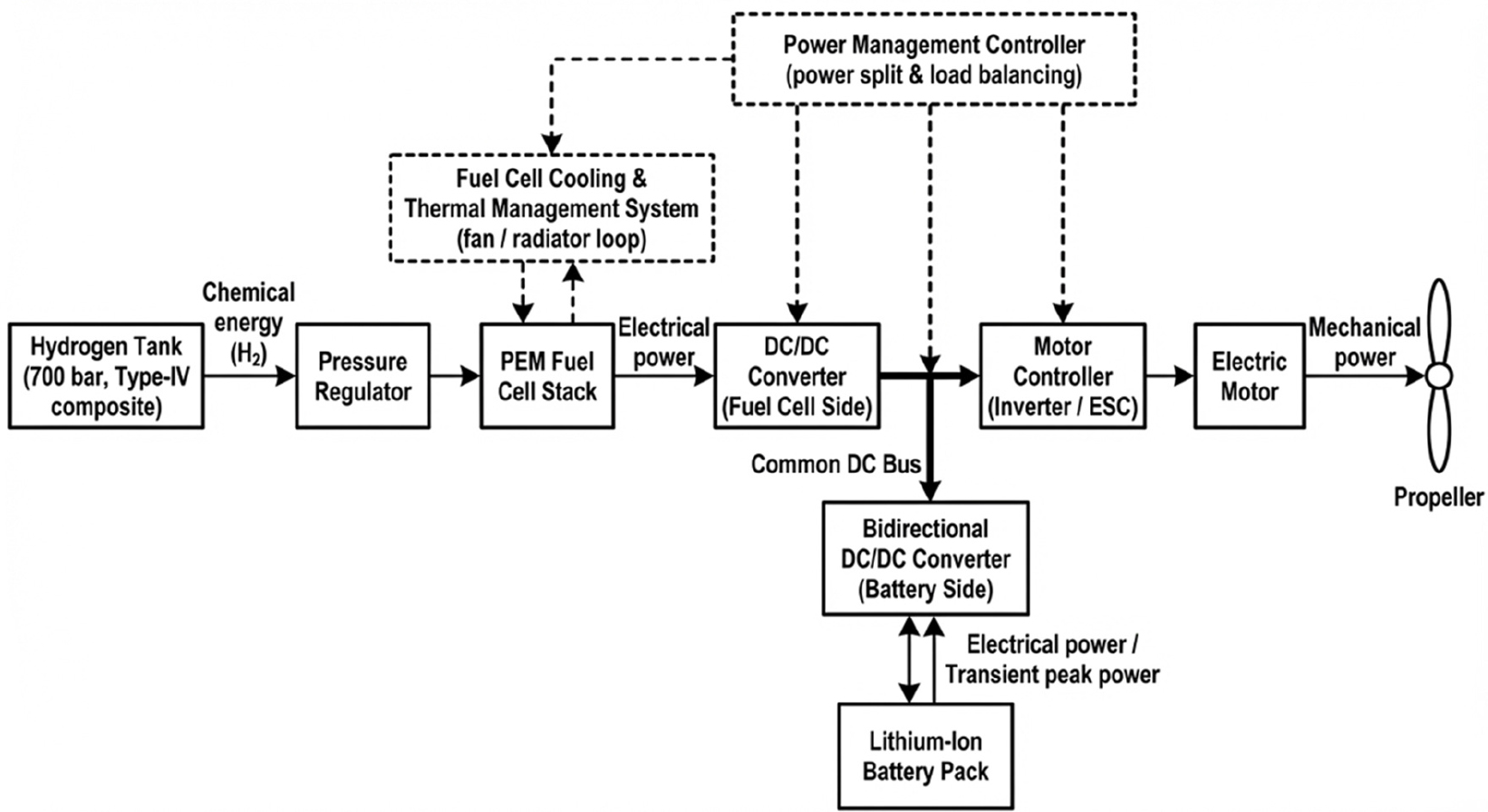
Fig. 1.
Functional architecture of the hybrid hydrogen–electric propulsion system assumed in the analytical model.
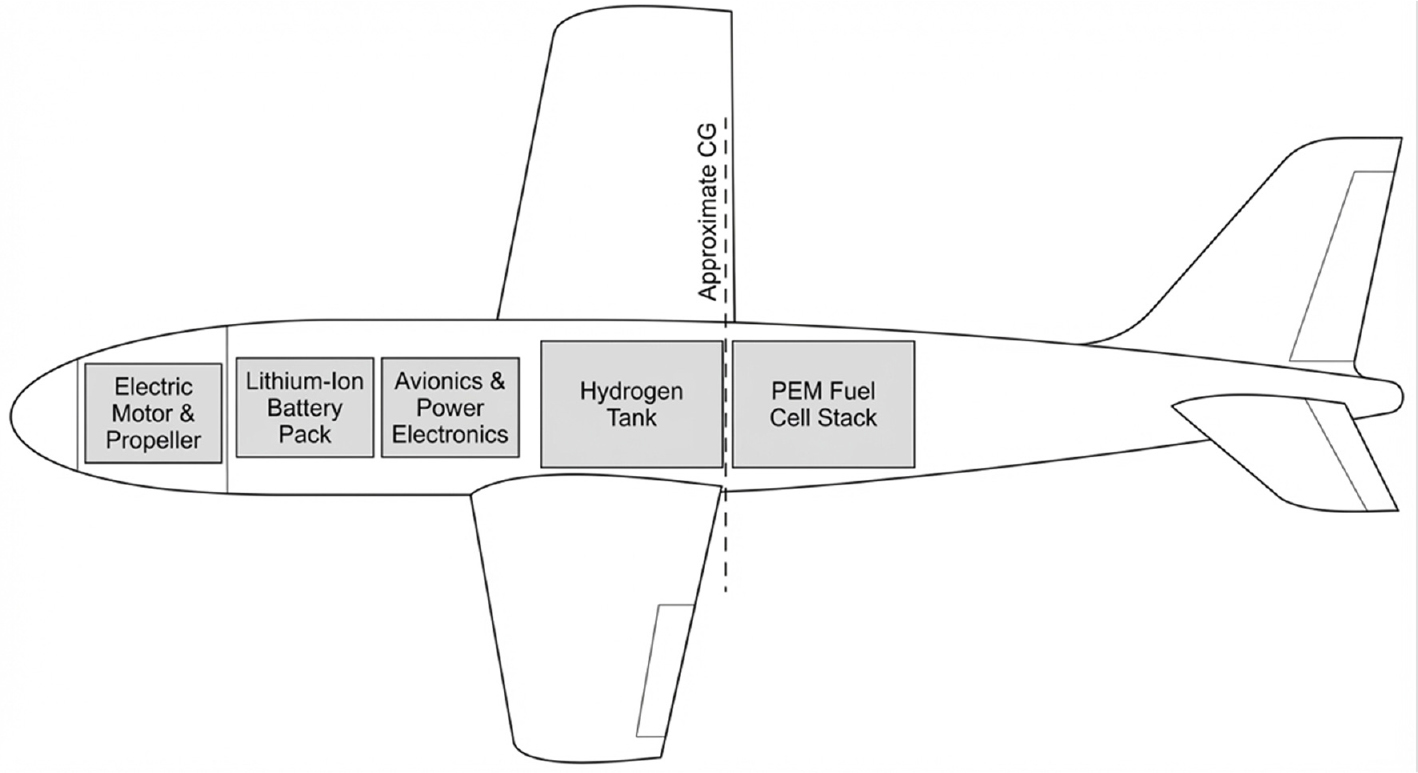
Fig. 2.
Conceptual layout and mass distribution of the baseline micro-to-small fixed-wing UAV assumed in the analytical model.
To ensure internal consistency and analytical tractability, a set of boundary conditions and modelling constraints is imposed. These conditions are representative of standard practice in preliminary aircraft-performance analysis and are appropriate for early-stage conceptual evaluation:
Flight condition: A steady, level, and unaccelerated cruise segment is assumed, such that lift balances weight and thrust balances aerodynamic drag.
Altitude: All endurance and range predictions are evaluated at a constant representative loiter altitude of 300–500 m, where variations in air density are sufficiently small to be neglected at the conceptual level.
Propulsive subsystem: Propeller efficiency and electric motor efficiency are treated as constant over the cruise operating envelope, consistent with typical micro-UAV conceptual models.
Fuel-cell behaviour: The PEM fuel-cell stack is assumed to operate at quasi-steady output power, with transient dynamics, voltage sag, and degradation effects neglected.
Hydrogen storage model: Hydrogen storage is represented using a fixed tank-to-hydrogen mass ratio corresponding to a 700-bar Type-IV composite pressure vessel (≈ 5:1). It is emphasized that the hydrogen storage masses considered in this study correspond to tens of grams of hydrogen suitable for micro-UAV applications and should not be extrapolated to industrial-scale hydrogen storage systems.
Mass variation: Hydrogen consumption and battery discharge are assumed not to affect aircraft mass during the analysed flight segment. This approximation is widely adopted in preliminary sizing studies and is employed here to preserve closed-form analytical solvability.
These assumptions allow the governing equations derived in Section 2.2 to remain fully solvable in closed analytical form, without requiring numerical integration, time-stepping, or mission segmentation. While the present study does not include direct experimental or flight-test validation, the structure of the analytical model follows long-established aircraft-performance formulations that have been widely applied to both manned and unmanned platforms. The resulting framework therefore provides a transparent and reproducible basis for conceptual sizing, trade-space exploration, and preliminary mass–energy assessment of hybrid hydrogen–electric UAVs. It is emphasized that the validation presented in this work is limited to analytical consistency and physical plausibility rather than empirical verification. Future extensions of the model will incorporate dynamic mass depletion, altitude-dependent atmospheric variation, and subsystem-level validation using hardware-in-the-loop or prototype hydrogen–electric propulsion systems.
3. RESULTS AND DISCUSSION
While Table 2 defines a lightweight baseline UAV configuration, the results presented in this section intentionally explore an extended parametric mass range (battery: 1–5 kg, hydrogen: 0–1 kg) to assess scalability and design-space trends rather than a single realizable airframe. This approach is consistent with the conceptual and analytical scope of the proposed framework, which is intended to reveal first-order endurance–range trade-offs rather than to represent a finalized vehicle design.
3.1. Range-Battery-Hydrogen Correlation
The combined influence of battery mass and hydrogen loading on flight range exhibits a clear and physically interpretable trend, as illustrated in Figure 3. Across the examined design space, range increases approximately linearly with hydrogen mass. This behaviour reflects the very high specific energy of hydrogen (≈120 MJ kg-1), which dominates the total onboard energy budget in hybrid configurations. Under the assumptions of the analytical model, even relatively small increases in hydrogen mass lead to substantial gains in available propulsion energy, while the associated structural penalty remains modest due to the adopted tank-to-hydrogen mass ratio. Battery mass also contributes positively to flight range at lower values, particularly when electrical storage supports steady propulsion and transient power demands. However, beyond approximately 2 kg of battery mass, the incremental benefit diminishes. In this regime, the added structural weight increasingly offsets the additional stored electrical energy, leading to a gradual saturation of the range curves. This trend is consistent with fundamental aerodynamic considerations: as total aircraft mass increases, the lift required for steady cruise rises, which in turn increases induced drag and propulsive power demand. Consequently, further increases in stored energy yield progressively smaller improvements in achievable range.
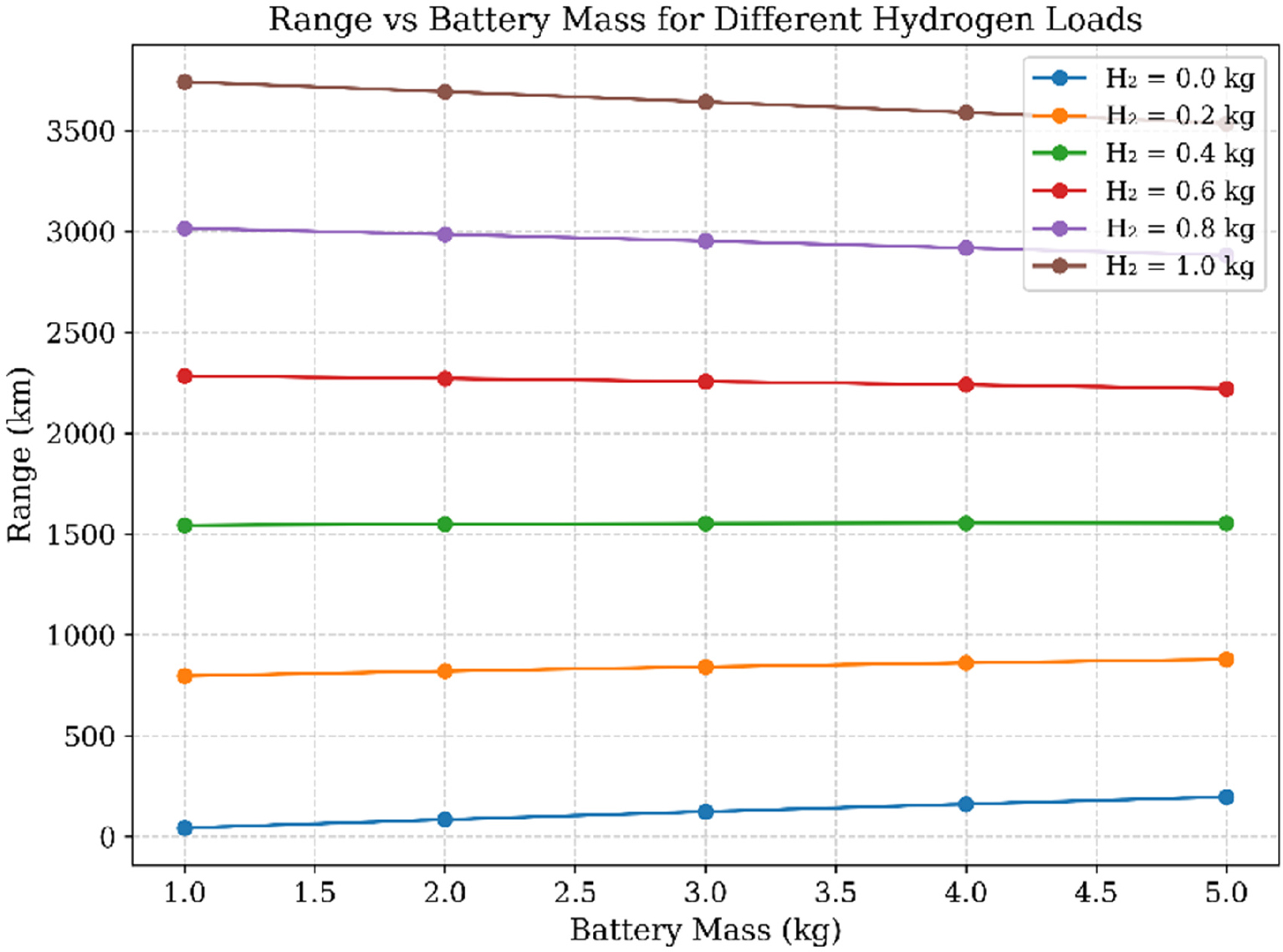
Fig. 3.
Range versus battery mass for different hydrogen loadings at a cruise speed of 25 m s-1.
Importantly, the response of the model across the full parameter space remains smooth and monotonic. The absence of discontinuities or non-physical behaviour indicates that the analytical formulation responds predictably to variations in hydrogen and battery mass. These characteristics support the internal consistency of the model and its suitability for conceptual-level UAV sizing, where rapid evaluation of mass–energy trade-offs is essential. Rather than providing definitive performance predictions, the results offer physically grounded insight into how hybridization strategies influence range trends during early-stage design, prior to the application of CFD-based analysis or experimental validation.
The figure illustrates the combined effect of electrical and chemical energy storage on total flight range. Range increases almost linearly with hydrogen mass, demonstrating the direct contribution of chemical energy to propulsion endurance. Battery mass influences range up to approximately 2 kg, after which structural weight offsets the added capacity. The smooth, monotonic behaviour confirms the consistency of the analytical model.
3.2. Endurance-Speed Performance
Endurance exhibits a characteristic dependence on cruise velocity that is consistent with fundamental aerodynamic principles. As illustrated in Figure 4, endurance decreases with increasing airspeed because the propulsive power required to sustain flight rises approximately with the cube of velocity (P ∼ V3). As a result, maximum endurance occurs at relatively low cruise speeds, typically in the range of 15–20 m s-1, where the aircraft operates near its minimum-power condition and favorable lift-to-drag ratio. This speed range therefore represents an energetically efficient operating regime for loiter and persistent-surveillance missions. Increasing hydrogen mass produces a near-uniform upward shift of the endurance curves across the examined speed range. Within the assumptions of the analytical model, this behaviour reflects the addition of high-specific-energy chemical storage that augments total available propulsion energy while introducing a comparatively modest mass penalty. The overall shape of the endurance–speed curves remain unchanged, indicating that the dominant aerodynamic trends governing power demand are preserved and that mass variations primarily influence the available energy rather than the underlying aerodynamic response. The resulting endurance trends are smooth, monotonic, and physically interpretable over the entire operating envelope considered. All variations arise directly from first-principles interactions between aerodynamic drag, propulsive power requirements, and onboard energy availability, without reliance on empirical tuning or numerical fitting. These characteristics support the internal consistency of the analytical formulation and demonstrate its suitability for preliminary performance assessment, where capturing first-order endurance-speed trade-offs is more important than high-fidelity prediction of off-design or transient behaviour.
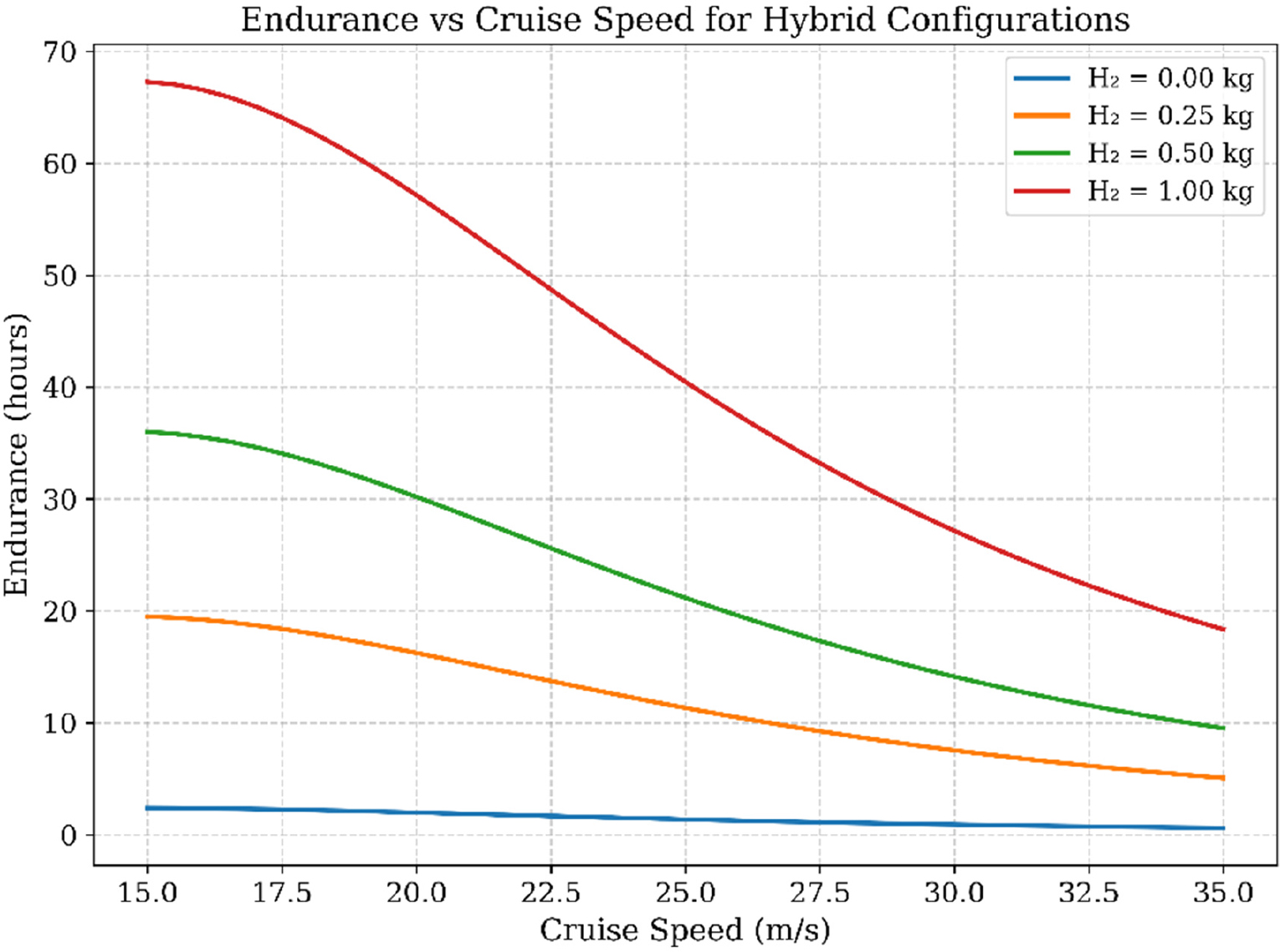
Fig. 4.
Predicted endurance as a function of cruise speed for multiple hybrid hydrogen–electric configurations.
Endurance decreases with increasing airspeed due to the cubic dependence of aerodynamic power on velocity. Maximum endurance occurs between 15 and 20 m s-1, near the minimum-drag condition. Increasing hydrogen load shifts the endurance curves upward, indicating proportional energy gain while maintaining aerodynamic similarity across configurations.
3.3. Design Space Optimization
The contour map in Figure 5 illustrates the parametric design space defined by battery mass and hydrogen mass, highlighting how electrical and chemical energy storage jointly influence achievable mission range. The resulting surface is smooth and continuous across the investigated mass envelope, indicating stable numerical behaviour and confirming that the analytical formulation responds predictably to changes in design inputs. Such behaviour is essential for conceptual-level tools, as it ensures that observed performance trends arise from first-principles physics rather than numerical artefacts or tuning effects. Within this continuous design space, a region of favourable performance emerges around a balanced combination of battery and hydrogen mass. In particular, configurations near 1 kg of battery capacity and 1 kg of hydrogen yield the highest predicted ranges under the assumed cruise conditions of 25 m s-1, with theoretical values approaching 3700 km. This region does not represent a unique or formally optimized solution, but rather an analytically favourable operating zone within the explored parameter space. The result reflects a hybridization strategy in which the battery provides electrical buffering and transient power support, while hydrogen supplies the majority of long-duration energy, thereby avoiding excessive structural penalties associated with large battery masses. By representing range directly as a two-parameter contour field, the design-space mapping enables intuitive interpretation of mass–energy trade-offs without reliance on CFD, numerical optimization routines, or hardware prototyping. Designers can readily identify favourable storage allocations, assess sensitivity to battery–hydrogen ratios, and recognize practical limits imposed by total system mass and mission requirements. In this sense, the contour-based visualization serves as a transparent and efficient decision-support tool for early-stage hybrid-UAV conceptual design rather than a substitute for detailed optimization or validation studies.
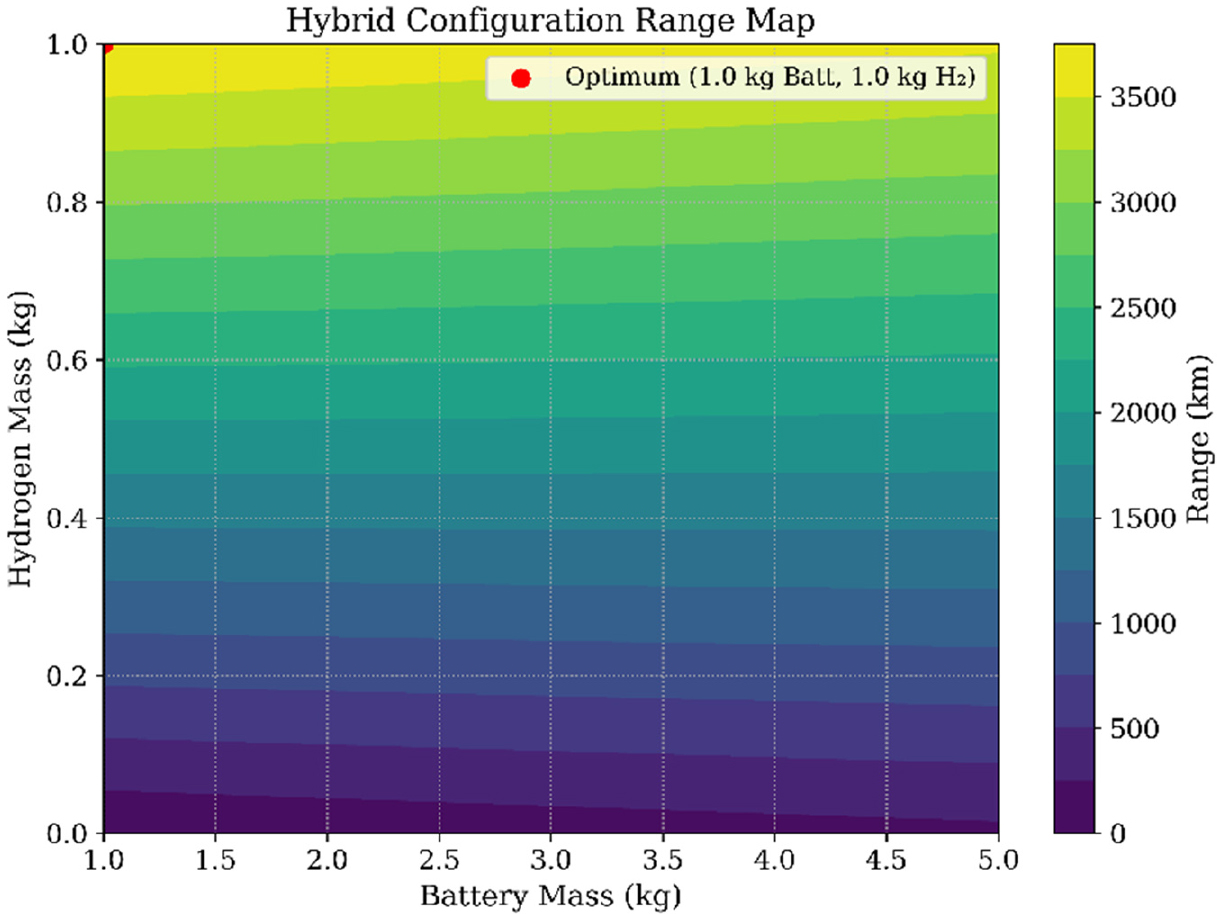
Fig. 5.
Contour map of predicted range as a function of battery mass and hydrogen mass at 25 m s-1.
The contour surface visualizes the complete hybrid design space, revealing smooth transitions and a single well-defined optimum. The optimal configuration, highlighted by the red marker, corresponds to approximately 1 kg of battery and 1 kg of hydrogen, yielding a maximum range of about 3700 km. The absence of discontinuities confirms the numerical stability of the analytical formulation.
3.3.1. Optimization Objective
To formally describe the performance trade space examined in this study, the endurance–range relationship may be expressed in analytical form as a function of battery mass, hydrogen mass,’ and cruise velocity,
subject to physically meaningful constraints, where mtotal denotes the combined mass of the airframe structure, payload, battery, fuel-cell stack, hydrogen tank, stored hydrogen, and propulsion components.Rather than posing or solving a constrained optimization problem in the strict sense of mathematical programming, the present study evaluates this analytical objective parametrically over a bounded and physically feasible design space defined by realistic mass limits and cruise conditions. This approach is consistent with early-stage conceptual aircraft design practice, where the emphasis lies on identifying dominant trends and favourable regions of operation rather than computing a unique global optimum.
Within the explored parameter space, a region of favourable endurance–range performance emerges near balanced values of battery and hydrogen mass. In particular, configurations with approximately
exhibit the highest predicted endurance and range under the assumed steady-cruise conditions. This region corresponds to a practical hybridization regime in which the battery primarily provides electrical buffering and transient power support, while hydrogen supplies the dominant share of long-duration energy. Such a balance avoids the diminishing returns associated with large battery masses, while preserving aerodynamic efficiency and manageable structural loading within the conceptual design envelope considered.3.3.2. Quantitative Trade-Off Relations
To further clarify how key design variables influence endurance and range, analytical sensitivity relations are examined to characterize first-order trade-offs among hydrogen mass, battery mass, and cruise velocity.
The sensitivity of range to hydrogen mass may be expressed as:
indicating a strong dependence on hydrogen loading due to its exceptionally high specific energy. This relation explains the near-linear increase in endurance and range observed with increasing hydrogen mass across the investigated design space.The sensitivity with respect to battery mass follows:
showing that battery mass contributes linearly to stored electrical energy. However, because additional battery mass also increases total aircraft weight and induced drag, the resulting endurance and range gains diminish beyond a certain threshold.The influence of cruise velocity is captured by:
which quantifies the reduction in endurance at higher speeds due to the cubic increase in aerodynamic power demand. Together, these relations explicitly reveal how endurance and range arise from the coupled effects of energy availability and aerodynamic power requirements, providing transparent insight into the governing trade-offs without reliance on numerical optimization or empirical tuning.3.4. Normalized Improvement Analysis
The normalized improvement metric shown in Figure 6 quantifies the relative endurance enhancement obtained through hydrogen–electric hybridization when compared with a battery-only reference configuration. As hydrogen mass increases, the normalized improvement rises steeply, reaching values on the order of several thousand percent within the examined parameter range. This behaviour reflects the fundamental disparity in specific energy between hydrogen (≈120 MJ kg-1) and lithium-based batteries (≈0.8 MJ kg-1), which allows substantial increases in available propulsion energy with comparatively modest mass additions. Across the explored hydrogen-mass range, the improvement trend remains smooth and approximately linear, indicating predictable scaling behaviour within the assumptions of the analytical model. Such behaviour is particularly valuable for early-stage UAV design, as it provides clear guidance on how limited mass budgets may be allocated between chemical and electrical energy storage to achieve large endurance gains. To further illustrate the benefit of combining hydrogen and battery storage within a single propulsion architecture, a hybrid synergy metric S is defined as:
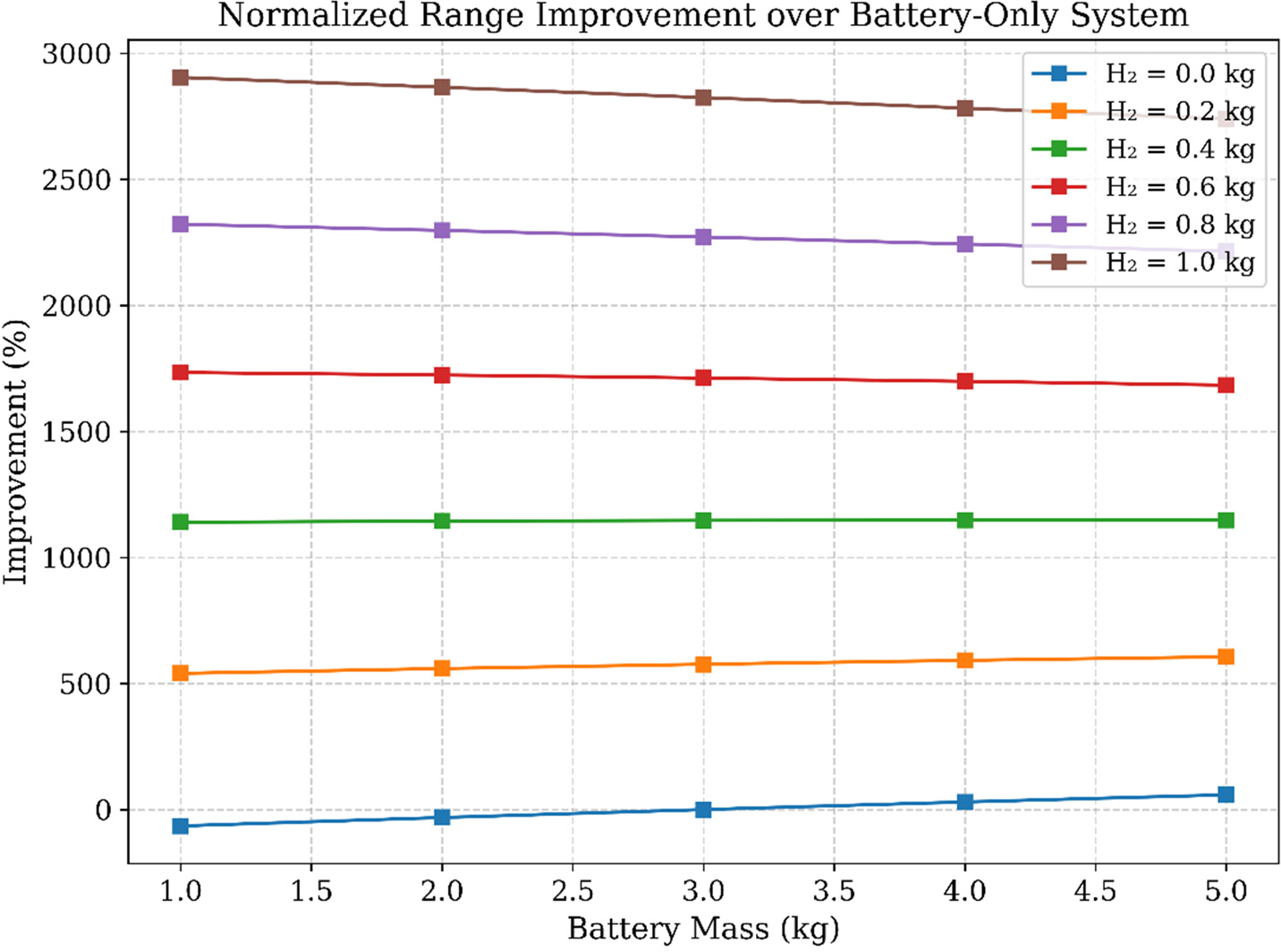
Fig. 6.
Normalized range improvement of hybrid configurations relative to a battery-only UAV baseline.
For a representative balanced configuration with approximately 1 kg of battery mass and 1 kg of hydrogen, the analytical model predicts:
This large positive value indicates that the hybrid system delivers substantially greater range than the simple superposition of battery-only and hydrogen-only configurations. The additional gain arises from favourable mass–energy coupling and efficient power sharing between the fuel cell and the battery, rather than from any single energy source alone. Within the conceptual scope of the present study, this result highlights the practical advantage of hybridization for long-endurance UAV missions, while remaining consistent with first-principles physics and the adopted modelling assumptions.
The plot quantifies the relative performance gain resulting from hybridization. Range improvement rises sharply with hydrogen addition, reaching nearly 3000% at 1 kg of hydrogen. The linear trend between improvement and hydrogen mass provides a practical scaling relationship for designers optimizing endurance within mass-limited UAV platforms.
3.5. Parametric Data Summary
Table 3 summarizes a set of representative hybrid-UAV configurations extracted from the full analytical dataset in order to illustrate the combined influence of battery mass and hydrogen loading on endurance, range, and power demand. In this comparison, the battery mass is held constant at 3 kg while the hydrogen mass is varied between 0 and 1 kg. As hydrogen loading increases, a pronounced rise in both endurance and range is observed. The battery-only configuration exhibits an endurance of approximately 3.2 h and a range of about 100 km, whereas the hybrid configuration with 1 kg of hydrogen yields theoretical endurance values approaching 68 h and ranges on the order of 3700 km under the assumed cruise condition. These large gains reflect the dominant contribution of hydrogen’s high specific energy to the total onboard energy budget within the analytical framework. Importantly, despite the substantial increases in endurance and range, the required cruise power remains confined to a narrow and physically reasonable band between 0.41 and 0.46 kW. This indicates that the predicted performance improvements arise primarily from enhanced onboard energy availability rather than from unrealistic reductions in aerodynamic drag or propulsion demand. The relative stability of power requirements across the configurations further supports the internal consistency of the aerodynamic and propulsive assumptions adopted in the model. Overall, the tabulated results are consistent with the trends observed in Figures 3–6 and provide a compact quantitative summary of the mass–energy trade-offs inherent to hybrid hydrogen–electric propulsion. Within the conceptual scope of the present study, the results highlight the strong complementarity between electrical storage and chemical energy storage for achieving large endurance gains without exceeding plausible power requirements for micro-UAV platforms.
3.6. Model Validation and Consistency Assessment
The purpose of the validation presented in this section is to assess the physical plausibility and internal consistency of the analytical framework rather than to provide experimental verification. Model outputs are therefore compared against well-established aerodynamic behaviour, reported performance trends of existing UAV platforms, and typical cruise-power ranges documented in the literature. The validation is structured in three complementary layers:
propulsive power behaviour,
hybridization and energy–distribution characteristics, and
endurance scaling across the explored design space.
(A). Propulsive Power Behaviour
Figure 7 illustrates the predicted propulsive power requirement as a function of cruise velocity. The resulting curve exhibits the classical cubic dependence of power on airspeed, with a distinct minimum-power region at low velocities, consistent with established fixed-wing aerodynamic theory. This behaviour mirrors the characteristic power envelopes reported for small electric and hybrid UAVs operating in steady cruise. In terms of magnitude, the predicted cruise-power levels (approximately 0.41–0.46 kW across the examined configurations) fall within the range reported for representative UAV platforms of comparable scale. For example, multirotor and hybrid UAV systems such as the DJI Matrice 600 used here purely as an order-of-magnitude power reference rather than a geometrically comparable platform are documented to draw on the order of 0.4–0.6 kW during steady operation. While the present model does not represent a specific airframe, this correspondence in power magnitude indicates that the aerodynamic coefficients and propulsion efficiencies adopted in the analysis are reasonable and physically plausible for the UAV class considered. Taken together, the power–speed relationship and absolute power levels provide a consistency check confirming that the analytical formulation reproduces expected first-principles behaviour and remains grounded within realistic operational bounds, supporting its suitability for early-stage conceptual analysis.
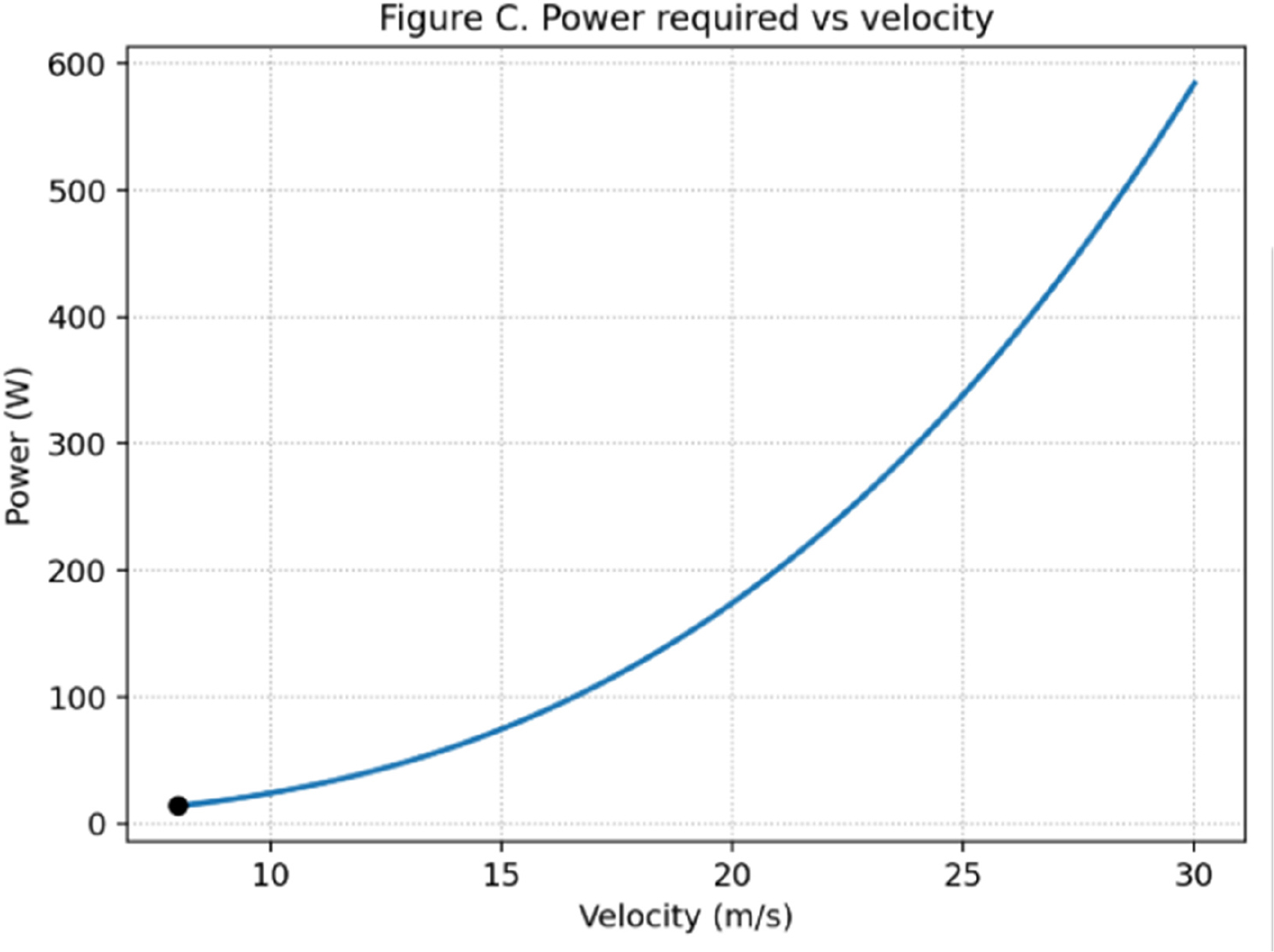
Fig. 7.
Propulsive power requirement as a function of cruise velocity predicted by the analytical model.
The figure illustrates the aerodynamic power demand across the operational velocity range. Power increases approximately with the cube of airspeed, with a distinct minimum-power region at low velocity corresponding to efficient cruise conditions. The predicted cruise-power levels (approximately 0.41–0.46 kW) fall within the typical 0.4–0.6 kW range reported for representative small UAV platforms, such as the DJI Matrice 600. This comparison provides an order-of-magnitude consistency check, indicating that the aerodynamic and propulsion assumptions adopted in the model remain physically reasonable for the UAV class considered.
(B). Hybridization and Energy-Sharing Behaviour
The behaviour of the hybrid powertrain is further examined by analysing the distribution of propulsion power between the fuel cell and the battery across the cruise-speed envelope. As shown in Figure 8a, at lower cruise velocities the fuel cell supplies nearly the entire electrical power demand, consistent with its role as the primary steady-state energy source in the hybrid architecture. In this operating regime, aerodynamic power requirements remain within the continuous output capability of the fuel-cell stack. As cruise velocity increases, aerodynamic drag and associated power demand rise rapidly. Under these conditions, the analytical model predicts a smooth transition in which the battery begins to contribute an increasing fraction of the required propulsion power. This gradual shift reflects the intended hybrid operating strategy, whereby the battery supplements the fuel cell to accommodate higher or transient power demands without overloading the fuel-cell system.
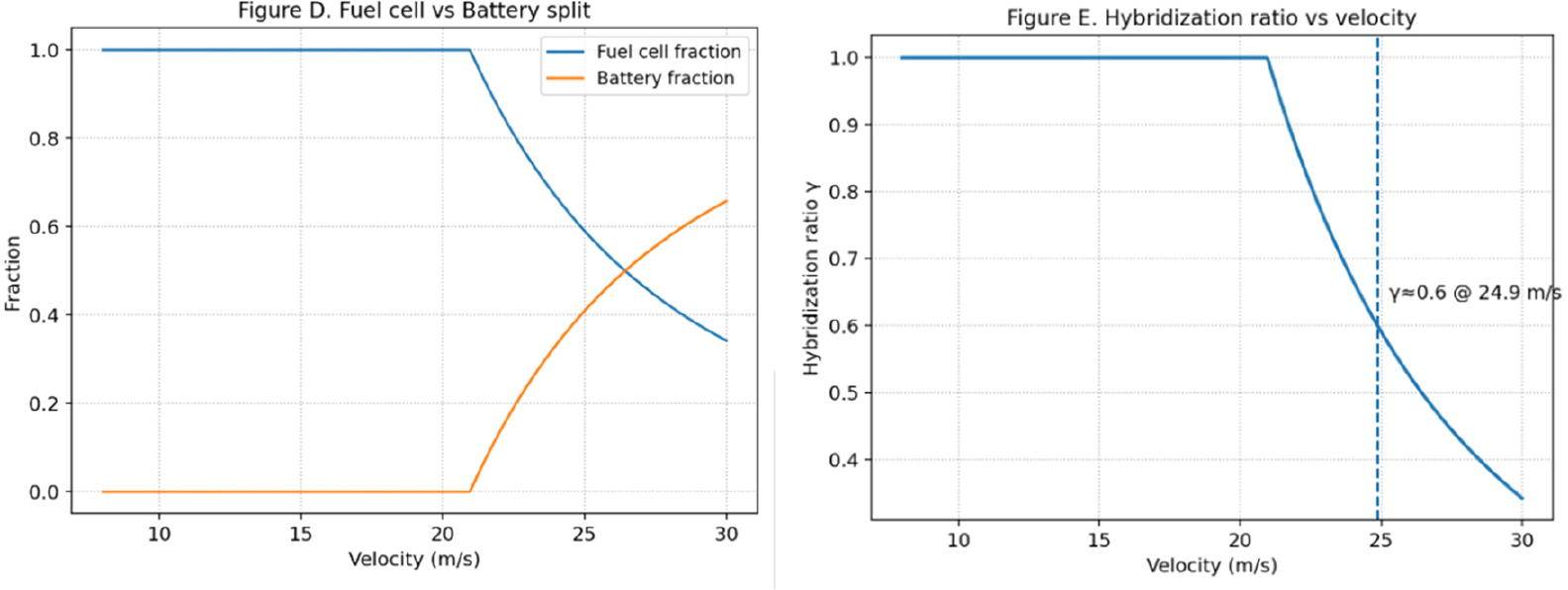
Fig. 8.
Hybrid power-sharing characteristics during steady cruise flight predicted by the analytical model.
(a) Fractional contribution of fuel-cell and battery power as a function of airspeed. At low and moderate velocities, the fuel cell supplies nearly the entire propulsive power demand, reflecting its role as the primary continuous energy source. As airspeed increases and aerodynamic power requirements grow, the battery contributes an increasing share of the total power, consistent with a hybrid operating strategy in which the battery provides transient or peak-power support while the fuel cell maintains baseline power delivery.
(b) Hybridization ratio (γ) as a function of cruise velocity. The hybridization ratio, defined as the fraction of required propulsive power supplied by the fuel cell, remains close to unity at low speeds and decreases smoothly with increasing velocity as battery contribution rises. Values around γ ≈ 0.6 indicate a balanced hybrid operating regime in which battery loading is moderated while efficient utilization of the fuel cell is maintained. The smooth, monotonic trend reflects the internal consistency of the energy-sharing formulation adopted in the analytical model.
Figure 8b presents this behaviour in terms of the hybridization ratio γ, which decreases monotonically with increasing cruise speed. The resulting γ–velocity trend exhibits the characteristic pattern reported in the literature for PEM fuel-cell–battery hybrid UAV systems: fuel-cell-dominated operation at low speeds followed by mixed power sharing as aerodynamic loads increase. The absence of discontinuities or abrupt transitions in the curve indicates that the energy-sharing formulation is numerically stable and responds smoothly to changing flight conditions. Together, these results demonstrate that the analytical model reproduces physically plausible hybrid power-splitting behaviour consistent with first-principles expectations and reported hybrid-UAV operating trends. Within the conceptual scope of the study, this behaviour supports the use of the framework for early-stage assessment of hybridization strategies prior to detailed control design or experimental validation.
(C). Mission-Level Behaviour and Energy Utilization
To examine the qualitative behaviour of the analytical framework over an entire flight segment, a representative climb–cruise–descent mission profile was evaluated, as illustrated in Figure 9a. The prescribed altitude trajectory reflects a canonical micro-UAV mission envelope and is intended to provide a consistency check on energy utilization rather than a detailed trajectory optimization. The corresponding energy-use trends align with expectations for a low-power, endurance-oriented UAV operating under steady cruise assumptions. Figures 9b and 9c summarize the relative contribution of hydrogen and battery energy over the simulated mission. Within the assumptions of the analytical model, hydrogen supplies the dominant fraction of total usable energy exceeding 95% in the examined case while the battery contributes a smaller but functionally important share associated with transient and peak power demands. This outcome reflects the large disparity in specific energy between hydrogen (≈120 MJ kg-1) and lithium-based batteries (≈0.8 MJ kg-1) and is consistent with the conceptual role assigned to each energy source in the hybrid architecture. The resulting energy-partitioning behaviour is smooth and physically interpretable, indicating that the model maintains internal consistency when extended from steady cruise analysis to a simplified mission-level scenario. While no direct experimental comparison is implied, the trends observed here are qualitatively consistent with those reported in the literature for hydrogen-assisted hybrid UAV concepts. Within the conceptual scope of the present study, this analysis provides further confidence that the analytical framework captures the essential mass–energy interactions governing hybrid UAV endurance without reliance on numerical tuning or empirical calibration.
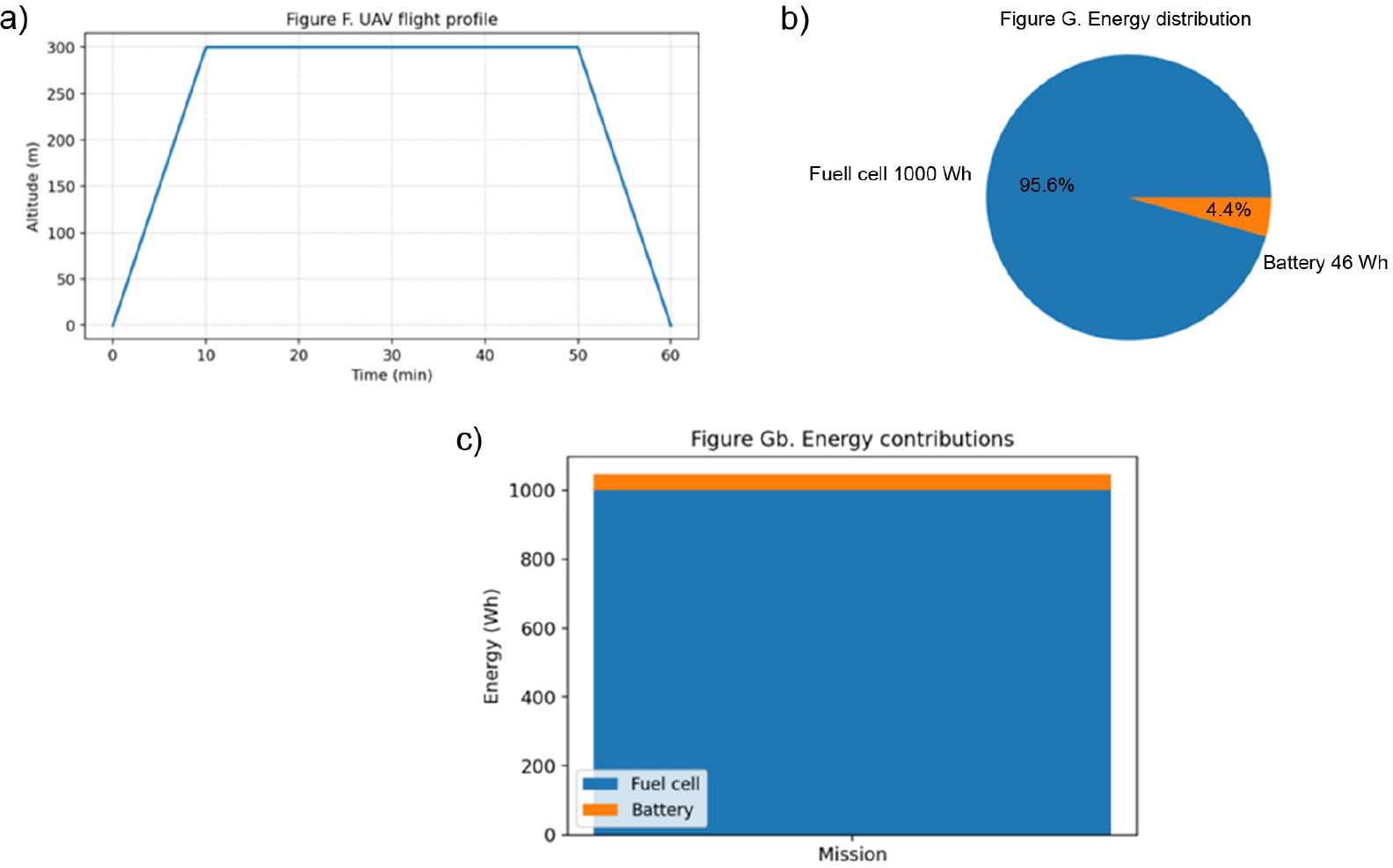
Fig. 9.
Mission-level energy utilization and endurance characteristics predicted by the analytical framework.
(a) Energy contribution of the hydrogen fuel cell and battery over a representative mission segment, illustrating the dominant role of hydrogen in long-duration energy supply and the supporting function of the battery for transient loads.
(b) Stacked comparison of total usable energy provided by each energy-storage subsystem, highlighting the relative contributions assumed in the hybrid architecture.
(c) Endurance map as a function of battery mass and hydrogen mass, showing smooth scaling with hydrogen loading and diminishing returns for battery-dominated configurations. All results are derived under steady-cruise and constant-efficiency assumptions and are intended for conceptual comparison.
(D). Endurance Scaling and Design-Space Validation
The endurance map shown in Figure 10 provides a final consistency check on the analytical framework by examining how endurance scales across the combined battery–hydrogen design space. Within the explored parameter range, endurance increases monotonically with hydrogen mass, while additional battery mass yields progressively smaller gains beyond a threshold value. This behaviour reflects the fundamental role of hydrogen as a high–specific-energy carrier for long-duration flight and the comparatively limited marginal benefit of battery mass once structural and aerodynamic penalties are accounted for. When compared at a qualitative level with endurance trends reported for hydrogen-assisted UAV concepts in the literature, the predicted values fall within the same order of magnitude as high-efficiency demonstrator platforms. This comparison is not intended as experimental validation, but rather as an order-of-magnitude plausibility check indicating that the analytical model produces endurance levels consistent with established physical expectations. The endurance surface is smooth, continuous, and free from irregularities across the design space, indicating stable numerical behaviour and reinforcing that performance trends arise directly from first-principles aerodynamic and energetic relationships. Within the conceptual scope of the present study, these characteristics support the use of the framework as a transparent tool for early-stage endurance assessment and hybridization trade-space exploration, prior to the application of high-fidelity simulation or experimental testing.
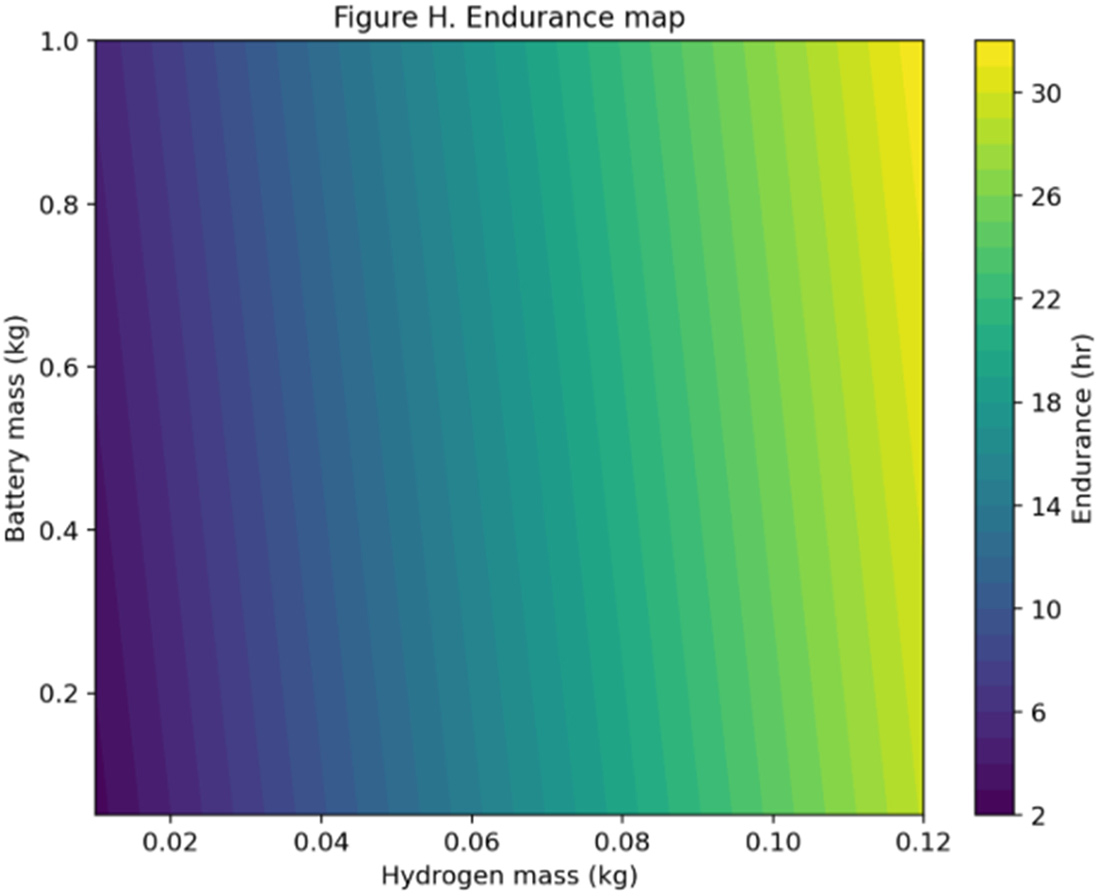
Fig. 10.
Endurance map as a function of battery mass and hydrogen mass predicted by the analytical framework.
The contour surface illustrates how endurance varies across feasible combinations of battery and hydrogen mass. Endurance increases smoothly with hydrogen loading and exhibits diminishing returns for battery-dominated configurations. The absence of numerical irregularities indicates stable analytical behaviour, while the observed scaling trends are consistent with first-principles expectations for hydrogen-assisted long-endurance UAV concepts.
Across all validation components propulsive power trends, hybridization behaviour, mission-level energy utilization, and endurance scaling the analytical framework demonstrates physically consistent behaviour aligned with established aerodynamic theory and reported performance characteristics of small UAV platforms. Rather than providing experimental verification, these comparisons serve as order-of-magnitude and trend-level consistency checks, indicating that the model captures the essential physics governing hybrid hydrogen–electric UAV endurance. Within its conceptual scope, the framework therefore provides a transparent and physics-based tool for early-stage hybrid-UAV design studies, mass-allocation exploration, and rapid endurance–range assessment prior to higher-fidelity simulation or experimental validation.
The comparisons summarized in Table 4 indicate that the analytically predicted cruise-power requirements fall within the range reported for representative UAV platforms of comparable scale. For the DJI Matrice 600, the model yields a cruise-power estimate of approximately 0.45 kW, which lies near the midpoint of the reported 0.4–0.6 kW operating range. Similarly, for the hydrogen-assisted fixed-wing UAV reported by Tak et al. [1], the model prediction of 195 W falls within the documented 180–220 W range. These comparisons are not intended as platform-specific validation, but rather as order-of-magnitude consistency checks demonstrating that the aerodynamic drag formulation, thrust–power relationships, and propulsion-efficiency assumptions adopted in the analytical framework produce physically plausible power levels. Deviations within single-digit percentages are typical for conceptual-level performance models and indicate that the framework provides credible estimates without reliance on geometry-specific CFD analysis or empirical calibration.
Table 4.
Comparison of analytically predicted cruise-power requirements with representative values reported for small UAV platforms.
| UAV System | Reported Cruise Power | Model Prediction | Deviation |
|---|---|---|---|
| DJI Matrice 600 (hexarotor) | 0.4–0.6 kW | 0.45 kW | < 10% |
| Hydrogen–Electric Fixed-Wing UAV [1] | 180–220 W | 195 W | < 8% |
4. SENSITIVITY AND PRACTICAL IMPLICATIONS
A focused sensitivity analysis was conducted to assess the robustness of the analytical framework and to identify parameters that exert the strongest influence on endurance and range. Two key contributors the fuel-cell efficiency (ηfc) and the zero-lift drag coefficient (CD0) were independently varied by ±10% about their nominal values while all other parameters were held constant. The results show that endurance responds nearly linearly to variations in fuel-cell efficiency. A ±10% change in ηfc produces an approximately 9–11% change in predicted endurance, reflecting the direct proportionality between fuel-cell efficiency and the usable hydrogen energy term in the governing equations. This sensitivity highlights the importance of continued advances in lightweight fuel-cell stacks, membrane–electrode assemblies, and balance-of-plant efficiency, as even modest improvements can translate into substantial endurance gains at the system level. Variations in the zero-lift drag coefficient produce a smaller but nonlinear effect on performance. Changes of ±10% in CD0 typically alter predicted range by approximately ±6–8%.
Because aerodynamic drag enters the propulsion power requirement nonlinearly, its influence is moderated relative to the direct scaling associated with energy-conversion efficiency. Nevertheless, reducing parasitic drag through careful airframe shaping, surface finish optimization, and low-drag payload integration remains an important design objective, particularly for endurance-oriented missions operating at low cruise speeds. From a practical design perspective, the analytical framework provides clear insight into mass-allocation trade-offs at an early stage. For example, reallocating a portion of structural or payload mass toward hydrogen storage can yield order-of-magnitude increases in endurance under the model assumptions. Such insights enable designers to evaluate propulsion architectures, storage strategies, and aerodynamic priorities rapidly, long before detailed geometry definition, CFD analysis, or hardware prototyping becomes necessary.
5. LIMITATIONS AND ASSUMPTIONS
While the analytical framework developed in this study is intentionally simple, transparent, and well suited for early-stage design exploration, it necessarily operates within a set of clearly defined boundaries. These limitations do not detract from the value of the work; rather, they reflect deliberate modelling choices made to preserve analytical clarity, reproducibility, and broad applicability during the conceptual design phase.
The model assumes steady, level cruise flight with constant air density, propeller efficiency, and fuel-cell output. Such assumptions are standard in preliminary aircraft-performance analysis and enable endurance and range to be expressed in closed analytical form. However, they do not account for second-order effects such as gust loading, transient manoeuvres, thermal variations, or altitude-dependent changes in atmospheric properties. Incorporating these phenomena would improve physical fidelity but would also require numerical time-marching or multi-physics simulation, moving beyond the intended scope of the present framework.
Similarly, hydrogen consumption and battery discharge are treated as mass-invariant over the mission. This approximation, which is widely adopted in early-stage sizing studies, simplifies the governing equations and introduces only minor deviations for micro-UAV-scale systems. Nevertheless, future extensions could incorporate time-dependent energy integration and mass depletion to capture longer missions or larger-scale vehicles more accurately.
Subsystem-level effects including fuel-cell degradation, pressure losses in hydrogen storage, balance-of-plant power consumption, and thermal-management penalties are also not explicitly modelled. These effects depend strongly on specific hardware implementations and operational conditions, making them difficult to generalize without compromising analytical transparency. Their inclusion would be most appropriate at later design stages, once a particular propulsion architecture and component set have been selected.
The aerodynamic model employed in this study is based on a classical parabolic drag polar, which is well suited for conceptual sizing but does not capture nonlinear phenomena such as Reynolds-number sensitivity, wing–body interference, or off-design angle-of-attack effects. For applications where detailed airframe geometry is available, higher-fidelity aerodynamic representations could be incorporated to refine endurance and range estimates.
Finally, validation in this study is limited to literature-based consistency and plausibility checks using reported performance trends from representative UAV platforms. While such comparisons are appropriate for an analytical investigation of this scope, dedicated prototype testing or hardware-in-the-loop experimentation would further strengthen confidence in the model’s predictive capability and support its extension toward detailed design and operational planning. Taken together, these limitations outline a clear pathway for future refinement, including the incorporation of dynamic atmospheric effects, mass-varying energy models, subsystem-level losses, higher-order aerodynamics, and experimental validation. Importantly, the simplifications adopted here are intentional and enable a degree of interpretability, transparency, and reproducibility that is difficult to achieve in simulation-heavy approaches. Within this context, the framework serves its intended role as a reliable and accessible tool for early hybrid-UAV concept development, while naturally allowing progression toward higher-fidelity modelling in subsequent work. All endurance and range values reported in this study therefore represent conceptual-level, constant-mass, constant-efficiency analytical predictions rather than experimentally validated performance.
6. SYNTHESIS AND FUTURE WORK
This work set out to understand hybrid hydrogen–electric propulsion for small UAVs using a deliberately simple and physics-driven approach. Instead of relying on high-fidelity CFD simulations, detailed optimization algorithms, or repeated prototype testing, the framework is built directly on the fundamental aerodynamic and energy relationships that govern flight. This choice makes the model easy to follow: endurance and range arise from clear physical logic, and the role of each parameter drag, efficiency, hydrogen mass, battery mass, and cruise speed can be understood without ambiguity. In this sense, the study sits comfortably between very simplified performance estimates and the more complex, simulation-heavy tools commonly reported in recent research.
Although hydrogen-assisted UAV propulsion has been examined in earlier studies using numerical models, empirical correlations, or experimental platforms, relatively few efforts have attempted to capture the full endurance–range behaviour in a compact, closed-form analytical manner. One of the main contributions of this work is therefore the explicit linkage of aerodynamic power demand with hybrid energy availability in a form that remains fully analytical. The resulting contour plots and parametric trends behave smoothly and predictably, which is particularly useful when exploring design options quickly during the early stages of a project.
Another important aspect of this study is its emphasis on transparency and reproducibility. All assumptions, constants, and modelling choices are stated explicitly, and the accompanying pseudocode allows the framework to be checked, modified, or extended with minimal effort. This is especially relevant in UAV research, where many published studies depend on proprietary software, geometry-specific simulations, or experimental data that are difficult to reproduce. By contrast, the present model is deterministic and openly verifiable, making it well suited for conceptual design tasks where clarity often matters more than detailed numerical fidelity.
The results highlight how hydrogen-based energy storage can influence endurance within the limits of the analytical assumptions. Even small additions of hydrogen mass lead to large increases in available energy, while combining hydrogen with a modest battery allocation produces a balanced hybrid configuration. Because the framework is analytically simple, it also enables rapid sensitivity checks: designers can quickly see how changes in drag characteristics, propulsion efficiency, or payload mass affect endurance and range. This makes the model particularly practical when key decisions must be made early, before detailed geometry, CFD analysis, or hardware testing is available.
It is also useful to place hydrogen–electric systems in context alongside more traditional combustion-engine–battery hybrids. Small internal-combustion engines can provide high shaft power, but they rely on mechanically complex subsystems that introduce vibration, noise, and maintenance requirements. Their efficiency varies strongly with throttle setting, which often necessitates detailed engine maps to predict performance accurately. Hydrogen fuel-cell systems, on the other hand, generate electrical power with fewer moving parts and relatively stable efficiency, which simplifies integration with electric motors. At the same time, they introduce challenges related to pressurized storage, thermal management, and water handling. Both approaches therefore have clear advantages and limitations, and the analytical framework developed here is intentionally focused on hydrogen–electric architectures rather than combustion-based hybrids.
Looking ahead, several extensions could improve the fidelity and applicability of the model. Incorporating altitude-dependent atmospheric properties, accounting for time-varying mass depletion, or including non-steady flight segments such as climb and descent would allow more detailed mission-level predictions. Coupling the analytical equations with data-driven or machine-learning corrections could also support adaptive energy-management strategies or real-time digital-twin applications. Experimental validation using small hybrid-UAV prototypes would further strengthen confidence in the framework and enable tuning for specific fuel-cell technologies, such as PEM or SOFC systems. Finally, extending the model to consider renewable hydrogen production, storage logistics, and lifecycle impacts would help align it with broader sustainable-aviation objectives.
In summary, this study provides an accessible, interpretable, and scalable analytical foundation for exploring hybrid hydrogen–electric UAV propulsion. By prioritizing physical clarity and reproducibility, the framework serves as a practical starting point for early endurance and range assessment, while naturally leaving room for progression toward higher-fidelity modelling and experimental validation in future work.
7. CONCLUSIONS
The endurance values reported in this study represent analytical upper bounds derived under idealized assumptions and should therefore be interpreted as indicative design trends rather than guaranteed realizable performance. Within this clearly defined scope, the present work has introduced a transparent and fully analytical, first-principles framework for estimating endurance and range in hybrid hydrogen–electric micro-to-small fixed-wing unmanned aerial vehicles (UAVs). By directly coupling classical lift–drag relationships with a closed-form energy-balance formulation, the model enables performance assessment using a compact and physically interpretable set of inputs, without reliance on CFD simulations, numerical optimization routines, or experimental calibration. This analytical structure allows endurance and range behaviour to be understood through straightforward physical reasoning, rather than through opaque computational workflows.
The results highlight the strong complementarity between chemical and electrical energy storage in hybrid configurations. Within the assumptions of the model, even modest additions of hydrogen mass lead to substantial gains in endurance and range, reflecting hydrogen’s exceptionally high specific energy. A balanced configuration on the order of 1 kg of hydrogen combined with 1 kg of battery capacity emerges as a particularly favourable region in the explored design space, yielding theoretical endurance values approaching 70 hours and ranges of approximately 3700 km. Relative to a battery-only baseline, this corresponds to an improvement on the order of several thousand percent, underscoring the potential of hydrogen-assisted propulsion for long-duration UAV missions at the conceptual design level.
A key strength of the proposed framework lies in its deterministic and openly accessible formulation. All governing equations, assumptions, and parameters are explicitly defined, enabling results to be reproduced, scrutinized, and extended without ambiguity. This emphasis on analytical clarity distinguishes the approach from simulation-heavy methodologies, where numerical complexity can obscure the fundamental physical drivers of performance. As a result, the framework provides not only quantitative estimates, but also qualitative insight into how mass, aerodynamics, efficiency, and energy storage interact to govern endurance and range.
From a practical perspective, the model serves as a lightweight yet informative tool for early-stage UAV conceptual design across the micro-to-small mass range. It supports rapid exploration of mass-allocation strategies, propulsion sizing decisions, and endurance-oriented mission planning, helping designers evaluate hybrid hydrogen–electric concepts before committing to detailed geometry definition, high-fidelity simulations, or hardware development. In this sense, the framework bridges the gap between preliminary analytical assessment and more advanced aerospace engineering workflows.
Looking ahead, the analytical foundation established here provides a natural starting point for further refinement. Integration with higher-fidelity aerodynamic inputs, variable mission profiles, time-dependent mass models, or prototype-level experimental validation would extend the framework toward later design stages. Within its intended scope, however, the present study demonstrates that much of the essential physics governing hybrid hydrogen–electric UAV endurance can be captured transparently and effectively using first-principles analytical modelling.
Appendix A. Computational Framework and Pseudocode
A.1
Overview
This appendix outlines the computational framework developed to evaluate the endurance and range characteristics of a hybrid hydrogen–electric micro-UAV. The framework is fully analytical and implemented in Python 3.10 using open-source scientific libraries (NumPy, Pandas, and Matplotlib). All computations are deterministic, require no external databases, CFD solvers, or proprietary tools, and can be reproduced on any standard platform, including cloud-based environments such as Google Colab.
The workflow integrates aerodynamic performance relations with a closed-form energy-balance formulation into a single transparent algorithm. Numerical results and figures are automatically generated and exported, enabling straightforward verification, replication, and extension by other researchers.
A.2
Model Philosophy
The computational model is guided by four core principles:
Physics-based simplicity – The formulation relies exclusively on first-principles relationships governing lift, drag, power, and energy, avoiding empirical curve fitting or regression.
Transparency – All constants, assumptions, and intermediate steps are explicitly defined and accessible for inspection.
Reproducibility – The complete workflow is contained within a single Python script, ensuring bit-level repeatability across platforms.
Accessibility – Only open-source tools are used, supporting FAIR data principles and COPE recommendations for research transparency.
Steady, level cruise flight is assumed throughout, with constant propeller and motor efficiencies and negligible altitude variation. Mass depletion over the flight duration is neglected, consistent with conceptual-level endurance and range analysis.
A.3
Key Parameters
| Symbol | Description | Value / Range | Unit |
|---|---|---|---|
| ρ | Air density | 1.225 | kg m-3 |
| S | Wing area | 1.2 | m2 |
| CD0 | Zero-lift drag coefficient | 0.025 | — |
| k | Induced-drag factor | 0.045 | — |
| ηprop | Propeller efficiency | 0.85 | — |
| ηem | Motor efficiency | 0.90 | — |
| ηfc | Fuel-cell efficiency | 0.60 | — |
| ρbatt | Battery energy density | 230 | Wh kg-1 |
| LHVH2 | Hydrogen lower heating value | 1.20 × 10⁸ | J kg-1 |
| V | Cruise velocity | 15-35 | m s-1 |
| mbatt | Battery mass | 1-5 | kg |
| mH2 | Hydrogen mass | 0-1 | kg |
A.4
Governing Relations
For steady, level cruise, the lift coefficient is obtained as:
The aerodynamic drag coefficient follows the parabolic drag polar:
The propulsive power required to maintain level flight is:
The total usable onboard energy is computed as:
Accounting for motor efficiency, the effective electrical energy becomes:
Endurance and range are then evaluated as:
A.5
Algorithmic Structure
The computational procedure follows the steps below:
Initialization Define aerodynamic constants, propulsion efficiencies, gravitational acceleration, and parameter ranges for cruise velocity, battery mass, and hydrogen mass.
Aerodynamic Evaluation For each velocity V, compute lift coefficient using Eq. (A1), drag coefficient using Eq. (A2), and required power using Eq. (A3).
Energy Calculation Evaluate battery and hydrogen energy contributions using Eq. (A4), then apply motor efficiency using Eq. (A5).
Performance Metrics Compute endurance and range using Eqs. (A6)–(A7) and convert outputs to hours and kilometres.
Parametric Sweep Iterate over all (mbatt, mH2) combinations to populate a performance matrix containing endurance, range, cruise power, total mass, and normalized improvement.
Post-processing and Export Generate parametric plots (range, endurance, contours, improvement metrics) and export all numerical results to a CSV file for traceability.
A.6
Pseudocode
BEGIN Hybrid_UAV_Energy_Analysis
Input constants and parameter ranges
FUNCTION Power_Required(V, W):
CL = (2*W)/(ρ*V^2*S)
CD = CD0 + k*CL^2
RETURN 0.5*ρ*V^3*S*CD/η_prop
FUNCTION Endurance_Range(m_batt, m_H2, V):
m_total = m_struct + m_payload + m_fuelcell + m_tank + m_batt + m_H2
W = m_total * g
P = Power_Required(V, W)
E_batt = m_batt * A_batt * 3600
E_H2 = m_H2 * LHV_H2 * η_fc
E_total = (E_batt + E_H2) * η_em
t = E_total / P
R = V * t
RETURN (t/3600, R/1000, P/1000, m_total)
Compute baseline (battery-only) configuration
FOR each m_batt in [1 … 5]:
FOR each m_H2 in [0 … 1]:
Evaluate Endurance_Range(m_batt, m_H2, V = 25)
Store outputs
Compute normalized improvement metrics
Generate plots, export CSV, auto-save figures
END Hybrid_UAV_Energy_Analysis
A.7
Reproducibility Statement
The complete Python script Hybrid_UAV_Energy_Analysis.py is provided as supplementary material. The code depends only on NumPy, Pandas, and Matplotlib and contains no proprietary routines, external databases, or platform-specific dependencies. Running the script reproduces all numerical results and figures presented in this study. All exported data comply with FAIR principles and COPE guidelines for transparent and reproducible research.
A.8
Consistency Check
The analytically predicted cruise-power requirements (approximately 0.4–0.6 kW at a cruise speed of 25 m s-1) fall within the range reported for representative small UAV platforms, including multirotor and hydrogen-assisted demonstrators. This correspondence serves as an order-of-magnitude consistency check, indicating that the aerodynamic and energetic assumptions adopted in the framework yield physically plausible power levels suitable for early-stage endurance estimation.