
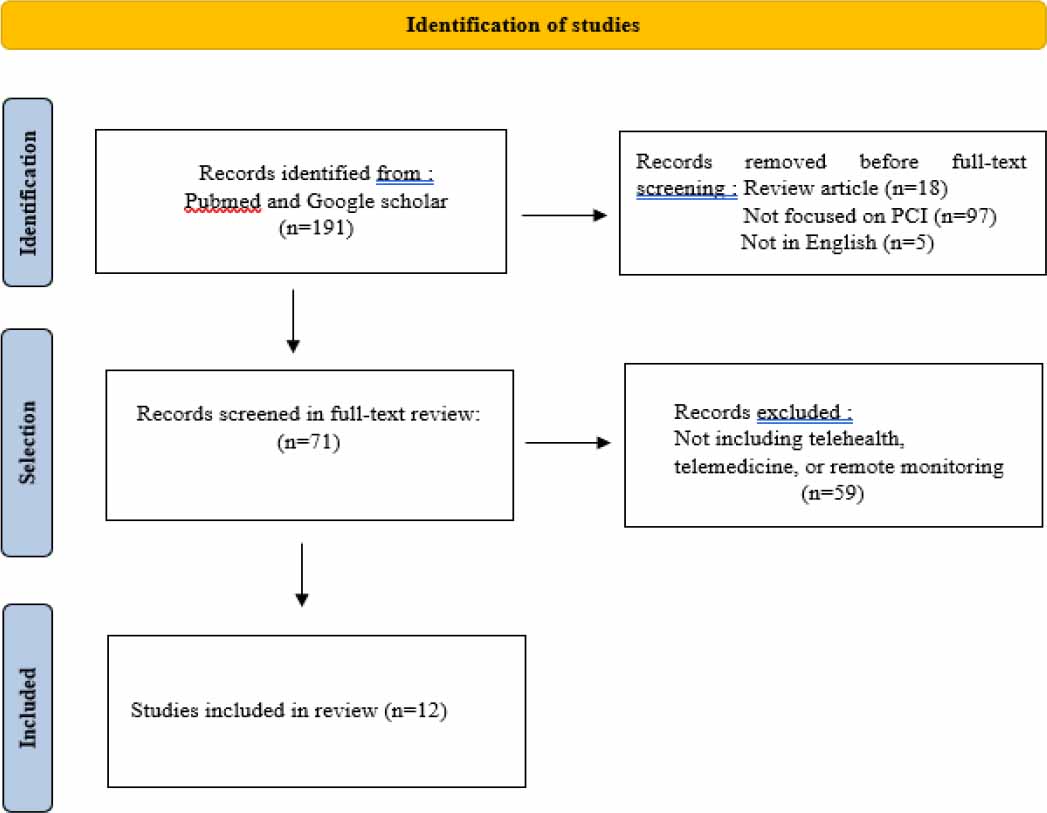
Figure 1
PRISMA flow diagram summarizing the study selection process.
Table 1.
Summary of included studies: telehealth and remote monitoring in post-PCI patients.
| Study | Technology | Intervention | Application | Type | Outcome Summary |
|---|---|---|---|---|---|
| Zhang et al. (2023) | Remote rehab app | Internet-based telerehab | CR adherence, LV function | Telehealth | Improved LV function, reduced anxiety |
| Wang et al. (2023) | Trinity rehab model | Hospital-community-family integration | Cardiac rehab participation | Telehealth + community | Improved LVEF and adherence |
| Mattioli et al. (2022) | Hybrid CR sessions | Hybrid cardiac rehab | Functional capacity, strength | Hybrid | Noninferior to center-based CR |
| Sato et al. (2025) | Wearable device | Remote PA feedback | Renal function, activity level | Wearable + web-based | Preserved eGFR, increased steps |
| Cruz-Cobo et al. (2023) | eMOTIVA app | Gamified mHealth app | Lifestyle, knowledge, satisfaction | mHealth | Improved diet, PA, satisfaction |
| Yamashita et al. (2022) | Smartphone app | Live health coaching | Medication adherence, QoL | mHealth + Coaching | Improved adherence, QoL |
| Pini (2024) | TeleCR program | Home-based rehab vs center | LDL, exercise capacity | TeleCR | Equivalent to center-based CR |
| Lindman et al. (2024) | Exercise tracking | Multicenter telerehab | Feasibility, engagement | Wearable/Tracking | Feasible, well-received |
| Li et al. (2022) | WeChat app | Structured health management | QoL, BP control | Messaging-based | Improved QoL, BP |
| Chen et al. (2023) | Chronic disease platform | Digital disease management | Self-care behavior | Web-based platform | Improved self-care literacy |
| Pini (2024) | TeleCR | Remote hybrid delivery | Risk factor control | Hybrid model | Preferred by younger patients |
| Chen et al. (2023) | Chronic disease platform | Digital disease management | Self-care behavior | Web-based platform | Improved self-care literacy |