
1. Introduction
Given the increasing overshoot of planetary boundaries (Richardson et al., 2023) and growing global inequality (Chancel et al., 2021), the transformation to sustainability is becoming more relevant and urgent. For over 50 years, international and national efforts have been made to address sustainability challenges through education and learning (e.g. Macintyre, Tilbury, & Wals, 2024). While in the 20th century, Environmental Education as well as Developmental Education and later Global Education were the most prominent concepts for addressing issues of sustainability, since the turn of the century, educational policy documents have increasingly focused on Education for Sustainable Development (ESD) (Singer-Brodowski et al., 2019). Activities during the UN Decade of ESD (2005–2014), the UNESCO Global Action Program (2015–2019) and the UNESCO ESD for 2030 program, which has been running since 2020, have contributed significantly to the diffusion of ESD in central documents of the educational systems (UNESCO 2021; National Platform, 2017). Implementing ESD generally requires a specific qualification of educators.
ESD teacher training (TESD) is undergoing dynamic development (e.g. McKeown & Hopkins, 2007). This applies both to practice, in which implementation is highly dependent on individuals and divergent across subjects (e.g. Uitto & Saloranta, 2017), and to research (German-speaking network LeNa – Teacher Education for a Sustainable Development, 2014).
For the international discourse, there are initial efforts of mapping the field of TESD, such as the systematic review by Fischer et al. (2022). This analysis focuses on general international trends and highlights key topics across different countries (five categories, including ‘measuring learning outcomes’) as well as various methodological approaches (such as single case studies). Out of 158 publications reviewed in this study, only 11 originate from Germany. For this reason, no conclusions can be drawn regarding the professionalisation of teachers at the single national level. In educational systems, that are mainly organized on a (sub-)national level, a focus on this national level, can provide a more detailed picture about certain trends and patterns that can be used for developing the field of research, inspiring practice and policy-making processes. Studies of national ESD monitoring provide indications that ESD is only rarely addressed in Germany's teacher education on the document level (Brock & Holst, 2022; Hemmer, Wittlich, & Schult, 2025), but there is an overall lack of differentiated insights into the structure of the research field. The present study addresses this gap by analysing the scientific discourse on TESD in Germany with a scoping review. The central research question captures characteristics as patterns of the TESD field that produce focal points and blind spots and that originate in certain discourses 1: Which characteristics and discourses can be identified in the scientific field of TESD in Germany?
2. State of research and conceptual framework
To approach the scientific field, six key questions based on the current state of research are presented in the following sections. They specify the aforementioned research interest, structure the analysis and ultimately guide the discussion, so that the review extends beyond a descriptive mapping of the field and contributes to the identification of desiderata and development of the practice and policy discourse.
2.1. Subject-specific dynamics and interdisciplinarity of TESD
In recent years, ESD has been increasingly implemented in official documents for schools. The “Curriculum Framework: Education for Sustainable Development” (Standing Conference of the Ministers of Education and Cultural Affairs & Federal Ministry for Economic Cooperation and Development, 2016) and the supplementary document for upper secondary education (German: gymnasiale Oberstufe) level (2025) aim to focus more on sustainability issues from a global perspective throughout all subjects. The actual implementation of ESD in curricula or other guiding documents are found more frequently in school subjects such as geography, biology or general studies in primary school (German: Sachunterricht) than in other subjects (Brock & Holst, 2022; Hemmer, Wittlich, & Schult, 2025). These studies show: in each subject, different ways of referencing ESD can be observed, shaped by subject-specific perspectives – including distinct goals, competencies, teaching methods – as well as underlying premises and disciplinary cultures (e.g. Bagoly-Simó & Hemmer, 2017).
The state of research on TESD in the various areas of subject-specific pedagogy and didactics has so far not been investigated. In particular, it has not yet been analysed to which extent the greater prominence of ESD in individual subjects based on curricula analyses are also reflected in research on TESD. Against this background, question I can be raised: Does the integration of TESD differ across subject didactics over time?
ESD, as an educational concept, is conceptualised to address interdisciplinary challenges in a problem-oriented manner (e.g. Yasin & Rahman, 2011). Analogously, ESD is implemented in school education and curricula as a cross-sectoral task (North Rhine-Westphalia), as a general guideline (Baden-Württemberg) or as an interdisciplinary endeavour (Saxony-Anhalt). However, interdisciplinary cooperation remains a major challenge in both school practice, teacher training, and research on ESD (Didham et al., 2024), as teaching, teacher training, and research is predominantly structured alongside disciplines and school subjects. To date, there is little systematic analysis of the number of interdisciplinary research projects. In view of its relevance, question II therefore focuses on interdisciplinarity: How do interdisciplinary studies shape the TESD discourse?
With the increasing mainstreaming of the concept in schools, it can be assumed that more researchers are developing an interest in this field. It can also be anticipated that researchers from subject didactics that have already been involved in ESD for longer periods of time will be prominently represented in the discourse and are part of bigger publication networks. Publication networks can be understood as social networks that indicate knowledge transfer between individuals and therefore also between disciplines (Krischel, Halling, & Fangerau, 2012). To obtain evidence for these considerations, we analyse who has been participating in the discourse, and how, by asking question III: Is the number of people shaping the scientific discourse increasing and which subject didactics can they be assigned to?
2.2. Target groups and school types as focal points in the scientific discourse on TESD
Numerous studies conclude that competency development of teachers for ESD still requires considerable effort (e.g., Brock & Grund, 2019; Grund & Brock, 2022; Hörsch et al., 2023). In the initial phase of teacher education – the university phase – there is evidence of an insufficient implementation of ESD in study regulations and module descriptions (Brock & Holst, 2022). Similarly, shortcomings have been identified in in-service teacher training, the third phase of teacher education (Waltner, Gaubitz, & Rieß, 2017). Inadequate integration of ESD across all phases of teacher education is also reflected in teachers' self-reported levels of knowledge (Brock & Grund, 2019; Grund & Brock, 2022).
Numerous studies on, for example, subjective theories, orientations, or motives of (prospective) teachers in the context of ESD focus on student teachers (e.g., Hinzke, Herzig, & Weber, 2024) or in-service teachers (e.g., Mittrach, 2023). However, the second phase of teacher education – the trainee phase for teachers between university and professional activity without supervision – remains largely unexplored in research (Kotthoff & Terhart, 2013). This is not surprising, because access to the field for empirical research is extremely difficult. Yet, it is of high relevance, as this is the phase in which content knowledge and pedagogical content knowledge are applied and critically reflected upon in real classroom settings.
Moreover, non-formal learning environments outside the classroom – and thus also external cooperation partners – play a significant role in the implementation of ESD, as they offer complementary expertise and provide experience-based learning environments (Singer-Brodowski, 2019; Brock & Grund, 2020). Teachers' competency to cooperate with external partners is particularly crucial for productive interaction and realisation of non-formal learning (Reinke, 2021). Based on the available data, it can be expected that students and teachers are also more frequently focused in the discourse on TESD than trainee teachers or external cooperation partners. Question IV is intended to address this assumption: Are target groups of TESD addressed differently in the scientific discourse?
An imbalance can also be assumed with regard to the types of school in which the actors are engaged 2: Explicit reference to ESD is much more frequently represented in the school profiles of primary school and upper secondary schools than in other types of school (Weselek, 2022). Studies have highlighted the problem that (prospective) teachers anticipate a class- and stratum-specific interest in sustainability practices and knowledge based on stereotypes and prejudices stemming from their parental homes (Weselek, 2022). Children and teenagers from socioeconomically disadvantaged and less privileged families are not seen as having a particular interest and prior knowledge of sustainability-related topics and behavior (Weselek, 2022). This finding is evident both among student teachers (Böse & Gräbe, 2025) and among teachers in the second (Weselek, 2024) and third phase (Weselek, 2022). The unequal preconditions for engaging with sustainability continue to be reproduced in informal adult learning contexts (Costa & Kühn, 2024). Considering that the topic of social inequality in the context of socio-ecological transformation has been increasingly discussed in recent years (e.g. Mau et al., 2023), it is highly relevant to account for and analyse the full range of school types. Question V therefore addresses a potential inequality regarding the possibility to engage in ESD: Are all school types equally represented in the scientific discourse on TESD?
2.3. The ratio of theoretical, conceptual and empirical contributions in the field of TESD
In general, ESD as a scientific field was initially characterised by explorations of the rather programmatic framework of ESD emerging from policy documents, like the Agenda 21 launched in 1992 in Rio de Janeiro. In the early years, the field was characterised by publications that did not refer extensively to theoretically or empirically based argumentation. Apart from few exceptions, they were rather understood as practical recommendations for the realisation of ESD. This also applies to TESD (German-speaking network LeNa – Teacher Education for a Sustainable Development, 2014). Therefore, it is worth asking whether the ratio of work on concrete programmes or activities, such as seminar concepts, has changed compared to studies focusing on theory development or work with empirical approaches. In addition, the question of whether the thought collective (Fleck, 1993) of the TESD research community has aligned more closely with scientific standards, as called for by Gräsel et al. in 2012, is also considered. Based on this, question VI is posed: How does the ratio of conceptual, theoretical and empirical work on TESD change over time?
3. Objectives of the present study
This scoping review aims to provide a systematic analysis of the national scientific discourse on professionalisation of teachers for ESD. Given the increasing prominence of ESD in key documents of the German education system, especially compared to related educational concepts (Singer-Brodowski et al., 2019), our study focuses on ESD. The goal is to identify the characteristics and research gaps of this discourse in order to develop a consolidated body of research on TESD in Germany and as a result also support professionalisation efforts in a systematic way.
Six indicators and key questions form an analytical framework for answering the general research question: What characteristics and discourses can be identified in the field of ESD teacher education and practice in Germany?
The characteristics of the scientific field are conceptualised as aspects of the discipline, the interdisciplinarity of projects, target groups, types of schools and types of contributions to the field (questions I–II and IV–VI). The discourses of the research field are conceptualised by people participating and their joint publications (question III).
4. Methodology
To answer the research question, a scoping review was conducted (Arksey & O'Malley, 2005; Gutierrez-Bucheli et al., 2022; Tricco et al., 2018), which is characterised by a systematic approach and a broad search strategy that includes various types of contributions, aiming to provide an overview of a wide research field and to identify knowledge gaps (Gutierrez-Bucheli et al., 2022; Tricco et al., 2018). To answer the research questions, we combined qualitative content coding to reveal characteristics of the TESD field and a bibliometric approach to gain further insights into discourse-participating persons and their publication networks (Krischel, Halling, & Fangerau, 2012).
4.1. Search Strategy
The search for publications was based on two pillars: a database search and a manual extension. For the database search, Web of Science (Science Citation Index Expanded and Social Sciences Citation Index) and “Fachportal Pädagogik” (including FIS Bildung, ERIC and BASE) were selected. The combination of these databases is expected to provide high coverage for the research focus (Heck et al., 2024). The search was conducted using two keyword clusters – one related to ESD and the other to teacher professionalisation – and was restricted to publication abstracts (search string see Appendix section I). The specific search terms are presented in Table 1. Within each row, terms were combined using the Boolean operator OR, while the two clusters (columns) were linked using AND. The search was conducted in September 2024.
Tab. 1
Search terms used in the databases ‘Fachportal Pädagogik’ and ‘Web of Science’, combined with the criteria of publication language (German or English) and the publication year criteria of 1992 to 2024 inclusive), without limiting the type of publication.
| Keyword cluster Search terms | ESD | Teacher professionalisation |
|---|---|---|
| Bildung für nachhaltige Entwicklung | Lehr*bildung | |
| BNE | Lehr* | |
| education for sustainable development | profession* | |
| ESD | teacher education | |
| education for sustainability | teach* sustainability education | |
| ESE |
In addition to the database search, project members manually added relevant missing publications from the respective disciplines 3 to the sample. Although this process reduces the replicability of the study, as targeted by the systematic database search, it increases the breadth of coverage of the field, as not all publications are listed in databases. This approach takes various traditions of publication in the respective disciplines into account. The inclusion of publications was then discussed by other project members, and the same criteria as in the database search were applied (see section 4.3).
4.2. Screening and Selection Process
Following the PRISMA guidelines for scoping reviews (Tricco et al., 2018), all publications were screened in multiple steps (see Figure 1). The database search yielded 516 results. Cumulative dissertations (n = 5) and edited volumes (n = 51) were examined separately to identify relevant contributions. Titles and abstracts of N = 394 publications were reviewed using five inclusion criteria: (1) reference to ESD, (2) focus on teacher professionalisation (pre- or in-service), (3) focus on general education schools, 4 (4) addressing the context of teaching in Germany, and (5) language. Two project members independently screened each publication using the online tool Sysrev (Bozada et al., 2021), achieving a satisfactory interrater reliability of 88% (Cohen's Kappa κ = 0.73). Discrepancies were resolved through discussion. The quality of publications is not an exclusion criterion in scoping reviews (contrary to systematic reviews; Arksey & O'Malley, 2005).
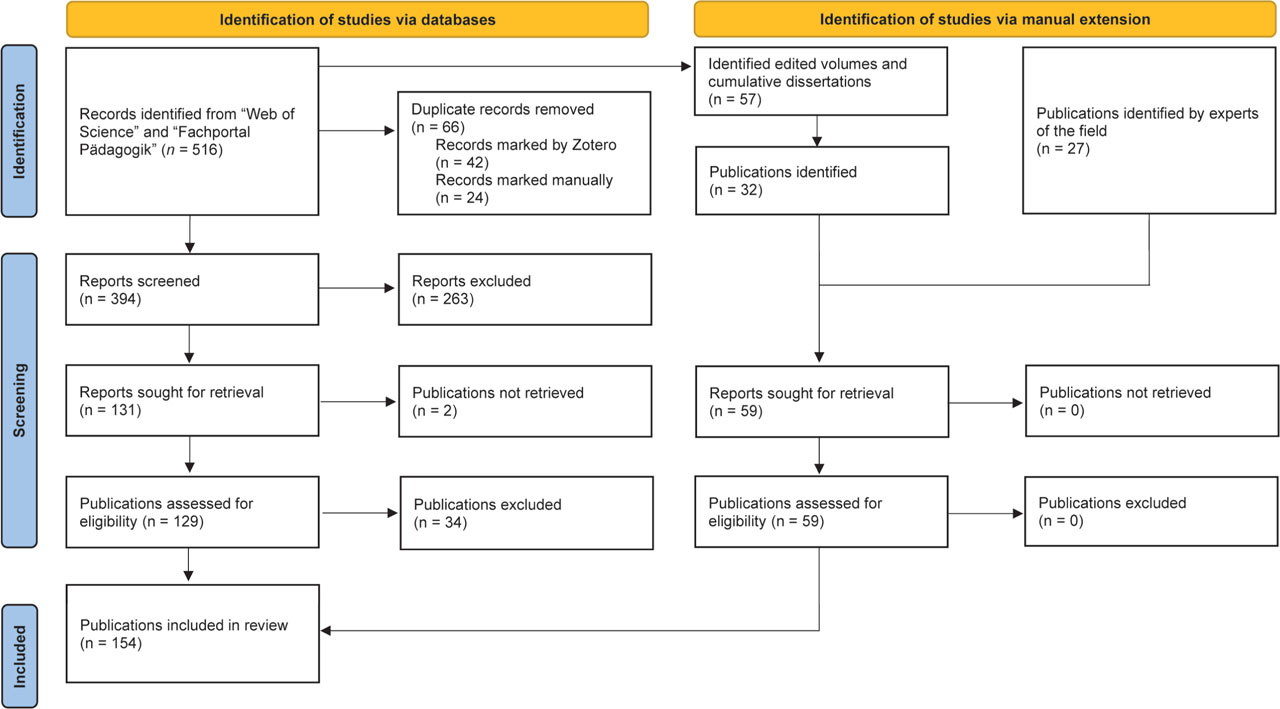
Fig. 1
Overview of the database search and the manual extension based on the PRISMA recommendations (Page et al., 2021)
At full-text screening, two reviewers applied the same five criteria to records from the database search and manual additions. Agreement reached 91% (Cohen's κ = 0.74); differences were resolved through discussion, resulting in a final sample of 154 publications.
4.3. Data Extraction
For data extraction regarding questions I–II and IV–VI, a category system was developed in an iterative process within the project group. Coding was conducted in interdisciplinary pairs, each comprising two project members. This approach ensured that individuals from different disciplinary cultures were coding the material, thereby minimising any potential disciplinary bias in the coding process. The interrater reliability for each category, measured using Cohen's Kappa, is presented in Table 2.
Tab. 2
Cohen's kappa coefficients by category
| category | subject area | target group | school type | type of contribution |
|---|---|---|---|---|
| κ | 0,68 | 0,60 | 0,33 | 0,77 |
| N | 235 | 211 | 295 | 173 |
The interrater reliabilities are generally satisfactory (Rädiker & Kuckartz, 2019). To explain the relatively low kappa value for the category “school type” the discrepancies were retrospectively evaluated empirically: The most common source of error relates to a margin of interpretation between the codes “unclear” and “irrelevant”. Publications with vague information on school type can, in principle, be assigned to both categories. The latter had no impact on the overall count of school types addressed. All discrepancies were discussed and resolved through consensus. The database for research question III draws on the authorship information contained in the publications.
4.4. Data Analysis
Data analysis was conducted using the statistical software R (R Core Team, 2024). To address the questions related to the characteristics of the research field (I – II and IV – VI), the frequencies of deductive categories were examined in relation to the year of publication. Visualisations were generated using the ggplot2 package (Wickham, 2023). To answer question III, a co-authorship network was constructed in R with the igraph package (Csardi & Nepusz, 2006) and visualised using ggraph (Pedersen, 2024).
5. Results
5.1. Description of the sample
The sample of 154 scientific publications comprises 12 books (8%), 59 book chapters (38%), and 83 journal articles (54%). German-language publications dominate the sample, accounting for 107 texts (70%). The journal articles were published across 44 different journals. The most frequently represented journals are Sustainability (n = 17), Zeitschrift für internationale Bildungsforschung und Entwicklungspädagogik (n = 6), and Environmental Education Research (n = 5). Figure 2 illustrates the publication trend over time. As the database search was conducted during the ongoing year 2024, the data for this year are incomplete. Publications in this research field date back to 1998, with a noticeable – albeit not continuous – increase starting in 2016. However, topic-specific edited volumes and journal issues must be taken into account when interpreting publication counts (Menthe et al., 2016; n = 3; Keil, Kuckuck, & Faßbender, 2020; n = 5; Graulich et al., 2024; n = 13).
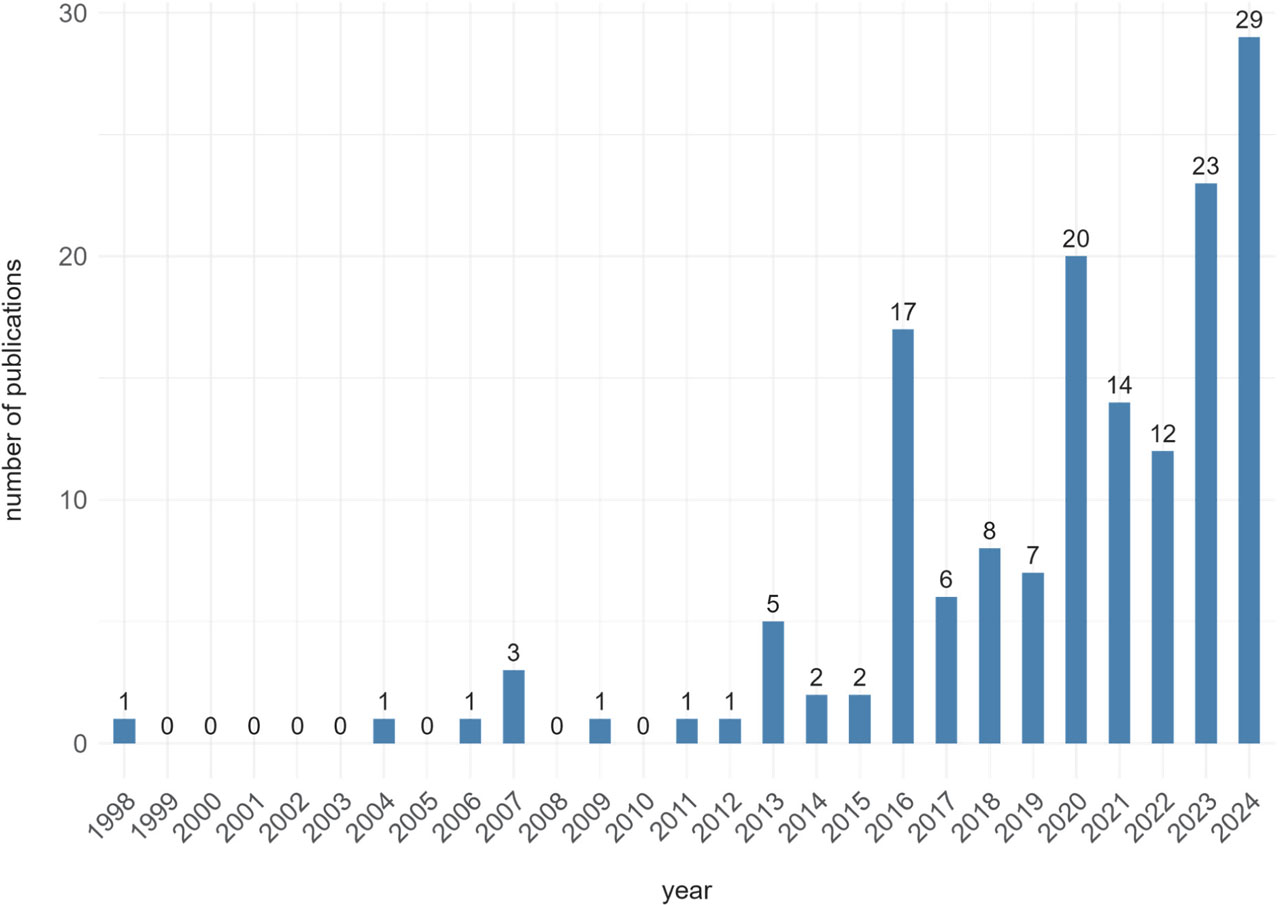
Fig. 2
Absolute frequencies of the publications included per year
5.2. Question I: Integration of TESD in subject didactics
To investigate whether the professionalisation of teachers for ESD is integrated at different times or to varying extents across different subjects, the subjects addressed within each publication were used as an indicator. The decisive criterion for assigning a publication to a specific subject was not the authors' institutional affiliation or the disciplinary focus of the publication venue, but rather the extent to which subject-specific aspects were emphasised in the text itself. If no clear subject-specific reference to TESD could be identified, the publication was coded as “subject-independent.” This category also includes publications that address, for example, cross-disciplinary didactics, educational science, or psychological perspectives. Figure 3 visualises the absolute frequencies of publications based on their coded subject reference.
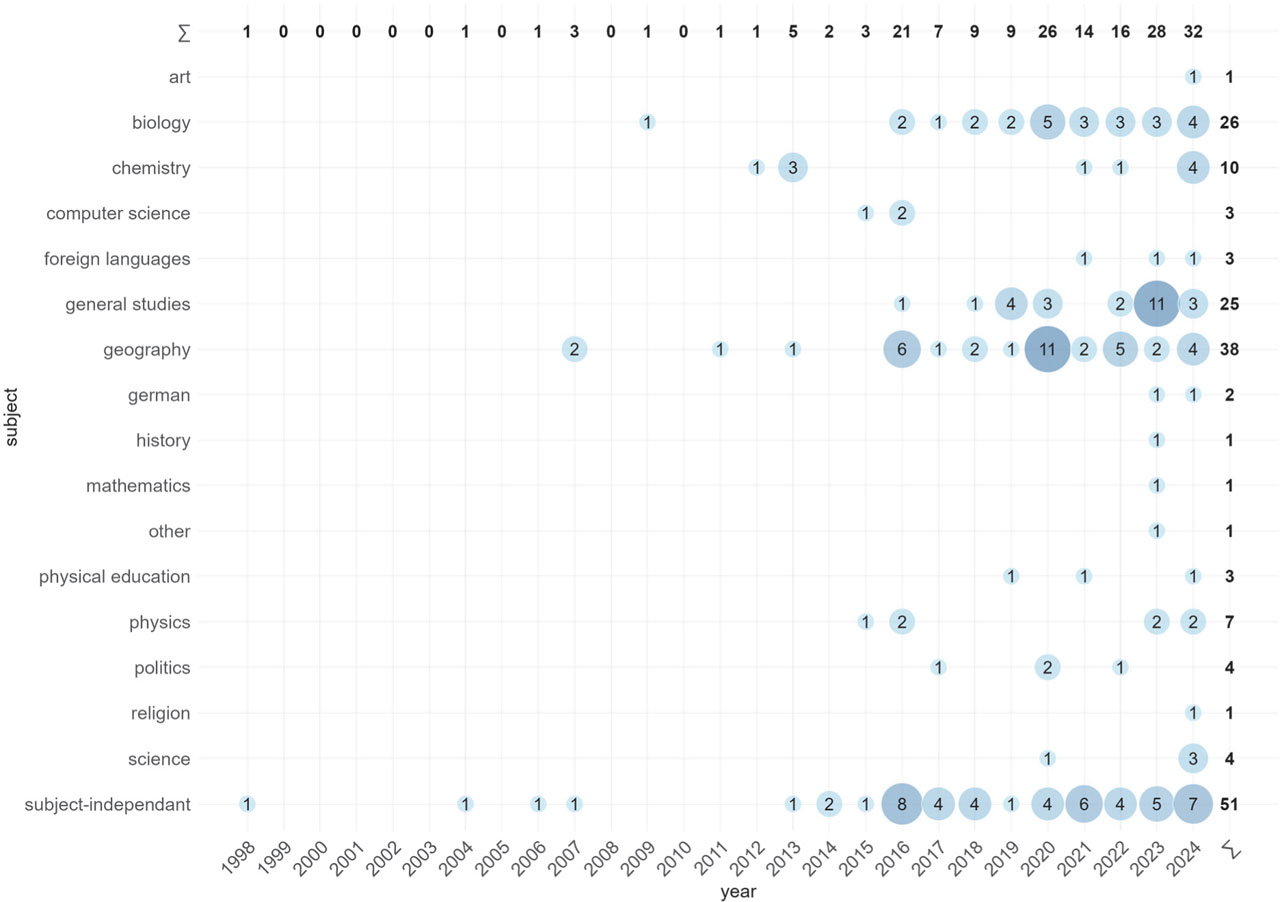
Fig. 3
Bubble chart showing absolute frequencies of publications by subject and year, including marginal sums per subject and per year; bubble size and colour intensity correspond to the frequency represent the absolute frequency
A subject-specific analysis of the development of the research field on teacher education for sustainable development (TESD) over time reveals differentiated patterns, allowing the identification of four distinct groups:
Since around 2016, there has been a notable increase in publications within the subjects of biology and geography, as well as from a subject-independent perspective. In the case of science and social studies, this trend has emerged with a slight delay.
Publications on TESD have also appeared in chemistry and physics during this period, though in significantly smaller numbers.
In subjects such as German, foreign languages, history, computer science, art, political education, religion, physical education, mathematics, and integrated science, only isolated publications on teacher professionalisation have emerged in recent years.
No relevant publications were identified for the subjects of music, philosophy, and economics.
The three publications which were categorised as non-subject-specific address the topic of TESD in a general way with a focus on conceptual understandings and motivations for implementing ESD, without outlining ESD in a subject-specific way. However, when taking the affiliations of the authors into account, the publications can be assigned to geography didactics (Engelhard, 1998), environmental communication (Rode, 2004) and science and social studies and biology didactics (Seybold & Rieß, 2006).
The integration of TESD into subject-specific discourses occurs at varying times and to differing extents across individual subjects. A distinction can be made between an initial, general engagement with the topic within a subject area and a subsequent, more specific discourse that either applies TESD-related considerations to the subject or responds to the broader ESD discourse from within the subject itself.
5.3. Question II: Interdisciplinarity of the projects
The analysis of interdisciplinarity within the field of teacher education for sustainable development (TESD) is based on the same coding scheme used in the previous section (see 5.2). A total of n = 21 publications in the sample adopt a subject-specific perspective that encompasses two or more subjects (n = 17 address two subjects, n = 3 address three subjects, and n = 1 addresses five subjects). Figure 4 illustrates the absolute frequencies of collaboration between two subjects.
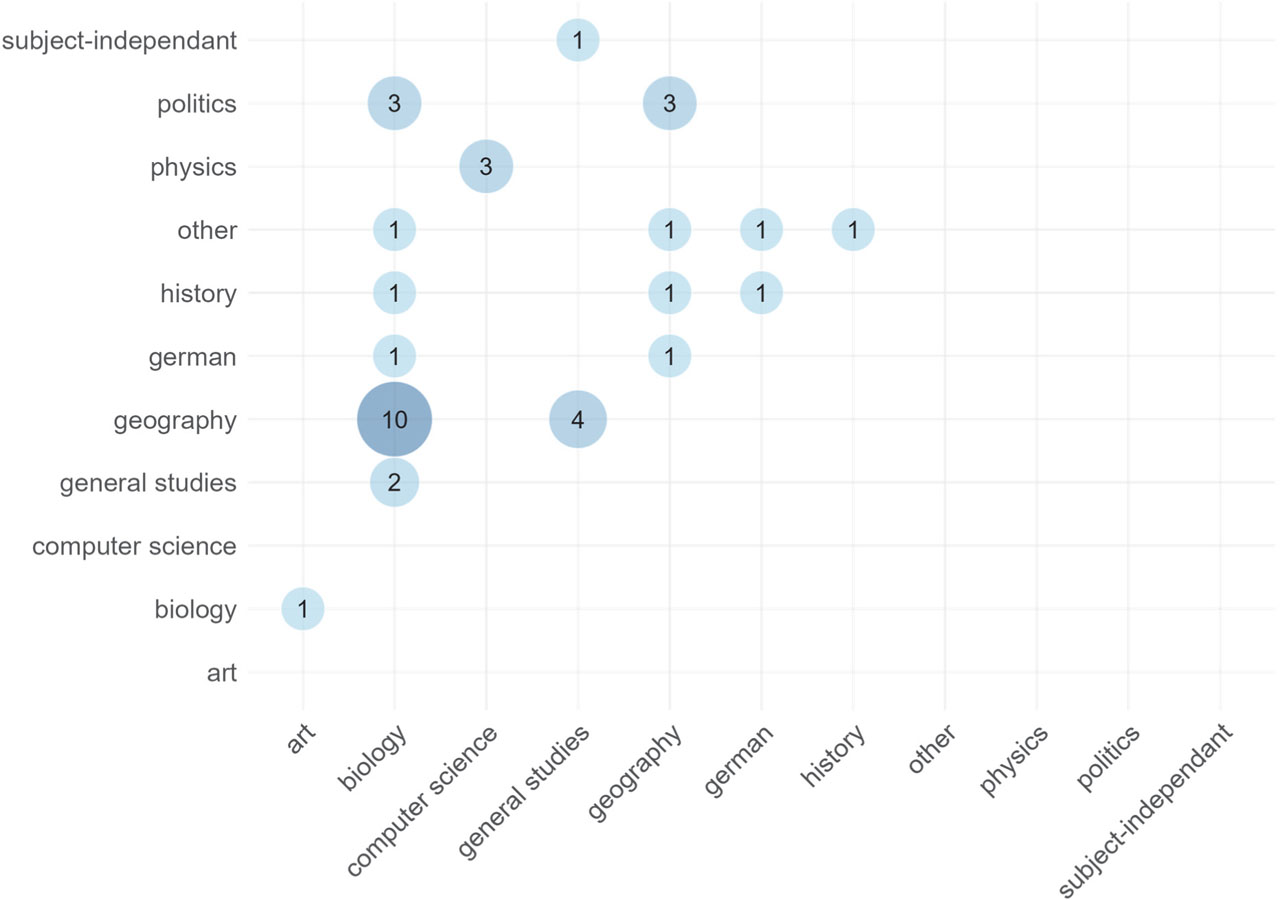
Fig. 4
Bubble chart showing absolute frequencies of cross-subject publications; bubble size and colour intensity correspond to the absolute frequency of interdisciplinary publications between subjects, which is also indicated numerically at the corresponding position
The analysis shows that two or more subject-specific perspectives are only integrated in a few cases. These include, in particular, studies linking geography and biology (n = 10, of which n = 6 between the two subjects and n = 4 with other subjects, including n = 3 with political education) as well as geography and general studies in primary school (n = 4). It should be noted that these interdisciplinary publications originate from the disciplines that were previously considered to have published frequently and to have entered the subject-specific discourse at an early stage.
5.4. Question III: Discourse-participating persons
Findings indicate that 253 different authors have been participating in the discourse on teacher professionalisation for ESD (Figure 5). Two indicators are used to analyse the development of the number: the absolute number of authors who have published in one year (= total number of authors) and the absolute number of new authors entering the discourse per year (= first-publishing authors). Editorships of thematic issues and edited volumes, which could facilitate thematic exchange between individuals and institutions beyond individual contributions, were not considered in this analysis.
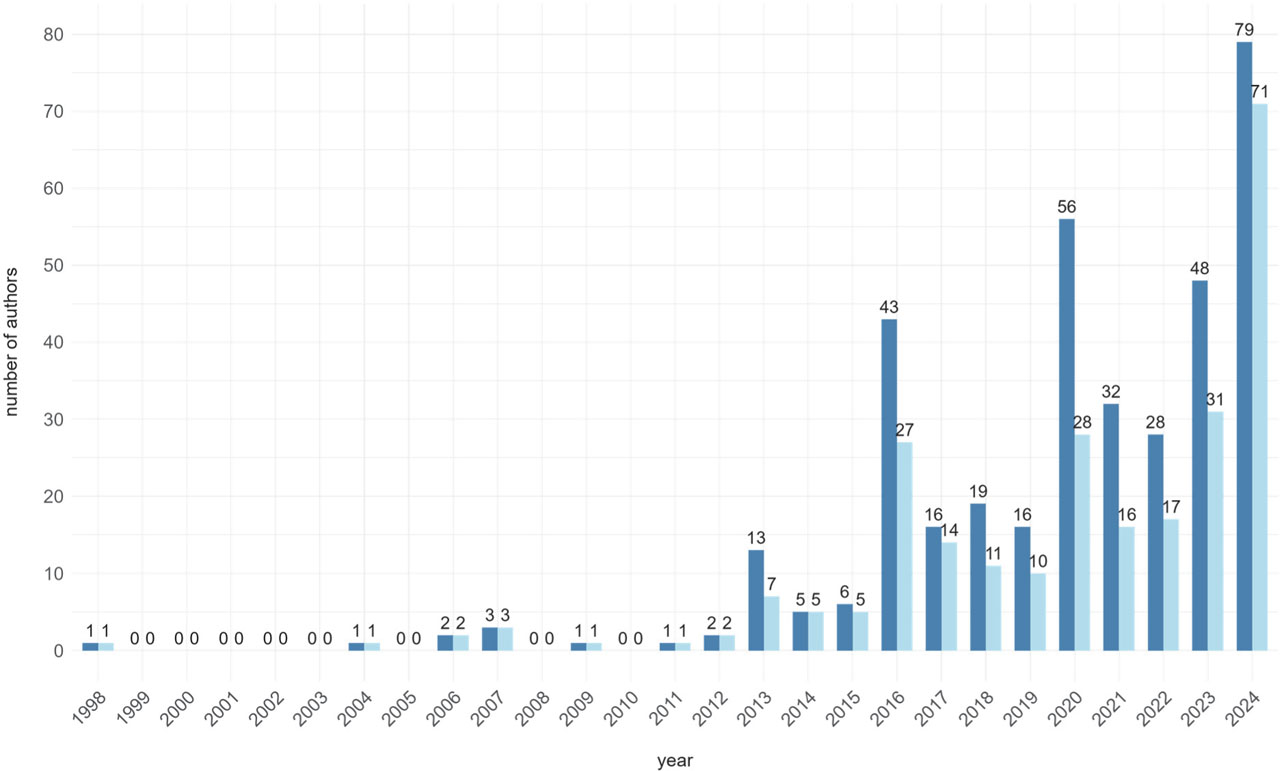
Fig. 5
Development of total number of authors per year and first authors per year; dark blue bars represent the total number of authors and light blue bars represent the number of first-time authors per year
A steady increase in the number of individuals contributing to the discourse over time becomes evident. Peaks in authorship activity in the years 2016, 2020, and 2024 suggest that edited volumes (see section 5.1) have played a significant role in shaping publication-based academic exchange. A comparison of publication frequencies indicates that repeated contributions to TESD only begin to appear from 2013 onwards. Prior to this point, the number of first-time authors corresponds to the total number of authors, implying no multiple publications by authors. Nevertheless, the proportion of first-time contributors remains consistently high relative to the overall number of authors throughout the observed period.
To address question II in greater depth, it is also relevant to examine which authors are contributing to the field and how (interdisciplinary) research networks are structured. To visualise the degree of interconnectedness, a co-authorship network was constructed (see Figure 6). Publications authored by a single individual (n = 47) are not included in the network representation.
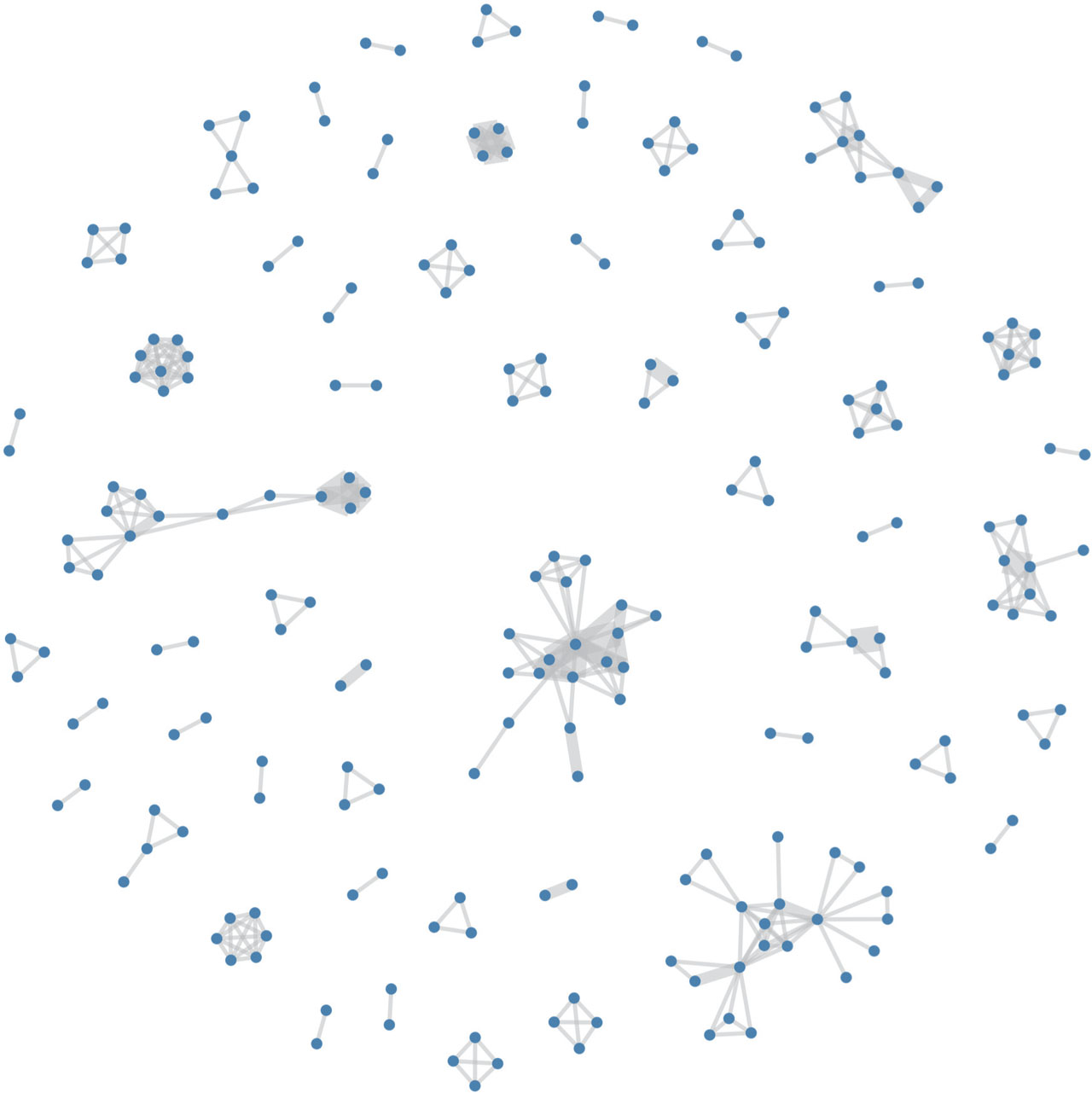
Fig. 6
Co-author network showing authors (nodes), co-authorship connections (edges), and collaboration frequency (edge thickness)
The co-author network for the TESD discourse is characterised by the following features: There are numerous small groups of two to four authors (n = 99), most of whom publish together once and have no connections to other networks. This finding is coherent with the high number of first authors (see Figure 5). Larger groups with five (n = 5), six (n = 2), seven (n = 1) or eight authors (n = 1) rarely publish. Only six larger clusters can be identified, which are formed by several publications and include between nine and 21 authors. Overall, the discourse does not form an overarching network.
To gain further insights, also with regard to the disciplinary structure, the three largest clusters – measured by the number of people – are analysed separately.
Figure 7 visualises the largest cluster (21 people, 11 publications). None of the publications were written by the same co-authors, resulting in a variety of teams that enable personalised knowledge transfer as part of the writing process. Anne-Kathrin Lindau (University of Halle; n = 5) and Gabriele Schrüfer (University of Bayreuth; n = 4) – both professors of geography didactics – have the most co-authorships. Most of the participants belong to geography didactics, and some to biology and science and social studies didactics. There is a high degree of networking across universities (universities in Bayreuth, Duisburg-Essen, Giessen, Halle-Wittenberg, Salzburg (Austria), Wuppertal, Zurich and the University of Applied Sciences Northwestern Switzerland). The central element for the connection of two sub-networks around Lindau and Schrüfer is a contribution to the conference proceedings based on a jointly designed World Café on teacher professionalisation (Bauer et al., 2020).
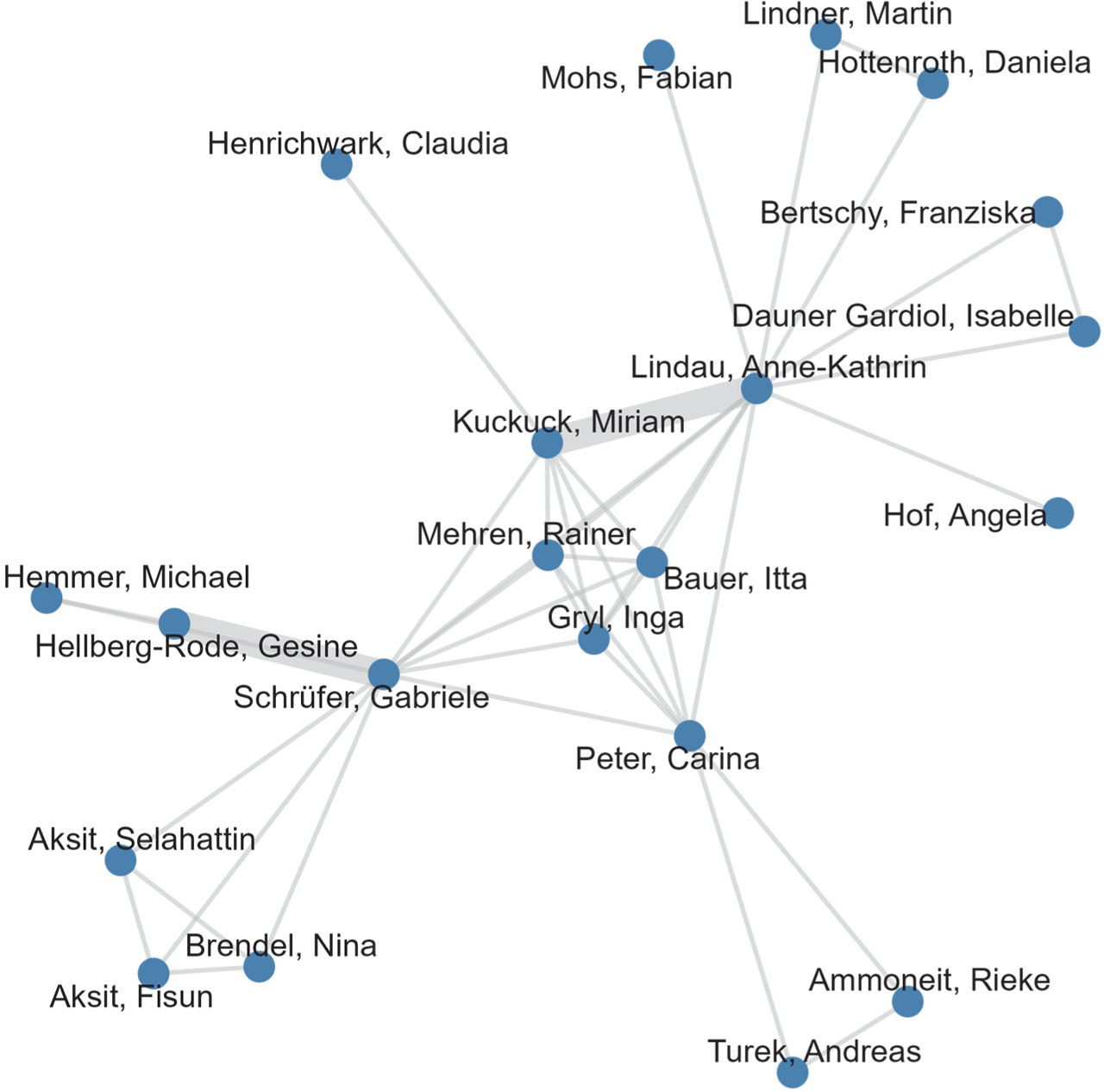
Fig. 7
Co-author network around Gabriele Schrüfer and Anne-Kathrin Lindau
The second-largest cluster (see Figure 8; 20 people, 15 publications) is centred around Werner Rieß, Professor of biology didactics. In contrast to the geography didactics network, this cluster exhibits a more homogeneous team structure, particularly within the University of Education Freiburg (PH Freiburg), as evidenced by numerous strong co-authorship links. The group frequently incorporates expertise from psychology, educational research, and educational sociology, often involving researchers from other institutions. A personal connection to the geography didactics group at PH Ludwigsburg is established through Professor Stephan Schuler, based on n = 3 joint publications. Additionally, the publication by Waltner, Rieß and Brock (2018) creates a link to the Institut Futur.
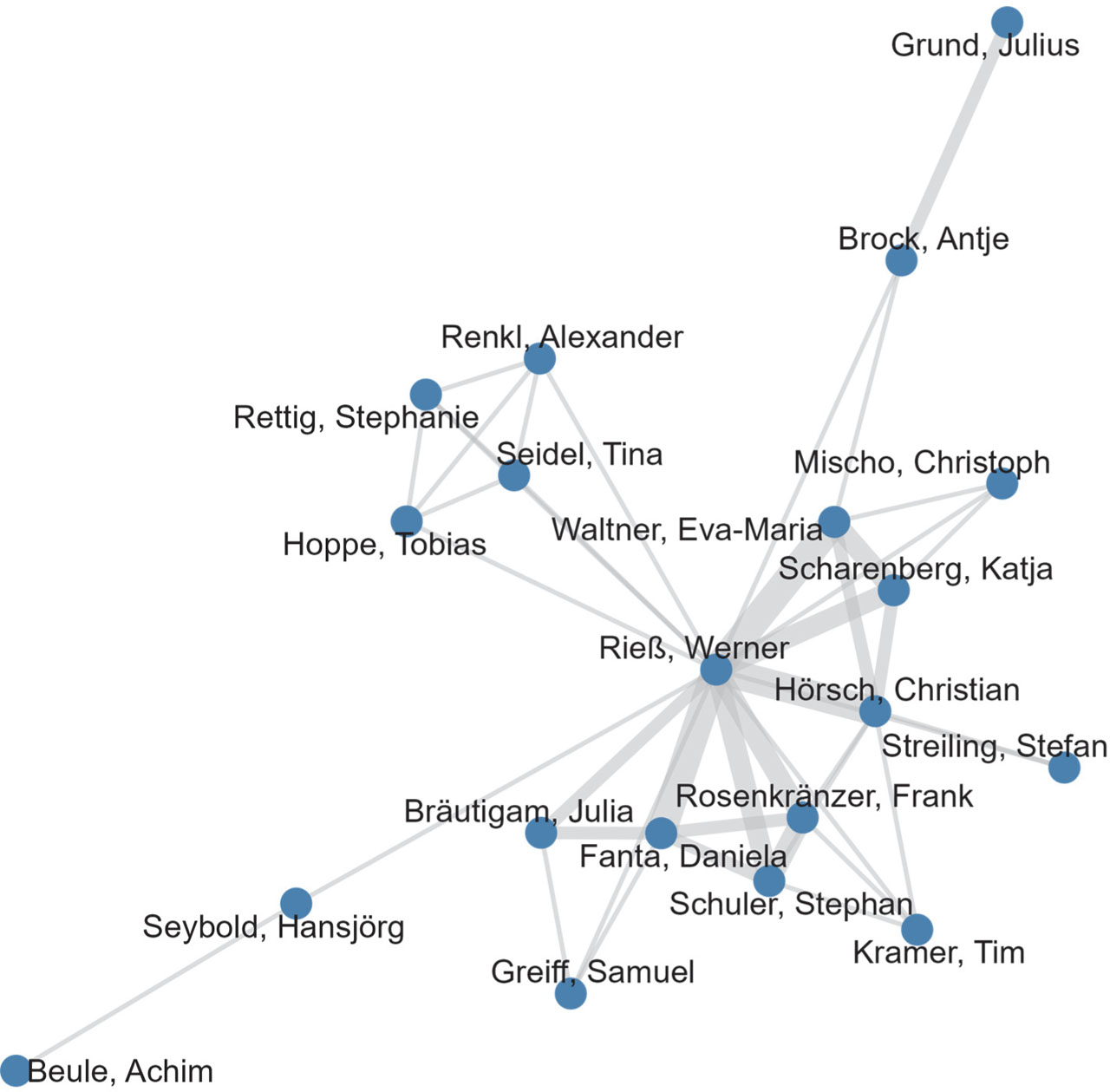
Fig. 8
Co-author network around Werner Rieß
The third cluster (Figure 9; 15 people, 7 publications) has two centres with n = 3 publications each. On the one hand, there is Julia Lohmann (post-doc, physical education, University of Freiburg and from 2019 University of Augsburg), who publishes with alternating co-authors from various disciplines (including sports science, geography didactics, educational science) and several universities (Karlsruhe Institute of Technology, Universities of Augsburg, Bern and Freiburg). On the other hand, there is a centre around Rebecca Baumann (doctoral student, primary school pedagogy, Erlangen-Nuremberg (FAU)) with work on the professionalisation of teachers for general studies in primary school. Three out of four of her works are published in the same team of researchers from FAU, another with a co-author from the University of Freiburg. Two publications create a bridge between the clusters (Lohmann, Wegner, & Gieß-Stübner, 2019; Stössel, Baumann, & Wegner, 2021).
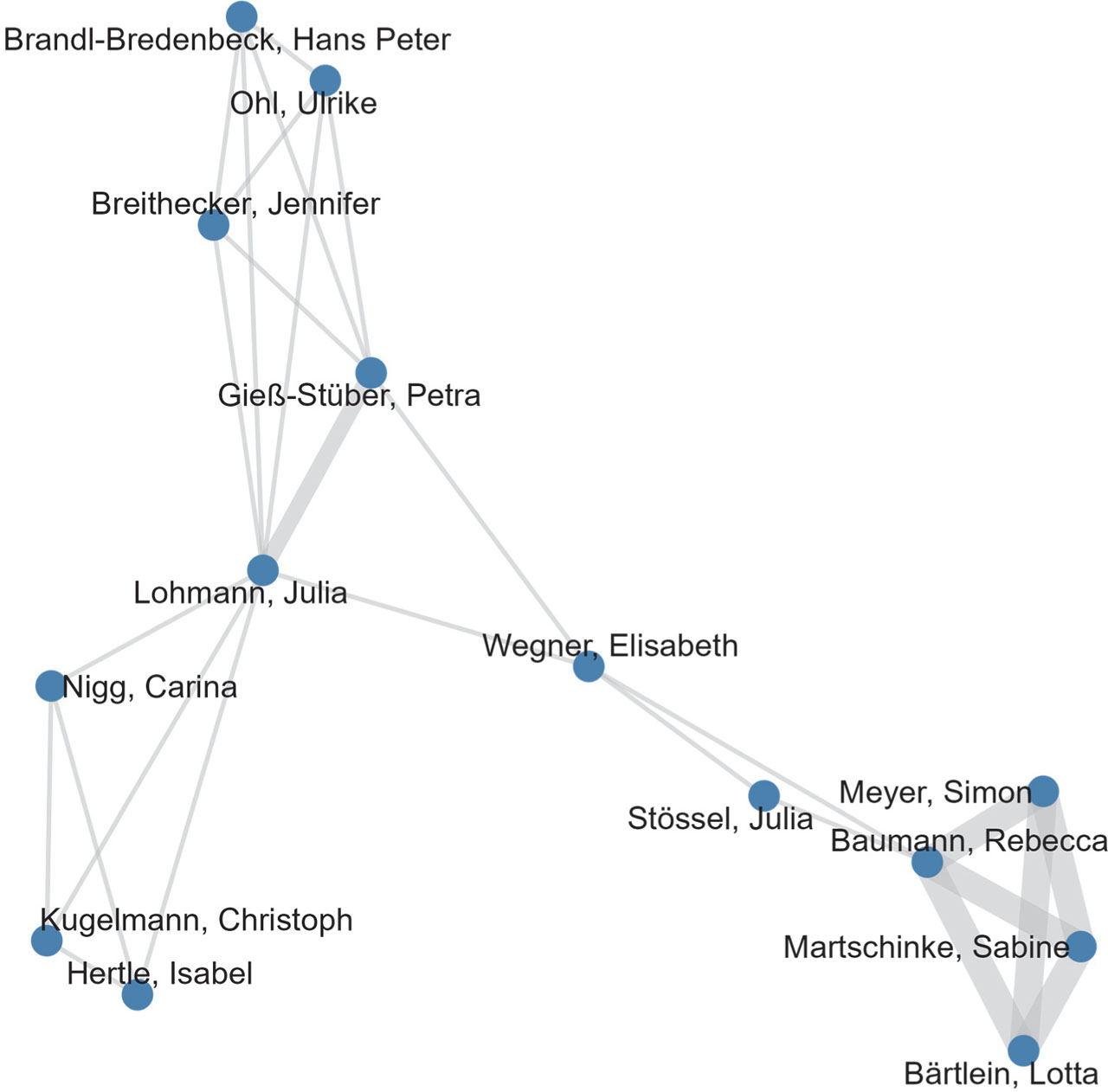
Fig. 9
Co-author network around Julia Lohmann and Sabine Martschinke
In conclusion, the centres consist not only of professors, but also of pre- and post-docs, and disciplinary and institutional segmentations are overcome in some areas. A notable example is the network described last, which links several disciplines and universities with each other and thus realises a high level of person-based knowledge transfer. Areas of subject didactics with long-standing involvement in ESD are substantially more represented. Physical education is an exception.
Regarding question III, it can be concluded that the number of researchers taking part in the discourse has increased considerably over time. It is unsurprising that the researchers come primarily from subject didactics that have been implementing ESD for a longer period of time. There are some interdisciplinary network-connections that may depend on the individuals involved.
5.5. Question IV: Focussed target groups in the field of TESD
To explore which target groups are primarily addressed in the field of TESD, the following analysis examines the distribution of foci across different educational actors (see Figure 10).
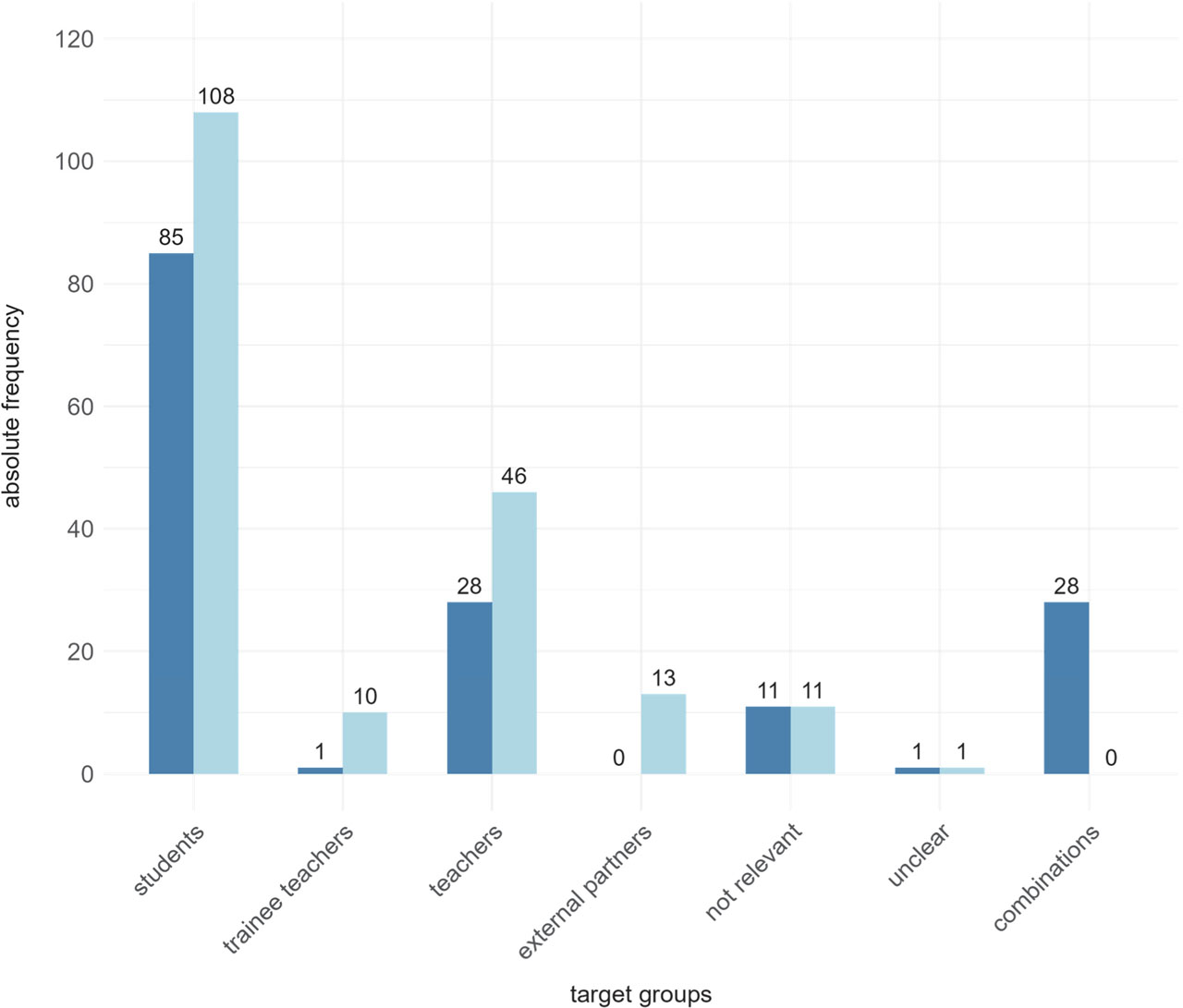
Fig. 10
Absolute frequencies of target groups addressed; dark blue bars show single-target publications, 'combinations' show multi-target publications; light blue bars display the distribution with combinations split into individual groups
Looking at the individual target groups (dark blue columns), student teachers are the most frequent focus, followed by teachers at a considerably lower frequency. Within the sample, there is only one conceptual publication on trainee teachers (Handschuh, 2016).
Once the ‘combinations’ category, that describes publications in which multiple target groups are addressed, has been broken down, the focus remains on students and teachers (light blue columns). Only n = 9 publications also consider trainee teachers, which illustrates that teachers in the second phase are rarely analysed independently within the scientific discourse. External cooperation partners are also rarely discussed (n = 13). This underrepresentation stands in stark contrast to the previously discussed relevance of these groups for ESD
5.6. Question V: Focussed school types
The following analysis highlights which school types and levels receive particular attention in the scientific field of TESD (see Figure 11).
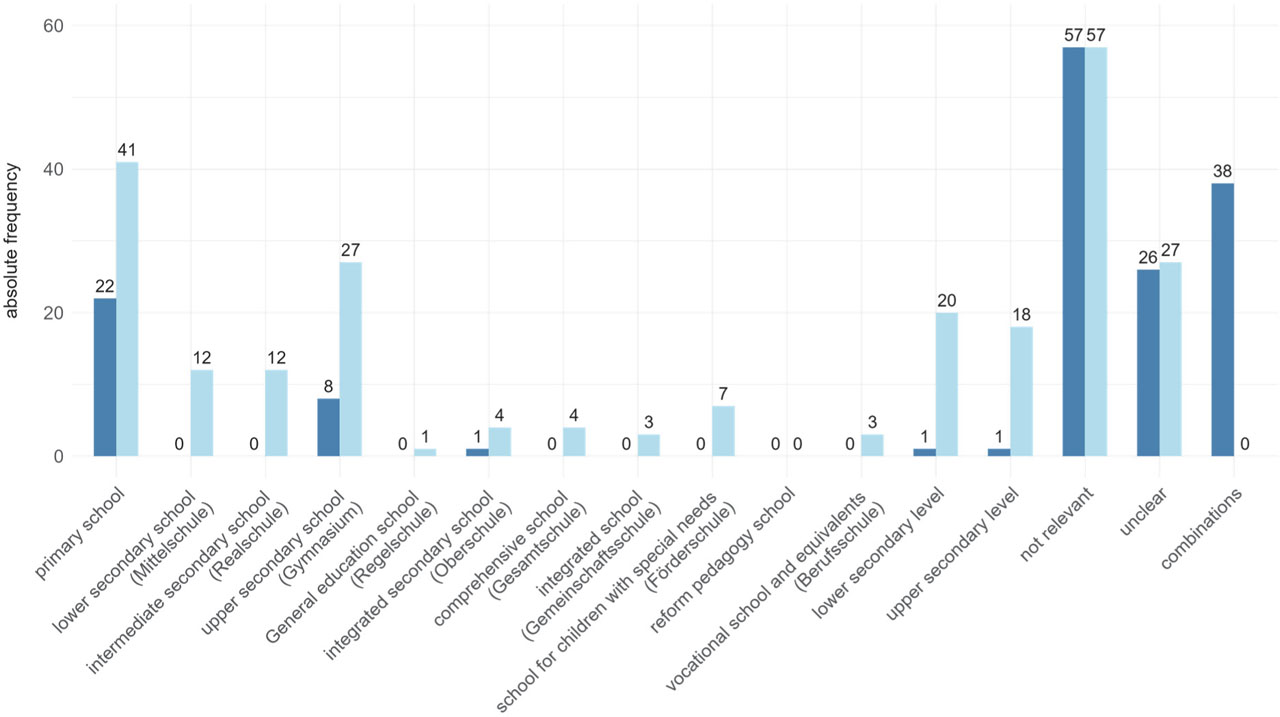
Fig. 11
Absolute frequencies of addressed school types; dark blue bars show frequencies for individually targeted school types, light blue bars show distribution with combinations split into individual types; the category system is highly differentiated to enable precise text-based coding, including state-specific school types; secondary levels I and II are included as separate codes since publications often use these group designations without specifying particular school types
The analysis outlines a differential focus on certain types of schools respectively school levels. In particular, the publications concentrate on (prospective) teachers for primary schools (n = 22) and secondary schools (n = 8). When the ‘combinations’ category, which again includes publications with multiple categories, is broken down, it also becomes clear that teachers from lower secondary schools (German: Mittelschule/Hauptschule), intermediate secondary schools (German: Realschule), and schools for children with special educational needs (German: Förderschule/Sonderschule) are also addressed in the publications. The integrated secondary school (German: Oberschule) and the intermediate secondary school (German: Realschule) both lead to equivalent qualifications. Combining the number of publications on these two school types would not change the overall conclusions drawn about school types. In addition, (prospective) teachers for lower secondary level (grades 5 to 10; n = 20) and upper secondary level (grades 11 to 13; n = 18) are addressed in publications as groups that include teachers from several types of school. Reform pedagogy schools are not addressed in the publications analysed.
Overall, this shows that the scientific field is dominated by publications on primary schools and secondary schools. Works relating to (prospective) primary school teachers are much more prevalent. However, the effect in relation to secondary schools could be overestimated, as the secondary school type exists in all federal states, while the other school types differ in their designation depending on the federal state. Nevertheless, there is a preponderance of secondary schools (including upper secondary level) among schools following primary education.
5.7. Question VI: Development of the field
The analysed publications on TESD can be characterised as empirical (n = 89; of which quantitative n = 36, qualitative n = 36 and papers with both shares n = 17), theoretical (n = 12; without own data collection) or conceptual (n = 47; with application-oriented products in focus) (n = 6 papers could not be assigned and are excluded from the analysis). Among the conceptual works, n = 12 also report empirical findings on the concepts implemented (e.g. an evaluation; these are included in the analysis in the absolute frequencies of both categories). Figure 12 visualises the development of the absolute frequencies per year.
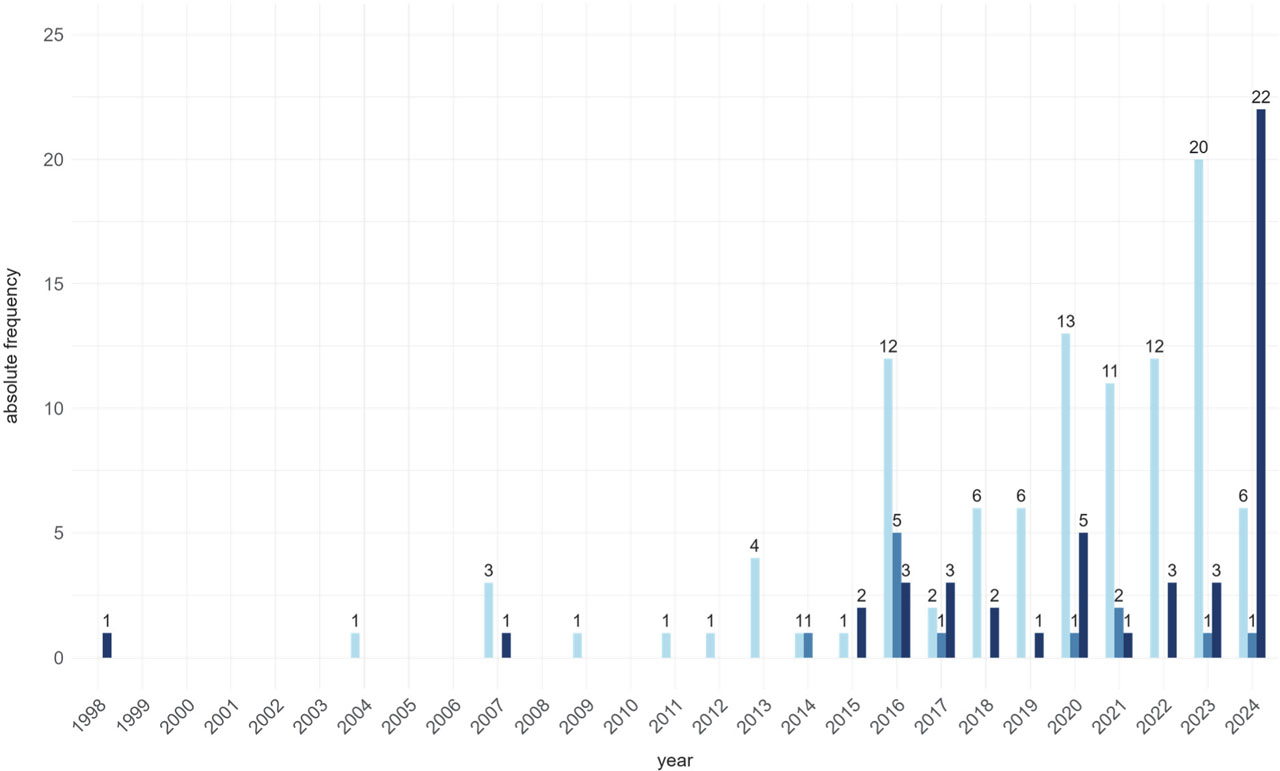
Fig. 12
Absolute frequencies of contribution types per year (empirical (light blue), theoretical (medium blue), and conceptual (dark blue) contributions)
The following pattern can be identified: empirical approaches characterise the academic field early on in the development of the discourse; the ratio is always higher than that of other types of contribution and shows an upward trend from 2020 in particular. The number of empirical papers is only significantly exceeded by conceptual contributions in 1998 due to the low total number, and in 2024 due to an edited volume (Graulich et al., 2024; see section 5.1).
Until 2015, there were only two conceptually orientated articles (Engelhard, 1998; Hamann, 2007). In particular, the publication of edited volumes in 2016, 2020 and 2024 (see section 5.1) contributed to the increased number of this type of contribution. Theoretical articles are the least common overall - their proportion fluctuates over the years mostly between n = 0 and n = 2 (n = 5 singularly in 2016), whereby the number seems to be less dependent on the edited volumes or themed issues (see 2020 and 2024).
Overall, the analysis of the types of contributions reveals a dynamic, but fundamentally empirically orientated research field with only few but consistently occurring theoretical works and occasional conceptual focuses.
6. Summary and discussion
The aim of this scoping review was to explore the structures, patterns, and dynamics of the scientific field of teacher education for sustainable development (TESD) in Germany using six indicators or key questions as an analytical heuristic and to determine areas in need of further research. This first indicator-based national overview enables the derivation of specific implications for TESD in Germany.
Overall, the scientific field is expanding and has increased in publication output since 2016. Whether the increase in publications from 2015 onwards is related to the adoption of the international sustainability agenda and/or the UNESCO Global Action Programme, which focuses on training educators, is unclear at this point. The finding is consistent with the results of Fischer et al. (2022) for the international community. It should be noted that the field of teacher training has overall grown, and empirical research has increased (Terhart, 2019). At the same time, however, the field of research on TESD is rather fragmented. One aspect of this fragmentation is already apparent in the data used to describe the sample: numerous publications appear in edited volumes, and in a variety of journals with different research foci. A further question that could be addressed in future studies is whether this also has a negative impact on the coherence of the discourse and the exchange of ideas.
The key findings regarding the six indicators are summarised and discussed below.
Question I: Does the integration of TESD differ across subject didactics over time?
There are particularly many publications on ESD in the subjects of biology, geography and general studies in primary school. According to national monitoring, these subjects are those in which ESD is highly integrated into curricula, modules and course descriptions (Brock & Holst, 2022). There are only a few publications in other subjects (for example in religion didactics (Tacke et al., 2022) or foreign language didactics (Surkamp, 2022). The reasons and dynamics underlying the initiation of the discourse in the respective subjects cannot be clarified based on the available data and would require further research. We hypothesise that a subject-specific approach to ESD must first be established before subsequent discussions on concepts and subject-specific empirical studies in teacher training can take place. Overall, topics and didactic approaches in the context of ESD have been addressed prior to the establishment of the educational concept in teacher education. In some subjects that have so far published relatively little on ESD or TESD, respectively, ESD-adjacent educational concepts are currently still in focus, for example Global Education in foreign language didactics (Surkamp, 2022) or environmental ethics in religion education (e.g. Altmeyer, 2021). Here some longitudinal studies that trace the usage of certain educational concepts over time appear promising: in ESD and TESD in general and in various subjects in particular.
The results also show that many publications on TESD are not subject-specific. While these are also written by researchers embedded in specific subject didactics (e.g. Engelhard, 1998), TESD is primarily addressed in a more general way across subject didactics. A more in-depth content-analytical assessment of the publications would likely reveal facets of the various subject didactic communities. Here secondary analysis of our sample would allow deeper insights. Overall, TESD seems to be a young and dynamic field of research that is currently being pursued to varying degrees in different subject-specific areas of teacher education.
Question II: How do interdisciplinary studies shape the TESD discourse?
Interdisciplinary projects with subject-specific profiles tend to be less common in the field of TESD. The few interdisciplinary publications are in clear contrast to the requirements and expectations generally imposed on ESD (e.g. Didham et al., 2014). Nevertheless, the findings align with the existing structure of subjects in schools and universities, as well as the challenges associated with realising interdisciplinary research projects (Defila & Di Giulio, 1998). Furthermore, an interdisciplinary approach to TESD presupposes the existence of disciplinary debates and viewpoints that can be related to each other in an interdisciplinary manner (see question I). In (research) practice such dialogue needs time, which is a strong justification for communicative spaces (conference, publications, practical materials), where disciplinary perspectives can be exchanged and mediated.
Question III: Is the number of people shaping the scientific discourse increasing? And which subject didactics can they be assigned to?
A growing number of people are participating in the academic discourse on TESD. Once more, the confounding effect of the increase in academic work within teacher training should be noted (Terhart, 2019). The proportion of first authors or people publishing once on TESD is surprisingly high. This suggests that only a few people specialise in TESD over time. The relatively high number of publications by teams of two to eight co-authors reflects general trends in scientific publications (Larivière et al., 2015) within the TESD discourse. Overall, the findings describe a field in a state of dynamic development which may also be 'fragile' due to the changing authorship, which should be given more attention in future research.
Initially, the co-author network analysis shows that there are only a few large clusters and, consequently, a small number of central actors (professors, pre-docs and post-docs). The analysed clusters correspond with findings on question II (TESD focal points within certain subject didactics). Focal points within universities and universities of education (German: Pädagogische Hochschulen) can also be identified using the co-author network analysis, with subject and institutional boundaries breaking down at certain points. In this respect, the cluster centred on physical education (see section 5.4, Figure 9) is notable, particularly when the results on subject-specific publications (see section 5.3) are considered, as these are rarely found in the context of physical education.
The institutional and, in particular, the subject-specific structure of the discourse can be classified as a challenge with regard to the development of a joint research agenda. In this context, specific conferences, thematic edited volumes and the establishment of professorships could also play an important role, as they contribute to further shaping of the discourse.
Question IV: Are target groups of TESD addressed differently in the scientific discourse?
The data indicate an imbalance in the target groups of research on TESD. The focus of scientific publications is primarily on students and thus on the university phase of teacher training. Pragmatic reasons, such as ease of access to respective samples, can be assumed as a possible cause of this focus. A gap can be identified in relation to the target group of trainee teachers and TESD, although the findings are consistent with teacher education research in Germany in general (Kotthoff & Terhart, 2013). We consider this to be problematic, given that this phase is particularly relevant for teacher professionalisation due to the specific conditions and practical application of knowledge gained during the first phase of teacher education.
The target group of external partners is rarely considered. Considering the focus on their importance as partners in collaboration (Reinke, 2021; Singer-Brodowski, 2019; Brock & Grund, 2020), as well as the difficulties associated with collaboration (Bludau, 2016), this finding is surprising and highlights a pivotal research gap.
Question V: Are all school types equally represented in the scientific discourse on TESD?
Based on the analysed publications, a body of work on (prospective) primary and upper secondary school teachers can be identified. In contrast to lower and intermediate secondary school teachers, both are considered as individual groups. However, when the differences found are considered in relation to the number of students in the different school types (see Federal Statistical Office, 2025), it becomes clear that the ratio is relative, given that far more students attend primary school (N = 3.098.664) and upper secondary school (N = 2.280.967) than lower secondary school (N = 333.907) and intermediate secondary school (N = 771.330). Against this background, the practical implications of the findings must be acknowledged.
Therefore, it cannot be clearly stated based on the data whether research on TESD nevertheless risks the reproduction of social inequalities, as research increasingly takes place in areas where ESD is implemented in school practice (or vice versa). Considering an increasing societal polarization with relation to social-ecological transformation processes (Eversberg et al., 2024) the connection between stratification, social inequality and ESD nevertheless needs further attention in research.
Question VI: How does the ratio of conceptual, theoretical and empirical work on TESD change over time?
An analysis of the types of articles reveals a dynamic academic publication landscape that is empirically oriented, with few theoretical works and occasional conceptual focuses. The latter are particularly moderated by edited volumes and special issues. The ratio of contribution types does not change substantially or systematically over time. The low number of theoretical contributions can be seen as part of the general trend that theory is usually dealt with as a component of empirical contributions. A content analysis is needed to determine whether theory development is being neglected in favour of empirical approaches. The high proportion of empirical papers could initially indicate a stronger orientation towards scientific standards (Gräsel et al., 2012), but the quality of these papers would need to be examined.
Overall, when reviewing the developments, it must be considered that contributors to the discourse also bring subject-specific traditions (e.g. questions and methods) from their respective disciplines to the discourse on TESD, in line with Fleck's (1993) concept of thought collectives. Due to the small number of cases, it is not possible to analyse whether the development of contribution types yields differentiated findings for different disciplines (see question I). The high number of empirical and, above all, quantitative studies also raises the question of the extent to which TESD is sufficiently grounded in theory and where theory development is taking place.
Summarising the results, we nevertheless see a vibrant, multi-perspectival and engaged research field that has been growing along with the urgent necessity of TESD.
7. Limitations
The present study has limitations resulting from the decisions on methodology. The search string for identifying relevant publications required that ESD is explicitly mentioned. Thus, publications that address ESD-related concepts (including Environmental Education, Global Education, Civic Education) were not included. Further studies could broaden the focus about the restriction to the ESD concept defined in the search string and thus generate further insights into subject-specific developments.
In addition to the search in two databases, a manual extension was carried out. While this increased the coverage of relevant publications from the field, it can introduce bias due to the representation of many, but not all, disciplines working on TESD within the project.
The level of agreement achieved when coding the content of the publications can largely be considered satisfactory when measured by Cohen's kappa reliability indicator. However, only moderate agreement was found for the school type category. However, as all publications were coded by two people and any differences in assessment were discussed in a consensual process, the reliability and validity of the coding can be rated as overall sufficient.
The lack of information in the texts also limited the number of data-based statements that could be made. For instance, some publications do not specify the type of school, which impedes categorisation.
8. Outlook
In light of the necessity of educating the educators for ESD the research field of TESD is one of exceptional relevance. This scoping review systematically analysed the field of research on TESD in Germany with regard to six key questions. We produced a first national overview about the research discourse on TESD in Germany and provided insights for future practice and policy initiatives for strengthening TESD. In conducting this review, we benefitted a lot from our interdisciplinary research team itself, which included representatives of mostly all subject didactics and could cover many perspectives.
The results reveal the following development opportunities for the discourse:
There is a need for more interdisciplinary projects on TESD that integrate different subject didactics. At the same time, interdisciplinary projects could encourage researchers in disciplines that have been less common in the ESD discourse to adopt a subject-specific approach. This could be achieved through contrastive work (cf. Bray, Adamson, & Mason, 2014), which focuses on similarities and differences, turning cooperation itself into an additional research objective. Furthermore, it would be interesting to conduct another survey of developments within the various disciplines in around ten years' time. However, due to the different ways in which ESD can be linked to the respective subject objectives, subject concepts, competence models and subject topics, it can hardly be expected that (T)ESD research will be evenly distributed across the subject didactics. Furthermore, an analysis of the content of publications that link subjects would be of interest for identifying prerequisites or reasons for cooperation. To this end, it would be useful to analyse the contributions in order to determine which research questions are being addressed in each case and whether the research questions of different contributions can be combined. It would also be useful to establish under which more abstract questions they can be clustered. This would provide a clearer picture of existing research needs. This would also contribute to the development of a self-reflective, disciplinary meta-theory of ESD, which could be enriched by future contributions to specific research (Kminek, 2025).
The number of empirical studies is already high, but there are blind spots regarding, for example, the target groups. In particular, when focusing on students, the selection of the sample for research projects must be considered as an aspect of methodological quality; sometimes results cannot be transferred by relying on ad hoc or convenience samples. Regarding the target groups of TESD, the second phase of teacher training has not yet been widely researched. Future studies should focus more on this phase to address the specific challenges and needs of teachers when teaching ESD for the first time. In general, there is a need for longitudinal and impact studies. Furthermore, transitions between the phases should receive more attention – also in policy initiatives.
Since external cooperation partners are considered to be of great importance for the implementation of ESD, while challenges for successful cooperation have been identified, this aspect should be examined more closely in the context of ESD research. Additionally, this comes with a strong plea for accounting for the relevance of non-formal learning organisations (Widany & Schulte-Südbeck, 2025).
All in all, the current study about the state of TESD in Germany has shown that the research field is a vibrant area of different studies in all subject didactics and has laid the foundation for a broad variety of future studies. As the education of educators is a basic requirement for empowering all learners to contribute to sustainable development (SDG 4.7), TESD will probably maintain its pivotal importance in the future.
Acknowledgement
This research was funded by the German Federal Ministry of Education and Research (BMBF) under Grand 01JO2405. The authors are solely responsible for the content of this publication.
Appendices
Appendices
I. Search string
The search was conducted separately for German and English. The reason for this was the addition of the search term ‘German’ for the search for English-language publications. This addition led to hits relating to Germany. Extending the search string for the German-language search with ‘German’ was not effective, as it led to a significant reduction in hits (presumably because German publications do not specifically refer to Germany or similar countries of reference).
a. Search string for the database “Fachportal Pädagogik”
((((Abstract: „BILDUNG FUER NACHHALTIGE ENTWICKLUNG“ oder BNE oder „EDUCATION FOR SUSTAINABLE DEVELOPMENT“ oder ESD oder „EDUCATION FOR SUSTAINABILITY“ oder „SUSTAINABILITY EDUCATION” oder ESE und Abstract: LEHR*BILDUNG oder LEHR* oder PROFESSION* oder „TEACHER EDUCATION“ oder TEACH*) und Jahr: >1991) und Freitext: GERMAN*) und Sprache: englisch) und Datenquelle „FIS Bildung“ oder „Library of Congress“ oder “Casalini libri“ oder ERIC oder „EBSCOhost ebooks“ oder „BBF 1945–993“ oder „Online Contents“ oder FID-Nationallizenzen oder BASE
 Resulting in 96 records
(((Abstract: „BILDUNG FUER NACHHALTIGE ENTWICKLUNG“ oder BNE oder „EDUCATION FOR SUSTAINABLE DEVELOPMENT“ oder ESD oder „EDUCATION FOR SUSTAINABILITY“ oder „SUSTAINABILITY EDUCATION” oder ESE und Abstract: LEHR*BILDUNG oder LEHR* oder PROFESSION* oder „TEACHER EDUCATION“ oder TEACH*) und Jahr: >1991) und Sprache: deutsch) und Datenquelle „FIS Bildung“ oder „Library of Congress“ oder “Casalini libri“ oder ERIC oder „EBSCOhost ebooks“ oder „BBF 1945–1993“ oder „Online Contents“ oder FID-Nationallizenzen oder BASE
Resulting in 292 records
b. Search string for the database “Web of Science”
AB=("Bildung für nachhaltige Entwicklung“ OR "BNE" OR "EDUCATION FOR SUSTAINABLE DEVELOPMENT“ OR "ESD" OR "EDUCATION FOR SUSTAINABILITY“ OR "SUSTAINABILITY EDUCATION” OR "ESE ") AND AB=("LEHR*BILDUNG" OR "LEHR* OR PROFESSION*" OR "TEACHER EDUCATION“ OR "TEACH*") AND PY=(1992–2024) NOT ALL=(medicine) AND ALL=(German*) AND LA=(English)
Resulting in 125 records
AB=("Bildung für nachhaltige Entwicklung“ OR "BNE" OR "EDUCATION FOR SUSTAINABLE DEVELOPMENT“ OR "ESD" OR "EDUCATION FOR SUSTAINABILITY“ OR "SUSTAINABILITY EDUCATION” OR "ESE ") AND AB=("LEHR*BILDUNG" OR "LEHR* OR PROFESSION*" OR "TEACHER EDUCATION“ OR "TEACH*") AND PY=(1992–2024) NOT ALL=(medicine) AND LA=(German)
Resulting in 3 records
II. Codebook for the inclusion and exclusion of texts based on titles and abstracts (1. Screening)
The initial screening based on titles and abstracts was carried out using the online programme Sysrev. The categories could be coded with ‘Yes’ or ‘No’.
| Kategorie | Lehrkräfte |
|---|---|
| Hintergrund | YES: Die Recherche soll sich auf den Aspekt der Professionalisierung und auf das Handeln von (angehenden) Lehrkräften beziehen. Die Veröffentlichung müssen sich deshalb direkt mit der Aus-, Fort- und/oder Weiterbildung von angehenden Lehrkräften oder Lehrkräften befassen oder die aktive Rolle/das Handeln der Zielgruppe in den Mittelpunkt stellen. Der Begriff „Professionalisierung“ muss dafür nicht explizit genannt werden. |
| NO: Das Kriterium wird mit NO codiert und damit Veröffentlichungen ausgeschlossen, wenn (angehende) Lehrkräfte nicht im Fokus stehen, sodass nicht zu erwarten ist, dass der Artikel einen Beitrag zur Beantwortung unserer Forschungsfrage leistet. | |
| NO: Mit NO wird ebenfalls codiert, wenn sich die Veröffentlichung ganz allgemein auf…
| |
| Fragetyp | boolean (Ja/Nein) |
| Frage | Geht es im Abstract um (angehende) Lehrkräfte? |
| Ja | Die Veröffentlichung adressiert schwerpunktmäßig (angehende) Lehrkräfte |
| Nein | Die Veröffentlichung hat keinen Schwerpunkt auf (angehende) Lehrkräfte |
| Kategorie | Schulart |
|---|---|
| Hintergrund | YES: Das Kriterium wird mit YES codiert, wenn in der Veröffentlichung (angehende) Lehrkräfte allgemeinbildender Schulen fokussiert werden (GS, MS, RS, Gym, Sonderschulen). |
| YES: Bleibt unklar, welche Schularten im Fokus der Veröffentlichung stehen (es wird also allgemein/unspezifisch von Lehrkräften oder von Schule gesprochen), dann wird das Kriterium ebenfalls mit YES codiert. | |
| YES: Veröffentlichungen werden auch mit YES codiert, wenn Lehrkräfte allgemeinbildender Schulen eine von mehreren Gruppen sind. | |
| NO: Das Kriterium wird mit NO codiert und damit Veröffentlichungen ausgeschlossen, wenn diese sich auf Kindergärtner:innen / Lehrpersonen für frühkindliche Bildung, Personen für außerschulische Bildung sowie Hochschullehrende oder berufliche Ausbilder*innen, etc. bezieht. | |
| Fragetyp | boolean (Ja/Nein) |
| Frage | Stehen allgemeinbildende Schulen im Fokus? |
| Ja | Der Text adressiert allgemeinbildende Schulen |
| Nein | Der Text adressiert Pädagog*innen in anderen Bildungseinrichtungen |
| Kategorie | Bezugsland |
|---|---|
| Hintergrund | YES: Die Recherche soll sich ausschließlich deutsche (angehende) Lehrkräfte beziehen. Wird aus der Veröffentlichung direkt ersichtlich, dass das Bezugsland Deutschland ist, wird dieses Kriterium mit YES codiert. |
| YES: Wenn unklar bleibt, auf welches Land sich die Veröffentlichung bezieht, führt das zunächst zur Codierung mit YES. | |
| YES: Handelt es sich um einen Vergleich zwischen verschiedenen Ländern und Deutschland ist eines dieser, wird das Kriterium ebenfalls mit YES codiert. | |
| NO: Das Kriterium wird mit NO codiert und damit Veröffentlichungen ausgeschlossen, in denen die Lehrkräfte in anderen Ländern thematisiert werden. | |
| Fragetyp | boolean (Ja/Nein) |
| Frage: | Geht es um deutsche (angehende) Lehrkräfte? |
| Ja | Der Text adressiert deutsche Lehrkräfte |
| Nein | Der Text adressiert Lehrkräfte in anderen Ländern |
| Kategorie | Nachhaltigkeitsverständnis |
|---|---|
| Hintergrund | YES: Da „nachhaltig“ bzw. „Nachhaltigkeit“ verschiedene Bedeutungen haben kann, muss geprüft werden, ob der Begriff tatsächlich in Bezug auf ein Konzept von Nachhaltigkeit/nachhaltiger Entwicklung im Sinne des (politischen) Gerechtigkeitskonzeptes bezogen ist. Dann ist der Bezug zu BNE hergestellt. Das Kriterium wird mit YES codiert, wenn der Begriff BNE oder seine Synonyme (ESE, ESD) genutzt werden oder sich das Nachhaltigkeitskonzept im Sinne des Gerechtigkeitskonzeptes zeigt (etwas durch einen Fokus auf die SDGs, den Brundlandt Report etc.). |
| NO: Das Kriterium wird mit NO codiert und damit Veröffentlichungen ausgeschlossen, wenn sich der Begriff „nachhaltig“ bzw. „Nachhaltigkeit“ auf eine längerfristige oder dauerhafte Wirkung von etwas bezieht (Synonym zu dauerhaft, anhaltend; z.B..: „Das Projekt ist nachhaltig wirksam, weil …“). | |
| Fragetyp | boolean (Ja/Nein) |
| Frage | Wird Nachhaltigkeit im Sinne der Bildung für nachhaltige Entwicklung verstanden? |
| Ja | Nachhaltigkeit wird im Sinne der Bildung für nachhaltige Entwicklung verstanden |
| Nein | Nachhaltigkeit wird als längerfristige Wirksamkeit von implementierten Bildungsmaßnahmen o.Ä. verstanden |
| Kategorie | Sprache |
|---|---|
| Hintergrund | YES: Im Review sollen nur deutsch und englischsprachige Artikel berücksichtigt werden. Ist der Abstract in einer der beiden Sprachen verfasst, wird das Kriterium mit YES codiert. Durch den Suchstring ist dies bereits geschehen; das Kriterium dient als Sicherheitsnetz. |
| NO: Das Kriterium wird mit NO codiert und damit Veröffentlichungen ausgeschlossen, wenn der Abstract ausschließlich in einer anderen Sprache verfügbar ist. | |
| Fragetyp | boolean (Ja/Nein) |
| Frage: | Ist die Sprache des Abstracts Deutsch oder Englisch? |
| Ja | Veröffentlichung ist in deutscher oder englischer Sprache |
| Nein | Veröffentlichung ist in einer anderen Sprache |
III. Extended codebook for the inclusion and exclusion of texts based on full texts (2. Screening)
The coding was carried out in an Excel spreadsheet by two people. The coders' results were only merged after completion and made visible to the other person. The categories could be coded with ‘0’ (exclusion) or ‘1’ (inclusion).
| Kategorie | Lehrkräfte |
|---|---|
| Hintergrund | 1 = JA: Die Recherche soll sich auf den Aspekt der Professionalisierung und auf das professionelle Handeln von (angehenden) Lehrkräften beziehen. Die Veröffentlichung müssen sich deshalb direkt mit der Aus-, Fort- und/oder Weiterbildung von angehenden Lehrkräften oder Lehrkräften befassen oder die aktive Rolle/ das Handeln der Zielgruppe in den Mittelpunkt stellen. Der Begriff „Professionalisierung“ muss dafür nicht explizit genannt werden. Die Veröffentlichungen können sich demnach mit dem status quo bzw. Bedingungsfaktoren des professionellen Handelns beschäftigen. Zum Beispiel zu … |
| - subjektiven Theorien | |
| - Vorstellungen | |
| - affektiv-emotionalen Voraussetzungen | |
| - Wissensbeständen | |
| - Wirkungen des (Schul-)Umfeldes auf das professionelle Handeln | |
| - sozio-ökonomischen Merkmalen | |
| von (angehenden) Lehrkräften und deren Entwicklungen in längsschnittlichen Designs. | |
| Oder die Förderung und Entwicklung von professionellem Handeln von (angehenden) Lehrkräften in den Fokus nehmen. | |
| 0 = NEIN: | |
| Das Kriterium wird mit NEIN codiert und damit Veröffentlichungen ausgeschlossen, wenn (angehende) Lehrkräfte nicht im Fokus stehen, sodass nicht zu erwarten ist, dass der Artikel einen Beitrag zur Beantwortung unserer Forschungsfrage leistet. | |
| 0= NEIN: | |
| Mit NEIN wird ebenfalls codiert, wenn sich die Veröffentlichung ganz allgemein auf… | |
| - BNE als Lerninhalt, | |
| - auf fachliche Grundlagen zur BNE, | |
| - Unterrichtsmaterial oder konkrete Stundenplanungen, | |
| - auf historische und konzeptionelle Entwicklungen zur BNE, | |
| - auf das Lernen von Schüler:innen, | |
| - politische Maßnahmen oder Curricula-Entwicklung, etc. fokussieren | |
| Fragetyp | boolean (Ja/Nein) |
| Frage | Geht es im Beitrag um (angehende) Lehrkräfte? |
| Ja = 1 | Die Veröffentlichung adressiert schwerpunktmäßig (angehende) Lehrkräfte |
| Nein = 0 | Die Veröffentlichung hat keinen Schwerpunkt auf (angehende) Lehrkräfte |
| Beispiel für eine Codierung mit 1 (=Ja) Einschluss | “Seen in this light, the systematic, nationwide integration of ESD in the numerous teacher training and continuing education institutions in Germany is one kind of – if not the – core ‘homework’ that needs to be done. To help achieve this end, this article analyses the special conditions that have so far prevented the systematic and consistent implementation of teacher education for sustainable development (TESD) in Germany. Against this background, a theory for the implementation of ESD in teacher education is presented, using various existing examples of good practice.” (Christoforatou, 2021) |
|
Begründung: Das Kernanliegen des Textes ist die Darstellung Standes der Implementation von ESD (BNE) in der Lehrkräftebildung bzw. von Bedingungsfaktoren für die Professionalisierung von Lehrkräften für BNE | |
| “As the study aims to draw conclusions on initial teacher professional development, we focused on pre-service teachers and addressed the following general research question: RQ: What contextual and personality variables are motivationally relevant for pre-service teachers’ motivation towards teaching about the return of the wolf?” (Büssing et al. 2018) | |
|
Begründung: der Fokus der Untersuchung liegt auf dem Einfluss von Persönlichkeitsmerkmalen angehender Lehrkräfte auf die Motivation ein BNE-bezogenes Thema zu unterrichten | |
| „Lehrveranstaltungen im Lehramtsstudium sind jedoch meist so gestaltet, dass sie sich entweder auf fachliche oder fachdidaktische oder bildungswissenschaftliche Inhalte beziehen und wenig Bezug zwischen den einzelnen Veranstaltungen hergestellt wird. […] Die universitätsweite Lehrveranstaltungsevaluation wurde im Sommersemester 2017 auch in den Veranstaltungen für „BNE outdoor“ durchgeführt. Für die didaktische Konzeption besonders relevant ist, dass die Studierenden (N = 16) das Können und Wissen, das sie in „BNE outdoor“ erwarben, für ihr späteres Tätigkeitsfeld als relevant einschätzten (75% trifft voll zu, 25% trifft zu).“ (Lohmann et al. 2019) | |
|
Begründung: Es steht die Konzeption und Evaluation eines Seminars für die Ausbildung von Lehramtsstudierenden im Fokus. | |
| Beispiel für eine Codierung mit 0 (=Nein) Ausschluss | “The study analyses the ability of German students (n = 268: 232 pupils in senior secondary school and 36 student teachers) to evaluate solutions for real-world Sustainable Development challenges quantitatively. […] We also administered the questionnaire to 36 student teachers (mean age: 24.36; SD: 3.0; female: 24; from the second semester of their bachelor to the sixth semester of their master of education, specializing in at least one of the following subjects: biology, politics, geography, economics). The student teachers volunteered to be tested in exchange for compensation of €10 each. Because data collection took place in the summer months, 12th-graders were in their final exams, and therefore, we did not include them in our study.” (Böhm et al. 2016) |
|
Begründung: Lehramtsstudierende wurden als Noviz:innen / als Ersatz für nicht verfügbare Schüler:innen der Abschlussklasse in die Studie aufgenommen. Sie werden nicht als angehende Lehrkräfte adressiert. | |
| „We examined curricula in Germany and Austria, conducted a largescale questionnaire and supplemented our data with qualitative interviews with students, teachers and farmers from educational farms. […] Qualitative interviews with geography teachers were based on an interview guide. The interviews took place in schools after the school day had finished or during breaks and lasted between 30 and 45 minutes. All seven interviews with teachers (two in Austria, three in Lower Saxony and two in Bremen) were audio recorded.” (Bruckner & Kowasch, 2019) | |
|
Begründung: In der Auswertung nehmen die insgesamt fünf Interviews mit deutschen Lehrkräften kaum Raum ein, sodass insgesamt kein Fokus auf Lehrkräften erkennbar ist |
| Kategorie | Schulart |
|---|---|
| Hintergrund | 1 = JA: Das Kriterium wird mit JA codiert, wenn in der Veröffentlichung (angehende) Lehrkräfte allgemeinbildender Schulen fokussiert werden (GS, MS, RS, Gym, Sonderschulen/Förderschulen). |
| 1 = JA: Bleibt unklar, welche Schularten im Fokus der Veröffentlichung stehen (es wird also allgemein/unspezifisch von Lehrkräften oder von Schule gesprochen), dann wird das Kriterium ebenfalls mit JA codiert. | |
| 1 = JA: Veröffentlichungen werden auch mit JA codiert, wenn Lehrkräfte allgemeinbildender Schulen eine von mehreren Gruppen sind. | |
| 0 = NEIN: Das Kriterium wird mit NEIN codiert und damit Veröffentlichungen ausgeschlossen, wenn diese sich auf Kindergärtner:innen / Lehrpersonen für frühkindliche Bildung, Personen für außerschulische Bildung sowie Hochschullehrende oder berufliche Ausbilder*innen, etc. bezieht. | |
| Fragetyp | boolean (Ja/Nein) |
| Frage | Stehen allgemeinbildende Schulen im Fokus? |
| Ja = 1 | Der Text adressiert allgemeinbildende Schulen |
| Nein = 0 | Der Text adressiert andere Bildungseinrichtungen |
| Beispiel für eine Codierung mit 1 (=Ja) Einschluss | „Datengrundlage ist eine Befragung baden-württembergischer Schuler*innen sowie ihrer Lehrkräfte. In den untersuchten Klassenstufen 5 bis 8 galt zum Zeitpunkt der Durchführung der Studie bereits der neue Bildungsplan 2016, in dem BNE als Leitperspektive ausgewiesen wird (Ministerium für Kultus, Jugend und Sport Baden-Württemberg, 2016). Zu Beginn (t1) und Ende des Schuljahres 2018/19 (t2) wurden Daten an zehn zufällig ausgewählten Schulen (eine Haupt-/Werkrealschule, zwei Realschulen, drei Gemeinschaftsschulen und vier Gymnasien) erhoben.“ (Hörsch et al. 2023) |
|
Begründung: Alle aufgeführten Schularten sind allgemeinbildend. | |
| „Um Lehramtsstudierende im Sinne von BNE umfassend darauf vorzubereiten, ihren Bildungsauftrag in einer weltweit verflochtenen und mobilen Gesellschaft zu erfüllen, erweist sich weiterhin eine Internationalisierung der Lehrerbildung als unverzichtbar (stellvertretend für andere: Quezada 2012; Kricke/ Kürten 2015). Daher sind angehenden Lehrkräften im Verlauf ihres gesamten Studiums regelmäßig Lerngelegenheiten und Erfahrungsräume bereitzustellen, die es ihnen ermöglichen, sich multiperspektivisch mit Themen globaler nachhaltiger Entwicklung zu befassen.“ (Christoforatou, 2017) | |
|
Begründung: Es wird in dem konzeptionellen Artikel allgemein von Lehramtstudierenden gesprochen. Er adressiert dadurch implizit Lehrkräfte allgemeinbildender Schulen und nicht ausschließlich solche ausgeschlossener Schularten. | |
| Beispiel für eine Codierung mit 0 (=Nein) Ausschluss | „Mit dem ProfESus-Konzept ist es gelungen, aktuelle pädagogische Ansätze mit den Forderungen der Nachhaltigkeitsbildung zu verknüpfen und Unterrichtskonzepte erfolgreich zu implementieren. Lehrkräfte der hauswirtschaftlichen Berufsbildung erhalten konkrete Hinweise für die innovative Gestaltung von Unterricht.“ (Michenthaler & Laufenberg-Beermann, 2019) Begründung: Es werden Lehrkräfte der Berufsschule adressiert. |
| Kategorie | Bezugsland |
|---|---|
| Hintergrund | 1 = JA: Die Recherche soll sich ausschließlich deutsche (angehende) Lehrkräfte beziehen. Wird aus der Veröffentlichung direkt ersichtlich, dass das Bezugsland Deutschland ist, wird dieses Kriterium mit JA codiert. |
| 1 = JA: Wenn unklar bleibt, auf welches Land sich die Veröffentlichung bezieht, führt das zunächst zur Codierung mit JA. | |
| 1 = JA: Handelt es sich um einen Vergleich zwischen verschiedenen Ländern und Deutschland ist eines dieser, wird das Kriterium ebenfalls mit JA codiert. | |
| 0 = NEIN: Das Kriterium wird mit NEIN codiert und damit Veröffentlichungen ausgeschlossen, in denen die Lehrkräfte in anderen Ländern thematisiert werden. | |
| FALLS KEINE ANGABEN GEMACHT WERDEN: Falls an keiner Stelle explizit der Bezug deutlich wird, dienen zur Bestimmung des Bezugslandes die Autor:innen und Ihre Zurordnung zu einer Universität / einer Einrichtung. Ggf. kann auch das Journal / das Publikationsorgan Aufschluss geben. (0 = NEIN, 1 = JA) | |
| Fragetyp | boolean (Ja/Nein) |
| Frage: | Geht es um deutsche (angehende) Lehrkräfte? |
| Ja = 1 | Der Text adressiert deutsche Lehrkräfte |
| Nein = 0 | Der Text adressiert Lehrkräfte in anderen Ländern |
| Beispiel für eine Codierung mit 1 (=Ja) Einschluss | „The cross-sectional study took place between October 2018 and May 2019. The survey was conducted in German. A total of 314 German student teachers from ten universities in seven federal states participated. (Richter-Beuschel & Bögeholz, 2020) |
|
Begründung: Explizite Erwähnung von Deutschland als Bezugsland in der Stichprobenbeschreibung | |
| Beispiel für eine Codierung mit 0 (=Nein) Ausschluss | “Fifteen students of a master degree program (education, teaching and training for primary school teachers) are involved in a course named Teaching geography and education for sustainable development, critical approaches. 15 hours out of 30 take place during the first semester and focus on designing a course for 10–11 year-old pupils on a local issue: the upcoming opening of a tram line in the Nantes urban area.“ (Doussot, 2012) |
|
Begründung: Die Stichprobe setzt sich aus Studierenden aus Frankreich zusammen. | |
| “In this article e conduct a systematic review of the frameworks and models of sustainability competences addressed to teachers and other educators to shed light on (a) the backgrounds of the analyzed frameworks, (b) the conceptual and pedagogical approaches towards sustainability and competences behind them, (c) the different types of educators’ competences included and particularly those addressed to promote transformational perspectives, and (d) the pedagogical strategies applied to develop them. We analyzed 14 papers out of an initial sample of 437. Findings show that all are developed in Europe.” (Corres et al. 2021) | |
|
Begründung: Systematisches Review, bei dem nur einer von vier Autor:innen aus Deutschland ist / in Deutschland tätig ist. Die einbezogene Literatur ist nicht auf Deutschland gegrenzt und es werden keine spezifischen nationalen Implikationen gezogen. |
| Kategorie | Nachhaltigkeitsverständnis |
|---|---|
| Hintergrund | 1 = JA: Da „nachhaltig“ bzw. „Nachhaltigkeit“ verschiedene Bedeutungen haben kann, muss geprüft werden, ob der Begriff tatsächlich in Bezug auf ein Konzept von Nachhaltigkeit/nachhaltiger Entwicklung im Sinne von intra- oder intergenerationaler Gerechtigkeit bezogen ist. Dann ist der Bezug zu BNE hergestellt. Das Kriterium wird mit JA codiert, wenn der Begriff BNE oder seine Synonyme (ESE, ESD) genutzt werden oder sich das Nachhaltigkeitskonzept im Sinne des Gerechtigkeitskonzeptes zeigt (etwas durch einen Fokus auf die SDGs, den Brundtland Report etc.). |
| 0 = NEIN: Das Kriterium wird mit NEIN codiert und damit Veröffentlichungen ausgeschlossen, wenn sich der Begriff „nachhaltig“ bzw. „Nachhaltigkeit“ auf eine längerfristige oder dauerhafte Wirkung von etwas bezieht (Synonym zu dauerhaft, anhaltend; z.B..: „Das Projekt ist nachhaltig wirksam, weil …“). | |
| Fragetyp | boolean (Ja/Nein) |
| Frage | Wird Nachhaltigkeit wird im Sinne der Bildung für nachhaltige Entwicklung verstanden? |
| Ja = 1 | Nachhaltigkeit wird im Sinne der Bildung für nachhaltige Entwicklung verstanden |
| Nein = 0 | Nachhaltigkeit wird als längerfristige Wirksamkeit von implementierten Bildungsmaßnahmen o.Ä. verstanden |
| Beispiel für eine Codierung mit 1 (=Ja) Einschluss | „Here, we present results of a classroom intervention that shed further light on German secondary students’ and preservice biology teachers’ beliefs and causal explanations about the nature of cooperative behavior in humans compared to a nonhuman primate. Based on these results, we highlight important learning opportunities for educators in biology on the themes of human evolution, human behavior, and sustainability. […] Link the themes of cooperation and group behavior to the NGSS theme of Human Sustainability and to themes in social studies. The social dilemma of the “tragedy of the commons,” inherent in the experimental design of this lesson, is a central model that highlights the challenges of cooperation toward sustainable development.“ (Hanisch & Eirdosh, 2021) |
|
Begründung: Der Bezug zu BNE wird v.a. in der Diskussion kurz und prägnant deutlich. Er wird durch den Verweis auf die „Tragedy of the commons“ vertieft. | |
| „This study monitors the educational process of 56 groups of students, who were participating in classes on environmental education and Education for Sustainable Development from 2010 until 2018. All groups learned about the principles, concepts, limits and strengths of Education for Sustainable Development, environmental education and environmental instruction, according to the standards of German forest education scheme”. (Hepper, 2018) | |
|
Begründung: Der Bezug zu BNE wird an mehreren Stellen deutlich und ist Fokus der Untersuchung |
| Kategorie | Sprache |
|---|---|
| Hintergrund | 1 = JA: Im Review sollen nur deutsch und englischsprachige Artikel berücksichtigt werden. Ist der Beitrag in einer der beiden Sprachen verfasst, wird das Kriterium mit JA codiert. Durch den Suchstring ist dies bereits geschehen; das Kriterium dient als Sicherheitsnetz. |
| 0 = NEIN: Das Kriterium wird mit NEIN codiert und damit Veröffentlichungen ausgeschlossen, wenn der Beitrag ausschließlich in einer anderen Sprache verfügbar ist. | |
| Fragetyp | boolean (Ja/Nein) |
| Frage: | Ist die Sprache des Beitrag Deutsch oder Englisch? |
| Ja = 1 | Veröffentlichung ist in deutscher oder englischer Sprache |
| Nein = 0 | Veröffentlichung ist in einer anderen Sprache |
IV. Codebook for content coding of full texts
The coding procedure was carried out by two individuals using an Excel spreadsheet. The coders' results were only merged after processing was complete and made visible to the other person.
| Kategorie | Fachbezug | ||
|---|---|---|---|
| Beschreibung | Die Kategorie erlaubt die Zuordnung der Publikation zu einer Disziplin bzw. Fachdidaktik. | ||
| Entscheidend für die Zuordnung zu einer Disziplin bzw. einer Fachdidaktik ist nicht die Affiliation der Autor:in, sondern der Fachbezug, der in der Veröffentlichung hergestellt wird oder auf den sich die Fragestellung bezieht. Bei empirischen Arbeiten ist nicht die Stichprobe/das Sample ausschlaggebend, sondern die Community, für die der Beitrag geschrieben ist ([siehe Beispiel 3]). | |||
| Werden mehrere Disziplinen adressiert, werden alle passenden Codes vergeben (siehe Beispiel [2]). | |||
| Codes |
| Die Codes 1 bis 16 werden vergeben, wenn in der Veröffentlichung die entsprechende Fachdidaktik adressiert wird. Für die Zuordnung zu einer Disziplin bzw. Fachdidaktik reicht dabei nicht die Nennung einer Disziplin bzw. einer Fachdidaktik (siehe Beispiel [3]), sondern die Veröffentlichung muss schwerpunktmäßig aus der Perspektive dieser geschrieben sein. | |
| 17 = keine spezifische Fachdidaktik (z.B. Bildungswissenschaftliche, Erziehungswissenschaftliche, Psychologische Perspektive) | Der Code wird vergeben, wenn die Veröffentlichung eine von Fachdidaktiken unabhängige Perspektive adressiert. Aufgrund dessen, dass Lehrkräfte in spezifischen Fächern ausgebildet sind und Unterricht typischerweise in Fächer gegliedert ist, können im Text verschiedene Fachdidaktiken genannt werden oder (angehende) Lehrkräfte aus verschiedenen Fächern untersucht werden. Entscheidend für die Zuordnung zu Code 17 ist, dass die fachdidaktische Perspektive oder ein Vergleich zwischen verschiedenen fachdidaktischen Perspektiven nicht im Fokus steht. | ||
| 18 = Sonstige | Der Code wird vergeben, wenn keiner der Codes 1 bis 17 vergeben werden kann. | ||
| Ankerbeispiele für die Codierung | [1] „Damit stellt sich die Frage, welche spezifischen Kompetenzen in einer BNE und hier spezifisch in einem Geographieunterricht für nachhaltige Entwicklung aufgebaut werden müssen.“ (Baumann & Niebert, 2022) | ||
|
Codierung: 7 | |||
| [2] „Im Rahmen des Projektes SysThema (systems thinking in ecological and multidimensional areas) wurde deshalb ein heuristisches Kompetenzmodell zum systemischen Denken abgeleitet und darauf basierend ein Messinstrument zur Erfassung systemischen Denkens bei Lehramtsstudierenden der Fächer Biologie und Geographie entwickelt.“ (Fanta et al., 2017) | |||
|
Codierung: 6, 7 | |||
| [3] „Es wurden Lehrkräfte (LKs) weiterführender Schulen und Fachdidaktiker:innen (FDs) rekrutiert, um sowohl Personen mit theoriebezogenem Wissen und spezifischen Kenntnissen zu COACTIV (FDs) als auch Personen mit Praxis- und Erfahrungswissen aus dem Unterrichtsalltag (LKs) zu befragen. Datengrundlage bilden 20 leitfadengestützte Expert:inneninterviews (FDs: n = 13; LKs: n = 7), drei der interviewten Lehrkräfte sind auch in der Wissenschaft tätig. Die Personen wurden aufgrund ihrer BNE-Expertise und/oder ihres schulischen Engagements für BNE ausgewählt. Vornehmlich haben wir Personen mit Expertise in einem der für BNE zentralen Schulfächer (Biologie, Geografie und Politik) rekrutiert (n = 19) […]“ (List et al., 2024) | |||
|
Codierung: 17 | |||
|
Begründung: Die Fachnennung erfolgt hier im Zuge der Stichprobenbeschreibung. Für die Veröffentlichung werden insgesamt anderweitig keine fachdidaktischen Perspektiven aufgearbeitet. | |||
| Ankerbeispiele für Textpassagen, die nicht zur Codierung führen | [4] „… ähnliche Vorstellungen von angehenden Lehrkräften finden sich in biologiedidaktischen Studien“ (eigenes Beispiel; ohne Referenz) | ||
| Kategorie | Zielgruppe | ||
| Beschreibung | Mit dieser Kategorie können Veröffentlichungen hinsichtlich der fokussierten Population beschrieben werden. Die Professionalisierung kann sich auf Studierende, Referendar:innen bzw. Lehrkräfte im Vorbereitungsdienst oder im Beruf stehende Lehrkräfte beziehen. | ||
| Wird die Population nicht als solche benannt, sondern auf die Phasen der Ausbildung rekurriert, wird analog dazu codiert (Erste Phase / Universitäre Phase = Studierende; Zweite Phase = Referendar:innen / im Vorbereitungsdienst; Dritte Phase = Lehrkräfte) | |||
| Bei der Verwendung des Begriffs „angehende Lehrkräfte“ müssen weitere Indikatoren herangezogen werden, welche Population fokussiert wird, da sowohl Studierende als auch Personen im Vorbereitungsdienst als solche bezeichnet werden können. | |||
| Werden mehrere Populationen adressiert, werden alle passenden Codes vergeben (siehe Beispiel [3]). | |||
| Bei theoretischen Arbeiten muss in Hinblick darauf geprüft werden, ob ein allgemeiner Anspruch besteht und deswegen alle Populationen gleichermaßen adressiert werden. Bei einem allgemeinen Anspruch des Textes wird "nicht relevant" codiert, auch wenn an einzelnen Stellen des Textes beispielhaft auf Populationen referenziert wird. | |||
| Codes | 1 = Studierende | Der Code wird vergeben, wenn Lehramtsstudierende im Fokus der Veröffentlichung stehen. Studierende befinden sich in der ersten Ausbildungsphase, also vor dem Abschluss der universitären Ausbildungsphase. | |
| 2 = Referen-dar:innen / Lehrkräfte im Vorbereitungsdienst | Der Code wird vergeben, wenn Referendar:innen oder Lehrkräfte im Vorbereitungsdienst im Fokus der Veröffentlichung stehen. Diese Gruppe hat den ersten, universitären Ausbildungsabschnitt abgeschlossen und befindet sich in der zweiten Phase der Ausbildung. | ||
| 3 = Lehrkräfte | Der Code wird vergeben, wenn Lehrkräfte im Fokus der Veröffentlichung stehen. Lehrkräfte haben den ersten und zweiten Ausbildungsabschnitt bereits abgeschlossen und befinden sich in der dritten Phase, in der die Fort- und Weiterbildung angesiedelt ist. | ||
| 4 = außer-schulische und außeruniversitäre Kooperationen | Der Code wird zusätzlich zu einem der Codes 1 bis 3 vergeben, wenn Studierende, Lehrkräfte oder Referendar:innen mit außerschulischen oder außeruniversitären Partner:innen arbeiten. | ||
| 5 = Nicht relevant | Der Code wird vergeben, wenn eine Spezifizierung, also die Eingrenzung auf eine Population im obengenannten Sinn für die Veröffentlichung nicht relevant bzw. nicht notwendig ist. Dies betrifft beispielsweise theoretisch-konzeptuelle Veröffentlichungen, die sich allgemein der Professionalisierung widmen. | ||
| 6 = Unklar | Der Code wird vergeben, wenn der Fokus gänzlich unklar bleibt oder die Population nicht mindestens einem der Codes 1 bis 5 zugeordnet werden kann. | ||
| Ankerbeispiele für die Codierung | [1] „Im Rahmen einer empirischen Studie wurde anschließend die Kompetenzentwicklung seitens der Studierenden analysiert, die an einem entsprechend gestalteten Seminarsetting teilnahmen.“ (Bürgener, 2021) | ||
|
Codierung: 1 | |||
| [2] „In der auf der Grundlage von 22 selektierten Items deutschlandweit durchgeführten Hauptstudie (n = 714) lassen sich Lehrpersonen der Sekundarstufe II, die sich in ihrer Einstellungsstruktur voneinander unterscheiden, clusteranalytisch in sechs Gruppen (Typen) einteilen.“ (Hellwig, 2009) | |||
|
Codierung: 3 | |||
| [3] „Die Studie untersucht die Frage: Welche Kenntnisse und Vorstellungen haben Studierende, Referendare und erfahrene Chemielehrkräfte bezüglich Nachhaltigkeit und BnE? Dieser Beitrag diskutiert zunächst die Ergebnisse aus einer Fragebogenerhebung bei Studierenden des Lehramts Chemie und Chemiereferendaren“ (Burmeister & Eilks, 2012) | |||
|
Codierung: 1, 2, 3 | |||
| [4] „Im Projekt BNE-Lehramtsausbildung im Schülerlabor der Freien Universität Berlin wurde ein Konzept entwickelt, wie BNE zur Ausbildung von KOM-BiNE in fachdidaktische Praxisseminare der ersten Phase der Lehramtsausbildung integriert werden kann.“ (Buchholz et al. 2016) | |||
|
Codierung: 1 | |||
| Kategorie | Schulart | |
|---|---|---|
| Beschreibung | Mit dieser Kategorie können Veröffentlichungen hinsichtlich der fokussierten Schulart beschrieben werden. Werden Vergleiche zwischen (angehenden) Lehrkräften verschiedener Schularten in der Veröffentlichung vorgenommen, werden alle passenden Codes vergeben. | |
| Wird in englischsprachigen Veröffentlichungen “secondary schools” als Begriff zur Beschreibung der Schulart verwendet (im Deutschen “weiterführende Schulen”), werden die Codes 12 und 13 für Sekundarstufe I und II hinterlegt. | ||
| Zur Information: Die Sekundarstufe I umfasst die Jahrgangsstufen ab der Primarstufe bis maximal zur 10. Klasse; die Sekundarstufe II beschreibt (für unser Sample) die gymnasiale Oberstufe ab der 11. Klasse. | ||
| Codes | 1 = Grundschule / Primarstufe | Der Code wird vergeben, wenn die Veröffentlichung explizit die Professionalisierung von Grundschullehrkräften (Synonym: Primarstufe) adressiert. |
| 2 = Mittelschule / Hauptschule | Der Code wird vergeben, wenn die Veröffentlichung explizit die Professionalisierung von Mittelschulbzw. Hauptschullehrkräften adressiert. | |
| 3 = Realschule | Der Code wird vergeben, wenn die Veröffentlichung explizit die Professionalisierung von Realschullehrkräften adressiert. | |
| 4 = Gymnasium | Der Code wird vergeben, wenn die Veröffentlichung explizit die Professionalisierung von Gymnasiallehrkräften adressiert. | |
| 5 = Regelschule | Der Code wird vergeben, wenn die Veröffentlichung explizit die Professionalisierung von Lehrkräften adressiert, die an Regelschulen tätig sind. Der Code referiert nicht auf Regelschule als Synonym für allgemeinbildende Schulen, sondern auf den spezifischen Schultypus im Bundesland Thüringen. | |
| 6 = Oberschule | Der Code wird vergeben, wenn die Veröffentlichung explizit die Professionalisierung von Lehrkräften adressiert, die an Oberschulen (Schultypus in Sachsen) tätig sind. | |
| 7 = Gesamtschule | Der Code wird vergeben, wenn die Veröffentlichung explizit die Professionalisierung von Lehrkräften adressiert, die an Gesamtschulen tätig sind. | |
| 8 = Gemeinschaftsschule | Der Code wird vergeben, wenn die Veröffentlichung explizit die Professionalisierung von Lehrkräften adressiert, die an Gemeinschaftsschulen tätig sind. | |
| 9 = Förderschule / Sonderschule | Der Code wird vergeben, wenn die Veröffentlichung explizit die Professionalisierung von Förderschulbzw. Sonderschullehrkräften adressiert. | |
| 10 = Reformpädagogische Schulen | Der Code wird vergeben, wenn die Veröffentlichung explizit die Professionalisierung von Lehrkräften adressiert, die an reformpädagogischen Schulen tätig sind (z.B. Waldorfschule, Montessorischule) | |
| 11 = Berufsschule und Äquivalente | Berufsqualifizierende Schulen sind bei ausschließlichem Fokus auf die Professionalisierung der dort tätigen Lehrkräfte ausgeschlossen. Werden sie in der Veröffentlichung als Vergleichsgruppe zu allgemeinbildenden Schulen herangezogen, wird dieser Code vergeben. | |
| Äquivalente sind z.B.: Wirtschaftsschule, Berufsoberschule, Berufsschule, Berufsfachschule, berufliches Gymnasium | ||
| 12 = Sekundarstufe I | Der Code wird vergeben, wenn die Veröffentlichung die Professionalisierung von (angehenden) Lehrkräften der Sekundarstufe I adressiert und dabei kein Fokus eine spezifische Schulart (Codes 1–10) gelegt wird. | |
| 3 = Sekundarstufe II | Der Code wird vergeben, wenn die Veröffentlichung die Professionalisierung von (angehenden) Lehrkräften der Sekundarstufe II adressiert und dabei kein Fokus eine spezifische Schulart (Codes 1–10) gelegt wird. | |
| 14 = Nicht relevant | Der Code wird vergeben, wenn die Veröffentlichung aus einer allgemeinen Perspektive zur Professionalisierung von Lehrkräften geschrieben ist und eine Zuordnung zu einer spezifischen Schulart nicht relevant bzw. notwendig ist. Dies betrifft beispielsweise theoretisch-konzeptuelle Veröffentlichungen, die sich allgemein der Professionalisierung widmen. | |
| 15 = Unklar | Der Code wird vergeben, wenn der Fokus gänzlich unklar bleibt oder die Schulart keinem der Codes 1 bis 14 zugeordnet werden kann. | |
| Anker-beispiele für die Codierung | [1] „In der auf der Grundlage von 22 selektierten Items deutschlandweit durchgeführten Hauptstudie (n = 714) lassen sich Lehrpersonen der Sekundarstufe II, die sich in ihrer Einstellungsstruktur voneinander unterscheiden, clusteranalytisch in sechs Gruppen (Typen) einteilen.“ (Hellwig, 2009) | |
|
Codierung: 13 | ||
| Kategorie | Art des Beitrags | |
|---|---|---|
| Beschreibung | Diese Kategorie bezieht sich auf die Art des Beitrags. Unterschieden wird zwischen empirische Studien, die eher quantitativ oder qualitativ ausgerichtet oder Zugänge beider Forschungsrichtungen vereinen und Veröffentlichungen, die sich aus einer theoretischen oder konzeptuellen Perspektive heraus mit der Professionalisierung von (angehenden) Lehrkräften für BNE befassen. | |
| Da qualitative und quantitative Forschungszugänge bzw. rekonstruktive und standardisierte Verfahren (Bohnsack, 2005) nur Pole auf einem Kontinuum darstellen, folgt die Zuordnung bei fehlender expliziter Nennung in der Zusammenschau von Erhebungs- und Auswertungsmethoden (siehe Beispiel [1]). | ||
| Werden Konzepte von Seminaren oder Fortbildungen etc. zunächst vorgestellt und anschließend Ergebnisse von Evaluationen dieser präsentiert, wird der Code 5 zusätzlich noch mit einem Code für den empirischen Zugang (1—3) versehen. | ||
| Codes | 1 = Quantitative empirische Studie | Der Code wird vergeben, wenn es sich um eine Studie handelt, die einem quantitativen Forschungszugang zugeordnet werden kann. |
| 2 = Qualitative empirische Studie | Der Code wird vergeben, wenn es sich um eine Studie handelt, die einem qualitativen Forschungszugang zugeordnet werden kann. Dabei genügt für die Codierung als qualitative empirische Studie nicht der Abdruck einzelner Zitate (bspw. eine Rückmeldung von Studierender zu einem Seminar). | |
| 3 = Mixed-Method Studie / Multi-Methods Arbeit | Der Code wird vergeben, wenn es sich um eine Studie handelt, die qualitative und quantitative Forschungszugänge verschränkt, um eine Forschungsfrage zu beantworten oder mehrere Teilstudien berichtet, für die qualitative und quantitative Forschungszugänge gewählt werden. | |
| 4 = Theoretische Arbeit | Der Code wird vergeben, wenn die Frage nach der Professionalisierung von Lehrkräften für BNE nicht mit einer eigenen Datenerhebung einhergeht, sondern allgemein Theorien oder Theorieentwicklung im Fokus steht. | |
| Im Zuge der Argumentation kann auch auf empirische Daten anderer zurückgegriffen werden. Es wird dafür jedoch nicht zusätzlich einer der Codes 1 bis 3 vergeben. | ||
| Eine Überführung in ein anwendungsorientiertes Produkt (z.B. ein Fortbildungskonzept, ein Seminar) wird nicht vollzogen. | ||
| 5 = Konzeptuelle Arbeit | Der Code wird vergeben, wenn Konzepte im Sinne von anwendungsorientierten Produkten für die Professionalisierung von Lehrkräften erarbeitet werden. Das betrifft vor allem die Konzeption von Seminaren für Studierende oder die Konzeption von Fort- und Weiterbildungsangeboten für Lehrkräfte und deren konkrete Umsetzung. | |
| 6 = Unklar | Der Code wird vergeben, wenn keiner der Codes 1 bis 5 zugeordnet werden kann, da die Art der Veröffentlichung nicht klar wird. | |
| Ankerbeispiele für die Codierung | [1] „Die Kenntnisse und Einstellungen von Lehramtsstudierenden der Chemie und Chemiereferendaren bezüglich Nachhaltigkeit und BnE wurden mit einem Fragebogen erhoben. Der Fragebogen besteht aus vier Teilen. Nach dem Erfassen personenbezogener Daten werden im ersten Teil des Fragebogens offene Fragen bezüglich des Verständnisses von Nachhaltigkeit, nachhaltiger Entwicklung und Bildung für nachhaltige Entwicklung gestellt. Im zweiten Teil des Fragebogens werden diese Begriffe dann definiert, um auf dieser Basis abzufragen, welche Konzepte aus Studium und Referendariat bekannt sind. Der dritte Teil besteht aus Zustimmungsfragen, in denen die Bereitschaft der Studierenden und Referendare abgefragt wird, BnE im eigenen Unterricht umzusetzen. […] Die offenen Fragen wurden mittels qualitativer Inhaltsanalyse ausgewertet, dazu wurden Kategorien gebildet, um die verschiedenen möglichen Definitionen von Nachhaltigkeit und BnE einzuschätzen. Die Kategorien wurden kommunikativ validiert.“ (Burmeister & Eilks, 2012) | |
|
Codierung: 2 | ||
|
Begründung: Es wird zwar ein Fragebogen eingesetzt, was eher für einem standardisierten Instrument bzw. einer Erhebungsmethode quantitativer Zugänge entspricht, die Auswertung erfolgt jedoch mit eher qualitativer Methodik. Ein rekonstruktiver Ansatz ist erkennbar. | ||
| [2] „February to March 2013. At the beginning of the study, all students participated in a pretest over a period of 2 to 3 weeks before. […] At the beginning of the study, all students participated in a pretest over a period of 2 to 3 weeks before teacher training. As part of the intervention, two experimental groups (EG 1 and EG 2) were formed, consisting of four and three teachers, respectively.” (Streiling et al., 2021) | ||
|
Codierung: 1 | ||
|
Begründung: Klassische Interventionsstudie mit pre- und posttest | ||
| [3] „Vor diesem Hintergrund erscheint die Frage zentral, welcher Fähigkeiten und Fertigkeiten es aufseiten der Lehrkräfte bedarf, um diesen Anforderungen gerecht werden zu können, und wie entsprechende Kompetenzen bei angehenden Sachunterrichtslehrkräften angebahnt und entwickelt werden können. Dieser Frage soll im Folgenden aus der Perspektive von Bildung für nachhaltige Entwicklung nachgegangen werden, indem zunächst nach den spezifischen Kompetenzen für Lehrkräfte gefragt wird und Schlussfolgerungen für die Entwicklung kompetenzorientierter Lernumgebungen in der Lehramtsausbildung gezogen und an einem Beispiel illustriert werden.“ (Barth, 2016) | ||
|
Codierung: 4 | ||
|
Begründung: Theoretische Überlegungen zu Fähigkeiten und Fertigkeiten von SU-Lehrkräften werden angestellt. Es gibt keine eigene Datenerhebung und kein konkretes, anwendungsorientiertes Produkt. | ||
V. Overview of included contribution and their origin
The codes in the last column indicate the origin of the contribution:
0 = database
1 = manual inclusion by experts
2 = extraction from edited volume or cumulative dissertation from database search
| bibliography | origin |
|---|---|
| Ammoneit, R., Turek, A., & Peter, C. (2022). Pre-service geography teachers’ professional competencies in education for sustainable development. Education Sciences, 12(1), 42. | 1 |
| Barth, M. (2016). Kompetenzentwicklung angehender Sachunterrichtslehrkräfte zwischen disziplinärer Verortung und interdisziplinärer Herausforderung: Einlassungen aus der Sicht der Bildung für nachhaltige Entwicklung. Beiträge zur Lehrerinnen- und Lehrerbildung, 34(3), 294–304). | 0 |
| Bauer, I., Gryl, I., Kuckuck, M., Lindau, A.-K., Mehren, R., Peter, C., & Schrüfer, G. (2020). Ergebnisse des World-Cafés zur Lehrerprofessionalität und Lehrerprofessionalisierung im Fach Geographie – Diskussion und Perspektiven. In M. Hemmer, A.-K. Lindau, C. Peter, M. Rawohl, & G. Schrüfer (Hrsg.), Lehrerprofessionalität und Lehrerbildung im Fokus von Theorie, Empirie und Praxis. Ausgewählte Tagungsbeiträge zum HGD-Symposium 2018 in Münster (Bd. 72, S. 293–311). Hochschulverband für Geographie und ihre Didaktik e.V. | 1 |
| Baumann, R., Meyer, S., Bärtlein, L., & Martschinke, S. (2023a). „Bildung für nachhaltige Entwicklung ist mir schleierhaft“. Präkonzepte von Grundschullehramtsstudierenden vor dem Besuch einer BNE-Lehrveranstaltung mit Sachunterrichtsbezug. In M. Haider, R. Böhme, S. Gebauer, C. Gößinger, M. Munser-Kiefer, & A. Rank (Hrsg.), Nachhaltige Bildung in der Grundschule. (Bd. 27, S. 78–83). Verlag Julius Klinkhardt. | 0 |
| Baumann, R., Meyer, S., Bärtlein, L., & Martschinke, S. (2023b). Intrinsische Motivation, Wissen und Selbstwirksamkeit zu BNE im Grundschullehramtsstudium. In I. Deibl, M. Tulis, & P. Warto (Hrsg.), Nachhaltige Lehre—Nachhaltige Bildungsinstitution Hochschule. (Bd. 18, S. 229–250). Books on Demand GmbH. | 2 |
| Baumann, R., Meyer, S., Bärtlein, L., & Martschinke, S. (2023c). Welche Präkonzepte besitzen Grundschullehramtsstudierende zu Nachhaltigkeit und nachhaltiger Entwicklung und (wie) verändern sich diese über ein Seminar zum Thema BNE hinweg? ZEP: Zeitschrift für internationale Bildungsforschung und Entwicklungspädagogik, 46(4), 4-7. | 0 |
| Becker-Genschow, S., Fränkel, S., & Schlüter, K. (2024). UTOPIA. Ein interdisziplinäres Lehrprojekt zur Entwicklung einer digital gestützten und inklusiven Lernumgebung im Kontext der Bildung für nachhaltige Entwicklung. In N. Graulich, J. Arnold, S. Sorge, & M. Kubsch (Hrsg.), Lehrkräftebildung von Morgen. Beiträge der Naturwissenschaftsdidaktiken zur Förderung überfachlicher Kompetenzen. (S. 85–92). Waxmann. | 2 |
| Bedehäsig, J. (2020). Lehrerinnen und Lehrer als Change Agents der Nachhaltigkeit in Theorie und Praxis. In M. Hemmer, A.-K. Lindau, C. Peter, M. Rawohl, & G. Schrüfer (Hrsg.), Lehrerprofessionalität und Lehrerbildung im Fach Geographie im Fokus von Theorie, Empirie und Praxis. Ausgewählte Tagungsbeiträge zum HGD-Symposium 2018 in Münster (Bd. 72, S. 251–262). Hochschulverband für Geographie und ihre Didaktik e.V. | 1 |
| Benning, A., & Gerholz, K.-H. (2023). Social Entrepreneurship Education in der Lehrkräftebildung – Didaktische Gestaltung eines Moduls und Ergebnisse einer formativen Evaluation. In I. Deibl, M. Tulis, & P. Warto (Hrsg.), Nachhaltige Lehre— Nachhaltige Bildungsinstitution Hochschule. (4; Bd. 18, S. 191–208). Books on Demand GmbH. | 2 |
| Bertschy, F., Dauner Gardiol, I., & Lindau, A.-K. (2023). Professionalisierung von Lehrpersonen für die Umsetzung von Bildung für nachhaltige Entwicklung (BNE). Progress in Science Education, 6(3), i–vii. | 1 |
| Besa, K.-S., Biehl, A., Kolter, A. K., & Paulus, D. (2024). Und jetzt auch noch BNE? Ergebnisse einer Lehrkräftebefragung zur Herausforderung BNE in der Schulentwicklung zu etablieren. Schulpraxis Entwickeln – Journal für Forschungsbasierte Schulentwicklung, 3(1), 60–72. | 1 |
| Beule, A., & Seybold, H. (2015). Nachhaltigkeit lehren. Kompetenzaufbau bei Lehrenden und Multiplikatoren. Pädagogik, 68(7/8), 28–32. | 0 |
| Bieniok, M., & Hinz, C. (2018). Zum Bildungsverständnis im Konzept der Nachhaltigkeit. Eine transdisziplinäre Betrachtung. In B. Meier (Hrsg.), Unser Bildungsverständnis im Wandel (Bd. 53, S. 249–263). trafo Wissenschaftsverlag. | 0 |
| Bliesmer, K., Komorek, M., & Tischer, J. (2024). Zwei Annäherungen an eine Bildung für nachhaltige Entwicklung in der Physik-Lehrkräftebildung. In N. Graulich, J. Arnold, S. Sorge, & M. Kubsch (Hrsg.), Lehrkräftebildung von Morgen. Beiträge der Naturwissenschaftsdidaktiken zur Förderung überfachlicher Kompetenzen. (S. 65–76). Waxmann. | 2 |
| Boffi, M., Rainisio, N., & Inghilleri, P. (2022). The Psychological Impact of Global Education Approach to SDGs. A Study on Emotions and Sustainability Attitudes of European Teachers. Frontiers in Psychology, 13, 926284. | 1 |
| Böse, S. (2023). Die Umsetzung von Bildung für nachhaltige Entwicklung im Sachunterricht. Eine rekonstruktive Fallstudie zu Motiven von Lehrkräften in der Grundschule. Verlag Julius Klinkhardt. | 0 |
| Brandt, J.-O., Barth, M., Hale, A., & Merritt, E. (2022). Developing ESD-specific professional action competence for teachers: Knowledge, skills, and attitudes in implementing ESD at the school level. ENVIRONMENTAL EDUCATION RESEARCH, 28(12), 1691–1729. | 0 |
| Brandt, J.-O., Bürgener, L., Barth, M., & Redman, A. (2019). Becoming a competent teacher in education for sustainable development: Learning outcomes and processes in teacher education. INTERNATIONAL JOURNAL OF SUSTAINABILITY IN HIGHER EDUCATION, 20(4), 630–653. | 0 |
| Brendel, N., Aksit, F., Aksit, S., & Schrüfer, G. (2016). Multicultural group work on field excursions to promote student teachers’ intercultural competence. JOURNAL OF GEOGRAPHY IN HIGHER EDUCATION, 40(2), 284–301. | 0 |
| Brockmüller, S., Volz, D., & Siegmund, A. (2016). Der Einsatz experimenteller Arbeitsweisen zur Förderung geographischen Systemverständnisses bei Schüler/innen und Lehramtsstudierenden. In K.-H. Otto (Hrsg.), Geographie und naturwissenschaftliche Bildung – Der Beitrag des Faches für Schule, Lernlabor und Hochschule. Dokumentation des 21. HGD-Symposiums im März 2015 in Bochum (Bd. 63, S. 104–123). Hochschulverband für Geographie und ihre Didaktik e.V. | 1 |
| Bub, F. (2024). Bildung für nachhaltige Entwicklung in der Lehrer*innenbildung: Konzeptionelle Grundlagen, politischer Rahmen und Umsetzung an der Martin-Luther-Universität Halle-Wittenberg. In F. Bub, A.-K. Lindau, & S. Schütz (Hrsg.), Bildung für nachhaltige Entwicklung in der Lehrer*innenbildung. Perspektiven und Beiträge aus der universitären Praxis (Bd. 6, S. 9–18). Martin-Luther-Universität Halle-Wittenberg, Zentrum für Lehrer*innenbildung. | 2 |
| Bub, F., & Rabe, T. (2023). Orientierungen von Physiklehrkräften zur Rolle von Technik und Verantwortung im Physikunterricht. Zeitschrift für Didaktik der Naturwissenschaften, 29(1), 1–19. | 0 |
| Bub, F., & Rabe, T. (2024). Physikalische Bildung für nachhaltige Entwicklung – Fachdidaktische Bezüge und Beiträge. In F. Bub, A.-K. Lindau, & S. Schütz (Hrsg.), Bildung für nachhaltige Entwicklung in der Lehrer*innenbildung. Perspektiven und Beiträge aus der universitären Praxis (Bd. 6, S. 61–68). Martin-Luther-Universität Halle-Wittenberg, Zentrum für Lehrer*innenbildung. | 2 |
| Buchholz, M., Krofta, H., Nordmeier, V., & Schulte, C. (2016). Kompetenzen für Bildung für nachhaltige Entwicklung in der ersten Phase der Lehramtsausbildung. In C. Maurer (Hrsg.), Authentizität und Lernen – das Fach in der Fachdidaktik. Gesellschaft für Didaktik der Chemie und Physik, Jahrestagung in Berlin 2015. (Bd. 36, S. 238–240). Universität Regensburg. | 0 |
| Budke, A., & Vasiljuk, D. (2024). Bildung für nachhaltige Entwicklung in der Lehrkräftebildung durch digitale Lerneinheiten vermitteln. In N. Graulich, J. Arnold, S. Sorge, & M. Kubsch (Hrsg.), Lehrkräftebildung von Morgen. Beiträge der Naturwissenschaftsdidaktiken zur Förderung überfachlicher Kompetenzen. (S. 77–84). Waxmann. | 2 |
| Bürgener, L. (2023). Professionalisierung von Sachunterrichtsstudierenden durch transdisziplinäre Projektarbeit im Kontext von Bildung für nachhaltige Entwicklung. Herausforderung Lehrer*innenbildung - Zeitschrift zur Konzeption, 6(1), 74–95. ′ | 2 |
| Bürgener, L., & Barth, M. (2018). Sustainability competencies in teacher education: Making teacher education count in everyday school practice. JOURNAL OF CLEANER PRODUCTION, 174, 821–826. | 0 |
| Bürgener, L., & Barth, M. (2020). Die Zusammenarbeit von Lehrkräften, Hochschule und außerschulischen Bildungsakteuren—Kollaborative Materialentwicklung unter der Perspektive BNE. ZEP : Zeitschrift für internationale Bildungsforschung und Entwicklungspädagogik, 43(2), 4–10. | 0 |
| Burmeister, M., & Eilks, I. (2012). Das Verständnis von Lehramtsstudierenden und Referendaren der Chemie über Bildung für eine nachhaltige Entwicklung (BnE). In S. Bernholt (Hrsg.), Konzepte fachdidaktischer Strukturierung für den Unterricht. Gesellschaft für Didaktik der Chemie und Physik, Jahrestagung in Oldenburg 2011. (S. 385–387). LIT Verlag. | 0 |
| Burmeister, M., & Eilks, I. (2013a). An understanding of sustainability and education for sustainable development among german student teachers and trainee teachers of chemistry. Science Education International, 24(2), 167–194. | 0 |
| Burmeister, M., & Eilks, I. (2013b). Using participatory action research to develop a course module on education for sustainable development in pre-service chemistry teacher education. Center for Educational Policy Studies Journal, 3(1), 59–78. | 0 |
| Burmeister, M., Schmidt-Jacob, S., & Eilks, I. (2013). German chemistry teachers’ understanding of sustainability and education for sustainable development – An interview case study. CHEMISTRY EDUCATION RESEARCH AND PRACTICE, 14(2), 169–176. | 0 |
| Büssing, A. G., Schleper, M., & Menzel, S. (2018). Do pre-service teachers dance with wolves? Subject-specific teacher professional development in a recent biodiversity conservation issue. SUSTAINABILITY, 11(1), 47. | 0 |
| Büssing, A. G., Schleper, M., & Menzel, S. (2019). Emotions and pre-service teachers’ motivation to teach the context of returning wolves. ENVIRONMENTAL EDUCATION RESEARCH, 25(8), 1174–1189. | 0 |
| Christoforatou, E. (2017). Universitäre Lehrerbildung für nachhaltige Entwicklung. Eine Sisyphosaufgabe? Der pädagogische Blick, 25(1), 19–29. | 0 |
| Christoforatou, E. (2021). Teacher education for sustainable development within national frameworks: Squaring the circle from a german perspective. International Journal of Development Education and Global Learning, 13(1), 1–15. | 0 |
| Cierpinski, A., & Schütz, S. (2024). Bildung für nachhaltige Entwicklung und Inklusion in der Lehrer*innenbildung. In F. Bub, A.-K. Lindau, & S. Schütz (Hrsg.), Bildung für nachhaltige Entwicklung in der Lehrer*innenbildung. Perspektiven und Beiträge aus der universitären Praxis (Bd. 6, S. 87–92). Martin-Luther-Universität Halle-Wittenberg, Zentrum für Lehrer*innenbildung. | 2 |
| Darji, B. B., & Lang-Wojtasik, G. (2014). Preparing globally competent teachers: Indo-German perspectives on teacher training. International Journal of Development Education and Global Learning, 6(3), 49–62. | 1 |
| Diekemper, D., & Schwarzer, S. (2022). Nachhaltigkeit als Thema im Chemieunterricht und Lehrkräftefortbildung – Ergebnisse einer länderübergreifenden Lehrkräftebefragung. In C. Lentz, J. Menthe, T. Waitz, & P. Düker (Hrsg.), BNE in Schule und Lehrkräftefortbildung—Nanotechnologie und Technikfolgenabschätzung als Chance für den Chemieunterricht (S. 99–110). Waxmann. | 2 |
| Dorn, A. (2019). Bildung für nachhaltige Entwicklung im Sachunterrichtsstudium. Eine empirische Untersuchung zu Einstellungskategorien von Sachunterrichtsstudierenden. Universitätsbibliothek der Universität Siegen. | 0 |
| Engelhard, K. (1998). Einleitung. Nachhaltige Entwicklung—Lernfeld der Lehrerausbildung. In K. Engelhard (Hrsg.), Umwelt und nachhaltige Entwicklung. Ein Beitrag zur Lokalen Agenda 21 (S. 7–18). | 1 |
| Fanta, D., Bräutigam, J., Greiff, S., & Rieß, W. (2017). Entwicklung und Validierung eines Messinstrumentes zur Erfassung von systemischem Denken bei Lehramtsstudierenden in ökologischen Kontexten. Zeitschrift für Didaktik der Naturwissenschaften, 23(1), 241–259. | 0 |
| Fanta, D., Bräutigam, J., & Rieß, W. (2020). Fostering systems thinking in student teachers of biology and geography – An intervention study. JOURNAL OF BIOLOGICAL EDUCATION, 54(3), 226–244. | 0 |
| Faßbender, M. (2019). Förderung nachhaltiger und aktiver Mobilität von Schülerinnen und Schülern. Möglichkeiten durch urbane infrastrukturelle Handlungsangebote wie die Wuppertaler Nordbahntrasse und daran anknüpfende projektorientierte BNE in der Lehramtsausbildung im Fach Geographie. Universitätsbibliothek Wuppertal. | 0 |
| Faßbender, M. (2020). Lehramtsstudierende BNE erleben lassen. Eigene Projekterlebnisse mit Nachhaltigkeits- und Methodenbezug im fachwissenschaftlichen Geographiestudium zur Förderung schulischer und universitärer BNE. In A. Keil, M. Kuckuck, & M. Faßbender (Hrsg.), BNE-Strukturen gemeinsam gestalten. Fachdidaktische Perspektiven und Forschungen zu Bildung für nachhaltige Entwicklung in der Lehrkräftebildung. (Bd. 13, S. 263–282). Waxmann. | 2 |
| Fett, A., & Grüttner, P. (2024). Perspektivenwechsel und Umgang mit Vielfalt als BNE-Leitideen für das Projekt „Internationalisierung der Lehrer*innenbildung“. In F. Bub, A.-K. Lindau, & S. Schütz (Hrsg.), Bildung für nachhaltige Entwicklung in der Lehrer*innenbildung. Perspektiven und Beiträge aus der universitären Praxis (Bd. 6, S. 99–110). Martin-Luther-Universität Halle-Wittenberg, Zentrum für Lehrer*innenbildung. | 2 |
| Freudenmacher, E., & Thyssen, C. (2024). Kompetent für nachhaltige Entwicklung Studierende als multiperspektivisch Lernende und Lehrende. In N. Graulich, J. Arnold, S. Sorge, & M. Kubsch (Hrsg.), Lehrkräftebildung von Morgen. Beiträge der Naturwissenschaftsdidaktiken zur Förderung überfachlicher Kompetenzen. (S. 45–56). Waxmann. | 2 |
| Friedrich, A. (2024). Bildung für nachhaltige Entwicklung im Altsprachenunterricht. In F. Bub, A.-K. Lindau, & S. Schütz (Hrsg.), Bildung für nachhaltige Entwicklung in der Lehrer*innenbildung. Perspektiven und Beiträge aus der universitären Praxis (Bd. 6, S. 33–38). Martin-Luther-Universität Halle-Wittenberg, Zentrum für Lehrer*innenbildung. | 2 |
| Gaubitz, S. (2023). Bildung für nachhaltige Entwicklung im Verständnis von Sachunterrichtsstudierenden. In D. Schmeinck, K. Michalik, & T. Goll (Hrsg.), Herausforderungen und Zukunftsperspektiven für den Sachunterricht. (Bd. 33, S. 101–107). Verlag Julius Klinkhardt. | 0 |
| Gebauer, M., Hofbauer, S., Siebach, M., & Simon, J. (2024). Bildung für nachhaltige Entwicklung (BNE) als eine der tragenden Säulen des Studiums für das Lehramt an Grund- und Förderschulen im Fach Sachunterricht an der Martin-Luther-Universität Halle-Wittenberg (MLU). In F. Bub, A.-K. Lindau, & S. Schütz (Hrsg.), Bildung für nachhaltige Entwicklung in der Lehrer*innenbildung. Perspektiven und Beiträge aus der universitären Praxis (Bd. 6, S. 47–52). Martin-Luther-Universität Halle-Wittenberg, Zentrum für Lehrer*innenbildung. | 2 |
| Gerlach, D., & Kroschewski, A. (2023). Bildung für nachhaltige Entwicklung im Fach Englisch. Hackathons und Professionalisierung. Journal für LehrerInnenbildung, 23(3), 102–109. | 0 |
| Göhre, A., & Lautenschläger, T. (2022). Passung von Universitätscurricula und Lehrplan. Ergebnisse einer Umfrage unter Biologielehrkräften. MNU Journal, 75(6), 444–446. | 0 |
| Groh, N., & Franz, U. (2023). Bildung für nachhaltige Entwicklung durch Service-Learning stärken? Ein Konzept für die universitäre Lehrkräftebildung. Journal für LehrerInnenbildung, 23(2), 62–71. | 0 |
| Grothaus, J., Elsholz, M., Weihrauch, K., Gerstner, S., Geidel, E., Hennecke, M., Siller, H.-S., & Trefzger, T. (2024). Labs4Future. Kristallisationskeim für Lehren und Lernen zur Klimakrise. In N. Graulich, J. Arnold, S. Sorge, & M. Kubsch (Hrsg.), Lehrkräftebildung von Morgen. Beiträge der Naturwissenschaftsdidaktiken zur Förderung überfachlicher Kompetenzen. (S. 147–158). Waxmann. | 2 |
| Grund, J., & Brock, A. (2019). Why we should empty pandora's box to create a sustainable future: Hope, sustainability and its implications for education. SUSTAINABILITY, 11(3), Article 893. | 0 |
| Grund, J., & Brock, A. (2020). Education for sustainable development in germany: Not just desired but also effective for transformative action. SUSTAINABILITY, 12(7), Article 2838. | 0 |
| Hamann, B. (2007). Education for sustainable development. Water. In S. Reinfried, Y. Schleicher, & A. Rempfle (Hrsg.), Geographical views on education for sustainable development. Proceedings. Lucerne-symposium, switzerland, july 29–31, 2007. (Bd. 42, S. 164–170). Selbstverlag des Hochschulverbandes für Geographie und ihre Didaktik e.V. | 0 |
| Handschuh, K. (2016). BNE in der Lehrerbildung. Lehren & lernen, 42(8/9), 43–45. | 0 |
| Handtke, K., Richter-Beuschel, L., & Bögeholz, S. (2022). Self-efficacy beliefs of teaching ESD: A theory-driven instrument and the effectiveness of ESD in german teacher education. SUSTAINABILITY, 14(11), Article 6477. | 0 |
| Hanisch, S., & Eirdosh, D. (2021). Are humans a cooperative species? Challenges & opportunities for teaching the evolution of human prosociality. AMERICAN BIOLOGY TEACHER, 83(6), 356–361. | 0 |
| Haustein, A. (2023). Bildung für nachhaltige Entwicklung und nachhaltige Ernährungsbildung in der Grundschule—Eine empirische Untersuchung im Mixed Methods-Design zur Erfassung der Rahmenbedingungen an sächsischen Grundschulen und der Überzeugungen von Lehrkräften zur Umsetzung in Schule und Unterricht. (S. 245 S.). Technische Universität Chemnitz. | 0 |
| Haustein, A., & Bröll, L. (2023). Nachhaltig(e) Ernährung lehren. Eine empirische Untersuchung zur Sichtweise von Lehrkräften. In D. Schmeinck, K. Michalik, & T. Goll (Hrsg.), Herausforderungen und Zukunftsperspektiven für den Sachunterricht. (Bd. 33, S. 93–100). Verlag Julius Klinkhardt. | 0 |
| Heinze, F. (2022). Bildung für nachhaltige Entwicklung als schulische Querschnittsaufgabe. Anforderungen an Lehrpersonen. Budrich Academic Press. | 0 |
| Hellberg-Rode, G., & Schrüfer, G. (2016). Welche spezifischen professionellen Handlungskompetenzen benötigen Lehrkräfte für die Umsetzung von Bildung für Nachhaltige Entwicklung (BNE)? Ergebnisse einer explorativen Studie. Biologie lehren und lernen—Zeitschrift für Didaktik der Biologie, 20, 1–29. | 0 |
| Hellberg-Rode, G., Schrüfer, G., & Hemmer, M. (2014). Brauchen Lehrkräfte für die Umsetzung von Bildung für nachhaltige Entwicklung (BNE) spezifische professionelle Handlungskompetenzen? Theoretische Grundlagen, Forschungsdesign und erste Ergebnisse. Zeitschrift für Geographiedidaktik, 42(4), 257–281. | 0 |
| Hellinger, F. (2021). Umsetzung der Leitperspektive BNE im ökologischen Lerngarten. Forschungsgestützte Entwicklung von Lehr-/Lernmaterialien für nachhaltige Bildungsprozesse. (S. 244 S.). Pädagogische Hochschule Karlsruhe. | 0 |
| Hellwig, H. (2009). Ökologie, Ökonomie und Soziales im Biologieunterricht. Konzepte von Lehrkräften. Humboldt-Universität zu Berlin, Mathematisch-Naturwissenschaftliche Fakultät I. | 0 |
| Hemmer, I. (2016). Bildung für nachhaltige Entwicklung. Der Beitrag der Fachdidaktiken. In J. Menthe, D. Höttecke, T. Zabka, M. Hammann, & M. Rothgangel (Hrsg.), Befähigung zu gesellschaftlicher Teilhabe. Beiträge der fachdidaktischen Forschung. (Bd. 10, S. 25-40). Waxmann. | 0 |
| Hepper, J. (2018). The Influence of Generation and Experiencing Daily Routines on Educators’ Training. Journal of Teacher Education for Sustainability, 20(2), 89–100. | 0 |
| Hilger, A., & Keil, A. (2022). Education for sustainable development with transdisciplinary-oriented courses-experiences and recommendations for future collaborations in higher education teaching. JOURNAL OF GEOGRAPHY IN HIGHER EDUCATION, 46(3), 427–446. | 0 |
| Hilger, A., Steffen, U., Faßbender, M., Meintz, N., Schaarwächter, M., & Keil, A. (2020). Lehrkräfte gestalten Zukunft – Auf dem Weg zu einer kohärenten Lehrkräftebildung im Geographiestudium. In A. Keil, M. Kuckuck, & M. Faßbender (Hrsg.), BNE-Strukturen gemeinsam gestalten. Fachdidaktische Perspektiven und Forschungen zu Bildung für nachhaltige Entwicklung in der Lehrkräftebildung. (Bd. 13, S. 53–69). Waxmann. | 2 |
| Hof, A., & Lindau, A.-K. (2024). GeoTandem Salzburg – Halle: „Cooling Cities = Greening Cities“ – OER zu Stadtökologie im Kontext von BNE in der Lehrkräftebildung gestalten. In I. Mossig & A.-L. Müller (Hrsg.), GeoTandems. Teamteaching in der geographischen Hochschullehre (Bd. 9, S. 91–109). LIT Verlag. | 1 |
| Hoffmann, T. (2016). Welche Kompetenzen für eine Bildung für nachhaltige Entwicklung brauchen Lehrende? Lehren & lernen, 42(8/9), 34–38. | 0 |
| Hoiß, C., Geneuss, K., & Ludwig, R. (2023). Bildung für nachhaltige Entwicklung strukturell in der 1. Phase der Lehrer:innenausbildung verankern. Erkenntnisse aus dem Zertifikatsprogramm el mundo. Lehrerbildung@LMU, 3(1), 45–56. | 0 |
| Holland, D. A. (2023). Bildung für nachhaltige Entwicklung (BNE) kooperativ gestalten Vergleich monodisziplinärer und interdisziplinärer Kooperation von Lehramtsstudierenden bei der Planung, Durchführung und Reflexion von Online-BNE-Unterricht (Bd. 372). Logos. | 1 |
| Hoppe, T., Renkl, A., Seidel, T., Rettig, S., & Rieß, W. (2020). Exploring how teachers diagnose student conceptions about the cycle of matter. SUSTAINABILITY, 12(10), Article 4184. | 0 |
| Hörsch, C., Scharenberg, K., Waltner, E.-M., & Rieß, W. (2023). Wie gelingt Bildung für eine nachhaltige Entwicklung in der Schule? Eine empirische Studie zur Entwicklung von Nachhaltigkeitskompetenzen und zur Rolle der Lehrkraft. Die deutsche Schule, 115(2), 105–116. | 0 |
| Hottenroth, D. (2021). Subjektive Ansichten angehender Geographielehrerinnen und -lehrer über benötigte Aspekte professioneller Handlungskompetenz zur Umsetzung von Wildnisbildung. In A.-K. Lindau, F. Mohs, A. Reinboth, & M. Lindner (Hrsg.), Wilde Nachbarschaft – Wildnisbildung im Kontext einer Bildung für nachhaltige Entwicklung (S. 249–259). Oekom. | 1 |
| Ibraj, K., Legscha, Y., & Prechtl, M. (2024). BNE-Lehrkräftefortbildung durchgeführt von Lehramtsstudierenden Facetten eines experimentellen Moduls in der Chemiedidaktik. In N. Graulich, J. Arnold, S. Sorge, & M. Kubsch (Hrsg.), Lehrkräftebildung von Morgen. Beiträge der Naturwissenschaftsdidaktiken zur Förderung überfachlicher Kompetenzen. (S. 101–110). Waxmann. | 2 |
| Jahnke, H., Schröder, B., & Hoffmann, K. (2013). Einsatz von Lerntagebüchern in der Geographielehrer_innenbildung. Erfahrungen auf der Grundlage theoriegeleiteter Lehrveranstaltungen an der Universität Flensburg. In K. Neeb, U. Ohl, & J. Schockmöhle (Hrsg.), Hochschullehre in der Geographiedidaktik (Bd. 7, S. 54–62). Shaker. | 1 |
| Jäkel, L., Kiehne, U., & Frieß, S. (2023). Zur Professionalisierung von Lehrkräften für die Bildung für nachhaltige Entwicklung in Outdoor-Kontexten gehört der Blick auf die Lernenden. Progress in Science Education, 6(3), 94–114. | 1 |
| Kanwischer, D., Schulze, U., & Segbers, T. (2018). Globales Lernen in der geographischen Lehrerinnen- und Lehrerbildung durch Service Learning: Ein Fallbeispiel im Kontext digitaler Geomedien und räumlicher Sozialisation. In N. Brendel, G. Schrüfer, & I. Schwarz (Hrsg.), Globales Lernen im digitalen Zeitalter (Bd. 11, S. 147–170). Waxmann. | 1 |
| Kater-Wettstädt, L., Bruhn, K., Bürgener, L., & Barth, M. (2020). Implementing Education for Sustainable Development in teacher education – case studies from Germany. In S. Lahiri (Hrsg.), Enviromental Education (S. 13–31). Studera Press. | 2 |
| Keil, A. (2020). BNE und Lehrkräftebildung Geographie – ein Fachlichkeitskonzept in Wuppertal. In A. Keil, M. Kuckuck, & M. Faßbender (Hrsg.), BNE-Strukturen gemeinsam gestalten. Fachdidaktische Perspektiven und Forschungen zu Bildung für nachhaltige Entwicklung in der Lehrkräftebildung. (Bd. 13, S. 35–51). Waxmann. | 2 |
| Kleespies, M. W., & Dierkes, P. W. (2020). Personal assessment of reasons for the loss of global biodiversity-an empirical analysis. SUSTAINABILITY, 12(10), Article 4277. | 0 |
| Kohlmann, E.-M., & Overwien, B. (2017). Bildung für nachhaltige Entwicklung und globale Perspektiven in der Lehrerbildung. ZEP : Zeitschrift für internationale Bildungsforschung und Entwicklungspädagogik, 40(3), 27–29. | 0 |
| Komorek, M., Ruberg, T., & Niesel, V. (2016). Lehrerfortbildung im Feld der „Bildung für eine nachhaltige Entwicklung“. In J. Menthe, D. Höttecke, T. Zabka, M. Hammann, & M. Rothgangel (Hrsg.), Befähigung zu gesellschaftlicher Teilhabe. Beiträge der fachdidaktischen Forschung. (S. 301–305). Waxmann. | 0 |
| Krengel, F. (2021). “Glocal Education” Through Virtual Exchange? Training Pre-. Global Education Review, 8(2–3), 138–153. | 1 |
| Krofta, H., Buchholz, M., Nordmeier, V., & Schulte, C. (2016). Förderung von BNE-Kompetenzen bei Lehrkräften durch zyklische Unterrichtsentwicklung im Lehr-Lern-Labor. In J. Menthe, D. Höttecke, T. Zabka, M. Hammann, & M. Rothgangel (Hrsg.), Befähigung zu gesellschaftlicher Teilhabe. Beiträge der fachdidaktischen Forschung (S. 185–203). Waxmann. | 1 |
| Krofta, H., Nordmeier, V., Buchholz, M., & Schulte, C. (2015). BNE-Lehramtsausbildung im Schülerlabor: Ein Projekt stellt sich vor. In S. Bernholt (Hrsg.), Heterogenität und Diversität-Vielfalt der Voraussetzungen im naturwissenschaftlichen Unterricht. Gesellschaft für Didaktik der Chemie und Physik, Jahrestagung in Bremen 2014 (Bd. 35, S. 495–497). IPN. | 0 |
| Kuckuck, M., & Henrichwark, C. (2020). Inklusive, gerechte und hochwertige Bildung gewährleisten. In A. Keil, M. Kuckuck, & M. Faßbender (Hrsg.), BNE-Strukturen gemeinsam gestalten. Fachdidaktische Perspektiven und Forschungen zu Bildung für nachhaltige Entwicklung in der Lehrkräftebildung. (Bd. 13, S. 95–110). Waxmann. | 2 |
| Kuckuck, M., & Lindau, A.-K. (2020). Wunschdenken oder Wirklichkeit—Bildung für nachhaltige Entwicklung im Geographieunterricht – Studierende forschen in der Schulpraxis. In A. Keil, M. Kuckuck, & M. Faßbender (Hrsg.), BNE-Strukturen gemeinsam gestalten. Fachdidaktische Perspektiven und Forschungen zu Bildung für nachhaltige Entwicklung in der Lehrkräftebildung. (Bd. 13, S. 149–166). Waxmann. | 2 |
| Kühne, T., Mathiszik, M., Mertlik, D., & Niethammer, M. (2024). An authentischen Problemen Lehren lernen. Ein hochschuldidaktischer Ansatz zur Entwicklung (über-) fachlicher Kompetenzen. In N. Graulich, J. Arnold, S. Sorge, & M. Kubsch (Hrsg.), Lehrkräftebildung von Morgen. Beiträge der Naturwissenschaftsdidaktiken zur Förderung überfachlicher Kompetenzen. (S. 179–190). Waxmann. | 2 |
| Laub, J. (2023). Antinomien einer BNE als Herausforderung angehender Lehrkräfte. Journal für LehrerInnenbildung, 23(3), 46–55. | 0 |
| Leininger-Frezal, C., & Sprenger, S. (2022). Virtual field trips in binational collaborative teacher training: Opportunities and challenges in the context of education for sustainable development. SUSTAINABILITY, 14(19), Article 12933. | 0 |
| Liedtke, P., Richter, L., & Riemer, N. (2024). Chemistry for Future. Planspiele zu grüner und nachhaltiger Chemie in fachwissenschaftlichen Seminaren im Chemie-Lehramtsstudium. In N. Graulich, J. Arnold, S. Sorge, & M. Kubsch (Hrsg.), Lehrkräftebildung von Morgen. Beiträge der Naturwissenschaftsdidaktiken zur Förderung überfachlicher Kompetenzen. (S. 127–134). Waxmann. | 2 |
| Lindau, A.-K. (2024). Bildung für nachhaltige Entwicklung im Bereich Didaktik der Geographie. In F. Bub & S. Schütz (Hrsg.), Bildung für nachhaltige Entwicklung in der Lehrer*innenbildung. Perspektiven und Beiträge aus der universitären Praxis (Bd. 6, S. 75–85). Zentrum für Lehrer*innenbildung der Martin-Luther-Universität Halle-Wittenberg. | 1 |
| Lindau, A.-K., Hottenroth, D., & Lindner, M. (2016). Wildnisbildung als Möglichkeit zur Professionalisierung zukünftiger Geographielehrer/innen – ein neuer Ansatz zur Bildung für nachhaltige Entwicklung? GW-Unterricht, 142/143, 138–152. | 1 |
| Lindner, M. (2024). Beiträge zur Bildung für nachhaltige Entwicklung in der Didaktik der Biologie. In F. Bub, A.-K. Lindau, & S. Schütz (Hrsg.), Bildung für nachhaltige Entwicklung in der Lehrer*innenbildung. Perspektiven und Beiträge aus der universitären Praxis (Bd. 6, S. 69–72). Martin-Luther-Universität Halle-Wittenberg, Zentrum für Lehrer*innenbildung. | 2 |
| List, M. K., Schönenberger, S., & Hartig, J. (2024). Spezifizierung des COACTIV-Modells der professionellen Handlungskompetenz von Lehrkräften für den Bereich Bildung für nachhaltige Entwicklung. Zeitschrift für Erziehungswissenschaft. | 1 |
| Lohmann, J., Breithecker, J., Ohl, U., Gieß-Stüber, P., & Brandl-Bredenbeck, H. P. (2021). Teachers’ professional action competence in education for sustainable development: A systematic review from the perspective of physical education. SUSTAINABILITY, 13(23), Article 13343. | 0 |
| Lohmann, J., Nigg, C., Hertle, I., & Kugelmann, C. (2024). Preservice physical education teachers’ beliefs about sustainable development in physical education—Scale development and validation. German journal of exercise and sport research. 54(1), 43–54. | 0 |
| Lohmann, J., Wegner, E., & Gieß-Stüber, P. (2019). BNE Outdoor. Eine Modulkonzeption zur Bildung für nachhaltige Entwicklung durch Natursport. Zeitschrift für Studium und Lehre in der Sportwissenschaft, 2(1), 5–13. | 0 |
| Meyer, C. (2007). Subjective theories as a basis of professional development. How far is ESD included? In S. Reinfried, Y. Schleicher, & A. Rempfle (Hrsg.), Geographical views on education for sustainable development. Proceedings. Lucerne-symposium, switzerland, july 29-31, 2007. (Bd. 42, S. 144–150). Selbstverlag des Hochschulverbandes für Geographie und ihre Didaktik e.V. | 0 |
| Michalik, K. (2023). Ungewissheit als Dimension des Lernens im Sachunterricht. In D. Schmeinck, K. Michalik, & T. Goll (Hrsg.), Herausforderungen und Zukunftsperspektiven für den Sachunterricht. (Bd. 33, S. 145–152). Verlag Julius Klinkhardt. | 0 |
| Mittrach, S. (2023). Subjektive Theorien von Geographielehrkräften zur „großen Transformation“—Perspektiven auf eine Bildung für nachhaltige Entwicklung am Beispiel der Textil- und Bekleidungsindustrie. (S. III, 377 S.). Gottfried Wilhelm Leibniz Universität. | 1 |
| Mittrach, S., & Meyer, C. (2020). Subjektive Theorien von Geographielehrkräften zur gesellschaftlichen Transformation – zum Potenzial der textilen Kette für eine „Transformative Literacy“. In Lehrerprofessionalität und Lehrerbildung im Fach Geographie im Fokus von Theorie, Empirie und Praxis. Ausgewählte Tagungsbeiträge zum HGD-Symposium 2018 in Münster (Bd. 72, S. 263–276). Hochschulverband für Geographie und ihre Didaktik e.V. | 0 |
| Mohs, F., & Lindau, A.-K. (2020). Wildnisbildung – ein Exkursionskonzept im Rahmen einer Bildung für nachhaltige Entwicklung. In A. Hof & A. Seckelmann (Hrsg.), Exkursionen und Exkursionsdidaktik in der Hochschullehre. Erprobte und reproduzierbare Lehr- und Lernkonzepte (S. 69–91). Springer. | 1 |
| Möller, W., Beutin, J., Blumenthal, S., & Dunker. (2024). (Transformative and Serious) Play for Future. Chancen der LEGO-SERIOUS-PLAY-Methode zur Anregung transformativer Bildungsprozesse. In N. Graulich, J. Arnold, S. Sorge, & M. Kubsch (Hrsg.), Lehrkräftebildung von Morgen. Beiträge der Naturwissenschaftsdidaktiken zur Förderung überfachlicher Kompetenzen. (S. 135–146). Waxmann. | 2 |
| Mrazek, J., & Siegmund, A. (2016). Bildung für nachhaltige Entwicklung (BNE) im Lehramtsstudium in Baden-Württemberg. Lehren & lernen, 42(8/9), 39–42. | 0 |
| Müller, S. (2024). Kreativitätsförderung von Chemie-Lehramtsstudierenden. Ein Seminarkonzept zur Gestaltung kreativer Unterrichtseinheiten im Kontext Bildung nachhaltiger Entwicklung. In N. Graulich, J. Arnold, S. Sorge, & M. Kubsch (Hrsg.), Lehrkräftebildung von Morgen. Beiträge der Naturwissenschaftsdidaktiken zur Förderung überfachlicher Kompetenzen. (S. 93–100). Waxmann. | 2 |
| Nauermann, L., Sorge, S., Garrecht, C., Bernholt, S., Kubsch, M., & Steegh, A. (2024). Gemeinsam globale Herausforderungen angehen. Ein Seminarkonzept zur Erstellung digitaler Unterrichtsmaterialien in den Naturwissenschaften. In N. Graulich, J. Arnold, S. Sorge, & M. Kubsch (Hrsg.), Lehrkräftebildung von Morgen. Beiträge der Naturwissenschaftsdidaktiken zur Förderung überfachlicher Kompetenzen. (S. 159–170). Waxmann. | 2 |
| Nikel, J. (2007). Making sense of education „responsibly“: Findings from a study of student teachers’ understanding(s) of education, sustainable development and education for sustainable development. Environmental Education Research, 13(5)545–564. | 0 |
| Polowy, V. (2024). „Bildung für nachhaltige Entwicklung in der Schule“ in der Lehrer*innenbildung an der Universität Leipzig. In F. Bub, A.-K. Lindau, & S. Schütz (Hrsg.), Bildung für nachhaltige Entwicklung in der Lehrer*innenbildung. Perspektiven und Beiträge aus der universitären Praxis (Bd. 6, S. 121–124). Martin-Luther-Universität Halle-Wittenberg, Zentrum für Lehrer*innenbildung. | 2 |
| Reichelt, M. (2024). Der Beitrag der Fachdidaktik Deutsch zur Bildung für nachhaltige Entwicklung. In F. Bub, A.-K. Lindau, & S. Schütz (Hrsg.), Bildung für nachhaltige Entwicklung in der Lehrer*innenbildung. Perspektiven und Beiträge aus der universitären Praxis (Bd. 6, S. 53–60). Martin-Luther-Universität Halle-Wittenberg, Zentrum für Lehrer*innenbildung. | 2 |
| Reinke, V. (2021). Unterscheidet sich die professionelle Handlungskompetenz von Geographielehrkräften und außerschulischen BNE-Multiplikatorinnen und Multiplikatoren? Ergebnisse einer empirischen Studie. Zeitschrift für Geographiedidaktik, 49(3), 106–127. | 0 |
| Reinke, V. (2022). Professionelle Handlungskompetenz von BNE-Akteurinnen und – Akteuren. Eigenverlag. | 1 |
| Richter-Beuschel, L., & Bögeholz, S. (2020a). Knowledge of student teachers on sustainable land use issues-knowledge types relevant for teacher education. SUSTAINABILITY, 12(20), Article 8332. | 0 |
| Richter-Beuschel, L., & Bögeholz, S. (2020b). Student teachers’ knowledge to enable problem-solving for sustainable development. SUSTAINABILITY, 12(1), 79. | 0 |
| Rieckmann, M., & Holz, V. (2017). Verankerung von Bildung für nachhaltige Entwicklung in der Lehrerbildung in Deutschland. ZEP : Zeitschrift für internationale Bildungsforschung und Entwicklungspädagogik, 40(3), 4–10. | 0 |
| Ringel, A. (2018). Lehrerinnen und Lehrer als Multiplikatoren einer Bildung für nachhaltige Entwicklung. Eine Untersuchung zum Bekanntheitsgrad des Bildungskonzeptes. In Hildesheimer Geographische Studien (Bd. 6, S. 53–68). Hildesheimer Geographische Studien. | 0 |
| Ringel, A., & Sauerwein, M. (2016). Gelingensfaktoren einer erfolgreichen Umsetzung einer Bildung für nachhaltige Entwicklung Eine qualitative Studie über Lehramtsstudierende. SOCIENCE - Journal of Science-Society Interfaces (Bd. 1). Regional Centre of Expertise in Education for Sustainable Development. | 0 |
| Risch, B., Blöcher, K., Holfelder, A.-K., Schehl, M., & Weinberger, P. (2017). Konzept und Praxis des Zertifikats „Bildung—Transformation—Nachhaltigkeit (BTN)“. BNE in der Lehrerbildung. ZEP : Zeitschrift für internationale Bildungsforschung und Entwicklungspädagogik, 40(3), 11–17. | 0 |
| Rode, H. (2004). Motivationen von Lehrkräften für globales Lernen im BLK-Programm. In E. Kroß (Hrsg.), Globales Lernen im Geographieunterricht – Erziehung zu einer nachhaltigen Entwicklung. 15. Symposium des Hochschulverbandes für Geographie und ihre Didaktik vom 10. – 12. Juni 2003 an der Ruhr-Universität Bochum. (Bd. 38, S. 247–266). Hochschulverband für Geographie und ihre Didaktik e.V. | 1 |
| Römer, D., Winkelmann, J., Kasper, L., & Schropp, D. (2024). Summerschool „Nachhaltigkeit in Wissenschaft, Gesellschaft und Technik“. Fächerübergreifende Projekte angehender Lehrkräfte zum Thema Nachhaltigkeit. In N. Graulich, J. Arnold, S. Sorge, & M. Kubsch (Hrsg.), Lehrkräftebildung von Morgen. Beiträge der Naturwissenschaftsdidaktiken zur Förderung überfachlicher Kompetenzen. (S. 119–126). Waxmann. | 2 |
| Rosenkränzer, F., Kramer, T., Hörsch, C., Schuler, S., & Rieß, W. (2016). Promoting student teachers’ content related knowledge in teaching systems thinking: Measuring effects of an intervention through evaluating a videotaped lesson. Higher Education Studies, 6(4), 156–169. | 0 |
| Scharenberg, K., Waltner, E.-M., Mischo, C., & Rieß, W. (2021). Development of students’ sustainability competencies: Do teachers make a difference? SUSTAINABILITY, 13(22), Article 12594. | 0 |
| Schmäing, T., & Grotjohann, N. (2023). Die Artenkenntnis von angehenden Biologie- und Sachunterrichtslehrkräften zum Ökosystem Wattenmeer. Zeitschrift für Didaktik der Naturwissenschaften, 29(1), 1–13. | 0 |
| Schmidt, E., & Schnüttgen, J. (2024). BNE in der interdisziplinären Lehre. Ein kooperatives Projektseminar der Biologiedidaktik und Kunstpädagogik. In N. Graulich, J. Arnold, S. Sorge, & M. Kubsch (Hrsg.), Lehrkräftebildung von Morgen. Beiträge der Naturwissenschaftsdidaktiken zur Förderung überfachlicher Kompetenzen. (S. 111–118). Waxmann. | 2 |
| Schuler, S., Fanta, D., Rosenkränzer, F., & Rieß, W. (2018). Systems thinking within the scope of education for sustainable development (ESD)—A heuristic competence model as a basis for (science) teacher education. JOURNAL OF GEOGRAPHY IN HIGHER EDUCATION, 42(2), 192–204. | 0 |
| Schuler, S., Rosenkränzer, F., Fanta, D., Rieß, W., & Rieß, W. (2016). Das Professionswissen von Lehramtsstudierenden zur Förderung von systemischem Denken im Unterricht – eine Interventionsstudie. In K.-H. Otto (Hrsg.), Geographie und naturwissenschaftliche Bildung – Der Beitrag des Faches für Schule, Lernlabor und Hochschule. Dokumentation des 21. HGD-Symposiums im März 2015 in Bochum (Bd. 63, S. 172–187). Hochschulverband für Geographie und ihre Didaktik e.V. | 1 |
| Schulz, B., & Uhlenwinkel, A. (2016). Challenges and opportunities in combinig the competences of formal education and ngos for teaching sustainability. In Review of International Geographical Education Online, 6(3), 271–286. | 0 |
| Schweer, M. K. W., & Plath, C. (2017). Bildung für nachhaltige Entwicklung als pädagogische Herausforderung. Zur Bedeutung von Vertrauen in Lehr-Lern-Prozessen. Der pädagogische Blick, 25(1). 30–42. | 0 |
| Seybold, H., & Rieß, W. (2006). Research in environmental education and education for sustainable development in germany: The state of the art. In Environmental Education Research, 12(1), 47–63. | 0 |
| Stössel, J., Baumann, R., & Wegner, E. (2021). Predictors of student teachers’ ESD implementation intention and their implications for improving teacher education. SUSTAINABILITY, 13(16), Article 9027. | 0 |
| Strehle, T. (2023). Wie positionieren sich Studierende des Lehramtes Grundschule im Diskurs um Klimagerechtigkeit? In M. Haider, R. Böhme, S. Gebauer, C. Gößinger, M. Munser-Kiefer, & A. Rank (Hrsg.), Nachhaltige Bildung in der Grundschule. (Bd. 27, S. 110–115). Verlag Julius Klinkhardt. | 0 |
| Streiling, S., Hörsch, C., & Rieß, W. (2021). Effects of teacher training in systems thinking on biology students-an intervention study. SUSTAINABILITY, 13(14), Article 7631. | 0 |
| Tacke, L., Henke, V., Spanu, S., & Zimmermann, J.-S. (2024). Partizipation als Gelingensbedingung emanzipatorischer (religiöser) Bildung für nachhaltige Entwicklung. Eine Rekonstruktion von impliziten Wissensbeständen angehender Lehrkräfte. THEO-WEB, 23(1), 150–167. | 1 |
| Timm, J.-M., & Barth, M. (2021). Making education for sustainable development happen in elementary schools: The role of teachers. ENVIRONMENTAL EDUCATION RESEARCH, 27(1), 50–66. | 0 |
| Trempler, K., Schellenbach-Zell, J., & Gräsel, C. (2013). Der Einfluss der Motivation von Lehrpersonen auf den Transfer von Innovationen. In M. Rürup & I. Bormann (Hrsg.), Innovationen im Bildungswesen. Analytische Zugänge und empirische Befunde. (Bd. 21, S. 330–347). Springer VS. | 0 |
| Waltner, E.-M. (2016). Vorschläge zur Stärkung von BNE an Schulen. Ergebnisse der Implementationsstudie zur UN-dekade „Bildung für nachhaltige Entwicklung“ (BNE). Lehren & lernen, 42(8/9), 30–33. | 0 |
| Waltner, E.-M., Rieß, W., & Brock, A. (2018). Development of an ESD indicator for teacher training and the national monitoring for ESD implementation in germany. SUSTAINABILITY, 10(7), Article 2508. | 0 |
| Waltner, E.-M., Scharenberg, K., Hörsch, C., & Rieß, W. (2020). What teachers think and know about education for sustainable development and how they implement it in class. SUSTAINABILITY, 12(4). | 0 |
| Weber, A., Büssing, A. G., Jarzyna, R., & Fiebelkorn, F. (2020). Do german student biology teachers intend to eat sustainably? Extending the theory of planned behavior with nature relatedness and environmental concern. SUSTAINABILITY, 12(12). | 0 |
| Weber, A., & Fiebelkorn, F. (2019). Nachhaltige Ernährung, Naturverbundenheit und Umweltbetroffenheit von angehenden Biologielehrkräften—Eine Anwendung der Theorie des geplanten Verhaltens. Zeitschrift für Didaktik der Naturwissenschaften, 25(1), 181–195. | 0 |
| Weber, A., Hahn, S. C., & Fiebelkorn, F. (2021). Teach what you eat: Student biology teachers’ intention to teach sustainable nutrition. JOURNAL OF NUTRITION EDUCATION AND BEHAVIOR, 53(12), 1018–1027. | 0 |
| Weber, A., Linkemeyer, L., Szczepanski, L., & Fiebelkorn, F. (2022). “Vegan teachers make students feel really bad”: Is teaching sustainable nutrition indoctrinating? Foods (Basel, Switzerland), 11(6), Article 887. | 0 |
| Welter, V. D. E. (2024). Mensch–Erde–Zukunft: Zum Potential eines zeitgemäßen Biologieunterrichts. Seminar, 30(3), 7-21. | 1 |
| Weselek, J. (2022). Bildung für nachhaltige Entwicklung zwischen politischer Erwartung und schulischer Praxis. Eine bildungs- und umweltsoziologische Analyse. Springer VS. | 0 |
| Weselek, J., & Wohnig, A. (2020). Praxisvorstellungen und -erfahrungen von Studierenden und Referendar/-innen zur Umsetzung von Bildung für nachhaltige Entwicklung in Schule und Unterricht. Zeitschrift für Didaktik der Gesellschaftswissenschaften, 11(2), 72–90. | 0 |
| Weselek, J., & Wohnig, A. (2021). Befähigung zu gesellschaftlicher und politischer Verantwortungsübernahme als Teil Globalen Lernens. Was heißt hier Neutralität? ZEP : Zeitschrift für internationale Bildungsforschung und Entwicklungspädagogik, 44(2), 4–10. | 0 |
| Wiegand, S., & Ferri, R. B. (2023). Promoting pre-service teachers’ professionalism in steam education and education for sustainable development through mathematical modelling activities. ZDM-MATHEMATICS EDUCATION, 55(7, SI), 1269–1282. | 0 |
| Ziliotto, S. (2011). Geographiedidaktische Analyse zum Thema „Bildung für nachhaltige Entwicklung“. Ein Vergleich zwischen Venetien und Bayern aufgezeigt an Kindergärten und Grundschulen in Padua und Würzburg. Universität Würzburg. | 0 |
| Zowada, C., Belova, N., & Eilks, I. (2021). Enhancing education for sustainable development through geographical perspectives in chemistry teaching. INTERNATIONAL JOURNAL OF SCIENCE AND MATHEMATICS EDUCATION, 19(1), 87–109. | 0 |