

Introduction
Political polarisation has become one of the prime objects of academic scrutiny. Besides the increased scientific attention, the term polarisation has seen an uptick in use also in media and public discussions linked to recent phenomena as disparate as the Covid-19 pandemic, the spread of misinformation, and the rise of populism and antidemocratic movements within Western societies. In other words, polarisation is a term used by scientists, journalists, and citizens that has become central to conversations about politics.
Though many of the phenomena associated with political polarisation are global, American politics and media are known to be particularly polarised (Mason, 2018; Oscarsson et al., 2021), which correlates with the fact that much research has its empirical focus on the US (Kubin & von Sirkoski, 2021; Winkler, 2019). In addition, Western media cover American politics extensively, much more than any other country or region. This coverage is particularly high across the Nordic countries (Hammarlund & Riegert, 2011; Gross, 2011), even though the Nordic countries themselves are quite different from the US. The Nordics have relatively low levels of political polarisation, are characterised by multi-party systems, and have less separation within the media systems along partisan lines (Fletcher et al., 2020; Huddy et al., 2018; Oscarsson et al., 2021; Urman, 2020). We therefore argue that studying the rhetorical functions of, and the frames associated with, the term polarisation in Swedish print media is particularly interesting, since it enables us to observe the various uses of the concept across different political, social, and media contexts.
In this article, we study the meanings that Swedish newspapers assign to the term polarisation. Therefore, we do not depart from an a priori defined and ideal notion of political polarisation (i.e., how polarisation itself is framed) to uncover how it functions as a framing device. Instead, we study the term as it is used within these newspapers and then inductively assign the discovered categories to scholarly polarisation types. Of these, most relevant to the context of our study are ideological (distance between policy preferences) and affective (negative evaluation of the political outgroup) polarisation (Levin et al., 2021). In previous studies, ideological polarisation has been related to economic inequality, globalisation, and cultural change (Inglehart & Norris, 2017), and in Europe, to the rise of populist parties and the decline of traditional left–right divisions (Dalton & Berning, 2022). Affective polarisation has also been connected to the rise of populism (Harteveld et al., 2022) and to the role of identity and emotions in shaping attitudes towards immigration (Wojcieszak & Garrett, 2018). Wojcieszak and Garrett also find supporting evidence for the role of media in shaping perceptions of polarisation, which further merits the study of polarisation as a framing device.
In this article, we explore the frames constructed around polarisation to uncover how polarisation is conceptualised and used in Swedish news media discourse. We approach this goal through three complementary research questions.
RQ1. Which rhetorical functions and frame associations does the term polarisation have in Swedish newspaper articles, and do these change over time?
RQ2. Which actors are identified in the Swedish media discourse as being associated with polarisation?
RQ3. Which issues are associated with the term polarisation?
To respond to these questions, we use a mixed-methods approach that combines an in-depth qualitative rhetorical analysis of polarisation as a framing device in 240 Swedish newspaper articles with a computerised analysis of 32,805 newspaper articles covering the period 2010–2021. The first research question aims to uncover how the term functions in everyday news texts, which discloses nascent ideas of its meanings and uses. The second and third question are posed to uncover the associative range of the term, its aggregate meaning, which may aid the interpretation of media content related to polarisation. Furthermore, these questions reduce potential bias through coding for manifested frame elements (Walter & Ophir, 2019). Taken together, this fundamentally intertextual approach was chosen to provide an understanding of how the term polarisation develops and functions as a media frame within our study period.
We begin by outlining the theoretical premises of our article, then move on to cover the state of the art and research design. The qualitative and quantitative studies are presented sequentially, each with their own empirical material, methodologies, and findings. These are followed by a summative discussion.
Framing, rhetorical function, and polarisation
News media play a key role in “the production and reproduction of sociality, social relations, social structures, social systems, and society” (Fuchs, 2020: 377). The proliferation and reproduction of media framings contribute to a convergence of meaning around key symbolic terms, such as polarisation, within a community. This can constrain discourse in an ideological way, which is a main concern of framing theory (Entman, 2007). Conversely, the widespread use of a concept may have dispersive effects on its meaning. A notion such as polarisation may, in this sense, be confused, ambiguous, or change its range of meaning over time (Perelman & Olbrechts-Tyteca, 1971: 132–135). Studies have shown that in journalistic writing, entertainment and an exciting narrative can be just as crucial as factual or conceptual precision, which can increase the vagueness of scientific concepts (Secko et al., 2013; Madsen, 2003).
According to Entman (1993: 52), to frame something “is to select some aspects of a perceived reality and make them more salient in a communicating text, in such a way as to promote a particular problem definition, causal interpretation, moral evaluation, and/or treatment recommendation”. As such, to frame is a rhetorical action insofar as its role is to persuade an audience to adopt a certain belief or attitude toward an object through making notions present to the mind (Perelman & Olbrechts-Tyteca, 1971: 117), at the same time as rhetorical structure is considered to be an integral part of frame analysis (Van Gorp, 2007). While we take the term polarisation to generally be used as a framing device – that is, devices through which a news frame is manifested in media through “word choice, metaphors, exemplars, descriptions, arguments, and visual images” (Van Gorp, 2007: 64) – our inquiry aims to more precisely determine how it functions as such in Swedish news writing.
We understand rhetoric as the “theory of reasoned persuasion” that explains the properties of communication that “create or increase the adherence of minds to the theses presented for their assent” (Perelman & Olbrechts-Tyteca, 1971: 45). Consequently, “polarisation” mandates a study based on both the assumption that its connotative meaning is central to precisely what it makes salient, and that there may be patterns in the way that it is employed as a framing device. We approach the former through quantitative and qualitative analysis of newspaper contexts of polarisation, in a sense treating these contexts as “reasons” to adhere to a certain thesis of what polarisation is. For the latter, we inquire into the rhetorical functions of the word polarisation, that is, the abstract roles the word performs in persuading an audience to adopt the various theses of the newspaper articles. It concerns the direct manner of how aspects of a perceived reality are made salient.
A rhetorical function in this sense discloses the persuasive, expressive, poetic, and referential aims of utterances to analysis (Kinneavy, 1980). Insofar, the answers to our three research questions interact in several ways. For example, the actors, issues, and concepts associated with polarisation provide parts of its meaning and will connotatively interact with how reasonable and forceful a charge of being polarising is within a text’s persuasive framework. As our analyses show, patterns in the contextualisation and rhetorical functions of the term polarisation disclose both dynamics of the evolving frame of polarisation and how it is put to use by writers referencing that frame in persuasive discourse. This approach is somewhat novel to rhetorical scholarship, which has typically approached polarisation as a rhetorical strategy with corresponding expressions in style, argument, framing, or constitutive speech (Desilet & Appel, 2011; Fortuna, 2019; King & Anderson, 1971), rather than directly inquiring into its rhetorical uses as a notion in public discourse.
A few studies discuss polarisation as a news frame. Fiorina and Abrams (2008) traced the media description of American politics as polarised to the early 1990s, when electoral success was attributed to a “culture war”, driven by “angry white males”. They connected the narrative of polarisation to a change in the campaign tactics of the political parties: Their focus moved from swing voters to their partisan bases. Attracting swing voters requires ideological triangulation and centrist policies, whereas a base-turnout strategy emphasises ideological differences.
Robinson and Mullinix (2016) showed in a framing analysis of American newspapers that elite polarisation was portrayed as negative, and almost half of the articles called for more bipartisanship. Levendusky and Malhotra (2016) performed a content analysis of news articles in American newspapers for the election years 2000–2012 containing the word polarisation and found a sharp increase in the number of articles mentioning it. Polarisation was used in the context of an increasing number of issues and was intricately connected to partisan conflict.
This article builds on analyses such as the ones above done in the American context and aims to apply a similar approach to Swedish newspaper articles. In this way, we are breaking new ground, since we are not aware of any other study outside the US that charts how the concept of political polarisation has been articulated in the news. Moreover, to our knowledge, no computational frame analyses of polarisation have been published, as the two studies discussed above used content analysis only on a small subset of news items.
Research design
Our study used a mixed methods research design. In Study 1, we explore the first research question, about the meanings and rhetorical functions of the term polarisation in a qualitative analysis of 240 articles. This study also allows us to become acquainted with the data and the evolution of the context in which the term polarisation appears in newspapers. In Study 2, we examine the second and third research questions: which are the actors, and which are the issues apparent in the data.
For both studies, the media database Retriever was queried for the search term polarise* (i.e., encompassing the Swedish noun polarisation, the adjective/adverb polarised, and the verb polarise). The database was accessed through a special agreement between Lund University and Retriever Media Group, using a researcher API. Notably, Retriever does not consistently distinguish between news and opinion pieces or between newspaper sections. As a result, we provide a holistic analysis of the uses of the term polarisation and its word family, without considering the various journalistic subgenres.
Study 1: The rhetorical uses of the term polarisation
The first part of our research used a combination of manual coding and interpretation of the uses of the word polarisation as a framing device in 240 articles from the ten largest national daily newspapers [Storstadspress] in Sweden. Six articles from every quarter of each year from 2011–2020 were randomly selected, excluding results not concerning people or ideas (i.e., optics, physics, climatology). Four coders analysed the use of the term, and each was assigned one quarter from every year in the period. Four benchmark analyses were used as a guideline for coders. The resulting codes were checked against the benchmarks, with only an insignificant number of interpretations deviating from the benchmark, thus ensuring intercoder consistency (O’Connor & Joffe, 2020). Detailed information about the articles analysed and quoted in this section can be found in Table 1 in our online data repository (OSF, 2023).
To establish which issues and actors are connected to polarisation and how polarisation is employed as a framing device, coding was performed for contextual information (article genre, author) and qualitative aspects of the word use. Several categories were identified through an inductive initial reading of the material, followed by a feedback loop where smaller categories were merged or dismissed. At the end of this category development process, the following codes were found to be consistent throughout the material: Site (i.e., Sweden, US, Europe, the Internet, the media, etc.); Target (who or what is described as polarised, i.e., actors, debate or issue, public opinion); Quality (ideological, social, material, or affective); Specificity (the degree of specific vs. general in context); Issues (political topics related to polarisation); Strategy (whether polarisation was implied to be a strategic action or not); and Expert quote (whether polarisation appeared in an expert quote). An overview of the coding results is provided in the Appendix.
Considering the results yielded by the category identification, the sample was revisited with a qualitative analysis of rhetorical functions performed using the notion of polarisation. The main rhetorical functions identified were as problem definition or description of a situation or actor, as motivation for a position, as a moral evaluation of a position or actor (negative, as in an indictment, or positive, as in supportive), or to contrast a position or actor with others. Our analytical scheme thus follows the traditional frame analysis (Entman, 1993), in which problem definition, moral evaluation, causal attribution, and treatment recommendation are seen as core functions of a frame following.
Study 1 result: Polarisation from specific to general
Our first research question concerns the changes over time in the descriptive uses of the term. In our sample, the strongest discernible change in usage was a gradual drift throughout the 2010s from a technical, specific, and delimited manner to an open and decontextualised manner. It seems that gradually, writers felt less need to specify what polarisation implies, and instead expected readers to understand what is meant by phrases such as “in our polarised times” (e.g., Uvell, 2020).1
In 2011, half of the analysed articles contained a highly syntactically disambiguated use of the term, similar to this example: “Here, the party factions are opposed and I can imagine that the party, under this leadership, will run a different type of opposition policy that will increase the polarisation in Swedish domestic politics” (Mellgren, 2011). The quote explicitly mentions the ideological polarisation of specific actors on the left–right economic axis, with a defined and manifest expression in oppositional politics.
From 2016 onwards, this level of clarity became rare, and in several cases, the referent of the word could not be explicated through close textual analysis. From 2018, the term appeared in half of the instances as a highly ambiguous and “empty” adjective, as in this example: “In an ever more climate-threatened and polarised world, our own, small home becomes all the more important to us” (Peruzzi, 2020). Thus, polarisation gradually changes from a technical adjective into a signifier that tacitly references what is implicitly taken for granted as an established frame. In these uses, polarisation recurringly has noun properties that communicate an evaluative perception of the implied or explicit referent of polarisation. This seems to indicate that polarisation proliferated through media reproduction as an idiom for the conflictual orientation of a discourse or social sphere in lieu of having a more fitting label outside typical everyday descriptors, such as “bad mood” [dålig stämning]. The increasing incidences of uses with noun properties suggest a reification of polarisation among some media voices; effectively construing polarisation as a phenomenon in itself rather than a property of other phenomena.
Study 1 result: Polarisation at home and abroad
We also explored the target of polarisation, or what was framed as being polarised. One of the elements we measured was geographical location, and for this purpose, we coded all the contexts in which the term appears: a nation, a region, or a general category, such as “the world” or “the Internet”. One frequent referent was the US, consistently present in our sample and with spikes during the election years. In some texts, polarisation is expressed as a spectacular trait of American politics, albeit with explanatory value for events. At the beginning of the studied period, polarisation is associated with the two-party system. For example, the US correspondent for the newspaper Dagens Nyheter reported about the primary campaigns for the 2016 presidential elections:
The distance between the Democrats and the Republicans is greater than ever before in this autumn’s presidential election. Political polarisation has been present for a long time but gained new momentum after the financial crisis and Obama’s first electoral victory in 2008.
Later, as our quantitative analysis also shows, the figure of Donald Trump is increasingly framed as polarising in the American context. A leader article in Dagens Industri commented on the results of the 2020 presidential elections like this:
The United States is a polarised society with violence as a neighbour. […] The Trumpification of the political conversation may mark the [Republican] party for a long time.
Sweden is the second most common geographical referent in the material. Despite the pronounced coalition-based politics of the last 15 years, Swedish polarisation is not distinctly associated with the party system. Instead, media reporting itself is framed as polarising, like in this quote from Expressen: “There are several problems with this polarised reporting that takes place on each respective channel, classic media, and the Internet respectively. Everyone needs to hear both sides’ points of view” (Källbäck, 2014). Thus, the association with the Democrat–Republican divide in the American reporting is not outright transferrable to Sweden.
For the third question, we wanted to detect issues connected to the term. In the first half of the period, these cover a rather wide range of conflict lines or relational comparisons. One topic is wolf hunting: “How many wolves we should have is the eternal question in the polarised wolf debate. Against those who want as few as possible, preferably none at all, stand those who demand a wolf population of over a thousand animals […]” (Ekman, 2013). Another is urban planning: “The unfortunate thing is that the debate about city planning and the urban cultural environment is usually polarised between conservation and change” (Amréus, 2013). The range of topics is broad, encompassing competing art galleries, lifestyle choices, but also the left–right economic divide, or socioeconomic segregation. Over time, there are fewer specific references to factions, ideas, or positions. In fact, the split between one side and the other, implied by the word, is increasingly losing specificity. In many examples, only the term polarisation itself contributes any semantic reference to bipolarity – but without contextual disambiguation. In one article, a political scientist is quoted describing Swedish parliamentary politics as showing “a strong tendency towards tripolarisation” (Runsten, 2015), but this is the only example in our material of a disambiguated usage that explicitly denies the bipolar interpretation. Thus, later in the period, polarisation is described as a trait of contemporary society and public life, or in some cases reified as a true social force, making causal attribution increasingly vague.
Our qualitative analysis could not identify a single dominant theme in the sample of articles. The strongest thematic presence in articles mentioning polarisation comes from issues of migration, integration, racism, and multiculturalism, especially if reporting on foreign ethnic groups or religious tensions between large Swedish migrant groups; jihadism and right-wing terrorism are also related to this theme. While texts refer to the polarisation of political debate or polarisation between specific groups, polarisation is a descriptor that does not hold a clear association to specific actors. An exception were articles describing certain individuals as polarising, that is, individuals who were inherently divisive, such as Donald Trump or Greta Thunberg: “At the same time, she is a strongly polarising person” (Bolling, 2019).
Study 1 result: Polarisation’s primary rhetorical functions are description and amplification
The articles generally took the meaning of polarisation for granted: It was simply something that existed or was growing. Even in cases where sentence structure implies that polarisation is a phenomenon in itself, there seems to be little perceived need to directly analyse or explain this phenomenon. Occasionally, a cause was mentioned where social polarisation was considered, for example, as emanating from increasing economic inequality, which in its turn was the result of economic policy or market factors. With some political issues, polarisation was explained as an outcome of diametrically opposed interests, as, for instance, in wildlife policy. At other times, polarisation was described as a deliberate tactic of given actors, such as Islamic terrorists, right-wing populists, and foreign powers. The head of the Swedish Security Service (SÄPO) stated that “troubling times are an opportunity for foreign powers and extremist milieus to build up polarisation and create distrust” (Engzell-Larsson, 2020).
Throughout the sample, we identified two main rhetorical functions of the term: as a referential provider of clarification in a problem definition, and as a persuasive amplifier, typically in the form of a moral evaluation. The descriptive function is applied whenever the word is used to describe something. This seems to be the original concept, as a simple adjective which describes a dichotomy or distance between two objects on a latitude, be they political factions, social classes, lifestyles, or ideas. The other recurring function was rhetorical amplification. Perelman and Olbrechts-Tyteca (1971: 175) argued that amplification, both in general and as a rhetorical figure, relates to presence. That is, polarisation is made present in the text in order to provide persuasive force to its arguments. While descriptive statements also make notions present as appeals to rational belief, amplificatory uses are pragmatically directed toward an attitudinal, affective, or active response. Polarisation is recurringly mentioned as one of several associated phenomena in a short series, usually to imply a sense of urgency, conflict, or threat, which would be an example of the rhetorical figure; for example, “we are seeing how polarisation and xenophobia are getting more and more room in our society” (Arborelius et al., 2018). Such amplification is typically used to provide reasons for action, but we found few instances of polarisation being connected to a treatment recommendation (cf. Entman, 1993). In some texts, the concept is used as a vaguely meaningful invective, as in “[he] called the appointment dangerous and polarising” (Ölmedal, 2019). Notably, these two functions are not always distinct, and the uses in our material could be construed as falling somewhere on a spectrum between them, based on their immediate verbal context.
We identified two strategic uses of moral evaluation as amplification in opinion texts. In the first type, writers imply that their opponents are increasing the level of conflict, often in an unspecified manner or sphere. These uses typically coincide with terms about incivility, racism, disinformation, right-wing populism, and it is implied that some actor is polarising for strategic and illicit purposes. In the second type, the writer construes two extremes of an issue, or simply describes a debate as polarised in order to portray their own advocacy as the reasonable middle or third position. In both types, polarisation is construed as a threat to reason. However, the first type typically portrays polarisation as a one-sided undermining of common sense or established legitimacy of ideas, whereas the second portrays whoever is included as polarised as irrational – undermining their position.
Taken in conjunction with the indication that the term polarisation is gradually used in less contextually specified meanings, we argue that the word in our search period becomes more and more associated with an established news frame. As the amplificatory and unspecified uses attest, this frame is tacitly referenced in everyday newspaper texts. The informative uses have what can be understood as a reciprocally constitutive relationship with this frame: Polarisation is exemplified in numerous ways throughout the material, which both negotiate the meaning of the term and, through a paradigmatic logic, provide substances to the news frame of contemporary polarisation, thus pointing to the complex dynamics of frame-building and the evolution of frames over time (cf. de Vreese & Lecheler, 2012). Notably, the terms polarising or polarised are recurringly used to undermine the credibility of, or inveigh against, public figures or debate opponents. Study 1 is limited, in that its scope could not provide any clear indications of what the salient substances of this frame were in the media discourse as a whole. Study 2, however, indicates several such salient meanings and contexts for the term polarisation.
Study 2: Computational analysis of actors and issues
For Study 2, a total of 32,805 articles were obtained by querying the Retriever database for Swedish articles that included the same phrase used in Study 1, anywhere in its text (i.e., title, captions, and main body). In contrast to Study 1, we did not just include the category “Storstadspress” (top-10 national newspapers) in our analysis, but also included “Prioritised Provincial Press” (regional press), and “Landsortspress” (local press), and we refer to these categories as media types throughout the rest of the paper. Since data for regional and local press on Retriever is consistently recorded only after 2009, we restricted our query to the period of 1 January 2010–30 June 2021, which coincides with the end of the second Löfven government in Sweden.
Since publishing practices varied during the observed period, we designed a baseline query against which the first query was compared. That baseline query identified all articles that included the terms politics, economy, society, or any combination thereof, with the rationale that the usage of these terms should be relatively constant over time. This was the most general query we could design given the practical limitations of the Retriever interface, leading to almost two million identified articles.
Drawing on previous developments within computational frame analysis (cf. Walter & Ophir, 2019), we rely on computational methods to analyse the large amount of text that we collected. Using such natural language processing methods can be a way to augment human coding and “offer insight into what frames might exist in a dataset, which theory has not already anticipated” (Nicholls & Culpepper, 2021: 162). Using the entire data collected and analogue to Study 1, we proceeded to identify the context in which references to polarisation were made and how such references changed over time. For this purpose, we analysed all text with respect to named entities (i.e., words referring to places and individuals). In line with the rules of Swedish spelling, we operationalise named entities as those words starting with a capital letter (not appearing at the beginning of a sentence). We analysed which named entities are mentioned most often in the context of polarisation and how the relevance of these entities changed over time.
We also trained word2vec models that arranged all words in all texts in a common vector space, where proximity between words corresponds to a relatively high co-occurrence and semantic relatedness of words (Goldberg & Levy, 2014). Pre-processing included the deletion of stopwords and lemmatisation of the remaining text which, given the relatively low amount of text available, was necessary to support word2vec by reducing the dimensionality of text and make the words associated with polarisation more interpretable (i.e., avoiding the possibility of finding many inflections of the same lemma in the words surrounding polarisation). Then, documents were divided into two batches, based on whether they were published before or after 1 January 2016. This splitting point was chosen for several reasons. First, this presents the half-way point in the observed time period and therefore allows us to observe change in the use of the term polarisation. We abstained from analysing the data on a year-to-year basis because the amount of data per year was too small to allow per-year word2vec modelling. Second, 2016 is also the year during which the American presidential campaign of Donald Trump started, which we expected to be an important event in the context of polarisation. We thus trained two separate word2vec models on each of those batches and compared commonalities and differences between the associations that the models learned between polarise* and other words. Note that although the amount of text is at the lower end of what is recommended for reliable word2vec models, we only used our models to estimate distances between pairs of words that include polarise*. All our documents are guaranteed to include polarise* at least once (through the query), and the model only considered terms that appeared at least ten times.
Study 2 result: Time trends
We start our analysis by presenting the general time trends of the usage of the expression polarise* in Swedish newspaper articles. Figure 1 (left panel) shows the number of entries from the query per quarter and media type. Across media types, we see an increase in the production of articles that include references to polarisation. Although the 12-year observed period might be deemed relatively short for studying language changes, Figure 1 illustrates that incorporating entries from before 2010 would yield only minimal observations. Consequently, it would not support a quantitative analysis. As a result, we pinpoint the early 2010s as the period when the concept of polarisation began to gain traction. To normalise the trend against the total article production during that time, the right panel in Figure 1 shows the quarterly distribution of articles relative to the number of articles in the baseline query. In other words, the right panel shows the relative frequency of references to polarisation in each media type. Again, we see that across time, references to polarisation increased, were most common in national press and quadrupled during the observed period.
We also tested for differences with respect to this time trend between the top-ten national newspapers by circulation but found that all outlets followed a similar trend. Although polarisation as a term was increasingly used across different media types, it was less common in local newspapers. This is likely due to their lesser focus on American politics.
While Figure 1 establishes the increase of articles including the term polarisation, we find that this can mainly be attributed to a term in the main body of an article. A similar time trend could not be observed for headlines or headers, where the term hardly appeared at all. On average, the term polarisation was used 1.15 times per article in our sample, and more than 99 per cent of the articles with mentions of polarisation used it less than three times per text. In other words, polarisation is almost never the main topic of an article or central in its vocabulary.
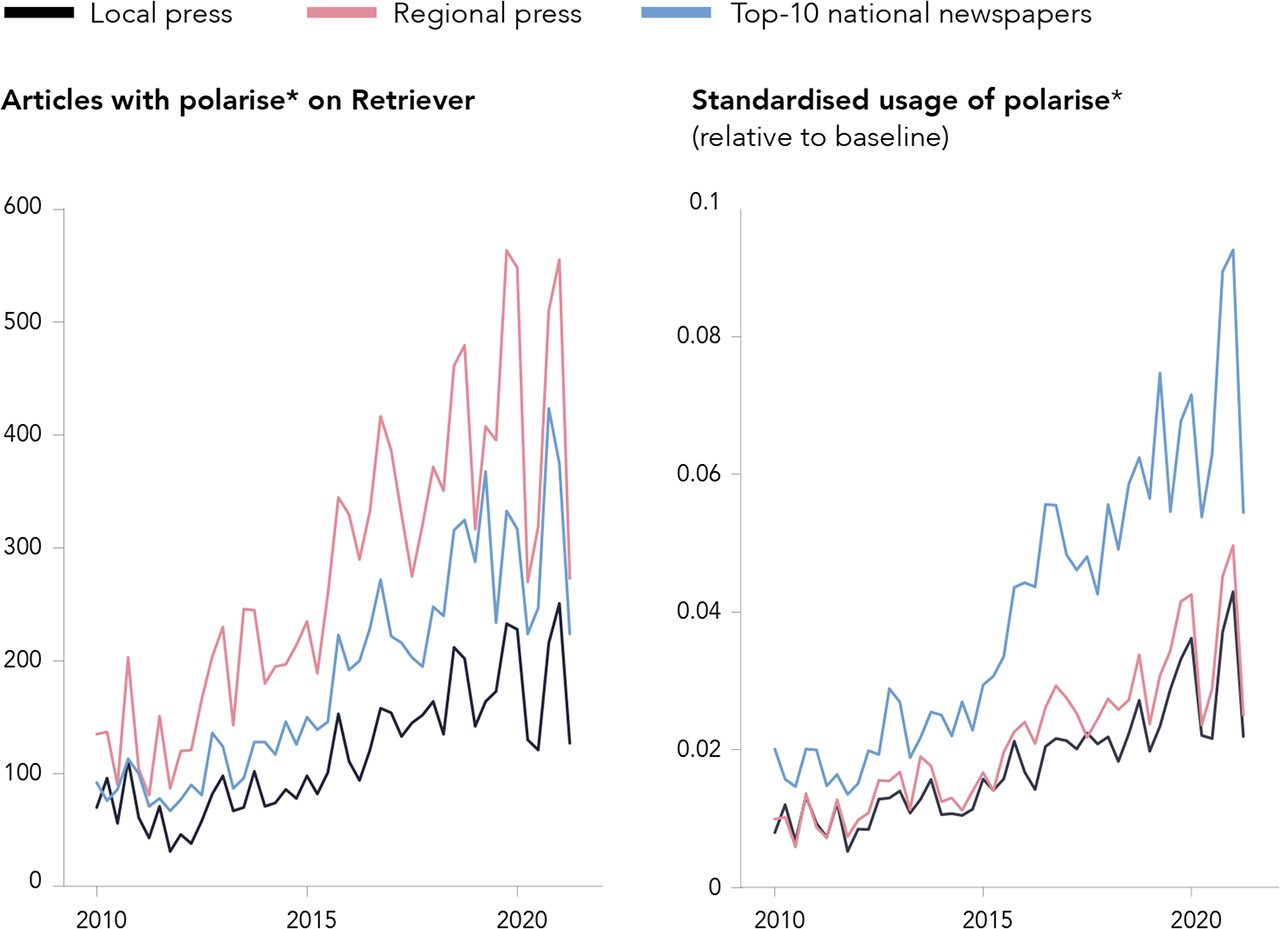
FIGURE 1
Number of articles with the term polarise* and standard usage
Comments: The panel on the left depicts the number of articles per quarter from the polarise* query. In the panel on the right, the number from the left panel is divided by the number of articles from the baseline during the quarter.
Study 2 result: Named entities
As a first analytical step, we identified the named entities that were most common in sentences including the term polarisation. We find that US-related entities were (by far) the most common among the 50 most mentioned entities. Table 1 shows the distribution of the geographic area from which the entities come. Furthermore, Table 1 also lists the most common entities by region, showing that entities from the US are more focused on politicians (primarily Donald Trump and Barrack Obama), while entities in Sweden and other regions are far more focused on geographic locations (in particular, cities). For more details, the Appendix presents the full list of the 50 most common entities.
TABLE 1
Most commonly named entities found in sentences that included polarise*
| Entities from | Same sentence mentions | Most common entities (by number of mentions) |
|---|---|---|
| USA | 5,223 | USA (2,417), Trump (833), Obama (323), Washington (172) |
| Sweden | 3,070 | Sweden (1,680), Stockholm (302), Gothenburg (218), Malmö (151) |
| EU | 2,176 | Europ* (700), EU (409), Russia (162), Germany (158) |
| Other | 697 | Israel (193), Turkey (174), Iraq (133), Erdogan (71) |
Figure 2 provides more detail on the politicians mentioned in the context of polarisation. The left panel shows that, whenever the term was used, Swedish media generally reported more about American politicians, with the notable exceptions of 2014–2015: During this period, Swedish general national and European elections were taking place, and the country was transitioning from a centre-right to a Social Democratic government. During this election, the right-wing populist party Sweden Democrats made significant gains, establishing itself as the third largest party in Sweden. In other words, the word polarisation only began to be used in a Swedish context when the populist right-wing party rose to power. Interestingly, as can be seen in Figure 2, this usage of the term polarisation was preceded by the usage of the term in the context of American politicians and national elections, speaking in favour of the concept of political polarisation being imported from the US to Sweden.
After 2015, we again see a clear dominance of American politicians, particularly with the presidential campaign of Donald Trump. We find that, by orders of magnitude, Trump is the most mentioned politician, mentioned more often than other American and Swedish politicians combined. As shown in the right panel of Figure 2, articles using the term polarisation mentioned Trump most frequently overall; the upward pointing line signals that the mentions of Trump were on the rise throughout 2020. Of all the politicians identified in our corpus, he was by far the one described as most polarising. Looking across the three panels, the uses by Swedish newspapers of the term polarisation was most intrinsically connected to the figure of Trump, who may single-handedly be the driver of the of the polarisation-related coverage of American politics.
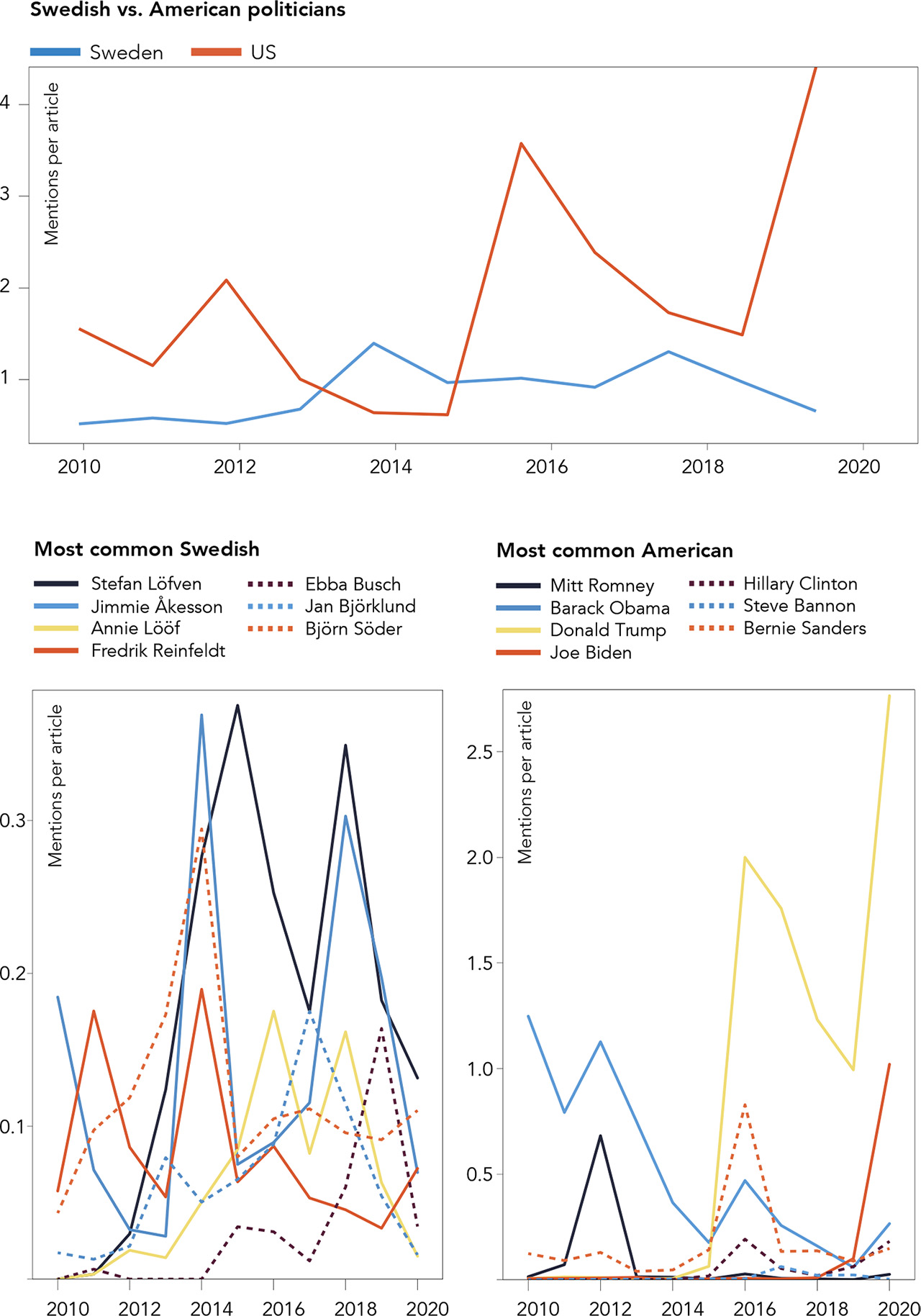
FIGURE 2
Comparing the frequency with which politicians are mentioned in the context of polarisation, 2010–2020
Comments: Y-axes show the average number of times that a politician was mentioned in the articles included in the news corpus.
As a second analytical dimension, we qualitatively categorised those same words regarding their affective connotations (relating to the concept of affective polarisation) or relationship with specific issues (ideological polarisation). We also considered including a category for actors, institutions, and other named entities; however, none of these entities appeared to be uniquely enough associated with the term polarise*. Approximately half of the words associated with polarise* did not fit with our categorisation and are therefore not included in our analysis. These words included primarily synonyms and antonyms (the full list of words is presented in the Appendix).
TABLE 2
Words associated with polarise* in the word2vec models
| Type of polarisation | 2010–2015 & 2016–2021 | Unique 2010–2015 | Unique 2016–2021 |
|---|---|---|---|
| issues and ideology |
|
|
|
| affective |
|
|
|
[i] Comments: Within each cell, words are ordered by their frequency of occurrence.
Comparing the cosine similarity between the words in Table 2, we used the standard t-test to determine whether the mean cosine values were statistically different from each other and found that the term polarisation was generally closer to words in the “issues and ideology” category than those in the “affective” category (p < 0.05). Strikingly, the words under the “issues and ideology” category unique to the 2016–2021 period describe more general social trends such as politicisation, populism, and contempt towards politicians, while the words unique to and common with the earlier time period primarily deal with concrete policy issues such as segregation, the income gap, and racism. Thereby, the term polarisation seems to have moved from a term that is used to discuss concrete issues to a term that is describing more general societal developments and, likely, an issue in itself, which is a confirmation of the qualitative analysis performed in Study 1.
Not surprisingly, whenever used to denote an attribute or affective term, the word polarisation is associated with negative moral evaluation. This negativity appears to grow stronger over time, with “förfäran” [dismay] as the only strong affective modality in the early period, contrasting with “oförsonlig” [irreconcilable/spiteful], “råare” [beastlier, cruder] and “förgiftad” [poisoned] in the latter. In conjunction with the qualitative study, this indicates that the negativity frame intensified throughout the period – not only in scope, but also in terms of level.
We also tested the cosine similarity between the aforementioned named entities and the term polarise* and found that all American politicians from Figure 2 are closer in terms of cosine similarity to polarise* than the closest Swedish politicians (Jimmie Åkesson and Björn Söder, the party leader and the leader of the parliamentary group – and later second deputy speaker of the Riksdag – of the Sweden Democrats, a radical right-wing party). These results point in the same direction as the analysis from Study 1, where we also saw the term polarisation being mainly used as a framing device in the context of American politics, and more seldomly in the Swedish context (only during national elections).
This particular distinction between the mentions of American versus Swedish politicians led us to visualise (see Figure 3) the polarisation conceptual space along a spatial dimension that separated the American and the Swedish context (on the vertical axis) and a time dimension, before and after 2016 (on the horizontal axis).
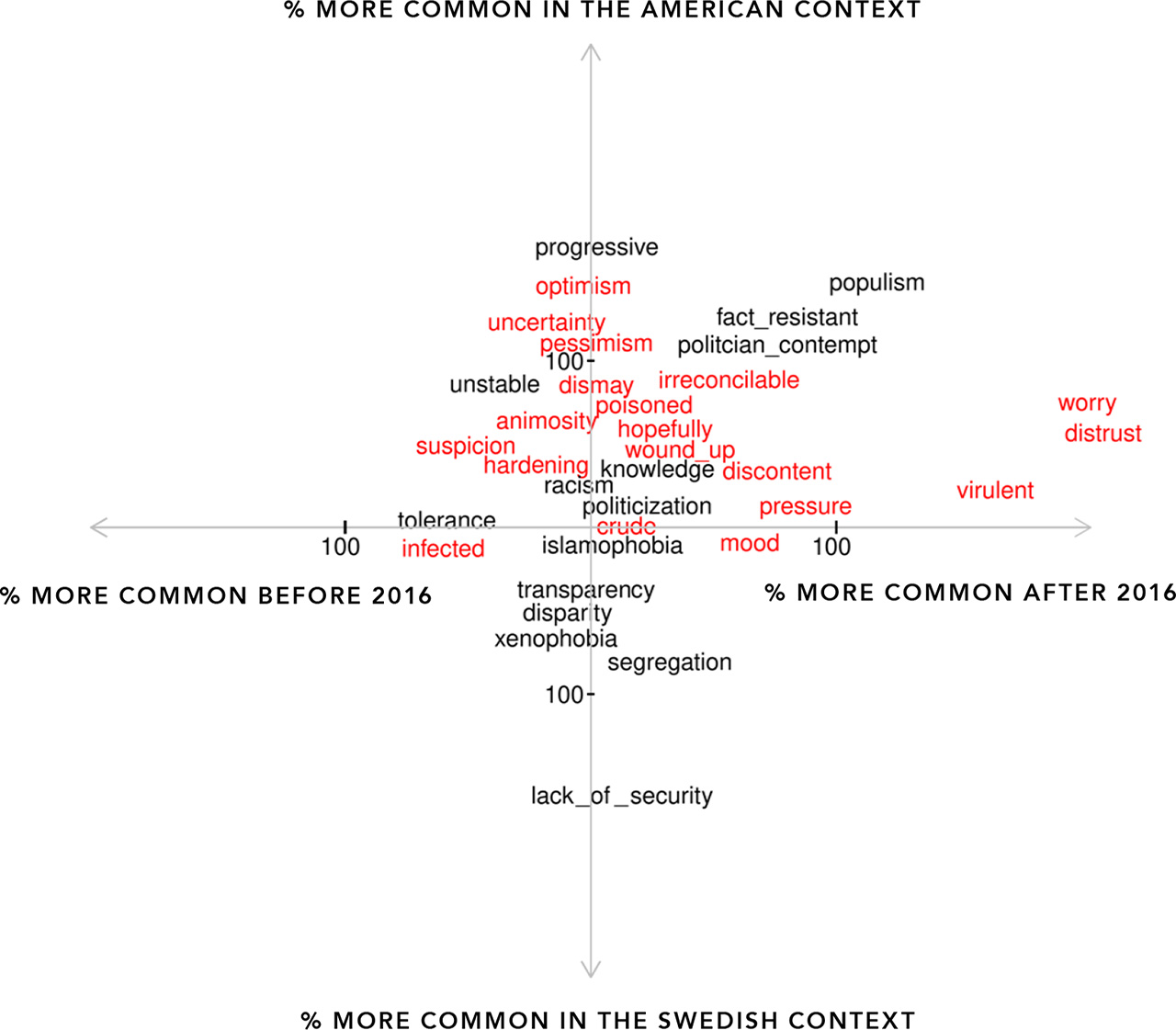
FIGURE 3
The polarisation vector space split before and after 2016 and between the US and Sweden
Comments: The red coloured words signal affective polarisation, and the black coloured words are associated with ideological polarisation.
The main takeaway from Figure 3 is that affective polarisation terms are most closely associated with the American context, whereas ideological polarisation terms are more common in the Swedish context. The affective terms cover sentiments such as pessimism and optimism, as well as a feeling of increased negativity (harder, more intense, infected, worry, suspicion, incompatibility, cruder). Ideological terms associated with the American context are populism and knowledge resistance; in the Swedish context, ideology is denoted by words such as insecurity, segregation, income cleavage, islamophobia, and xenophobia. Another interesting tendency is that, after 2016, the incidence of affective polarisation words increased relative to the period before 2016. In contrast, ideological terms did not change much before or after our benchmark year.
Discussion and conclusion
Our study of the use of the term polarisation as a framing device in Swedish newspaper articles during the last decade found that polarisation is increasingly used in the media coverage of politics and society. However, most of the time, the word did not appear in the title or header of the article but was used instead in the main body of the texts. When measured as a proportion of the overall coverage of economic, social, and political news, the frequency of polarisation quadrupled in the period 2010–2021, with the term’s use taking off especially from 2016 onwards. This could be due to the rise to power of Donald Trump, an American anti-immigration populist leader who won the American presidential election in 2016. Just before the election of Trump, the Syrian refugee “crisis” unfolded in Europe, which led to a large influx of asylum-seekers on the European continent. The dramatic increase in the use of the term in the Swedish print media may be due to these two concomitant events and their long-term implications, since populism and immigration are the two factors that the academic literature often connects to polarisation (see, e.g., Grande et al., 2019).
In response to our first research question, we find that the newspaper articles did not contain coherent news framing about polarisation, and that the functions of the word polarisation changed gradually throughout the period. Initially, the term was used for descriptive purposes in problem definitions, to describe a concrete situation or debate, as a simple adjective in highly defined circumstances. In more recent newspaper articles, the term seemed to be primarily used for the purpose of rhetorical amplification – infusing the term with a moral evaluation. We also found strategic uses of the term in debate, either to justify one’s own position, or to undermine one’s adversaries. Over time, the media discourse about polarisation moved from a focus on concrete issues towards a more general discussion of social and political tensions. The overall trend points to an increase in negative uses of the term over time.
Two notable observations from the qualitative analysis are the diffusion of the bipolar meaning of the word polarisation and, conversely, the seeming reification of the phenomenon in some texts. The bipolar implications of polarisation is certainly reductive in many cases reporting on both American and Swedish politics. It does, however, make some sense applied to the bipartisan American system that Study 2 showed to be dominating reporting using the concept. We find that these implications get blurred over time in the uses in media, which raises some critical considerations. The shift detected in our material is seemingly metonymic (cf. Laclau 2008), in the sense that Swedish and American polarisation are contingently associated, rather than analogous, through the conflictual orientation implied by the uses in Swedish media discourse. If the term infuses frames with a sense of bipolarity, as would be the case in a metonymic association of American and Swedish politics, it could influence the way citizens perceive multi-party politics, constraining it to bipolar oppositions (Levendusky & Malhotra, 2016). On the other hand, if polarisation is reified into a state or social force, or understood as a trait of contemporary society, it can divert attention from the realities of conflict. Used in this manner, the term can shape the view of conflicts as expressions of polarisation, rather than polarisation as the expression of material or political disparities. While our studies found examples of polarisation in this reified sense, the comparable lack of polarisation as the main focus of articles would suggest that it is generally understood as an epiphenomenon. Both these tendencies relate to Swedish media framing of politics and should be considered in analysis of conflict reporting.
To respond to our second research question about the actors most often named in connection with the term polarisation, both qualitative and quantitative approaches point out that polarisation was most often used to describe political developments in the US throughout our study period, constituting almost half (46.7%) of same sentence mentions. The term was also associated with Swedish politics (in 27.5% of all sentences), which was equal to the proportion of mentions in connection to all other countries combined (26%). An analysis of named entities showed that certain political figures were seen as more polarising than others. In the American context, candidates for the American presidency, particularly Donald Trump, were frequently mentioned in the context of polarisation. In Sweden, the top figures associated with polarisation were the leader of the radical right-wing party Sweden Democrats, Jimmie Åkesson, Prime Minister Stefan Löfven, and to a lesser extent, the leader of the Centre Party, Annie Lööf. This confirms the findings of previous studies about the “Trump effect” (e.g., Inglehart & Norris, 2017) as well as the role of populist anti-immigration parties as drivers of polarisation (e.g., Dalton & Berning, 2022; Harteveld et al., 2022).
Our most interesting finding comes as a response to our third research question, about the issues with which media coverage associated polarisation. Here we find a clear distinction between the American and Swedish context. Terms denoting affective polarisation were clearly more used as framing devices in stories on American politics and society, whereas those connected to political issues appeared in the Swedish political and social context. We can conclude that Swedish media coverage most prominently depicts the US as a locus of polarisation, and that it describes American polarisation as primarily affective. In contrast, Swedish politics is not framed as being as polarised as in the US; when occurring, polarisation in Sweden happens along issue lines such as the income cleavage or immigration. Thus, both value-based distinctions (along the GAL-TAN scale) and left–right contestation are present in the politics and society coverage in Sweden, supporting recent evidence about party politics produced by Hagevi and colleagues (2022).
Looking at the trends in the use of the term polarisation over time, the distinction between the US and Sweden remains meaningful for the entire period covered in our study. While ideological polarisation is rather constant throughout, the affectively laden reporting about polarisation increases, but only in texts related to the American context.
Based on the above distinctions, we find that it may be fruitful to separate two salient ways in which polarisation acted as a framing device in the Swedish newspapers during our research period. The first frame that became crystalised, which we might call “US politics as polarised”, appears as the most common, stable, and well-defined through its strong association to actors and its articulation in connection to events such as elections. The US is also clearly associated with an affective dimension of polarisation, which takes on a more pronounced negativity over time.
A decidedly more diffuse and less referenced frame of “polarisation in Sweden” seems to be present in parallel to the American frame. The Swedish frame is more strongly associated with ideological or issue polarisation, in particular migration, but overall, it has a weaker attachment to particular actors and policies. This frame does have an affective aspect, however, it is less salient than is the case of the American frame. This diffusion is also evident in how the named entities analysis showed it to be typically referencing locations (cities) rather than persons in Sweden.
The rhetorical functions of description and amplification are not restricted to any single frame. In particular, amplification is used across contexts, with the rhetorical force hinging on connotations of conflict, spite, irrationality, and morality. Our study constitutes a novel contribution to the study of polarisation in rhetorical research and may therefore lay the groundwork for further analyses that test the generalisability of these two functions in other media systems.
Our study has several limitations, among which we can count the small number of articles analysed in the qualitative sample. For the quantitative analysis, the major differences in frequency use of the term from year to year made tracing a more fine-grained chronological change impossible. In addition, the database used did not provide consistent information about the author names and the newspaper section where articles were published, and thus we could not detect if the term was used by particular authors or in a specific journalistic genre (editorial, reportage, book review, etc.).
To address these limitations, future research should endeavour to produce more fine-grained analyses of the media production of polarisation frames. This could be achieved in qualitative ways, by performing interviews with journalists who authored texts that included the term polarisation, to find out which meanings and functions they assigned to this particular framing device. Quantitatively, a computational model could be trained to detect the valence of texts where the word polarisation has a central position, to compare with the valence of articles where the term is used only in passing. Moreover, the model could potentially extract the genre of the article to check whether the notion of polarisation has different functions depending on the type of article it appears in.
Acknowledgements
We are grateful for the support of Elin Topp (Lund University) during the qualitative coding of the newspaper articles.
Appendices
Appendix
Since the results presented in the main text were based on separate qualitative and quantitative legs of our study, we also present details for the analyses in two separate sections.
Quantitative analysis
Data
All data was obtained through Retriever, a Swedish commercial service archiving most print, radio, and television media in Sweden (and other Nordic countries) and most of the associated online media (e.g., their websites, blogs, etc.). For copyright reasons, the obtained data cannot be shared in its obtained form; however, aggregate data with which parts of our analysis can be reproduced are available in our online data depository (OSF, 2023).
Our query selected all print media in the Swedish language that were published between 1 January 2010 and 31 June 2021 on a national level (Riksmedia: 10 sources), a regional level (Regionmedia: 82 sources), or a local level (Lokalmedia: 335 sources) and included the search phrase polarise* (encompassing the Swedish noun polarisation, the adjective/adverb polarised, and the verb polarise). For the baseline query, the phrase encompassed all nouns, verbs, and adjectives related to politics, economy, and society (politi* OR ekonomi* OR samhäll*).
Named entity recognition
To identify named entities, only the main body of an article was considered. The primary reason for this is that in the Retriever database, headlines and leads often were capitalised and, therefore, one of our criteria to identify a word as a named entity (i.e., if it started with a capital letter) did not work. Other criteria for a named entity were that the word was not at the beginning of a sentence (since any word at this position starts with a capital letter) and if words starting with a capital letter were preceded or followed by another word with a capital letter, those two (or more) words would be considered one named entity (e.g., for names like Donald Trump). For the 3,000 most common entities identified through this approach, a coder manually merged entities that referred to the same real-world entity (e.g., merging Donald Trump, Trump, and Trump’s). Furthermore, several smaller pre-processing steps needed to be done to avoid mistakes in counting the occurrence of the most common named entities. Most important was the deletion of typical parts of names that are not used consistently (e.g., von der, v/d, D’) from all text in order to correctly identify names like Ursula von der Leyen; the deletion of words of length 1 (potentially followed by a dot), to correctly identify, for example, Donald J. Trump; and the replacement of single-letter words that are usually placeholders for party names in Swedish politics (e.g., “S” for Social Democrats).
We compared the performance of this approach with other named-entity recognition algorithms (e.g., the Python model “swedish_ner_840B_300”) and found that our parsimonious approach led to the same top-50 list of most prominent entities. Since the results are the same, we preferred our approach because of the ease of communicating its logic. Note that this analysis was run on the text before performing the pre-processing steps described in the following section.
25 most common entities
In the main text, we present the most common types of entities. Below, we present the 25 most common entities by name.
TABLE A1
Named entities mentioned most commonly in sentences that included polarise*
| Entity | Number of same sentence mentions |
|---|---|
| Sweden | 1,680 |
| USA | 1,640 |
| Trump | 833 |
| America* | 777 |
| Europe* | 700 |
| EU | 409 |
| Obama | 323 |
| Stockholm | 302 |
| Gothenburg | 218 |
| Israel | 193 |
| Turkey | 174 |
| Washington | 172 |
| Clinton | 165 |
| Russia | 162 |
| Germany | 158 |
| Biden | 154 |
| Malmö | 151 |
| Iraq | 130 |
| France | 122 |
| New York | 119 |
| Åkesson | 117 |
| UK | 117 |
| Italy | 110 |
| Poland | 108 |
| Löfven | 102 |
Pre-processing
In order for the word embeddings to ignore semantically meaningless words and in order to combine words with the same root, the following pre-processing steps were taken in the following order:
Single-letter words that are usually placeholders for party names in Swedish politics (e.g., “S” for Social Democrats) were replaced.
All text was lower-cased and punctuation removed.
All words were lemmatised using the Python package Stanza, reducing all words to their grammatically simplest form. (Note, this was the approach recommended by The National Library of Sweden, KB Lab, at the time of analysis.)
All Swedish and English stopwords were deleted from the text (also using Stanza).
Words with length 1 were removed.
Word embeddings/word2vec
To create word embeddings, we used the Word2vec function provided by the Python package Gensim. The parameters of the model were 1) words needed to occur at least five times across all texts; 2) to calculate the semantic distance between two words, a word window of length 5 was used (corresponding to the median length of a sentence in our preprocessed data); and 3) a word vector with 100 dimensions was used to represent the vector space. All other parameters were set to the package’s default.
Two models were trained: one for the part of the data that was published before 1 January 2016 and the other for the time thereafter. The package’s function “most_similar” was used to determine the 100 most similar words to polarise* in terms of cosine difference (all other parameters were set to the default). All other steps of the analysis are detailed in the main text. In Table A2, we present all words associated with polarise* in the models and their English translations.
TABLE A2
Words associated with polarise* in the word2vec models.
| Word type | 2010–2015 & 2016–2021 | Unique 2010–2015 | Unique 2016–2021 |
|---|---|---|---|
| synonyms/antonyms/definitions/metaphors |
|
|
|
| causes/outcomes |
|
|
|
| carriers/expressions |
|
|
|
| issues/themes/ |
|
|
|
| qualitative/affective |
|
|
|
| other/unclear |
|
|
|
[i] Comments: Within each cell, words are ordered by their frequency of occurrence
TABLE A3
Typical sentences in which words appeared together with the term polarisation
| Word | Typical Sentence | Translation |
|---|---|---|
| segregation | minska polarise och segregation | reduce polarisation and segregation |
| progressiv |
| the county has a polarised history with land use and industry but also a progressive social democracy... |
| främlingsfientligheten |
| Motalas association kulturslussen felt that something had to be done against polarisation and xenophobia |
| inkomstklyftor |
| There is a risk that increased unemployment and sharpened income gaps will strengthen the political polarisation according to Adrian Cooper |
| toleransen |
| SSR believes that the debate on the issue has hardened and become increasingly polarised in recent times. |
| rasismen | det är rasismen i sverige som är polariserad | it is the racism in Sweden that is polarising |
| islamofobin |
| and when the media inflates the terror threat, of course polarisation and Islamophobia also increase |
| transparensen | Så transparens är viktigt om man vill minska polariseringen inom debatten. | So transparency is important if you want to reduce polarisation within the debate. |
| kunskapsklyftorna |
| Rutavdraget risks increasing knowledge gaps and thereby contributing to school results becoming even more polarised than they are today. |
| politisering | då förvandlas politisering till polarisering | then politicisation turns into polarisation |
| politikerföraktet |
| the disdain for politicians creates a polarisation, which damages all parties |
| populismen | populismen och polarisering är farlig | Populism and polarisation are dangerous |
| faktaresistent |
| unfortunately, the discussion in society is becoming increasingly polarised and resistant to facts |
| otryggheten | otryggheten och polarisering ökar | insecurity and polarisation increase |
| misstro |
| that it creates polarisation and mistrust |
| oron | oron för polarisering | concern about polarisation |
| hätsk | hätsk retorik och ökad polarisering kan gynna extremism | virulent rhetoric and increased polarisation can favour extremism |
| osäkerhet |
| propaganda limited news reporting and polarisation create everyday uncertainty |
| stämning |
| there is an escalation, an increasingly heated atmosphere and polarisation |
| infekterad | debatten har blivit polariserad och infekterad | the debate has become polarised and infected |
| fientlighet |
| aggressive identity politics and militant anti-racism polarises, it creates hostility and conflict instead of solidarity and brotherhood |
| tryck |
| polarisation also takes pressure off others |
| förfäran |
| increasingly dissatisfied and frustrated with the superficiality and with dismay at how contradictions and polarisation eat into our society |
| förhoppningsvis |
| issues that very easily and often become polarised, could hopefully become a little more nuanced |
| missnöje |
| inequality in society increases, which leads to dissatisfaction and polarisation |
| uppskruvad |
| the contemporary debate is polarised and the volume is turned up high |
| hårdnat |
| via the tech giants’ hate-promoting algorithms, the tone in social media has hardened and polarisation has increased |
| oförsonlig |
| right now we have a time of more polarisation, more violent climate, more intransigent rhetoric |
| råare | tonen har blivit råare när samhället blir mer polariserad | the tone has become rawer as society becomes more polarised |
| förgifta |
| such exaggerations should not be allowed to poison the debate, because then we can slip into the same polarised debate mess as in the US |
| pessimism |
| pessimism, mistrust, bureaucracy, fake news, walls, aviation shame, customs walls, polarisation, and closed-mindedness put a damper on the mood |
| optimism |
| from the optimism of the early speech to the rhythmic boredom of the speech via the polarised cultural struggle |
| misstänksamhet |
| they created fear, suspicion, and polarisation East and West |
Qualitative analysis
The following coding instructions (translated from Swedish) were used for qualitative coding of the randomly selected articles. Coders analysed six randomly selected newspaper texts from their assigned quarter of each year of the search period. Uses of polarise* were defined as all conjunctions and inflections of the word polarisation, including, for example, polarise and polarising as they pertain to human relationships. Should a randomly selected article contain polarise* in a different domain, such as physics or optics (e.g., polarising sunglasses), the coder skipped to the next article in the chronological results of the Retriever database.
Coding was done for each of the following categories in an Excel template. When possible, metatags were used and information as published in the source. When analysing the word use according to qualitative categories, sentence level grammatical and syntactical disambiguation of word use took priority. If the use in the sentence was ambiguous, coders proceeded the analysis through surrounding sentences, up to the paragraph level. If the use of polarise* was still ambiguous at the paragraph level, coders checked the full article, headline, and co-occurring texts (e.g., information boxes, bylines) for words and sentences that would disambiguate or interanimate with polarise* in a standard reading of the article (e.g., general themes or topics covered in the article). If coding terms were not applicable, coders left the field in the table blank, or substituted it for a more fitting term.
Coding categories
title: Log the title of the text coded in the row
type: The text type/genre of the text, e.g., editorial, news article, column, review
author : Author attribution of the text, including press agency – if unsigned, mark “unsigned” if editorial, “unknown” if other type
source : Newspaper of publication
date : Date of publication
polarise*: Number of uses of polarise* in any conjunction/inflection in the text body and headline.
expert quote : Note whether polarise* occurs in a sentence that is part of the copy of the text – i.e., written in the author’s voice – or if part of a quote from a source/interviewee/cited text.
site: Note geographical region/physical space/location to which polarise* is attributed (e.g., a specific country, a region, etc). If implicit in the sentence, look to the text in general/headline for attribution.
sphere : Note how/whether polarise* is attributed/delimited to some societal sphere/imaginary space/practice, such as politics, the Internet, labour relations, etc.
role : Note in what role/capacity the voice uttering polarise* is represented as having in the general framework of the text. Use “observer” for a voice assuming a disinterested/commenting position (such as a news report or expert testimony on polarisation in some sphere). Use “stakeholder” for voices construed as a participant in the polarised sphere/debate (such as politicians commenting on polarisation in their political field, debaters mentioning the polarisation of the current debate). If illuminating, specify further the role.
cause / effect: Code as “Cause” if polarisation is primarily construed as the cause of some activity/response/situation in the text. Code as “effect” if it is construed as a (possible) outcome of something else discussed in the text. Code as “state” if it is merely descriptively attributed to something, for example, in a sentence like “The issue is polarised”.
positive /negative /neutral : Code for evaluations of polarise*. If there are no explicit evaluating terms modifying polarise*, look to the sentence- or paragraph context to see whether it is mentioned in a positive, negative, or neutral sense. The categories “expert quote” and “role” should guide what parts of the text are considered for evaluative statements. If part of a quote, look primarily to evaluative language/positions attributed to the quoted source.
risk / fact: Code as “risk” if polarise* is construed as a possibility, such as a possible outcome/risk of a course of events/actions. Code as “fact” if it is construed as an actual and present state.
increases / decreases : Code for whether polarise* is mentioned as increasing/decreasing or a stable state (e.g., if something is talked about as polarised, mark “is”). Look particularly at modifying conjunctions, verbs, and adverbs.
strategy: Code as “active” if polarise* is construed as actively/strategically created by some group/actor or arises from some group with attributed agency. Code as “passive” if polarise* is construed as arising spontaneously/naturally from circumstances, for example, if an issue is cast as naturally polarising.
scope: Code for what is implied/explicitly stated to be encompassed by polarise*, or what is being polarised. Note result in abstract level, use terms issue, group, sphere, but substitute with another label should these not be fitting.
target: Note the site where polarise* is construed as residing coding for scope in a more specified level. For example, if scope is an issue, code specific issue(s) mentioned in the text. If scope is a sphere, code for specifications of this sphere. If scope is group, specify which group characteristic is construed as pivotal for polarisation.
stakeholders : Code for mentioned stakeholders/participants in polarisation.
quality: Code for the quality of polarise* attributed in the article, that is, what type of polarisation is explicitly or implicitly discussed in the text. If unclear, use contextual cues to draw conclusions (e.g., ideological, material, affective).
cause : If a cause is explicitly or implicitly attributed to polarisation, code for the specific cause given.
effect abstract: Code for abstract effects of polarisation in the sphere discussed. Include such problems mentioned as synonyms to polarise*. Abstract effects include states and generalised processes at the group or societal level (e.g., tensions, deteriorating public sphere/conversation).
effect concrete : Any concrete practices, actions, or other specific outcomes attributed to be caused by polarise* in the text. This include examples or proof given of something being polarised or concrete potential outcomes of possible polarisation (e.g., violence, political impasse, specific election outcomes).
related terms : Include notably related terms to polarise* in the text that do not fit other categories. Include, for example, words found in constructions like “this decision will lead to increased polarisation and X”, words used as possible synonyms for polarise* in other sentences, or other contextually/syntactically related concepts.
quote : Copy the original sentence(s) where polarisation occurs, and possibly surrounding sentences if meaningful.
interpretation : Write a short summary of your interpretation of the full text, and the role polarise* plays in it.
specificity: Analyse the degree of specificity/disambiguation the concept of polarise* has in context. Code as “specific” for highly disambiguated uses, where the text explicitly defines the poles and qualities of the polarisation it mentions. Code as “general descriptive” when the word is used to describe, for example, an explicated situation or a relationship, but with only limited grammatical/syntactical disambiguation of the term polarise*. Code as “empty” when polarise* appears as an empty signifier or is written in such a commonsensical manner that its meaning is not disambiguated by surrounding text but used as though it has an obvious meaning. Empty uses could be such uses where a person unfamiliar with the term polarise* would not understand the sentence.
Qualitative data aggregation
The tables described in the following are available in our data repository (OSF, 2023) as Excel files. They present the aggregation of the qualitative codes presented in the main text.
table 1, coding summary: This table comprises all the qualitative coding performed by the four coders. Empty boxes are due to coder 2 submitting a coding chart lacking a handful of categories. These were manually checked by the qualitative project manager in comprising the quantitative content table. The category “specific/general/empty” was added after initial coding, and this analysis was performed by the qualitative project manager.
table 2, summary of data set: This table contains summaries of general traits of the dataset; sources, article types, and geographical site of article main emplacement.
table 3, quantitative content table: This table contains a count of the occurrence per quarter of a specific code within the six articles analysed during that quarter. The table represents a hermeneutic process of reclassifying specific codings into more general categories. Codes for the quantitative coding table were inductively derived from the submitted qualitative codings. Each coding category is represented by a separate colour in the table. The qualitative project manager aggregated the codes from the four coders for each quarter and table column. Since the occurrence of the word polarisation in the text could be related to multiple codes within a coding category, the count of codes for each coding category can exceed the number of articles during each quarter (i.e., six). Discrepancies between the number of articles in each period (24) and results in the general categories are due to source texts using the term polarisation more than once. Some of the specific codes within a coding category have some overlap, and choices of coding were made from which terms were featured in the source text. In all cases where the submitted coding table was ambiguous or lacked coding in a specific category (i.e., empty cell in submitted table), the original article text was checked and recoded. The column “Evaluative texts out of 6/quarter” comprises such journalistic text genres that traditionally allow for evaluative arguments/language: Editorials, reviews, opinion pieces, and columns. The column on “speaker/author persona” counts the number of times the first person of the copy/quote text (uttering the sentence containing “polarisation”) is positioned/positions themselves as an expert, rather than for example a pundit, journalist, or stakeholder.