

Midjourney AI, prompt GCO
Few concepts in marketing have had as much pedagogical influence as the 4 Ps – product, price, place and promotion. For generations, this framework has structured how a significant portion of marketing is taught, understood and practiced – beyond important foundational elements like situational analyses (the “5 Cs”) and segmentation, targeting and positioning. The 4 Ps distilled the complexity of the marketplace into four controllable levers, offering marketers a way to structure decisions and demonstrate their role as architects of value and growth.
A time for reflection, a time for renewal
Yet in practice, the scope and influence of the 4 Ps have always depended on organizational context. In some companies – particularly in consumer-packaged goods and advertising industries – marketers have enjoyed wide-ranging authority, shaping product strategy and pricing and so on. In others, their influence has been far narrower, often confined to communications. As companies have become more data-driven, efficiency-oriented and operationally fragmented, some marketing departments have seen their decision-making power erode, with responsibilities once core to marketing redistributed across other functions.
This shift has led to a marginalization of marketing's voice in some organizations. At the very moment when digital disruption, stakeholder activism and artificial intelligence (AI) are transforming the competitive landscape, too many companies are sidelining the function best equipped to bring customer insight, integrative thinking and creative leadership to bear.
Marketing has never been more vital. To fulfill its potential, the discipline must reimagine its mandate, reposition itself within the company and reclaim its strategic role as a driver of growth.
A brief overview of marketing's recent history
Marketing has never been a static discipline. Its scope, tools and organizational influence have evolved significantly over time, shaped by shifts in the economy, technology and consumer expectations. To understand where marketing might be heading, we must first consider where it has been.
In the pre-digital era, especially throughout the mid- to late 20th century, marketing primarily operated within a relatively stable media landscape dominated by mass communication channels such as television, print and radio. Marketing departments often focused on advertising and promotions, with an emphasis on brand awareness, positioning and broad messaging. The 4 Ps offered a framework that reflected this environment. Products were often standardized, markets were less fragmented and customer feedback loops were long and indirect.
The arrival of the internet in the 1990s marked a significant inflection point. Digital tools allowed marketers to engage in two-way communication with customers, track behavior with more precision and create more targeted campaigns. Email marketing, banner ads and e-commerce platforms opened new possibilities – and introduced new metrics. The idea of personalization at scale became imaginable. This led to the rise of digital marketing as a distinct discipline, often running parallel to traditional marketing efforts.
Marketing analytics gained traction in the 2000s and early 2010s, as CRM systems, web analytics and marketing automation tools gave marketers access to unprecedented volumes of data. While not universally adopted, these tools opened new possibilities for data-driven decision-making. Some marketers embraced the shift, while others remained hesitant. My own research with colleagues has documented the significant performance gains that can result when companies effectively leverage marketing analytics (Figure 1).
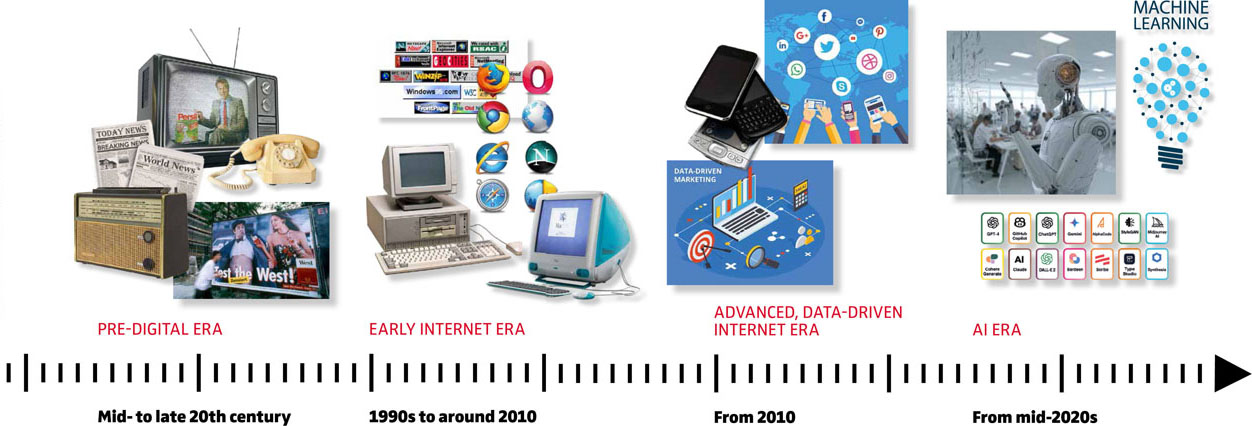
FIGURE 1
The evolution of marketing from the pre-digital age to the AI era
iStock, Adobe, Alamy, envato, Freepik, Dall-e, pngfind.com
Today, we are again at a turning point: the era of artificial intelligence. AI and machine learning are transforming how customers are understood, how experiences are delivered and how resources are allocated. The ability to predict, personalize and automate is accelerating rapidly.
“To assume a leadership role, marketing must be structured and positioned to shape strategy, not simply support it.”
While nearly all business functions have been affected by these technological shifts, marketing arguably has been impacted the most. Core practices in functions like accounting or finance – such as revenue recognition or cash flow modeling – have remained relatively stable. In contrast, marketing has had to reinvent itself repeatedly.
These transformations, while never easy – change rarely is – present marketing with a rare opportunity: to redefine and elevate its role within organizations. But this requires more than a nostalgic reliance on traditional frameworks. Instead, marketing must adapt its tools to new realities and lead organizations through complexity.
Beyond the 4 Ps: A new mandate for marketing
The original 4 Ps offered a useful framework – but one designed for a more stable and product-focused marketplace. Today's environment is more volatile, interconnected and stakeholder-driven. Marketing must broaden its mandate – not by discarding the 4 Ps but by reimagining them for a world defined by experience, authenticity, value and access (Box 1).
In recent years, many marketers have begun to reinterpret the 4 Ps to better reflect contemporary challenges and opportunities.
BOX 1
A reinterpretation of the 4 Ps in a contemporary environment
From product to experience
Marketing must evolve from a product-centric discipline to one that orchestrates holistic customer experiences. Consumers no longer evaluate brands solely on features or benefits. They care about how brands make them feel, how seamlessly they solve problems and whether their values align. This shift requires marketing to serve as the custodian of the end-to-end customer journey – ensuring that every touchpoint is well-designed, emotionally resonant and continuously optimized.
REAL-WORLD EXAMPLES
Disney has mastered experience orchestration by integrating physical and digital touchpoints into a cohesive whole. From its parks to its streaming services, Disney's marketing and operations teams work closely to create a consistent, immersive experience. Disney's Magic Band, for instance, allows guests to unlock hotel rooms, enter parks and pay for meals – all while enabling Disney to collect data to refine the customer journey in real time.

From promotion to purpose
The shift from promotion to purpose mirrors a broader societal transformation. Consumers – especially younger generations – demand authenticity. They expect brands to reflect their values and take meaningful stances on social, environmental and economic issues. Marketing can no longer function as a megaphone for messaging; it must instead act as a mirror of values and a driver of organizational alignment. From campaign strategy to supply chain choices, from DEI efforts to sustainability initiatives, marketing must help ensure that purpose is not only proclaimed but practiced.
Patagonia has made purpose central to its brand, not just through communication but through bold corporate action. Its “Don't Buy This Jacket” campaign encouraged mindful consumption, and for decades, the company has donated 1% of sales to environmental causes. In 2022, Patagonia's founder transferred ownership to a trust and non-profit to ensure all future profits are used to combat climate change – demonstrating how marketing, governance and strategy can converge around shared purpose.

From price to value
The concept of price has also evolved into a broader understanding of value creation. Effective pricing now requires deep insight into customer psychology, perceived benefits and behavioral economics. Traditional trade-offs between price and volume have given way to dynamic segmentation strategies, value-based models and personalized offerings. Marketers must champion pricing structures that not only drive growth but also reinforce brand equity and trust.
Adobe's transition from one-time software licenses to a subscription-based model (Creative Cloud) exemplifies value-based pricing. Instead of competing on price alone, Adobe positioned its offering as a continuously evolving service, bundling cloud storage, collaborative tools and ongoing updates. The result is stabilized revenue streams, increased customer lifetime value and stronger alignment between price and perceived value.

From place to platform
Distribution, once narrowly defined as physical logistics and shelf presence, has become a strategic and digital frontier. In today's omnichannel world, the “place” where customers engage with brands includes digital marketplaces, mobile apps, direct-to-consumer platforms and even augmented and virtual realities. The imperative is to design platforms that enable seamless access, meaningful interaction and data-informed relationships. Marketing must lead in shaping these ecosystems and ensuring they are both efficient and emotionally engaging.
Nike has aggressively expanded its direct-to-consumer presence through apps, flagship stores and proprietary platforms like Nike Training Club. By reducing dependence on third-party retailers and investing in personalized digital experiences, Nike has gained more control over brand narrative, improved margins and enhanced its ability to build lasting customer relationships through first-party data.

This reframing captures a deeper truth: Marketing is no longer confined to its traditional boundaries. Instead, it has the potential to touch every facet of how value is created and delivered, within and beyond organizations.
Taken together, these shifts have the potential to dramatically expand marketing's scope – and raise the bar for what it means to be a marketing leader.
Maintaining and gaining marketing power: What needs to change
Marketing is moving beyond the 4 Ps – toward a function that shapes experiences, leads with purpose, delivers value and builds platforms. But how can marketing departments bring this vision to life? What must change within organizations to allow marketing to fulfill this expanded role?
The answer, I believe, lies in large part in structure, metrics and mindset – three interdependent levers that determine whether marketing is treated as a tactical support unit or as a strategic growth engine. When approached intentionally, these levers can help reposition marketing as a central, value-creating force – one that earns its seat at the leadership table not by asking for it but by demonstrating its impact (Figure 2).
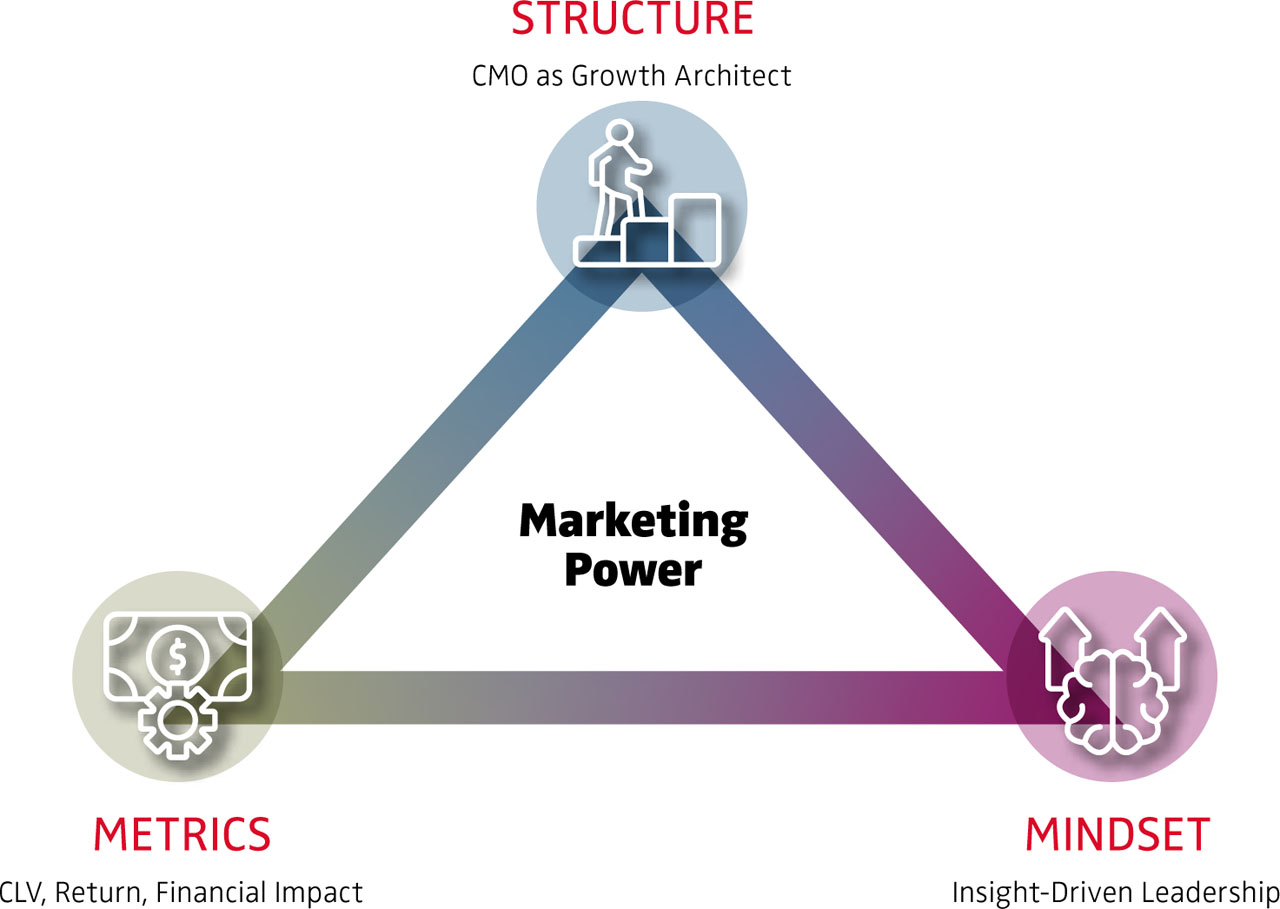
FIGURE 2
Levers for building marketing as a strategic growth unit
Structure: Marketers as networked growth architects
Influence in companies is not granted – it is earned. For marketing to lead, it must be structured and positioned to shape strategy, not just support it. This begins with rethinking the role of the CMO and the marketing department's relationship to the rest of the C-suite.
The CMO should not be seen merely as the steward of the brand, as is the case in many companies, but instead as a growth architect – a leader who contributes meaningfully to innovation roadmaps, capital allocation and enterprise strategy. My colleagues' and my research provides compelling evidence that companies with empowered marketing departments, CMOs and marketers represented on the board consistently outperform their peers. Yet paradoxically, marketing is often the first function to face budget cuts when economic pressures mount – a sign that its strategic relevance remains fragile.
To strengthen its position, marketing must build deeper relationships with other executive leaders and, critically, with boards of directors. Board-level engagement is essential for ensuring that marketing has both the visibility and the voice to influence long-term strategy.
Marketing's organizational structure must also evolve. Cross-functional teams should be built around customer journeys, with marketing in a coordinating role – ensuring that insights, messaging and execution are aligned from ideation to delivery. Companies like Intuit and Airbnb exemplify this model, embedding marketing into agile pods that include product, data science and design. This upstream integration empowers marketing to shape what gets built, not just how it gets sold.
To earn trust in this expanded role, marketing leaders must be accountable and deliver innovation. They must prove that marketing is a rigorous function – one that experiments, learns and delivers results aligned with company-wide objectives. By spotting demand shifts early, uncovering latent customer needs and translating insights into business strategy, marketers can become indispensable partners to CEOs and boards.
Another limiting factor is the discipline's cultural orientation. Many marketers are drawn to creativity, intuition and storytelling – a historic strength that must now be paired with data fluency, experimentation and financial acumen. In a world of AI-powered decision-making and ROI-driven leadership, embracing both sides of the brain is no longer optional. Marketers must balance emotional resonance with analytical rigor.
Metrics: Speaking the language of the business
Power in organizations is tied to how performance is measured – and how well those metrics are understood by decision-makers. For marketing to gain influence, it must speak the language of finance and strategy, not just that of media and engagement.
This means moving beyond tactical KPIs like impressions or click-through rates to connect marketing activity to core business outcomes: revenue growth, profit margins, retention, customer life-time value and even stock performance. These links are not always easy to measure, but they are essential to demonstrate impact.
Unilever's transformation under former CEO Paul Polman offers a powerful illustration. Polman reoriented the company around sustainable growth, empowering marketing to help define brand purpose and track its effects not only on reputation but also on sales and shareholder value. Brands like Dove, Lifebuoy and Ben & Jerry's were positioned around clear social missions and supported with data-driven insights about consumer values and behaviors. The result: Purpose-led brands grew faster than the company average, giving marketing a central role in shaping both Unilever's strategy and its investor narrative.
“Leadership today is less about hierarchical authority and more about influence through insight.“
To build credibility, marketers must invest in analytics – but even more, they must become storytellers with data. Dashboards don't earn trust – interpretation does. Influence grows when marketers can frame insights in business terms, explain causal pathways and connect marketing actions to long-term financial value. When they do so consistently, marketing functions not only gain respect – they shape organizational priorities.
BOX 2
Goodbye, customer insights?
A common critique of marketing's focus on customer insight stems from a famous line attributed to Henry Ford: “If I had asked customers what they wanted, they would have said a faster horse.” This quote, famously echoed by Steve Jobs, is often used to suggest that listening to customers is misguided – that customers don't know what they want and visionary leaders should instead rely on instinct. But this interpretation misses the point. Jobs himself, despite his reputation for intuition, was one of the most effective marketers of our time – not despite his understanding of customers but because of it. While it's true that customers may struggle to articulate desires for radical innovations like the original iPhone, most new products are not revolutionary – they are incremental improvements. In these cases, the voice of the customer is not only worthwhile but essential. Marketing's ability to surface, interpret and synthesize these insights remains one of its most powerful and relevant contributions to growth.
“If I had asked people what they wanted, they would have said faster horses.”
HENRY FORD

Midjourney AI, prompt GCO
Mindset: Leading with confidence and curiosity
Finally, reclaiming marketing's power requires a mindset shift from tactical execution to strategic leadership. Leadership today is less about hierarchical authority and more about influence through insight. Nike's marketing team exemplifies this approach, helping to lead company-wide initiatives on digital transformation, sustainability and DEI. Their influence stems not from control but from their ability to embed brand values into everyday decisions and partner across departments to activate them.
In this light, marketing is not merely a function – it is a way of thinking. One that connects customer needs to business opportunities, current performance to future growth and purpose to profit. Marketers who embrace this mindset don't wait for a seat at the table – they earn it by shaping the conversation, reframing business problems and offering bold, insight-driven paths forward.
Structure, metrics and mindset: Connecting the dots
What I'm proposing here is not a cosmetic shift. The opportunity is real, not rhetorical. But it requires more than lip service. It calls for deliberate choices: to build the structures, adopt the metrics and cultivate the mindsets that empower marketing to lead with substance. Some may call this ambitious or even idealistic. Perhaps it is. But the timing is right, not least because the broad emergence of AI offers a powerful tailwind for marketing's strategic realignment.
The AI crucible: A defining moment for marketing
AI is one of the most powerful forces reshaping the marketing landscape. It is transforming how organizations engage customers, analyze data, allocate resources and personalize offerings. But AI is not merely a set of tools – it is a test of marketing's strategic relevance. It offers both promise and peril and represents a defining moment for marketing.
On the one hand, AI can automate routine tasks such as media buying, content optimization and customer segmentation, freeing marketers to focus on higher-order activities such as brand strategy, innovation and cross-functional alignment. This shift can help elevate marketing's role, positioning it as a true driver of long-term growth, as elaborated above.
On the other hand, if marketers do not lead AI's integration with intentionality and vision, they risk ceding influence to IT or analytics teams. The role of marketing is not to deploy technology for its own sake but to ensure that AI enhances the human aspects of marketing – storytelling, trust-building and value creation. That includes shaping how AI is introduced to customers, communicating its benefits and boundaries transparently and guiding responsible data use across the organization.
I believe that those who embrace AI as a strategic enabler will be best positioned to shape the future of marketing. They will use AI not just to optimize tactics but to transform how the company listens, learns and adapts. This can help marketing reclaim its place as a catalyst for growth, innovation and trust.
A call to strategic leadership
Marketing stands at a pivotal moment. Rather than retreating into a narrower tactical role, it has the opportunity to rise to the level of strategic leadership, guiding organizations through customer evolution, organizational complexity and technological disruption. This path demands not only creativity and analytical rigor but also vision, courage and a renewed understanding of marketing's mandate.
The journey forward does not require abandoning the 4 Ps. Instead, it calls for reinterpreting them for today's realities – where products are holistic experiences, promotions are platforms for purpose, pricing reflects behavioral and psychological value and place is shaped by dynamic, omnichannel ecosystems. These shifts invite marketers to step forward not just as communicators but as architects of customer-centric growth.
At the same time, the rise of AI presents a defining test. Marketing must not merely adopt new technologies but also lead their thoughtful integration. This means using AI to elevate – not replace – the human elements of insight, storytelling and trust. It means aligning action with purpose and translating data into strategic clarity.
Of course, marketing's trajectory will vary by company. In some organizations, marketing will (continue to) lead – shaping strategy, guiding investments and earning its seat at the leadership table. In others, it will remain siloed or relegated to a support role. But I believe that companies that embrace marketing's full potential will outperform those that don't. Indeed, in a world of rising complexity and growing stakeholder expectations, companies that empower marketing to lead will be better positioned to adapt, inspire and thrive.