
Welcome to a new era of digital engagement. In today’s hyperconnected world, brands are grappling with a new challenge: how to engage with chronically online consumers who spend an extraordinary amount of time immersed in digital culture. At its most extreme, the term “chronically online” is a critique, mocking those whose constant social media preence seems to warp their grasp of real-life experiences. But at its core, the term describes an undeniable shift in consumer behavior: a growing segment of the market that is perpetually connected and fluent in niche digital topics. These consumers speak in memes and track online trends with insider precision.
For marketing practitioners, chronically online consumers present a double-edged sword: an unparalleled opportunity for digital engagement and also the daunting task of keeping pace with the accelerated and often fractured cycle of digital culture. But there is one group intimately familiar with this dynamic: influencers.
Influencers have been navigating the front lines of chronically online consumer culture. They’ve mastered the art of engaging with hyper-specific audiences, responding to fleeting trends with agility and maintaining relevance in a constantly shifting landscape. In the age of chronically online consumers, what can brands learn from influencers themselves, and how can these insights refine and elevate influencer marketing?
“The creator economy is built on the promise that anyone has the potential to become well-known and well-loved.”
How influencers and chronically online consumers are redefining celebrity status
Forget red carpets and paparazzi—today’s celebrities are born from the glow of ring lights and the buzz of comment sections. In influencer culture, stardom isn’t just handed out by Hollywood gatekeepers. It’s earned, one TikTok dance, skincare routine or Instagram Reel at a time. At the heart of this shift is something that my colleagues and I refer to in our research as “influencer celebrification”—the process by which everyday people leverage social media to gain celebrity capital. Unlike traditional celebrities who climb the fame ladder through organized sports, blockbuster movies or billboard music charts, influencers build their empires by gaining favor with chronically online consumers, bypassing the usual intermediaries. This means that the creator economy is built on the promise that anyone has the potential to become well-known and well-loved—not just traditional celebrities like Beyoncé and Cristiano Ronaldo but also everyday micro-celebrities who have small but devoted followings.
But there’s a fine line between a thriving industry and a saturated one. An estimated 50 million people worldwide now fall under the broad umbrella of “influencers,” according to the 2024 Forbes Top Creator list. The spectrum of influencers has never been wider. As the label becomes increasingly ubiquitous, its meaning—and impact—is evolving. This is especially true in the age of chronically online consumers, who are constantly bombarded with content, trends and personalities vying for their attention. In this always-on environment, it’s not just the role of the influencer that is shifting—it’s the experience of being influenced. Consumers, inundated with voices and choices, are becoming more selective. The line between “influencer” and “influenced” is blurrier than ever, with chronically online consumers playing a key role in deciding who commands the cultural spotlight and for how long.
Surveillance and the rise of panopticontent
A few years ago, a BuzzFeed reporter interviewed me about the normalization of filming strangers in public without their knowledge or consent, driven by the hope of going viral on social media. I described it as a self-induced surveillance state; she gave it a much catchier term: the age of panopticontent, where everything is content for the creating, and everyone is a nonplayer character. It’s not just influencers in the spotlight—anyone, from a Starbucks barista to your neighbor’s dog walker, can be swept into the viral vortex, willingly or not. This democratization (or demonization) of fame is central to rethinking how we approach influencer marketing. At its core, influencer marketing is built on a two-way mirror of surveillance: Influencers curate their lives for public consumption, while consumers scrutinize, emulate and engage. It’s a cycle of watching and being watched, constantly.
“Everyone’s a potential marketer, a potential subject, a potential consumer and a potential story.”
A more holistic way to think about influencer marketing is to see it as a spectrum (Figure 1). On one end, we have Big Influencer Marketing—capital I, capital M—the formalized and professionalized creator industry, where paid brand deals and algorithmic expertise reign supreme. On the other end lies little influencer marketing—lowercase i, lowercase m—a reflection of how we’ve all become content creators in our everyday lives. Whether we’re meticulously curating our Instagram Stories, participating in viral TikTok trends or unintentionally going viral ourselves, we’re emulating the lifestyles and behaviors of influencers, even if we’re not getting paid to do so. Spread throughout the spectrum are micro influencers, semiprofessional content creators, user-generated content creators and others who may not squarely fall on one side or the other.
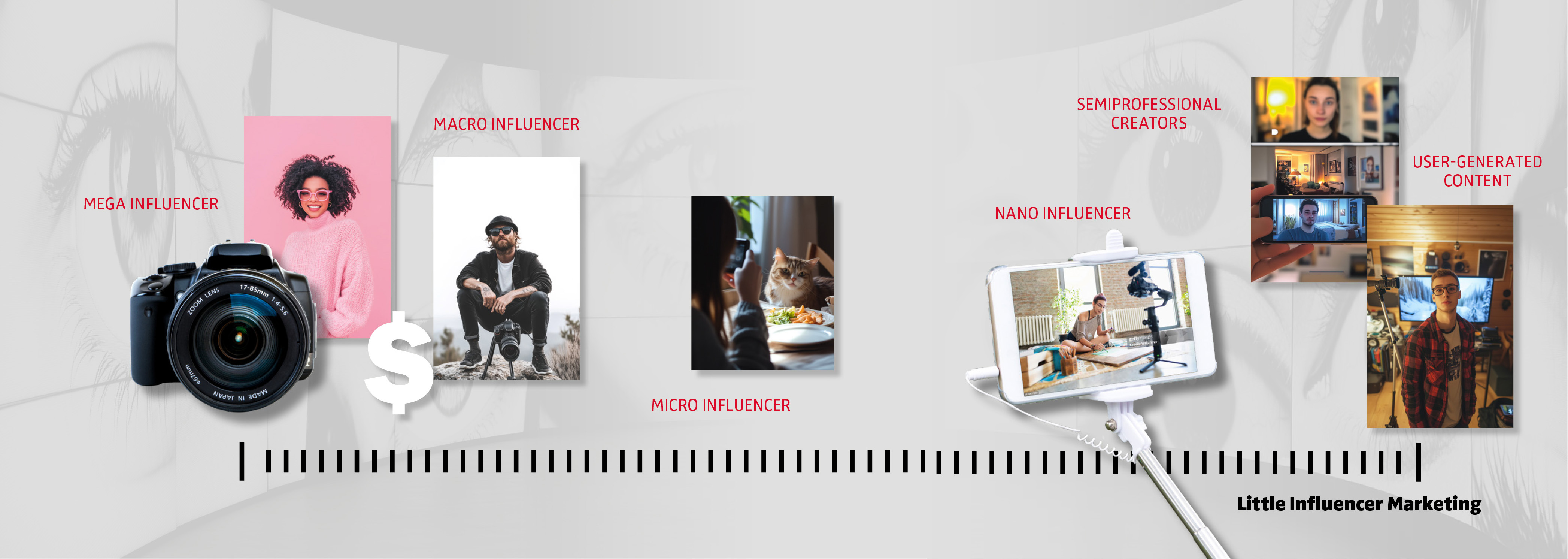
FIGURE 1
The spectrum of influencer marketing
midjourney AI, prompt GCO; istockphoto
This self-surveillance culture isn’t just a quirk of chronically online consumers; it’s the foundation of modern social interaction. And for brands, it means rethinking the scope of influencer marketing entirely. It’s no longer just about tapping into professional creators with massive followings—it’s about understanding how all of us, willingly or unwillingly, are part of the creator economy. Everyone’s a potential marketer, a potential subject, a potential consumer and a potential story. The question is: How can brands not only adapt to but actively participate in influencer marketing in this new age of chronically online consumers?
How brands can embrace and navigate “chronically online influencer marketing”
Throughout the past two decades, the professionalization of influencer marketing has ushered in an era of polished, planned and perfected social media campaigns, where influencers often operate as scripted extensions of brand messaging. Authenticity—once the cornerstone of influencer appeal—became increasingly manufactured, with every post carefully curated to align with brand strategies. Today, while this model continues to thrive in the booming creator economy, a gap has opened up, creating space for the unexpected, the quirky, the weird and the fun—what we might call chronically online influencer marketing.
“As a marketing strategy, chronically online influencer marketing shifts away from calculated perfection and embraces the unpredictable, often absurd humor of chronically online consumer culture.”
As a marketing strategy, chronically online influencer marketing shifts away from calculated perfection and embraces the unpredictable, often absurd humor of chronically online consumer culture. What once went by names like “real-time social media marketing”—epitomized by Oreo’s iconic “You can still dunk in the dark” tweet in 2013 during a power outage at the Superdome—or “viral marketing,” like Burger King’s Subservient Chicken, starring in a customized and immersive experience around the slogan “Have It Your Way” in 2004, laid the groundwork for chronically online influencer marketing: Brands started to take calculated risks, consumers became active participants in the meme-fueled chaos that defines modern social media and content creators invented themselves as cultural intermediaries who can amplify brand messages.
The foundation of chronically online influencer marketing, however, remains rooted in the principle that made influencer marketing successful in the first place: authenticity. In many ways, a call to embrace chronically online influencer marketing is a call to return influencer marketing to its roots: that raw, relatable, irreverent, emotional, creative essence that initially distinguished influencers from traditional celebrities. To embrace chronically online influencer marketing is to invite spontaneity back into the mix.
Chronically online influencer marketing is not proprietary; it’s participatory
Influencers not only reflect the interests of their communities but also shape them. Their ability to detect and respond to cultural shifts makes them indispensable partners for brands aiming to remain relevant in the digital age. Companies are understandably invested in protecting the proprietary aspects of their brands—the logos, the colors, the designs, the messages—but chronically online influencer marketing invites brands to take a participatory approach to engaging with influencers, even when it touches formerly sacrosanct brand assets such as logos (see example 1 in Box 1).
BOX 1
Examples of successful influencer marketing beyond polished narratives
TikTok
Building on unsolicited redesigns of brand logos (example 1)
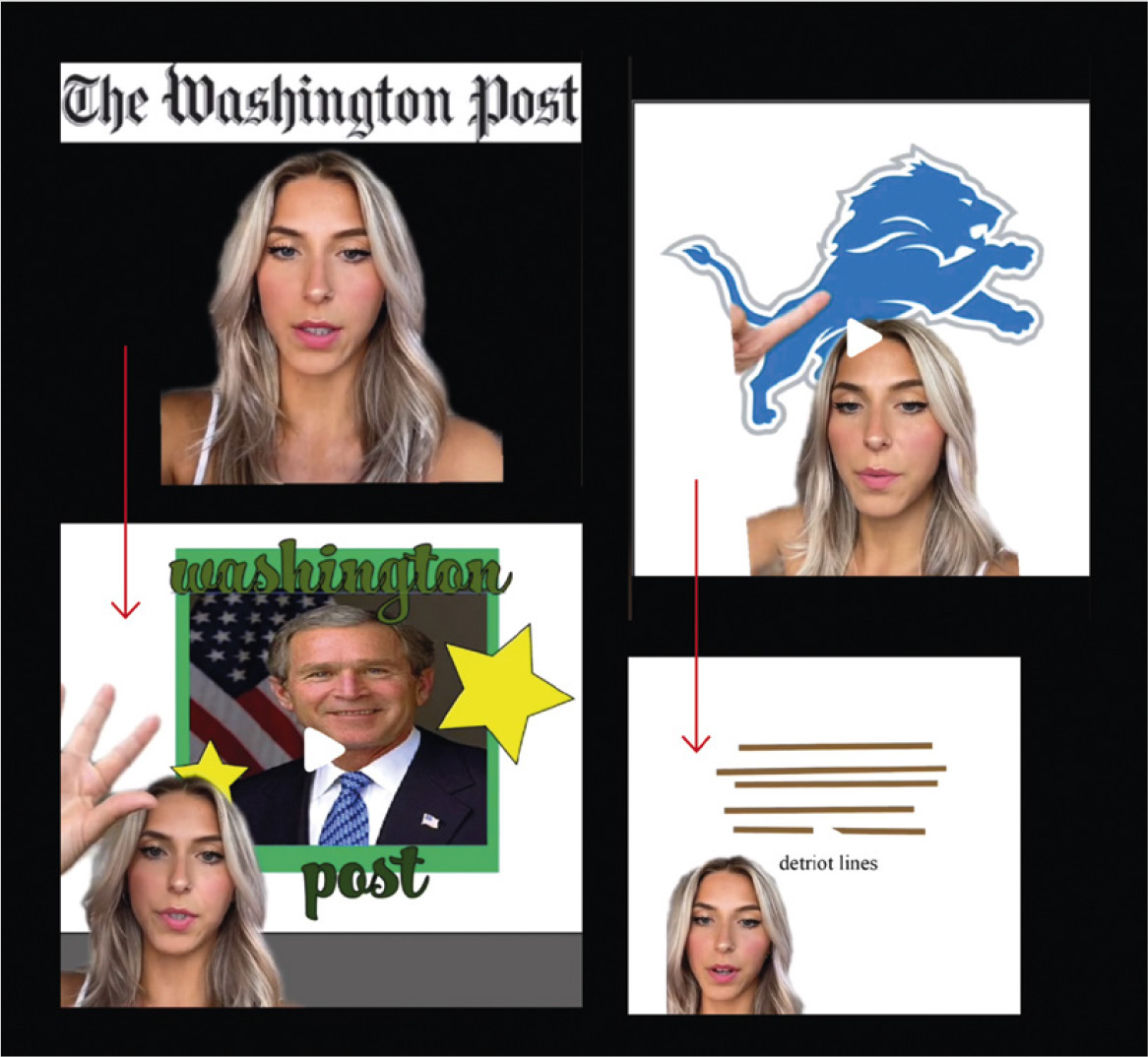
In 2021, TikToker Emily Zugay posted her unsolicited redesigns of iconic brand logos from major companies like Starbucks, Tinder, Adobe, Apple, Amazon and McDonald’s. Her so-called new and improved logos were deliberately amateurish, as if created using a mashup of Microsoft Paint and WordArt. Her redesign for the newspaper The Washington Post featured a photograph of former US President George W. Bush in reference to his middle name, Washington. Her redesign for the department store Target replaced its famous red bullseye with an image of a deer, inspired by hunting. Zugay’s monotone critiques of major brand logos quickly went viral, amassing millions of views. Brands could have ignored her videos or even reprimanded her; after all, official logos are proprietary and highly valued brand assets. But they didn’t. Instead, many of these major brands adopted her satirical logos as their official TikTok profile pictures, showcasing a willingness to be in on the joke. Even TikTok itself changed its profile image from its classic music note logo to Zugay’s wonky pink and teal analog clock emblazoned with “Tik Tock.” Soon, brands were angling to have their logos roasted and capitalize on the refresh, entering into influencer partnerships with Zugay. Gushers, a fruit snack brand, paid Zugay to create a new Gushers logo and film several TikTok ads. The Detroit Lions, a football team, printed Zugay’s redesigned logo on T-shirts and invited her to the stadium, where she posted a video from the gift shop promoting sales of the T-shirt.
Spontaneous responses to influencer content (example 2)
Take Revlon’s TikTok response video featuring Heather Rae El Moussa, reality television star of Netflix’s Selling Sunset. El Moussa posted a TikTok video of her own, cheekily reprimanding her husband (also a reality television star) after finding a Revlon lip liner in his old Sprinter van. She says, “Revlon? I don’t wear Revlon.” In the caption, she admitted, “I knew it was his sister’s from when she borrowed our sprinter but always make them sweat ladies”—but that didn’t stop Revlon from capitalizing. The brand seamlessly stitched El Moussa’s TikTok video with one of their own to make it seem like the moment she throws the lip liner, a woman at Revlon headquarters catches it and says, “Thanks girl, I’ve been looking for that.” El Moussa’s original video earned 500K+ likes and nearly 600 comments. The Revlon brand response? Nearly 860K+ likes and over 10K comments.

TikTok
Demonstrating community-specific insider knowledge (example 3)
This IYKYK approach to chronically online influencer marketing means that influencers can be found in the most unexpected places—even looking eerily similar to a celebrity. In 2024, viral “celebrity lookalike contests” popped up in parks and public venues: A Timothée Chalamet doppelganger was crowned in New York City, a Jeremy Allen White doppelganger was crowned in Chicago, a Paul Mescal doppelganger was crowned in Dublin, and a Harry Styles doppelganger was crowned in London. These lookalike contest winners weren’t crafted by public relations teams or social media managers; they were organic, fan-inspired personas catapulted into the limelight among a few deeply invested fans, and brands tapped into this trend. The luggage brand Away posted a coordinated Instagram campaign featuring several of the celebrity lookalike winners with the caption, “Even lookalikes travel with the real thing.” By leveraging the faces of these everyday people turned pseudo-celebrities, Away gave a nod and a wink to fans in the know. The comments section was quickly flooded with positive support, including one follower who said, “This is marketing for the chronically online and I am obsessed with it.” Away is exemplary at embracing the granularity of a niche trend in digital culture to maintain relevance without sacrificing authenticity.
The Emily Zugay example highlights a pivotal shift in chronically online influencer marketing. Brands that successfully engage this audience often do so by embracing internet humor and participating in platform-specific trends, thereby demonstrating cultural fluency and relatability. By collaborating with influencers like Zugay who possess an innate understanding of digital culture, brands can foster authentic connections with consumers. This approach not only enhances brand visibility but also cultivates a sense of community and shared experience among consumers.
Chronically online influencer marketing is not rehearsed; it’s responsive
The speed of digital culture demands that brands pivot from preplanned campaigns to responsive interactions. Traditional influencer marketing often involves detailed scripts, professional-grade photoshoots and meticulously planned product placements. In contrast, chronically online influencer marketing thrives on immediacy, adaptability and responsiveness, as Revlon demonstrated with a funny response video to an influencer post (example 2).
What made Revlon’s social media post particularly successful was its balance of edginess and brand consistency. Revlon capitalized on an unofficial, unpaid partnership with an influencer by responding to a story already unfolding in the digital zeitgeist.
This approach works because it mirrors the way chronically online consumers interact with influencer content. They don’t wait for polished narratives—they dive into the comments section and reply by remixing content. For brands, successful chronically online influencer marketing is less about perfecting the message and more about perfecting the response. The strength of a good chronically online influencer marketing strategy is knowing to say no to hopping on trends but going all in on a response when it is a yes.
Chronically online influencer marketing is not normative; it’s niche
In the lexicon of the internet, the acronym IYKYK (if you know, you know) has become slang for a shared joke or insider knowledge. In chronically online influencer marketing, consumers evaluate brands on their ability to “get it.” This means shifting away from mass appeal toward hyper-specialized, niche corners of the internet, like the celebrity lookalike contests in example 3 in Box 1. Is every-one going to understand chronically online influencer marketing? No. But the people who do will be deeply connected and invested in the brand.
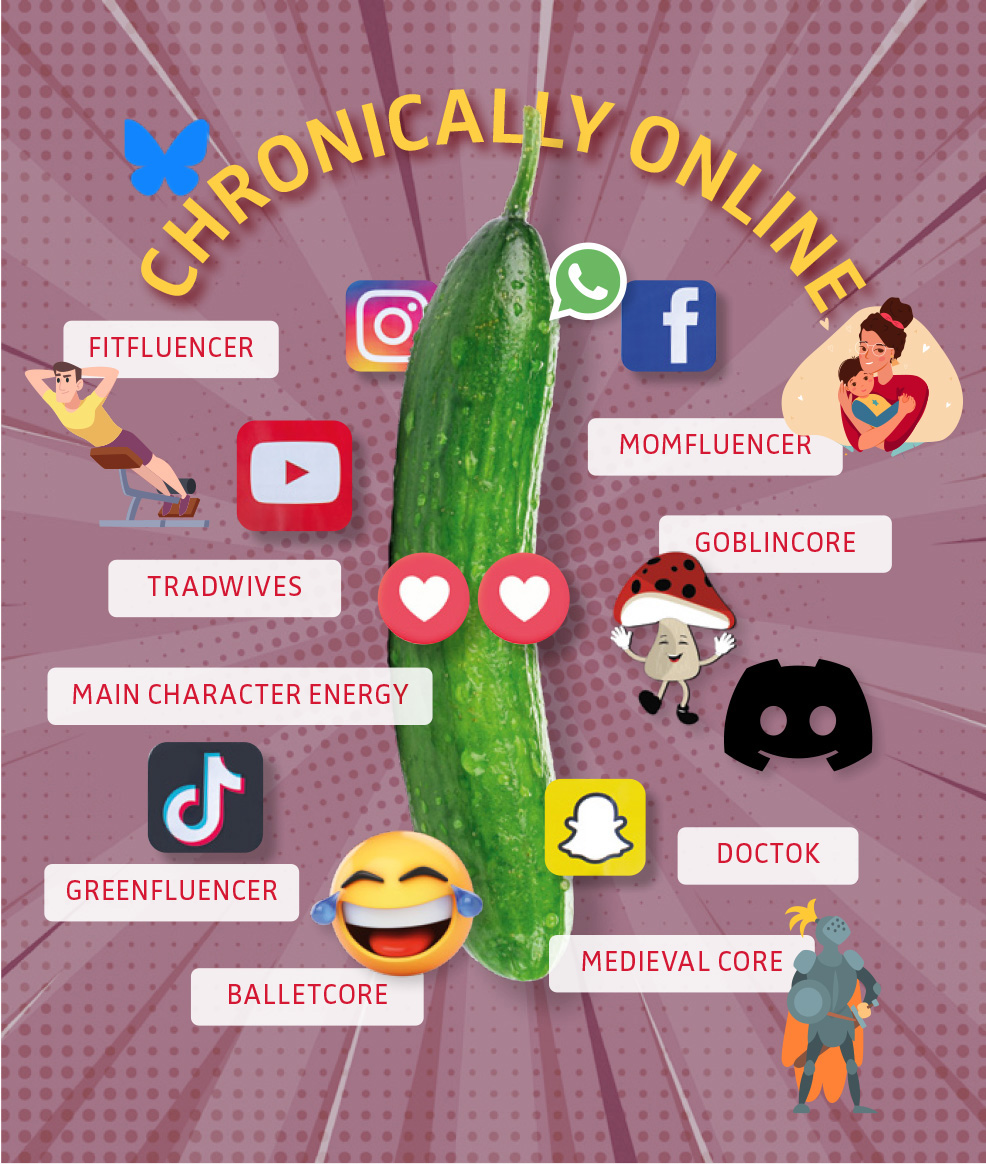
An early focus of influencer marketing was on broad lifestyle categories such as beauty, fashion and travel, but influencers themselves have spearheaded the shift away from normativity by catering to highly specific niche audience segments— vegan bodybuilders, retro tech collectors, minimalist travel vloggers, mushroom foragers. The suffix “-fluencer” turns almost any word into a niche: momfluencer, grieffluencer, petfluencer, fitflu-encer, kidfluencer, edfluencer, techfluencer, docflu-encer, greenfluencer and more. Similar granularity is evident in the rise of “cores”—aesthetic subcultures like cottagecore, goblincore, cluttercore and fairycore that reflect highly specific sensibilities (see image above).
istockphoto
Potential pitfalls of chronically online influencer marketing
While engaging with chronically online consumers through influencer marketing strategies offers immense potential, it comes with risks. First, chronically online influencer marketing risks alienating offline audiences. That is, over-indexing on digital culture may exclude consumers who are less immersed in online trends. Second, brands that adopt chronically online influencer marketing risk becoming a “pick me” brand. “Pick me” is internet slang for someone who obsessively—and detrimentally—seeks approval and validation from others. The same could be said of brands. Trying too hard to be relevant can lead to clout-chasing behaviors that alienate audiences. Third, brands must consider legal and ethical concerns. Jumping on trends without proper vetting can result in copyright issues or backlash.
The human behind each influencer in chronically online influencer marketing
Chronically online consumers are quick to manufacture and dramatize stories about individuals, transforming social media into a modern tabloid. Everyday individuals can become the “main character of the day”—a lightning rod for digital culture. For some, this exposure is an opportunity to launch a career. For others, it is an unwelcome and overwhelming experience for which they are entirely unprepared. The power dynamics between big-brands-with-big-money and everyday-people-turned-flash-influencers mean that the individuals behind the screen can easily be taken advantage of or become fodder for a brand’s attempt to enter the conversation. This often occurs with little consideration for the potential long-term impacts on the person.
By respecting the humanity and individuality of influencers, brands can foster authentic relationships that benefit both parties. This approach requires intentionality, ethical consideration and a commitment to acknowledging the complexities of digital culture and the vulnerabilities of those who inhabit it.
“The speed of digital culture demands that brands pivot from preplanned campaigns to responsive interactions.”
The future of influencer marketing and the creator economy
The days of the “Big Influencer” aren’t entirely over, but they’re certainly no longer the whole story. New interactive features and refined algorithms on social media platforms have revolutionized the mechanics of influence by prioritizing entertainment over individual creators. Influence is spread across a breadth of individuals, many of whom are recognized not by their names but by their content. For instance, consumers may refer to popular influencers by their content categories rather than their given names or even their social media handles. Collectively, “the cucumber guy” (TikTok: @ logagm; Instagram: @logansfewd), “the girl who makes fashion dupes out of trash” (Instagram: @ angelicahacks; TikTok: @angelicahicks) and “the woman who does ‘that friend’ skits” (TikTok: @ sabrina.cinoman.brier; Instagram: @sabrinabrier) have over 11 million followers across TikTok and Instagram. Yet their actual names are not widely known, and even their social media names vary across platforms. They are recognized for their content, not their personal identities. This shift challenges brands to rethink influencer marketing. “Name-brand” influencers are increasingly giving way to a model where embedding brands within pockets of digital culture may be more effective. These pockets are defined by shared humor, values and aesthetics, with influencers acting as conduits for content-driven cultural expression rather than traditional advertising partners.
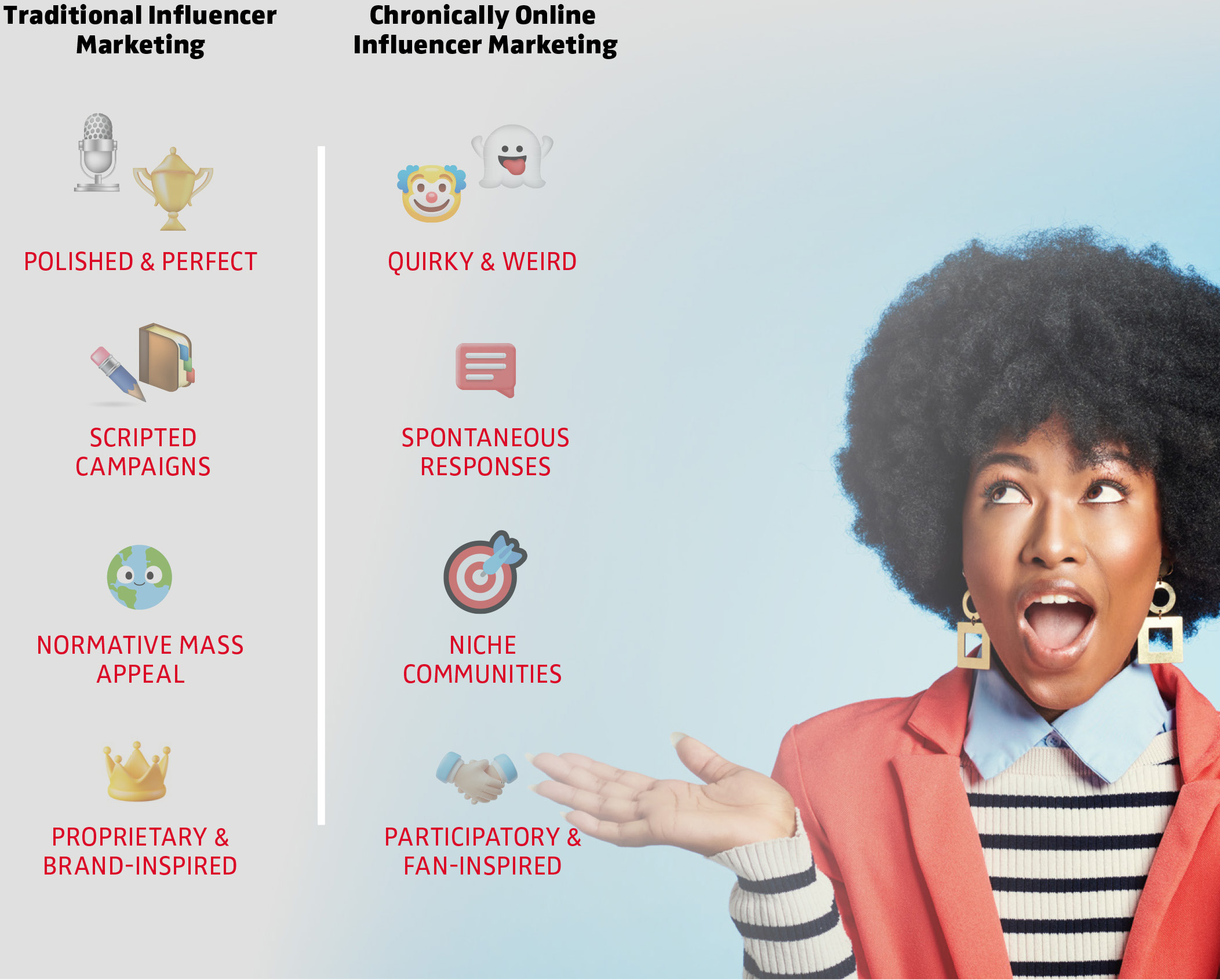
FIGURE 2
Traditional compared to chronically online influencer marketing
istockphoto; Delmaine Donson, get tyimages
Chronically online influencer marketing marks a broadening of how brands approach influencer marketing—an antidote to overly polished campaigns and a return to authenticity. It requires brands to be bold, authentic and adaptable, leveraging the quirks of digital culture to foster genuine connections. In a world where everyone is a potential content creator, the brands that succeed won’t just follow trends—they’ll pioneer new ways of connecting through them.