
1. Introduction
Additive manufacturing (AM), commonly known as 3D printing, has rapidly transformed various industries by enabling the production of complex geometries and customized parts with unprecedented design freedom and reduced lead times [1]. As AM transitions from rapid prototyping to full-scale production of functional components, especially in demanding sectors, ensuring dimensional accuracy and consistent quality becomes paramount [2], [3]. Precise dimensional control is crucial for the proper assembly and functionality of multi-part systems and for ensuring that manufactured parts meet strict engineering tolerances [4].
Despite its transformative potential, achieving and maintaining high-dimensional accuracy in AM, particularly with fused deposition modeling (FDM), remains a significant challenge [5], [6]. Factors such as process parameters, material properties, and inherent process characteristics can cause deviations from the intended CAD model [6]. Effective quality control and metrology methods are therefore essential for assessing and ensuring the reliability of 3D-printed parts [7], [8], [9]. Various types of complex artifacts have been proposed to evaluate accuracy [10].
The primary purpose of a test artifact is to quantitatively evaluate the performance of a system [11]. Geometric performance artifacts can be specifically designed to evaluate dimensional and geometric accuracy, repeatability, or minimum feature size [12]. The advantage of using artifacts is that different systems can produce the same test object and be directly compared. Properly designed artifacts can also test the limitations of a system. In addition, artifacts can be used to validate performance among system users and provide suppliers with a way to showcase improvements in additive technologies [13].
Measurement artifacts for AM have been designed in various forms, incorporating geometric features such as thin walls, holes, overhangs, and fine structures. Their purpose is to enable the evaluation of accuracy, surface roughness, and overall process performance with relatively simple measurements [10], [14], [15]. Each artifact is designed for a specific application and can be measured using a coordinate measuring machine (CMM) [16]. AM accuracy is strongly affected by build orientation, and complex geometric shapes, such as overhangs, remain problematic [17], [18], [19].
AM artifact design follows a “design-for-metrology” approach, which emphasizes the need to consider the measurement process at the design stage and optimize artifact properties for accurate and efficient inspection [20]. Comparisons of CMM and optical 3D scanners show significant differences in both accuracy and data characteristics. Several studies have therefore used CMM as a benchmark for optical measurement results — for example, Rebaioli and Fassi emphasized the need for standardized evaluation procedures based on CMM, while Stojkić et al. demonstrated that although CMM provides the highest accuracy, 3D scanners can achieve acceptable deviations for most industrial applications [12], [21]. Similarly, Cuesta et al. compared CMM with several 3D scanners and confirmed that differences between measured data depend on geometric features and their dimensions [22].
CMMs offer higher accuracy in point-based measurements but require more time and physical contact with the surface. In contrast, optical 3D scanners allow fast and non-contact measurement of the entire surface, although with slightly lower accuracy, especially for reflective or dark surfaces. The choice between these methods depends on the required precision and the characteristics of the measured part [23], [24].
2. Subject & methods
The study methodology outlines the experimental procedures carried out to achieve the objectives, which included artifact design and fabrication, FDM process parameters, and detailed protocols for both CMM and 3D scanning measurements. This comprehensive approach ensured a robust comparison between the two artifact designs and the two metrology techniques, allowing for a thorough analysis of their capabilities in assessing dimensional accuracy. The study also aimed to validate the utility of the custom artifact in streamlining quality control processes while maintaining metrological integrity.
A. Design of measurement artifacts
The methodology included a measurement artifact compliant with ISO/ASTM 52902 (Fig. 1). This artifact contained multiple geometric features to evaluate the accuracy of 3D printing. Linear features assessed accuracy in the X and Y planes, while a circular feature evaluated diameter accuracy and roundness. Angular accuracy was verified using grooved angular features. To evaluate accuracy along the Z-axis, the artifact included a vertical linear feature and a hemispherical feature to measure spatial accuracy.
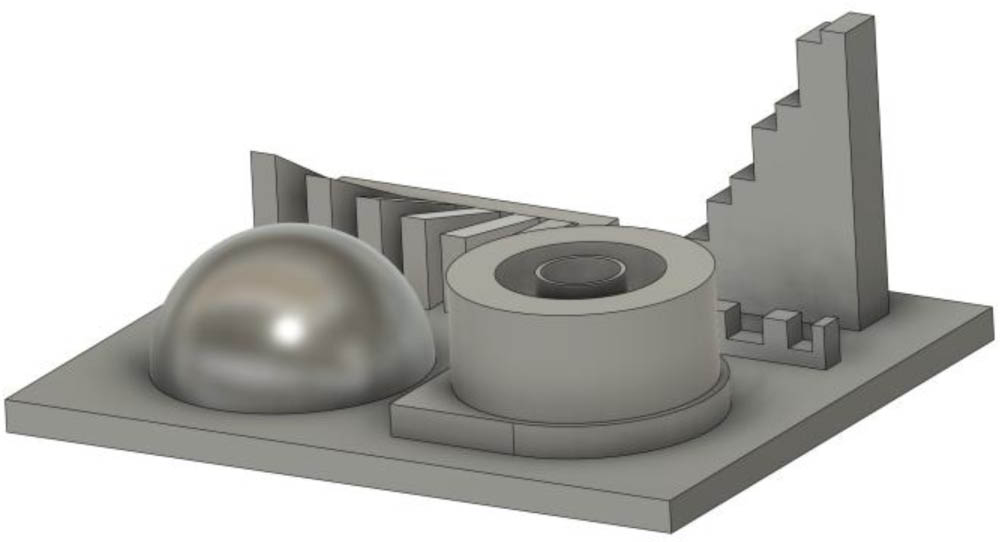
Fig. 1.
CAD representation of an artifact compliant with ISO/ASTM 52902.
In addition, a custom-designed measurement artifact was developed (Fig. 2), incorporating a wide range of geometric features typical for 3D printing. It included linear features to measure dimensions in the X, Y, and Z planes, circular features and cylinders for roundness and diameter checks, spherical and hemispherical shapes to verify spatial accuracy, and inclined and stepped surfaces to assess angular accuracy and parallelism. The design reduced material consumption by approximately 35% and production time by 40 %, while preserving all measurement functionalities.
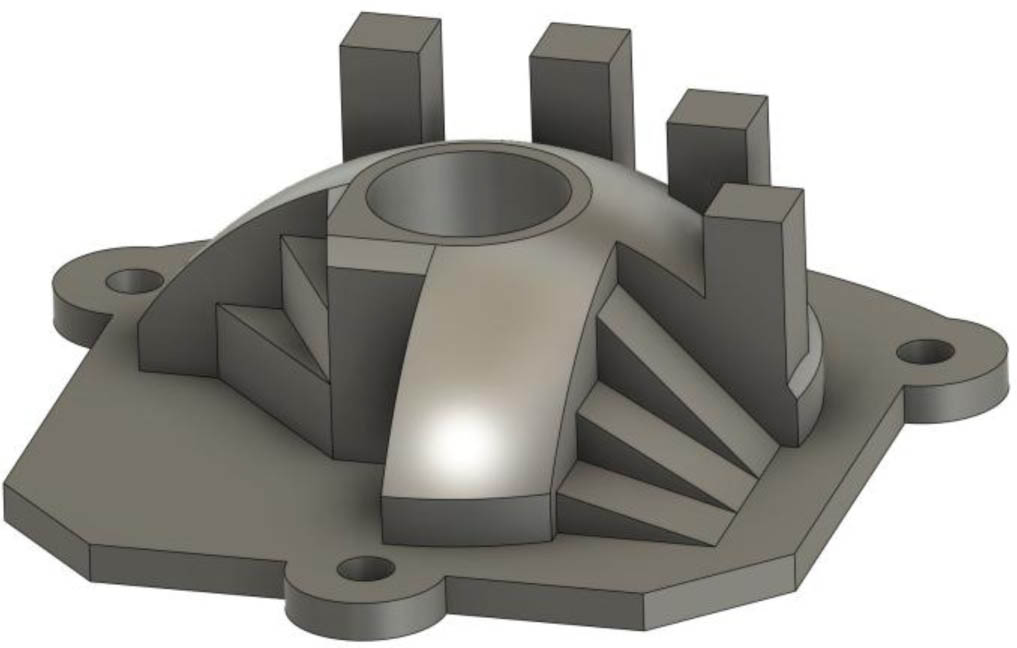
Fig. 2.
CAD representation of the designed artifact.
B. Additive manufacturing of artifacts
Both artifacts were fabricated using a commercial FDM 3D printer with polyactic acid (PLA) filament under controlled parameter settings (Table 1), ensuring consistency. Printing was performed on a Bambu Lab X1 Carbon machine equipped with a carbon-reinforced frame, active vibration compensation, and optical layer monitoring. A 0.4 mm nozzle and 0.1 mm layer height were used consistently for both artifacts.
C. Dimensional control
After printing, dimensional inspection was performed using CMM (Fig. 3) and 3D optical scanning. In the experiment, three artifacts of each shape variant were used to ensure the reproducibility of the results and to minimize the influence of individual deviations between specimens. Multiple measurements were performed on each artifact, resulting in a total of 157 recorded values. This number includes all measurements conducted across the individual artifacts and shape groups. Measurement uncertainty was carefully managed to ensure the reliability of both contact and non-contact measurements. For the CMM (Zeiss Eclipse), the primary sources of uncertainty included probe calibration, thermal drift, and mechanical vibration. The ruby probe was calibrated before each measurement session using a certified 25 mm reference sphere, and the machine was allowed to thermally stabilize for at least 30 minutes before operation. Measurements were performed under controlled conditions (22 ± 0.5 °C, 45 % relative humidity) on a vibration-damped table, minimizing environmental effects on dimensional accuracy. According to the manufacturer’s specification, the CMM’s volumetric accuracy is ±(1.8 + L/300) µm, where L is the measured length in millimeters, which corresponds well with the required precision of this study. A 3 mm ruby probe was used, and surfaces were scanned using raster strategies. Circular and cylindrical features were analyzed using a low-pass spline filter (UPR = 50), following ISO 16610 recommendations.
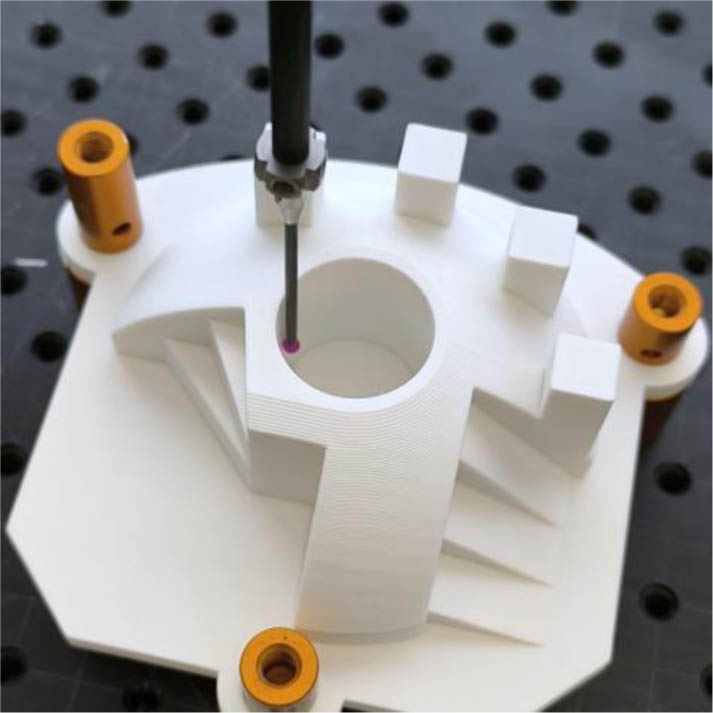
Fig. 3.
CMM measuring the designed artifact.
Measured parameters on artifacts
ISO artifact: cylinder diameter D = 47 mm, cylinder cylindricity in 3 sections, circularity of individual sections, spherical surface profile, Z distance between artifact blocks, X distance between square segments (5, 7.5, and 10 mm).
Designed artifact: diameter of the central cylindrical hole D = 25 mm, cylindricity of the hole in 3 sections, circularity of individual sections, Z distances between blocks, angles between elements in the XY plane, profile and shape of the spherical surface (including max and min values), block distances in the X and Y axes.
The artifacts were also measured using a Zeiss T-SCAN Hawk 2 optical scanner with ±30 µm accuracy and 0.05 m resolution. The scanner was operated within the recommended working distance of 150 – 400 m to maintain nominal accuracy and resolution. To minimize uncertainty related to surface reflectivity and alignment, all scans were performed under stable lighting and temperature conditions. Each dataset was aligned and cross-checked against CAD reference geometry to detect potential systematic deviations. This procedure helped to reduce both random and systematic components of measurement uncertainty, improving the comparability between the optical and contact measurement methods.
Scanned data were processed in Zeiss Inspect Optical 3D. Applying the same spline filtering ensured full comparability between CMM and 3D scanning results.
The measured values were compared with CAD nominal values, and deviation maps were generated to visualize local inaccuracies. This dual-method approach enabled a comprehensive evaluation of dimensional accuracy, highlighting differences between contact and non-contact techniques.
3. Results
This section presents the experimental findings derived from the comparative evaluation of the two artifacts. Dimensional deviations were analyzed along the X, Y, and Z axes for both the ISO/ASTM 52902-compliant artifact and the custom design. Statistical methods were applied to verify the significance of these deviations, with emphasis on the influence of measurement method and artifact design.
A. Dimensional deviations
Fig. 4 shows a graph of the measured deviations from the nominal dimension when measured using a CMM. The vertical axis of the graph represents the deviation values in millimeters, while the horizontal axis shows the individual measurement axes (X, Y, Z). The results show that in all three axes, the designed artifact achieves higher deviation values than the ISO artifact. The largest differences are observed in the X and Y axes, where the difference in deviations between the artifacts is 0.015 mm. In the Z axis, the differences between the two artifacts are smaller, with deviation values at the level of 0.005 mm.
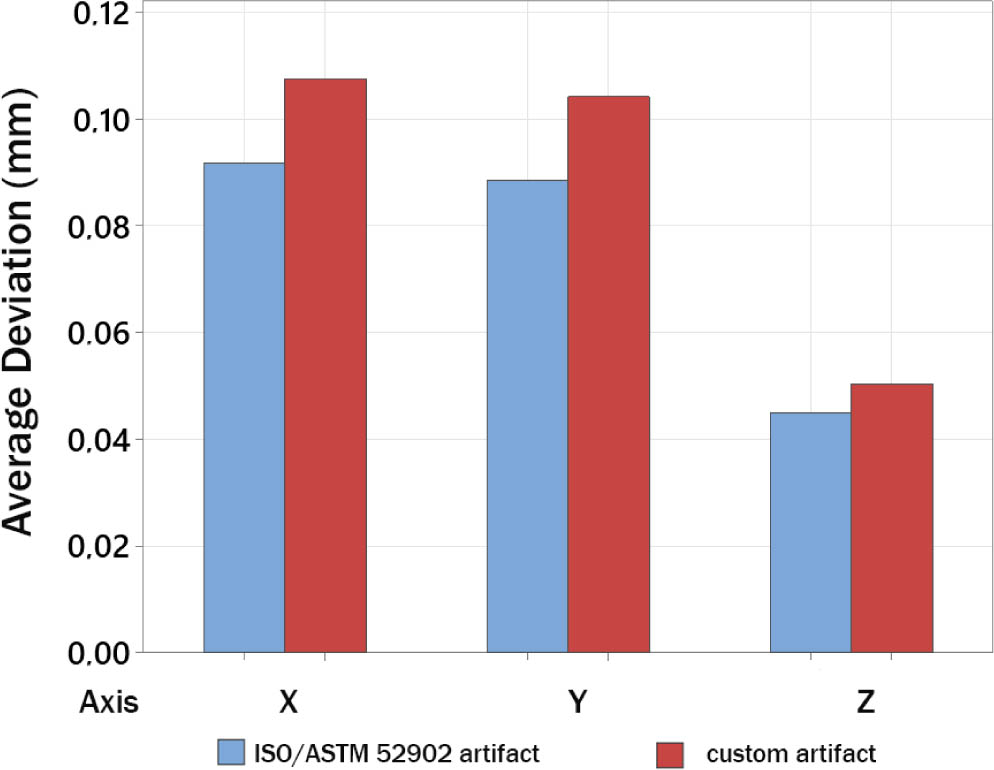
Fig. 4.
Deviations measured by CMM.
Comparison of artifacts in terms of deviations from nominal dimensions was also performed using 3D scanning. This alternative method offers a complementary view of the geometric accuracy of printed parts, enabling a comprehensive assessment of surface contours and volumetric deviations that may not be fully captured by point CMM measurements. However, it is important to note that while 3D scanning offers detailed surface analysis, it also introduces its own set of uncertainties related to surface reflectivity, feature resolution, and the calibration of the scanning device itself, which can lead to generally larger absolute deviation values compared to CMM measurements.
Fig. 5 shows a color map of the deviations between the CAD model and the data obtained by 3D scanning of the standardized test artifact ISO/ASTM 52902. Most surfaces, especially the base plate, show deviations in the range of ±0.05 mm, as indicated by the green color, representing a very good match with the nominal geometry. Larger differences appear especially on the curved surfaces of the sphere segment and the cylinder, where the deviations range up to ±0.15 mm. These results indicate that simple shapes with planar surfaces are reproduced with higher accuracy, while more complex geometries are more prone to larger deviations due to the layering in the FDM process.
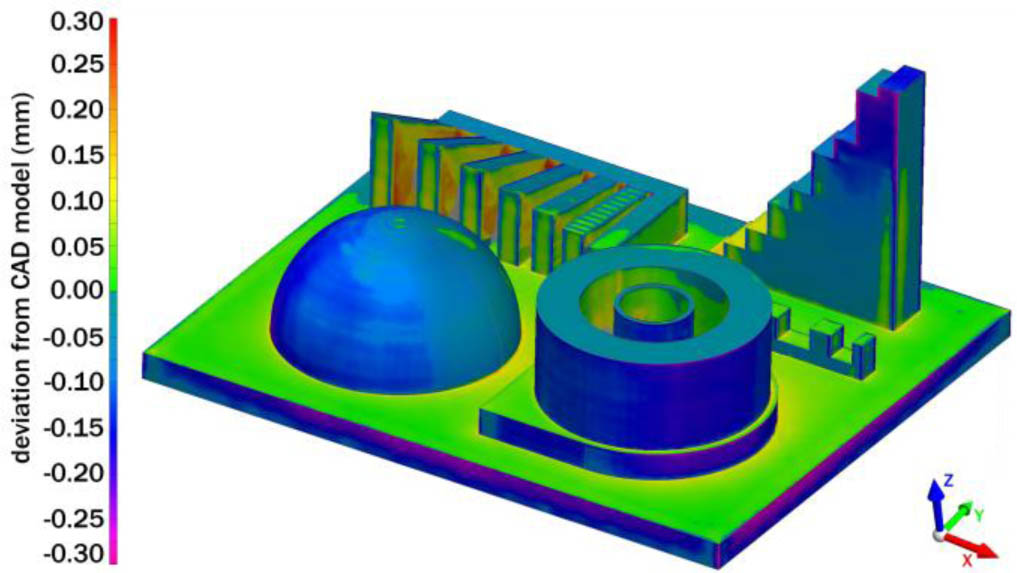
Fig. 5.
Comparison of 3D scanned data with CAD model (ISO/ASTM 52902 artifact).
Similarly, the custom-designed artifact also showed these trends, confirming that complex geometries remain a challenge for FDM processes regardless of the specific artifact design. In this case, the distribution of deviations is more uneven compared to the standard artifact. Negative deviations, indicated by blue to purple, are visible primarily on the bottom surface of the part, which in this case is not functional; therefore, its deviations do not have a significant impact on the overall usability of the part. On functional surfaces, such as cylindrical holes and inclined ribs, deviations are predominantly within ±0.20 mm (Fig. 6). Positive deviations are also present in places on edges and protrusions, reflecting a combination of systematic process errors and local inaccuracies caused by geometry and orientation during printing.
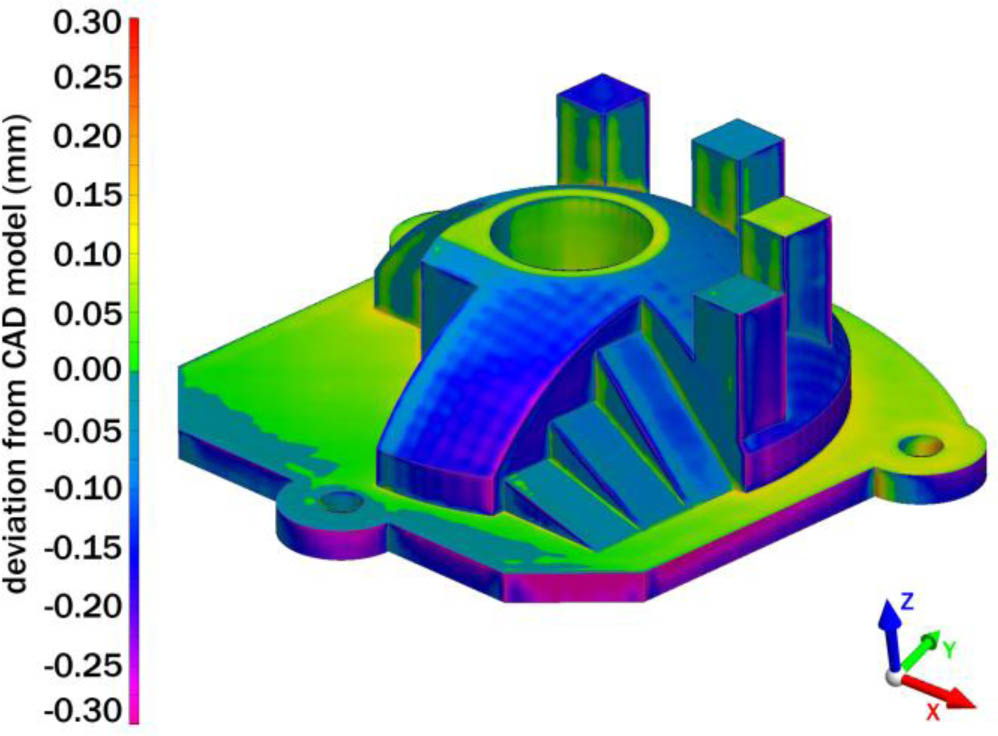
Fig. 6.
Comparison of 3D scanned data with CAD model (custom artifact).
Fig. 7 shows the average values of deviations from the CAD model obtained by 3D scanning and reveals similar trends to those of CMM measurements, but with generally larger absolute deviation values in both types of artifacts. In the X-axis, the deviation difference is 0.013 mm, for the Y-axis, it is 0.007 mm, and a significant difference occurs in the Z-axis, where the deviation difference is 0.03 mm. 3D scanning generally shows larger absolute deviations than CMM, even for the same artifacts, highlighting the influence of the measurement methodology itself. 3D scanning captures surface data that may include surface roughness, localized imperfections, or varying levels of mesh triangulation, which can lead to a different assessment of “deviation” compared to point CMM measurements that may sample specific, more idealized features.
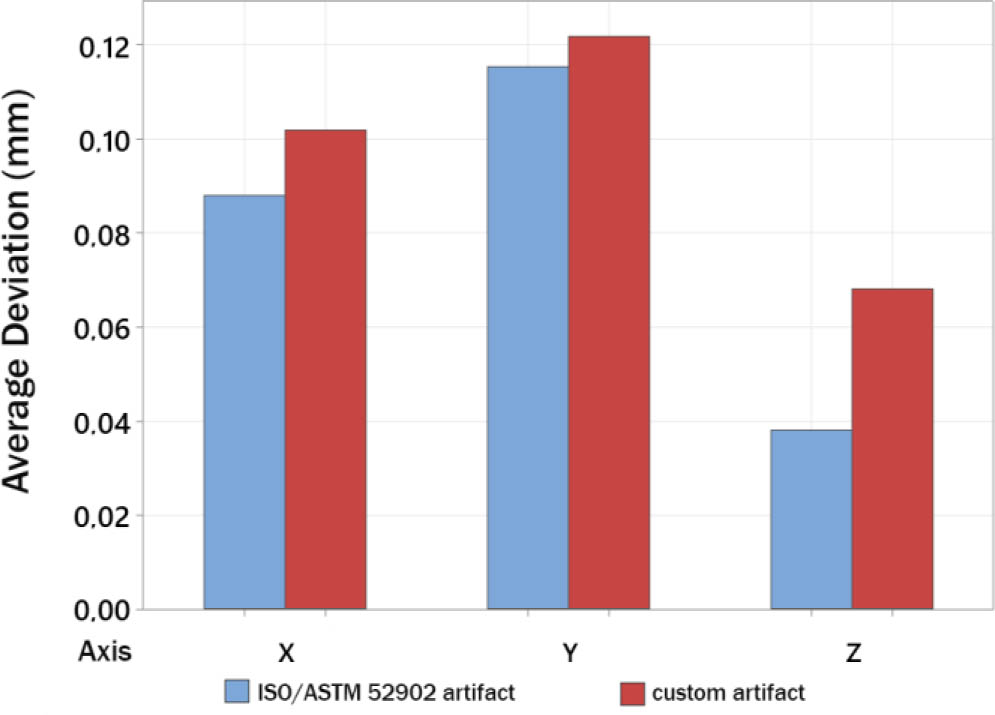
Fig. 7.
Deviations measured by 3D scanning.
B. Statistical analysis outcomes
Graphical observations indicate that, although the custom artifact exhibits predominantly larger deviations, these quantities require careful assessment using statistical tests to determine their practical significance and whether they fall within acceptable tolerance limits for specific applications. A two-way analysis of variance (ANOVA) was used to determine whether these observed differences are statistically significant or are simply due to random variation. This statistical examination will help confirm whether the custom artifact can indeed serve as a viable and reliable alternative to standardized solutions in various technical and industrial contexts.
The results showed that the measurement factor had no statistically significant effect on the deviation values, with the difference between CMM and 3D scanning being only approximately 0.005 mm (p = 0.323). The artifact factor was also insignificant, although the deviation values were approximately 0.009 mm lower for the ISO artifact compared to the designed artifact (p = 0.092). The interaction between the two factors was negligible, with a change of only 0.001 mm (p = 0.811). The evaluation also included an analysis of the accuracy of the model. The coefficient of determination value reached a very low level (R2 = 2.41 %, R2adj = 0.50 %), indicating that the included factors explain only a negligible part of the variability of the measured deviations. The predictive ability of the model was practically zero (R2pred = 0.00 %). Although the two-way ANOVA model yielded a low coefficient of determination (R2 = 2.41 %) and negligible predictive capability (R2pred = 0.00 %), this does not invalidate the statistical analysis. In metrology-oriented studies, ANOVA is primarily used to assess the significance of factors rather than to build predictive models. The low R2 values indicate that most of the variation in the measured data is due to random experimental noise or uncontrolled minor influences, rather than systematic effects captured by the tested factors. From a practical standpoint, this means that while the analyzed factors have only a limited impact on the dimensional deviations, the measurement system and process remain stable and not dominated by any single variable. These results confirm that the differences between the measurement methods or between the artifacts were not statistically significant, indicating that both artifacts show comparable results and can be interchanged during measurements without significantly affecting the accuracy of the obtained data.
C. Material and time efficiency
To demonstrate the practical impact of the proposed approach, a cost–benefit analysis was conducted for a specific PLA material printing application using the given process parameters and material.
The comparison was based on a batch of 30 artifacts fabricated under identical conditions (Fig. 8). The ISO/ASTM 52902 artifact required a total production time of 198 hours and 2913.9 g of material, resulting in an overall production cost of approximately 182.7 €. In contrast, the custom-designed artifact required only 122.5 hours and 1822.5 g of material, with a total cost of about 114 €. This corresponds to a 38 % reduction in manufacturing time, a 37 % reduction in material consumption, and an overall cost saving of approximately 38 % for the evaluated PLA application. These results confirm that the proposed artifact design can significantly improve efficiency and reduce quality-control costs without compromising metrological capability.
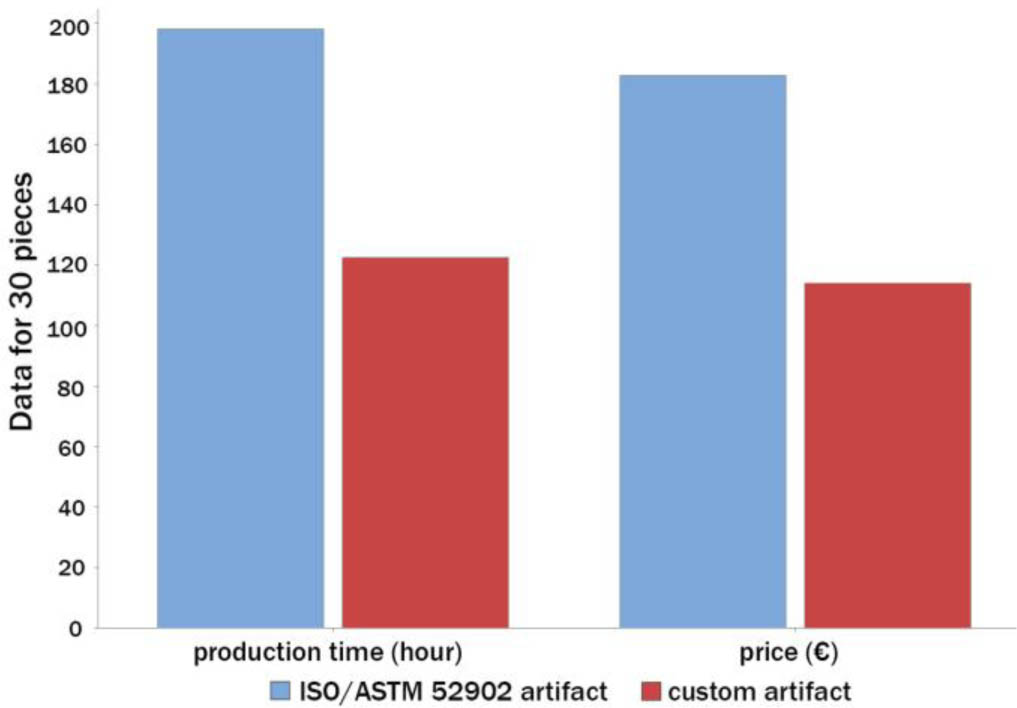
Fig. 8.
Comparison of total production time and cost for 30 artifacts.
4. Discussion
The dimensional accuracy of FDM parts is affected by factors such as manufacturing orientation [25]. For example, layer thickness and “bridge” can play a significant role in height accuracy [26]. The presence of greater Z-axis variation is a known characteristic of FDM, resulting from the layering process [27] and phenomena such as thermal contraction. Differences in the way metrology systems capture this full-surface data can make these effects more pronounced in 3D scanning.
The study findings indicate that the standardized artifact conforming to ISO/ASTM 52902 and the customized design provided comparable data regarding the dimensional accuracy of FDM 3D printing using PLA material. Further analysis showed that the observed deviations were within acceptable tolerances for the specified FDM process, confirming the utility of the customized artifact for application-specific quality control. Although there were no statistically significant differences in the measured deviations between the two artifacts, their designs offered distinct advantages. The ISO-based artifact allowed for standardized and reproducible evaluations across laboratories, while the custom artifact provided increased flexibility and the ability to adapt to specific measurement requirements.
The observations suggest a potential anisotropy in the manufacturing process or measurement methodology, which requires further investigation to determine the underlying causes of the differential accuracy along orthogonal axes. Furthermore, the consistent pattern of higher inherent artifact bias for the X and Y axes compared to the Z axis suggests a direction-dependent effect on dimensional accuracy, which could be related to material flow characteristics during FDM or post-processing effects. A smaller bias along the Z axis could indicate greater stability in layer height control or reduced susceptibility to thermal gradients along the manufacturing direction, thus differentiating it from planar axes [28].
Using a custom artifact brings several benefits. First and foremost, it reduces material consumption and waste, as the design can be tailored to use less input material while maintaining the required functionality. Another benefit is potentially faster measurement. The optimized shape and configuration of the custom artifact enable more efficient scanning by a CMM, thereby reducing measurement time and ultimately the overall inspection process time. In addition, the designed artifact can be specifically tailored to the needs of a particular application or manufacturing environment, which increases its added value in quality control. In such a case, the artifact becomes not just a universal tool but part of a targeted metrological control strategy. From a practical perspective, these findings suggest that a custom artifact can not only replace the standardized ISO artifact but can also provide cost savings, increased flexibility, and improved efficiency of measurement processes in an industrial manufacturing environment.
5. Conclusion
This study experimentally compared a standardized ISO/ASTM 52902 artifact with a custom-designed artifact for evaluating FDM dimensional accuracy using CMM and 3D scanning. The results confirmed that there were no statistically significant differences between methods and artifacts. Although deviations were slightly higher for the custom artifact, they were negligible in practice and did not affect overall accuracy.
These findings validate the custom artifact as a reliable alternative to standardized artifacts in assessing dimensional accuracy. Its design offers practical advantages such as material savings, reduced inspection times, and adaptability for application-specific metrology. The study confirms that application-driven measurement artifacts can complement standardized solutions by striking a balance between metrological rigor and practical efficiency.
Future research could focus on automating the measurement of complex artifacts using CMMs, exploring methods to optimize the measurement program to reduce time without compromising accuracy, and investigating a broader range of AM technologies and materials.
Acknowledgment
This research was funded by the University of Žilina project: APVV-23-0366: Research of reference standards and measurement methods ensuring determination of the relationship of geometric specifications and qualitative indicators of 3D objects created by additive technologies; APVV-22-0328: Design of a methodology and its verification for measuring selected parameters of Ti implants in the manufacturing process.; VEGA 1/0722/25 Research on additive technologies with a focus on their application in the design and construction of cutting tools; 09I05-03-V02-00080 DigiDent (Research on the Digitalization of Dental Implant Components for the Creation of Personalized 3D Models for the Manufacturing Process)