
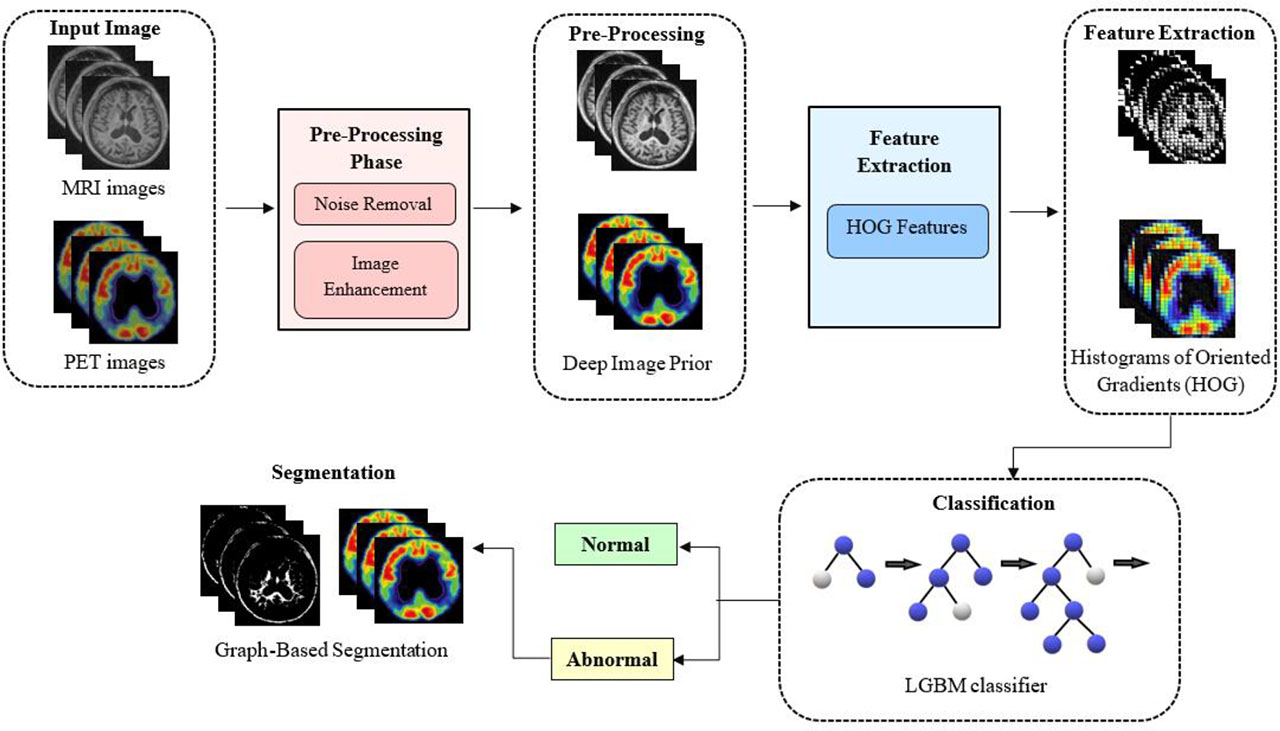
Fig. 1.
The proposed AD-HOLDER methodology.
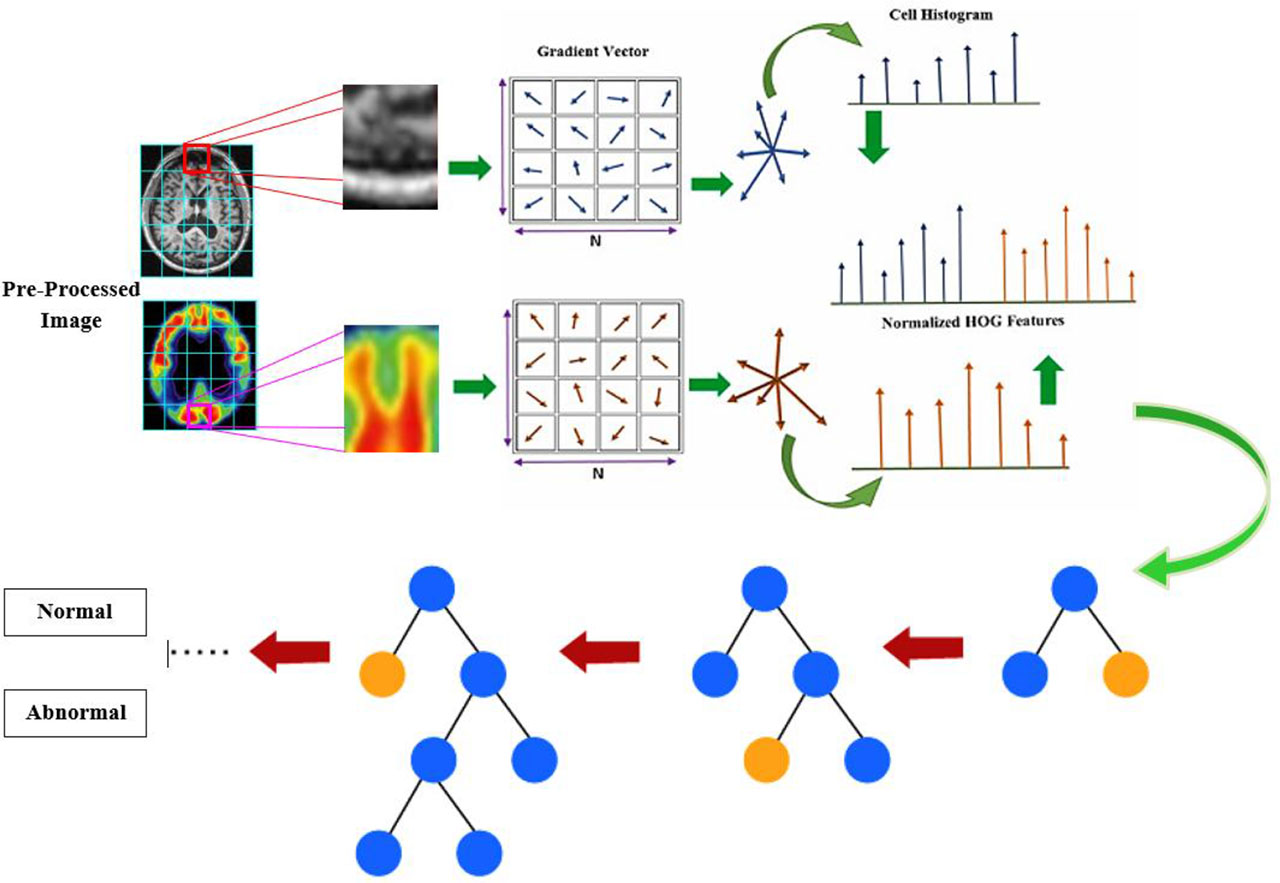
Fig. 2.
Architecture diagram of the HOG-based LGBM model.
Table 1.
Hyperparameter settings of the LGBM classifier.
| Hyper parameter | Value |
|---|---|
| Number of estimators | 500 |
| Learning rate | 0.05 |
| Maximum depth | 8 |
| Feature fraction | 0.8 |
| λL1(L1 reg) | 0.1 |
| λL2(L2 reg) | 0.2 |
| Cross-validation folds | 3 and 5 |
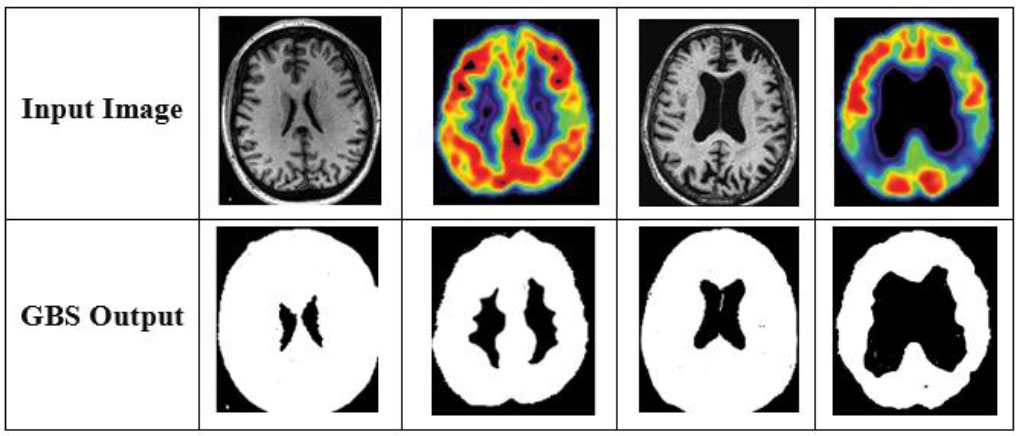
Fig. 3.
Visual examples of segmented regions.
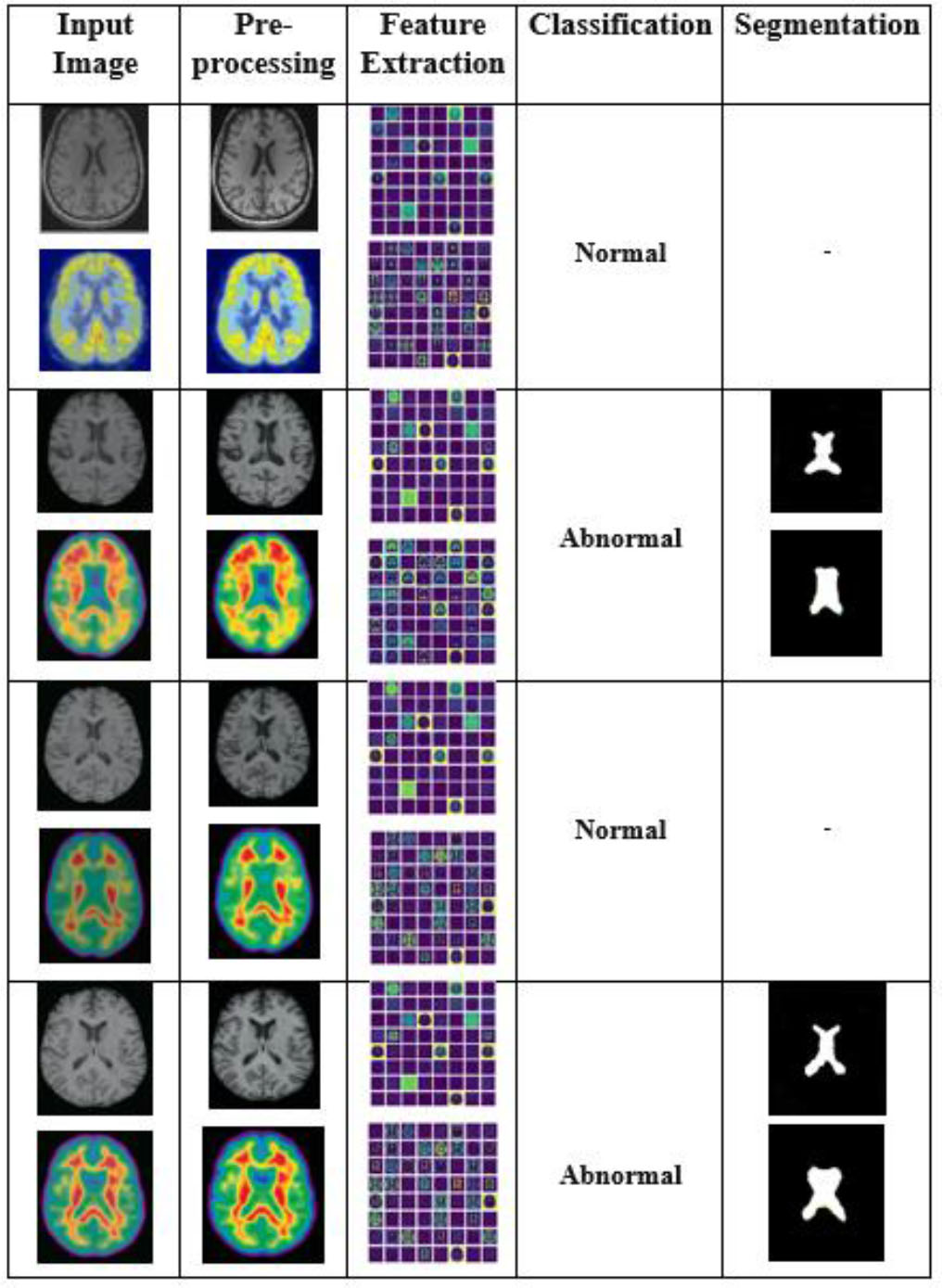
Fig. 4.
Experimental results of the proposed AD-HOLDER methodology.
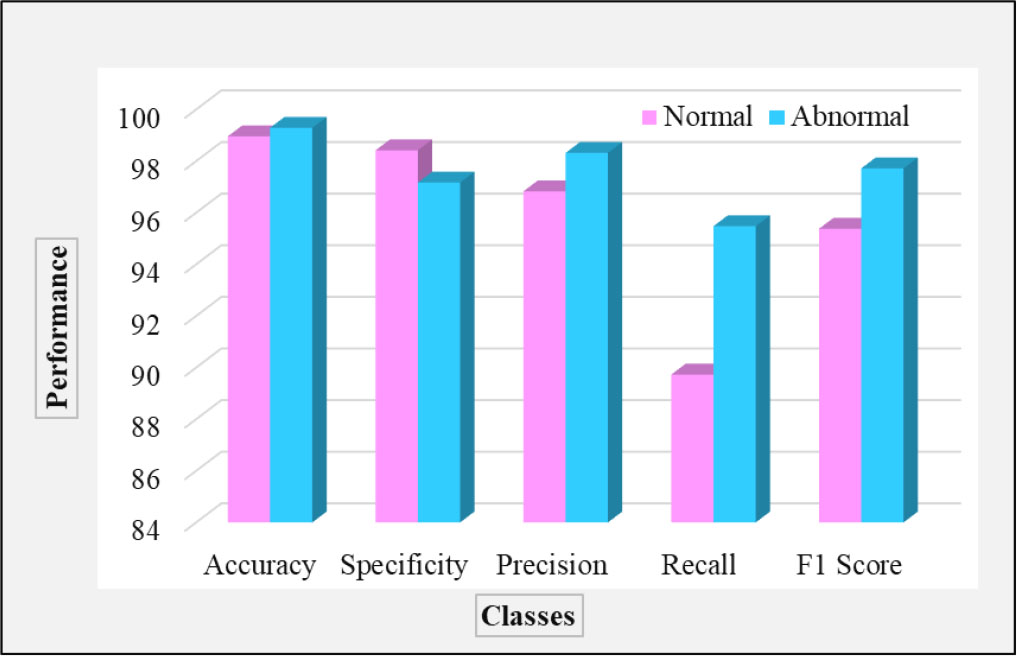
Fig. 5.
Performance analysis for two-class classification.
Table 2.
Efficiency assessment of the proposed AD-HOLDER model.
| Classes | ACC | SPE | PRE | REC | F1 |
|---|---|---|---|---|---|
| Normal | 98.96 | 98.42 | 96.83 | 89.73 | 95.38 |
| Abnormal | 99.29 | 97.17 | 98.32 | 95.48 | 97.72 |
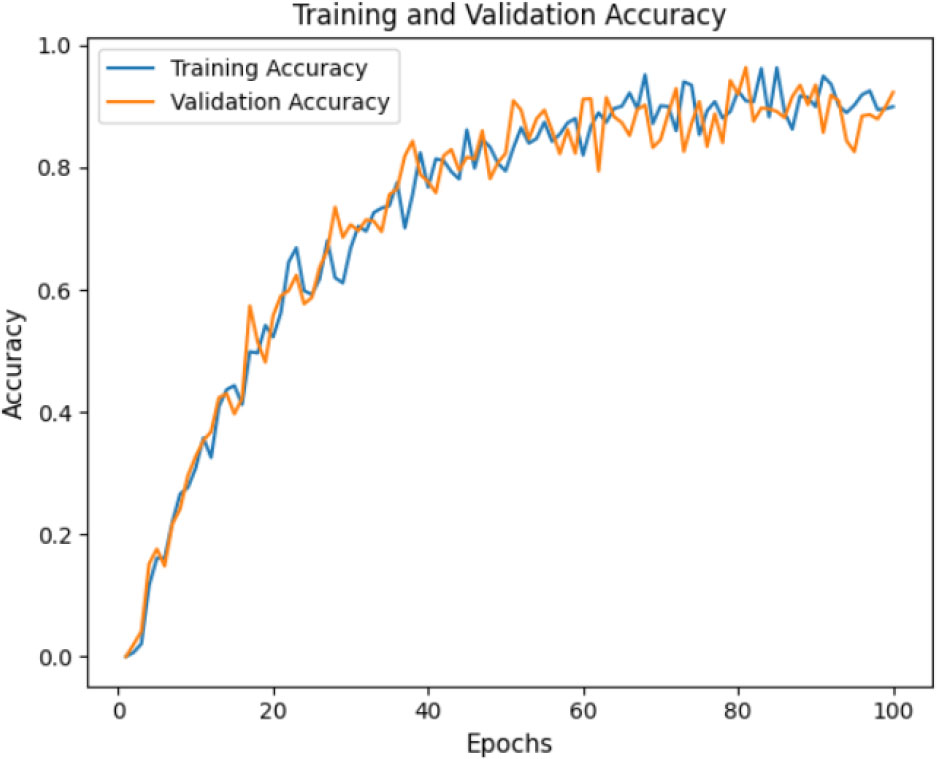
Fig. 6.
ACC curve for the proposed AD-HOLDER model.
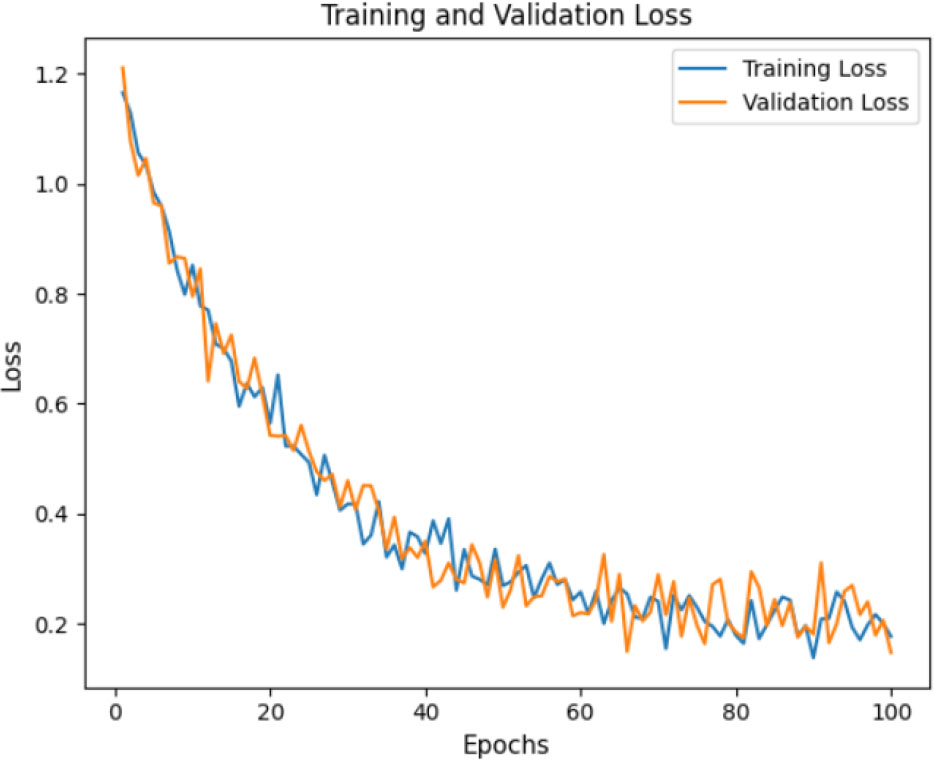
Fig. 7.
Loss curve for the proposed AD-HOLDER model.
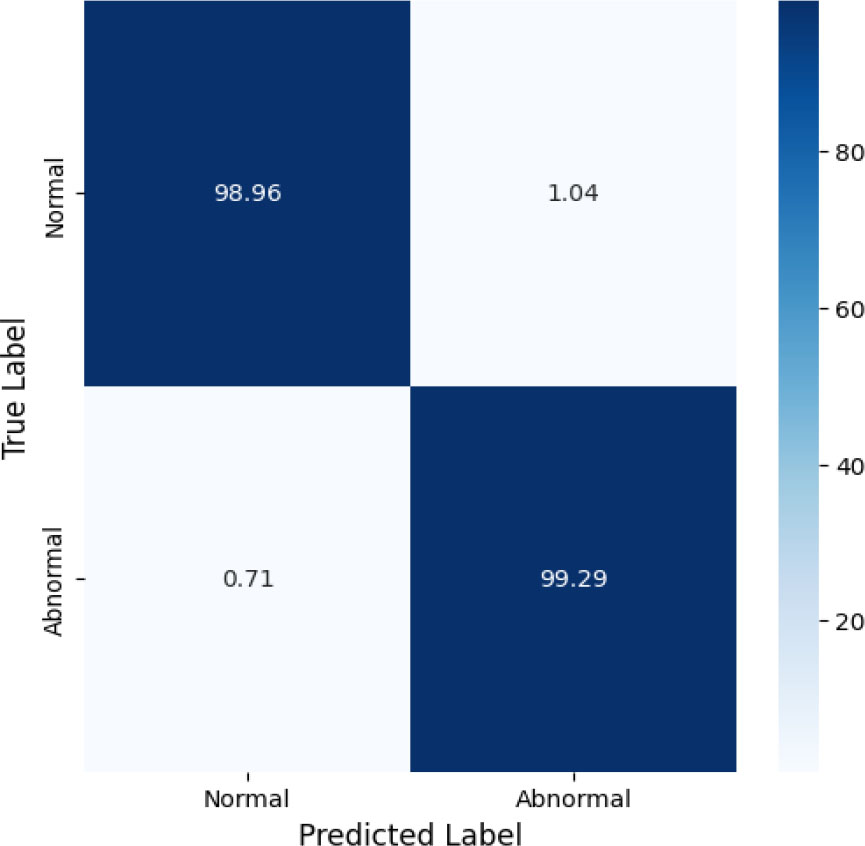
Fig. 8.
CM for two-class classification.
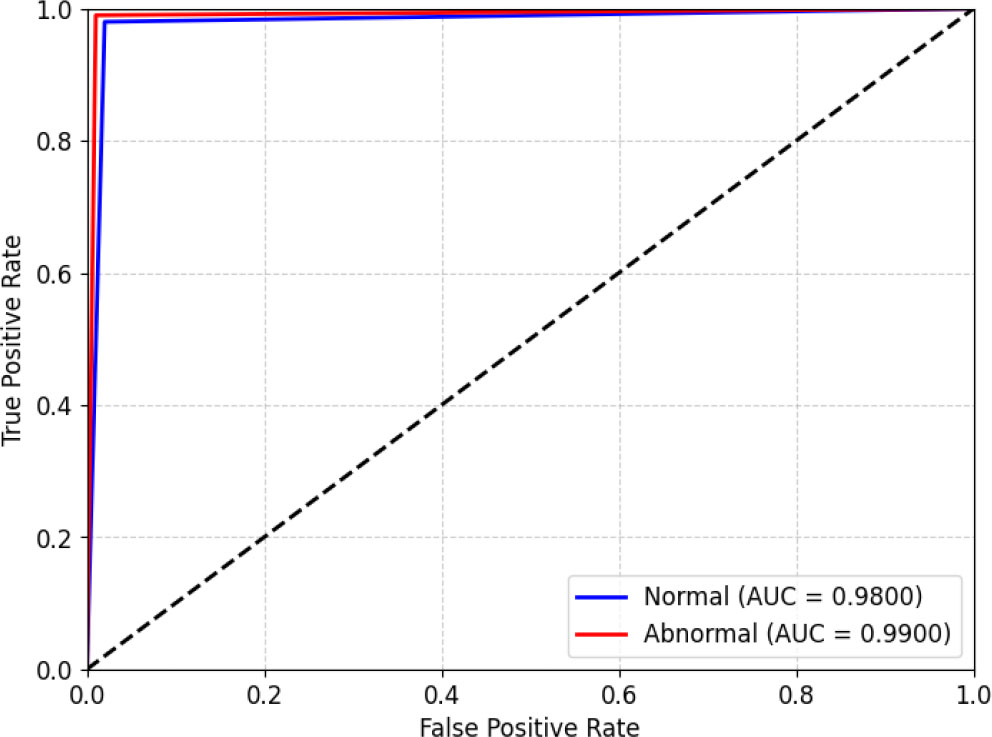
Fig. 9.
ROC curve of the proposed AD-HOLDER classification model.
Table 3.
Cross-validation results of the proposed AD-HOLDER model.
| Metric | 3-fold cross-validation [%] | 5-fold cross-validation [%] |
|---|---|---|
| ACC | 98.27 | 98.59 |
| SPE | 96.80 | 96.14 |
| PRE | 96.17 | 96.73 |
| REC | 89.27 | 90.83 |
| F1 | 94.68 | 94.91 |
Table 4.
Quantitative comparison of denoising methods on MRI and PET images.
| Method | PSNR [dB] | SSIM |
|---|---|---|
| Median filter | 27.42 | 0.712 |
| Gaussian filter | 28.06 | 0.815 |
| Bilateral filter | 28.75 | 0.822 |
| NLM filter | 29.74 | 0.858 |
| DIP (proposed) | 31.82 | 0.917 |
Table 5.
Comparative analysis between traditional ML networks.
| Techniques | ACC | SPE | PRE | REC | F1 |
|---|---|---|---|---|---|
| KNN | 90.63 | 89.39 | 90.37 | 85.92 | 87.93 |
| CNN | 93.95 | 94.21 | 92.49 | 87.37 | 90.62 |
| Naive Bayes | 92.84 | 91.83 | 88.93 | 86.75 | 89.51 |
| Decision Tree | 93.92 | 93.72 | 94.93 | 88.23 | 92.73 |
| ViT | 96.38 | 92.63 | 94.26 | 90.18 | 95.29 |
| RF | 95.29 | 95.90 | 95.27 | 91.35 | 94.62 |
| LGBM | 99.12 | 97.79 | 97.57 | 92.60 | 96.55 |
Table 6.
Comparison of traditional segmentation algorithms [%].
| Methods | ACC | DI | IoU |
|---|---|---|---|
| U-net | 91.37 | 71.82 | 58.2 |
| V-net | 93.75 | 81.46 | 69.9 |
| Nested V-net | 95.01 | 84.28 | 72.9 |
| SegNet | 92.37 | 86.10 | 73.5 |
| GBS (ours) | 99.12 | 90.74 | 82.7 |
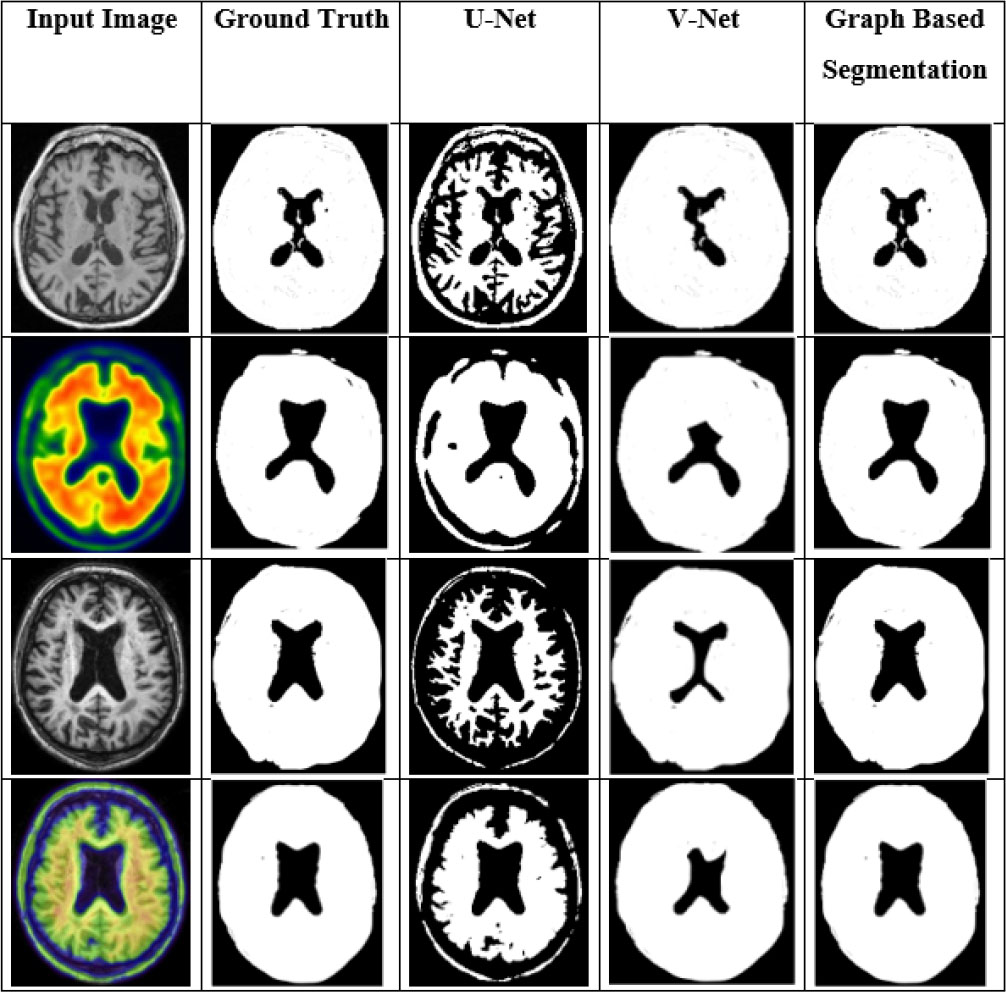
Fig. 10.
Comparison results of different segmentation techniques.
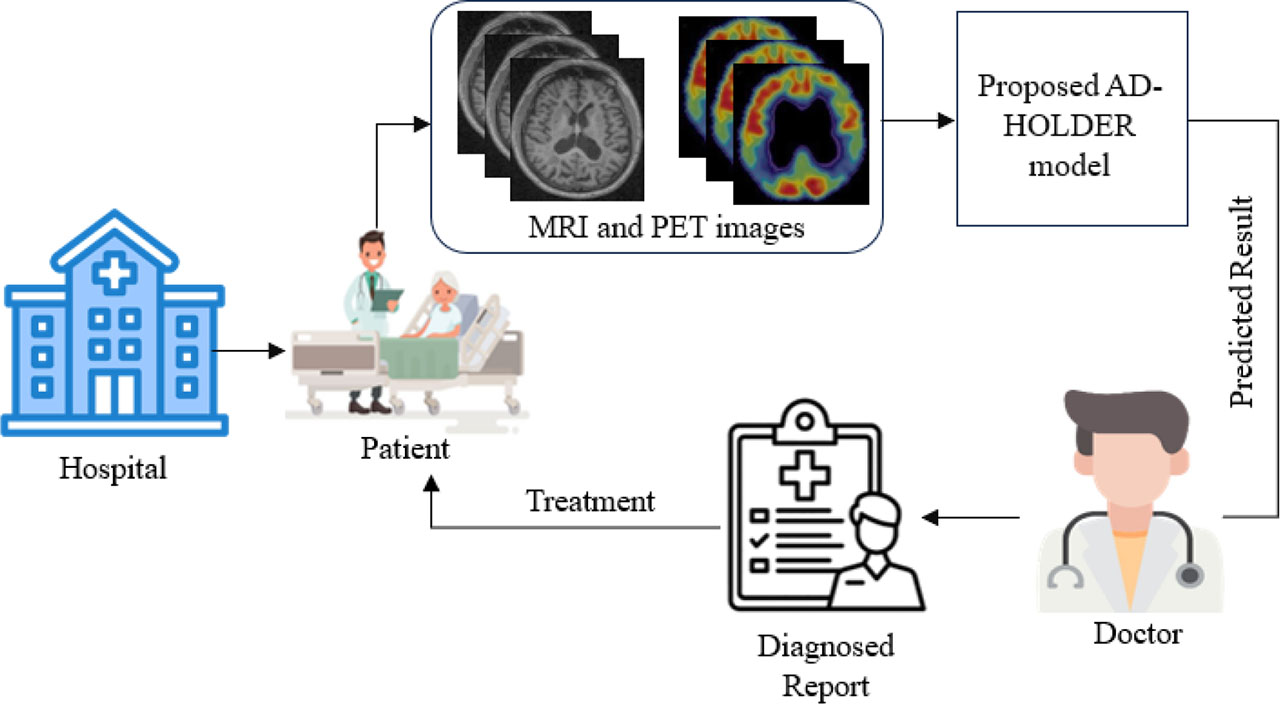
Fig. 11.
Real-time clinical setting of the proposed AD-HOLDER model.