
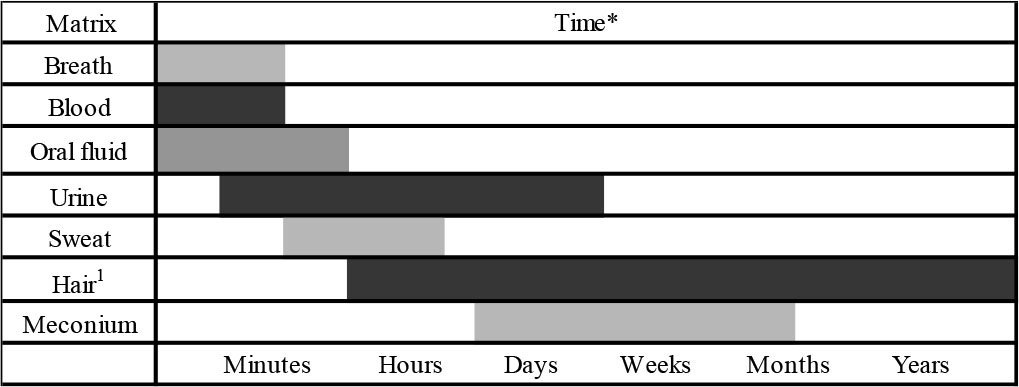
Fig. 1.
Window of detection for various matrices (Adapted from: Clinical Drug Testing in Primary Care 2012).
* Very broad estimations that also depend on the substance, the amount and frequency of use, and other factors.
1 7–10 days after use to the time required to grow the length of hair, but may be limited to 6 months of hair growth. However, most laboratories analyze an amount of hair equivalent to 3 months of growth.
Table 1.
Specificity and accuracy of DDT 5000 obtained in the DRUID project in Belgium.
| Substance | Belgium | |
|---|---|---|
| Specificity [%] | Accuracy [%] | |
| Cocaine | 96 | 93 |
| Opioids | 87 | 89 |
| Benzodiazepines | 99 | 99 |
| Cannabis | 99 | 91 |
| Amphetamine | 100 | 99 |
| Methamphetamine | 100 | 100 |
Table 2.
Specificity and accuracy of DDT 5000 obtained in the DRUID project in the Netherlands.
| Substance | Netherlands | |
|---|---|---|
| Specificity [%] | Accuracy [%] | |
| Cocaine | 97 | 95 |
| Opioids | 100 | 100 |
| Benzodiazepines | 90 | 84 |
| Cannabis | 100 | 100 |
| Amphetamine | 100 | 98 |
| Methamphetamine | 100 | 100 |
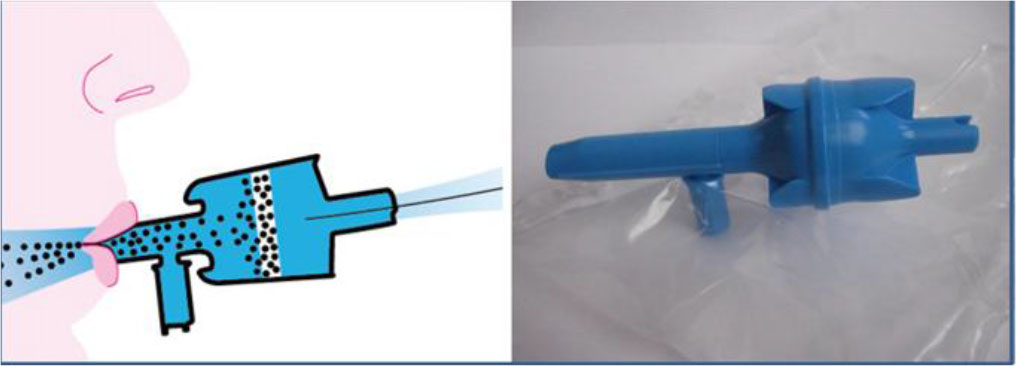
Fig. 2.
Sampling device for the determination of drugs from breath (Adapted from: Beck, Stephanson, Sandqvist, Franck [2012]).
Table 3.
Detection limits estimated by the manufacturer.
| Substance | Detection limits [ng/ml] |
|---|---|
| Amphetamine | 50 |
| Benzodiazepines | 15 |
| Cocaine | 20 |
| Methamphetamine | 35 |
| Methadone | 20 |
| Ketamine | 300 |
| Opiates | 20 |
| THC | 5/10/25* |
Table 4.
Uncertainty contributions from the calibration and characteristics of the balance for the starting standard.
| Parameter | Uncertainty | Unit |
|---|---|---|
| Calibration | 0.65∙10−3 | g |
| Drift | 0.20∙10−3 | g |
| Resolution | 0.17∙10−3 | g |
| umi | 0.70∙10−4 | g |
Table 5.
Uncertainty contributions from the calibration and characteristics of the balance for the solvent.
| Parameter | Uncertainty | Unit |
|---|---|---|
| Calibration | 0.85∙10−3 | g |
| Drift | 2.20∙10−3 | g |
| Resolution | 0.58∙10−3 | g |
| umsol | 2.43∙10−3 | g |
Table 6.
Calculated values of uncertainties and the corresponding sensitivity coefficients.
| Parameter | Uncertainty | Unit | Sensitivity coefficient | Unit |
|---|---|---|---|---|
| umi | 0.70∙10−4 | g | 2.00∙10−3 | ml−1 |
| umsol | 2.43∙10−3 | g | 1.56∙10−7 | ml−1 |
| uρw | 9.00∙10−7 | g/ml | 7.77∙10−5 | - |
| uB | 1.40∙10−7 | g/ml | - | - |
| uBr | 1.44∙10−7 | % | - | - |
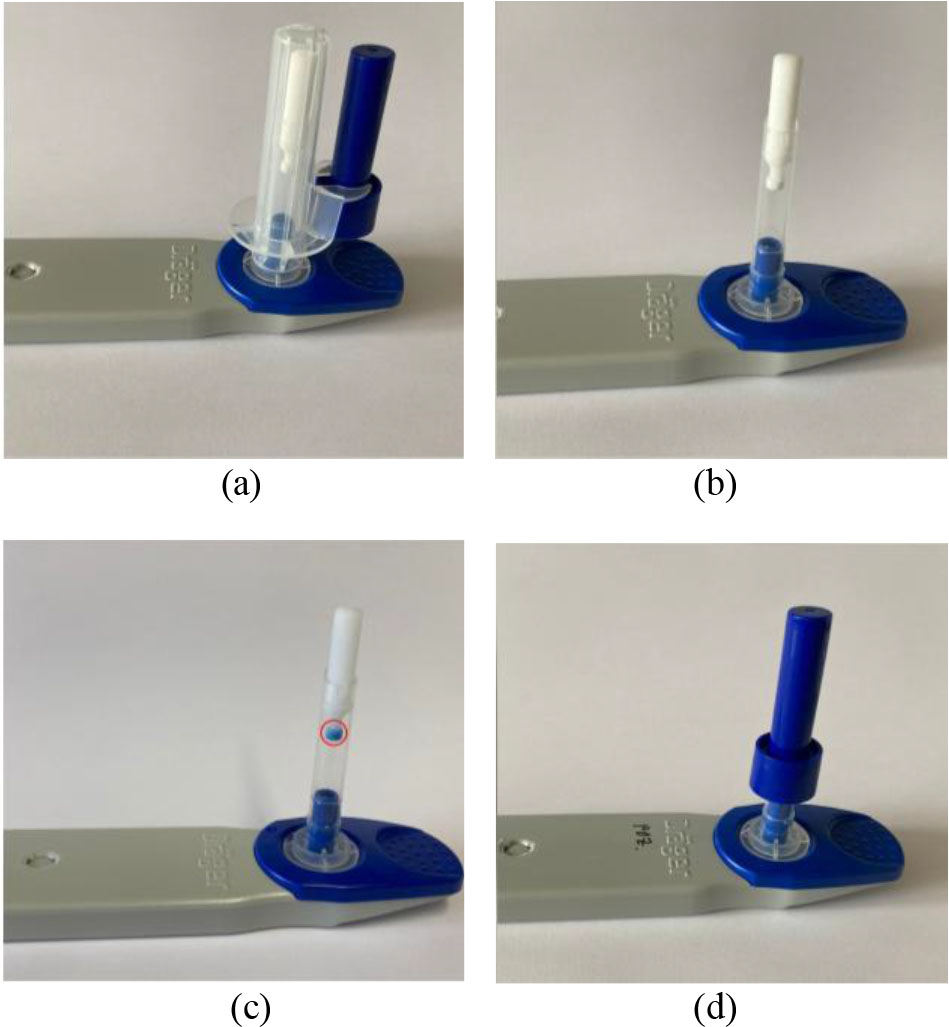
Fig. 3.
Sampling kit for DDT 5000; (a) New kit; (b) Kit prepared for use; (c) Kit with collected sample; (d) Kit after evaluation.
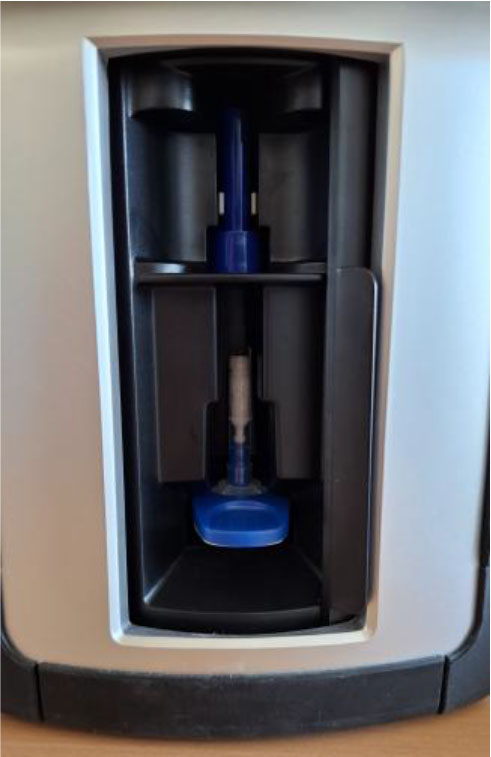
Fig. 4.
Collector inserted into the DDT 5000 device.
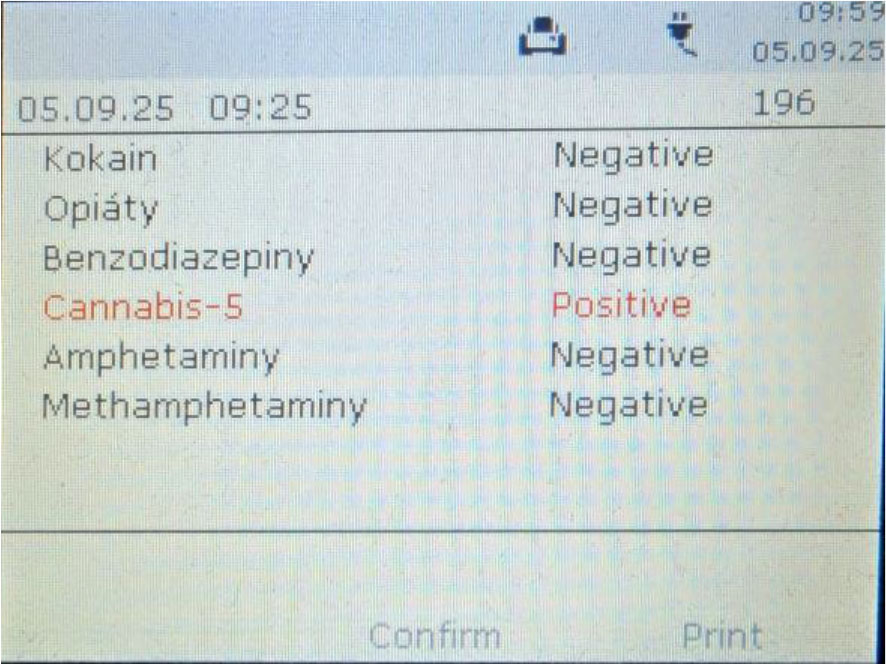
Fig. 5.
Results presentation by the DDT 5000 analyzer.
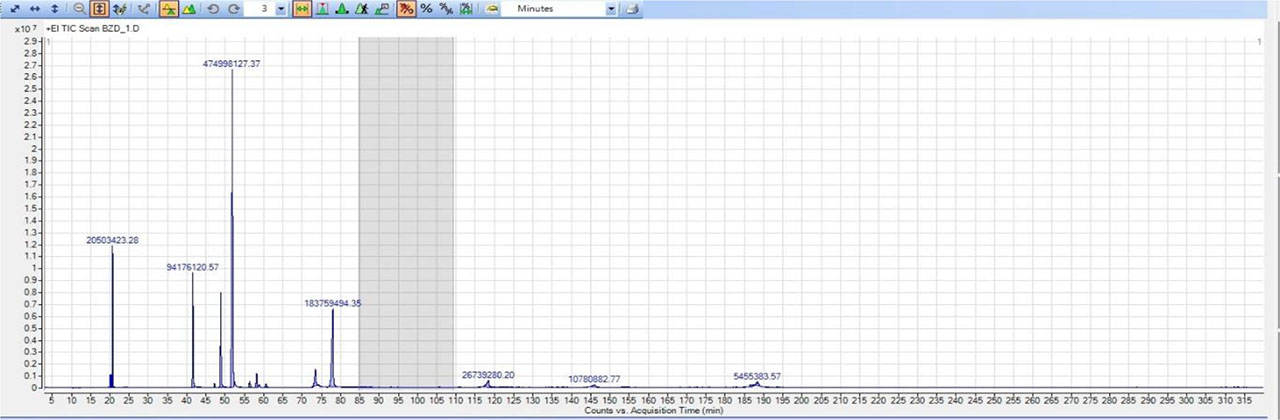
Fig. 6.
Result from analysis of benzodiazepines reference material.
Table 7.
Parameters of analytical method.
| Parameter | Value |
|---|---|
| Initial temperature | 80 °C |
| Initial hold time | 15 min |
| Ramp | 10 °C/min |
| Final temperature | 200 °C |
| Final hold time | 180 min |
| Carrier gas flow | 1.0 ml/s |
| Injection | 2 µl |
| Column | HP-5ms; 30 m; 0.32 mm; 25 µm |
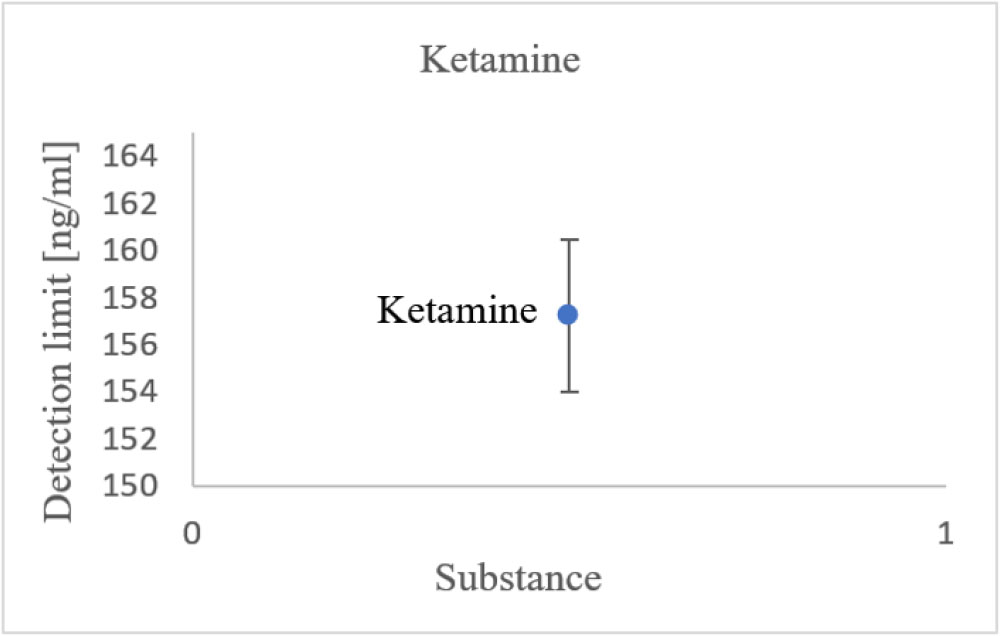
Fig. 7.
Estimated detection limit of ketamine.
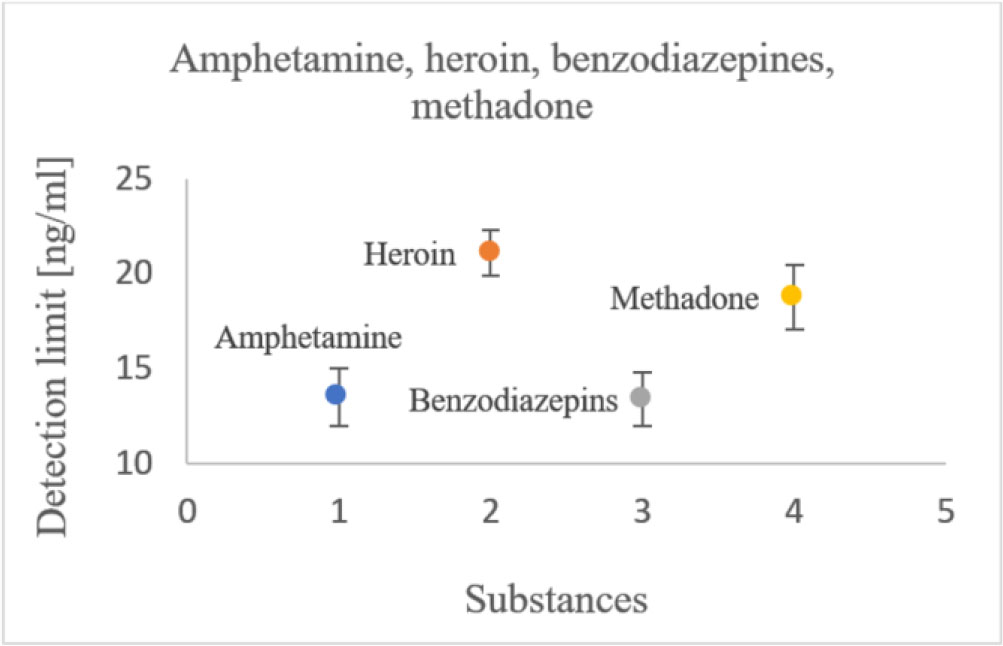
Fig. 8.
Estimated detection limits for amphetamine, heroin, benzodiazepines, methadone.
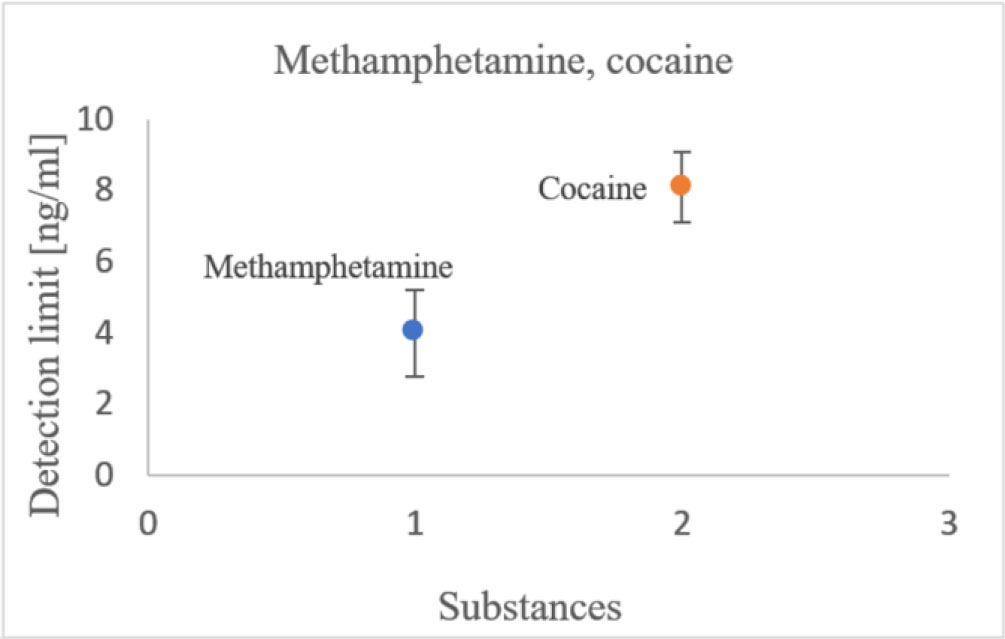
Fig. 9.
Estimated detection limits for methamphetamine and cocaine.