Have a personal or library account? Click to login
The Joint Calibration Method of Multi-line Laser and Tracking System based on Conjugate Gradient Iteration Cover

The Joint Calibration Method of Multi-line Laser and Tracking System based on Conjugate Gradient Iteration

Open Access
|Sep 2025

Figures & Tables

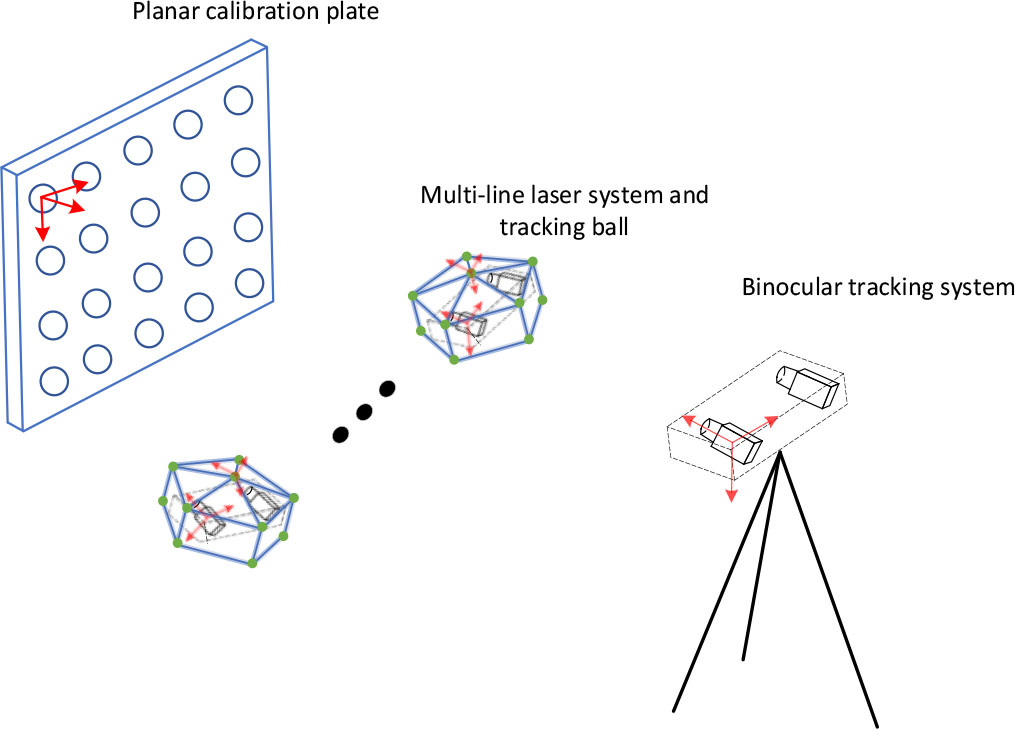
Fig. 1.

Traditional multi-line laser system and tracking ball joint calibration schematic diagram.
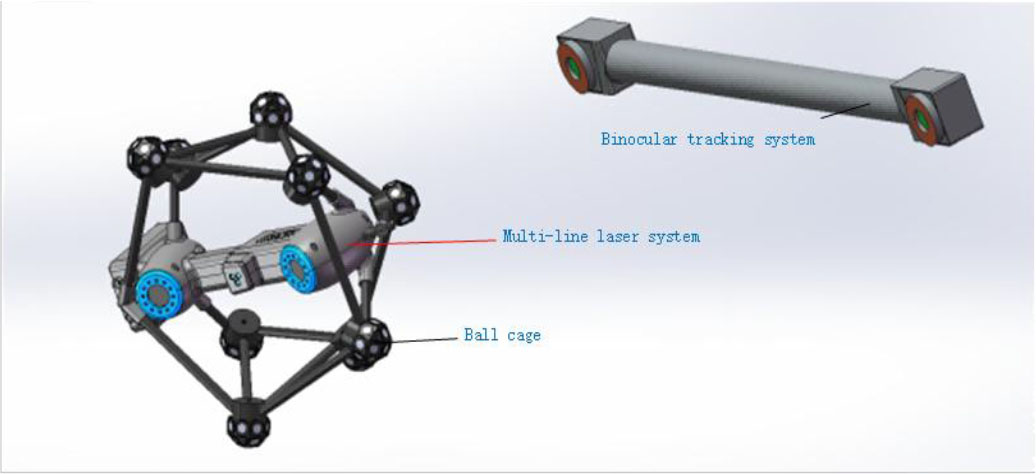

Fig. 2.

Track system structure diagram.
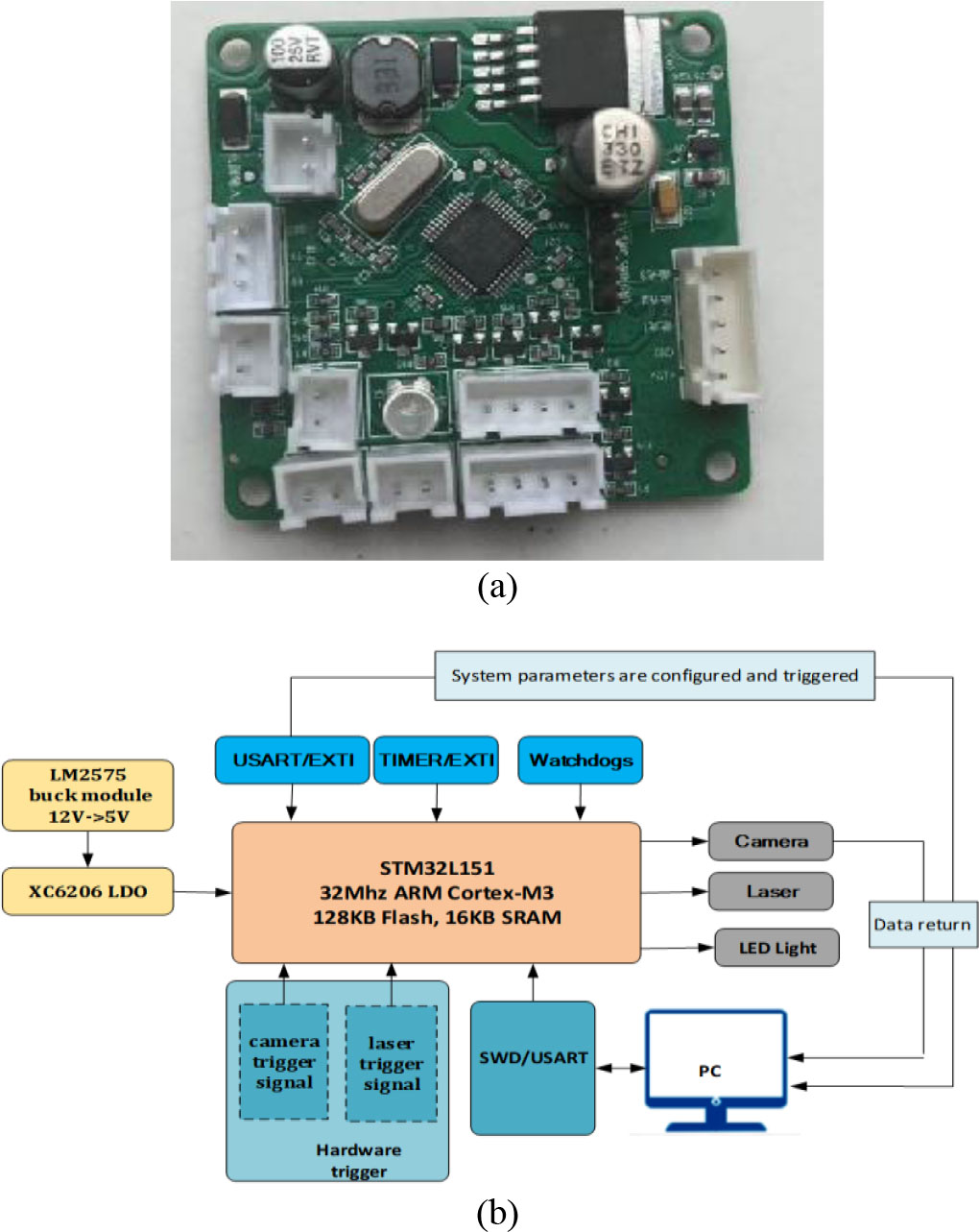

Fig. 3.

Hardware controller, (a) hardware circuit board, (b) circuit board structure diagram.
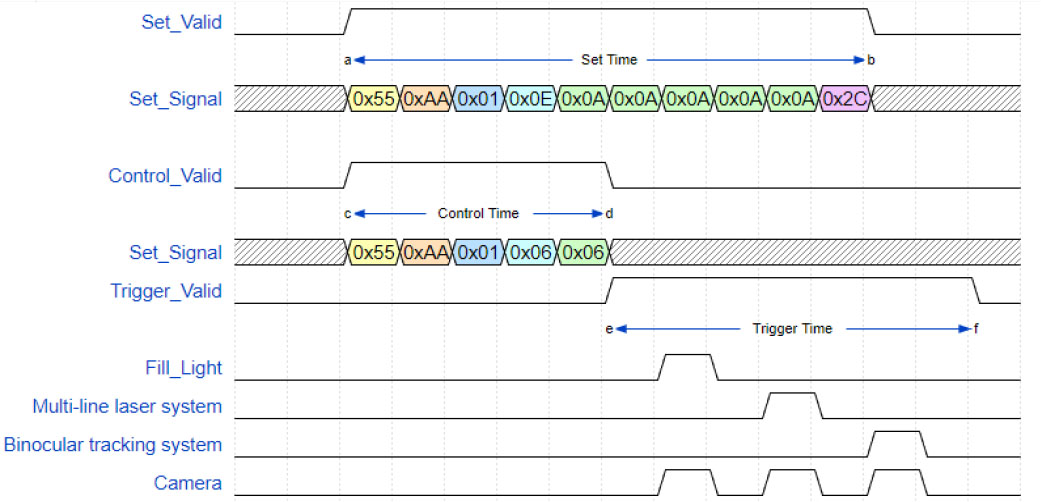

Fig. 4.

Signal timing diagram of the laser controller.
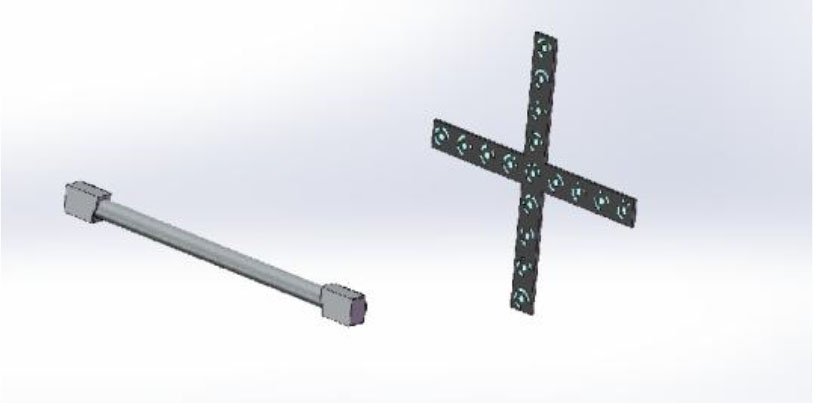

Fig. 5.

Binocular tracking system and cross pole.
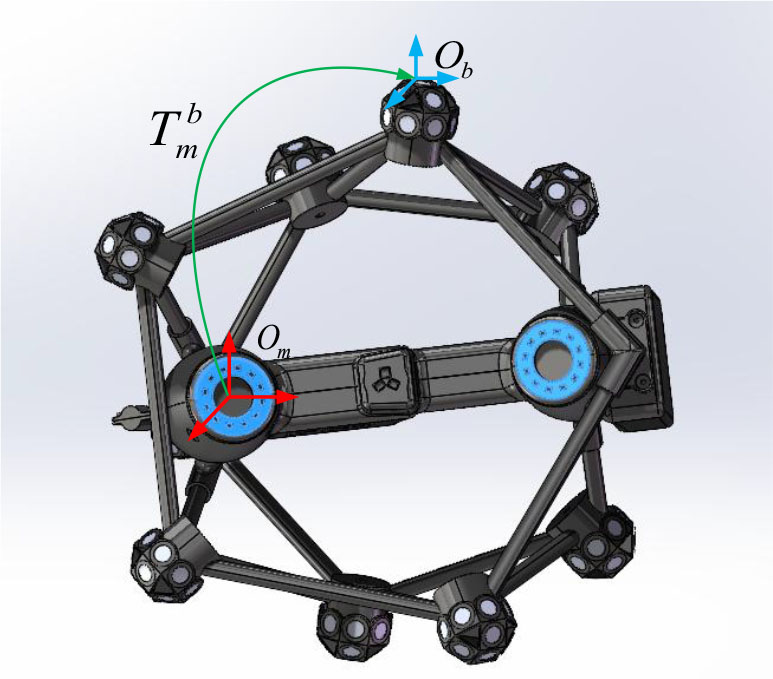

Fig. 6.

The conversion relationship between the multi-line laser system and the tracking ball cage.
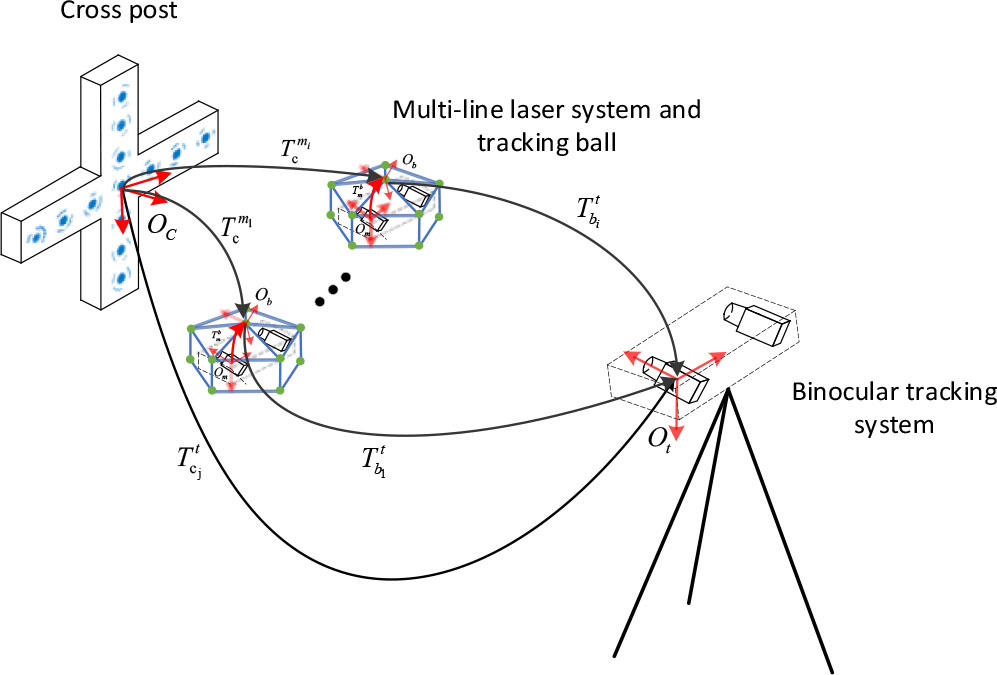

Fig. 7.

Joint calibration schematic diagram.
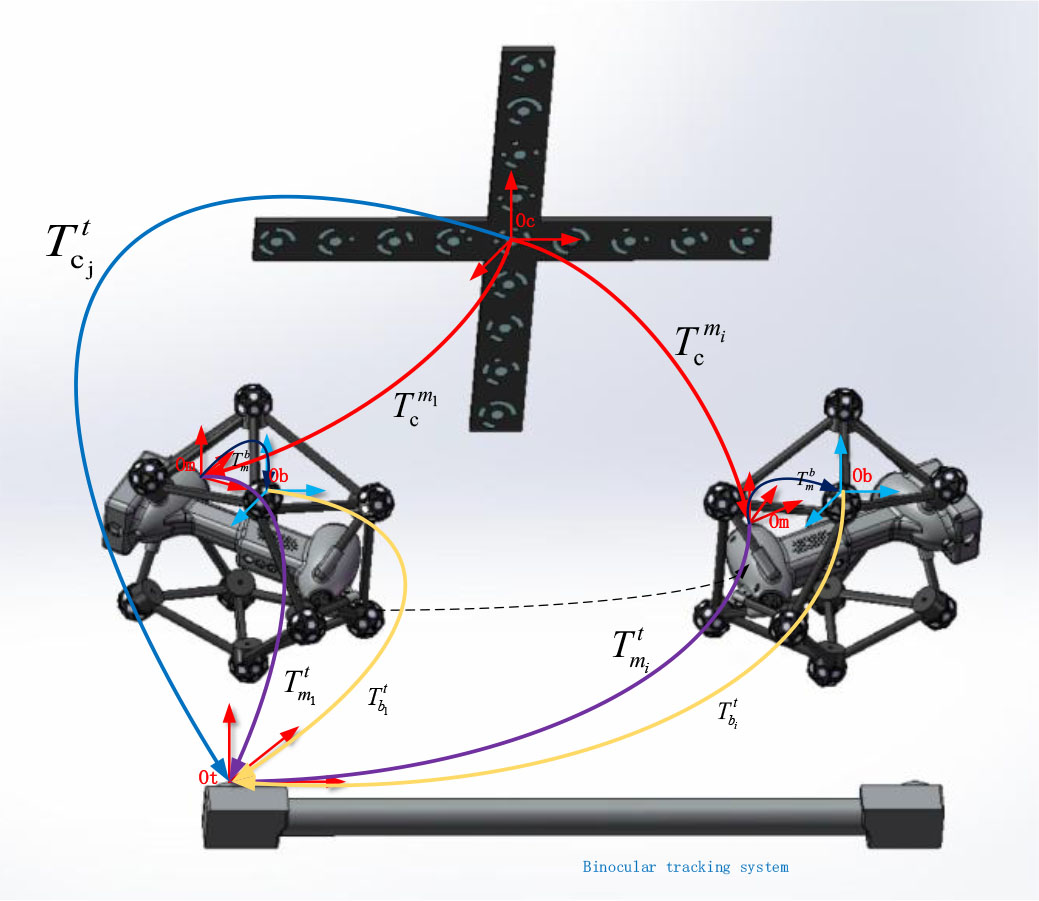

Fig. 8.

Joint calibration of physical structure drawing.
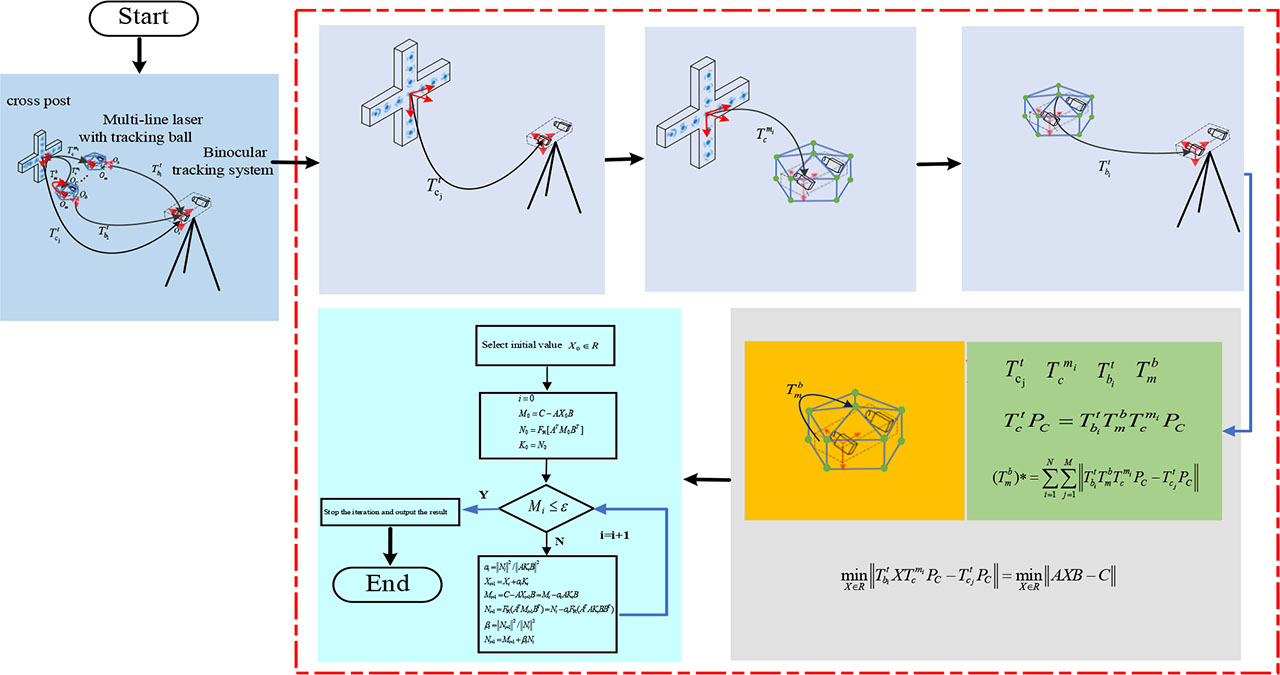

Fig. 9.

Joint calibration flow chart.
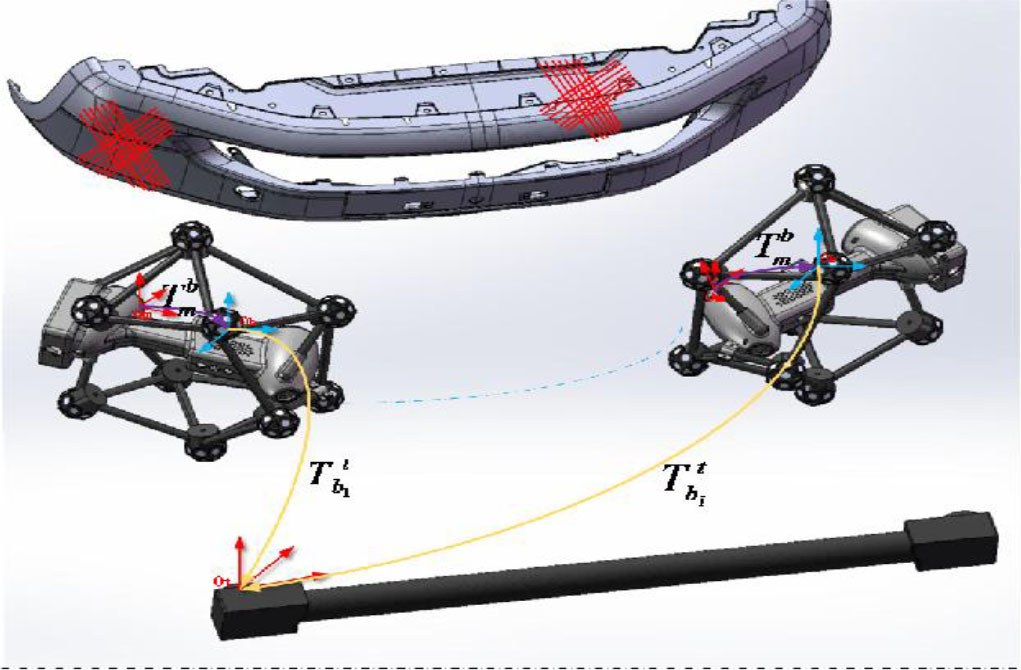

Fig. 10.

Schematic diagram of stitching the tracking system.
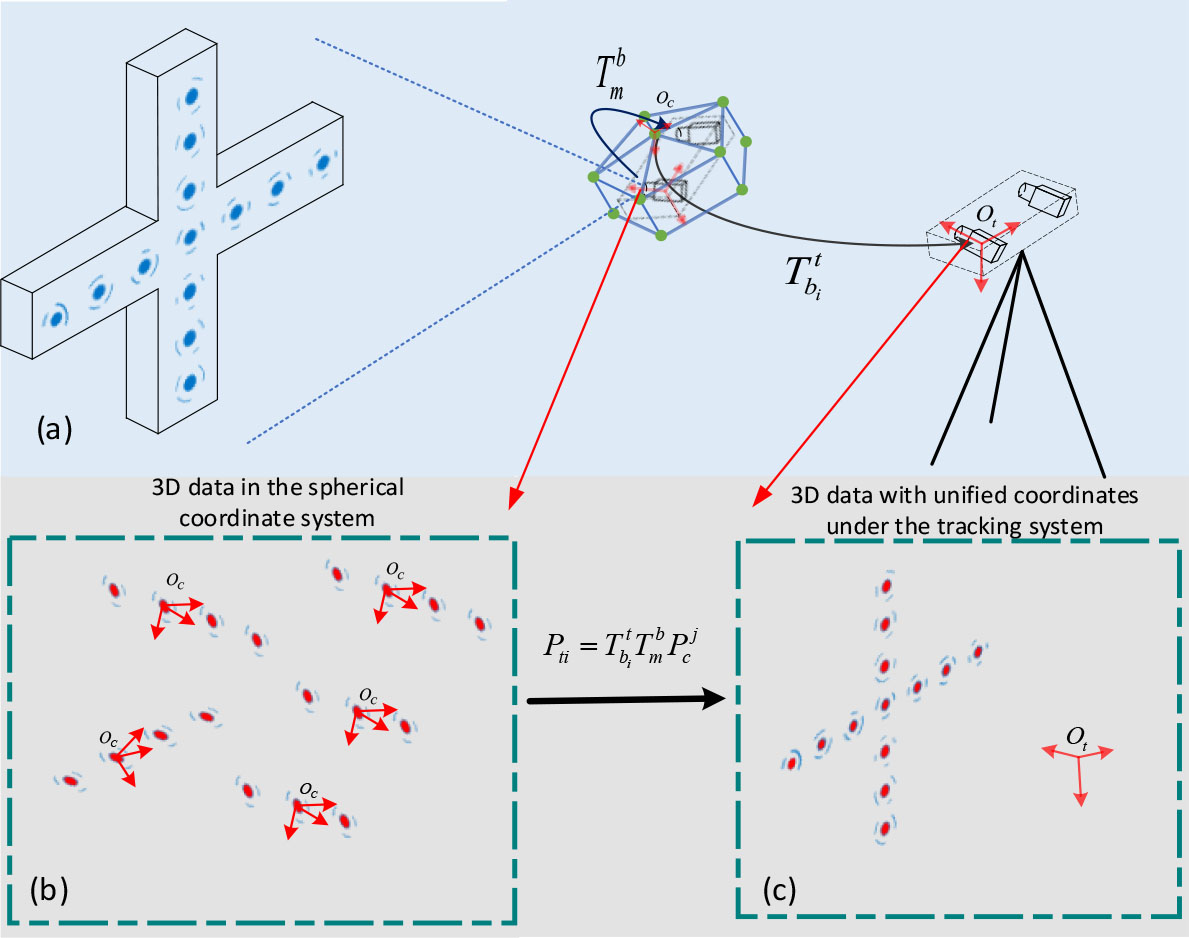

Fig. 11.

Accuracy verification of joint calibration.

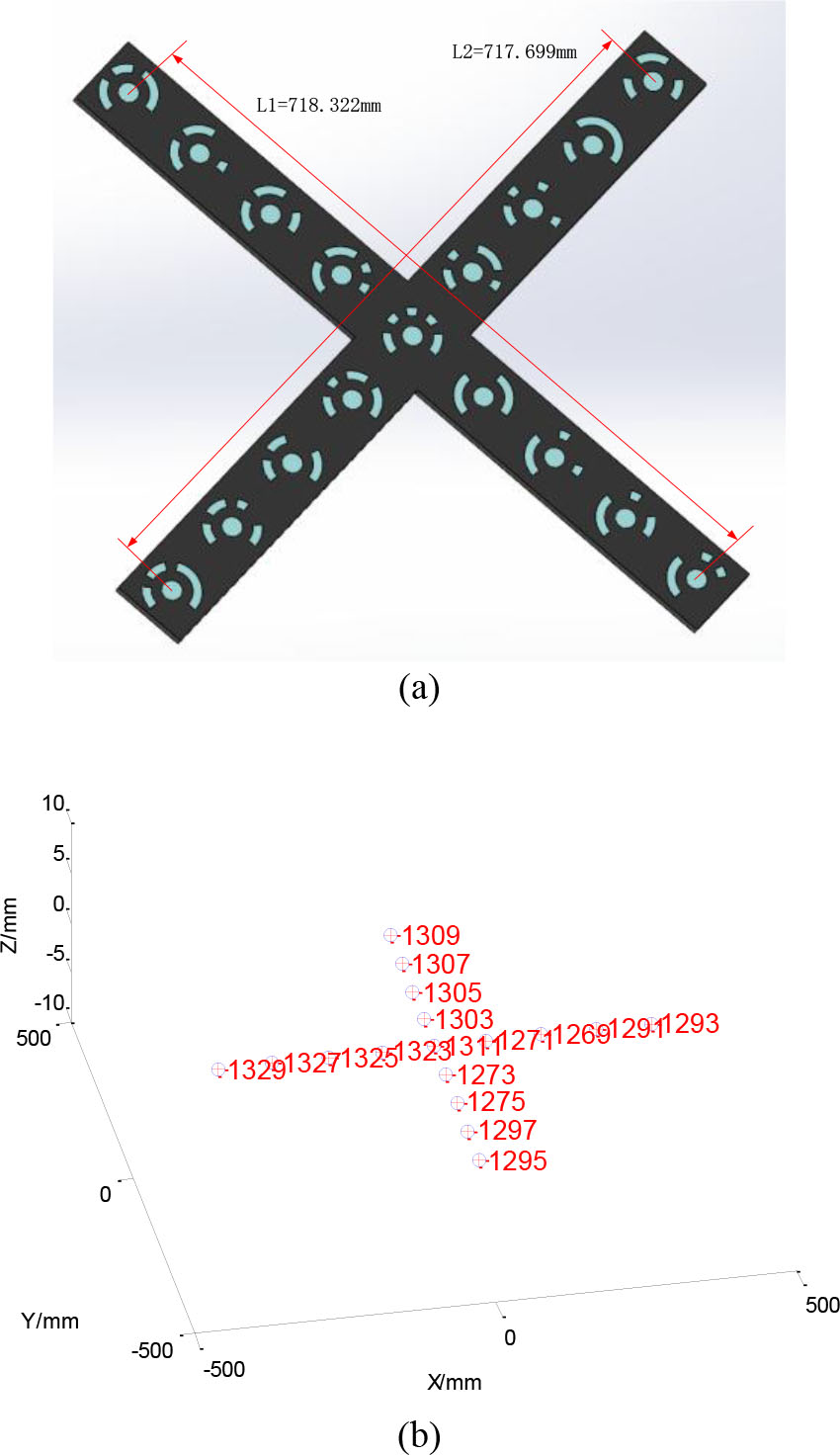
Fig. 12.

(a) Cross pole; (b) Three-dimensional coordinates and encoded values of points on the cross pole.
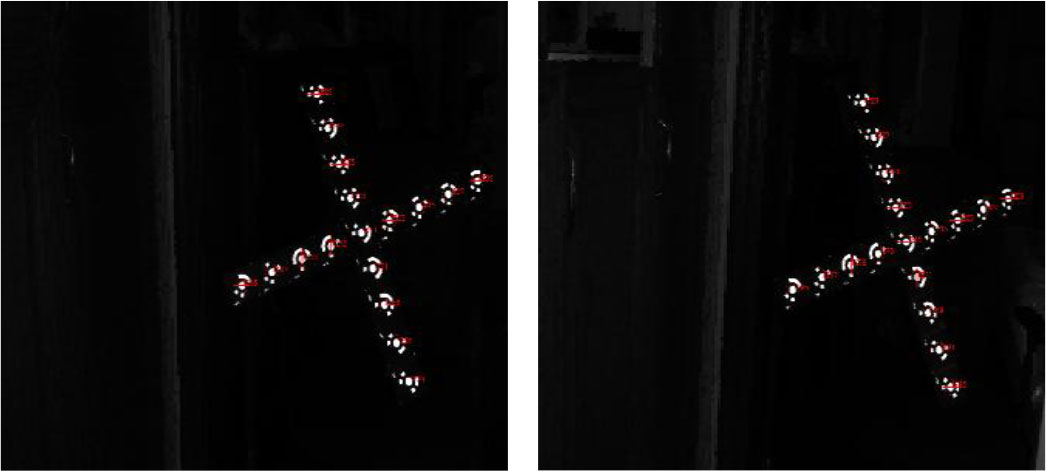
Fig. 13.

The results of left and right image coding point detection.
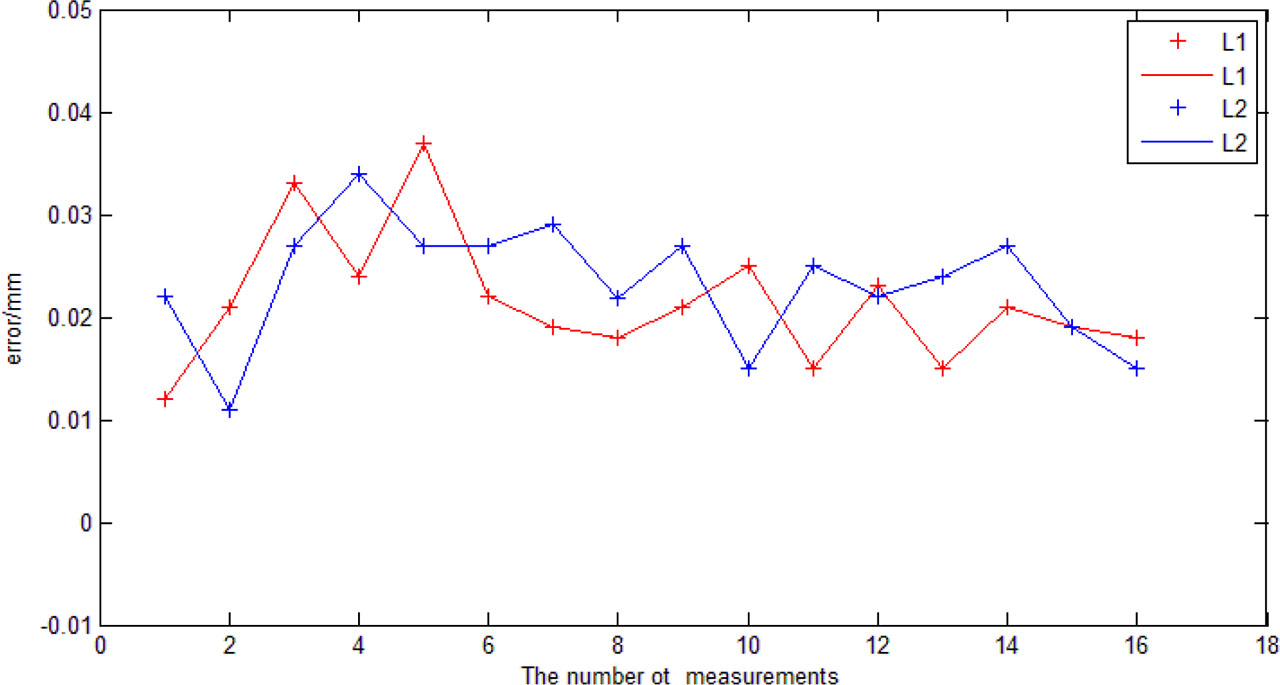

Fig. 14.

Calibration error.
Calibration error.

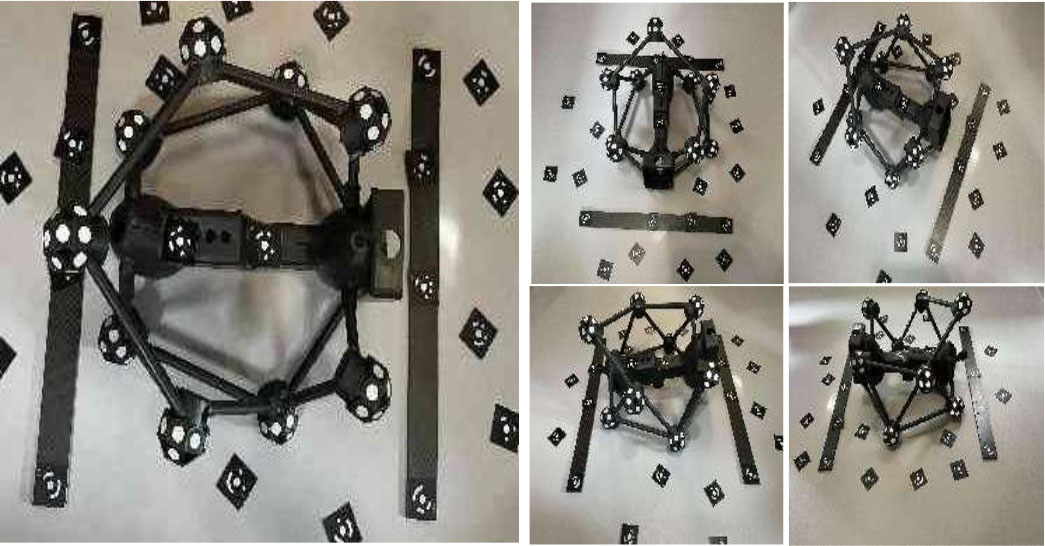
Fig. 15.

The images of the ball cage were captured from various perspectives.
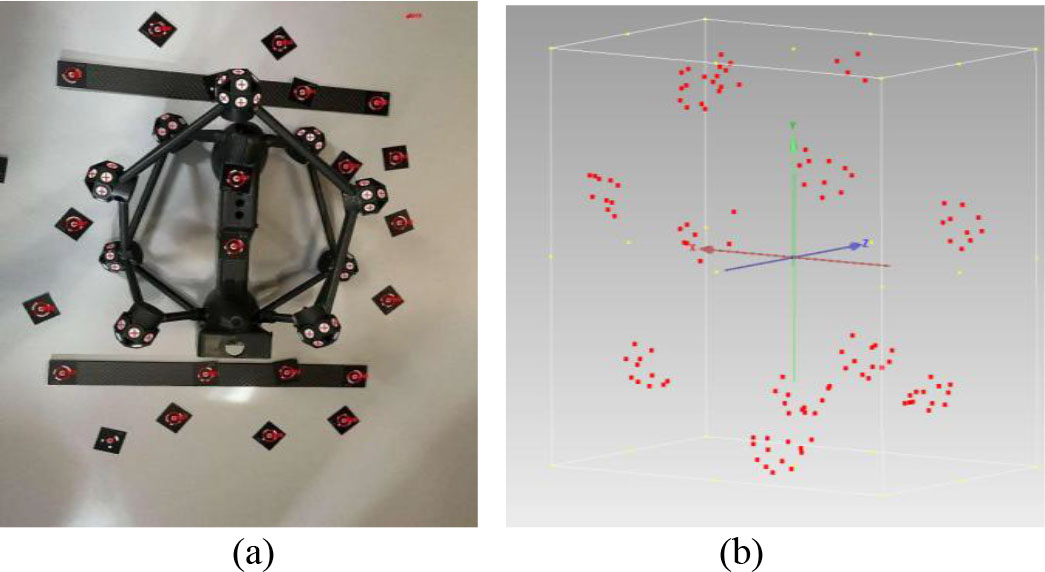

Fig. 16.

(a) Effect of coding point recognition, (b) 3D coordinates of all reflecting points on the ball cage.
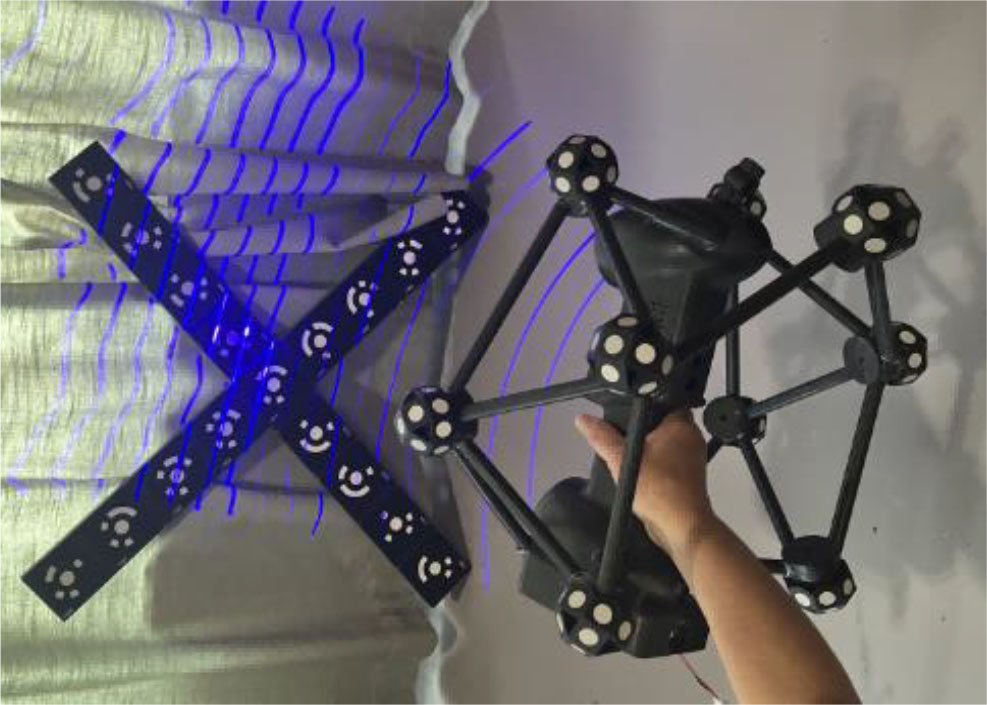

Fig. 17.

Multi-line laser and tracking ball cage joint calibration.
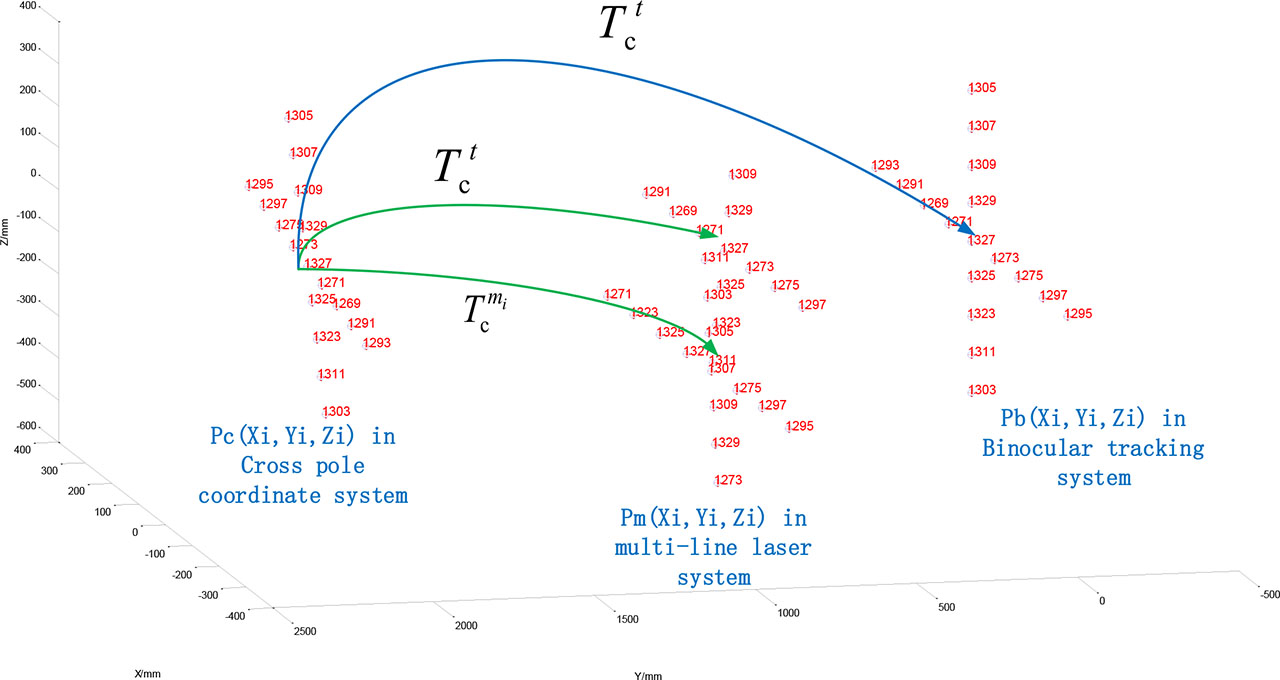

Fig. 18.

The 3D data and the transformation relationship of the cross pole within the multi-line laser system and the binocular tracking system.
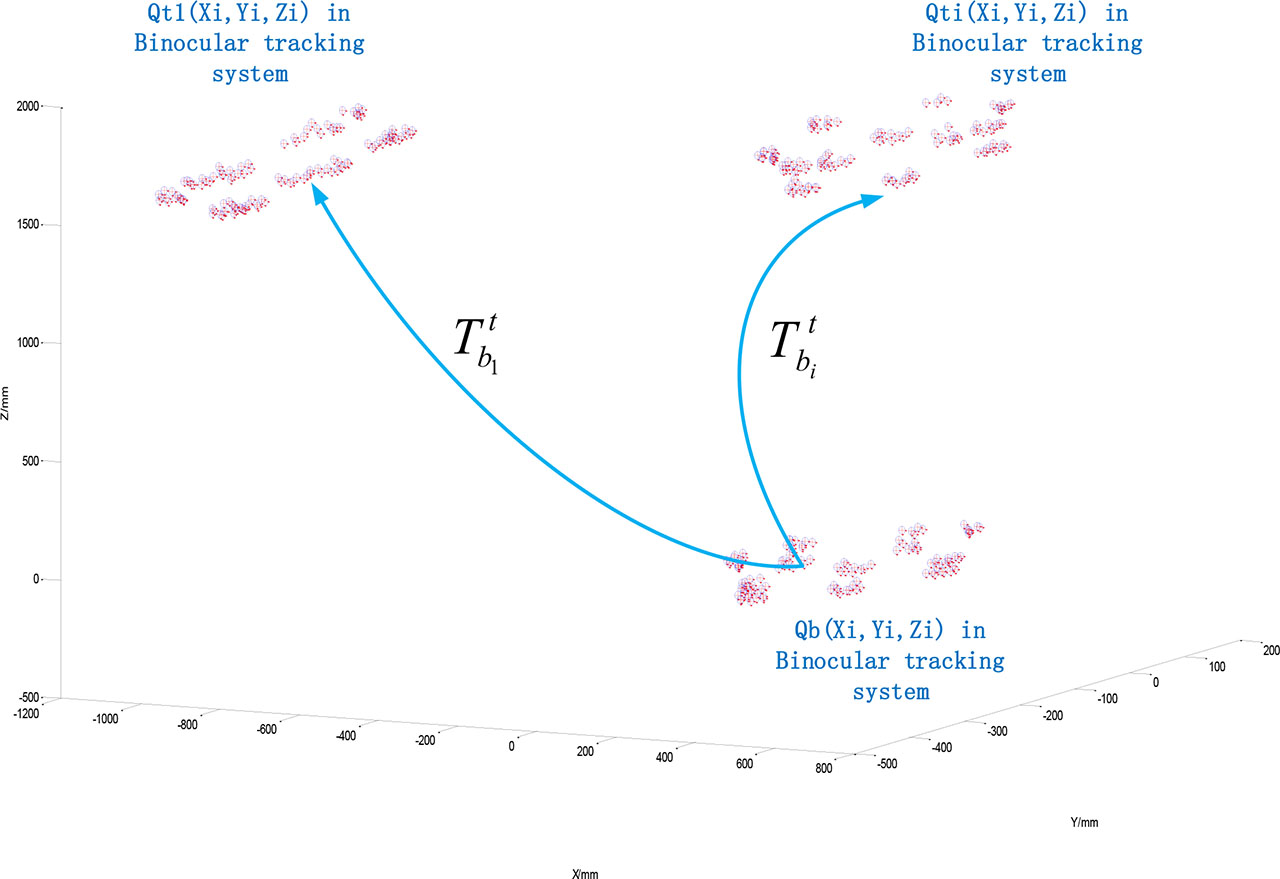

Fig. 19.

The conversion relationship between the tracking ball cage and the binocular tracking system.
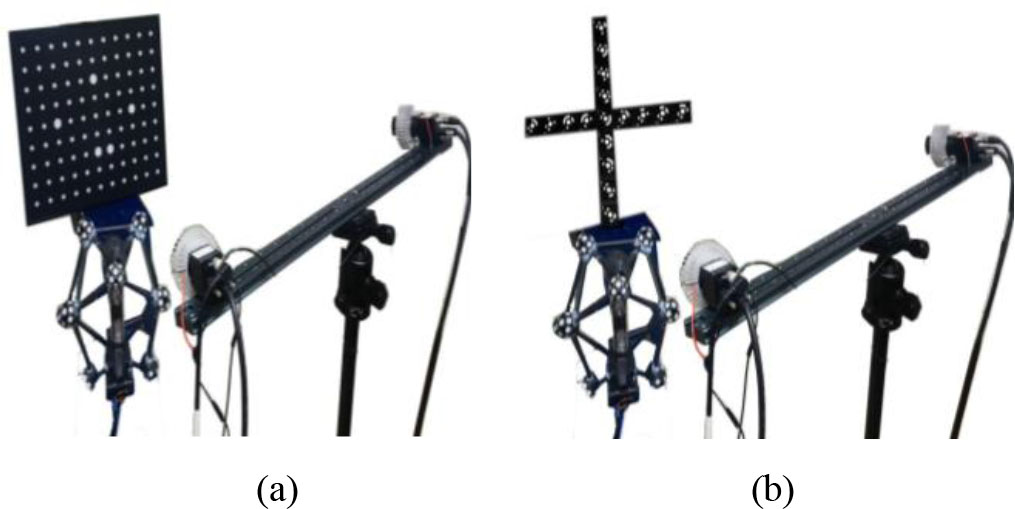

Fig. 20.

Schematic diagram of the joint calibration comparison, (a) Joint calibration based on a flat plate; (b) Joint calibration based on a cross pole.
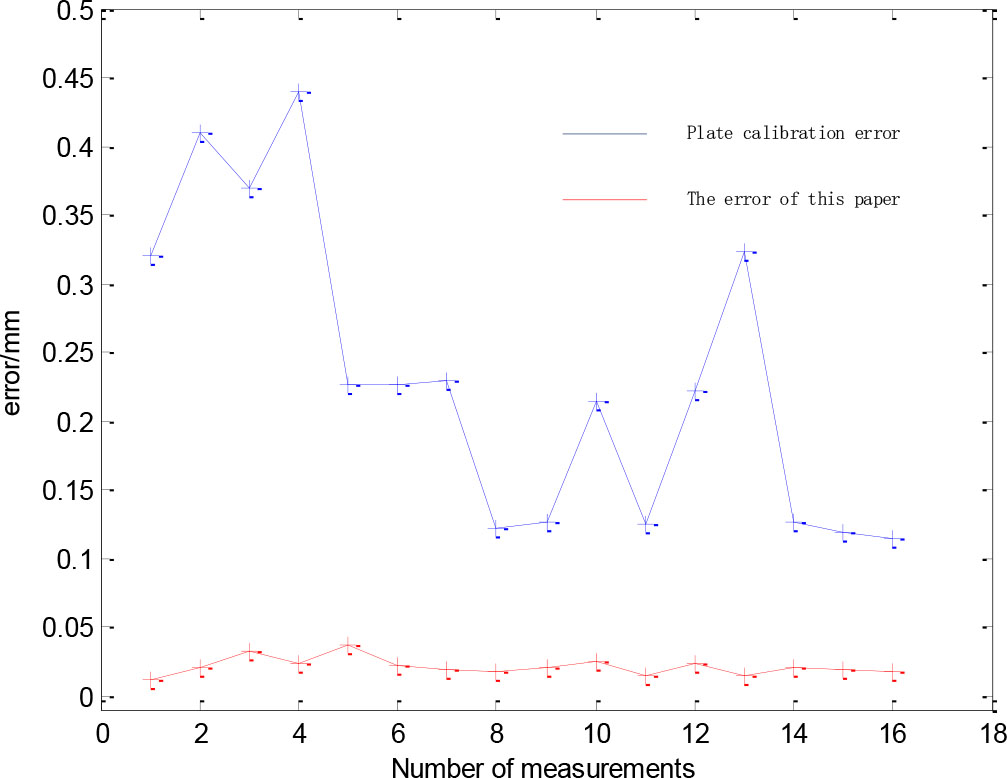

Fig. 21.

Comparison of joint calibration accuracy.

Fig. 22.

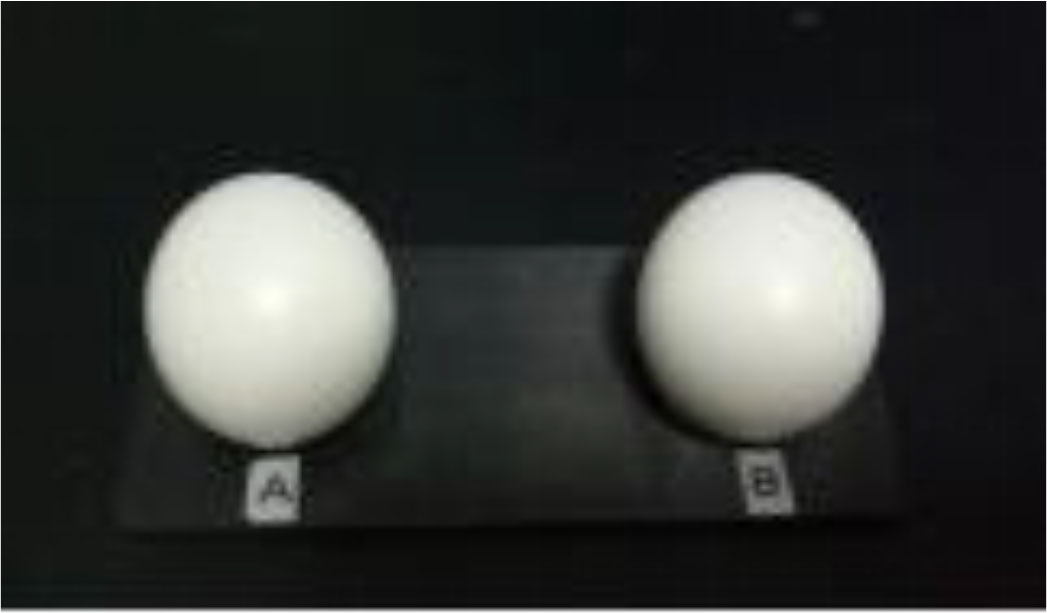
Standard ball.
Standard ball.

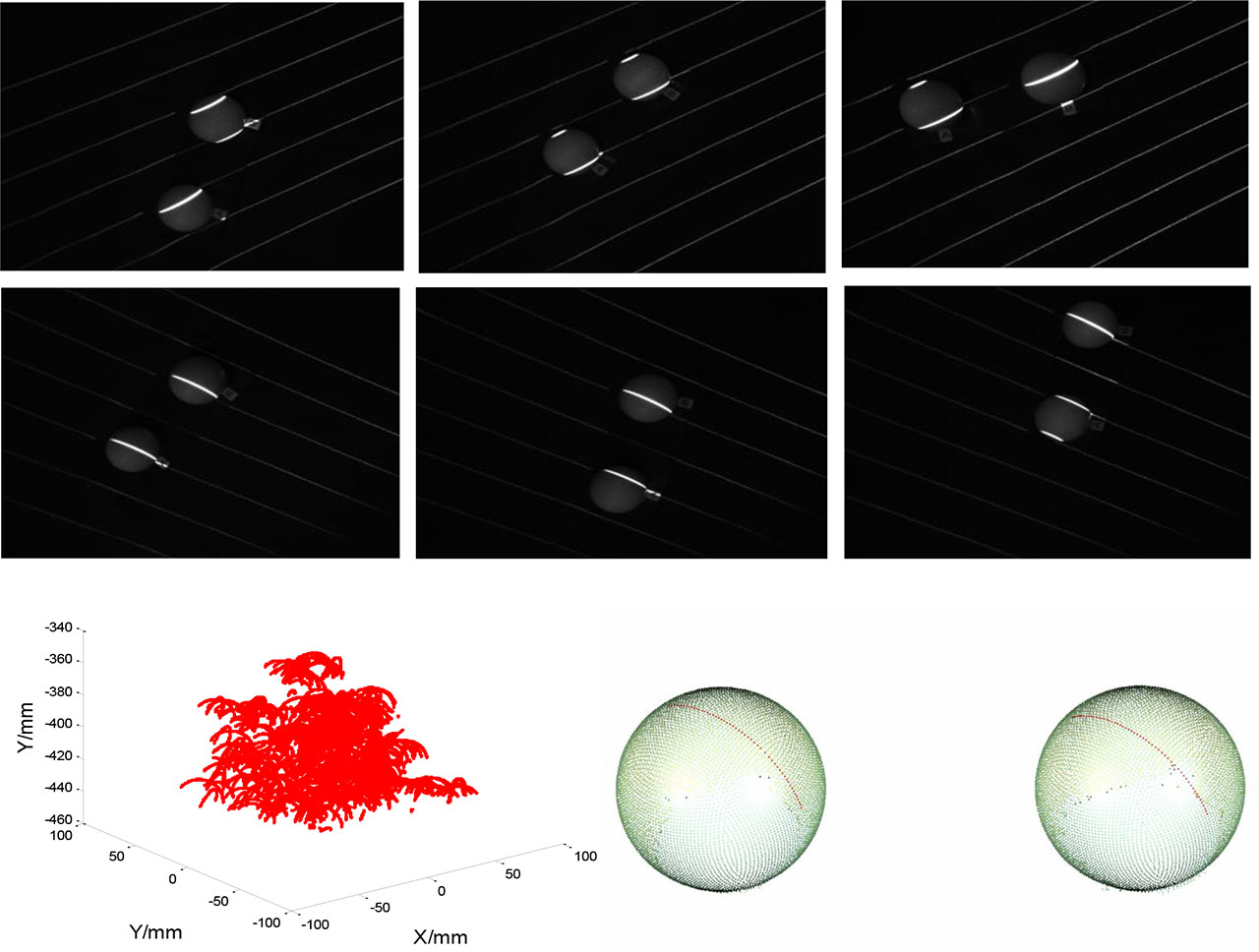
Fig. 23.

Standard ball reconstruction process based on the tracking system.
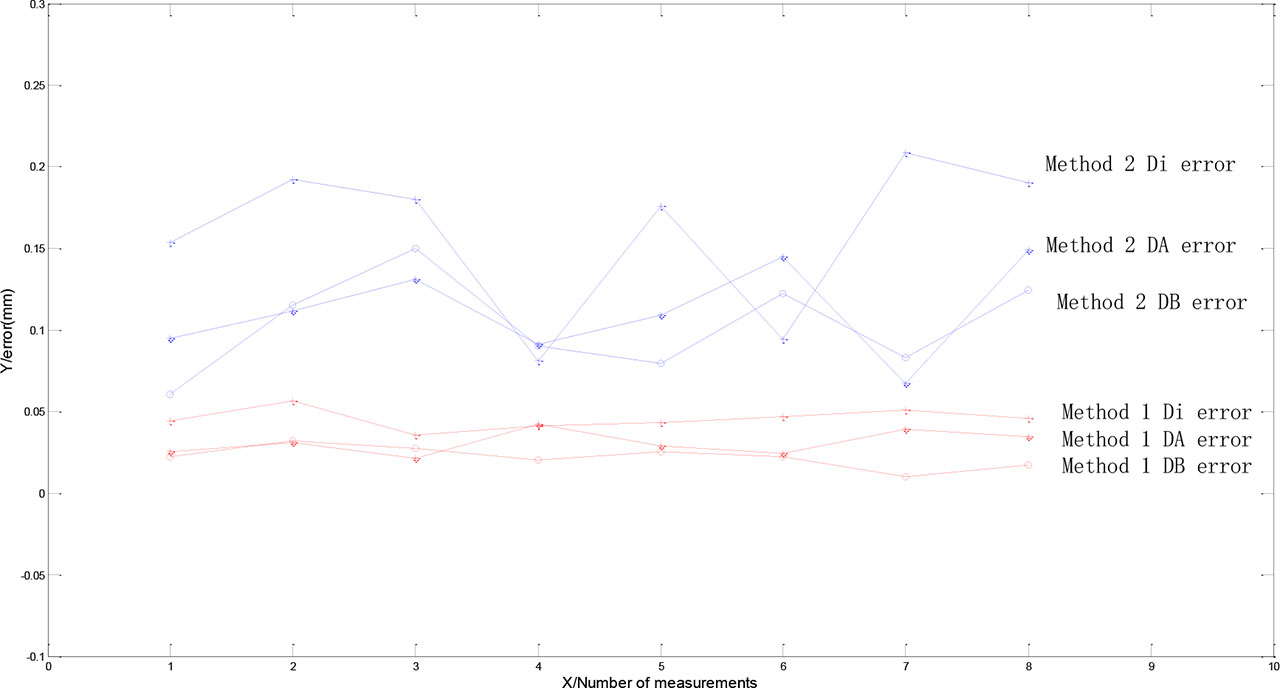

Fig. 24.

Error plots for both methods.

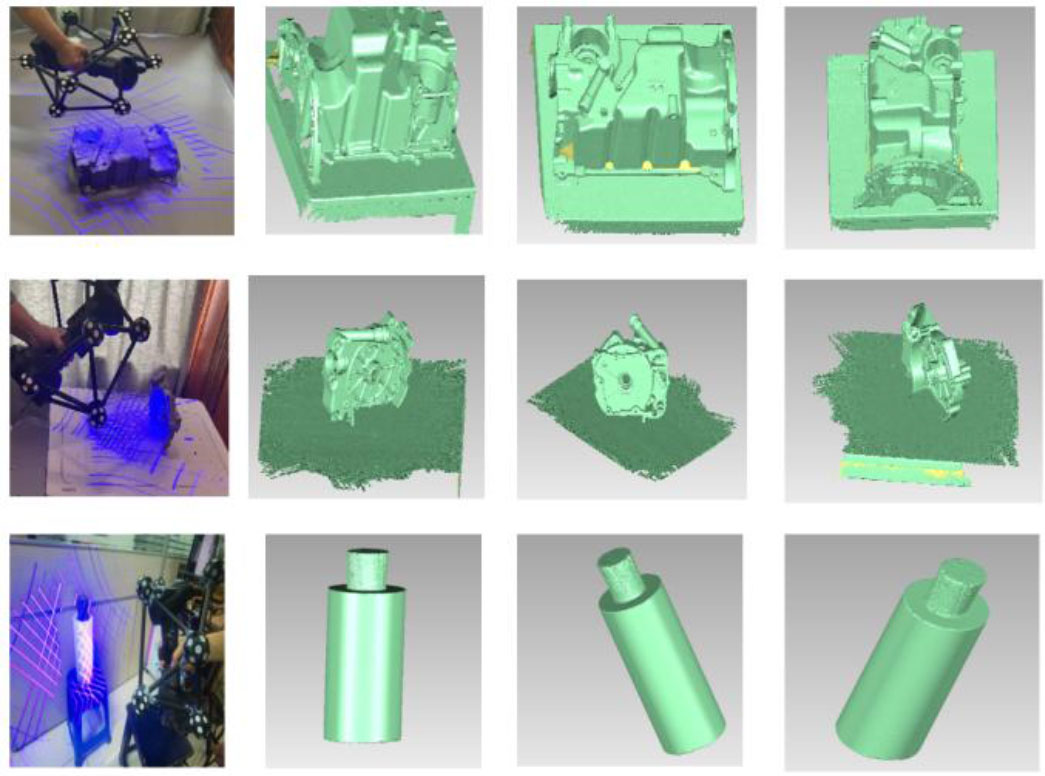
Fig. 25.

Other objects are reconstructed based on a multi-line laser tracking system.

Binocular hardware parameters_

Camera Cross pole
Resolution [pixel2]2248×2048Size [mm2]1200×1200
Focal length [mm]8Coded point number16
Frame rate [s−1]90Coded point size [mm2]80×80
Field range [mm]3000~4000
Distance [mm]2000~3000

Comparison test parameters for joint calibration_

The method in this paperTraditional methods

Calibrated objectCross polePlanar calibration board
Field of view3000 mm × 4000 mm
Depth of field range800 mm × 1000 mm
Object testCross pole
Camera – resolution2448 × 2048
Camera – focal length8 mm
Calibration results Tbm=0.972340.081870.14523121.08320.309830.9853200.4028434.82390.142390.268120.988123149.82340001 T_b^m = \left[ {\matrix{ {0.97234} & { - 0.08187} & {0.14523} & {121.0832} \cr {0.30983} & {0.985320} & {0.40284} & {34.8239} \cr { - 0.14239} & { - 0.26812} & {0.988123} & {149.8234} \cr 0 & 0 & 0 & 1 \cr } } \right] Tbm=0.972340.081870.14523121.08320.309830.9853200.4028434.82390.142390.268120.988123149.82340001 T_b^m = \left[ {\matrix{ {0.97234} & { - 0.08187} & {0.14523} & {121.0832} \cr {0.30983} & {0.985320} & {0.40284} & {34.8239} \cr { - 0.14239} & { - 0.26812} & {0.988123} & {149.8234} \cr 0 & 0 & 0 & 1 \cr } } \right]

The intermediate and final results of joint calibration_

Tct=0.9154320.0682350.396645238.5720.1347550.9806060.142311313.7020.3792420.1837260.9068742354.210001 T_c^t = \left[ {\matrix{ {0.915432} & {0.068235} & {0.396645} & { - 238.572} \cr { - 0.134755} & {0.980606} & {0.142311} & { - 313.702} \cr {0.379242} & {0.183726} & { - 0.906874} & {2354.21} \cr 0 & 0 & 0 & 1 \cr } } \right]
Tcm1=0.9134860.1345670.234568137.6540.1675360.9367800.223134151.4560.237860.342780.945893795.2340001 T_c^{{m_1}} = \left[ {\matrix{ {0.913486} & { - 0.134567} & { - 0.234568} & { - 137.654} \cr {0.167536} & {0.936780} & {0.223134} & { - 151.456} \cr {0.23786} & { - 0.34278} & {0.945893} & {795.234} \cr 0 & 0 & 0 & 1 \cr } } \right] Tbt1=0.8712580.185240.16452782.4520.2457850.7528960.32587875.7450.352870.3574820.9247521514.4570001 T_b^{{t_1}} = \left[ {\matrix{ {0.871258} & { - 0.18524} & {0.16452} & { - 782.452} \cr {0.245785} & {0.752896} & {0.32587} & { - 875.745} \cr { - 0.35287} & { - 0.357482} & {0.924752} & { - 1514.457} \cr 0 & 0 & 0 & 1 \cr } } \right]
Tcm1=0.925840.140250.22547129.1450.172580.942530.202452171.5280.225780.3625840.92458810.4520001 T_c^{{m_1}} = \left[ {\matrix{ {0.92584} & { - 0.14025} & { - 0.22547} & { - 129.145} \cr {0.17258} & {0.94253} & {0.202452} & { - 171.528} \cr {0.22578} & { - 0.362584} & {0.92458} & {810.452} \cr 0 & 0 & 0 & 1 \cr } } \right] Tbt1=0.9722450.1328090.192618415.1080.02912140.8855650.463602921.6490.2321460.4451250.8648541421.110001 T_b^{{t_1}} = \left[ {\matrix{ {0.972245} & { - 0.132809} & {0.192618} & { - 415.108} \cr {0.0291214} & {0.885565} & {0.463602} & { - 921.649} \cr { - 0.232146} & { - 0.445125} & {0.864854} & { - 1421.11} \cr 0 & 0 & 0 & 1 \cr } } \right]
Tbm=0.9863250.114250.11475120.14250.247580.9754250.4572835.14250.153680.247580.99442150.1400001 T_b^m = \left[ {\matrix{ {0.986325} & { - 0.11425} & {0.11475} & {120.1425} \cr {0.24758} & {0.975425} & {0.45728} & {35.1425} \cr { - 0.15368} & { - 0.24758} & {0.99442} & {150.140} \cr 0 & 0 & 0 & 1 \cr } } \right]

Calibration parameters results_

Intrinsic and distortion parameterExternal parameter
Cleft=3667.057960.00005941315.322703667.57804910.788437001 {C_{left}} = \left[ {\matrix{ {3667.05796} & {0.0000594} & {1315.3227} \cr 0 & {3667.57804} & {910.788437} \cr 0 & 0 & 1 \cr } } \right]
Cright=3672.25100.00011251335.04484803672.77186908.559738001 {C_{right}} = \left[ {\matrix{ {3672.2510} & { - 0.0001125} & {1335.044848} \cr 0 & {3672.77186} & {908.559738} \cr 0 & 0 & 1 \cr } } \right] R=0.96850.04410.244860.04560.998950.0005940.24450.011760.96955 R = \left[ {\matrix{ {0.9685} & { - 0.0441} & { - 0.24486} \cr {0.0456} & {0.99895} & {0.000594} \cr {0.2445} & { - 0.01176} & {0.96955} \cr } } \right]
Dleft=0.08370.370110.0026830.0000380.0025 {D_{left}} = \left[ {\matrix{ { - 0.0837} & {0.37011} & {0.002683} & {0.000038} & {0.0025} \cr } } \right] T=526.399.78146.10 T = \left[ {\matrix{ {526.39} & {9.781} & {46.10} \cr } } \right]
Dright=0.07520.213670.0019700.0000410.000361 {D_{right}} = \left[ {\matrix{ {0.0752} & { - 0.21367} & {0.001970} & {0.000041} & {0.000361} \cr } } \right]

Comparison of precision between the calibration algorithm proposed in this article and the traditional flat-plate calibration algorithm_

NumberCalibration algorithm of this paper (Method 1)Calibration algorithm of traditional plate calibration (Method 2)

DiDADBDiDADB
1300.045660.024760.0182300.154760.062860.0978
2300.057860.034160.0138300.123660.117460.1147
3300.037260.029760.0142300.041260.152460.1340
4300.042460.022560.0150300.082460.092560.0941
5300.044760.027960.0118300.147160.081760.1119
6300.048160.024860.0171300.075860.124760.1477
7300.052560.012160.0121300.11060.085260.0701
8300.047360.019560.0177300.091460.126460.1517

Mean error0.04540.02200.03060.15930.10300.1121
Language: English
Page range: 229 - 247
Submitted on: Mar 7, 2025
|
Accepted on: Jul 17, 2025
|
Published on: Sep 17, 2025
In partnership with: Paradigm Publishing Services
Publication frequency: Volume open

© 2025 Huiming Huang, Guihua Liu, Jiajia Liu, Xueyin Liu, Lei Deng, Tao Song, Fuping Qin, published by Slovak Academy of Sciences, Institute of Measurement Science
This work is licensed under the Creative Commons Attribution-NonCommercial-NoDerivatives 4.0 License.