
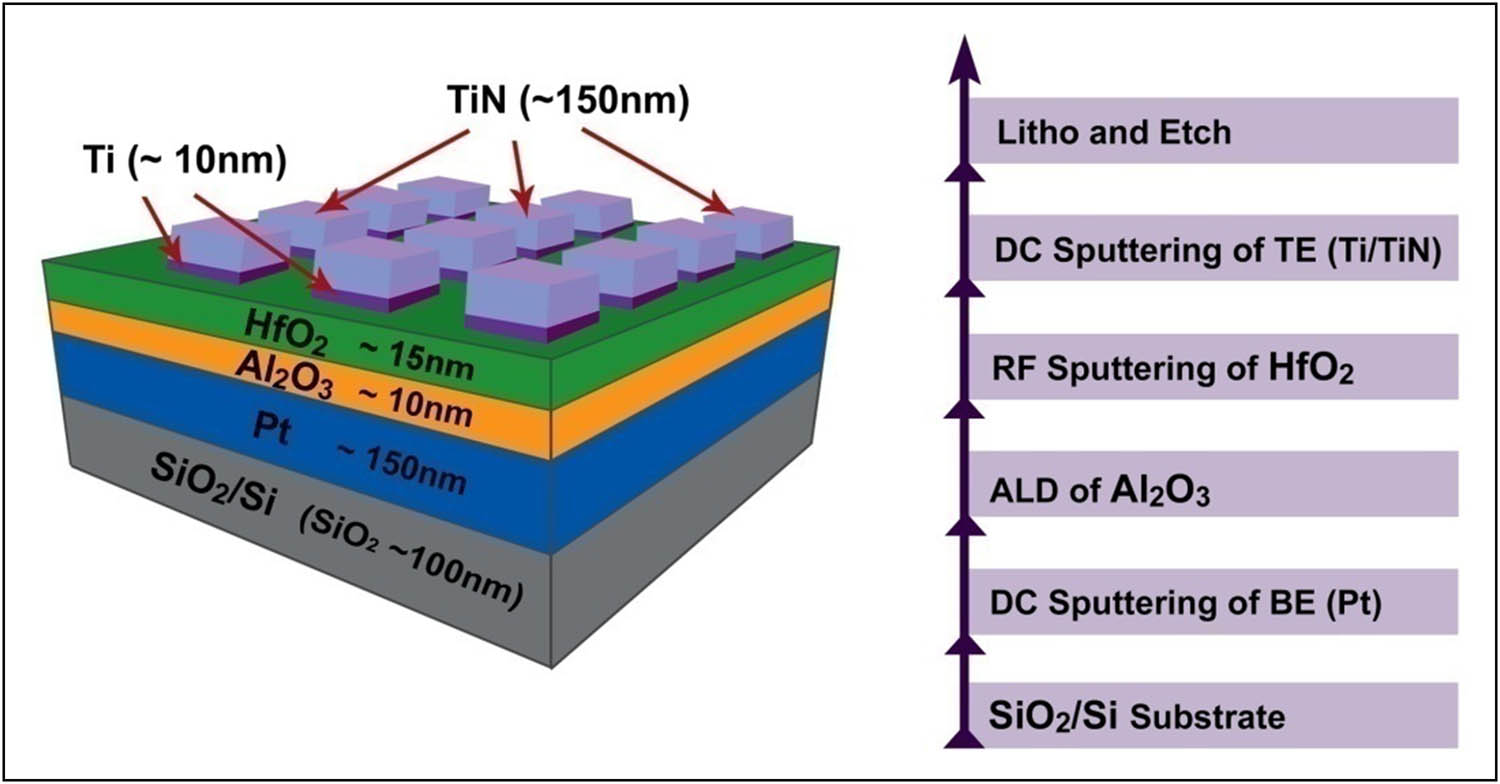
Figure 1
Step-by-step process of fabricating the proposed RRAM device.
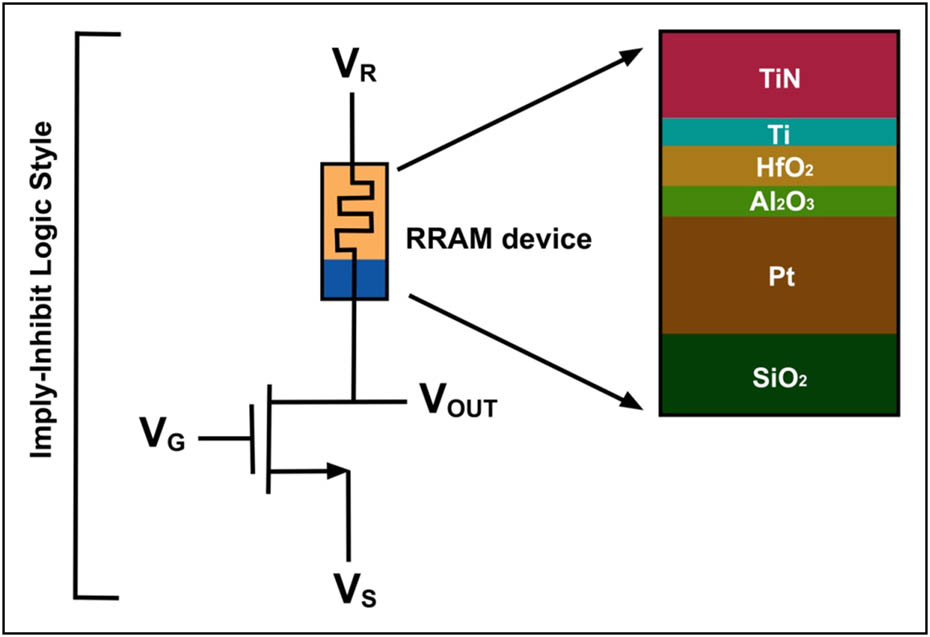
Figure 2
Proposed 1T-1R structure for imply–inhibit logic gates.
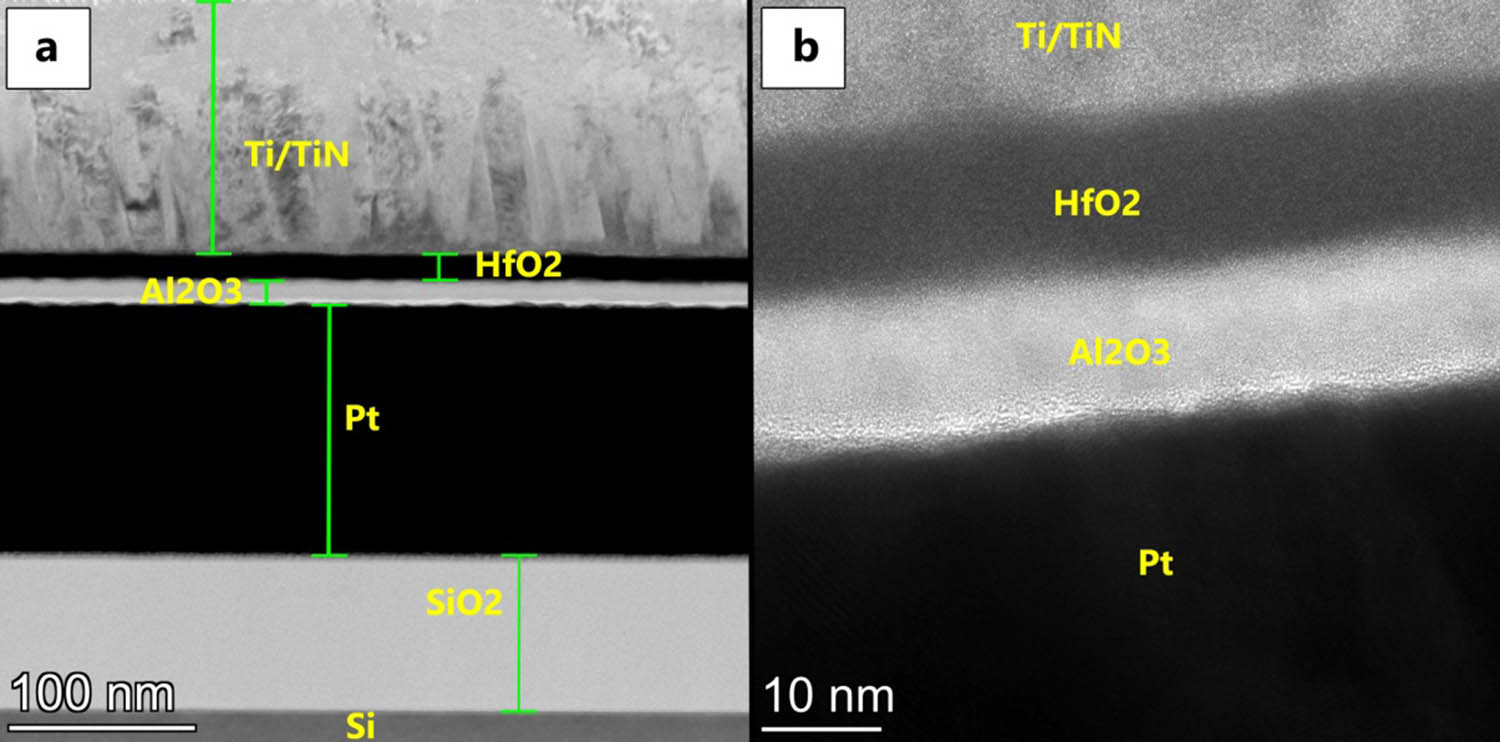
Figure 3
(a) Cross-sectional HRTEM image of the Pt/Al2O3/HfO2/Ti/TiNbi-layer RRAM structure. (b) The closer view of layer deposition and its interface.
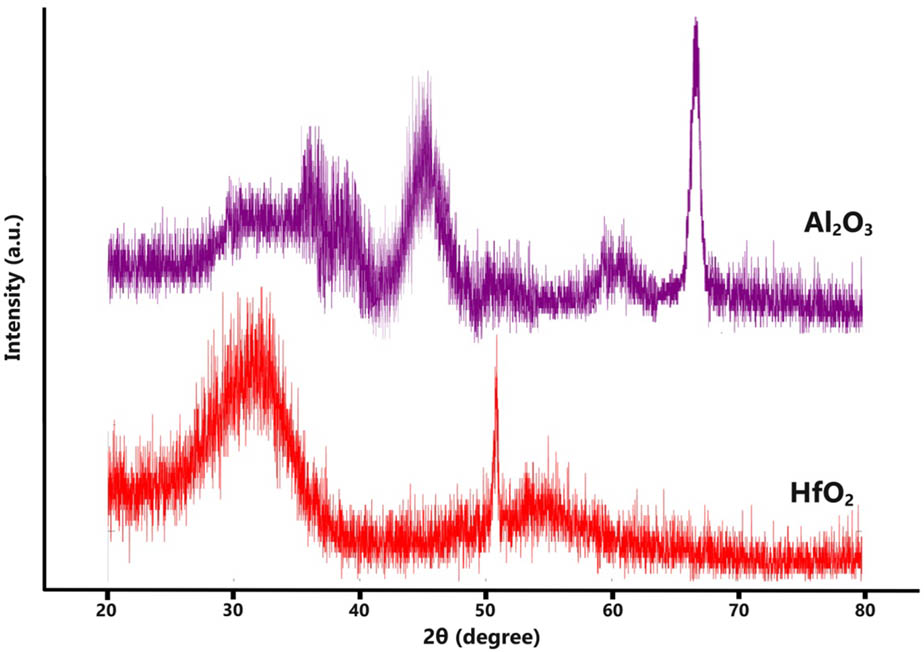
Figure 4
XRD pattern of Al2O3 and HfO2 nanoparticles.
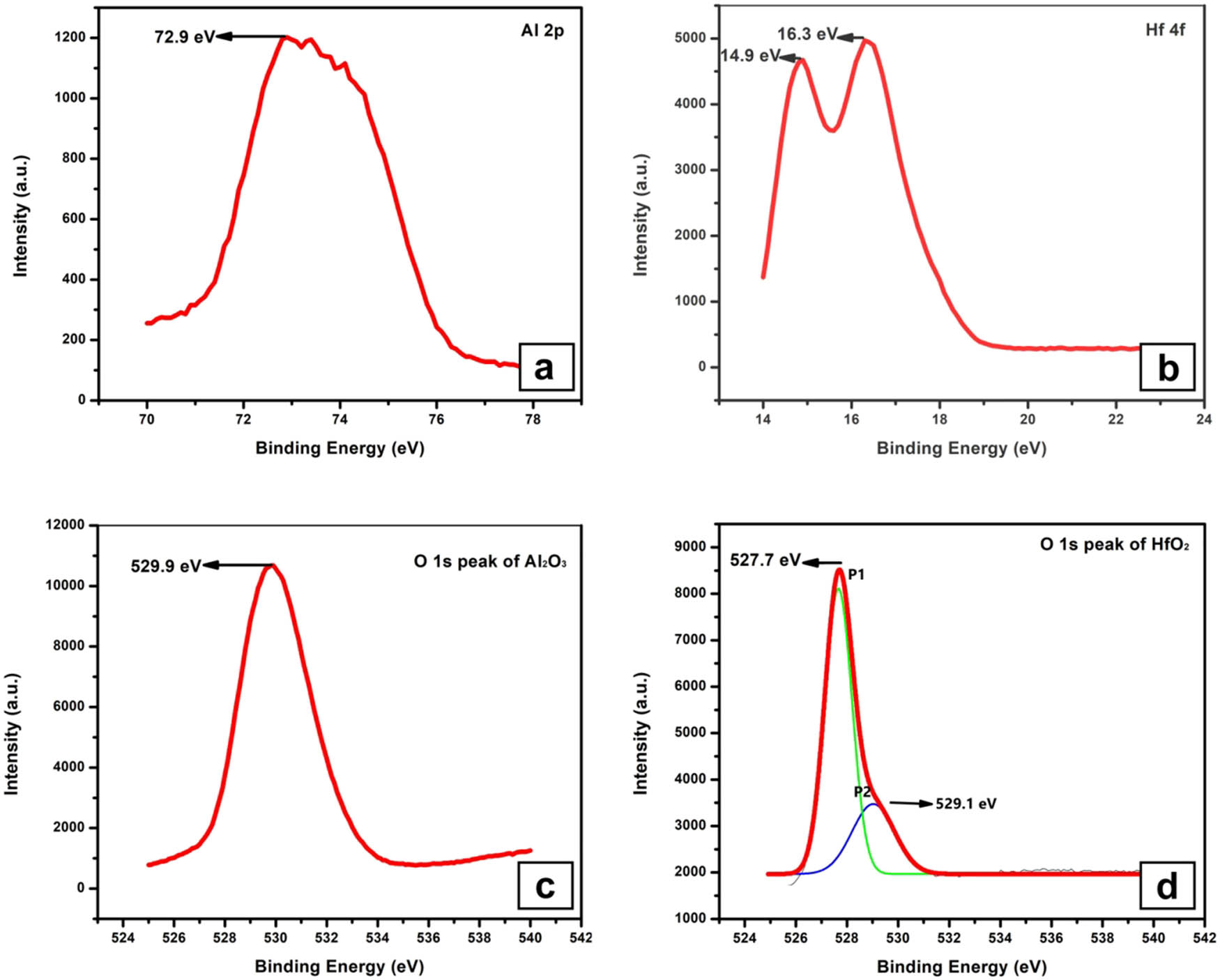
Figure 5
XPS spectra of the Al2O3/HfO2 bi-layer structure. (a) Al2p, (b) Hf4f peaks, (c) O 1-s peak of the Al2O3 layer, and (d) O 1-s peak of the HfO2 layer.
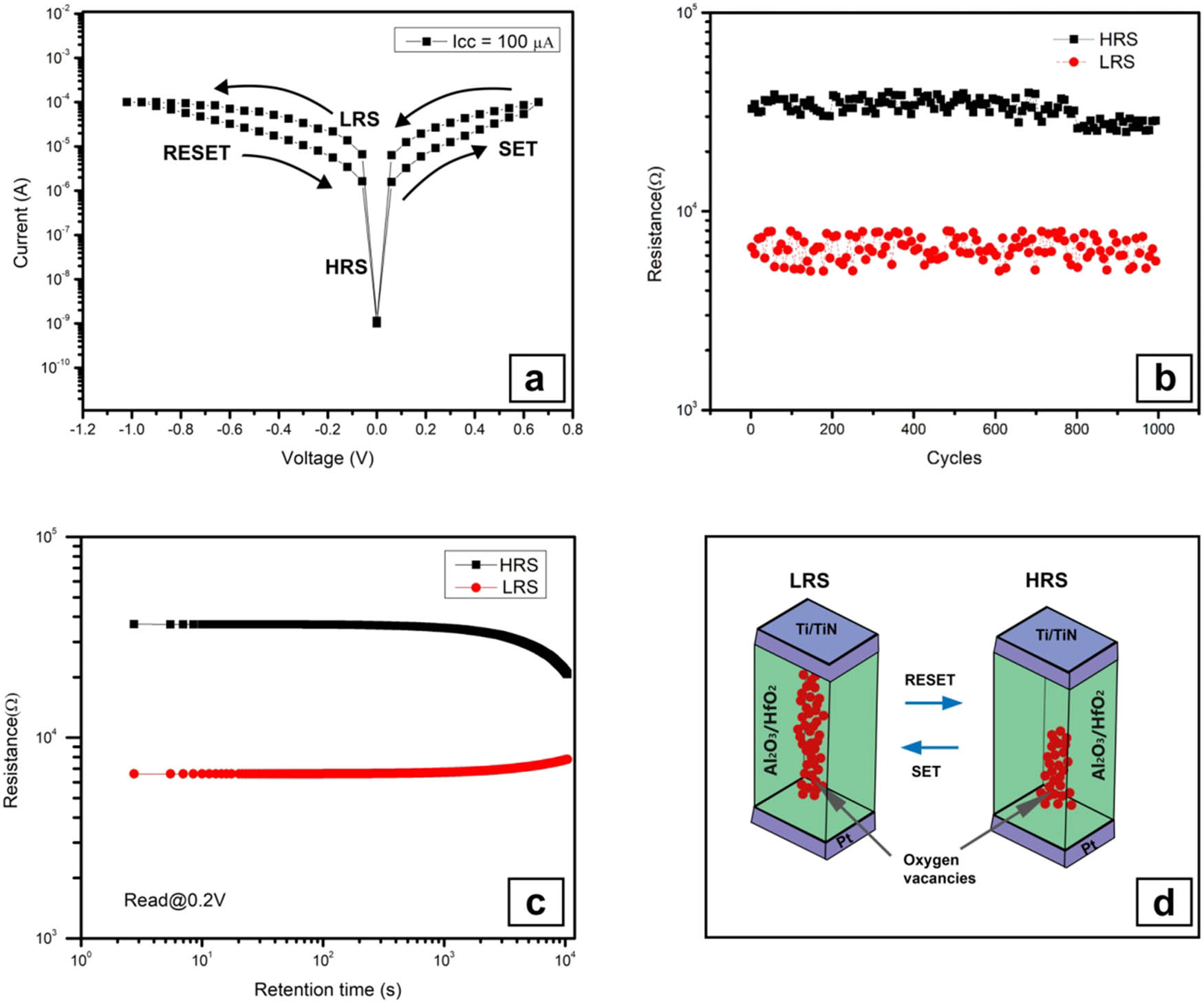
Figure 6
Resistive switching characteristics of the device unit and distribution of the SET and RESET voltages. (a) Typical resistive switching characteristics of the device, (b) durability of the device unit, (c) memory retention of HRS and LRS for 103 s with a read voltage of 0.2 V, and (d) resistive switching mechanism of the Pt/Al2O3/HfO2/Ti/TiN RRAM during the SET and RESET process.
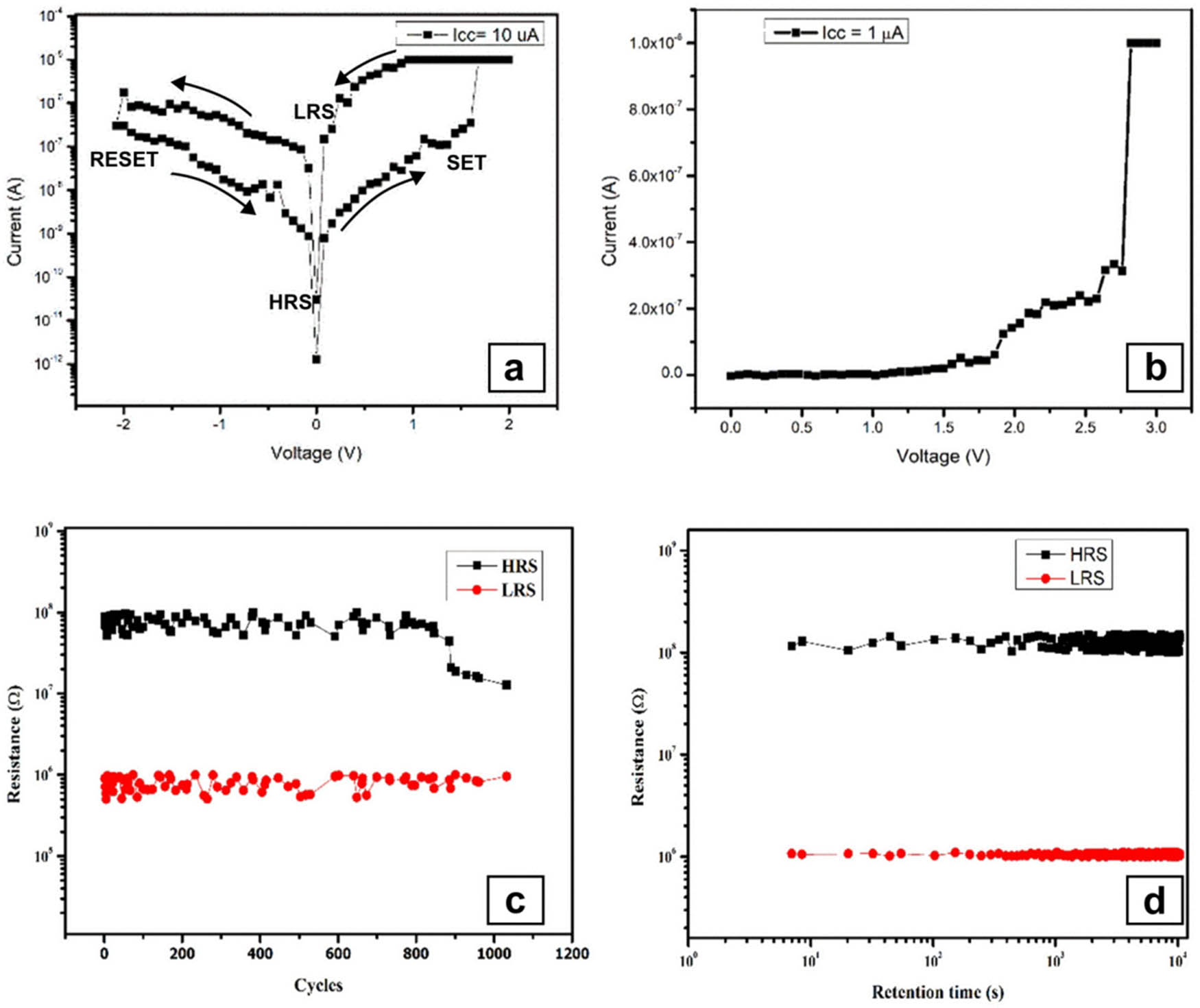
Figure 7
Resistive switching characteristics of the Pt/Al2O3/HfO2/TiN device. (a) Typical I–V characteristics of the device, (b) forming behavior, (c) durability of the device, and (d) memory retention of HRS and LRS for 103 s with a read voltage of 0.2 V.
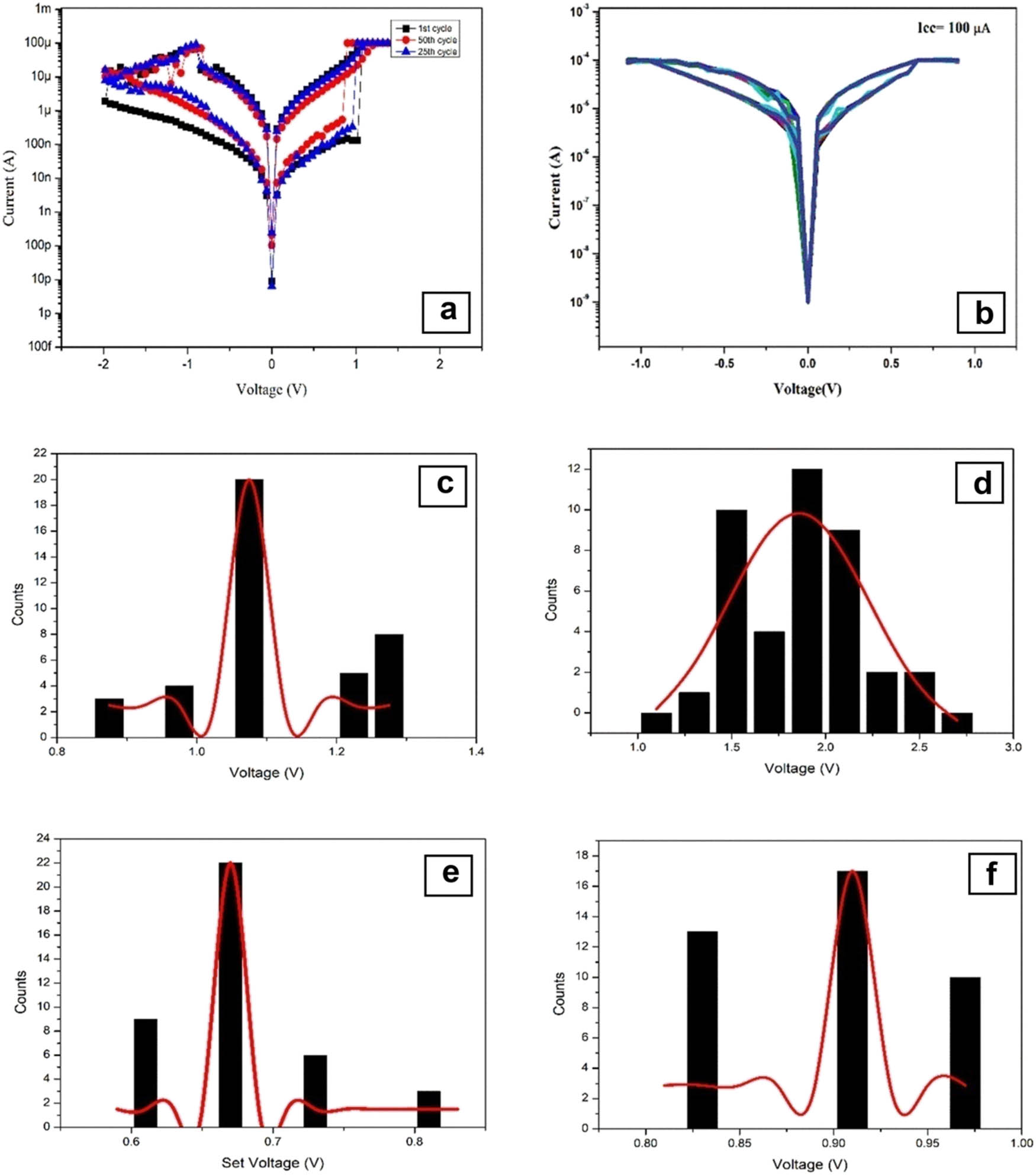
Figure 8
(a) Cycle-to-cycle variation in I–V characteristics of Pt/Al2O3/HfO2/TiN device, (b) cycle-to-cycle variation in I–V characteristics of the Pt/Al2O3/HfO2/Ti/TiN device, (c) and (d) SET and RESET voltage distribution of the Pt/Al2O3/HfO2/TiN device, and (e) and (f) SET and RESET voltage distribution of the Pt/Al2O3/HfO2/Ti/TiN device.
Table 1
Truth table for simulated logic gates.
| Inputs | Logic gates | |||||||||
|---|---|---|---|---|---|---|---|---|---|---|
| A | B | NOT | AND | OR | IMPLY | INHIBIT | NAND | NOR | XOR | XNOR |
| 0 | 0 | 1 | 0 | 0 | 0 | 1 | 1 | 1 | 0 | 1 |
| 0 | 1 | 1 | 0 | 1 | 1 | 1 | 1 | 0 | 1 | 0 |
| 1 | 0 | 0 | 0 | 1 | 0 | 0 | 1 | 0 | 1 | 0 |
| 1 | 1 | 0 | 1 | 1 | 0 | 1 | 0 | 0 | 0 | 1 |
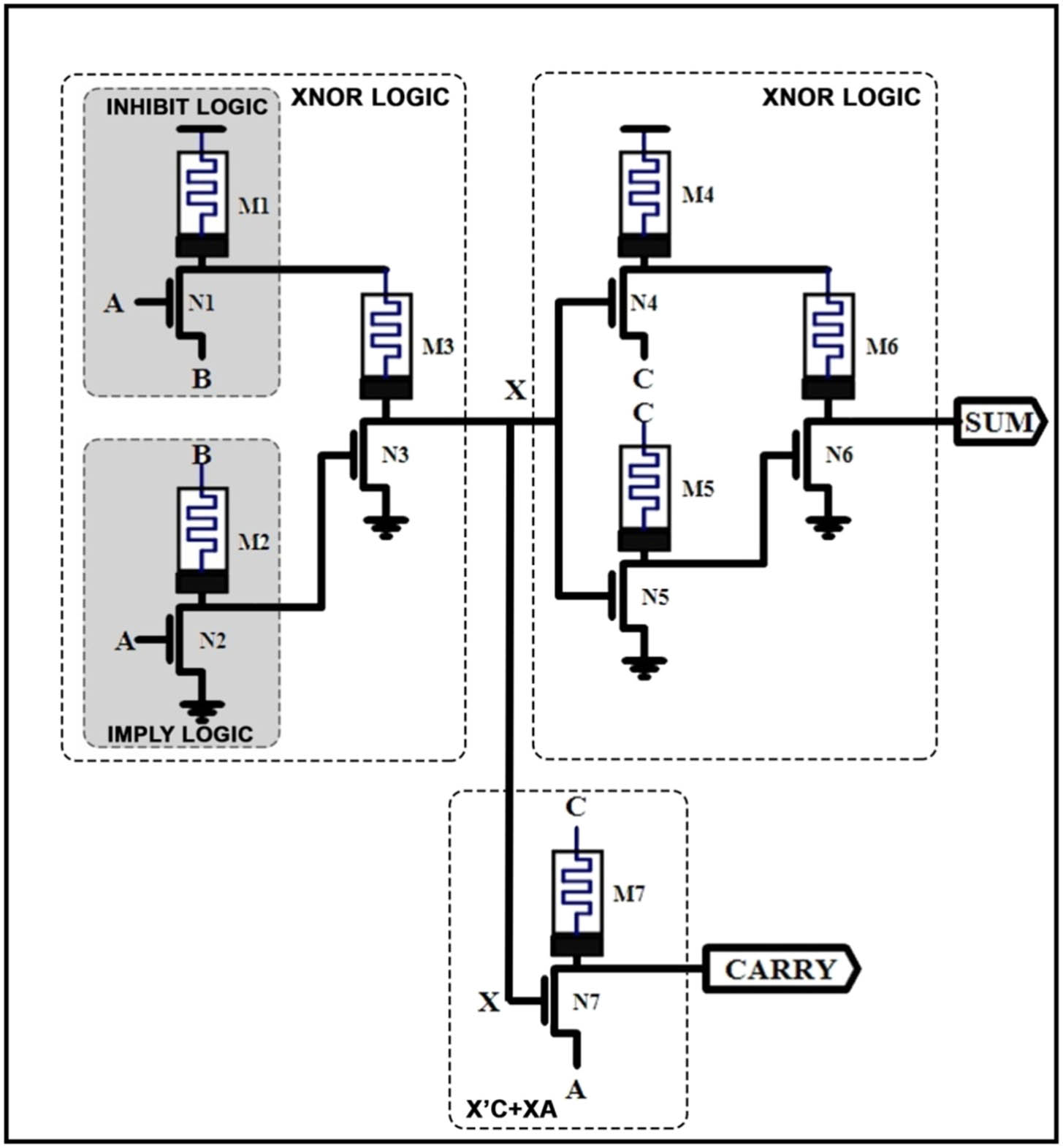
Figure 9
The circuit diagram for a 1-bit adder with a combination of inhibit, imply, and XNOR logic gates.
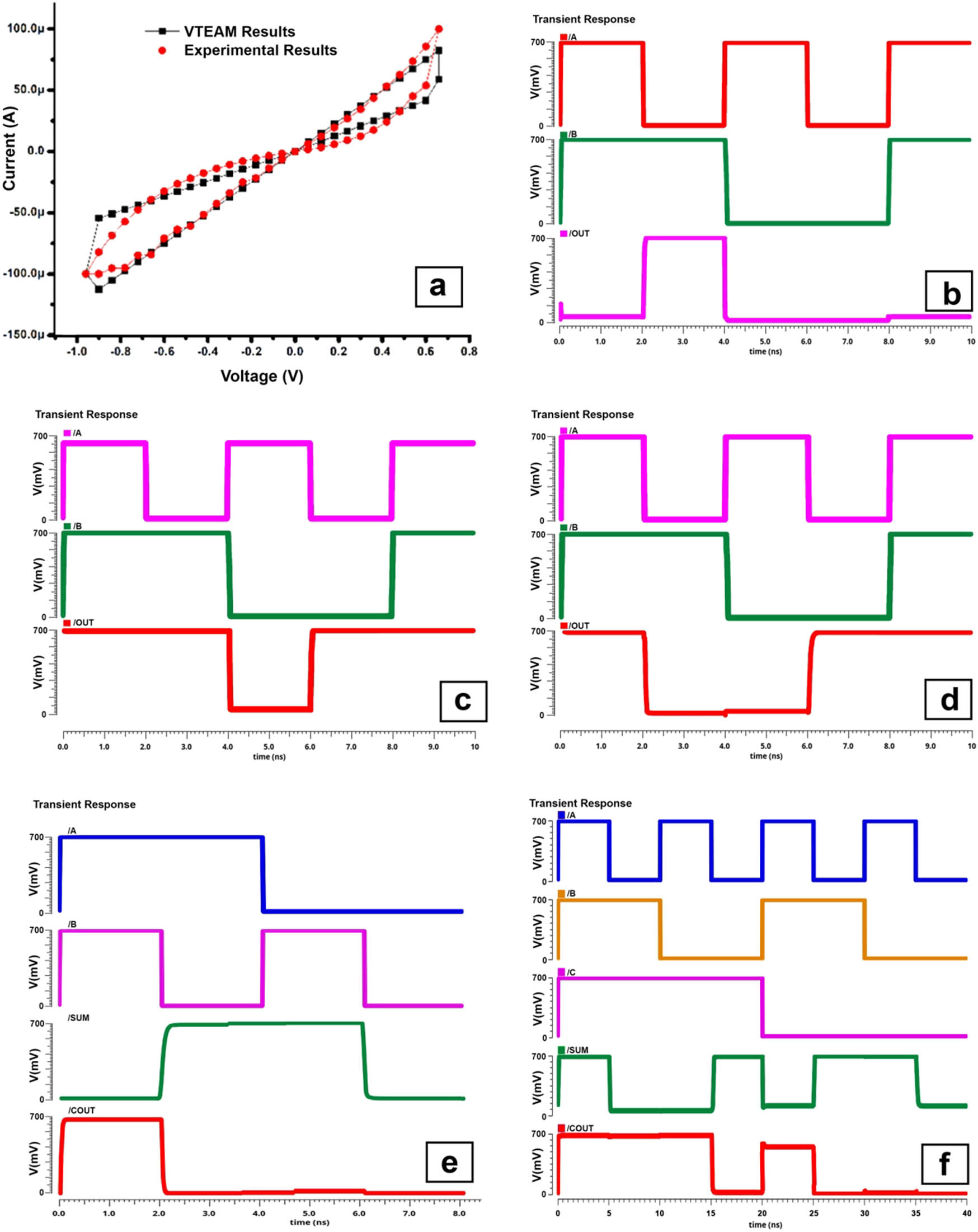
Figure 10
(a) Hysteresis curve of the simulation results superimposed on the experimental results, (b) simulated waveform of imply logic, (c) simulated waveform of inhibit logic, (d) simulated waveform of XNOR logic, (e) simulated waveform of half-adder, and (f) simulated waveform of full-adder.
Table 2
Comparison between proposed memristor-based logic circuits and other logic circuits.
| Function | Logic circuits | Component | Power (µW) | Delay (ps) |
|---|---|---|---|---|
| XOR | 1T2M-based logic [19] | 1T + 6R | 156 | 48.7 |
| Universal logic [20] | 2T + 2R + 1 resistor | 25.77 | 16.74 | |
| MeMOS logic [21] | 4T + 6R | 2.08 | 30.6 | |
| CMOS logic [22] | 8T + 2 inverter | 28.42 | 87.5 × 10³ | |
| Proposed logic | 4T + 4R | 1.955 | 25.6 | |
| XNOR | 1T2M-based logic | 1T + 6R | 168 | 51.7 |
| Universal logic | 2T + 2R + 1 resistor | 36.28 | — | |
| MeMOS logic | 4T + 6R | 2.41 | 31.11 | |
| Proposed logic | 3T + 3R | 1.182 | 23.68 | |
| NOT | 1T2M-based logic | 1T + 2R | 142 | 45.03 |
| MeMOS logic | 2T | 0.5 | 18.7 | |
| CMOS logic | 2T | 0.086 | 13.04 | |
| Proposed logic | 1T + 1R | 0.916 | 7.262 | |
| Half-adder | MeMOS logic | 8T + 8R | 8.07 | 98.05 |
| Proposed logic | 6T + 6R | 1.996 | 42.5 | |
| 1-bit Adder | 1T2M-based logic | 3T + 16R | 307 | 57.93 |
| Universal logic | 16T + 10R + 2 resistor | 134 | 69.3 | |
| MeMOS logic | 16T + 18R | 17.87 | 212.3 | |
| Proposed logic | 7T + 7R | 2.775 | 74.2 | |
| IMPLY | CMOS logic | 6T | 0.218 | 38.91 |
| Proposed logic | 1T + 1R | 0.463 | 7.221 | |
| INHIBIT | CMOS logic | 6T | 0.228 | 42.38 |
| Proposed logic | 1T + 1R | 0.45 | 13.49 |
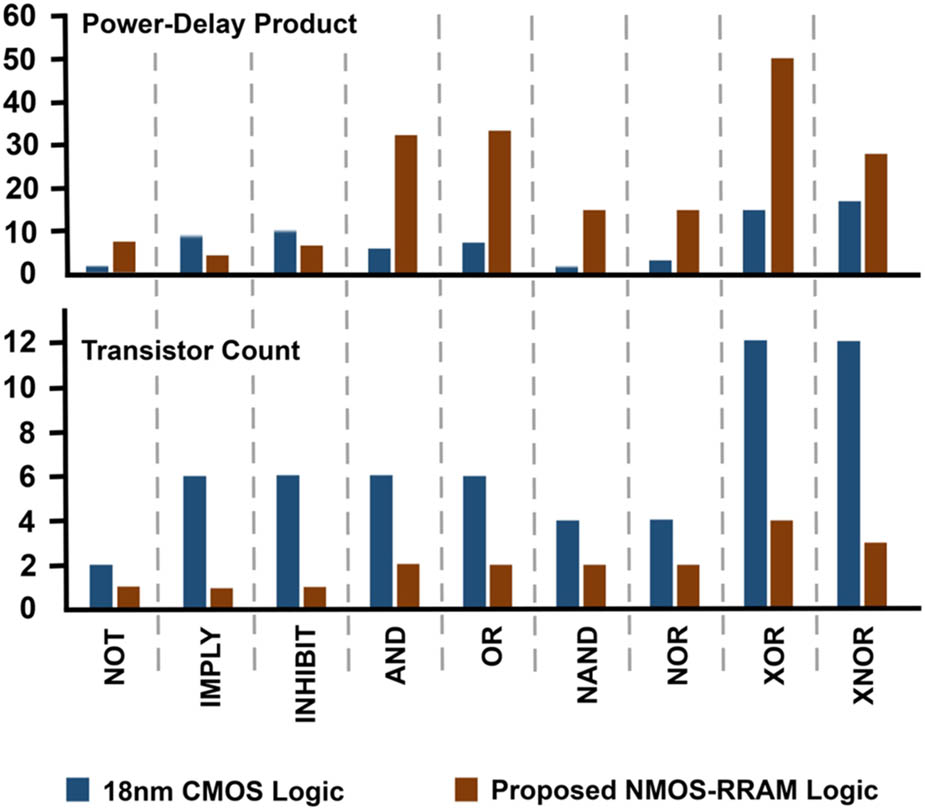
Figure 11
PDP and transistor count comparison between proposed logic style and CMOS logic style.