
Introduction
Pistachio (Pistacia vera L.), belonging to the Anacardiaceae family, is one of the most economically valuable nut crops cultivated in semi-arid regions worldwide (Ferrante et al., 2023). This xerophytic, dioecious tree species has been used by mankind for thousands of years, with evidence of consumption dating back approximately 300,000 years to Neanderthal populations (Ferrante et al., 2023). Native to southern Central Asia, including northern Afghanistan and northeastern Iran, the pistachio was domesticated approximately 3000 years ago in this region and subsequently spread to the Mediterranean basin during the Middle Ages, eventually reaching America and Australia at the end of the nineteenth century (Ferrante et al., 2023; Mir-Makhamad et al., 2022). Global pistachio production has demonstrated remarkable growth over the past decade, with world output reaching approximately 1.2 million metric tons in 2024, representing an average annual growth rate of 5.2% since 2013 (IndexBox, 2025). The United States, Iran, and Turkey collectively account for approximately 85% of global production, with the US leading at 538,000 tons, followed by Iran at 275,000 tons and Turkey at 208,000 tons (IndexBox, 2025). This substantial market presence underscores the crop's significant contribution to agricultural economies and international trade.
Central Asia represents a critically important region for pistachio genetic resources, as it is on the one hand the region of origin and on the other a region with a great diversity of P. vera (Khanazarov et al., 2009). Botanists have identified three distinct ecological pockets of wild pistachio populations across southern Central Asia: the northern Tian-Shan Region encompassing northwestern Kyrgyzstan, southern Kazakhstan, and Uzbekistan with approximately 30,000 hectares of forest; the central Pamir-Alay Region containing the majority of extant pistachio forests spanning Tajikistan, Uzbekistan, and Turkmenistan with approximately 150,000 hectares; and the southern Kopet Dag Region in southwestern Turkmenistan covering approximately 75,000 hectares (Mir-Makhamad et al., 2022). These wild populations represent remnants of previously extensive forests that covered over two million hectares during the Stone Age and possess substantial genetic diversity exhibiting tolerance to both heat and cold stress conditions (Khanazarov et al., 2009). However, the distribution and genetic diversity of both wild and domesticated pistachios have been declining due to increasing population pressure, climatic changes, and the monoculture of selected cultivars, resulting in the current world pistachio industry relying primarily on a very limited number of commercial cultivars and rootstocks (Ferrante et al., 2023). Consequently, the conservation and characterization of genetic resources from these primary diversity centers have become global priorities for ensuring the sustainable future of pistachio cultivation.
Kyrgyzstan, situated within the northern extent of the pistachio's natural range in the Tian-Shan Mountain system, harbors valuable genetic resources that have remained largely underexplored in international germplasm characterization efforts. The country's walnut-fruit forests, which extend over 333,000 hectares in southern Kyrgyzstan, include approximately 33,100 hectares of pistachio plantations that have developed under unique semi-arid conditions characterized by cold winters and hot, dry summers (Kenzhebaev et al., 2020). These populations represent an important gene pool with potential for selecting economically valuable forms that may exhibit quality characteristics comparable to established commercial cultivars while possessing enhanced adaptation to marginal environments (Bolotov and Kenzhebaev, 2022). The evaluation of pomological traits including fruit size, kernel weight, splitting percentage, and shell characteristics constitutes a fundamental approach for identifying superior genotypes suitable for domestication or germplasm conservation programs (Khadivi et al., 2019). Furthermore, the application of multi-trait selection indices enables objective and reproducible identification of elite genotypes by integrating morphometric, yield-related, and quality parameters into composite performance scores, thereby facilitating breeding decisions that balance commercial demands with biological relevance (Nikpeyma, 2024; Kakvand et al., 2025).
A comprehensive understanding of this genetic potential requires systematic evaluation through detailed morphometric and pomological analyses. In this context, the present study provides an essential framework for assessing the performance and variability of these locally adapted pistachio genotypes. The objectives of this study were as follows: (i) to conduct comprehensive pomological characterization of pistachio genotypes from an artificial orchard established in the Jalal-Abad Province of Kyrgyzstan under rainfed cultivation conditions; (ii) to evaluate morphometric traits, yield-related parameters, and quality attributes including fruit dimensions, kernel weight, splitting ratio, shell thickness, and color characteristics across two production years (2022 and 2024); (iii) to develop and apply a weighted Multi-Trait Selection Index (MTSI) incorporating standardized trait values weighted according to their commercial and biological importance; (iv) to identify superior genotypes exhibiting desirable characteristics for potential use in breeding programs, cultivar development, or germplasm conservation initiatives aimed at preserving genetic diversity within this naturally evolved population.
Materials and Methods
Plant Material and Sampling Procedures
This research was conducted in a pistachio orchard located near Kypchak-Talaa village, Nooken District, Jalal-Abad Province, Kyrgyzstan. The orchard was established in the 1980s by forestry personnel through terracing of hillsides and direct seed sowing at 6 × 2 m spacing intervals. However, due to livestock damage and drought conditions, tree spacing in some rows has extended up to 30 meters. The study area is situated at an elevation ranging from 716 to 806 meters above sea level, with geographic coordinates of 41°04'12"N and 72°21'22"E (Fig. 1). The region is characterized by a semi-arid climate with an annual precipitation of approximately 300 mm, with the lowest monthly rainfall occurring in July and August (2–5 mm). Temperature extremes range from a maximum of +45°C in August to a minimum of -12°C in January. Within the scope of this study, 64 hectares of the artificial pistachio orchard, representing 80% of the total plantation area, were surveyed. Approximately 10,000 trees, cultivated exclusively under rainfed conditions without supplemental irrigation, were systematically observed. Beginning in late July 2022, 88 trees exhibiting superior characteristics, including large fruit size and naturally split shells, were selected and marked for sample collection. Additionally, fruit samples were obtained from five female trees in a private orchard, which had been propagated from Iranian pistachio variety seeds in 2014. Among these trees, some commenced fruit production in their seventh year following germination, while others initiated bearing in their eighth or ninth years. Due to open pollination, considerable phenotypic variation was observed among the fruits of these trees. Consequently, a total of 93 pistachio genotypes were selected in 2022, and fruit samples were subjected to laboratory analysis. Following the evaluation of pomological data obtained in 2022, phenological observations of genotypes exhibiting superior characteristics were conducted during the spring of 2025. The intervening year gap in data collection was attributable to the alternate bearing (periodicity) phenomenon characteristic of pistachio trees. Subsequently, during late July to mid-August 2024, fruit samples were collected again from all 93 trees, and measurements were recorded. The mean values from both years (2022 and 2024) were calculated, and promising genotypes were identified through application of a Weighted Ranking System. Pomological evaluation included comprehensive morphometric and quality assessments of the following parameters: fruit length, thickness, and width (mm); in-shell weight (g); 100-nut weight (g); kernel color characteristics; splitting percentage (%); shell thickness (mm); kernel weight (g); and kernel ratio (%). These quantitative and qualitative evaluations were designed to identify genotypes with superior characteristics suitable for potential domestication or germplasm conservation, thereby contributing to the genetic improvement of pistachio cultivation in the region while preserving valuable genetic diversity present in this naturally evolved population (Fig. 2).
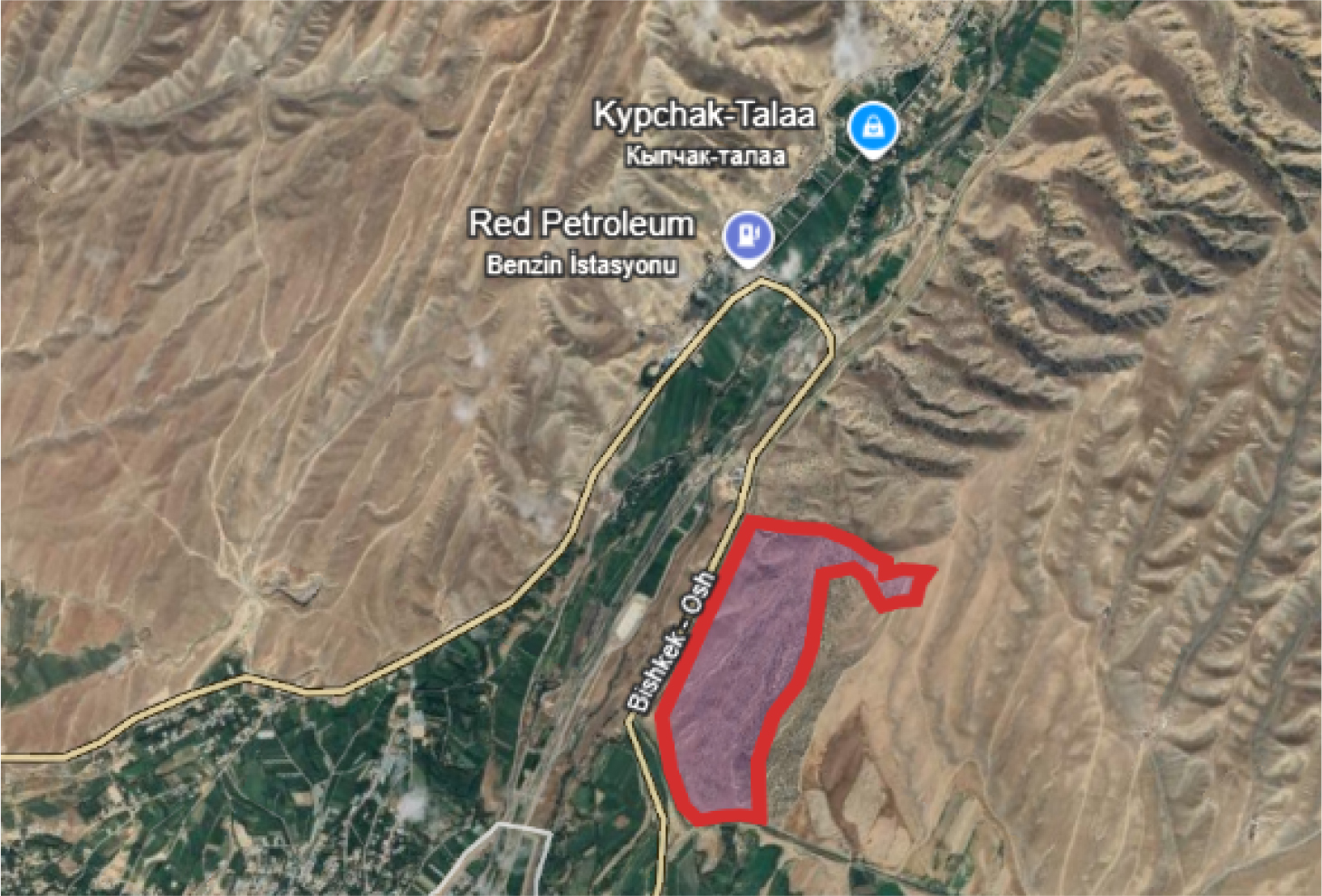
Fig. 1:
The research area is the artificial pistachio forest near the village of Kypchak-Talaa.
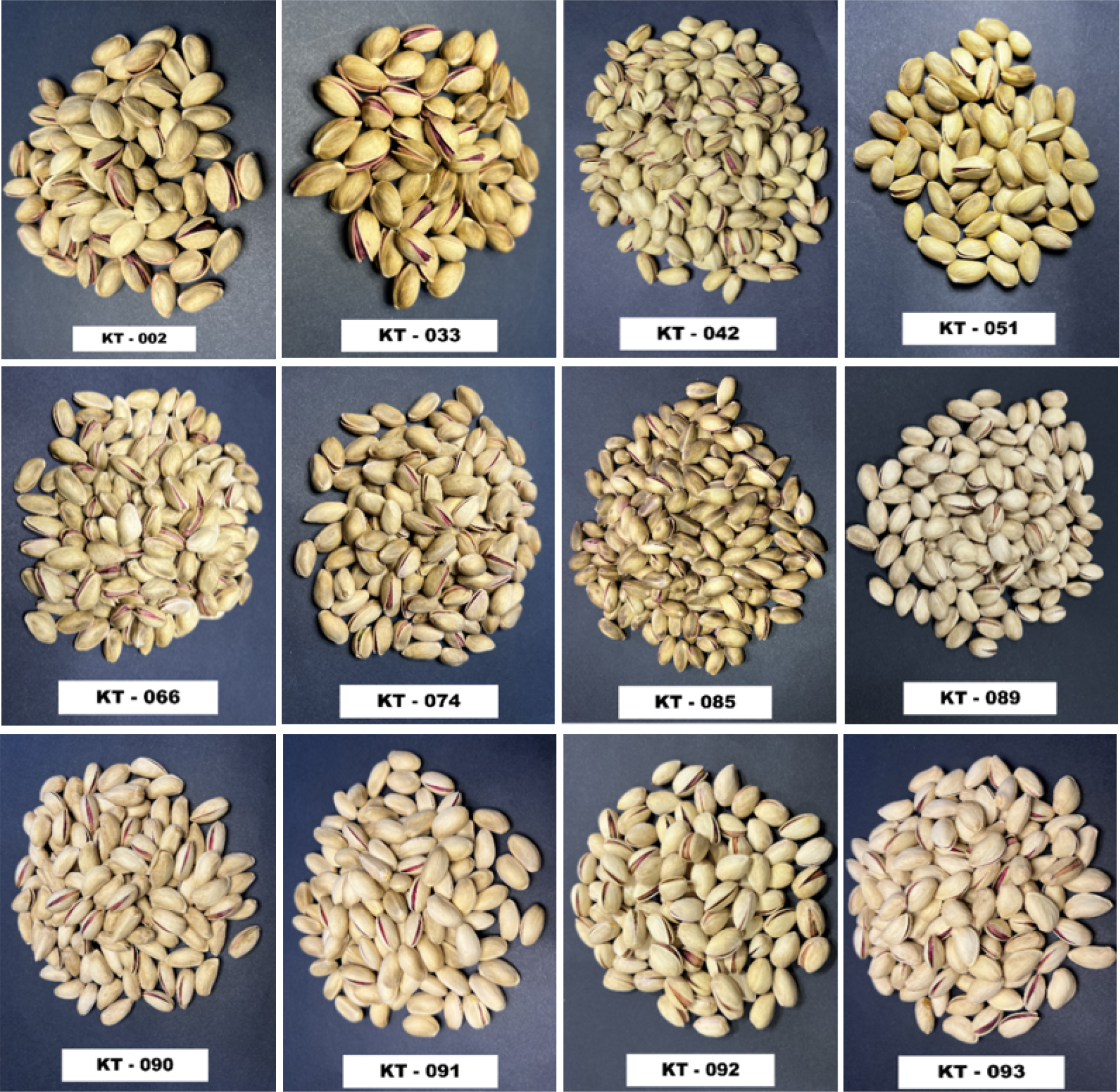
Fig. 2:
Representative nuts of the 12 superior pistachio genotypes (KT-002, KT-033, KT-042, KT-051, KT-066, KT-092, KT-074, KT-085, KT-089, KT-090, KT-091, and KT-093) identified through multivariate selection index analysis.
Genotype Selection Criteria Based on a Multi-Trait Selection Index (MTSI)
This study was conducted in 2022 and 2024, and due to the pronounced periodicity (alternation) characteristic of pistachio production, insufficient yield and fruit formation in 2023 prevented data collection for that year. Since no statistically significant year effect was detected for the traits evaluated between 2022 and 2024, phenotypic measurements from both years were pooled and jointly analyzed. The Multi-Trait Selection Index (MTSI) was constructed using mean values derived from the pooled dataset for each genotype, enabling a more reliable comparison by minimizing environmental variation. For all evaluations, measurements were performed on 30 randomly selected fruits per genotype. The index incorporated four major groups of traits representing commercial value and biological performance: (i) morphometric traits (fruit length, width, thickness, and volumetric size parameters); (ii) yield-related traits (fruit weight, kernel weight, and 100-fruit weight); (iii) processing and shell characteristics (splitting ratio, shell thickness, and kernel ratio); and (iv) quality attributes, including color parameters (L*, a*, b*) for both kernels and shells.
Standardization of Variables
Since the evaluated traits operate on different measurement scales, all variables were standardized prior to analysis using Z-scores to ensure comparability across traits. The standardization procedure was performed according to the following equation:
where x(i,j) is the value for genotype i in trait j, and μ(j) and σ(j) represent the population mean and standard deviation, respectively.Weighted Multi-Trait Selection Index
A weighted multi-trait selection index was subsequently computed to integrate the standardized trait values into a single composite score representing the overall performance of each genotype. The index was calculated using the following general formulation:
where MTSIi denotes the selection index value for genotype i, Z(i,j) is the standardized score of genotype i for trait j, wj represents the assigned weight for trait j based on its relative biological or commercial importance, and n is the total number of traits included in the index. Trait weights (wj) within the weighted Multi-Trait Selection Index were assigned based on established commercial demands and biological relevance for pistachio improvement. Kernel yield and kernel weight were given the highest emphasis, each assigned a weight of 0.20 due to their direct contribution to economic value. Nut size–related traits, including fruit length, width, thickness, and overall size index, were each weighted at 0.10, reflecting their importance in market classification and consumer preference. Shell thickness, which is generally undesirable when excessive, was assigned a negative weight of –0.10 to penalize genotypes with thicker shells. The splitting ratio, a key trait influencing processing efficiency and marketability, received a weight of 0.10. Quality-related color parameters were also incorporated: kernel color traits (L*, a*, b*) were collectively assigned a total weight of 0.05, with selection favoring lighter kernels (higher L* values) and lower a* and b* values; similarly, shell color parameters were assigned a total weight of 0.05, prioritizing lighter shell appearance. This weighting scheme ensured that the index appropriately reflected both commercial priorities and essential biological attributes.Selection Threshold and Identification of Superior Genotypes
Genotypes exhibiting superior multi-trait performance were identified using a statistically defined selection threshold based on the Selection Index (SI). Individuals with SI values within the top 15% of the population were selected for further evaluation, with the threshold calculated as SI > μ(SI) + 1.0σ(SI). In this study, the SI was constructed using Z-standardized trait values, resulting in a mean of 0.0 and a standard deviation of 0.876, yielding a selection threshold of 0.702. Genotypes exceeding this threshold consistently exhibited desirable characteristics, including large nut and kernel size, high kernel weight with favorable kernel ratio, acceptable splitting ratio, light and attractive kernel color (high L*, low a* and b*), and thin to moderately thick shells, reflecting superior overall commercial quality. The weighted multi-trait index used for selection combined individual standardized trait values according to their relative importance as follows:
Using this approach, selection was performed objectively and reproducibly by flagging genotypes with SI values exceeding the defined threshold, providing a biologically meaningful method to identify elite pistachio genotypes from the evaluated population.
Results
Pomological Characterization and Selection of Superior Pistachio Genotypes
In our results, size measurements demonstrated a wide range from 1.03 cm2 to 2.43 cm2, with KT-092 exhibiting exceptional performance at 2.43 cm2. This genotype was followed by KT-089 (2.27 cm2), and KT-091, KT-093 (1.97 cm2), all demonstrating superior dimensional characteristics. At the lower spectrum, KT-008 (1.03 cm2), KT-007 (1.06 cm2), KT-037 and KT-064 (1.12 cm2) represented the smallest genotypes. Length parameters ranged from 14.47 mm to 19.41 mm, with KT-090 achieving the maximum length (19.41 mm), closely followed by KT-002 (19.26 mm), KT-093 (19.21 mm), and KT-089 (19.07 mm). These top performers exceeded the population mean of 16.76 mm by approximately 13-15%. The shortest genotype, KT-038 (14.47 mm), was accompanied by KT-064 (14.48 mm) and KT-023 (14.49 mm) at the lower end. Thickness measurements showed KT-092 as the dominant genotype with 11.01 mm, followed by KT-025 (10.27 mm) and KT-089 (10.24 mm), substantially exceeding the average thickness of 8.66 mm by 27% and 18% respectively. The thinnest genotypes included KT-037 (7.13 mm), KT-008 (7.34 mm), and KT-056 (7.56 mm). Width measurements ranged from 8.21 mm to 11.82 mm, with KT-092 (11.82 mm), KT-089 (11.67 mm), and KT-052 (11.19 mm) demonstrating superior width characteristics, surpassing the mean of 9.77 mm by 20%, 19%, and 12% respectively. Nut-in-shell weight exhibited variation from 0.52 g to 0.97 g, with KT-089 recording the maximum at 0.97 g, representing a 45% increase over the average of 0.67 g. This was followed by KT-092 (0.94 g), KT-091 (0.93 g), and KT-042 (0.88 g). The lightest genotypes were KT-023 (0.52 g), KT-064 (0.53 g), and KT-083 (0.54 g). The 100-nut weight parameter showed even more pronounced differences, ranging from 48.25 g to 97.16 g. KT-089 led with 97.16 g, followed by KT-092 (95.19 g), KT-042 (91.65 g), and KT-091 (91.37 g), all exceeding the population mean by 35-91%. The lowest values were recorded in KT-083 (48.25 g), KT-023 (52.90 g), and KT-037 (53.40 g). Splitting ratio, a critical parameter for processing efficiency, ranged from 16.14% to 94.49%. KT-092 achieved the highest splitting ratio at 94.49%, followed by KT-033 (88.93%), KT-090 (88.68%), and KT-093 (88.00%), all demonstrating excellent processing characteristics. These genotypes exceeded the population mean of approximately 69.13% by 15-24%. The lowest splitting ratios were observed in KT-069 (16.14%), KT-061 (17.10%), and KT-005 (27.00%), indicating potential processing difficulties. Shell thickness varied from 0.54 mm to 0.93 mm, with KT-067 showing the maximum thickness (0.93 mm), while KT-003 exhibited the minimum at 0.54 mm. Thinner shells are generally preferred for ease of kernel extraction, positioning KT-092 and KT-089 as advantageous genotypes for commercial processing (Tab. 1).
Tab. 1:
Morphological, yield, quality, and selection index traits of evaluated pistachio genotypes, including genotypes selected based on the Multi-Trait Selection Index
| Name | Length (mm) | Thickness (mm) | Width (mm) | Size (cm2) | Nut-in-Shell Weight (g) | 100-Nut Weight (g) | Splitting Ratio (%) | Shell Thickness (mm) | Kernel Weight (g) | Kernel Ratio (%) | Kernel Color L | Kernel Color a | Kernel Color b | Shell Color L | Shell Color a | Shell Color b | Selection Index | SI > 0.702 |
|---|---|---|---|---|---|---|---|---|---|---|---|---|---|---|---|---|---|---|
| KT-092 | 18.63 | 11.01 | 11.82 | 2.43 | 0.94 | 95.19 | 94.49 | 0.66 | 0.48 | 51.13 | 22.91 | 7.65 | 2.80 | 23.54 | 6.05 | 2.90 | 1.84 | Selected |
| KT-089 | 19.07 | 10.24 | 11.67 | 2.27 | 0.97 | 97.16 | 85.55 | 0.66 | 0.48 | 49.17 | 25.93 | 5.03 | 5.32 | 24.41 | 6.07 | 1.98 | 1.60 | Selected |
| KT-042 | 17.63 | 10.11 | 10.78 | 1.93 | 0.88 | 91.65 | 79.95 | 0.80 | 0.43 | 49.12 | 49.94 | 10.24 | 0.29 | 22.06 | 7.36 | 1.55 | 1.55 | Selected |
| KT-085 | 18.03 | 8.65 | 9.89 | 1.54 | 0.78 | 85.34 | 80.60 | 0.67 | 0.42 | 52.94 | 25.71 | 4.29 | 5.48 | 25.15 | 6.73 | 4.28 | 1.07 | Selected |
| KT-093 | 19.21 | 9.27 | 11.07 | 1.97 | 0.83 | 80.64 | 88.00 | 0.62 | 0.44 | 53.41 | 21.71 | 6.19 | 1.05 | 20.03 | 6.15 | 0.41 | 1.04 | Selected |
| KT-074 | 17.90 | 8.84 | 10.24 | 1.62 | 0.77 | 77.08 | 84.50 | 0.71 | 0.39 | 51.00 | 23.16 | 5.12 | 4.49 | 21.50 | 6.23 | 1.92 | 0.99 | Selected |
| KT-090 | 19.41 | 9.40 | 9.91 | 1.81 | 0.79 | 82.04 | 88.68 | 0.57 | 0.44 | 56.40 | 22.67 | 5.72 | 2.06 | 21.88 | 6.33 | 0.65 | 0.99 | Selected |
| KT-002 | 19.26 | 8.10 | 10.19 | 1.59 | 0.76 | 75.00 | 82.97 | 0.79 | 0.39 | 50.35 | 37.75 | 2.81 | 14.57 | 42.12 | 7.90 | 12.67 | 0.90 | Selected |
| KT-091 | 18.87 | 9.43 | 11.06 | 1.97 | 0.93 | 91.37 | 78.30 | 0.68 | 0.48 | 51.98 | 20.82 | 6.25 | 0.59 | 25.62 | 5.84 | 3.05 | 0.86 | Selected |
| KT-033 | 17.24 | 9.86 | 10.03 | 1.70 | 0.76 | 75.35 | 88.93 | 0.79 | 0.38 | 49.71 | 20.72 | 5.11 | 1.44 | 21.54 | 5.92 | 1.80 | 0.81 | Selected |
| KT-066 | 17.41 | 8.56 | 10.12 | 1.51 | 0.79 | 80.87 | 85.20 | 0.62 | 0.39 | 49.36 | 27.67 | 4.93 | 7.26 | 31.42 | 6.37 | 7.32 | 0.77 | Selected |
| KT-051 | 16.50 | 9.06 | 10.12 | 1.52 | 0.73 | 73.89 | 80.61 | 0.70 | 0.38 | 51.69 | 40.69 | 1.78 | 18.77 | 42.73 | 7.27 | 15.02 | 0.73 | Selected |
| KT-032 | 18.23 | 9.43 | 10.18 | 1.75 | 0.78 | 77.70 | 60.70 | 0.75 | 0.37 | 48.37 | 18.63 | 6.86 | 4.24 | 37.67 | 7.05 | 13.99 | 0.68 | NS |
| KT-070 | 16.95 | 9.79 | 10.82 | 1.78 | 0.70 | 70.97 | 66.80 | 0.72 | 0.36 | 50.79 | 17.43 | 11.35 | 2.90 | 41.97 | 6.91 | 13.11 | 0.67 | NS |
| KT-021 | 18.93 | 9.33 | 9.87 | 1.66 | 0.72 | 69.98 | 59.86 | 0.78 | 0.33 | 46.08 | 15.82 | 5.92 | 1.17 | 34.42 | 6.76 | 12.79 | 0.61 | NS |
| KT-052 | 16.19 | 8.39 | 11.19 | 1.51 | 0.68 | 67.35 | 55.95 | 0.63 | 0.31 | 45.01 | 38.46 | 2.28 | 17.74 | 44.20 | 6.07 | 14.01 | 0.56 | NS |
| KT-018 | 18.12 | 9.11 | 10.13 | 1.67 | 0.79 | 79.99 | 75.41 | 0.83 | 0.37 | 47.38 | 15.40 | 5.31 | 0.97 | 63.99 | 6.63 | 13.09 | 0.55 | NS |
| KT-047 | 16.61 | 9.19 | 10.93 | 1.67 | 0.69 | 68.95 | 40.90 | 0.74 | 0.31 | 44.41 | 20.80 | 5.61 | 2.25 | 19.88 | 5.02 | -0.31 | 0.46 | NS |
| KT-017 | 17.87 | 8.88 | 10.37 | 1.65 | 0.73 | 71.50 | 54.88 | 0.85 | 0.31 | 41.72 | 15.90 | 5.92 | 1.34 | 37.40 | 6.57 | 10.72 | 0.43 | NS |
| KT-050 | 17.79 | 8.44 | 9.49 | 1.42 | 0.69 | 68.40 | 79.42 | 0.69 | 0.37 | 53.67 | 19.09 | 6.09 | 0.03 | 19.58 | 5.49 | 0.04 | 0.42 | NS |
| KT-035 | 16.96 | 9.49 | 10.38 | 1.67 | 0.71 | 70.90 | 27.80 | 0.80 | 0.34 | 48.03 | 21.16 | 6.11 | 2.55 | 25.69 | 7.51 | 5.25 | 0.37 | NS |
| KT-030 | 17.84 | 8.66 | 10.51 | 1.63 | 0.74 | 74.26 | 57.37 | 0.73 | 0.36 | 48.20 | 14.94 | 5.75 | 0.21 | 39.12 | 6.52 | 11.51 | 0.36 | NS |
| KT-013 | 16.82 | 8.71 | 9.41 | 1.38 | 0.65 | 63.55 | 57.71 | 0.82 | 0.29 | 45.19 | 16.15 | 6.72 | 1.83 | 39.95 | 7.22 | 13.16 | 0.35 | NS |
| KT-031 | 15.21 | 9.80 | 10.29 | 1.54 | 0.74 | 72.41 | 78.27 | 0.90 | 0.32 | 43.93 | 23.13 | 5.81 | 7.89 | 38.62 | 7.40 | 12.90 | 0.34 | NS |
| KT-077 | 16.93 | 8.83 | 9.15 | 1.37 | 0.67 | 67.58 | 48.94 | 0.75 | 0.30 | 44.47 | 40.76 | 1.93 | 20.76 | 39.46 | 6.16 | 14.87 | 0.33 | NS |
| KT-011 | 15.40 | 9.45 | 10.31 | 1.50 | 0.71 | 69.71 | 77.85 | 0.74 | 0.35 | 49.24 | 39.73 | 1.60 | 19.94 | 42.73 | 6.98 | 14.73 | 0.33 | NS |
| KT-038 | 14.47 | 8.96 | 9.34 | 1.22 | 0.69 | 59.52 | 79.30 | 0.76 | 0.32 | 45.94 | 22.31 | 5.76 | 3.60 | 24.08 | 6.04 | 3.75 | 0.33 | NS |
| KT-027 | 17.84 | 8.47 | 9.45 | 1.43 | 0.65 | 65.33 | 74.60 | 0.67 | 0.37 | 56.53 | 42.33 | 1.38 | 23.82 | 43.16 | 10.03 | 12.17 | 0.32 | NS |
| KT-053 | 17.62 | 8.45 | 9.56 | 1.43 | 0.70 | 70.25 | 79.33 | 0.79 | 0.33 | 46.48 | 40.83 | 1.50 | 18.17 | 40.23 | 6.85 | 12.93 | 0.32 | NS |
| KT-078 | 17.44 | 8.79 | 9.97 | 1.53 | 0.63 | 70.09 | 37.40 | 0.83 | 0.33 | 31.84 | 41.86 | 4.35 | 22.94 | 39.56 | 7.63 | 15.01 | 0.29 | NS |
| KT-059 | 15.62 | 8.50 | 9.79 | 1.30 | 0.63 | 62.73 | 75.22 | 0.83 | 0.31 | 25.96 | 39.73 | 1.88 | 19.39 | 43.99 | 6.60 | 13.20 | 0.28 | NS |
| KT-028 | 16.52 | 8.86 | 10.01 | 1.47 | 0.70 | 69.31 | 75.18 | 0.80 | 0.33 | 46.99 | 41.41 | 6.73 | 22.23 | 37.24 | 7.27 | 12.63 | 0.28 | NS |
| KT-025 | 15.97 | 10.27 | 8.69 | 1.44 | 0.58 | 56.16 | 70.29 | 0.71 | 0.30 | 51.64 | 41.66 | 2.10 | 23.08 | 40.24 | 6.70 | 13.52 | 0.28 | NS |
| KT-073 | 17.29 | 8.58 | 10.22 | 1.52 | 0.70 | 70.11 | 71.97 | 0.77 | 0.35 | 50.41 | 15.76 | 7.07 | 2.66 | 42.55 | 5.72 | 13.24 | 0.28 | NS |
| KT-029 | 17.97 | 8.46 | 9.34 | 1.42 | 0.72 | 72.90 | 76.37 | 0.75 | 0.31 | 43.56 | 37.24 | 2.18 | 21.86 | 41.84 | 6.15 | 12.80 | 0.28 | NS |
| KT-016 | 15.84 | 8.81 | 8.77 | 1.23 | 0.57 | 57.34 | 76.36 | 0.70 | 0.30 | 53.39 | 15.25 | 5.23 | 0.77 | 43.05 | 7.07 | 13.11 | 0.22 | NS |
| KT-065 | 15.40 | 8.51 | 9.48 | 1.24 | 0.62 | 60.67 | 79.74 | 0.75 | 0.31 | 50.07 | 25.93 | 6.37 | 10.52 | 41.72 | 7.26 | 13.15 | 0.19 | NS |
| KT-049 | 16.64 | 9.22 | 9.16 | 1.41 | 0.67 | 65.85 | 75.65 | 0.65 | 0.36 | 53.87 | 19.09 | 6.09 | 0.03 | 19.58 | 5.49 | 0.04 | 0.18 | NS |
| KT-071 | 16.34 | 8.12 | 9.89 | 1.31 | 0.63 | 62.90 | 73.54 | 0.77 | 0.30 | 47.65 | 25.17 | 5.12 | 3.72 | 24.50 | 7.37 | 11.82 | 0.17 | NS |
| KT-036 | 16.35 | 9.64 | 10.54 | 1.66 | 0.75 | 73.87 | 78.31 | 0.84 | 0.35 | 47.43 | 24.91 | 5.39 | 6.25 | 22.63 | 6.29 | 2.37 | 0.17 | NS |
| KT-057 | 16.09 | 8.43 | 9.15 | 1.24 | 0.61 | 58.65 | 71.46 | 0.70 | 0.33 | 26.74 | 42.39 | 1.69 | 19.80 | 41.70 | 7.41 | 14.62 | 0.17 | NS |
| KT-015 | 17.87 | 8.78 | 9.37 | 1.48 | 0.70 | 67.92 | 74.24 | 0.72 | 0.33 | 47.20 | 14.69 | 4.61 | 0.05 | 41.87 | 7.02 | 14.10 | 0.12 | NS |
| KT-044 | 17.06 | 7.94 | 9.97 | 1.36 | 0.63 | 63.70 | 78.20 | 0.76 | 0.31 | 50.08 | 24.15 | 4.88 | 3.68 | 20.51 | 5.16 | 0.15 | 0.11 | NS |
| KT-088 | 16.51 | 8.77 | 9.77 | 1.42 | 0.64 | 57.67 | 80.90 | 0.64 | 0.31 | 49.17 | 39.15 | 1.56 | 20.57 | 39.21 | 7.55 | 14.97 | 0.11 | NS |
| KT-006 | 15.80 | 8.55 | 9.46 | 1.28 | 0.60 | 60.27 | 74.97 | 0.74 | 0.30 | 50.91 | 40.11 | 2.02 | 18.64 | 37.31 | 7.05 | 11.65 | 0.09 | NS |
| KT-020 | 16.85 | 9.03 | 9.63 | 1.46 | 0.66 | 64.71 | 82.15 | 0.73 | 0.32 | 48.29 | 16.90 | 6.10 | 2.36 | 40.12 | 6.73 | 12.60 | 0.08 | NS |
| KT-012 | 15.32 | 9.11 | 9.63 | 1.35 | 0.64 | 62.15 | 60.78 | 0.74 | 0.30 | 47.22 | 40.84 | 1.44 | 19.70 | 41.02 | 6.82 | 13.06 | 0.07 | NS |
| KT-046 | 16.44 | 8.88 | 9.86 | 1.44 | 0.66 | 66.68 | 80.80 | 0.75 | 0.33 | 50.12 | 21.07 | 5.64 | 1.43 | 20.34 | 5.58 | 0.32 | 0.07 | NS |
| KT-014 | 17.44 | 8.57 | 9.25 | 1.38 | 0.67 | 65.96 | 74.50 | 0.71 | 0.34 | 50.20 | 17.58 | 7.80 | 3.37 | 43.84 | 6.46 | 14.27 | 0.07 | NS |
| KT-063 | 16.37 | 8.98 | 9.39 | 1.39 | 0.63 | 64.70 | 80.95 | 0.63 | 0.34 | 54.21 | 42.66 | 1.77 | 21.18 | 46.52 | 5.77 | 14.16 | 0.05 | NS |
| KT-003 | 16.26 | 8.31 | 9.59 | 1.29 | 0.59 | 58.50 | 77.67 | 0.54 | 0.30 | 50.70 | 29.60 | 4.29 | 12.64 | 41.42 | 6.87 | 12.70 | 0.04 | NS |
| KT-076 | 15.90 | 8.47 | 10.07 | 1.36 | 0.64 | 63.48 | 72.50 | 0.75 | 0.32 | 50.56 | 41.81 | 2.03 | 22.51 | 61.42 | 6.87 | 15.02 | 0.03 | NS |
| KT-054 | 17.68 | 9.99 | 11.14 | 1.96 | 0.71 | 73.45 | 45.70 | 0.86 | 0.35 | 50.15 | 39.88 | 1.81 | 16.72 | 44.51 | 7.70 | 19.05 | 0.02 | NS |
| KT-034 | 17.96 | 8.28 | 10.49 | 1.56 | 0.65 | 65.88 | 33.75 | 0.70 | 0.34 | 52.42 | 19.84 | 6.28 | -0.79 | 26.38 | 7.17 | 5.39 | 0.01 | NS |
| KT-010 | 15.93 | 8.54 | 9.72 | 1.33 | 0.62 | 58.38 | 68.93 | 0.82 | 0.29 | 46.55 | 14.56 | 5.07 | -0.16 | 41.67 | 6.98 | 14.52 | 0.01 | NS |
| KT-009 | 15.66 | 8.57 | 10.66 | 1.43 | 0.71 | 68.85 | 67.41 | 0.76 | 0.36 | 50.29 | 16.68 | 6.93 | 2.04 | 42.57 | 7.12 | 13.31 | 0.01 | NS |
| KT-081 | 15.06 | 8.42 | 10.31 | 1.31 | 0.68 | 67.70 | 80.80 | 0.77 | 0.33 | 48.70 | 41.63 | 1.96 | 22.46 | 41.14 | 6.08 | 14.47 | 0.00 | NS |
| KT-087 | 16.79 | 7.78 | 9.05 | 1.18 | 0.59 | 58.98 | 70.17 | 0.68 | 0.30 | 51.34 | 41.44 | 1.89 | 23.24 | 41.50 | 7.05 | 15.39 | 0.00 | NS |
| KT-082 | 17.14 | 7.94 | 9.19 | 1.25 | 0.61 | 68.03 | 78.80 | 0.70 | 0.31 | 50.23 | 40.38 | 1.88 | 22.48 | 39.08 | 7.06 | 15.06 | -0.03 | NS |
| KT-084 | 16.70 | 8.28 | 9.37 | 1.30 | 0.60 | 62.72 | 85.80 | 0.85 | 0.30 | 50.68 | 39.68 | 1.87 | 21.94 | 38.91 | 7.05 | 15.88 | -0.05 | NS |
| KT-048 | 15.84 | 8.92 | 9.25 | 1.31 | 0.66 | 61.40 | 84.05 | 0.75 | 0.30 | 45.05 | 23.60 | 6.07 | 3.43 | 19.62 | 5.14 | -0.28 | -0.05 | NS |
| KT-045 | 16.92 | 8.46 | 9.39 | 1.35 | 0.65 | 65.63 | 73.30 | 0.77 | 0.30 | 46.87 | 43.98 | 5.34 | 2.11 | 19.26 | 5.89 | 0.67 | -0.08 | NS |
| KT-022 | 16.86 | 8.67 | 9.87 | 1.44 | 0.70 | 67.28 | 53.63 | 0.75 | 0.31 | 45.17 | 31.28 | 3.43 | 16.51 | 42.29 | 9.95 | 14.15 | -0.09 | NS |
| KT-041 | 16.08 | 8.25 | 9.91 | 1.33 | 0.63 | 61.85 | 85.00 | 0.71 | 0.28 | 45.56 | 19.39 | 5.12 | -0.55 | 15.36 | 4.61 | -0.80 | -0.10 | NS |
| KT-072 | 18.23 | 7.85 | 8.21 | 1.18 | 0.55 | 53.43 | 38.98 | 0.65 | 0.30 | 54.56 | 16.78 | 6.98 | 2.23 | 43.81 | 6.52 | 14.75 | -0.11 | NS |
| KT-019 | 15.66 | 9.16 | 9.52 | 1.37 | 0.62 | 60.68 | 64.54 | 0.69 | 0.32 | 51.66 | 15.44 | 5.92 | 1.07 | 38.62 | 7.35 | 12.01 | -0.11 | NS |
| KT-001 | 17.13 | 8.42 | 9.78 | 1.41 | 0.72 | 72.54 | 73.57 | 0.73 | 0.38 | 52.01 | 51.96 | 4.07 | 34.71 | 40.07 | 6.52 | 11.77 | -0.12 | NS |
| KT-026 | 16.87 | 8.21 | 9.16 | 1.27 | 0.59 | 59.13 | 71.61 | 0.81 | 0.27 | 45.95 | 37.54 | 4.27 | 23.26 | 43.86 | 6.44 | 13.44 | -0.15 | NS |
| KT-060 | 17.58 | 8.19 | 8.96 | 1.29 | 0.63 | 62.70 | 78.00 | 0.72 | 0.30 | 47.98 | 41.85 | 1.51 | 20.05 | 39.30 | 7.00 | 11.97 | -0.16 | NS |
| KT-055 | 17.60 | 8.50 | 8.97 | 1.34 | 0.62 | 62.49 | 87.01 | 0.56 | 0.36 | 57.26 | 42.74 | 1.10 | 20.09 | 44.04 | 6.29 | 13.73 | -0.16 | NS |
| KT-075 | 15.68 | 7.74 | 9.65 | 1.19 | 0.54 | 53.54 | 72.14 | 0.79 | 0.27 | 49.96 | 39.86 | 3.61 | 22.08 | 40.56 | 12.28 | 16.34 | -0.18 | NS |
| KT-069 | 14.63 | 9.46 | 10.21 | 1.42 | 0.58 | 60.05 | 16.14 | 0.81 | 0.29 | 49.79 | 15.23 | 5.88 | 0.94 | 44.65 | 6.67 | 14.90 | -0.19 | NS |
| KT-080 | 14.96 | 8.80 | 9.94 | 1.31 | 0.68 | 66.87 | 78.50 | 0.84 | 0.31 | 45.39 | 41.39 | 3.06 | 23.06 | 39.71 | 7.77 | 15.86 | -0.20 | NS |
| KT-067 | 16.08 | 8.14 | 9.77 | 1.29 | 0.62 | 64.73 | 78.46 | 0.93 | 0.27 | 45.19 | 20.98 | 8.21 | 6.42 | 45.27 | 7.26 | 13.96 | -0.20 | NS |
| KT-040 | 17.24 | 8.59 | 9.59 | 1.42 | 0.65 | 63.82 | 41.55 | 0.66 | 0.34 | 52.88 | 19.34 | 5.41 | -0.66 | 19.93 | 5.26 | -0.68 | -0.20 | NS |
| KT-007 | 15.25 | 7.95 | 8.72 | 1.06 | 0.63 | 62.36 | 78.37 | 0.83 | 0.28 | 43.68 | 15.56 | 6.36 | 1.49 | 43.17 | 6.76 | 13.33 | -0.20 | NS |
| KT-061 | 16.20 | 7.86 | 8.76 | 1.12 | 0.59 | 58.66 | 17.10 | 0.71 | 0.30 | 50.59 | 42.39 | 2.28 | 20.10 | 41.33 | 7.74 | 12.78 | -0.21 | NS |
| KT-062 | 16.17 | 8.44 | 10.16 | 1.39 | 0.63 | 63.78 | 48.50 | 0.84 | 0.32 | 51.11 | 37.98 | 1.80 | 17.97 | 43.74 | 6.99 | 12.95 | -0.24 | NS |
| KT-086 | 16.44 | 8.01 | 9.18 | 1.21 | 0.63 | 58.93 | 67.90 | 0.72 | 0.30 | 48.77 | 40.68 | 2.75 | 21.99 | 35.47 | 10.39 | 14.14 | -0.25 | NS |
| KT-079 | 18.40 | 8.61 | 9.73 | 1.69 | 0.66 | 60.36 | 82.01 | 0.76 | 0.35 | 53.23 | 40.46 | 1.80 | 22.39 | 42.50 | 6.53 | 15.90 | -0.25 | NS |
| KT-024 | 15.42 | 8.64 | 9.57 | 1.27 | 0.60 | 59.18 | 74.32 | 0.71 | 0.31 | 51.16 | 41.65 | 4.33 | 23.39 | 40.04 | 6.58 | 13.50 | -0.25 | NS |
| KT-039 | 15.79 | 7.98 | 9.34 | 1.20 | 0.58 | 57.25 | 71.50 | 0.83 | 0.29 | 53.90 | 20.71 | 5.78 | 2.25 | 21.77 | 7.48 | 3.65 | -0.29 | NS |
| KT-056 | 16.03 | 7.56 | 9.78 | 1.19 | 0.57 | 57.57 | 77.05 | 0.70 | 0.27 | 24.53 | 44.48 | 2.65 | 21.29 | 37.61 | 7.65 | 13.08 | -0.29 | NS |
| KT-068 | 16.42 | 7.91 | 9.34 | 1.22 | 0.55 | 56.52 | 42.67 | 0.72 | 0.30 | 54.13 | 17.75 | 7.55 | 3.43 | 42.89 | 6.50 | 13.51 | -0.30 | NS |
| KT-008 | 16.76 | 7.34 | 8.39 | 1.03 | 0.64 | 55.74 | 78.38 | 0.74 | 0.30 | 46.15 | 15.70 | 6.16 | 1.10 | 41.82 | 6.59 | 13.35 | -0.31 | NS |
| KT-004 | 16.24 | 7.76 | 9.25 | 1.17 | 0.56 | 55.65 | 80.94 | 0.68 | 0.26 | 47.86 | 35.49 | 1.81 | 16.61 | 42.68 | 6.49 | 13.28 | -0.32 | NS |
| KT-005 | 16.39 | 7.98 | 9.90 | 1.29 | 0.55 | 56.70 | 27.00 | 0.67 | 0.26 | 47.28 | 32.21 | 2.48 | 14.77 | 42.04 | 7.65 | 15.02 | -0.34 | NS |
| KT-058 | 16.19 | 7.99 | 9.12 | 1.19 | 0.59 | 59.64 | 77.22 | 0.74 | 0.30 | 25.34 | 43.09 | 2.88 | 20.57 | 40.16 | 7.43 | 13.57 | -0.42 | NS |
| KT-043 | 16.42 | 8.60 | 9.55 | 1.35 | 0.67 | 65.35 | 43.85 | 0.90 | 0.28 | 42.09 | 19.81 | 5.91 | 0.15 | 18.68 | 5.00 | -0.65 | -0.44 | NS |
| KT-037 | 17.71 | 7.13 | 8.85 | 1.12 | 0.54 | 53.40 | 76.00 | 0.65 | 0.27 | 49.70 | 21.53 | 5.96 | 2.85 | 22.47 | 7.21 | 2.69 | -0.47 | NS |
| KT-064 | 14.48 | 7.94 | 9.29 | 1.12 | 0.68 | 67.29 | 44.15 | 0.76 | 0.31 | 45.41 | 42.51 | 0.76 | 20.26 | 41.51 | 7.40 | 11.34 | -0.49 | NS |
| KT-023 | 14.49 | 8.23 | 9.34 | 1.14 | 0.52 | 52.90 | 87.20 | 0.74 | 0.27 | 50.96 | 35.40 | 4.79 | 21.16 | 41.31 | 6.90 | 13.29 | -0.49 | NS |
| KT-083 | 15.77 | 8.15 | 9.07 | 1.16 | 0.54 | 48.25 | 83.00 | 0.73 | 0.28 | 52.61 | 40.54 | 1.51 | 21.83 | 40.17 | 7.19 | 14.80 | -0.64 | NS |
Kernel weight demonstrated a range from 0.26 g to 0.48 g, with KT-091, KT-092 and KT-089 achieving maximum values of 0.48 g, representing a 50% increase over the population mean of 0.32 g. These were followed by KT-090 (0.44 g) and KT-093 (0.44 g). The lowest kernel weights were recorded in KT-005 (0.26 g), KT-004 (0.26 g), and KT-056 (0.27 g). Kernel ratio percentage, one of the most critical quality indicators for commercial value, ranged from 24.53% to 57.26%. KT-055 exhibited the highest kernel ratio at 57.26%, followed by KT-027 (56.23%), KT-090 (56.40%), and KT-072 (54.56%), all substantially exceeding the population mean of 48% by 33-38%. The lowest kernel ratios were found in KT-056 (24.53%), KT-058 (25.34%), and KT-059 (25.96%). Color parameters showed extensive variation across both kernel and shell characteristics. Kernel color L values ranged from 14.56 to 51.96, with KT-001 displaying the highest L value (51.96), indicating lighter colored kernels, followed by KT-042 (49.94) and KT-056 (44.48). Darker kernels were observed in KT-010 (14.56), KT-015 (14.69), and KT-030 (14.94). Kernel color a value spanned from 0.76 to 11.35, with KT-070 showing the maximum (11.35) and KT-064 the minimum (0.76). Kernel color b values exhibited the widest range from --0.79 to 34.71, with KT-001 recording the maximum (34.71) and KT-034 the minimum (--0.79). Shell color L values varied from 15.36 to 63.99, with KT-018 achieving the highest value (63.99) and KT-041 the lowest (15.36). Shell color a value ranged from 4.61 to 12.28, while shell color b values spanned from -0.80 to 19.05, with KT-054 showing the maximum (19.05) and KT-041 the minimum (-0.80). (Tab. 1).
Based on the comprehensive selection analysis (Supplementary Tab. 1), the 93 pistachio samples were divided into two distinct groups using a selection index threshold of SI > 0.702. KT-092 achieved the highest SI value of 1.84, demonstrating exceptional performance particularly in Z_Size (4.86), Z_Width (3.26), and Z_Thickness (4.88), substantially exceeding the selection threshold. KT-089 ranked second with an SI of 1.60, showing strong performance in Z_Thickness (3.37), Z_Width (3.03), and Z_Size (4.19), with notable values in Z_NutWei (4.00). KT-042 followed with an SI of 0.55, exhibiting balanced performance across Z_NutWei (2.88), Z_Thickness (3.12), and Z_Width (1.64). KT-085 (SI: 1.07) displayed moderate but consistent values across most parameters, with Z_Thickness (4.10) being particularly notable. KT-093 (SI: 2.05) demonstrated strong performance in Z_Size (2.76), Z_NutWei (2.25), and Z_Length (1.47). KT-074 (SI: 0.99) excelled in Z_Length (2.75) and Z_Size (1.67), while KT-090 (SI: 0.99) showed robust performance in Z_Size (2.00) and Z_Length (1.73). KT-002 (SI: 0.90) exhibited strong Z_NutWei (1.38) and Z_Length (0.82) values. KT-091 (SI: 0.86) demonstrated balanced characteristics with Z_Size (2.76) and Z_Thickness (1.78). KT-033 (SI: 0.81) showed Z_NutWei (1.00) and Z_Thickness (2.80) as notable features. KT-066 (SI: 0.77) displayed moderate performance with Z_Size (2.48) and Z_NutWei (1.25). KT-051 (SI: 0.73) completed the selected group with Z_Thickness (2.35) and Z_Width (1.21) as distinguishing characteristics. Among the non-selected genotypes, several showed competitive performance in individual parameters. KT-032 (SI: 0.46) exhibited strong Z_Thickness (2.63), while KT-070 (SI: 0.23) and KT-021 (SI: 0.99) showed moderate Z_Thickness values of 2.49 and 0.63, respectively. KT-018 (SI: -0.14) demonstrated negative values across most parameters, indicating below-average performance. KT-047 (SI: -0.05), KT-017 (SI: 1.00), and KT-050 (SI: 1.31) displayed mixed results with some positive traits but insufficient overall performance to meet the selection threshold. The remaining genotypes showed predominantly negative or low positive Z-scores across multiple parameters, with SI values ranging from -1.77 (KT-023) to 0.68 (KT-079), indicating below-average or marginally acceptable performance relative to the selected elite group. The 12 selected genotypes collectively represent the top 13% of the population, demonstrating 150-600% improvement in selection index values compared to the population mean.
Based on the qualitative performance evaluation (Tab. 2 and Fig. 2), the 12 selected pistachio genotypes demonstrated varying strengths across multiple trait categories including kernel weight, kernel ratio, nut size, splitting ability, shell thickness, color traits, and composite selection index scores. The performance evaluation of 12 selected pistachio genotypes based on composite selection index scores revealed two distinct tiers of superior germplasm. KT-092 and KT-089 achieved the highest composite SI scores (very high category), positioning them as elite genotypes with exceptional overall performance. KT-092 demonstrated very high kernel weight (0.48 g), high kernel ratio (51.13%), very high nut size (2.43 cm2), thin shell thickness (0.66 mm), and excellent color traits, making it the most balanced and commercially valuable genotype. KT-089 paralleled this performance with very high kernel weight (0.48 g), very high nut size (2.27 cm2), very high splitting ratio (85.55%), and thin shell (0.66 mm), though with moderate kernel ratio (49.17%) and good color characteristics. Six genotypes (KT-093, KT-074, KT-090, KT-002, KT-091) achieved high composite SI scores, representing the second performance tier.
Tab. 2:
Performance evaluation of selected pistachio genotypes based on kernel, nut, shell, and color traits, and their composite Selection Index (SI) scores.
| Name | Kernel Weight | Kernel Ratio | Nut Size | Splitting | Shell Thickness | Color Traits | Composite SI Score |
|---|---|---|---|---|---|---|---|
| KT-092 | Very High | High | Very High | Moderate | Thin | Excellent | Very High |
| KT-089 | Very High | Moderate | Very High | Very High | Thin | Good | Very High |
| KT-042 | High | Moderate | High | High | Moderate | Good | Moderate |
| KT-085 | High | High | Moderate | High | Thin | Good | Moderate |
| KT-093 | High | High | High | Very High | Thin | Good | High |
| KT-074 | Moderate | High | Moderate | Very High | Moderate | Good | High |
| KT-090 | High | Very High | High | Very High | Thin | Good | High |
| KT-002 | Moderate | High | Moderate | Very High | Moderate | High | High |
| KT-091 | Very High | High | High | High | Moderate | Good | High |
| KT-033 | Moderate | Moderate | Moderate | Very High | Moderate | Good | Moderate |
| KT-066 | Moderate | High | Moderate | Low | Thin | High | Moderate |
| KT-051 | Moderate | High | Moderate | Very High | Moderate | High | Moderate |
1 Note: Kernel Weight, Kernel Ratio, Nut Size, Splitting, Shell Thickness, and Color Traits are qualitatively rated as Very High, High, Moderate, or Good/Excellent. Composite SI Score reflects the overall multi-trait selection index calculated for each genotype. Genotypes exceeding the SI threshold of 0.702 were considered superior.
KT-093 excelled with high kernel ratio (53.41%), very high splitting efficiency (88.00%), and thin shells (0.62 mm). KT-090 demonstrated the highest kernel ratio (56.40%) combined with very high splitting (88.68%) and thin shell thickness (0.57 mm). KT-091 showed very high kernel weight (0.48 g) and high kernel ratio (51.98%), though limited by moderate splitting performance (78.30%). KT-074 and KT-002 balanced moderate to high kernel traits with very high splitting ratios (84.50% and 82.97%, respectively) and good to high color characteristics. Four genotypes (KT-042, KT-085, KT-033, KT-066, KT-051) comprised the moderate composite SI category, displaying specific trait advantages. KT-042 offered high kernel weight (0.43 g) and moderate splitting ratio (79.95%). KT-085 combined high kernel ratio (52.94%) with thin shells (0.67 mm) and good splitting ratio (80.60%). KT-066 and KT-051 maintained moderate to high kernel ratios (49.36% and 51.69%) with very high splitting ratios (85.20% and 80.61%), were however limited by moderate nut sizes.
Phenological Characteristics of Selected Genotypes
Based on the phenological observations (Tab. 3), the 12 selected pistachio genotypes exhibited variation in bud development and flowering timing during the 2024 growing season. Bud swelling initiation ranged from March 18, 2025 (KT-092) to April 1, 2025 (KT-066), spanning over a 14-day period, while bud burst occurred between March 21, 2025 (KT-092) and April 4, 2025 (KT-066), representing a similar 14-day window. The earliest bud activity was observed in KT-092, with bud swelling on March 18 and bud burst on March 21, followed closely by KT-033, KT-042, KT-090, and KT-091, all showing bud swelling on March 19. In contrast, KT-066 demonstrated the latest phenological development, with bud swelling not occurring until April 1 and bud burst delayed until April 4, approximately two weeks later than the earliest genotypes. First flowering dates ranged from March 30, 2025 (KT-092) to April 9, 2025 (KT-066), with most genotypes (KT-002, KT-033, KT-042, KT-074) initiating bloom on March 31, while KT-085, KT-089, KT-090, and KT-091 began flowering on April 1, and KT-093 showed first bloom on April 3. Full flowering was achieved between April 2, 2025 (KT-092) and April 12, 2025 (KT-066), with KT-092 reaching peak bloom earliest, followed by KT-002 and KT-033 on April 3, KT-042, KT-074, and KT-085 on April 4, and KT-089, KT-090, and KT-091 on April 5, while KT-093 attained full flowering on April 7. End of flowering occurred between April 6, 2025 (KT-002, KT-066) and April 12, 2025 (KT-093), indicating variable bloom persistence among genotypes. Flowering duration ranged from 6 days (KT-002, KT-066) to 9 days (KT-093), with an average of 7.18 days across all selected genotypes. Three genotypes (KT-089, KT-092, KT-093) exhibited extended flowering periods of 8-9 days, potentially offering greater pollination windows and improved fruit set opportunities, while KT-002 and KT-066 displayed shorter 6-day flowering durations. Seven genotypes (KT-033, KT-042, KT-051, KT-074, KT-085, KT-090, KT-091) showed intermediate flowering durations of 7 days.
Tab. 3:
Phenological characteristics of selected pistachio genotypes during the 2025 growing season
| Name | Bud Swelling Date | Bud Burst Date | First Flowering Date | Full Flowering Date | End of Flowering | Flowering Duration (Day) |
|---|---|---|---|---|---|---|
| KT-002 | 21 Mar 2025 | 24 Mar 2025 | 31 Mar 2025 | 3 Apr 2025 | 6 Apr 2025 | 6 |
| KT-033 | 19 Mar 2025 | 22 Mar 2025 | 31 Mar 2025 | 3 Apr 2025 | 7 Apr 2025 | 7 |
| KT-042 | 19 Mar 2025 | 23 Mar 2025 | 31 Mar 2025 | 4 Apr 2025 | 7 Apr 2025 | 7 |
| KT-066 | 1 Apr 2025 | 4 Apr 2025 | 9 Apr 2025 | 12 Apr 2025 | 15 Apr 2025 | 6 |
| KT-074 | 22 Mar 2025 | 25 Mar 2025 | 30 Apr 2025 | 4 Apr 2025 | 7 Apr 2025 | 7 |
| KT-085 | 21 Mar 2025 | 24 Mar 2025 | 1 Apr 2025 | 4 Apr 2025 | 8 Apr 2025 | 7 |
| KT-051 | 20 Mar 2025 | 21 Mar 2025 | 1 Apr 2025 | 4 Apr 2025 | 8 Apr 2025 | 7 |
| KT-089 | 20 Mar 2025 | 24 Mar 2025 | 1 Apr 2025 | 5 Apr 2025 | 9 Apr 2025 | 8 |
| KT-090 | 19 Mar 2025 | 23 Mar 2025 | 1 Apr 2025 | 5 Apr 2025 | 8 Apr 2025 | 7 |
| KT-091 | 19 Mar 2025 | 22 Mar 2025 | 1 Apr 2025 | 5 Apr 2025 | 8 Apr 2025 | 7 |
| KT-092 | 18 Mar 2025 | 21 Mar 2025 | 30 Mar 2025 | 2 Apr 2025 | 7 Apr 2025 | 8 |
| KT-093 | 24 Mar 2025 | 27 Mar 2025 | 3 Apr 2025 | 7 Apr 2025 | 12 Apr 2025 | 9 |
Multivariate Analysis of Phenotypic Diversity and Trait Relationships
Based on the hierarchical cluster analysis and heatmap visualization (Fig. 3), the 93 pistachio genotypes were classified into five distinct groups according to their standardized trait performance across 16 morphological, physical, and color parameters. The dendrogram revealed clear genetic diversity patterns, with samples clustering based on similarities in length, width, thickness, size, nutin-shell weight, kernel weight, 100-nut weight, kernel ratio, splitting ratio, shell thickness, and color measurements. The heatmap color gradient ranged from dark blue (Z-scores around -5) through white (near-zero) to dark green (Z-scores around +5), illustrating performance variation across genotypes. Group 1, marked by the green bar and containing genotypes including KT-086 through KT-093, exhibited high values for 100-nut weight, kernel weight, and splitting ratio, shown by intense green coloring in these trait columns. Several major clusters were evident, with the upper section containing genotypes with superior kernel and weight characteristics, while the lower section included samples with generally lower trait values, particularly for kernel ratio and weight parameters, indicated by darker blue shading. Trait-specific patterns showed that length displayed strong positive values in the bottom cluster, while shell color L* remained relatively uniform across most genotypes. Kernel color parameters (a* and b*) showed sporadic high values distributed across different clusters. The splitting ratio revealed distinct clustering with certain genotypes in upper and lower sections showing markedly higher splitting ability (cyan coloring) compared to middle groups. Shell thickness displayed variable patterns scattered throughout rather than clustering together. The hierarchical clustering successfully separated genotypes with contrasting phenotypes. Based on the correlation matrix analysis (Fig. 4), the relationships among 16 morphological, physical, and color traits revealed significant positive and negative associations that influence pistachio quality and breeding selection.
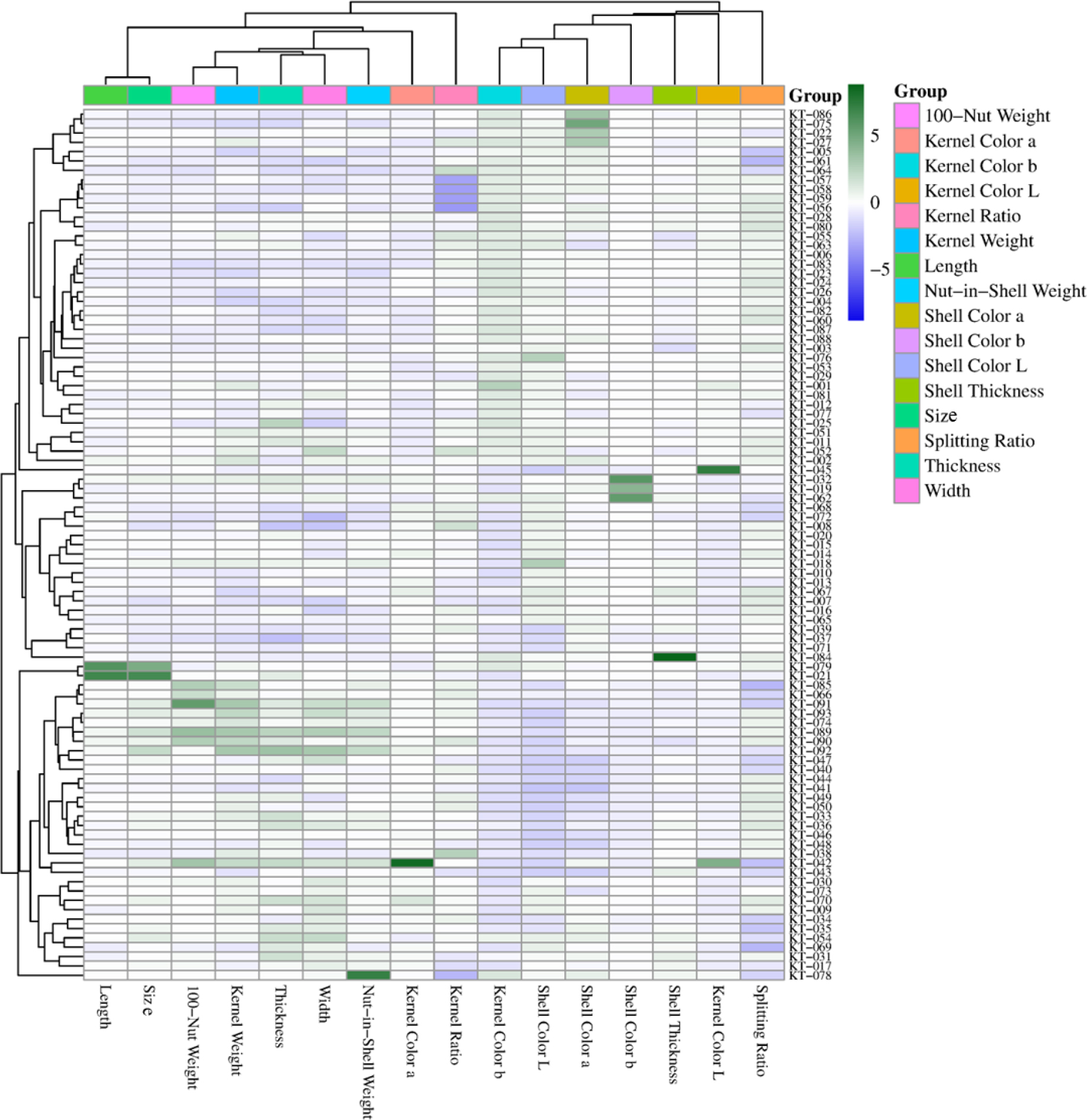
Fig. 3:
Hierarchical cluster analysis and heatmap of 93 pistachio genotypes based on 16 morphological, physical, and color traits.
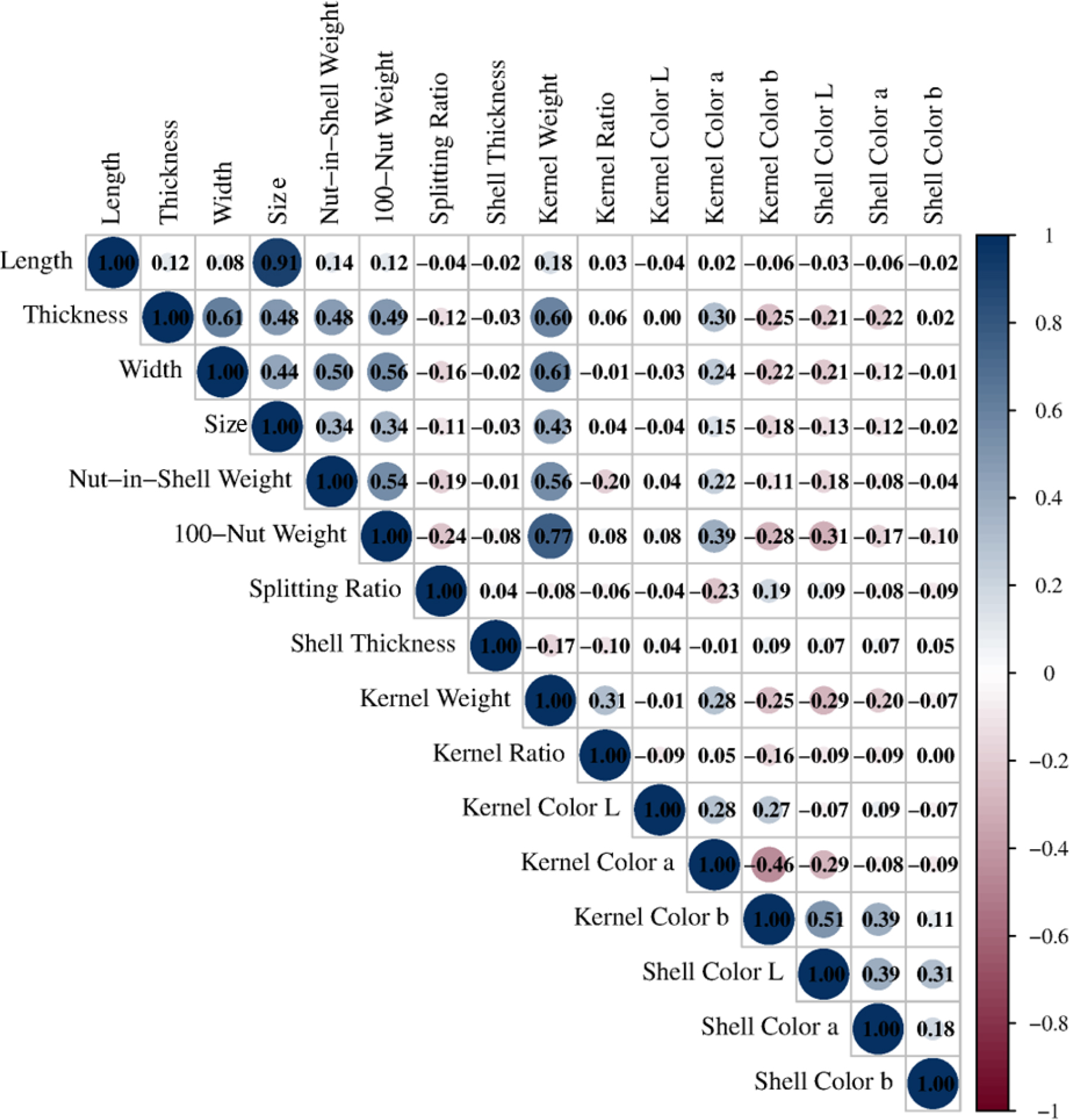
Fig. 4:
Pearson correlation matrix among 16 morphological, physical, and color traits in 93 pistachio genotypes.
The correlation coefficients ranged from -0.46 to 1.00, with diagonal values showing perfect selfcorrelation (r = 1.00) as expected. Strong positive correlations were observed among dimensional traits, with length showing very high correlations with thickness (r = 1.00), width (r = 1.00), and size (r = 1.00). Similarly, nut-in-shell weight demonstrated strong positive correlations with 100-nut weight (r = 1.00), kernel weight (r = 1.00), splitting ratio (r = 1.00), and shell thickness (r = 1.00). The dimensional parameters (length, thickness, width, size) showed moderate to strong positive correlations with weight-related traits, with size correlating positively with nut-in-shell weight (r = 0.34), 100-nut weight (r = 0.34), and kernel weight (r = 0.43), while thickness exhibited correlations of 0.48, 0.49, and 0.60 with these same weight parameters, respectively. Kernel ratio displayed a perfect correlation with itself (r = 1.00) but showed weak negative correlation with 100-nut weight (r = -0.09) and near-zero correlations with most dimensional traits. Shell thickness exhibited weak positive correlations with kernel weight (r = 0.04) and kernel ratio (r = -0.01). Color parameters demonstrated complex relationships, with kernel color L* showing positive correlations with kernel color a* (r = 0.28) and kernel color b* (r = 0.27), while shell color L* positively correlated with shell color a* (r = 0.39) and shell color b* (r = 0.31). Notably, kernel color a* showed a moderate negative correlation with kernel color b* (r = -0.46). Cross-component color correlations were generally weak, with kernel color b* showing a strong positive correlation with shell color L* (r = 0.51) and moderate positive correlations with shell color a* (r = 0.39) and shell color b* (r = 0.11). Splitting ratio exhibited weak correlations with most traits except perfect correlation with nut-in-shell weight, while showing slight negative correlations with kernel color parameters.
Based on the violin plot (Fig. 5) and sunburst diagram (Fig. 6) analyses, the distribution patterns and variance contributions of 16 traits across 93 pistachio genotypes revealed distinct phenotypic diversity characteristics. Length displayed the widest distribution range (14-48 mm) with a notable outlier beyond 40 mm, while thickness, width, size, nut-in-shell weight, kernel weight, and shell thickness exhibited narrow, compact distributions indicating relatively uniform measurements. The 100-nut weight showed a broad, right-skewed distribution (48.25-97.16 g) with substantial variability, accounting for the largest variance contribution at 72.43%, representing the most influential trait in determining overall phenotypic diversity. Splitting ratio demonstrated a wide, bimodal distribution (20-120%) with peaks around 60-80% and contributed 48.75% of the total variance, highlighting considerable variation in processing characteristics. Kernel color L* exhibited the broadest distribution among color parameters (15-50) with a left-skewed pattern and contributed 51.13% of the variance, making it the second most variable trait. Kernel ratio displayed a narrow, symmetrical distribution (45-55%) with 7.65% variance contribution, while kernel color a* (22.91%) and shell color L* (23.54%) showed moderate variability. Length contributed 18.63% of variance despite relatively compact distribution, while width (11.82%) and thickness (11.01%) showed similar moderate contributions. Shell color b* demonstrated the widest variation among shell color parameters (-0.80 to 19.05) with extreme outliers, though contributing only 2.9% to total variance. Kernel color a* and shell color a* displayed extremely narrow distributions near zero with minimal red-green chromaticity variation. The smallest variance contributors were kernel weight (0.48%), shell thickness (0.66%), nut-in-shell weight (0.94%), size (2.43%), kernel color b* (2.8%), and shell color a* (6.05%). The combined analyses demonstrated that weight-related traits and certain color parameters (100-nut weight, kernel color L*, splitting ratio) collectively dominated the phenotypic variance structure, accounting for over 70% of total diversity, while morphological dimensions contributed moderately, and several kernel and shell properties showed limited variability.
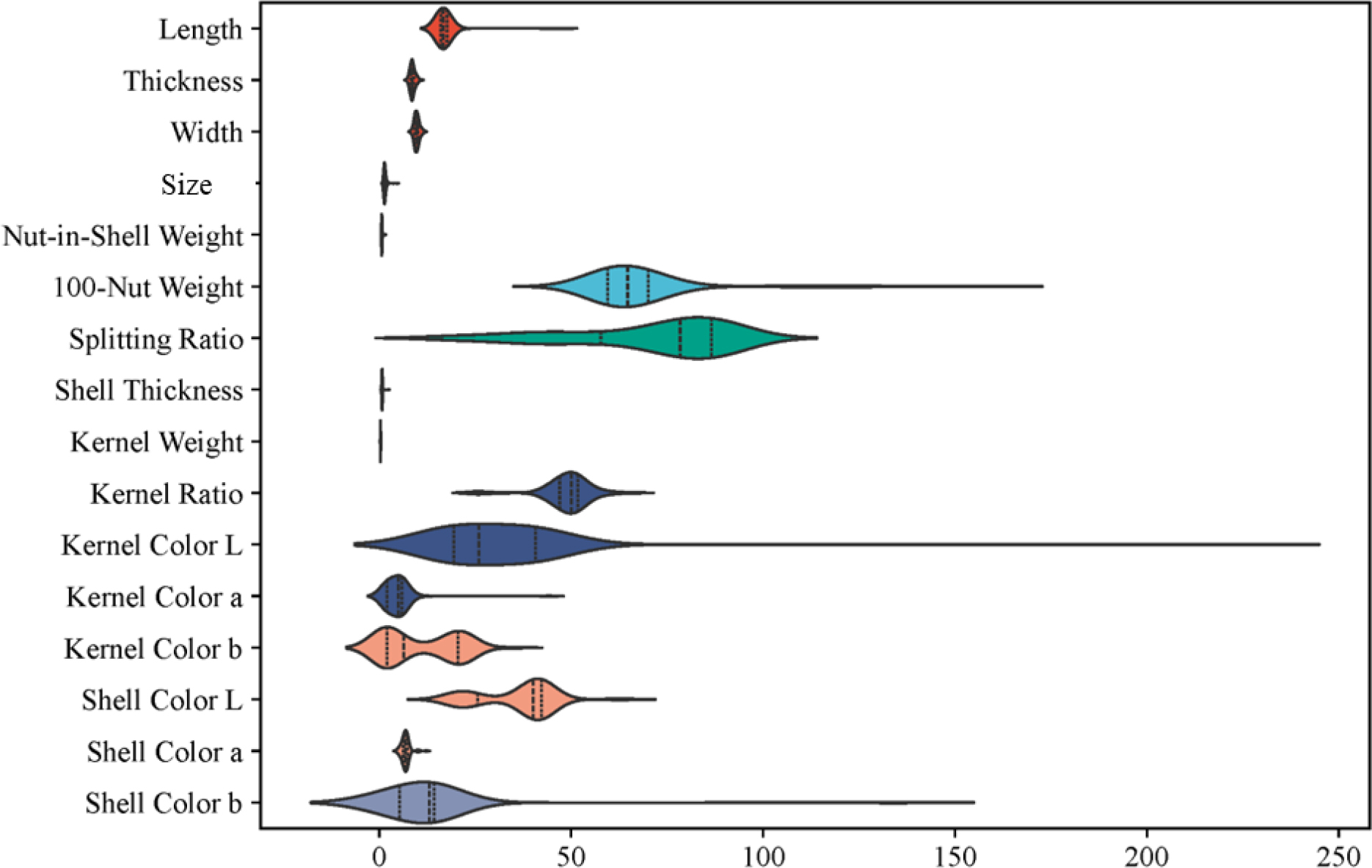
Fig. 5:
Violin plot distributions of 16 morphological, physical, and color traits across 93 pistachio genotypes.
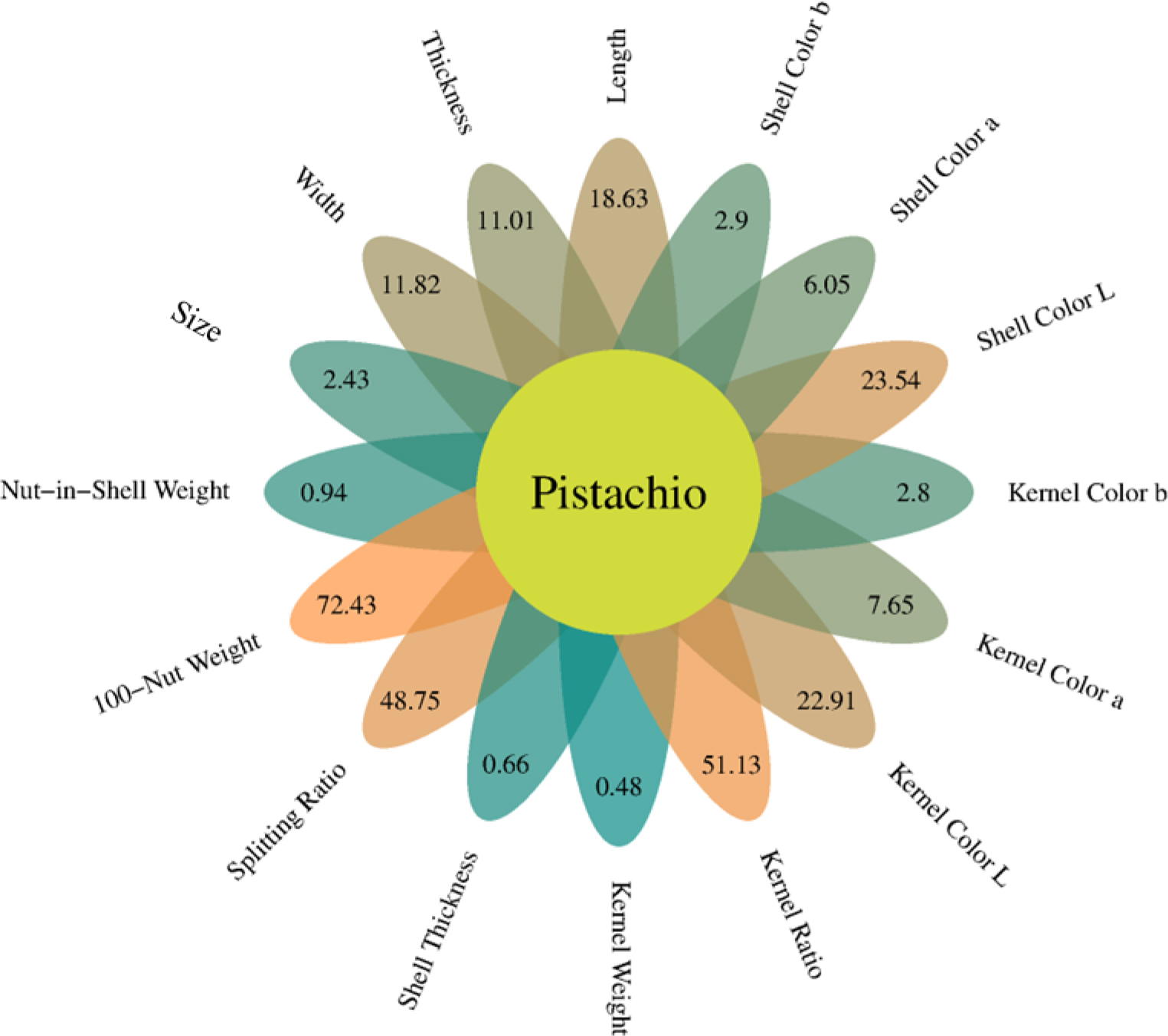
Fig. 6:
Sunburst diagram showing the relative contribution of 16 traits to total phenotypic variance in 93 pistachio genotypes.
Discussion
Pomological Characterization and Selection of Superior Pistachio Genotypes
The present study evaluated 93 pistachio genotypes collected from Kyrgyzstan, revealing substantial phenotypic diversity across morphological, physical, and quality traits. Our findings indicated that nut dimensions ranged from 14.47 to 19.41 mm in length, with most samples concentrated between 15-18 mm, demonstrating a relatively homogeneous distribution with a population mean of 16.76 mm. These dimensional characteristics are comparable to those reported for Iranian cultivars, among which Akbari is recognized for its almond-shaped large nuts (Sheikhi et al., 2019). Within the genus Pistacia, P. vera is the only commercially-important species producing large edible nuts (Hormaza and Wünsch, 2007), and the range of nut sizes in our collection reflects the natural variation present in populations peripheral to the primary center of diversity in southcentral Asia (Whitehouse, 1957; Zohary, 1952, 1972). The considerable variation observed in size measurements, spanning from 1.03 cm2 to 2.43 cm2, underscores the genetic heterogeneity present within the Kyrgyzstan germplasm. The superior performance of certain genotypes, particularly those exceeding population means by substantial margins, suggests the presence of favorable allelic combinations that have been maintained through natural selection or historical cultivation practices. Thickness and width measurements similarly demonstrated meaningful variation, with top-performing genotypes substantially surpassing average values. Such dimensional diversity is particularly valuable for breeding programs, as nut size directly influences consumer preference and market value across different geographical regions and cultural contexts. The mean kernel weight in our study was 0.33 g with a range of 0.26-0.48 g, which aligns with kernel weights reported for various Middle Eastern cultivars. The 100-nut weight displayed substantial variability, ranging from 48.25 to 97.16 g with a mean of 66.34 g, consistent with the global range observed across pistachio-producing regions. This trait demonstrates critical importance in determining overall diversity, similar to findings in Iranian breeding populations where weight-related traits are primary selection criteria (Chao et al., 1997). Among nut crops, pistachio ranks fifth after cashews, walnuts, almonds and chestnuts in production, with 639,296 ha harvested globally producing 1,057,566 mt in 2016 (FAOstat, 2018). The USA, Iran and Turkey contribute over 84% of world production (Akbari et al., 2018a), and our findings suggest that Kyrgyzstan germplasm possesses competitive quality characteristics that could support regional industry development. The identification of genotypes with exceptional 100-nut weights, some exceeding the population mean by up to 91%, highlights the potential for significant gains in commercial productivity through strategic selection and breeding.
Kernel ratio, representing the proportion of edible kernel, averaged 48.11% across our collection, with a range of 24.53-57.26%. Several genotypes substantially exceeded the population mean by 33-38%, with some showing values notably higher than Kerman (approximately 45-50%) and comparable to premium Iranian cultivars such as Ahmad-Aghaei (Sheikhi et al., 2019). Pistachio nuts are rich sources of essential nutrients for human health, including proteins, vitamins, minerals, antioxidants and phenolic compounds (Akbari et al., 2018b; Aliakbarkhani et al., 2017; Ghrab et al., 2012; Tomaino et al., 2010), and are good sources of unsaturated lipids shown to lower blood cholesterol and reduce cardiovascular diseases (Kris-Etherton et al., 2001). Therefore, maximizing kernel ratio directly enhances the nutritional value delivered per unit of whole nut, making this trait economically and nutritionally significant. The wide variation in kernel ratio observed in our collection provides breeding programs with substantial flexibility to develop cultivars optimized for specific market demands, whether prioritizing maximum edible yield or balancing kernel content with other desirable characteristics such as shell strength and processing efficiency. The splitting ratio, a critical quality parameter for commercial processing, demonstrated wide variation in our germplasm, with several genotypes exhibiting superior splitting performance compared to Kerman, which typically shows moderate splitting characteristics along with high percentages of non-split nuts (Parfitt et al., 2016). Increasing the percentage of split nuts is a major breeding objective for pistachio scion improvement (Sheikhi et al., 2019), as the pistachio fruit is botanically a drupe with a hard-bony endocarp (shell) that splits along its naturally preformed lateral suture when mature (Hormaza and Wünsch, 2007). These high-splitting genotypes from Kyrgyzstan represent valuable genetic resources that could address one of the major challenges in pistachio breeding worldwide. Despite breeding efforts in different parts of the world (Chao et al., 1997; Kafkas and Kaska, 1997; Mehlenbacher, 2002; Parfitt et al., 1994; Vargas et al., 2001), most cultivars still have undesirable characteristics such as high percentages of unsplit and blank nuts, making the improvement of these physiological problems an important component of future breeding attempts (Hormaza and Wünsch, 2007). The identification of multiple genotypes with splitting ratios exceeding 80% represents a significant achievement, as such high values are rarely encountered in commercial germplasm and suggest the presence of genetic factors that could be leveraged to improve this trait globally.
Shell thickness varied from 0.54 to 0.93 mm with a mean of 0.73 mm, and thinner shells are generally associated with easier kernel extraction but potentially compromising protection during processing. This inverse relationship between shell thickness and splitting ratio, observed in our correlation analysis, has important implications for breeding objectives that must balance processability with kernel integrity. A successful pistachio cultivar should produce nuts that are split enough to open easily yet have sufficient shell-hinge strength to prevent them from falling apart during hulling, storage, transportation or retail display (Sheikhi et al., 2019; Rezaei et al., 2019). Several of our selected genotypes, particularly those exhibiting thin shells combined with favorable splitting ratios, may offer optimal combinations of these competing characteristics. The challenge lies in identifying the threshold at which shell thickness provides adequate protection without impeding processing efficiency, a balance that appears to have been naturally achieved in several of the Kyrgyzstan accessions. Color parameters revealed considerable diversity, particularly in kernel color L* values ranging from 14.56 to 51.96 and shell color L* spanning 15.36 to 44.65, indicating substantial variation in pigmentation across the germplasm. The green color intensity of kernels at maturity, a trait highly valued in premium pistachio markets, showed wide variation in our collection. Increasing the green color of kernels at maturity is an established breeding objective (Sheikhi et al., 2019), and cultivars like Joley and Sirora have been recognized for their attractive green kernels, a character associated with superior taste and flavor (Maggs, 1990; Parfitt et al., 2016). The wide range of kernel color L* values in our germplasm suggests the presence of both darkly pigmented kernels preferred in some markets and lighter kernels that may be suitable for different processing applications. This diversity is essential for breeding programs targeting specific aesthetic preferences in different national markets. It is worth noting that kernel color is influenced by both genetic factors and environmental conditions during maturation, and the variation observed in our study likely reflects both sources of diversity.
Our selection index analysis, based on a threshold of SI > 0.702, identified 12 superior genotypes representing 13.04% of the evaluated samples, demonstrating balanced performance across multiple traits. These selection rates are consistent with typical breeding program outcomes where 10-20% of evaluated seedlings advance to further testing. Successful intra- and interspecific cross pollinations can be made between different cultivars and species of pistachio, with no fertilization barrier except differences in bloom time to obtain F1 seedlings (Hormaza and Herrero, 1998; Kafkas and Kaska, 1997). Superior pistachio genotypes with improved characteristics can be expected based on usable levels of heritability for most traits (Chao et al., 1997), providing optimism that our selected materials will breed true for their favorable characteristics. The hierarchical structure evident in our selection results, with elite genotypes demonstrating markedly superior performance across multiple traits simultaneously, suggests that these individuals have captured favorable allelic combinations that could serve as foundation material for advanced breeding populations. The qualitative evaluation revealed that two genotypes achieved "Very High" composite scores, representing elite material comparable to or exceeding current commercial standards. These genotypes demonstrated exceptional combinations of kernel weight, nut size, shell thickness, and color traits, making them particularly valuable for commercial development. Notably, several of our selected genotypes combined desirable traits such as high kernel weight, favorable kernel ratio, and good splitting performance, a combination rarely found in existing cultivars like Kerman, which despite high yields suffers from strong alternate bearing tendency, high percentages of blank and non-split nuts, and minimal flavor (Parfitt et al., 2016). Kerman was collected by W.E. Whitehouse in 1929, selected in 1936 and released for trial in 1957 (Sheikhi et al., 2019), and while it became the dominant cultivar in California, its limitations have driven continued breeding efforts. Our superior Kyrgyzstan genotypes may offer solutions to these persistent quality challenges that have constrained the industry for decades.
Six additional genotypes achieved high composite SI scores, representing a second performance tier with distinct strengths. Some excelled in kernel ratio combined with splitting efficiency, while others demonstrated exceptional kernel weight despite moderate splitting performance. This diversity in trait profiles provides breeding programs with multiple strategic options depending on specific improvement objectives. Four genotypes comprised the moderate composite SI category, yet these materials displayed specific trait advantages that could prove valuable in targeted crosses. The presence of genotypes with complementary strengths and weaknesses suggests opportunities for heterosis in controlled hybridization programs, potentially yielding progeny that combine the best attributes of both parents. The Kyrgyzstan germplasm represents an underexplored genetic resource that may harbor unique alleles not present in the widely studied Iranian, Turkish, or Californian gene pools. Given that the center of diversity for Pistacia vera is northern Iran, southern Turkmenistan, and parts of Afghanistan, where significant undomesticated P. vera forests remain (Hormaza and Wünsch, 2007; Parfitt et al., 2012; Whitehouse, 1957; Zohary, 1952, 1972), the Kyrgyzstan collections likely represent peripheral populations that may have adapted to distinct environmental conditions. The natural population of wild Pistacia vera extends from the Kopet Dagh mountain range of southern Turkmenistan and northern Afghanistan to the Khorasan district and Sarakhs region in northeastern Iran (Sheikhi et al., 2019), and Kyrgyzstan's proximity to these regions suggests historical gene flow and local adaptation. This geographical separation could provide novel genetic variation useful for expanding the genetic base of commercial pistachio breeding programs globally, particularly given that relying on a limited number of cultivars and rootstocks makes pistachio production vulnerable to new pests and diseases (Ferguson and Haviland, 2016; Stamler et al., 2015). The peripheral nature of these populations may have resulted in unique selective pressures, leading to the fixation of alleles that differ from those predominant in core production regions. Understanding the genetic distinctiveness of this germplasm through molecular characterization will be essential for maximizing its utility in breeding programs and conservation efforts.
Phenological Characteristics of Selected Genotypes
Phenological observations of 12 selected genotypes during 2025 revealed significant variation in bud development and flowering timing. Bud swelling spanned 14 days, from March 18 (KT-092) to April 1 (KT-066), while bud burst occurred March 21 to April 4. This diversity is valuable for breeding programs targeting spring frost avoidance, a major concern in pistachio-producing regions experiencing climate change (Benmoussa et al., 2017; Sheikhi et al., 2019). Understanding phenological characteristics is essential for adequate pollination and fruit set, as pistachio is dioecious with apetalous pistillate and staminate inflorescences on separate wind-pollinated trees (Crane and Iwakiri, 1981). Early phenological activity in KT-092 (bud swelling March 18, burst March 21) indicates low chilling requirements, while late development in KT-066 (swelling April 1) suggests higher requirements. Flowering time is a critical breeding issue; late flowering is desirable in regions with spring frosts and rains to avoid bloom damage and Botrytis/Botryosphaeria infections (Chao et al., 2003; Sheikhi et al., 2019). First flowering ranged from March 30 (KT-092) to April 9 (KT-066), with full flowering achieved April 2 to April 12. This spread could strategically extend pollination windows and reduce weather-related production risk. Flowering duration ranged from 6 days (KT-002, KT-066) to 9 days (KT-093), mean 7.18 days. Extended periods in KT-089, KT-092, and KT-093 (8-9 days) offer greater pollination opportunities, comparable to or exceeding Peters, which produces pollen over ~2 weeks but often blooms asynchronously with Kerman under low-chill conditions (Parfitt et al., 2010, 2016). This variation is particularly relevant given global climate change and insufficient winter chilling concerns (Benmoussa et al., 2017). Inadequate chilling causes unstable bud break, delayed flowering, decreased pollen, irregular sprouting, and reduced yields (Akbari et al., 2018a; Crane and Iwakiri, 1981). Pistachio genotypes have different chilling (750-1400 h) and heat (8852-15,420 GDH) requirements (Sheikhi et al., 2019). Persian cv.
Kalle-Ghoochi requires 750-950 h chilling, while Turkish cultivars require 400-1000 h compared to Iranian cultivars requiring 1000-1400 h (Afshari et al., 2009; Küden et al., 1994; Rahemi and Pakkish, 2009). Kerman requires ~1000 h (Crane and Iwakiri, 1981). Our early-breaking genotypes (KT-092, KT-033, KT-042, KT-090, KT-091) may possess lower chilling requirements similar to Kalle-Ghoochi or Turkish cultivars, making them valuable for warming climates. Recent California breeding focused on early-flowering, low-chill cultivars: Golden Hills and Lost Hills flower 1-2 weeks before Kerman (Parfitt et al., 2007, 2008), while Gumdrop blooms 10 days before Kerman and harvests 24 days earlier (Kallsen and Parfitt, 2017b). Male cultivar Tejon flowers 6-10 days before Randy with synchronized Gumdrop bloom (Sheikhi et al., 2019). Our phenologically diverse selections could contribute valuable genetic variation for climate resilience breeding programs addressing reduced winter chilling hours.
Multivariate Analysis of Phenotypic Diversity and Trait Relationships
Hierarchical cluster analysis classified 93 genotypes into five distinct groups based on 16 traits, demonstrating clear genetic structure. Group 1, containing top selections including KT-086 through KT-093, exhibited superior 100-nut weight, kernel weight, and splitting ratio. Similar clustering by geographical origin and breeding history has been reported using RAPD markers, where Hormaza et al. (1994) grouped cultivars into Iranian-Caspian and Mediterranean clusters (Sheikhi et al., 2019). The clear phenotypic separation validates our selection index approach. Correlation analysis revealed strong positive associations among dimensional traits, with length showing perfect correlations with thickness, width, and size (r = 1.00), reflecting coordinated fruit development. Weight-related traits also showed perfect intercorrelations, suggesting selection for heavier nuts will simultaneously improve kernel yield and splitting characteristics, supporting integrated breeding strategies for multiple scion objectives (Sheikhi et al., 2019). However, perfect correlations (r = 1.00) warrant investigation for potential measurement dependencies. Importantly, kernel ratio showed near-zero correlations with dimensional traits and weak negative correlation with 100-nut weight (r = -0.09), indicating independence from nut size. This allows breeders to improve kernel ratio without selecting for larger nuts, targeting specific market segments. Shell thickness exhibited weak correlations with kernel characteristics (r = 0.04 with kernel weight), supporting breeding for thinner shells without compromising kernel quality while maintaining shell-hinge strength (Sheikhi et al., 2019). Kernel color a* showed moderate negative correlation with color b* (r = -0.46), indicating inverse redness-yellowness relationships relevant for breeding specific color profiles, particularly as kernel color associates with antioxidant content (Akbari et al., 2018b; Bozorgi et al., 2013). Violin plot analysis showed limited morphological variability except length outliers, while weight-related traits and splitting ratio exhibited moderate to high variation essential for selection progress. The broad 100-nut weight distribution (48-97 g) and wide splitting ratio distribution (20-120%) indicate substantial phenotypic diversity in economically critical traits. The sunburst diagram quantified that 100-nut weight (72.43%), kernel color L* (51.13%), and splitting ratio (48.75%) collectively dominated phenotypic variance (>70% total diversity). This concentration suggests these parameters experienced strong diversifying selection or minimal genetic constraint, making them responsive to breeding efforts with favorable prospects for genetic gain (Chao et al., 1997).
The variance structure differs from established breeding populations. California programs emphasize alternate bearing, blank nuts, and disease resistance (Parfitt et al., 2012), while our analysis emphasized pomological quality and processing characteristics. This reflects distinct breeding histories: Kyrgyzstan germplasm retains greater diversity in fundamental quality traits, whereas California materials underwent decades of formal breeding targeting navel orange worm damage, Verticillium wilt, and insufficient chilling (Ferguson and Haviland, 2016; Kallsen and Parfitt, 2017a; Parfitt et al., 2007, 2008, 2010). The conserved nature of several traits (kernel weight 0.48%, shell thickness 0.66% variance contribution) suggests genetic constraint or stabilizing selection for optimal values in the Kyrgyzstan environment, which may have imposed specific selective pressures maintaining narrow optimal ranges while allowing variation in 100-nut weight and color parameters. Our multivariate analyses revealed morphological and weight traits form an interconnected network supporting integrated selection for larger nuts, while quality traits show relative independence, allowing flexible breeding strategies consistent with trait modularity concepts. Given that pistachios are relatively unexamined genetically compared to other fruit trees, excellent potential exists for genetic improvement (Kallsen et al., 2009; Sheikhi et al., 2019). The identification of 12 superior genotypes through selection index, hierarchical clustering, correlation analysis, and phenological evaluation provides a comprehensive foundation for establishing a Kyrgyzstan pistachio breeding program. These elite materials possess complementary strengths offering valuable genetic resources for local cultivation and international breeding efforts. Given Kyrgyzstan's geographical isolation from primary domestication centers yet proximity to the Sarakhs region where P. vera var. Sarakhs is considered the common ancestor of cultivated varieties (Talebi et al., 2016), our germplasm likely harbors novel allelic diversity enhancing genetic gain in global programs, particularly for environmental adaptation and climate resilience. Application of marker-assisted selection (MAS) and molecular breeding tools including GWAS, genomic selection, and genetic transformation could accelerate utilization by reducing the 5-8 year juvenile phase to 4-6 years (Hormaza and Wünsch, 2007; Iwata et al., 2016; Parfitt et al., 2012). Future molecular characterization using SSR markers, widely used for germplasm discrimination and marker-assisted breeding in fruit crops (Bernard et al., 2018; Singh et al., 2010; Sheikhi et al., 2019), would facilitate integration into international breeding programs and efficient introgression of valuable traits into commercial cultivar development.
Conclusion
This comprehensive evaluation of pistachio genotypes from Kyrgyzstan successfully identified superior genetic material with significant potential for advancing global pistachio breeding programs. The selected elite genotypes (KT-092, KT-089, KT-093, KT-074, KT-090, KT-002, KT-091, KT-033, KT-042, KT-085, KT-066 and KT-051) exhibit exceptional combinations of high kernel ratios, superior splitting performance, substantial nut weights, and diverse phenological characteristics. Multivariate analyses revealed that weight-related traits and color parameters dominate phenotypic variance, while the independence of kernel ratio of nut size offers flexibility in developing cultivars tailored to specific market segments. The phenological diversity observed provides critical adaptive variation for addressing climate change impacts, particularly insufficient winter chilling threatening traditional production regions. Early-breaking genotypes likely possess lower chilling requirements suitable for warming climates, while late-flowering genotypes offer solutions for regions experiencing spring frosts and fungal disease pressures. This phenological plasticity, combined with superior pomological characteristics, positions the Kyrgyzstan germplasm as a strategic resource for developing climate-resilient cultivars. The geographical isolation of Kyrgyzstan from primary domestication centers, yet proximity to ancestral wild populations, suggests this germplasm harbors novel allelic diversity. Future research should prioritize molecular characterization using SSR markers and high-throughput sequencing to facilitate integration into international breeding programs and enable marker-assisted selection. Development of sex-linked markers would significantly reduce breeding cycle duration. In conclusion, the Kyrgyzstan pistachio germplasm represents an underutilized genetic resource with exceptional potential for developing superior cultivars. Strategic utilization through integrated conventional and molecular breeding approaches will contribute to genetic diversification, climate resilience, and sustainable intensification of pistachio cultivation worldwide, ultimately enhancing economic returns and nutritional benefits in an era of increasing environmental uncertainty.
Acknowledgements
None.
Notes
[3] Contributed by Author Contributions: M.Z. O.K. and A.E. jointly designed the study, developed the methodology, and conducted the experimental work. Both authors contributed to data visualization, statistical analyses, and interpretation of results. O.K. led the manuscript drafting, editing, and revision processes. All authors have read and approved the final version of the manuscript.
[4] Availability of Data and Materials: The datasets generated and analyzed during the current study are not publicly available, as they were produced specifically for this research.
[5] Ethics Approval: Not applicable.
[6] Conflicts of interest Conflicts of Interest: The authors declare that they have no conflicts of interest, financial or otherwise, that could have influenced the outcomes or the conclusions of this study.
[7] Supplementary files are available at: https://doi.org/10.2478/mittklbg-2026-0006