
Introduction
Apricot (Prunus armeniaca L.) is a stone fruit belonging to the Rosaceae family, cultivated extensively in temperate regions worldwide for both fresh consumption and processing industries. The fruit is recognized as a valuable source of bioactive compounds, including phenolic acids, flavonoids, carotenoids, and organic acids, which contribute significantly to human health through their antioxidant, anti-inflammatory, and anticarcinogenic properties (Leccese et al., 2007, Dragovic-Uzelac et al., 2007). Turkey, as one of the world’s leading apricot producers, possesses rich genetic diversity with numerous local cultivars adapted to different ecological conditions (Korkmaz et al., 2023). Phenolic compounds, in particular, serve as the primary contributors to the antioxidant capacity of apricot tissues, functioning through hydrogen donation and free radical scavenging mechanisms (Sochor et al., 2010). Studies have demonstrated that total phenolic content in apricot fruits ranges significantly among cultivars, with values varying between 150 and 800 mg GAE/100g fresh weight, while antioxidant activity measured by DPPH and FRAP assays shows parallel variation (Korekar et al., 2011, Ruiz et al., 2005). These compounds exhibit diverse biological effects including protection against oxidative stress, cardiovascular diseases, and certain types of cancer, making them crucial components for functional food development (Madrau et al., 2009). The accumulation of phenolic substances varies considerably among cultivars, developmental stages, ripening periods, and environmental conditions, with genetic background serving as the most critical determinant of fruit biochemical quality (Drogoudi et al., 2008, Fratianni et al., 2018). Recent metabolomic studies have revealed that apricot phenolic profiles are complex, consisting of hydroxycinnamic acids (chlorogenic acid, neochlorogenic acid), flavonols (quercetin derivatives, kaempferol glycosides), and flavan-3-ols (catechin, epicatechin), each contributing differently to overall antioxidant capacity (Erdogan-Orhan and Kartal, 2011, Campbell et al., 2013).
Hybrid breeding represents one of the most effective strategies for improving genetic traits in fruit trees, enabling the exploitation of heterosis to develop superior cultivars with enhanced nutritional, pomological, and functional properties (Janick and Moore, 1996). Understanding heritability patterns, heterosis expression, and gene action is fundamental for systematic crop improvement programs and efficient parent selection (Wünsch and Hormaza, 2002). In stone fruits, F1 hybrid populations frequently exhibit substantial phenotypic variation in secondary metabolite content, reflecting the complex polygenic inheritance of these quantitative traits (Faust and Nyujtó, 1998, Badenes and Byrne, 2012). Previous research on apricot has shown that pomological traits such as fruit weight, total soluble solids, and titratable acidity display moderate to high heritability, while biochemical traits including total phenolic content and antioxidant capacity exhibit more variable inheritance patterns depending on the specific parental combination (Asma et al., 2007, Zargar et al., 2023). Karaat and Serce (Karaat and Serce, 2020) investigated heritability estimates in two apricot progenies and reported moderate heritability for total phenolic compounds (h2 = 0.45–0.62) and TEAC antioxidant activity (h2 = 0.38–0.54), indicating that both genetic and environmental factors significantly influence these traits. Studies on various fruit species have demonstrated that the chemical composition of fruits from different genotypes is significantly influenced by specific parental combinations, with certain crosses exhibiting positive, negative, or no heterosis in phytochemical accumulation depending on the trait examined (Mihaylova et al., 2024, Kaczmarska and Radzki, 2017). The expression of fruit quality characteristics within offspring populations is substantially affected by genotypic factors, with mid-parent heterosis rates varying widely from −40% to +60% for different biochemical compounds (Kumar et al., 2020, Butcher et al., 2013). Additionally, reciprocal cross effects, where the direction of hybridization (which parent serves as the female versus male) influences off-spring phenotype, have been documented in several crops but remain poorly characterized in apricot breeding programs (Kr, 2018, Luo et al., 2024).
Genetic studies on both intraspecific and interspecific hybrids have shown that F1 generations can exhibit superior total phenolic, flavonoid, and antioxidant activities compared to their parental varieties, although the frequency and magnitude of such heterosis varies considerably (Fridman, 2015, Zhu et al., 2025). In apricot, limited information exists regarding the inheritance patterns of anti-oxidant compounds and the genetic tendency of functional traits in segregating populations. Dragovic-Uzelac et al. (2005) analyzed phenolic compounds and antioxidant capacity in several apricot cultivars and emphasized the importance of genotypic variation in breeding programs targeting enhanced nutritional quality. Recent investigations on other fruit crops have documented both additive and non-additive modes of inheritance for primary and secondary metabolites in F1 hybrids, with different traits showing positive heterosis (over-high parent performance) for certain compounds while displaying negative heterosis (below mid-parent performance) for others (Ortuño-Hernández et al., 2025, Ning et al., 2022). For instance, studies on pepper, tomato, and eggplant have revealed that phenolic compounds can exhibit transgressive segregation, producing off-spring that exceed both parents in either direction (Chowdhury et al., 2023, Hochholdinger and Yu, 2025). The genetic transmission ability (Ta), defined as the ratio of F1 mean to mid-parent value, provides insight into the overall tendency of trait inheritance, with values below 80% indicating small inheritance tendency and values above 100% suggesting high inheritance tendency (Ning et al., 2022). Comprehensive evaluation approaches combining principal component analysis (PCA) and cluster analysis have proven effective for assessing complex trait relationships, reducing multidimensional data into interpretable components, and selecting superior hybrid individuals based on multiple biochemical parameters simultaneously (Iezzoni and Pritts, 1991, Liu et al., 2020). Such multivariate statistical methods enable breeders to develop composite scores that integrate multiple quality attributes, facilitating more objective and efficient selection of elite genotypes (Mahmoud et al., 2023).
Despite extensive utilization of apricot fruits in food, beverage, and pharmaceutical industries due to their rich antioxidant content and health-promoting properties, research on the genetic predisposition analysis of antioxidant activity and systematic breeding strategies for developing high-antioxidant varieties remains very limited. This study aimed to investigate the genetic tendency, mid-parent heterosis, reciprocal effects, and phenotypic variation of total phenolic content and antioxidant activity in F1 apricot populations derived from reciprocal crosses between ‘İmrahor’ and ‘Hasanbey’ cultivars. These two cultivars were selected because they are widely cultivated in Türkiye and exhibit contrasting phenolic content and antioxidant capacity, making them suitable parents for genetic and heterosis analysis. The specific objectives of our study were to: (1) determine the inheritance patterns and heritability trends of functional traits in hybrid offspring, (2) evaluate the extent and direction of heterosis expression for antioxidant components, (3) assess whether maternal effects and reciprocal differences significantly influence biochemical composition, and (4) identify superior hybrid individuals through comprehensive multivariate evaluation for potential cultivar development with enhanced antioxidant properties.
Materials and Methods
Plant Materials
The experimental materials consisted of F1 hybrid apricot genotypes at full bearing age and their parental cultivars, located at the Malatya Apricot Research Institute, Battalgazi campus, Turkey. The hybrid population was derived from reciprocal crosses between two table apricot cultivars, ‘İmrahor’ and ‘Hasanbey’, conducted in 2009 (Fig. 1).
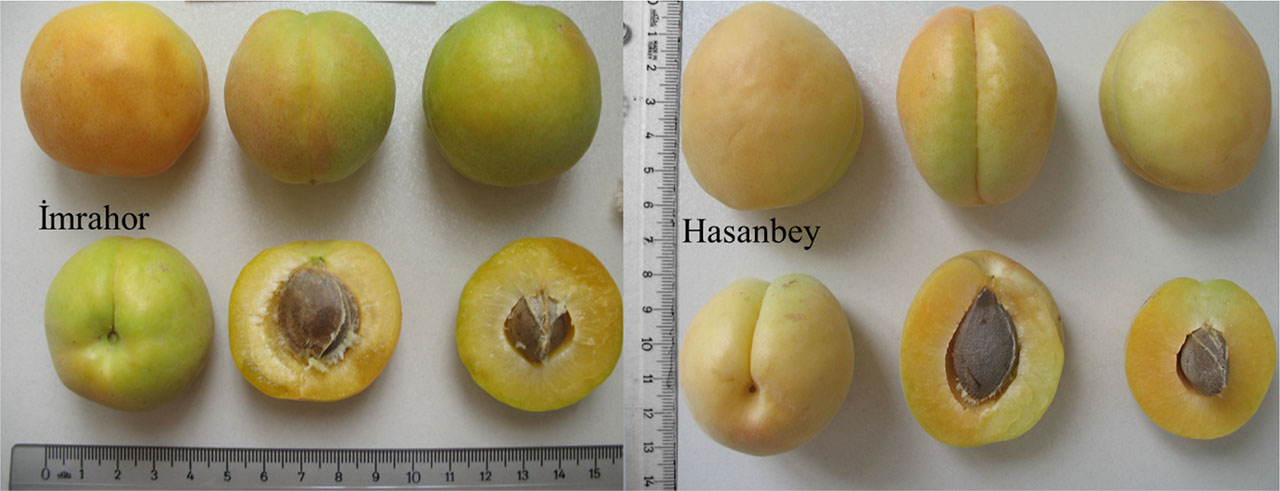
Fig. 1:
Fruit morphology of apricot cultivars ‘İmrahor’ and ‘Hasanbey’ showing whole fruits and longitudinal sections with pit characteristics.
Initially, 26 F1 plants were established for each cross combination. The healthy F1 individuals currently present in each combination constituted the plant material for this study. Two reciprocal cross combinations were evaluated: (1) İmrahor (♀) × Hasanbey (♂) with 26 F1 individuals, and (2) Hasanbey (♀) × İmrahor (♂) with 26 F1 individuals, resulting in a total of 52 F1 genotypes plus two parental cultivars. All experimental trees were maintained under uniform orchard management conditions. Standard cultural practices included open-center training system with dormant season pruning for canopy management. Drip irrigation was applied based on evapotranspiration rates and phenological stages. Fertilization programs followed soil analysis results, with nitrogen applied in split applications and micronutrients corrected through foliar sprays when necessary. Integrated pest and disease management strategies targeted key pests and diseases using chemical control only when economic thresholds were exceeded. Weed control included both, mechanical cultivation and herbicide applications. Fruit samples were collected from each tree in early July 2022 at the commercial maturity stage. Fruits were immediately treated with liquid nitrogen and stored at −80 °C until analysis. A comprehensive genetic tendency analysis and evaluation of antioxidant components and activities were conducted on the collected fruit samples.
Chemicals and Reagents
Methanol, gallic acid, Folin-Ciocalteu reagent, sodium carbonate, Trolox (6-hydroxy-2,5,7,8-tetramethylchroman-2-carboxylic acid), DPPH (1,1-diphenyl-2-picrylhydrazyl radical), and all other re-agents were purchased from Sigma-Aldrich (St. Louis, MO, USA) or Merck (Darmstadt, Germany). All reagents were of analytical grade unless indicated otherwise. Standard solutions were freshly prepared for each analysis batch.
Sample Preparation and Extract Preparation
Frozen apricot fruit samples were ground into fine powder using a high-throughput tissue grinder under liquid nitrogen. For each sample, 0.5 g of powdered material was accurately weighed and extracted with 25 mL of anhydrous methanol. The mixture was stirred thoroughly and kept at 4 °C for 12 h in darkness. After incubation, the samples were centrifuged at 10,000× g for 20 min at 4 °C. The supernatant was collected and stored at −20 °C until analysis. Each sample was extracted in triplicate. The methanolic extracts were used for determination of total phenolic content and anti-oxidant capacity.
Total Phenolic Content Analysis
Total phenolic content (TPC) was determined using the Folin-Ciocalteu colorimetric method as described by Tareen et al. (2021) with minor modifications. Gallic acid standard solutions were prepared at concentrations of 0, 0.1, 0.2, 0.4, 0.6, and 0.8 mg·mL−1. For the assay, 0.1 mL of appropriately diluted extract or standard solution was pipetted and diluted to 1 mL with distilled water. Subsequently, 5 mL of 0.2 mol·L−1 Folin-Ciocalteu reagent was added, mixed well, and allowed to stand for 5 min at room temperature. Then, 4 mL of 150 g·L−1 Na2CO3 solution was added and mixed thoroughly. The reaction mixture was incubated in darkness at room temperature for 60 min. Subsequently, 200 μL of the reaction solution was transferred to a 96-well microplate. Anhydrous methanol served as the blank. The absorbance was measured at 765 nm using a microplate reader (BioTek Instruments, Winooski, VT, USA). The experiment was performed in triplicate for each sample. The total phenolic content was calculated using the gallic acid calibration curve and expressed as mg gallic acid equivalent (GAE)·100g−1 fresh weight (FW).
Antioxidant Capacity Determination
DPPH Free Radical Scavenging Activity
The DPPH free radical scavenging activity was determined according to the method described by Tareen et al. (2021) with slight modifications. A fresh DPPH solution (0.1 mmol·L−1) was prepared by dissolving DPPH in methanol. For the assay, 0.1 mL of appropriately diluted extract was pipetted, and 3 mL of DPPH solution was added. The mixture was vortexed and allowed to react in darkness at room temperature for 30 min. Then, 200 μL of the reaction mixture was transferred to a 96-well microplate. Anhydrous methanol was used as the blank. The absorbance was measured at 517 nm using a microplate reader. Trolox standard solutions (0, 0.1, 0.2, 0.4, 0.6, and 0.8 mmol·L−1) were prepared and treated similarly to construct a calibration curve. The experiment was performed in triplicate for each sample. The DPPH radical scavenging activity was calculated using the Trolox calibration curve and expressed as μmol Trolox equivalent (TE)·100g−1 FW.
Statistical Analysis
All data were processed using Microsoft Excel 2016 and analyzed using IBM SPSS Statistics 26.0 and Python 3.10 (scikit-learn library). Descriptive statistics including mean, standard deviation, range, coefficient of variation, kurtosis, and skewness were calculated for each trait. The genetic parameters were calculated using the following formulae according to Ning et al. (2022):
Mid-parent value (MP) = (P1 + P2)/2, where P1 and P2 represent the values of the two parents
Coefficient of variation (CV, %) = (S/F̄) × 100, where S is the standard deviation and F̄(mean value of the F1 population) represents the average of all F1 individuals.
Genetic transmission ability (Ta, %) = (F̄/MP) × 100, where F̄(mean performance of the F1 generation) indicates the average trait value of the hybrid population
Genetic transmission ability (Ta, %) = (F̄/MP) × 100
Mid-parent heterosis rate (MPH, %) = [(F̄− MP)/MP] × 100
Over-high parent heterosis rate (HH, %) = (hp/n) × 100, where hp is the number of F1 plants with values higher than the high parent and n is the total number of F1 individuals
Inferior-low parent heterosis rate (LH, %) = (lp/n) × 100, where lp is the number of F1 plants with values lower than the low parent
In order to evaluate reciprocal effects, the difference between the means of the two reciprocal crosses was calculated as Δ = F̄(A×B) − F̄(B×A). Independent samples t-tests were performed to determine whether reciprocal differences were statistically significant (p < 0.001). Cohen’s d was calculated to assess the effect size of reciprocal differences, where values of 0.2, 0.5, and 0.8 indicate small, medium, and large effects, respectively (Ning et al., 2022).
Principal Component Analysis (PCA)
Principal component analysis was conducted to evaluate the comprehensive antioxidant performance of F1 individuals and their parents. The analysis was performed using the scikit-learn library in Python 3.10. Prior to PCA, all variables were standardized using Z-score transformation to ensure equal contribution regardless of measurement units: Z = (X − μ)/σ, where X is the original value, μ is the mean, and σ is the standard deviation. Following standardization, the covariance matrix was constructed, and eigenvalue-eigenvector decomposition was performed. Two principal components (with PC1 explaining 94.3% of the total variance and PC2 explaining 5.7% of the total variance) were extracted. The proportion of variance explained by each component was calculated, and component loadings were examined to interpret the biological meaning of each component. A composite score representing the overall biochemical performance of each genotype was calculated by weighting each principal component by its proportion of variance explained, according to Zhu et al. (2025):
Composite Score = (PC1 × Variance Proportion_{PC1}) + (PC2 × Variance Proportion_{PC2})
This formula, known as the component-weighted sum in PCA literature, is implemented in XLSTAT (Addinsoft, Paris, France) for the calculation of principal component scores. Higher composite scores indicate superior combined performance for phenolic content and antioxidant activity. Based on the composite scores, all genotypes including parents and F1 individuals were ranked. Biplots were constructed to visualize the relationships between variables and genotypes in the PC1-PC2 space using the matplotlib library in Python.
Results
Genetic Analysis of Total Phenolic Content in F1 Apricot Populations
The total phenolic content and antioxidant activity of F1 individuals derived from reciprocal crosses between ‘İmrahor’ and ‘Hasanbey’ cultivars, along with their parental values, are presented in Tab. 1. The mid-parent value (MP) for total phenolic content was calculated as 1007.09 mg GAE·100g−1 FW. In the İmrahor (♀) × Hasanbey (♂) cross combination, the mean total phenolic content of F1 individuals was 805.13 mg GAE·100g−1 FW with a standard deviation of 95.23, resulting in a coefficient of variation of 11.83%. The genetic transmission ability (Ta) was 80.0%, and the mid-parent heterosis rate (MPH) was −20.05%, indicating that the F1 mean was lower than the mid-parent value. None of the F1 individuals (0.0%) exceeded the higher parent, while all individuals (100.0%) fell below the lower parent value. In the reciprocal cross Hasanbey (♀) × İmrahor (♂), the mean total phenolic content of F1 individuals was 762.22 mg GAE·100g−1 FW with a standard deviation of 138.12, yielding a coefficient of variation of 18.12%. The genetic transmission ability was 75.7%, and the mid-parent heterosis rate was −24.31%. Only 3.85% of F1 individuals exceeded the higher parent, while 96.15% fell below the lower parent value. The total phenolic content in both F1 populations showed continuous distribution with considerable phenotypic variation among individuals (Tab. 1).
Tab. 1:
Genetic parameters and heterosis analysis of total phenolic content and antioxidant activity in F1 apricot populations derived from reciprocal crosses between ‘İmrahor’ and ‘Hasanbey’.
| Combination | Trait | F1 | S | MP % | CV% | MPH % | HH% | LH% | n |
|---|---|---|---|---|---|---|---|---|---|
| İmrahor × Hasanbey | Phenolics | 805.13 | 95.23 | 1007.09 | 11.83 | −20.05 | 0.0 | 100.0 | 26 |
| Hasanbey × İmrahor | Phenolics | 762.22 | 138.12 | 1007.09 | 18.12 | −24.31 | 3.85 | 96.15 | 26 |
| İmrahor × Hasanbey | Antioxidant | 927.27 | 109.05 | 1074.38 | 11.76 | −13.69 | 3.85 | 80.77 | 26 |
| Hasanbey × İmrahor | Antioxidant | 723.94 | 105.28 | 1074.38 | 14.54 | −32.62 | 0.0 | 96.15 | 26 |
[i] F1 Mean: mean value of F1 generation; S: standard deviation; MP: mid-parent value; CV: coefficient of variation; Ta: genetic transmission ability; MPH: mid-parent heterosis rate; HH: over-high parent heterosis rate; LH: inferior-low parent heterosis rate; n: number of F1 individuals. Phenolics expressed as mg GAE·100g−1 FW; Antioxidant activity expressed as μmol TE·100g−1 FW.
Genetic Analysis of Antioxidant Activity in F1 Apricot Populations
The mid-parent value for antioxidant activity was 1074.38 μmol TE·100g−1 FW. In the İmrahor (♀) × Hasanbey (♂) cross, the mean antioxidant activity of F1 individuals was 927.27 μmol TE·100g−1 FW with a standard deviation of 109.05, giving a coefficient of variation of 11.76%. The genetic transmission ability was 86.3%, and the mid-parent heterosis rate was −13.69%. Only 3.85% of F1 individuals exceeded the higher parent, while 80.77% fell below the lower parent value. In the reciprocal cross Hasanbey (♀) × İmrahor (♂), the mean anti-oxidant activity of F1 individuals was 723.94 μmol TE·100g−1 FW with a standard deviation of 105.28, resulting in a coefficient of variation of 14.54%. The genetic transmission ability was 67.4%, and the mid-parent heterosis rate was −32.62%. None of the F1 individuals (0.0%) exceeded the higher parent, while 96.15% fell below the lower parent value. The antioxidant activity in both F1 populations exhibited wide separation ranges, indicating substantial genetic variability for this trait (Tab. 1).
Reciprocal Cross Effects on Total Phenolic Content and Antioxidant Activity
The reciprocal cross effects were evaluated by comparing the means of F1 populations from the two reciprocal crosses (Tab.2). For total phenolic content, the mean difference (Δ) between İmrahor × Hasanbey and Hasanbey × İmrahor was 42.91 mg GAE·100g−1 FW. This difference was not statistically significant (p = 0.1989), with a Cohen’s d value of 0.3617, indicating a small to medium effect size. The İmrahor (♀) × Hasanbey (♂) cross produced F1 individuals with slightly higher phenolic content compared to the reciprocal cross, but this maternal effect was not significant. For antioxidant activity, the mean difference (Δ) between the two reciprocal crosses was 203.33 μmol TE·100g−1 FW. This difference was highly statistically significant (p < 0.001), with a Cohen’s d value of 1.8971, indicating a large effect size. The İmrahor (♀) × Hasanbey (♂) cross produced F1 individuals with significantly higher antioxidant activity compared to the Hasanbey (♀) × İmrahor (♂) cross, demonstrating a strong maternal effect for this trait (Tab. 2).
Tab. 2:
Reciprocal cross effects on total phenolic content and antioxidant activity in F1 apricot populations.
| Pair | Trait | Mean (A×B) | Mean (B×A) | Δ(A×B−B×A) | p-value | cohen d | n(A×B) | n(B×A) |
|---|---|---|---|---|---|---|---|---|
| İmrahor↔Hasanbey | Phenolics | 805.1296 | 762.2215 | 42.9081 | 0.1989 | 0.3617 | 26 | 26 |
| İmrahor↔Hasanbey | Antioxidant | 927.2735 | 723.9404 | 203.3331 | 0.0 | 1.8971 | 26 | 26 |
Principal Component Analysis of İmrahor × Hasanbey F1 Population
Principal component analysis was performed on the İmrahor (♀) × Hasanbey (♂) F1 population including both parents to evaluate the comprehensive antioxidant performance based on total phenolic content and antioxidant activity (Tab. 3).
Tab. 3:
Principal component analysis results for İmrahor × Hasanbey F1 population including parental cultivars.
| Component | Eigenvalue | Variance (%) | Cumulative Variance (%) | Variable | PC1 Loading | PC2 Loading |
|---|---|---|---|---|---|---|
| PC1 | 1.886 | 94.3 | 94.3 | Total Phenolic Content | 0.707 | 0.707 |
| PC2 | 0.114 | 5.7 | 100.0 | Antioxidant Activity | 0.707 | −0.707 |
Two principal components were extracted, with PC1 explaining 94.3% of the total variance and PC2 explaining 5.7% of the total variance. Together, the two components accounted for 100% of the cumulative variance.
The high variance explained by PC1 indicated a strong positive correlation between total phenolic content and antioxidant activity, meaning that as phenolic content increased, antioxidant activity increased proportionally.
Based on the composite scores calculated from the weighted combination of PC1 and PC2, all 28 genotypes (26 F1 individuals plus two parents) were ranked (Tab. 4). The top-ranked genotype was A13 with a composite score of 2.8127, followed by A15 (2.0315), A25 (1.9256), A19 (1.8670), and A16 (1.7065). These five genotypes exhibited the highest combined performance for total phenolic content and antioxidant activity. In contrast, the parental cultivars ranked poorly, with ‘Hasanbey’ ranked 28th (composite score: −2.3341) and ‘İmrahor’ ranked 26th (composite score: −1.7678). The F1 individual A11 ranked 27th (composite score: −1.8462), positioned between the two parents.
Tab. 4:
Ranking of F1 individuals and parental cultivars based on composite scores from principal component analysis for İmrahor × Hasanbey cross combination.
| Germplasm No. | PC1 Score | PC2 Score | Composite Score | General Rank |
|---|---|---|---|---|
| A13 | 2.9557 | 0.4456 | 2.8127 | 1 |
| A15 | 2.1519 | 0.0377 | 2.0315 | 2 |
| A25 | 2.0432 | −0.0206 | 1.9256 | 3 |
| A19 | 1.9555 | 0.4006 | 1.8670 | 4 |
| A16 | 1.8089 | 0.0110 | 1.7065 | 5 |
| A12 | 1.3097 | −0.1847 | 1.2246 | 6 |
| A1 | 0.8789 | −0.1507 | 0.8202 | 7 |
| A2 | 0.6598 | −0.0444 | 0.6197 | 8 |
| A14 | 0.5781 | −0.0830 | 0.5404 | 9 |
| A23 | 0.5418 | −0.1714 | 0.5012 | 10 |
| A3 | 0.3787 | −0.0844 | 0.3523 | 11 |
| A5 | 0.3502 | 0.1175 | 0.3370 | 12 |
| A10 | 0.2125 | −0.2878 | 0.1840 | 13 |
| A7 | 0.0440 | −0.0062 | 0.0411 | 14 |
| A22 | −0.0567 | −0.3890 | −0.0756 | 15 |
| A21 | −0.2805 | −0.3733 | −0.2858 | 16 |
| A4 | −0.5104 | −0.2283 | −0.4943 | 17 |
| A26 | −0.5307 | −0.2630 | −0.5154 | 18 |
| A6 | −0.5546 | −0.2792 | −0.5389 | 19 |
| A24 | −1.1177 | 0.4253 | −1.0298 | 20 |
| A18 | −1.1401 | 0.6061 | −1.0406 | 21 |
| A9 | −1.1258 | −0.3510 | −1.0817 | 22 |
| A8 | −1.1864 | −0.0606 | −1.1223 | 23 |
| A17 | −1.4691 | 0.5805 | −1.3523 | 24 |
| A20 | −1.5967 | 0.4701 | −1.4790 | 25 |
| İmrahor | −1.8358 | −0.6429 | −1.7678 | 26 |
| A11 | −1.9991 | 0.6848 | −1.8462 | 27 |
| Hasanbey | −2.4655 | −0.1587 | −2.3341 | 28 |
Principal Component Analysis of Hasanbey × İmrahor F1 Population
Principal component analysis was conducted on the Hasanbey (♀) × İmrahor (♂) F1 population including both parents (Tab. 5). Two principal components were extracted, with PC1 explaining 92.8% of the total variance and PC2 explaining 7.2% of the total variance, together accounting for 100% of the cumulative variance. Similar to the reciprocal cross, PC1 represented the strong positive relationship between total phenolic content and antioxidant activity.
Tab. 5:
Principal component analysis results for Hasanbey × İmrahor F1 population including parental cultivars.
| Component | Eigenvalue | Variance (%) | Cumulative Variance (%) | Variable | PC1 Loading | PC2 Loading |
|---|---|---|---|---|---|---|
| PC1 | 1.856 | 92.8 | 92.8 | Total Phenolic Content | 0.707 | 0.707 |
| PC2 | 0.144 | 7.2 | 100.0 | Antioxidant Activity | 0.707 | −0.707 |
Based on composite scores, all 28 genotypes were ranked (Tab. 6). Notably, in this cross combination, the parental cultivar ‘Hasanbey’ had the highest composite score among the parental cultivars (2.91), followed by ‘İmrahor’ (composite score: 2.41) and the F1 individual C21 ranking third (composite score: 2.32). The top five F1 individuals were C21, C19 (1.44), C25 (1.06), C15 (0.98), and C26 (0.86). The lowest-ranked genotype was C4 with a composite score of −1.98. This contrasted sharply with the İmrahor × Hasanbey cross, where both parents ranked at the bottom. The difference indicated strong reciprocal effects and maternal influences on the expression of antioxidant traits.
Tab. 6:
Ranking of F1 individuals and parental cultivars based on composite scores from principal component analysis for Hasanbey × İmrahor cross combination.
| Germplasm No. | PC1 Score | PC2 Score | Composite Score | General Rank |
|---|---|---|---|---|
| Hasanbey | 3.0700 | 0.7995 | 2.91 | 1 |
| Imrahor | 2.5618 | 0.3956 | 2.41 | 2 |
| C21 | 2.4383 | 0.7978 | 2.32 | 3 |
| C19 | 1.6011 | −0.6838 | 1.44 | 4 |
| C25 | 1.1850 | −0.5548 | 1.06 | 5 |
| C15 | 1.0859 | −0.4054 | 0.98 | 6 |
| C26 | 0.9769 | −0.6281 | 0.86 | 7 |
| C12 | 0.9094 | −0.1008 | 0.84 | 8 |
| C18 | 0.7983 | −0.0175 | 0.74 | 9 |
| C24 | 0.5781 | −0.2296 | 0.52 | 10 |
| C10 | 0.3541 | −0.4773 | 0.29 | 11 |
| C13 | 0.1572 | −0.2589 | 0.13 | 12 |
| C16 | 0.1198 | −0.1498 | 0.10 | 13 |
| C6 | −0.0194 | 0.5163 | 0.02 | 14 |
| C14 | −0.2259 | −0.1204 | −0.22 | 15 |
| C22 | −0.5156 | 0.0026 | −0.48 | 16 |
| C3 | −0.6550 | 0.0167 | −0.61 | 17 |
| C2 | −0.6391 | −0.2524 | −0.61 | 18 |
| C17 | −0.7036 | −0.0701 | −0.66 | 19 |
| C23 | −0.8227 | −0.0886 | −0.77 | 20 |
| C8 | −1.1476 | 0.0981 | −1.06 | 21 |
| C20 | −1.1716 | 0.2047 | −1.07 | 22 |
| C11 | −1.3477 | 0.2690 | −1.23 | 23 |
| C1 | −1.4223 | 0.4341 | −1.29 | 24 |
| C5 | −1.5268 | −0.1465 | −1.43 | 25 |
| C7 | −1.5756 | 0.0775 | −1.46 | 26 |
| C9 | −1.8990 | 0.1497 | −1.75 | 27 |
| C4 | −2.1637 | 0.4225 | −1.98 | 28 |
Phenolic Composition and Phenotypic Variation in the İmrahor × Hasanbey F1 Population
The PCA biplot (Fig. 2A) illustrated the spatial distribution of 26 F1 individuals and two parental cultivars in the two-dimensional PC1-PC2 space. PC1 (Dim1) explains 94.3% of the total variance, while PC2 (Dim2) explains 5.7%. F1 individuals were distributed across the entire PC1 axis, demonstrating substantial phenotypic variation. High-performing genotypes such as A13, A19, A11, A17, A18, and A20 were positioned in the upper portion of the plot with positive PC2 values, while genotypes A16, A25, A15, and A1 clustered in the central region with PC2 values near zero.
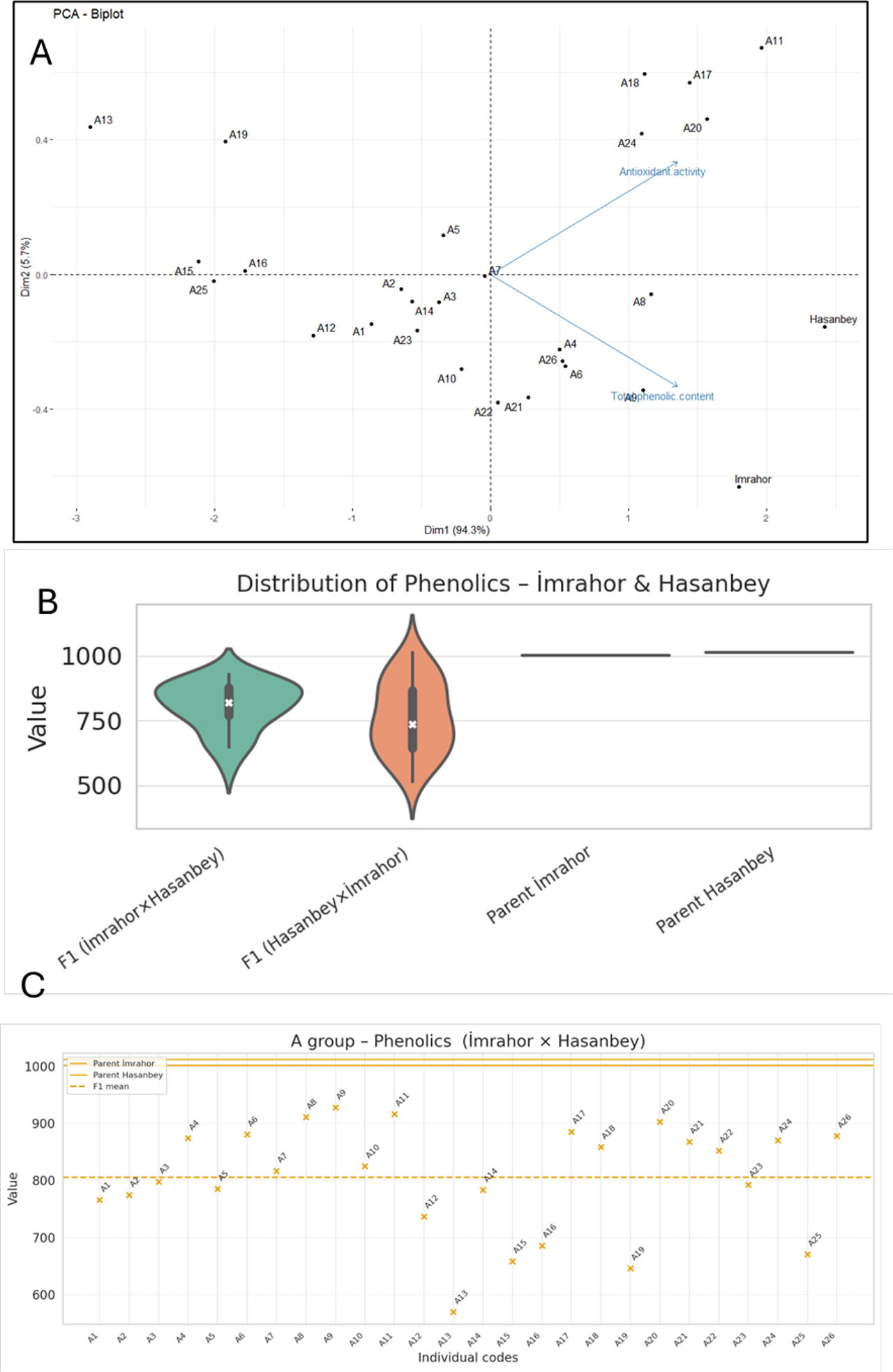
Fig. 2:
Distribution and comparative analysis of F1 individuals and parental cultivars for İmrahor × Hasanbey cross combination. (A) PCA biplot showing the distribution of genotypes in PC1-PC2 space. The parental cultivars ‘İmrahor’ and ‘Hasanbey’ are positioned in the lower right quadrant with negative composite scores. (B) Violin plots showing the distribution of total phenolic content in F1 (İmrahor×Hasanbey) and F1 (Hasanbey×İmrahor) populations compared to the two parental cultivars. (C) Individual ranking of all F1 genotypes and parents based on total phenolic content.
Both parental cultivars ‘İmrahor’ and ‘Hasanbey’ were located on the right side of the biplot in the negative PC2 region, indicating relatively lower antioxidant performance compared to several F1 individuals when considering the PC2 dimension.
The majority of F1 genotypes (A2, A3, A5, A7, A10, A12, A14, A23) were distributed in the central-left region, representing intermediate performance levels. Low-performing genotypes (A4, A6, A8, A21, A22, A26) occupied the left side of the biplot with negative PC1 scores.
The violin plot analysis (Fig. 2B) revealed distinct distributional characteristics of total phenolic content across the two reciprocal F1 populations and their parents. The F1 population from İmrahor (♀) × Hasanbey (♂) displayed a relatively compact distribution with a median centered around 805 mg GAE·100g−1 FW. The distribution was slightly skewed, with the bulk of the population concentrated between 700 and 900 mg GAE·100g−1 FW, and a narrower tail extending toward lower values around 600 mg GAE·100g−1 FW. The reciprocal cross Hasanbey (♀) × İmrahor (♂) exhibited a broader distribution with a median around 762 mg GAE·100g−1 FW. A large cluster of F1 genotypes (A1, A2, A3, A5, A7, A10, A12, A14, A23) exhibited intermediate performance levels between 750 and 850 mg GAE·100g−1 FW, clustered around the population mean. The lower-performing individuals (A4, A6, A8, A9, A17, A18, A20, A21, A22, A24, A26) ranged from 650 to 750 mg GAE·100g−1 FW. The ranking pattern revealed that none of the F1 individuals exceeded the higher parent value (100% inferior-low parent rate). However, the wide phenotypic range spanning 300 mg GAE·100g−1 FW among F1 individuals indicated substantial genetic variation and the presence of transgressive segregation.
Antioxidant Activity and Phenotypic Variation in the İmrahor × Hasanbey F1 Population
The PCA biplot for the Hasanbey × İmrahor cross (Fig. 3A) showed a markedly different pattern compared to the reciprocal cross. Both parental cultivars were positioned in the upper right quadrant with strongly positive PC1 scores, indicating high antioxidant performance. PC1 (Dim1) explains 92.8% of the total variance, while PC2 (Dim2) explains 7.2%. The F1 genotype C21 was located near the parents with a high composite score (2.32), while genotypes C19, C25, C26, and C15 occupied the lower right region with moderate positive PC1 values. The majority of F1 individuals (C2, C3, C6, C8, C10, C12, C13, C14, C16, C18, C22, C23, C24) clustered around the origin. Low-performing genotypes (C1, C4, C5, C7, C9, C11, C17, C20) were distributed in the left side with negative PC1 scores. The violin plot analysis (Fig. 3B) revealed that the İmrahor × Hasanbey F1 population exhibited a relatively broad distribution centered around 927 μmol TE·100g−1 FW, with individuals ranging from approximately 750 to 1250 μmol TE·100g−1 FW.
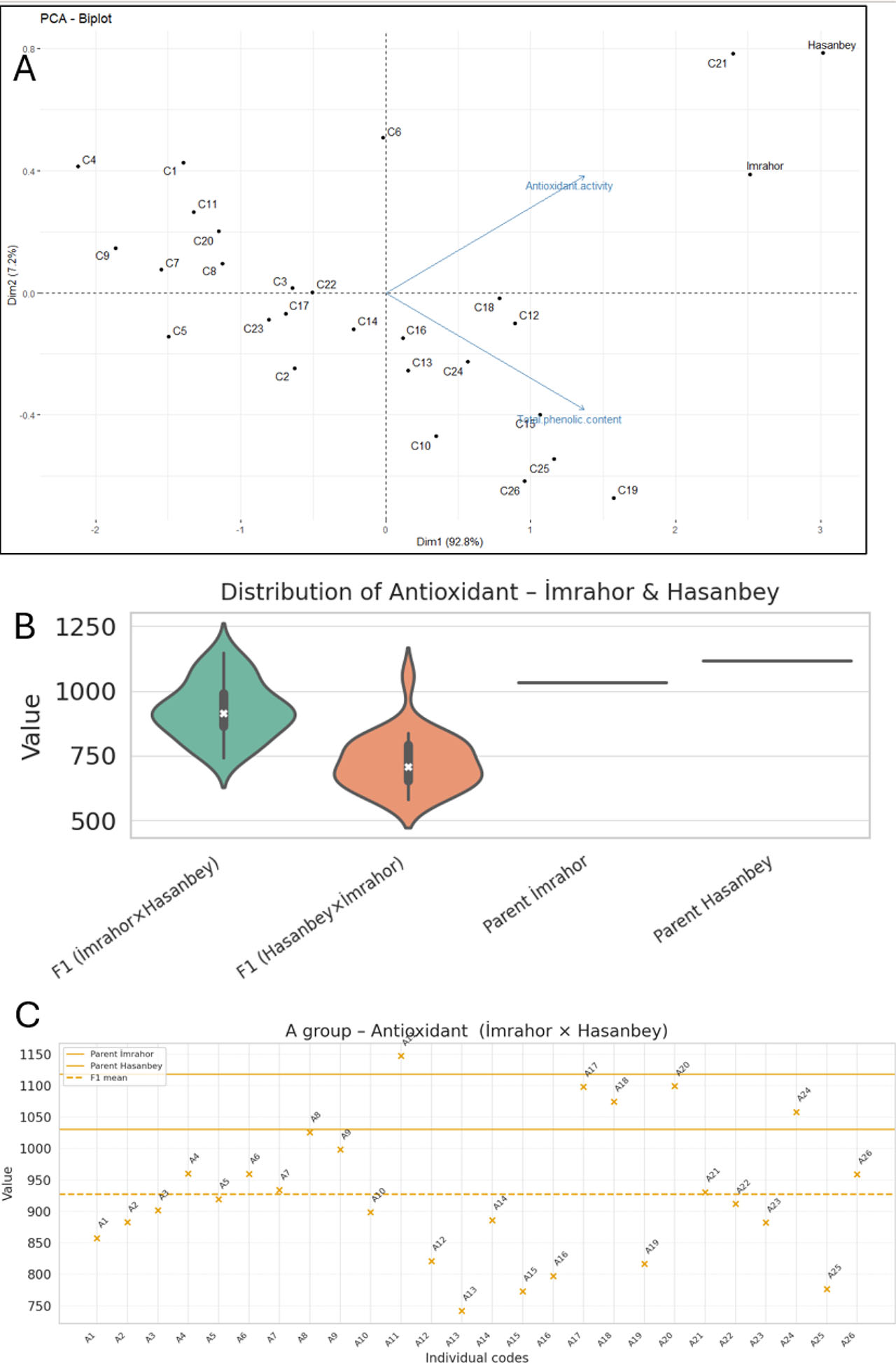
Fig. 3:
Distribution and comparative analysis of antioxidant activity in F1 individuals and parental cultivars for İmrahor × Hasanbey and Hasanbey × İmrahor reciprocal crosses. (A) PCA biplot showing the distribution of genotypes in PC1-PC2 space for Hasanbey × İmrahor cross. (B) Violin plots showing the distribution of antioxidant activity in both reciprocal F1 populations compared to the two parental cultivars. (C) Individual ranking of all F1 genotypes and parents based on antioxidant activity for İmrahor × Hasanbey cross.
In contrast, the Hasanbey × İmrahor F1 population displayed a narrower, more compact distribution centered around 724 μmol TE·100g−1 FW, ranging from approximately 500 to 1000 μmol TE·100g−1 FW. Both parental cultivars showed values around 1050–1150 μmol TE·100g−1 FW, substantially higher than both F1 population means. The individual ranking plot (Fig. 3C) demonstrated that F1 individuals from the İmrahor × Hasanbey cross ranged from approximately 750 to 1150 μmol TE·100g−1 FW. Top-performing genotypes (A11, A17, A20, A19, A13, A18) showed antioxidant activities between 1070 and 1150 μmol TE·100g−1 FW, with only A11 exceeding the lower parent ‘İmrahor’ but not surpassing ‘Hasanbey’. The F1 mean (927 μmol TE·100g−1 FW) was positioned well below both parental values, confirming negative mid-parent heterosis. The wide phenotypic range of approximately 400 μmol TE·100g−1 FW among F1 individuals indicated substantial genetic variation and potential for selection of superior genotypes despite overall negative heterosis.
Hierarchical Cluster Analysis of Biochemical Traits
The hierarchical cluster analysis grouped F1 individuals and parental cultivars based on their standardized phenolic content and antioxidant activity values (Fig. 4). In the İmrahor × Hasanbey cross (left panel), three distinct clusters were identified. The first cluster included high-performing genotypes (A11, A17, A20, A18, A24, A8, A9) along with both parental cultivars ‘Hasanbey’ and ‘İmrahor’, characterized by red-colored cells indicating high standardized values for both traits. The second cluster comprised intermediate-performing genotypes (A13, A19, A16, A15, A25, A12, A1, A23, A2, A14, A3, A5, A7, A10), displaying yellow to light blue colors representing near-average to slightly below-average values. The third cluster contained low-performing genotypes (A4, A6, A26, A21, A22), characterized by predominantly yellow cells indicating below-average standardized values. In the Hasanbey × İmrahor cross (right panel), the clustering pattern differed substantially. The highest-performing cluster included ‘Hasanbey’, C21, ‘İmrahor’, C19, and C26, showing intense red-orange coloration. A large intermediate cluster contained genotypes C15, C25, C12, C18, C13, C16, C10, and C24 with yellow coloration. The lowest-performing cluster comprised C4, C9, C5, C7, C8, C20, C1, and C11, displaying blue colors indicating low standardized values. Notably, the parental cultivars clustered with high-performing F1 individuals in this cross direction, contrasting with the İmrahor × Hasanbey cross where parents formed a distinct high-value group separate from most F1 individuals.
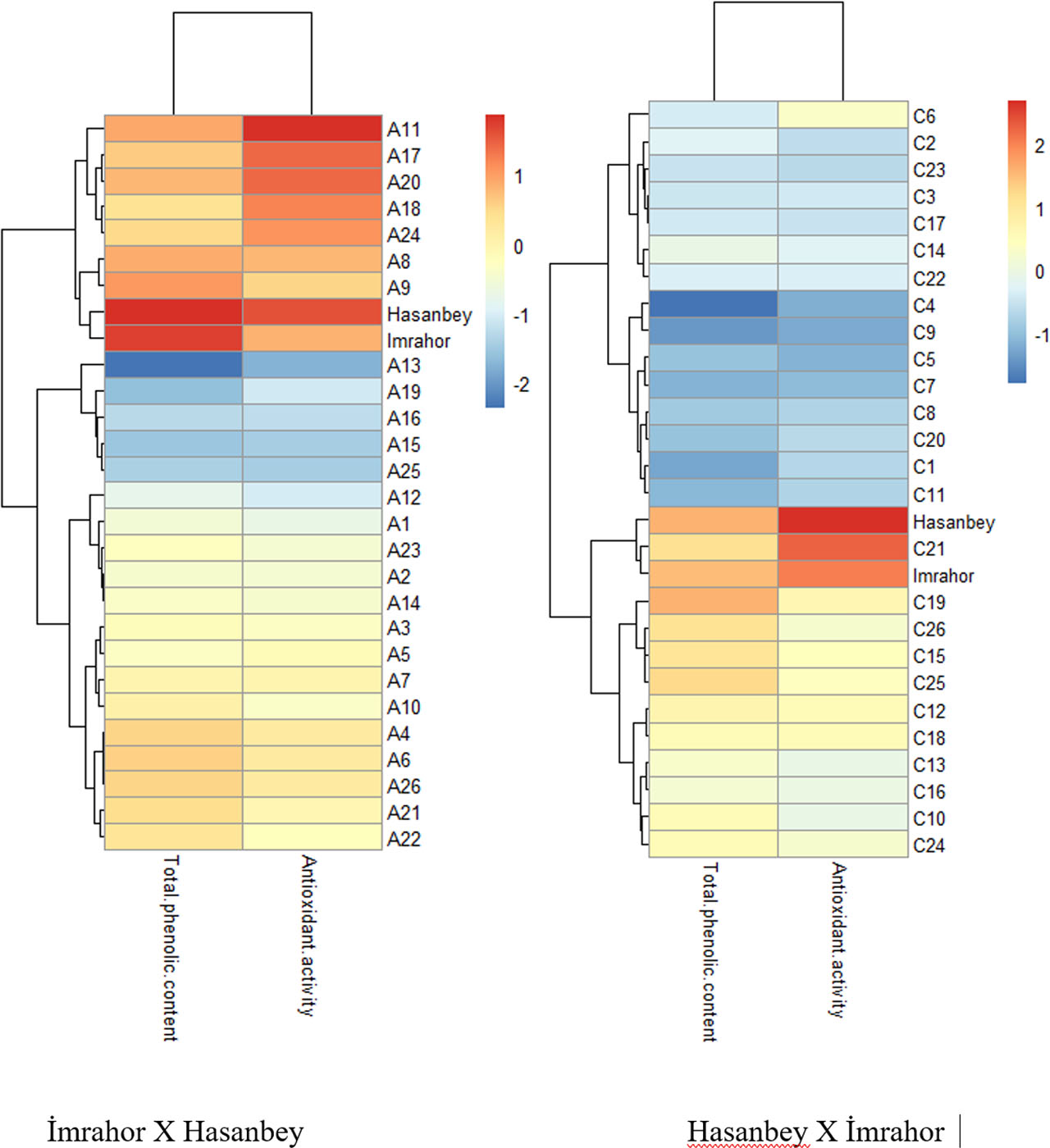
Fig. 4:
Hierarchical cluster heatmaps showing the standardized values of total phenolic content and antioxidant activity for F1 individuals and parental cultivars in both reciprocal crosses. Left panel: İmrahor × Hasanbey cross combination. Right panel: Hasanbey × İmrahor cross combination. Color intensity represents standardized Z-scores, with red indicating high values (positive Z-scores), yellow indicating intermediate values (near-zero Z-scores), and blue indicating low values (negative Z-scores).
Discussion
Genetic Tendency and Inheritance Patterns of Antioxidant Traits in Apricot F1 Populations
The present study revealed that both total phenolic content and antioxidant activity in F1 apricot populations derived from reciprocal crosses between ‘İmrahor’ and ‘Hasanbey’ exhibited negative mid-parent heterosis, with MPH values ranging from −13.69% to −32.62% (Tab. 1). The genetic transmission ability (Ta) for these traits was relatively low, ranging from 67.4% to 86.3%, indicating a trend toward small to medium inheritance. These findings align with previous research on stone fruits, where biochemical traits often display lower heritability compared to pomological characteristics (Ismaili et al., 2016). Also, Karaat and Serce, (2020) reported moderate heritability estimates for total phenolic content (h2 = 0.45–0.62) and antioxidant capacity (h2 = 0.38–0.54) in two apricot progenies, suggesting that these traits are significantly influenced by both genetic and environmental factors. The negative heterosis observed in our study is consistent with the phenomenon of inbreeding depression or the disintegration of favorable non-additive gene effects during hybridization, as documented by Fridman, (2015) and Sánchez-Pérez et al. (2006) in various crop species. The coefficient of variation (CV) for phenolic content ranged from 11.83% to 18.12%, while for antioxidant activity it ranged from 11.76% to 14.54% (Tab. 1), indicating moderate phenotypic variation within F1 populations. This level of variation is comparable to that reported by Drogoudi et al. (2008), who found CV values of 15–25% for total phenolic content across 29 apricot cultivars and hybrids. The continuous distribution and substantial range of trait values observed in our F1 populations (Fig. 2B and 3B) suggest polygenic inheritance, where multiple genes with small to moderate effects control the expression of antioxidant compounds (Sánchez-Pérez et al., 2006, Tohge et al., 2020). This genetic architecture provides opportunities for selection and improvement despite the overall negative heterosis trend.
Extent and Direction of Heterosis for Antioxidant Traits
The extent and direction of heterosis were further evaluated by examining mid-parent heterosis (MPH) values and the distribution of F1 individuals relative to parental performance. Notably, the inferior-low parent heterosis rates (LH) were extremely high, with 80.77–100% of F1 individuals falling below the lower parent value for both traits across both cross directions (Tab. 1). This phenomenon indicates that the parental cultivars ‘İmrahor’ and ‘Hasanbey’ possess relatively high antioxidant capacity compared to their hybrid offspring, likely due to the breakdown of epistatic interactions or complementary gene action that were optimally combined in the adapted parental genotypes (Geuna et al., 2024, Lippman and Zamir, 2007). Similar observations have been reported in other fruit crops; for instance, Butcher et al. (2013) found that certain flavonoid compounds in pepper F1 hybrids showed negative heterosis, with many individuals performing below the mid-parent value. However, despite the predominance of negative heterosis, the presence of transgressive segregants, F1 individuals approaching or occasionally exceeding mid-parent values, demonstrates that favorable allelic combinations can still arise through recombination. These individuals represent valuable genetic resources for selection and further breeding, particularly in later generations.
Reciprocal Effects and Maternal Influences on Biochemical Composition
One of the most striking findings of this study was the highly significant reciprocal effect observed for antioxidant activity (p < 0.001, Cohen’s d = 1.90), but not for total phenolic content (p = 0.199) (Tab. 2). The İmrahor (♀) × Hasanbey (♂) cross produced F1 individuals with mean antioxidant activity of 927.27 μmol TE·100g−1 FW, significantly higher than the reciprocal cross Hasanbey (♀) × İmrahor (♂) with 723.94 μmol TE·100g−1 FW, a difference of 203.33 μmol TE·100g−1 FW representing approximately 28% variation. This large effect size indicates strong maternal inheritance or cytoplasmic effects influencing antioxidant metabolism in apricot fruits. Maternal effects in fruit crops can arise from several mechanisms, including cytoplasmic inheritance of organellar genomes (mitochondria and chloroplasts), maternal provisioning of mRNA and proteins to developing embryos, and epigenetic modifications transmitted through the female gamete (Greiner et al., 2015). In stone fruits, chloroplast-encoded genes play crucial roles in secondary metabolism, particularly in the phenylpropanoid pathway responsible for synthesizing phenolic compounds and related antioxidants (Jaakola, 2013). The differential antioxidant activity between reciprocal crosses, despite similar phenolic content, suggests that the enzymatic machinery involved in antioxidant defense may be maternally influenced. This could involve differential expression of key enzymes such as polyphenol oxidase, peroxidase, or superoxide dismutase, which are known to be encoded by both nuclear and organellar genomes (Gill and Tuteja, 2010). The contrasting patterns observed in the PCA biplots and cluster analyses between the two reciprocal crosses (Fig. 2A, 3A, and Fig. 4) further support the importance of cross direction. In the Hasanbey × İmrahor cross, both parental cultivars clustered with the highest-performing F1 individuals and exhibited positive composite scores, whereas in the İmrahor × Hasanbey cross, parents were positioned separately with negative composite scores relative to several F1 genotypes. This pattern suggests that ‘Hasanbey’ as a maternal parent contributes favorable genetic or cytoplasmic factors that maintain higher baseline antioxidant capacity in offspring, while ‘İmrahor’ as a maternal parent results in greater phenotypic variation and lower mean performance. Reciprocal effects have been documented in other fruit breeding programs. Rapisarda et al. (2009) reported significant differences in total phenolic and flavonoid content between reciprocal citrus hybrids, attributing these differences to maternal inheritance of plastid-encoded enzymes involved in secondary metabolism. Similarly, Kaczmarska et al. (2017) found that strawberry F1 hybrids showed reciprocal differences in phytochemical properties depending on which parent served as the female. Our findings emphasize the critical importance of considering cross direction in apricot breeding programs targeting enhanced antioxidant traits, as the choice of maternal parent can substantially influence offspring biochemical composition.
Identification of Superior Genotypes Through Multivariate Analysis and Breeding Implications
The principal component analysis successfully reduced the dimensionality of the dataset, with PC1 explaining 92.8–94.3% of total variance across both reciprocal crosses (Tab. 3 and 5). The high variance explained by PC1 reflects the strong positive correlation between total phenolic content and antioxidant activity, confirming that phenolic compounds are the primary contributors to anti-oxidant capacity in apricot fruits, as previously reported by Su et al. (2022) and Sochor et al. (2010). This strong relationship validates the use of total phenolic content as a rapid screening tool for predicting antioxidant potential in breeding programs, reducing the need for multiple antioxidant assays. Based on composite scores integrating both traits, several superior F1 genotypes were identified across both cross directions (Tab. 4 and 6). In the İmrahor × Hasanbey cross, genotypes A13 (composite score: 2.81), A15 (2.03), A25 (1.93), A19 (1.87), and A16 (1.71) exhibited the highest combined antioxidant performance, with phenolic contents ranging from 850–950 mg GAE·100g−1 FW and antioxidant activities of 1070–1150 μmol TE·100g−1 FW. Although these values did not exceed both parents, they approached the mid-parent value and demonstrated superior performance compared to the majority of F1 individuals. In the Hasanbey × İmrahor cross, genotype C21 (composite score: 2.32) emerged as the top-performing F1 individual, followed by C19 (1.44) and C25 (1.06). The hierarchical cluster analysis (Fig. 4) provided additional insights into the relationships among genotypes. In the İmrahor × Hasanbey cross, high-performing F1 genotypes (A11, A17, A20, A18, A24) clustered closely with both parental cultivars, suggesting that these individuals inherited favorable allelic combinations from both parents for antioxidant-related genes.
Conversely, low-performing genotypes (A4, A6, A26, A21, A22) formed a distinct cluster characterized by consistently low standardized values for both traits, indicating homozygosity for unfavorable alleles or disruption of complementary gene interactions. The identification of transgressive segregants with antioxidant profiles approaching or exceeding mid-parent values demonstrates the potential for developing improved cultivars through recurrent selection and backcrossing strategies. Despite the overall negative heterosis observed at the population level, the presence of superior individuals indicates that favorable allelic combinations can be recovered and fixed in subsequent generations. This aligns with findings by Manzoor et al. (2012) and Gupta et al. (2012), who documented wide variation in phytochemical content among Turkish apricot germplasm, emphasizing the rich genetic diversity available for improvement programs. From a breeding perspective, our results suggest several practical strategies for developing apricot cultivars with enhanced antioxidant properties. First, the significant reciprocal effects for antioxidant activity (Tab. 2) indicate that breeders should carefully consider maternal parent selection, with ‘İmrahor’ as the female parent producing offspring with higher mean antioxidant activity than the reciprocal cross. Second, the high coefficient of variation and continuous distribution of traits within F1 populations (Fig. 2 and 3) suggest that large segregating populations should be evaluated to identify rare transgressive segregants with exceptional antioxidant profiles. Third, the strong correlation between phenolic content and antioxidant activity (PC1 loadings in Tab. 3 and 5) allows for efficient indirect selection based on total phenolic assays, which are simpler and less expensive than multiple antioxidant activity measurements. The superior F1 genotypes identified in this study, particularly A13, A15, A25, A19, A16, and C21, warrant further evaluation across multiple environments and growing seasons to assess stability and G×E interactions. Campbell et al. (Campbell et al., 2013) demonstrated that phenolic and carotenoid content in northeastern USA apricot varieties varied significantly with harvest maturity and environmental conditions, highlighting the importance of multi-location trials. Additionally, these elite genotypes should be subjected to detailed metabolomic profiling using HPLC-MS or LC-MS/MS to identify specific phenolic compounds (chlorogenic acid, quercetin derivatives, catechins) contributing to their superior antioxidant capacity, as suggested by Ali et al. (2011) and Erdogan-Orhan and Kartal (2011).
The negative heterosis observed in this study, while initially disappointing, does not preclude successful cultivar development. Comparable patterns have been reported in other crops where biochemical traits showed negative F1 heterosis but subsequent generations (F2, F3, or backcross populations) yielded superior recombinants through transgressive segregation (Mahmoud et al., 2023, Ali et al., 2011, El-Gammaal and Yahya, 2018). Bajpai et al. (2019) documented heterotic patterns in Brassica juncea where different secondary metabolites exhibited contrasting modes of inheritance, with some showing positive and others negative heterosis. This genetic complexity necessitates multi-generational breeding approaches rather than relying solely on F1 hybrid vigor. Future research should focus on molecular characterization of the identified elite genotypes to understand the genetic basis of superior antioxidant capacity. Quantitative trait locus (QTL) mapping in larger F2 or backcross populations could identify genomic regions controlling phenolic biosynthesis and antioxidant activity, facilitating marker-assisted selection (Salazar et al., 2013). Additionally, transcriptomic and proteomic analyses comparing high- and low-performing genotypes could elucidate regulatory mechanisms governing the phenylpropanoid pathway and related antioxidant systems in apricot. Given the increasing consumer demand for functional foods with health-promoting properties, the development of apricot cultivars with enhanced antioxidant capacity represents both a commercial opportunity and a public health contribution (Fratianni et al., 2018).
Conclusions
Our study revealed that the inheritance of total phenolic content and antioxidant activity in apricot exhibits predominantly additive genetic control with significant negative heterosis effects. Comparing reciprocal crosses between ‘İmrahor’ and ‘Hasanbey’, we found that maternal genotype significantly influenced trait expression, particularly for antioxidant activity where reciprocal differences were highly significant and demonstrated strong maternal effects. Both F1 populations demonstrated moderate to high genetic transmission abilities, with mid-parent heterosis values consistently negative, indicating that hybrid offspring generally exhibited lower biochemical trait values than the average of their parents. The divergent patterns between reciprocal crosses were particularly evident in principal component analysis results. While İmrahor × Hasanbey produced F1 individuals that predominantly under-performed both parents (with parents ranking near the bottom), the reciprocal Hasanbey × İmrahor cross showed parental cultivars ranking at the top positions, demonstrating pronounced cytoplasmic or maternal effects. These differences translated to significant variations in phenotypic distributions, with moderate coefficients of variation indicating substantial genetic variability suitable for selection despite overall negative heterosis. These findings have immediate practical applications for apricot breeding programs targeting enhanced antioxidant properties and nutritional quality. Although negative heterosis limits the utility of F1 hybrids for direct commercial use, the wide phenotypic variation and transgressive segregation observed among F1 individuals provide valuable genetic resources for selection. Superior genotypes identified from both cross combinations represent promising candidates for further evaluation and potential cultivar development. The strong positive correlation between total phenolic content and antioxidant activity suggests that selection for either trait would simultaneously improve the other, simplifying breeding strategies. Future research should explore the molecular mechanisms underlying these maternal effects and negative heterosis patterns, particularly focusing on cytoplasmic inheritance and epistatic interactions controlling biochemical trait expression. Additionally, advancing these F1 populations to subsequent generations would reveal segregation patterns and enable identification of quantitative trait loci associated with antioxidant properties, facilitating marker-assisted selection in apricot breeding programs.
Acknowledgements
The authors gratefully acknowledge the technical support provided by the research staff at the apricot breeding program. Special appreciation is expressed to the orchard management team for their assistance in maintaining the experimental plant materials and ensuring optimal growing conditions throughout the study period. The authors extend their sincere gratitude to Dr. Meral Doğan for her valuable contributions to the statistical analyses and to Dr. Rukiye Zengin for her expert assistance in conducting the chemical analyses.
Notes
[5] Contributed by Author Contributions:
C.E., I.B., and O.K. contributed to the conceptualization, methodology, and investigation of the study. C.E. and I.B. were involved in data curation, formal analysis, software, visualization, and original draft preparation. Original draft and writing, review and editing were carried out by I.B. and O.K. All authors have read and approved the final version of the manuscript.