
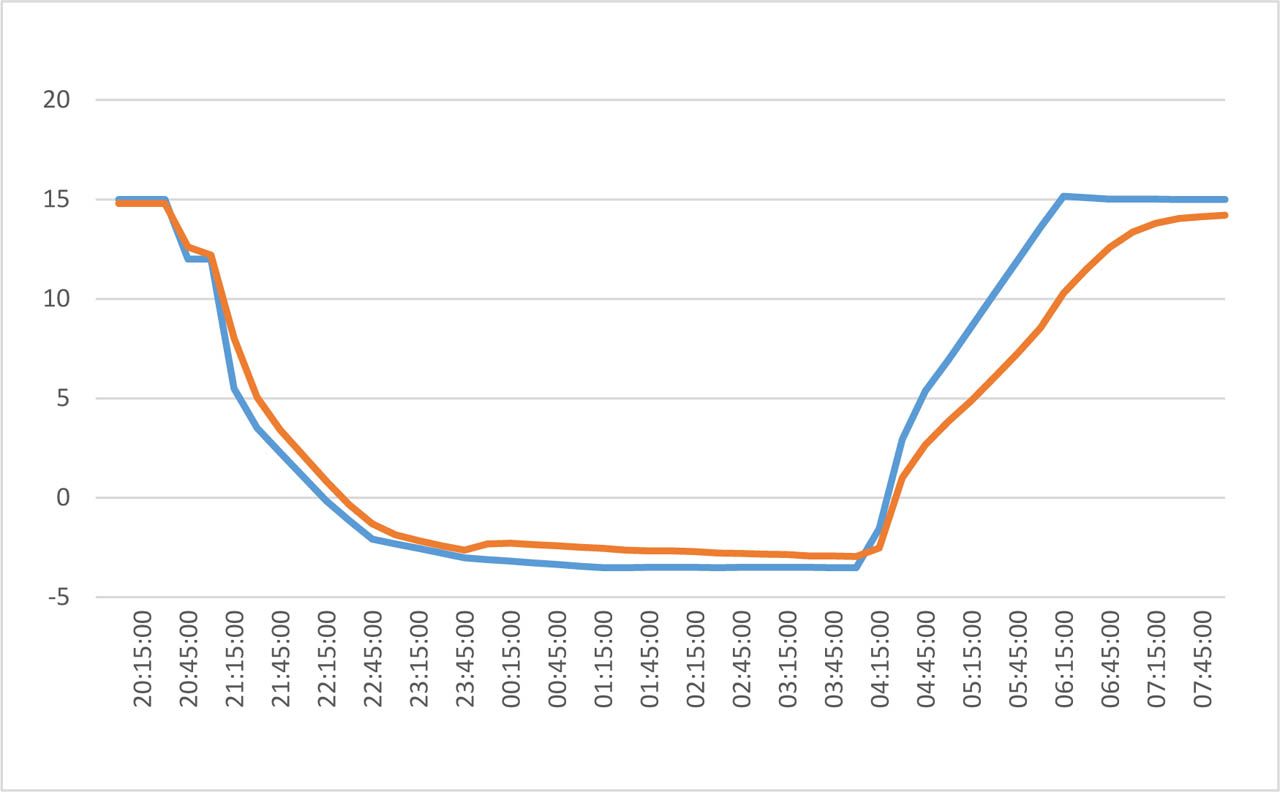
Fig. 1:
Temperature profile of a frost regimen applied in the incubation chamber, the red line is the air temperature while the blue line is the sensor temperature at the object in °C
Tab. 1:
Substances used in the protection trials with information about the supplier and the used concentration
| Substance or product | supplier | concentrations |
|---|---|---|
| Agros-3 | Deygest, ES | 0,5%, 1%, 2% |
| Cutisan | Biohelp, AT | 1% |
| Hortisul | Agrando, DE | 1%, 2% |
| Prev B | Biohelp, AT | 0,2%, 0,3% |
| Superfifty | Biohelp, AT | 1%, 2% |
| Zn Chelate | Raiffeisen LH, AT | 1% |
| Baking soda | Kotanyi, AT | 1%, 2% |
| Basfoliar Aktiv | BASF, DE | 0,5%, 1%, 2,5%, 5% |
| Cocana | Biohelp, AT | 0,5%, 1% |
| CropAid | Cropaid Int. Limited, UK | 0,3%, 0,5% |
| Fertileader Vital | Timac Agro, FR | 1%, 2% |
| Fruit Lime | Schneider, Verblasetechnik, DE | 1% |
| Fuguran Progress | Certis, DE | 1% |
| Genol Antifreeze | Raiffeisen warehouse | 1% |
| KHPO4 | Merck, DE | 1%, 2% |
| Kumar | Certis, DE | 1%, 2% |
| Megafol | Syngentha, DE | 1%, 2%, 2,5% |
| Myco Sin Vin | Biohelp, AT | 1%, 2% |
| PK Fit | Hechenbichler, AT | 0,5%, 1% |
| Potassium Water Glass | Pottasol, Biohelp, AT | 0,5%, 0,7%, 1% |
| Prestop | Biohelp, AT | 0,50% |
| Radam Extra 250 | Kwizda Agro AT | 0,1%, 0,5%, 1%, 1,5% |
| Regalis® Plus | BASF, DE | 0,10% |
| Sojall Vitana | SOJALL Pro Natura GmbH | 1%, 2% |
| Syneco AF5 | Syneco, Milano IT | 1%, 1,5%, 2% |
| Urea | Roth, AT | 1%, 2% |
| Veganofluid | Veganosol GmbH, DE | 3%, 4%, 5% |
Tab. 2:
Results gained by incubation with the frost chamber after a twice spray treatment. The differences were not significant. Number of pots for each classification.
| Tissue | Substance (concentration) | Application frequency | Incubation | Control - healthy | Control - damaged | Treated-healthy | Treated-damaged |
|---|---|---|---|---|---|---|---|
| ZW cuttings | NaHCO3 (1%) | 2x | short | 2 | 4 | 4 | 2 |
| GV cuttings | Urea (1%) | 2x | long | 1 | 5 | 3 | 3 |
| GV cuttings | Syneco AF5 (1%) | 2x | long | 2 | 4 | 3 | 3 |
Tab. 3:
Results of grapevine cuttings treated with a combination of Zn chelate and urea
| Tissue | Substance (concentration) | Application frequency | Incubation | Control - healthy | Control - damaged | Treated-healthy | Treated-damaged |
|---|---|---|---|---|---|---|---|
| GV cuttings | Urea (2%) | 2x | long | 2 | 4 | 4 | 2 |
| GV cuttings | Zn chelate (1%) - urea (2%) | 2x | long | 2 | 4 | 4 | 2 |
Tab. 4:
Results of treatment with different substances and following frost exposition
| Tissue | Substance (concentration) | Application frequency | Incubation | Control - healthy | Control - damaged | Treated-healthy | Treated-damaged |
|---|---|---|---|---|---|---|---|
| GV cuttings | Superfifty (2%) | 2x | short | 2 | 4 | 4 | 2 |
| GV cuttings | Veganofluid (3%) | 2x | long | 0 | 6 | 0 | 6 |
| GV cuttings | Urea (2%) | 2x | long | 1 | 5 | 4 | 2 |
Tab. 5:
Results of treatment with Cropaid and following frost exposition
| Tissue | Substance (concentration) | Application frequency | Incubation | Control - healthy | Control - damaged | Treated-healthy | Treated-damaged |
|---|---|---|---|---|---|---|---|
| GV cuttings | Cropaid (0,5%) | 2x | short | 4 | 2 | 2 | 4 |
| GV cuttings | Cropaid (0,5%) | 2x | long | 2 | 4 | 4 | 2 |
| GV cuttings | Cropaid (0,5%) | 2x | long | 2 | 4 | 5 | 1 |
Tab. 6:
Results of treatment with Megafol 2% and following frost exposition
| Tissue | Substance (concentration) | Application frequency | Incubation | Control - healthy | Control - damaged | Treated-healthy | Treated-damaged |
|---|---|---|---|---|---|---|---|
| GV cuttings | Megafol (2%) | 2x | short | 2 | 4 | 3 | 3 |
| GV cuttings | Megafol (2%) | 2x | long | 2 | 4 | 4 | 2 |
| GV cuttings | Megafol (2%) | 2x | long | 3 | 3 | 2 | 4 |
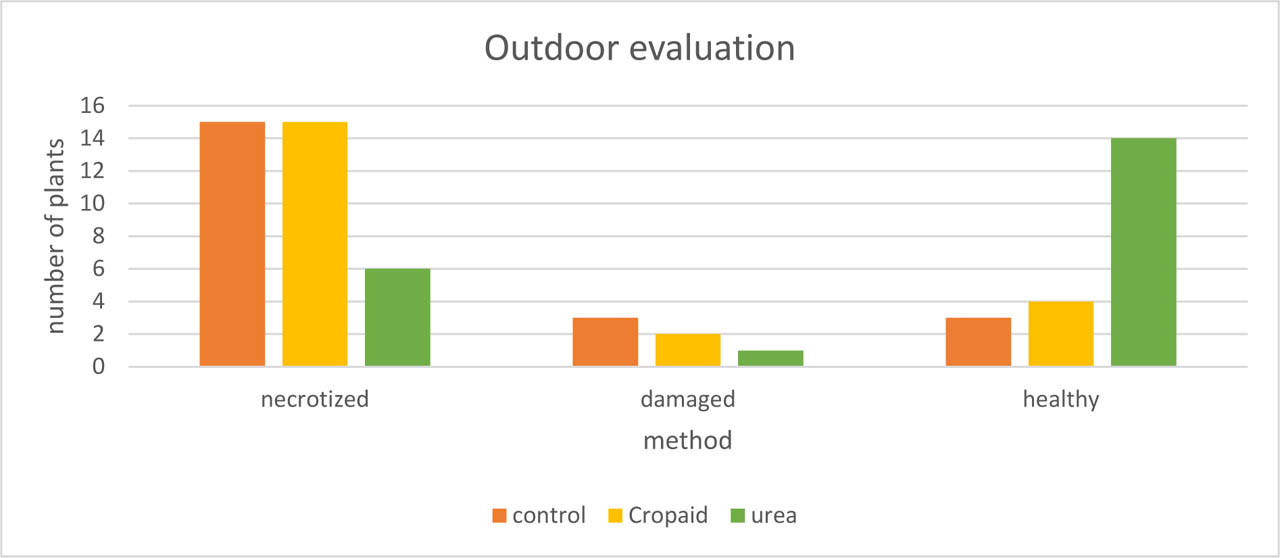
Fig. 2:
Grapevine cuttings exposed to frost conditions outdoor with a minimum temperature of −4 °C and the reaction of the shoots (leaves)
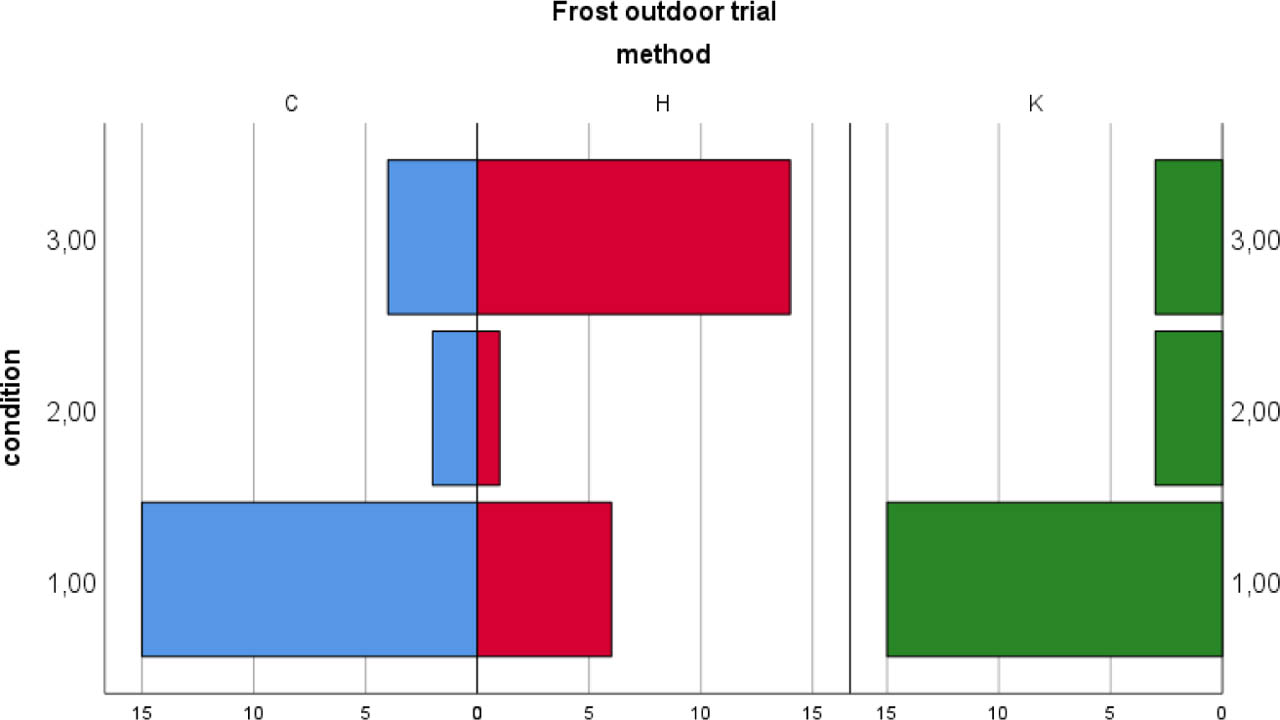
Fig. 3:
Frequency of damaged (1), necrotized (2) and healthy (3) grapevine shoots after treatment with Cropaid (C), urea (H) and in the untreated control (K)
Tab. 7:
The difference between Urea (U; 2%) and both the control (C) and Cropaid (K; 0,5%) was significant
| Var. 1 | Var. 2 | difference of mean value | standard deviation | Significance | confidence | interval |
|---|---|---|---|---|---|---|
| K | C | −0,04762 | 0,25614 | 0,981 | −0,6632 | 0,5679 |
| U | −,95238* | 0,25614 | <0,001 | −1,5679 | −0,3368 | |
| C | K | 0,04762 | 0,25614 | 0,981 | −0,5679 | 0,6632 |
| U | −,90476* | 0,25614 | 0,002 | −1,5203 | −0,2892 | |
| U | K | ,95238* | 0,25614 | <0,001 | 0,3368 | 1,5679 |
| C | ,90476* | 0,25614 | 0,002 | 0,2892 | 1,5203 |
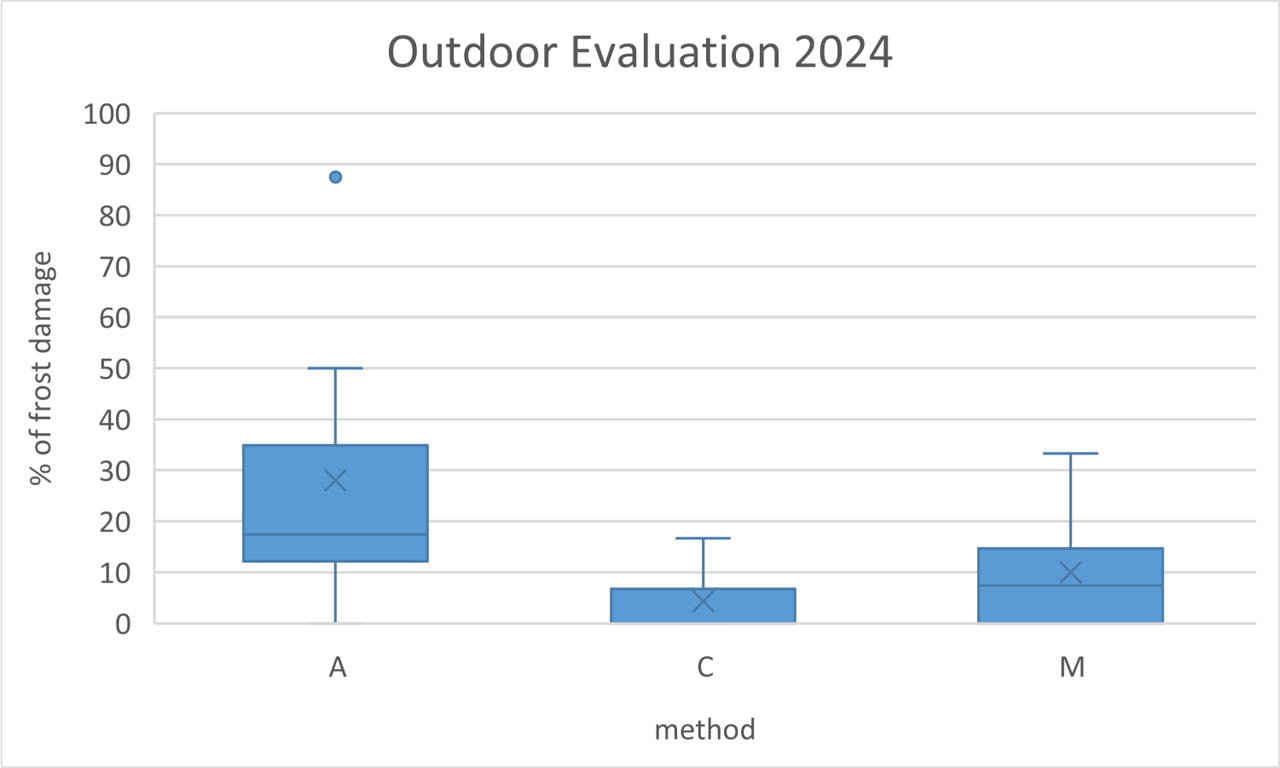
Fig. 4:
Comparison of frost damage control (C), Megafol application (M) and Agros-3 application (A) by the frequency of damaged shoots
Tab. 8:
Incidence and severity of frost damage on shoots at a vineyard in Krems. Statistical analysis was done with Kruskal Wallis Test. Different superscript letters represent significant differences.
| Frost damage | Incidence (%) | Severity (%) |
|---|---|---|
| Control | 8.0b | 5.9b |
| Megafol | 3.5a | 2.3a |
| Agros-3 | 23.8c | 11.5c |
| p-value | < 0.001 | < 0.001 |