
Introduction
Late Frost and Its Impact on Austrian Viticulture
Late frost and the consequences for grapevines have been a ongoing task in Austrian viticulture (Soja et al., 2010; Kothgasser, 2018). Due to global warming, the bud break of grapevines is occurring earlier in most years, which increases the likelihood of late frost damage (Formeyer et Goler, 2013). Mild winters and early bud break due to changed temperatures increase the risk of damage from late frost events in spring (Poni et al., 2022). In Austria, the last major late frost incidences of a national (not only regional) dimension were recorded in 2016 and 2017 (Kothgasser, 2018). In 2024, frost damage occurred again, especially in Lower Austria. Nevertheless, frost can be technically prevented nowadays, and there are many methods to prevent or mitigate late frost damage (Poni et al., 2022). Lower-quality locations are more commonly threated than perfect sites and usually the economic situation does not allow extensive technical measures against frost (Petgen, 2016). Even sites in more benign locations usually do not have the properties to contend with the effects of global warming. Within the species Vitis vinifera, the bud break period of various grapevine varieties can extend up to five weeks, depending on the year, climate and location (Hoppmann et al., 2017). In Central Europe, the bud break time of grapevine varieties will typically occur from the second half of March to mid-April. The main factor regulating bud break is soil temperature (Kartschall et al., 2015). Risk for frost incidence disappears only in the second half of May.
Frost Protection in Viticulture through Pruning
On the one hand frost protection in viticulture can be reached through delaying development by late pruning (Archer et Schalkwyk, 2007, Morgani et al., 2022). Frost sensitivity increases with the development of the bud and shoot length. While closed buds are still very robust and strong frost does not cause damage, stability against frost decreases significantly with bud break and appearance of green parts (Moran et al., 2018). As long as the bud is still covered with wool, the protection extends up to about −4 °C (Poni et al., 2022). Once first green leaves appear, the threshold falls to about −2 °C, and a fully developed shoot with spread leaves can tolerate a maximum of −1 °C for a longer period (Hopmann, 2015). Consequently, delaying bud break can reduce or even avoid damage to grapevines (Regner et al., 2023). The extent of frozen tissue depends on the stage of vegetative development, on the duration of the frost event and on the temperature profile. A delay of development by some days is possible, but is not discernable after a few weeks in most years (Frioni et al., 2016, Friend et Trought, 2007). Late pruning, if the vine is already active, bears the risk of Esca infections (Travadon et al., 2016). Also, leaving an increased number of developing shoots can delay the development of the single shoot (Main et Morris, 2008). Additionally, in the case of a partial damage, sufficient shoots will survive. As the vigor of the shoots is lower, development is slightly delayed, and frost risk is marginally reduced (Schiefer et Thim, 2020).
Substances for Delaying Bud Break
A simple method for inexpensive frost prevention could be established through the application of active substances (Poling, 2008). Different substances could be applied to the vine to delay shoot development (Dami et al., 1997, Persico et al., 2021). Some of the most promising bud break-retarding substances are plant oils (Dami, 2007). Also, phytohormones like abscisic acid or gibberellic acid can be used to retard development in the bud break (Perez et Noriega, 2018). Ethephon delays bud break under certain conditions (Labay, 2018). A shoot with green tissue, as reached at BBCH stage 07, is more resistant to frost than a shoot that has already unfolded one leaf at BBCH-stage 11. The application of oil is among the most well-established methods for delaying bud burst in practical viticulture. Two applications of 10% (v/v) rapeseed oil resulted in an average bud burst delay of one week in the varieties Grüner Veltliner and Zweigelt (Herrera et al., 2018). Centinari et al., 2018 showed that the duration of the delay with soybean oil was variety-dependent. Wang et Dami (2020) also confirmed a varietal influence and observed a discontinuity in the effect.
Technical Possibilities for Frost Protection
Equipment to protect against frost has been developed. One option is the use of wind machines for mixing air of different temperatures. Other strategies are based on heating with electric heating cables and frost irrigation with micro-sprinklers (Poni et al., 2022). All these technical solutions are associated with high investments. However, it would be appreciated if methods could be applied with the existing infrastructure of a vineyard, for instance, spraying equipment. Frost protection by spraying immediately before the event takes place would be of great interest (Centinari et al., 2016). Substances or microorganisms are applied to achieve improvement in frost stability. The efficiency is still rather low, but substances for application are available and popular among practitioners.
Substances for reduction of frost sensitivity
Syneco AF5 (Syneco, Milan-IT) is approved as a foliar fertilizer. The ingredients potassium and monopropylene glycol are primarily responsible for stabilizing the plant against frost. In addition to frost protection, it is also credited with improving performance due to fertilization. Its effect was tested on apple crops by the University of Bologna (synecoaf5). Genol Antifreeze, obtained from Raiffeisen warehouse, is used as antifreeze for piping systems and plant protection equipment. Its active ingredient is polyethylene glycol. It is not approved for use in viticulture, and there is no literature on its use as a frost minimizing substance for growing plants. Regalis® Plus (BASF, DE) is approved for loosening cluster structure in grapes, its active ingredient is prohexadione-calcium. In fruit cultivation, Regalis is used against fire blight. Its mechanism of action is to disrupt the plant's phytohormone balance, thereby reducing growth or causing the grape clusters to shatter (Böll et al., 2009). CropAid (Cropaid International Limited, UK) is a registered trademark and listed as an organic fertilizer in the EU. It is promoted as a fertilizer for higher yields, better quality, and improved resistance to frost and cold. Among other ingredients, it contains Thiobacillus strains and minerals (Cropaid, 2025). Fertileader Vital (Timac Agro, FR) is a universal fertilizer with a focus on N supply (9%), but also contains 5% P and 4% K. Trace elements include B, Fe, Mn, Cu, and Zn. Fruit Lime (Schneider, Verblasetechnik, DE) consists of finely ground lime composed of Ca and Mg carbonate and bicarbonate. It causes a strongly alkaline reaction when suspended on the leaf surface. It is approved as a fertilizer EU-wide. PK Fit (Hechenbichler, AT) is a fertilizer that focuses on phosphorus supply and also contains phosphorous acid. Consequently, it is not suitable for organic production. The P content is 27%, the N content is only 3%, and the K content is 18%. The trace elements B, Fe, Mn, Cu, and Zn are also included. Basfoliar Aktiv (BASF, DE) has the same composition as the PK Fit fertilizer. This product has also been used for plant protection purposes because the phosphorous acid provides systemic protection against downy mildew. Radam Extra 250 (Kwizda Agro AT) is specifically designed to provide a high amount of potassium. Its high concentrations of K (52%) and S (18%) are achieved in the form of an EDTA chelate. It is used to combat wilting and drought stress and to improve wine quality. Potassium is a wellknown cellular osmotic agent and therefore important for maintaining turgor. Hortisul (Agrando, DE) has been created to provide mainly potassium. It is a readily soluble potassium sulfate (KSO4). Its concentration of 52% K and 18% S can be used specifically to supplement potassium. It is recommended to treat vines with wilting and drought stress symptoms and to improve wine quality (RWA, 2025). Cocana (Biohelp, AT) is produced by extracting coconut flesh and it is used as an additive in viticulture and the cultivation of other agricultural crops. Cocana is used as an additive to spray mixtures; it reduces surface tension, has an alkaline effect, and leaves a light, waxy film on the leaves and berries. It is also often used to wash grapes in cases of powdery mildew infections (Pertot et al., 2017). The active ingredient of baking soda (Kotanyi, AT) is NaHCO3, which has long been used as a leavening agent in the baking industry. Baking soda has also been used as a medication against hyperacidity. It has a weak alkaline effect and has drying properties on plant surfaces (Bauer et al., 2017). Kumar (Certis, DE) consists of potassium bicarbonate and is used as an additive to spraying agents or plant protection product. It is a contact fungicide used against scab on apples, botrytis, and powdery mildew on grapevines. Myco Sin Vin (Biohelp, AT) contains sulfuric clay and was an approved plant strengthener that was sprayed preventively. It is effective against fungal and bacterial diseases. The pH is 3.8, yet it is relatively acidic. It also contains yeast, horsetail, and biological adhesives. Due to Al− ions found as residues, it is currently no longer approved for use in viticulture (Pertot et al., 2017). Prestop (Biohelp, AT) is a biologically based biofungicide. It contains spores and mycelium of the yeast Gliocladium catenulatum, which has an antagonistic effect on various diseases. In viticulture it is used against Botrytis (Ephytoa, 2025).
Funguran Progress (Certis, DE) contains the active ingredient copper hydroxide, which is particularly important in viticulture as a fungicide against downy mildew and red smut fungus. Cutisan (Biohelp, AT) is a finely ground kaolin that can form a film on the leaf surface. This helps maintain the elasticity of epidermal cells for longer and also provides some protection against sunburn. Zn Chelate (Raiffeisen LH, AT) is a salt of Zn EDTA. It is used as a zinc fertilizer, particularly in cases of absorption disorders caused by excessively high pH. Zinc is a component of numerous enzymes and is important for flower quality, fruit set, fruit quality, and calcium transport in the vine. It is also involved in the storage of reserve substances (e.g., starch). Zinc is poorly available in humus-rich soils, at high pH levels, with high phosphorus content, and in cold and wet conditions (Bauer et al., 2017). Sojall Vitana (Sojall Pro Natura GmbH) is an organic plant strengthener. It contains organic acids and their salts, as well as silicon dioxide. It strengthens the leaf surface and roots, promotes natural resistance to fungi and pests, has a positive influence on growth, and contributes to the regulation of water balance. The application of Potassium Water Glass (Pottasol, Biohelp, AT) leads to the hardening of the leaf surface. The effect of the silica makes the epidermis more resistant. The substance adheres well to the leaf and has a caustic effect. It also has a plant protection effect against certain fungal diseases. Superfifty (Biohelp, AT) is a highly concentrated seaweed extract (from knotted kelp) containing antioxidants and plant metabolites, including precursors of phytohormones. It is a thick plant extract. It is used as a fertilizer in viticulture. Prev B (Biohelp, AT) is used as a plant aid in viticulture and contains orange oil. The AM formulation is applied as an insecticide. It acts as an oil, forming a film on the plant and also contains special phenols that exert a bactericidal effect. Veganofluid (Veganosol GmbH, DE) is a liquid organic fertilizer marketed as a heat and frost protection for plants in general. A contact time of at least two days after application is required. It is a fertilizer with a focus on nitrogen supply and is also registered for organic farming. It contains an additive containing glycine betaine, which is derived from beet molasses. Megafol (Syngentha, DE) is a liquid biostimulant of plant origin (brown algae extract). It consists of a complex of selected biologically active plant extracts (betaines, vitamins, proteins) and is produced using Geapower® technology (GEA931). Megafol is used to increase tolerance to abiotic stress (cold, heat, drought) in cereals and arable crops. Agros-3 (Deygest, ES) (algae extract, pine resin extract) is a cell regulator that acts by dissolving poorly soluble precipitates and increasing the ionic concentration in the sap.
In this study, treatment methods were investigated to stabilize green plant tissue against frost temperatures and thus offer protection against late frost. Frost sensitivity increases with shoot development. We varied several parameters to optimize the protective effect, including application frequency, residence time, and concentration. Our main objective was to identify protection strategies that combine high efficiency with minimal cost.
Material and Methods
The Federal College and Research Institute for Viticulture and Pomology Klosterneuburg operated several greenhouses for growing cuttings on Bisamberg in Langenzersdorf (northwest of Vienna). A climate chamber was installed in one of these greenhouses, which served to conduct the frost tests. It was a Binder Konstant climate chamber (model KMF 115), into which a temperature sequence was programmed based on natural frost nights (Fig. 1). The programs used had a minimum temperature of −2 to −4.5 °C. The required planting material was grown in the greenhouse under conditions to produce homogeneous cuttings. The chamber trials were conducted during spring months from 2020 to 2022. We differentiated with long (24h) and short exposure time (8h) to the substance before frost treatment. However, since the chamber requires air movement to prevent the formation of gradients, a plastic screen was installed to prevent direct wind but indirect circulation was given. A few experiments with cuttings could also be conducted outdoors in 2022 and 2024. This seemed all the more important because the humidity in the cabinet cannot be regulated under frost conditions. As a pragmatic approach, a shallow water tray was placed inside the chamber. The increase in temperature was quicker than in nature and temperature soon reached 15 °C which allowed fast symptom development. A conclusive evaluation took place 24h after incubation end. In some cases of weak symptoms the second evaluation on the next day was more precise. However, we also differentiated between damaged and necrotized tissue. For one trial 12 pots were randomly put to the chamber. However, long exposure times of several days were deliberately avoided as practical requirements imply short-term application.
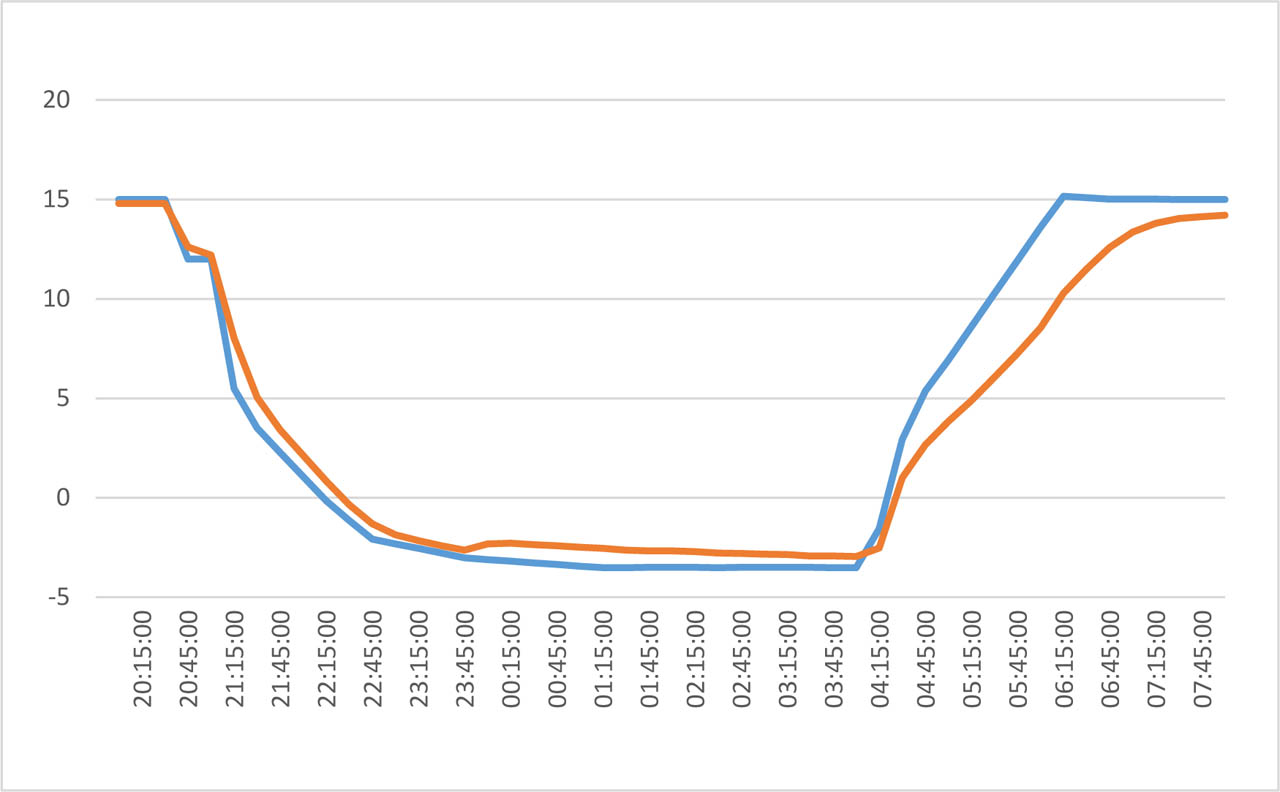
Fig. 1:
Temperature profile of a frost regimen applied in the incubation chamber, the red line is the air temperature while the blue line is the sensor temperature at the object in °C
Independent of the chamber trials, one field treatment took place with pot plants and another field experiment was performed in a vineyard close to Krems (latitude: 48°25′34″ N, longitude: 15°36′28″ E). This vineyard was planted with the variety Grüner Veltliner (GV) and the rows were oriented from North to South. The soil of the trial area was a chernozem and the site was a plain on a high plateau. The temperature was measured by a weather station (OTT Hydromet, Kempten, Germany). The training system was a trellis system with cane pruning and vertical shoot positioning. The spacing was 2.2 x 1.1 m and the cordon height 100 cm. In every second row cover crops were sown in spring after tillage and in the other rows no tillage was done. All rows were mulched 3 times in 2024. Plant protection was carried out according to integrated production guidelines, with 7 applications. The applications in this trialwere conducted at BBCH 14 on 20th April 2024, 1 day before frost was forecasted. The treatments and were done with the products Megafol (2.0 l/ha) and Agros-3 (4.5 l/ha). These products were selected due to their single-use nature and their common application by winegrowers. No application was performed on the untreated control. At least two hundred vines per treatment were sprayed with an airblast back-pack sprayer (Stihl SR400, Waiblingen, Germany) with an application volume of 200 l/ha. Four repetitions with each 10 vines were evaluated in a random block design. In the field trial, frost damage was assessed on 28th April 2024. On each shoot of the vines the percentage of dead tissue on leaves and shoot axes was determined and incidence and severity were calculated. Severity is the percentage of dead tissue on leaves per shoot. Incidence is calculated by the number of damaged shoots per vine divided by the total number of shoots per vine.
Scoring
In order too assess frost damage, a maximum of 12 cuttings or 10 potted vines were compared per trial. Six were untreated and six had undergone an application. The extent of damage was assessed and each case assigned to one of the three established categories (see below). Substances that showed less or no damage on the grapevine were applied repeatedly, and the concentrations were varied.
Categories
Healthy – no visible frost symptoms; tissue is green
Necrotized – slight to moderate damage; parts of the tissue show discoloration and/or necrosis
Damaged – tissue completely necrotic or dead
Assessment
In order to o evaluate the effectiveness of the substances, developing shoots were assessed, and their damage post incubation in the frost chamber was determined. One half of the vines were used as untreated control while the treated ones were sprayed twice with different concentrations of the specific substances (Tab. 1). The distribution within the camber was randomized to minimize the influence of a location within the chamber.
Tab. 1:
Substances used in the protection trials with information about the supplier and the used concentration
| Substance or product | supplier | concentrations |
|---|---|---|
| Agros-3 | Deygest, ES | 0,5%, 1%, 2% |
| Cutisan | Biohelp, AT | 1% |
| Hortisul | Agrando, DE | 1%, 2% |
| Prev B | Biohelp, AT | 0,2%, 0,3% |
| Superfifty | Biohelp, AT | 1%, 2% |
| Zn Chelate | Raiffeisen LH, AT | 1% |
| Baking soda | Kotanyi, AT | 1%, 2% |
| Basfoliar Aktiv | BASF, DE | 0,5%, 1%, 2,5%, 5% |
| Cocana | Biohelp, AT | 0,5%, 1% |
| CropAid | Cropaid Int. Limited, UK | 0,3%, 0,5% |
| Fertileader Vital | Timac Agro, FR | 1%, 2% |
| Fruit Lime | Schneider, Verblasetechnik, DE | 1% |
| Fuguran Progress | Certis, DE | 1% |
| Genol Antifreeze | Raiffeisen warehouse | 1% |
| KHPO4 | Merck, DE | 1%, 2% |
| Kumar | Certis, DE | 1%, 2% |
| Megafol | Syngentha, DE | 1%, 2%, 2,5% |
| Myco Sin Vin | Biohelp, AT | 1%, 2% |
| PK Fit | Hechenbichler, AT | 0,5%, 1% |
| Potassium Water Glass | Pottasol, Biohelp, AT | 0,5%, 0,7%, 1% |
| Prestop | Biohelp, AT | 0,50% |
| Radam Extra 250 | Kwizda Agro AT | 0,1%, 0,5%, 1%, 1,5% |
| Regalis® Plus | BASF, DE | 0,10% |
| Sojall Vitana | SOJALL Pro Natura GmbH | 1%, 2% |
| Syneco AF5 | Syneco, Milano IT | 1%, 1,5%, 2% |
| Urea | Roth, AT | 1%, 2% |
| Veganofluid | Veganosol GmbH, DE | 3%, 4%, 5% |
Statistical analysis was performed using SPSS (IBM, Statistics 26). The data were checked for normal distribution using the Kolmogorov-Smirnov test and analyzed using T-test or ANOVA. Means were assessed using the LSD test (P < 0.05) or with Kruskal Wallis test. The graphical representation of the data was created using SPSS and Microsoft Excel (Microsoft Austria GmbH, Vienna, Austria).
Results
Applications 2020
In the first year, the following substances were tested as antifreeze agents: Syneco AF5, PK-Fit, Basfoliar Aktiv, Radam Extra, Fertileader, Hortisul, Cocana, baking soda, Kumar, Mycosin Vin, Prestop, Fuguran Progress, Fruit lime, Cutisan, Zn Chelate, Sojall Vitana, potash water glass, Superfifty, and Prev B. The concentrations varied between 0,5% and 2%. The following substances showed improvement in frost resistance compared to untreated vine cuttings: Syneco AF5, baking soda, Zn Chelate, and Superfifty. However, none of the improvements was statistically (T-test) significant. All other treatments did not result in higher stability against frost temperatures neither by number nor by statistics.
Applications 2021
In the second year, new products were tested only to a limited extent, namely: Veganofluid, urea and Regalis. Apart from those, the promising substances from the previous year were applied in different concentrations and with different waiting times (Tab. 2). Combinations of products were also tested. The following substances showed a significant frost-reducing effect: urea and zinc chelate. Also, these were the only two active ingredients that showed an improvement in a combination. The survival rate was not higher than when spraying the single compounds (Tab. 3).
Tab. 2:
Results gained by incubation with the frost chamber after a twice spray treatment. The differences were not significant. Number of pots for each classification.
| Tissue | Substance (concentration) | Application frequency | Incubation | Control - healthy | Control - damaged | Treated-healthy | Treated-damaged |
|---|---|---|---|---|---|---|---|
| ZW cuttings | NaHCO3 (1%) | 2x | short | 2 | 4 | 4 | 2 |
| GV cuttings | Urea (1%) | 2x | long | 1 | 5 | 3 | 3 |
| GV cuttings | Syneco AF5 (1%) | 2x | long | 2 | 4 | 3 | 3 |
Applications 2022
During third year Agros-3, Superfifty, Veganofluid, potassium phosphate, baking soda, urea, Basfoliar Aktiv, Cropaid, Genol-Antifreeze, and Megafol were tested. Only 2% urea treatment resulted in a significant improvement (Tab. 4). Use of Cropaid as a frost protective substance could be improved by longer incubation time in advance to the frost (Tab. 5). At least one trial resulted in a significant improvement, while others showed a difference without statistical confirmation. Contradictory results were obtained for Megafol (Tab. 6) and potassium phosphat. Both positive and negative effects were observed with these substances. None of the results could be statistically verified. Consequently, the use of these products is not advisable without additional testing in practice. The more constant stabilization could be observed by usage of Cropaid and urea. Therefore, these substances were used for outdoor testing during a frost night.
Tab. 4:
Results of treatment with different substances and following frost exposition
| Tissue | Substance (concentration) | Application frequency | Incubation | Control - healthy | Control - damaged | Treated-healthy | Treated-damaged |
|---|---|---|---|---|---|---|---|
| GV cuttings | Superfifty (2%) | 2x | short | 2 | 4 | 4 | 2 |
| GV cuttings | Veganofluid (3%) | 2x | long | 0 | 6 | 0 | 6 |
| GV cuttings | Urea (2%) | 2x | long | 1 | 5 | 4 | 2 |
Tab. 5:
Results of treatment with Cropaid and following frost exposition
| Tissue | Substance (concentration) | Application frequency | Incubation | Control - healthy | Control - damaged | Treated-healthy | Treated-damaged |
|---|---|---|---|---|---|---|---|
| GV cuttings | Cropaid (0,5%) | 2x | short | 4 | 2 | 2 | 4 |
| GV cuttings | Cropaid (0,5%) | 2x | long | 2 | 4 | 4 | 2 |
| GV cuttings | Cropaid (0,5%) | 2x | long | 2 | 4 | 5 | 1 |
Tab. 6:
Results of treatment with Megafol 2% and following frost exposition
| Tissue | Substance (concentration) | Application frequency | Incubation | Control - healthy | Control - damaged | Treated-healthy | Treated-damaged |
|---|---|---|---|---|---|---|---|
| GV cuttings | Megafol (2%) | 2x | short | 2 | 4 | 3 | 3 |
| GV cuttings | Megafol (2%) | 2x | long | 2 | 4 | 4 | 2 |
| GV cuttings | Megafol (2%) | 2x | long | 3 | 3 | 2 | 4 |
A field trial under winter conditions showed a useful effect with urea. However, Cropaid also increased the survival rate, but not significantly (Fig. 2). Only urea showed significant differences compared to the control (Fig. 3). Urea even showed a highly significant <0,001 difference to the control (Tab. 7).
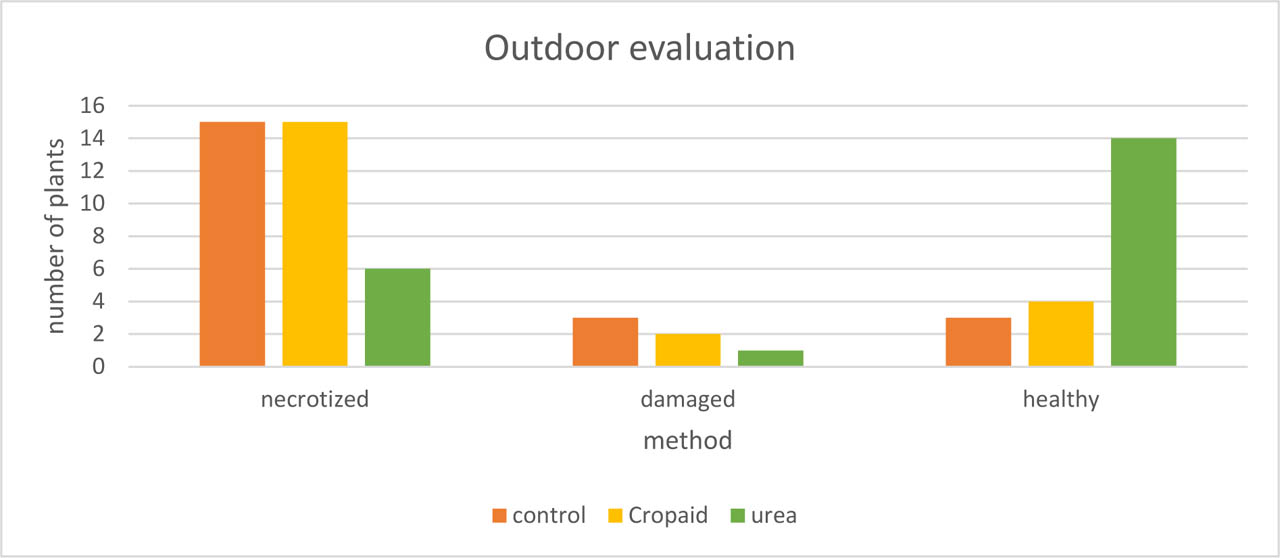
Fig. 2:
Grapevine cuttings exposed to frost conditions outdoor with a minimum temperature of −4 °C and the reaction of the shoots (leaves)
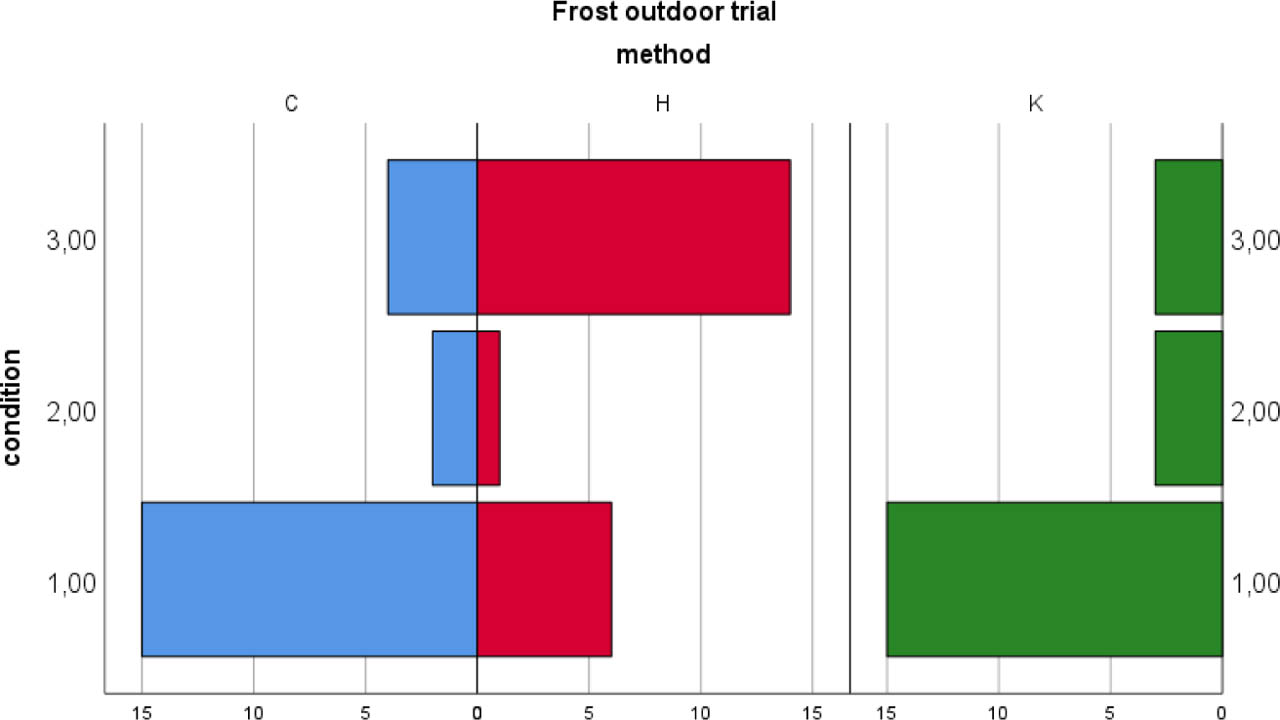
Fig. 3:
Frequency of damaged (1), necrotized (2) and healthy (3) grapevine shoots after treatment with Cropaid (C), urea (H) and in the untreated control (K)
Tab. 7:
The difference between Urea (U; 2%) and both the control (C) and Cropaid (K; 0,5%) was significant
| Var. 1 | Var. 2 | difference of mean value | standard deviation | Significance | confidence | interval |
|---|---|---|---|---|---|---|
| K | C | −0,04762 | 0,25614 | 0,981 | −0,6632 | 0,5679 |
| U | −,95238* | 0,25614 | <0,001 | −1,5679 | −0,3368 | |
| C | K | 0,04762 | 0,25614 | 0,981 | −0,5679 | 0,6632 |
| U | −,90476* | 0,25614 | 0,002 | −1,5203 | −0,2892 | |
| U | K | ,95238* | 0,25614 | <0,001 | 0,3368 | 1,5679 |
| C | ,90476* | 0,25614 | 0,002 | 0,2892 | 1,5203 |
Application 2024
Due to the frost forecast, applications with substances available at that moment were done in a vineyard near Krems on the 20th of April. On the 21st of April morning temperature fell to −1,7 °C and a few shoots were damaged by frost. The same happened on 22nd and 23rd but temperatures did not drop below −1 °C. On the 28th the shoots were counted and the extent of destroyed tissue was estimated. As Tab. 8 (results of T-test) shows there was a higher incidence of frost damage after application of Agros-3 while the treatment with Megafol could stabilize some shoots and prevent their damage and die-off, respectively. The results could be verified by a Kruskal Wallis test (Fig. 4).
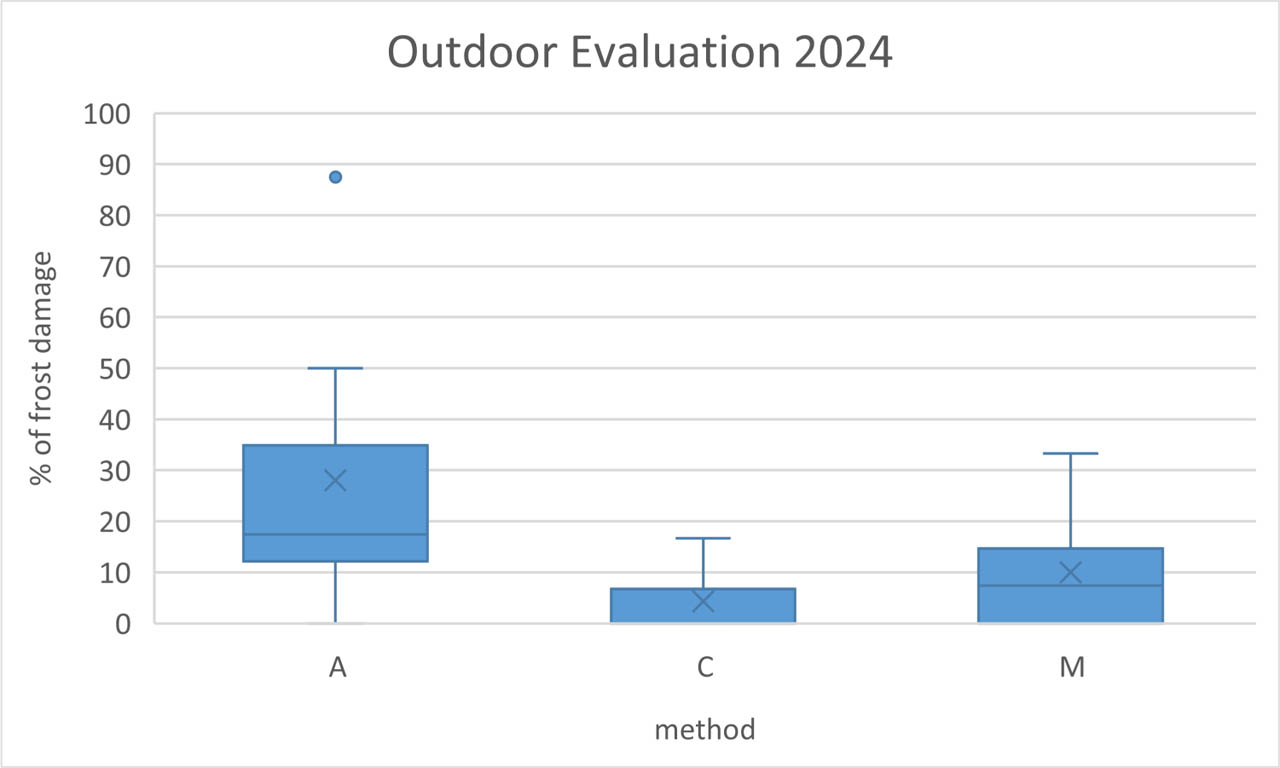
Fig. 4:
Comparison of frost damage control (C), Megafol application (M) and Agros-3 application (A) by the frequency of damaged shoots
Tab. 8:
Incidence and severity of frost damage on shoots at a vineyard in Krems. Statistical analysis was done with Kruskal Wallis Test. Different superscript letters represent significant differences.
| Frost damage | Incidence (%) | Severity (%) |
|---|---|---|
| Control | 8.0b | 5.9b |
| Megafol | 3.5a | 2.3a |
| Agros-3 | 23.8c | 11.5c |
| p-value | < 0.001 | < 0.001 |
Discussion
Applications trials in the year 2020 showed that the usage of an aqueous solution of most substances could not improve behavior against frost. Only the following substances increased the frost resistance of vine cuttings: Syneco AF5, baking soda, Zn chelate, and Superfifty. The increase in protection did not represent a fundamental change and could not be confirmed statistically, but a slight improvement in frost stability was observed Although fewer new substances were tested in the following years, substances were still identified as positive stimulators against late frost: Cropaid and urea. Both showed a significant improvement under specific conditions. These were also the two substances used for field testing on vine cuttings during the winter months. The results confirmed a certain increase in frost resistance for urea, but not for Cropaid. Of the combination products, only urea in combination with Zn chelate proved to be helpful, however onlykeeping the positive effects but without an additional increase in protection rate. In the final trial year, potassium phosphat and Megafol showed improvements in some trials but did not result in a constant effect. However, contradictory results impeded a clear assessment. Repeated trials of urea, and Cropaid showed that these products had the best and most consistent effectiveness against late frost damage of all tested compounds. In conclusion, the trials showed that not all products offered for frost protection meet the required criteria, and it appears important to identify the most appropriate procedure.
Despite the different behavior at late spring frost the agronomical data could not be differentiated at harvest time. This result is a confirmation of the dynamic behavior of a vine, varying berry dimension and cluster size according to the number of shoots. Better chances for differentiation would exist if the rate of damage was higher due to deeper temperatures.
Variability was also gained due to the different plant materials of rooted cuttings and potted vine plants. Within one trial we always used material of high homogeneity derived from same procedure, same variety and same physiology. Critical parameters are the concentration of the substance and incubation time before the frost regimen. Nevertheless, some influence was also observed from the applied program, particularly regarding the duration of exposure and, of course, the degree of frost temperature (Formeyer et Goler, 2013).
However, differences in behavior against late frost are also clearly observable outdoors. Apart from soil and microclimate influences, there are differences in metabolism that can be rapidly altered by, for example, fertilization effects. Urea is probably an example of how rapid uptake of N-containing substances has a positive effect on frost stability. It is supposed that specific proteins are involved in a stabilizing development. Juurakko et al (2021) mentioned the role of specific cold stress related proteins as a key contribution to frost stability However, N-containing fertilizers do not have the same sufficient effect. A fertilizing substance has the advantage that there is no legal necessity to register it as a plant protection agent. Application at an early stage of development is accepted as a fertilization procedure. Therefore, the application of 2% urea is a simple and effective measure against freezing caused by late spring frost and complies with current legislation.
In general, a good nutrient supply and a high mineral content in the tissue can be considered positive as long as they do not result in overwhelming growth, which would negatively impact frost resistance.
Acknowledgements
This work was supported by the Ministery of Agriculture within the “Froststrat” project in EIP-AGRI frame.