
Table 1
Examples of studies on metal leaching from various materials using the fungus Aspergillus niger
| Type of material/waste and elements of interest | Experimental conditions | Results | Reference |
|---|---|---|---|
| Cu-converter slag | Bioleaching culture: Aspergillus niger | Maximum metal extraction after 48 h of experiment (30°C, 5% pulp density): Cu 12% (4.8 g/kg), Ni 3–3.7% (0.6–0.7 g/kg), Co <1% (<0.05 g/kg), Fe < 0.2% (0.8 g/kg) | Source: data from Sukla et al. (1992) |
| Fe: 38.32% | Medium: pH 6.5, | ||
| Cu: 4.03% | T: 35 ± 1°C, | ||
| Co: 0.49% | time: 4–5 days | ||
| Ni: 1.97% | Material particle size: <150 μm | ||
| Pulp density: 5–1% (L/S: 20–100) | |||
| Temperature: 30–60°C | |||
| Duration: 24–120 h | |||
| Shaking speed: 120 rpm | |||
| Abiotic experiments: succinic acid, citric acid and their mixture | |||
| Cu–converter slag | Bioleaching culture: Aspergillus niger | Higher dextrose concentrations favored microbial activity, resulting in increased metal extraction | Source: data from Sukla et al. (1995) |
| Fe: 38.32% | Medium: potato dextrose, pH 6.8 | Cu 78.5% (31.6 g/kg), Co 90% (4.3 g/kg), Ni 45.5% (9 g/kg), Fe 40.15% (155.9 g/kg) | |
| Cu: 4.03% | Material particle size: <150 μm | ||
| Co: 0.48% | Pulp density: 2–10% (L/S: 10–50) | ||
| Ni: 1.98% | Temperature: 37°C | ||
| Duration: 72 h | |||
| Shaking speed: 120 rpm | |||
| Abiotic experiments: acetic, succinic, | |||
| oxalic acids (1 M) | |||
| Control: distilled water | |||
| Electronic waste (PCB) | Bioleaching methods: single-step, two-step and spent medium (spent medium) | Under the given conditions, 100% Cu was recovered from the waste | Source: data from Sharada et al. (2022) |
| Cu, Br, Sn, Pb, Zn, Fe | |||
| The most favorable conditions among the tested variants: | |||
| Nutrient: Modified Ammonium Nutrient | |||
| Incubation period: 5 days | |||
| Material particle size: > 0.105 mm | |||
| Temperature: 30°C | |||
| Pulp density: 0.5% (0.005 g/ml) | |||
| pH: 7 | |||
| Best source of carbon: 1.5% glucose | |||
| Best source of nitrogen: ammonium chloride 0.2% | |||
| Shaking speed: 200 rpm | |||
| Sewage sludge | Nutrient: 400ml sucrose solution (10–100 g/l) | Recovered:
| Source: data from Chen and Wang, (2019) |
| Mn, Zn, Ni, Pb | Incubation period: 14 days | ||
| Material particle size: >0.84 mm | |||
| Temperature: 25°C | |||
| Shaking speed: 150 rpm | |||
| Used lithium-ion cell phone batteries | Bioleaching methods: single-step, two-step and spent medium (spent medium) | Recovered:
| Source: data from Horeh et al. (2016) |
| Cu, Li, Mn, Al, Co, Ni, Fe, S, Mg, Si, Na, Ti, Nb | Nutrient: sucrose | ||
| Incubation time: 30 days, | |||
| Material particle size: >75 mm | |||
| Pulp density: 1% | |||
| pH: 6 | |||
| Temperature: 30°C | |||
| Shaking speed: 130 rpm | |||
| Contaminated sediments taken from the river | 1 ml spore suspension and 99 ml culture mediumIncubation time: 7 days | The highest efficiency in the two-step method. Recovered:
| Source: data from Zeng et al. (2015) |
| Pb, Cd, Cu, Zn | Material particle size: >2mm | ||
| pH: 6.6 | |||
| Temperature: 30°C | |||
| Shaking speed: 220 rpm | |||
| Lateritic chromite overburden | Incubation time: 7, 14, 21 days | Leaching occurs most favorably at 2% density, 80°C and 21 days of incubation. | Source: data from Biswas et al. (2013) |
| Ni, Co, Fe, Cr, Mg | Material particle size: 75 + 53 μm | ||
| Pulp density: 2%, 5% and 8% | |||
Recovered:
| |||
| Medium: sucrose solution, NH4NO3, KH2PO4, MgSO4·7H2O and yeast extract | |||
| pH: 6.8 | |||
| Temperature: 60°C, 70°C and 80°C | |||
| Shaking speed: 150 rpm | |||
| Material particle size: 75 + 53μm | |||
| Bauxite Remains | One-step method | Leaching occurs most advantageously at a density of 1%, a medium of 140 g/l sucrose and an initial fungus content of 6%46% Sc recovered | Source: data from Kiskira et al. (2023) |
| Cu, Pb, Mn, Ni, Cr, K, Zn, Sc, Ga, Nb, Zr, Ba, Ta, Cd, Hg, As, Be, Th, U, C, S, P, | Incubation time: 20 days | ||
| Pulp density: 1%, 5%, 10% | |||
| Nutrient: sucrose 40, 90 and 140 g/l | |||
| Temperature: 30°C | |||
| Shaking speed: 100 rpm | |||
| Low-grade mining ore | Incubation time: 14 days | Recovered:
| Source: data from Mulligan et al. (2004) |
| Temperature: 20°C | |||
| Cu, Fe, Zn, Ni | Material particle size: >1.18mmMedium: ore sample (100 g/L) and salts (1.6 g/L yeast extract, 1.5 g/L NaNO3, 0.5 g/L KH2PO4, 0.025 g/L MgSO4·7H2O, 0.025 g/L KCl) | ||
| Kaolin clay | Incubation time: 30 days | In the best conditions (pulp density - 20 g/l, clay added at the beginning of the study) 42.8% Fe was recovered | Source: data from Hosseini et al. (2007) |
| P2O5, MnO, TiO2, MgO, K2O, Na2O, CaO, Fe2O3, Al2O3, SiO2 | Material particle size: >9.32 μm | ||
| Pulp density: 20g/l | |||
| Medium: sucrose 120 g/l; NH4NO3 450 mg/l, KH2PO4 100 mg/l, MgSO4·7H2O 300 mg/l, | |||
| FeSO4·7H2O 0.1 mg/l, ZnSO4·7H2O 0.25 mg/l | |||
| Temperature: 30°C | |||
| Material quantity: 2g (beginning of research) and 6g kaolin (3rd day) | |||
| Shaking speed: 160 rpm | |||
| Material particle size: >9.32 μm | |||
| Pulp density: 20 g/l | |||
| Red mud (bauxite residue) red mud | Bioleaching methods: single-step, two-step and spent medium (spent medium) | The highest efficiency in the spent medium method (spent medium) and 1% density. | Source: data from Qu et al. (2013) |
| Incubation time: 40 days | |||
| Material particle size: >74 μm | Recovered:
| ||
| Pulp density: 1%, 2%, 5% | |||
| Cd, V, Cr, Ni, Cu, Zn, As | Medium: Sucrose 100 g/l, KNO3 0.5 g/l, KH2PO4 0.5 g/l, yeast extract 2 g/l, Peptone 2 g/l | ||
| Temperature: 30°C | |||
| Shaking speed: 120 rpm | |||
| Incubation time: 40 days | |||
| Galvanic sludge rich in chromium | Incubation time: 1–24 days | Leaching occurs most advantageously at a pulp density of 10 g/l, a temperature of 66°C and a minimum incubation time of 1 day. | Source: data from Nikfar et al. (2020) |
| Material particle size: >0.074 mm | |||
| Cr, Zn, Cu, Ni, Cd | Pulp density: 10–50 g/l | ||
| Temperature: 30–70°C | |||
| Shaking speed: 160 rpm | |||
Recovered:
| |||
| Phosphorite | Incubation time: 2 days | Recovered:
| Source: data from Osman et al. (2019) |
| U, Th, La, Ce, Nd, Sm, Tb, Er, Tm, Lu | Material particle size: >0.063 mm | ||
| pH: 7 | |||
| Nutrient: Potato Dextrose Broth | |||
| Mixture: 300 ml of Aspergillus niger siderophore solution and 3 g of phosphate powder | |||
| Temperature: 30°C | |||
| Shaking speed: 130 rpm | |||
| Material particle size: >0.063 mm | |||
| Worn Printed Circuit Boards (WPCB) | Bioleaching methods: single-step, two-step and spent medium (spent medium) | Recovered:
| Source: data from Faraji et al. (2018) |
| Cu, Pb, Ni, Fe, Ag, Au, Zn | Incubation time: 21 days | ||
| Material particle size: >300 μm | |||
| Medium: Sucrose with NaNO3, KH2PO4, MgSO4·7H2O, KCl | |||
| Temperature: ambient temperature | |||
| Shaking speed: 120 rpm | |||
| Spent hydrocracking catalyst | Incubation time: 30 days | Recovered:
| Source: data from Amiri et al. (2012) |
| Mo, Ni, W, V | Material particle size: 150–212 μm | ||
| Pulp density: 3% | |||
| Medium: sucrose 93.8 g/L with NaNO3, KH2PO4 and yeast extract | |||
| pH: 7 | |||
| Material particle size: 150–212 μm | |||
| Pyrometallurgical copper slags | Bioleaching methods: direct leaching and indirect leaching using spent medium | Better bioleaching results using A. niger than P. ochrochloron
| Source: data from Georgiev et al. (2025) |
| Cu: 0.36% | Incubation time: 6 weeks | ||
| Zn: 1.93% | Material particle size: 75–25 μm | ||
| Co: 0.09% | Pulp density: 5%, 10%, 15% | ||
| Fe: 27.2% | Shaking speed: 300 rpm | ||
| Si: 15.9% | Medium: sucrose (185 g/L), KH2PO4 (3.0 g/L), NH4Cl (0.96 g/L), MgSO4·7H2O (1.2 g/L), and trace amounts of FeSO4·7H2O, ZnSO4·7H2O, CuSO4·7H2O | ||
| Ca: 6.9% | Temperature: 25°C | ||
| Mn: 0.8% | |||
| Al: 2.78% | |||
| P: 0.08% | |||
| S; 0.91% | |||
| Pyrometallurgical copper slags | Bioleaching method: Spent medium |
A. niger indirect bioleaching results
| Source: data from Georgiev et al. (2025) |
| Cu, Zn, Co, Fe, Si, Ca, Mn, Al, P, S | Experiment time: 3 days | (results for sample F) | |
| Material particle size: 75–25 μm | |||
| Pulp density: 5%, 10%, 15% | |||
| Shaking speed: 300 rpm | |||
| Medium: sucrose (185 g/L), KH2PO4 (3.0 g/L), NH4Cl (0.96 g/L), MgSO4.7H2O (1.2 g/L), and trace amounts of FeSO4·7H2O, ZnSO4·7H2O, CuSO4·7H2O | |||
| Temperature: 25°C, 55°C | |||
| Silicates (calamine and garnierite) | Bioleaching methods: direct and indirect | Best bioleaching results using A. niger than other microorganisms
| Source: data from Castro et al. (2000) |
| Calamine: 40.7% SiO2, 10.9% ZnO, 6.7% Fe2O3, 8.65% CaO, 4.13% MgOGarnierite: 43.2% SiO2, 0.9% Ni | Material particle size: 100 mesh | 66% Zn (direct process, 10% sucrose) | |
| Pulp density: 5% | |||
| Shaking speed: 200 rpm | |||
| Medium for A. niger: 5–15% sucrose, 0.025% MgSO4·7 H2O, 0.25% (NH4)2CO3, 0.25% KH2PO4, 0.06 mg/l ZnCl2, 1.3 mg/l FeCl3 or Fe2(SO4)3 | |||
| Temperature: 30°C | |||
| Material particle size: 100 mesh | |||
| Fly Ash from Municipal Waste Incineration | Bioleaching methods: one-step and two-step | Better results in two-step method
| Source: data from Bosshard et al. (1996) |
| Incubation time: 1–23 days | |||
| Fly ash concentration: 0–10% | |||
| Shaking speed: 110 rpm | |||
| Medium: Sucrose (100 g/L), NaNO₃ (1.5 g/L), KH₂PO₄ (0.5 g/L), MgSO₄·7H₂O (0.025 g/L), KCl (0.025 g/L), yeast extract (1.6 g/L) | |||
| Temperature: 30°C | |||
| Incubation time: 1–23 days | |||
| Fly ash concentration: 0–10% |
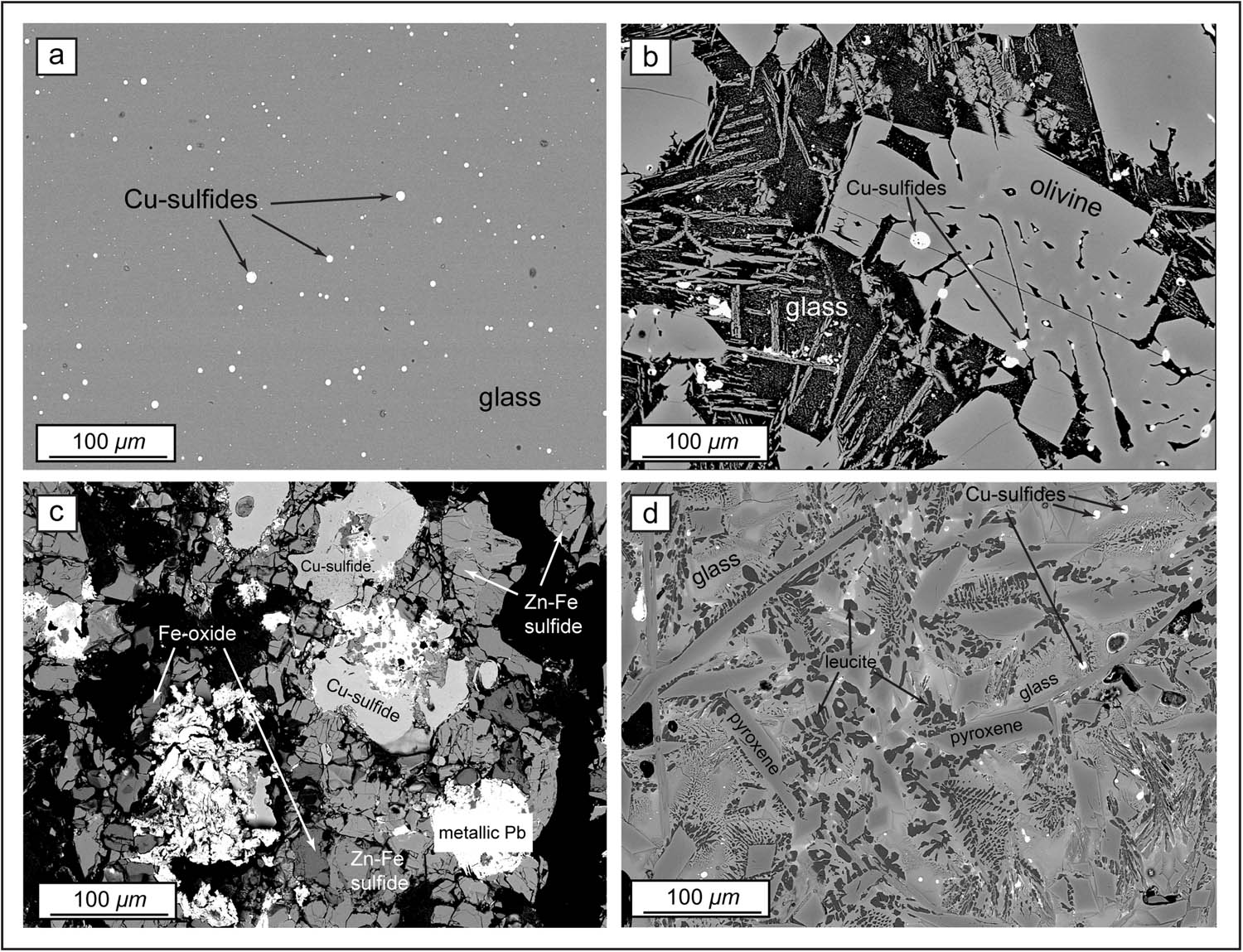
Figure 1
Scanning electron microscope (SEM) images of fresh (unleached) slags: (a) AS, (b) HS, (c) LS, (d) CS.
Table 2
Chemical composition of slags
| AS | HS | LS | CS | |
|---|---|---|---|---|
| Wt.% | ||||
| SiO2 | 48.3 | 37.6 | 0.68 | 46.5 |
| TiO2 | 0.57 | 0.45 | 0.02 | 0.80 |
| Al2O3 | 11.8 | 7.46 | 0.20 | 17.6 |
| Fe2O3 tot. | 13.5 | 50.7 | 31.20 | 4.76 |
| MnO | 0.49 | 0.17 | 0.39 | 0.21 |
| MgO | 2.10 | 2.5 | 0.14 | 2.73 |
| CaO | 17.5 | 1.1 | 0.39 | 18.1 |
| Na2O | 0.21 | 0.27 | 0.65 | 0.19 |
| K2O | 4.59 | 1.58 | 0.81 | 5.97 |
| S | 0.05 | 0.67 | 25.3 | 0.21 |
| mg kg−1 | ||||
| Cu | 19,724 | 5,657 | 36,050 | 4,060 |
| Zn | 53 | 3,962 | 199,600 | 59 |
| Pb | 587 | 111 | 54,900 | 164 |
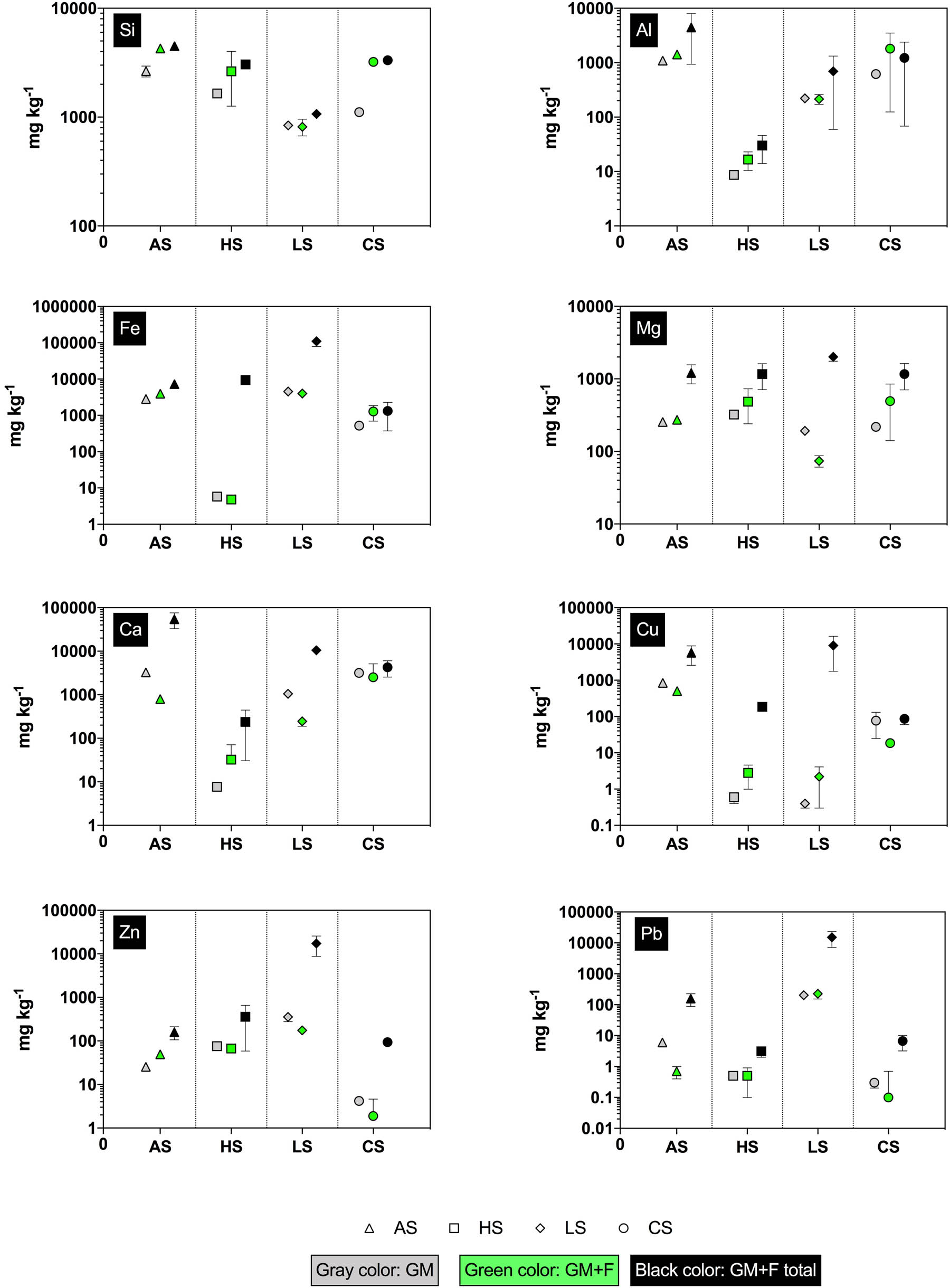
Figure 2
Elements leaching from individual slags exposed to various experimental conditions.
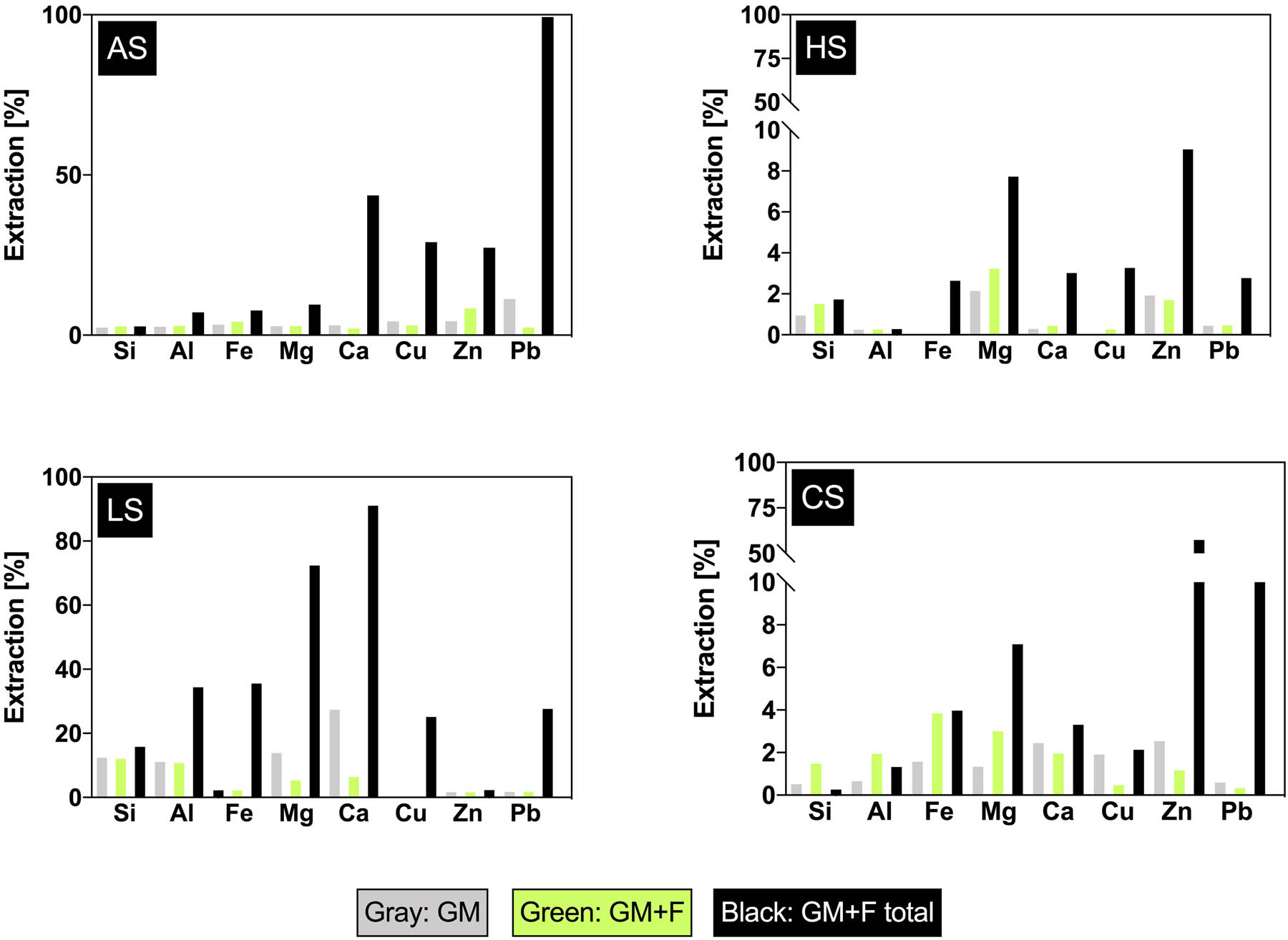
Figure 3
Relative values (%) of elements leached for slags exposure to different conditions.
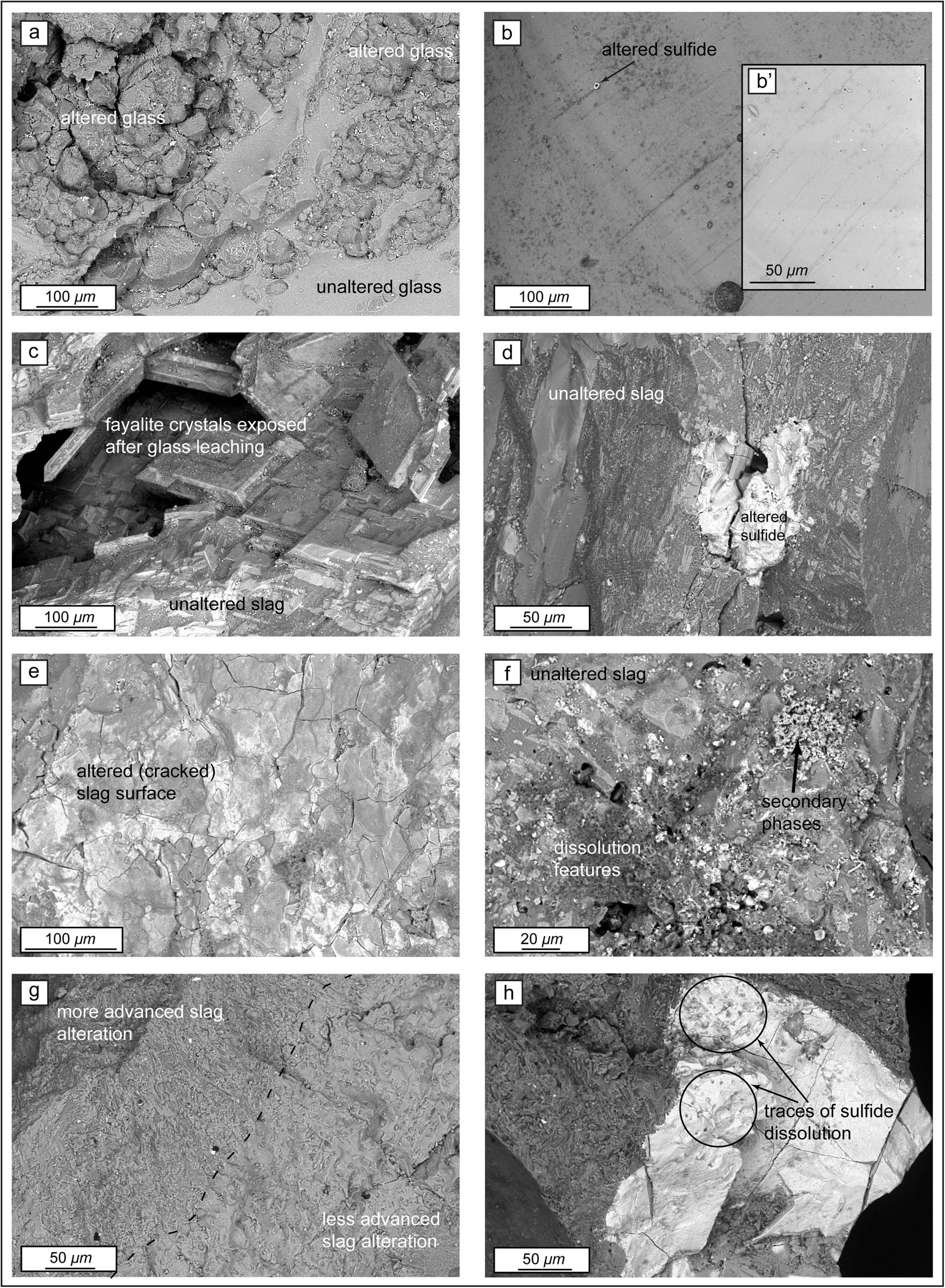
Figure 4
SEM-BSE micrographs of slags after leaching experiment: (a and b) AS, (c and d) HS, (e and f) LS, (g and h) CS; (a) Secondary surface alterations on amorphous slag; (b) unaltered glass with voids formed by the dissolution of Cu-sulfides; (c) olivine crystals exposed due to the dissolution of interstitial glass; (d) altered sulfide within relatively unweathered slag; (e) evidence of slag alteration, visible as a cracked surface; (f) signs of dissolution and presence of secondary phases; (g) slag surface showing dissolution features; the dashed line marks the boundary between more and less altered zones; and (h) round structures indicating dissolution of Cu-sulfides.
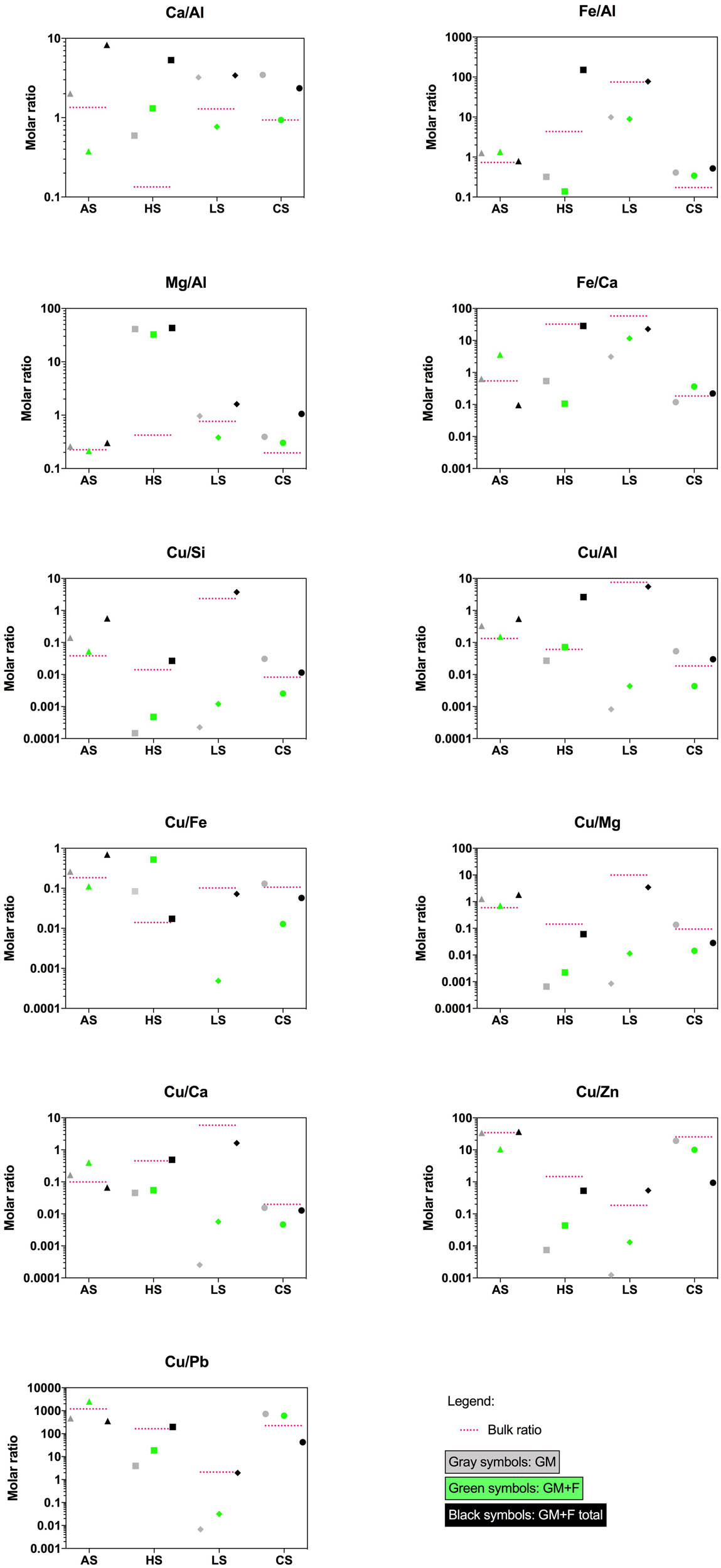
Figure 5
Theoretically and experimentally achieved element ratios with respect to Cu – effect of different incubation conditions.
Table 3
Results of multiple comparisons among the abiotic (GM), biotic (GM + F), and GM + F total groups for all slags considered together
| Element | ANOVA Kruskal–Wallis test | Post-hoc Dunn Bonferroni test | ||
|---|---|---|---|---|
| Abiotic (GM) | Biotic (GM + F) | GM + F total | ||
| Si | H = 15.77, df = 2, p < 0.05 | b | b | a |
| Al | H = 1.64, df = 2, p > 0.05 | nd1 | nd | nd |
| Fe | H = 7.96, df = 2, p < 0.05 | a | a, b | b |
| Mg | H = 15.61, df = 2, p < 0.05 | a | a | b |
| Ca | H = 5.71, df = 2, p > 0.05 | nd | nd | nd |
| Cu | H = 7.98, df = 2, p < 0.05 | a | a, b | b |
| Zn | H = 8.06, df = 2, p < 0.05 | a, b | a | b |
| Pb | H = 3.76, df = 2, p > 0.05 | nd | nd | nd |