
1. Introduction
Metallic raw materials are essential for modern industry and high-tech sectors. However, extraction of metals from primary sources resulted in depletion of the natural resources, more intensive exploitation of high-grade deposits, and increased waste production. Waste rock, metallurgical slags, and process residues are one among the major waste streams generated during mining, ore beneficiation and smelting processes. It is estimated that globally, the annual production of solid waste from primary mineral processing and metal production exceeds 100 billion tons (Giurco et al., 2014). These solid residues deserve special attention because of their potential use as secondary metal resources, with metal contents comparable to those found in natural ores (Hoque & Philip, 2011). Metallurgical slags represent a prominent example of such residues, as their disposal in landfills has historically led to various environmental concerns associated with metal release into the environment (Potysz et al., 2015; Tyszka et al., 2021; Derkowska et al., 2023, Kupczak et al., 2025; Kierczak et al., 2010). The development of modern metal recycling technologies has been driven by the need to identify more sustainable and competitive alternatives to conventional metallurgical waste management (Hoque & Philip, 2011; Zhang et al., 2016). In this context, the integration of metallurgical slags into a circular economy framework offers substantial economic and environmental benefits through their reuse and valorization (Habib et al., 2016; Kaksonen et al., 2011; Potysz et al., 2018).
Bioleaching is one of the promising methods for recovering metals from various waste materials (Gadd & White, 1993; Krishnan et al., 2021; Tezyapar Kara et al., 2023). Compared with conventional chemical leaching, bioleaching is a more sustainable and environmentally friendly approach utilizing naturally occurring microorganisms and their biogenic metabolites for the extraction, thereby reducing the need for use of strong acids and other hazardous chemical reagents (Gadd & Pan, 2016; Hagelüken & Goldmann, 2022; Sarkodie et al., 2022). However, bioleaching can be economically viable if the process parameters, such as type of microorganism, leaching time, temperature, stirring speed, particle size, pulp density, pH, growth medium (GM) composition, and energy consumption, are properly optimized to achieve the maximum leaching efficiency (Table 1 and references therein). Furthermore, one experimental factor influencing dissolution cannot be treated as a separate entity nor fully understood without considering the interplays of the others. Although the industry recognizes that several parameters influence bioleaching processes, no standardized protocol currently exists that defines specific conditions for metal extraction from all types of solid materials. The extraction rate and efficiency are inherently linked to the mineralogy and chemical composition of the material subjected to leaching. Therefore, at present, each waste material requires an individual approach and optimization of leaching conditions (Potysz et al., 2018). Experimental incubation involving autotrophic and heterotrophic microorganisms serves as a useful tool for understanding both element release and susceptibility of metal-bearing phases to dissolution (Jeremic et al., 2016; Erüst et al., 2013; Tezyapar Kara et al., 2023; Kaksonen et al., 2011; Potysz et al., 2015; Schippers, 2017; Sethurajan et al., 2018). Previous studies demonstrated bacterially facilitated leaching and dissolution of metallurgical wastes (Potysz et al., 2015; Gomes et al., 2018; Behera et al., 2022; Schippers, 2017; Mikoda et al., 2019; Potysz et al., 2016b). Autotrophic sulfur-oxidizing bacteria (e.g., Acidithiobacillus thiooxidans, Acidithiobacillus caldus), iron-sulfur oxidizing bacteria (e.g., Acidithiobacillus ferrooxidans, Sulfobacillus benefaciens) and iron-oxidizing bacteria (e.g., Leptospirillum ferrooxidans) are the most widely used bioleaching microorganisms (Sethurajan et al., 2018). Furthermore, heterotrophic fungal bioleaching employing e.g., Aspergillus niger and Penicillium simplicissimum is also efficient due to the ability of these microorganisms to secrete large amounts of organic acids including lactic acid, citric acid, oxalic acid, gluconic acid, and siderophores (Cruz-Rodríguez et al., 2022; Liaud et al., 2014; Jain et al., 2017; Sarkodie et al., 2022). Particularly noteworthy is fungi Aspergillus niger, which, in addition to producing large quantities of useful metabolites, is characterized by its tolerance to high concentrations of metallic elements. Application of A. niger in bioleaching experiments involving various solid materials (electronic waste, sewage sludge, spent lithium-ion batteries, contaminated river sludge, laterite chromite overburden, bauxite residue, mining ores, kaolin clay, red mud, galvanic sludge, phosphorite, spent circuit boards, and spent hydrocracking catalysts) and the corresponding extraction efficiencies have extensively been reviewed in Table 1. However, fungi mediated bioleaching for the recovery of metals from slags has relatively rarely been reported (Sukla et al., 1995, 1992; Georgiev et al., 2025).
Table 1
Examples of studies on metal leaching from various materials using the fungus Aspergillus niger
| Type of material/waste and elements of interest | Experimental conditions | Results | Reference |
|---|---|---|---|
| Cu-converter slag | Bioleaching culture: Aspergillus niger | Maximum metal extraction after 48 h of experiment (30°C, 5% pulp density): Cu 12% (4.8 g/kg), Ni 3–3.7% (0.6–0.7 g/kg), Co <1% (<0.05 g/kg), Fe < 0.2% (0.8 g/kg) | Source: data from Sukla et al. (1992) |
| Fe: 38.32% | Medium: pH 6.5, | ||
| Cu: 4.03% | T: 35 ± 1°C, | ||
| Co: 0.49% | time: 4–5 days | ||
| Ni: 1.97% | Material particle size: <150 μm | ||
| Pulp density: 5–1% (L/S: 20–100) | |||
| Temperature: 30–60°C | |||
| Duration: 24–120 h | |||
| Shaking speed: 120 rpm | |||
| Abiotic experiments: succinic acid, citric acid and their mixture | |||
| Cu–converter slag | Bioleaching culture: Aspergillus niger | Higher dextrose concentrations favored microbial activity, resulting in increased metal extraction | Source: data from Sukla et al. (1995) |
| Fe: 38.32% | Medium: potato dextrose, pH 6.8 | Cu 78.5% (31.6 g/kg), Co 90% (4.3 g/kg), Ni 45.5% (9 g/kg), Fe 40.15% (155.9 g/kg) | |
| Cu: 4.03% | Material particle size: <150 μm | ||
| Co: 0.48% | Pulp density: 2–10% (L/S: 10–50) | ||
| Ni: 1.98% | Temperature: 37°C | ||
| Duration: 72 h | |||
| Shaking speed: 120 rpm | |||
| Abiotic experiments: acetic, succinic, | |||
| oxalic acids (1 M) | |||
| Control: distilled water | |||
| Electronic waste (PCB) | Bioleaching methods: single-step, two-step and spent medium (spent medium) | Under the given conditions, 100% Cu was recovered from the waste | Source: data from Sharada et al. (2022) |
| Cu, Br, Sn, Pb, Zn, Fe | |||
| The most favorable conditions among the tested variants: | |||
| Nutrient: Modified Ammonium Nutrient | |||
| Incubation period: 5 days | |||
| Material particle size: > 0.105 mm | |||
| Temperature: 30°C | |||
| Pulp density: 0.5% (0.005 g/ml) | |||
| pH: 7 | |||
| Best source of carbon: 1.5% glucose | |||
| Best source of nitrogen: ammonium chloride 0.2% | |||
| Shaking speed: 200 rpm | |||
| Sewage sludge | Nutrient: 400ml sucrose solution (10–100 g/l) | Recovered:
| Source: data from Chen and Wang, (2019) |
| Mn, Zn, Ni, Pb | Incubation period: 14 days | ||
| Material particle size: >0.84 mm | |||
| Temperature: 25°C | |||
| Shaking speed: 150 rpm | |||
| Used lithium-ion cell phone batteries | Bioleaching methods: single-step, two-step and spent medium (spent medium) | Recovered:
| Source: data from Horeh et al. (2016) |
| Cu, Li, Mn, Al, Co, Ni, Fe, S, Mg, Si, Na, Ti, Nb | Nutrient: sucrose | ||
| Incubation time: 30 days, | |||
| Material particle size: >75 mm | |||
| Pulp density: 1% | |||
| pH: 6 | |||
| Temperature: 30°C | |||
| Shaking speed: 130 rpm | |||
| Contaminated sediments taken from the river | 1 ml spore suspension and 99 ml culture mediumIncubation time: 7 days | The highest efficiency in the two-step method. Recovered:
| Source: data from Zeng et al. (2015) |
| Pb, Cd, Cu, Zn | Material particle size: >2mm | ||
| pH: 6.6 | |||
| Temperature: 30°C | |||
| Shaking speed: 220 rpm | |||
| Lateritic chromite overburden | Incubation time: 7, 14, 21 days | Leaching occurs most favorably at 2% density, 80°C and 21 days of incubation. | Source: data from Biswas et al. (2013) |
| Ni, Co, Fe, Cr, Mg | Material particle size: 75 + 53 μm | ||
| Pulp density: 2%, 5% and 8% | |||
Recovered:
| |||
| Medium: sucrose solution, NH4NO3, KH2PO4, MgSO4·7H2O and yeast extract | |||
| pH: 6.8 | |||
| Temperature: 60°C, 70°C and 80°C | |||
| Shaking speed: 150 rpm | |||
| Material particle size: 75 + 53μm | |||
| Bauxite Remains | One-step method | Leaching occurs most advantageously at a density of 1%, a medium of 140 g/l sucrose and an initial fungus content of 6%46% Sc recovered | Source: data from Kiskira et al. (2023) |
| Cu, Pb, Mn, Ni, Cr, K, Zn, Sc, Ga, Nb, Zr, Ba, Ta, Cd, Hg, As, Be, Th, U, C, S, P, | Incubation time: 20 days | ||
| Pulp density: 1%, 5%, 10% | |||
| Nutrient: sucrose 40, 90 and 140 g/l | |||
| Temperature: 30°C | |||
| Shaking speed: 100 rpm | |||
| Low-grade mining ore | Incubation time: 14 days | Recovered:
| Source: data from Mulligan et al. (2004) |
| Temperature: 20°C | |||
| Cu, Fe, Zn, Ni | Material particle size: >1.18mmMedium: ore sample (100 g/L) and salts (1.6 g/L yeast extract, 1.5 g/L NaNO3, 0.5 g/L KH2PO4, 0.025 g/L MgSO4·7H2O, 0.025 g/L KCl) | ||
| Kaolin clay | Incubation time: 30 days | In the best conditions (pulp density - 20 g/l, clay added at the beginning of the study) 42.8% Fe was recovered | Source: data from Hosseini et al. (2007) |
| P2O5, MnO, TiO2, MgO, K2O, Na2O, CaO, Fe2O3, Al2O3, SiO2 | Material particle size: >9.32 μm | ||
| Pulp density: 20g/l | |||
| Medium: sucrose 120 g/l; NH4NO3 450 mg/l, KH2PO4 100 mg/l, MgSO4·7H2O 300 mg/l, | |||
| FeSO4·7H2O 0.1 mg/l, ZnSO4·7H2O 0.25 mg/l | |||
| Temperature: 30°C | |||
| Material quantity: 2g (beginning of research) and 6g kaolin (3rd day) | |||
| Shaking speed: 160 rpm | |||
| Material particle size: >9.32 μm | |||
| Pulp density: 20 g/l | |||
| Red mud (bauxite residue) red mud | Bioleaching methods: single-step, two-step and spent medium (spent medium) | The highest efficiency in the spent medium method (spent medium) and 1% density. | Source: data from Qu et al. (2013) |
| Incubation time: 40 days | |||
| Material particle size: >74 μm | Recovered:
| ||
| Pulp density: 1%, 2%, 5% | |||
| Cd, V, Cr, Ni, Cu, Zn, As | Medium: Sucrose 100 g/l, KNO3 0.5 g/l, KH2PO4 0.5 g/l, yeast extract 2 g/l, Peptone 2 g/l | ||
| Temperature: 30°C | |||
| Shaking speed: 120 rpm | |||
| Incubation time: 40 days | |||
| Galvanic sludge rich in chromium | Incubation time: 1–24 days | Leaching occurs most advantageously at a pulp density of 10 g/l, a temperature of 66°C and a minimum incubation time of 1 day. | Source: data from Nikfar et al. (2020) |
| Material particle size: >0.074 mm | |||
| Cr, Zn, Cu, Ni, Cd | Pulp density: 10–50 g/l | ||
| Temperature: 30–70°C | |||
| Shaking speed: 160 rpm | |||
Recovered:
| |||
| Phosphorite | Incubation time: 2 days | Recovered:
| Source: data from Osman et al. (2019) |
| U, Th, La, Ce, Nd, Sm, Tb, Er, Tm, Lu | Material particle size: >0.063 mm | ||
| pH: 7 | |||
| Nutrient: Potato Dextrose Broth | |||
| Mixture: 300 ml of Aspergillus niger siderophore solution and 3 g of phosphate powder | |||
| Temperature: 30°C | |||
| Shaking speed: 130 rpm | |||
| Material particle size: >0.063 mm | |||
| Worn Printed Circuit Boards (WPCB) | Bioleaching methods: single-step, two-step and spent medium (spent medium) | Recovered:
| Source: data from Faraji et al. (2018) |
| Cu, Pb, Ni, Fe, Ag, Au, Zn | Incubation time: 21 days | ||
| Material particle size: >300 μm | |||
| Medium: Sucrose with NaNO3, KH2PO4, MgSO4·7H2O, KCl | |||
| Temperature: ambient temperature | |||
| Shaking speed: 120 rpm | |||
| Spent hydrocracking catalyst | Incubation time: 30 days | Recovered:
| Source: data from Amiri et al. (2012) |
| Mo, Ni, W, V | Material particle size: 150–212 μm | ||
| Pulp density: 3% | |||
| Medium: sucrose 93.8 g/L with NaNO3, KH2PO4 and yeast extract | |||
| pH: 7 | |||
| Material particle size: 150–212 μm | |||
| Pyrometallurgical copper slags | Bioleaching methods: direct leaching and indirect leaching using spent medium | Better bioleaching results using A. niger than P. ochrochloron
| Source: data from Georgiev et al. (2025) |
| Cu: 0.36% | Incubation time: 6 weeks | ||
| Zn: 1.93% | Material particle size: 75–25 μm | ||
| Co: 0.09% | Pulp density: 5%, 10%, 15% | ||
| Fe: 27.2% | Shaking speed: 300 rpm | ||
| Si: 15.9% | Medium: sucrose (185 g/L), KH2PO4 (3.0 g/L), NH4Cl (0.96 g/L), MgSO4·7H2O (1.2 g/L), and trace amounts of FeSO4·7H2O, ZnSO4·7H2O, CuSO4·7H2O | ||
| Ca: 6.9% | Temperature: 25°C | ||
| Mn: 0.8% | |||
| Al: 2.78% | |||
| P: 0.08% | |||
| S; 0.91% | |||
| Pyrometallurgical copper slags | Bioleaching method: Spent medium |
A. niger indirect bioleaching results
| Source: data from Georgiev et al. (2025) |
| Cu, Zn, Co, Fe, Si, Ca, Mn, Al, P, S | Experiment time: 3 days | (results for sample F) | |
| Material particle size: 75–25 μm | |||
| Pulp density: 5%, 10%, 15% | |||
| Shaking speed: 300 rpm | |||
| Medium: sucrose (185 g/L), KH2PO4 (3.0 g/L), NH4Cl (0.96 g/L), MgSO4.7H2O (1.2 g/L), and trace amounts of FeSO4·7H2O, ZnSO4·7H2O, CuSO4·7H2O | |||
| Temperature: 25°C, 55°C | |||
| Silicates (calamine and garnierite) | Bioleaching methods: direct and indirect | Best bioleaching results using A. niger than other microorganisms
| Source: data from Castro et al. (2000) |
| Calamine: 40.7% SiO2, 10.9% ZnO, 6.7% Fe2O3, 8.65% CaO, 4.13% MgOGarnierite: 43.2% SiO2, 0.9% Ni | Material particle size: 100 mesh | 66% Zn (direct process, 10% sucrose) | |
| Pulp density: 5% | |||
| Shaking speed: 200 rpm | |||
| Medium for A. niger: 5–15% sucrose, 0.025% MgSO4·7 H2O, 0.25% (NH4)2CO3, 0.25% KH2PO4, 0.06 mg/l ZnCl2, 1.3 mg/l FeCl3 or Fe2(SO4)3 | |||
| Temperature: 30°C | |||
| Material particle size: 100 mesh | |||
| Fly Ash from Municipal Waste Incineration | Bioleaching methods: one-step and two-step | Better results in two-step method
| Source: data from Bosshard et al. (1996) |
| Incubation time: 1–23 days | |||
| Fly ash concentration: 0–10% | |||
| Shaking speed: 110 rpm | |||
| Medium: Sucrose (100 g/L), NaNO₃ (1.5 g/L), KH₂PO₄ (0.5 g/L), MgSO₄·7H₂O (0.025 g/L), KCl (0.025 g/L), yeast extract (1.6 g/L) | |||
| Temperature: 30°C | |||
| Incubation time: 1–23 days | |||
| Fly ash concentration: 0–10% |
In this regard, the main objective of this study is to investigate the dissolution of metallurgical Cu-slags exposed to biotic (A. niger) and abiotic (sterile medium) conditions. Slags exhibiting different characteristics (texture, chemical, and phase composition) were subjected to incubation experiments to decipher which host phases are the element donors during dissolution. In addition, the biotic samples (leachates) were separated into dissolved and biomass-associated fractions, allowing the quantification of elements in each fraction. By the assessing the dissolution potential of copper metallurgical slags, a new insight into their reactivity can be provided. The results of this study are relevant not only to tracking potential environmental risk during slags exposure to bioweathering, but also demonstrate A. niger as perspective microorganism to be applied as a bioleaching agent in the metal recovery technology.
2. Materials and methods
2.1. Materials
Four types of metallurgical slags originating from copper production have been selected for this study. Detailed characteristics concerning the mineralogy of these materials have been described elsewhere: historic slag (HS), lead slag (LS) (Potysz et al., 2016a), crystalline slag (CS), and amorphous slag (AS) (Derkowska et al., 2023). Generally, AS exhibits amorphous texture and it is mainly composed of silicate glass and metallic phases. Other solids revealed crystalline texture; HS consists of fayalite, silicate glass, and sulfides, LS sample is characterized by the major volumetric proportion of sulfides, whereas CS slag reveals the most complex composition due to the presence of plagioclase, pyroxene, leucite, glass, and sulfides (Figure 1). Bulk chemical composition of the samples are presented in Table 2.
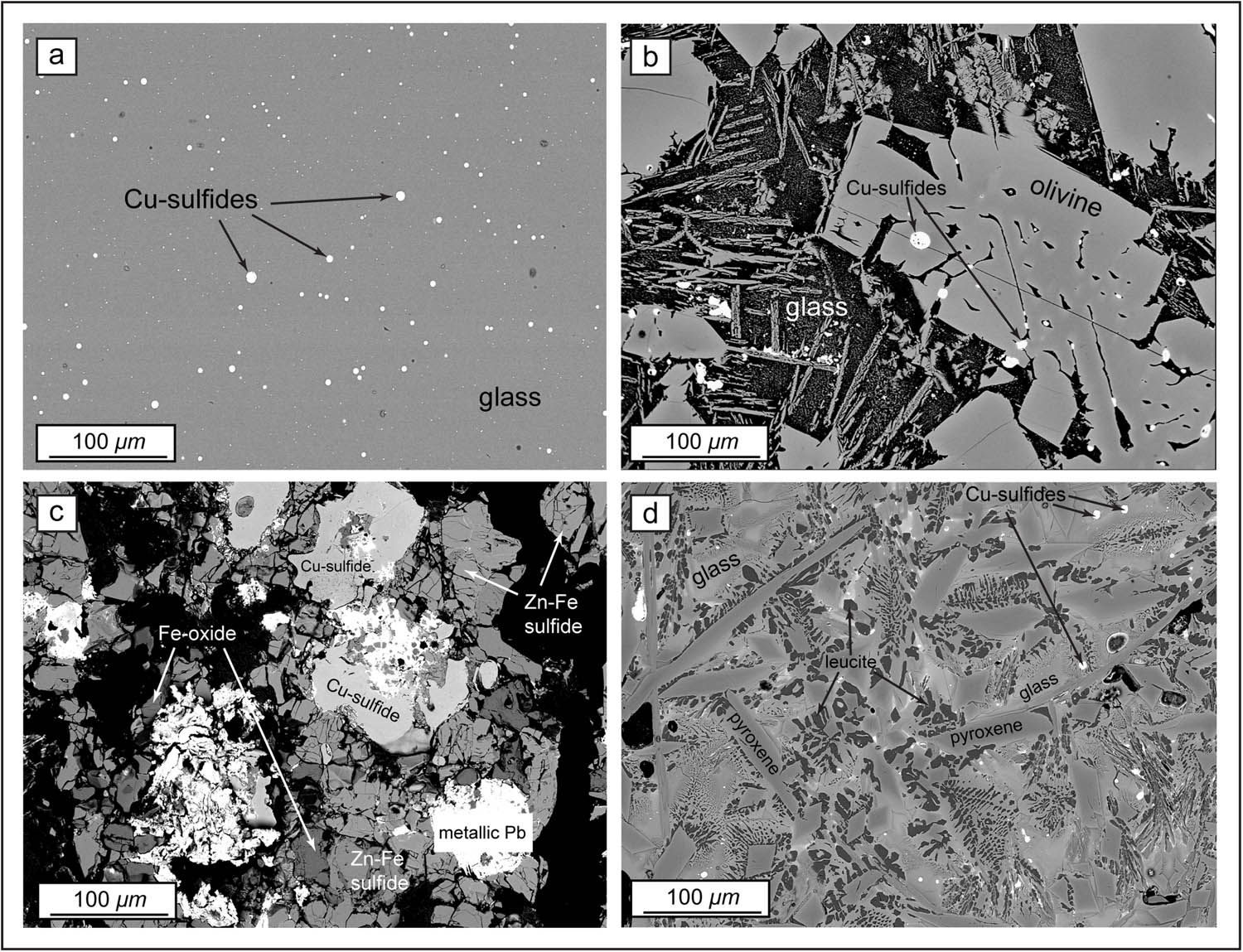
Figure 1
Scanning electron microscope (SEM) images of fresh (unleached) slags: (a) AS, (b) HS, (c) LS, (d) CS.
Table 2
Chemical composition of slags
| AS | HS | LS | CS | |
|---|---|---|---|---|
| Wt.% | ||||
| SiO2 | 48.3 | 37.6 | 0.68 | 46.5 |
| TiO2 | 0.57 | 0.45 | 0.02 | 0.80 |
| Al2O3 | 11.8 | 7.46 | 0.20 | 17.6 |
| Fe2O3 tot. | 13.5 | 50.7 | 31.20 | 4.76 |
| MnO | 0.49 | 0.17 | 0.39 | 0.21 |
| MgO | 2.10 | 2.5 | 0.14 | 2.73 |
| CaO | 17.5 | 1.1 | 0.39 | 18.1 |
| Na2O | 0.21 | 0.27 | 0.65 | 0.19 |
| K2O | 4.59 | 1.58 | 0.81 | 5.97 |
| S | 0.05 | 0.67 | 25.3 | 0.21 |
| mg kg−1 | ||||
| Cu | 19,724 | 5,657 | 36,050 | 4,060 |
| Zn | 53 | 3,962 | 199,600 | 59 |
| Pb | 587 | 111 | 54,900 | 164 |
Slags exhibiting a wide range of chemical compositions and mineralogical characteristics were deliberately chosen to capture the diversity of metallurgical residues generated by different industrial processes. The objective was not to evaluate the behavior of a single slag type, but rather to gain broader insight into the dissolution mechanisms and bioleaching performance of materials representing a wide spectrum of geochemical properties.
2.2. Experimental approach
Metallurgical wastes were subjected to leaching experiments under abiotic and biotic conditions. Bioleaching experiments were carried out with the fungus A. niger (strain number DSM 2466, available from Deutsche Sammlung von Mikroorganismen und Zellkulturen; Braunschweig, Germany). Aspergillus niger is widely used in bioleaching studies (Table 1); this microorganism secretes organic acids, including citric, gluconic, and oxalic acids, which lower the pH and promote the dissolution of metal-bearing phases, enhancing mobilization of metallic elements. In addition, A. niger is tolerant of acidic conditions and elevated metal concentrations, making it well suited for the treatment of metallurgical slags. Its physiology, ease of cultivation, and extensive characterization in the biohydrometallurgical literature make it a suitable model organism for investigating interactions of fungi with solid materials.
Slag samples were crushed using a jaw crusher and sieved to receive a particle size of 0.25–0.5 mm. GM was prepared according to supplier’s recommendation and contained per 1 l of ultrapure water: 100 g saccharose, 1.5 g NaNO3, 0.025 g KH2PO4, 0.025 g MgSO4·7H2O, 0.025 g KCl, 1.6 g yeast extract, and pH adjusted to 4.0. Solid materials, solutions, and laboratory equipment were sterilized in an autoclave (VWR Vapor-Line Lite II P; VWR International, USA) at 121°C, and all preparatory steps were performed under a laminar flow cabinet (CJ-600P; Chemland, Poland). Slags (10 g) were placed in a polypropylene flask (250 ml capacity) with a Hepa filter plug and immersed in 100 ml of the following solutions: (i) GM with fungus (GM + F) and (ii) sterile GM. All experiments were carried out in duplicates. Batch reactors were placed in an incubator shaker (Environmental Shaker ES-20/60, SIA Biosan, Latvia) set at 100 rpm and 30°C for a period of 30 days. The choice of experiment duration was made based on the growth cycle of the A. niger and literature survey. A typical growth cycle of A. niger (based on the biomass dry weight) will have 1 day lag phase followed by 14 days of log phase and then the stationary phase till 70 days (Aung & Ting, 2005). In our literature survey, we found that several researchers investigated fungal bioleaching by A. niger over periods ranging from 26 to 35 days (Santhiya & Ting, 2006; Xu et al., 2014; Xu & Ting, 2004).
After termination of the experiments, the leachate supernatants were separated from slag particles. Leachates obtained from abiotic leaching were filtered through 0.22 μm polytetrafluoroethylene syringe filters, acidified with 2% (v/v) Suprapur 65% HNO3 (Merck), and stored at 4°C until elemental analysis. Leachates obtained from bioleaching were divided into two aliquots. The first aliquot was filtered, acidified, and stored following the same procedure as that applied to the abiotic leachates. The second aliquot was subjected to perchloric acid digestion at 70°C for 15 min to determine the acid-digestible elemental inventory of the fungus-containing fraction.
The slag fraction used in our experiments ranged from 0.25 to 0.5 mm. This relatively coarse fraction was intentionally selected to allow efficient separation of the slag particles from the microbial biomass at the end of the experiment. Fungal growth was assessed at each sampling time by collecting a 1 ml aliquot from each sample and aseptically transferring it into fresh sterile growth medium. The inoculated tubes were incubated under the specified conditions and subsequently examined for evidence of fungal growth.
The data acquired through Inductively coupled plasma – optical emission spectroscopy (ICP-OES) were recalculated to express them as mg kg−1 of the element released from each waste (Figure 2) and to reveal the extraction efficiency (expressed as a percentage % of the total Figure 3). Procedural blanks (GM without slag and GM without slag but containing biomass) were subtracted from the corresponding leachate measurements. In addition, molar ratios of elements were calculated by converting the amounts of leached elements to moles and then determining the ratio of one element to another (e.g., Ca/Al, Cu/Fe etc.). Theoretical ratios were calculated from the bulk composition of the slags and represent the elemental ratios expected under congruent dissolution. In contrast, experimental ratios were calculated from the leaching data obtained in this study and reflect the incongruent dissolution that is more likely to occur under the experimental conditions (Welch et al., 2008).
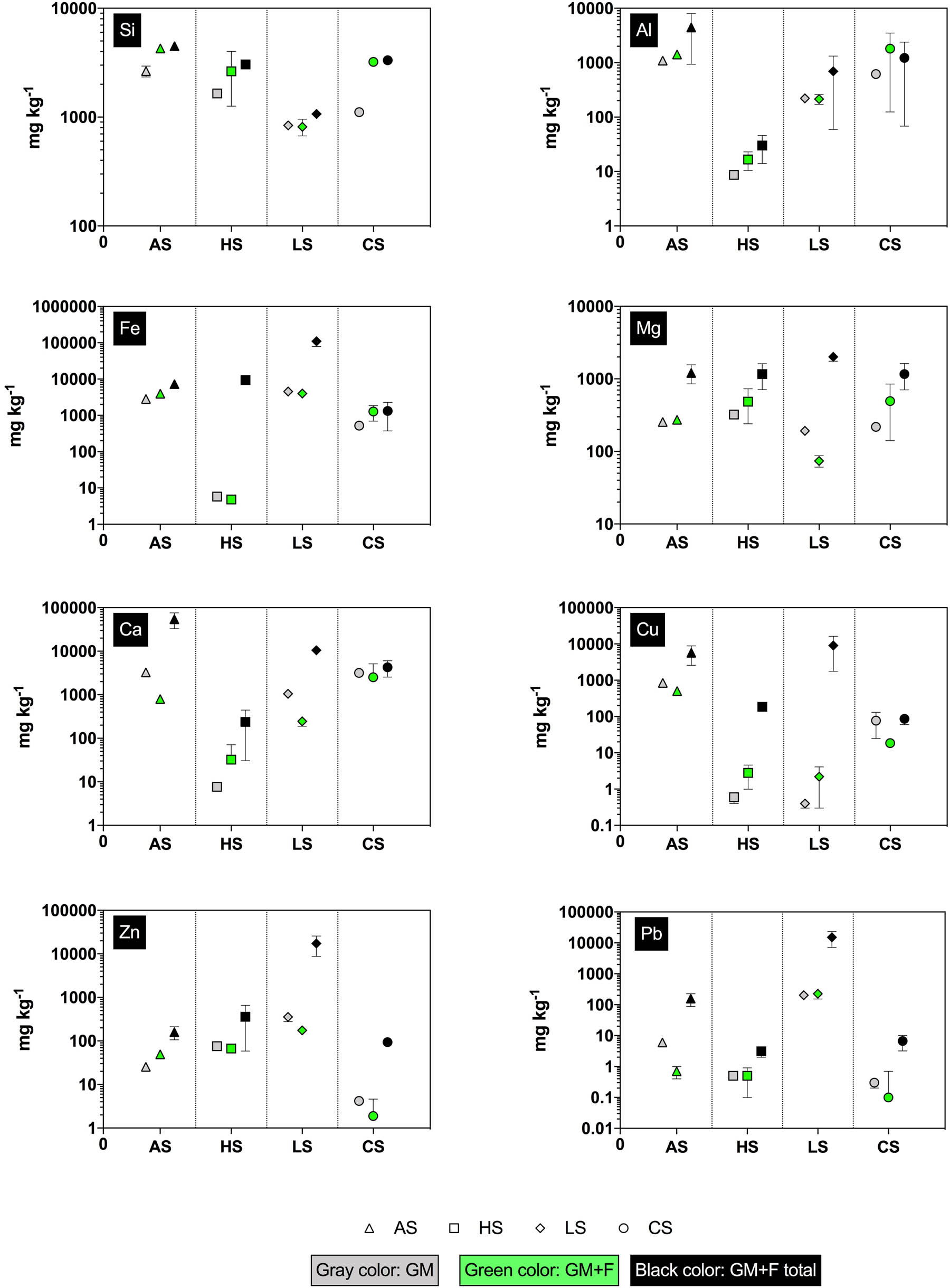
Figure 2
Elements leaching from individual slags exposed to various experimental conditions.
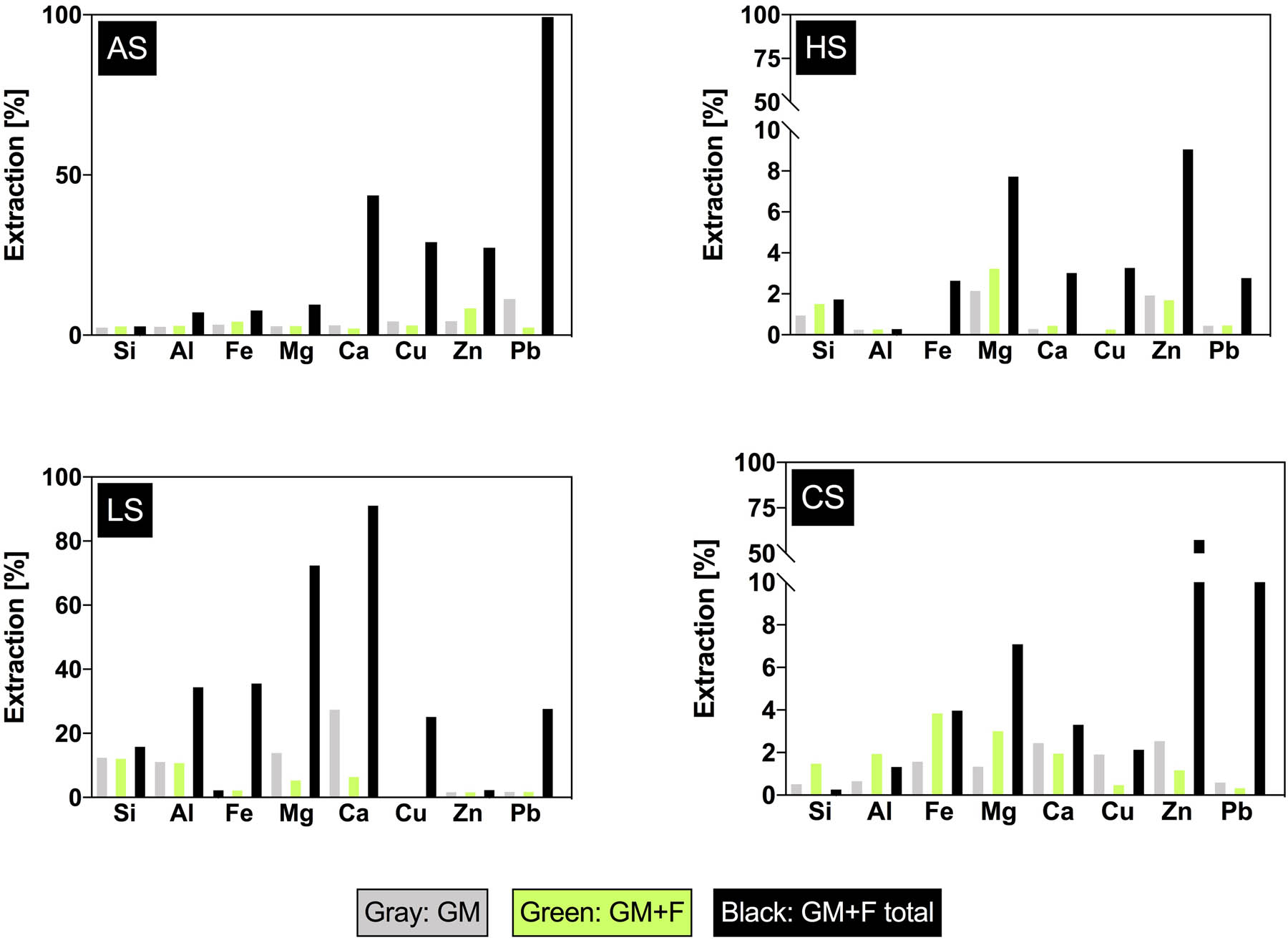
Figure 3
Relative values (%) of elements leached for slags exposure to different conditions.
2.3. Leachate analysis
The concentrations of elements in the leachates after the experiment were measured using the ICP-OES method (Avio 200, Perkin Elmer®). The following wavelengths were applied for the analysis: 327.393 nm for Cu, 259.939 nm for Fe, 220.353 nm for Pb, 213.857 nm for Zn, and 396.153 nm for Al, 212.412 nm for Si, 285.213 nm for Mg, and 317.993 nm for Ca. Operating conditions during analysis were as follows: plasma gas (argon) flow 12 l/min; auxiliary gas (argon) flow 0.2 l/min; nebulizer gas (argon) flow 0.6 l/min; RF power 1,500 W; pump flow rate 1 ml/min; spray chamber: TFE Tracey Spray Chamber. Calibration curves were prepared from single-element ICP-certified reference materials (Merck®).
2.4. Surface analysis
Scanning Electron Microscope with energy dispersive X-ray spectroscopy (JEOL JSM-IT100, JEOL, Tokyo, Japan) has been used for analysis of the slags before and after leaching. Fresh (unweathered) slags were prepared as polished sections, whereas slags recovered after the leaching experiments were gently rinsed with sterile ultrapure water and dried in a laminar flow cabinet. The dried grains were then used for microscopic observations to preserve the dissolution features and avoid their alteration or removal during surface polishing. Microscope operated at low vacuum and in the 15–20 kV working mode.
2.5. Statistical analysis
The results from the leaching experiments were analyzed using a non-parametric ANOVA Kruskal–Wallis test, followed by the post-hoc Dunn test with a Bonferroni correction (Kruskal & Wallis, 1952). Normal distribution of data was checked using the Shapiro–Wilk test, and homogeneity of variance (for Mg and Si) by means of Levene’s test (Shapiro & Wilk, 1965). The significance level (α) in this study is 0.05. All statistical analyses were performed in Statistica 13.3 (Tibco).
3. Results
3.1. Leaching
The results of the bioleaching experiments for the elements are presented in Figures 2 and 3 as graphs with values expressed in mg kg−1 and %, respectively. The pH of the leachate after termination of the experiment was 4.54 (AS), 3.25 (HS), 5.42 (LS), and 4.51 (CS). The pH drop was observed only for HS, whereas a slight increase was noted for the other materials. The decrease observed for HS was likely caused by sulfide dissolution, whereas the increase in the AS- and CS-containing solutions may be related to the buffering effect of silicates. The highest pH values observed for LS were unexpected, as this material contains a high proportion of sulfides. This suggests that, in addition to phase composition, the activity of A. niger may affect the pH of the solution by altering the H⁺ balance.
Overall, biotic conditions enhanced metallic elements leaching compared with abiotic conditions (Figure 2). For Si, Fe, Mg, Ca, Cu, Zn, and Pb, the highest recoveries were generally obtained under GM + F total conditions, indicating a substantial contribution of the fungus-containing fraction to the bioleaching process. This effect was particularly pronounced for Cu, Zn, and Pb in the LS sample and for Si and Ca in the AS sample. For instance, Cu extraction in the LS sample increased from only 0.400 mg kg⁻¹ under GM and 2.20 mg kg⁻¹ under GM + F to 9.06 × 10³ mg kg⁻¹ under GM + F total. Similarly, Zn and Pb recoveries from LS reached 1.73 × 10⁴ and 1.51 × 10⁴ mg kg⁻¹, respectively, under GM + F total conditions. In the AS sample, Si and Ca extraction under GM + F total reached 4.50 × 10³ and 5.46 × 10⁴ mg kg⁻¹, respectively (Figure 2).
The positive effect of biotic treatments was also evident in the HS and CS samples. Under GM + F total conditions, Si leaching increased from 1.65 × 10³ to 3.05 × 10³ mg kg⁻¹ in HS, while Fe recovery reached up to 9.37 × 10³ mg kg⁻¹. In CS, biotic conditions also promoted leaching, although the differences between GM + F total and GM + F were generally smaller; for example, Fe extractions were 1.32 × 10³ and 1.28 × 10³ mg kg⁻¹, respectively. Despite these improvements, HS and CS generally exhibited lower extraction efficiencies than AS and LS, particularly for Cu and Pb. In contrast, abiotic conditions (GM) consistently yielded lower recoveries, although for some elements (e.g., Ca, Zn, and Pb in selected samples), GM performed slightly better than GM + F (Figure 2).
3.2. Dissolution features
The dissolution features observed on slag surfaces following the leaching experiments are shown in Figure 4. SEM-BSE micrographs reveal representative alteration features in all slag types. AS exhibits secondary surface alteration, while unaltered glass contains voids left by the dissolution of Cu sulfides (Figure 4a–b). In HS, dissolution of the interstitial glass exposed olivine crystals (Figure 4c), and localized dissolution of sulfides was observed within otherwise relatively unweathered slag (Figure 4d). LS shows surface cracking associated with alteration (Figure 4e), together with dissolution features and the formation of secondary phases (Figure 4f). CS exhibits surface dissolution, with the notable boundary between more and less altered zones (Figure 4g), as well as rounded voids indicating dissolution of Cu sulfides (Figure 4h).
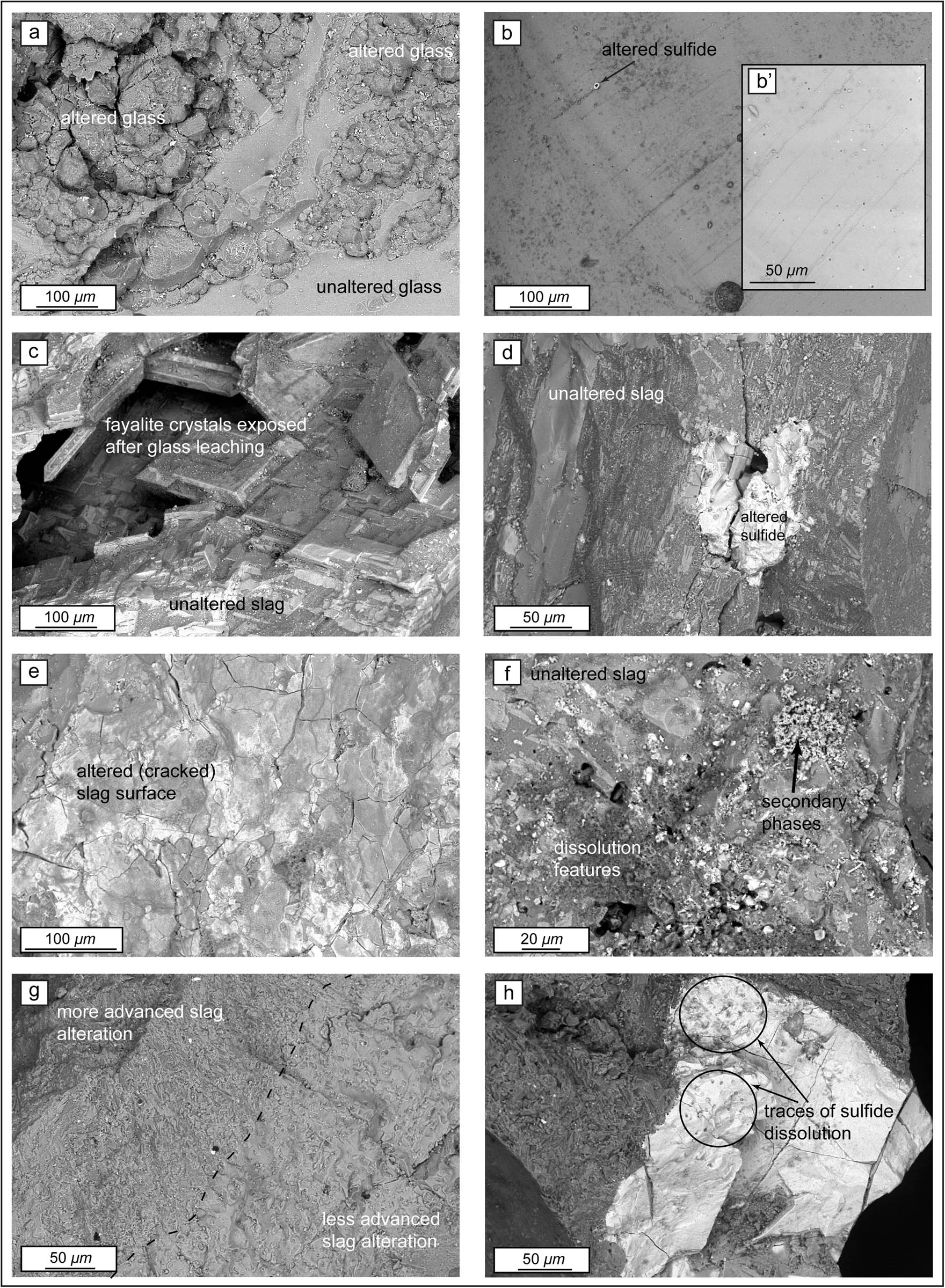
Figure 4
SEM-BSE micrographs of slags after leaching experiment: (a and b) AS, (c and d) HS, (e and f) LS, (g and h) CS; (a) Secondary surface alterations on amorphous slag; (b) unaltered glass with voids formed by the dissolution of Cu-sulfides; (c) olivine crystals exposed due to the dissolution of interstitial glass; (d) altered sulfide within relatively unweathered slag; (e) evidence of slag alteration, visible as a cracked surface; (f) signs of dissolution and presence of secondary phases; (g) slag surface showing dissolution features; the dashed line marks the boundary between more and less altered zones; and (h) round structures indicating dissolution of Cu-sulfides.
4. Discussion
The environmental conditions, including abiotic and biotic factors, are the major parameters controlling the leaching of elements from metallurgical slags. Careful control of the experimental conditions allows the evolution of slag weathering to be reproduced by monitoring the chemistry of the leachates. In this study, the leaching susceptibility of various slags derived from copper processing was investigated, to determine whether variations in the chemical and phase composition of these solids affect their environmental behavior.
4.1. Susceptibility of slags to biodissolution
The results obtained by using the batch incubation tests (Figures 3 and 4) were compared for different types of Cu-slags to identify better the dissolution mechanisms and phases that control the release of individual elements from slags. The results revealed a clear relationship between the dissolution of mineral phases in the slags and the observed leaching trends of major and metallic elements.
Throughout the 30 days incubation period, the slags were exposed to a certain variation in terms of incubation conditions encompassing both abiotic and biotic leaching processes taking place at the same pH (GM vs GM + F) as seen in Figures 2 and 3. Generally, biotic incubation was found to have higher impact on elements leachability as compared to abiotic conditions (Figure 2). For this reason, phases susceptibility to dissolution presented here is considered based on results from GM + F incubation variant.
One of the main differences between the leachability of metallic elements and that of major elements is the fact that metals are associated with sulfides and intermetallic phases (Cu-bearing droplets), while major elements mainly occur in silicates and glass. Consequently, the leaching tendency of individual elements may vary from one phase to another and is specific to the overall phase composition of the slag (Figure 3). An analysis of Cu leaching behavior revealed that AS and LS samples exhibited the highest susceptibility, with leaching rates reaching 25.1–29% (GM + F total) (Figure 3). However, given the entirely different phase compositions of these materials, it can be stated that amorphous texture of AS played main role in determining its susceptibility to leaching (Figure 3). On the other hand, Cu in LS was primarily incorporated into sulfides, which also serve as the main Cu carriers in HS and CS. This suggests that the volumetric dominance of sulfide phases in LS promoted their greater exposure to the leaching environment, thereby enhancing subsequent sulfide dissolution and element release, whereas in HS and CS, the presence of crystalline silicate phases, where sulfides are encapsulated impeded leaching by reducing sulfide exposure compared to LS (Figure 4). Furthermore, the highest Zn leaching was achieved for AS slag (27.3%, Figure 3) likely due to its amorphous texture, whereas CS revealed the following leaching behavior: CS (57.4%) > HS (9.1%) > LS (8.7%) (Figure 3). It must be emphasized that LS contains sphalerite (Zn-sulfide) in the highest volumetric proportion (Potysz et al., 2016) despite its leaching being lower than that of CS and HS. In the former slags, the Zn impurities in crystalline phases and glass were primary contributors to Zn release. This shows that greater susceptibility to dissolution of crystalline phases can be observed rather than Zn-bearing sulfides. This finding contradicts the observations of LS dissolution in organic acids reported by Potysz et al., 2017. They suggested that a higher concentration of biotic agents may be necessary to enhance sphalerite leaching. As reported by Nnanwube et al., (2024); Nnanwube and Onukwuli, (2020), the sphalerite leaching rate increases with higher organic acid concentrations. Furthermore, slags revealed the following tendency to Pb leaching: AS (99.3%) > LS (27.6%) > CS (11.3%) > HS (2.8%) (Figure 3). Again, the amorphous texture of AS was the primary variable determining the behavior of this material (Figure 4). In LS, intermetallic phases were the main Pb carriers, known for their susceptibility to leaching, whereas in CS and HS, the dissolution of sulfides was responsible for the primary Pb input to the solution.
The calculation of the molar ratios of the individual elements is a useful geochemical tool for deciphering which phase is being preferentially dissolved under specific weathering conditions (Figure 5). An important observation derived from the calculated molar ratios is that these values achieved for GM + F total are similar to those in a bulk sample. This result suggests that the presence of A. niger (considering its biomass) affect slags promoting its bulk dissolution. When all the elements were compared to Cu, regardless of incubation conditions and the material studied, Cu is leached less preferentially than the major elements and Zn (Figure 5). An exception from this rule was observed for AS sample for which Cu was leached preferentially. However, Cu exhibited preferential leaching over Pb. Even though slag exposure to biotic factors can contribute to Cu leaching, the major phases (glass) still show greater susceptibility to dissolution (Figure 5). Tracking the leaching of the major elements allowed to relate materials behavior to the dissolution of silicate phases. Focusing solely on Si would have made it impossible to decipher the dissolution process; therefore, a broader analysis encompassing additional elements was conducted. Calcium was released in the quantities 43.7% (AS) vs 3.31% (CS), which again suggests greater susceptibility of AS as compared to crystalline one (Figure 4). In addition, Ca (3.31%) vs Al (1.31%) in CS (Figure 3) indicates that higher susceptibility of plagioclase and/or pyroxene rather than leucite took place (Figure 5). As reported by Welch and Ullman, (1993), organic acids (such as those involved in the studied bioleaching) enhance plagioclase dissolution even by ten times compared to inorganic solutions at the same acidity. In addition the authors pointed out that Ca leaching from plagioclase reveals faster rates than that of Al and Si (Welch & Ullman, 1993), which is also in accordance with the present study (Figures 3 and 4). In HS, the main indicator for crystalline phases dissolution was Fe-bearing fayalite; in this case, the Fe release reached 2.6%, which was lower than that observed for other materials LS (35.5%) > AS (7.7%) > CS (4.0%) (Figure 3). Based on that, it is concluded that silicate phases of HS are similarly susceptible to dissolution as crystalline phases of CS, which is also confirmed by Si leaching reaching 1.7% and 1.5% for HS and CS, respectively. In addition, calculated molar ratios indicate that glass of HS is generally preferentially dissolved with respect to fayalite except for GM + F total incubation conditions, where the impact of fungus on fayalite dissolution becomes more notable (Figure 5). Interestingly, despite fayalite occurring in LS in minor volumetric proportions, its leaching was greater than that of HS, which contains fayalite as a volumetrically major phase (Figure 4). This statement is confirmed by leaching results showing Si and Fe leaching from HS, 1.7% (Si) and 2.6% (Fe) compared to leaching from LS at 15.8% (Si) and 35.5% (Fe).
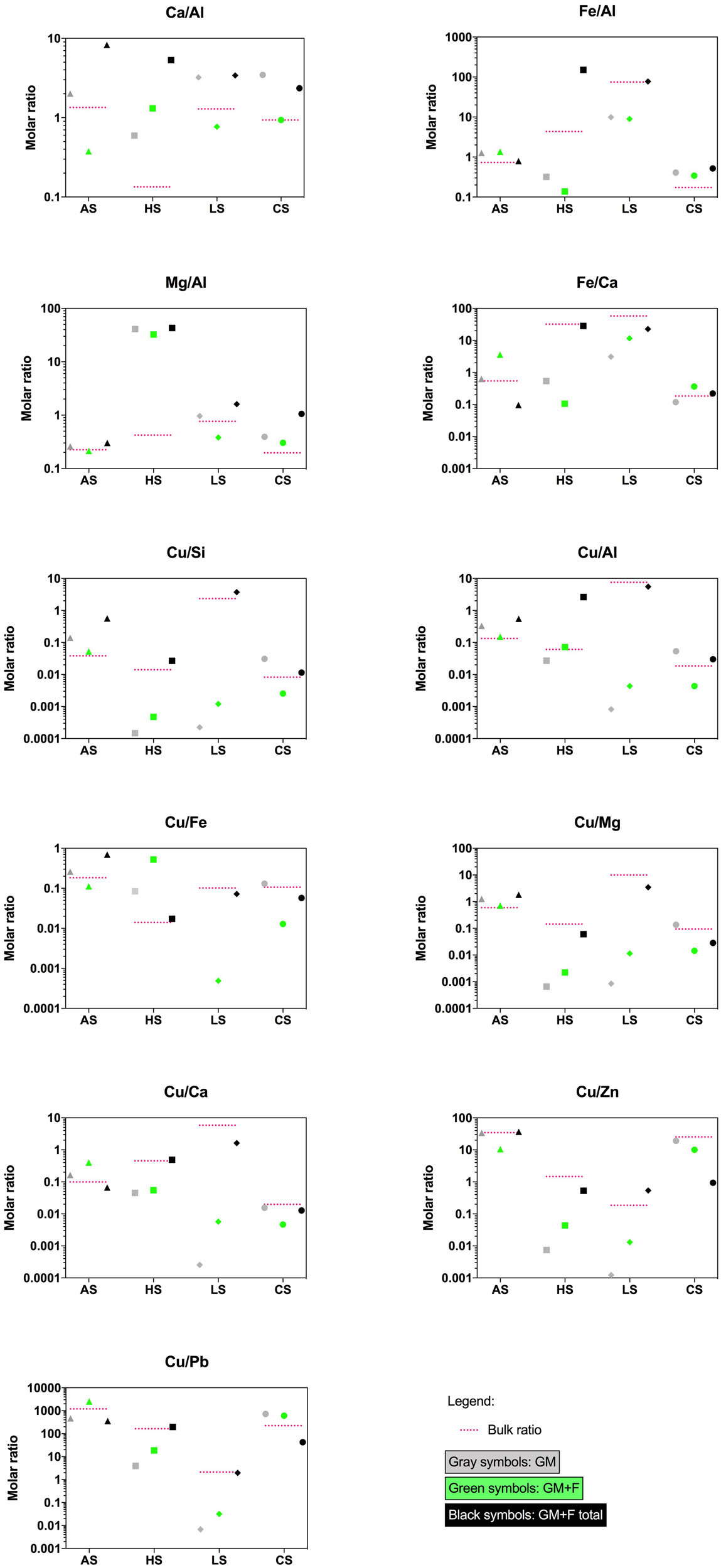
Figure 5
Theoretically and experimentally achieved element ratios with respect to Cu – effect of different incubation conditions.
4.2. Effect of incubation conditions on slags behavior
In this study, two incubation conditions were investigated, which included slags immersion in GM representing abiotic leaching and medium inoculated with fungus A. niger representing biotic leaching mechanism. In addition, the biomass of A. niger was mineralized to differentiate between the amount of elements released into the dissolved fraction and those associated with the microbial cells. Regardless of the slag studied, it was shown that the concentration of elements in the leachates was similar under both abiotic (GM) and biotic (GM + F) conditions, whereas notably higher concentrations of elements were determined in fungus-associated fraction (Figure 2). This statement is supported by the statistical analysis (Table 3), which demonstrates that differences in Si, Fe, Mg, Cu, and Zn concentrations in leachates (across all types of slags used) between biotic and abiotic conditions are not statistically significant. Regarding the fungus-associated fraction, notably higher Mg content is observed compared to biotic and abiotic conditions (Table 3). For the other elements, differences are more diversified. It must be emphasized that elements detected after biomass digestion may represent surface sorption, intracellular uptake, oxalate precipitation, and secondary phases formation (Javanbakht et al., 2014; Warren & Grant Ferris, 1998). The abundance of functional groups (carboxyl, amine, hydroxyl, phosphate, sulfonate) in fungal biomass may be an excellent biosorbent for metals. In our case, the living microbial cells of A. niger were present in the incubation experiment and therefore the active mechanisms of detoxification and biosorption took place and could effectively enhance metal sorption (Malik, 2004). The carboxylate and amine groups of A. niger biomass were more important biosorbing sites than the phosphate and the lipid functional groups (Kapoor & Viraraghavan, 1997). Infrared spectroscopy analysis revealed the binding sites in A. niger such as two absorption bands in the 3,690–3,615 and 2,970–2,895 cm−1 regions correspond to OH and CH groups in fatty acids and bands around 1,600 cm−1 and 1,048 cm−1 correspond to C═O groups of amides (Gáplovská et al., 2018). The biosorption of metals such as Cu, and Zn by A. niger generally obey Langmuir and Freundlich models (Filipovic-Kovacevic et al., 2000; Mukhopadhyay et al., 2007). When the total amount of elements (GM + F total) released during the incubation experiment was considered, most elements showed higher concentrations than those observed in the dissolved fraction (GM + F), and the leaching yield was improved by factors up to 68.6 (Ca), 27.8 (Fe), 13.6 (Mg), 3.2 (Al), and 1.3 (Si) (Figure 3). The differences between GM, GM + F, and GM + F total were particularly pronounced for several elements in the HS slag (Figure 2). For Ca, the recovered amount increased from 0.2 mg kg⁻¹ in GM to 32.4 mg kg⁻¹ in GM + F and 237.4 mg kg⁻¹ in GM + F total, while for Mg the corresponding values were 322.5, 486.6, and 1,163.9 mg kg⁻¹, respectively. The most pronounced difference was observed for Cu, for which the recovery increased from 0.6 mg kg⁻¹ in GM to 2.8 mg kg⁻¹ in GM + F and 184.7 mg kg⁻¹ in GM + F total. These results demonstrate that the contribution of the fungus-associated fraction to total element recovery was strongly element-dependent. Similar, although less pronounced and less consistent, differences between the incubation conditions were observed for the other slag types, indicating that element partitioning between the dissolved and fungus-associated fractions depends on both element type and slag composition. However, it must be emphasized that element binding to biomass varied from one solid to another, demonstrating that not only the general affinity of the element to biomass but also the overall element dissolution, determines fungal capture. Among the major elements, Ca was the most intensively incorporated to biomass (factor up to 67). The ability of A. niger to capture Ca has already been reported (Su et al., 2023). Additionally, calcium oxalate particles formed on fungus hyphae have been previously demonstrated. The bioleaching process enhances element dissolution by promoting their complexation with organic acids released by the fungus into the leaching medium. Thus, once Ca is captured by fungal hyphae, the competition of this element with other metals is reduced (Xu et al., 2014). Metallic elements exhibited the following tendency to bind to biomass: Cu (factor up to 4,000), Zn (factor up to 98.5), and Pb (factor up to 80.1). Apart from Cu sorption, Zn was also reported to be effectively captured by A. niger (Hajahmadi et al., 2015). This is an important result indicating that studies dedicated to incubation with microorganisms forming dense biomass must consider not only the dissolved element fraction but also the fraction embedded in biomass to draw more reliable conclusions on phase susceptibility to bioleaching (Table 3).
Table 3
Results of multiple comparisons among the abiotic (GM), biotic (GM + F), and GM + F total groups for all slags considered together
| Element | ANOVA Kruskal–Wallis test | Post-hoc Dunn Bonferroni test | ||
|---|---|---|---|---|
| Abiotic (GM) | Biotic (GM + F) | GM + F total | ||
| Si | H = 15.77, df = 2, p < 0.05 | b | b | a |
| Al | H = 1.64, df = 2, p > 0.05 | nd1 | nd | nd |
| Fe | H = 7.96, df = 2, p < 0.05 | a | a, b | b |
| Mg | H = 15.61, df = 2, p < 0.05 | a | a | b |
| Ca | H = 5.71, df = 2, p > 0.05 | nd | nd | nd |
| Cu | H = 7.98, df = 2, p < 0.05 | a | a, b | b |
| Zn | H = 8.06, df = 2, p < 0.05 | a, b | a | b |
| Pb | H = 3.76, df = 2, p > 0.05 | nd | nd | nd |
4.3. Overall effect of bioleaching approach investigated for the studied slags
Bioleaching was especially efficient for the extraction of Zn from CS (57.4%), Cu from AS (29.1%) and LS (25.1%), and Pb from AS (>99%). These yields were obtained under non-optimized conditions (10% pulp density, 0.25–0.5 mm particle size, 30 days), which were deliberately chosen to reflect industrially relevant solid loadings and to facilitate biomass separation, rather than to maximize leaching efficiency. The observed differences in metal recovery between slag types are therefore primarily attributed to their mineralogical composition, with amorphous phases in AS and sulfide-rich phases in CS and LS being more susceptible to fungal-mediated dissolution. At the same time, notable leaching of major elements (e.g., Ca and Fe) occurred, which would require additional purification steps in any potential recovery process. Another important finding is the sequestration capacity of live A. niger biomass (Figure 3), as evidenced by the consistently higher concentrations of Cu, Zn, and Pb in the GM + F total fraction compared to GM + F and GM alone (Figure 3). This is consistent with previous reports on the sorption of divalent metal ions by A. niger biomass (Kapoor & Viraraghavan, 1997; Liu et al., 2006; Mukhopadhyay et al., 2011). However, direct comparison of our bioleaching efficiencies with literature data (Gomes et al., 2020; Schippers, 2017) is limited because this study was not designed to optimize bioleaching parameters. The relatively high pulp density (10% w/v) and long incubation time (30 days) suggest that a broader range of parameters should be considered in future experiments. A methodological perspective is presented in Section 5.
5. Parameters to be evaluated in future bioleaching studies of metallurgical slags
Bioleaching is a promising alternative to more environmentally intensive recovery processes; however, its successful application requires the optimization of numerous operational parameters. Comparing the experimental conditions applied in our study with those reported in previous studies (Table 1), several modifications can be suggested that could potentially enhance bioleaching efficiency. Future studies should place greater emphasis on investigating the following factors:
(i) Particle size is a key parameter influencing bioleaching efficiency. In general, smaller particles enhance metal recovery by increasing the surface area available for interaction with the leaching medium. For example, studies using Aspergillus niger for Cu recovery from electronic waste demonstrated improved bioleaching performance with decreasing particle size. However, the relationship is not always linear; for example (Amiri et al., 2012) reported that excessively small particles may reduce leaching efficiency due to the occupation of available binding sites and enhanced metal bioaccumulation by A. niger (Yang et al., 2009; Amiri et al., 2012). Therefore, particle size optimization is required, as reducing particle size is beneficial only up to a certain threshold, which needs to be experimentally assessed.
(ii) pH is a key parameter in A. niger-mediated bioleaching, as the production of organic acids by the fungus typically causes a substantial decrease in pH during the process. The extent of pH changes depends on the characteristics of the treated material and experimental conditions, while acidic environments promote metal solubilization and reflect the metabolic activity of the fungus (Mulligan et al., 2004; Mulligan & Kamali, 2003; Nikfar et al., 2020).
(iii) The carbon source in the growth medium, particularly sucrose, plays a crucial role by supporting fungal growth and organic acid production, which promotes metal dissolution (Dörsam et al., 2017; Hossain et al., 1984; Faraji et al., 2018; Sharada et al., 2022). High bioleaching efficiencies have been reported using sucrose or glucose as carbon sources, including complete Cu recovery from electronic waste and spent lithium-ion batteries (Bahaloo-Horeh et al., 2019). However, the effects of individual parameters are interconnected. While increasing sucrose concentration enhances organic acid production, excessively high levels may inhibit fungal growth and ultimately reduce metal recovery efficiency (Amiri et al., 2012; Bahaloo-Horeh & Mousavi, 2017). Therefore, careful optimization of both temperature and nutrient composition is required to achieve effective bioleaching.
(iv) Pulp density strongly influences bioleaching efficiency, with lower values (1–2%) generally promoting higher metal recovery by improving contact between organic acids and the material surface (Qu et al., 2013; Biswas et al., 2013; Horeh et al., 2016). However, although higher pulp densities are advantageous from an industrial productivity perspective, they often reduce leaching efficiency, particularly for fine-grained materials.
(v) Agitation and incubation time. Appropriate agitation enhances aeration and fungal metabolism, thereby improving metal dissolution, whereas excessively high agitation may reduce leaching efficiency (Sharada et al., 2022). Incubation periods reported in the literature range from several days to over a month and are generally associated with progressive accumulation of organic acids, which play a key role in metal solubilization. For example, in 40-day metallic elements bioleaching experiments from red mud, an increase in citric acid concentration reaching a maximum of 82.3 mmol/l within 10 days was noted, whereas gluconic acid and oxalic acid peaked at 16.9 mmol/l and 18.3 mmol/l after 20 and 10 days (Qu et al., 2013).
Depending on the material subjected to bioleaching, the experimental parameters should be appropriately designed to balance the costs and efficiency of the process.
6. Conclusion
This study demonstrated that incubation experiments can be effectively used to evaluate the release of elements from metallurgical slags. The leaching results expressed in % and calculated molar ratios allowed to decipher the general sample susceptibility to leaching as well as to indicate preferential release of individual elements. Based on that, the following conclusions can be drawn:
(1) Fungus Aspergillus niger was found to enhance elements leaching from slags. This may contribute to the contamination of the local environment at landfill sites where this microorganism occurs. On the other hand, such a microorganism might be a promising candidate for application in biohydrometallurgical processes for metal recovery.
(2) Among the investigated materials, AS, composed predominantly of silicate glass with only minor metallic phases, exhibited the highest susceptibility to bioleaching under the applied experimental conditions.
(3) In the partially amorphous HS, the glass phase is typically more susceptible to dissolution than fayalite under most experimental conditions. In contrast, fayalite dissolves more rapidly than the glass phase under the GM + F incubation conditions.
(4) In the CS, plagioclase and pyroxene dissolve more readily than leucite, whereas the glass phase exhibits the greatest resistance to leaching. This suggests that the glass is partially protected by surrounding crystalline phases, highlighting the importance of material texture, in addition to mineral composition, in controlling leaching behavior.
(5) LS was identified as the least suitable material for bioleaching using Aspergillus niger.
(6) Bioleaching mediated by the fungus Aspergillus niger resulted in important element sequestration within the fungal biomass as demonstrated by acid-digestible elemental inventory of the fungus-containing fraction. These findings highlight that studies investigating biotic leaching agents should consider not only the dissolved fraction of elements but also the fraction associated with microbial biomass. Only then can a reliable assessment of element mobilization and solid-phase dissolution be achieved.
Acknowledgements
The authors would like to thank the Handling Editor, prof. Silvio Ferrero and Reviewers (Bartosz Puzio, AGH University of Krakow and two anonymous Reviewers) for their time dedicated to evaluating their work.
Funding information
This work was financially supported by The National Science Center (NCN) in Poland in the frame of OPUS25 program under grant agreement 2023/49/B/ST10/01227 to Anna Potysz.
Author contributions
Conceptualization: A.Po, Data curation: A.C. and A.P., Funding acquisition: APo, Investigation: A.C. and A.Po., Methodology: A.P. and J.K., Project administration: A.Po., Supervision: A.Po., Validation: M.S., J.K., A.P., and A.Po, Visualization: A.C., A.Po, and J.K. Writing – original draft: A.C. and A. Po, and Writing – review and editing: A.Po, A.P., J.K., and M.S.
Conflict of interest statement
The authors declare that they have no known competing financial interests or personal relationships that could have appeared to influence the work reported in this manuscript.