
1. Introduction
Chert is a siliceous rock composed of free silica, either in the form of chalcedonic and microcrystalline quartz or in the form of opaline silica of various types. Typically, it has a silica content of >75–80 wt.% (Knauth, 1994). With respect to the origin of chert, biogenic silica derived from siliceous tests of diatoms, radiolarians, and some sponges, is accepted to be primary source. Hydrothermal silica related to volcanisms on sea floors and near mid-oceanic ridges can be additional source of cherts. Silica may also precipitate from lake waters and hot springs, although the volume of these deposits is smaller. Certain types of chert have been given names; for example, flint is often used as a synonym for chert, and is more often used for chert in chalk. Jasper refers to a red-colored variety of chert, its color being due to the finely disseminated hematite and/or goethite. In the geologic record, chert is divided into bedded and nodular layers with different modes of occurrence. Most bedded cherts are primary deposits; many nodular cherts, on the other hand, are diagenetic, having formed by replacement in limestones and to a lesser extent in mudstones and evaporites (Tucker & Jones, 2001). Even so, nodular cherts do still reflect deposition in a silica-rich environment. The origin of chert is still a topic of continuing research, with studies focusing on silica sources and depositional environments (e.g. Adachi et al., 1986; Ge et al., 2024; Moore et al., 2024; Murray, 1994; Peng et al., 2000; Yamamoto, 1987; Zheng et al., 2021; Zhou et al., 2022).
Here, the first results derived from mineralogical and chemical analyses of the chert and associated sand samples from Gebel El-Khashab, east Cairo, Egypt are discussed. The main objective is to characterize these cherts and to assess their silica sources. The results, in turn, should allow us to better interpret the petrological signals contained in cherts from fluviatile deposits.
2. Geological Background
The so-called ‘Gebel El-Khashab’ (Arabic for ‘Wood Mountain’) in Egypt covers a large area (>300 km2) extending for tens of kilometers from Cairo towards Suez, and is located on the north coast of the Gulf of Suez on the Red Sea (Fig. 1a). The area includes sands, chert gravels, silicified wood fragments and tree trunks that overlie the dolomitic limestones (late Eocene) disconformably and lie unconformably below the Miocene marine sediments (Said, 1990). The sands and gravels were transported and deposited by rivers during Oligocene. The deposition of sands and gravels was in part governed by hot springs and basaltic eruptions which affected the Red Sea regions, as well as the belts of highs between the stable and unstable shelves. These eruptions occurred as a result of the rifting process of the Suez Gulf during the Oligocene and Miocene (see Ali-Bik & Gabr, 2022 and references therein). Field investigations in the region have revealed hot-spring (Tosson, 1954) and volcanoclastic deposits (Abdel-Motelib et al., 2015).
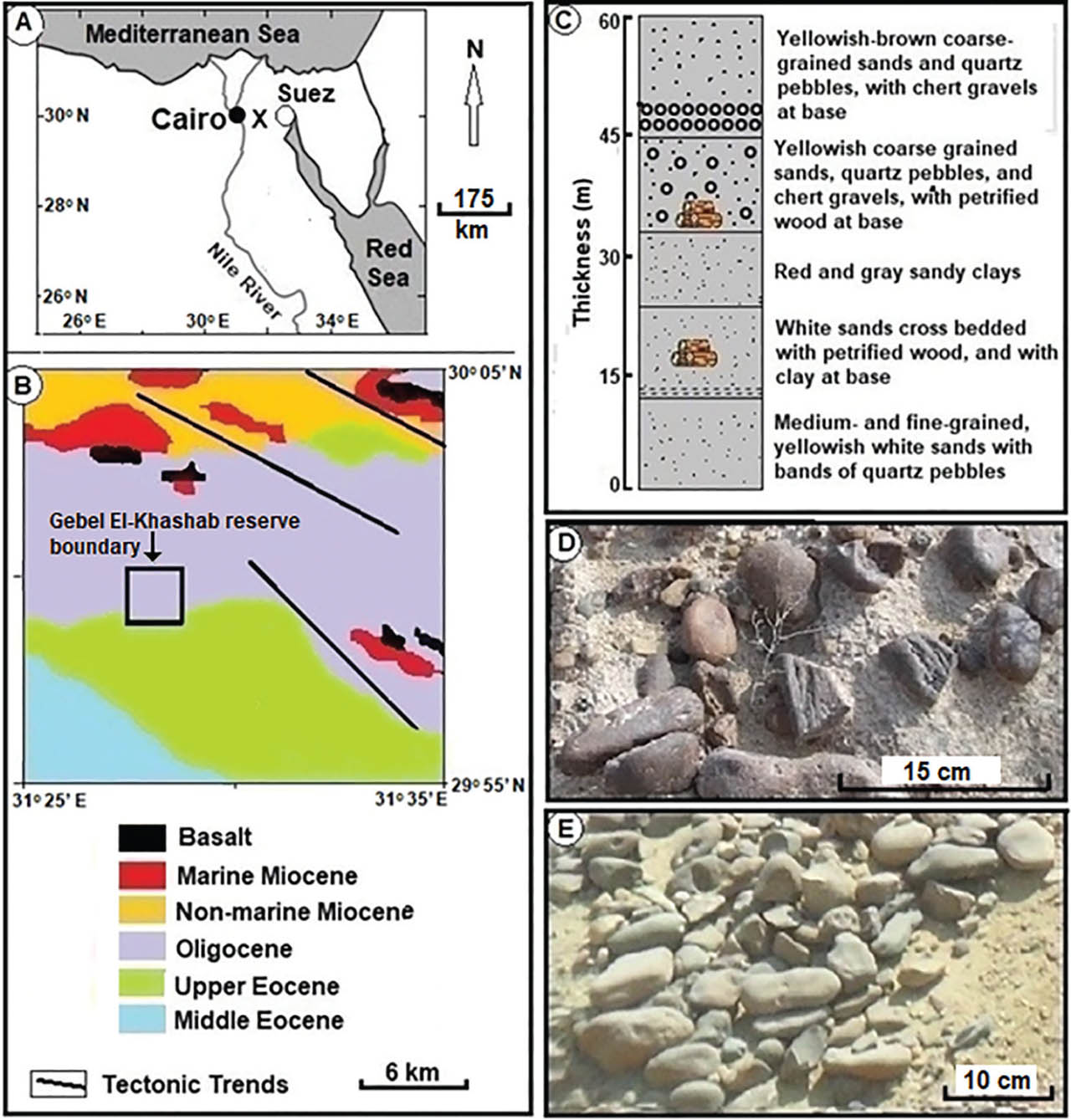
Figure 1.
(a) Location of the area of Gebel El-Khashab reserve (X); (b) Geological map of East Cairo, Egypt (after Salama & Mustoe, 2023); (c) Stratigraphic section of the reserve area; (d,e) Field pictures showing chert gravels associated with sands in the area. Note the size, shape, and surface texture of these gravels are highly variable, most likely due to the long journey they made before reaching to their present place.
However, the only area of high concentration of silicified wood fragments and tree trunks in the Cairo-Suez region (Fig. 1a, b) is that area of 6–7 km2 (located in New Cairo City, El-Katameya, Eastern Desert). This defined area—declared as a natural reserve by decree 944/1989—is also known as the Maadi Petrified Forest and New Cairo Petrified Forest. Low altitude predominates, with elevations from ∼300 m to 370 m above sea level. Inside the reserve area, several silicified tree trunks (up to 30 m long) are lying on the ground; and the soils are dry (Hassan, 2015), and exposed sediments reach ∼70 m in thickness (Fig. 1c). The bottom layer is fine- to medium-grained whitish to yellow friable sands with pebbly quartz, and these sands are overlain by white to yellow cross-bedded sands interbedded with grey clays. The upper-most layer in the study area consists of coarse pebbly sands with gravels at their base. The gravels are made up of chert usually blackened by weathering. The source of chert and the coloration of sand have been attributed to fluids ascending along faults (Shukri, 1954) or due to exogenic fluids (El-Sharkawi, 1977).
The chert gravels are coarse to smooth, dense pebbles and cobbles ranging up to 20 cm in size (Fig. 1d, e). They are often grey or ashy, and the yellow ones are chiefly creamy, yellow or brown, usually due to iron. The shape of chert gravels is approximately ellipsoidal, flattened to a variable degree, reniform or irregular in many ways. The observed variations in the morphology of chert gravels might be directly related to the distance travelled. Consequently, the presence of chert gravels should not be taken as evidence for the deposition environment of the area in which they are presently found. Some chert gravels exhibit concentric internal bands (Fig. 2a–h), while the others are non-banded (Fig. 2i–l). In the field, the gravels with bands occur nearby non-banded ones. The banding structures are not formed around a well-defined nucleus, but they likely reflect periods of chert precipitation. Chert gravels contain geodes or hollows (Fig. 2k, l) and these microfeatures are viewed as concretions or nodules with internal solutions.
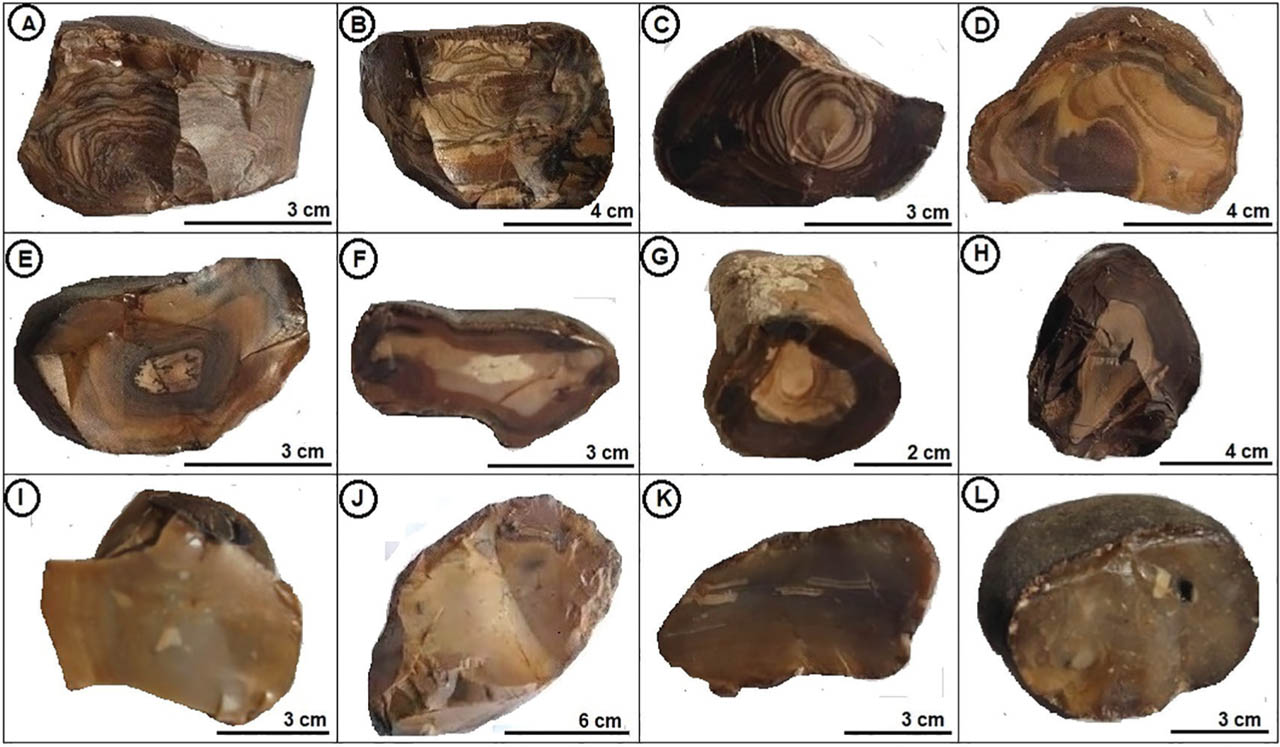
Figure 2.
Photographs of freshly broken chert gravels from the studied area: (a–h) Siliceous gravels exhibiting banding structures; (i–l) Non-banded siliceous gravels without cortices (Note geodes or cavities in K and L samples).
3. Methods
Thirty two samples of the chert gravels as well as five samples of the sands associated with these gravels were collected from the Gebel El-Khashab reserve in east Cairo, Egypt. The samples are namely C-1 to C-32 and S-1 to S-5, respectively. Thin sections of chert gravels were studied at the Nuclear Materials Authority, Egypt, using the Olympus BX53 polarizing microscope. Chert gravel and sand samples were analyzed by X-ray diffraction (XRD) using two different instruments: (1) an X'Pert PRO with Cu Kα radiation at the Egyptian Mineral Resources Authority (EMRA) and (2) a Brucker D8 Advance with Cu Kα1,2 radiation at the National Research Center, Egypt. Analyses of loss on ignition (LOI) and major elements in chert gravel and sand samples were carried out at the EMRA. The LOI was determined as the loss in mass after dry samples were heated for 2 hr at 1100°C in a muffle furnace. The determination of SiO2 relied upon fusing the sample with sodium carbonate. After cooling, the fused substance was treated with HCl acid and then evaporated. The residue was dried and weighted. Finally, the SiO2 content was determined by dividing the weight of the dried substance by the initial weight of the sample multiplied by 100. For TiO2, Al2O3, Fe2O3T, MnO, CaO, MgO, Na2O, and K2O determinations, sample aliquots were digested with an acid solution of HClO4–HF–HNO3. The dissolved mixture residue was taken up in a diluted HCl and was then heated using a mixing hot block. After cooling, the solutions were transferred to test tubes, and brought to volume with 5% HCl. Concentrations were measured on an atomic absorption spectrometer (AAS, SavantAA GBC). Uncertainty (±1δ), determined from sample duplicates, was <10 wt.% for LOI and element oxides (except for TiO2, Fe2O3T and CaO, with uncertainties up to 17 wt.%).
For trace-element analysis, sample aliquots each 0.2 g was digested with an acid solution of HF–HClO4–HCl. The dissolved mixture residue was taken up in a dilute HCl and was then heated using a mixing hot block. After cooling, the solutions were transferred to test tubes and brought to volume with 5% HNO3. The TraceCERT material, certified in accordance with ISO/IEC 17025 and ISO Guide 34, containing 50 μg/L each: Sc, Y, La, Ce, Pr, Nd, Sm, Eu, Gd, Tb, Dy, Ho, Er, Tm, Yb, and Lu, was used to prepare the calibrations standards. Analyses were carried out at the Atomic Energy Authority, Egypt, using an inductively coupled plasma mass spectrometer (iCAP™ TQ ICP-MS; ThermoFisher Scientific, Bremen, Germany) with detection limits as low as 0.0001 ppb (part per billion). The results of these standards were within the accepted values (ESM Table S1 in Supplementary Materials).
4. Results
4.1. Transmitted-light petrography
The chert of Gebel El-Khashab, under the optical microscope, shows three main types of silica: (1) microquartz, (2) megaquartz, and (3) chalcedonic quartz (Fig. 3). Microquartz is a prominent component, comprising >85% of each sample on average, and is finely crystalline (only a few microns across) with pin-point extinction. Megaquartz forms crystals that reach 200 μm or more in size, have undulose extinction, often possess good crystalline shapes and terminations. The megaquartz occurs as a vein-filling cement and, hence, is characterized by a drusy texture (Fig. 3a). Chalcedonic quartz is a fibrous variety with crystals varying from a few tens to hundreds of microns in length and occurring in a radiating arrangement, forming wedge-shaped and spherulitic structures (Fig. 3b). The spherulitic structures are consistent with a hollow-fill rather than a replacement. This is supported by the evidence from of the sample illustrated (Fig. 3b), in that there are straight boundaries between adjacent growths of chalcedonic quartz and triple points where three growths meet.
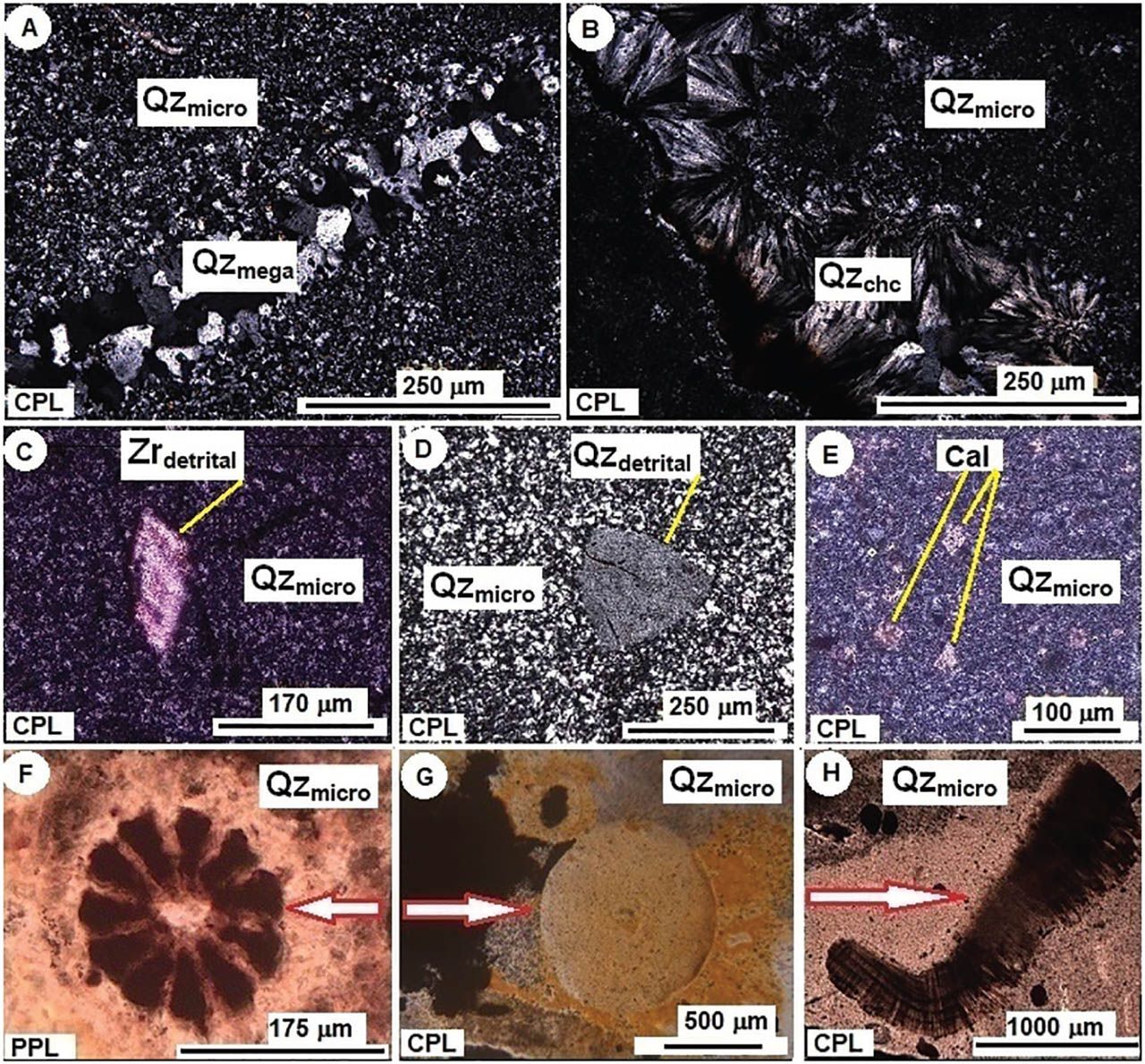
Figure 3.
Optical photomicrographs showing mineral and textural characteristics of chert gravels from the studied area. (a) Cavity occupied by megaquartz, drusy texture; (b) Another cavity filled with chalcedonic quartz; (c) Prismatic, zoned-detrital zircon; (d) Monocrystalline, detrital quartz; (e) Rhombic calcite microcrystals; (f) One complete section of an echinoid spine; (g) Fossil of a crinoid columnal; (h) Fragment of an echinoid plate. CPL, cross-polarized light; PPL, plane-polarized light; Qzchc, chalcedoic quartz; Qzdetrital, detrital quartz; Qzmega, megaquartz; Qzmicro, microquartz; Zrdetrital, detrital zircon.
The Gebel El-Khashab chert contains traces of detrital zircon and quartz (Fig. 3c, d). The zircon grains were only found in one sample, forming euhedral, prismatic crystals up to 170 μm in size and being partially altered. The detrital quartz, on the other hand, was found in most of the chert samples. It forms monocrystalline grains up to 300 μm across and has typical undulose extinction. The detrital zircon and quartz are allogenic components and, hence, were transported into the chert basin, likely by run-off from rivers and streams. Carbonate inclusions, ∼7 μm in diameter and mostly rhombic, are also scattered throughout the chert (Fig. 3e). Rhombic crystals are calcite, as confirmed by chemical analysis. No siliceous biogenic remains were found in the thin sections of the chert samples that might support a biogenic source of silica. However, the samples are characterized by well-preserved fossils of crinoid and echinoid species (Fig. 3f–h). The crinoid and echinoid fossils are completely silicified; they appear to have formed simultaneously with the chert.
Chert samples contain varying amounts of organic matter (OM). The OM is embedded in the silica and, characteristically, has a dense, dark appearance in transmitted-light images (Fig. 4). Several forms of OM are recognized: (1) branching organic textures, (2) diffused OM, (3) clotted OM, (4) tiny organic spheres, and (5) a morphologically diverse group of organic-rich structures (Fig. 4). The organic-rich structures are in the forms of spheres, elliptical and other irregular shapes, which are potential fossil morphologies. They range from a few micrometers up to 250 μm and, sometimes, are filled with microquartz (Fig. 4). Different potential fossil morphologies are seen alongside one another within any given sample. This suggests that differences in OM morphology do not reflect variations in the burial and preservation processes but rather reflect diversity in the original structures.
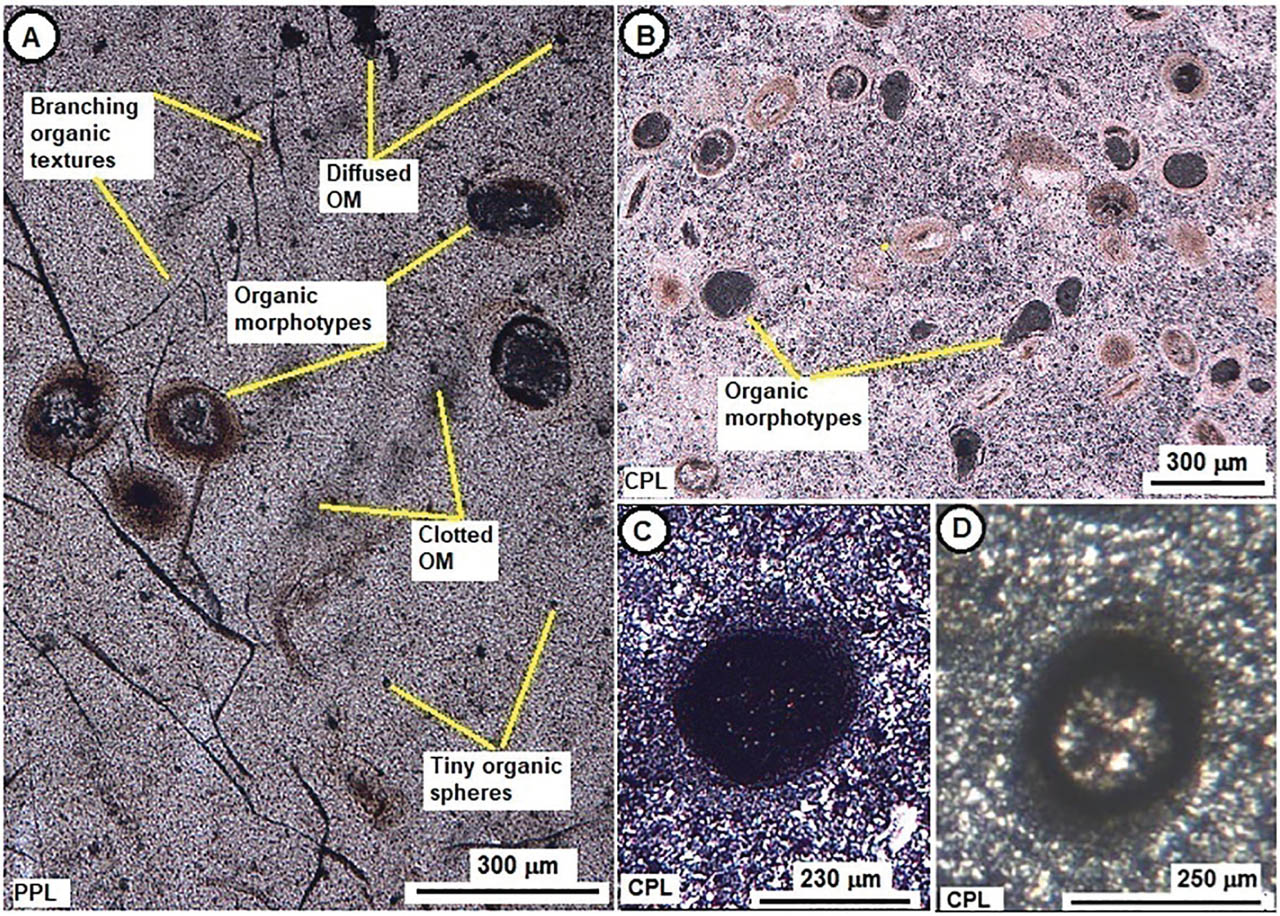
Figure 4.
Characteristic OM textures and morphologies in the studied chert: (a) Branching organic textures, diffused and clotted OM, tiny organic spheres, and organic morphotypes; (b) Various forms of organic morphotypes (c) Approximately 200 μm diameter sphere filled with OM and having spongy texture; (d) Organic sphere filled with microcrystalline quartz. CPL, cross-polarized light; OM, organic matter; PPL, plane-polarized light.
4.2. Bulk X-ray mineralogy
The XRD patterns of all analyzed chert and sand samples, with identifications of minerals, are presented in electronic supplementary material (ESM) Figures S1 and S2. The chert samples are made up of quartz ± goethite ± moganite, with no evidence of opal or clay minerals. Contents of quartz (>90 wt.%) and goethite (<5 wt.%) were determined by XRD analysis software. The content of moganite, determined from the intensity of the diagnostic XRD peak (2θ = 19.67), was found to be <3 wt.%.
In the sand samples, besides quartz, Mg-calcite, feldspar and hematite were identified by XRD analysis as minor components.
4.3. LOI values
The LOI for cherts and sands ranges from 0.4 wt.% to 2.0 wt.% and from 1.3 wt.% to 1.8 wt.%, respectively (Table 1). LOI values give a measure of volatile materials lost from the samples upon their heating at 1100°C. Lost volatiles were mainly CO2 (from carbonaceous compounds) and H2O (from hydrates and hydroxyl-bearing minerals).
Table 1.
LOI values and major element contents (wt.%) of chert and its associated sand from the studied area.
| SiO2 | TiO2 | Al2O3 | Fe2O3T | MnO | CaO | MgO | Na2O | K2O | LOI | |
|---|---|---|---|---|---|---|---|---|---|---|
| Chert | ||||||||||
| C-1 | 97.05 | bdl | 0.04 | 0.41 | bdl | bdl | 0.01 | 0.005 | 0.01 | 0.80 |
| C-2 | 98.12 | bdl | 0.14 | 0.36 | 0.003 | 0.01 | nm | nm | nm | nm |
| C-3 | 96.96 | bdl | 0.12 | 0.45 | 0.004 | 0.17 | nm | nm | nm | nm |
| C-5 | 97.40 | 0.04 | 0.05 | 0.46 | bdl | bdl | 0.02 | 0.01 | 0.01 | 1.28 |
| C-6 | 96.40 | 0.01 | 0.09 | 0.68 | bdl | 0.02 | 0.03 | 0.01 | 0.02 | 1.50 |
| C-8 | 93.10 | 0.03 | 0.09 | 3.86 | 0.31 | 0.64 | 0.04 | 0.06 | 0.01 | 1.53 |
| C-9 | 94.38 | bdl | 0.05 | 2.70 | 0.20 | 0.29 | nm | nm | nm | nm |
| C-10 | 91.27 | 0.04 | 0.05 | 6.10 | bdl | bdl | 0.02 | 0.01 | 0.02 | 1.75 |
| C-12 | 96.10 | 0.03 | 0.11 | 0.89 | 0.01 | 0.32 | 0.05 | 0.06 | 0.01 | 2.03 |
| C-13 | 97.22 | bdl | 0.07 | 1.70 | 0.01 | 0.04 | nm | nm | nm | nm |
| C-14 | 97.58 | bdl | 0.07 | 1.18 | 0.06 | 0.13 | nm | nm | nm | nm |
| C-15 | 94.20 | bdl | bdl | 1.44 | 0.04 | 2.96 | 0.01 | 0.04 | 0.01 | 1.19 |
| C-17 | 96.60 | bdl | bdl | 0.47 | 0.004 | 1.55 | bdl | 0.03 | 0.01 | 0.58 |
| C-19 | 95.33 | 0.04 | 0.26 | 0.58 | bdl | 0.03 | 0.02 | 0.05 | 0.03 | 1.87 |
| C-20 | 96.73 | 0.01 | 0.05 | 0.80 | bdl | 0.12 | 0.01 | 0.005 | 0.01 | 0.40 |
| C-22 | 96.31 | 0.03 | 0.12 | 0.27 | bdl | 0.56 | 0.03 | 0.004 | 0.02 | 1.27 |
| C-23 | 90.42 | 0.02 | 0.05 | 5.07 | bdl | 1.44 | 0.05 | 0.01 | 0.02 | 1.80 |
| C-24 | 90.42 | 0.01 | 0.08 | 5.78 | bdl | 0.05 | 0.02 | 0.005 | 0.02 | 1.49 |
| C-25 | 89.44 | bdl | 0.13 | 4.74 | 0.38 | 0.61 | 0.07 | 0.04 | bdl | 2.30 |
| C-26 | 88.18 | 0.02 | 0.05 | 5.59 | bdl | 1.35 | 0.02 | 0.01 | 0.02 | 1.90 |
| C-27 | 94.08 | bdl | 0.08 | 1.26 | 0.17 | 0.14 | nm | nm | nm | nm |
| C-28 | nm | bdl | 0.08 | 3.95 | 0.39 | 0.48 | nm | nm | nm | nm |
| C-29 | 98.18 | bdl | 0.04 | 0.37 | 0.007 | 0.11 | nm | nm | nm | nm |
| C-30 | 92.34 | bdl | 0.04 | 2.10 | 0.19 | 0.33 | nm | nm | nm | nm |
| C-31 | 98.26 | bdl | 0.06 | 0.20 | 0.04 | 0.11 | nm | nm | nm | nm |
| C-32 | 94.00 | bdl | 0.13 | 0.29 | 0.007 | 1.19 | nm | nm | nm | nm |
| Av. | 94.80 | 0.025 | 0.085 | 2.00 | 0.11 | 0.55 | 0.028 | 0.023 | 0.016 | 1.45 |
| Sand | ||||||||||
| S1 | 95.00 | 0.15 | 0.67 | 0.64 | 0.011 | 0.66 | 0.15 | 0.05 | 0.22 | 1.57 |
| S2 | 92.50 | 0.59 | 1.47 | 1.17 | 0.024 | 1.21 | 0.25 | 0.16 | 0.45 | 1.83 |
| S3 | 94.35 | 0.22 | 1.14 | 0.41 | 0.01 | 1.73 | 0.07 | 0.12 | 0.38 | 1.30 |
| S4* | 94.80 | 0.25 | 1.20 | 0.46 | 0.04 | 2.34 | 0.10 | 0.23 | 0.39 | nm |
| S5* | 94.85 | 0.41 | 1.59 | 0.75 | 0.07 | 1.12 | 0.11 | 0.13 | 0.48 | nm |
| Av. | 94.3 | 0.32 | 1.21 | 0.69 | 0.03 | 1.41 | 0.14 | 0.14 | 0.38 | 1.57 |
* Analysis from Hassan (2017).
4.4. Major elements
Contents of major elements of all analyzed chert and sand samples in this study are listed in Table 1, along with the LOI values. The major elements of cherts, in decreasing order of concentration (wt.%), are: SiO2 = 88.2–99.3, Fe2O3T = 0.2–6.1, CaO = 0.0–3.0, MnO = 0.003–0.4, Al2O3 = 0.04–0.26, MgO = 0.01–0.07, Na2O = 0.04–0.06, TiO2 = 0.01–0.04, K2O = 0.01–0.03. The sands, on the other hand, have 92.5–95.0 wt.% SiO2, 0.66–2.34 CaO, 0.67–1.59 Al2O3, 0.41–1.2 Fe2O3T, 0.15–0.59 TiO2, 0.22–0.48 K2O, 0.07–0.25 MgO, 0.05–0.23 Na2O, and 0.01–0.07 MnO, respectively.
In the chert samples, the content of Fe2O3T generally becomes more depleted as the silica content increases (Table 1). This negative correlation (r = −0.9; ESM Fig. S3) is likely due to dilution processes. Here, the silica acts as a dilutant, with final SiO2 concentrations in the chert samples often exceeding 95 wt.%. Therefore the absolute abundance of elements in cherts largely reflects the extent of addition of silica (Murray, 1994), which in turn, is controlled by environmental factors.
Ratios of some elements were computed using data listed in Table 1. The results—Al/(Al + Fe + Mn), Al2O3/TiO2, Al2O3/(Al2O3 + Fe2O3T), (Fe + Mn)/Ti, Fe/Ti, and Fe2O3T/TiO2 — are in Table 2. The ratios of Al/(Al + Fe + Mn), Al/(Al + Fe), and Al2O3/(Al2O3 + Fe2O3T) increase from the chert to the sand samples, while the (Fe + Mn)/Ti, Mn/Ti, and Fe/Ti ratios decrease. These systematic chemical trends imply that the cherts and the sands were not formed in similar geochemical processes and are of different origin.
Table 2.
Calculated ratios of some elements for samples listed in Table 1.
| Al/(Al + Fe + Mn) | Al2O3/TiO2 | Al2O3/(Al2O3 + Fe2O3T) | (Fe + Mn)/Ti | Fe/Ti | Fe2O3T/TiO2 | |
|---|---|---|---|---|---|---|
| Chert | ||||||
| C-1 | 0.07 | - | 0.09 | - | - | - |
| C-2 | 0.23 | - | 0.28 | - | - | - |
| C-3 | 0.17 | - | 0.21 | - | - | - |
| C-5 | 0.07 | 1.2 | 0.10 | 13.40 | 13.40 | 11.50 |
| C-6 | 0.09 | 9.0 | 0.12 | 79.30 | 79.30 | 68.00 |
| C-8 | 0.02 | 3.0 | 0.02 | 163.0 | 150.0 | 128.7 |
| C-9 | 0.01 | - | 0.02 | - | - | - |
| C-10 | 0.01 | 1.2 | 0.01 | 178.0 | 178.0 | 152.5 |
| C-12 | 0.02 | 3.7 | 0.11 | 34.60 | 34.60 | 29.70 |
| C-13 | 0.03 | - | 0.04 | - | - | - |
| C-14 | 0.04 | - | 0.09 | - | - | - |
| C-15 | - | - | - | - | - | - |
| C-17 | - | - | - | - | - | - |
| C-19 | 0.25 | 6.5 | 0.30 | 16.90 | 16.90 | 14.60 |
| C-20 | 0.04 | 5.0 | 0.06 | 93.20 | 93.30 | 80.00 |
| C-22 | 0.25 | 3.6 | 0.30 | 10.50 | 10.50 | 9.000 |
| C-23 | 0.01 | 2.5 | 0.01 | 295.0 | 295.0 | 253.5 |
| C-24 | 0.01 | 8.0 | 0.01 | 673.0 | 673.0 | 578.0 |
| C-25 | 0.02 | - | 0.03 | - | - | - |
| C-26 | 0.01 | 2.5 | 0.01 | 326.0 | 325.0 | 279.5 |
| C-27 | 0.04 | - | 0.06 | - | - | - |
| C-28 | 0.01 | - | 0.02 | - | - | - |
| C-29 | 0.07 | - | 0.10 | - | - | - |
| C-30 | 0.01 | - | 0.02 | - | - | - |
| C-31 | 0.18 | - | 0.23 | - | - | - |
| C-32 | 0.25 | - | 0.31 | - | - | - |
| Av. | 0.08 | 4.20 | 0.11 | 171.0 | 170.0 | 145.9 |
| Sand | ||||||
| S1 | 0.43 | 4.47 | 0.51 | 5.0 | 4.97 | 4.27 |
| S2 | 0.48 | 2.49 | 0.56 | 2.4 | 2.33 | 1.98 |
| S3 | 0.67 | 5.18 | 0.74 | 2.3 | 2.20 | 1.86 |
| S4* | 0.65 | 4.80 | 0.72 | 2.3 | 2.13 | 1.84 |
| S5* | 0.60 | 3.88 | 0.68 | 2.3 | 2.13 | 1.83 |
| Av. | 0.57 | 4.16 | 0.64 | 2.86 | 2.75 | 2.36 |
* analysis from Hassan (2017).
4.5. Trace elements
The results of Sc, Y, rare earth elements (REE) analyses are shown in Table 3, along with the normalization standards PAAS (Post Archean Australian Shale) and chondrite from Taylor and McLennan (1985). In the chert samples, Sc, Y, and ΣREE range from 0.04 ppm to 0.24 ppm, from 0.13 ppm to 2.2 ppm, and from 0.9 ppm to 5.6 ppm, respectively. The sand, on the other hand, contains 0.6 ppm Sc, 3.0 ppm Y, and 22 ppm ΣREE. The ratio of light to heavy REE (LREE/HREE) is 4.3–9 for cherts and 8.2 for the sand. The concentrations of Y and ΣREE in all analyzed samples are depleted relative to the PAAS values (Y = 27 ppm; ΣREE = 183 ppm). Low abundances of trace and REE in cherts are somewhat a reflection of dilution by quartz which is depleted in trace elements (Murray, 1994).
Table 3.
Trace element compositions (ppm) of chert and its associated sand from the studied area, along with average compositions of the chondrite and PAAS (see text for references).
| C-1 | C-5 | C-8 | C-10 | C-19 | C-20 | C-22 | C-26 | Av. | S3 | |||
|---|---|---|---|---|---|---|---|---|---|---|---|---|
| Sc | 0.043 | 0.042 | 0.090 | 0.042 | 0.238 | 0.194 | 0.107 | 0.087 | 0.10 | 0.640 | nr | nr |
| Y | 0.839 | 0.126 | 1.125 | 0.336 | 1.301 | 1.237 | 2.204 | 1.561 | 1.09 | 3.040 | 2.100 | 27 |
| La | 0.472 | 0.153 | 0.815 | 0.262 | 1.405 | 0.871 | 1.308 | 0.818 | 0.76 | 4.952 | 0.367 | 38 |
| Ce | 0.796 | 0.514 | 0.890 | 0.634 | 1.813 | 3.432 | 1.134 | 0.867 | 1.26 | 8.817 | 0.957 | 80 |
| Pr | 0.098 | 0.041 | 0.133 | 0.050 | 0.295 | 0.160 | 0.210 | 0.131 | 0.14 | 1.351 | 0.137 | 8.9 |
| Nd | 0.296 | 0.077 | 0.365 | 0.131 | 0.809 | 0.449 | 0.586 | 0.373 | 0.39 | 3.556 | 0.711 | 32 |
| Sm | 0.065 | 0.020 | 0.082 | 0.031 | 0.162 | 0.092 | 0.132 | 0.083 | 0.08 | 0.738 | 0.231 | 5.6 |
| Eu | 0.026 | 0.013 | 0.061 | 0.022 | 0.056 | 0.051 | 0.049 | 0.037 | 0.04 | 0.200 | 0.087 | 1.1 |
| Gd | 0.092 | 0.026 | 0.111 | 0.041 | 0.173 | 0.134 | 0.188 | 0.114 | 0.11 | 0.661 | 0.306 | 4.7 |
| Tb | 0.017 | 0.005 | 0.019 | 0.007 | 0.035 | 0.023 | 0.034 | 0.022 | 0.02 | 0.133 | 0.058 | 0.8 |
| Dy | 0.073 | 0.020 | 0.098 | 0.033 | 0.149 | 0.120 | 0.175 | 0.113 | 0.10 | 0.577 | 0.381 | 4.4 |
| Ho | 0.024 | 0.006 | 0.032 | 0.010 | 0.046 | 0.039 | 0.057 | 0.041 | 0.03 | 0.159 | 0.085 | 1.0 |
| Er | 0.055 | 0.013 | 0.078 | 0.024 | 0.107 | 0.103 | 0.139 | 0.094 | 0.08 | 0.358 | 0.249 | 2.9 |
| Tm | 0.010 | 0.003 | 0.014 | 0.005 | 0.019 | 0.018 | 0.026 | 0.017 | 0.01 | 0.064 | 0.036 | 0.4 |
| Yb | 0.069 | 0.018 | 0.079 | 0.033 | 0.110 | 0.106 | 0.148 | 0.097 | 0.08 | 0.381 | 0.248 | 2.8 |
| Lu | 0.012 | 0.003 | 0.014 | 0.005 | 0.018 | 0.018 | 0.024 | 0.018 | 0.01 | 0.067 | 0.038 | 0.4 |
| ΣREE | 2.100 | 0.912 | 2.791 | 1.288 | 5.197 | 5.616 | 4.210 | 2.825 | 3.11 | 22.01 | 3.891 | 183 |
| LREE | 1.753 | 0.818 | 2.346 | 1.13 | 4.54 | 5.055 | 3.419 | 2.309 | 2.67 | 19.61 | 2.49 | 165.6 |
| HREE | 0.352 | 0.094 | 0.445 | 0.158 | 0.657 | 0.561 | 0.791 | 0.516 | 0.45 | 2.40 | 1.401 | 17.4 |
| LRRE/HREE | 4.98 | 8.70 | 5.27 | 7.15 | 6.91 | 9.01 | 4.32 | 4.47 | 6.35 | 8.17 | 1.78 | 9.52 |
| Y/Ho | 34.9 | 21.0 | 35.0 | 33.6 | 28.3 | 31.7 | 35.4 | 38.10 | 32.3 | 21.4 | 24.7 | 27.0 |
| PAAS normalized | ||||||||||||
| Ce/Ce* | 0.85 | 1.49 | 0.61 | 1.26 | 0.65 | 2.10 | 0.49 | 0.60 | 1.01 | 0.78 | - | - |
| Eu/Eu* | 1.55 | 4.02 | 2.99 | 2.90 | 1.56 | 2.07 | 1.45 | 1.77 | 2.29 | 1.34 | - | - |
REE concentrations (Table 3) are displayed as PAAS-normalized patterns in Figure 5. The calculation formulas of the Eu and Ce anomalies are as follow:
where the subscript N denotes to the normalization of the REE to PAAS (Taylor & McLennan, 1985). The PAAS-normalized REE concentrations of the samples are characterized by moderate enrichment of HREE and a notable positive Eu anomaly (Eu/Eu* = 1.45–4.02).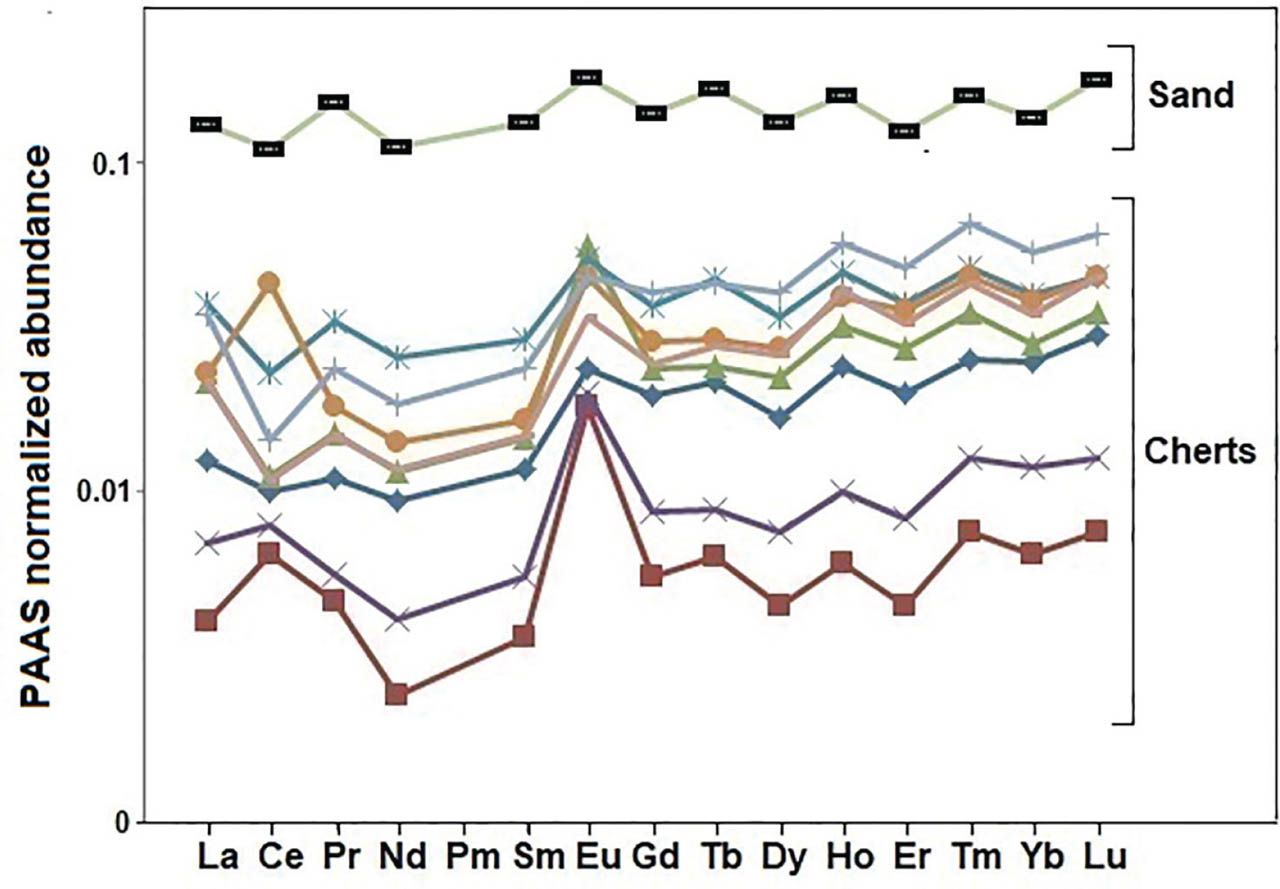
Figure 5.
PAAS-normalized REE values of the chert and its associated sand from the studied area. PAAS, Post Archean Australian Shale; REE, rare earth elements.
5. Discussion
The chert of Gebel El-Khashab, as indicated by the XRD method is made up of quartz ± goethite ± moganite (ESM Fig. S1 and S2). This method showed no trace of the opal-cristobalite/tridymite (opal-CT) pattern. The opal-CT would be present if amorphous silica (opal-A) was in the initial silica rock. Three types of quartz fabrics are optically recognized: microcrystalline quartz, megaquartz, and chalcedonic quartz. Microcrystalline quartz is most common. It occurs mainly as lenses of mosaic quartz and well-defined laminae. Megaquartz forms irregular patches in complex aggregates and disrupted mosaics, while chalcedonic quartz is fibrous and forms wedge-shaped and spherulitic growth structures. The microcrystalline quartz of the chert samples analyzed in this study does not reflect diagenetic transformation (i.e. opal-A→ opal-CT→quartz) but rather reflects direct precipitation of silica from an inorganic solution. This is also consistent with the XRD and petrographic analyses that show the samples to be completely without evidence of a biogenic silica source. The microcrystalline nature of chert in this study, the irregular crystal boundaries (Fig. 3) and undulose extinction support primary deposition (Maliva et al., 2005). The preservation of primary fossils of echinoderm species in some chert samples implies that the sediments were deposited in a shallow marine environment (e.g. Amemiya et al., 2005).
Moganite was detected only in eight chert samples (ESM Fig. S1 and S2), with contents of <3 wt.%. The absence of moganite in the other samples may suggest that moganite readily recrystallizes to quartz in the presence of water, or that moganite has a higher solubility than quartz and has been leached out (Heaney & Post, 1992). Studies indicate that cherts from evaporative environments contain between 20 wt.% and 75 wt.% moganite, while non-evaporative specimens contain between 5 wt.% and 15 wt.% moganite (Heaney, 1995). The practical absence of moganite indicates chert mineralogical maturity (Marcos et al., 2021).
A notable feature in Figure 4 is the preservation of organic textures and organic-rich structures in several chert samples. The branching organic textures, the clotted and diffused OM found in these samples are likely the remains of algal mats and biofilms (Moore et al., 2024). However, the organic-rich structures including spheres, elliptical and other irregular shapes up to 250 μm in size are potential fossil morphologies. They may represent a range of microfossils including algae, simple eukaryotes, and possibly pollen. The potential fossil morphologies are likely primary and, hence, formed simultaneously with the chert. Their primary preservation suggests that a diverse group of microorganisms thrived in at least some microenvironments during the chert deposition. The preservation of such organic morphologies requires rapid and early precipitation of silica (Knoll, 2014).
Elements such as Fe, Mn, Al, and Ti are important indicators to assess the origin and depositional environments of cherts. High contents of Fe and Mn are primarily related to the involvement of hydrothermal fluids, while the high Al and Ti contents are related to terrigenous inputs from the erosion of rocks on land (e.g. Adachi et al., 1986; Murray, 1994). Modern hydrothermal deposits have higher contents of Fe and Mn, both showing a close association with each other in most cases but separated in normal sea sediments; however, the relative contents of Al and Ti are largely influenced by weathering and, hence, are directly related to the amount of fine-grained terrigenous materials (Boström, 1983). Studies show that the ratio of Al/(Al + Fe + Mn) is <0.4 for hydrothermal sediments (Boström, 1973, 1983; Boström & Peterson, 1969), 0.01 for pure hydrothermal silica, and 0.6 for biogenic silica (Adachi et al., 1986; Yamamoto, 1987). In the chert samples of Gebel El-Khashab (Table 2), the ratio of Al/(Al + Fe + Mn) varies from 0.01 to 0.25 and averages 0.11, suggesting a hydrothermal origin of silica in these samples.
Hydrothermal fluids usually carry more dissolved silica as a result of greater solubility at higher temperatures (Crerar & Anderson, 1971). For example, hydrothermal fluids at 100°C, 200°C, and 300°C resulted in dissolving 1 mM, 4 mM, and 11 mM of silica, respectively (Shen et al., 2018). Hydrothermal cherts are reported as being enriched in Si, Fe but depleted in Al, Mn and Ti (Peng et al., 2000; Zheng et al., 2021; Zhou et al., 2022). These chemical patterns are similar to those found in this study. Here, the Gebel-El Khashab chert samples (Table 1) contain 88.2–98.3 wt.% SiO2, 0.2–6.1 Fe2O3T, 0.003–0.4 MnO, 0.04–0.3 Al2O3, and 0.01–0.04 TiO2, respectively.
Ratios of Al2O3/(Al2O3 + Fe2O3T) are important indicators to infer the depositional environments of silica in cherts. Murray (1994) showed that the ratio of Al2O3/(Al2O3 + Fe2O3T) was <0.4 in the mid-oceanic ridge, changed from 0.4 to 0.7 in the pelagic environment, and from 0.5 to 0.9 in the continental margin deposits. When the silica of the chert was deposited close to the mid-oceanic ridge and was affected by hydrothermal fluids, Al2O3/(Al2O3 + Fe2O3T) was <0.5, but when it was deposited near the continental margin and was affected by the terrigenous input, this ratio was >0.5 (Qiu & Wang, 2011). In the Gebel El-Khashab chert samples (Table 2), the Al2O3/(Al2O3 + Fe2O3T) ratio ranges from 0.01 to 0.31 and averages 0.11, which is within the mid-oceanic ridge hydrothermal range silica (<0.5).
Adachi et al. (1986) studied was hydrothermal cherts and associated siliceous rocks from the northern Pacific, and established the Al–Fe–Mn ternary discrimination diagram. In this diagram, most of the chert samples of Gebel El-Khashab are plotted near either the Al–Fe line or the Mn–Fe line because of their low Al and Mn contents (Fig. 6a). All samples fall within the field of hydrothermal origin. Another relationship diagram—Fe/Ti–Al/(Al + Fe + Mn) —was established in modern oceanic sediments of hydrothermal, biological, and terrestrial origins (Boström, 1970, 1973, 1983). The Fe/Ti–Al/(Al + Fe + Mn) diagram (Fig. 6b) shows that the chert samples of Gebel El-Khashab are within the field of hydrothermal origin, with a lack of detrital continental contribution. Huang et al. (2012) established the association graph of AL2O3/TiO2–Al/(Al + Fe + Mn). In the AL2O3/TiO2–Al/(Al + Fe + Mn) graph (Fig. 6c), the chert samples of Gebel El-Khashab are plotted within or adjacent the field of hydrothermal cherts associated with basaltic volcanism.
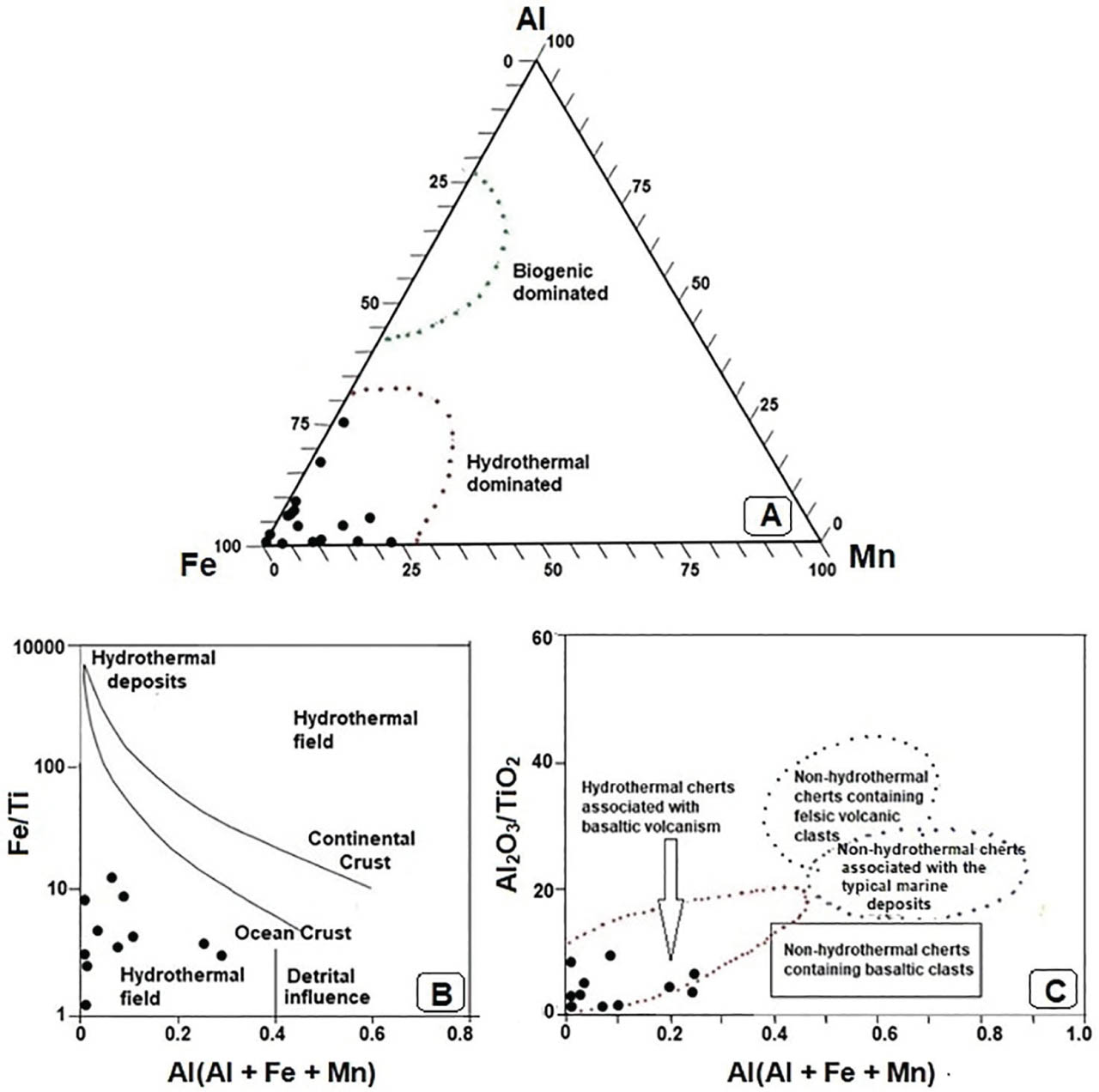
Figure 6.
Origin of the studied chert: (a) Ternary diagram of Al–Fe–Mn of the samples (after Adachi et al., 1986); (b) Fe/Ti–Al/(Al + Fe + Mn) relationship diagram of the samples (after Boström, 1970, 1973, 1983). Plot includes ideal mixing curves from hydrothermal deposits to the mean values of continental crust and oceanic crust or basalts; (c) Al2O3/TiO2–Al/(Al + Fe + Mn) diagram of the samples (after Huang et al., 2012).
Contents of Al and Ti are associated with aluminum silicate phases and, hence, are excellent indicators of terrigenous input, while the Fe content is enriched in metalliferous sediments near mid-oceanic ridges and, therefore, can be used as an indicator of hydrothermal input near mid-oceanic ridge sediments (Murray, 1994). That author established the Fe2O3/TiO2–Al2O3/(Al2O3 + Fe2O3) association diagram. In this diagram (Fig. 7), the chert samples of Gebel El-Khashab are plotted both in and outside the field of near-oceanic ridge.
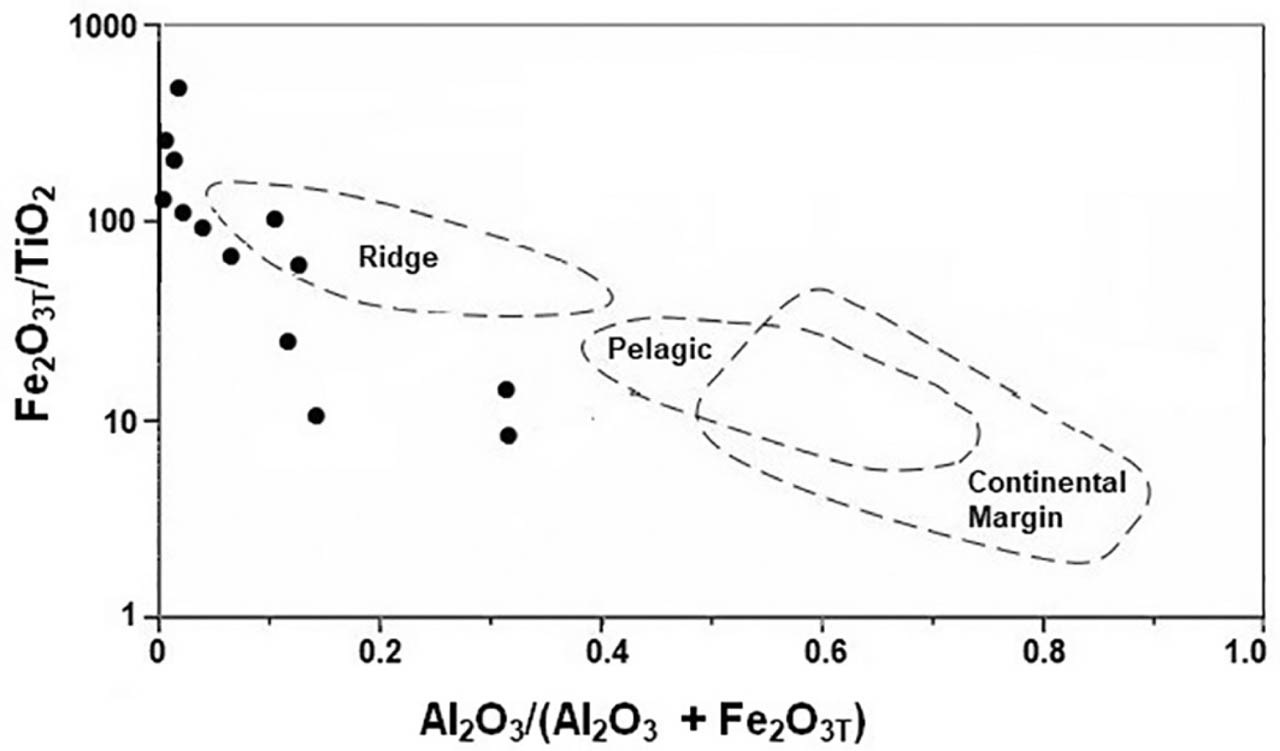
Figure 7.
Fe2O3T vs Al2O3/(Al2O3 + Fe2O3T) diagram for the chert samples of the studied area (after Murray, 1994).
Trace elements are also used to differentiate between non-hydrothermal and hydrothermal cherts (e.g. Bolhar et al., 2005; Qiu & Wang, 2011; Zhou et al., 2004). Non-hydrothermal cherts exhibit positive Ce anomalies (av. Ce/Ce* = 1.2), whereas hydrothermal cherts exhibit negative ones (av. Ce/Ce* = 0.29) (Shimizu & Masuda, 1977). Studies indicate that Ce anomalies in sediments were influenced by terrigenous input, water, and the rate of deposition (Murray, 1994; Murray et al., 1991). Fleet (1983) reported that non-hydrothermal cherts have high ΣREE content, positive Ce anomaly, and no HREE enrichment. However, hydrothermal cherts are usually characterized by positive Eu anomalies, low REE contents, negative Ce anomalies (Bangdong et al., 1995; Dias et al., 2011; Douville et al., 1999; Zhou et al., 2009, 2012), and low Y/Ho ratios of ∼27 (Bolhar et al., 2005). In the chert samples of Gebel El-Khashab (Table 3), the Y/Ho ratio is generally low (av. 32), and the ΣREE content of these samples is also low (0.9–5.6 ppm). The PAAS-normalized REE distribution is characterized by a moderate HREE enrichment and a strong positive Eu anomaly (1.45 ≤ Eu/Eu* ≥ 4.02; Table 3), which are indicative of hydrothermal silica-derived cherts. Whole-rock positive Eu anomalies usually imply some degree of hydrothermal influence. This is because Eu can be separated from other REE by reducing from Eu3+ to Eu2+ under high temperature (especially >250°C) and reducing conditions, leading to an increase of Eu in the deposits (Bau, 1991; Bolhar & Van Kranendonk, 2007; Tostevin et al., 2016).
In Table 3, some chert samples of Gebel El-Khasha have positive Ce anomalies (Ce/Ce* = 1.26–2.1), while the other samples have negative ones (Ce/Ce* = 0.49–0.85). The positive Ce anomalies are not consistent with the contention that the silica in the cherts under investigation was derived from hydrothermal fluids. These Ce anomalies are indicative of an input of terrigenous material (Shimizu & Masuda, 1977). Evidence of terrigenous inputs comes from the presence of detrital zircon and quartz in chert samples (Fig. 3c, d). Zircon usually contains considerable amounts of Ce and other LREE (e.g. Hassan & Brunarska, 2023). The presence of zircon in cherts will enhance the concentrations of Ce and other light REE, resulting in positive Ce anomalies.
In short, according to the comprehensive chemical analysis and interpretation of results by comparison with findings in prior studies, it can be concluded that the silica in the chert of Gebel El-Khashab is of hydrothermal origin, with minor terrestrial inputs. The silica source might be linked to the volcanic and hydrothermal events associated with the rifting process of the Suez Gulf during the Oligocene and Miocene. This event is evidenced by the existing geysers and tuff deposits in the region (Abdel-Motelib et al., 2015; Tosson, 1954).
From a regional perspective the chert gravels, together with sands, form part of the so-called fluviatile sediments extending for tens of square kilometers from east Cairo to the Suez Gulf on the Red Sea. These gravels are found mingled in the fluviatile sands, along with silicified wood fragments and tree trunks. However, this study suggests that the silica source in the chert largely deposited from hydrothermal fluids close to the mid-oceanic ridge, in a shallow marine environment and that the deposits were transported during the Oligocene to their current location. Unlike the cherts, the silicified wood fragments and tree trunks occurred through the action of geysers in a terrestrial environment, either inside or outside the area (Said, 1990 and references cited therein). Collectively, the silicification of these plant species at the terrestrial environment and the precipitation of chert in a hydrothermal shallow mid-oceanic realm might have happened simultaneously through the hydrothermal fluids erupted during the Oligocene-Miocene rifting process of the Gulf of Suez. The resulting silicified wood and chert deposits were transported to their present setting. The cherts and silicified wood specimens are classified with the Oligocene on stratigraphic evidence. Oligocene-Miocene chert gravels occur in areas like the North American Plains and their occurrences are linked to tectonic uplift and rifting (e.g. Hurst et al., 2010; Juracek & Perry, 2005).
From the mineralogical and chemical perspective, the chert gravels exhibit features similar to those of the silicified wood reported by Hassan (2014, 2017). Both are quartz, with minor goethite and moganite contents. Furthermore, they are enriched in Si and Fe, but depleted in Al, Mn, Na, K, and Mg. The similarities in mineral and chemical composition between the cherts and silicified wood specimens do not necessarily confirm a single source of geological material. It is true that if different sources are derived from the same or similar parent material (i.e. widespread volcanic ash), their basic composition will naturally be similar. However, different formation conditions (i.e. temperature, pressure) can produce materials with similar mineral assemblages and chemical characteristics, even geographically separate. More studies are needed for further evaluation of the silica sources in Gebel El-Khashab. Its chert and silicified wood provide a means for conducting such investigations. These siliceous deposits contain geochemical indicators of environmental change (i.e. δ28Si and δ18O) that potentially record their paleoenvironments.
6. Conclusions and Remarks
This study discusses the results of X-ray mineralogy, transmitted-light petrography, and major and trace element analyses conducted on chert gravels from Gebel El-Khashab in east Cairo, Egypt. The samples consists of microcrystalline quartz ± megaquartz ± chalcedonic quartz ± goethite ± moganite, with no evidence of opal or clay minerals. Microcrystalline quartz seems to have formed by direct precipitation from an inorganic solution. Several trace components are found within the microcrystalline fabrics, including: (1) calcite, (2) detrital quartz and zircon, (3) well-preserved fossils of echinoderms and other unidentified fossils, (4) organic textures, and (5) organic-rich structures that are likely fossil morphologies. The primary preservation of echinoderm fossils and organic morphologies in some chert samples implies that a diverse group of microorganisms lived in a shallow marine environment during silica deposition.
The cherts are enriched in SiO2, Fe2O3T but depleted in Al2O3, MgO, TiO2, MnO, Na2O, and K2O. They are also characterized by low REE concentrations and positive Eu anomalies which are within the hydrothermal silica range. This is further supported by the Al/(Al + Fe + Mn) ratios, Al–Fe–Mn, Fe/Ti–Al/(Al + Fe + Mn) and Al2O3/TiO2–Al/(Al + Fe + Mn) discrimination plots. The Al2O3/(Al2O3 + Fe2O3T) ratios and the Fe2O3T/TiO2–Al2O3/(Al2O3 + Fe2O3T) discrimination diagram implied that the silica in these cherts was deposited in a hydrothermal submarine environment close to the mid-oceanic ridge. Hydrothermal silica-derived cherts were transported in Oligocene and redeposited to their present place. Some samples with positive Ce anomalies suggest an influence of terrestrial material source.
There is a linkage between the chert and the silicified wood in the studied area. Both occur in the same stratigraphic unit and exhibit similar mineralogical and basic element features. These findings demonstrate a need for future studies in various areas of chert-silicified wood research. The chert and silicified wood contain geochemical indicators, such as stable silicon and oxygen isotopes that likely record their former depositional environments.
Acknowledgements
The author acknowledges the workers at Gebel El-Khashab reserve in East Cairo for their cooperation during the field work. I thank Dr. Ehab Abu-Zeid for access to the optical microscopy laboratory at the Nuclear Materials Authority, El Katameya, Egypt. I also thank Dr. Dana Ulmer-Scholle (New Mexico Institute of Mining and Technology, Socorro, NM, USA) for advice regarding identification of microfossils and Dr. Peter Heaney (Department of Geosciences, the Pennsylvania State University, University Park, PA, USA) for advice regarding identification of moganite.
Thanks are extended to the handing editor (Dr. Abigail Barker) and the two anonymous reviewers who helped this manuscript reach a level of clarity satisfactory for publication.
Notes
[6] Supplementary data
Supplementary data to this article can be found online at https://doi.org/10.2478/mipo-2025-0012