
1. Introduction
Pyroxenites represent the second most abundant ultramafic rock type within the shallow sub-continental lithospheric mantle (SCLM), following the spinel lherzolite-harzburgite series (Downes, 2000). They are thought to form through three primary processes: by interaction between melts/fluids and peridotite in the mantle (Kelemen et al., 1992; Sobolev et al., 2005; Wang et al., 2001), through recrystallization of recycled oceanic crust within the mantle (Allègre & Turcotte, 1986), or as a crustal cumulate rock within lower crustal magma chambers (DeBari & Coleman, 1989).
Cumulate pyroxenites can typically be identified by their lower Mg# values and elevated concentrations of Al, Ca, and Ti compared with mantle peridotites (Downes, 2000, 2001). Their chemical compositions may also reflect the characteristics of the melts from which they crystallized (Irving, 1980).
Despite limited study, pyroxenites are considered important in models of melt petrogenesis across different tectonic settings. Their study is essential for understanding mantle heterogeneity, deep melting, melt-transport processes and metasomatism.
Metasomatism is a process that can alter the chemical composition of a rock via interaction with fluids/melts. Two distinct types of metasomatism are defined: cryptic metasomatism and modal metasomatism (O’Reilly & Griffin, 2013). Modal metasomatism corresponds to strong chemical imbalances involving formation of new mineralogical phases at the expense of the rock-forming minerals. In the case of Earth's mantle rocks, the new phases are, in general, OH− bearing minerals (phlogopite, amphibole) but clinopyroxene, orthopyroxene and sometimes, rutile, ilmenite, sulphides are also present. Cryptic metasomatism is described as a variation in the contents of certain major and trace elements in the rock, without any apparent mineralogical change.
This paper describes a phlogopite-amphibole-plagioclase bearing websterite xenolith (sample GJI 12) found in alkali basaltic pyroclastite from Guinadji volcano at Dibi (SE Ngaoundéré, Adamawa Plateau, eastern extension of the Cameroon Volcanic Line [CVL]) in northern Cameroon (Fig. 1a). To our knowledge, such xenoliths have not yet been described in the CVL literature. We are addressing questions such as whether it is of cumulative origin or not, and if not under which conditions it was formed, as well as elucidating and to elucidate possible metasomatic processes.
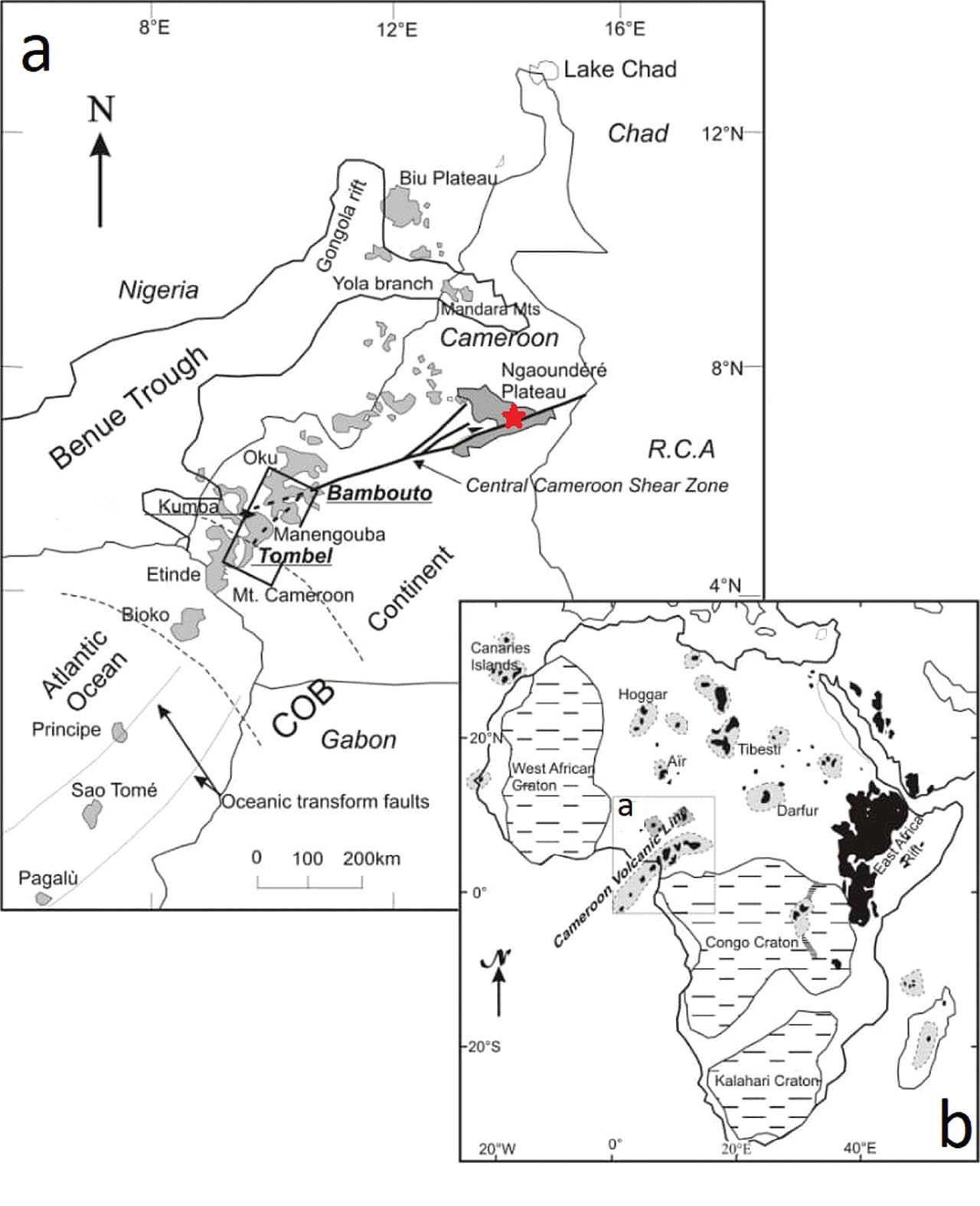
Figure 1.
(a) Location of Adamawa plateau (red star) and other principal volcanic centers along the CVL (modified according to Nkouathio et al., 2008). Dashed lines are limits between the CVL segments: ocean, COB and continent. (b) Location map of the CVL. The principal geologic features of Africa (Congo Craton, CVL, East African Rift, Hoggar, Kalahari Craton, Tibesti, West African Craton) are indicated. COB, continental ocean boundary; CVL, Cameroon volcanic line.
In the CVL, cumulate rocks are interpreted as the products of magmatic differentiation within crustal magma chambers. These cumulates form through the fractional crystallization of mantle-derived basaltic or picritic magmas, during which pyroxene crystals accumulate as the magma cools. This process suggests contributions from both asthenospheric melts and metasomatized lithospheric mantle sources (Caldeira & Munha, 2002; Wandji et al., 2009). In the Adamawa plateau, most of the mantle xenoliths brought to the surface by alkaline basalts are spinel and spinel-plagioclase bearing lherzolites, spinel and spinel-plagioclase bearing harzburgites, dunites and wehrlites associated with pyroxenites including spinel, spinel-garnet and olivine bearing websterites and clinopyroxenites (Dautria & Girod, 1986; Njombie Wagsong et al., 2018; Nkouandou et al., 2022; Nkouandou & Temdjim, 2011). The types of metasomatic fluid described in the majority of these xenoliths are carbonated, CO2-rich fluids that might have circulated at high temperatures in the SCLM beneath Adamawa during or after deformation and recrystallization linked to Pan-African stick-slip-faults (Njombie Wagsong et al., 2018; Nkouandou et al., 2022). In this paper we show that apart from this carbonatite melt, fluids rich in alkalis and volatile elements, coming from crustal materials have also had an impact on the chemical composition of the mantle beneath the Adamawa plateau.
2. Geological Background
The CVL is a 1600 km-long line of volcanic centers that straddles the western margin of the African continent, extending from the Pagalu island (2°S) in the Atlantic Ocean, through Cameroon and into central Africa; an alignment of mountains trending N30° (Fig. 1a,b). It crosscuts the Pan-African Fold Belt and is surrounded at its south-eastern edge by the Congo craton (Marcel et al., 2018). The volcanic activity observed in the continental part, including lava flows, pyroclastic rocks, and plugs, dates back to approximately 30 Ma (Dunlop & Fitton, 1979). The main mountains include mount (Mt) Cameroon (4095 m) mainly formed by alkaline basalts (Déruelle et al., 2007); Mt Manengouba (2420 m) characterized by basaltic, trachytic and rhyolitic formations, Mt Bambouto (2679 m) made up of alkaline basalts and trachytes, and Mt Oku (3011 m) which consist of transitional basalt, quartz trachyte and rhyolite flows (Fitton & Dunlop, 1985; Marcel et al., 2018).
In certain parts of the CVL, mantle xenoliths have been raised by alkaline lavas, thus providing the possibility of directly studying the mantle in this part of the continent. These xenoliths have been widely studied since the 1980s in 10 sites: Bioko, Biu, Kapsiki, Kumba, Mount Cameroon, Mount Oku, N’Gaoundéré, Pagalu, Principe, and Sao Tomé (Matsukage & Oya, 2010; Nkouandou & Temdjim, 2011; Tamen et al., 2015; Tedonkenfack et al., 2021; Wandji et al., 2009).
From these studies, two major conclusions can be drawn:
– a lithospheric mantle containing a plagioclase level in the northern part (equilibrium temperatures: 790–1000°C), which is unlike the southern section probably devoid of such a level (equilibrium temperatures: 850–1050°C),
– a lithospheric mantle that is predominantly heterogeneous and metasomatized throughout with cryptic metasomatism occurring along the entire CVL, and modal metasomatism restricted to its southern section.
Silica-rich fluids and carbonatitic percolating liquids are the two most commonly discussed metasomatizing agents (Girod et al., 1984; Njombie Wagsong et al., 2018). Estimation of mantle melting rates shows that with the exception of the mantle beneath Bioko (oceanic domain) which underwent a partial melting rate between 25% and 30%, the melting rates of the mantle beneath other localities do not exceed 25% (Matsukage & Oya, 2010).
Regarding Adamawa Plateau, it is a volcanic and tectonic dome-shaped structure within the Pan-African belt of Cameroon covered by Miocene-Pliocene basaltic and felsic volcanic formations (Nkouandou et al., 2008). Its basement is mainly composed of 630–620 Ma pre- to syn-D1, 580–600 Ma syn-D2, and 550 Ma post-orogenic granitoid (Toteu et al., 2001). The recent volcanic episode of Adamawa plateau, dated at 0.91 ± 0.06 Ma, produced maars and cinder cones with associated basaltic lava flows (Temdjim et al., 2004b), mainly around Ngaoundéré. Geophysical investigations on the Adamawa Plateau indicate the existence of the following features:
– crustal uplift linked to the upward migration of the lithosphere-asthenosphere boundary (Browne & Fairhead, 1983): the elevation of the boundary between the rigid lithosphere and the more ductile asthenosphere caused, in this region, an elevation of the crust, which influenced the formation and evolution of rifting,
– an abnormally hot upper mantle upwelling located at 70–90 km depth (Dorbath et al., 1986). This anomaly is associated with the upward migration of the lithosphere-asthenosphere boundary that led to crustal uplift in the region. This upwelling contributes to the volcanic activity observed along the CVL,
– two large negative gravity anomalies (−80 to −100 and −120 mgL/cm), due to lithospheric (40 km) and crustal (20 km) thinning, respectively (Poudjom-Djomani et al., 1997): these negative anomalies suggest areas where the lithosphere and crust are thinner than average, indicating regions of potential tectonic activity or rifting.
According to Tokam et al. (2010), the Moho discontinuity beneath the Adamawa plateau is located at a depths of 33–36 km, more precisely at about 33 km beneath the Ngaoundéré area.
The Guinadji Volcano (13°44′14.3‴E, 7°09′11‴N) in the Adamawa Plateau reaches an elevation of 1284 m. Studies conducted by Mulimbi Kagarabi et al. (2025) show that volcanic rocks from this volcano are predominantly basanites and foidites, characterized by a porphyritic microlithic texture. The primary mineral assemblage comprises olivine, clinopyroxene, plagioclase, and alkali feldspars, with accessory phases including Fe-Ti oxides, chromite, and apatite. Geochemical data reveal that Guinadji lavas are within-plate basalts with Ocean Island Basalt (OIB)-like signatures with affinities to High-μ (HIMU), Enriched Mantle type 1 (EM1), and recycled mantle components, which are characteristic of magmas generated by mantle plume activity. These lavas are considered uncontaminated and result from low degrees of partial melting (3–5%) of a garnet-bearing peridotite source in the asthenospheric mantle.
3. Analytical Methods and Calculations
Major elements compositions of minerals were analyzed using a Cameca SXFive FE electron microprobe at the Department of Lithospheric Research, University of Vienna (Austria). Operating conditions included an acceleration voltage of 15 kV, a beam current of 20 nA, 20 s counting times on peak position and 10 s on background. The Mg-number (Mg#) is the atomic ratio Mg/(Mg + Fe2+).
Whole-rock analyses were conducted in Johannesburg (South Africa) at the ALS minerals laboratory. Major elements were determined using ICP-AES method while trace and rare earth elements (REE) were analyzed using ICP-MS. Detection limits were 0.01 wt% for major elements, 0.01–20 ppm for trace elements and 0.01–0.5 ppm for REE. The modal composition was determined by point counting.
Calculating atoms per formula unit (apfu) for pyroxenes, amphiboles, plagioclase, and phlogopite involved systematic normalization of chemical analyses to stoichiometric conventions. Oxide weight percentages were converted to molar proportions using molecular weights, with cations distributed across crystallographic sites based on mineral-specific structural frameworks.
Pyroxenes were normalized to six oxygen atoms, following the general formula X Y [Si, Si + Al]2 O6 where X (Ca, Na) and Y (Mg, Fe²⁺, Al) occupy octahedral and M4/M1-3 sites.
Amphibole required normalization to 23 oxygens (A0–1 B2 C5 T8 O22 [OH]2), with careful partitioning of Ca–Na (B-sites), Mg-Fe-Al (C-sites), and Si-Al (T-sites), alongside hydroxyl accounting.
Plagioclase feldspars were calculated on an eight-oxygen basis ([Ca, Na, K][Al, Si]4O8), prioritizing Al-Si ordering in tetrahedral sites and alkali/alkaline-earth cation ratios. Phlogopite mica follows a 22-oxygen basis (K Mg3 [Al Si3 O10] [OH]2), balancing octahedral Mg–Fe–Al, interlayer K, and tetrahedral Al–Si substitutions.
Charge-balance calculations ensured total cation charges offset negative oxygen/hydroxyl contributions, adjusting Fe2+/Fe3+ ratios if not directly measured. Software tools (AMPH16, MICACALC of Gabbrosoft) automating these workflows ensured consistency with the International Mineralogical Association nomenclature standards.
4. Results
4.1. Petrography
The GJI 12 xenolith is rounded, ≈10 cm in diameter, and free of alteration. It is an olivine-free websterite characterized by interlocking pyroxenes with clinopyroxene modally prevailing over orthopyroxene (50.8% vs 44.2%), and containing accessory phlogopite, amphibole, plagioclase and rutile, while iron oxides (opaque minerals) occur interstitially; spinel has not been observed so far. This rock is partly moderately recrystallized. Ortho- and clinopyroxene are mostly cracked. The texture of this websterite is cumulative with medium and equant grains (Fig. 2a), the grain size is relatively homogeneous (0.5–1.5 mm). The grain borders are curvilinear, rarely straight and devoid of reaction products except scarce points where the pyroxenes are in contact with phlogopite or where clinopyroxene is in contact with plagioclase. The light brown melts (Fig. 2b,c) are infiltrations of host basalt.
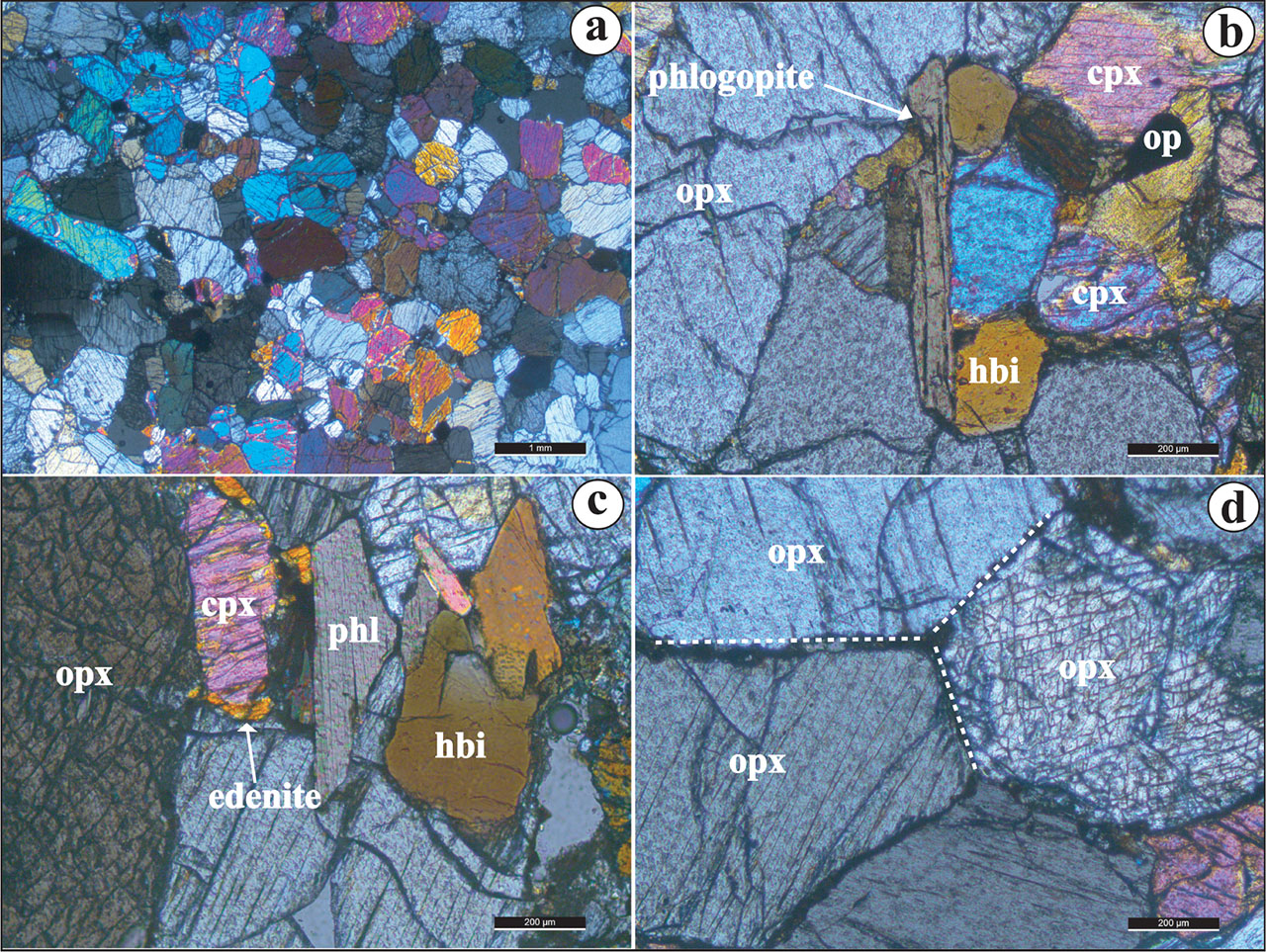
Figure 2.
Photomicrographs of the studied websterite. (a) Cumulative texture. (b) Interstitial phlogopite. (c) Edenite as rim around cpx. (d) Three aspects of opx. Dashed lines represent their triple junctions. hbi, host basalt infiltration, op, opaque minerals; Phl, phlogopite.
Phlogopite, pleochroic brown and sub-euhedral to euhedral, occurs as long rods of approximately 0.5 mm. It does not appear to be perfectly in equilibrium with the mantle paragenesis but rather in an interstitial form: it is mainly found intercalated between orthopyroxene grains, sometimes also between orthopyroxene and clinopyroxene.
Orthopyroxene in the thin section under the optical microscope is mainly sub-euhedral (sometimes euhedral). It occurs in three aspects (Fig. 2d):
– An appearance without cleavage, strongly cracked, 0.7–1.5 mm in size, sometimes reaching 2 mm when stretched. It is the largest orthopyroxene. It often shows kink-bands;
– A parallel cleavage appearance of medium to strong relief, slightly cracked, with a size between 0.7 mm and 0.1 mm;
– A spongy appearance, mostly without cracks, with folded and very tight cleavages with a size varying between 0.7 mm and 0.1 mm.
When these three grains are side by side, they show triple junctions of 120°. A few grains <0.5 mm are intercalated between the clinopyroxene grains.
Rutile occurs in the form of very small grains (around 15 μm, Fig. 3a) developing either alongside amphibole or alongside the phlogopite and sometimes it is found with both minerals between the pyroxenes.
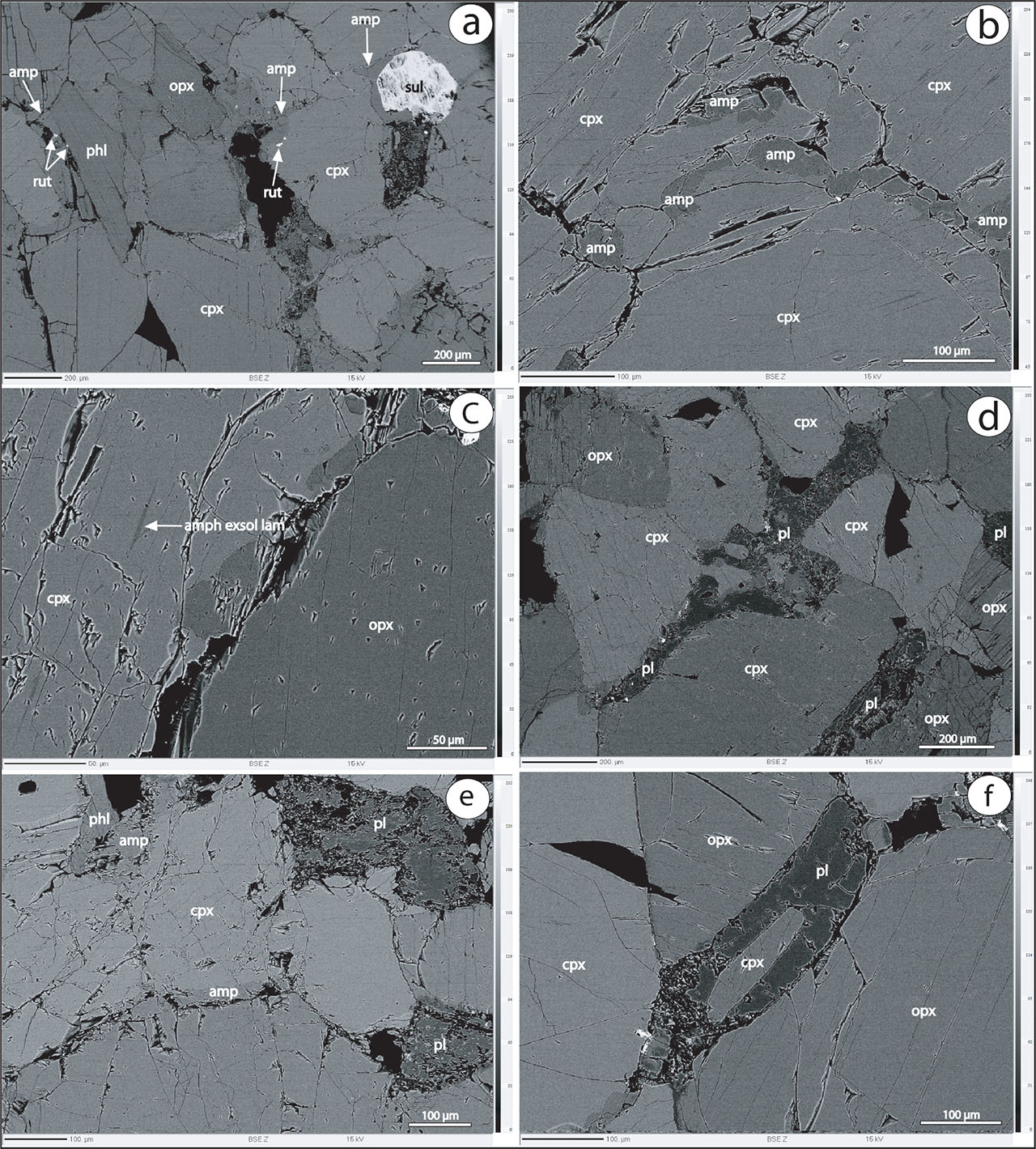
Figure 3.
BSE images of the studied websterite. (a) Association phlogopite-amphibole-rutile. (b) Amphibolitization of clinopyoxene. (c) Amphibole elongated exsolution lamellae following clinopyroxene cleavage. (d) Plagioclase as intercumulus phase. (e) Image showing that amphibole and phlogopite are of metasomatic origin. (f) Clinopyroxene remants as inclusion in plagioclase. sul, sulfides.
Amphibole (0.2–0.3 mm), sub-euhedral, is intrestitial and always associated with clinopyroxene, sometimes forming a rim around the latter (Fig. 2c and 3b) or as elongated exsolution lamellae within clinopyroxene (Fig. 3c). Amphibole does not exhibit reaction rims with other crystallized metasomatic minerals or dark oxidized parts, unlike amphibole breakdown by decompression or incongruent melting (Ntaflos et al., 2017). Moreover, upon contact with iron oxide, its border becomes rectilinear, unlike when it is in contact with the clinopyroxene (which shows a mainly curvilinear contour).
Plagioclase (around 200 μm, Fig. 3c,d, and f) appears in interstitial areas between clinopyroxene and orthopyroxene. It is mainly anhedral, rarely sub-euhedral. Sometimes, this phase has clinopyroxene relics in inclusions.
Clinopyroxene is sub-euhedral to euhedral, slightly cracked and cleaved more or less intensely. Traces of deformation are almost absent. It is often found as relics in plagioclase and it is often rimmed by amphibole (Fig. 3d,e, and f).
4.2. Whole rock major and trace elements geochemistry
The whole rock chemical composition of the sample GJI12 is shown in Table 1. The websterite has a Mg# of 0.79 and is characterized by low alkalis (Na2O = 0.58 wt% and K2O = 0.12) and by relatively high TiO2 = (0.25 wt%).
Table 1.
Major (wt.%) and trace elements (ppm) bulk rock compositions of the phlogopite-amphibole-plagioclase-bearing websterite xenolith of Guinadji volcano.
| SiO2 (wt%) | 51.54 |
| TiO2 | 0.43 |
| Al2O3 | 4.88 |
| Cr2O3 | 0.25 |
| FeO* | 9.5 |
| MnO | 0.19 |
| MgO | 19.55 |
| CaO | 12.98 |
| Na2O | 0.58 |
| K2O | 0.12 |
| P2O5 | 0.07 |
| BaO | 0.01 |
| LOI | 0.32 |
| Mg# | 0.79 |
| Total | 100.42 |
| Ba (ppm) | 100 |
| Ce | 11.1 |
| Cr | 1690 |
| Cs | 0.05 |
| Dy | 1.89 |
| Er | 1.15 |
| Eu | 0.61 |
| Ga | 7.8 |
| Gd | 2.07 |
| Hf | 0.85 |
| Ho | 0.41 |
| La | 3.8 |
| Lu | 0.12 |
| Nb | 1.3 |
| Nd | 8.4 |
| Pr | 1.68 |
| Rb | 3.9 |
| Sc | 46.3 |
| Sm | 2.36 |
| Sr | 76.5 |
| Tb | 0.35 |
| Th | 0.2 |
| Ti | 0.28 |
| Tm | 0.12 |
| U | 0.08 |
| V | 248 |
| Y | 9.3 |
| Yb | 0.87 |
| Zr | 30 |
A striking feature of sample GJI12 is the high concentration of vanadium (V = 248 ppm). The chondrite-normalized REE pattern (using values from Sun & McDonough, 1989) exhibit a relatively flat pattern and a slight depletion in heavy rare earth elements (HREE) (Fig. 4a). Notably, there is no significant Eu anomaly, as the Eu concentration lies close to the general REE trend. The multi-element diagram (Fig. 4b) reveals distinct geochemical anomalies. Pronounced positive anomaly is observed in Ba. Positive anomalies are also observed in Nd and Sm, while negative anomalies are evident in Nb, Sr, and Y.
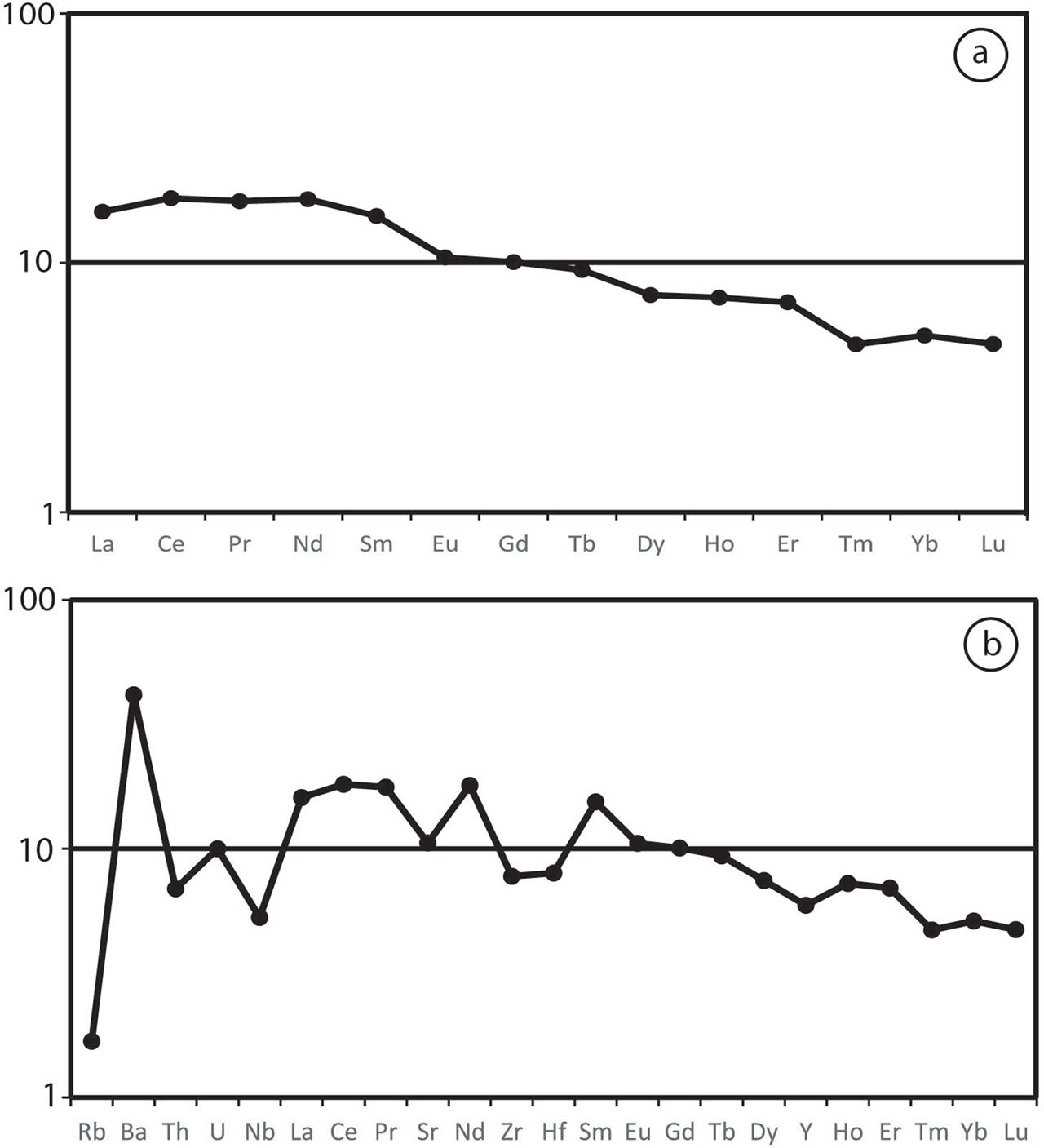
Figure 4.
Chondrite normalized REE (a) and spider diagram (b) of the Guinadji volcano websterite; normalization values are from Sun and McDonough (1989). REE, rare earth elements.
4.3. Mineral chemistry
Representative chemical analyses of mineral phases of the websterite are given in Tables 2–5.
Table 2.
Representative EMPA of pyroxene (wt.%).
| cpx | ||||||||||||||
| SiO2 | 52.53 | 51.34 | 51.01 | 51.73 | 52.42 | 51.58 | 51.44 | 51.41 | 51.5 | 52.16 | ||||
| TiO2 | 0.35 | 0.48 | 0.50 | 0.40 | 0.37 | 0.47 | 0.4 | 0.49 | 0.56 | 0.46 | ||||
| Al2O3 | 3.07 | 4.05 | 4.21 | 3.54 | 3.22 | 3.95 | 3.66 | 4.16 | 4.5 | 3.98 | ||||
| Cr2O3 | 0.31 | 0.38 | 0.4 | 0.38 | 0.32 | 0.40 | 0.38 | 0.40 | 0.39 | 0.40 | ||||
| FeO | 5.63 | 5.38 | 5.37 | 5.46 | 5.47 | 5.53 | 5.56 | 5.49 | 5.53 | 5.53 | ||||
| MnO | 0.16 | 0.11 | 0.17 | 0.16 | 0.17 | 0.13 | 0.16 | 0.15 | 0.14 | 0.12 | ||||
| MgO | 15.47 | 14.97 | 14.85 | 15.28 | 15.42 | 14.95 | 15.04 | 14.85 | 14.68 | 14.95 | ||||
| CaO | 22.00 | 22.08 | 21.96 | 21.95 | 21.82 | 21.91 | 21.99 | 21.97 | 21.8 | 21.94 | ||||
| Na2O | 0.45 | 0.49 | 0.48 | 0.48 | 0.45 | 0.5 | 0.44 | 0.51 | 0.53 | 0.48 | ||||
| NiO | 0.01 | 0.01 | 0.02 | b.d.l | 0.04 | 0.02 | 0.01 | 0.01 | 0.02 | 0.01 | ||||
| Total | 99.98 | 99.28 | 98.98 | 99.39 | 99.71 | 99.44 | 99.08 | 99.44 | 99.64 | 100.04 | ||||
| Si (a.p.f.u) | 1.93 | 1.9 | 1.89 | 1.91 | 1.93 | 1.9 | 1.91 | 1.9 | 1.9 | 1.91 | ||||
| Ti | 0.01 | 0.01 | 0.01 | 0.01 | 0.01 | 0.01 | 0.01 | 0.01 | 0.02 | 0.01 | ||||
| Al | 0.13 | 0.18 | 0.18 | 0.15 | 0.14 | 0.17 | 0.16 | 0.18 | 0.20 | 0.17 | ||||
| Cr | 0.01 | 0.01 | 0.01 | 0.01 | 0.01 | 0.01 | 0.01 | 0.01 | 0.01 | 0.01 | ||||
| Fe3+ | 0.01 | 0.03 | 0.03 | 0.03 | 0.02 | 0.03 | 0.02 | |||||||
| Fe2+ | 0.16 | 0.14 | 0.14 | 0.14 | 0.16 | 0.15 | 0.14 | 0.15 | 0.17 | 0.17 | ||||
| Mn | 0.01 | 0.01 | 0.01 | |||||||||||
| Mg | 0.85 | 0.82 | 0.82 | 0.84 | 0.85 | 0.82 | 0.83 | 0.82 | 0.81 | 0.82 | ||||
| Ca | 0.87 | 0.87 | 0.87 | 0.87 | 0.86 | 0.87 | 0.87 | 0.87 | 0.86 | 0.86 | ||||
| Na | 0.03 | 0.04 | 0.03 | 0.03 | 0.03 | 0.04 | 0.03 | 0.04 | 0.04 | 0.03 | ||||
| Mg# | 0.84 | 0.86 | 0.86 | 0.86 | 0.84 | 0.84 | 0.85 | 0.85 | 0.83 | 0.83 | ||||
| AlVI | 0.06 | 0.07 | 0.08 | 0.06 | 0.07 | 0.08 | 0.07 | 0.08 | 0.09 | 0.09 | ||||
| AlIV | 0.07 | 0.10 | 0.11 | 0.09 | 0.07 | 0.10 | 0.09 | 0.10 | 0.10 | 0.09 | ||||
| AlVI/AlIV | 0.83 | 0.7 | 0.69 | 0.67 | 0.97 | 0.79 | 0.69 | 0.77 | 0.91 | 1.02 | ||||
| Wo | 45.91 | 46.88 | 46.91 | 46.24 | 45.9 | 46.59 | 46.53 | 46.84 | 46.84 | 46.63 | ||||
| En | 44.92 | 44.2 | 44.14 | 44.79 | 45.13 | 44.23 | 44.28 | 44.03 | 43.88 | 44.2 | ||||
| Fs | 9.17 | 8.92 | 8.95 | 8.98 | 8.98 | 9.18 | 9.19 | 9.14 | 9.28 | 9.17 | ||||
| opx | ||||||||||||||
| SiO2 | 53.89 | 53.3 | 54.02 | 54.26 | 54.27 | 54.55 | 54.16 | 53.77 | 53.84 | 53.72 | 54.07 | 54.23 | 54.12 | 54.1 |
| TiO2 | 0.12 | 0.12 | 0.10 | 0.12 | 0.11 | 0.12 | 0.12 | 0.11 | 0.10 | 0.11 | 0.12 | 0.12 | 0.14 | 0.11 |
| Al2O3 | 2.23 | 2.7 | 2.32 | 2.24 | 2.29 | 2.05 | 2.32 | 2.28 | 2.28 | 2.54 | 2.21 | 2.48 | 2.78 | 2.23 |
| Cr2O3 | 0.17 | 0.23 | 0.17 | 0.14 | 0.17 | 0.13 | 0.20 | 0.20 | 0.21 | 0.23 | 0.20 | 0.23 | 0.25 | 0.15 |
| FeO | 14.07 | 14.23 | 14.2 | 14.08 | 14.23 | 14.17 | 14.17 | 14.19 | 14.08 | 14.24 | 14.14 | 14.25 | 14.29 | 14.43 |
| MnO | 0.3 | 0.28 | 0.28 | 0.29 | 0.28 | 0.27 | 0.29 | 0.29 | 0.31 | 0.28 | 0.29 | 0.27 | 0.31 | 0.29 |
| MgO | 27.79 | 27.64 | 27.65 | 27.43 | 27.39 | 27.79 | 27.54 | 27.36 | 27.55 | 27.45 | 27.61 | 27.38 | 27.3 | 27.4 |
| CaO | 0.89 | 0.61 | 0.78 | 0.75 | 0.75 | 0.83 | 0.80 | 0.85 | 0.86 | 0.70 | 0.81 | 0.80 | 0.73 | 0.78 |
| Na2O | 0.03 | 0.01 | 0.03 | 0.02 | 0.02 | 0.01 | 0.02 | 0.03 | 0.02 | 0.09 | 0.02 | b.d.l | 0.03 | 0.02 |
| NiO | 0.02 | 0.02 | 0.02 | 0.01 | 0.05 | b.d.l | 0.02 | b.d.l | 0.04 | b.d.l | 0.02 | 0.01 | 0.04 | 0.01 |
| Total | 99.51 | 99.14 | 99.59 | 99.36 | 99.6 | 99.91 | 99.66 | 99.07 | 99.3 | 99.38 | 99.48 | 99.77 | 100 | 99.53 |
| Si (a.p.f.u) | 1.94 | 1.92 | 1.94 | 1.96 | 1.96 | 1.96 | 1.95 | 1.95 | 1.94 | 1.94 | 1.95 | 1.95 | 1.94 | 1.95 |
| Al | 0.09 | 0.11 | 0.10 | 0.10 | 0.10 | 0.09 | 0.10 | 0.10 | 0.10 | 0.11 | 0.09 | 0.10 | 0.12 | 0.09 |
| Fe3+ | 0.02 | 0.02 | 0.01 | 0.01 | 0.01 | |||||||||
| Fe2+ | 0.40 | 0.41 | 0.42 | 0.42 | 0.43 | 0.42 | 0.43 | 0.43 | 0.42 | 0.42 | 0.43 | 0.43 | 0.43 | 0.44 |
| Mn | 0.01 | 0.01 | 0.01 | 0.01 | 0.01 | 0.01 | 0.01 | 0.01 | 0.01 | 0.01 | 0.01 | 0.01 | 0.01 | 0.01 |
| Mg | 1.49 | 1.49 | 1.48 | 1.48 | 1.47 | 1.49 | 1.48 | 1.48 | 1.48 | 1.48 | 1.48 | 1.47 | 1.46 | 1.47 |
| Ca | 0.03 | 0.02 | 0.03 | 0.03 | 0.03 | 0.03 | 0.03 | 0.03 | 0.03 | 0.03 | 0.03 | 0.03 | 0.03 | 0.03 |
| Mg# | 0.79 | 0.79 | 0.78 | 0.78 | 0.77 | 0.78 | 0.78 | 0.78 | 0.78 | 0.78 | 0.78 | 0.77 | 0.77 | 0.77 |
| AlVI | 0.03 | 0.04 | 0.04 | 0.05 | 0.05 | 0.04 | 0.05 | 0.04 | 0.04 | 0.04 | 0.04 | 0.06 | 0.06 | 0.05 |
| AlIV | 0.06 | 0.08 | 0.06 | 0.04 | 0.04 | 0.04 | 0.05 | 0.06 | 0.06 | 0.06 | 0.05 | 0.05 | 0.06 | 0.05 |
| AlVI/AlIV | 0.54 | 0.52 | 0.74 | 1.26 | 1.2 | 0.95 | 0.9 | 0.76 | 0.7 | 0.69 | 0.79 | 1.10 | 1.03 | 0.9 |
| Wo | 1.76 | 1.21 | 1.55 | 1.51 | 1.51 | 1.65 | 1.58 | 1.69 | 1.71 | 1.4 | 1.62 | 1.6 | 1.46 | 1.56 |
| En | 76.51 | 76.65 | 76.42 | 76.47 | 76.27 | 76.47 | 76.37 | 76.15 | 76.39 | 76.38 | 76.42 | 76.16 | 76.17 | 75.98 |
| Fs | 21.74 | 22.13 | 22.03 | 22.03 | 22.22 | 21.88 | 22.05 | 22.15 | 21.9 | 22.22 | 21.96 | 22.24 | 22.37 | 22.45 |
Table 3.
Representative EMPA of phlogopite and amphibole (wt. %).
| Phlogopite | Amphibole | ||||||||||
|---|---|---|---|---|---|---|---|---|---|---|---|
| SiO2 | 38.93 | 39.62 | 39.32 | 39.48 | 39.16 | 38.91 | 39.53 | 38.8 | 44.75 | 45.58 | 44.20 |
| TiO2 | 3.56 | 3.61 | 3.58 | 3.61 | 3.67 | 3.69 | 3.56 | 3.56 | 1.81 | 1.64 | 1.65 |
| Al2O3 | 14.03 | 13.93 | 13.7 | 14.01 | 14.04 | 14.07 | 13.73 | 14.11 | 11.49 | 10.52 | 11.25 |
| FeO | 6.05 | 5.96 | 6.12 | 6.02 | 6.23 | 5.92 | 6.11 | 6.08 | 6.43 | 6.19 | 6.39 |
| MnO | 0.02 | 0.04 | b.d.l | 0.04 | 0.02 | 0.03 | 0.02 | 0.06 | 0.13 | 0.09 | 0.1 |
| MgO | 20.59 | 21.27 | 20.75 | 20.97 | 20.6 | 20.47 | 20.83 | 20.46 | 16.53 | 17.35 | 16.96 |
| CaO | b.d.l | b.d.l | 0.01 | 0.01 | b.d.l | 0.01 | 0.02 | b.d.l | 11.78 | 11.7 | 11.85 |
| Na2O | 0.57 | 0.56 | 0.55 | 0.57 | 0.58 | 0.59 | 0.57 | 0.57 | 1.81 | 1.75 | 1.79 |
| K2O | 9.61 | 9.57 | 9.67 | 9.55 | 9.51 | 9.42 | 9.56 | 9.49 | 1.71 | 1.57 | 1.64 |
| F | 2.95 | 3.04 | 2.95 | 3.14 | 2.79 | 3.00 | 2.65 | 2.87 | n.a | 1.50 | n.a |
| Cl | n.a | n.a | n.a | n.a | n.a | n.a | n.a | n.a | 0.02 | 0.02 | 0.02 |
| BaO | 0.37 | 0.39 | 0.36 | 0.39 | 0.38 | 0.43 | 0.33 | 0.36 | n.a | n.a | n.a |
| Total | 96.67 | 98 | 97.03 | 97.8 | 96.99 | 96.54 | 96.92 | 96.36 | 96.45 | 97.91 | 95.85 |
| Si(a.p.f.u) | 5.69 | 5.71 | 5.73 | 5.71 | 5.70 | 5.69 | 5.74 | 5.69 | 6.51 | 6.61 | 6.48 |
| Ti | 0.39 | 0.39 | 0.39 | 0.39 | 0.40 | 0.41 | 0.39 | 0.39 | 0.20 | 0.18 | 0.18 |
| Al | 2.42 | 2.37 | 2.35 | 2.39 | 2.41 | 2.43 | 2.35 | 2.44 | 1.98 | 1.80 | 1.94 |
| AlVI | 0.48 | 0.41 | 0.42 | ||||||||
| AlIV | 1.49 | 1.39 | 1.52 | ||||||||
| Fe2+ | 0.74 | 0.72 | 0.75 | 0.73 | 0.76 | 0.72 | 0.74 | 0.74 | 0.78 | 0.75 | 0.78 |
| Mn | 0.02 | 0.01 | 0.01 | ||||||||
| Mg | 4.49 | 4.57 | 4.51 | 4.52 | 4.47 | 4.47 | 4.51 | 4.47 | 3.59 | 3.75 | 3.71 |
| Ca | 1.84 | 0.82 | 1.86 | ||||||||
| Na | 0.16 | 0.16 | 0.16 | 0.16 | 0.16 | 0.17 | 0.16 | 0.16 | 0.51 | 0.49 | 0.51 |
| Na (M4) | 0.11 | 0.08 | 0.04 | ||||||||
| Na (A) | 0.41 | 0.41 | 0.47 | ||||||||
| K | 1.79 | 1.76 | 1.80 | 1.76 | 1.77 | 1.76 | 1.77 | 1.77 | 0.32 | 0.29 | 0.31 |
| F | 1.36 | 1.39 | 1.36 | 1.44 | 1.29 | 1.39 | 1.21 | 1.33 | |||
| Mg# | 0.86 | 0.86 | 0.86 | 0.86 | 0.86 | 0.86 | 0.86 | 0.86 | 0.82 | 0.83 | 0.83 |
| Na + K | 1.95 | 1.92 | 1.96 | 1.92 | 1.93 | 1.93 | 1.93 | 1.93 | 0.83 | 0.78 | 0.83 |
Table 4.
Representative EMPA of plagioclase (wt.%).
| SiO2 | 52.92 | 52.15 |
| TiO2 | b.d.l | 0.01 |
| Al2O3 | 29.06 | 29.77 |
| FeO | 0.14 | 0.15 |
| MnO | 0.02 | 0.01 |
| MgO | 0.05 | 0.06 |
| CaO | 12.04 | 12.60 |
| Na2O | 4.42 | 4.04 |
| K2O | 0.51 | 0.49 |
| Total | 99.17 | 99.28 |
| Si (a.p.f.u) | 2.42 | 2.38 |
| Al | 1.56 | 1.60 |
| Fe2+ | 0.01 | 0.01 |
| Ca | 0.59 | 0.62 |
| Na | 0.39 | 0.36 |
| K | 0.03 | 0.03 |
| An | 58.30 | 61.47 |
| Ab | 38.75 | 35.71 |
| Or | 2.94 | 2.82 |
Table 5.
Representative EMPA of rutile and iron oxide (wt.%)
| Rutile | Iron oxide | ||
|---|---|---|---|
| SiO2 | 0.09 | 0.07 | 0.04 |
| TiO2 | 96.73 | 98.97 | b.d.l |
| Al2O3 | 0.18 | 0.05 | b.d.l |
| Cr2O3 | 0.94 | b.d,l | 0.02 |
| Nb2O5 | 0.15 | 0.28 | b.d.l |
| FeO | 0.74 | 0.65 | 90.50 |
| MnO | b.d.l. | b.d.l | 0.03 |
| CaO | 0.58 | 0.02 | 0.01 |
| NiO | 0.03 | b.d.l | 0.14 |
| ZnO | 0.01 | 0.02 | 0.03 |
| V2O3 | 0.21 | 0.02 | b.d.l |
| Total | 99.65 | 100.09 | 90.78 |
| Si (a.p.f.u) | 0.001 | 0.001 | |
| Ti | 0.980 | 0.993 | |
| Al | 0.003 | 0.001 | |
| Cr | 0.010 | b.d.l | |
| Nb | 0.001 | 0.002 | |
| Fe2+ | 0.008 | 0.007 | |
| Ca | 0.008 | b.d.l. | |
Clinopyroxenes (En43.88–45.13Wo45.90–46.91Fs8.92–9.28) plot according to the Morimoto et al. (1988) classification within the diopside field (Fig. 5). This cpx is Fe-rich (Mg# = 0.83–0.86) and Al2O3 contents vary between 3.07 wt% and 4.50 wt% (Al-rich diopside). The Cr2O3 contents are low and vary slightly among the crystal (0.31–0.40 wt.%). The Na2O and TiO2 contents are also low (0.45–0.53 wt.% and 0.35–0.56 wt.%, respectively). The correlation is positive between Mg# and CaO, while it is negative between Mg# and Al2O3 (Fig. 6a,b).
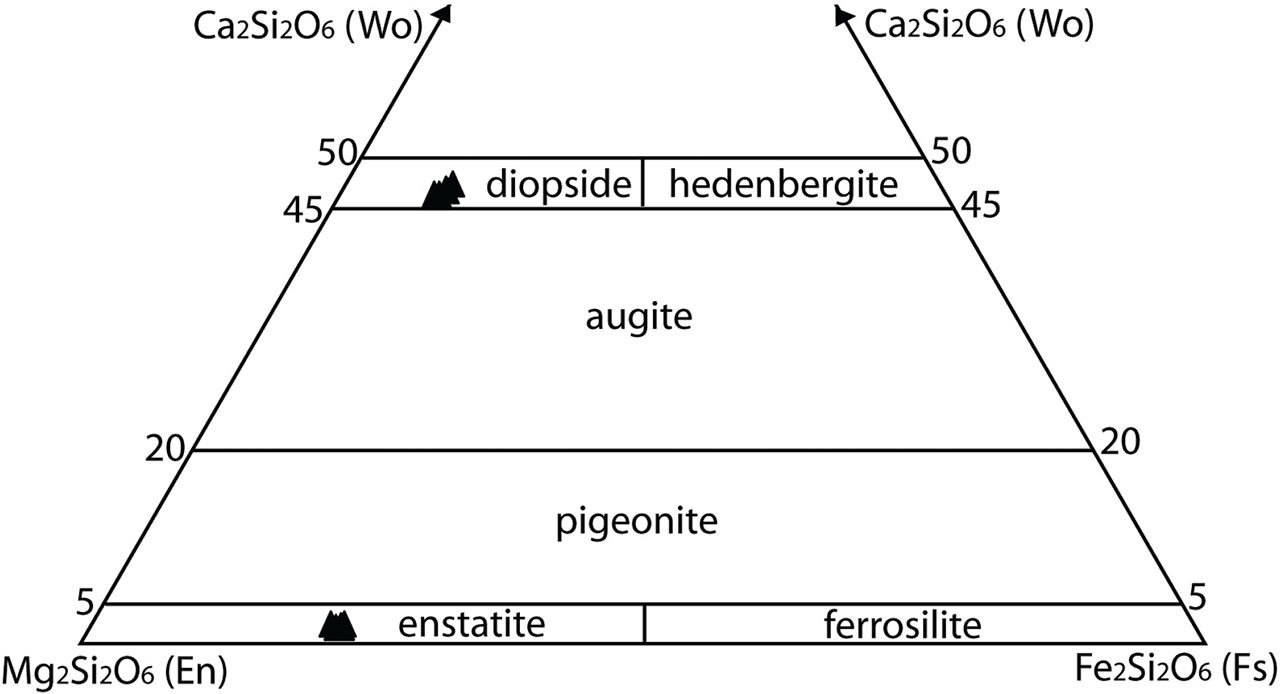
Figure 5.
Pyroxene composition from the studied websterite plotted on the En-Wo-Fs ternary diagram after Morimoto et al. (1988).
Orthopyroxenes (En75.98–76.65Wo1.21–1.76Fs21.74–22.45) plot within the enstatite field of Morimoto et al. (1988) (Fig. 5). This opx shows a lower Mg# (0.77–0.79) than coexisting cpx. Cr2O3, Al2O3, CaO and TiO2 contents are low respectively 0.13–0.25 wt%, 2.05–2.78 wt%, 0.61–0.89 wt% and 0.10–0.14 wt%. The correlation is positive between Mg# and CaO, whereas no clear correlation is observed between Mg# and Al2O3 (Fig. 6c,d).
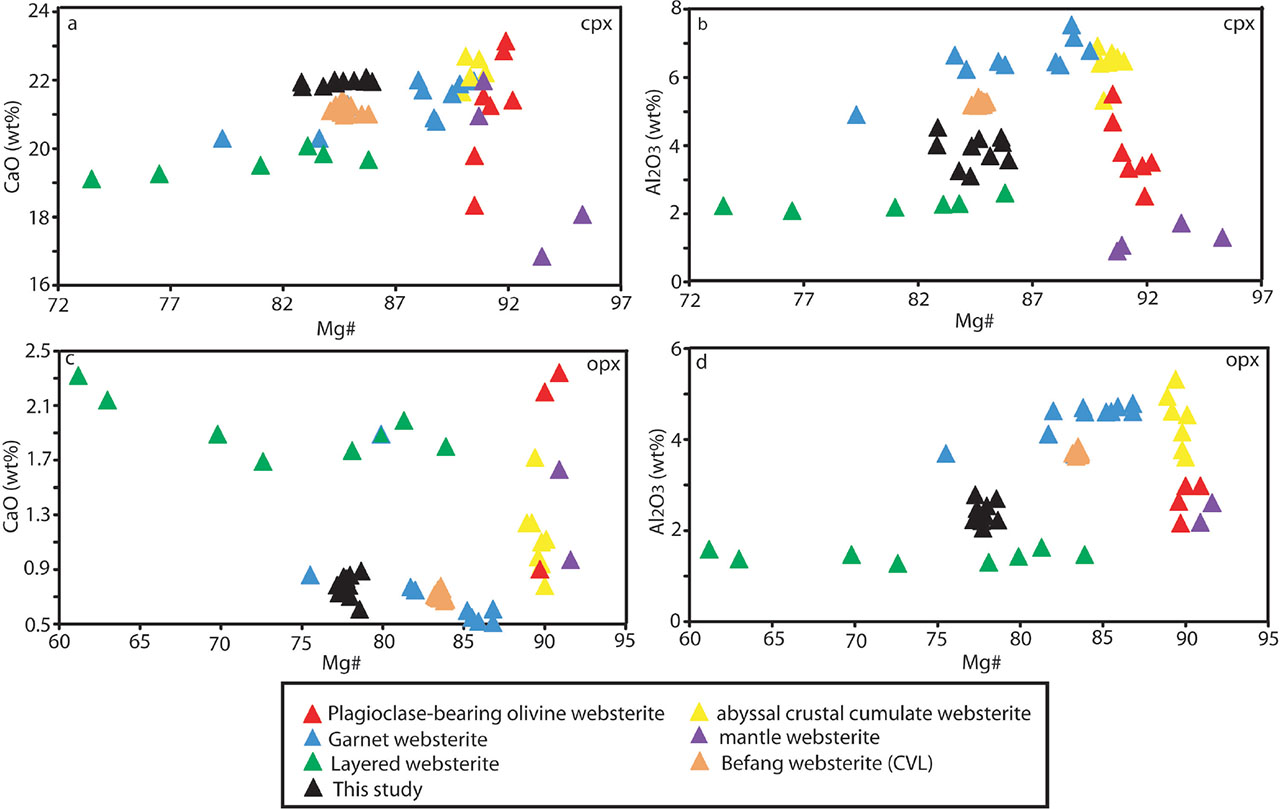
Figure 6.
Clino- and orthopyroxene mineral chemistry plots. (a) CaO (wt%) versus Mg# content of clinopyroxene, (b) Al2O3 versus Mg# for clinopyroxene, (c) CaO (wt%) versus Mg# content of clinopyroxene, (d) Al2O3 versus Mg# for clinopyroxene. Plagioclase-bearing olivine websterite from Serri et al. (1988), Layered websterite from Wilson and Chaumba (1997), Abyssal crustal cumulate pyroxenite after Dantas et al. (2007); Mantle websterites from Rogkala et al., 2017; Garnet websterites from Lu et al., 2018, Befang websterite from Tedonkenfack et al. (2021).
Detailed electron microprobe analysis (EMPA) data and calculated structural formulae for representative phlogopite are presented in Table 3. The analyzed micas are K-phlogopite (see Khedr & Arai, 2016). Based on the International Mineralogical Association scheme, phologopite compositions lie close to the siderophyllite and eastonite boundary (Fig. 7a) and show Mg# of 0.86. Element concentrations do not show large variation. The crystal is homogeneous throughout the xenolith (Table 3).
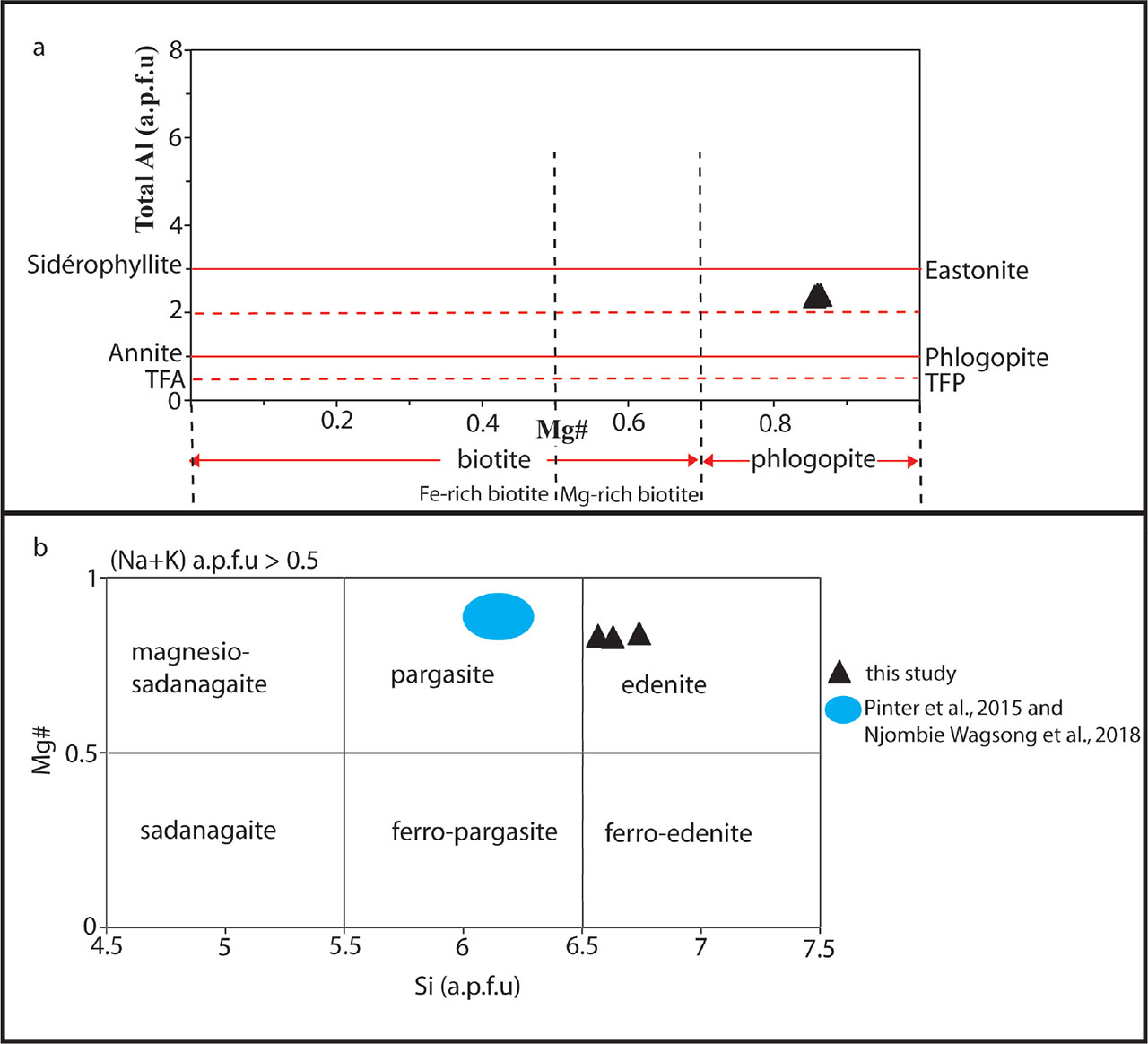
Figure 7.
(a) Chemical composition of phlogopite on the Mg/(Fe + Mg) versus Altot classification diagram of Rieder et al. (1998). Red circles represent chemical compositions of phlogopite. (b) Amphibole classification diagram after Leake et al. (1997). The blue field represents amphiboles described by Pintér et al. (2015) and Njombie Wagsong et al. (2018). TFA, Tetra-Ferri-Annite; TFP, Tetra-Ferri-Phlogopite.
We have classified the amphibole compositions by calculating a.p.f.u. of Si and Mg/Fe + Mg on a diagram Si versus Mg# following the recommendation of Leake et al. (1997) (Fig. 7b). Mineral formulae were calculated using the AMPH16 program of Preston and Still (2001). All of the amphibole analyses plot in the edenite field, which is a rare in upper mantle xenoliths. The analyzed grains are calcic (Ca/[Ca + Na] a.p.f.u ≥ 0.75 with slightly higher values of [Na + K] a.p.f.u: ≈0.8) and are of magnesian affinity with Mg# values ranging between 0.82 and 0.83. This amphibole is slightly ferrous (FeOt = 6.19–6.43 wt%).
Representative plagioclase compositions are given in Table 4. This plagioclase is identified by its medium calcic nature (An58.30–61.47) and has a slightly low sodium content (Ab35.71–-38.75): it is a labradorite ([Na0.36–0.39Ca0.59–0.62] [Si2.38–2.42Al1.56–1.60]O8). Compared to the plagioclase (labradorite and andesine) described by Dautria and Girod (1986) in the lhe Iherzolites sampled in the same study area, this plagioclase is more potassic (Or3 against Or0.4).
5. Geothermobarometry
The minerals of the studied websterite xenolith are compositionally homogeneous reflecting chemical equilibrium prior to the xenolith’s incorporation into the host lava. Pyroxenes do not show signs of compositional modification, so their core compositions should be suitable for estimating pressure and temperature equilibration conditions. Equilibration temperatures were calculated using the cpx-only geothermobarometer of Wang et al. (2021), yielding values ranging between 1195°C and 1208°C. The application of the Blundy and Holland (1990) amphibole-plagioclase geothermometer yields temperatures below 500°C, which are out of the valid temperature range for this geothermometer. The equilibrium pressure is between 4.7 and 5.9 kbar.
6. Discussion
6.1. Evidence of a cumulate origin for websterite from Guinadji volcano
Cumulate rocks typically form through the precipitation of solid crystals from a fractionating basaltic magma. The studied websterite provides evidence of a cumulate origin.
First, the predominance of early-crystallizing phases such as orthopyroxene and clinopyroxene supports a cumulate nature. These two minerals are arranged in such a way as to show an interlocking texture characteristic of cumulates (Fig. 2a). They are therefore the minerals forming the cumulus phase. Between them, plagioclase is very often found filling the very small intervals left after their crystallization (Fig. 3d); the latter thus constitutes the intercumulus phase. Phlogopite and amphibole are metasomatic minerals that make up the late-stage mineral assemblage. The low alkalis and the relative high FeO and MgO show that the source of the cumulates was presumably a tholeiitic magma. In addition, the whole rock low Mg# (0.79) as well the absence or olivine and spinel preclude an ultramafic origin.
The compostion of clinopyoxene in the websterite studied also attests to this cumulate origin. Mantle clinopyroxenes are typically Mg-rich (high in Mg# which is often around 0.9), since they are the residues after partial melting of upper mantle peridotites while clinopyroxene from pyroxenite cumulate have been precipitated from a basaltic magma.
The fact of having small orthopyroxene grains intercalated between the clinopyroxene grains suggests that clinopyroxene was the first to crystallize, the second was orthopyroxene and the third was plagioclase.
As shown in Figure 6, this websterite departs significantly from mantle websterites and is comparable to crustal cumulate pyroxenites (Fig. 8). The calculated equilibration temperatures (1195–1208°C) and pressures (4.7–5.9 kbar) indicate that the websterite crystallized under high-temperature conditions at mid-to lower-crustal depths (approximately 15–20 km).
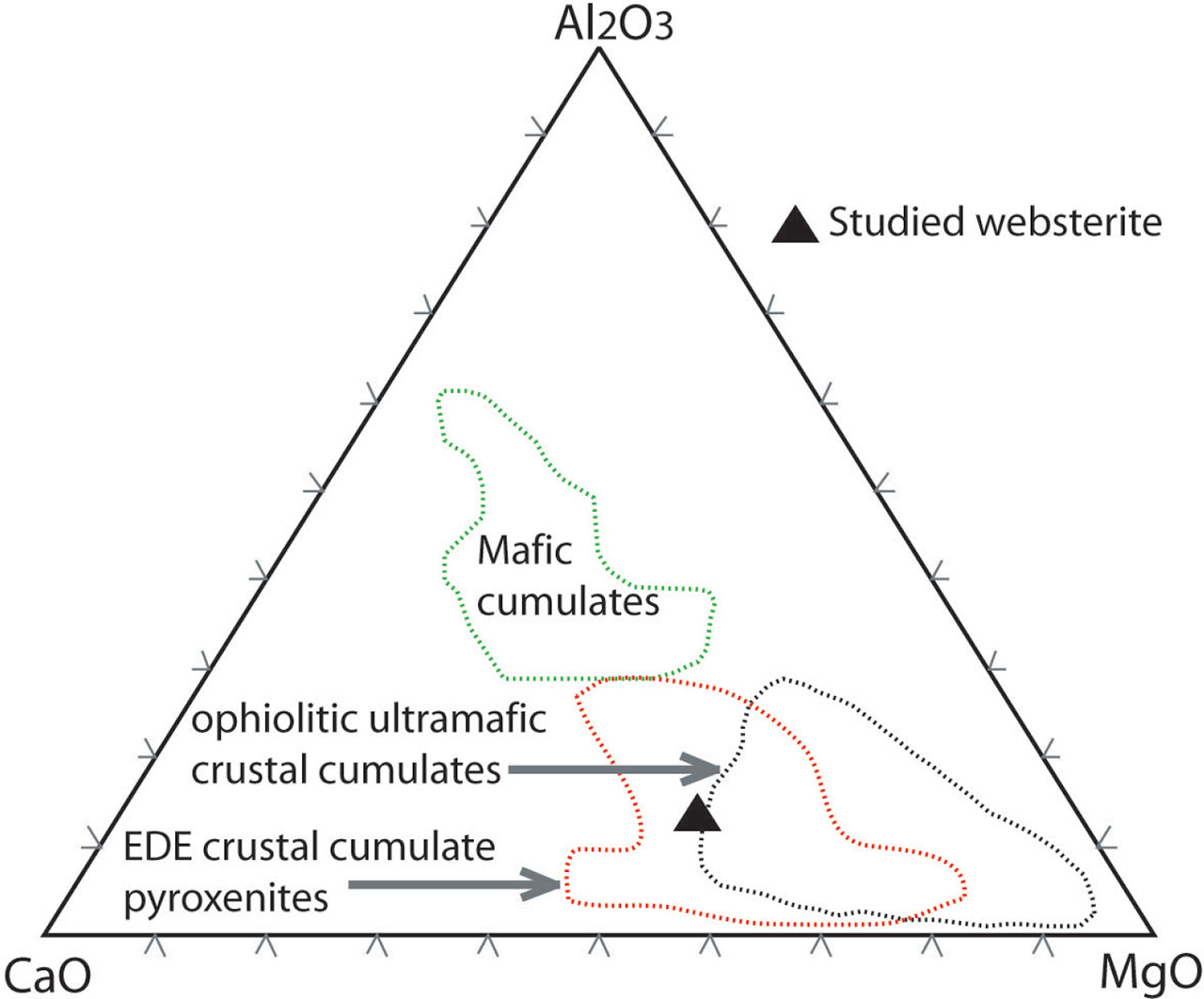
Figure 8.
Whole-rock CaO–Al2O3–MgO plot of the Guinadji volcano websterite (references of the fields after Selim et al., 2025).
Cumulates with similar whole rock composition and estimated temperatures between 950°C and 1000°C have been reported by Marchev et al. (2006).
6.2. Metasomatism and evidence of crustal contribution beneath Adamawa Plateau
The varied nature of ultramafic xenoliths sampled in the alkaline basalts of Adamawa and the major element compositions of their minerals highlight a great heterogeneity of the mantle below this plateau. The GJI 12 xenolith differs in mode and phase composition from peridotite and pyroxenite xenoliths from the same volcanic field. For example, compared to clinopyroxene in the olivine-websterite and websterite xenoliths of Nyos (Temdjim, 2012) and Oku (Tedonkenfack et al., 2021), its clinopyroxene is Fe-rich and Al2O3-poor. Also, orthopyroxene has been less magnesian than orthopyroxene in the olivine-websterite described by Temdjim (2012). So far, pargasite is the amphibole described along the CVL (e.g. Njombie Wagsong et al., 2018; Nkouandou & Temdjim, 2011; Pintér et al., 2015; Temdjim et al., 2004a) while the amphibole described in this sample is edenite (Fig. 7b). Compared to the rare amphibole crystals already described in Adamawa (e.g. Njombie Wagsong et al., 2018), this amphibole is less aluminous (<13 wt% [10.52–11.49 wt%]) and less sodic (<4 wt% [1.75–1.81 wt%]) but has a high K2O (>0.8 wt% [1.57–1.71 wt%]) contents.
As previously shown, this websterite is of cumulative origin and does not contain olivine or spinel as do many pyroxenite xenoliths from the CVL (Tamen et al., 2015; Temdjim et al., 2004a); however, importantly, it does contain phlogopite and some grains of amphibole. The presence of phlogopite and amphibole provides clear evidence that the studied websterite is modally metasomatized. Both hydrous phases contain F indicating that they formed at the same time from the same metasomatic agent. The amphibole is always associated with clinopyroxene but never found included in it. It is often found in clinopyroxene as elongated exsolution lamellae following its cleavage (Fig. 3c). These amphibole textures support a reaction-replacement origin where clinopyroxene is replaced as rods along cleavage planes at crystal margins (resulting in pseudo-interstitial texture; Fig. 3b). The markedly low AlVI and Na (M4, Table 3) are evidence for a low-pressure formation of the amphibole (Niida & Green, 2000). Best (1974) attributed this feature, in specimens from Grand Canyon (Arizona), to a reaction between intercumulus melt and cumulus pyroxene grains. As previously stated, amphibole shows no evidence of destabilization resulting from decompression or in situ partial melting processes. This also support a reaction-replacement origin. The formation of amphibole through melt-clinopyroxene reaction is a well-documented and long-recognized process in cumulate rocks (Smith, 2014), mantle pyroxenites (Dantas et al., 2009; Francis, 1976) and peridotitic mantle affected by metasomatism (Coltorti et al., 2004). This development of amphibole through alteration of anhydrous phases in pyroxenites is a response to the presence of a hydrous melt enriched in volatile components and not critically undersaturated in silica. Figure 7b shows that this amphibole is an edenite (sodic amphibole). Such type of amphibole (with tremolite) forms when ultramafic rocks interacts with water-rich crustal fluids (Yang, 2003). The presence of a high concentration of K and F in this sodic amphibole (Table 3) is also indicative of the influence of crustal-derived fluids.
Based on the petrographic characteristics (Fig. 2b,c), phlogopite is interstitial and sometimes associated with amphibole between pyroxenes, more particulary near clinopyroxene. This shows that phlogopite in the studied websterite crystallized after the coexisting orthopyroxene and clinopyroxene, directly from the fluid phase during amphibole-associated hydrothermal metasomatism and did not attain chemical equilibrium with primary minerals.
Given its composition, phlogopite formation requires the supply of K, Mg and Al. Bonadiman et al. (2021) showed that phlogopite coexisting with amphibole suggests an influx of K(Na)-OH-bearing melts. This attests that metasomatic fluid that affected the websterite was rich in alkalis, mainly K. The abundance of fluorine in the phlogopite (2.65–3.14 wt%, Table 3) and amphibole also confirms the richness in volatiles of the metasomatic fluid. The metasomatic agent would thus be K–F-rich crustal-derived fluids responsible for the marginal amphibolitization of clinopyroxene and the formation of phlogopite.
Because of their silica and volatile-rich compositions, these melts may be saturated in titanium oxides even at relatively low concentrations of Ti (Karmalakar et al., 2005). This characteristic is confirmed by the frequent occurrence of rutile side by side with OH− bearing minerals (Fig. 3a) and also by the high TiO2 contents in phlogopite and amphibole (respectively 3.56–3.69 wt% and 1.64–1.81 wt%; Table 3) while they are very low in primary minerals (<0.6 wt% Table 2). Such type of K-melts with Ti has already been described in the xenoliths of Kutch (India) by Karmalakar et al. (2005) and of northern Great Xing’an Range (Nuomin volcanic field, China) by Sui et al. (2014). In the Kutch xenoliths, the exsolutions of rutile in the orthopyroxenes have been interpreted as products of K-metasomatism while the enrichment of K and Ti in Nb metasomatic melt was associated with recycled crustal materials.
The estimated unusual high temperature at relatively low pressure could be an indication of a steep geothermal gradient, which evidently is attributed to the existence of a plume underneath the Cameroon Line (Burke, 2001). As mentioned above, the phlogopite and amphibole are characterized by relatively high F contents. Also, the Ba concentration is high and shows a prominent positive anomaly in the chondrite-normalized spider diagram (Fig. 4b). The orthopyroxene and clinopyroxene cannot account for the high light REE (LREE) and low HREE abundances in the chondrite normalized REE patterns. Instead, the metasomatic phase phlogopite, which is also the repository for the high Ba content, and amphibole are the main contributors to the LREE enrichments in the websterite. Evidently, the metasomatic, fluid-rich melts might have been derived from the granitoids of the Adamawa Plateau.
7. Conclusions
Among our collection of ultramafic xenoliths from the Guinadji volcano (Adamawa, Cameroon), a websterite was identified. Due to its modal composition, it is different from websterites studied so far along the CVL. To understand its origin and the metasomatic agent, we report petrographic observations, bulk-rock composition and the chemical composition of its main mineral phases.
This websterite shows a texture of cumulate origin with clinopyroxene and orthopyroxene as cumulus and plagioclase (labradorite) as intercumulus. The fact of finding orthopyroxene grains intercalated between clinopyroxene grains shows that clinopyoxene was the first mineral to precipitate before orthopyroxene. These microscopic observations, coupled with the absence of olivine and spinel in this xenolith, support a cumulate formed in a magma chamber consisting of tholeiitic basalts.
Phlogopite, amphibole (edenite) and a few small grains of rutile, all later than the previously mentioned minerals, are interstitial between the pyroxenes with the amphibole developing either on the rims of clinopyroxene or along its cleavage plane.
Mineralogically, pyroxenes do not contain K as an oxide and are poor in TiO2 (<0.60 wt%) unlike phlogopite (K2O: 9.42–9.57 wt%; TiO2: 3.56–3.69 wt%) and amphibole (K2O: 1.57–1.71 wt%; TiO2: 1.64–1.81 wt%) which show high contents of these two oxides and also in fluorine (F > 1.20 wt%). The metasomatic agent thus appears to be a hydrous melt of crustal origin rich in K–F with relatively high contents of Ti responsible for the marginal amphibolitization of clinopyroxene and the formation of phlogopite and rutile.
The evolutionary trajectory of the basaltic source of the cumulate appears to be closely linked to mantle plume activity. Upwelling of tholeiitic magma, which represents the parental melt of the cumulate, was emplaced at the crust–mantle boundary, where the cumulate crystallized. Continued plume upwelling subsequently led to the uplift and re-equilibration of this cumulate at depths of approximately 20 km, where it underwent metasomatic modification.
Acknowledgements
The authors wish to thank the Department of Lithospheric Research of the University of Vienna for the EMP analyses. We are also very grateful to Prof. Jaroslaw Majka and two anonymous reviewers whose remarks have greatly improved the quality of this paper.