
1. Introduction
Magnesites are rocks that commonly form in the stratabound sedimentary environment or that are associated with alteration processes of ultramafic rocks (Schroll, 2002). From petrological point of view formation of magnesites can be related to precipitation due to evaporation at Earth’s surface, but most often requires either chemical weathering or hydrothermal alteration of primary carbonate or ultramafic rock (Scheller et al., 2021). The involvement of hydrothermal fluids that carbonated ultramafic rocks and, after migrating toward the Earth’s surface, precipitated magnesite deposits has been proposed for several occurrences (e.g., Yu et al., 2024; Zedef et al., 2000). For deeper magnesite deposits, the provenance of the fluids responsible for magnesitization remains a subject of ongoing debate.
To date, magnesite occurrences in Svalbard are strictly connected to the high-pressure (HP) rocks cropping out along Oscar II Land coast and mark subduction event in the Ordovician (Bernard-Griffiths et al., 1993; Ohta et al., 1995). Magnesite is hosted by green-brown dolostone and its association with serpentinites and presence of chromium minerals such as chromite and fuchsite unequivocally suggest its origin as resulting from hydrothermal alteration of ultramafic rocks (Ohta et al., 1995).
Here we describe a newly discovered occurrence of magnesites, tentatively interpreted as a stratabound deposit of possibly the Veitsch-type in Prins Karls Forland (PKF), Svalbard confirmed using optical and X-ray diffraction methods. A geothermometer based on Raman spectra of carbonaceous matter (Kouketsu et al., 2014) provided formation temperatures in the range of 260–360°C. We hypothesize that magnesites wereform at the lower greenschist-facies metamorphic conditions during tectonic assembly of western Svalbard as a result of metasomatism aided by fluids originating from hydrothermal alteration of neighbouring ultramafic rocks.
2. Samples and Methods
2.1. Geological background
PKF is a westernmost island in the Svalbard Archipelago (Fig. 1A). It is a part of the Southwestern Basement Province in the traditional tripartite division of Svalbard’s crystalline basement ( Gee & Teben’kov, 2004). This province is characterized by occurrences of the Torellian metamorphism, the early Caledonian HP metamorphic rocks as well as Ellesmerian metamorphic rocks (Majka & Kośmińska, 2017) and is divided into several terranes including the Prins Karls Terrane that encompasses the PKF (Wala et al., 2021).
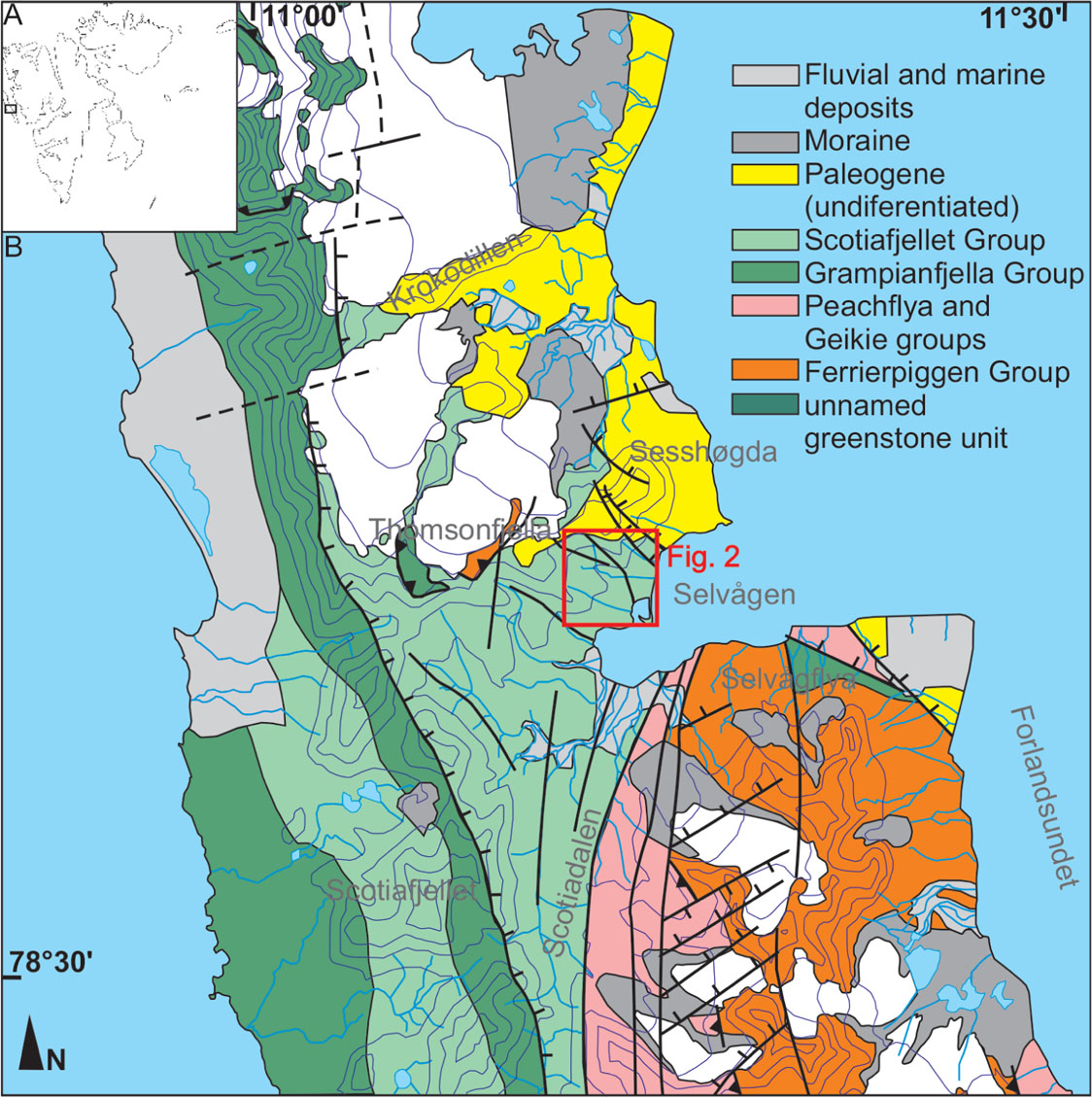
Figure 1.
(A) Simplified map of Svalbard. Outlined box shows the location of Figure 1b; (B) Geological map of central Prins Karls Foreland (after Dallmann, 2015). Fig. 2a marked with red rectangle.
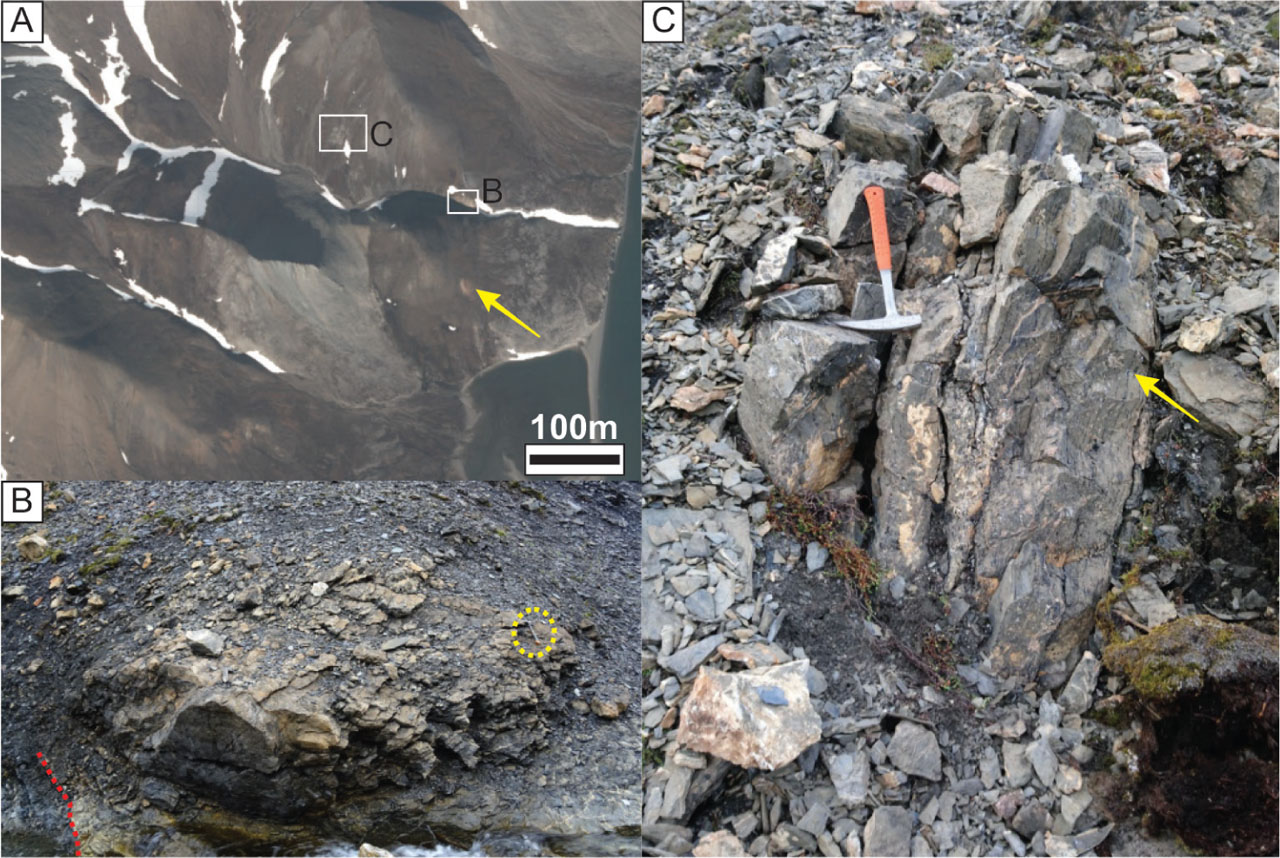
Figure 2.
(A) Satellite image of the sampling area. Example of carbonate vein rich in siderite marked with yellow arrow. (toposvalbard.no) (B) Outcrop of magnesite in contact with surrounding black marbles and phyllites marked with red dotted line. (C) Close up image of the magnesite outcrop with visible bands of black metachert (marked by arrow). Note multiple dolomite veins crosscutting the vertical foliation within magnesite.
The island is built of two parts, northern and southern, that are juxtaposed on the N-S trending Baklia Shear Zone that runs from Selvågen to Haukebukta (Hjelle et al., 1979); (Fig. 1B). The southern part of the island is composed of Neoproterozoic metasedimentary succession intercalated with minor volcanics and occurs only locally in the northern part of the island where it overthrusts the northern successions (e.g. Manby, 1986). The northern part consists predominantly of the carbonate and siliciclastic dominated Grampian Group that is underlain by the Scotiafjellet Group comprising phyllites, slates and metacarbonates with chert nodules (Hjelle et al., 1979; Tyrrell, 1924). These two groups of preassumably late Neoproterozoic age locally overthrust the Pinkie Group which is a Neoproterozoic complex metamorphosed under amphibolite facies conditions during the Ellesmerian Orogeny ( Kośmińska et al., 2020). PKF was subjected to at least three tectonic events including Caledonian, Ellesmerian and Eurekan episodes. The earliest deformation and metamorphism was connected to westward folding and thrusting, and subsequent rejuvenation of tectonic structures (Manby, 1986; Schneider et al., 2019). In the northern PKF tectonic discontinuities are accompanied by carbonate veins composed of siderite, dolomite and pyrite.
Dark grey magnesite rock weathering to olive-green,forms a hill which clearly stands out on the northern shore of Selvågen NW above the ruins of the cottage (Fig. 2; GPS coordinates: 78.5527188°N 11.2331401°E). The rock contains characteristic black, discontinuous, parallel bands of cherts. To date, massive metacarbonates with chert nodules were sampled only in the northern part of Scotiafjellet Group and studied only in the context of microfossils (Knoll & Ohta, 1988). Paleontological constrains suggest a late Neoproterozoic age of the studied metacarbonate.
2.2. Methods
Samples were collected from an outcrop during the 2018 Geological Expedition to Svalbard, organized by the Department of Mineralogy, Petrography, and Geochemistry at AGH University of Kraków. Petrographic analyses of thin sections were conducted using optical microscopy (under polarized light, Carl Zeiss Primotech), scanning electron microscopy coupled with energy-dispersive spectrometry (SEM/EDS; FEI Quanta 200 FEG, operated in low-vacuum mode without sample coating). Mineral composition was determined using powder X-ray diffraction (XRD, Rigaku Miniflex 600, CuKα monochromatic radiation, step size 0.05° 2θ). Raman spectroscopy was performed using a DXR Raman Microscope (Thermo Fisher Scientific) equipped with a confocal Olympus BX-40 reflected light microscope and a 10W, 514.5nm laser, with spectra collected over the range of 100–3585 cm−1. Spectral data were processed using Omnic (Thermo Fisher Scientific) and PeakFit 4.12 software (Systat Software) packages. Mineral abbreviations in this article are according to Whitney & Evans (2010).
3. Results
3.1. Petrography
The outcrops of magnesite rock that belongs to Taylorfjellet Formation of the Scotiafjellet group are dispersed along the unnamed hill on the northern side of Selvågen (Fig. 2A). The thickness of the metacarbonates can be estimated to several tens of meters. The rocks are poorly exposed but locally the contact with surrounding calcite dominated black marbles and phyllites can be observed as conformable (Fig. 2B). Surrounding lithologies do not contain chert bands. The cryptocrystalline metacarbonate exhibits distinctive black, discontinuous, and parallel chert bands as well as pale orange dolomite veins (Fig. 2C). The rock displays well-developed foliation that is parallel to the chert banding, with foliation locally deflected around the margins of chert nodules (Fig. 3A). This deformation likely reflects compaction of the carbonate sediment during diagenesis and early stages of metamorphism. Contacts between the chert bands and the carbonate matrix range from sharp to gradational.
The rock is composed predominantly of magnesite and quartz, with minor dolomite, scattered pyrite grains, and occasional plagioclase and mica (Figs 3B and 4). The fine-grained carbonate matrix is cryptocrystalline and largely structureless aside from the foliation, with individual crystals typically a few micrometers in size (Figs 4A, B). Locally, larger crystals of magnesite and dolomite occur within the matrix. The crystal size, subhedral forms, and sharp grain boundaries collectively suggest that the carbonates recrystallized from the original sedimentary precursor to their present metamorphic texture.
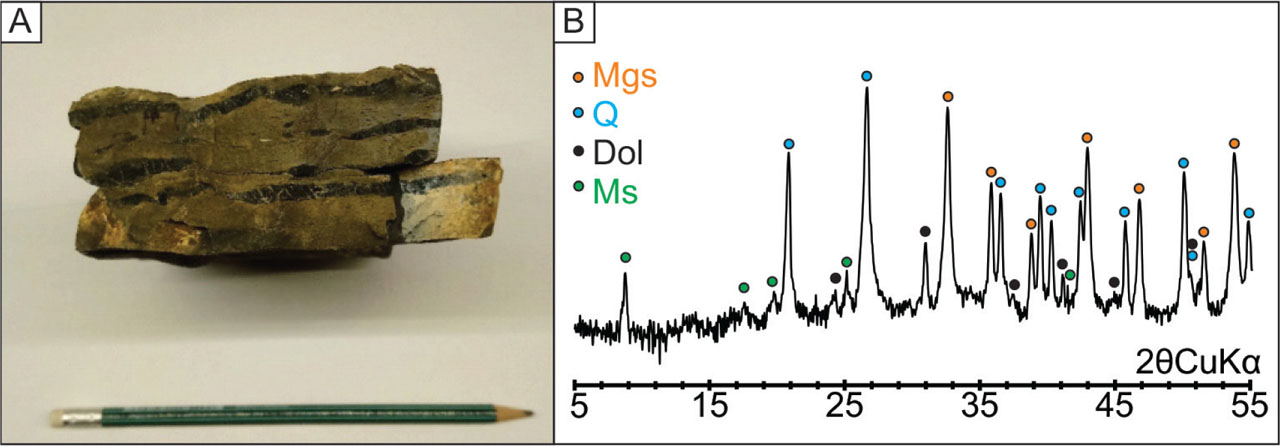
Figure 3.
(A) Photograph of a sample of the metacarbonate with cherts. Cherts are preserved as horizontal black discontinuous bands and smaller nodules within microcrystalline metacarbonate matrix (B) Mineral composition of the metacarbonate rock based on the XRD pattern.
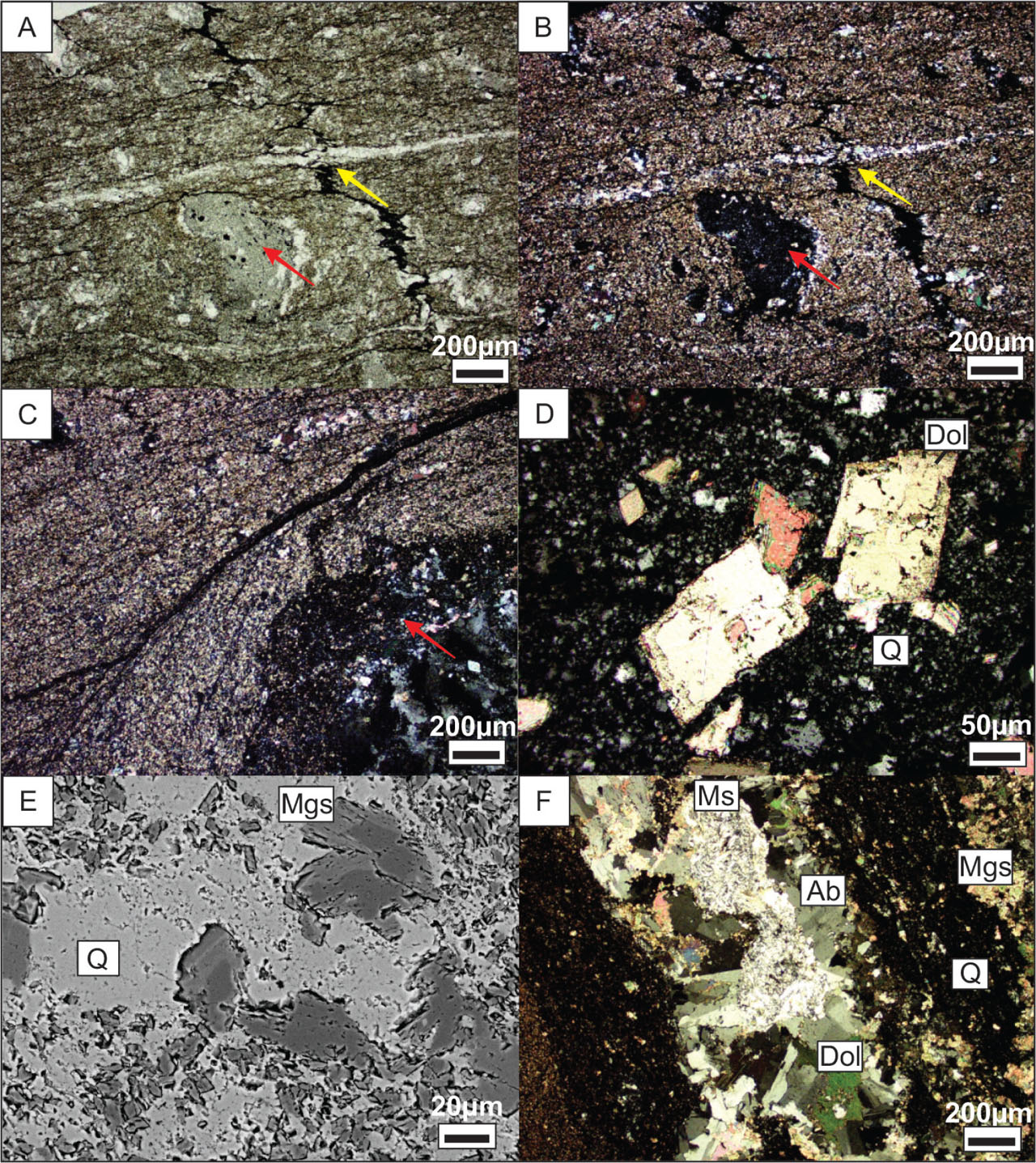
Figure 4.
(A, B) Microphotographs of laminated magnesite rock around a small chert nodule in the centre (red arrow). A stylolite (yellow arrow) oblique to foliation and crosscut by a dolomitic vein is apparent (optical microscopy, A—1N, B—NX). (C) Foliation deflected around chert nodule marked with red arrow (D). Euhedral dolomite crystals embedded in finely crystalline silica of the chert (optical microscopy, NX). (E) Subhedral, zoned magnesites embedded in chert quartz matrix (SEM/BSE image). (F) First generation of dolomitic veins with albite and muscovite present.
Chert bands within the cryptocrystalline metacarbonate are typically several millimeters thick, while chert nodules range from several hundred micrometers to a few centimeters in diameter (Figs 4A–C). Chert occurs as both bands and nodules, though no significant compositional or textural differences have been observed between these two morphologies. The alignment of the nodules parallel to the general banding suggests they may represent boudins. However, the relationship between the chert structures and the magnesite host rock does not provide conclusive evidence as to whether the banding reflects primary sedimentary layering or the development of metamorphic foliation. Further investigation focusing on sedimentary structures is warranted.
The cherts are predominantly structureless, composed of fine-grained quartz with disseminated euhedral dolomite crystals within a siliceous matrix (Fig. 4D). Quartz grains typically measure a few micrometers, with coarser grains concentrated near chert margins. Grain contacts are sharp and locally sutured, indicating recrystallization under pressure. Euhedral dolomite crystals reach approximately 100 μm in size and their textural relationship with quartz suggests formation through neomorphic processes.
Scanning electron microscopy reveals zoning in magnesite crystals (Fig. 4E), characterized by pure magnesite core and iron-enriched rims (Table 1). This zoning is present in both larger recrystallized grains and finer matrix crystals, implying an evolution of the source fluid chemistry. The magnesite cores likely crystallized during early diagenetic magnesitization, whereas the Fe-enriched rims formed later from metamorphic fluids during deeper burial.
Table 1.
Representative elemental composition of magnesite rim and core (semi-quantitative SEM/EDS analysis normalized to 100%).
| COMPONENT | CORE | RIM | ||
|---|---|---|---|---|
| wt% | mol% | wt% | mol% | |
| CO2 | 52 | 51 | 52 | 51 |
| MgO | 47 | 49 | 44 | 48 |
| Fe2O3 | 1 | 0.2 | 4 | 1 |
Chert bodies contain abundant carbonaceous material, although its preservation is compromised by low-grade metamorphism. Despite degradation, several putative biogenic structures can be identified. Most carbonaceous remnants appear as detrital agglomerates with subtle color variation relative to the surrounding chert matrix (Fig. 5A). Some of these aggregates contain microstructures resembling primitive organisms, including dispersed cyanobacterial cells and spherical clusters, possibly representing microbial colonies, infilled with framboidal pyrite (Fig. 5B). Due to poor preservation, definitive identification is challenging; however, these features are broadly comparable to microfossils described from the northern Scotiafjellet Group (Knoll, 1992), which appear to have experienced less alteration. The cherts of this unit thus remain promising targets for future paleobiological investigations.
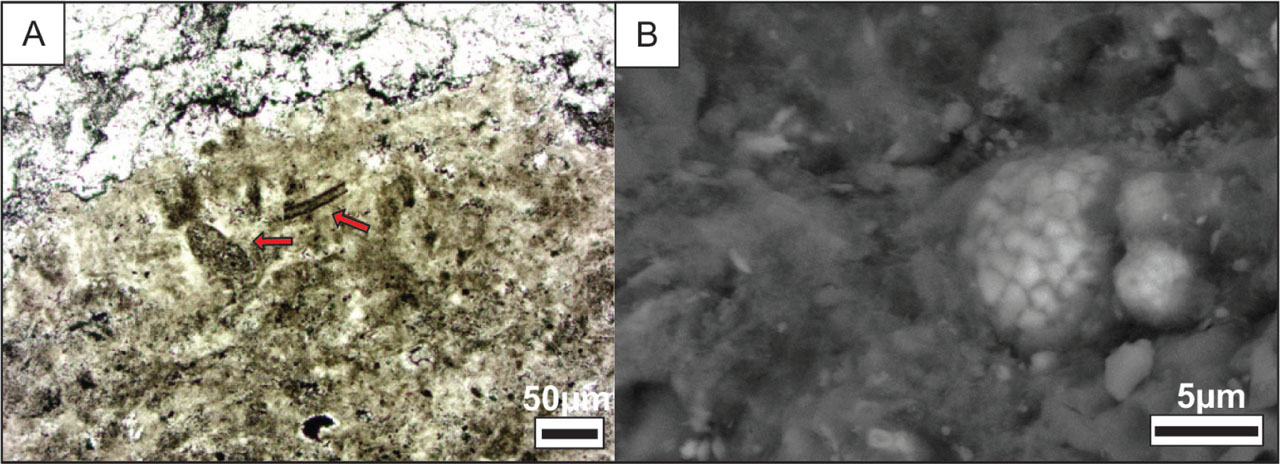
Figure 5.
(A) Aggregates of detritus with biogenic structures (red arrows) (optical microscopy, 1N). (B) Framboidal pyrite embedded in chert. (SEM/BSE image).
Stylolites are present within the metacarbonate, oriented obliquely to foliation and commonly folded around larger, partially dissolved quartz grains. No dissolution features were observed in magnesite crystals. Locally, secondary carbonate veins crosscut stylolites, indicating vein formation postdates chemical compaction. The oblique orientation of stylolites relative to foliation suggests deformation postdating diagenesis. Quartz appears to have resisted dissolution, rendering the stylolites inactive in quartz-rich zones. The absence of dissolution features at magnesite contacts may imply either complete dissolution of earlier magnesite during stylolitization or subsequent recrystallization of magnesite after stylolite formation.
The magnesite–dolomite metacarbonate hosts multiple generations of carbonate veins (Fig. 6A), predominantly composed of authigenic dolomite crystals ranging from several micrometers to over one millimeter in size. The first-generation veins consist of dolomite, with subordinate feldspar and muscovite mica occurring as fine-grained aggregates. Rare magnesite crystals exceeding 1mm are also present. SEM/Backscattered electron (BSE) imaging reveals magnesite grains rimmed by reaction zones, characterized by elevated iron concentrations in adjacent dolomite crystals (Fig. 6B). A second generation of dolomite veins crosscuts the earlier assemblage and is composed of finer crystals (up to several micrometers). Contacts between these younger veins and the host rock vary from sharp to gradational. In places, vein minerals from both generations are disseminated into the surrounding matrix. Sporadic feldspar grains exceeding 200 μm with characteristic albite twinning were identified (Fig. 4F). Raman spectroscopy and SEM/EDS analysis confirm the composition of these grains as pure albite.
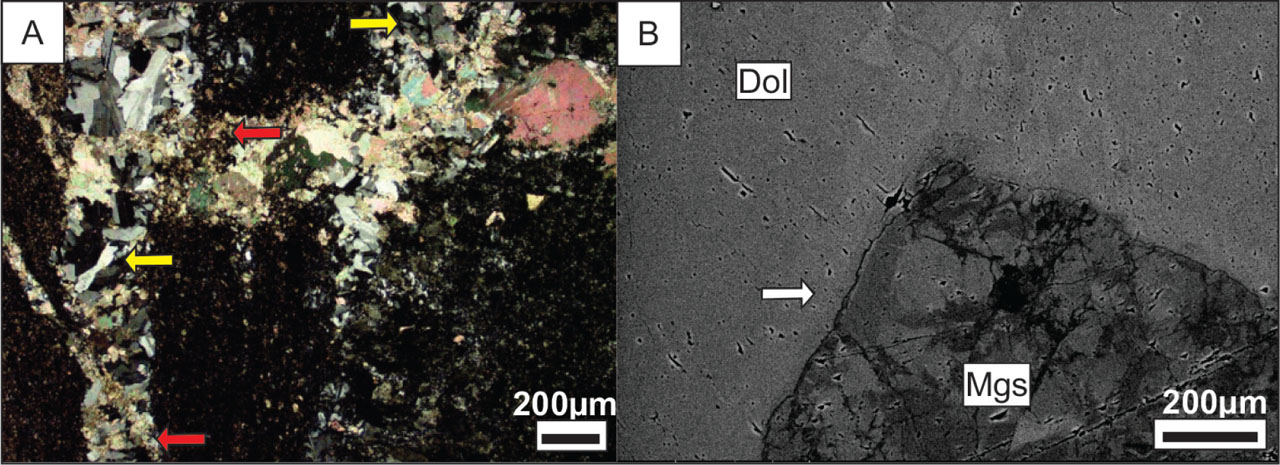
Figure 6.
(A) Second generation dolomite veins (red arrows) crosscutting the first generation albite veins (yellow arrows; optical microscopy, NX). (B) BSE image of the reaction rim around the magnesite grain manifested by elevated Fe content in dolomite (white arrow).
3.2. Raman geothermometry
The metamorphic temperature was estimated using the Raman spectroscopy-based geothermometer of Kouketsu et al. (2014), which relies on the deconvolution of Raman spectra of carbonaceous matter. The spectrum was acquired from carbonaceous inclusions within quartz grains to minimize potential artefacts associated with surface polishing. Spectral processing was performed with PeakFit 4.12 software, employing Lorentzian functions for peak fitting. The spectral decomposition followed the fitting ‘F’ protocol recommended by Kouketsu et al. (2014), with the positions of the D4 and G bands fixed at 1245 cm−1 and 1593 cm−1, respectively.
The Raman spectrum of carbonaceous matter reveals two broad bands centered near 1349 cm−1 and 1603 cm−1 (Fig. 7), corresponding to the D1 and G bands of disordered graphite (Beyssac et al., 2002; Kouketsu et al., 2014). The broad feature near 1603 cm−1 is interpreted as an overlap of the G and D2 bands and is hereafter referred to as GL (G-Low). An elevated background in the 1100–1200 cm−1 range reflects the presence of the broad D4 band. A 1615 cm−1 is assigned to D2 (which typically appears around 1620 cm−1). The D3 band is identified at ̴ 1531 cm−1. The presence of both D4 and GL bands suggests that the carbonaceous matter is of low metamorphic grade. Following the fitting ‘F’ procedure, for which the intensity ratio GL/D1 is below 1.5. Peaks were extracted using Lorentzian functions, while maintaining fixed positions for the D4 and G bands. The results of spectral deconvolution are summarized in Table 2 and Figure 7.
Table 2.
Carbonaceous matter Raman bands positions after decomposition (FWHM).
| BAND | CENTRE | INTENSITY | FWHM |
|---|---|---|---|
| D4 | 1244.6 | 18 | 381 |
| D1 | 1349.4 | 142 | 80 |
| D3 | 1531.2 | 19 | 144 |
| G | 1593.0 | 73 | 44 |
| D2 | 1615.2 | 63 | 33 |
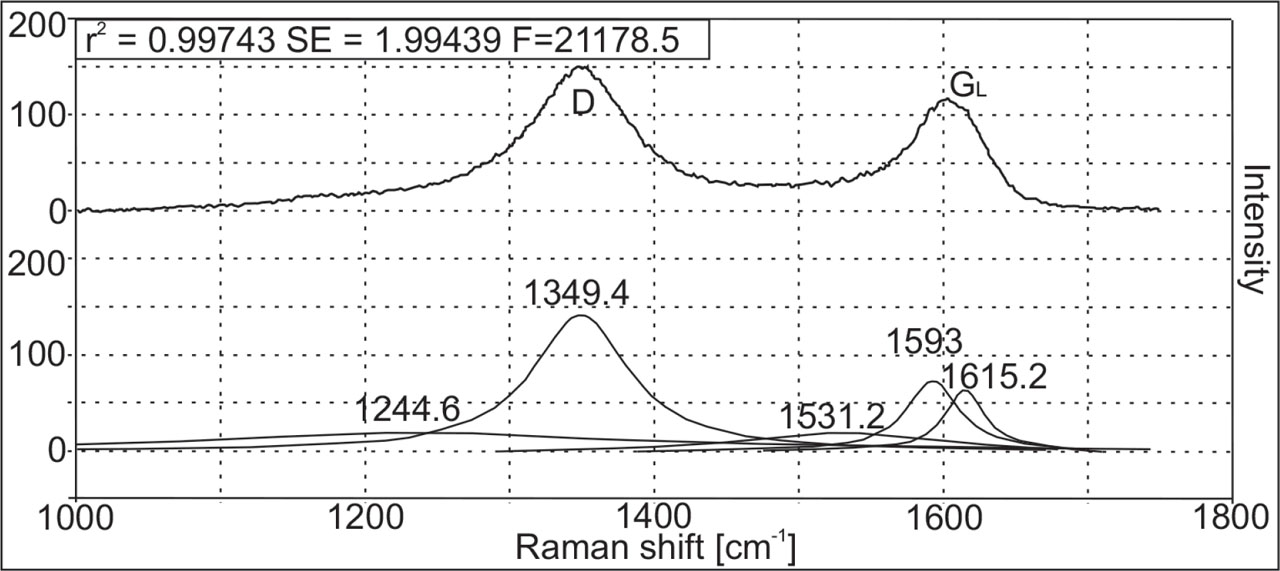
Figure 7.
Raman spectrum of carbonaceous matter (top) and its deconvolution (bottom); R2—coefficient of determination, SE, F—area. SE, standard error.
Temperature estimates were calculated using two empirical formulas from Kouketsu et al. (2014):
where FWHM means full width at half maximum. The resulting temperatures T1 = 305 ± 30°C and T2 = 309 ± 50°C are identical within analytical uncertainty and consistent with the temperature range inferred from the formation of albite in the rock (Spötl et al., 1999). Attempts to apply additional geothermometers were unsuccessful. Application of the Beyssac et al. (2002) geothermometer based on D1, G, and D2 bands in Raman spectra proved inconclusive owing to the ambiguous resolution of the G and D2 bands (data not shown). The absence of graphite reflections in XRD patterns of cherts precluded the use of the Shengelia et al. (1977) method, likely due to the low crystallinity of the carbonaceous matter and potential peak overlap with quartz.4. Discussion
4.1. Classification of magnesite deposit
The magnesites from PKF are characterized by paragenesis containing mainly magnesite and quartz with minor dolomite, pyrite, white mica and organic matter. Their association with fossiliferous cherts suggests that a carbonaceous protolith was affected by metasomatic changes to produce magnesite. Two sets of dolomitic veins shed more light on this process. The first generation of veins with dolomite, magnesite albite and muscovite notably cut only the chert layers and boudinaged fragments, but do not cut the magnesites (Figs 4A, B). When reaching the boundary of two lithologies they become finer-grained and follow the edge of the chert. It is in line with the different behaviour of the two protoliths i.e. magnesite rock behaves plastically while cherts remain brittle. This contrast in rheological behaviour resulted most likely in the opening of fractures in chert layers that allowed the infiltration of the Mg-rich fluid into primary carbonates.
The secondary carbonate veins built of dolomite cut the cherts, magnesites and primary veins (Fig. 7). Some of them also follow the foliation planes in magnesites which suggest that they were formed already in post-kinematic stage, likely during the uplifting of the whole complex back to the brittle regime depths. Reaction halos in the primary veins suggest that magnesite was replaced by dolomite which was accompanied by increase of the iron content in dolomite. Substantial amounts of Ca2+ released during magnesite formation may later result in its redolomilitization (Aharon, 1988). The metasomatic replacement of dolomite is controlled by temperature where an increase in temperature results in magnesitization whereas a decrease in temperature may lead to redolomitization (Krupenin et al., 2013). Therefore, observed interaction suggests the redolomization that was likely coeval with the introduction of the secondary veins.
The rheological behaviour of the magnesite rock suggests that the process occurred in the metamorphic conditions of the greenschist facies. This is corroborated by geothermometry estimates based on Raman spectra of carbonaceous matter (Kouketsu et al., 2014) that yielded the results of 260–360°C, well in the lower greenschist facies. Composition of the primary carbonate veins also supports these metamorphic conditions. The occurrences of authigenic albite in carbonate rocks are related to deep-burial environments, i.e. very low-grade metamorphic to low-grade metamorphic rather than diagenetic. Formation of albite seems to be the result of the interaction between carbonates and NaCl brines in pore solution at temperatures corresponding to either high-grade diagenesis ( ̴ 150–200°C) or low greenschist facies (̴ 300–350°C) (Spötl et al., 1999).
The order of events as well as the observed structures are remarkably similar to the development of the Veisch-type magnesite in their type locality (Wölfler et al., 2015). There, a precursor coarse dolomite rock is locally metasomatized to coarser magnesite crystals which is followed by late-stage metasomatic reaction of dolomite into fine-grained magnesites. The whole process is similarly followed by development of the secondary dolomite-quartz veins (Wölfler et al., 2015). The conformable contact with surrounding phyllites and marbles suggest that the magnesite occurrence can be tentatively classified as stratabound. Sedimentary sequence of a marine shelf, structural and compositional characteristics, as well as an elevated iron content imply that the forming of the magnesite rock can be explained by Veitsch-type model (Pohl, 1989).
4.2. Magnesite formation and its regional significance
The magnesite formation in PKF was a result of metasomatism of the primary carbonate in presence of Mg rich fluid. The origin of the fluid cannot be determined without proper oxygen isotope studies, however observed structures would suggest that in the lower greenschist metamorphic conditions it could have originated in the deeper part of the crust. To date the timing of the metamorphism is assumed to be Caledonian and related to the formation of the westward translated nappe stack (Manby, 1986). Discontinuities related to the nappe stacking are frequently associated with voluminous carbonate veining (e.g. Fig. 2A), which is likely related to the deeper-seated mobilisation of carbonate fluid.
The only other occurrence of magnesite bodies in Svalbard in Oscar II Land is related to metasomatism of the suture marking ultramafic rocks (Ohta et al., 1995). The age of the late Caledonian structures in Oscar II Land is considered coeval to the ones developed in PKF, however the vergence of the structures is opposite. Recent studies in the Mullerneset area showed that between the PKF and Oscar II Land the zone of intensive shearing was documented and possibly incorporates the suture related Vestgötabreen Complex (Ziemniak et al., 2022). The origin of the Mg rich fluid that resulted in formation of the magnesite in PKF might be therefore related to mobilisation of the Mg from lithologies Lower Unit of Vestgötabreen Complex involved in the late Caledonian sinistral shearing.
Similar ultramafic origin of the Mg rich fluid was proposed for the formation of the Hirsizdere sedimentary magnesite deposit in Turkey (Zedef et al., 2000) and Kamado deposit in China (Yu et al., 2024). Nevertheless this deposits formed in relatively lower temperatures then the magnesite from PKF. For higher temperatures of formation in Veitsch type deposit a metamorphic fluid is invoked as a main cause of magnesitization (e.g. Schroll, 2002). Some of the authors suggest that the fluid may have its origin in ultramafic rocks (e.g. Kiesl et al., 1990), however REE patterns do not match seawater or ultramafic protolith of the fluid (Schroll, 2002).
Nevertheless, more detailed studies, including more detailed field investigation and isotopic analysis, are required to understand the formation process of the magnesites from PKF.
Acknowledgments
MM was supported by AGH research funds No 16.16.140.315. We thank Aratz Beranoaguirre and an anonymous reviewer for constructive reviews. We also thank Aratz Beranoaguirre and Iwona Klonowska for editorial handling.