
Table 1.
Microscope specifications.
| Application | Plan UW |
|---|---|
| Magnification | 2× |
| Numerical aperture | 0.06 |
| Lens image distance/coverslip thickness (mm) | ∞/− |
| Working distance | WD 7.5 |
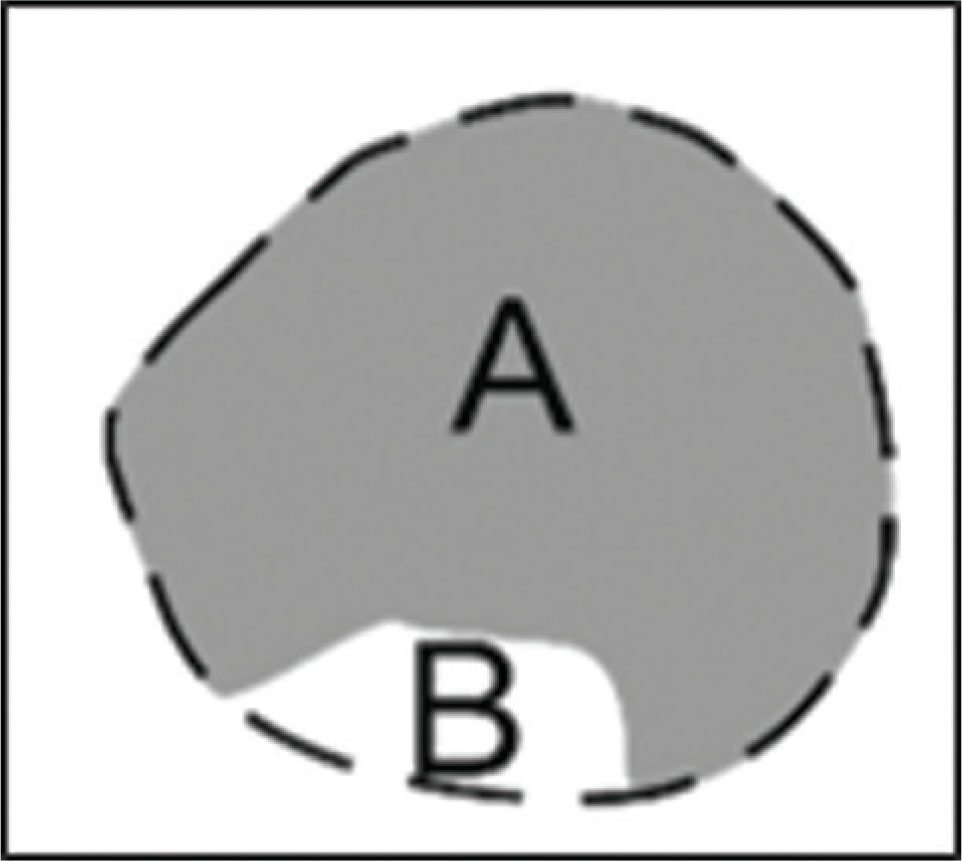
Figure 1.
Equation for calculating convexity. Convexity = (perimeter of A + B)/(perimeter of A).
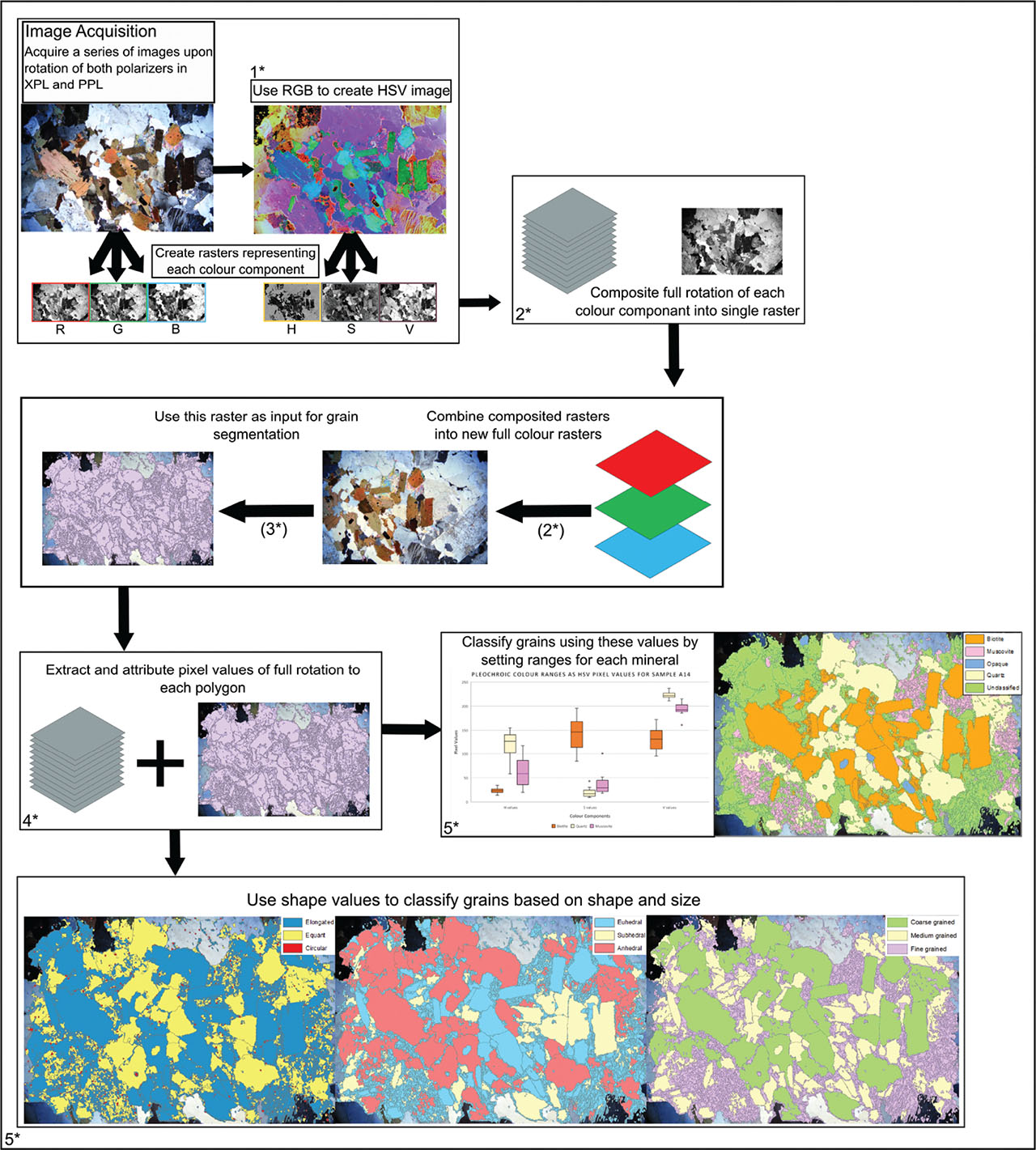
Figure 2.
Workflow devised for this study. The ArcMap tools used are numbered and are as follow: (1) Colour Model Conversion function, (2) Composite Bands tool, (3) MFA, specifically the GSD tool, (4) Zonal Statistics tool, (5) Inbuilt raster calculator. GSD, grain size detector; MFA, micro fabric analyser; PPL, plane polarised light; RGB, red, green, blue; XPL, crossed polarised light.
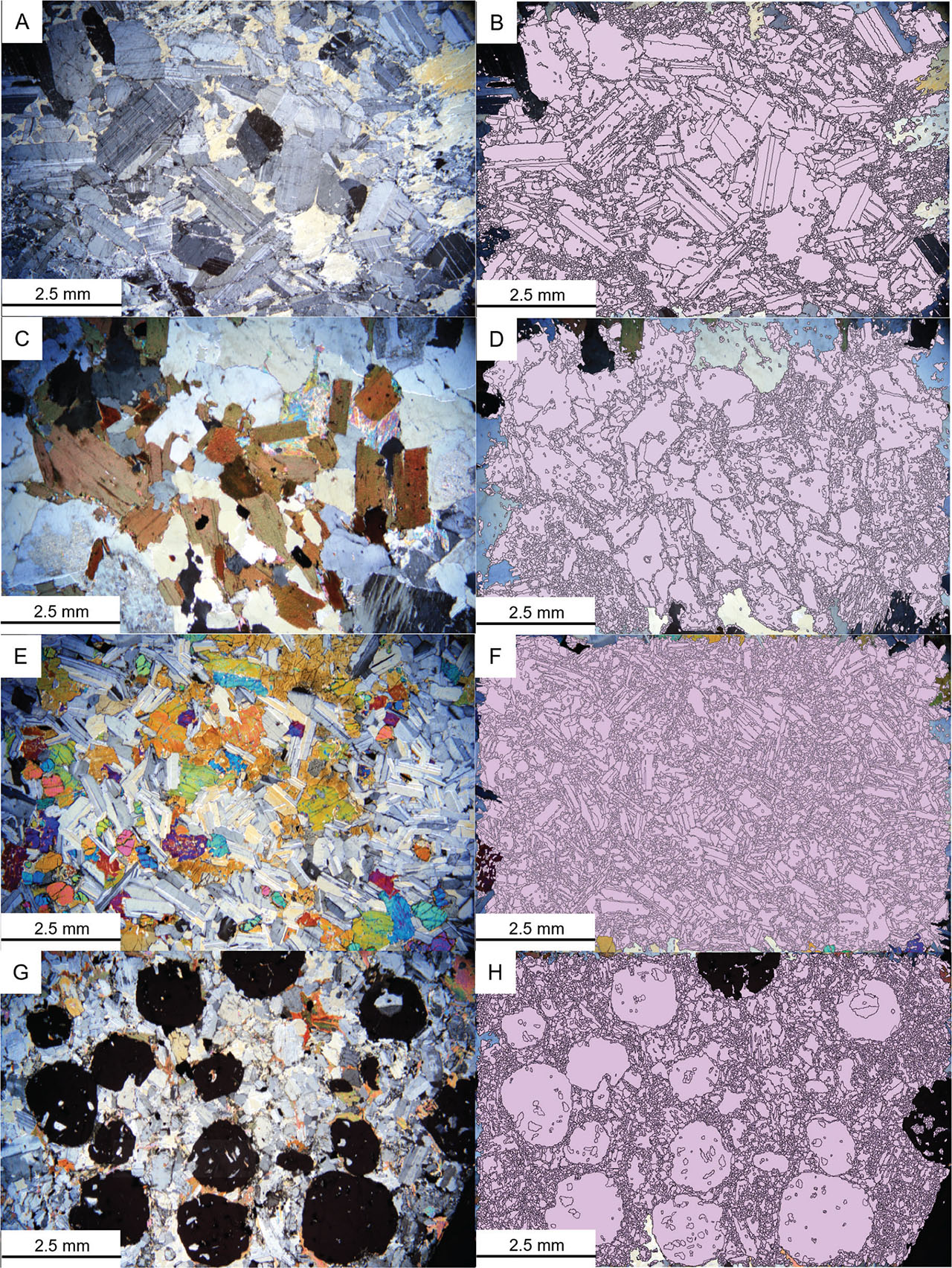
Figure 3.
Average interference colour images and MFA polygons for sample DRT 34 (A, B), sample A14 (C, D), sample D15 (E, F) and sample C20 (G, H). MFA, micro fabric analyser.
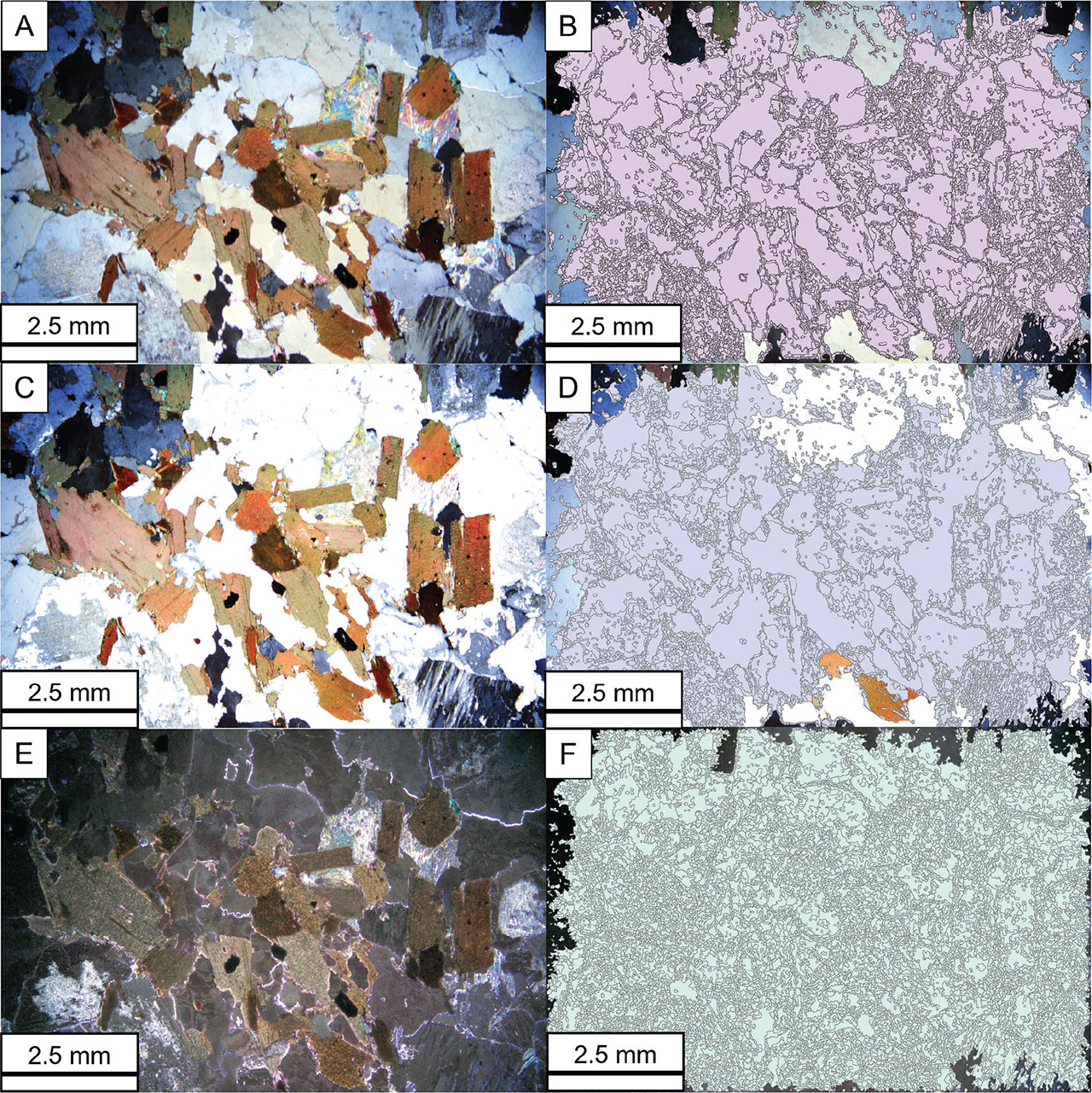
Figure 4.
Average Interference colour image for sample A14 along with polygons produced from grain segmentation (A, B). Maximum Interference colour image for sample A14 along with polygons produced from grain segmentation (C, D). Minimum interference colour image for sample A14 along with polygons produced from grain segmentation (E, F).
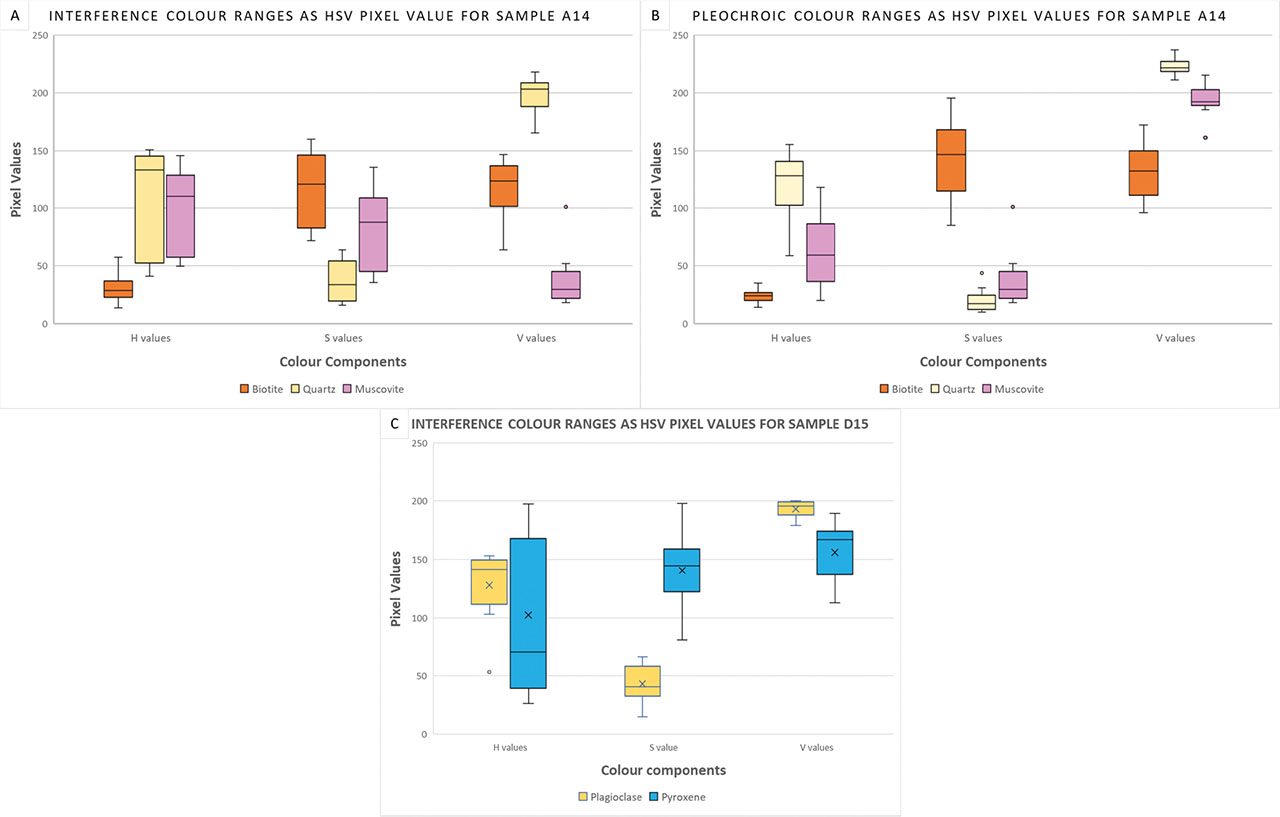
Figure 5.
Graphs showing the interference colour ranges (A) and the pleochroic colour ranges (B) for sample A14. (C) Graph showing the interference colour ranges for sample D15. HSV, hue, saturation and value.
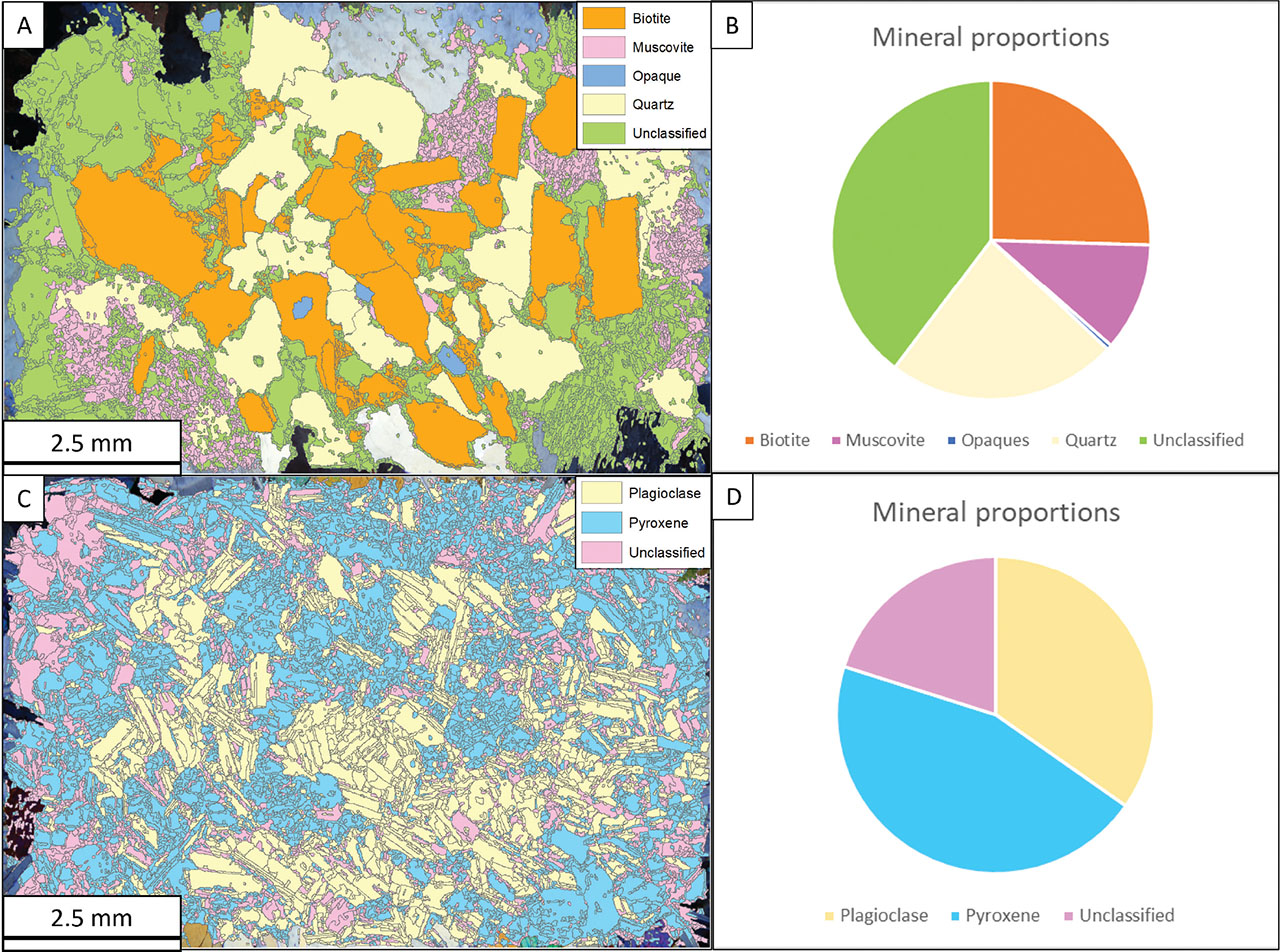
Figure 6.
Interference based classification for sample A14 (A, B) and sample D15 (C, D) along with mineral proportions.
Table 2.
Calculated extinction angles for biotite grains from sample A14.
| Grain ID | Calculated extinction angle |
|---|---|
| 5242 | 5.5 |
| 5498 | 7.8 |
| 6320 | 4.6 |
| 4302 | 0.7 |
| 6123 | 8.7 |
| 6119 | 6.7 |
| 2414 | 5 |
| 2142 | 1.8 |
| 7255 | 2.3 |
| 1983 | 4.5 |
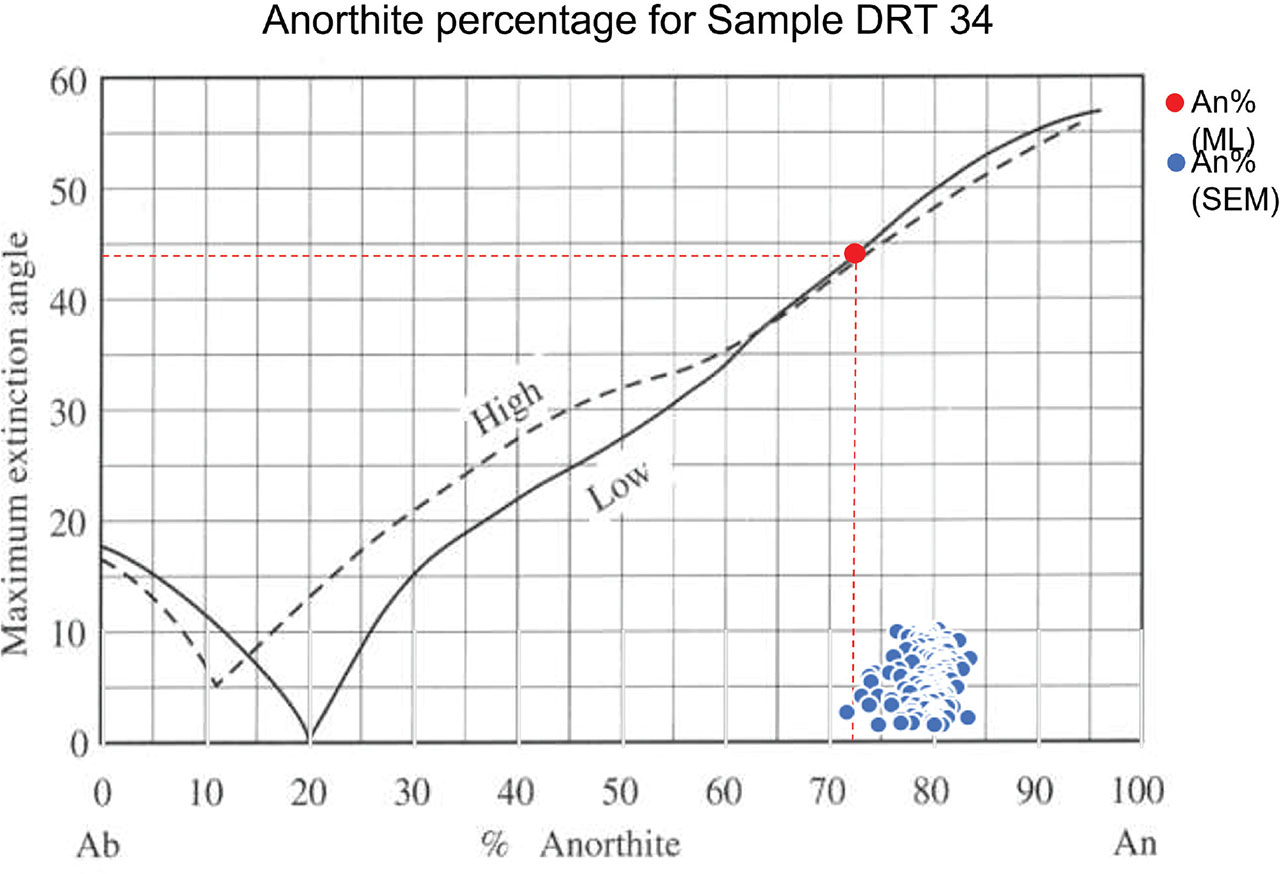
Figure 7.
The anorthite percentage for plagioclase grains in sample DRT 34 using both the Michel-Levy method and SEM analysis.
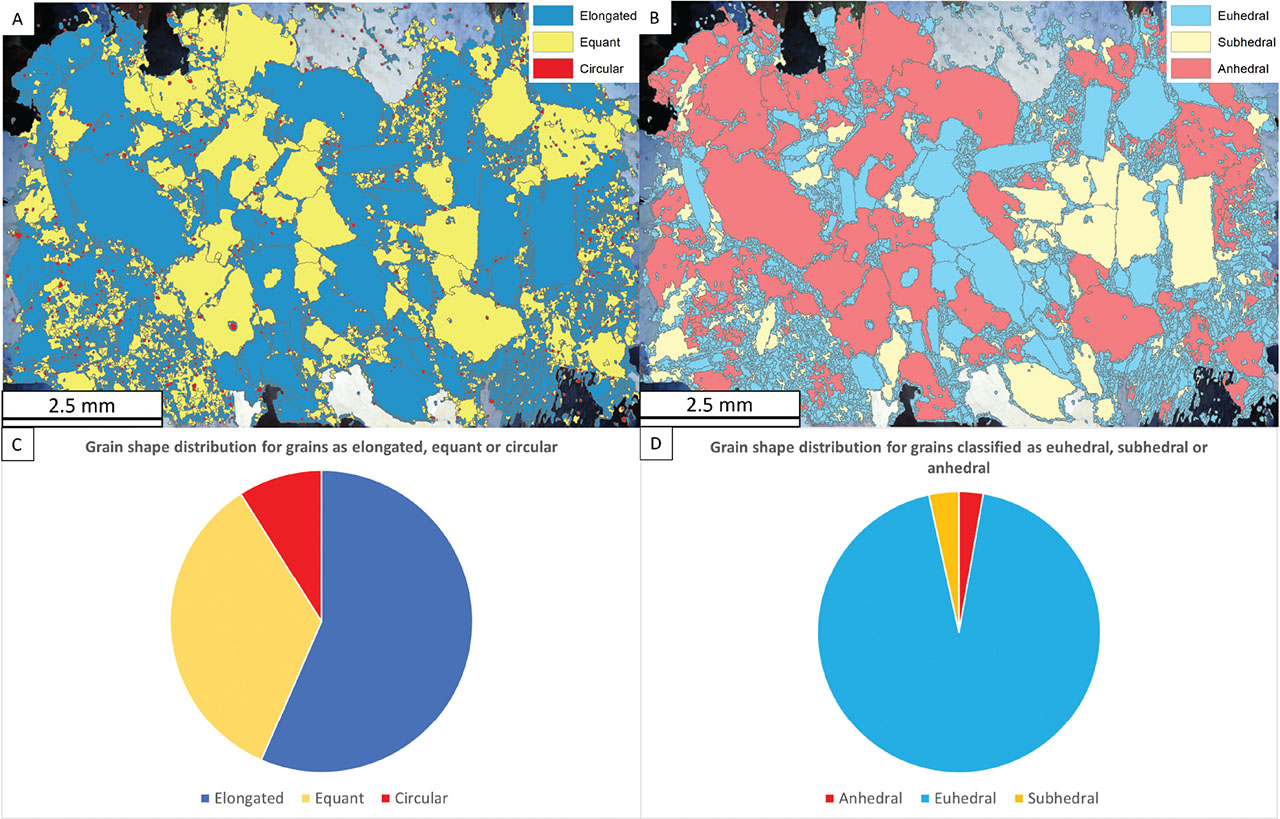
Figure 8.
Grain shape classification for sample A14. (A) Grains classified as either elongated, equant or circular. (B) Grains classified as either euhedral, subhedral or anhedral. (C) The distribution of grains classified as elongated, equant or circular. (D) The distribution of grains classified as euhedral, subhedral or anhedral.
Table 3.
Ranges used for classifying grains based on general proportions.
| Shape | AsR | Circularity |
|---|---|---|
| Elongated | >1.6 | n/a |
| Equant | <1.6 | <0.8 |
| Circular | <1.6 | >0.8 |
Table 4.
Ranges for classifying grains based on crystal shape.
| Shape | Convexity |
|---|---|
| Euhedral | >1.8 |
| Subhedral | <1.8 |
| >1.7 | |
| Anhedral | <1.7 |
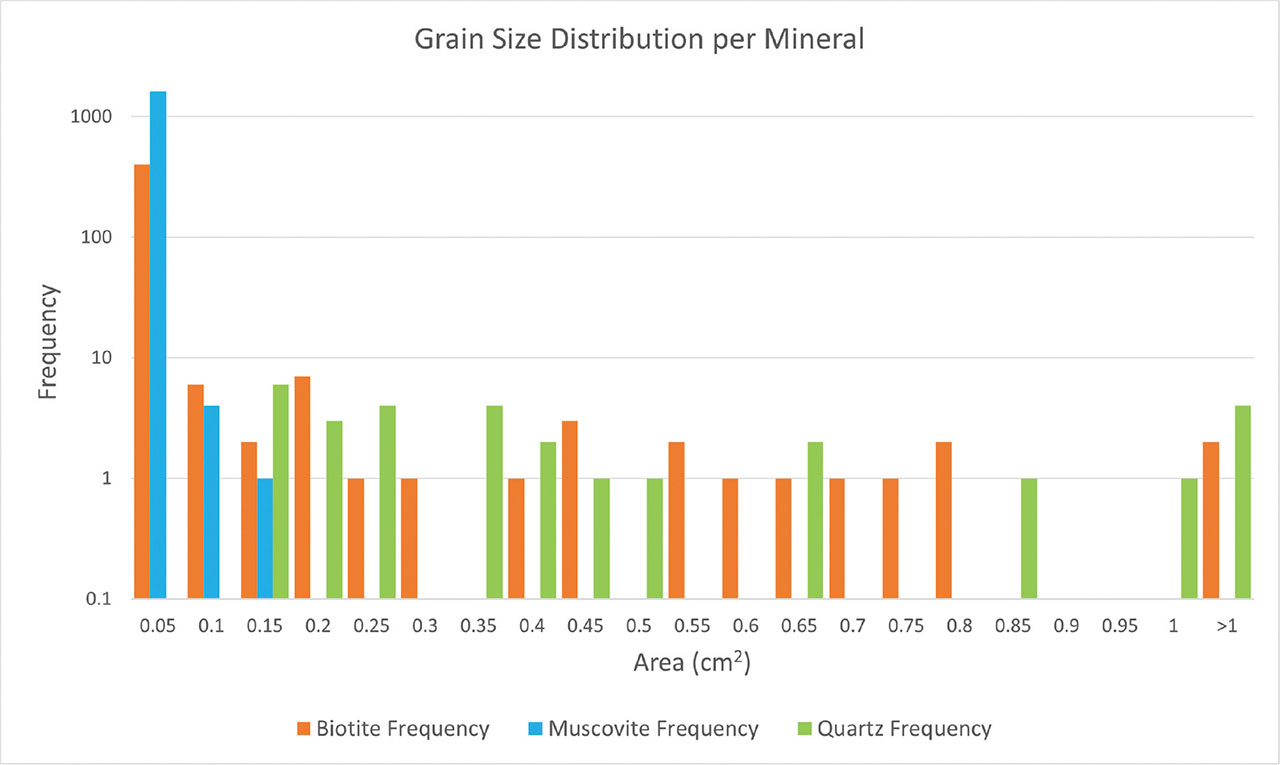
Figure 9.
Grain size distribution per mineral.
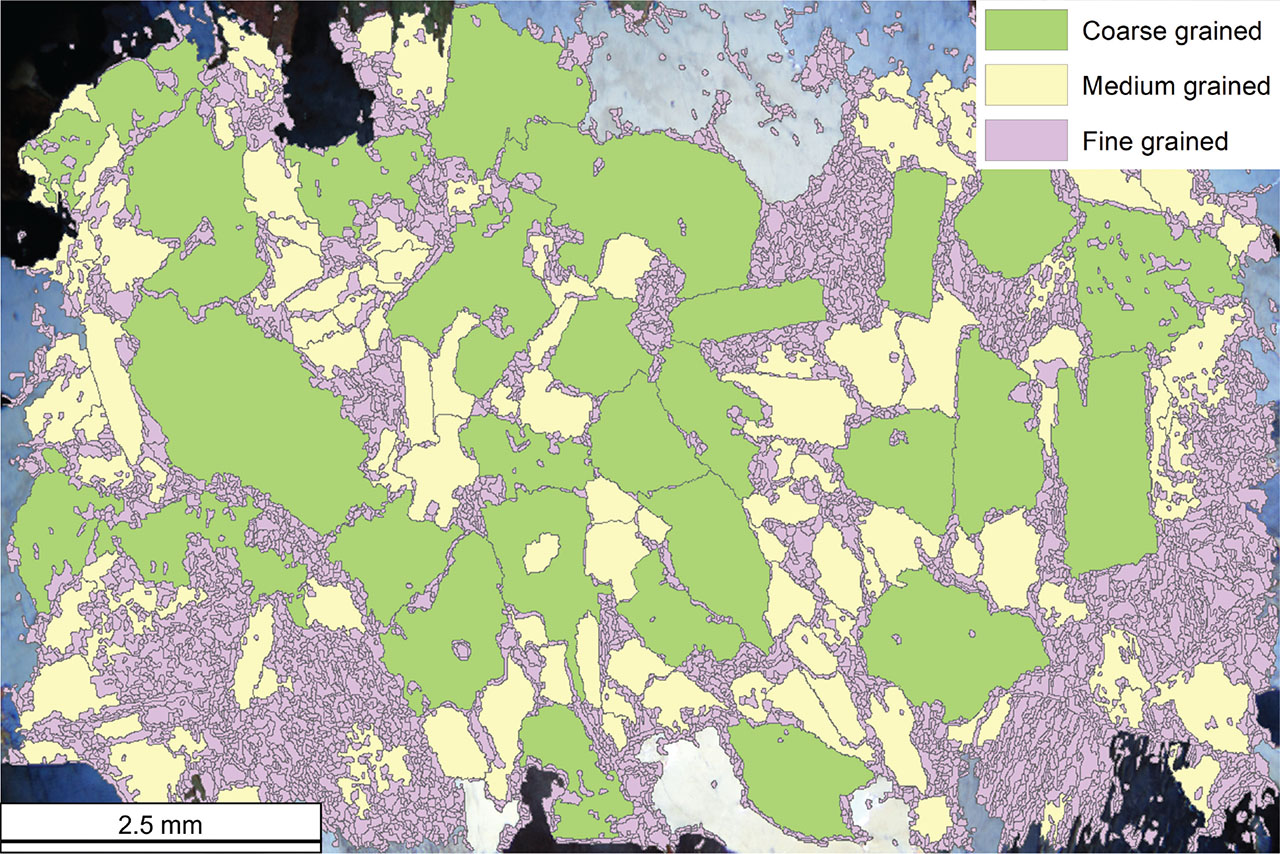
Figure 10.
Grains classified based on size as either coarse-, medium- or fine-grained.
Table 5.
Ranges for grouping grains based on size.
| Size | Pixels | cm2 |
|---|---|---|
| Coarse | >100,000 | >0.37 |
| Medium | <100,000, >10,000 | <0.37, >0.037 |
| Fine | <10,000 | <0.037 |
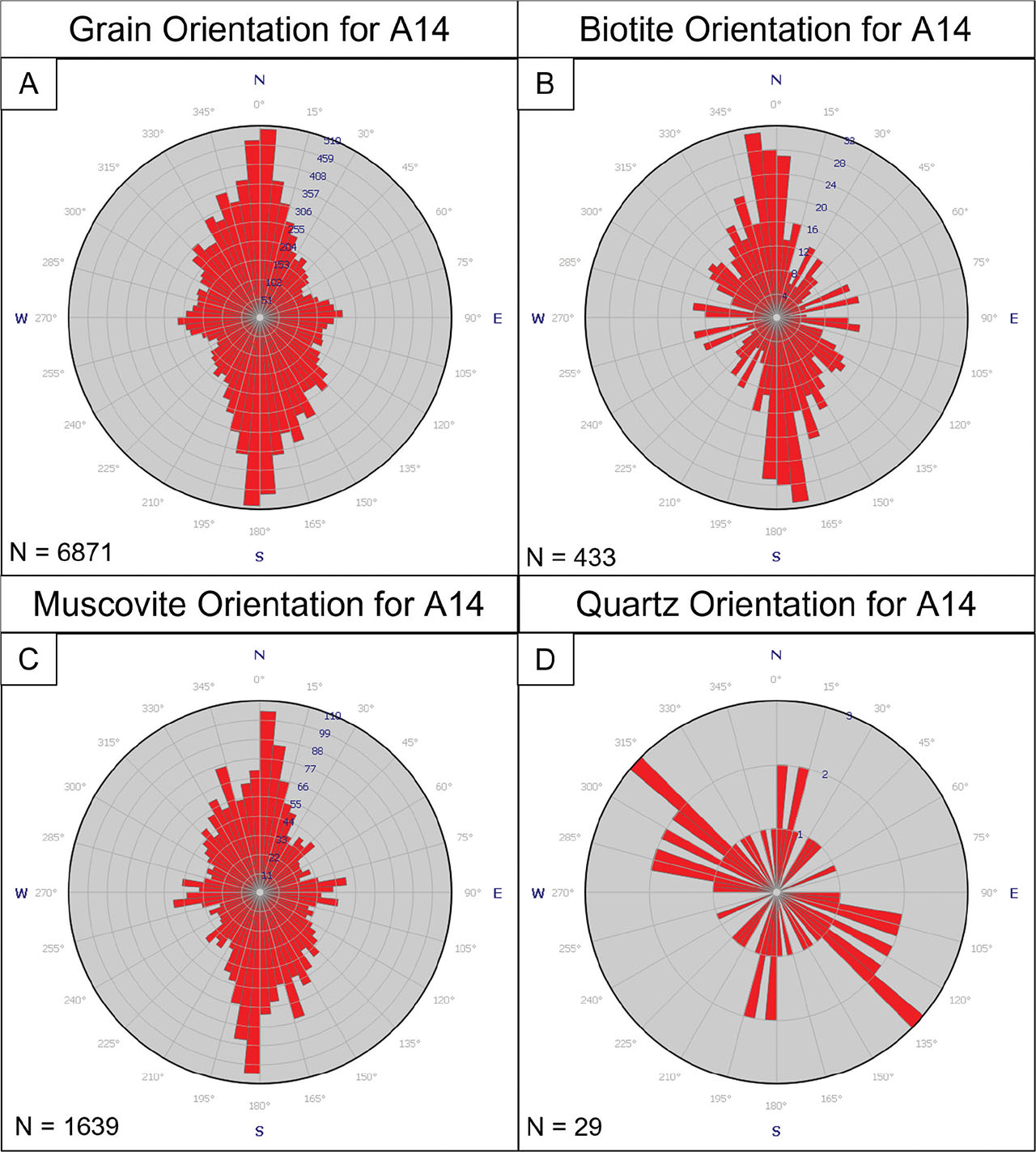
Figure 11.
Grain orientation with respect to the long axis for sample A14 plotted as rose diagrams. (A) Orientation of all grains within thin section. (B–D) Represent the orientation of the biotite, muscovite and quartz grains present.