Have a personal or library account? Click to login
Syn-volcanic melt-rock reactions recorded in peridotitic xenoliths from Scania, S Sweden Cover

Syn-volcanic melt-rock reactions recorded in peridotitic xenoliths from Scania, S Sweden

Open Access
|Feb 2025

Figures & Tables

Figure 1.

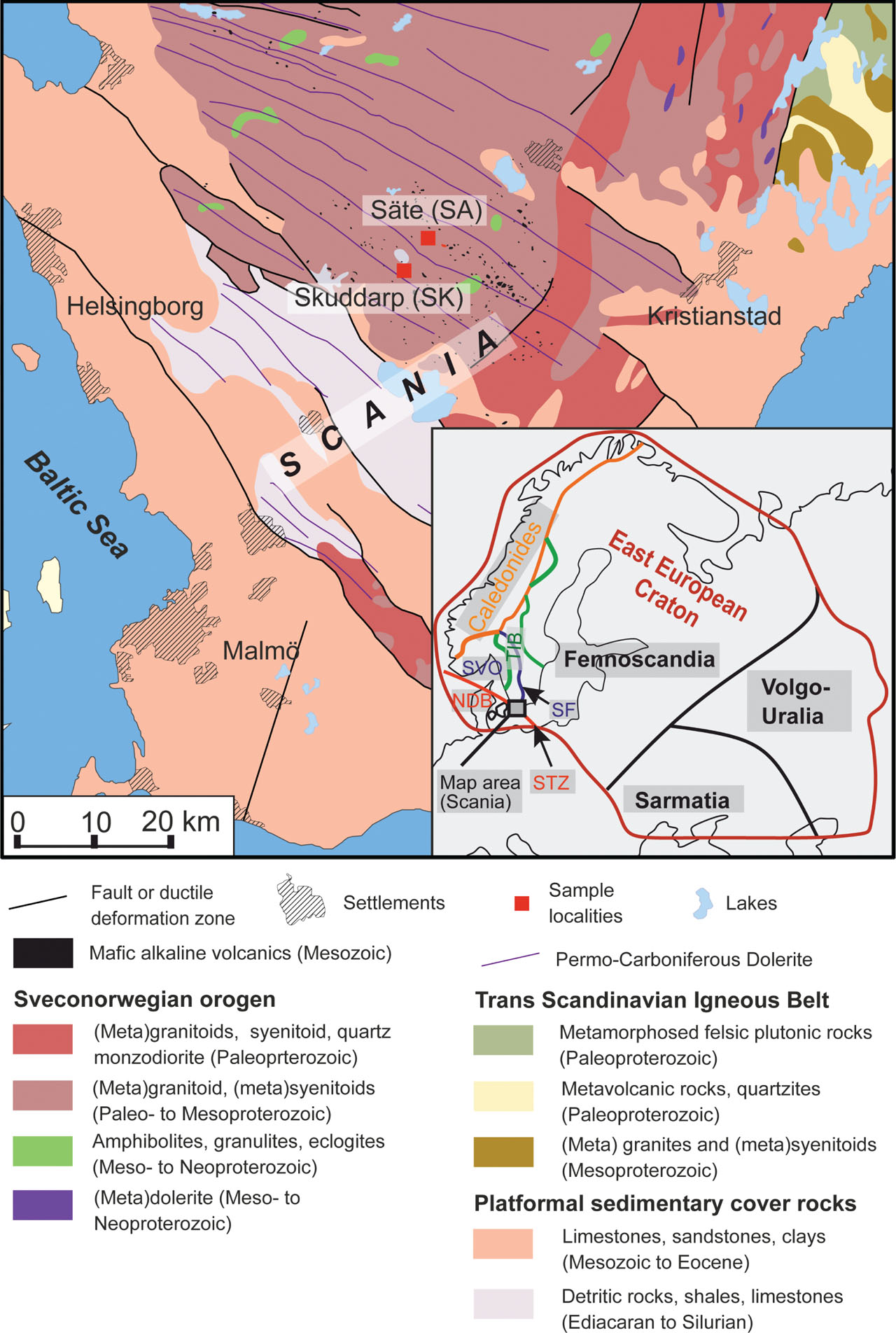
Localities of Mesozoic mafic alkaline volcanics in the Scania region, red squares mark vents from which the studied xenoliths were collected. Säte (SA), Skuddarp (SK). Inset shows schematic geotectonic position of Scania, STZ – Sorgenfrei-Tornquist Zone, SVO – Sveconorwegian Orogen, SF – Sveconorwegian Front, TIB – Trans Scandinavian Igneous Belt, NDB – Norwegian-Danish basin. Compiled from Asch (2005), Babuška & Plomerová (2004), Bingen et al. (2021) and Geological Survey of Sweden Digital Database (2018).
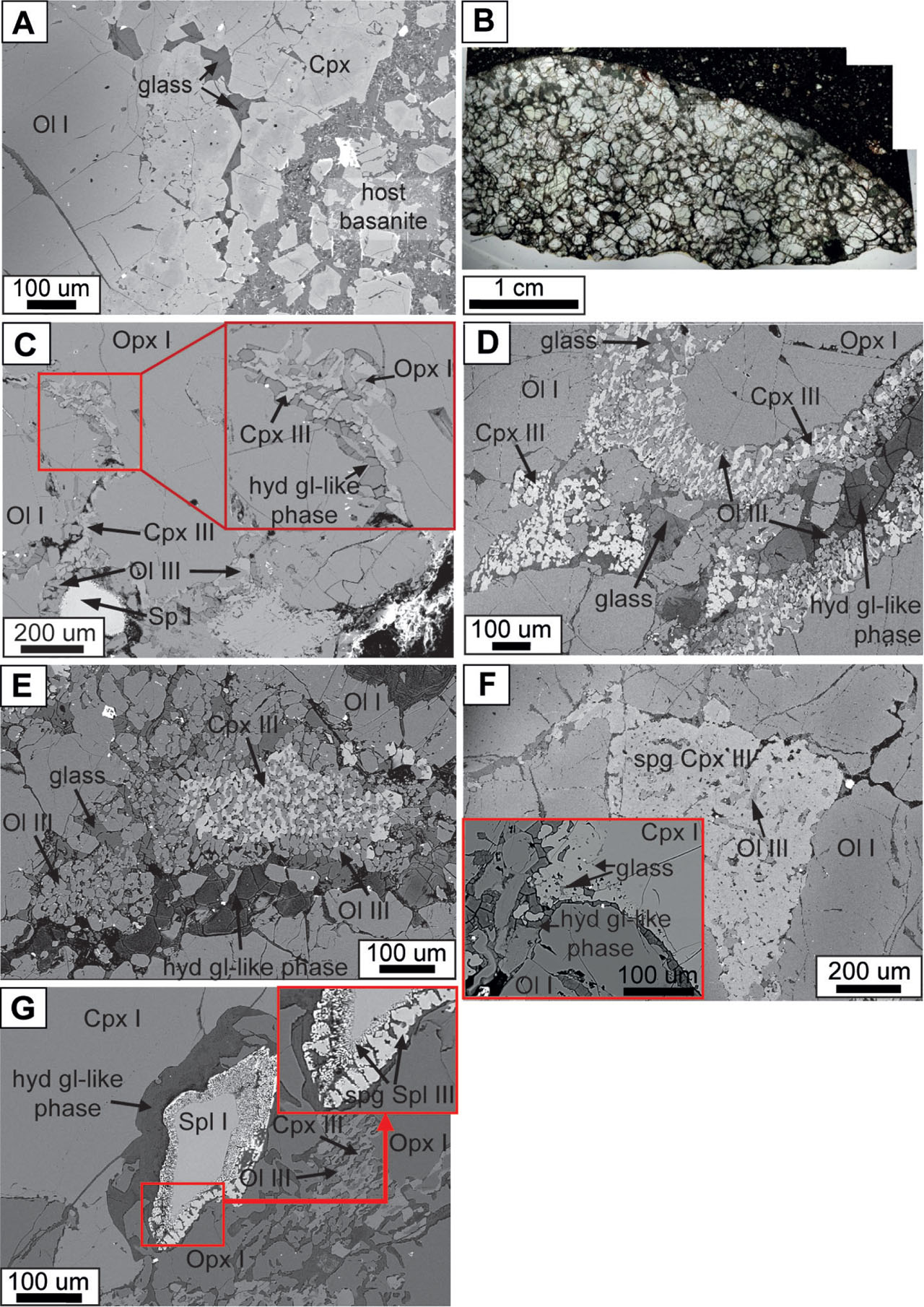

Figure 2.

Microtextural features related to presence of aggregates in peridotitic xenoliths from Scania: (A) Contact between the host basanite and xenolith SA28 (“back-scattered electron image” – BSE image); (B) Equigranular texture in sample SA28 (plane polarized light); (C) Thin aggregates occurring between grains of orthopyroxene I and olivine I, inset shows enlargement of the area indicated by rectangle (sample SA28; BSE image); (D) Thick aggregates formed of parallel crystals of clinopyroxene III and olivine III and glass enveloping orthopyroxene I and spongy clinopyroxene (lower left corner; sample SA28; BSE image); (E) Aggregates formed of clinopyroxene III, olivine III, and glass, note the absence of orthopyroxene I in the core (sample SA28; BSE image); (F) Spongy clinopyroxene enclosing grains of olivine III (BSE images); inset shows the spongy margin of clinopyroxene with minute pools of glass and surrounded by vein of altered, hydrous high Mg glass-like phase (sample SA28); (G) Spinel I grain surrounded by spongy rims (BSE images); inset show dual structure of spinel spongy rim (sample SK121); hyd gl-like phase stands for altered, hydrous, high Mg glass-like phase; spg stands for spongy.
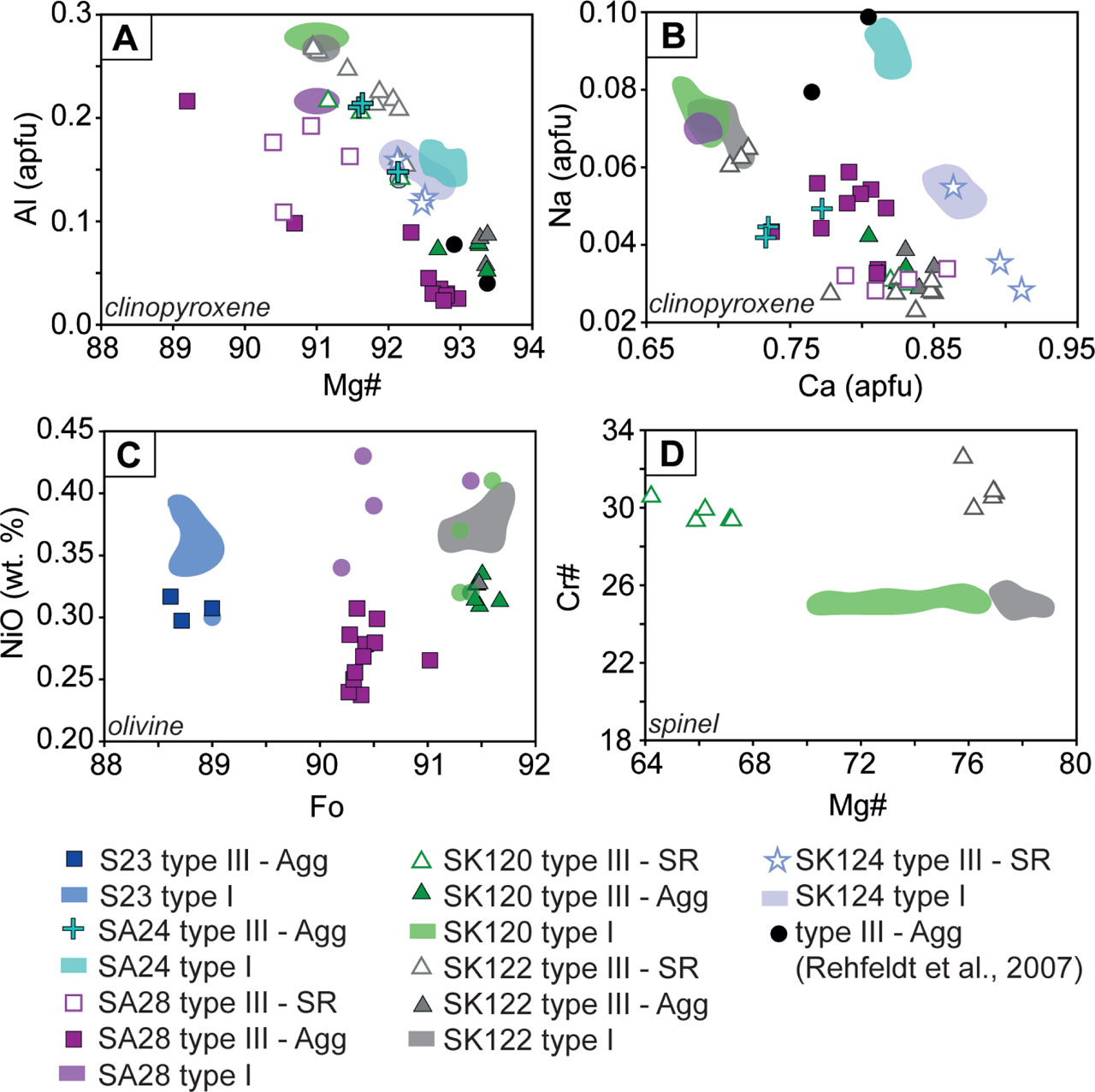

Figure 3.

The chemical composition of minerals: (A) Mg# vs. Al content in clinopyroxene III and clinopyroxene I; (B) Ca vs. Na content in clinopyroxene III and I; (C) Fo vs. NiO content in olivine III compared to olivine I; (D) Mg# vs. Cr# in spinel III compared to spinel I. Fields for type I minerals are given for comparison with a chemical composition of spongy (type III – SR) and aggregate-forming type III (type III – Agg) minerals (unpublished data by Mikrut et al.). Data presented in the figure are representative for clarity reasons; the full data set is given in the Supplementary Materials.
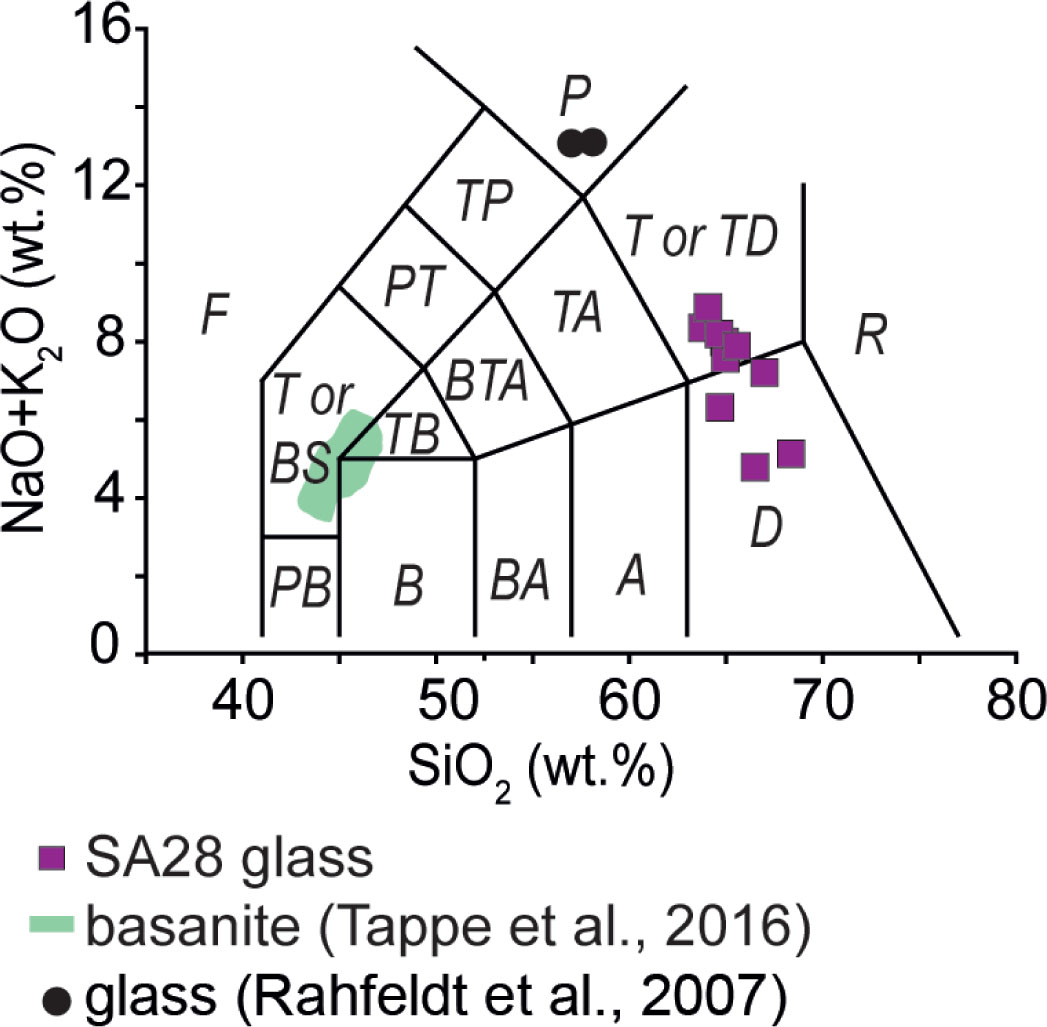

Figure 4.

The Total Alkali Silica diagram (after Le Maitre et al., 1989) showing the chemical composition of glass from Scania peridotitic xenoliths from this study in comparison to glass studied by Rehfeldt et al. (2007) and host basanite from Scania (Tappe et al., 2016).
DOI: https://doi.org/10.2478/mipo-2025-0002 | Journal eISSN: 1899-8526 | Journal ISSN: 1899-8291
Language: English
Page range: 4 - 12
Submitted on: Nov 10, 2024
Accepted on: Jan 8, 2025
Published on: Feb 19, 2025
Published by: Mineralogical Society of Poland
In partnership with: Paradigm Publishing Services
Publication frequency: 1 issue per year

© 2025 Anna Kukuła, Magdalena Matusiak-Małek, Jakub Mikrut, Theodoros Ntaflos, Leif Johansson, published by Mineralogical Society of Poland
This work is licensed under the Creative Commons Attribution 4.0 License.