
1. Introduction
With the rise of the knowledge economy, universities evolved from traditional teaching and research institutions into actors actively pursuing a “third mission” – the direct stimulation of economic development. Both national and EU public policies explicitly assign universities the task of driving economic growth and technological advancement, departing from the traditional model of knowledge confined to laboratories (Etzkowitz & Leydesdorff, 2000; European Commission, 2022). This expectation forced deep organizational change on academic institutions. Universities began establishing technology transfer centers (TTCs) on a large scale, deploying commercialization support programs – including on-campus incubators and science parks – and systematically deepening collaboration with industry. The initial wave of this infrastructure expansion (Siegel et al., 2003; Markman et al., 2005) has matured into fully embedded structural adaptations within contemporary academic ecosystems, including those in Poland (Szarek & Pachciarek, 2021; Łaskowska et al., 2023). The expansion of this infrastructure was intended to close the distance between scientific discovery and its market application. However, as recently diagnosed in the Draghi Report, the EU still faces a critical failure in translating innovation into commercialisation, meaning that a significant portion of knowledge generated by European universities remains commercially unexploited (Draghi, 2024). This structural challenge is particularly evident in countries undergoing dynamic economic transitions. For instance, the European Innovation Scoreboard (2025) highlights that while Poland has recorded one of the highest growth rates in innovation performance in the EU, it still remains classified as an “Emerging Innovator”, operating at roughly 66% of the EU average. This macro-level urgency underscores the critical need to identify and dismantle the operational barriers to technology transfer at the micro level, such as the competency asymmetries explored in this study.
Organizational expansion, however, frequently fails to produce market results. Empirical research points to a persistent gap between high levels of scientific excellence and actual commercialization outcomes, measured by the number of patents implemented, licensing revenues, and the formation of durable science–business partnerships (Geuna & Muscio, 2009; Perkmann et al., 2013). As highlighted by the OECD (2019), the effectiveness of these interactions is heavily constrained by the business sector’s own characteristics; specifically, firms often lack the technological capabilities and staff with scientific backgrounds needed to effectively absorb and implement academic knowledge. Even in the presence of strong financial support, the ultimate effectiveness of academia–industry interactions remains deeply unsatisfactory. To understand why public interventions fail despite sound structural assumptions, it is necessary to shift the analytical focus from macro-institutional frameworks to the operational capabilities of the researchers themselves.
This article analyzes competency asymmetries among academic researchers and their implications for R&D commercialization and technology transfer. Unlike the predominantly macro-structural analyses that dominate the literature, the focus here descends to the individual level, to examine the real and perceived capabilities of scientists themselves. A mixed-methods approach was employed: desk research, a quantitative CAWI survey administered to academic researchers, and in-depth qualitative interviews (IDI). This design allowed us to pursue three research questions:
Q1: How do researchers assess their research competencies relative to the skills required for commercialization and direct industry collaboration?
Q2: What role does prior practical experience in implementation play in differentiating these competency profiles?
Q3: How do researchers themselves perceive the systemic barriers that impede the translation of their findings into practical applications?
By shifting analytical weight to the individual researcher, the article complements existing approaches in innovation policy. Competency gaps are not treated here as purely individual deficits; rather, we show that these asymmetries constitute a systemic “bottleneck” in knowledge transfer, deeply rooted in the academic promotion system. By combining quantitative analysis with in-depth qualitative interviews, the study also illuminates the mechanisms that, day-to-day, perpetuate the phenomenon of commercialization reluctance. Early studies of university-industry linkages attributed this reluctance primarily to individual risk aversion and rigid institutional policies (Siegel et al., 2004). Current data confirm that these defensive attitudes remain pervasive, actively sustained by modern academic evaluation metrics and a persistent disconnect between scientific identity and market demands (Taxt, 2024; Mascarenhas et al., 2024).
The research was conducted in the context of the Polish higher education system, where relatively high levels of research achievement are still accompanied by low technology transfer effectiveness (Kwiek, 2021; Łaskowska et al., 2023). This context makes the phenomenon under study particularly legible – it shows that even with a well-developed support infrastructure, it is competency asymmetries at the individual level that constitute the systemic bottleneck blocking commercialization. The remainder of the article is structured as follows: Section 2 reviews the literature, Section 3 describes the research design, and Section 4 presents the empirical findings. Section 5 discusses the results; Section 6 presents concluding remarks and policy recommendations for universities and decision-makers.
2. Literature review and theoretical framework
2.1. Institutional and organizational determinants of technology transfer
Existing research on technology transfer focuses primarily on its institutional and organizational determinants. Early accounts framed the process through multi-actor models such as the Triple Helix (Etzkowitz & Leydesdorff, 2000). Over time, knowledge commercialization became an institutionalized “third mission” of the university (Geuna & Muscio, 2009). In response to these expectations, universities began establishing TTCs on a large scale. These served as intermediaries between science and business (Siegel et al., 2003). However, contemporary literature highlights that these early frameworks have evolved into broader innovation ecosystem models, such as the Quadruple and Quintuple Helix, integrating multiple stakeholders into a complex network of relationships (Carayannis et al., 2018; Łącka, 2020).
In Poland, the institutional landscape for technology transfer relies heavily on two specific entities: TTCs responsible for direct commercialization, and Special Purpose Vehicles (SPVs) established for indirect commercialization, such as creating spin-offs (Szarek & Pachciarek, 2021). Despite this developed infrastructure, the Polish innovation ecosystem faces severe structural limitations. A persistent structural barrier is the low absorptive capacity in firms (Muscio et al., 2013). Recent analyses of the Polish market demonstrate that a weak demand for innovation, combined with the low technological level of regional enterprises, continues to impede the effective uptake of new solutions (Łącka, 2020).
Furthermore, formal support instruments rarely guarantee success due to internal frictions within universities. A primary obstacle is the misalignment of incentive systems, rooted in the conflict between the academic logic of “open science” and the business need for market protection of knowledge. First articulated in early models of university-industry linkages (D’Este & Patel, 2007), these institutional frictions remain strongly perceived by today’s academics (Mascarenhas et al., 2024). Organizational barriers within universities themselves also play a significant role. Researchers confront rigid administrative procedures and overly restrictive approaches to intellectual property.
While early models identified excessive bureaucracy as the primary barrier (Siegel et al., 2003; 2004), recent empirical studies confirm that this problem persists strongly in the Polish context, where overwhelming administrative burdens continue to impede operational efficiency (Waligóra & Górski, 2022), and the deep bureaucratization of Polish academic institutions constitutes a major obstacle to industry collaboration (Szarek & Pachciarek, 2021). Rigid procedures frequently turn TTCs into functional “bottlenecks” of transfer (Markman et al., 2005). As a result, many researchers deliberately bypass official channels. Instead, they often prefer to commercialize through informal routes, drawing on personal business networks (Goel & Göktepe-Hultén, 2018; Van Burg et al., 2021; Taxt, 2024).
Though these diagnoses accurately describe the organizational reality, they reduce technology transfer almost entirely to the level of legal and administrative frameworks. Consequently, macro-level models too rarely account for the perspective of the researchers themselves (Perkmann et al., 2013) - an analytical gap that systematic reviews confirm is still prevalent in current literature (Perkmann et al., 2021; Zastempowski et al., 2024). These limitations call for a shift in focus - from the macro level to the individual, where the motivations and experiences of researchers themselves play the decisive role (Bercovitz & Feldman, 2008). Because macro-level organizational structures often fail to capture the operational reality of academic entrepreneurship, recent scholarship strongly advocates for examining the micro-foundations of technology transfer (Taxt, 2024; Werker & Hopp, 2020). In this perspective, the individual competencies and proactive engagement of researchers serve as the ultimate bridge between scientific discovery and successful market application.
2.2. Individual motivations and peer environment as micro-foundations of commercialization
Recent evidence highlights that the institutional environment plays a surprisingly limited role in technology transfer success. A comprehensive study on academic mobility reveals that university-specific factors account for only 15% to 30% of the geographic variation in commercialization spillovers, while individual researcher characteristics drive the vast majority of this difference (Lerner et al., 2024). This underscores that decisions to engage in industry collaboration depend primarily on a researcher’s individual goals. Individual characteristics shape these interactions more strongly than the disciplinary profile of the home department (D’Este & Patel, 2007). Direct financial gain is rarely the primary motivator. Scientists engage with business mainly to support their own research activity (D’Este & Perkmann, 2011). However, recent literature indicates a significant evolution in these drivers. Contemporary studies demonstrate a growing prominence of pro-social objectives (Perkmann et al., 2021), and reveal that pecuniary motivations – such as direct access to funding and the desire for commercialization – are increasingly becoming the primary drivers for formal university-industry collaborations (Mascarenhas et al., 2024).
Despite these shifting drivers, researchers firmly embedded in the traditional norms of the academic system often exhibit only symbolic compliance with new requirements. The lack of genuine motivation among academics to take on market risk (Bercovitz & Feldman, 2008) strongly persists. Many modern academics continue to view commercialization as a risky gamble disconnected from their core scientific identity (Fini et al., 2022; Taxt, 2024).
Individual decisions are, however, strongly moderated by the work environment. Research shows that commercialization decisions are shaped by social learning mechanisms and peer pressure (Bercovitz & Feldman, 2008; Tartari et al., 2014). Researchers emulate the decisions of colleagues with similar academic standing in their immediate environment. These peer effects operate through specific mechanisms of social influence, such as the acquisition and assessment of information, perceived social approval, and the construction of an entrepreneurial identity, which strongly legitimize commercial activities (Portyanko et al., 2023). This influence can be strong enough to produce deep dissonance: even researchers with a pro-implementation orientation frequently abandon commercialization when placed in a unit dominated by traditional academic logic (Bercovitz & Feldman, 2008).
Even when such willingness to engage is present, individual motivation and peer support must translate into effective collaboration within research teams. Recent studies from the Polish context demonstrate that commercialization success heavily depends on specific team roles – particularly the “creator” (who generates innovative concepts) and the “executor” (who translates theory into practice and coordinates implementation) (Zastempowski et al., 2024). Unfortunately, the practical realization of these roles faces systemic barriers. In Polish universities, commercialization often operates primarily as a formalized administrative procedure, and instruments for evaluating and rewarding researchers for their market-oriented efforts are relatively rarely used (Łaskowska et al., 2023).
A supportive environment and willingness to engage are, however, only a starting condition. They do not explain the difficulties that arise at the operational stage of bringing a technology to market.
2.3. Competency asymmetries in knowledge transfer processes
The effectiveness of market application ultimately depends on a researcher’s operational capabilities. Over a decade ago, scholars established that the key explanatory variable for engagement in market-facing ventures is entrepreneurial capacity – the ability to recognize opportunities and navigate high-risk environments (Rasmussen & Mosey, 2011; Clarysse et al., 2011). This individual capacity matters more than the mere existence of a technology transfer office. Today, this requirement remains just as critical. To effectively bridge science and market, researchers must actively develop integrative capabilities that translate results into concrete applications and transcend traditional disciplinary boundaries (Werker & Hopp, 2020; Fini et al., 2022). This transition requires proactive behaviors to acquire heterogeneous resources and build entirely new networks of industrial scientists, consultants, and investors (Perkmann et al., 2021).
Implementation competencies differ fundamentally from the traditional scientific toolkit. They include the operational refinement of market opportunities, resource orchestration from the external environment, and the leadership required to cross the “credibility threshold” in the eyes of investors (Rasmussen & Mosey, 2011). Even when willing to engage, researchers often lack the practical toolkit to independently navigate commercial realities. This specific deficit, originally noted in longitudinal studies of early spin-offs (Rasmussen & Mosey, 2011), remains a critical operational bottleneck in contemporary transfer processes (Werker & Hopp, 2020; Zastempowski et al., 2024). Because researchers strongly associate with their core academic identity and focus on intra-disciplinary research, they frequently face barriers in adapting to the logic of technology development, which is subordinated to the usefulness of knowledge for commercialization (Fini et al., 2022). Consequently, without building external networks to bridge the gap between academic discovery and industry application, effective transfer is severely hindered (Fini et al., 2022; Perkmann et al., 2021).
The problem is that academia rarely cultivates these entrepreneurial competencies. They are not typically taught during early-stage scientific training. More crucially, contemporary evidence confirms that this skills deficit is still actively reinforced by institutional structures. Modern promotion and evaluation systems continue to orient primarily toward publication records, offering almost no formal career benefits for engaging in time-intensive, practical industry projects (Taxt, 2024; Zastempowski et al., 2024).
2.4. The role of experience and the capability trap
Market-specific skills are acquired almost exclusively through experience. Entrepreneurial capabilities develop through iterative interactions with industry representatives (Rasmussen & Mosey, 2011). This is precisely why prior engagement in applied projects is the primary predictor of repeated researcher activity (Clarysse et al., 2011). Contemporary literature strongly corroborates this, emphasizing that accumulated entrepreneurial and non-academic work experience remains the most critical factor in mitigating role conflicts and bridging the cultural gap between academia and business (Gulbrandsen & Thune, 2017). The potential to gain this experience, however, can be blocked by vintage effects – academic norms are durably internalized at early career stages, so researchers socialized in an era of resistance to business exhibit lower propensity toward implementation (Bercovitz & Feldman, 2008). Recent evidence highlights that without early exposure to commercialization, researchers often struggle to adapt their professional identity to modern entrepreneurial demands, leaving them isolated from market-oriented networks (Gulbrandsen & Thune, 2017; Perkmann et al., 2021).
The absence of early experience sets off a negative feedback loop. Limited prior engagement impedes the development of practical operational skills (Rasmussen & Mosey, 2011). Insufficient competencies in turn reduce the likelihood of securing further commercialization experience (Clarysse et al., 2011). This phenomenon is described as a capability trap. Over time, it entrenches low levels of technology transfer, permanently constraining a researcher’s engagement. This capability trap is distinctly visible in the Polish academic setting. Recent empirical studies confirm that accumulated professional experience is one of the few contextual factors significantly increasing the probability of commercialization success among Polish researchers (Zastempowski et al., 2024). Those who manage to acquire such experience develop a deep understanding of industry realities, more extensive collaborative networks, and the effective communication skills necessary to convince potential business partners (Zastempowski et al., 2024). Conversely, for the vast majority trapped without initial practical exposure, breaking out of the cycle of insufficient competencies remains structurally improbable.
2.5. Research gap and conceptual framework
The literature on technology transfer typically separates organizational determinants from individual researcher competencies. Most contemporary work concentrates on macro-structures - support infrastructure and implementation metrics - while competency issues are often restricted to a narrow elite of spin-off founders or “star scientists”. The asymmetry between research and market competencies in the broader academic population remains underexplored (Perkmann et al., 2021; Zastempowski et al., 2024).
Recent policy interventions often assume that increasing the international mobility of researchers will naturally overcome these deficits, as international experience is generally proven to broaden scientists’ networks and directly stimulate academic entrepreneurship (Krabel et al., 2012). However, this assumption does not hold uniformly in the Polish context. Empirical evidence from this region reveals a specific “Polish paradox”: highly internationalized, “cosmopolitan” researchers do not exhibit higher rates of commercialization. Instead, it is the “local” scientists-those focused on the national research system-who are significantly more likely to successfully engage in academic entrepreneurship than their cosmopolitan peers (Bojko et al., 2021). This paradox demonstrates that simply internationalizing the academic environment does not automatically resolve the commercialization deficit if not accompanied by the development of practical implementation competencies.
These observations highlight a critical gap regarding the relationship between researcher competencies and the institutional environment of the university. While existing studies document how the academic setting blocks implementation, few examine how it is strongly related to researchers’ capacity to pursue it. To address this, the present study conceptualizes competency asymmetries as a functional bottleneck in technology transfer – one that operates at the individual level but is structurally produced by institutional incentive systems.
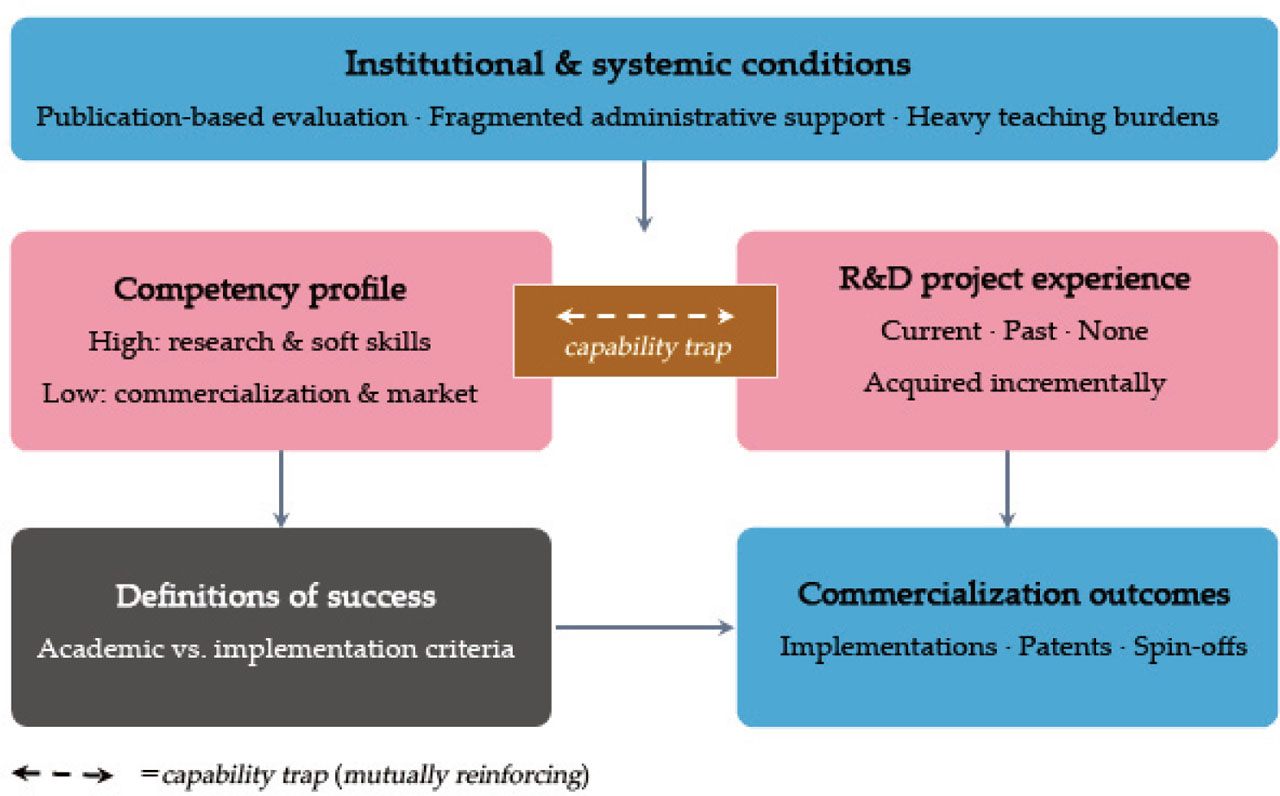
Figure 1.
Conceptual framework: key variables and their hypothesized relationships in technology transfer processes. Note: This figure maps the key variables and their hypothesized relationships as an orientation tool for the reader. Arrows represent conceptual paths derived from qualitative insights and observed patterns in the data, not statistically verified causal effects.
The framework presented in Figure 1 identifies five key variables examined in this study and maps the hypothesized direction of their relationships. Institutional and systemic conditions - including publication-based evaluation, fragmented administrative support, and heavy teaching burdens - shape the competency profile of researchers, producing an asymmetry between high research and soft skills and underdeveloped market competencies. This competency profile is closely intertwined with R&D project experience: limited experience constrains the development of practical skills, while insufficient competencies reduce the likelihood of engaging in further implementation work – a mutually reinforcing dynamic referred to here as the capability trap. Both the competency profile and the experience level interact with how researchers define success (academic versus implementation criteria), which in turn is associated with observable commercialization outcomes, such as the number of implementations, patents, and spinoffs.
3. Methods
3.1. Research design and analytical strategy
The study employed a mixed-methods approach built on a sequential triangulation logic. In the first phase, an exploratory qualitative study was conducted to identify perceived competency gaps and the institutional conditions that support or impede technology transfer. The findings from this phase informed the construction of the quantitative instrument used in the second phase, enabling the translation of qualitative insights into measurable population-level constructs. Integration of both strands occurred at the interpretation stage.
3.2. Qualitative study
3.2.1. Sample and data collection procedure
The qualitative study, based on individual in-depth interviews (IDI), was conducted in early 2025. This article analyzes a sub-sample of 20 academic researchers participating in a broader project. Purposive sampling was applied to ensure a diverse representation of academic disciplines. To address the competency asymmetry comprehensively, the sample included not only researchers from engineering, technical, and medical sciences, but also representatives of fields traditionally perceived as having lower commercialization potential, such as social sciences and the humanities. This specific selection was intended to cover a broad spectrum of academic researchers, ensuring that the analysis has a cross-sectional application and captures different models of scientific activity. The main inclusion criterion was hands-on experience in R&D projects with business partners. Focusing on experienced individuals constitutes a cognitive limitation, as it omits the initial barriers faced by unengaged academics. However, this criterion was essential to assess implementation competencies “in action” and observe the capability trap directly. Semi-structured interviews covered career trajectories, implementation experience, perceived competency gaps, and institutional barriers.
3.2.2. Qualitative analysis
Interview transcripts were subjected to thematic analysis. Coding focused on identifying recurring patterns across four domains: (a) the structure of competencies relevant to R&D, (b) competency gaps and their consequences for projects, (c) differences in the expectations of the academic and business environments, and (d) institutional conditions. The findings from this phase generated hypotheses and conceptual categories that were subsequently operationalized in the quantitative study.
3.3. Quantitative study
3.3.1. Sample and data collection procedure
The quantitative study was conducted in early 2025 using the CAWI (Computer-Assisted Web Interviewing) method. Invitations were distributed across 221 public and private higher education institutions through internal mailing lists, academic networks, and the Polish Association of Technology Transfer Centers (PACTT). The final analysis is based on 386 complete questionnaires submitted by academic researchers affiliated with Polish higher education institutions. To mitigate the risk of self-selection bias, we applied a structured purposive sampling strategy. Beyond the primary inclusion criterion of active university affiliation, the distribution targeted specific parameters to ensure a balanced representation of diverse scientific disciplines, academic degrees, and varying levels of prior R&D engagement (from none to extensive). This approach aimed to ensure that the sample reflected the structural diversity of the broader academic population.
3.3.2. Measures
Competencies were measured using an original self-assessment instrument developed on the basis of interview findings and the existing literature. Respondents rated their skill level across 12 detailed areas related to the implementation process – including networking, project management, negotiation, intellectual property protection, and funding acquisition. Ratings were made on a continuous scale from 0 (“no competency or experience”) to 100 (“very high level”). This parametrization was chosen deliberately to produce continuous indicators, which – unlike standard ordinal scales – enable more precise variance analysis and the examination of within-population interdependencies.
The measurement instrument was conceptually structured around four main domains: (1) research and methodological competencies, (2) R&D project management, (3) collaboration and communication competencies, and (4) commercialization competencies. To provide a more nuanced understanding of the existing gaps, the results are presented for each of the 12 specific competencies independently. The instrument was supplemented with hard metrics on prior R&D experience, the number and value of grants secured, implementation outcomes (including patents and capital exits), and perceptions of institutional barriers.
3.3.3. Data analysis
The data were analyzed using descriptive statistics, between-group comparisons. Competency profiles were cross-tabulated with levels of R&D project experience and researchers’ commercialization activity. Given the diagnostic and exploratory character of the study, analyses were oriented toward identifying systematic patterns and interdependencies rather than estimating causal effects.
4. Results
4.1. Sample characteristics and R&D engagement
The quantitative study analyzed responses from 386 researchers affiliated with Polish universities. The sample was dominated by those employed in combined research-and-teaching positions (74.9%), with smaller shares in teaching-only (19.2%) and research-only (5.9%) roles. By academic degree, the largest groups were holders of a PhD (53.6%) and habilitated PhD (27.5%), followed by professors (9.8%) and master’s degree holders (9.1%). Respondents represented a broad range of disciplines, with the largest shares in engineering and technical sciences (24.2%), social sciences (16.4%), and medical and health sciences (10.7%). Mean academic tenure in the sample was 19.6 years (Md = 18.5). Among those reporting R&D experience (N = 312), mean time engaged in R&D projects was 12.5 years (Md = 10.0).
Table 1.
Academic tenure and R&D tenure – overall values (N = 386).
| Indicator | Mean (years) | Median (years) | N |
|---|---|---|---|
| Academic employment length - overall | 19.6 | 18.5 | 386 |
| R&D experience | 12.5 | 10 | 312 |
Table 2.
Distribution of respondents by academic degree (N = 386).
| Academic degree | Number of respondents | Percentage share |
|---|---|---|
| PhD | 207 | 53.6% |
| Habilitated PhD | 106 | 27.5% |
| Professor | 38 | 9.8% |
| Master’s degree | 35 | 9.1% |
In terms of implementation experience, the data point to polarization within the sample. At the time of the study, among those responding to this question (n = 319), 64.9% (n = 207) reported active involvement in R&D projects, while 35.1% (n = 112) were not engaged at that point. The data also show that over half of respondents (52.2%) had not participated in any externally funded projects (grants), while 21.0% had completed three or more. Among researchers currently running R&D projects, the mean number of implemented solutions was 1.59 and patent applications 0.96. Among those with historical experience only, these figures were 0.90 and 0.33 respectively.
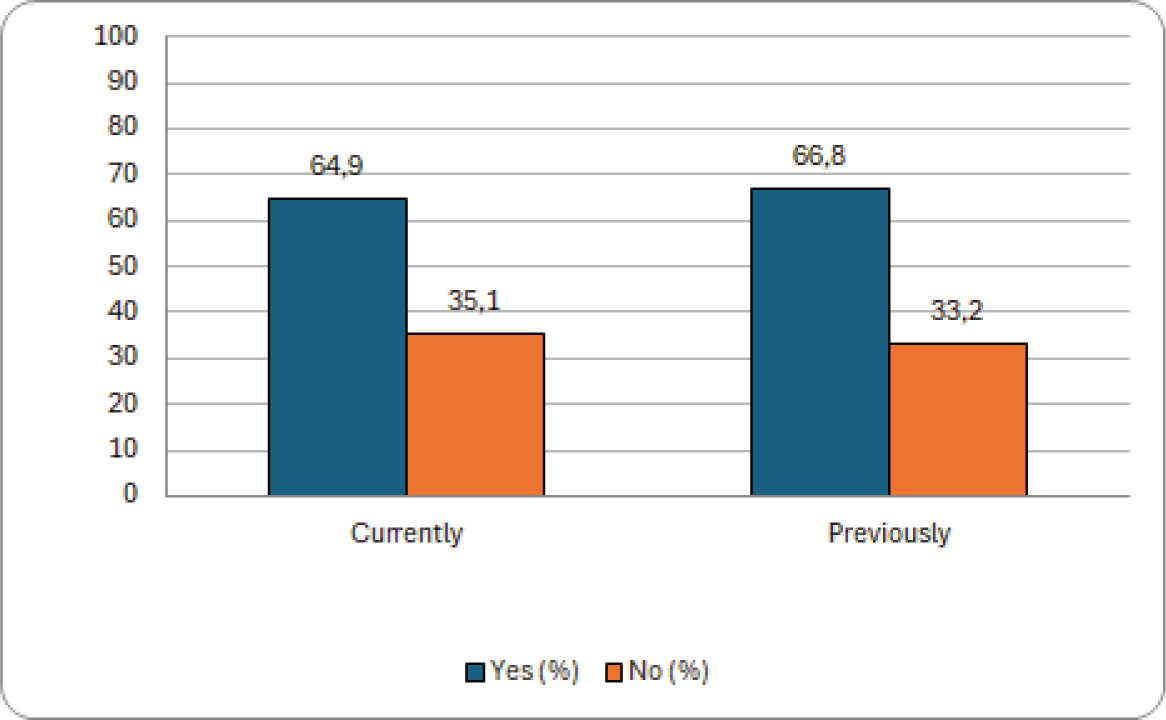
Figure 2.
Current and past R&D activity (N = 319–386*). *The number of observations varies slightly across different variables due to the specific questions asked: 312 respondents reported having at least one year of R&D experience, whereas 319 answered the question about their current R&D activity (207 active and 112 inactive). Past participation in R&D activity of any kind was reported by 258 respondents (66.8% of the full sample N=386). Source: Own elaboration based on CAWI survey results (N = 319–386).
From the in-depth interviews, respondents’ R&D engagement took varied forms - applied research oriented toward specific market applications, participation in large industry consortia, the founding of university spin-offs, and acting as technology brokers. This engagement produced tangible application outputs: patents and technology commercialization across sectors ranging from psychological diagnostic tools and veterinary preparations to advanced engineering solutions and artificial intelligence applications. The practical character of this work is captured by one respondent’s account of a project cycle: “The main output was a patent application (…) It was commercialized very effectively. The company then launched the product after a year and a half.”
4.2. Self-assessed competency levels
As shown in Figure 3, the CAWI measurement (on a continuous 0–100 scale) reveals a clear asymmetry in researchers’ competency profiles. Respondents rate their soft skills highest (M = 74.8), along with organizational capabilities such as team-building. At the opposite end sit the strictly transfer-related domains. Implementation of research results and their commercialization received the lowest ratings in the entire sample (M = 32.8 and M = 29.7 respectively).
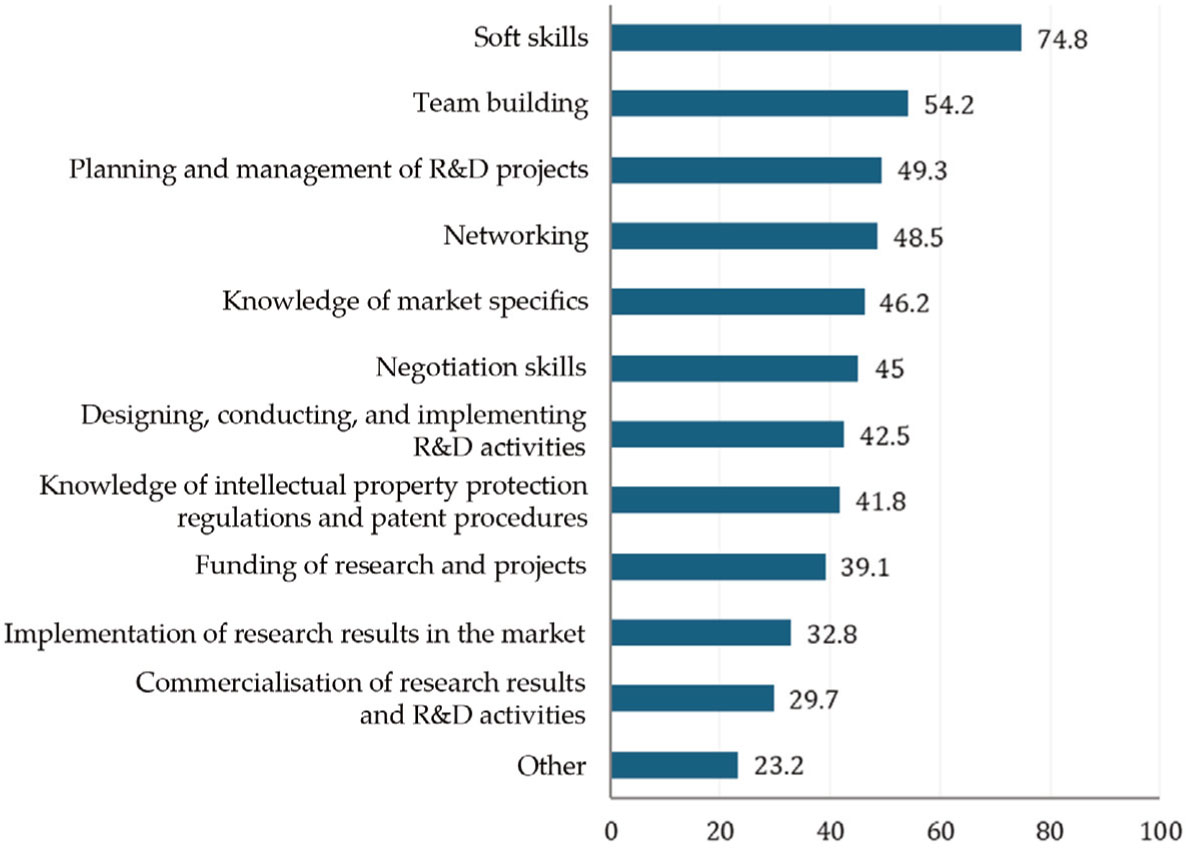
Figure 3.
Mean competency ratings across R&D activity domains – mean score per competency on a 0–100 scale (N = 386). Note: The ’Other’ category aggregates diverse, self-reported competencies dynamically specified by respondents outside the predefined list. Due to its high heterogeneity, the mean scores for this category should be interpreted with caution. Source: Own elaboration based on CAWI survey results (N = 386).
This asymmetry is persistent – even after excluding respondents who reported no experience at all, self-assessed competency in commercialization (M = 37.6) and implementation (M = 41.9) remained at the bottom of the competency hierarchy.
In the in-depth interviews, respondents asked to evaluate their own skills highlighted the high utility of soft and communication competencies. One researcher emphasized that working with business “requires even a change of language – to one that is understandable” to people outside the academic environment. In areas where respondents acknowledged deficiencies, they pointed primarily to legal, patent, and business knowledge. One participant described his early encounters with investors as follows: “I was thrown to the wolves of business. There is a gigantic gap in a scientist’s knowledge compared to people from business (…) we get played by people on the other side.” Another noted a deficit in “knowledge about not even specific regulations, just the basic fact that certain things are regulated, or how billing works – that kind of (…) business knowledge.”
Respondents’ attitudes toward acquiring these competencies varied. Some stressed that technology transfer requires familiarity with concepts such as “patent law, industrial property law, trade secrets, non-disclosure agreements.” Others declared a conscious reliance on specialized university units, arguing: “These formal matters are so secondary to me that I don’t even know what I’m signing (…) I have no intention of acquiring those competencies. I think everyone should focus on what they know.”
4.3. Competency variation by experience level
R&D experience level differentiates researchers’ competency profiles. The highest values across all analyzed domains (with the exception of soft skills) were recorded in the group currently engaged in implementation projects, lower among those with historical experience only, and lowest among researchers who had never participated in such activities. This stratification is strongest in areas requiring direct project practice.
Table 3.
Self-assessed competency levels across R&D experience groups – mean score per competency on a 0–100 scale (N = 386). Note: The ’Other’ category aggregates diverse, self-reported competencies dynamically specified by respondents outside the predefined list. Due to its high heterogeneity, the mean scores for this category should be interpreted with caution.
| Competency | Currently conducts (n=207) | Conducted in the past (n=51) | Never conducted (n=128) |
|---|---|---|---|
| Soft skills | 76.37 | 72.92 | 73.12 |
| Networking | 52.46 | 47.35 | 39.34 |
| Market knowledge | 50.15 | 44.32 | 38 |
| Obtaining funding | 44 | 35.44 | 22.38 |
| Team building | 60.37 | 52.83 | 34.86 |
| Planning and management of R&D projects | 55.9 | 49.4 | 27.28 |
| Negotiation skills | 48.57 | 42.17 | 34.78 |
| Intellectual property protection | 46.56 | 41.79 | 30.4 |
| Commercialization of R&D results | 33.43 | 30.04 | 18.82 |
| Implementations | 37.46 | 33.04 | 18.72 |
| Other | 30.87 | 15.92 | 16.9 |
In interdisciplinary team-building, self-assessed competency drops from M = 60.3 in the active group to M = 34.8 in the group with no experience. A comparable gap was recorded in planning and management (M = 55.9 vs. M = 27.2), implementation (M = 37.4 vs. M = 18.7), and commercialization of results (M = 33.4 vs. M = 18.8). At the same time, the data show that transfer competencies rise systematically with overall academic tenure, while soft skills remain at a similar level regardless of career stage.
The interviews confirm that market and managerial skills were acquired incrementally, only through the execution of specific projects. Early in their careers, respondents lacked practical knowledge of how to collaborate with business. One participant, recalling his own beginnings after completing his studies, described it this way: “The first project ended with something getting done, and that was it (…) a young guy fresh out of university came to the company and couldn’t even hold a conversation, let alone negotiate. And then those competencies grew, because you started getting into it (…) you have to learn them over time.” Accumulated experience also helps avoid formal mistakes in future projects. As another participant noted, “the older you get, the more you know about commercialization,” which allows for better protection of one’s interests vis-à-vis investors. Competency acquisition is thus grounded in direct correction based on prior difficulties: “once I encountered that kind of problem, I tried to resolve those things differently in subsequent R&D projects.”
As experience accumulates, researchers also change how they organize their work. In team-building, they move away from ad hoc selection of collaborators toward leveraging established networks – choosing partners “by feel,” based on prior relationships and knowledge of “who can be trusted.” Implementation practice, including work on complex projects, also forces a change in research methodology itself. Respondents noted the need to allocate markedly more resources to the early stages of a project, citing as a newly acquired practical competency the fact that “we devoted a large part of the time – most of the time – to planning,” in contrast to how they had managed projects before. Managerial and commercialization skills are acquired primarily through experience: respondents reported that formal training rarely covers real implementation problems, and the necessary market and formal knowledge “comes more from experience than from a course.”
4.4. Institutional support and access to competency development
Only 35.2% of CAWI participants had ever used any form of formal development support (training, workshops, advisory services) in R&D or commercialization. The availability of institutional support at universities was rated on average at just 30 points on a 0–100 scale, with a high standard deviation (SD = 31.2) indicating extreme variation in these experiences across the population. The quantitative data show that respondents’ most pressing need is relief from administrative and formal burdens – 247 respondents identified urgent need for administrative support in preparing project documentation and managing grants. These quantitative findings were consistent with the qualitative material.
The qualitative material clarifies that the low rating of university support stems from fragmented structures and an excess of administrative procedures. Researchers reported that units established to handle technology transfer operate in isolation, with numerous separate offices on campus where “everyone has their own desk, their own department” – making navigation and coordination drastically difficult. Rather than receiving help with grant management, scientists often find themselves “fighting their own internal unit” over basic equipment purchases or timely approval of contracts with external partners. Rigid procedures and unfamiliarity with the specifics of implementation projects produced situations in which external partners withdrew from collaboration for purely procedural reasons, because the university lawyer “didn’t sign some document.” Respondents expressed a clear need to separate substantive functions from administrative handling, so that researchers can focus on the technological work rather than “sitting on Zoom calls with lawyers.”
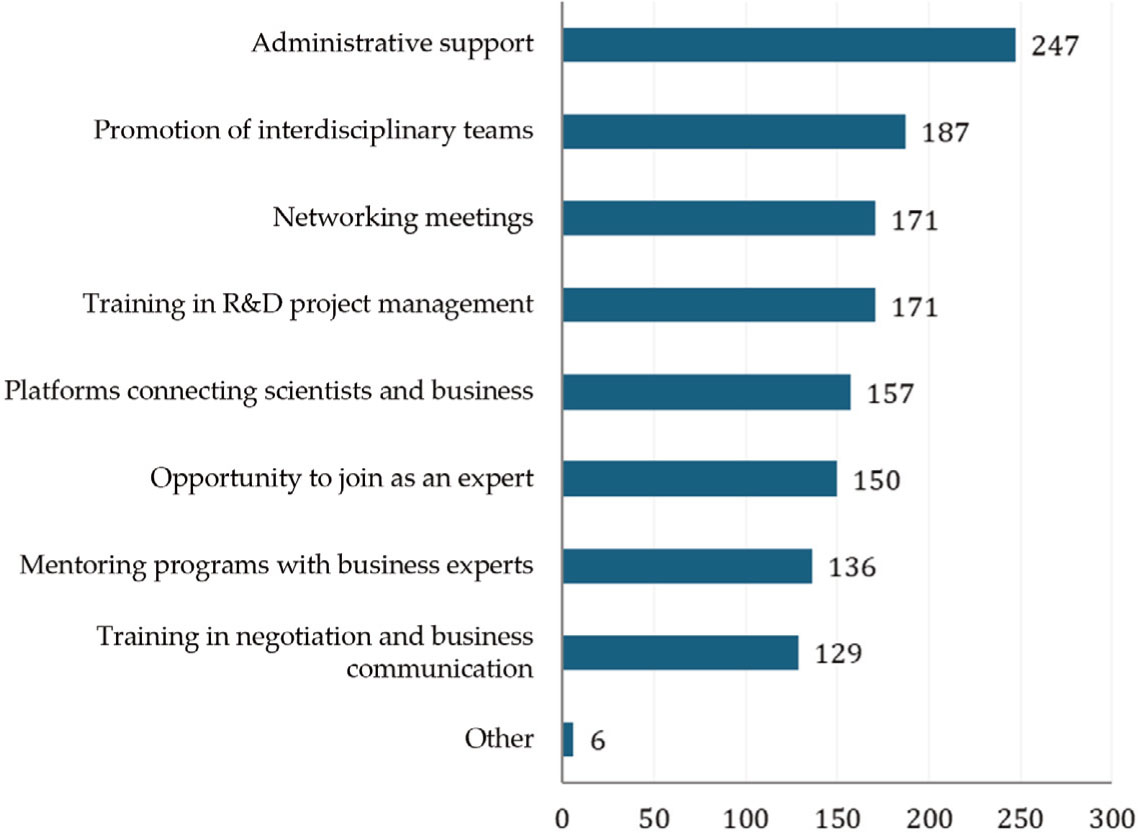
Figure 4.
Most expected institutional support actions to facilitate business collaboration (multiple choice, N = 386). Source: Own elaboration based on CAWI survey results.
On access to competency development, respondents were critical of the courses widely on offer. Training provided by agencies or external providers is frequently seen as too generic, aimed at people setting up simple one-person businesses - entirely disconnected from the realities of high-technology commercialization. Respondents stressed that meaningful implementation education requires instructors “from the border of these two worlds,” capable of combining scientific rigor with hard market practice. A systemic absence of training preparing early-career researchers – including doctoral students – for key practical stages of funding acquisition and implementation was also identified: constructing business plans, defending projects before expert panels. In the absence of institutional support, researchers are left to acquire this knowledge by trial and error, or by seeking informal advice from foreign collaborators immediately before high-stakes appearances before grant evaluation committees.
4.5. Definitions of success and commercialization outcomes
Among the most frequently declared indicators of R&D project success in the CAWI study were strictly academic outputs and market collaboration. The quantitative data show that 58% of respondents (n = 224) associate success with business cooperation resulting in a concrete outcome, and 56.5% (n = 218) with publications in prestigious journals.
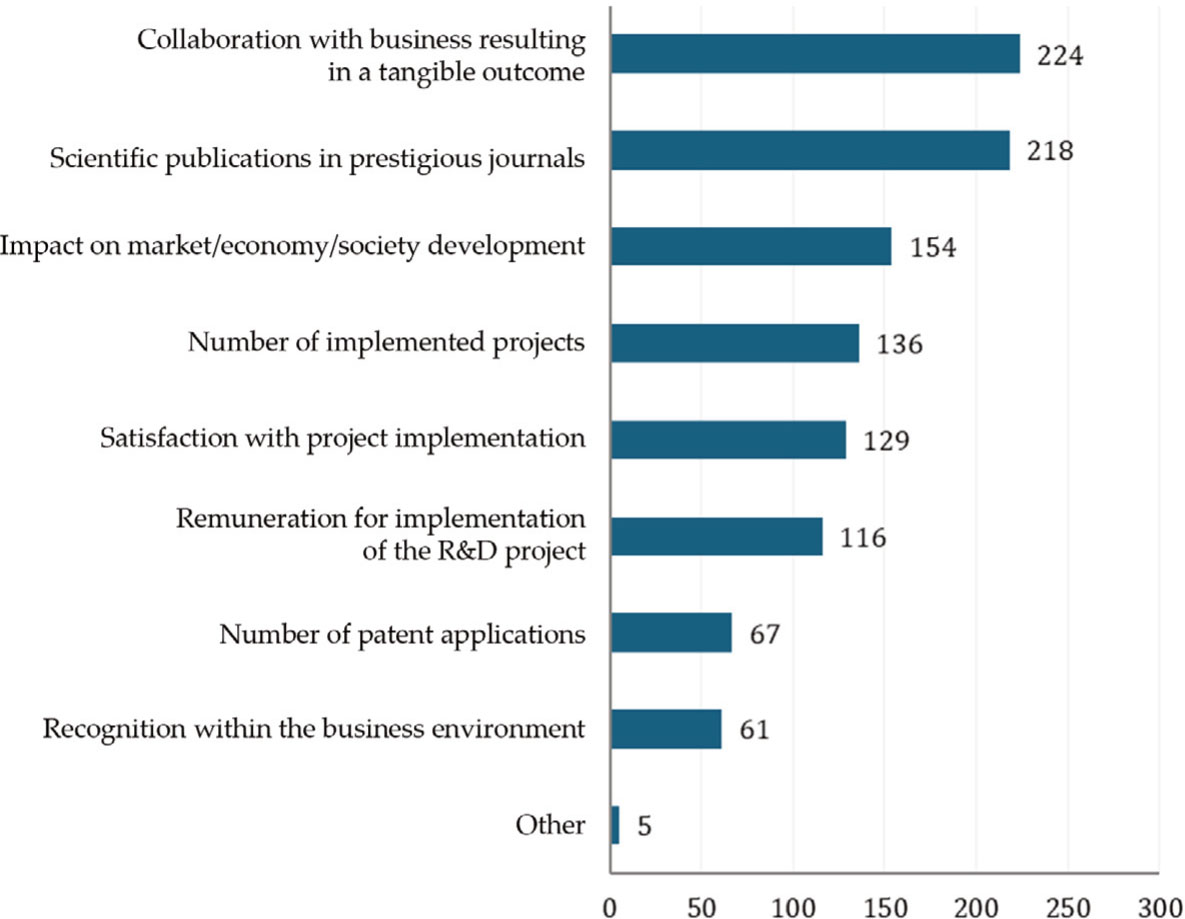
Figure 5.
Researchers’ definitions of R&D project success (multiple choice, N = 386). Source: Own elaboration based on CAWI survey results.
The analysis shows that higher objective commercialization activity characterizes exclusively those researchers who define success in ways open to application outcomes – these respondents achieve measurably higher numbers of implementations and patent applications. Researchers who evaluate R&D success primarily through academic indicators (such as publications) or personal satisfaction show no elevated level of technology transfer, regardless of their experience. However, it should be noted that this relationship may be endogenous: due to the cross-sectional nature of the data, it cannot be definitively stated whether a market-oriented definition of success drives commercialization, or if researchers actively engaged in commercialization retroactively adjust their success criteria to match their ongoing practice.
The interview material identifies two distinct models of how researchers define the purpose of R&D work. The first reduces success to its formal-academic dimension. For some respondents, the priority is closing the administrative framework correctly – “getting and settling the project” and meeting the indicators imposed by “the legal framework for evaluating academic staff.” In this model, the primary goal becomes “producing some kind of output that is, let’s say, publishable,” with no interest in market validation or the financial returns from one’s research.
In the implementation model, success is equated with the physical absorption of the technology by the socioeconomic environment. Commercially active researchers define a project’s success through its actual functioning in the economy or in public life, arguing that the intended outcome must be “concrete, forged in metal,” or manifest as “the application of the project’s results in everyday life.” In this group, the ultimate verification of research assumptions is “implementation and recipient satisfaction.” Researchers operating with market logic also openly acknowledge the economic dimension as hard evidence of the utility of their work, noting that in commercialization “the best indicator (…) is obviously money,” because it objectively confirms market demand for the technology produced.
4.6. Qualitative mechanisms underlying the quantitative patterns
In the qualitative study, respondents indicate that research competencies are acquired within an institutionalized academic system, while market and transfer competencies develop informally, through trial and error in the course of specific projects. The absence of structured education in commercialization produces a disproportion between academic subject-matter preparation and the operational skills required for engagement with the economic environment.
Table 4.
Typology of barriers to technology transfer identified in the qualitative study.
| Barrier level | Examples of identified barriers |
|---|---|
| Individual | Competency and communication gaps; lack of operational experience; differing time horizons and distinct “languages” between science and business. |
| Institutional | Paralyzing administrative procedures (e.g., public procurement); rigid organizational structures; excessive teaching obligations limiting time for R&D. |
| Systemic | Misaligned evaluation systems (“fighting for points”); lack of formal career benefits for engaging in time-intensive, confidential industry projects. |
Respondents identify differences in time horizons and divergent success criteria as a fundamental barrier in technology transfer processes. While the academic system accommodates long-term procedures, the business environment demands immediate results. In practice, this means operating across “two different speeds,” because “business comes (…) today and says, ’I need this and that today,’ while science unfortunately has what you might call inertia.” Both sectors also operate with different conceptual vocabularies. Science and industry representatives “speak different languages,” and reaching out to entrepreneurs “requires even a change of language to one that is understandable.” This disparity creates a demand for informal “translation” work by individuals who bridge both sectors – people who “know what both sides are saying to each other and can explain it.”
The identified competency and communication gaps are entrenched by unfavorable structural conditions. Respondents point directly to the paralyzing effect of administrative procedures, including public procurement law requirements, described as “the main brake on project execution.” University organizational structures are perceived as rigid and inflexible, directly undermining the capacity to adapt quickly to market needs. The high volume of teaching obligations is also a critical burden, drastically reducing the time resources needed for advanced implementation work and maintaining business relationships.
Respondents also identify the evaluation system as a mechanism that systematically discourages commercialization. Given the rigorous criteria for assessing academic output, researchers’ priority remains “fighting for points” from publications. Engaging in time-intensive implementation work with companies – which often requires strict confidentiality – brings scientists no commensurate formal benefit in the assessment of their academic careers.
4.7. Summary of findings
Based on the empirical results, the research questions formulated in the introduction can be answered as follows:
Q1: Researchers assess their soft and methodological skills very highly, but report markedly lower competency levels in areas related to commercialization and implementation of research results. This gap is visible across the entire sample, regardless of the scientific discipline or academic degree.
Q2: Previous experience in R&D projects is associated with higher researchers’ overall skills, especially in project management and team building. However, it is not associated with a complete closing of the commercialization skills gap, mainly because scientists often leave formal and business issues to the university administration, avoiding direct contact with the market.
Q3: Respondents indicate that the main barriers to technology transfer are extensive bureaucracy, lack of effective institutional support, and an evaluation system that rewards academic publications rather than practical implementations. These factors effectively discourage researchers from engaging in time-consuming collaboration with business.
5. Discussion
5.1. Competency asymmetries as a functional bottleneck in technology transfer
The findings indicate a persistent asymmetry between research and commercialization competencies among academic researchers. Participants consistently reported high methodological skills alongside systematically lower market competencies – crucially, this pattern holds regardless of discipline, career stage, or institutional type. The scale and consistency of this pattern rule out interpretation in terms of individual deficits, pointing instead to its systemic character. The current evaluation structure may indirectly discourage the development of market-oriented competencies by rewarding publication-centered academic activity more strongly than implementation engagement. In Poland, this evaluation pressure operates as a dual mechanism. It stems both from state-mandated parameters imposed by the Ministry of Science and Higher Education, which heavily weight academic publications, and from autonomous universities, which embed these national priorities directly into their internal criteria for periodic staff assessment and promotion. Since promotion depends on publication and grant records, time invested in learning technology valuation, contract negotiation, or investor relations necessarily reduces the time available for activities rewarded within the evaluation system. The observed market competency gap strongly corresponds to the prevailing incentive structure. It is precisely these gaps in researchers’ operational capabilities that constitute the functional bottleneck in technology transfer – confirming that support infrastructure alone may remain insufficient without the researcher’s entrepreneurial capacity (Clarysse et al., 2011). This aligns with recent comprehensive reviews confirming that systemic constraints and misaligned incentives continue to override individual commercialization intentions across contemporary academic ecosystems (Perkmann et al., 2021; Mascarenhas et al., 2024).
5.2. The limits of project experience as a compensatory mechanism
Despite its systemic character, project experience does not fully compensate for this asymmetry. Although actively engaged researchers report higher organizational skill levels, the asymmetry between scientific and market competencies remains structurally similar to that of researchers with no such experience. The explanation lies partly in the organizational structure of university-industry collaboration processes. Support structures transfer the key elements of the process – intellectual property, negotiation, investor relations – to specialized units, removing the researcher from precisely the interactions through which market competencies develop (Rasmussen & Mosey, 2011). Recent research corroborates this mechanism, suggesting that the administrative focus of TTCs may inadvertently isolate academics from direct market learning (Taxt, 2024; Van Burg et al., 2021). Given that only 35.2% of respondents had used any form of formal development support, the absence of early, independent interactions with the commercial environment is linked to the capability trap. In the Polish academic setting, recent empirical evidence demonstrates that accumulated professional experience remains one of the primary contextual factors significantly increasing the probability of a researcher’s commercialization success (Zastempowski et al., 2024). Limited early experience impedes the development of practical skills, which in turn is associated with a lower probability of success in subsequent commercialization attempts (Clarysse et al., 2011).
5.3. Institutional conditions as a structural blockade
The development of implementation competencies is further impeded by the rigid organizational structures of home institutions. The qualitative material reveals a clear structural mechanism: university units established to handle technology transfer frequently operate in isolation, and rather than receiving operational support, researchers reported having to “fight their own internal unit” over the approval of partnership contracts or equipment purchases. The extreme consequence of this administrative rigidity is situations in which external partners withdraw from collaboration for purely procedural reasons – because the university lawyer “didn’t sign some document.” These procedural barriers align with observations that bureaucratization within Polish academic institutions remains a significant obstacle to science-business cooperation (Szarek & Pachciarek, 2021). Consequently, rigid administrative frameworks can turn support units into operational obstacles, which may prompt researchers to bypass official university channels entirely when seeking to commercialize their work (Goel & Göktepe-Hultén, 2018; Taxt, 2024). This type of barrier differs from competency deficits: even a researcher with a full commercialization toolkit runs into an institutional blockade. These findings confirm the concept of path dependency in innovation systems (Bercovitz & Feldman, 2008; Muscio et al., 2013). Institutional realities do not merely block transfer – they contribute to reinforcing the perception that commercialization is a risky and peripheral path, and researchers rationally internalize these negative signals.
5.4. Definitions of success and researchers’ operational decisions
The gap between declared openness to business and the absence of real implementation activity is most visible at the level of operational micro-decisions. The quantitative data show that only those definitions of success that explicitly invoke direct market-oriented criteria – number of implementations and business collaboration – are strongly associated with higher measurable commercialization activity. Whether this mindset precedes commercialization, or simply results from it, remains an open question. By contrast, the frequently cited “individual satisfaction” or purely academic criteria show no meaningful link with patent creation or spin-off formation. This difference surfaces in situations of allocative conflict: when time spent reporting to an industrial partner reduces the time available for academic publishing. Researchers whose definitions of success are oriented toward market outcomes make different decisions in those moments than those for whom implementation is merely a declarative goal. This maps onto the phenomenon of symbolic compliance (Bercovitz & Feldman, 2008), in which researchers engage with pro-commercialization programs purely instrumentally, to support basic research (D’Este & Perkmann, 2011). Yet, moving beyond this instrumental approach may yield measurable scientific benefits. Recent literature suggests that substantive entrepreneurial engagement can shift researchers’ attention toward new knowledge domains, which is associated with more impactful subsequent scientific discoveries (Fini et al., 2022). Even the formal availability of support instruments may remain ineffective if they are not aligned with researchers’ operational priorities and internal definitions of success.
6. Conclusions
This article analyzes competency asymmetries among academic researchers and their effect on technology transfer within the context of the Polish higher education system. The findings from the mixed-methods approach (CAWI, N = 386; IDI, N = 20) indicate that the identified asymmetry between research and market competencies operates as a systemic barrier in day-to-day implementation decisions. Researchers often fail to fully utilize the available support infrastructure because they lack the practical skills to navigate the commercial environment. These findings suggest that these deficits are strongly related to a fundamental misalignment between the evaluation system and the demands of the implementation process. Because this pressure operates through the dual mechanism identified in this study – driven simultaneously by state-level science policy and internal university assessment criteria – the resulting capability trap appears deeply institutionalized. The evaluation system compels and rewards the development of publication competencies while offering substantially weaker incentives for implementation-oriented knowledge. As a result, accumulating R&D project experience alone does not close this gap, and researchers remain insulated from the direct market mechanisms that would validate their ideas.
Competency asymmetries constitute a structural bottleneck in technology transfer. Commercialization effectiveness is primarily linked to researchers’ daily operational decisions. When promotion depends on academic scoring, scientists tend to withdraw from activities carrying elevated market risk. This negative feedback loop between the parametrization of science and university procedures explains the central problem: why the expansion of support institutions in Poland does not translate into proportional economic outcomes.
Changing this state of affairs requires concrete interventions from science managers and policymakers. Expanding TTCs is likely to yield measurable results only if the academic incentive system is simultaneously redefined. At the institutional level, science managers should implement dedicated career paths for applied researchers, where measurable implementation outcomes are included in staff evaluation criteria, assigned weight equal to publication output. TTCs, in turn, should increasingly absorb the burden of legal-formal handling, intellectual property management, and procurement procedures. Establishing fast-track administrative procedures for commercial projects and clearly separating operational roles will relieve researchers of bureaucracy and allow them to focus on direct engagement with industry.
While this study provides clear evidence for the systemic nature of competency asymmetries, its findings must be interpreted in light of several methodological limitations. First, competency measurement in the CAWI instrument relies on self-assessment, making it susceptible to perceptual bias. This is particularly evident in the evaluation of soft skills, where consistently high ratings across all experience groups suggest a potential ceiling or leniency effect, which may obscure actual differences in interpersonal capabilities. Second, the purposive sampling focused on researchers with some degree of R&D experience, which precludes a full understanding of the barriers faced by individuals who have not yet taken their initial step toward commercialization. Furthermore, the non-probabilistic nature of the data collection and the inability to calculate an exact response rate restrict the formal statistical representativeness of the sample. Finally, the cross-sectional design also precludes definitive confirmation of the direction of causal relationships. Understanding whether market orientation precedes commercialization activity or results from it requires longitudinal study. Comparative analyses across higher education systems with different incentive structures will provide an additional perspective – allowing for assessment of which evaluation models are more effective in reducing the identified gap.