
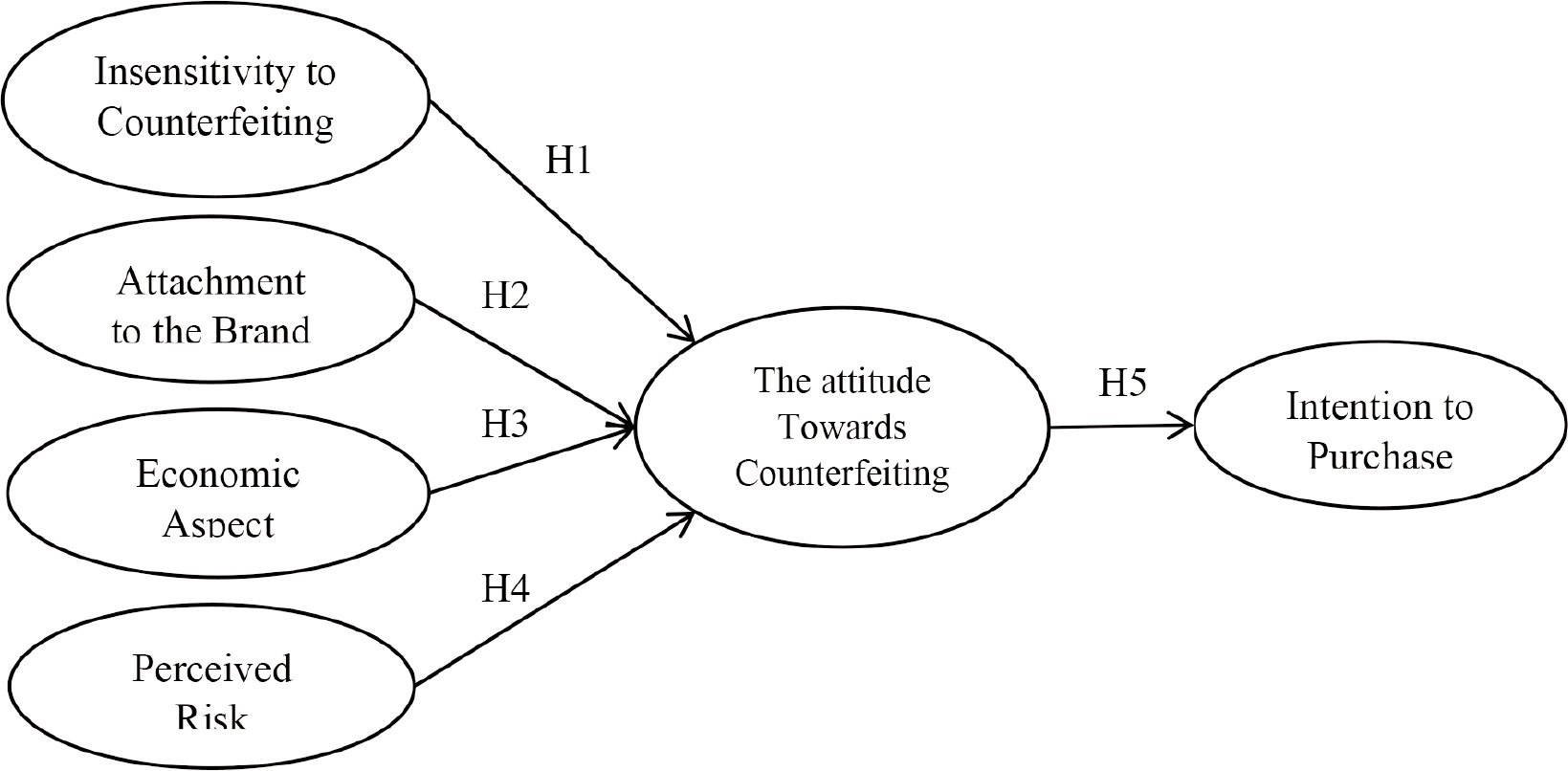
Figure 1.
Basic model for PLS path modelling processing
Source: Elaboration by the authors. PLS, partial least squares.
Table 1.
Sociodemographic characteristics
| Nb. cit. | Freq. (%) | ||
|---|---|---|---|
| Age (years) | 18–24 | 144 | 61.3 |
| 25–29 | 61 | 26.0 | |
| 30–34 | 19 | 8.1 | |
| 35–39 | 11 | 4.7 | |
| Salary | No income | 131 | 55.7 |
| Less than 25,000 DA | 49 | 20.9 | |
| Between 26,000 DA and 45,000 DA | 45 | 19.1 | |
| Between 46,000 DA and 65,000 DA | 8 | 3.4 | |
| Between 66,000 DA and 85,000 DA | 1 | 0.4 | |
| More than 86,000 DA | 1 | 0.4 | |
| Socio professional category | Farmer | 0 | 0.0 |
| Employee | 58 | 24.7 | |
| Trader | 2 | 0.9 | |
| Frame | 3 | 1.3 | |
| Student | 138 | 58.7 | |
| Workwomen | 0 | 0.0 | |
| Unemployed | 10 | 4.3 | |
| Administrative | 19 | 8.1 | |
| Other | 5 | 2.1 | |
| Total | 235 | 235 | |
Table 2.
Reliability of measures (CR and AVE)
| Latent variable | CR | AVE |
|---|---|---|
| Threshold | >0.7 | >0.5 |
| Excessive | 0.89 | 0.73 |
| Affective | 0.93 | 0.87 |
| Attachment | 0.88 | 0.66 |
| Low price | 0.89 | 0.80 |
| Cognitive | 0.85 | 0.73 |
| Past behaviour | 0.85 | 0.74 |
| Differentiation | 0.81 | 0.68 |
| Physical risk | 0.92 | 0.78 |
| Psychological risk | 0.87 | 0.69 |
| Rejection | 0.82 | 0.60 |
Table 3.
Discriminant validity √AVE > Cor
| 1 | 2 | 3 | 4 | 5 | 6 | 7 | 8 | 9 | 10 | |
|---|---|---|---|---|---|---|---|---|---|---|
| Criterion validity | √AVE > Cor | |||||||||
| Excessive | 0.85 | |||||||||
| Affective | 0.09 | 0.93 | ||||||||
| Attachment | –0.07 | –0.27 | 0.81 | |||||||
| Low price | 0.34 | 0.35 | –0.07 | 0.90 | ||||||
| Cognitive | 0.04 | 0.48 | –0.17 | 0.33 | 0.86 | |||||
| Past behaviour | 0.10 | 0.40 | –0.12 | 0.16 | 0.23 | 0.86 | ||||
| Differentiation | 0.04 | –0.16 | 0.25 | –0.18 | –0.24 | –0.03 | 0.83 | |||
| Physical risk | 0.08 | –0.20 | 0.29 | –0.12 | –0.27 | –0.01 | 0.26 | 0.89 | ||
| Psychological risk | –0.07 | –0.25 | 0.41 | 0.01 | –0.06 | –0.21 | 0.09 | 0.22 | 0.83 | |
| Rejection | 0.05 | –0.27 | 0.43 | –0.02 | –0.21 | –0.17 | 0.30 | 0.15 | 0.37 | 0.78 |
1 AVE, average of the variance extracted; RMSEA, Root Mean Square Error of Approximation; SRMR, Standardized Root Mean Square Residual; PLS, partial least squares.
The diagonal of the bold table indicates the AVEs for each latent variable, the other values concern the squares of the correlations between the different latent variables.
Notes : Fit values ; RMSEA=0.043, SRMR = 0.07, NFI=0.95.
Source: Smart PLS V3 data.
Table 4.
Path coefficients and their significance
| Relation | Standard error | T-values | |
|---|---|---|---|
| H1 | Insensitivity ⟹ Attitude | 0.072 | 3.235 |
| H2 | Attachment ⟹ Attitude | 0.071 | 1.035 |
| H3 | Economic Aspect ⟹ Attitude | 0.063 | 4.097 |
| H4 | Perceived Risk ⟹ Attitude | 0.073 | 2.010 |
| H5 | Attitude ⟹ Purchase Intention | 0.076 | 0.617 |
| Variables | Items | Questions | Reference |
|---|---|---|---|
| Attachment | Att1 | • I have a lot of affection for this brand. | Lacoeuilhe (2000) |
| Att2 | • I find some comfort in buying or owning this brand. | ||
| Att3 | • I relate to this brand very much. | ||
| Att4 | • I am very attracted to this brand. | ||
| Differentiation | Diff1 | • Counterfeiting is not solid. | Mourad (2014) |
| Diff2 | • Counterfeiting can never match a luxury product. | ||
| Psychological risk | RisP1 | • When I think about buying a product, I get anxious. | Stone and Gronhung (1993) |
| RisP2 | • The purchase of a product makes me psychologically uncomfortable. | ||
| RisP3 | • Thinking about buying a product makes me feel tense. |