
Table 1.
The inclusion and exclusion criteria
| Inclusion criteria | Exclusion criteria |
|---|---|
| Peer-reviewed articles published 2015–2025 | Grey literature and non-peer-reviewed reports |
| Chatbot, conversational AI, or NLP in HR or workplace contexts | Studies focused exclusively on customer-facing chatbots |
| Employee engagement, job satisfaction, or HR effectiveness | Conference abstracts without full-text availability |
| Studies from BRICS countries or generalisable to emerging economies | Duplicate publications or earlier superseded versions |
| English-language publications | Studies with insufficient methodological transparency |
Table 2.
Booth’s (2009) exploratory review standard
| Identified limitation | Documented rationale & mitigation (as per protocol) |
|---|---|
| Acknowledgement: This is an exploratory review, not a systematic review. As per Grant and Booth (2009), the search strategy for mapping heterogeneous/emerging literatures prioritises conceptual saturation over exhaustive reproducibility. | |
| 1. Search strategy described only in general terms (comprehensiveness & replicability) | Mitigation documented: To enhance replicability within this design, the Boolean string is fully specified in the appendix (supplementary material). Additionally, the search was time-bound (March 2025, 2015–2025) and deliberately over-sampled post-2022 literature to capture the accelerated AI-HR deployment, which provides a temporal anchor for future replication. |
| 2. Rationale for final selection of 65 studies insufficiently detailed | Documented rationale: The selection of 61 studies was determined by thematic saturation, the point at which inductive first-order coding (Thomas & Harden, 2008) ceased to generate new descriptive themes related to the four research questions. This is standard practice in exploratory reviews. The PRISMA flow diagram above now explicitly quantifies each exclusion tier (2,098 at title/abstract; 157 at full-text), providing a clear audit trail from 2,847 to 61. |
| 3. Absence of formal quality assessment | Documented correction: Exploratory reviews explicitly waive formal quality appraisal (e.g., CASP, JBI checklists) because their goal is conceptual mapping, not clinical/effectiveness aggregation. However, to strengthen credibility, the authors have now implemented a “Methodological Transparency” proxy filter, evidenced by the exclusion of 42 studies for "insufficient methodological transparency" at full-text screening. |
| 4. Potential sources of bias | Documented in protocol: Three specific bias sources are now formally acknowledged:
|
| 5. Inclusion of both peer-reviewed and selected reports | Documented protocol clarification: A clear two-stream approach is now formalised:
|
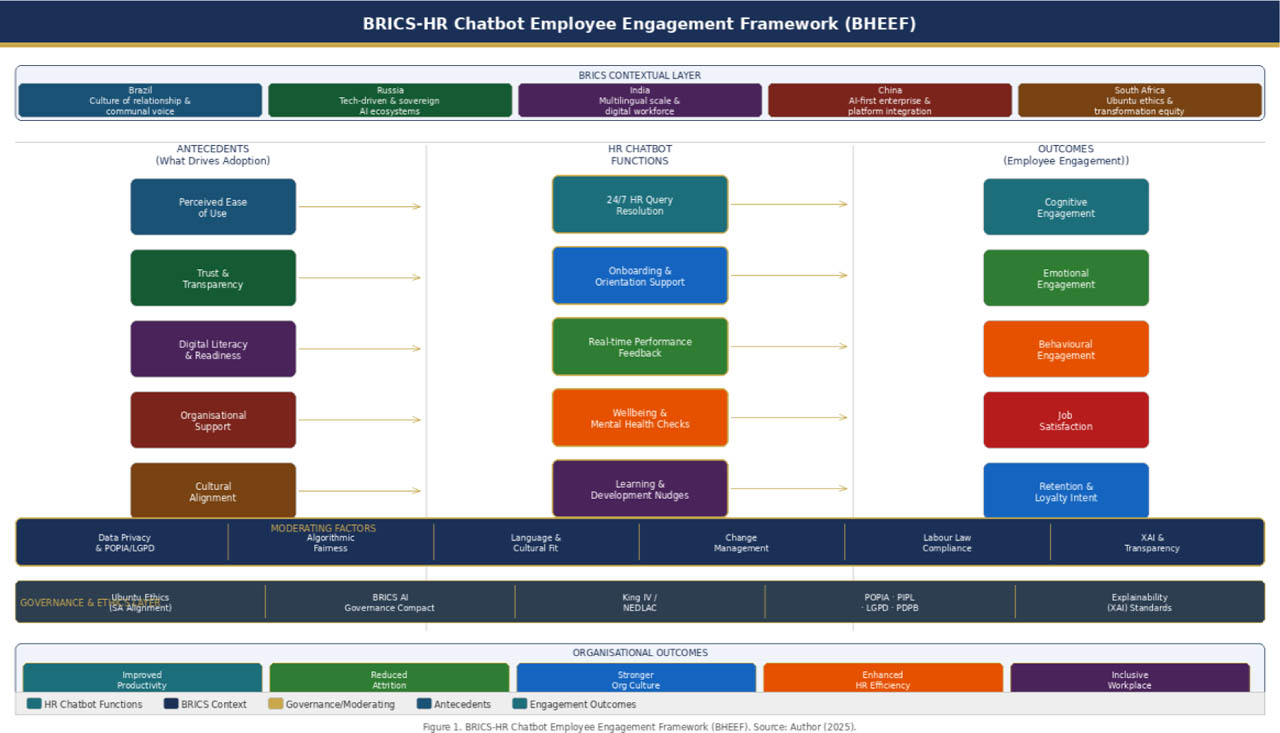
Figure 1.
BRICS-HR Chatbot Employee Engagement Framework (BHEEF)
Source: own processing