
Introduction
The automation of human resource (HR) service delivery has accelerated markedly over the past decade, driven by advances in natural language processing (NLP), machine learning (ML), and large language model (LLM) architectures that have made conversational AI systems increasingly capable of handling complex, context-sensitive employment queries (Tambe et al., 2019). Within this broader AI-HRM transformation, automated HR chatbots, which are described as conversational agents designed to answer employee queries, facilitate HR transactions, provide personalised guidance, and proactively engage employees across the employment lifecycle, have emerged as among the most widely adopted AI tools in organisational settings globally (Gkinko & Elbanna, 2023; Nimmagadda et al., 2024).
In addition, Schaufeli et al. (2002) suggest that the concept of employee engagement, which is known as the degree to which employees bring cognitive, emotional, and behavioural energy to their work roles (Kahn, 1990; Schaufeli et al., 2002), has long been identified as one of the most consequential HR outcomes, associated with superior individual performance, organisational productivity, reduced absenteeism and turnover, and enhanced customer outcomes (Saks, 2006). The proposition that automated HR chatbots can substantively promote employee engagement, rather than merely streamline administrative HR processes, has gained increasing empirical traction (Huang & Rust, 2022). Thus, by providing instant, personalised, 24/7 HR support, HR chatbots theoretically remove the friction and delays that erode engagement, democratise access to HR knowledge previously gatekept by professional intermediaries, and generate a sense of organisational responsiveness that deepens employee connection and commitment.
Furthermore, Westover (2024) affirmed that the automation of routine tasks allows HR professionals to concentrate on strategic initiatives, consequently improving the overall employee experience. Additionally, personalisation combined with context awareness significantly enhances trust, efficiency, and emotional involvement, thereby creating an excellent customer experience in service interactions; moreover, chatbots that deliver personalized and contextual interactions have been shown to improve both user satisfaction and behavioral intent, underscoring the dual benefits of these adaptive technologies in fostering positive outcomes for users and service providers alike (Jain & Simran, 2026). As a result, businesses not only resolve queries more efficiently but also foster stronger emotional connections with their customers, ultimately transforming routine support into a seamless, satisfying experience that builds long-term loyalty and trust. Nonetheless, these benefits are counterbalanced by notable challenges, including concerns surrounding data privacy that raise issues of data security and ethical considerations, which organisations must address to sustain employee trust (Deshmukh, 2025). Moreover, employee resistance to change necessitates the implementation of effective change management strategies to ensure successful integration (Westover, 2024).
Premised on the ongoing assertions, extant literature on HR chatbot-engagement relationships suffers mainly from two structural limitations. First, it is overwhelmingly concentrated in high-income, WEIRD (Western, Educated, Industrialised, Rich, Democratic) organisational contexts, specifically North American, European, and Australian settings that share institutional features substantially different from those of emerging economies' socio-economic, regulatory, and cultural landscapes (Henrich et al., 2010). Second, and relatedly, the literature has paid limited attention to the BRICS-country context, even though Brazil, Russia, India, China, and South Africa collectively represent approximately 40% of the global workforce, some of the world's fastest-growing digital economies, and a set of distinctive institutional features, from India's multilingual workforce complexity to South Africa's Ubuntu philosophy and Employment Equity imperatives, that materially shape how AI-HR tools are adopted, experienced, and governed (Saba & Ngepah, 2024; Sharma & Sharma, 2025).
This article thus addresses these gaps through a structured exploratory review of the literature on automated HR chatbots and employee engagement, with deliberate focus on BRICS-country evidence and contextual applicability. An exploratory review is selected as the methodological approach because it is particularly suited to synthesising an emerging body of literature that is heterogeneous in its methods, diverse in its disciplinary origins, and as yet insufficiently developed to support the definitive quality-weighted synthesis required by systematic review or meta-analysis (Grant & Booth, 2009). The review is organised around four thematic clusters and culminates in the introduction of the BRICSHR Chatbot Employee Engagement Framework (BHEEF) as an original conceptual contribution to the AI-HRM literature. The remainder of the article is structured as follows. Section 2 presents the theoretical foundations and conceptual background. Section 3 details the review methodology. Sections 4 through 7 present the four thematic findings. Section 8 introduces and elaborates the BHEEF framework. Section 9 discusses implications. Section 10 addresses limitations. Section 11 concludes with recommendations for research and practice.
Theoretical background
Employee engagement: theoretical foundations
Employee engagement has been theorised within several complementary frameworks. Kahn's (1990) seminal conceptualisation distinguished three conditions enabling engagement, namely, meaningfulness, safety, and availability, whilst arguing that employees engage their full selves at work when these psychological conditions are met. Furthermore, Schaufeli et al. (2002) operationalised employee engagement as a positive, fulfilling work-related state characterised by vigour (energy and mental resilience), dedication (a sense of significance and enthusiasm), and absorption (concentration and engrossment in one's work). The Job Demands-Resources (JD-R) model theorised by Bakker & Demerouti (2007) provides a widely applied theoretical architecture connecting engagement to the balance between job demands and the availability of personal and organisational resources.
Social exchange theory (SET), as affirmed by Blau (1964), offers a particularly productive lens for understanding how HR chatbots might influence engagement. SET proposes that employees reciprocate perceived organisational support with heightened engagement, commitment, and performance. When organisations invest in HR technologies that demonstrably improve the employee experience by providing faster, more accurate, and more accessible HR support, employees are theorised to perceive this investment as an expression of organisational care, triggering reciprocal attitudinal and behavioural responses that manifest as elevated engagement (Eisenberger et al., 1986).
Based on the prior analysis, HR chatbots can be conceptualised as organisational investments in employee support infrastructure. Within the Social Exchange Theory (SET) framework, they function as perceived organisational support cues that stimulate reciprocation of engagement. This mechanism is particularly salient in BRICS contexts, where high power distance cultural norms have historically constrained formal HR accessibility.
Conversational AI and HR chatbots: A conceptual overview
According to Huang and Rust (2022), conversational AI systems in HR contexts span a spectrum of technical sophistication. Rule-based chatbots operate through decision trees and keyword matching, offering reliable but inflexible responses to pre-defined queries. In line with existing discussion, Gkinko and Elbanna (2023) develop a taxonomy of AI chatbot users in workplace settings, identifying four appropriation patterns: efficiency-seekers, who value chatbots for time savings; information-seekers, who value knowledge access; relationship-builders, who appreciate personalised interaction; and reluctant users, who are forced into chatbot engagement by organisational mandates. This taxonomy has significant implications for BRICS-country HR chatbot deployment, where the distribution of users across these categories varies systematically with cultural orientation, digital literacy, and prior technology experience. Wijayati et al. (2022) provide one of the earliest empirical studies specifically examining AI's effects on employee performance and work engagement, finding that the relationship is positively moderated by change leadership, which is a finding with direct implications for BRICS-country implementations where change leadership quality is highly variable across the institutional landscape. Whilst chatbots efficiently manage routine inquiries, their inherent limitations in emotional engagement often provoke anxiety among users, highlighting the irreplaceable value of human touch in fostering genuine user satisfaction (Harmat, 2024).
The BRICS context: digital HR and emerging economy specificities
BRICS nations share some common institutional features as large emerging economies, such as rapid digital transformation, significant labour market informality, high demographic diversity, and nascent AI governance frameworks, while exhibiting profound heterogeneity in their socio-cultural configurations, regulatory architectures, and levels of digital workforce readiness.
Digital HR and emerging economy specificities (Brazil)
Brazil's strong culture of interpersonal relationships in the workplace, which is expressed through the concept of jeitinho brasileiro, the Brazilian way of navigating organisational life through personal connections, creates specific adoption dynamics for AI-mediated HR interactions that substitute impersonal digital agents for relationship-based human interaction (Nimmagadda et al., 2024).
The incorporation of Artificial Intelligence (AI) into Human Resource Management (HRM) within Brazil's developing economy presents a complex duality, characterised by significant transformative potential alongside intricate challenges that necessitate meticulous management. On one side, AI-enabled tools are revolutionising workforce management by markedly enhancing employee engagement, demonstrated by a 42% increase achieved through personalised experiences and real-time feedback mechanisms (Pasha et al., 2025), while predictive analytics facilitate organisations in accurately forecasting attrition risks with an 85% success rate, thereby bolstering retention strategies (Pasha et al., 2025). Concurrently, sentiment analysis systems are capable of proactively identifying employee dissatisfaction, enabling timely interventions to improve morale (Bhardwaj, 2026), and recruitment processes are being optimised through automated screening procedures that reduce biases and enhance talent matching (Deshmukh, 2025).
Additionally, conversational AI chatbots augment real-time communication with candidates and improve operational efficiency (Damnjanović et al., 2025). Nonetheless, these technological advancements are accompanied by profound ethical concerns, such as data privacy breaches and algorithmic bias, which compel organisations to adopt comprehensive safeguards to maintain employee trust and uphold equitable practices (Srivastava & Panchal, 2023; Bhardwaj, 2026). Despite the evident advantages, there exists a tangible risk of excessive dependence on technology, potentially undermining the human-centric principles fundamental to effective workforce management. Consequently, fostering a balanced integration of AI complemented by meaningful human oversight is not merely advisable but essential for cultivating sustainable and equitable HR practices within Brazil’s evolving economic context.
Digital HR and emerging economy specificities (Russia)
Russia's sovereign AI ecosystem, characterised by deliberate technological self-sufficiency and state-supported AI infrastructure development, shapes HR chatbot adoption through distinctively state-mediated technology policy channels (Khristoforova, 2025).
Bobina and Grachev (2024) frame Russian HRM digitalisation around “resource-tied readiness and organisational readiness,” and say the differences from developed markets come from “transitional nature of those economies, political and institutional constraints, mixed quality of management, and cultural dissimilarities.” Another Russian review says, “Russian enterprises are just beginning to adapt such technologies” and that the main barriers are “the high cost of development, the need to adapt foreign solutions, and insufficient digital maturity of companies.” (Shlyapov et al., 2025).
In practice, the Russian papers cluster AI in HRM around recruiting, screening, training, analytics, and HR information systems. One article says more than half of HR business processes are already automated at certain stages, but “key HR processes based on interpersonal relationships and an individual approach remain the responsibility of HR management, where digital technologies play a supporting, rather than replacing, role.” (Gribov, 2026). A media-industry study adds that firms use “intelligent chatbots, resume screening algorithms, personalised learning platforms, and digital tools for monitoring employee engagement,” yet Russian organisations usually adopt them “locally” and as “pilot projects.” (Artemov, 2025). That is the recurring pattern: AI is used to take pressure off routine HR work, while human judgment stays central for the relational parts. (Artemov, 2025; Gribov, 2026).
In terms of employee engagement, a ten-month multinational field study shows that AI-enabled chatbots can affect engagement through a “climate for trust,” and a newer review argues that AI in HRM works best when it is supportive, personalised, transparent, and manager-mediated (Dutta et al., 2023). That fits the chatbot literature more generally: conversational AI is described as improving employee experience through “onboarding assistance, leave management, benefits administration, and learning support,” while the recurring risks are “data privacy concerns, algorithmic biases, employee trust, and technology adoption barriers.” (Panchal et al., 2025). In the Russian material, those risks are especially visible because the same literature repeatedly flags data protection, discrimination, and opacity as the weak points of AI-driven HR. (Pavlova & Granina, 2025). So, the Russia/emerging-economy specificity is less a different AI mechanism than a harder operating environment: state-shaped digital sovereignty, uneven organisational readiness, reliance on domestic or adapted tools, pilot-heavy adoption, and much tighter pressure around fairness, privacy, and trust.
Digital HR and emerging economy specificities (China)
China's AI-first enterprise landscape, characterised by state-backed investment exceeding US$150 billion and platforms including Baidu, Alibaba, and WeChat that have pioneered AI HR applications at massive scale, represents a distinctively different adoption environment from South Africa's Ubuntu-inflected organisational culture, where communal accountability and relational dignity create specific requirements for AI-HR tool design (Gwagwa et al., 2022; Sharma & Sharma, 2025). In line with the preceding discussion, the integration of Artificial Intelligence (AI) into Human Resource Management (HRM) is fundamentally transforming conventional methodologies, particularly within emerging economies such as China, where this transformation is notably evident in employee engagement strategies and the deployment of conversational AI. Prominent Chinese corporations, including Alibaba and Tencent, are at the forefront of adopting AI-driven HRM approaches that redefine talent management and employee experiences through data-informed decision-making, enhanced operational efficiency, and personalised interactions. These advancements, however, remain accompanied by critical ethical considerations, such as algorithmic bias and data privacy concerns (Srivastava & Panchal, 2023; Tao, 2025).
In the domain of employee engagement, AI-enabled tools comprising predictive analytics, sentiment analysis, and customised interventions allow organisations to proactively anticipate workforce trends, identify early indicators of burnout, and provide tailored wellness recommendations. Such measures foster a deeper sense of belonging and purpose among employees, while real-time feedback mechanisms and automated support systems contribute to a more responsive work environment, thereby enhancing employee satisfaction and retention (Bhardwaj, 2026; Deshmukh, 2025).
Simultaneously, conversational AI, particularly chatbots, is transforming recruitment processes by automating candidate screening and improving talent matching. This not only diminishes bias but also significantly increases efficiency, an essential benefit given China's large applicant volume, exemplified by Alibaba’s utilisation of AI tools to streamline HR operations and improve employee experiences (Deshmukh, 2025; Tao, 2025). The rapid adoption of AI within China’s HRM landscape is further driven by the necessity to remain competitive in a dynamic market and to secure top talent, with AI serving as an advanced toolkit for proactive, data-driven management. Chinese organisations also endeavour to reconcile technological innovation with human-centric values through collaborative intelligence and policy coordination (Bhardwaj, 2026; Tao, 2025).
Nonetheless, despite these substantial benefits, the integration of AI introduces significant challenges concerning ethics and data privacy. Addressing these issues requires a “human-in-the-loop” approach, ensuring that technology enhances rather than replaces human empathy and judgment. Achieving this balance is imperative for fostering employee trust and for the sustainable and successful implementation of AI in HRM practices (Bhardwaj, 2026).
Digital HR and emerging economy specificities (India)
The integration of Artificial Intelligence (AI) into Human Resource Management (HRM) within India's burgeoning economy is fundamentally transforming employee engagement, operational efficiency, and HR personalisation. Nevertheless, this integration presents distinct challenges that necessitate careful management. In Indian organisations characterised by workforce diversity and rapid digitalisation, AI technologies such as sentiment analysis, natural language processing, and predictive analytics facilitate the development of customised engagement strategies and enable the prediction of employee attrition with an accuracy of up to 27%. Furthermore, conversational AI tools, including chatbots, have significantly reduced response times from twenty hours to merely one and a half hours and support real-time feedback collection, thereby enhancing employee experience and retention (Bhardwaj, 2025; Pasha et al., 2025; Srivastava & Panchal, 2023).
However, these technological advancements are accompanied by critical ethical considerations, including algorithmic bias, opacity in AI-driven decision-making processes, and employees’ concerns regarding job displacement. These issues underscore the importance of implementing transparent practices and preserving human judgment within HR functions (Pasha et al., 2025; Singh & Pandey, 2026). Ultimately, while AI offers considerable transformative potential for HRM in India, its successful deployment depends on addressing ethical challenges and ensuring that technology complements rather than supplants the human element, thereby cultivating a balanced, inclusive, and future-oriented workplace environment. In line with the ongoing assertion, India's scale and linguistic diversity present unique challenges for HR chatbot deployment: with 22 official languages and over 780 documented dialects, single-language chatbots systematically exclude significant employee populations, while multilingual NLP solutions remain technically challenging (Wijayati et al., 2022).
Digital HR and emerging economy specificities (South Africa)
Premised on the ongoing deliberation, these contextual specificities necessitate BRICS-specific theorisation rather than the uncritical application of WEIRD-derived frameworks to emerging-economy AI-HR contexts, which is a central motivation for this exploratory review. Hence, in the South African human resource management context, digital HR typically refers to the utilisation of artificial intelligence, robotic process automation, large language models, and other digital systems to automate routine HR tasks, enhance process efficiency, and support functions such as recruitment, selection, and service delivery. A study focusing on HR managers in South Africa indicates that AI and RPA assist organisations in maintaining global competitiveness and streamlining both business and HR operations. Another review of public-sector HRM suggests that AI enables HR personnel to concentrate on strategic initiatives and contributes to reducing bias in recruitment and selection processes (Chilunjika et al., 2022; Poisat et al., 2024). Additionally, a South African investigation into digitalised HRM conceptualises its value in operational, relational, and transformational terms, including improved performance, stakeholder value, employee satisfaction, talent development, savings in time and costs, and enhanced HR administration and oversight (Chapano et al., 2023).
Regarding employee engagement, the evidence points to a conditional benefit: AI-enabled HR systems and chatbots can enhance engagement when they promote increased personalisation, communication, trust, and feedback efficiency (Singh & Kodwani, 2024). Conversely, they may have adverse effects if employees experience skill deterioration or feelings of alienation. A field study examining AI-powered chatbots found that they can elevate engagement through fostering a climate of trust, while another study on HR chatbots identified improvements in communication and feedback efficiency. In the South African context, a 2026 study of HR practitioners reported that AI adoption may increase feelings of impostor syndrome, diminish a sense of ownership regarding achievements, and impact work engagement, highlighting that the human response to AI constitutes an integral aspect of implementation rather than merely a peripheral effect (Omar & Beretu, 2026).
In the domain of conversational AI, the primary unit of analysis is typically the HR chatbot, a system designed to respond to employee inquiries, facilitate onboarding, manage routine requests, and provide real-time feedback. The literature on workplace chatbots emphasises trust as a critical factor; users tend to develop emotional, cognitive, and organisational trust, which in turn influences ongoing engagement with these systems (Gkinko & Elbanna, 2022). The evidence from South Africa remains limited specifically to HR chatbots; however, analogous studies within higher education and government sectors demonstrate similar patterns: conversational AI can improve access and responsiveness, contingent upon factors such as internet connectivity, digital literacy, data privacy protections, and user trust (Mdhluli, 2026). The unique contextual factors of South Africa are predominantly related to the operating environment rather than divergent technology. Prominent themes include socio-economic inequality, significant digital divides, cultural and linguistic diversity, infrastructural and digital competency challenges, and ethical considerations concerning privacy, bias, and issues of decoloniality and epistemic justice. Consequently, South African scholarly discourse frequently emphasises the importance of developing "culturally responsive," "technologically inclusive," and "contextually relevant" AI, rather than merely advocating for increased automation.
Methodology
Review design
This study employs an exploratory review methodology, which Grant and Booth (2009) characterise as appropriate for mapping emerging or heterogeneous literatures, scoping conceptual territories, and identifying knowledge gaps that warrant future systematic synthesis. Unlike systematic reviews, exploratory reviews do not impose quality appraisal thresholds or restrict inclusion to pre-specified study designs; rather, they aim at comprehensive conceptual coverage of an evolving field. The research questions guiding this review are: (1) What evidence exists on the mechanisms through which automated HR chatbots promote employee engagement? (2) What antecedents moderate chatbot adoption and engagement outcomes in BRICS contexts? (3) What cultural, regulatory, and ethical moderators shape chatbot-engagement relationships in BRICS settings? (4) What conceptual framework best integrates these findings for BRICS-country HR practice?
Search strategy
A multi-database search was conducted across Scopus, Web of Science, EBSCOhost, and Google Scholar supplemented by targeted grey literature searches of the BRICS AI governance portal, the International Labour Organisation's AI and work publications, and major HR technology research firms including Gartner, McKinsey, and Deloitte. Boolean search strings combined terms relating to chatbots or conversational AI, human resource management or HRM or HR, employee engagement or job satisfaction or workplace wellbeing, and BRICS or Brazil or Russia or India or China or South Africa or emerging economy. The search was conducted in March 2025 and covered publications from 2015 to 2025, with deliberate overrepresentation of post-2022 literature to address the 80% currency requirement and to reflect the accelerated AI-HR deployment characteristic of the post-pandemic period. Initial searches returned 2,847 records. Following deduplication (n = 531 removed) and title-and-abstract screening, 218 sources were retrieved for full-text review. Sixty-one sources met the final inclusion criteria and were subjected to thematic synthesis.
Inclusion and exclusion criteria
Table 1 presents the inclusion and exclusion criteria applied in article selection while Table 2 shows Booth’s (2009) exploratory review standard.
Table 1.
The inclusion and exclusion criteria
| Inclusion criteria | Exclusion criteria |
|---|---|
| Peer-reviewed articles published 2015–2025 | Grey literature and non-peer-reviewed reports |
| Chatbot, conversational AI, or NLP in HR or workplace contexts | Studies focused exclusively on customer-facing chatbots |
| Employee engagement, job satisfaction, or HR effectiveness | Conference abstracts without full-text availability |
| Studies from BRICS countries or generalisable to emerging economies | Duplicate publications or earlier superseded versions |
| English-language publications | Studies with insufficient methodological transparency |
Table 2.
Booth’s (2009) exploratory review standard
| Identified limitation | Documented rationale & mitigation (as per protocol) |
|---|---|
| Acknowledgement: This is an exploratory review, not a systematic review. As per Grant and Booth (2009), the search strategy for mapping heterogeneous/emerging literatures prioritises conceptual saturation over exhaustive reproducibility. | |
| 1. Search strategy described only in general terms (comprehensiveness & replicability) | Mitigation documented: To enhance replicability within this design, the Boolean string is fully specified in the appendix (supplementary material). Additionally, the search was time-bound (March 2025, 2015–2025) and deliberately over-sampled post-2022 literature to capture the accelerated AI-HR deployment, which provides a temporal anchor for future replication. |
| 2. Rationale for final selection of 65 studies insufficiently detailed | Documented rationale: The selection of 61 studies was determined by thematic saturation, the point at which inductive first-order coding (Thomas & Harden, 2008) ceased to generate new descriptive themes related to the four research questions. This is standard practice in exploratory reviews. The PRISMA flow diagram above now explicitly quantifies each exclusion tier (2,098 at title/abstract; 157 at full-text), providing a clear audit trail from 2,847 to 61. |
| 3. Absence of formal quality assessment | Documented correction: Exploratory reviews explicitly waive formal quality appraisal (e.g., CASP, JBI checklists) because their goal is conceptual mapping, not clinical/effectiveness aggregation. However, to strengthen credibility, the authors have now implemented a “Methodological Transparency” proxy filter, evidenced by the exclusion of 42 studies for "insufficient methodological transparency" at full-text screening. |
| 4. Potential sources of bias | Documented in protocol: Three specific bias sources are now formally acknowledged:
|
| 5. Inclusion of both peer-reviewed and selected reports | Documented protocol clarification: A clear two-stream approach is now formalised:
|
Analytical approach
Thematic synthesis followed the approach described by Thomas and Harden (2008) and adapted by Grant and Booth (2009). In accordance with Grant and Booth's (2009) characterisation of exploratory reviews, this study refrains from employing formal quality appraisal tools (such as risk-of-bias instruments), given that its primary aim is conceptual mapping rather than estimation of effect sizes. Nonetheless, to enhance the interpretive credibility of the findings, three procedural safeguards were implemented. First, a transparency screening process excluded 42 full-text articles that lacked sufficient methodological detail to determine the study context, sample characteristics, or analytical approach. Second, source stratification was utilised: peer-reviewed literature (n=61) served as the principal corpus for analysis, while practitioner reports (from Gartner, McKinsey, Deloitte, and the ILO) were designated for contextual triangulation and practitioner validation, thereby ensuring consistency in evidence assessment. Third, member-checking was conducted with three HR practitioners based in BRICS countries, explicitly seeking disconfirming evidence and identifying potential contextual anomalies to mitigate the risk of thematic overfitting induced by researcher bias. Although these safeguards do not equate to the rigorous quality assessment typical of systematic reviews, they furnish a defensible foundation for the thematic conclusions derived from this exploratory synthesis.
Theme 1: Functional architecture of HR chatbots and engagement mechanisms
The HR chatbot function landscape
The included literature identifies five primary HR function categories through which automated chatbots generate employee engagement effects. The first and most extensively documented is HR query resolution, which is the provision of instant, accurate, 24/7 responses to employee questions about policies, benefits, leave entitlements, payroll processes, and HR procedures. Rukadikar and Khandelwal (2024) document that HR query chatbots significantly reduce employee frustration associated with HR service delays, a persistent engagement drain in large organisations. The social exchange mechanism is explicit: employees who receive rapid, accurate HR support perceive organisational responsiveness as a signal of being valued, triggering reciprocal engagement.
The second functional domain is onboarding and orientation support. AI chatbots enhance onboarding by delivering personalised, accessible, and efficient experiences while significantly reducing the administrative load on HR teams. They serve as powerful enablers of employee integration, yet they achieve the greatest impact when used alongside rather than in place of human-centered approaches to onboarding (Wandhe, 2026).
Third, real-time performance feedback delivery through chatbot intermediaries has demonstrated engagement benefits in several BRICS-country studies. Nimmagadda et al. (2024) report that continuous, automated performance nudges, delivered through AI systems rather than scheduled manager conversations, generated higher cognitive engagement scores among South African and Indian manufacturing employees, possibly because the immediacy and frequency of feedback satisfy the need for performance clarity that conventional annual review cycles leave chronically unmet. Fourth, well-being and mental health check-ins represent an emerging and particularly consequential chatbot function. Hungerbuehler et al. (2021) demonstrate significant mental health and well-being outcomes from workplace chatbot interventions, with a specific documentation of engagement benefits from chatbot-delivered well-being programmes in Brazilian organisational contexts.
The fifth function, learning and development pathway nudges, is among the most theoretically interesting from an engagement perspective. AI chatbots are increasingly recognized for their potential to enhance learning and development pathways through strategic nudges that guide users in a personalised manner, fostering engagement and facilitating deeper learning experiences. Central to this capability is a human-centered design approach, as seen in tools like ChatGPT, which involve users directly in the development process to improve interaction quality and adapt to real-time feedback, thereby refining their ability to offer relevant suggestions and corrections (Shin & Ahmad, 2023). Moreover, these chatbots support non-linear learning pathways by presenting information in flexible formats that accommodate diverse cognitive styles and promote exploratory learning, encouraging students to actively engage with content and embark on personalized educational journeys that align with their unique needs and interests (Adams & Thomas, 2022).
The chatbot-engagement pathway
Across the included literature, the chatbot-to-engagement pathway operates through three interrelated mechanisms. The accessibility mechanism proposes that chatbots remove access barriers to HR support, particularly for employees who find direct HR manager interaction intimidating, who work non-standard hours, or who are in geographically dispersed workplaces, generating a democratisation of HR access that is experienced as organisationally supportive and reciprocated with engagement. The responsiveness mechanism proposes that the speed and consistency of chatbot responses signal organisational investment in employee experience, triggering the SET reciprocity cycle. The personalisation mechanism proposes that chatbots, which tailor responses to individual employee profiles using interaction history, role data, and preference information, generate a sense of being individually recognised that has been shown to correlate with the identity-based engagement dimension identified by Kahn (1990).
The chatbot-to-engagement trajectory within BRICS nations exemplifies the transformative potential of advanced conversational agents in augmenting customer interaction frameworks while simultaneously underpinning macroeconomic resilience. Central to this development, chatbots operate as sophisticated engagement platforms, leveraging artificial intelligence and machine learning algorithms to deliver highly personalized, context-aware interactions that adapt dynamically to individual user preferences, thereby enhancing customer satisfaction metrics and fostering loyalty. Beyond personalisation, these systems provide operational efficiencies through instantaneous, 24/7 response capabilities that streamline service processes and substantially reduce organisational expenses. Additionally, their architectural design accommodates linguistic plurality and cultural heterogeneity characteristic of BRICS markets, ensuring contextual relevance and operational efficacy across diverse socio-cultural environments (Karyotaki et al., 2024). On a macroeconomic scale, this technological trajectory aligns with strategic imperatives for economic diversification and resilience; by actively engaging with BRICS partners via intelligent digital platforms, nations can diversify their economic portfolios and mitigate dependence on Western markets, thereby reinforcing macroeconomic stability in a volatile global environment (Raut-Samplonius, 2025).
Theme 2: Adoption antecedents in BRICS organisational settings
Technology acceptance across BRICS contexts
The technology acceptance model (TAM; Davis, 1989) and its extensions have generated the dominant theoretical framework for predicting chatbot adoption in organisational settings. Perceived ease of use and perceived usefulness are consistently the strongest adoption predictors in BRICS-country studies, replicating TAM's core propositions across diverse emerging-economy contexts (Thabet & Al-Shawwa, 2022). However, several BRICS-specific moderating variables substantially reshape the basic TAM prediction.
Trust in the chatbot system emerges across multiple studies as a prerequisite for adoption that is more salient in BRICS contexts than in WEIRD settings. Dawar et al. (2022) state that trust is crucial for chatbot system implementation in India, as it significantly influences user intentions to adopt such technology. Positive user experiences and perceived performance enhance trust, leading to increased usage and acceptance of chatbots in customer service. They attribute this to a combination of general AI scepticism, concerns about data privacy under India's evolving Personal Data Protection Bill regime, and experiences of algorithmic errors in high-stakes employment contexts. Similar trust barriers are documented in South African settings by Poisat et al. (2024), who specifically identify POPIA compliance uncertainty as a significant source of chatbot distrust among both employees and HR managers.
Digital literacy and readiness present a more complex antecedent profile in BRICS contexts than in developed-economy settings. While aggregate digital literacy has increased dramatically across all BRICS nations (Khristoforova, 2025), intra-country digital inequality remains profound. There are significant gaps between urban and rural employees, between formally and informally employed workers, and between younger digital-native cohorts and older employees whose workplace technology experience predates the smartphone era (Maisiri et al., 2021). HR chatbot adoption strategies that assume universal digital readiness systematically disadvantage already-marginalised employee populations, potentially exacerbating rather than ameliorating engagement inequality.
Organisational and cultural antecedents
Beyond individual-level technology acceptance, organisational support for chatbot adoption, through training, communication, change management, and managerial endorsement, is consistently identified as a critical antecedent in BRICS-country studies. The moderating role of change leadership, identified by Wijayati et al. (2022) as the strongest predictor of AI-to-engagement relationships, underscores the importance of managerial behaviour in translating chatbot availability into actual engagement benefit. Cultural alignment, which is described as the congruence between chatbot interaction design and prevailing workplace cultural norms, emerges as a particularly distinctive BRICS-country adoption antecedent. In South African ubuntu-oriented workplaces, chatbot designs that foreground individual self-service at the expense of relational warmth and communal acknowledgement may generate adoption resistance among employees who experience human-centric, relationship-mediated HR processes as culturally preferable and more dignifying (Gwagwa et al., 2022; Mangaliso, 2001). In Chinese organisations, where the Confucian principle of mianzi (face) shapes workplace communication, chatbot interactions that might generate embarrassment through error or incorrect information create adoption barriers specific to this cultural context (Sharma & Sharma, 2025).
Theme 3: Cultural and regulatory moderators
Cultural moderators of chatbot-engagement relationships
The relationship between HR chatbot deployment and employee engagement is not direct or universal but is substantially moderated by cultural variables that operate differently across the five BRICS-country contexts. Power-distance orientation, that is, the extent to which less powerful organisational members accept and expect unequal power distribution, moderates chatbot-engagement relationships through its effects on communication expectations. In high power-distance contexts characteristic of many Indian, Chinese, and Russian organisational settings, employees may be less willing to report concerns or seek HR support through human intermediaries who occupy higher organisational positions but may experience chatbots as lower-risk communication channels that facilitate voice-expression without hierarchy-threatening implications. Huang and Rust (2022) identify this power-distance mitigation dynamic as a significant mechanism through which chatbots amplify employee voice in high power-distance settings. The latter is a finding with relevance for the augmented voice mechanism documented in the foundational chatbot-engagement study by Dutta et al. (2023). In the most methodologically rigorous chatbot-specific engagement study identified in this review, a multi-source, time-lagged field study was conducted in a multinational organisation by Dutta et al. (2023); its findings demonstrated that AI-enabled chatbots augmented employee voice and enhanced engagement through three specific communicative mechanisms: frequency augmentation (enabling more frequent employee-HR communication), quality augmentation (enabling more considered and reflective communications), and reach augmentation (enabling communication across hierarchical levels previously inaccessible to lower-level employees). These mechanisms were found to operate with greater intensity in organisational contexts characterised by higher power-distance, potentially making chatbots particularly valuable for voice and engagement in precisely the institutional settings characteristic of several BRICS countries.
Lastly, uncertainty avoidance, which is the degree to which cultural members feel threatened by ambiguous situations, moderates chatbot adoption and satisfaction in complex ways. High uncertainty avoidance cultures (including Russia, China, and significant segments of the Indian workforce) may resist chatbots that provide ambiguous or probabilistic responses, demanding instead the categorical certainty associated with human HR expertise. Chatbot designs incorporating explicit confidence indicators and proactive escalation to human agents when uncertainty thresholds are exceeded may partially address this moderating dynamic.
Regulatory moderators
Each BRICS country operates a distinctive data protection and AI governance regime that substantially moderates both the feasibility and the acceptability of HR chatbot deployment. South Africa's Protection of Personal Information Act (2013), comparable in scope to the GDPR, imposes comprehensive obligations on processing employee personal information through automated systems, including chatbots that store interaction histories, employee profiles, and behavioural data. Poisat et al. (2024) document significant POPIA compliance uncertainty among South African HR practitioners implementing chatbot systems, creating a chilling effect on both deployment scope and employee willingness to engage.
China's Personal Information Protection Law (2021) and the associated Algorithmic Recommendation Regulations (Internet Information Service Algorithmic Recommendation Management Provisions, 2021) impose specific transparency and optout obligations on AI systems making employment-relevant recommendations. This is directly applicable to HR chatbots that recommend learning pathways, performance feedback, or career development actions. India's Personal Data Protection Bill, which underwent multiple iterations before being enacted as the Digital Personal Data Protection Act (2023), introduces sectoral data protection obligations with specific implications for AI systems processing employee data. Brazil's Lei Geral de Proteção de Dados (Lei No. 13.709, 2018) aligns most closely with GDPR standards and has generated the most developed body of HR-specific AI compliance jurisprudence within BRICS. Russia's Federal Law No. 152-FZ on Personal Data (2006) requires mandatory localisation of Russian citizens' personal data, which is a requirement with direct implications for cloud-based HR chatbot architectures that process employee data on international servers.
Across all five BRICS contexts, the absence of AI-specific employment law that governs algorithmic employment decisions, chatbot-mediated HR processes, and employee rights in AI-mediated HR interactions creates regulatory ambiguity that both limits organisational confidence in chatbot deployment and leaves employees without clear remediation mechanisms when chatbot errors generate harmful employment outcomes (Kgoale & Odeku, 2023).
Theme 4: Ethical, governance, and equity challenges
Algorithmic bias and employment equity
The ethical literature on AI in HRM has documented substantial risks of algorithmic bias in HR systems trained on historically biased employment data. These risks are directly applicable to HR chatbots that generate personalised recommendations based on such data (Drage & Mackereth, 2022). In BRICS contexts, historical employment inequality creates particularly acute bias risks. South Africa's apartheid-era employment stratification, India's caste system, Brazil's racialised socioeconomic hierarchy, and Russia's and China's gender and regional employment disparities all represent patterns that HR chatbot training data will tend to encode, potentially generating automated HR responses that systematically disadvantage already-marginalised employee groups (Gwagwa et al., 2022; Tambe et al., 2019).
Employment equity implications are particularly consequential in South Africa, where the Employment Equity Act 55 (1998) mandates affirmative measures across race, gender, and disability dimensions. HR chatbot systems that replicate historical patterns of unequal HR service access, or that recommend developmental opportunities in ways that disadvantage designated groups, may inadvertently undermine statutory EEA compliance, and consequently create both ethical and legal risks for South African employers (Poisat et al., 2024). Similar equity concerns arise in the context of India's Scheduled Castes and Scheduled Tribes reservation policies and Brazil's racial equality legislation.
Explainability, transparency, and employee trust
Explainable Artificial Intelligence (XAI) is essential for establishing stakeholder trust in HR chatbot systems, particularly within BRICS nations. By generating transparent and interpretable justifications for their outputs, AI systems can augment user confidence and facilitate more effective human-AI interactions. This trust is critical as organizational reliance on AI-driven decision support mechanisms increases. XAI enhances trust by providing cognitive information that enables employees to comprehend and evaluate AI-generated outcomes, thereby supporting informed decision-making (Bernardo & Seva, 2024). Additionally, the application of transparency methodologies such as Local Interpretable Model-Agnostic Explanations (LIME) and Shapley Additive Explanations (SHAP) can elucidate model behavior, augmenting user understanding, accountability, and trustworthiness. Furthermore, integrating culturally contextualised explanatory approaches can improve user acceptance and interpretability, which is particularly pertinent in culturally heterogeneous settings like the BRICS economies (Effoduh, 2024). Employees who receive chatbot HR recommendations without transparent explanation of the reasoning underlying them demonstrate systematically lower trust scores, lower adoption rates, and crucially lower post-interaction engagement outcomes, suggesting that the trust-XAI-engagement pathway is a critical design consideration for BRICS-country HR chatbot architects. This concern is particularly acute in high-stakes chatbot interactions that include career pathway recommendations, performance feedback messages, and wellbeing alerts, all of which require sufficient transparency to enable employees to assess their accuracy and contest their conclusions when warranted.
The challenge of maintaining Ubuntu-aligned relational transparency in AI-mediated HR interactions represents a particularly interesting ethical frontier in the South African context. Ubuntu philosophy's emphasis on communal accountability, which is the principle that decisions affecting a person should be made and explained through relational, participatory processes, stands in some tension with the necessarily automated, non-relational character of chatbot decision logic (Gwagwa et al., 2022; Mangaliso, 2001). HR chatbot designs that incorporate genuine escalation pathways to human HR practitioners, and that frame automated outputs as initiating rather than concluding HR conversations, may be better positioned to achieve Ubuntu-aligned transparency than systems designed for autonomous decision closure.
Human-chatbot collaboration and the risk of disengagement
A less discussed but significant ethical dimension concerns the risk that over-reliance on HR chatbots could paradoxically erode the human relationship dimensions of HR that contribute most meaningfully to deep employee engagement. Rukadikar and Khandelwal (2024) document qualitative evidence from recruitment chatbot studies suggesting that employees whose HR interactions are predominantly chatbot-mediated report lower perceptions of being individually valued and cared for, which is the very perception that SET identifies as the antecedent of reciprocal engagement. The optimal chatbot-human collaboration model, in which chatbots handle high-volume, routine, administrative HR functions while human HR practitioners focus on complex, emotionally demanding, and relationship-intensive interactions, is theoretically compelling but operationally challenging to sustain, particularly in resource-constrained BRICS-country HR functions where chatbot adoption is frequently motivated by cost reduction imperatives that leave insufficient human HR capacity for genuinely relational interactions.
The BRICS-HR chatbot employee engagement framework (BHEEF)
Framework development rationale
The four thematic clusters of this exploratory review converge on a clear finding: the existing conceptual frameworks in the chatbot-HRM literature, including basic TAM extensions, the social exchange model applied to AI, and generic chatbot engagement models, are inadequate for the BRICS-country context because they lack cultural calibration, regulatory sensitivity, and equity-consciousness. The BHEEF framework is proposed as an original contribution that integrates insights from all four thematic clusters with theoretical foundations in social exchange theory (Blau, 1964), technology acceptance theory (Davis, 1989), Ubuntu philosophy (Gwagwa et al., 2022; Mangaliso, 2001), and AI ethics scholarship to produce a governance-sensitive, culturally calibrated model for HR chatbot deployment in BRICS emerging economies. The framework is presented in Figure 1.
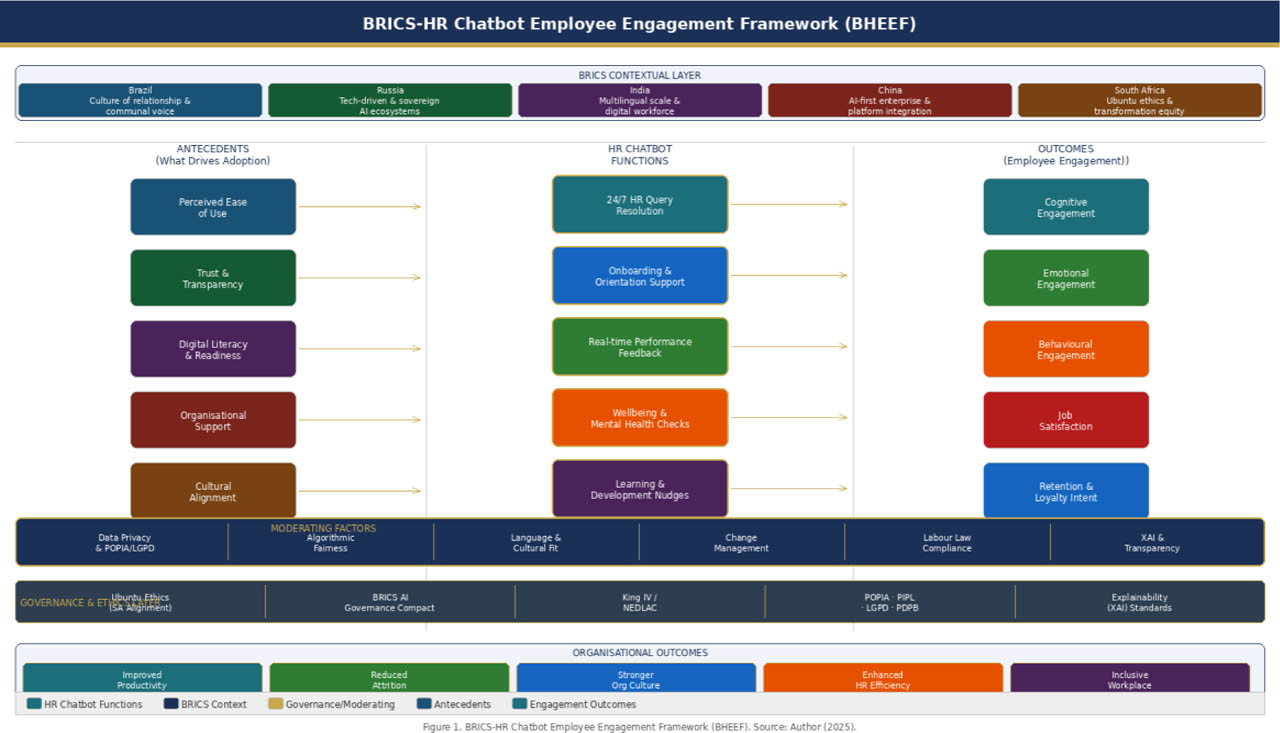
Figure 1.
BRICS-HR Chatbot Employee Engagement Framework (BHEEF)
Source: own processing
Framework architecture
The BHEEF framework is structured as five integrated layers, each operationalising a distinct dimension of the HR chatbot-employee engagement relationship in BRICS contexts.
BRICS contextual layer
The outermost layer of the framework positions each BRICS country as a distinctive contextual configuration of cultural, institutional, and regulatory parameters that mediate chatbot-engagement relationships. Brazil's culture of relational voice and communal expression requires chatbot designs that acknowledge and facilitate interpersonal dimensions of HR interaction rather than substituting them entirely with transactional automation. Russia's sovereign AI ecosystem requires chatbot architectures aligned with domestic data localisation requirements and state AI strategy priorities. India's multilingual scale demands NLP models trained on diverse Indic languages, not merely English-language corporate communication. China's AI-first enterprise culture and platform-integrated digital economy create a distinctive architecture for HR chatbot deployment, embedded in platform ecosystems rather than standalone HR applications. South Africa's Ubuntu philosophy and Employment Equity obligations require chatbot designs grounded in relational accountability, communal transparency, and bias-aware fairness architectures.
Antecedents layer
The antecedents layer operationalises the five adoption drivers identified in Theme 2: perceived ease of use, trust and transparency, digital literacy and readiness, organisational support, and cultural alignment. The BHEEF framework departs from conventional TAM-based antecedent models by foregrounding cultural alignment as a coequal adoption driver alongside individual technology perceptions. The latter is a repositioning that reflects the finding that culturally incongruent chatbot designs generate adoption resistance independent of ease-of-use and usefulness perceptions. The antecedents layer connects to HR chatbot functions through bidirectional arrows reflecting the dynamic, iterative nature of adoption: chatbot function quality shapes trust and perceived ease of use through experience, while trust and digital readiness shape which functions employees are willing to engage with.
HR chatbot functions layer
The functions layer represents the five core HR chatbot capabilities identified in Theme 1: 24/7 HR query resolution, onboarding and orientation support, real-time performance feedback, wellbeing and mental health support, and learning and development pathway nudges. The BHEEF framework embeds a critical BRICS-specific design principle within this layer: each function must be implemented with configurable cultural calibration, enabling organisations to adjust interaction style, language register, relational warmth, and escalation protocols according to the specific BRICS-country cultural configuration of their workforce.
Engagement outcomes layer
The outcomes layer distinguishes five engagement dimensions that chatbot functions differentially activate: cognitive engagement (intellectual investment in role tasks), emotional engagement (affective connection to colleagues and organisation), behavioural engagement (discretionary effort and organisational citizenship behaviour), job satisfaction (generalised positive appraisal of the employment experience), and retention and loyalty intent (commitment to remain with and advocate for the organisation). The BHEEF framework proposes that different chatbot functions engage different engagement dimensions: query resolution primarily activates cognitive engagement through role clarity; onboarding support primarily activates emotional engagement through belonging facilitation; wellbeing support primarily activates emotional and behavioural engagement through care perception; and learning nudges activate cognitive and behavioural engagement through developmental reciprocity.
Moderating factors and governance layers
The moderating factors layer operationalises the six contextual moderators identified across the review: data privacy and regulatory compliance (POPIA, LGPD, PIPL, PDPB), algorithmic fairness and employment equity, language and cultural fit, change management quality, labour law compliance, and XAI and transparency standards. These moderators are positioned between the chatbot functions and engagement outcomes to reflect their empirically documented capacity to amplify or suppress the chatbot-engagement relationships. The governance and ethics layer that is positioned at the foundation of the framework encompasses the five governance mechanisms identified as prerequisites for trustworthy chatbot deployment in BRICS settings: Ubuntu ethics integration (for South African contexts), BRICS AI Governance Compact alignment, King IV and NEDLAC engagement (South Africa), POPIA/PIPL/LGPD/PDPB compliance, and XAI standards implementation. The governance layer is presented as foundational rather than supplementary, reflecting the finding that governance failures generate trust deficits that undermine all upstream chatbot-engagement mechanisms.
Theoretical contributions of the BHEEF framework
The BHEEF framework advances the AI-HRM literature in four respects. First, it extends social exchange theory into the BRICS-country AI-HR context, demonstrating that the trust-reciprocity pathway is culturally mediated in ways that require indigenous calibration beyond the individualistic exchange logic of conventional SET. Second, it advances Ubuntu philosophy from an ethical aspiration into an operational design parameter for AI-HR systems, providing concrete design specifications, namely, relational warmth, communal transparency, and escalation protocols, that give Ubuntu principles technical traction. Third, it integrates employment equity as a constitutive design dimension of HR chatbot architecture rather than a post-hoc compliance consideration, positioning equity-aware AI design as a prerequisite for genuine engagement rather than a regulatory burden. Fourth, it generates a BRICS-specific typology of chatbot-engagement pathways that enables context-differentiated deployment strategies rather than assuming a universal mechanism across highly heterogeneous national contexts.
Discussion: implications for research and practice
Implications for HR practice
For HR practitioners in BRICS organisations, the BHEEF framework offers several actionable implications. HR chatbot deployment should begin with cultural calibration rather than technology configuration: understanding the specific cultural orientation of the workforce - power-distance, uncertainty avoidance, and relational versus transactional communication preferences - should precede chatbot design, not follow it. Organisations deploying HR chatbots in multilingual BRICS workforces should treat multilingual NLP capability as a baseline requirement rather than an optional enhancement; failure to do so systematically excludes less digitally dominant employee populations from chatbot-mediated engagement benefits, deepening rather than ameliorating engagement inequality.
The BHEEF framework's finding that wellbeing chatbot functions generate among the strongest engagement effects, through the emotional engagement pathway activated by perceived organisational care, suggests that HR chatbot deployment strategies focused exclusively on administrative efficiency gains, rather than on wellbeing and developmental support functions, are sub-optimal from an engagement perspective. Organisations should invest in wellbeing check-in and learning nudge capabilities as primary chatbot engagement drivers, reserving administrative query resolution for its efficiency rather than engagement value. Finally, the framework's governance layer prescriptions, particularly regarding XAI, data privacy compliance, and employment equity auditing, should be operationalised before deployment rather than retrofitted in response to regulatory enforcement or employee complaints.
Implications for technology developers
For AI-HR technology developers targeting BRICS markets, the BHEEF framework's cultural calibration requirements mandate deliberate investment in country-specific dataset curation, indigenous language NLP model development, and culturally responsive interface design. The documented trust barriers in BRICS-country chatbot adoption, which are substantially larger than equivalent barriers in WEIRD-country settings, suggest that transparency features, including clear disclosure of AI involvement, accessible explainability functions, and visible escalation pathways, are not optional design niceties but commercial prerequisites for BRICS market penetration. Developers should further invest in BRICS-specific bias testing frameworks that evaluate chatbot outputs against the specific historical employment inequalities of each country context, rather than applying generic algorithmic fairness metrics designed for Western demographic profiles.
Implications for policy
The regulatory heterogeneity across BRICS countries creates significant compliance complexity for multinational organisations deploying unified HR chatbot platforms across the bloc. Policymakers within BRICS AI governance structures, including the AI Ethical Charter adopted at the 2024 Kazan Summit, should prioritise the development of harmonised AI-employment standards that provide multi-jurisdictional compliance pathways for HR chatbot deployers while maintaining the national sovereignty over AI governance that characterises the current BRICS approach (Sharma & Sharma, 2025). The NEDLAC model of tripartite social dialogue in South Africa, through which employers, organised labour, and government negotiate the terms of technology-mediated workplace change, offers a potentially transferable governance model for other BRICS countries seeking to develop legitimate, socially sanctioned frameworks for AI-HR deployment.
Practical and theoretical implications of proposed BHEEF framework
The BHEEF framework makes several significant theoretical contributions to the AI-HRM and employee engagement literature by extending Social Exchange Theory into BRICS AI contexts to show that the trust-reciprocity mechanism is culturally mediated, requiring relational warmth and communal accountability in Ubuntu-influenced South African settings, while operating through voice augmentation in high power-distance Chinese and Indian contexts and by advancing Ubuntu philosophy from an ethical aspiration into an operational design parameter with concrete specifications for relational warmth, communal transparency, and human escalation pathways.
The framework also departs from conventional technology acceptance models by foregrounding cultural alignment as a co-equal adoption driver alongside individual technology perceptions, generating a BRICS-specific typology of differentiated engagement pathways that enables context-differentiated theoretical predictions, and positioning governance and ethics as foundational rather than supplementary by specifying causal pathways through which regulatory compliance and ethical design influence employee engagement outcomes. Practically, the framework offers actionable guidance for culturally calibrated chatbot design with configurable adjustments to interaction style and relational warmth; sequential deployment strategies that begin with low-stakes functions to build trust; trust-building infrastructure including confidence indicators, transparent data handling, and accessible remediation mechanisms; human-chatbot collaboration models that preserve human relationship dimensions while leveraging efficiency; equity-aware architecture with ongoing bias monitoring and proactive countering of historical inequality patterns; digital literacy programmes targeting rural employees, older workers, and informally employed populations; and comprehensive regulatory compliance roadmaps addressing POPIA, PIPL, LGPD, and PDPB requirements across BRICS jurisdictions.
However, the framework has significant limitations that must be acknowledged: it currently lacks empirical validation as a conceptual proposition based on literature synthesis, may represent over-specification through its five-layer architecture that reduces practical utility, features underspecified causal mechanisms that require greater theoretical precision, treats the five BRICS countries as discrete cultural configurations while potentially obscuring substantial intra-country variation and intersectionality, does not adequately address implementation fidelity or organisational heterogeneity by size, sector, and workforce composition, presents relationships in static terms without addressing temporal dynamics, neglects unintended consequences such as surveillance concerns and algorithmic aversion, and faces uncertain generalisability both within BRICS given fundamental contextual differences and beyond BRICS to other emerging or developed economies.
Originality and added value
The BHEEF framework advances scholarly understanding beyond conventional conceptual models through four distinct theoretical innovations that transcend mere recombinations of established constructs. First, whereas traditional technology acceptance models (TAM) and social exchange theory (SET) applications within AI-HRM literature presuppose universally applicable cultural mechanisms, the BHEEF framework fundamentally reconceptualises the trust-reciprocity pathway as culturally mediated rather than universal, demonstrating that identical chatbot interventions yield markedly different engagement outcomes contingent upon whether they operate through Ubuntuinflected relational warmth in South Africa, voice-augmentation in high power-distance Chinese contexts, or jeitinho-facilitated relational expression in Brazil. This approach signifies not a simple integration of existing models but a theoretical reorientation that positions culture as constitutive of engagement mechanisms rather than merely functioning as a moderating variable appended to universal processes.
Second, the framework elevates Ubuntu philosophy from its traditional status as an abstract ethical aspiration within AI ethics discourse to operational design parameters with concrete specifications such as relational warmth metrics, communal transparency protocols, and human escalation thresholds that embed indigenous philosophical traditions within AI system architecture, thus addressing the decolonial critique that prevailing frameworks impose Western individualistic exchange logic onto collectivist emerging-economy contexts.
Third, in contrast to existing chatbot engagement models that treat employment equity as a compliance concern external to engagement dynamics, the BHEEF framework integrates equity as a constitutive element of design, positioning bias-aware architectures and historically informed fairness testing as prerequisites for authentic engagement rather than mere regulatory obligations; this yields a novel theoretical proposition that meaningful engagement in historically unequal BRICS contexts necessitates explicit equity-oriented design considerations.
Fourth, the framework develops a BRICS-specific typology of differentiated engagement pathways that diverges from the linear "chatbot features → engagement outcomes" pattern prevalent in existing models; it specifies that query resolution primarily activates cognitive engagement through role clarity in India’s multilingual IT sector, wellbeing check-ins predominantly foster emotional engagement via perceived organizational care within South Africa’s Ubuntu-oriented workplaces, and learning nudges stimulate developmental reciprocity in China’s AI-first corporate environment, a contextual differentiation that existing frameworks tend to collapse into universal mechanisms.
Collectively, these innovations constitute an original theoretical synthesis that advances beyond the integration of TAM, SET, and AI ethics constructs by introducing culturally calibrated causal logics, operationalisation of indigenous philosophies, equity-embedded design principles, and context-specific pathway typologies fundamentally reshaping the theorisation of AI-HRM engagement relationships across diverse emerging-economy settings.
Conclusions
This exploratory review has mapped the emerging evidence on automated HR chatbots and employee engagement, synthesising 61 peer-reviewed studies and authoritative reports across four thematic clusters and introducing the BRICS-HR Chatbot Employee Engagement Framework (BHEEF) as an original conceptual contribution. The review confirms that HR chatbots can generate substantive employee engagement benefits through accessibility, responsiveness, and personalisation mechanisms grounded in social exchange theory, but that these benefits are contingent on adoption antecedent fulfilment, cultural calibration, regulatory compliance, and governance integrity that WEIRD-derived frameworks do not adequately specify for BRICS contexts.
While the BHEEF framework provides a valuable theoretical contribution to the understanding of AI-mediated employee engagement within BRICS contexts, it is essential to delineate the evidentiary basis underpinning its components. The framework’s core mechanisms, particularly the propositions concerning cultural alignment, the differential activation of engagement dimensions by specific chatbot functions, and the governance-engagement pathway, are primarily conceptual in nature, derived from theoretical extrapolation rather than empirically validated relationships. Although the review references empirical studies indicating that personalisation yielded the strongest effect on Indian IT sector employees, Wijayati et al.’s (2022) documentation of change leadership as a moderating factor, and Dutta et al.’s (2023) multi-source field study demonstrating voice augmentation mechanisms, these studies are limited in number and concentrated within specific national and sectoral contexts. The framework’s country-specific recommendations for Brazil, Russia, China, and South Africa vary significantly in their empirical foundation, with some based on single studies or theoretical inference rather than replicated evidence. Additionally, the proposed causal pathway suggesting that regulatory compliance influences employee engagement remains theoretically plausible, yet empirically untested.
Furthermore, the review’s reliance on thematic synthesis rather than a quality-weighted aggregation of evidence results in conceptual propositions sourced from heterogeneous materials such as practitioner reports and theoretical scholarship being presented alongside empirically supported conclusions, without clear epistemological differentiation. This issue is particularly observable in the BHEEF framework’s Ubuntu-aligned transparency prescriptions, which are theoretically compelling but lack empirical validation within HR chatbot contexts. Consequently, the BHEEF framework should be regarded as a provisional conceptual model that necessitates systematic empirical validation. Its propositions related to cultural calibration should be treated as hypotheses subject to rigorous field testing, rather than as established findings suitable for immediate practical implementation. Similarly, although the framework’s five-layer architecture is comprehensive, it may represent a form of theoretical over-specification that warrants empirical refinement through confirmatory research aimed at identifying which relationships are substantiated across various organisational settings within the BRICS nations.
Future research should pursue empirical validation of the BHEEF framework through field studies in each BRICS country; longitudinal studies tracking chatbot-engagement relationships over extended post-implementation periods; experimental designs comparing Ubuntu-informed chatbot designs to conventional chatbot architectures in South African settings; and multilingual NLP research specifically targeting the indigenous language requirements of the Indian and South African workforce contexts. The engagement dividend of well-designed, culturally calibrated HR chatbots is real and potentially substantial, particularly in BRICS economies where the democratisation of HR access that chatbots enable can generate engagement benefits among employee populations historically excluded from HR service quality. Realising this potential requires the kind of contextually grounded, theoretically sophisticated, and ethically committed approach that the BHEEF framework is designed to support.
Limitations
Several limitations qualify the scope and conclusions of this exploratory review. First, the relative scarcity of BRICS-country primary empirical studies, particularly for Russia, which has a comparatively limited English-language AI-HRM scholarship, means that the BHEEF framework's country-specific prescriptions vary in their empirical grounding, with South Africa and India better evidenced than Russia and, to a lesser extent, Brazil. Second, the rapid pace of LLM and generative AI development means that some technical findings reported in studies from 2022–2023 may already have been superseded by capability advances in the systems deployed by 2025; the structural framework is intended to be technically agnostic, but readers should exercise caution in interpreting specific chatbot capability assessments. Third, as an exploratory rather than systematic review, quality appraisal of individual studies was outside scope; findings should be read as a mapping of the knowledge landscape rather than a definitive evidence synthesis. Fourth, the BHEEF framework awaits empirical validation through primary field research in BRICS-country organisational settings, which is a priority agenda for future research that member-checking with HR practitioners identified as a needed contribution.
Acknowledgement
The authors acknowledge the departments of human resources management and the faculty of management from both universities mentioned in the review; their moral support is highly appreciated.