
Introduction
The sustained drive towards digitalization mandates that business entities continuously confront the complex challenge of new technology adoption. This is particularly salient in emerging economies, where rapid technological shifts necessitate swift organizational change to maintain market relevance and operational efficiency. Within the Indonesian economic landscape, a crucial element of this national digital strategy is the universal adoption of QRIS (Quick Response Code Indonesian Standard). QRIS represents a national integration of QR code-based payment technology, designed to unify various payment channels, and is directly pushed by the Indonesian Central Bank (Second amendment to Regulation of Members of the Board of Governors Number 21/18/PADG/2019 regarding implementation of the National Quick Response Code Standard for Payments, 2022). The successful proliferation of this technology among smaller economic actors is deemed essential for enhancing the efficacy of the national payment infrastructure.
Despite its strategic importance, the rate of QRIS assimilation remains subdued among older Indonesian microentrepreneurs, which results in its reliance on the younger generation (Kurniawan, 2025). This slow acceptance is noteworthy, especially concerning micro-enterprises in Bandung City. Given Bandung’s reputation as a major tourism and creative industry hub as well as its geographic proximity to the nation’s capital, Jakarta, these businesses possess significant potential to capitalize on the efficiency and transaction security offered by QRIS.
Moreover, the prevailing theoretical foundation for studying new technology adoption is often rooted in the Unified Theory of Acceptance and Use of Technology (UTAUT), an integrative model expanding upon earlier frameworks such as the Technology Acceptance Model (TAM) (Díaz-Arancibia et al., 2024; Hall & Khan, 2003). A frequent and critical enhancement to UTAUT models involves the inclusion of Perceived Risk as a primary impediment to adoption across various digital financial innovations (Dwivedi et al., 2019; Pandey & Kushwaha, 2025; Williams et al., 2015). However, a significant theoretical gap persists in current FinTech and e-payment literature, which is that traditional Perceived Risk constructs focus predominantly on exogenous threat assessments in the form of the user’s subjective evaluation of potential loss, insecurity, or performance failure (Li, 2025; Xie et al., 2021). Recent empirical studies on digital payment adoption in developing economies continue to view trust and cybersecurity as static drivers, while highlighting how adverse behavioral experiences such as cybercrime exposure act as disruptive shocks that suppress usage behavior (Aljaradat & Shukla, 2025; Manippi et al., 2025; Timur et al., 2025). Notwithstanding, these studies continue to treat users as passive evaluators of security threats rather than active agents employing structured risk-handling mechanisms.
To bridge this critical gap, scholars must look beyond threat perception and examine how potential adopters actively manage and modify risks through structured Risk Treatment strategies. Risk Treatment, a foundational concept in organizational resilience, is systematically formalized within established frameworks like the ISO 31000:2018 Risk Management Guidelines. These guidelines outline primary categories of risk response, including Risk Avoidance, Risk Control, Risk Mitigation, Risk Transfer, and Risk Acceptance (Becker, 2025; International Organization for Standardization, 2018). While ERM principles have been widely applied in corporate and project management contexts (Chen et al., 2024; Hosseini Shekarabi et al., 2025), their integration into individual technology acceptance decisions among micro-enterprises remains under-explored.
To fill this research gap, this study empirically investigates how specific ISO 31000-based risk treatment strategies influence Risk Acceptance and subsequently drive the Intention to Adopt QRIS among non-adopting microentrepreneurs in Bandung City. By shifting the analytical focus from passive threat perception to active risk-treatment mechanisms, this study extends UTAUT literature and provides practical insights into overcoming adoption barriers in resource-constrained micro-enterprises.
This study makes three contributions to literature. First, it extends UTAUT by integrating ISO 31000-based risk treatment strategies into a technology adoption framework. Second, it shifts the focus from passive risk perception toward active risk-management behavior. Third, it identifies Risk Acceptance as an important psychological mechanism through which risk treatment strategies are translated into adoption intentions among non-adopting microentrepreneurs.
The remainder of this paper is structured as follows. The “Literature Review” section reviews the theoretical background and relevant literature on UTAUT, perceived risk, and ISO 31000 risk treatment strategies, followed by the development of the conceptual framework and hypotheses. The “Methodology” section outlines the research methodology, including sampling design, measurement development, and analytical procedures using PLS-SEM. The “Results” section presents the empirical findings, covering measurement model validation, structural model assessment, and predictive power evaluations. The “Discussion” section discusses the theoretical and practical implications of the results in the context of microenterprise digital transformation. Finally, the “Conclusions” section concludes the study, highlighting its key contributions, limitations, and potential directions for future research.
Literature review
Intention to adopt
Technology adoption is a pivotal process where economic contributions are realized only through wide diffusion and utilization (Hall & Khan, 2003). This process involves a tradeoff between uncertain benefits and inherent implementation risks, which is particularly complex for MSMEs in developing countries due to digital transformation barriers and organizational challenges (Díaz-Arancibia et al., 2024).
The Unified Theory of Acceptance and Use of Technology (UTAUT) serves as a cornerstone for understanding these adoption mechanics (Williams et al., 2015). Recent evolutions of this framework emphasize “attitude” as a central mediator between technological constructs and behavioral intentions (Dwivedi et al., 2019). In the Indonesian digital finance landscape, behavioral intention remains the primary driver for QRIS integration, shaped significantly by performance expectancy and facilitating conditions (Hamzah Muchtar et al., 2024). Consequently, this study adopts the Intention to Adopt measurement scales from Hamzah Muchtar et al. (2024) for contextual relevance.
However, adoption is also constrained by uncertainty, where perceived security and trust significantly influence decision-making (Nabila et al., 2025). Perceived risk often acts as a barrier that negates positive performance expectations, leading potential adopters to cognitively evaluate how to handle threats (Dwivedi et al., 2019; Williams et al., 2015). Moving beyond mere risk perception, this research employs a Risk Treatment perspective to explore how strategies of avoidance, control, mitigation, transfer, and acceptance ultimately shape the intention to adopt QRIS.
Perceived risk
The concept of Perceived Risk is a fundamental and well-established construct within the consumer behavior and information systems literature, defining a user’s cognitive vulnerability to uncertainty and potential negative consequences associated with an adoption decision (Li, 2025; Mitchell, 1999). Risk, within this framework, is not an objectively measurable metric, but rather a subjective, probabilistic evaluation shaped by the individual’s assessment of the likelihood and magnitude of potential loss (Dowling & Staelin, 1994).
In the context of technology adoption, particularly concerning digital payment systems and FinTech, Perceived Risk manifests as a multidimensional construct that is consistently identified as a significant negative predictor of behavioral intention. Contemporary research specifically highlights several dimensions relevant to digital transactions, such as (1) Security and Privacy Risk (Bland et al., 2024; Gómez-Hurtado et al., 2025; Kumar et al., 2023), (2) Performance Risk (Sohn, 2024; Xie et al., 2021), (3) Financial Risk (Xie et al., 2021), and (4) Time and Social Risk (Habib & Hamadneh, 2021).
Empirical findings conclusively demonstrate that a high perception of risk among end-users significantly inhibits their intention to adopt the technology (Bland et al., 2024). However, despite the successful identification and measurement of these risk perceptions, a theoretical gap exists in understanding the subsequent response. According to Dowling and Staelin (1994), perceived risk acts as a central trigger that should initiate risk-handling activities by the individual. Therefore, an investigation that integrates this subjective threat assessment with a structured Risk Treatment framework is required to bridge the gap between subjective risk appraisal and rational adoption behavior.
Digital payment adoption and perceived risk dynamics
Recent empirical investigations into digital payment and financial technology acceptance have increasingly recognized the complex interplay between trust, perceived risk, and adoption behavior in emerging economies (Aljaradat & Shukla, 2025; Pandey & Kushwaha, 2025). Studies focusing on micro-enterprises and small merchants highlight that while digital payment systems like QRIS enhance income and operational efficiency (Manippi et al., 2025), adoption decisions remain heavily conditioned by usability, institutional trust, and perceived threat environments (Timur et al., 2025). Furthermore, recent work demonstrates that adverse cybersecurity experiences and perceived vulnerability act as dynamic behavioral shocks that can severely suppress usage intention, even when system features are objectively secure (Aljaradat & Shukla, 2025).
However, a synthesized review of this contemporary literature reveals a predominant reliance on static risk and trust constructs. Most existing models evaluate Perceived Risk or Security as exogenous antecedents rather than exploring the specific behavioral procedures users employ to modify or neutralize those threats. While these studies effectively establish that high risk reduces adoption, they offer limited theoretical insight into how non-adopting micro-entrepreneurs systematically process and respond to risk. By integrating ISO 31000-based Risk Treatment strategies that consist of Avoidance, Control, Mitigation, Transfer, and Acceptance into the technology adoption framework, this study addresses this critical literature gap, advancing from passive threat evaluation to active risk-handling behavior.
ISO 31000 risk treatment
Enterprise Risk Management (ERM) is guided by the international standard ISO 31000:2018 Risk Management Guidelines, which provides principles, a framework, and a process for managing risk across all organizational levels and activities. ISO 31000 is applicable to any organization, regardless of size, sector, or type, and aims to embed risk management into governance, strategy, operations, and culture (International Organization for Standardization, 2018). The 2018 edition is the latest and currently valid version, having replaced ISO 31000:2009 in February 2018. The revision was introduced to simplify language, reduce the number of guiding principles from eleven to eight, and emphasize leadership, integration, and continuous feedback through an open systems model (Makajić-Nikolić, 2020). ISO 31000:2018 also reinforces the role of risk management not only in minimizing threats but also in recognizing opportunities, with a strong focus on value creation and protection (International Organization for Standardization, 2018).
In the context of this study, the focus is placed on the Risk Treatment component of ISO 31000:2018, which refers to the process of selecting and implementing measures to modify risk (International Organization for Standardization, 2018). ISO 31000:2018 outlines four primary categories of risk treatment: Risk Avoidance, Risk Reduction, Risk Transfer, and Risk Acceptance. However, in practice, Risk Reduction can be further divided into two distinct approaches: Risk Control, which aims to reduce the likelihood of risk occurrence, and Risk Mitigation, which focuses on reducing the impact of risk once it occurs (Becker, 2025; International Organization for Standardization, 2018; Roselius, 1971). Therefore, this study adopts a five-construct model derived from ISO 31000:2018’s risk treatment framework, namely Risk Avoidance, Risk Control, Risk Mitigation, Risk Transfer, and Risk Acceptance.
Risk Avoidance refers to the decision not to engage in an activity that carries risk, thereby eliminating the possibility of exposure. Risk Control involves proactive measures to reduce the likelihood of risk occurrence, such as implementing safeguards or monitoring systems. Risk Mitigation focuses on reducing the impact of risks that do occur, through contingency planning or resource allocation. Risk Transfer is the shifting of risk to another party, typically through contracts or insurance mechanisms. Lastly, Risk Acceptance is the conscious decision to retain a risk after evaluating its potential consequences and determining it to be tolerable, thus it is an expected state after a user has implemented Risk Control, Risk Mitigation, and/or Risk Transfer to the risk. The definitions form the theoretical foundation for the study’s measurement items, which were adapted from 25 academic sources (2017–2025). Each item was contextually modified to reflect QRIS adoption behaviors among microentrepreneurs, with the full synthesis of constructs and literature presented in Table 1.
Table 1.
Synthesis of construct measurements
| Construct | Item Code | Measurement item (Adapted for QRIS) | Supporting literature |
|---|---|---|---|
| Risk Avoidance | RAV01 | Concerned about complicated relationships with other merchants. | Čirjevskis (2025) |
| RAV02 | Reluctance to make cost-related adjustments. | Hosomi and Ge (2025) | |
| RAV03 | Not implemented because it is not government-mandated. | Ruberti and Calciolari (2025) | |
| RAV04 | Fear of disruption to business operations. | Kiettikunwong and Sangsarapun (2025) | |
| RAV05 | Perception of QRIS as a risky digital tool. | Bouzguenda and Jarboui (2025) | |
| Risk Control | RC01 | Focusing on minimizing the chance of customer misuse. | Taherdoost (2021) |
| RC02 | Ensuring safety for both business and customers. | Ferrara et al. (2024) | |
| RC03 | Regular monitoring to identify usage problems early. | Chen et al. (2024) | |
| RC04 | Adjusting infrastructure to ensure effective usage. | Hiebl (2024) | |
| RC05 | Meticulous planning to avoid usage issues. | Osei-Kyei et al. (2022) | |
| Risk Mitigation | RM01 | Studying cost changes resulting from adoption. | Balea-Stanciu et al. (2025) |
| RM02 | Keeping manual transaction notes as a backup. | Sapountzaki (2022) | |
| RM03 | Setting aside emergency funds for QRIS-related issues. | Akomea-Frimpong et al. (2024) | |
| RM04 | Using QRIS alongside other digital tools (e.g., e-wallets). | Hosseini Shekarabi et al. (2025) | |
| RM05 | Accepting traditional cash alongside QRIS. | Rezvani et al. (2023) | |
| Risk Transfer | RT01 | Relying on known individuals to manage financial risks. | Leng et al. (2017) |
| RT02 | Letting experts handle adoption to avoid regulation risk. | Ashmawi et al. (2018) | |
| RT03 | Relying on community/networks to manage adoption. | Feng and Liu (2025) | |
| RT04 | Delegating tasks to avoid single-person responsibility. | Feng (2023) | |
| RT05 | Asking official parties to handle technical complications. | Franco et al. (2024) | |
| Risk Acceptance | RAC01 | Accepting risks as a natural part of doing business. | Marhavilas and Koulouriotis (2021) |
| RAC02 | Believing that financial risks are eventually manageable. | Jain et al. (2023) | |
| RAC03 | Tolerating the possibility of technical issues. | Ludvigsen and Parnell (2023) | |
| RAC04 | Accepting risks after gaining sufficient understanding. | Panos and Wilson (2020) | |
| RAC05 | Accepting risks because benefits outweigh drawbacks. | Barraza de la Paz et al. (2023) |
Beyond reducing objective exposure to uncertainty, risk treatment strategies may also function as psychological coping mechanisms that increase an individual’s tolerance for residual risk. Drawing upon coping and adaptive behavioral perspectives, individuals are more likely to accept risk when they perceive that appropriate preventive, mitigative, or risk-sharing arrangements are available. In this sense, Risk Control, Risk Mitigation, and Risk Transfer do not simply reduce risk exposure. They also facilitate Risk Acceptance by enhancing perceptions of manageability, preparedness, and support. Prior technology adoption research further suggests that factors such as age, digital literacy, and social influence may shape these cognitive evaluations, although such effects are beyond the scope of the present study.
Hypotheses development
Risk control employs proactive safeguards and monitoring to minimize the probability of negative events (Taherdoost, 2021). Through structured planning and early threat identification, individuals reduce the uncertainty of technology adoption (Chen et al., 2024; Osei-Kyei et al., 2022). When microentrepreneurs possess the infrastructure to oversee digital transactions, their sense of security and systemic mastery increases (Ferrara et al., 2024; Hiebl, 2024). These robust mechanisms act as a psychological safety net, transforming perceived threats into tolerable operational risks (Marhavilas & Koulouriotis, 2021). Consequently, effective control measures foster a higher disposition toward risk acceptance in digital payment adoption.
H1: Risk Control has a significant effect on Risk Acceptance.
Risk mitigation reduces the severity of negative impacts once a risk materializes (Sapountzaki, 2022). Effective strategies, such as financial buffers or redundant systems, foster resilience among microentrepreneurs (Akomea-Frimpong et al., 2024; Hosseini Shekarabi et al., 2025). Possessing clear contingency plans and backup solutions enhances preparedness for uncertainty (Rezvani et al., 2023) and lowers anxiety regarding technology failures (Balea-Stanciu et al., 2025). By cushioning the adverse effects of QRIS adoption, these mitigative actions make inherent risks more tolerable, allowing entrepreneurs to consciously accept risk as a manageable part of their business operations.
H2: Risk Mitigation has a significant effect on Risk Acceptance.
Risk transfer is a strategic behavior where individuals shift the potential financial or operational burden of a risk to another party, such as insurance providers, technical experts, or social networks (Feng & Liu, 2025; Leng et al., 2017). In the context of technology adoption, transferring risk, either through contractual allocations or by delegating the management of digital tools to trusted entities, serves as a mechanism to reduce personal accountability for potential failures (Ashmawi et al., 2018; Feng, 2023). When microentrepreneurs believe they can rely on their community, experts, or official parties to handle the complexities and complications of QRIS, the perceived weight of the risk is diminished (Franco et al., 2024). This delegation of responsibility creates a buffer that allows the entrepreneur to feel more comfortable with the innovation. By offloading the most daunting aspects of digital risk to more capable or responsible parties, the remaining risk becomes much more tolerable. Consequently, the ability to transfer risk acts as a catalyst for risk acceptance, as the adopter no longer views themselves as the sole bearer of potential negative consequences.
H3: Risk Transfer has a significant effect on Risk Acceptance.
Risk acceptance represents the conscious decision to tolerate the residual risks of a technology after considering its potential benefits and the effectiveness of current treatment strategies (Marhavilas & Koulouriotis, 2021). In the context of digital financial tools, an individual’s willingness to embrace uncertainty is a critical precursor to actual behavior (Jain et al., 2023). When microentrepreneurs reach a state of risk acceptance, they acknowledge that while technical or financial issues may occur, these risks are manageable and outweighed by the advantages of digital integration (Barraza de la Paz et al., 2023; Panos & Wilson, 2020). This psychological readiness directly facilitates the formation of a positive behavioral intent. As established in the Indonesian QRIS ecosystem, the transition toward e-payment adoption is heavily dependent on how users perceive and internalize the security-risk trade-off (Hamzah Muchtar et al., 2024). Therefore, a higher level of risk acceptance significantly boosts the intention to adopt, as it removes the psychological barriers that typically hinder the adoption of new technology in the MSME sector (Díaz-Arancibia et al., 2024; Hall & Khan, 2003).
H4: Risk Acceptance has a significant effect on Intention to Adopt.
Risk avoidance is a defensive strategy characterized by the decision to withdraw from or completely bypass activities that involve perceived threats (Taherdoost, 2021). In the realm of digital innovation, avoidance often stems from a lack of digital literacy or deep-seated anxiety regarding financial loss and cyber-attacks (Díaz-Arancibia et al., 2024). When microentrepreneurs perceive the risks of QRIS, such as transaction errors or fraudulent activities, as being beyond their capacity to manage, they may choose to postpone or reject the technology altogether to maintain business stability (Hall & Khan, 2003). As noted by Hamzah Muchtar et al. (2024), the Indonesian e-payment landscape is still sensitive to security concerns, where a high disposition toward avoiding risk can lead to a significant decrease in adoption intention. Therefore, risk avoidance acts as a critical psychological filter. If the inclination to avoid potential pitfalls is stronger than the perceived functional benefits of the system, the intention to adopt will be severely constrained (Williams et al., 2015).
H5: Risk Avoidance has a significant effect on Intention to Adopt.
The relationship between risk control and the intention to adopt QRIS is not merely direct but is significantly facilitated by the cognitive process of risk acceptance. Risk control mechanisms, such as encrypted security protocols and transaction monitoring, serve as the structural foundation that reduces the objective probability of technical failure (Taherdoost, 2021). However, the presence of these controls only leads to adoption when the user perceives them as sufficient to make the remaining risks tolerable (Hiebl, 2024). In this context, risk acceptance acts as a psychological bridge. It transforms the technical assurance provided by control measures into a behavioral readiness to use the technology (Marhavilas & Koulouriotis, 2021). Without this mediation, even the most robust control systems might fail to trigger adoption if the user has not yet consciously accepted the residual uncertainty (Jain et al., 2023). This is particularly relevant in the Indonesian MSME sector, where the transition from perceiving a secure environment to forming an adoption intent requires a formalized acceptance of the digital ecosystem’s inherent risks (Hamzah Muchtar et al., 2024). Therefore, risk acceptance is essential in translating the efficacy of risk control into a proactive intention to adopt QRIS.
H6: Risk Acceptance significantly mediates the effect of Risk Control on Intention to Adopt.
The impact of risk mitigation on the intention to adopt QRIS is significantly mediated by the internal state of risk acceptance. While risk mitigation strategies provide the objective means to cushion potential losses (Akomea-Frimpong et al., 2024; Sapountzaki, 2022), these measures primarily influence adoption by shifting the user’s psychological threshold. By having a safety net in place, microentrepreneurs experience a reduction in perceived vulnerability, which allows them to consciously decide that the remaining risks are tolerable (Balea-Stanciu et al., 2025; Rezvani et al., 2023). This mediation process suggests that mitigation does not lead to adoption solely through its functional utility, but rather by fostering a state of risk acceptance that bridges the gap between “being prepared” and “being willing to adopt” (Marhavilas & Koulouriotis, 2021). In the Indonesian digital payment landscape, where uncertainty remains a primary deterrent, the ability to mitigate risks provides the mental security necessary for entrepreneurs to internalize and accept the risk-benefit trade-off (Hamzah Muchtar et al., 2024). Consequently, risk acceptance is the critical psychological mechanism through which mitigative efforts are translated into a firm intention to utilize QRIS.
H7: Risk Acceptance significantly mediates the effect of Risk Mitigation on Intention to Adopt.
The relationship between risk transfer and the intention to adopt QRIS is fundamentally governed by the mediating role of risk acceptance. Risk transfer strategies function as a mechanism to offload the most daunting aspects of digital threats (Ashmawi et al., 2018; Feng & Liu, 2025). However, the mere act of transferring risk does not automatically lead to adoption, as it must first lower the entrepreneur’s internal resistance and foster a willingness to embrace the remaining operational uncertainties (Leng et al., 2017). In this context, risk acceptance acts as the vital link that translates external support and shared responsibility into a personal behavioral commitment (Marhavilas & Koulouriotis, 2021). When microentrepreneurs feel that they are not the sole bearers of potential failure, they reach a psychological state of acceptance that effectively removes the “fear barrier” (Díaz-Arancibia et al., 2024; Jain et al., 2023). Especially within the Indonesian e-payment ecosystem, the perception of being protected by an institution or system allows users to internalize the risk-benefit trade-off more positively (Hamzah Muchtar et al., 2024). Therefore, risk acceptance serves as the psychological gateway through which risk transfer efforts are converted into a robust intention to adopt QRIS.
H8: Risk Acceptance significantly mediates the effect of Risk Transfer on Intention to Adopt.
The following model results from the corroboration of the hypotheses (Figure 1).
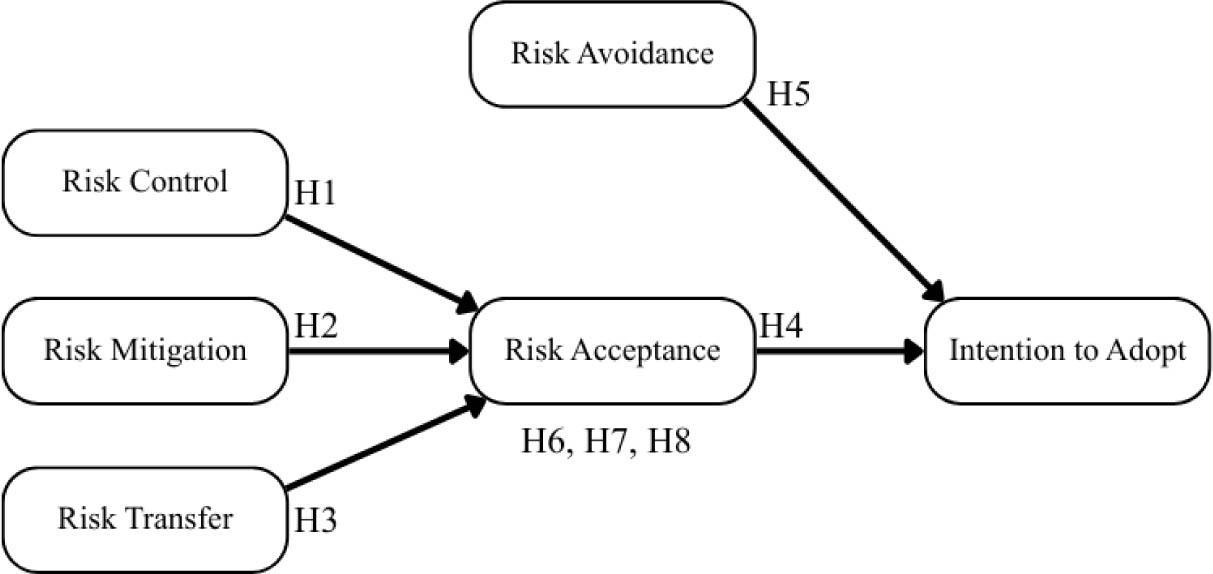
Figure 1.
Research framework
Source: own processing
Methodology
This study employs a quantitative research design using Partial Least Squares Structural Equation Modeling (PLS-SEM) to investigate the determinants of QRIS adoption among microentrepreneurs in Bandung City. The research focuses on the interplay between various risk treatment strategies, namely Risk Avoidance (RAV), Risk Control (RC), Risk Mitigation (RM), Risk Transfer (RT), and Risk Acceptance (RAC), as well as their subsequent impact on the Intention to Adopt (IA) QRIS.
Bandung City was selected due to its strategic position as a hub for tourism and the creative industry in Indonesia. Furthermore, its close proximity to the capital city, Jakarta, places Bandung at the forefront of digital payment transformation. The study specifically targets microentrepreneurs because they represent the backbone of Indonesia’s economic development yet often face significant barriers to digital transition due to limited financial backups and a higher vulnerability to operational disruptions.
Given the specific criteria required, this study utilized a purposive sampling technique. Questionnaires were distributed in November–December 2025. The sample consists of 150 microentrepreneurs in Bandung City who meet two specific criteria: (1) they are actively managing a micro-scale business, and (2) they have not yet integrated QRIS as a payment method in their daily operations. This non-probability sampling approach was chosen to ensure that the data gathered specifically reflects the perceptions and risk treatment behaviors of those who are still in the pre-adoption phase, providing deeper insights into the barriers to digital financial inclusion. To ensure measurement validity, the scale for Intention to Adopt was adapted from Hamzah Muchtar et al. (2024), while the five risk treatment constructs were developed by synthesizing conceptual insights from 25 academic sources (2017–2025). This multi-source synthesis ensures that each indicator accurately captures the specific dimensions of risk behavior in the context of QRIS adoption.
To assess sample adequacy, a post-hoc statistical power analysis was conducted using G*Power 3.1. Following Cohen’s recommendations (Cohen, 1988), a medium effect size (f2 = 0.15), a significance level of 0.05, and a high statistical power of 0.95 were specified. Considering the maximum number of predictors directed toward an endogenous construct in the proposed model (three predictors for Risk Acceptance), the analysis indicated a minimum required sample size of 119 observations. Therefore, the final sample of 150 respondents substantially exceeded this threshold, suggesting that the study possessed robust statistical power to detect meaningful relationships among the constructs. Furthermore, the sample size also satisfies commonly recommended requirements for PLS-SEM applications (Hair et al., 2022).
Data analysis was executed using SmartPLS 4, adhering to the advanced PLS-SEM evaluation framework proposed by Hair et al. (2022). The analysis was conducted in three phases: (1) Measurement Model Assessment to verify internal consistency, convergent validity, and discriminant validity, supplemented by a CFA-based single-factor test to detect common method variance (CMV), (2) Structural Model Assessment to test the hypothesized direct and indirect relationships, and (3) Predictive Power Evaluation using Q2 and the PLSpredict procedure to ensure the model’s out-of-sample predictive relevance.
Results
Respondents’ profile
The demographic and operational characteristics of the surveyed micro-enterprises in Bandung are summarized in Table 2. This profile provides context for understanding the risk management behaviors of these small-scale business owners.
The age distribution of the respondents reveals a significant concentration of mature entrepreneurs. The largest group consists of individuals aged 50–59 years, representing 30.7% (35 respondents) of the total sample, followed by those older than 59 years at 23.3% (13 respondents). Combined, more than half of the participants are over 50 years old. In contrast, younger entrepreneurs aged below 30 years only make up a small fraction (14.7%). This age demographic is particularly noteworthy for this study, as it highlights that the majority of microentrepreneurs currently navigating digital payment risks in Bandung are from the older generation. This profile provides a unique perspective on technology adoption, suggesting that the risk treatments being analyzed are those practiced by “digital immigrants” who may perceive and manage the risks of QRIS differently compared to the tech-savvy younger generation.
The majority of respondents are engaged in the Food and Beverage (F&B) sector, accounting for 52% (78 respondents). This is followed by the Trade/Retail sector with 42.7% (64 respondents). The Services sector represents a smaller portion of the sample. This distribution aligns with Bandung’s economic structure, where small-scale retail and culinary ventures serve as the primary drivers of local commerce.
In terms of financial scale, the survey results show that the majority of respondents operate on a very small scale, with 84% (126 respondents) reporting monthly sales of less than IDR 5,000,000. This is followed by 12.7% (19 respondents) earning between IDR 5,000,001 and IDR 10,000,000, while a small fraction of the sample (3.3%) earns between IDR 10,000,001 and IDR 20,000,000. These figures confirm that the participants strictly align with the classic definition of micro-enterprises under the 2008 Law (Law of the Republic of Indonesia Number 20 of 2008 concerning micro, small, and medium enterprises, 2008), where the IDR 25,000,000 monthly sales limit represents a much lower benchmark compared to current regulatory standards. While the newer regulation of 2021 (Government Regulation Number 7 Year 2021 regarding the ease, protection, and empowerment of cooperatives and micro, small, and medium enterprises, 2021) has significantly increased the threshold for micro-enterprises to annual sales of up to IDR 2,000,000,000 to facilitate broader developmental support, the respondents in this study represent microentrepreneurs at the grass-roots level. By focusing on this specific group, the study provides a more representative and accurate analysis of the digital payment risk vulnerabilities faced by the smallest economic actors in Indonesia, who often lack the financial cushions of larger enterprises.
Table 2.
Respondents’ profile
| Category | Type | Number of respondents (Total 150) | Percentage of respondents |
|---|---|---|---|
| Respondent Age | < 20 years old | 9 | 6.0% |
| 20 – 29 years old | 20 | 8.7% | |
| 30 – 39 years old | 27 | 13.3% | |
| 40 – 49 years old | 46 | 18.0% | |
| 50 – 59 years old | 35 | 30.7% | |
| > 59 years old | 13 | 23.3% | |
| Business Age | < 1 years old | 21 | 14.0% |
| 1 – < 3 years old | 32 | 21.3% | |
| 3 – 5 years old | 20 | 13.3% | |
| >5 years old | 77 | 51.3% | |
| Business Type | Services | 8 | 5.3% |
| F&B | 78 | 52.0% | |
| Trade / Retail | 64 | 42.7% | |
| Average Monthly Sales | < IDR 5,000,000 | 126 | 84.0% |
| IDR 5,000,001 – 10,000,000 | 19 | 12.7% | |
| IDR 10,000,001 – 15,000,000 | 3 | 2.0% | |
| IDR 15,000,001 – 20,000,000 | 2 | 1.3% | |
| Location | Bandung City (purposive sampling) | 150 | 100% |
| QRIS System Implemented | No (purposive sampling) | 150 | 100% |
Regarding the duration of business operation, the data reveals that the majority of respondents are highly experienced entrepreneurs, with 51.3% (77 respondents) having been operating their businesses for more than 5 years. In contrast, newer businesses with less than 1 year of experience represent only a small fraction of the sample at 14% (21 respondents). This profile suggests that the findings of this study are predominantly shaped by established microentrepreneurs who have long-term operational experience, providing a solid basis for evaluating how seasoned microentrepreneurs perceive and treat risks associated with digital payment adoption.
Regarding QRIS System Implementation, this study utilized a purposive sampling method to specifically target microentrepreneurs in Bandung who have not yet implemented QRIS, resulting in a sample where 100% of the respondents are currently non-adopters of the platform. Selecting Bandung City as the research location provides a strategic urban context: despite the city’s status as a tourism and creative hub, these entrepreneurs remain reliant on conventional transaction methods. This deliberate focus is essential to accurately identify the situations that hinder QRIS integration amidst national efforts.
Measurement model evaluation
In this research, the measurement model is evaluated as a reflective construct, encompassing variables such as IA, RAC, RAV, RC, RM, and RT (Table 3). The assessment of this reflective model relies on several key metrics: outer loadings and composite reliability (including Cronbach’s alpha) must exceed the 0.70 threshold, while the Average Variance Extracted (AVE) is required to be at least 0.50.
Table 3.
Measurement model evaluation
| Variable | Items | Outer Loading | Cronbach’s Alpha | Composite Reliability (rho_a) | Composite Reliability (rho_c) | Average Variance Extracted |
|---|---|---|---|---|---|---|
| Intention to Adopt (IA) | IA01 | 0.864 | 0.907 | 0.912 | 0.931 | 0.730 |
| IA02 | 0.883 | |||||
| IA03 | 0.890 | |||||
| IA04 | 0.785 | |||||
| IA05 | 0.846 | |||||
| Risk Acceptance (RAC) | RAC01 | 0.810 | 0.878 | 0.881 | 0.911 | 0.673 |
| RAC02 | 0.880 | |||||
| RAC03 | 0.829 | |||||
| RAC04 | 0.794 | |||||
| RAC05 | 0.787 | |||||
| Risk Avoidance (RAV) | RAV01 | 0.770 | 0.734 | 0.736 | 0.849 | 0.652 |
| RAV02 | 0.835 | |||||
| RAV03 | 0.817 | |||||
| Risk Control (RC) | RC01 | 0.741 | 0.882 | 0.905 | 0.912 | 0.677 |
| RC02 | 0.792 | |||||
| RC03 | 0.860 | |||||
| RC04 | 0.852 | |||||
| RC05 | 0.860 | |||||
| Risk Mitigation (RM) | RM01 | 0.775 | 0.783 | 0.784 | 0.860 | 0.606 |
| RM02 | 0.765 | |||||
| RM03 | 0.818 | |||||
| RM04 | 0.755 | |||||
| Risk Transfer (RT) | RT01 | 0.789 | 0.813 | 0.814 | 0.877 | 0.640 |
| RT02 | 0.806 | |||||
| RT03 | 0.778 | |||||
| RT04 | 0.826 |
Additionally, discriminant validity is verified through the application of the Fornell-Larcker criterion (Hair et al., 2022). Furthermore, to mitigate the risk of Common Method Bias (CMB) as highlighted by Podsakoff et al. (2024), a CFA-based single-factor test was performed. The analysis yielded a Chi-square value of 704.734, which significantly exceeds the critical threshold of 25.188 (p < 0.001). This result confirms that a single-factor model fails to fit the data, thereby demonstrating that common method variance does not pose a significant threat to the integrity of the structural relationships in this study.
The measurement model in this study was evaluated as a reflective construct, encompassing six primary variables: IA, RAC, RAV, RC, RM, and RT. To ensure the integrity of the model, an initial screening of factor loadings was conducted. During the measurement model assessment, four indicators (RAV04, RAV05, RM05, and RT05) exhibited relatively lower outer loadings of 0.633, 0.685, 0.680, and 0.641, respectively. A closer examination of the removed indicators suggests that several items reflected contextual conditions that may not have been uniformly relevant to all respondents. For example, RM05 (accepting traditional cash alongside QRIS) may represent a routine operational practice rather than a distinct risk-mitigation strategy, while RT05 (asking official parties to handle technical complications) may not reflect the actual support mechanisms typically relied upon by microentrepreneurs.
Following the recommendations of Hair et al. (2022), indicators with loadings between 0.40 and 0.70 may be considered for removal when their exclusion improves construct reliability and convergent validity. Consequently, these indicators were removed, and the model was re-estimated. The exclusion of RAV04, RAV05, RM05, and RT05 resulted in improved construct reliability and convergent validity. At the same time, the retained indicators continued to capture the core dimensions of the respective constructs, indicating that the measurement refinement enhanced model quality while preserving the theoretical integrity of the constructs.
As shown in the analysis, the reliability coefficients (Composite Reliability) for all constructs exceeded the 0.70 benchmark, while the Average Variance Extracted (AVE) values for each variable consistently remained above the 0.50 threshold. These metrics collectively verify that the measurement instruments are statistically sound and possess adequate explanatory power for the latent variables.
To evaluate the discriminant validity of the constructs, the Fornell-Larcker criterion was employed. As shown in Table 4, the square root of the Average Variance Extracted (AVE) for each construct, which is represented by the diagonal values, is consistently higher than the correlation coefficients between that construct and any other latent variables. For instance, the construct IA has a square root of AVE of 0.855, which is greater than its correlation with other variables, such as 0.562 with RAC, 0.248 with RAV, among others.
Table 4.
Discriminant validity (Fornell-Larcker)
| Variable | IA | RAC | RAV | RC | RM | RT |
|---|---|---|---|---|---|---|
| IA | 0.855 | |||||
| RAC | 0.562 | 0.821 | ||||
| RAV | 0.248 | 0.080 | 0.808 | |||
| RC | 0.429 | 0.529 | 0.167 | 0.823 | ||
| RM | 0.465 | 0.647 | 0.115 | 0.751 | 0.778 | |
| RT | 0.417 | 0.563 | 0.278 | 0.296 | 0.421 | 0.800 |
These results demonstrate that each variable shares more variance with its own indicators than with other constructs in the model. Therefore, the measurement model satisfies the requirements for discriminant validity, confirming that the constructs are empirically distinct from one another.
Structural model evaluation
The evaluation of the structural model in this study follows a systematic four-stage procedure. First, potential multicollinearity issues among the constructs were examined through the Inner Variance Inflation Factor (VIF), where values must remain below the 5.0 threshold to ensure stable parameter estimates (Hair et al., 2022). Second, the research hypotheses were tested by analyzing Path Coefficients, focusing on T-statistics (>1.96), P-values (<0.05), and 95% confidence intervals. Third, the F Square was measured to determine the substantive impact or effect size of each relationship. Finally, the mediation effects were assessed using the upsilon (υ) statistic as suggested by (Lachowicz et al., 2018) to provide a robust estimation of the indirect paths.
Before proceeding to hypothesis testing, the inner VIF values were scrutinized to ensure the absence of collinearity. The analysis revealed that the highest inner VIF value was only 2.550, which is well below the recommended limit. These results indicate a negligible level of multicollinearity, thereby confirming that the structural model is robust and the subsequent parameter estimates are unbiased and reliable for interpreting the relationship between risk perceptions and QRIS adoption barriers.
As seen in Table 5, the structural model assessment provides a detailed look at how various risk treatment strategies influence the level of Risk Acceptance (RAC) and the subsequent Intention to Adopt (IA) QRIS. The empirical results reveal that Risk Mitigation (RM) and Risk Transfer (RT) are significant drivers of Risk Acceptance. Specifically, RM shows a strong positive impact on RAC (H2: β = 0.409, p < 0.001, f2 = 0.138), and RT also contributes significantly (H3: β = 0.357, p < 0.001, f2 = 0.221), with upper confidence intervals reaching 0.568 and 0.503, respectively. From an effect-size perspective, RT demonstrates a stronger substantive contribution to Risk Acceptance than RM. These findings suggest that when entrepreneurs have solid mitigation and transfer mechanisms, their willingness to accept residual risks increases. Furthermore, Risk Acceptance (RAC) itself emerged as the most critical determinant of Intention to Adopt (IA) (H4: β = 0.546, p < 0.001, f2 = 0.461), indicating that the decision to embrace digital payment risks is a fundamental precursor to technology adoption.
Table 5.
Direct effects
| Direct Effect | Path Coefficients | P Values | 95% Confidence Interval Path Coefficient | F Square | |
|---|---|---|---|---|---|
| Lower Limit | Upper Limit | ||||
| H1: RC -> RAC | 0.117 | 0.203 | −0.064 | 0.291 | 0.013 |
| H2: RM -> RAC | 0.409 | 0.000 | 0.240 | 0.568 | 0.138 |
| H3: RT -> RAC | 0.357 | 0.000 | 0.206 | 0.503 | 0.221 |
| H4: RAC -> IA | 0.546 | 0.000 | 0.406 | 0.678 | 0.461 |
| H5: RAV -> IA | 0.204 | 0.006 | 0.060 | 0.347 | 0.065 |
Risk Avoidance (RAV) demonstrated a significant positive influence on Intention to Adopt (IA) (H5: β = 0.204, p = 0.006, f2 = 0.065). Although statistically significant, the effect size is relatively small, suggesting that its practical contribution is substantially weaker than that of Risk Acceptance. This suggests paradoxical behavior among microentrepreneurs. Although they are highly aware of the risks and express a desire to avoid them, this awareness does not deter their adoption intent. This may be attributed to the necessity-driven adoption factor, where entrepreneurs feel they must adopt technology to remain competitive, despite their concerns and avoidance tendencies toward its inherent risks. On the other hand, the path from Risk Control (RC) to Risk Acceptance (RAC) was statistically insignificant (H1: β = 0.117, p = 0.203, f2 = 0.013). With a confidence interval that crosses zero (−0.064 to 0.291), the data suggests that existing risk control measures do not necessarily lead to higher levels of risk acceptance among the surveyed microentrepreneurs. The negligible effect size further suggests that formal control mechanisms contribute very little to explaining variations in Risk Acceptance among the surveyed microentrepreneurs. This highlights a potential gap where formal controls may not be perceived as sufficient to shift the entrepreneurs’ stance on accepting the digital transition’s inherent risks.
The mediation effects in this study were evaluated using both bootstrapping results and the Upsilon (υ) statistic as a measure of effect size (Lachowicz et al., 2018) (Table 6 and Figure 2).
Table 6.
Indirect effects
| Indirect Effect | Path Coefficients | P Values | Lower Limit | Upper Limit | Upsilon (υ) |
|---|---|---|---|---|---|
| H6: RC -> RAC -> IA | 0.064 | 0.223 | −0.031 | 0.172 | 0.004 |
| H7: RM -> RAC -> IA | 0.223 | 0.000 | 0.130 | 0.339 | 0.049 |
| H8: RT -> RAC -> IA | 0.195 | 0.000 | 0.109 | 0.298 | 0.038 |
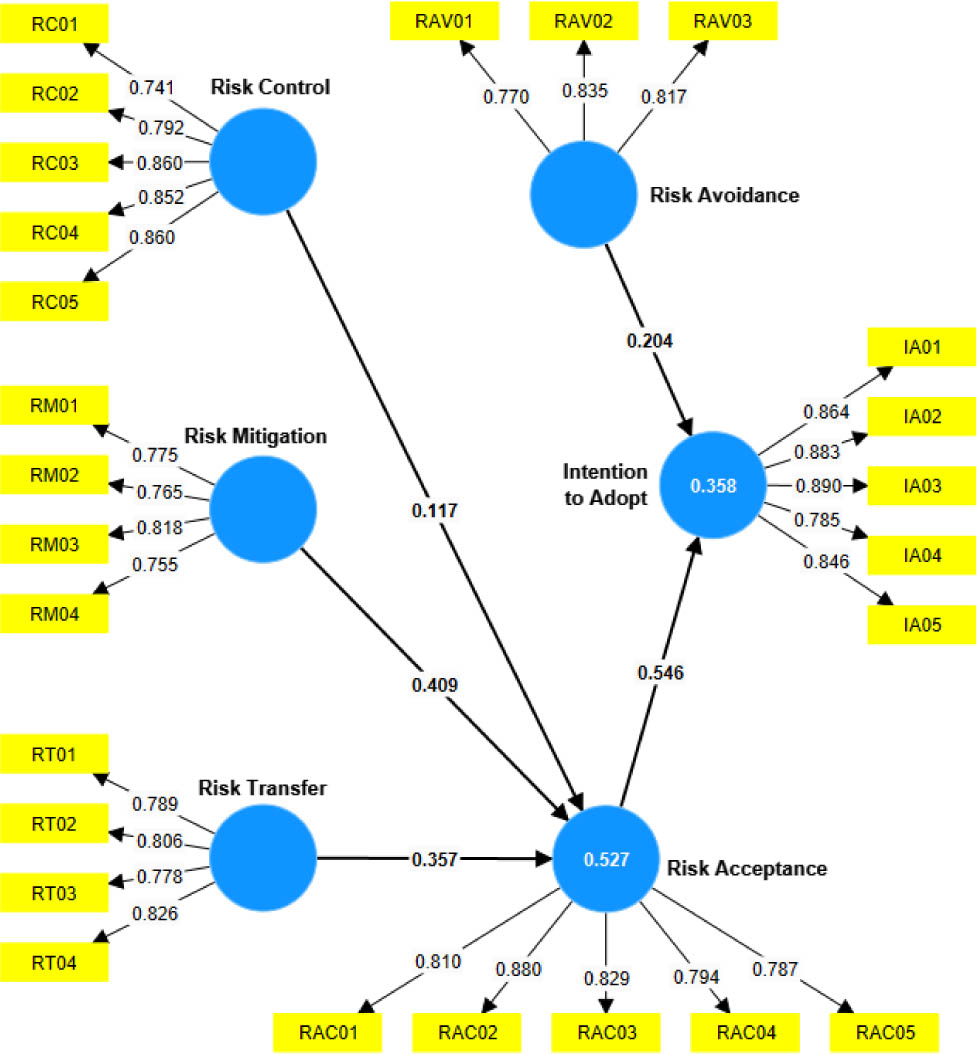
Figure 2.
Outer model
Source: own processing
Based on the analysis, two out of three mediation hypotheses were statistically supported. H7, which examines the indirect effect of Risk Mitigation (RM) on IA through Risk Acceptance (RAC), was accepted with the highest effect size (H7: β = 0.223, p < 0.001, υ = 0.049). Similarly, H8 was accepted, confirming that Risk Transfer (RT) significantly influences adoption intent via RAC (H8: β = 0.195, p < 0.001, υ = 0.038). The 95% confidence intervals for both paths do not include zero, further solidifying the robustness of these mediation roles.
In contrast, H6 was rejected, as the indirect effect of Risk Control (RC) on IA through RAC was found to be statistically insignificant (H6: β = 0.064, p = 0.223, υ = 0.004). The confidence interval for this path ranges from −0.031 to 0.172, crossing zero and indicating a lack of a mediation relationship. These results demonstrate that while RM and RT successfully foster adoption intent by increasing risk acceptance, formal risk controls do not yield the same indirect impact within the structural model.
Model goodness and fit evaluation
The final stage of the structural model evaluation involves assessing the model’s explanatory power and its predictive relevance for the endogenous constructs. The analysis reveals that the combined influence of Risk Control (RC), Risk Mitigation (RM), and Risk Transfer (RT) explains 52.7% of the variance in Risk Acceptance (RAC) (R2 = 0.527), indicating a moderate to strong explanatory effect. Furthermore, the model accounts for 35.8% of the variance in Intention to Adopt (IA) (R2 = 0.358), which falls within the moderate category. These results suggest that while Risk Acceptance is heavily influenced by RC, RM, and RT, the intention to adopt is also shaped by other external factors not fully captured in the current framework.
To evaluate the model’s predictive capabilities, the Stone-Geisser Q2 values were examined (Table 7). The results show that Risk Acceptance possesses a high level of predictive relevance (Q2 = 0.487), while Intention to Adopt demonstrates a moderate predictive accuracy (Q2 = 0.261). Since all Q2 values are consistently above zero, the model confirms its adequacy in predicting the adoption behavior and risk perceptions of microentrepreneurs toward QRIS technology.
To evaluate the out-of-sample predictive power of the model, a PLSpredict procedure was performed using a 10-fold cross-validation approach. Following the criteria established by Hair et al. (2022), the predictive performance of the PLS-SEM model is assessed by comparing its Root Mean Square Error (RMSE) or Mean Absolute Error (MAE) against a naive Linear Regression (LM) model. A model is considered to have high predictive power if all its indicators yield lower error values in PLS-SEM than in LM. If most of the indicators show lower errors, the model is categorized as having medium predictive power (Table 8).
Table 8.
PLSpredict
| Variable | PLS-SEM | LM | ||
|---|---|---|---|---|
| RMSE | MAE | RMSE | MAE | |
| IA01 | 2,706 | 2,151 | 2,909 | 2,247 |
| IA02 | 2,537 | 1,952 | 2,636 | 2,073 |
| IA03 | 2,327 | 1,837 | 2,431 | 1,894 |
| IA04 | 2,787 | 2,310 | 2,802 | 2,229 |
| IA05 | 2,603 | 2,185 | 2,531 | 2,003 |
| RAC01 | 1,768 | 1,339 | 1,964 | 1,422 |
| RAC02 | 1,875 | 1,411 | 1,971 | 1,491 |
| RAC03 | 1,768 | 1,328 | 1,922 | 1,482 |
| RAC04 | 1,895 | 1,425 | 2,049 | 1,542 |
| RAC05 | 1,947 | 1,496 | 1,999 | 1,531 |
The analysis of the measurement items revealed that most indicators, specifically IA01, IA02, IA03, RAC01, and RAC02, demonstrated lower RMSE and MAE values in the PLSSEM model compared to the LM benchmarks. Although a few items, such as IA04 and IA05, exhibited slightly higher error margins in the PLS estimation, the overall results show that the majority of the indicators favor the PLS-SEM approach. Consequently, it can be concluded that the proposed model possesses a medium predictive power, confirming its reliability in predicting future adoption intentions and risk acceptance behaviors among microentrepreneurs.
Discussion
The acceptance of hypotheses H2 and H3 confirms that Risk Mitigation (RM) and Risk Transfer (RT) significantly enhance Risk Acceptance (RAC) among microentrepreneurs in Bandung who have not yet adopted QRIS. RM’s strong positive effect (β = 0.409, p < 0.001) suggests that respondents who intend to prepare for potential QRIS-related issues (such as noting every transaction, setting aside emergency funds, and using backup payment methods) are more willing to accept residual risks. These behaviors reflect a pragmatic approach in which entrepreneurs anticipate operational challenges and proactively plan to minimize their impact, which aligns with resilience and contingency planning literature (Hosseini Shekarabi et al., 2025; Sapountzaki, 2022). Similarly, RT’s significant effect (β = 0.357, p < 0.001) indicates that entrepreneurs who prefer to delegate QRIS adoption tasks to trusted individuals or networks, whether through family members, community support, or experts, feel more comfortable accepting associated risks. This finding resonates with risk-sharing theories, where transferring responsibility reduces perceived personal exposure (Feng & Liu, 2025; Leng et al., 2017).
Consistent with H4, Risk Acceptance (RAC) emerges as the strongest predictor of Intention to Adopt (IA) (β = 0.546, p < 0.001). Respondents who acknowledge QRIS risks but believe they can manage them, especially after understanding how QRIS works and weighing benefits against drawbacks, are most likely to express adoption intent. For microentrepreneurs operating with monthly revenues below IDR 5,000,000, this cognitive shift is critical. Adoption occurs when perceived benefits, such as easier transactions or customer convenience, outweigh concerns about technical issues or financial risks. This supports prior research on technology adoption under uncertainty, emphasizing that acceptance of residual risk is a prerequisite for behavioral intention (Dwivedi et al., 2019; Williams et al., 2015).
Unexpectedly, H5 shows that Risk Avoidance (RAV) positively influences IA (β = 0.204, p = 0.006). Entrepreneurs who initially avoid QRIS, citing reasons such as fear of complicating merchant relationships, reluctance to adjust costs, or lack of regulatory mandate, still exhibit strong intention to adopt. Unexpectedly, Risk Avoidance exhibited a positive relationship with Intention to Adopt QRIS. Although this result appears counterintuitive, a closer examination of the retained indicators suggests that Risk Avoidance may not necessarily represent complete rejection of QRIS. Instead, the construct reflects cautious and conditional evaluation of adoption decisions, including concerns about implementation costs, operational adjustments, and the absence of formal mandates.
For many microentrepreneurs, particularly those operating with limited financial resources, delaying adoption may represent a strategy for reducing uncertainty while gathering additional information about the technology. Such cautious behavior does not necessarily eliminate future adoption intentions. Rather, entrepreneurs may remain interested in adopting QRIS once sufficient institutional support, regulatory guidance, or implementation certainty becomes available. This interpretation suggests that risk avoidance and adoption intention are not always mutually exclusive. Among non-adopting microentrepreneurs, avoiding immediate implementation may coexist with a willingness to adopt in the future, particularly when the perceived benefits of QRIS become clearer and the uncertainties associated with adoption are reduced.
Conversely, H1 is rejected: Risk Control (RC) does not significantly affect RAC (β = 0.117, p = 0.203). Although respondents express intentions to monitor QRIS usage, adjust infrastructure, and plan ahead, these formal control measures do not translate into higher risk acceptance. This non-significant relationship suggests that preventive control activities alone may not be sufficient to foster psychological acceptance of QRIS-related risks among microentrepreneurs. Although respondents expressed willingness to monitor transactions, improve infrastructure, and plan for potential issues, such activities may be perceived as additional operational responsibilities rather than sources of reassurance.
Unlike Risk Mitigation and Risk Transfer, which directly reduce the perceived consequences or personal burden of adverse events, Risk Control primarily focuses on preventing risk occurrence. For microentrepreneurs operating with limited financial, technological, and human resources, continuous monitoring and control activities may increase perceptions of complexity and workload without necessarily enhancing confidence in the technology itself. As a result, these control mechanisms may fail to translate into greater acceptance of residual risks associated with QRIS adoption.
The mediation analysis provides deeper insight into these relationships. H7 and H8 are supported, confirming that RM and RT influence IA indirectly through RAC (β_indirect = 0.223 and 0.195, respectively; p < 0.001). This underscores RAC as the psychological gateway through which mitigation and transfer strategies activate adoption intent. RM’s role is not limited to functional preparedness, since it fosters a mental state where entrepreneurs feel equipped to tolerate residual uncertainty (Marhavilas & Koulouriotis, 2021; Rezvani et al., 2023). Similarly, RT reduces internal resistance by distributing responsibility, enabling entrepreneurs to perceive QRIS adoption as less personally risky (Ashmawi et al., 2018; Feng & Liu, 2025). These findings align with prior studies emphasizing that external safeguards and shared responsibility should be internalized as acceptable risk before they translate into behavioral commitment (Hamzah Muchtar et al., 2024; Jain et al., 2023).
In contrast, H6 is rejected: the indirect effect of RC via RAC is not significant (β_indirect = 0.064, p = 0.223). While risk control mechanisms such as monitoring and infrastructure adjustments provide technical assurance, they fail to trigger adoption when entrepreneurs do not perceive these measures as sufficient to make residual risks tolerable (Hiebl, 2024; Taherdoost, 2021). Based on these results, QRIS adoption programs should emphasize risk mitigation education, such as how to maintain transaction logs or set aside small reserves, and community-based support for risk transfer, such as peer mentoring or incorporating local champions. Policymakers and payment providers should design low-friction control tools like automated alerts or simple dashboards, rather than expecting manual monitoring. Finally, acknowledging the coexistence of avoidance and intention, strategies should allow gradual adoption with flexible options, enabling entrepreneurs to start small and expand as confidence grows. The explanatory power of the model further supports these recommendations. The proposed framework explains 52.7% of the variance in Risk Acceptance and 35.8% of the variance in Intention to Adopt, indicating that ISO 31000-based risk treatment strategies provide meaningful explanatory value for understanding QRIS adoption among microentrepreneurs, although additional contextual factors may also influence adoption decisions.
From a theoretical standpoint, this study extends UTAUT by integrating Risk Treatments as behavioral antecedents in technology adoption. The strong mediating role of RAC and the unexpected positive effect of RAV challenge traditional assumptions that avoidance uniformly inhibits adoption. Instead, findings reveal a nuanced, necessity-driven adoption pattern among resource-constrained entrepreneurs, offering new directions for research on selective adoption and adaptive risk strategies in emerging markets.
Theoretical contributions
This study contributes to the technology adoption literature in three important ways. First, it extends UTAUT by incorporating ISO 31000 risk treatment strategies as behavioral antecedents of technology adoption. While most prior studies conceptualize risk as a passive perception that inhibits adoption, the present study shifts the focus toward active risk-management responses undertaken by potential adopters. Second, the findings identify Risk Acceptance as an important psychological mechanism that translates risk treatment behaviors into technology adoption intentions. This finding helps explain why entrepreneurs may remain willing to adopt digital technologies despite recognizing the existence of residual risks. Third, the positive relationship between Risk Avoidance and Intention to Adopt challenges the conventional assumption that avoidance always suppresses adoption behavior. Among non-adopting microentrepreneurs, risk avoidance may reflect cautious postponement and conditional evaluation rather than outright rejection of a technology. This finding suggests that avoidance and adoption intention may coexist during the transition from non-adoption to future adoption.
Practical implications
The practical implications of this study are informed by the relative strength of the observed effects. Risk Acceptance emerged as the strongest predictor of Intention to Adopt (β = 0.546; f2 = 0.461), suggesting that interventions focused solely on promoting awareness of QRIS may be insufficient unless they also increase entrepreneurs’ willingness to tolerate manageable residual risks. Risk Mitigation (β = 0.409) and Risk Transfer (β = 0.357) significantly influenced Risk Acceptance, indicating that policymakers and payment providers should prioritize mitigation-oriented education, contingency planning support, technical assistance, peer mentoring, and community-based support mechanisms. Conversely, the non-significant effect of Risk Control suggests that highly formalized control procedures may not always be suitable for micro-scale businesses operating with limited time, financial resources, and technological capabilities.
Conclusions
This study examined how ISO 31000-based risk treatment strategies shape Risk Acceptance and subsequently influenced the Intention to Adopt QRIS among microentrepreneurs in Bandung City. The findings indicate that Risk Mitigation (β = 0.409, p < 0.001) and Risk Transfer (β = 0.357, p < 0.001) significantly increased Risk Acceptance, while Risk Control did not demonstrate a statistically significant effect (β = 0.117, p = 0.203). Risk Acceptance emerged as the strongest predictor of Intention to Adopt (β = 0.546, p < 0.001; f2 = 0.461), highlighting its central role in transforming risk-management behaviors into adoption intentions. In addition, Risk Avoidance exhibited a positive direct effect on adoption intention (β = 0.204, p = 0.006), suggesting that non-adopting microentrepreneurs may simultaneously express risk-avoidance tendencies while remaining open to future adoption once uncertainty is sufficiently reduced. The model explained 52.7% of the variance in Risk Acceptance and 35.8% of the variance in Intention to Adopt, indicating moderate explanatory power.
From a theoretical perspective, this study contributes to the technology adoption literature by extending UTAUT through the integration of ISO 31000 risk treatment constructs. Unlike conventional technology adoption studies that emphasize perceived risk as a passive assessment of potential threats, this study demonstrates that active risk treatment behaviors represent an important mechanism influencing adoption decisions. Furthermore, the findings identify Risk Acceptance as a critical psychological mediator that translates risk treatment strategies into behavioral intentions. The unexpected positive relationship between Risk Avoidance and adoption intention also suggests that risk avoidance does not necessarily suppress technology adoption among resource-constrained entrepreneurs but may coexist with necessity-driven adoption behavior.
From a practical perspective, the findings suggest that policymakers, payment service providers, and MSME-support institutions should prioritize interventions that strengthen risk mitigation and risk transfer capabilities among microentrepreneurs. Educational programs focusing on transaction security, contingency planning, transaction recordkeeping, and emergency preparedness may help entrepreneurs become more comfortable with digital payment adoption. Likewise, community-based mentoring, technical assistance, and peer-support mechanisms may serve as effective risk-transfer arrangements that enhance confidence in QRIS implementation. Given the limited influence of Risk Control, simplified and low-friction control mechanisms should be developed to ensure that formal safeguards do not become an additional burden for micro-scale enterprises operating with constrained resources.
Several limitations should be acknowledged. First, the use of purposive sampling and data collection restricted to non-adopting microentrepreneurs in Bandung City may limit the generalizability of the findings to other regions and business contexts. Second, the cross-sectional design does not permit strong causal inference and captures perceptions at only one point in time. Third, the study relied on self-reported measures, which may be susceptible to common method bias despite diagnostic procedures indicating that such concerns are unlikely to be substantial. Finally, several indicators were removed during measurement model refinement, which may affect the broader applicability of the measurement instrument. Future studies are encouraged to employ longitudinal designs, replicate the model across multiple regions, examine moderators such as age, digital literacy, business experience, and social influence, and investigate alternative risk-sharing mechanisms including micro-insurance, cooperative support systems, and institutional protection schemes.