
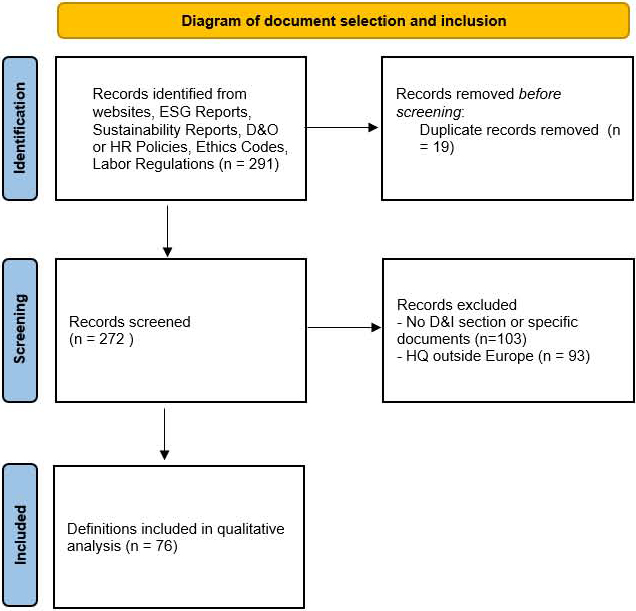
Figure 1.
Diagram of document selection and inclusion process
Source: own processing
Table 1.
Regional differences in the representation of employee groups within D&I policies
| Region | Women | Disability | LGBTQ+ | Ethnic minorities | Intergenerat ional cooperation | Parents and caregivers | Socioeconomic groups | Older employees (50+) |
|---|---|---|---|---|---|---|---|---|
| Anglo-Saxon countries | 4.0 | 4.5 | 3.5 | 1.5 | 1.0 | 0.0 | 0.5 | 0.5 |
| Continental Europe | 2.6 | 2.4 | 2.9 | 1.7 | 0.7 | 0.3 | 0.0 | 0.0 |
| Nordic countries | 0.7 | 1.2 | 0.7 | 0.5 | 0.3 | 0.0 | 0.0 | 0.0 |
| Southern Europe | 1.0 | 0.7 | 1.0 | 0.7 | 0.3 | 0.3 | 0.3 | 0.3 |
| Southeastern Europe | 1.5 | 0.3 | 0.7 | 0.8 | 0.7 | 0.0 | 0.0 | 0.0 |
| Central-Eastern Europe | 1.0 | 0.0 | 1.0 | 0.5 | 0.0 | 1.0 | 0.0 | 0.0 |
Table 2.
One-way ANOVA results by priority employee groups
| Indicator | F-statistic | p-value | η2 |
|---|---|---|---|
| Women | 1.458 | 0.247 | 0.26 |
| Persons with disabilities | 5.412 | 0.003 | 0.56 |
| LGBTQ+ community | 2.766 | 0.047 | 0.40 |
| Ethnic minorities | 0.634 | 0.676 | 0.13 |
| Intergenerational cooperation | 0.461 | 0.801 | 0.10 |
| Parents and caregivers | 1.898 | 0.140 | 0.31 |
| Socio-economically disadvantaged | 2.330 | 0.080 | 0.36 |
| Older employees (50+) | 2.330 | 0.080 | 0.36 |
Table 3.
Summary of post-hoc comparisons for the indicator persons with disabilities
| Region 1 | Region 2 | MD | Tukey HSD |
|---|---|---|---|
| Anglo-Saxon countries | Southeastern Europe | 4.17 | 0.005 |
| Anglo-Saxon countries | Southern Europe | 3.83 | 0.024 |
| Anglo-Saxon countries | Nordic countries | 3.33 | 0.030 |
| Anglo-Saxon countries | Central-Eastern Europe | 4.50 | 0.014 |
| Anglo-Saxon countries | Continental Europe | 2.07 | 0.306 |