
Introduction
Diversity and Inclusion (D&I) have become central elements of contemporary organisational strategies, which increasingly reflect not only ethical and social obligations, but also economic, reputational and regulatory requirements. In the context of globalisation, demographic changes and growing expectations of stakeholders, organisations are under increasing pressure to establish inclusive practices and to publicly report on them within the broader framework of sustainability and ESG standards (Environmental, Social, and Governance).
In the contemporary knowledge economy, organisational performance increasingly depends on the effective use of human capital, knowledge exchange, and the capacity to innovate. Within this context, Diversity and Inclusion (D&I) have become strategic levers that shape management dynamics by influencing decision-making processes, leadership behaviour, organisational learning, and firms’ ability to adapt to complex environments. Recent studies show that inclusive organisational cultures enhance collaboration, creativity, and the sharing of expertise, thereby strengthening organisations’ potential to generate and retain intellectual resources (Koç et al., 2025). Similarly, meta-analytic evidence demonstrates that D&I practices function as systemic interventions that affect structural change, employee engagement, and long-term organisational resilience, core components of contemporary management systems (Zhao et al., 2025). Recent theoretical and empirical work further emphasises that inclusion operates as a multi-level construct encompassing organisational, leader, workgroup, and interpersonal processes, all of which jointly determine how effectively diverse knowledge is leveraged within firms (Shore & Chung, 2024). For these reasons, understanding how organisations conceptualise and prioritise D&I is not only a matter of social responsibility but also a key determinant of competitiveness and sustainable value creation in knowledge-based economies.
The origins of D&I practices in contemporary organisations stem from the American civil rights movement and legislative changes in the 1960s, particularly the passage of the Civil Rights Act of 1964, which prohibited employment discrimination based on race, sex, religion, and national origin (Bay & Walwema, 2025). Today, an extremely important part of organisational culture and business, which originated in the USA, has spread its influence to the rest of the world. The model of corporate diversity and inclusion policies, developed in the USA, quickly spread to Europe through global business networks and multinational companies. In the European context, D&I, however, has often taken on a regulatory and socio-legal character, aligned with the principles of social cohesion and equal opportunities promoted by the European Union (Köllen, 2021). Today, D&I is deeply rooted in European culture, which is in line with the general efforts to create an inclusive society, starting from education, health, culture and general accessibility (in particular through the strengthening of universal design and inclusive cities).
In line with the above, if we create or want to create a society of equal opportunities for all, it is necessary to involve all actors and all environments in creating such an environment. It is in this sense that the European Union has built a broad institutional and legal framework for promoting diversity and inclusion, which includes fundamental treaties, directives and strategic documents. Key among them are Directive 2000/43/EC on equal treatment regardless of racial or ethnic origin and Directive 2000/78/EC on equal treatment in employment and occupation, which form the core of European antidiscrimination legislation and lay the foundations for the integration of the principle of equality into all EU policies (European Union 2020a, 2020b). This distinguishes the European approach to D&I from the American model, as in Europe the focus is on legal protection, social cohesion and the systematic institutionalisation of equal opportunities, rather than primarily on the reparation of historical injustices (European Commission, 2020; Köllen, 2021; Saeys et al., 2019). Recent European studies further confirm that public support for D&I policies is shaped not only by individual attitudes but also by broader structural factors such as national inequality levels, anti-discrimination frameworks and perceived prevalence of discrimination, underscoring the systemic nature of inclusion in the EU (Blommaert & Coenders, 2024). Moreover, research on structural racism in European societies demonstrates that institutional norms and historical power relations continue to shape opportunities for ethnic and migrant groups, reinforcing the importance of strong legal and policy frameworks for ensuring equal treatment across member states (Groglopo et al., 2023).
At the organisational level, European states and companies have gradually operationalised the principles of diversity and inclusion through the concept of diversity management, which has become the dominant framework for managing diversity in the labour market (Wrench, 2007). Unlike earlier approaches that were based on compliance with minimum legal obligations, contemporary organisations in Europe increasingly integrate D&I into their sustainability strategies, social responsibility reports (CSR) and ESG (environmental, social, governance) standards. In this context, diversity and inclusion are recognised as factors that contribute to innovation, organisational resilience and longterm competitiveness (European Commission, 2020; Köllen, 2021). Recent literature shows that inclusive organisational cultures, supported by leadership commitment and coherent D&I structures, significantly enhance employee satisfaction, service quality and operational performance, particularly in service sectors such as hospitality and tourism (Koç et al., 2025). Meta-review evidence also indicates that organisations relying solely on compliance-based measures achieve limited impact, whereas integrated systems combining policies, practices, training and transparent monitoring mechanisms produce more consistent and meaningful inclusion outcomes (Zhao et al., 2025). The European Commission additionally encourages the institutionalisation of these practices through the EU Gender Equality Strategy 2020-2025, LGBTIQ Equality Strategy 2020-2025 and Disability Rights Strategy 2021-2030, which creates a normative framework that connects social justice with economic sustainability and responsible governance (European Commission, 2020).
In order for European companies to harmonise their internal policies and processes with increasingly strong regulatory requirements, it is necessary to start from the beginning. Namely, if companies want inclusion to be part of their identity, reality and brand, an integrative approach is needed. At the beginning, companies most often carried out certain analyses based on certain quantitative indicators (eg number of employees with disabilities or number of women), and the next step included researching work experience as one of the determinants of inclusive culture. In today’s organisational context, we increasingly use tools such as the Employee engagement survey, which can help us with this (Lauderdale, 2023). After the initial understanding and answer to the question “Where are we?”, it was necessary to ask the question “Where do we want to be?” As one of the key questions in the strategic planning of the company’s operations, this question is also important for the strategic planning of D&I.
To adequately answer this question, companies started developing internal D&I policies that would ensure compliance with regulatory requirements, but also improve the position and visibility of employees, especially those who are marginalised or disenfranchised in any context (Jansen et. al, 2024; Topalović, 2024). Such policies are most often covered by several segments, such as understanding diversity and inclusion, monitoring mechanisms, certain activities, but also priorities that are particularly interesting to us. When we talk about priorities, we want to answer the question “Which groups of employees are the focus of the D&I policy?”. Setting thematic priorities or priority groups deeply shapes the direction of development of inclusive initiatives. It is especially related to the choice of activities, mechanisms and measures that organisations apply in practice – from affirmative employment policies and educational programs to the creation of support networks, mentoring systems and adaptations of the work environment. Prioritisation also reveals the value framework within which the concept of diversity is understood – whether it is about gender equality, ethnicity, age, disability or other forms of diversity.
Although D&I research is widespread, it is mainly related to employee experiences (Nishii, 2013; Shore et al., 2010), while analyses of D&I policies are almost non-existent in professional and recent literature. Considering that such policies have a significant place and determine the long-term direction of the development of an inclusive culture, it is important to ensure an adequate research perspective in order to better understand the context. In addition to theoretical understanding, such research can be a significant help in creating and shaping internal documents in current organisations. The scarcity of systematic analyses of D&I policy content contrasts sharply with the rapidly expanding research on individual experiences of inclusion, highlighting an urgent need to understand how organisations translate regulatory expectations and societal norms into concrete strategic priorities (Zhao et al., 2025).
Therefore, research on institutional patterns and organisational approaches to diversity and inclusion in the European context allows for understanding how the concepts of equal opportunities are operationalised across different sectors and regions. This paper aims to analyse how European organisations set priorities within their D&I policies, which employee groups they identify as central to the development of inclusive strategies, and to what extent these priorities differ across sectors and countries. In this way, the paper aims to contribute to a better understanding of institutional patterns of diversity and inclusion in Europe and to point to possible directions for further development of organisational policies in this area. Such an approach aligns with recent calls for multilevel analyses of D&I that consider individual, organisational and structural dimensions simultaneously, reflecting the complexity of contemporary European labour markets and governance systems (Blommaert & Coenders, 2024; Koç et al., 2025).
Theoretical framework of the research
In this research, the Four Layers of Diversity Model (Gardenswartz & Rowe, 2003) was chosen as a theoretical framework because it allows for a multidimensional view of identity and diversity within organisations. Unlike other models that emphasise only the demographic or economic aspects of diversity (e.g., Cox, 1991; Ely & Thomas, 2001), this approach allows for a deeper understanding of the interrelationship of personal, social, and organisational factors that shape inclusive practices. This makes the model particularly applicable in the analysis of D&I policies, as it includes both individual and institutional dimensions that are crucial for the development of an inclusive organisational culture.
The Four-Layer Diversity Model
In discussions of D&I in contemporary organisations, the Four-Layer Diversity Model (Gardenswartz & Rowe, 2003) holds a special place because it offers a multidimensional understanding of identity that goes beyond superficial categorisations. While early approaches to diversity management, such as those of Cox and Blake (1991), emphasised the economic benefits of heterogeneous teams, Gardenswartz and Rowe (2003) conceptualised diversity as a structure of identity – layered, dynamic, and contextually conditioned. Given the rapid demographic changes sweeping Europe, it would be irresponsible to understand diversity as a static and rigidly defined category that is operationalised through several “visible” or “expected” diversities. Recent research reinforces this critique of reductionist approaches, demonstrating that the effects of diversity depend heavily on organisational context, team climate and psychological safety, rather than demographic differences alone (Verwijs & Russo, 2023). The model assumes that identity cannot be reduced to a single attribute, but rather consists of four interconnected layers: personality, internal dimensions, external dimensions, and organisational dimensions. Each layer influences the perception of self and others, shapes the experience of work, and defines the degree of involvement of the individual in organisational processes (Mor Barak, 2015; Shore et al., 2010). This multilayered perspective is consistent with recent European findings showing that attitudes toward D&I policies are shaped by a combination of individual characteristics and macrostructural conditions, including national inequality, anti-discrimination laws, and perceptions of societal discrimination (Blommaert & Coenders, 2024).
The first layer, personality, forms the core of the model. This layer of diversity can be explained most simply as what makes a person unique when considering all other people. This dimension encompasses relatively stable psychological patterns of behaviour, motivation, and emotional response (McCrae & Costa, 2008). This emphasis on “deeplevel” diversity has also been supported by recent systematic analyses, which highlight that personality, values, and cognitive styles increasingly shape team effectiveness in complex organisational environments (Sundermeier & Mahlert, 2023). Although often marginalised in diversity discourse, personality is crucial for understanding the microdynamics of teamwork and interpersonal interaction (Barrick et al., 2013). Organisations that recognise personality differences as a resource rather than a source of tension develop more flexible forms of leadership and learning cultures (Hogan & Holland, 2003). In other words, the authenticity of the individual becomes an integral part of collective creativity.
Internal dimensions encompass largely immutable characteristics – gender, age, ethnicity, physical ability/disability, and sexual orientation (Gardenswartz & Rowe, 2003). These characteristics shape the experience of belonging and the perception of equality, but they are also the foundation of social hierarchies. Contemporary meta-reviews of D&I interventions further show that immutable identity dimensions (e.g., age, gender, disability) cannot be effectively addressed through isolated initiatives, but require integrated combinations of policies, programs, and organisational practices (Zhao et al., 2025). As Bonilla-Silva (2017) points out, social structures often produce “racial and gender normality”, which results in differences being treated as deviations. In the work context, this leads to the emergence of “glass ceilings” (Loden, 1985), “glass cliffs” (Ryan & Haslam, 2005), and other subtle forms of exclusion. Therefore, inclusion cannot be reduced to numerical representation but requires a reshaping of organisational values and norms (Eagly & Carli, 2007).
The third layer, external dimensions, includes variables that are subject to change and reflect social conditions: education, marital and parental status, religious affiliation, physical appearance, work experience, and geographic origin. This layer reveals how social inequalities are reflected within organisational structures (Becker, 1993; Bourdieu, 1986). For example, educational capital often serves as a filter for social selection, while phenomena such as the “beauty premium” and the “lookism penalty” (Hamermesh & Biddle, 1994; Rhode, 2010) are indicators of how external characteristics can shape career opportunities. A critical theoretical perspective (Topalović, 2024) warns that these patterns cannot be understood without exposing the power relations and cultural norms that sustain them. Recent analyses from European labour markets confirm that external dimensions, such as socioeconomic status, migration background, and educational capital, play a crucial role in shaping attitudes toward diversity and creating unequal opportunities in employment structures (Groglopo et al., 2023).
Finally, organisational dimensions refer to the position of an individual within an institutional structure – work role, hierarchical status, team affiliation, union membership, or work location. They shape access to resources, information and decisionmaking (Ely & Meyerson, 2000; Roberson, 2019). In this layer, diversity takes on a structural character: it is not just about who is employed, but how work is organised and who has the power to influence. Intersectional analysis (Mor Barak, 2015; Nishii, 2013) shows that identity axes such as gender, ethnicity, class, and functional status do not occur in isolation, but overlap and multiply experiences of exclusion or privilege. Consistent with this, the newest D&I meta-reviews emphasise that organisational structures, hiring processes, role distribution, promotion pathways, and access to decision-making are the key mechanisms determining actual inclusion, far more than demographic composition alone (Zhao et al., 2025).
Additionally, studies in service-sector organisations show that inclusive cultures, shaped by leadership and organisational norms, exert a stronger influence on diversity outcomes than any single identity dimension (Koç et al., 2025). The four-layer model, viewed from this perspective, offers not only an analytical tool but an epistemological shift. It calls for the decentralisation of the dominant subject and recognition of the organisation as a living system in which identity is constantly negotiated. Using this model, researchers and practitioners can view diversity as a process rather than a state, as a movement between the personal and the collective, between structure and experience. This process-oriented perspective is echoed in recent studies of team dynamics, where diversity is characterised as a “double-edged sword” whose effects depend on context, task complexity, climate, and organisational learning (Verwijs & Russo, 2023). Ultimately, Gardenswartz and Rowe (2003) offer more than a taxonomy of identity: they provide a conceptual bridge between the theory and practice of inclusion. At a time when organisations strive for sustainability and social responsibility, understanding diversity through its layers becomes crucial for the development of a truly inclusive culture, one that does not “measure differences” but understands, respects, and transforms them. Recent reviews of D&I practices suggest that only models integrating multiple levels of identity, personal, social, and organisational, can support effective implementation of inclusion policies and alignment with increasingly rigorous European regulatory frameworks (Blommaert & Coenders, 2024; Zhao et al., 2025). By applying the Four Layers of Diversity Model, it is possible to see how different dimensions of identity are reflected in organisational policies and D&I priorities. This model thus serves as an analytical tool for understanding how organisations define and operationalise their inclusive practices, especially in the context of European institutional requirements and regulatory standards.
Research approach
The research was conducted using quantitative content analysis to determine the patterns of representation of different groups of employees in organisational documents on D&I (Neuendorf, 2016; Schreier, 2012). This approach enables objective and systematic quantification of qualitative material, thereby identifying dominant priorities and patterns in the way organisations conceptualise inclusion. The choice of quantitative content analysis was made primarily because of the uniform operationalisation of all analysis categories in the collected analyses. Namely, the scientific benefit of qualitative analysis of priorities has not been shown, since descriptions of priorities are most often aligned with generally accepted definitions (e.g. according to Weida, 2025, disability, the experience of any physical or cognitive health condition and its impact on the affected person’s ability to interact with the environment and to carry out activities).
The analytical framework is based on a comparative-descriptive approach, with which the collected data was analysed according to sectors, organisation size and geographical region. In this way, the research combines elements of empirical description and comparative analysis, which enables a deeper understanding of institutional differences in the shaping of D&I policies within the European context.
Data sources and sample
The data used in the study were collected by analysing public organisational documents available through websites and official reports. The analysis included sustainability and ESG reports, diversity and inclusion (D&I) policies, codes of ethics, and strategic plans of the organisations. The study covers organisations headquartered in Europe operating in eight sectors: social services and services, energy, financial and legal sectors, infrastructure, logistics and construction, manufacturing and industry, technology and information sectors, trade, food and consumer goods, and healthcare and biotechnology.
In the initial phase, 291 documents were collected, of which 19 were removed as duplicates, leaving 272 documents for review. After applying the inclusion criteria, 103 documents without a defined D&I section and 93 documents from organisations headquartered outside Europe were excluded from the analysis. The final sample included 76 documents that met the criteria for inclusion in further analysis. The identification, review and selection process is shown in Figure 1, prepared according to the PRISMA 2020 guidelines (Page et al., 2021).
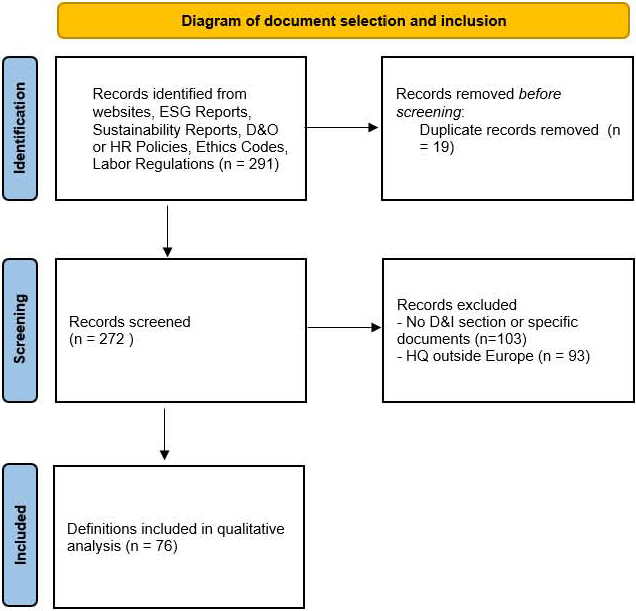
Figure 1.
Diagram of document selection and inclusion process
Source: own processing
The analysis includes 76 organisations from 27 European countries, grouped into six regions: Anglo-Saxon, Continental, Nordic, Southern, South-Eastern and Central and Eastern Europe. The number of organisations per region varied depending on the availability and quality of publicly available documents, with Continental and SouthEastern Europe being the most represented, and Southern and Central Eastern Europe having the fewest cases analysed. Such a distribution allowed for a comparison of institutional patterns of diversity in different socio-economic contexts.
Coding and analysis procedure
Content analysis was conducted to identify and quantify thematic patterns related to diversity and inclusion in organisational documents. The process was multi-phased and combined a qualitative approach of content coding with a quantitative representation of the frequency of occurrences.
In the first phase, all documents were reviewed to determine their relevance and structure, that is, whether they contain clear sections dedicated to diversity, inclusion, equal opportunities or social responsibility. Documents that met the inclusion criteria were then analysed in more detail, with a focus on the parts that explicitly define the priority groups of employees and how they are presented in the context of organisational policies.
In the second phase, a code frame was created based on previous research and theoretical models (Gardenswartz & Rowe, 2003; Mor Barak, 2015) but adapted to the specific goals of this work. The coding framework included eight thematic categories that appeared in organisational policies: 1. women, 2. people with disabilities, 3. LGBTQ+ community, 4. national and ethnic minorities, 5. intergenerational cooperation, 6. parents and caregivers, 7. older employees (50+), 8. socioeconomically disadvantaged groups.
For each of the categories, the presence or absence in the document was recorded (0 = not mentioned, 1 = mentioned), which allowed for the quantification and comparison of themes across sectors, regions and organisations of different sizes. Coding was carried out manually, with the consistent application of uniform criteria, to preserve the reliability and consistency of the analysis.
In the third phase, the results were statistically processed and visualised. Descriptive analysis was used to show the basic patterns of theme representation, while differences between regions were examined using one-way analysis of variance (ANOVA). For additional verification, Tukey HSD post-hoc tests and FDR p-value correction were applied to control for false positives in multiple comparisons.
By combining qualitative and quantitative approaches, a balance was achieved between understanding the meaning of the content and objective comparisons across organisations and regions. Such an approach allowed diversity patterns to be viewed simultaneously as a textual phenomenon and as a structural indicator of institutional maturity.
Analytical units and variables
The analytical basis of the research was individual organisational documents, which served as the main unit of analysis. Each document represented a representative example of the institutional approach to diversity and inclusion within a particular organisation. Three sets of variables were used in the analysis. The first set consists of thematic variables, which represent eight priority employee groups covered by organisational policies: women, people with disabilities, LGBTQ+ communities, national and ethnic minorities, intergenerational cooperation, parents and caregivers, older employees (50+), and socio-economically disadvantaged groups. Each of these categories was first coded binary (0 = not mentioned, 1 = mentioned) at the level of an individual document. These data were then aggregated by region and sector, where totals and average values of the representation of each group in each region were calculated. This enabled the quantification and comparison of institutional priorities across different European contexts. The second set consists of structural variables, which describe the characteristics of organisations: sector of activity and geographical region. These variables allowed for a comparison of diversity approaches across different institutional contexts.
Results
An analysis of organisational documents from European organisations revealed pronounced regional differences in the representation of employee groups recognised as priorities within diversity and inclusion (D&I) policies. At the level of the overall sample, three categories were consistently dominant: women, persons with disabilities, and the LGBTQ+ community, while parents and caregivers, older employees, and socioeconomically disadvantaged groups were, in most cases, marginalised or entirely absent from formal documentation. Regional mean scores (ranging from 0 to 8) represent the average number of diversity categories explicitly addressed in institutional policy documents within each European region (Table 1).
Table 1.
Regional differences in the representation of employee groups within D&I policies
| Region | Women | Disability | LGBTQ+ | Ethnic minorities | Intergenerat ional cooperation | Parents and caregivers | Socioeconomic groups | Older employees (50+) |
|---|---|---|---|---|---|---|---|---|
| Anglo-Saxon countries | 4.0 | 4.5 | 3.5 | 1.5 | 1.0 | 0.0 | 0.5 | 0.5 |
| Continental Europe | 2.6 | 2.4 | 2.9 | 1.7 | 0.7 | 0.3 | 0.0 | 0.0 |
| Nordic countries | 0.7 | 1.2 | 0.7 | 0.5 | 0.3 | 0.0 | 0.0 | 0.0 |
| Southern Europe | 1.0 | 0.7 | 1.0 | 0.7 | 0.3 | 0.3 | 0.3 | 0.3 |
| Southeastern Europe | 1.5 | 0.3 | 0.7 | 0.8 | 0.7 | 0.0 | 0.0 | 0.0 |
| Central-Eastern Europe | 1.0 | 0.0 | 1.0 | 0.5 | 0.0 | 1.0 | 0.0 | 0.0 |
The most developed framework for managing diversity is found in Anglo-Saxon countries, characterised by a balanced representation of gender, identity, and ethnic dimensions. Particularly high scores are observed in the areas of gender equality, disability inclusion, and support for the LGBTQ+ community. These results indicate a mature stage of institutionalisation of diversity, grounded in strong regulatory standards, certification systems, and a well-established culture of public reporting.
Continental Europe occupies a middle position. The focus is primarily on gender equality, disability, and sexual orientation, while intergenerational and social issues are less represented. This pattern reflects institutional stability but also a somewhat limited approach, where inclusion is often viewed through the lens of formal legal compliance rather than as part of a broader organisational culture.
In the Nordic countries, despite high levels of social equality, the formalisation of diversity policies is relatively low. This does not indicate a lack of inclusiveness; on the contrary, diversity in these societies is largely taken for granted. Including their functions more as a social norm than as an administrative obligation, which explains the lower levels of formal representation in institutional documents.
Southern Europe demonstrates a lower but more varied level of institutionalisation. Italy and Spain place particular emphasis on gender equality and disability, while Portugal is the only country to systematically include socio-economic aspects and older employees. Such patterns suggest fragmented and often reactive approaches, developed primarily under the influence of regulatory requirements or public initiatives.
At the bottom of the scale are Southeastern and Central-Eastern Europe, where diversity policies are often declarative and substantively limited. Croatia and Poland somewhat stand out with a stronger focus on gender and family-related topics, but in most countries of these regions, the institutional development of inclusive policies remains in its early stages.
Comparative analysis of regional differences in inclusion dimensions
To examine whether institutional priorities differ among European regions in relation to specific dimensions of inclusion, a one-way analysis of variance (ANOVA) was conducted (Table 2). The analysis was performed separately for each of the eight observed employee groups: women, persons with disabilities, the LGBTQ+ community, ethnic minorities, intergenerational cooperation, parents and caregivers, socio-economically disadvantaged groups, and older employees.
Table 2.
One-way ANOVA results by priority employee groups
| Indicator | F-statistic | p-value | η2 |
|---|---|---|---|
| Women | 1.458 | 0.247 | 0.26 |
| Persons with disabilities | 5.412 | 0.003 | 0.56 |
| LGBTQ+ community | 2.766 | 0.047 | 0.40 |
| Ethnic minorities | 0.634 | 0.676 | 0.13 |
| Intergenerational cooperation | 0.461 | 0.801 | 0.10 |
| Parents and caregivers | 1.898 | 0.140 | 0.31 |
| Socio-economically disadvantaged | 2.330 | 0.080 | 0.36 |
| Older employees (50+) | 2.330 | 0.080 | 0.36 |
The results indicated that regional differences were statistically significant for two groups: persons with disabilities (F = 5.41, p = 0.003) and the LGBTQ+ community (F = 2.77, p = 0.047). After applying the correction for multiple testing (FDR), significance remained for the category of persons with disabilities (pFDR = 0.024), while differences for the LGBTQ+ group were no longer significant (pFDR = 0.188).
To further determine between which regions these differences occurred, Tukey HSD post – hoc tests were conducted (Table 3). The results showed that Anglo-Saxon countries were statistically significantly more developed in the inclusion of persons with disabilities compared to Southeastern (p = 0.005), Southern (p = 0.024), Nordic (p = 0.030), and Central-Eastern Europe (p = 0.014).
Table 3.
Summary of post-hoc comparisons for the indicator persons with disabilities
| Region 1 | Region 2 | MD | Tukey HSD |
|---|---|---|---|
| Anglo-Saxon countries | Southeastern Europe | 4.17 | 0.005 |
| Anglo-Saxon countries | Southern Europe | 3.83 | 0.024 |
| Anglo-Saxon countries | Nordic countries | 3.33 | 0.030 |
| Anglo-Saxon countries | Central-Eastern Europe | 4.50 | 0.014 |
| Anglo-Saxon countries | Continental Europe | 2.07 | 0.306 |
These findings confirm that the institutional inclusion of persons with disabilities within D&I policies varies significantly across European regions. Western countries demonstrate a higher degree of maturity in implementing inclusion practices, while Eastern and Southeastern regions still lag behind in developing systematic approaches. Although the differences for the LGBTQ+ community did not retain statistical significance after correction, the effect size (η2 = 0.40) suggests practically relevant differences that might be confirmed with a larger sample.
Overall, the results indicate that diversity in European organisations is institutionally developing mainly along gender and identity dimensions, while social, intergenerational, and economic aspects remain marginalised. This highlights the need to expand the framework of D&I policies to include groups whose forms of exclusion are less formally recognised but equally important for fostering an inclusive organisational culture.
Discussion
This research aimed to examine how European organisations define diversity and inclusion (D&I) priorities in their official documents and to what extent these priorities differ by region. The results showed pronounced regional differences in institutional approaches, whereby women, persons with disabilities and the LGBTQ+ community are consistently recognised as the most important priority groups, while parents, older employees and socioeconomically disadvantaged groups are most often marginalised. These patterns mirror broader European public opinion trends, where support for D&I varies significantly across countries depending on inequality levels, perceived discrimination and existing anti-discrimination frameworks (Blommaert & Coenders, 2024). These findings confirm the thesis of Köllen (2021) that European D&I policies are still primarily based on a regulatory approach and formal fulfilment of legal obligations, and less on a deep transformative understanding of diversity as a resource. According to Wrench (2007), the institutionalisation of diversity in Europe often stems from the policy of equal opportunities and anti-discrimination directives of the EU (EU, 2000/43/EC; 2000/78/EC), which results in a normative and not necessarily a cultural approach. In other words, European organisations most often view D&I as an administrative obligation and reputational standard within the ESG framework, rather than as a strategic tool for innovation and resilience. This tendency is also reflected in recent meta-reviews showing that organisations adopting compliance-driven approaches achieve limited cultural change compared to those that implement integrated and sustained D&I systems (Zhao et al., 2025).
Regional differences further point to the existence of different institutional traditions. Anglo-Saxon countries record the most developed practices and a balanced approach to multiple identity dimensions. This is in line with Bay and Walwem (2025), who point out that the long-standing presence of regulations and public campaigns in these countries creates a culture of corporate responsibility towards diversity. In contrast, South-Eastern and Central Eastern Europe show a low level of formalisation of D&I policies, which can be interpreted as a combination of weaker regulatory pressures and limited institutional capacities. In this sense, the differences are not only cultural, but also structural – they reflect historical inequalities in access to resources, the labour market and political stability. Studies of structural racism in European societies further support this interpretation, demonstrating how unequal institutional capacities, socioeconomic disparities and racialised labour market dynamics continue to shape inclusion outcomes across regions (Groglopo et al., 2023). A particularly interesting finding is related to the Nordic countries. Although these countries are often cited as examples of social equality, their institutional documents show a low formal presence of D&I policies. Such a result can be explained by the fact that inclusion in Nordic societies is already deeply internalised as a social norm (Saeys et al., 2019), so formal policies are simply not needed to the same extent. This contradiction raises the question of whether diversity should be measured according to institutional formalisation or according to actual social practice, a dilemma highlighted by both Mor Barak (2015) and Nishii (2013) in their conceptual analysis of inclusion.
The distinction between formal policy presence and lived inclusion is also emphasised in cross-sector studies showing that inclusive climates emerge more from leadership behaviours, everyday practices and employee interactions than from the existence of written policies (Koç et al., 2025). By comparing the results with the theoretical framework, the Model of Four Layers of Diversity (Gardenswartz & Rowe, 2003), it is evident that most organisations focus exclusively on internal dimensions of identity: gender, disability and sexual orientation. External and organisational dimensions (such as education, class, hierarchical status or location) are significantly less represented, suggesting that diversity in institutional documents is still understood in terms of individual characteristics rather than as a structural issue of power and access. In this way, Gardenswartz and Rowe’s (2003) model allows for a deeper understanding of the limitations of current practices; they are inclusive towards the individual, but rarely towards the system.
The results of the ANOVA analysis further confirm that the differences between regions are not accidental but reflect different degrees of institutional maturity. The statistically significant difference in the representation of people with disabilities shows that in Western European countries, inclusion is more understood as part of a wider system of social responsibility, while in Eastern European regions, it is still reduced to symbolic gestures. This is in line with the observation of Eagly and Carli (2007) that organisational barriers are often reproduced even within declaratively equal systems. Sector-based evidence also indicates that genuine inclusion emerges only when organisations implement structural adjustments, such as accessible environments, revised career systems and equitable evaluation mechanisms rather than symbolic measures alone (Koç et al., 2025).
From a theoretical perspective, the research confirms that the Four Layers of Diversity Model can serve as a useful tool for assessing the institutional depth of D&I policies. These findings extend existing theoretical debates by demonstrating that the Four Layers of Diversity Model remains analytically relevant but requires revision to adequately reflect how organisations operationalise diversity in practice. The results show that European organisations predominantly activate only the internal layer of the model (gender, disability, sexual orientation), while external (education, socioeconomic background, family status) and organisational dimensions (hierarchical status, job role, access to decision-making) remain largely unaddressed in formal policies. This empirical pattern suggests that the current model underestimates the influence of institutional environments, regulatory pressures and resource asymmetries on which layers of diversity are recognised or ignored. Accordingly, the study contributes to theory by arguing that diversity models must explicitly account for institutional context, power relations and organisational structures if they are to explain how inclusion is constructed in real organisational settings.
The findings also indicate that D&I policies should be conceptualised not only as identity – focused interventions, but as mechanisms embedded in broader management systems that shape knowledge flows, decision-making authority and access to organisational opportunities. This confirms the need for a broader, intersectional approach that includes not only identity-based, but also socioeconomic and structural aspects (Nishii, 2013; Topalović, 2024). From a broader theoretical perspective, the observed regional differences reflect how D&I policies intersect with management dynamics and the distribution of organisational power. Organisations that restrict their priorities to internal identity dimensions risk reinforcing a narrow, compliance-driven understanding of inclusion. In contrast, integrating external and organisational layers, such as socioeconomic background, hierarchical access or geographic disparities, would enable a more systemic approach aligned with contemporary knowledge-based environments, where innovation, learning and human capital mobility are key drivers of competitiveness.
From a practical perspective, the findings indicate that organisations that want to develop truly inclusive policies need to move from declarative to integrative approaches. This includes systematically monitoring the impact of D&I policies, including marginalised groups in the decision-making process, and changing organisational structures that perpetuate inequalities. In addition, the results can help policymakers formulate new guidelines that would encourage a more comprehensive approach to diversity, one that also includes social, generational, and economic dimensions. This is consistent with evidence showing that inclusive cultures flourish when employees perceive fairness, belonging and active participation (Koç et al., 2025). Practically, this implies that organisations should establish clear D&I performance indicators and link leadership accountability to inclusion outcomes, ensuring that D&I principles are embedded into recruitment, promotion and evaluation systems. This research gap mirrors broader findings across European labour markets, where misalignments between formal D&I commitments and lived employee experiences remain a persistent challenge (Blommaert & Coenders, 2024).
Despite methodological limitations, this research contributes to the understanding of institutional patterns of diversity in Europe and opens up space for further research. Given the limitation of relying only on publicly available documents, future studies should incorporate internal policies and interviews to capture implementation more accurately. To address the limitations of content quantification, future research should explore the qualitative depth and actual outcomes of D&I initiatives. Finally, due to uneven document availability across countries, comparative studies with more balanced or sector-specific samples are recommended. Future work could include qualitative case studies and longitudinal analyses to track how institutional practices evolve over time and how they influence employees’ real experiences of inclusion.
Conclusions
The research conducted in this paper provides a comprehensive insight into institutional patterns of diversity and inclusion (D&I) in European organisations, with a particular focus on differences across regions and sectors. The results show that European organisations largely approach D&I policies through a regulatory and formal framework, with gender equality, disability and LGBTQ+ issues being the most recognised dimensions of inclusion. Such an approach, while important for compliance with legislation and ESG standards, often remains limited to a declarative level and does not encompass broader structural and organisational aspects of diversity.
Regional differences further confirm that the institutional development of D&I practices is not uniform. Anglo-Saxon countries have shown the most mature approaches, with clearly defined strategies and measurable objectives, while the Middle East and Southeast regions are still in the initial phase of institutionalisation, where diversity is often viewed as a formal obligation rather than a value. Nordic countries, on the other hand, stand out for their social equality and implicit inclusion, which reduces the need for formal policies but makes their comparative analysis difficult. From a theoretical perspective, the application of the Four Layers of Diversity Model (Gardenswartz & Rowe, 2003) has proven to be extremely useful as it enables a multidimensional understanding of identity within organisations. The analysis revealed that most organisations recognise only the internal dimensions of diversity, while the external and organisational dimensions, related to power, status and access to resources, are still underrepresented. This points to the need for an intersectional approach that views diversity as a systemic rather than an individual category.
The practical contribution of the work is reflected in the identification of areas in which European organisations can improve their D&I policies. To achieve a truly inclusive organisational culture, it is necessary to move from a formal to an integrative approach, which includes systematic monitoring of the effects of policies, the inclusion of different groups in decision-making processes, and the transformation of organisational structures that maintain inequalities. In conclusion, diversity and inclusion in the European context cannot be reduced only to regulatory harmonisation or symbolic gestures. They require a bigger institutional and cultural change that will enable the real involvement of all employees and recognise diversity as a source of innovation, resilience and sustainable development. Future research should focus on longitudinally monitoring the development of D&I policies, as well as analysing their implementation in practice, to understand the extent to which formal policies are reflected in the actual experience of employees.
Like any empirical research, this one has certain methodological limitations that are important to consider when interpreting the results. The first and most significant limitation is that the analysis only included publicly available documents, which means that internal policies, unpublished strategies, or reports that could shed additional light on how diversity is implemented in practice were not included. Namely, organisations are not required to publicly publish organisational documents, and this limitation could generally have influenced an unrealistic representation. In some cases, the content of the documents was very general or communication-oriented, which may limit a deeper understanding of the actual implementation of inclusive measures. Second, since the analysis is based on content quantification, the results show the frequency of mentions, but not necessarily the qualitative depth or degree of implementation of individual topics. In other words, the fact that a certain group is frequently mentioned in documents does not necessarily mean that it is included in organisational practices. Taking the above into account, additional analysis could include annual reports (e.g. Annual reports, ESF reports, HR dashboards, etc.) or communication materials such as social media posts, etc. This additional analysis could monitor the implementation of certain activities. Third, although the sample covered a wide range of sectors and European regions, the number of documents analysed differed between countries, which may affect the stability of the estimates in some comparisons. The difference occurred due to the inability to find enough organisational documents from individual countries or sectors. Despite the limitations, the research offers valuable and representative insight into institutional patterns of diversity and inclusion in Europe. The applied methodology enabled the systematic identification of key priorities and gaps in organisational policies and laid the foundation for further research that could examine the implementation dimension of inclusive strategies in more detail.