
Table 1
Meloidogyne hapla egg incubation temperature and duration
| Stage | Incubation duration (h) | Temperature | Number of repetitions | |||||
|---|---|---|---|---|---|---|---|---|
| aStress temperatures | aNon-stress temperatures | |||||||
| 10 eggs | 1 (control) | 5°C | 35°C | 40°C | 10°C | 20°C (control) | 30°C | 3 |
| 2 | ||||||||
| 8 | ||||||||
| 24 | ||||||||
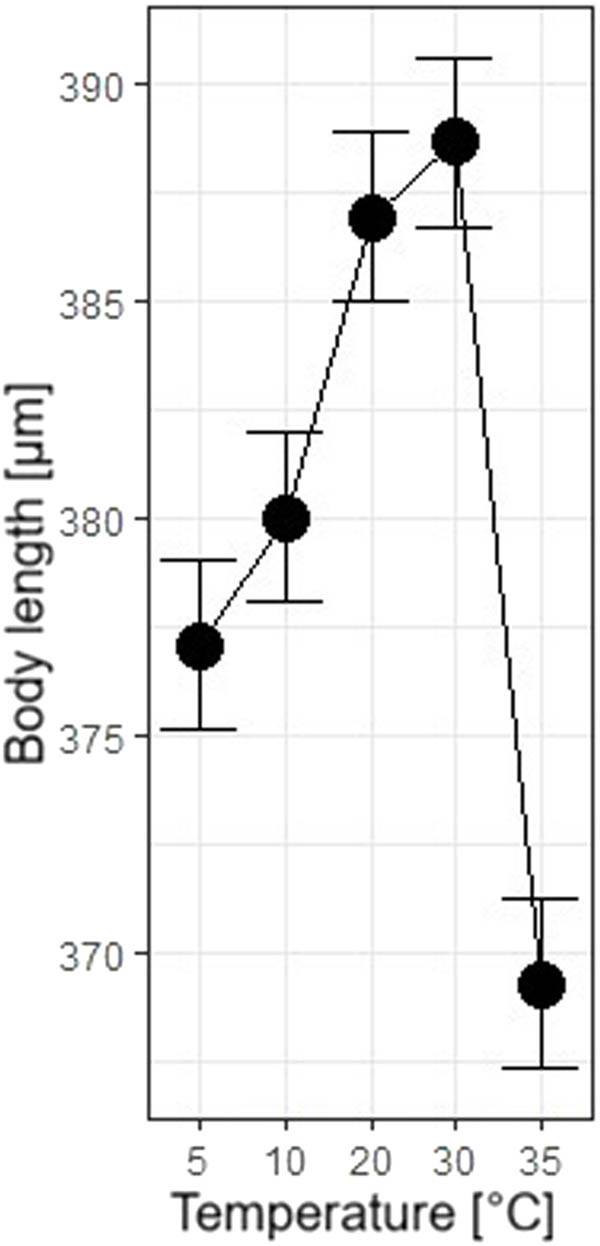
Figure 1
Association between Meloidogyne hapla J2 body length and temperature. Control = temperature 20°C. Averaged effects (marginal means) estimated for the best model indicated in the model selection are presented (Table 2, model 1). The dot indicates the value of the estimate, the whiskers indicate the 95% confidence interval of this estimate.
Table 2
Selection of GLM models explaining differences in body length of J2 Meloidogyne hapla in relation to egg incubation temperature/duration
| No. | Model (predictors) | LL | AICc | Δ AICc | df | weight |
|---|---|---|---|---|---|---|
| 1 | Body length ∼ temperature | −2283.2 | 4578.6 | 0.0 | 6 | 0.88 |
| 2 | Body length ∼ temperature + incubation duration | −282.2 | 4582.6 | 4.0 | 9 | 0.12 |
| 3 | Body length ∼ temperature + incubation duration + temperature: incubation duration | −278.6 | 4600.8 | 22.2 | 21 | <0.001 |
| 4 | Body length ∼ incubation duration | −386.6 | 4783.2 | 204.6 | 5 | <0.001 |
For each model, the variables used as predictors, are given: the logarithm of the maximum likelihood (LL), the value of the AICc, the difference in the AICc values of the given model and the model with the minimum AICc in the analyzed set of models (Δ AICc), the number of degrees of freedom (df), and the Akaike weight of the given model (weight).
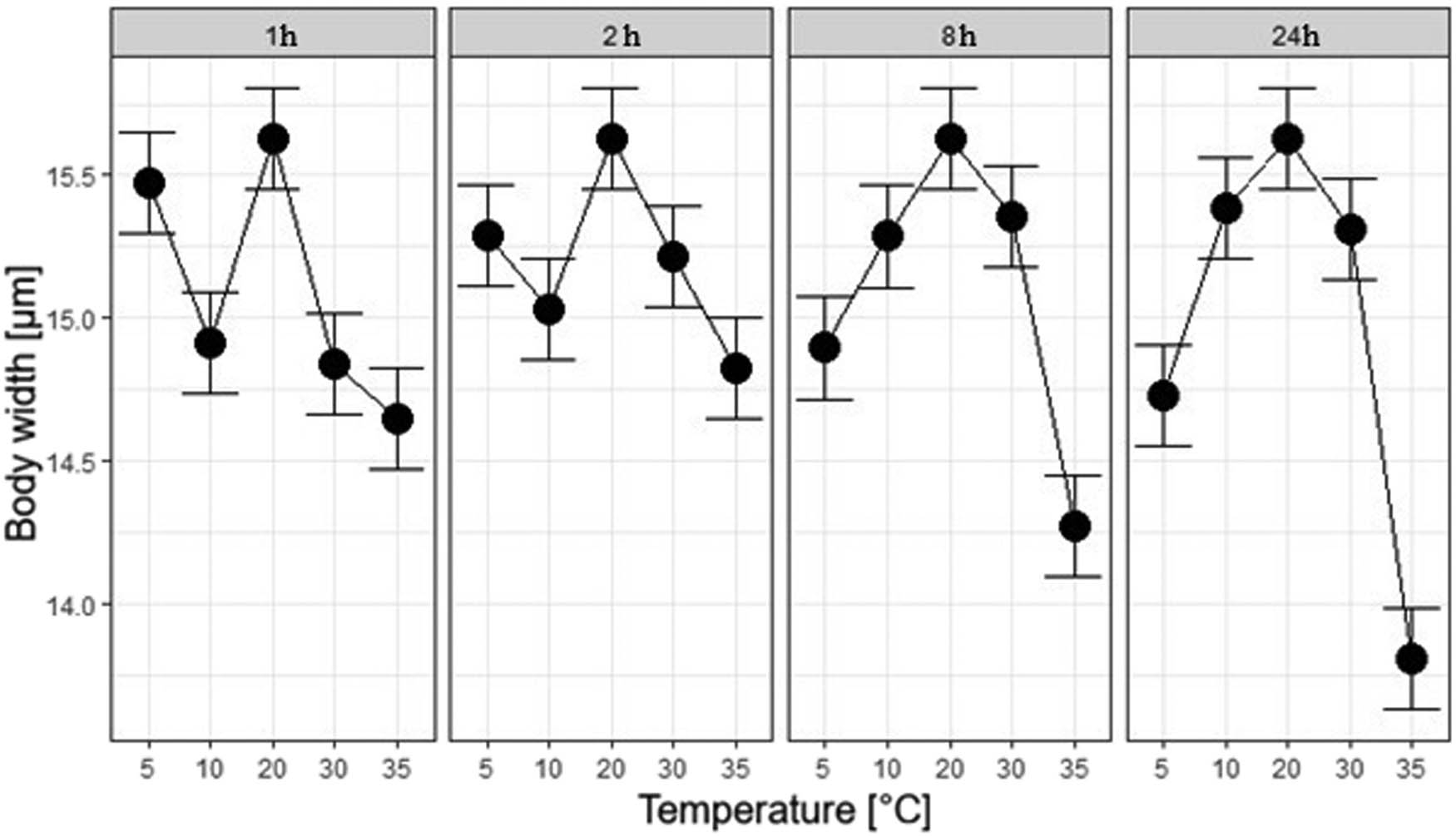
Figure 2
Association between body width of Meloidogyne hapla J2 and egg incubation temperature and duration (h – hour, individual panels). Control = temperature 20°C. Averaged effects (marginal means) estimated for the best model indicated in the GLM model selection are presented (Table 3, model 1). The dot indicates the value of the estimate, the whiskers indicate the 95% confidence interval of this estimate.
Table 3
Selection of GLM models explaining differences in body width of J2 Meloidogyne hapla in relation to egg incubation temperature/duration
| No. | Model (predictors) | LL | AICc | Δ AICc | df | weight |
|---|---|---|---|---|---|---|
| 1 | Body width ∼ temperature + incubation duration + temperature: incubation duration | −417.1 | 877.8 | 0.0 | 21 | 1 |
| 2 | Body width ∼ temperature + incubation duration | −82.2 | 982.8 | 104.9 | 9 | <0.001 |
| 3 | Body width ∼ temperature | −488.7 | 989.4 | 111.6 | 6 | <0.001 |
| 4 | Body width ∼ incubation duration | −612.1 | 1234.3 | 356.5 | 5 | <0.001 |
For each model, the variables used as predictors, are given: the logarithm of the maximum likelihood (LL), the value of AICc, the difference in the AICc values of the given model and the model with the minimum AICc in the analyzed set of models (Δ AICc), the number of degrees of freedom (df), and the Akaike weight of the given model (weight).
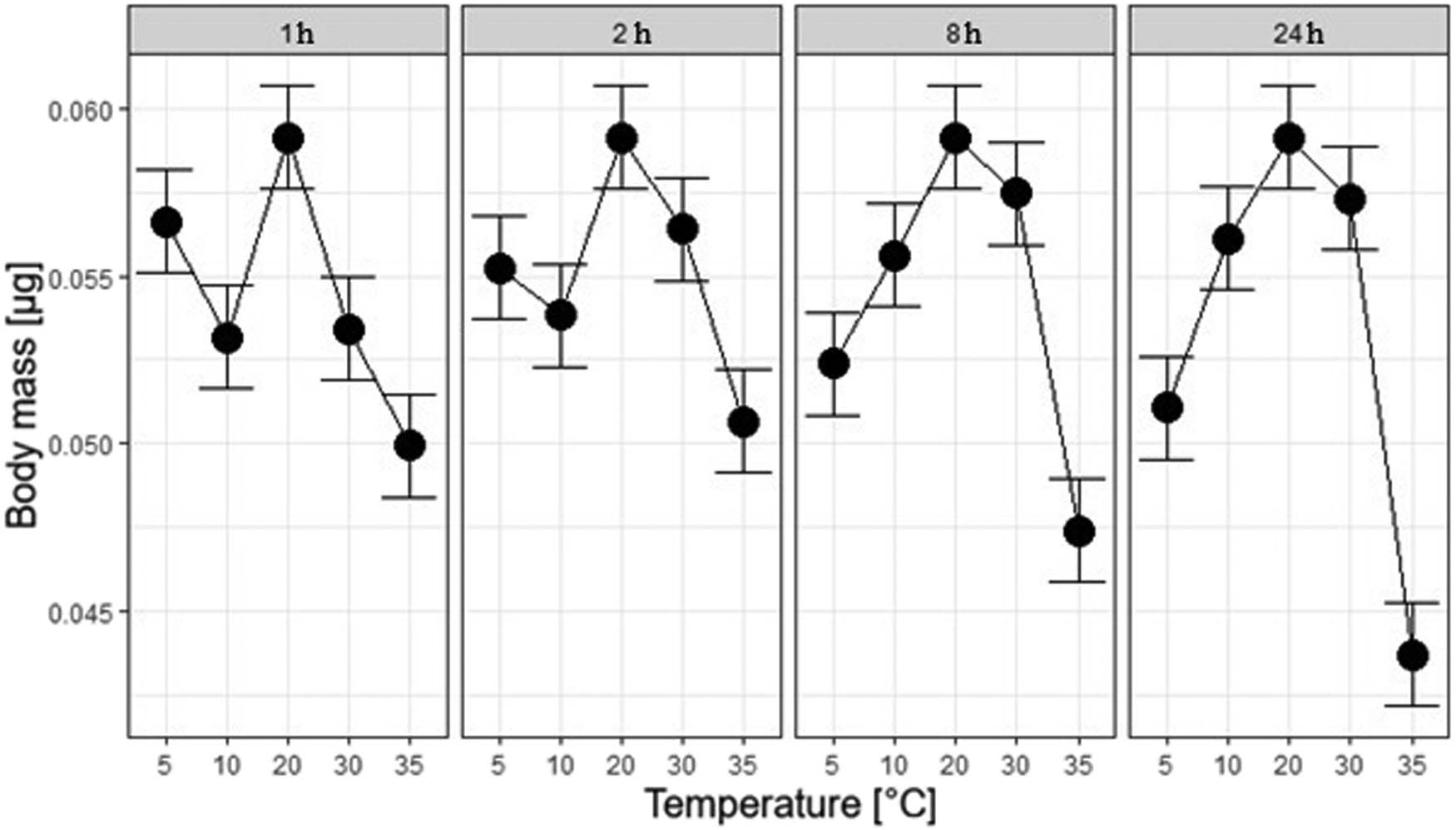
Figure 3
Association between body mass of Meloidogyne hapla J2 and egg incubation temperature/time (h – hour, individual panels). Control = temperature of 20°C. Average effects (marginal means) estimated for the best model indicated by the GLM model selection are shown (Table 4, model 1). The dot denotes the value of the estimate, the whiskers denote the 95% confidence interval of that estimate.
Table 4
Selection of GLM models explaining differences in body mass of J2 Meloidogyne hapla in relation to egg incubation temperature/duration
| No. | Model (predictors) | LL | AICc | Δ AICc | df | weight |
|---|---|---|---|---|---|---|
| 1 | Body mass ∼ temperature + incubation duration + temperature: incubation duration | 2430.0 | −4816.3 | 0.0 | 21 | 1 |
| 2 | Body mass ∼ temperature + incubation duration | 2383.7 | −4749.1 | 67.2 | 9 | <0.001 |
| 3 | Body mass ∼ temperature | 2379.1 | −4746.0 | 70.3 | 6 | <0.001 |
| 4 | Body mass ∼ incubation duration | 2232.8 | −4455.5 | 360.8 | 5 | <0.001 |
For each model, the variables used as predictors are given: the logarithm of the maximum likelihood (LL), the value of AICc, the difference in the AICc values of the given model and the model with the minimum AICc in the analyzed set of models (Δ AICc), the number of degrees of freedom (df), and the Akaike weight of the given model (weight).